Venezuela: The Next Move and the Final Word
By Maximilian C. Forte | Zero Anthropology | February 17, 2019
Almost a month after Donald Trump recognized Juán Guaidó as the “interim president” of Venezuela, and the imperial media started to label Nicolás Maduro as the “disputed” president of Venezuela (as if that were a universally accepted statement of fact), nothing has happened to unseat Maduro. The intended coup does not appear to be advancing. Meanwhile the US continues its sanctions, only now they are sanctioning a country they claim is led by someone who is not Maduro. If one mistook rhetoric for reality, US foreign policy would appear to have been conceived in some sort of Twilight Zone. Back in the real world, the US tacitly recognizes that Maduro is in fact the head of government and state in Venezuela, and both the threats of US military intervention and the sanctions themselves prove that point.
Far from a wave of popular condemnation of the Maduro government, Venezuela instead experiences something of a “slow coup,” mostly based on support from foreign right-wing governments. Following ZA’s sketch of the models used for this intended coup, ranging from Ukraine to Libya and Syria, others warned that we should look out for the “7 rules of regime change” that typically constitute the US’ campaigns of foreign destabilization. Libya was actually an appropriate analogy in some key regards, one of them being that the US was actively inciting chaos by trying to create a situation where more than one government claimed legitimacy. As for Ukraine, it was the Ukrainian Foreign Minister himself who drew the analogy between the Maidan protests and events in Venezuela. Also indicative of this approach is the fact that Trump hired the infamous Elliot Abrams (an ardent “Never Trumper” but an even bigger opportunist), one of the original neocons who played a role not just in the 2002 coup attempt against Hugo Chávez in Venezuela—and has now been called back for an encore—but was also tied to the covert war against Nicaragua, lying to Congress, and providing cover for the notorious death squads in El Salvador during the 1980s. In the US Congress, Democrats in charge of the House Foreign Affairs Committee put together a “team” to deal with Venezuela, including one Debbie Wasserman Schultz, who was guilty of rigging electoral processes within the DNC to the disadvantage of Bernie Sanders in 2016—worthy coup experience. (Yet, on that same committee there have been some outstanding exceptions, namely Ilhan Omar.)
Venezuela and the Problem for Trump’s White House

Nicolás Maduro, President of Venezuela
However the problem is that the “slow coup” approach seems to be increasing frustration in the ranks of both the Venezuelan opposition and the White House. How much longer can the US government tolerate its commands being ignored and “defied”? The longer this goes on, the greater the chance that Trump will lose face, at a delicate political time of upcoming US presidential elections and when he has lost so much face already. This is a person who has long boasted that his administration would always be “winning,” winning so much that his supporters would tire of all the winning. What has Trump won with Venezuela? If Trump just lets things continue, Venezuela could learn to survive sanctions the way several other states have also learned to survive them. Venezuela still has some powerful friends: China, India, and Russia chief among them. Venezuela is not under a UN-approved international sanctions regime, the kind imposed on Iraq, North Korea, and Iran. Venezuela still has room for manoeuvre, and even an IOU can carry a lot of weight if it’s based on possession of the world’s largest proven oil reserves. In addition, Venezuela’s armed forces declared their loyalty to President Maduro. The opposition made feeble, legalistic efforts to win over the military’s support (basically promising only to not “prosecute” the military for supporting the legitimate government), but this failed from the outset. Meanwhile the military held prominent exercises under the direction of Maduro’s government. The military continued to hold extensive exercises from February the 10th to the 15th, in practice for a counter-invasion. At this rate, Trump could enter the 2020 electoral campaign with Maduro still in power in Venezuela, and Trump’s opponents lampooning him as a failure: all sound and fury and nothing more than promises made of hot air.
The other option of course, the one that Trump frequently repeats is always “on the table,” is US military intervention in Venezuela. This would then be Trump’s first new war added to the list of the US’ current wars. There now appears to be a straight line of seamless continuity running from George W. Bush to Barack Obama and now Donald Trump, especially where regime change in Venezuela is concerned. Trump, who sometimes feigns awful annoyance at the “Obama legacy,” which he pretends to want to destroy, is only too keen to shore it up in Venezuela. The one “national emergency” about which no one is threatening to sue the White House, a “national emergency” decreed by Obama and still in force, is the one that classes Venezuela as an “unusual and extraordinary threat to the national security and foreign policy of the United States”. On his way out the door, Obama renewed and extended that same “national emergency”—and Trump loyally picked up the baton. Yet Venezuela has never threatened the US, and the US Congress has not authorized any military action in Venezuela. Will Trump be reticent about usurping authority by continuing to expand the executive power of the imperial presidency? If he does, another charge will then stick during the 2020 campaign: that he is authoritarian. Not just authoritarian, but one also responsible for starting a new, unpopular and costly war, an illegal war. Far from ending the US’ “foreign entanglements” and “nation building” crusades, Trump will have added to them. This would then become the final word on the Trump presidency.
Trailing a long line of failures and broken promises, Trump would be entering the 2020 presidential campaign (if his administration can survive that long), with a brand new war to place on the shoulders of Americans. Tired of all the “winning” yet?
Trump has engineered quite the situation for himself. If he does nothing more, and Maduro survives, Trump loses face. More than that, he has already lost Venezuelan oil for a whole range of US-based oil refineries and transnational shipping firms, not to mention countless billions bypassing the US financial system, and there is already talk of tapping the national oil reserve. It would be a situation where Trump ends up with less than if he had said nothing at all about the Maduro presidency—an indisputable defeat. On the other hand, if Trump chooses the military option, besides the US facing eventual defeat like it has done regularly since Vietnam, the political backlash at home would be devastating. So which is the way out for Trump?
Trump’s Next Move
There are two significant clues that suggest Trump will choose to go to war with Venezuela. One is a foreign clue, and the other is domestic. The first clue is that February 23 is likely to be the turning point. The US and its Venezuelan force multipliers are constructing a situation that could be used to provoke armed intervention by the US: an innocent humanitarian aid convoy, embraced by democracy-loving innocent civilians in Venezuela, fired upon mercilessly by the forces of the “brutal dictatorship”. Not only is the US ready to sacrifice Venezuelan lives, it is likely ready to sacrifice the lives of the US AID personnel currently in Cucuta, Colombia (poor saps, they had better get their life insurance policies in order). It has to be the kind of event that makes most Americans gasp in shock, and demand immediate justice. I don’t know if this can work, or will happen, especially because the Venezuelan government has so far excelled at playing it cool, and outsmarting the opposition.
The second clue, domestic in focus, is that Trump has recently decided to declare a war on socialism at home, with the aid of Fox News, Breitbart, and various alternative right-wing media. The only way for Trump to sell his war in Venezuela is by simultaneously linking it to a war at home. That way Trump can parade himself among diminished groups of supporters and pretend that his policy in Venezuela is what they want, and what they need: a world free of socialism.
The image of “Venezuela” is thus being instrumentalized for use against “domestic enemies,” suggestively linking the two, and the evidence for that comes directly from Trump himself. In his “State of the Union” speech of February 5, 2019, Trump stated the following about Venezuela just before turning back to the US:
“Two weeks ago, the United States officially recognized the legitimate government of Venezuela—(applause)—and its new President, Juan Guaidó. (Applause.) We stand with the Venezuelan people in their noble quest for freedom, and we condemn the brutality of the Maduro regime, whose socialist policies have turned that nation from being the wealthiest in South America into a state of abject poverty and despair. (Applause.)
Here in the United States, we are alarmed by the new calls to adopt socialism in our country….”
When one heard the speech, the flow from Venezuela to socialism in the US was both smooth and rapid—it was unmistakable that the suggestive link between the two was deliberately planned. To further applause, including from some Democrats, Trump added: “Tonight, we renew our resolve that America will never be a socialist country”. What they did not hear, and they should have if they truly listened, was Trump’s declaration of war on Venezuela.
Venezuela: The Final Word on Trump
In reviewing Trump’s foreign policy positions over the past three decades, there was one vital piece of evidence that I either overlooked or whose significance I simply did not realize (and since I have not seen the analysis that follows anywhere else, it seems everyone missed this too). While Trump may sound like he is against “endless wars,” “foreign entanglements,” “nation building” and the overthrow of foreign regimes that involves the US in affairs that do not concern it, and while he preaches respect for “sovereignty” and vows not to impose “American values” on other nations—all seemingly exceptional positions for an American president, enough to get him branded an “isolationist”—all of this is conditional on one key factor: distance/proximity.
If a potential target nation is “far away”—for example, Afghanistan and Syria—then it is wrong for the US to get involved. However, if the nation is “close” to the US—i.e., all the nations of the Western Hemisphere—then it is right for the US to intervene because in areas close to home, the US has a “special responsibility”. It’s a claim to ownership, and it’s a return to the classic neocolonial geopolitics of the Monroe Doctrine (and Trump formally cited Monroe in his 2018 address to the UN General Assembly).
The evidence for this notion of a “special responsibility” tied to proximity, comes from Trump himself. While at a golf course in August of 2017, Trump told reporters:
“We have many options for Venezuela, this is our neighbor. We’re all over the world and we have troops all over the world in places that are very, very far away. Venezuela is not very far away and the people are suffering and dying. We have many options for Venezuela including a possible military option if necessary”.
Vice President Mike Pence reiterated this explanation to Fox News, answering a question about why Trump is withdrawing troops from Syria and Afghanistan while intervening in Venezuela:
“President Trump has always had a very different view of our hemisphere… He’s long understood that the United States has a special responsibility to support and nurture democracy and freedom in this hemisphere and that’s a longstanding tradition”.
Not speaking out of turn (for a change), national security adviser John Bolton offered further confirmation: “The fact is Venezuela is in our hemisphere. I think we have a special responsibility here, and I think the president feels very strongly about it”.
Trump views Latin America as the US’ “backyard,” sovereignty thus does not apply to the Western Hemisphere’s states. But if Trump does not respect the sovereignty of Latin Americans, then why should they in turn respect the sovereign borders of the US? If sovereignty does not apply in relations between states in the Americas, then Latin Americans should dismiss US sovereignty, and freely pour across the US’ southern border. Where there is no equality and reciprocity, then invasion and counter-invasion will have to do.
If distance/proximity is one factor limiting, even reversing the scope of Trump’s putative anti-interventionism, civilization is another. On a trip to Poland in July of 2017, Trump delivered a controversial speech that many justifiably understood to be a classic defence of “White, Western, Christian civilization”:
“…. we will never forget who we are…. Americans will never forget. The nations of Europe will never forget. We are the fastest and the greatest community. There is nothing like our community of nations. The world has never known anything like our community of nations. We write symphonies. We pursue innovation. We celebrate our ancient heroes, embrace our timeless traditions and customs, and always seek to explore and discover brand-new frontiers. We reward brilliance. We strive for excellence, and cherish inspiring works of art that honor God. We treasure the rule of law and protect the right to free speech and free expression…. That is who we are. Those are the priceless ties that bind us together as nations, as allies, and as a civilization”.
Reflecting on this, I argued elsewhere that “Trump respects sovereignty only for those who are qualified to possess it : White Western Christian nations, in loose terms”. I noted that Trump evidenced the most respect for nations that are linked to the US through cultural parentage—“but where cultural affinity is lacking, Trump chooses the American materialist’s preferred substitute for culture: money, and lots of it”. Trump thus has respect for European nations plus Israel (i.e., Euro-America in the Middle East), but also China, Japan, and Saudi Arabia—that is the map of Trump’s world of sovereign states. The rest of the world is inhabited by what he freely calls “animals,” and “monsters,” shit-hole nations usually ruled by “brutal dictators”—this is the wild neocolonial frontier: it is the world beyond the pale, and beyond the pallid.
It is outside of the domain of Trump logic where we find Trump’s supposed anti-interventionist stance on Syria and Afghanistan directly collides with his actions against Venezuela and Iran, a fact noted by many others besides myself. (Except Iran does not fit within Trump’s logic as described above, which shows that it’s not much of a logic at all.) In the world of the critically rational, where people struggle to understand reality and not deny it, where contradictions need to be explained even if they cannot be reconciled, then this is how Venezuela will be the final word on Trump, especially if a war happens—read each sentence on the left, and then interject the word on the right as a corrective:
| Donald Trump’s Explicit Position (Myth) | The Final Word (Reality) |
| “We will seek friendship and goodwill with the nations of the world”… | Venezuela |
| “We do not seek to impose our way of life on anyone”… | Venezuela |
| “each nation of the world must decide for itself what kind of future it wants to build for its people”… | Venezuela |
| “America will always choose independence and cooperation over global governance, control, and domination”… | Venezuela |
| “I honor the right of every nation in this room to pursue its own customs, beliefs, and traditions. The United States will not tell you how to live or work or worship”… | Venezuela |
| “Around the world, responsible nations must defend against threats to sovereignty not just from global governance, but also from other, new forms of coercion and domination”… | Venezuela |
| “Here in the Western Hemisphere, we are committed to maintaining our independence from the encroachment of expansionist foreign powers”… | Venezuela |
| “Sovereign and independent nations are the only vehicle where freedom has ever survived, democracy has ever endured, or peace has ever prospered. And so we must protect our sovereignty and our cherished independence above all”… | Venezuela |
| “Strong, sovereign nations let diverse countries with different values, different cultures, and different dreams not just coexist, but work side by side on the basis of mutual respect”… | Venezuela |
| “…you, as the leaders of your countries will always, and should always, put your countries first”… | Venezuela |
| “The United States of America has been among…the greatest defenders of sovereignty”… | Venezuela |
| “We are going to have to stop being the policemen of the world”… | Venezuela |
| “the United States cannot continue to be the policeman of the world. We don’t want to do that”… | Venezuela |
| “it is now time to bring our troops back home. Stop the ENDLESS WARS!”… | Venezuela |
Before being elected president, Trump spoke specifically about Venezuela and Hugo Chávez in brief comments to the Miami Herald, saying: “Their leaders are not very friendly to our leaders. But, of course, our leaders don’t get along with too many people….” On Chávez he said, “He had some feelings, some very strong feelings, and he did represent a lot of people, and he represented a lot of people that had been left behind”. However, even then, Trump made comments that suggested he wanted to become involved in Venezuela’s affairs. His wish has come true, but it’s Venezuela that will have the final word.
Guaido Gives Pro-Maduro Military 7 Days to ‘Take Side of Constitution’
Sputnik – 16.02.2019
Venezuelan opposition leader Juan Guaido, who has declared himself the country’s interim president, called on the Venezuelan Armed Forces, supporting President Nicolas Maduro, to change sides, giving the military seven days to do so, in the anticipation of humanitarian aid arrivals to the crisis-hit country.
“February 23 is coming, gentlemen from the Armed Forces. It is a very important date for the Venezuelan society not only because we have an opportunity to stop this emergency, which is directly and indirectly killing people, but also to open the doors of change for Venezuela. You have this opportunity, you have eight days to take the side of the constitution,” Guaido said during a forum dedicated to national oil industry.
Guaido suggested that “usurpation” of power by Maduro and his supporters should be ended in order to leave poverty, facing the country, behind.
23 February is the day when humanitarian aid, coordinated by Guaido, is expected to reach Venezuela. Earlier in February, Guaido warned the military that blocking the aid from entering the country would be a “crime against humanity.”
The government of President Nicolas Maduro has been refusing to take in the aid saying it would justify foreign interference in the country’s internal affairs.
Christoph Harnisch, the head of the International Committee of the Red Cross (ICRC) in Columbia, has said his organization would not assist in delivering the goods to Venezuela because the ICRC does not consider the US assistance to be humanitarian aid. Earlier this month, the ICRC warned US officials against politicizing humanitarian assistance and delivering aid without the consent of local authorities.
On 23 January, Guaido, who is the speaker of the opposition-controlled National Assembly, proclaimed himself an interim president until election is held in the country, saying that an article of the Venezuelan constitution allowed him to do this. This claim was subsequently denied by supporters of Maduro.
Guaido was almost immediately recognized by the United States and its allies. Russia, China, Mexico, among other nations, voiced support for constitutionally elected Maduro, who, in turn, accused Washington of orchestrating a coup in the country.
Venezuela & The Mighty Wurlitzer
By Joyce Nelson | CounterPunch | February 15, 2019
On February 11, Bloomberg News published an astonishing piece about the unfolding Venezuelan turmoil. It was apparently the result of a major investigative effort involving three reporters and five others providing “assistance”. You’ll notice I haven’t called it a piece of news (although that’s what it looks like), but I’m not sure what to call it. It’s a piece of something, but what?
With eight people working on it, the piece is a long one, with plenty of sources. By my count, there were 19 sources. Here are 16 of them:
1-4) “four people with knowledge of the discussions”
5) “another person”
6) “a person familiar with the thinking”
7) “a person with knowledge of the conversations”
8) “another person” (different from the previously cited “another person”)
9) “a foreign military official”
10) “a French official”
11) “another person with knowledge of the deliberations”
12) “a person with knowledge of the internal discussions”
13) “a person familiar with [Juan] Guaido’s thinking”
14) “a person familiar with the discussions”
15) “a senior Turkish official”
16) “another person” (different from the previously cited “another person” and “another person”)
A seventeenth source was Elliott Abrams, the Trump administration’s special representative for Venezuela. It’s not clear, however, that any of Bloomberg News’ three reporters or the five others providing “assistance” actually interviewed Abrams or were simply quoting from a previous press conference: “Speaking in Washington last week, Abrams said…”
So what was the focus of this piece? The intrepid reporters were picking up on a January 31st tweet by U.S. National Security Advisor John Bolton, who encouraged Venezuelan President Nicolas Maduro to retire to “a nice beach somewhere far from Venezuela” while he still had time.
The Bloomberg News piece is entitled: “As Nicolas Maduro digs in, his aides hunt for an emergency escape route out of Venezuela.” It got wide exposure, including in Canada’s National Post. [1] The eight reporters and aforementioned 16 sources imply that Maduro is frantically seeking a bolthole somewhere, anywhere – Cuba? Russia? Turkey? Mexico? France? – while appearing to hang on to power.
Their quote from Abrams is this: “’I think it is better for the transition to democracy in Venezuela that he be outside the country,’ Elliott Abrams, U.S. Secretary of State Michael Pompeo’s special representative for Venezuela, said of Maduro. ‘And there are a number of countries that I think would be willing to accept him,’ he told reporters, citing ‘friends in places like Cuba and Russia’.”
There were two more sources cited in this piece: Andrey Kortunov, head of a Moscow research organization entitled the Russian International Affairs Council, and Russian lawmaker Andrey Klimov, deputy head of the upper house of Parliament’s foreign affairs committee. Both affirmed Maduro’s resilience in the midst of the turmoil, with Klimov telling Bloomberg News that Maduro “is not planning to go anywhere.”
Indeed, Klimov “dismissed talk of Maduro’s evacuation as ‘psychological warfare’ aimed at ‘sowing panic and hysteria’” in Venezuela.
In the old days, according to persons knowledgeable on the matter, psychological warfare was conducted through the CIA’s “Mighty Wurlitzer” – massive propaganda efforts utilizing mainstream media and other outlets. These days U.S. taxpayer-funded organizations like the National Endowment for Democracy (NED) have taken over much of that function. As The Intercept (Jan. 30) informs us, Elliott Abrams is on the board of the NED. [2]
The Mighty Wurlitzer blares on, but under different management and branding. Has Bloomberg News become part of this effort? At this point, persons familiar with the company’s thinking about the question have yet to come forward.
Footnotes:
[1] Esteban Duarte, Eric Martin, Ilya Arkhipov (Bloomberg News ), “As Nicolas Maduro digs in, his aides hunt for an emergency escape route out of Venezuela,” National Post, February 11, 2019.
https://nationalpost.com/news/world/as-nicolas-maduro-digs-in-his-aides-hunt-for-an-emergecy-escape-route-out-of-venezuela
[2] Jon Schwartz, “Elliott Abrams, Trump’s Pick for Fixing ‘Democracy’ in Venezuela, Has Spent His Life Crushing Democracy,” The Intercept, January 30, 2019.
Joyce Nelson’s sixth book, Beyond Banksters: Resisting the New Feudalism, can be ordered at: http://watershedsentinel.ca/banksters. She can be reached through www.joycenelson.ca.<
Venezuelan Opposition Raises $100Mln From Intl Donors in DC – Guaido’s Embassy
Sputnik – February 15, 2019
WASHINGTON – Venezuela’s opposition raised more than $100 million from international donors at a fundraiser in Washington, self-proclaimed interim president Juan Guaido’s embassy in the United States said in a press release.
“The Global Conference on the Humanitarian Crisis in Venezuela held at the Organization of Americas States Headquarters raised over one hundred million dollars, thanks to the donations of different international delegations”, the release said on Thursday.
The opposition’s envoy to the United States, Carlos Vecchio, was quoted as saying in the release that the meeting goes hand in hand with Guaido’s announcement that humanitarian aid will be delivered into Venezuela on 23 February.
On Monday, Christoph Harnisch, the head of the International Committee of the Red Cross (ICRC) in Columbia, said his organization will not assist because the ICRC does not consider the US assistance to Venezuela to be humanitarian aid. Earlier this month, ICRC officials and the UN Secretary-General’s office called on the Trump administration to refrain from politicizing humanitarian assistance.
Venezuelan President Nicolas Maduro has refused to accept aid delivered by the United States to neighboring Columbia, blasting it as a ploy to topple his government.On 23 January, Guaido, with the full support of the US government, declared himself interim president of Venezuela. Constituionally elected Maduro accused Washington of orchestrating a coup and then cut off diplomatic ties with the United States. Russia, China, Turkey and Mexico, among other nations, have reaffirmed their support for Maduro as the only legitimate democratically-elected president of Venezuela.
Meanwhile, Venezuelan Foreign Minister Jorge Arreaza announced Thursday that Caracas has established a working group at the United Nations to oppose foreign meddling in the Latin American country’s affairs.
The US-Based media reported earlier that US President Donald Trump is expected to give a speech on the crisis in Venezuela on 18 February. Trump has said in an interview with the CBS broadcaster that US military intervention in Venezuela was “an option”.
READ MORE:
US Special Envoy Says Ending Venezuela Crisis Necessitates Maduro’s Resignation
Propaganda Blitz Against Venezuela’s Elected President
By Joe Emersberger – FAIR – February 12, 2019
The Miami Herald (2/8/19) reported, “Venezuelan leader Nicolás Maduro continues to reject international aid—going so far as to blockade a road that might have been used for its delivery.“
The “Venezuelan leader” reporter Jim Wyss referred to is Venezuela’s elected president. In contrast, Wyss referred to Juan Guaidó as Venezuela’s “interim president.”
Guaidó, anointed by Trump and a new Iraq-style Coalition of the Willing, did not even run in Venezuela’s May 2018 presidential election. In fact, shortly before the election, Guaidó was not even mentioned by the opposition-aligned pollster Datanálisis when it published approval ratings of various prominent opposition leaders. Henri Falcón, who actually did run in the election (defying US threats against him) was claimed by the pollster to basically be in a statistical tie for most popular among them. It is remarkable to see the Western media dismiss this election as “fraudulent,” without even attempting to show that it was “stolen“ from Falcón. Perhaps that’s because it so clearly wasn’t stolen.
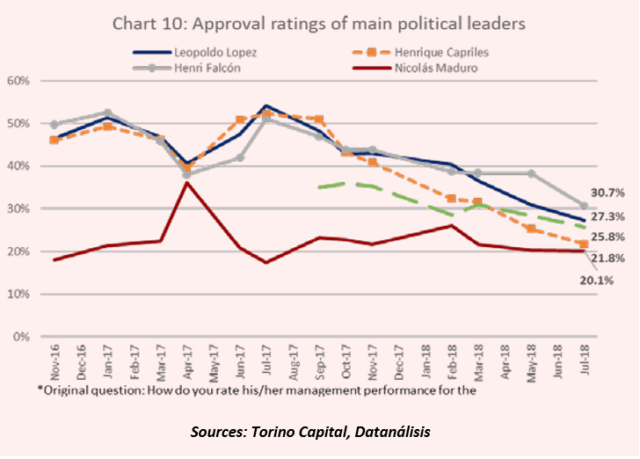
Data from the opposition-aligned pollsters in Venezuela (via Torino Capital) indicates that Henri Falcón was the most popular of the major opposition figures at the time of the May 2018 presidential election. Nicolás Maduro won the election due to widespread opposition boycotting and votes drawn by another opposition candidate, Javier Bertucci.
The constitutional argument that Trump and his accomplices have used to “recognize” Guaidó rests on the preposterous claim that Maduro has “abandoned” the presidency by soundly beating Falcón in the election. Caracas-based journalist Lucas Koerner took apart that argument in more detail.
What about the McClatchy-owned Herald‘s claim that Maduro “continues to reject international aid”? In November 2018, following a public appeal by Maduro, the UN did authorize emergency aid for Venezuela. It was even reported by Reuters (11/26/18), whose headlines have often broadcast the news agency’s contempt for Maduro’s government.
It’s not unusual for Western media to ignore facts they have themselves reported when a major “propaganda blitz” by Washington is underway against a government. For example, it was generally reported accurately in 1998 that UN weapons inspectors were withdrawn from Iraq ahead of air strikes ordered by Bill Clinton, not expelled by Iraq’s government. But by 2002, it became a staple of pro-war propaganda that Iraq had expelled weapons inspectors (Extra! Update, 10/02).
And, incidentally, when a Venezuelan NGO requested aid from the UN-linked Global Fund in 2017, it was turned down. Setting aside how effective foreign aid is at all (the example of Haiti hardly makes a great case for it), it is supposed to be distributed based on relative need, not based on how badly the US government wants somebody overthrown.
But the potential for “aid” to alleviate Venezuela’s crisis is negligible compared to the destructive impact of US economic sanctions. Near the end of Wyss’ article, he cited an estimate from the thoroughly demonized Venezuelan government that US sanctions have cost it $30 billion, with no time period specified for that estimate. Again, this calls to mind the run-up to the Iraq invasion, when completely factual statements that Iraq had no WMDs were attributed to the discredited Iraqi government. Quoting Iraqi denials supposedly balanced the lies spread in the media by US officials like John Bolton, who now leads the charge to overthrow Maduro. Wyss could have cited economists independent of the Maduro government on the impact of US sanctions—like US economist Mark Weisbrot, or the emphatically anti-Maduro Venezuelan economist Francisco Rodríguez.
Illegal US sanctions were first imposed in 2015 under a fraudulent “state of emergency” declared by Obama, and subsequently extended by Trump. The revenue lost to Venezuela’s government due to US economic sanctions since August 2017, when the impact became very easy to quantify, is by now well over $6 billion. That’s enormous in an economy that was only able to import about $11 billion of goods in 2018, and needs about $2 billion per year in medicines. Trump’s “recognition” of Guaidó as “interim president” was the pretext for making the already devastating sanctions much worse. Last month, Francisco Rodríguez revised his projection for the change in Venezuela’s real GDP in 2019, from an 11 percent contraction to 26 percent, after the intensified sanctions were announced.
The $20 million in US “aid” that Wyss is outraged Maduro won’t let in is a rounding error compared to the billions already lost from Trump’s sanctions.
Former US Ambassador to Venezuela William Brownfield, who pressed for more sanctions on Venezuela, dispensed with the standard “humanitarian” cover that US officials have offered for them (Intercept, 2/10/19):
And if we can do something that will bring that end quicker, we probably should do it, but we should do it understanding that it’s going to have an impact on millions and millions of people who are already having great difficulty finding enough to eat, getting themselves cured when they get sick, or finding clothes to put on their children before they go off to school. We don’t get to do this and pretend as though it has no impact there. We have to make the hard decision—the desired outcome justifies this fairly severe punishment.
How does this gruesome candor get missed by reporters like Wyss, and go unreported in his article?
Speaking of “severe punishment,” if the names John Bolton and Elliott Abrams don’t immediately call to mind the punishment they should be receiving for crimes against humanity, it illustrates how well the Western propaganda system functions. Bolton, a prime facilitator of the Iraq War, recently suggested that Maduro could be sent to a US-run torture camp in Cuba. Abrams played a key role in keeping US support flowing to mass murderers and torturers in Central America during the 1980s. Also significant that Abrams, brought in by Trump to help oust Maduro, used “humanitarian aid” as cover to supply weapons to the US-backed Contra terrorists in Nicaragua.
In the Herald article, the use of US “aid” for military purposes is presented as another allegation made by the vilified Venezuelan president: “Maduro has repeatedly said the aid is cover for a military invasion and has ordered his armed forces not to let it in, even as food and medicine shortages sweep the country.”
Calling for international aid and being democratically elected will do as little to protect Maduro’s government from US aggression as being disarmed of WMD did to prevent Iraq from being invaded—unless there is much more pushback from the US public against a lethal propaganda system.
Fiction Plus Coercion Makes Reality: The Illegitimacy of the US-led Coup in Venezuela
By Maximilian C. Forte | Zero Anthropology | February 14, 2019
After considering the economic foundation of current US intervention, designed to erase Venezuela’s economic sovereignty, the purpose here is to focus more on the political side of the equation, not that we can neatly divide the politics from the economics of either the intervention or the defence of sovereignty. What we find is a situation where the anti-government opposition inside Venezuela is limited on three fronts:
(a) it has a narrow base of support among the public, and is thus incapable of producing a “popular uprising,” nor does it command the state machinery;
(b) it relies heavily on foreign support, in other words, the opposite of legitimacy in a democracy—having gone the route of seeking foreign intervention, their real foundation is coercion, not authority; and,
(c) in the absence of any real authority, the leadership is suspended in a web of fiction, which means that it spins fictions of its own power and authority.
Also undermining the legitimacy of the opposition is the US, imposing itself as a supreme tribunal that has arrogated to itself the right to decide on the course of Venezuela’s political future. Right now what we are witnessing is not so much an attempted coup (not yet at least), as much as an intended coup.
Since there is little movement on the ground that would seem to promise anything like an impending removal of the Maduro administration by local forces and by peaceful means, this heightens the possibility of both escalating local violence combined with foreign military intervention. This is especially true since, following the Americans, the opposition rejects dialogue with the government. When claims are exposed as fictions that lack substance, the only way to force them into the domain of reality is through violence.
“Maduro Must Go”: The US as the Ultimate Elector in Venezuela
On February 1 in Miami, in a brazen act of bellicosity that violated international law, US Vice President Mike Pence publicly declared that, “Nicolas Maduro must go,” smearing Maduro as “a dictator with no claim to power” (language oddly reminiscent of the domestic opponents of his own boss). More than that, Pence proceeded to directly threaten Venezuela’s government if it should continue to defy US wishes, in language redolent of classic imperialism:
“Let’s be clear: this is no time for dialogue. This is time for action. And the time has come to end the Maduro dictatorship once and for all…. The United States will continue to assert all diplomatic pressure to bring about a peaceful transition to democracy…. But those looking on should know this: All options are on the table…. And Nicolas Maduro would do well not to test the resolve of the United States”.
“The resolve of the United States”; a US Vice President deciding on whether a foreign leader has the right to stay in power, regardless of those who voted him into power—these examples clearly establish that the real line of conflict here is between the US and Venezuela, and not between Guaidó and Maduro.
Speaking as an official of a rogue state, John Bolton uttered a ridiculously crass threat against President Maduro, in a display of naked imperialism gone wild:
“I wish him [Maduro] a long, quiet retirement on a pretty beach far from Venezuela. And the sooner he takes advantage of that, the sooner he’s likely to have a nice, quiet retirement on a pretty beach rather than being in some other beach area like Guantanamo”.
Interestingly, this is precisely the language of dictatorship: commanding, threatening, abducting, disappearing opponents. The US has a history of not just deposing foreign leaders, but even kidnapping them, when not executing them outright. It is also the speech of a rogue state—no state that respects international law allows its officials to routinely and casually threaten others in this manner. After expressing desires to loot Venezuela’s wealth, they now publicly entertain fantasies of abducting Venezuela’s elected president.
These were not the only times that the Trump administration directly threatened the government of Venezuela with regime change. In July of 2017, then CIA director Mike Pompeo spoke at the Aspen Security Forum about working with Colombia, the Venezuelan opposition, and the CIA in developing “options” for regime change, just a month after Colombia joined NATO as a “Global Partner”. Then on August 5, 2018, an attempted assassination against Venezuelan President Nicolas Maduro took place. Soon after that, Nikki Haley, the US ambassador to the UN at the time, went on a tour to Colombia’s border with Venezuela, covered exclusively by Fox News, in which she advocated for the illegal overthrow of Venezuela’s government. Outside of the UN building in New York, US ambassador Nikki Haley chose to violate the UN Charter itself by openly advocating for the overthrow of a foreign government and hinting loudly that it would happen thanks to strong US intervention. On Thursday, September 27, 2018, Haley shouted into a megaphone in front of demonstrators: “We are going to fight for Venezuela and we are going to continue doing it until Maduro is gone!… We need your voices to be loud, and I will tell you, the US voice is going to be loud”.
“I will tell you, the US voice is going to be loud,” said Haley in reprising George W. Bush’s threat prior to invading Afghanistan (America’s 18-year tale of “success” in Central Asia). The fact of the matter is that the US never imagined that the removal of Maduro’s party from power could ever happen organically and thanks purely to local dynamics. It was always to be something artificial, a fiction brought to life through American violence. The threat of military intervention, which itself flouts international law, was made in the first months of the Trump administration.
From as early as August of 2017 Trump was already suggesting the possibility of a US military coup to overthrow Venezuela’s government. This was before the elections it would discount were even announced. Then Secretary of State Rex Tillerson repeated the suggestion in February 2018, and said Maduro should leave the country altogether and retire in Cuba, much like Bolton above would later do. (The suggestion that Tillerson was among those “pushing back” against Trump’s move to military conflict with Venezuela, is thus pure fantasy. It’s part of the liberal “resistance” veneration of transnationalist oligarchs like Tillerson as representing one of the “adults in the room”.) Again, even before elections had been called in Venezuela, Trump threatened Venezuela with US military intervention.
Venezuela’s government made it clear that one thing that would never be “discussed” with the US (which wants to discuss nothing) would be Venezuela’s sovereignty, and Maduro announced that the military was ready to fight back against US intervention. As for Trump’s repeated threat military options are “on the table,” Maduro simply replied: “There will be no war or military intervention”. In the meantime, however, Venezuela is preparing to make any US military escalation as costly as possible to the US—something which several forces in the world have successfully done, starting with Vietnam, and then especially since 2001. In addition, Maduro in a letter to Trump, asked if politicians in Washington were ready to send their country’s “sons and daughters to die in an absurd war” (unfortunately, we already know the answer to that question).
However, underlining the illegitimacy of the intended coup, the overwhelming majority of Venezuelans are very far from supporting either Guaidó or the US when it comes to US military intervention and economic sanctions. Even before Trump threw his support behind Guaidó, local polling data from Venezuela showed that 86% of Venezuelans were against any foreign military intervention, and 81% opposed the US’ sanctions. With respect to seeking US intervention, Guaidó represents the 14%. In addition, recently launched was a largely symbolic, political campaign to get 10 million signatures of Venezuelans denouncing US intervention; a large rally came out in support to start the process. Should foreign military intervention happen, done in the name of “helping Venezuelans,” it should be remembered that such intervention has virtually no support in Venezuela itself.
The “Early Elections” Ruse
Call new presidential elections—this has been one of the key commands coming from the Venezuelan opposition’s foreign backers. Before 2019 the command was call early elections. Yet when the US and their Venezuelan force multipliers previously pressed the Venezuelan government to hold early elections—just as their EU counterparts would do again in January 2019—they then turned around and condemned the announcement of early elections. Now once again the demand is for new, early elections: states like Spain instructed the Venezuelan government to declare, within eight days, that new elections would be held, or else Spain and others would recognize Guaidó—an ultimatum on how Venezuela should conduct its domestic politics. Venezuela’s government of course rejected this demand outright.
This then raises a key question: if these outside interests did not accept the last elections, why would they accept the results of the next ones? All previous elections had been widely recognized as free and fair, and it was the same system which produced the opposition’s victory in the now defunct National Assembly. Indeed, as recently as August of 2017, the opposition itself accepted the new Constituent Assembly’s call for gubernatorial elections. It was the same system in which Maduro won his re-election, and would be the same for any new elections. Yet the same governments that oppose Maduro, falsely claim that he “stole” the election—and if he had stolen it, it wasn’t from Guaidó, who did not run as a candidate. Clearly the ultimatum, unacceptable as it was shockingly arrogant, was meant as bait to trigger even further intervention: EU-supervised and EU-designed elections perhaps (and let’s not forget the Haitian elections that were rigged under UN auspices). Those EU states which then officially recognized Guaidó were rightly denounced by Russia for engaging in brazen intervention in a sovereign nation’s internal affairs.
In order to denounce past elections while calling for new ones, the US had to fabricate the myth of illegitimate elections in Venezuela. Thus the Trump administration directly threatened with targeted sanctions a leading opposition candidate, Henri Falcón, who was considering launching a presidential campaign, warning him not to do so. The US’ top diplomat in Venezuela even met with Falcón, to persuade him not to run. Widely reported polls showed that he had a good chance of winning the election too. The Venezuelan opposition was instructed by the US to boycott the election, in order to produce what could then be called a “sham”. Mike Pence thus decided in advance that the elections would be a sham, without a shred of evidence provided. The same argument was made by some of the opposition, that Maduro’s election was illegitimate—an election held using the very same system that won the opposition their own seats. There is no evidence to deny that Maduro’s election followed all of the proper legal procedures, and though the turnout was low, Maduro’s share of eligible voters was higher than that of Trump in 2016 and Obama in 2012.
Now here is where myth-making has taken a new turn. Those states which now recognize Guaidó as the president of Venezuela, cannot very well press the demand for new elections on Maduro. To do so would be to continue legitimizing Maduro as the President. So it is now up to Guaidó to call for early elections. Has he done so? After all, if he really believed he was the interim president, with all of the rights and duties of an interim president, then it was his job to call new elections in 30 days. Guaidó has not done so, and this violates the very Constitution which he claims to be defending. The defunct National Assembly has instead invented some new parts of the Constitution—because they simply do not exist in that document—about “technical conditions” that give Guaidó the right to be interim president not just for 30 days, but for a whole year now. Talk about dictatorship. The idea is to deny Maduro and his whole government any legitimacy, an argument that also fails, and it backfired on the opposition with all of its petty, selective, and inventive legalisms about “the Constitution” (which they themselves violate).
The legitimacy of Maduro’s government was rarely respected by his domestic opposition, and almost never by the more powerful extraterritorial opposition represented by US power. And as Maduro clearly pointed out, Venezuela has had no deficit of elections (six occurred in the past 18 months alone, at different levels of government)—so elections themselves are neither the root of the problem, nor can they be a solution.
The Venezuelan government repeated that it was open to holding talks with the opposition, which the opposition continues to publicly refuse. President Maduro also held out the offer of early elections for the legally constituted Constituent Assembly. That offer has also been rejected.
“No Dialogue” Means Violence, No Democracy
Imagine you claim to be interested in defending democracy. Then imagine you reject any dialogue whatsoever with fellow citizens who have views that differ from yours. Are you really interested in democracy then? Imagine you believe yourself to represent the majority, but still the opposing side represents a significant minority, and yet you refuse to deal with the other side. Does that advance democracy?
The US claims that it is seeking peaceful and diplomatic means of securing regime change in Venezuela, a goal which is neither peaceful nor diplomatic. Unable to reconcile this harebrained contradiction, the US inevitably rejects any dialogue with the government of Venezuela, dismissing an offer of mediation by Mexico and Uruguay. This underscores the perverse definition of “diplomacy” that the US has adopted. For successive US regimes, “diplomacy” is merely a default position—it means everything that is not outright “shock and awe”. Saying there can be no dialogue whatsoever, narrows the avenue of peaceful solutions. Moreover, whatever the US seeks, by seeking it in Venezuela its actions can only go against democracy—Venezuelans did not elect the US government, and did not elect to have it involved in their affairs, let alone usurp the authority of Venezuelans.
Guaidó has dutifully echoed the US line in consistently dismissing dialogue, while Maduro has been just as consistent in offering it. Meanwhile, other top opposition leaders in the country—for example, the two former presidential candidates of the two main traditional parties, Claudio Fermín and Eduardo Fernández—have instead favoured “electoral participation and recognition of the legitimacy of the Maduro government”. Not all of the opposition has chosen the avenue of treason that beckons violence.
One thing is certain, this time Venezuela has reached a turning point and there is no going back. The most tragic and extreme steps have been taken, precisely the kinds which should never have been taken. A number of actors are going to have to pay a very high price for their decisions. On the opposition’s side, those who actively involved a foreign imperial power in the domestic affairs of Venezuela, who behave as if it were natural and normal for the US to have a say in Venezuelan politics, and who proceed like they have the full support of US military power authorizing their actions—the price they will need to pay will have to be the maximum one. On the government’s side, those whose decisions and whose many errors of omission and commission have helped to fan the flames of crisis, may find their own future is not assured.
Temir Porras Ponceleón, who served as chief of staff to Nicolás Maduro from 2007 to 2013, and is now a visiting professor at Sciences Po in Paris, has shared a series of important observations and questions about the election issue and the civil war issue, in a hypothetical post-Maduro Venezuela. In a recent interview, he raised these questions:
“We can imagine the crisis getting deeper. Probably the government collapsing, but what about the day after? What about the military of Venezuela? What about the divisions within the military? What I am concerned is, to have a stable and democratic country the day after. And that requires not provoking each other, political dialogue and understanding”.
About the opposition, if it came to power, he asks:
“Do they have a plan to guarantee that this country remains stable and democratic? The day after, do they guarantee that they will not allow, for instance, the US government or the US troops to enter Venezuela? Do they have a plan to deal with the Venezuelan military?”
Then there is the real possibility of a civil war erupting if Maduro leaves or is forced from power:
“And what guarantees that the departure of Maduro doesn’t create a civil war, for instance? The reality of Venezuela is that it is a very polarized country. It is totally unrealistic or irresponsible to think or to assume that there are all the guarantees for Venezuela to be in a peaceful situation. In order to be an election, you have to agree on the terms of that election. When will the election be held? Who can be allowed to run for those elections? And that’s exactly the problem—saying there will be elections is assuming that the problem is solved before even addressing it”.
Ponceleón thinks that it is “highly likely” that the situation will escalate into a civil war in Venezuela. On one point at least, we can already address his question: the opposition cannot guarantee a democratic Venezuela, because it has chosen the most undemocratic means available to it: foreign military intervention. It would be useful to remember that one of the principal ways of conceiving democracy, that came out of many formerly colonized nations, was that democracy meant freedom from alien domination. Any time a foreign power exercises its might in determining the affairs of another people, no matter what those people produce cannot be democratic because the context in which they operate itself stands against democracy.
US intervention, by definition, cancels out self-determination and that means democracy is impossible under such circumstances.
Fictions: Delusions of Authority
There is a serious problem with the person who was appointed and announced himself as the “interim president” of Venezuela, Juán Guaidó. The problem might be diagnosed as megalomania—having serious delusions of authority. In just the last three weeks, Guaidó has gone on record with the following positions:
- Guaidó claimed to have won the support of the United Nations Security Council (UNSC);
- Guaidó acted as if he was in a position to issue orders to the military;
- Guaidó claimed to have obtained foreign aid, though no one knows how it entered the country; and, best of all,
- Guaidó presumed that he was the one to authorize US military intervention.
With the possible exception of the third point, there is a definite pattern here. It involves a realty-denial problem, that is prone to spin fictions. It is what one can expect from someone, unknown to the vast majority of Venezuelans and whose party controlled only 14 seats of the 167 in the defunct National Assembly. It is the posture of a person who was not elected to be president, claiming that the elected president is a sham. The only thing authorizing Guaidó’s fabrications is the power of the US standing behind him. From not having dialogue with Venezuelans, to not having a dialogue with reality, the program represented by Guaidó is that of a fiction waiting—wanting—to become reality. The only chance it has of becoming reality is that it has to be forced through, with massive violence. Why? Because it is artificial; because it is not a program that arises from its grounding in facts. It is pure ideology, at its worst; it is the kind of ideological stance that leads one to foolishly engage in comical stunts on the one hand, while begging for war on the other hand.
Fictions: Movement on the Ground
“What’s going on within Venezuela itself?” asks Paul Dobson—“The answer, however, is not much”. With all the media noise about governments backing the opposition’s claim to presidential authority (in a transparent violation of international law), there is little to show for the opposition making any headway inside Venezuela itself. In fact, most of the hum-drum of everyday life continues, with a few isolated protests, and no public disorder—“conspicuously absent are any of the tell-tale signs of a genuine power shift that might indicate that the government is about to fall”. As Dobson observes, “the man whose name 81 percent of Venezuelans didn’t even know one month ago has not managed to spur the country into the sort of popular action at all levels of society which he probably needs to make this attempted coup a reality”. Guaidó’s primary base of power is his foreign backing, primarily that of the US; his only claim to authority is acting as a gatekeeper of foreign aid allegedly smuggled into the country. As a real president, little would be different, having vowed to sell off Venezuela’s oil facilities to foreign private interests. Guaidó’s greatest achievement would be to become Venezuela’s version of Ashraf Ghani—a figurehead, propped up by foreign aid, overseeing a badly divided country. The only way for a fiction of authority to become a reality is through massive force (violence), and then it only becomes a farcical reality whose life will be short.
On Saturday, February 2, Guaidó’s loudly touted opposition protests occurred, passing without changing anything in the country and even receiving minimal international media coverage. Loudly denounced as a “brutal dictatorship,” the government did absolutely nothing to “repress” the demonstrations, and nobody was reported as hurt or killed. At the same time, a pro-government march countered the opposition protest, and according to some reports, was much larger. In fact, footage of the pro-government demonstration was dishonestly used by Fox News’ Neil Cavuto as he spoke of the opposition rally—when the screen behind him showed a huge mass of people wearing red, the governing party’s colour, along with members of militias. The BBC was at least able to tell the two apart. The opposition protesters were said to number in the “tens of thousands,” which falls far short of the millions who attended pro-government rallies in the past, or a number rivalling the opposition that turned out for Maduro on the same day. Guaidó clearly lacked faith in the possibility of a popular uprising materializing, and he thus continued to call for high-level military defections and for US intervention (though some of the so-called “defectors” were revealed to be fakers)—and the US was reportedly making direct contacts to persuade Venezuelan officers to “defect”. The Saturday protests followed from those held earlier, on Wednesday, January 30, which were reported to be very small and largely confined to the traditional opposition stronghold. Guaidó called for new opposition protests to be held on February 12, clearly not confident that any change would happen anytime soon. The protests came and went, without incident, and without any change. So now the opposition invented a new milestone: February 23, when they said they would push to unblock “aid” sent by the US, which would indeed be using such aid to provoke a violent confrontation, which is likely one of the US’ original objectives in sending the “aid” against the wishes of the legitimate government. (Meanwhile even Colombia’s International Red Cross views the “aid” as a US ploy and said it would have no part in distributing it.)
Indicative of Guaidó’s own lack of confidence, which stems from his lack of legitimacy and the opposition’s over-reliance on foreign support, he made the absurd declaration that he was not ruling out “authorizing” US military intervention. Apparently he was usurping power in the US too now. Responding appropriately, US Representative Ro Khanna stated: “Mr. Guaido, you can proclaim yourself leader of Venezuela but you don’t get to authorize US military interventions”. Khanna added that US legislators would authorize no such action. In a further attempt to pretend he has authority, Guaidó then “ordered” Venezuela’s military to let in “aid” sent by the US—with no sign whatsoever that the military intends to “obey” him.
The Question of International Recognition
In North America, most of the media instruct us on the names and/or numbers of countries that have called on Maduro to step down, and which have recognized Guaidó’s interim presidency. They say little or nothing about all of the countries which have not done so; instead, they occasionally select a certain few that have been the loudest in denouncing the intended coup. The fact of the matter, however, is that the overwhelming majority of the United Nations’ member states continue to acknowledge President Maduro as the legal and legitimate head of government and state in Venezuela—they have made no move whatsoever to withdraw that recognition.
Note that the US took its attempt to shore up support for its force multipliers—the opposition “led” by Guaidó—to the UN Security Council, and not the UN General Assembly which would have meant allowing all member states a vote. The proportion of those supporting the US is greater in the UNSC than in the UNGA. Americans, great tellers of tall tales and ardent fans of impression management, believe that “optics matter”—any performer of magic tricks would immediately agree.
The US failed in its effort to get the United Nations Security Council to support its coup initiative of delegitimizing Maduro and recognizing Guaidó. China, Russia, Equatorial Guinea, and South Africa were some of the countries that expressed support for the Maduro government at the UNSC on January 26, and blocked the US from passing its resolution. China was in fact one of the countries that sent an official delegation to Maduro’s inauguration earlier in the month. Venezuela’s foreign minister, also speaking at the UNSC, declared: “The United States is not behind the coup d’état, it is in the vanguard”. He also blasted a European ultimatum demanding new elections: “Nobody is going to give us deadlines or tell us if there are elections or not”. Russia’s position at the UNSC was not just correct, it was absolutely correct: Venezuela’s internal affairs should never have been brought to the Security Council for discussion in the first place. As Russia’s foreign minister explained, Venezuela “does not represent a threat to the international community, but Washington’s actions do”. This has apparently not stopped the US from returning to the UNSC with a proposed resolution asking it to intervene in Venezuela’s domestic politics, by demanding a new presidential election. Meanwhile, Guaidó’s imagination knows no limits when it comes time to assuming authority: he reportedly told RT that the UNSC has endorsed his side and its attempted coup, not the only “fake news” which he tried to manufacture in that interview.
The UN has since said it would support, not the “Lima Group,” but the Montevideo dialogue, of which Caribbean states have been a key source of momentum (also in opposition to the OAS’ head). The UN Secretary General, Antonio Guterres, also explicitly condemned any move toward foreign military intervention in Venezuela: “The time for an era of foreign intervention passed long ago”. As for the Lima Group, the main outcome of its Ottawa meeting to discuss ways to screw Venezuela, was essentially to call on the military to engage in a coup—so much for “liberal democracy”. Maduro has rejected all EU intervention and also affirmed his support for the Montevideo dialogue instead. That dialogue, however, had thus far only produced a European-backed resolution which Bolivia opposed. The first meeting thus ended with a non-unanimous statement—the obstacle being the Europeans pressing for new presidential elections.
While about 48 governments have recognized Guaidó (usually not in consultation with their electorates), 141 countries, that is, the vast majority of UN members did not heed the US’ call to recognize him. No wonder the US never took its case to the UN General Assembly, where its defeat would have been even more humiliating, and instructive, than it was at the Security Council. Yet, some of the propagandistic North American media, such as Bloomberg, essentially whited out most of the world in order to claim that “global leaders” have backed Guaidó. The rest simply do not exist on their map. They count as those opposing recognition of Guaidó only those that have openly said they would not do so—dismissing those who also have not offered recognition, but who have stayed quiet on Maduro (which is what actual non-intervention looks like). In addition, Bloomberg’s graphic is suitably small enough that we cannot see more than a dozen Caribbean states that have explicitly rejected foreign intervention and recognition of Guaidó. Bloomberg also fails to question the opposition’s fanciful imagining of Russia, China, and Turkey as being “neutral”—so even those countries’ opposition is rhetorically whitewashed. This is a reality-denial problem. Much better, though not perfect, are Venezuelanalysis’ accurate and up-to-date infographics which demonstrate one basic reality very starkly: the world is mostly divided between the “Global North,” made up mostly of former colonial and imperial powers, and the “Global South,” but even more than that it shows what an increasingly multipolar world looks like.
Among the countries that continue to recognize Maduro are the overwhelming majority of African states (with a single exception), Caribbean states (with a single exception), all of Asia, and the Middle East (with one exception).

“Is Venezuela yours?… How do you oust a person who came to office through elections? How do you hand over presidential [powers] to someone who did not even get elected? Do you know what democracy is?”
Earlier, Erdogan in a message to President Maduro exclaimed: “Maduro, brother, stand tall”. Turkey has developed close economic and political ties with Venezuela, and the two leaders have visited each other’s countries in recent years. As for any possible outreach to Russia, the Venezuelan opposition will find itself immediately blocked. Russia does not respect Guaidó as anything other than an instrument of a foreign power, and thus there is no point in holding talks directly with him.
The Venezuelan government promised to review its ties to states that recognized Guaidó, and also promised a symmetrical response to US sanctions and seizures of Venezuela’s assets. Nothing about Maduro suggested he was either intimidated or considered surrendering to US wishes. Maduro insisted he was still interested in good relations with the US, but explicitly not with its government, saying that relations in areas except diplomacy and politics were welcome. What else does one say to those who will not even speak to you?
Lastly, let’s consider those illustrious members of the US Congress: when interviewed on the subject of intervention in Venezuela, they displayed a remarkable degree of not just dishonesty and hypocrisy, but what could also be easily classed as gross intellectual incompetence and even cowardice. It is difficult to locate a better collection of buffoonery in which alcohol was ostensibly absent.
While on the right, figures like Senator Rand Paul stood out in their opposition to US foreign intervention, on the subject of Venezuela it is a small group of particularly bright and courageous young Democrats who have taken the right stand: Tulsi Gabbard, Ro Khanna, and the unflappable Ilhan Omar, who recently interrogated Elliot Abrams. Abrams, is the neoconservative Never Trumper whom Trump has appointed the US “special envoy” for Venezuela. Omar’s comments were not only accurate and on target, they were long overdue. Fox News could only express “shock” (eloquence usually has that effect on them), repeatedly calling the exchange between Omar and Abrams “stunning” (because facts are loathsome things)—but without ever offering a single substantive point to counter Omar’s presentation. They did, however, raise the issue of her identity.
US Air Freight Company that Smuggled Weapons Into Venezuela Linked to CIA “Black Site” Renditions
By Whitney Webb | MintPress News | February 13, 2019
GREENSBORO, NORTH CAROLINA – Two executives at the company that chartered the U.S. plane that was caught smuggling weapons into Venezuela last week have been tied to an air cargo company that aided the CIA in the rendition of alleged terrorists to “black site” centers for interrogation. The troubling revelation comes as Venezuelan President Nicolás Maduro has rejected a U.S. “humanitarian aid” convoy over concerns that it could contain weapons meant to arm the country’s U.S.-backed opposition.
Last Tuesday, Venezuelan authorities announced that 19 rifles, 118 ammo magazines, 90 radios and six iPhones had been smuggled into the country via a U.S. plane that had originated in Miami. The authorities blamed the United States government for the illicit cargo, accusing it of seeking to arm U.S.-funded opposition groups in the country in order to topple the current Maduro-led government.
A subsequent investigation into the plane responsible for the weapons caché conducted by McClatchyDC received very little media attention despite the fact that it uncovered information clearly showing that the plane responsible for the shipment had been making an unusually high number of trips to Venezuela and neighboring Colombia over the past few weeks.
Steffan Watkins, an Ottawa-based analyst, told McClatchy in a telephone interview that the plane, which is operated by U.S. air cargo company 21 Air, had been “flying between Philadelphia and Miami and all over the place, but all continental U.S.” during all of last year. However, Watkins noted that “all of a sudden in January, things changed” when the plane began making trips to Colombia and Venezuela on a daily basis, sometimes multiple times a day.
According to Watkins’ analysis, this single plane had conducted 40 round-trip flights from Miami International Airport to Caracas and Valencia — where the smuggled weapons had been discovered — in Venezuela, as well as to Bogota and Medellin in Colombia in just the past month.
Publicly available flight radar information shows that the plane, although it has not returned to Venezuela since the discovery of its illicit cargo, has continued to travel to Medellin, Colombia, as recently as this past Monday.
Multiple CIA ties
In addition to the dramatic and abrupt change in flight patterns that occurred just weeks before U.S. Vice President Mike Pence prompted Venezuelan opposition member Juan Guaidó to declare himself “interim president,” a subsequent McClatchy follow-up investigation also uncovered the fact that two top executives at the company that owns the plane in question had previously worked with a company connected to controversial CIA “black sites.”
Indeed, the chairman and majority owner of 21 Air, Adolfo Moreno, and 21 Air’s director of quality control, Michael Steinke, both have “either coincidental or direct ties” to Gemini Air Cargo, a company previously named by Amnesty International as one of the air charter services involved in a CIA rendition program. In this CIA program, individuals suspected of terrorism were abducted by the intelligence agency and then taken abroad to third-country secret “black sites” where torture, officially termed “enhanced interrogation,” was regularly performed.
Steinke worked for Gemini Air Cargo from 1996 to 1997, according to a 2016 Department of Transportation document cited by McClatchy. Moreno, although he did not work for Gemini, registered two separate businesses at a Miami address that was later registered to Gemini Air Cargo while the CIA rendition program was active. McClatchy noted that the first business Moreno registered at the location was incorporated in 1987 while the second was created in 2001. Gemini Cargo Logistics, a subsidiary of Gemini Air Cargo, was subsequently registered at that same location in 2005.
21 Air has denied any responsibility for the weapons shipment discovered onboard the plane it operates, instead blaming a contractor known as GPS-Air for the illicit cargo. A GPS-Air manager, Cesar Meneses, told McClatchy that the weapons shipment had been “fabricated” by the Maduro-led government to paint his government as the victim. Meneses also stated that “the cargo doesn’t belong to 21 Air and it doesn’t belong to GPS-Air” and that it had been provided by third parties, whose identities Meneses declined to disclose.
Contras redux?
The revelation that the company that operates the plane caught smuggling weapons into Venezuela has connections to past controversial CIA programs is unlikely to surprise many observers, given the CIA’s decades-long history of funneling weapons to U.S.-backed opposition fighters in Latin America, Southeast Asia and other conflict areas around the globe.
One of the best-known examples of the CIA using airliners to smuggle weapons to a U.S.-backed paramilitary group occurred during the 1980s in what became known as the Iran-Contra scandal, in which the Reagan administration delivered weapons to the Contra rebels in order to topple the left-leaning Sandinista movement. Many of those weapons had been hidden on flights claiming to be carrying “humanitarian aid” into Nicaragua.
The parallels between aspects of the Contra scandal and the current situation in Venezuela are striking, particularly given the recent “outrage” voiced by mainstream media and prominent U.S. politicians over Maduro’s refusal to allow U.S. “humanitarian aid” into the country. Maduro had explained his rejection of the aid as partially stemming from the concern that it could contain weapons or other supplies aimed at creating an armed opposition force, like the “rebel” force that was armed by the CIA in Syria in 2011.
Though the media has written off Maduro’s concern as unfounded, that is hardly the case in light of the fact that the Trump administration’s recently named special envoy in charge of the administration’s Venezuela policy, Elliott Abrams, had been instrumental in delivering weapons to the Nicaraguan Contras, including hiding those weapons in “humanitarian aid” shipments. In subsequent testimony after the scandal broke in the 1980s, Abrams himself admitted to funneling weapons to the Contras in exactly this way.
With the recently uncovered illicit weapons shipment from the U.S. to Venezuela now linked to companies that have previously worked with the CIA in covert operations, Maduro’s response to the “humanitarian aid” controversy is even more justified. Unfortunately for him, the U.S.-backed “interim president,” Juan Guaidó, announced on Monday that his parallel government had received the first “external” source of “humanitarian aid” into the country, but would not disclose its source, its specific contents, nor how it had entered the country.
Guaido’s True Colors: “President” to Fix Venezuelan Relations with Israel
By Jim Carey | Geopolitics Alert | February 13, 2019
Caracas – In an interview over the weekend, “interim President” of Venezuela Juan Guaido promised he would work on restoring relations with Israel.
Despite not actually having a government or being in any type of official position of power within Venezuela Juan Guaido is still somehow making big promises. Last week it was the promise to sell oil he doesn’t control to the US and this week he is setting foreign policy for a state, a military, and a diplomatic core that he doesn’t have.
Regardless of Juan Guaido’s material position, Israel has been more than willing to indulge in the US fantasy in Venezuela and was one of the early states to recognize the fraud as “interim President.” Now it seems Guaido is more than willing to repay the favor should he ever actually hold office.
Guaido made this promise in a recent interview with the Israel Hayom newspaper where he told the interviewer that he was “very happy to announce that the process of stabilizing relations with Israel is in full swing.” While what exactly that means when you’re a President with no power is rather ambiguous, for some reason Guaido has said restoring relations “is very important for us.”
Regardless of all these factors, there are still several reasons the new President has made this a high priority. Even without any actual diplomatic staff recognized by the state, Guaidó has still been in contact with Israel and has even discussed opening a new Venezuelan embassy in Israel, saying it “is one of the subjects we are talking about.”
Another reason Guaidó claims he wants to restore relations with the Zionists is due to the fact that there “are many Venezuelans in Israel and many Jews in Venezuela.”
According to Guaidó, this Venezuelan Jewish community “is very active and prosperous” and have expressed to the president their hopes for renewed relations with Israel.
Guaidó says this Jewish community has a friend in him and he wishes to ‘restore their rights’ and has “no doubt that the Jews are afraid.” Now Guaidó has promised to protect this Jewish community should he ever take power.
Relations between Israel and Venezuela were cut off in 2009 under Hugo Chavez, the previous Venezuelan President and mentor of Nicolás Maduro. Chavez knew well that Israel is very active in Latin America in helping the US subvert democracy and didn’t wish to allow the Zionists a base of operations in his country.
Obviously, the reasons cited by Hugo Chavez to justify throwing the Zionists out of Venezuela is perfectly legitimate but this has been a sore point with Washington and imperial media for some time. US media considers the fact that Chavez expelled the Zionists and supported Palestine as proof of the anti-semitism inside the United Socialist Party of Venezuela (PSUV).
This is all totally ridiculous of course and the Chavistas chose to expel the Israelis in solidarity with Palestine against imperialism. This shift in foreign policy was framed as dangerous and the distrust of Zionism is said to be responsible for the “flight” of Venezuelan Jews to Israel.
But just how big is this important Jewish community?
Before Chavez, the total Jewish population in Venezuela was only estimated at about 22,000 out of over 30 million. Since Chavez took power that population has dwindled down to around 7,000 meaning there are about 15,000 Venezuelan Jews in Israel.
Supposedly restoring the Venezuelan embassy in Israel is very important, just not to more than about 20-30,000 people. Many Venezuelans still oppose any type of outside intervention in their country and it likely wouldn’t matter if it was US or Israeli soldiers but Guaidó is clearly more beholden to his foreign backers than he is to his own people.
With all that said, Guaidó still hopes Israel will invest more in regime change in his country. “Many Western countries have already committed to sending humanitarian aid to Venezuela,” he said adding that he is “confident that Israel will also help us.”
Since Israel is basically a US proxy this likely means Guaidó would like aid from them in the form of firearms like the ones Washington recently tried to smuggle in. Chavez made the correct choice in throwing out the Zionists and their agents of subversion, meaning the best hope for Venezuela to remain independent is for the Chavistas to uphold this legacy of anti-imperialism.
Hands off ‘our hemisphere’ or Venezuela pays the price: US Senator warns Russia
RT | February 13, 2019
The US staked a claim on half the world, as Senate Armed Services Committee chair Jim Inhofe said Washington might have to intervene in Venezuela if Russia dares set up a military base not just there, but “in our hemisphere.”
“I think that it could happen,” Inhofe (R-Oklahoma) told a group of reporters on Tuesday. “You’ve got a guy down there that is killing everybody. You could have him put together a base that Russia would have on our hemisphere. And if those things happen, it may be to the point where we’ll have to intervene with troops and respond.”
Should Russia dare encroach on the US’ neck of the woods, Inhofe said: “we have to take whatever action necessary to stop them from doing that.”
As opposition leader Juan Guaido vies for power, the Russian government has stuck by President Nicolas Maduro. Russia has not, however, promised military aid to Maduro, and Russian diplomat Alexander Shchetinin said on Monday that Venezuela has not requested military aid from Moscow.
After Guaido declared himself interim president of Venezuela last month, US President Donald Trump immediately recognized Guaido as Venezuela’s legitimate leader. Since then, the US has pledged humanitarian aid to Guaido, called on Venezuela’s military to support him, and slapped Maduro’s government with fresh economic sanctions. Maduro has denounced Washington’s sponsorship of Guaido as a “vile” coup attempt but nevertheless called for talks with the opposition leader. The US has outright rejected taking part in any discussions with Maduro.
The US has stopped short of deploying troops to Venezuela, despite Trump and national security adviser John Bolton both saying the option is “on the table.” Speaking on Tuesday, Inhofe agreed and suggested that Trump could launch a military operation in Venezuela without Congressional authorization.
“I don’t think it’s necessary,” he said. “If there is a threat that reaches the threshold of the president having the ability, the constitutional ability of deploying troops, then that’s an unknown. We don’t know right now.”
Russian Foreign Minister Sergei Lavrov warned the United States against military intervention on Tuesday.
“Lavrov has warned against all interference in Venezuela’s domestic affairs including the use of force threatened by Washington and which is in violation of international law,” the Russian foreign ministry said in a statement.
‘Our hemisphere’
Inhofe said that a flow of Russian troops or weapons into the Western hemisphere “would be a threat to the United States of America.” The United States, meanwhile, reads from a different rulebook.
The US maintains nearly 800 military bases in over 70 countries worldwide, with a foothold on every continent. And, while Inhofe wants to keep an entire hemisphere free from Russian influence, the US is currently in talks to establish a permanent military base in Poland, right on Russia’s doorstep. Given the long history of animosity between Poland and Russia, the Polish government has offered to cough up $2 billion towards setting up the base.
Further afield, no hemisphere is beyond the reach of the United States. The US military divides the globe up into six Combatant Command ‘Areas of Responsibility,’ which it maintains in times of peace and war. Russia, meanwhile, divides its territory into four military districts, all within its own borders.


Mainstream media boosts Trudeau’s popularity over Venezuela
By Yves Engler · February 13, 2019
US presidents have bombed or invaded places like Grenada, Panama, Iraq and Sudan to distract from domestic scandals or to gain a quick boost in popularity. But, do Canadian politicians also pursue regime change abroad to be cheered on by the dominant media as decisive leaders?
In a discussion on regime change in Venezuela after last Monday’s “Lima Group” meeting in Ottawa, Conservative foreign affairs critic Erin O’Toole praised Canadian policy but added that the Liberals used the meeting of countries opposed to Nicolas Maduro’s government to drown out criticism of their foreign policy. O’Toole claimed the “Lima Group” meeting was “put together quite quickly and I think there are some politics behind that with some of the foreign affairs challenges the Trudeau government has been having in recent months.” In other words, O’Toole believes the Liberals organized a gathering that concluded with a call for the military to oust Venezuela’s elected president to appear like effective international players.
Understood within the broader corporate and geopolitical context, O’Toole’s assessment appears reasonable. After being criticized for its China policy, the Liberals have been widely praised for their regime change efforts in Venezuela. In a sign of media cheerleading, CTV News host Don Martin began his post “Lima Group” interview with foreign minister Chrystia Freeland by stating “the Lima summit has wrapped and the object of regime change is staying put for the time being” and then he asked her “is [Venezuelan President Nicolas] Maduro any step closer to being kicked out of office as a result of this meeting today?” Later in the interview Martin applauded the “Lima Group’s” bid “to put the economic pincers around it [Venezuela’s economy] and choking it off from international transactions.”
In recent days Ben Rowswell, a former Canadian ambassador in Caracas, has been widely quoted praising the Liberals’ leadership on Venezuela. “It’s clear that the international community is paying attention to what Canada has to say about human rights and democracy,” Rowswell was quoted as saying in an article titled “Trudeau’s Venezuela diplomacy is a bright spot amid China furor”.
Rowswell heads the Canadian International Council, which seeks to “integrate business leaders with the best researchers and public policy leaders”, according to its billionaire financier Jim Balsillie. Long an influential voice on foreign policy, CIC hosted the above-mentioned forum with O’Toole that also included the Liberal’s junior foreign minister Andrew Leslie and NDP foreign affairs critic Hélène Laverdière. CIC’s post “Lima Group” meeting forum was co-sponsored with the Canadian Council of the Americas, which is led by Kinross, Kinross, ScotiaBank, KPMG and SNC Lavalin. On the day of the “Lima Group” meeting CCA head Ken Frankel published an op-ed in the Globe and Mail headlined “Venezuela crisis will be a true test of Canada’s leadership in the hemisphere.” Frankel told CPAC he was “always supportive of Canadian leadership in the Hemisphere” and “the Venezuela situation has presented … a perfect opportunity for the Trudeau government to showcase the principles of its foreign policy.”
At the CCA/CIC forum Laverdière made it clear there’s little official political opposition to Ottawa’s regime change efforts. The NDP’s foreign critic agreed with Canada’s recognition of Juan Guaidó as president of Venezuela, as she did on Twitter, at a press scrum and on CPAC during the day of the “Lima Group” meeting in Ottawa. (Amidst criticism from NDP activists, party leader Jagmeet Singh later equivocated on explicitly recognizing Guaidó.)
With the NDP, Conservatives, CIC, CCA, most media, etc. supporting regime change in Venezuela, there is little downside for the Liberals to push an issue they believe boosts their international brand. To get a sense of their brashness, the day of the “Lima Group” meeting the iconic CN Tower in Toronto was lit up with the colours of the Venezuelan flag. A tweet from Global Affairs Canada explained, “As the sun sets on today’s historic Lima Group meeting, Venezuela’s colours shine bright on Canada’s CN Tower to show our support for the people of Venezuela and their fight for democracy.”
The Liberals drive for regime change in Venezuela to mask other foreign-policy problem is reminiscent of Stephen Harper’s push to bomb Libya. Facing criticism for weakening Canada’s moral reputation and failing to win a seat on the UN Security Council, a Canadian general oversaw NATO’s war, seven CF-18s participated in bombing runs and two Royal Canadian Navy vessels patrolled Libya’s coast.
The mission, which began six weeks before the 2011 federal election, may have helped the Conservatives win a majority government. At the time Postmedia published a story titled “Libya ‘photo op’ gives Harper advantage: experts” and Toronto Star columnist Thomas Walkom published a commentary titled “Libyan war could be a winner for Harper”. He wrote: “War fits with the Conservative storyline of Harper as a strong, decisive leader. War against a notorious villain contradicts opposition charges of Conservative moral bankruptcy. The inevitable media stories of brave Canadian pilots and grateful Libyan rebels can only distract attention from the Conservative government’s real failings.”
Similar to Venezuela today, the regime change effort in Libya was unanimously endorsed in Parliament (three months into the bombing campaign Green Party MP Elizabeth May voted against a second resolution endorsing a continuation of the war). “It’s appropriate for Canada to be a part of this effort to try to stop Gadhafi from attacking his citizens as he has been threatening to do,’’ said NDP leader Jack Layton. After Moammar Gaddafi was savagely killed six months later, NDP interim leader Nycole Turmel released a statement noting, “the future of Libya now belongs to all Libyans. Our troops have done a wonderful job in Libya over the past few months.”
Emboldened by the opposition parties, the Conservatives organized a nationally televised post-war celebration for Canada’s “military heroes”, which included flyovers from a dozen military aircraft. Calling it “a day of honour”, Prime Minister Stephen Harper told the 300 military personnel brought in from four bases: “We are celebrating a great military success.”
Today Libya is, of course, a disaster. It is still divided into various warring factions and hundreds of militias operate in the country of six million.
But who in Canada ever paid a political price for the destruction of that country and resulting destabilization of much of the Sahel region of Africa?
A similar scenario could develop in Venezuela. Canadian politicians’ push for the military to remove the president could easily slide into civil war and pave the way to a foreign invasion that leads to a humanitarian calamity. If that happened, Canadian politicians, as in Libya, would simply wash their hands of the intervention.
Canadians need to reflect on a political culture in which governing parties encourage regime change abroad with an eye to their domestic standing.
U.S. Is Setting Ground For Military Intervention In Venezuela
South Front | February 12, 2019
The Venezuelan government seems to be openly preparing to face a US military invasion.
On February 10, the country’s military kicked off large-scale military drills, which will run until February 15. According to President Nicolas Maduro, the drills are set to become the biggest ones the country has held in its 200-year history.
On the same day, multiple air defense systems, including Pechora-2M launchers, were spotted maneuvering in the area of San Cristobal, near the border with Columbia, an expected member of the US-led coalition in the event of invasion in Venezuela.
On February 7, Israel’s satellite company ImageSat International released a satellite image, allegedly showing that the Venezuelan military was releasing its S-300VN air defense system from mothballs in Captain Manuel Rios Airbase on February 4.
Separately, President Maduro announced the setting up of 50,000 “popular defence units” and promised that the US will get a South American “Vietnam War” if it decides to invade.
The military preparations came amid several important security developments. In January, authorities detained fugitive Colonel Oswaldo Garcia Palomo after he had crossed back into the country from Colombia. On February 7, he appeared on a video confessing to his ties with the CIA and Colombian officials to overthrow the Maduro government. According to Venezuelan Information Minister Jorge Rodriguez, Palomo was involved in an effort to rally soldiers to mutiny, close off the capital and overtake the presidential palace.
On February 5, authorities seized a shipment of US-made weapons, which was discovered at a storage yard of Arturo Michelena International Airport in the city of Valencia. The stash included at least 19 rifles and 118 magazines, high-caliber ammunition, as well as 90 radios and six mobile phones – and was likely sent from Miami, Florida on February 3.
At the same time, Washington is reportedly engaged in so-called direct contacts with representatives of the Venezuelan military and government to convince them to support the coup and help to bring US-proclaimed Interim President Juan Guaido into power. These efforts achieved at least a partial success.
On February 2, Air Force General Yanez, reportedly defected to the opposition’s side. He called for others to follow him in supporting “the right side.” On February 9, Colonel Ruben Paz Jimenez declared his support to the opposition. Separately, two more service members, Captain Hector Luis Guevara Figueroa and Army pilot Carlos Vásquez defected and called for others to do so.
Another, but also important front is the media sphere. US President Donald Trump openly states that he does not rule out a military option for Venezuela. Nonetheless, Washington still needs some formal pretext. Therefore, State Secretary Mike Pompeo declared in an interview with FOX Business that there is a growing Hezbollah and Iranian influence in Venezuela.
“People don’t recognize that Hezbollah has active cells — the Iranians are impacting the people of Venezuela and throughout South America. We have an obligation to take down that risk for America and how we do that in South America and all across the globe,” Pompeo said.
Washington says that Hezbollah, which it is considers to be a terrorist group, has been using Latin America as a base of fund-gathering for years. If it accidentally appears that the Maduro government has “deep ties” with Hezbollah, this could become a sufficient and necessary condition to propel a military intervention.
One more point of pressure is the delivery of the US humanitarian aid, which the Venezuelan government rejects.
President Maduro called this effort a “fake humanitarian assistance” designed to “humiliate” the country and “justify a military aggression”. On February 9, Guaido stressed that he would not rule out authorizing a US military intervention, whenever the term “authorizing” means in the case of the nation leader appointed from Washington.
With all these public statements and accusations, the White House cannot afford to tolerate the Maduro victory in the ongoing standoff. So, the US will continue to ramp up the pressure in political, economic and clandestine spheres. However, if these measures appear to be not enough to overthrow the government, a more direct action, including a military invasion, may be implemented.
Being Marco Rubio
The boyish senator from Florida is owned by the Israel Lobby
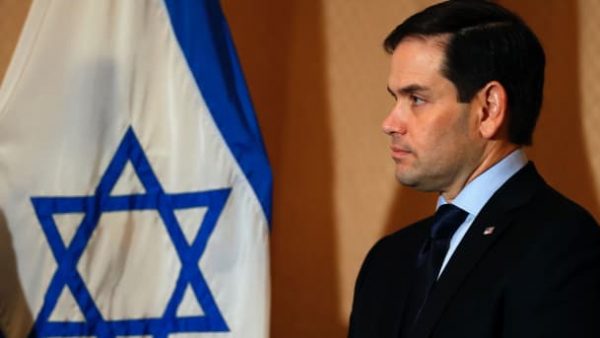
By Philip Giraldi • Unz Review • February 12, 2019
Americans consistently indicate in opinion polls that they approve of congress less than any other part of the federal government. The approval rating is sometimes in the single digits. As the congress was intended, per the Founders, to serve as the direct link to the American people, there is a certain irony in its being the most despised branch of government.
One can blame the two major parties for much of the negativity, as the process whereby candidates for office rise through the system that seems designed to weed out anyone who has ever expressed any viewpoint that is not approved by the bipartisan establishment. Indeed, many Americans complain that Democratic and Republican congress critters differ only superficially, both being corrupt from top to bottom and largely driven to stay on top so they can continue to benefit personally from the spoils of office.
One of the emptiest of all the empty suits in the Senate is Marco Rubio of Florida. The boyish looking Rubio is, to be sure, ambitious, but his thought processes, if they exist at all, are hard to discern. He is, more than most congressmen, both totally ignorant and completely programed in what he says and how he says it. Anyone who doubts that judgement should watch the February 2016 debate with former New Jersey governor Chris Christie in which Christie totally destroyed Rubio, effectively ending his bid to become the GOP candidate for president. Christie criticized Rubio for memorizing a “25-second speech that is exactly what his advisers gave him.” The two argued, but Rubio seemed stuck with his stump speech, which Christie called him out on every time he launched into it. Christie eventually turned and told the audience “There it is. The 25-second memorized speech.”
Rubio is pretty much straight-line neocon in his pronouncements, his most recent policy statement being that the Venezuelan people have two choices – change their government or starve. He tweeted it with his usual eloquence: “Hunger & desperation is growing inside #Venezuela & people know the only thing standing in the way of $50 million of food & medicine is #Maduro. Military leaders should make a choice, before a choice is made for them. The window for a negotiated exit is closing fast.” Columnist Whitney Webb responded with “Marco Rubio is openly saying that if Venezuela’s military doesn’t turn on Maduro soon, ‘a choice will made for them’ by the United States. Scariest threat for an imminent invasion of Venezuela I have yet to see.”
Rubio, who is Cuban-American, is inevitably hard-line against taking any steps to improve relations with his ancestral homeland, is hostile to “enemies” Russia and China, and wants American soldiers to stay in Afghanistan and Syria forever. It is a formula for continuous conflict worldwide, with the United States paying the tab both in dollars and in casualties.
But Senator Marco Rubio’s greatest affection is reserved for the Jewish state Israel. Why? Because that’s where his money and political support come from, and, for its part, the Israel Lobby sees Rubio as a perfect simple-minded patsy to advance its agenda. Israel’s promoter with the deepest pockets, casino magnate Sheldon Adelson, was pursued by Rubio who “… consistently championed Israel in speeches on the Senate floor while also pushing legislation aimed at supporting the cause” during the GOP nomination process. Rubio eventually received Adelson’s endorsement in February 2016.
Before acquiring Adelson’s support, Rubio had “already gained support from Miami billionaire Norman Braman and New York billionaire investor Paul Singer, among others.” Both Braman and Singer are known to be major supporters of Israel. Marco’s affection for both Israel and Florida Jews derives largely from his connection to Braman, a former Philadelphia Eagle’s owner and currently a billionaire Miami resident who owns Florida’s largest network of car dealerships. Braman, an active supporter and funder of the illegal Jewish settlements in the Middle East, has been Rubio’s major financial backer since his early days in Florida state politics and as a quid pro quo whenever Marco expresses his love for both Jews and Israel, he is speaking to and for Braman.
Rubio has recently written, or had written for him, an op-ed in The New York Times entitled “The Truth About BDS and the Lies About My Bill” that seeks to explain why recent legislation to protect Israel that the senator sponsored does not violate the First Amendment guarantee of free speech.
Senate bill S.1 for 2019 finally passed out of the Senate last week on a 77 to 23 vote with Rand Paul as the only Republican Senator to vote against it. The full title of S.1 is the Strengthening America’s Security in the Middle East Act of 2019, which might be considered a bit of a fraud as it has nothing to do with the United States and is really all about giving Israel money and anything else it might desire, to include destroying the nonviolent Boycott, Divestment and Sanctions (BDS) movement that has targeted Israel’s apartheid. In his speech defending the bill, Rubio openly admitted that he was seeking to help Israel. He also registered his opposition to the impending pullout of U.S. troops from Syria because it would, according to him, “endanger” the Jewish state.
Rubio’s op-ed was written before the final vote on February 5th, but it predicted correctly that the bill would receive “a bipartisan supermajority” in the Senate. Anything having to do with Israel normally receives such “supermajorities” from congressmen who are intimidated, or expecting to be raptured shortly or on the Israel Lobby payroll.
The op-ed’s author comes out swinging, declaring that critics have “echoed false claims made by anti-Israel activists and others that the bill violates Americans’ First Amendment rights. That line of argument is not only wrong but also provides cover for supporters of the Boycott, Divestment and Sanctions movement, who embrace an international campaign of discriminatory economic warfare against Israel, a fellow democracy and America’s strongest ally in the Middle East.”
One supposes that “anti-Israel activists” consist of that increasing number of Americans who want to see Israel held accountable for its war crimes and crimes against humanity. Yes indeed, a boycott is “discriminatory economic warfare” using peaceful and non-threatening means to bring about change. And no, Israel is neither a democracy nor an ally of the United States. Has the Senate approved a treaty of alliance with Israel, Marco? You’re in the Senate and should know the answer to that one.
Rubio goes on to claim that “the goal of the movement is to eliminate any Jewish state between the Jordan River and the Mediterranean Sea.” Wrong again Marco. Even if some BDS supporters might like to see that, it is not a “goal of the movement.” The movement is non-violent and Israel has a large army that would make such an objective a fantasy.
The author then describes how “While the First Amendment protects the right of individuals to free speech, it does not protect the right of entities to engage in discriminatory conduct. Moreover, state governments have the right to set contracting and investment policies, including policies that exclude companies engaged in discriminatory commercial -or investment- related conduct targeting Israel… That’s why, since 2015, more than 25 states, including Florida, have adopted laws or issued executive orders to divest from or prohibit contracts with companies that wage discriminatory economic warfare against Israel.” Wrong again Marco. Free speech includes supporting discriminatory conduct. The American Civil Liberties Union has addressed the issue succinctly, arguing correctly that “Public officials cannot use the power of public office to punish views they don’t agree with. That’s the kind of authoritarian power our Constitution is meant to protect against.” And several state laws protecting Israel from the First Amendment have already been ruled unconstitutional.
Marco then expands on his argument, “The Combating BDS Act does not infringe on Americans’ First Amendment rights or prohibit their right to engage in boycotts. By design, it focuses on business entities — not individuals — … it focuses on conduct, not speech. Indeed, it does not restrict citizens or associations of citizens from engaging in political speech, including against Israel.” Indeed Marco, but how do you explain the fact that several of the well-publicized cases involving BDS legislation have involved individuals not “business entities” who refused to sign pledges regarding Israel, which, when last I checked, was not even part of the United States and has nothing to do with contracting in this country? Those individuals have been denied government benefits and have been fired from jobs they had held for years.
And then there is the hypocrisy issue for Marco Rubio. If openly and vocally opposing trade with or travel to Cuba should similarly be suppressed, would he and his Cubanos associates consider that to be constitutional or perfectly legal? I think not. And Cuba, as far as I know, does not line up snipers to shoot children and medical workers while also stealing land from its rightful owners. Israel is a racist apartheid state. Cuba, for all its faults, is not.
It would be difficult to find more insipid justifications for S.1 than those provided by Marco Rubio. He does not understand that the “state” at all levels is supposed to be politically neutral in terms of providing government services. It is not supposed to retaliate against someone for views they hold, particularly, as in this case, when those views are part of a nonviolent opposition to the policies of a foreign government that many consider to be guilty of crimes against humanity. Rubio clearly believes that you can exercise free speech but government can then punish you by taking away your livelihood or denying you services that you are entitled to if you do not agree with it on an issue that ultimately has nothing to do with the United States. How such a lightweight came to be a Senator of the United States of America eludes me.
Philip M. Giraldi, Ph.D., is Executive Director of the Council for the National Interest, a 501(c)3 tax deductible educational foundation that seeks a more interests-based U.S. foreign policy in the Middle East. Website is www.councilforthenationalinterest.org, address is P.O. Box 2157, Purcellville VA 20134 and its email is inform@cnionline.org.
Featured Video
Racist Seinfeld Dances for Joy as Bibi Unveils His New Map
or go to
Aletho News Archives – Video-Images
TV Drama Review
Japanese drama projects Japan’s wartime atrocities onto Chinese characters

Global Times | October 25, 2026
By portraying Chinese characters as perpetrators of ruthless violence while casting Japanese Self-Defense Forces (SDF) intelligence operatives as defenders, the season 2 of the Japanese drama Vivant has recently drawn criticism from Chinese netizens, who argue that its depiction turns historical reality on its head while ignoring Japan’s wartime atrocities.
The TBS drama series – a spy suspense story in which an alleged unofficial intelligence unit of the SDF operates across the globe — has attracted a passionate fanbase. Its currently airing season 2 opened with a household rating of 18.8 percent, the highest for a TV drama this year, according toa commentary article by Japanese media Toyo Keizai.
What draws attention is the portrayal of the enemies in the series, the article noted. Scenes in which the Chinese organization subjects kidnapped members of the SDF unit to brutal torture are repeated with unrelenting intensity.
It is rare for Japanese TV dramas to explicitly portray a real-life country as the enemy, the article noted.
Japanese Prime Minister Sanae Takaichi also made a reference to the drama, saying that she has been recording Vivant and hopes to binge-watch it over the year-end and New Year holidays, according to Japanese media outlets.
China’s CCTV News report on Sunday revealed that the drama features scenes in which Chinese personnel cut off the fingers of and stab Japanese intelligence operatives in the abdomen. Such acts bear striking similarities to the torture inflicted on Chinese nationals by invading Japanese troops during the World War II.
The drama distorts the truth by attributing these atrocities to modern Chinese characters. Beneath the surface, it subtly glorifies Japan’s cross-border overseas operations, blurs the functional boundaries of the SDF and implicitly promotes an expansionist narrative, per CCTV News. … continue
Blog Roll
 Aletho News
- Iran FM Araghchi: “Hormuz Will No Longer Be the Same”
- EU facing trillion-euro debt hole while seeking more cash for Kiev
- How US, Europe, Persian Gulf states exhausted missile stockpiles, splurged billions to defend Israel
- Up in arms… Koreans reject U.S. empire’s plan to make South Korea the next Ukraine
- Iran, Turkey, Pakistan, Saudi Arabia could advance region-led security framework in Tehran: FM spox
- Netizens condemn Japanese drama for projecting Japan’s wartime atrocities onto Chinese characters
- Racist Seinfeld Dances for Joy as Bibi Unveils His New Map
- A West Bank War for Netanyahu’s Election Campaign, Could It Backfire?
- Yemen denounces European Parliament’s ‘hypocritical’ push to blacklist Ansarullah
- Qalibaf: UAE’s UN bid aims to ‘clear the runway’ for ‘Greater Israel’, whitewash genocide
- If Americans Knew
- An error has occurred; the feed is probably down. Try again later.
- No Tricks Zone
- Sudden Stratospheric Warming, Powerful El Niño Combination May Lead To Extreme Europe Cold, Energy Crisis!
- Two New Studies Find Thwaites Glacier Melt Cannot Be Driven By Human Activity Or A Warming Ocean
- E-Cars Reduce CO2 Emissions By Only 41% Compared To Internal Combustion Engine Vehicles
- Predictions Made By Renowned Climate Professor Over Past Decades Have Been Proven To Be Poor
- New Study Suggests Large Regions Of The Pacific Ocean Have Been Cooling For The Last 80 Years
- Germany’s Green Energy Debacle: High Energy Costs Force Kahla Porzellan to Close After 182 Years!
- New Study: 50 Years Of The Most Aggressive ‘Net Zero’ Policies Can Only Affect The Global Climate By 0.03°C
- US September “Heat” Was No Record…Many Records Set Decades Ago
- Latest European Green Energy Debacle; Portugal’s Largest Flagship Solar Park Insolvent!
- Green Energy Debacle: German Expert Professor Fritz Vahrenholt Warns Of Severe Economic And Social Consequences

