Maduro Denies Hezbollah Ties, Mocks Pompeo’s Charge As “Proven Lies”
By Tyler Durden – Zero Hedge – 02/09/2019
One day after US Secretary of State Mike Pompeo claimed Hezbollah was “active” and operating inside of Venezuela, embattled President Nicolas Maduro responded in a televised speech in Caracas slamming Pompeo’s allegation which had also hinted at Iranian connections as”lies that have been proven false.”
According to Maduro, “Hezbollah is a legal political party within Lebanon’s political life. Hezbollah is primarily a political party, with ministers, deputies, and elected officials.”
“We do not have, nor have we had any political relations with the Hezbollah political party. There are many Lebanese living in Venezuela,” he continued during the Friday statement, as translated by Al-Masdar News journalist Renato Velez. Acknowledging the historic roots of Arab communities in Latin America and Venezuela, he continued, “Long live the Lebanese, Syrian and Palestinian Arab colonies in Venezuela.”
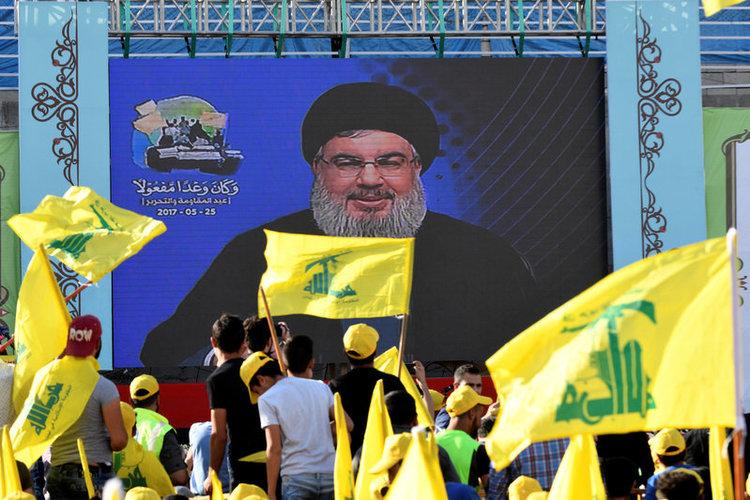
Hezbollah Secretary-General Hassan Nassrallah
“The U.S. will continue to spread lies – lies that have been proven false. The Lebanese in Venezuela have political freedom and Venezuela, in order to defend itself, does not need cells of anyone in the world. We will defend ourselves,” he added.
He was responding specifically to Pompeo’s Wednesday night interview with Fox Business wherein Pompeo implied the Maduro government was allowing the US-designated terror group to have a base of operations in Venezuela. We noted previously that what looked like an apparent failure to come up with an even remotely original narrative for another imminent American intervention, Pompeo asserted during the interview that “Hezbollah has active cells in Venezuela.”
He said that “people don’t recognize that Hezbollah has active cells” in the country, adding that “the Iranians are impacting the people of Venezuela and throughout South America. We have an obligation to take down that risk for America” he said further, as quoted by the Independent.
Ironically or not, when it comes to Hezbollah, which the US has long considered a terrorist organization, sanctions on people in Venezuela linked to the Iranian-backed Lebanese group have been imposed as far back as the George W Bush administration, seemingly in anticipation for just such an event.
Washington also believes Latin America has served as a base of fund-gathering for the group for some years, including through drugs and money-laundering schemes, according to past reports and to justify said close link, the media notes that Venezuela’s former president Hugo Chavez formed tight links with Iran under Mahmoud Ahmedinejad’s leadership. Supposedly that is a sufficient and necessary condition to conclude that Maduro is now harboring terrorists, which in turn would require a US “peacekeeping” mission.
And just so the US population does not lose plot, later in his Wednesday evening Fox interview, the former CIA director described Maduro as “evil” and insisted the US was intervening on behalf of ordinary Venezuelans who have suffered under his rule. In other words, yet another “humantiarian” coup under US auspices.
“We should not permit a country in our hemisphere to treat its own people this way,” he said, despite Washington’s – and the CIA’s – dismal track record of fomenting government overhauls in the region. “American values – America’s, not only our interests but our values – are at stake here.” But it wasn’t clear just which values he was referring to.
As US Laments Human Rights in Venezuela, US-Allied Colombia Descends into Drug-fueled Humanitarian Crisis
By Whitney Webb | MintPress News | February 8, 2019
BOGOTÁ, COLOMBIA – Several troubling situations are currently playing out across Colombia, yet the country’s continuing downward spiral into drug-fueled and politically-motivated violence has caused little concern in Washington, offering yet another clear indication that the U.S.’ current posturing on Venezuela is hardly motivated by concerns about “democracy,” “human rights,” or the welfare of the Venezuelan people.
This, of course, can hardly be considered surprising, given that Colombia is a top U.S. ally whose government has long been closely aligned with Washington’s interests. However, although the lack of U.S. government or media attention to Colombia may effectively hide it from the American public, the country is becoming increasingly lawless, with cocaine production reaching new record levels and the government sanctioning the mass murder of the country’s largest indigenous group. Not only that but since Colombia’s new president, Iván Duque, came to power late last year, the number of indigenous social leaders who have been murdered has spiked to the highest levels in over a decade.
Ultimately, the lack of media coverage of Colombia’s humanitarian crises, which have large implications for the Americas as a whole, is a telling example of how such crises are regularly weaponized by governments and media to exclusively target governments it wishes to pressure or overthrow, while turning a blind eye to those same or worse acts when committed by an allied nation.
An absurdly double standard
Though it was Barack Obama who first deemed Venezuela a “national security threat” and re-initiated draconian sanctions against the oil-rich nation, the Trump administration has greatly increased the sanctions targeting Venezuela, often citing its government’s alleged participation in illegal drug trafficking as justification for doing so. However, the U.S. has offered little in the way of concrete evidence to back up those allegations.
During this same period, moreover, the Trump administration has expressed little concern for the booming illicit drug trade in neighboring Colombia, which has broken records for cocaine production for the last two years in a row. Though the Colombian government and military have been repeatedly tied to the country’s drug trade, the Trump administration – like previous U.S. administrations – hasn’t lifted a finger.
According to UN figures released last September, Colombia’s cocaine production has again broken records, with the country producing an estimated 1,379 tons of cocaine in 2017, the latest year for which such statistics exist. That figure is a 31 percent increase in cocaine production from 2016. 2016 itself was a record-breaking year with cocaine production gaining by 50 percent over 2015 levels.
Though Trump had threatened to decertify former Colombian President Juan Manuel Santos’ government over the rapid growth of cocaine production, he ultimately gave Colombia a pass in the U.S.’ annual determination of countries considered to be “major drug transit or major drug producing” areas “because the Colombian National Police and Armed Forces are close law enforcement and security partners of the United States in the Western Hemisphere.”
The document also described Venezuela, along with its regional ally Bolivia, as “countries that have failed demonstrably during the previous 12 months to adhere to their obligations under international counternarcotics agreements” despite the fact that Bolivia had the fewest illegal coca crops of any South American country that year.
Since getting a free pass from the Trump administration, Colombia’s current president, Iván Duque, has signaled his hopes to revive a failed, U.S.-backed program to indiscriminately spray suspected coca fields with the infamous Monsanto product glyphosate to reduce cocaine production.
Though the U.S. government and Western media have traditionally placed the blame on leftist guerillas in Colombia, like the FARC, the 2016 peace deal that saw the FARC abandon the drug trade has removed this convenient scapegoat and highlighted the long-standing role of the Colombian military and prominent right-wing politicians in cocaine production.
In fact, the United Nations Drug Control Program (UNDCP) has described the Colombian military — which has been armed and trained for decades by the U.S. under the Clinton era policy known as “Plan Colombia” — as being among “the biggest heroin and cocaine trading institutions.”
The Colombian government has also been intimately involved, particularly during the presidency of Álvaro Uribe, who allegedly served as the “head of Colombia’s paramilitary groups” both before and while in office. Uribe was once ranked by the U.S. Defense Intelligence Agency “on a list of 104 important narco-traffickers contracted by the Colombian narcotics cartels.”
There are also indications of the U.S. government’s own involvement in the Colombian cocaine trade. For example, Colombia’s most notorious drug trafficker, Pablo Escobar, at one point worked for the U.S. Central Intelligence Agency, according to Escobar’s own children. Escobar allegedly sold cocaine for the CIA to help the U.S. government finance its fight against communism and left-wing governments in Latin America.
As pointed out in the book Cocaine, Death Squads and the War on Terror: U.S. Imperialism and Class Struggle in Colombia, the U.S.’ anti-drug efforts in Colombia were never intended to eradicate cocaine, but instead alter the market share by ensuring that allies of the U.S. in Colombia – the Colombian government, paramilitaries and the wealthy elite who are favorable to U.S. business interests – could monopolize the drug trade with no competition from outsiders. Thus, it should hardly shock anyone that the U.S. continues to turn a blind eye to the country’s booming illegal drug trade and its associated violence, even as it continues to break records year after year.
Erasing the erasure of the Wayuú
As the long-standing, U.S.-backed plan to oust the Chavista regime in Venezuela has unfolded, Maduro’s government has been called out in Western media for “starving his own people,” despite the fact that U.S. sanctions imposed on Venezuela are a driving factor behind the country’s economic crisis. However, since 2011, Colombia has been the site of ongoing genocide against the country’s largest indigenous group – the Wayuú – in the country’s Guajira region, after the Colombian government diverted their only source of water to support the operations of the country’s – and continent’s – largest coal mine.
The suffering of the Wayuú, who have reported the deaths of at least 14,000 children due to the lack of clean water, has gone unreported by the same outlets that routinely raise concern about lack of essential goods in Venezuela. The Wayuú, who comprise around 20 percent of Colombia’s entire indigenous population and 48 percent of the Guajira region’s total inhabitants, are now on the brink of dying out completely seven years after the Ranchería river – their community’s only freshwater source – was diverted by the government-constructed Cercado dam in order to service the water needs of the Cerrejón coal mine.
An estimated 37,000 Wayuú now suffer from severe malnutrition, as they can no longer grow crops or raise livestock without a freshwater source. Each person in the community now lives off of less than 0.7 liters (24 oz.) of water a day while the Cerrejón mine guzzles more than 2.7 million liters of water in a 24-hour period – most of which is used to improve mine “visibility” by minimizing dust pollution. Despite the clear impact of the dam and mine on the humanitarian crisis facing the Wayuú, the Colombian government and supportive Western media have blamed “climate change” and weather patterns like El Niño for the situation.
The most likely reason for the erasure of the slow genocide of the Wayuú from Western media is the fact that the Cerrejón mine is a largely a U.S.-backed operation, as the mine was originally founded by ExxonMobil and is now owned by a consortium of largely Western mining companies such as Anglo American and BHP Billiton. These same mining companies often work with right-wing paramilitary groups — who are also closely connected to the Colombian government — and who repeatedly threaten the lives of Wayuú who speak up about their people’s suffering, including their chief legal advocate, Javier Rojas Uriana.
Notably, the Colombian Wayuú have been immigrating to the Wayuú community in Venezuela in order to avoid the slow death caused by malnutrition, lack of water, and waterborne illnesses from the polluted water from the community’s remaining wells. The Venezuelan Wayuú have been largely supportive of Chavismo and have backed the Maduro-led government, referring to U.S.-backed opposition protests as violent riots “intended to create chaos.” The Huffington Post noted in 2017 that the Wayuú’s support for Maduro had largely been erased by the Western media because it “does not match up with the media’s anti-Venezuelan government narrative.”
Liquidating social leaders, activists, human-rights advocates
While the fate of the Wayuú (and thus 20 percent of the country’s entire indigenous population) continues to hang in the balance, the plight of Colombia’s indigenous peoples has grown even worse since the recent inauguration of Colombian President Iván Duque.
Despite Duque’s having come to power just last August, El Tiempo recently reported that the murders of indigenous leaders in the country have spiked to levels unseen in over a decade since Duque became Colombia’s president. According to data cited by El Tiempo, 120 indigenous social leaders – as well as human-rights defenders — have been murdered in cold blood during Duque’s first 100 days in office.
Though the murder of social leaders by right-wing paramilitary groups has a standing problem in Colombia’s recent history, this level of targeted murder represents a spike over recent years — in which 226, 159, and 97 such murders occurred over the course of the entire years of 2018, 2017 and 2016, respectively. Notably, the Venezuelan government of Nicolás Maduro has been routinely accused by Western media of murdering opposition activists; yet, those same outlets have been silent on Colombia’s recent spike in activist murders.
Despite the jump, Duque’s government has expressed little concern. This is hardly surprising when one considers that Duque is the hand-picked successor and protégé of Álvaro Uribe, the former Colombian president who was once “the head of Colombia’s paramilitary groups,” according to former paramilitary group commanders of the right-wing death squad AUC, which has been funded by several prominent U.S. corporations.
Uribe, who was Colombia’s president from 2002 to 2010, and was a close ally of George W. Bush, was also personally implicated in organizing a massacre conducted by a right-wing paramilitary group; and his cousin, Colombian politician Mario Uribe, was charged with mobilizing right-wing death squads in the country to help secure Uribe’s presidential victory in 2002. Uribe’s brother was also arrested for founding a right-wing paramilitary group in 2016.
Under Uribe’s presidency, the Colombian military massacred thousands of civilians — such as in the “false positives” scanda,l where the Colombian military dressed up an estimated 5,000 civilians in guerilla clothing and killed them in cold blood, subsequently gaining a bonus from Uribe’s government for the sinister act. It should be no surprise then that, under Uribe, the murder rate of indigenous leaders and human-rights activists reached its all-time high at 1,912 murders in 2003.
Given Duque’s close relationship to Uribe, it is also little surprise that paramilitary groups have endorsed Duque following his election and have vowed to “exterminate” Duque’s opposition, calling prominent Colombian progressives “military targets.”
What to expect if US gets its way in Venezuela
If Washington’s publicly stated concerns about “human rights” and the welfare of a country’s people in Venezuela were genuine, it would be equally critical of Colombia’s government, given the numerous troubling situations currently unfolding in that country. Instead, the dichotomy between Washington’s relationship with Venezuela and Colombia is yet another clear example that the public justifications for the U.S.’s Latin America policy are little more than window dressing for the U.S.-backed expansion of neo-fascist governments throughout Latin America.
Indeed, if Juan Guaidó – the self-declared, U.S.-backed “president” of Venezuela – manages to seize power in the country, the current state of affairs in Colombia is a telling harbinger of what would likely manifest should Nicolás Maduro be overthrown and replaced with the same type of government that the U.S. has either backed or installed in several Latin American countries over the last few decades, and particularly in recent years.
Whitney Webb is a staff writer for MintPress News and has contributed to several other independent, alternative outlets. Her work has appeared on sites such as Global Research, the Ron Paul Institute and 21st Century Wire among others. She also makes guest appearances to discuss politics on radio and television. She currently lives with her family in southern Chile.
William Hague Attacks Corbyn on Venezuela, Exposes Barbarism of Regime Change Policy
By Nina Cross | 21st Century Wire | February 8, 2019
The rhetoric of the establishment media and political class in their attempt to vilify the mildest dissent from Jeremy Corbyn is shocking, not because it is unexpected, but because it is now apparently normal to break international law and plot to overthrow a government. In fact it’s the done thing if Corbyn just hints disapproval. An article written by William Hague, former British Foreign Secretary, attacking Corbyn for his non-intervention stance on Venezuela shows our foreign policymakers are out of control.
Corbyn said on Friday that he opposes “outside interference in Venezuela” and that Jeremy Hunt was wrong to call for more sanctions on the regime. He clearly does not agree with those governments now recognising Juan Guaido as the new and legitimate leader of the country. This is a hugely revealing moment, which tells us a great deal about the limits of any moral compass in Corbyn’s mind.
William Hague’s gunning for the overthrow of Maduro comes as no surprise, given his role in the overthrow of Libyan leader Muammar Gadhafi in 2011. In an interview in 2016 on his role in the destruction of Libya he offered advice for when the British Foreign Office next planned to overthrow a government:
A major issue for future interventions is that the leaders who were well-liked disappeared from the scene very quickly… Future interventions’ need longer transitions…
At the time of Hague’s comments, the consequences of the invasion of Libya by the UK, France and the US had had years to take root. They include the genocide of Blacks, slavery, a refugee crisis, and thousands of people drowning at sea in an attempt to flee the resulting conflict and they are still unfolding. Hague does not have regrets about Libya; he could only make ‘unpalatable choices.’ In fact, he says if he had to do it again, he would not avoid intervention. Perhaps if Hague lived in Libya and experienced the results of his plotting he might have a different view. For now he is keen to do it all over again:
But even more telling is the justification he (Corbyn) uses for his position – hostility to “outside interference”. This is the language of authoritarian rulers the world over, the constant refrain of those who fear a compassionate and responsible world coming to the aid of people they have impoverished and oppressed.
In 2011 Hague helped lead an attack that not only destroyed Libya but destabilised the entire region around it. In 2016 he was still talking about overthrowing governments, and in 2019 he is comparing Corbyn to a dictator for rejecting regime change. This is not so surprising given that in his article Hague presents intervention as a noble cause, and this is also how he presented it when defending his role:
“The threat, the possibility, the stated intentions – of the Gadhafi government to kill large numbers of people – the Arab League thought it was going to happen…”
But, the massacre did not take place, and Hague’s ‘stand against tyranny’ to ‘prevent another Rwanda’ can be seen for what it was. What took place in Libya has been described as an insurrection planned months in advance. Confirmation of this is found in emails released by Wikileaks in its Global Intelligence Files:
He (Abdelhakim Belhaj) and his men were being trained for the siege of Tripoli for months, however. This is a prime example of the secret side of the war that NATO, France, the UK, U.S. and Qatar were fighting.
Hilary Clinton’s emails also released by Wikileaks further question the motive for regime change in Libya following revelations that Gadhafi was intending to create a pan-African currency based on the Libyan gold Dinar.
‘Venezuela’s agonies expose the heartlessness of Corbyn’s dogma.’
Read my latest @Telegraph articlehttps://t.co/zaE8bD98Mf— William Hague (@WilliamJHague) February 5, 2019
This is not Hague’s only attempt to shape public opinion with selective facts and rhetoric. He also deceived the British public and Parliament about the events in Ukraine in 2014. He claimed falsely that the removal of the elected President Yanukovych was in accordance with the constitution of Ukraine. Hague’s statement was designed to mask the US intervention, which led to the overthrow of the Yanukovych government, presented to Western audiences as a colour revolution.
As well as joining in a needless aggression on Libya that led to a failed state, Hague was influential in easing the arms embargo in Syria so he could supply arms to the opposition. As it was recognised that the opposition included many Islamist extremists this ran the risk of weapons ending up in the hands of terrorists. He supported crippling sanctions that added to the misery of the population while at the same time he enabled lifting of some sanctions so that the ‘opposition’ could sell Syria’s oil to the EU. So Venezuela makes number four on Hague’s hit list of interventions that now spread across entire regions of the world: North Africa, the Middle East, Europe. The next stop: South America.
Hague is likely to approve of the weapons used against Venezuela to gather imperialist muscle. One such weapon is the Lima Group. Informal gatherings of concerned nations are useful in that they present a picture of neighbourly humanitarian concern while carrying out acts of aggression on their target. The purpose of the Lima Group has always been to bring down the Venezuelan government. Its very existence undermines the non-intervention clause of the Organisation of American States Charter which each member individually signed. The Friends of Syria, attended by Hague while Foreign Secretary, had a similar purpose. Like the Lima Group its members were also US allies and stakeholders in intervention. These ‘friendly’ groups were set up to isolate and force the governments into submission regardless of the consequences on the civilian population.
This is a list showing ways the Lima Group is trying to subordinate Venezuela but it may not be comprehensive:
travel sanctions against members of the Venezuelan government
economic sanctions
cutting diplomatic ties
enlisting the International Criminal Court and other Western institutions
freezing of assets
accusations such as sponsoring of terrorism
discrediting legitimacy of elected leaders
floating the idea of military intervention either as a genuine threat or as a form of intimidation
using humanitarian aid to gain access and influence
appealing to internal and sovereign institutions such as the military
supporting US-backed opposition
The Friends of Syria created the same list for the Syrian government and added the supply of arms to groups they knew included Islamist extremists.
Another mechanism used by Hague in the past is the creation of puppet governments, especially useful when the US and EU arm non-state actors in violation of international law. Western audiences are expected to believe interim governments spontaneously and conveniently pop-up when NATO decides to invade a country, and these new interim governments are sympathetic to NATO and the US for some reason. Interim governments or councils in each country targeted for intervention have almost always included groups linked to extreme ideology. In Venezuela the self-proclaimed ‘interim President’ Juan Guaido is of the right-wing Popular Will party that has a history of violence and collusion with the US government, and Guaido’s own involvement has been uncovered.
Given that the US-backed opposition attempting to overthrow the elected Venezuelan government is so divided and violent, it is fitting that Hague, after years of supporting ‘rivalling moderate rebels’ sees them as just a…
‘… united and moderate opposition.’
Pompeo: America ‘obligated’ to fight ‘Hezbollah’ in Venezuela to save ‘duly elected’ Guaido
RT | February 7, 2019
Straining to explain Washington’s eagerness for regime change in Caracas, Secretary of State Mike Pompeo said Cuba was already occupying Venezuela, misunderstood how democracy works, and claimed Iran had a presence in the country.
While navigating extremely delicate issues like international diplomacy for most world leaders requires finesse and sophistication, Pompeo opted for a more ham-fisted approach in an interview with Fox Business on Wednesday. Weaving together a loosely-knit narrative of garish moralizing and lists of countries on America’s naughty list, President Donald Trump’s chief diplomat attempted to help American audiences understand what the State Department is doing in Venezuela.
After making the expectant accusations of Russian and Chinese interference in Venezuela, Pompeo decided to mobilize his go-to excuse for US meddling – Iran!
“People don’t recognize that Hezbollah has active cells — the Iranians are impacting the people of Venezuela and throughout South America,” adding that “We have an obligation to take down that risk for America.”
It might seem that Pompeo merely has trouble with geography, having recently shared a bizarre map on Twitter that featured the non-existent countries of East and West Turkey, among other things. However, in the course of the interview, he also made several other puzzling declarations, such as referring to self-declared Venezuelan leader Juan Guaido as having been “duly elected,” even though the Washington-backed politician never even ran for president.
When asked why the issue was so important for “our hemisphere,” Pompeo answered that “American values are at stake,” in Venezuela. He believes US interference in internal affairs of Venezuela is an “obligation,” although last year he waxed concerned about alleged foreign interference in US elections.
US sanctions, he went on to explain, “aren’t aimed at the Venezuelan people,” but are instead aimed at “a really good outcome.” Though it was Pompeo who openly argued that US sanctions against Iran were intended to effect regime change by starving its citizens, he tried to argue that in Venezuela US sanctions are “for the good” of the Venezuelan people because they are against the “evil Mr Maduro.”
UN-appointed human rights expert Idriss Jazairy has a different opinion on the matter. While failing to spell out who is good and who is evil, he did point out that the sanctions against Venezuela may “lead to starvation and medical shortages.”
Just in case these helpful sanctions packages don’t end up being “really good” enough, the US is not ruling out plan B: military invasion. A few days ago, Trump told CBS a military option was still on the table, despite overwhelming opposition on both sides of the Venezuelan crisis.
Pompeo brushed off rumors of a possible US invasion, saying the US technically can’t invade Venezuela because “Cuba already did” and has been secretly controlling the country “for an awful long time.”
Uruguay, Mexico Unveil Four-Step Proposal on Venezuela Crisis
Al-Manar | February 7, 2019
Uruguay and Mexico on Wednesday unveiled a four-step proposal to end the political crisis in Venezuela.
The “Montevideo Mechanism” was announced by Uruguayan Foreign Minister Rodolfo Nin Novoa and his Mexican counterpart Marcelo Ebrard at a press conference in the Uruguayan capital one day before Montevideo is set to host an international meeting on Venezuela.
The first step calls for immediate dialogue to create conditions for direct contact between Venezuela’s ruling socialist party and President Nicolas Maduro on the one hand and the right-wing opposition led by self-proclaimed interim president Juan Guaido on the other, Novoa said.
That would be followed by a negotiation phase, a commitments phase, and a finally implementation phase, according to Novoa.
The proposal did not insist on holding snap presidential elections as the opposition had been demanding.
“If we ask for elections at such a moment, we are imposing conditions that hinder dialogue,” said Novoa.
Uruguay and Mexico have also proposed three prominent regional figures to advance the mechanism: ex-president of the Inter-American Development Bank Enrique Iglesias, former Mexican foreign affairs secretary and former judge of the International Court of Justice Bernardo Sepulveda, and Ibero-American Secretary General Rebeca Grynspan, a Costa Rican economist and former United Nations under-secretary-general.
Juan Guaidó: The Man Who Would Be President of Venezuela Doesn’t Have a Constitutional Leg to Stand On
By Roger D. Harris | Dissident Voice | February 6, 2019
Donald Trump imagines Juan Guaidó is the rightful president of Venezuela. Mr. Guaidó, a man of impeccable illegitimacy, was exposed by Cohen and Blumenthal as “a product of a decade-long project overseen by Washington’s elite regime change trainers.” Argentinian sociologist Marco Teruggi described Guaidó in the same article as “a character that has been created for this circumstance” of regime change. Here, his constitutional credentials to be interim president of Venezuela are deconstructed.
Educated at George Washington University in DC, Guaidó was virtually unknown in his native Venezuela before being thrust on to the world stage in a rapidly unfolding series of events. In a poll conducted a little more than a week before Guaidó appointed himself president of the country, 81% of Venezuelans had never even heard of the 35-year-old.
To make a short story shorter, US Vice President Pence phoned Guaidó on the evening of January 22nd and presumably asked him how’d he like to be made president of Venezuela. The next day, Guaidó announced that he considered himself president of Venezuela, followed within minutes by US President Trump confirming the self-appointment.
A few weeks before on January 5, Guaidó had been installed as president of Venezuela’s National Assembly, their unicameral legislature. He had been elected to the assembly from a coastal district with 26% of the vote. It was his party’s turn for the presidency of the body, and he was hand-picked for the position. Guaidó, even within his own party, was not in the top leadership.
Guaidó’s party, Popular Will, is a far-right marginal group whose most enthusiastic boosters are John Bolton, Elliott Abrams, and Mike Pompeo. Popular Will had adopted a strategy of regime change by extra-parliamentary means rather than engage in the democratic electoral process and had not participated in recent Venezuelan elections.
Although anointed by Trump and company, Guaidó’s Popular Will Party is not representative of the “Venezuelan opposition,” which is a fractious bunch whose hatred of Maduro is only matched by their abhorrence of each other. Leading opposition candidate Henri Falcón, who ran against Maduro in 2018 on a neoliberal austerity platform, had been vehemently opposed by Popular Will who demanded that he join their US-backed boycott of the election.
The Venezuelan news outlet, Ultimas Noticias, reported that prominent opposition politician Henrique Capriles, who had run against Maduro in 2013, “affirmed during an interview that the majority of opposition parties did not agree with the self-swearing in of Juan Guaidó as interim president of the country.” Claudio Fermin, president of the party Solutions for Venezuela, wrote “we believe in the vote, in dialogue, we believe in coming to an understanding, we believe Venezuelans need to part ways with the extremist sectors that only offer hatred, revenge, lynching.” Key opposition governor of the State of Táchira, Laidy Gómez, has rejected Guaidó’s support of intervention by the US, warning that it “would generate death of Venezuelans.”
The Guaidó/Trump cabal does not reflect the democratic consensus in Venezuela, where polls consistently show super majorities oppose outside intervention. Popular opinion in Venezuela supports negotiations between the government and the opposition as proposed by Mexico, Uruguay, and the Vatican. The Maduro administration has embraced the negotiations as a peaceful solution to the crisis facing Venezuela.
The US government rejects a negotiated solution, in the words of Vice President Pence: “This is no time for dialogue; this is time for action.” This intransigent position is faithfully echoed by Guaidó. So while most Venezuelans want peace, the self-appointed president, backed by the full force of US military power, wrote in a New York Times op-ed that it was possible to “end the Maduro regime with a minimum of bloodshed.”
The Guaidó/Trump cabal’s fig leaf for legitimacy is based on the bogus argument that Article 233 of the Venezuelan constitution gives the National Assembly the power to declare a national president’s “abandonment” of the office. In which case, the president of the National Assembly can serve as an interim national president, until presidential elections are held. The inconvenient truth is that Maduro has shown no inclination to abandon his post, and the constitution says no such thing.
In fact, the grounds for replacing a president are very clearly laid out in the first paragraph of Article 233 of the Venezuelan constitution and do not include fraudulent or illegitimate election, which is what the cabal has been claiming. In the convoluted logic of the US government and its epigones, if the people elect someone the cabal doesn’t like, the election is by definition fraudulent and the democratically elected winner is ipso facto a dictator.
The function of adjudicating the validity of an election, as in any country, is to be dealt with through court challenges, not by turning to Donald Trump for his approval. And certainly not by anointing an individual from a party that could have run in the 2018 election but decided to boycott.
The Supreme Tribunal of Justice (TSJ), which is the separate supreme court branch of the Venezuelan government has certified Maduro’s reelection, as have independent international observers. Further, no appeal was filed by any of the boycotting parties, while all participating parties – including opposition ones – signed off on the validity of the election after the polls closed.
The far-right opposition has boycotted the high court as well as the electoral process. They contest the legitimacy of the TSJ because some members of the TSJ were appointed by a lame duck National Assembly favorable to Maduro, after a new National Assembly with a majority in opposition had been elected in December 2015 but not yet seated.
Even if President Maduro were somehow deemed to have experienced what is termed a falta absoluta (i.e., some sort of void in the presidency due to death, insanity, absence, etc.), the National Assembly president is only authorized to take over if the falta absoluta occurs before the lawful president “takes possession.” However, Maduro was already “in possession” before the January 10, 2019 presidential inauguration and even before the May 10, 2018 presidential election. Maduro had won the presidency in the 2013 election and ran and won reelection last May.
If the falta absoluta is deemed to have occurred during the first four years of the presidential term, the vice president takes over. Then the constitution decrees that a snap election for the presidency must be held within 30 days. This is what happened when President Hugo Chávez died while in office in 2013. Then Vice President Nicolás Maduro succeeded to the presidency, called for new elections, and was elected by the people of Venezuela.
If it is deemed that the falta absoluta occurred during the last two years of the six-year presidential term, the vice president serves until the end of the term, according to the Venezuelan constitution. And if the time of the alleged falta absoluta is unclear – when Maduro presided over “illegitimate” elections in 2018, as is claimed by the far-right opposition – it is up to the TSJ to decide, not the head of the National Assembly or even such an august authority as US Senator Marco Rubio. Or the craven US press (too numerous to cite), which without bothering to read the plain language of the Bolivarian Constitution, repeatedly refers to Guaidó as the “constitutionally authorized” or “legitimate” president.
As Alfred de Zayas, United Nations independent expert on the promotion of a democratic and equitable international order, tweeted: “Article 233 of the Venezuelan constitution is inapplicable and cannot be twisted into legitimizing Guaidó’s self-proclamation as interim President. A coup is a coup.”
Roger D. Harris is with the Task Force on the Americas and the Campaign to End US/Canada Sanctions Against Venezuela.
Why are Democrats Driving Regime Change in Venezuela?
By William Walter Kay | Ron Paul Institute | February 6, 2019
Many see President Trump conspiring with oilmen to capture Venezuelan petroleum reserves. Trump’s earlier blunt talk about seizing oilfields buttresses this thesis. As well, ExxonMobil, ConocoPhillips and Chevron appreciate better than anyone the astronomic value of Venezuela’s heavy oil. There are, however, flaws in the petro-conquistador thesis. Foremost, it does not explain why oil-resistant Democrats and Europeans play lead roles in this regime change travesty.
On December 18, 2014 a Democrat-led Senate passed the Venezuela Defense of Human Rights and Civil Society Act. This legislation, sponsored by Democratic Senator Robert Menendez, imposed sanctions on Venezuela while promising support for Venezuelan “civil society.” The Act also sought to meet “the information needs of the Venezuelan people” through publications and broadcasts; and through “distribution of circumvention technology.” Obama signed immediately.
On March 9, 2015 Obama declared:
… a national emergency with respect to the unusual and extraordinary threat to the national security and foreign policy of the United States presented by the situation in Venezuela.
His accompanying Executive Order 13692 extended sanctions while undertaking to: “support greater political expression in Venezuela.”
At this time the US deep state conducted an orchestra of American and European agencies and foundations disbursing $50 million a year to Venezuelan “civil society” (opposition politicians, student activists and journalists). Key agencies were USAID and National Endowment for Democracy. Participating foundations included: (Jimmy) Carter Centre; (Soros’s) Open Society; (Democratic Party-affiliated) National Democratic Institute for International Affairs; plus several Spanish and German concerns.
On January 16, 2017, four days before Trump’s inauguration, Obama renewed his declaration designating Venezuela a national security threat. Venezuela’s Foreign Minister called the move “new aggression by Barack Obama” extending Obama’s “legacy of hate and serious violation of international law.”
On January 4, 2019 a Democrat-led House of Representatives swore in.
On January 10 House Foreign Affairs Committee Chair, Eliot Engel (Democrat-NY) said he would waste no time holding “Mr. Maduro” accountable. Simultaneously, former DNC Chair and Hillary Clinton fixer, Democratic Congresswoman Debbie Wasserman-Schultz unveiled her Venezuelan-Russian Threat Mitigation Act. She was flanked by former Clinton cabinet member and Clinton Foundation boss, Democratic Congresswoman Donna Shalala who announced her Venezuelan Arms Restriction Act to prevent weapons sales, including non-lethal police gear, to Venezuela. Next up was Democratic Congresswoman Debbie Mucarsel-Powell, sponsor of the Venezuelan Humanitarian Assistance Act aimed at allowing US operatives to bypass Venezuelan authorities and distribute “aid” directly to Venezuelans.
On January 24, less than 24 hours after Juan Guaido declared himself Venezuelan President, Democratic Congressman Adam Schiff (House Intelligence Committee Chair) blamed Maduro’s “dictatorial” rule for devastating Venezuela’s economy, then recognised Guaido as Venezuela’s “rightful leader.” Senate Minority Whip Dick Durbin (Democrat-IL) piped in calling Venezuela’s 2018 election a sham before endorsing Guaido’s presidency.
Of 280 Democratic Senators and Representatives 3 dissented. This troika did not include Bernie Sanders. On January 24 Bernie boarded the war-train with a battle-whoop beginning:
The Maduro government in Venezuela has been waging a violent crackdown on Venezuelan civil society, violated the constitution by dissolving the National Assembly and was re-elected last year in an election that many observers said was fraudulent. Further the economy is a disaster and millions are migrating.
Bernie goes on to warn of the perils of regime change while leaving wide open the door to punitive sanctions. His statement is silent on America’s economic war on Venezuela. His support for “civil society” is willfully naïve about such groups’ involvement in political meddling up to and including regime change. (Bernie supported starvation sanctions against Iraq, and the bombing of Serbia. He calls Hugo Chavez a “dead communist dictator.”)
Regarding Venezuela the Democrats march in lockstep with: the Liberal Party of Canada under PM Trudeau; Merkel’s ruling coalition in Germany; French President Macron; and the governments of Sweden, Denmark, Austria and Spain.
These governments are committed to phasing petroleum out of their economies. All champion the Paris Climate Accord. None can be quickly dismissed as Exxon’s goons. None take orders from Trump. Thus, the petro-conquistador thesis appears ill-equipped to explain their behaviour.
No doubt Washington DC hosts cabals of oilmen and politicos coveting unfettered access to the Orinoco Belt. Here, however, it seems fantastical that President Maduro might be removed by anything short of civil war; or that the Orinoco Belt might be exploitable amidst the Vietnam-style conflagration surely to ensue. Then, arises the enigmatic spectacle of a dozen “liberal-leftist-environmentalist” Western parties and governments frantically tilting at the same windmill. Pourquoi?
Against Intervention in Venezuela: The Case of the Caribbean Community
By Maximilian Forte | Zero Anthropology | February 6, 2019
As discussed in the previous article, the membership of the Organization of American States is in fact not at all united around support for foreign intervention and recognition of an alternative second “president” (Juán Guaidó). Standing opposed to the denial of recognition of Maduro’s legitimacy as the elected leader are not just Cuba, Nicaragua, Bolivia, and for now Mexico and Uruguay, but also Caribbean states such as Dominica, St Vincent and the Grenadines, and Suriname. Trinidad and Tobago, St Kitts and Nevis, Antigua and Barbuda, Barbados, and Belize abstained from the OAS resolution—which, it turns out, does not mean the same as indifference. The action by the OAS implicitly threatened all governments in the region, which has already significantly damaged the organization’s integrity, as discussed below.
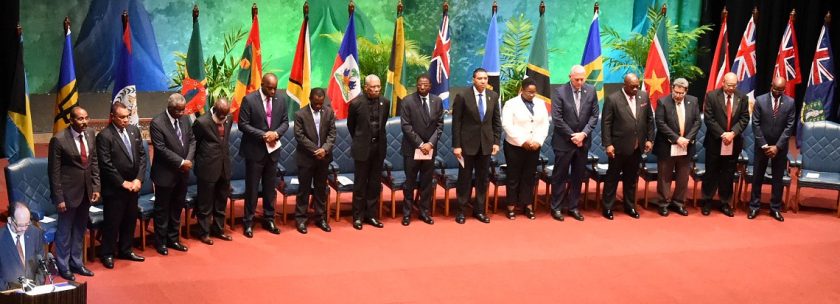
CARICOM Heads of Government
CARICOM
Caribbean states, including those that abstained from voting on the OAS resolution, stood firmly on anti-interventionist principles that respected Venezuela’s sovereignty. Leaders of the member states of the Caribbean Community and Common Market (CARICOM) held an emergency meeting to discuss Venezuela on January 24. The heads of government of Antigua and Barbuda, Barbados, Belize, Dominica, Jamaica, Montserrat, St. Kitts and Nevis, Saint Lucia, St. Vincent and the Grenadines, Trinidad and Tobago, and the Foreign Ministers of Grenada and Suriname, participated in the meeting. Guyana, which has a long standing territorial dispute with Venezuela, nonetheless endorsed the CARICOM position the next day. The resulting statement “reaffirmed” the members’ “principles of non-interference and non-intervention in the affairs of states, respect for sovereignty, adherence to the rule of law, and respect for human rights and democracy”. In addition, they insisted that the crisis should only be “resolved peacefully through meaningful dialogue and diplomacy”. Without naming the US and the Trump administration, CARICOM heads explicitly rejected foreign intervention in Venezuela’s affairs, and threats of violence against the country:
“Reaffirming their commitment to the tenets of Article 2 (4) of the United Nations Charter which calls for Members States to refrain from the threat or the use of force and Article 21 of the Charter of the Organization of American States which refers to territorial inviolability, the Heads of Government emphasized the importance of the Caribbean remaining a Zone of Peace”.
Taking aim again at US policy, CARICOM,
“called on external forces to refrain from doing anything to destabilize the situation and…called on all actors, internal and external, to avoid actions which would escalate an already explosive situation to the detriment of the people of Bolivarian Republic of Venezuela and which could have far-reaching negative consequences for the wider region”.
Trinidad & Tobago and CARICOM vs. the OAS
Within CARICOM, the case of Trinidad & Tobago deserves special mention. First, Trinidad, mere miles from Venezuela with which it has long historical and demographic ties, is now home to a growing number of Venezuelan refugees. Recent events have triggered fears of an even larger refugee crisis in the making. The media make it clear that many locals neither like nor trust the Venezuelans entering their country, and resent their presence. In addition, Venezuelans protesting in the capital, Port of Spain, against Maduro and demanding that the government of Prime Minister Keith Rowley recognize Guaidó instead, faced a mixed reaction at best. Aside from being denounced by Trinidadian commenters, the protesters drew a sharp rebuke from the leader of one of the parties in parliament, David Abdulah:
“Citizens of Venezuela can appeal to the Government of Venezuela and the parties in Venezuela but Venezuelans here in Trinidad and Tobago cannot determine what the foreign policy of Trinidad and Tobago ought to be. It is the Government of Trinidad and Tobago and the citizens of Trinidad and Tobago ultimately and the governments of Caricom and the citizens of Caricom who must determine the foreign policy of Trinidad and Tobago and of Caricom”.
Abdulah also took exception with the protesters claim that Guaidó had popular support, while Maduro was isolated as a dictator. Abdulah said Maduro got significant support at the February 2nd demonstration in Venezuela, which was much bigger than Guaidó’s rally:
“So it is not as if President Maduro is clinging on to power by himself and so on and the vast majority of the Venezuelans are against him. That is not the case”.
Moreover, Abdulah condemned the opposition:

Dr. Keith Rowley, Prime Minister of Trinidad & Tobago
“Very regrettably, but not surprising, Guaido has taken the consistent right-wing line of the opposition rejecting any talks, rejecting any mediation and simply wanting for [sic] resolve the thing by force backed, of course, by the United States and some other countries”.
Squaring off against his domestic opposition, Prime Minister Keith Rowley took direct aim at the United National Congress in parliament, which is pro-US and pro-interventionist. Rowley openly called them “traitors” for trying to undermine CARICOM’s mission of mediation.

Luís Almagro, Secretary-General of the OAS
Prime Minister Rowley has also clashed with the leadership of the OAS, precisely on the question of Venezuela, well before this latest crisis erupted. Back in 2017, Rowley called for the dismissal of OAS secretary-general Luís Almagro. Prime Minister Rowley’s point, which was correct, is that the OAS was compromised by taking an interventionist stance towards Venezuela, and delegitimizing its duly elected leader. Rowley further accused the OAS leadership saying that the result was that, “the OAS has now removed itself from any meaningful participation and has deteriorated now into partisan attacks”.
The conflict between CARICOM, and Trinidad & Tobago in particular, and the head of the OAS was reignited with the latest crisis. CARICOM, and Trinidad’s Minister of National Security, expressed shock that Almagro would dare to speak for all OAS members in personally denouncing Maduro. In a January 31 letter to the OAS’ Almagro, CARICOM’s leadership instructed Almagro that the OAS does not speak for CARICOM members on this issue. The letter from CARICOM’s chairman, Prime Minister Timothy Harris of St Kitts and Nevis, stated:
“The Heads of Government consider it imperative that you publicly clarify that you did not speak on behalf of all the member states of the Organisation of American States….We are aware that this is not the only occasion on which you have made public utterances in the name of the organisation without authority”.
CARICOM described Almagro’s actions as a “clear departure of from normal practice and cause for great concern”. Almagro has gone as far as advocating a foreign military invasion of Venezuela. Journalists noted that, “the OAS website lists media and press releases for the month of January and there is nothing about the OAS’s support for Guaido”. Trinidad & Tobago joined a CARICOM team to meet in Uruguay on February 7, as part of a mediation effort led by Mexico and Uruguay. Calls for dialogue continue to be flatly rejected by Guaidó, echoing the same line taken by Trump and his team.
Meeting in Montevideo
The meeting of 15 Caribbean nations plus Mexico, Uruguay, and parties in Venezuela, taking place in Montevideo tomorrow, represents the formation of a bloc that can act as a significant counterweight to the so-called “Lima Group” of US dependents in Latin America and neocolonial states such as Canada. Unlike the Lima Group, no foreign media have been banned in advance— the Canadian government blocked Russian and Venezuelan media from covering the Lima Group meeting in Ottawa on February 4, an act of suppression of press freedoms that occasioned no outcry at all in Canada.
The largely right wing “Lima Group” that opposed Maduro itself consisted of a range of shady and extreme characters tarred by their involvement in corruption scandals and with ties to death squads, along with Canada with its liberal authoritarian tradition and its penchant for necolonial violence. Once again, none of the “decolonial” crowd, fashionable as they are in academia, has drawn any of the logical and historical connections between Canada’s internal colonialism and its external neocolonialism, which are united by the same principles and interests, even the very same parties and actors. This failure of intellect is not an accident either, but is a subject best explored at another time.
In the meantime, I strongly recommend that you listen carefully to the full interview of RT with Nicolás Maduro:
Venezuelan Oil Exports Plunge On ‘Harsher’ Sanctions
By Nick Cunningham | Oilprice.com | February 4, 2019
Venezuela’s oil production could be disrupted to a greater degree than most analysts first thought, as the U.S. government seeks essentially shut in the country’s oil sector.
When the Trump administration first announced sanctions on Venezuela’s oil sector a little over a week ago, it sounded as if they would simply bar U.S. companies from buying oil. That would still mean that Venezuela could ship the oil elsewhere, albeit at a painful discount.
However, the U.S. Treasury issued some more details on February 1, sketching out a harsher sanctions regime. The sanctions on Venezuela will actually resemble the measures targeting Iran in that it will bar companies from using the U.S. financial system to do business with PDVSA. As such, the reach of the sanctions will extend well beyond the shores of the United States.
Reuters reported that even prior to last Friday’s clarification from the U.S. Treasury, European buyers were already slashing purchases because of concerns over payments. Reuters reported that two of the world’s largest oil traders, Vitol and Trafigura, said that they would comply with all U.S. sanctions.
As a result, PDVSA and Maduro’s government could have a much harder time finding destinations for Venezuelan oil than first thought. The Wall Street Journal reported oil storage is “filling up” in Venezuela because of a lack of buyers.
Moreover, not only are the effects of the sanctions more far-reaching, but also more immediate than first thought. At first, the U.S. seemed to exempt shipments that were underway, outlining a sort of phased approach that would allow a handful of American refiners to gradually unwind their oil purchase from Venezuela. The phased approach, which was supposed to be extended into April, would help “to minimize any immediate disruptions,” U.S. Secretary of Treasury Steven Mnuchin said in late January.
But that now does not appear to be what is unfolding. PDVSA has demanded upfront payment, likely because it fears not being paid at all or having the revenues steered to the opposition. Indeed, the U.S. effort to steer PDVSA and its revenues into the hands of the U.S.-backed opposition leader Juan Gauidó appears to be a decisive turning point.
Oil tankers linked to Chevron, Lukoil and Respsol are delayed, redirected or sitting offshore because of lack of payment. The WSJ says that several of those tankers had recently sent oil to Corpus Christi, Texas, but are now anchored off the coast of Maracaibo sitting idle. “This is an absolute disaster,” Luis Hernández, a Venezuelan oil union leader, told the WSJ. “There’s almost no way to move the oil.”
Unable to sell any oil, Maduro’s regime could quickly run out of cash. The result could be a humanitarian catastrophe, a merciless and destructive objective that the Trump administration seems to have in mind. The U.S. government is essentially betting that by driving the country into the ground, the military and the people will turn on Maduro. It could yet turn out that way, but it could also deepen the misery and exact an unspeakable toll on the Venezuelan population, the very people the Trump administration says it is trying to help.
In the meantime, oil exports are likely heading into a freefall. The WSJ says that labor problems, including “mass defections of workers” are accelerating declines. PDVSA could soon run out of refined fuel.
Officials with knowledge of the situation told the WSJ that Venezuela’s oil production has likely already fallen well below 1 million barrels per day (mb/d), down more than 10 percent – at least – from December levels.
Wood Mackenzie estimates that production probably stands a little bit higher at about 1.1 mb/d, but that it could soon fall to 900,000 bpd.
It’s hard to imagine how Maduro can hang on if oil exports fall precipitously from here. But even if he does manage to stay in power, the U.S. may escalate the situation. Last month, U.S. national security adviser John Bolton had “5,000 troops to Colombia” written on his legal pad. President Trump himself said that a military intervention is an option.
For the oil market, the crisis presents a series of problems. If Maduro hangs on and the U.S. continues to heap more pressure on his government, Venezuelan oil production and exports will continue to fall. Alternatively, the U.S. is hoping for a quick regime change, after which it would lift sanctions, which it believes will lead to a reversal in output losses.
The next round of Iran sanctions is nearing, with U.S. sanctions waivers expiring in May. As such, the window of opportunity for the Trump administration “is open only a crack, necessitating a quick political change,” Barclays wrote in a note. By the third quarter, the loss of Venezuelan output, Iran sanctions, and the looming regulations from the International Maritime Organization will put an increasing premium on medium and heavy oils.
That would push up oil prices significantly. But the U.S. government has blown past the point of no return, leaving it with no other options except to escalate. That means that Venezuela is set to lose a lot more oil than analysts thought only two weeks ago.
Canada’s goal of overthrowing Venezuela’s government is decades old
By Yves Engler · ricochet · January 31, 2019
According to the official story that the Liberal government and most of the mainstream media have been trying to sell, Ottawa recently recognized the leader of Venezuela’s National Assembly as that country’s president because Nicolas Maduro suspended the constitution 18 months ago and thus lost legitimacy. Thus, Ottawa intervened aggressively to re-establish democratic order there. But this narrative of Canada’s involvement omits its long-standing hostility to the Venezuelan government.
In recent days Canada’s former ambassador to Venezuela, Ben Rowswell, has repeatedly claimed that Canada’s effort to overthrow Venezuela’s government began with Maduro’s call for a Constituent Assembly in July 2017, which Rowswell considers illegitimate. Canada’s “approach to democracy promotion … can be traced to the summer of 2017, when Nicolas Maduro suspended the constitutional order,” he wrote in a Globe and Mail op-ed.
But Rowswell knows this is not true. In fact, when he departed as ambassador in July 2017, he sang a different tune, boasting that “we established quite a significant internet presence inside Venezuela, so that we could then engage tens of thousands of Venezuelan citizens in a conversation on human rights. We became one of the most vocal embassies in speaking out on human rights issues and encouraging Venezuelans to speak out.”
At the time, Rowswell told the Ottawa Citizen, that anti-Maduro forces need not worry about his departure, “I don’t think they have anything to worry about because Minister (of Foreign Affairs Chrystia) Freeland has Venezuela way at the top of her priority list.”
Direct Canadian assistance to the opposition dates to at least the mid-2000s. In January 2005, Foreign Affairs invited Maria Corina Machado to Ottawa. Machado was in charge of Súmate, an organization at the forefront of efforts to remove Hugo Chavez as president. Just prior to this invitation, Súmate had led an unsuccessful campaign to recall Chavez through a referendum in August 2004. Before that, Machado’s name appeared on a list of people who endorsed the 2002 coup, for which she faced charges of treason. She denied signing the now-infamous Carmona Decree that dissolved the National Assembly and Supreme Court and suspended the elected government, the attorney general, comptroller general, and governors as well as mayors elected during Chavez’s administration. It also annulled land reforms and reversed increases in royalties paid by oil companies.
Canada also helped finance Súmate. According to disclosures made in response to a question by NDP foreign affairs critic Alexa McDonough, Canada gave Súmate $22,000 in 2005–06. Minister of International Cooperation José Verner explained that “Canada considered Súmate to be an experienced NGO with the capability to promote respect for democracy, particularly a free and fair electoral process in Venezuela.”
Alongside large sums from Washington, Canada has provided millions of dollars to groups opposed to the Venezuelan government over the past 15 years. The foremost researcher on U.S. funding to opposition groups in Venezuela, Eva Golinger, cited Canada’s role, and according to a May 2010 report from Spanish NGO Fride, “Canada is the third most important provider of democracy assistance” to Venezuela after the U.S. and Spain.
In a 2011 International Journal article Neil A. Burron describes an interview with a Canadian “official [who] repeatedly expressed concerns about the quality of democracy in Venezuela, noting that the [federal government’s] Glyn Berry program provided funds to a ‘get out the vote’ campaign in the last round of elections in that country.” You can bet it wasn’t designed to get Chavez supporters to the polls.
Ottawa wasn’t overly concerned about democracy in April 2002 when a military coup took Chavez prisoner and imposed an unelected government. It lasted only two days before popular demonstrations, a split within the army, and international condemnation returned the elected government. While most Latin American leaders condemned the coup, Canadian diplomats were silent.
“In the Venezuelan coup in 2002, Canada maintained a low profile, probably because it was sensitive to the United States ambivalence towards Venezuelan president Hugo Chavez,” writes Flavie Major in the book Promoting Democracy in the Americas.
The Stephen Harper government didn’t hide its hostility to Chavez. When Chavez was re-elected president with 63 per cent of the vote in December 2006, 32 members of the Organization of American States — which monitored the election — supported a resolution to congratulate him. Canada was the only member to join the U.S. in opposing the message.
Just after Chavez’s re-election, the U.S. assistant secretary of state for hemispheric affairs, Thomas Shannon, called Canada “a country that can deliver messages that can resonate in ways that sometimes our messages don’t for historical or psychological reasons.” Six months later Harper toured South America to help stunt the region’s rejection of neoliberalism and U.S. dependence. (“To show [the region] that Canada functions and that it can be a better model than Venezuela,” in the words of a high-level Foreign Affairs official quoted by Le Devoir.)
During the trip, Harper and his entourage made a number of comments critical of the Chavez government. Afterwards the prime minister continued to demonize a government that had massively expanded the population’s access to health and education services. In April 2009 Harper responded to a question regarding Venezuela by saying, “I don’t take any of these rogue states lightly.” A month earlier, the prime minister referred to the far-right Colombian government as a valuable “ally” in a hemisphere full of “serious enemies and opponents.”
After meeting opposition figures in January 2010, Minister for the Americas Peter Kent told the media, “Democratic space within Venezuela has been shrinking and in this election year, Canada is very concerned about the rights of all Venezuelans to participate in the democratic process.”
“During my recent visit to Venezuela, I heard many individuals and organizations express concerns related to violations of the right to freedom of expression and other basic liberties,” said Kent.
Virginie Levesque, a spokesperson for the Canadian Embassy in Venezuela, also accused the Chavez government of complicity with racism against Jews.
“The Canadian Embassy has encouraged and continues to encourage the Venezuelan government to follow through on its commitment to reject and combat anti-Semitism and to do its utmost to ensure the security of the Jewish community and its religious and cultural centers” said Levesque.
Even the head of Canada’s military joined the onslaught of condemnation against Venezuela. After a tour of South America in early 2010, Walter Natynczyk wrote:,“Regrettably, some countries, such as Venezuela, are experiencing the politicization of their armed forces.” (A Canadian general criticizing another country’s military is, of course, not political.)
After Chavez died in 2013 Harper declared that Venezuelans “can now build for themselves a better, brighter future based on the principles of freedom, democracy, the rule of law, and respect for human rights.” And when Maduro won the presidential election later that year Ottawa called for a recount, refusing to at first to recognize the results.
Canada’s bid to oust Venezuela’s elected president is not new. These efforts have grown over the past year and a half mostly because of Venezuela’s economic troubles, the rightward shift in the region, and Donald Trump’s hawkishness on the issue.
Guaido Says All Opportunities for Dialogue With Maduro Government Exhausted
Sputnik – 04.02.2019
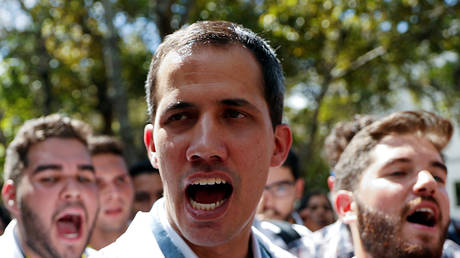 All opportunities for dialogue with Venezuelan President Nicolas Maduro have been exhausted, Venezuelan opposition parliament speaker Juan Guaido, who has proclaimed himself the country’s interim president, said on Monday, after declining Mexico and Uruguay’s offer to mediate a dialogue with Maduro.
“As for the initiative of Mexico and Uruguay, I must be sincere by telling you that all of Venezuela’s democratic forces believe that the opportunities for dialogue with Maduro government have been exhausted… The [Maduro] regime has rejected any chance to reach a political agreement within the framework of our constitution,” Guaido told Italy’s Corriere della Sera newspaper.
On January 31, the European Union and a number of Latin American countries decided to set up an international contact group “to create conditions for a political and peaceful process to emerge” in Venezuela.
China, Mexico, Russia, Turkey and Uruguay are among the countries that have voiced their support for Maduro.
Russian Foreign Minister Sergei Lavrov said earlier in the day that the European Union was giving an ultimatum to Caracas rather than mediating the Venezuelan crisis, and called for settlement talks that would include all relevant parties.
The Chinese Foreign Ministry said last month that Beijing was against any meddling in Venezuela’s internal affairs and supportive of the country’s government in its efforts to maintain stability.
Canada Doubles Down on Media Censorship of Lima Group Meeting
teleSUR | February 24, 2019
The Foreign Ministry of Canada has denied access to several media outlets to cover the Lima Group meeting taking place in Ottawa Monday. At that meeting, countries who are currently allied against Venezuela are expected to discuss further steps associated with their actions against the Bolivarian nation.
Canada’s foreign ministry issued the same terse response to Russian media outlets Sputnik News as it did Ria Novosti’s bid for press credentials for the meeting: “Thank you for your interest in the 10th ministerial meeting of the Lima Group in Ottawa. This letter is to inform you you have not been accredited as media.”
As with Canada’s rejection of teleSUR for media credentials as reported Feb. 3., the response provided no reason for the rejection, however, Canadian spokesperson for the Lima Group responded to Sputnik by saying that the news outlet was rejected for a “lack of respect to the Canadian Foreign Minister.”
This Russian agency has also not received credentials for the meeting in Canada. Arbitrary decisions. It’s not new, but we won’t stop calling it out.
The predominantly right-wing Lima Group which supports the coup attempt by self-proclaimed president Juan Guaido backed by the United States, has said they would not condone a military intervention to depose President Nicolas Maduro.
The group was created in 2017 at the behest of Peru. Recently, it has been highly engaged in promoting regime change in Venezuela with the backing of the United States and the European Union.
It is composed of Argentina, Brazil, Canada, Chile, Colombia, Costa Rica, Guatemala, Honduras, Mexico, Panama, Paraguay, Peru, Santa Lucia, and Guyana. All of its members, except for Mexico, Guyana, and Santa Lucia, have backed Guiado’s coup attempt. Ecuador — not a party to the association — has also backed the group’s stance on Venezuela.
Featured Video
Iran FM Araghchi: “Hormuz Will No Longer Be the Same”
or go to
Aletho News Archives – Video-Images
From the Archives
Sam Husseini: The entire US establishment helped lie their way into the Iraq war
By Slava Zilber | American Herald Tribune | October 14, 2019
Sam Husseini is a senior analyst with the Institute for Public Accuracy, independent journalist and contributor to The Nation and FAIR.
Slava Zilber: Sam, three years ago, you appeared on Talk Nation Radio with David Swanson and spoke about the case of the GCHQ whistleblower Katharine Gun. You pointed out that the people involved in the spying on the UN and the people authorizing the Iraq War were not held accountable:
“Virtually everybody who went along with the war, whether it is Kerry or Clinton, of course, the Bush administration themselves has falsified their own records in terms of why, what they did, when they did, why they did it, to the extent that they’ve been scrutinised at all.”
You also address it in a recent article. And recently, Joe Biden has been lying about his position on the Iraq War. How can such an important issue escape meaningful scrutiny? … continue
Blog Roll
 Aletho News
- Iran FM Araghchi: “Hormuz Will No Longer Be the Same”
- EU facing trillion-euro debt hole while seeking more cash for Kiev
- How US, Europe, Persian Gulf states exhausted missile stockpiles, splurged billions to defend Israel
- Up in arms… Koreans reject U.S. empire’s plan to make South Korea the next Ukraine
- Iran, Turkey, Pakistan, Saudi Arabia could advance region-led security framework in Tehran: FM spox
- Netizens condemn Japanese drama for projecting Japan’s wartime atrocities onto Chinese characters
- Racist Seinfeld Dances for Joy as Bibi Unveils His New Map
- A West Bank War for Netanyahu’s Election Campaign, Could It Backfire?
- Yemen denounces European Parliament’s ‘hypocritical’ push to blacklist Ansarullah
- Qalibaf: UAE’s UN bid aims to ‘clear the runway’ for ‘Greater Israel’, whitewash genocide
- If Americans Knew
- An error has occurred; the feed is probably down. Try again later.
- No Tricks Zone
- Sudden Stratospheric Warming, Powerful El Niño Combination May Lead To Extreme Europe Cold, Energy Crisis!
- Two New Studies Find Thwaites Glacier Melt Cannot Be Driven By Human Activity Or A Warming Ocean
- E-Cars Reduce CO2 Emissions By Only 41% Compared To Internal Combustion Engine Vehicles
- Predictions Made By Renowned Climate Professor Over Past Decades Have Been Proven To Be Poor
- New Study Suggests Large Regions Of The Pacific Ocean Have Been Cooling For The Last 80 Years
- Germany’s Green Energy Debacle: High Energy Costs Force Kahla Porzellan to Close After 182 Years!
- New Study: 50 Years Of The Most Aggressive ‘Net Zero’ Policies Can Only Affect The Global Climate By 0.03°C
- US September “Heat” Was No Record…Many Records Set Decades Ago
- Latest European Green Energy Debacle; Portugal’s Largest Flagship Solar Park Insolvent!
- Green Energy Debacle: German Expert Professor Fritz Vahrenholt Warns Of Severe Economic And Social Consequences

