Juan Guaidó: The Man Who Would Be President of Venezuela Doesn’t Have a Constitutional Leg to Stand On
By Roger D. Harris | Dissident Voice | February 6, 2019
Donald Trump imagines Juan Guaidó is the rightful president of Venezuela. Mr. Guaidó, a man of impeccable illegitimacy, was exposed by Cohen and Blumenthal as “a product of a decade-long project overseen by Washington’s elite regime change trainers.” Argentinian sociologist Marco Teruggi described Guaidó in the same article as “a character that has been created for this circumstance” of regime change. Here, his constitutional credentials to be interim president of Venezuela are deconstructed.
Educated at George Washington University in DC, Guaidó was virtually unknown in his native Venezuela before being thrust on to the world stage in a rapidly unfolding series of events. In a poll conducted a little more than a week before Guaidó appointed himself president of the country, 81% of Venezuelans had never even heard of the 35-year-old.
To make a short story shorter, US Vice President Pence phoned Guaidó on the evening of January 22nd and presumably asked him how’d he like to be made president of Venezuela. The next day, Guaidó announced that he considered himself president of Venezuela, followed within minutes by US President Trump confirming the self-appointment.
A few weeks before on January 5, Guaidó had been installed as president of Venezuela’s National Assembly, their unicameral legislature. He had been elected to the assembly from a coastal district with 26% of the vote. It was his party’s turn for the presidency of the body, and he was hand-picked for the position. Guaidó, even within his own party, was not in the top leadership.
Guaidó’s party, Popular Will, is a far-right marginal group whose most enthusiastic boosters are John Bolton, Elliott Abrams, and Mike Pompeo. Popular Will had adopted a strategy of regime change by extra-parliamentary means rather than engage in the democratic electoral process and had not participated in recent Venezuelan elections.
Although anointed by Trump and company, Guaidó’s Popular Will Party is not representative of the “Venezuelan opposition,” which is a fractious bunch whose hatred of Maduro is only matched by their abhorrence of each other. Leading opposition candidate Henri Falcón, who ran against Maduro in 2018 on a neoliberal austerity platform, had been vehemently opposed by Popular Will who demanded that he join their US-backed boycott of the election.
The Venezuelan news outlet, Ultimas Noticias, reported that prominent opposition politician Henrique Capriles, who had run against Maduro in 2013, “affirmed during an interview that the majority of opposition parties did not agree with the self-swearing in of Juan Guaidó as interim president of the country.” Claudio Fermin, president of the party Solutions for Venezuela, wrote “we believe in the vote, in dialogue, we believe in coming to an understanding, we believe Venezuelans need to part ways with the extremist sectors that only offer hatred, revenge, lynching.” Key opposition governor of the State of Táchira, Laidy Gómez, has rejected Guaidó’s support of intervention by the US, warning that it “would generate death of Venezuelans.”
The Guaidó/Trump cabal does not reflect the democratic consensus in Venezuela, where polls consistently show super majorities oppose outside intervention. Popular opinion in Venezuela supports negotiations between the government and the opposition as proposed by Mexico, Uruguay, and the Vatican. The Maduro administration has embraced the negotiations as a peaceful solution to the crisis facing Venezuela.
The US government rejects a negotiated solution, in the words of Vice President Pence: “This is no time for dialogue; this is time for action.” This intransigent position is faithfully echoed by Guaidó. So while most Venezuelans want peace, the self-appointed president, backed by the full force of US military power, wrote in a New York Times op-ed that it was possible to “end the Maduro regime with a minimum of bloodshed.”
The Guaidó/Trump cabal’s fig leaf for legitimacy is based on the bogus argument that Article 233 of the Venezuelan constitution gives the National Assembly the power to declare a national president’s “abandonment” of the office. In which case, the president of the National Assembly can serve as an interim national president, until presidential elections are held. The inconvenient truth is that Maduro has shown no inclination to abandon his post, and the constitution says no such thing.
In fact, the grounds for replacing a president are very clearly laid out in the first paragraph of Article 233 of the Venezuelan constitution and do not include fraudulent or illegitimate election, which is what the cabal has been claiming. In the convoluted logic of the US government and its epigones, if the people elect someone the cabal doesn’t like, the election is by definition fraudulent and the democratically elected winner is ipso facto a dictator.
The function of adjudicating the validity of an election, as in any country, is to be dealt with through court challenges, not by turning to Donald Trump for his approval. And certainly not by anointing an individual from a party that could have run in the 2018 election but decided to boycott.
The Supreme Tribunal of Justice (TSJ), which is the separate supreme court branch of the Venezuelan government has certified Maduro’s reelection, as have independent international observers. Further, no appeal was filed by any of the boycotting parties, while all participating parties – including opposition ones – signed off on the validity of the election after the polls closed.
The far-right opposition has boycotted the high court as well as the electoral process. They contest the legitimacy of the TSJ because some members of the TSJ were appointed by a lame duck National Assembly favorable to Maduro, after a new National Assembly with a majority in opposition had been elected in December 2015 but not yet seated.
Even if President Maduro were somehow deemed to have experienced what is termed a falta absoluta (i.e., some sort of void in the presidency due to death, insanity, absence, etc.), the National Assembly president is only authorized to take over if the falta absoluta occurs before the lawful president “takes possession.” However, Maduro was already “in possession” before the January 10, 2019 presidential inauguration and even before the May 10, 2018 presidential election. Maduro had won the presidency in the 2013 election and ran and won reelection last May.
If the falta absoluta is deemed to have occurred during the first four years of the presidential term, the vice president takes over. Then the constitution decrees that a snap election for the presidency must be held within 30 days. This is what happened when President Hugo Chávez died while in office in 2013. Then Vice President Nicolás Maduro succeeded to the presidency, called for new elections, and was elected by the people of Venezuela.
If it is deemed that the falta absoluta occurred during the last two years of the six-year presidential term, the vice president serves until the end of the term, according to the Venezuelan constitution. And if the time of the alleged falta absoluta is unclear – when Maduro presided over “illegitimate” elections in 2018, as is claimed by the far-right opposition – it is up to the TSJ to decide, not the head of the National Assembly or even such an august authority as US Senator Marco Rubio. Or the craven US press (too numerous to cite), which without bothering to read the plain language of the Bolivarian Constitution, repeatedly refers to Guaidó as the “constitutionally authorized” or “legitimate” president.
As Alfred de Zayas, United Nations independent expert on the promotion of a democratic and equitable international order, tweeted: “Article 233 of the Venezuelan constitution is inapplicable and cannot be twisted into legitimizing Guaidó’s self-proclamation as interim President. A coup is a coup.”
Roger D. Harris is with the Task Force on the Americas and the Campaign to End US/Canada Sanctions Against Venezuela.
Why are Democrats Driving Regime Change in Venezuela?
By William Walter Kay | Ron Paul Institute | February 6, 2019
Many see President Trump conspiring with oilmen to capture Venezuelan petroleum reserves. Trump’s earlier blunt talk about seizing oilfields buttresses this thesis. As well, ExxonMobil, ConocoPhillips and Chevron appreciate better than anyone the astronomic value of Venezuela’s heavy oil. There are, however, flaws in the petro-conquistador thesis. Foremost, it does not explain why oil-resistant Democrats and Europeans play lead roles in this regime change travesty.
On December 18, 2014 a Democrat-led Senate passed the Venezuela Defense of Human Rights and Civil Society Act. This legislation, sponsored by Democratic Senator Robert Menendez, imposed sanctions on Venezuela while promising support for Venezuelan “civil society.” The Act also sought to meet “the information needs of the Venezuelan people” through publications and broadcasts; and through “distribution of circumvention technology.” Obama signed immediately.
On March 9, 2015 Obama declared:
… a national emergency with respect to the unusual and extraordinary threat to the national security and foreign policy of the United States presented by the situation in Venezuela.
His accompanying Executive Order 13692 extended sanctions while undertaking to: “support greater political expression in Venezuela.”
At this time the US deep state conducted an orchestra of American and European agencies and foundations disbursing $50 million a year to Venezuelan “civil society” (opposition politicians, student activists and journalists). Key agencies were USAID and National Endowment for Democracy. Participating foundations included: (Jimmy) Carter Centre; (Soros’s) Open Society; (Democratic Party-affiliated) National Democratic Institute for International Affairs; plus several Spanish and German concerns.
On January 16, 2017, four days before Trump’s inauguration, Obama renewed his declaration designating Venezuela a national security threat. Venezuela’s Foreign Minister called the move “new aggression by Barack Obama” extending Obama’s “legacy of hate and serious violation of international law.”
On January 4, 2019 a Democrat-led House of Representatives swore in.
On January 10 House Foreign Affairs Committee Chair, Eliot Engel (Democrat-NY) said he would waste no time holding “Mr. Maduro” accountable. Simultaneously, former DNC Chair and Hillary Clinton fixer, Democratic Congresswoman Debbie Wasserman-Schultz unveiled her Venezuelan-Russian Threat Mitigation Act. She was flanked by former Clinton cabinet member and Clinton Foundation boss, Democratic Congresswoman Donna Shalala who announced her Venezuelan Arms Restriction Act to prevent weapons sales, including non-lethal police gear, to Venezuela. Next up was Democratic Congresswoman Debbie Mucarsel-Powell, sponsor of the Venezuelan Humanitarian Assistance Act aimed at allowing US operatives to bypass Venezuelan authorities and distribute “aid” directly to Venezuelans.
On January 24, less than 24 hours after Juan Guaido declared himself Venezuelan President, Democratic Congressman Adam Schiff (House Intelligence Committee Chair) blamed Maduro’s “dictatorial” rule for devastating Venezuela’s economy, then recognised Guaido as Venezuela’s “rightful leader.” Senate Minority Whip Dick Durbin (Democrat-IL) piped in calling Venezuela’s 2018 election a sham before endorsing Guaido’s presidency.
Of 280 Democratic Senators and Representatives 3 dissented. This troika did not include Bernie Sanders. On January 24 Bernie boarded the war-train with a battle-whoop beginning:
The Maduro government in Venezuela has been waging a violent crackdown on Venezuelan civil society, violated the constitution by dissolving the National Assembly and was re-elected last year in an election that many observers said was fraudulent. Further the economy is a disaster and millions are migrating.
Bernie goes on to warn of the perils of regime change while leaving wide open the door to punitive sanctions. His statement is silent on America’s economic war on Venezuela. His support for “civil society” is willfully naïve about such groups’ involvement in political meddling up to and including regime change. (Bernie supported starvation sanctions against Iraq, and the bombing of Serbia. He calls Hugo Chavez a “dead communist dictator.”)
Regarding Venezuela the Democrats march in lockstep with: the Liberal Party of Canada under PM Trudeau; Merkel’s ruling coalition in Germany; French President Macron; and the governments of Sweden, Denmark, Austria and Spain.
These governments are committed to phasing petroleum out of their economies. All champion the Paris Climate Accord. None can be quickly dismissed as Exxon’s goons. None take orders from Trump. Thus, the petro-conquistador thesis appears ill-equipped to explain their behaviour.
No doubt Washington DC hosts cabals of oilmen and politicos coveting unfettered access to the Orinoco Belt. Here, however, it seems fantastical that President Maduro might be removed by anything short of civil war; or that the Orinoco Belt might be exploitable amidst the Vietnam-style conflagration surely to ensue. Then, arises the enigmatic spectacle of a dozen “liberal-leftist-environmentalist” Western parties and governments frantically tilting at the same windmill. Pourquoi?
Against Intervention in Venezuela: The Case of the Caribbean Community
By Maximilian Forte | Zero Anthropology | February 6, 2019
As discussed in the previous article, the membership of the Organization of American States is in fact not at all united around support for foreign intervention and recognition of an alternative second “president” (Juán Guaidó). Standing opposed to the denial of recognition of Maduro’s legitimacy as the elected leader are not just Cuba, Nicaragua, Bolivia, and for now Mexico and Uruguay, but also Caribbean states such as Dominica, St Vincent and the Grenadines, and Suriname. Trinidad and Tobago, St Kitts and Nevis, Antigua and Barbuda, Barbados, and Belize abstained from the OAS resolution—which, it turns out, does not mean the same as indifference. The action by the OAS implicitly threatened all governments in the region, which has already significantly damaged the organization’s integrity, as discussed below.
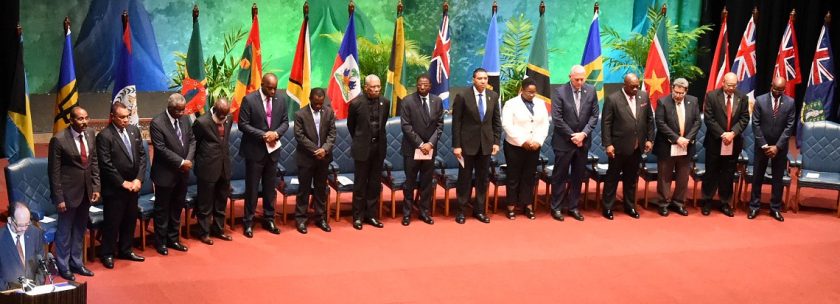
CARICOM Heads of Government
CARICOM
Caribbean states, including those that abstained from voting on the OAS resolution, stood firmly on anti-interventionist principles that respected Venezuela’s sovereignty. Leaders of the member states of the Caribbean Community and Common Market (CARICOM) held an emergency meeting to discuss Venezuela on January 24. The heads of government of Antigua and Barbuda, Barbados, Belize, Dominica, Jamaica, Montserrat, St. Kitts and Nevis, Saint Lucia, St. Vincent and the Grenadines, Trinidad and Tobago, and the Foreign Ministers of Grenada and Suriname, participated in the meeting. Guyana, which has a long standing territorial dispute with Venezuela, nonetheless endorsed the CARICOM position the next day. The resulting statement “reaffirmed” the members’ “principles of non-interference and non-intervention in the affairs of states, respect for sovereignty, adherence to the rule of law, and respect for human rights and democracy”. In addition, they insisted that the crisis should only be “resolved peacefully through meaningful dialogue and diplomacy”. Without naming the US and the Trump administration, CARICOM heads explicitly rejected foreign intervention in Venezuela’s affairs, and threats of violence against the country:
“Reaffirming their commitment to the tenets of Article 2 (4) of the United Nations Charter which calls for Members States to refrain from the threat or the use of force and Article 21 of the Charter of the Organization of American States which refers to territorial inviolability, the Heads of Government emphasized the importance of the Caribbean remaining a Zone of Peace”.
Taking aim again at US policy, CARICOM,
“called on external forces to refrain from doing anything to destabilize the situation and…called on all actors, internal and external, to avoid actions which would escalate an already explosive situation to the detriment of the people of Bolivarian Republic of Venezuela and which could have far-reaching negative consequences for the wider region”.
Trinidad & Tobago and CARICOM vs. the OAS
Within CARICOM, the case of Trinidad & Tobago deserves special mention. First, Trinidad, mere miles from Venezuela with which it has long historical and demographic ties, is now home to a growing number of Venezuelan refugees. Recent events have triggered fears of an even larger refugee crisis in the making. The media make it clear that many locals neither like nor trust the Venezuelans entering their country, and resent their presence. In addition, Venezuelans protesting in the capital, Port of Spain, against Maduro and demanding that the government of Prime Minister Keith Rowley recognize Guaidó instead, faced a mixed reaction at best. Aside from being denounced by Trinidadian commenters, the protesters drew a sharp rebuke from the leader of one of the parties in parliament, David Abdulah:
“Citizens of Venezuela can appeal to the Government of Venezuela and the parties in Venezuela but Venezuelans here in Trinidad and Tobago cannot determine what the foreign policy of Trinidad and Tobago ought to be. It is the Government of Trinidad and Tobago and the citizens of Trinidad and Tobago ultimately and the governments of Caricom and the citizens of Caricom who must determine the foreign policy of Trinidad and Tobago and of Caricom”.
Abdulah also took exception with the protesters claim that Guaidó had popular support, while Maduro was isolated as a dictator. Abdulah said Maduro got significant support at the February 2nd demonstration in Venezuela, which was much bigger than Guaidó’s rally:
“So it is not as if President Maduro is clinging on to power by himself and so on and the vast majority of the Venezuelans are against him. That is not the case”.
Moreover, Abdulah condemned the opposition:

Dr. Keith Rowley, Prime Minister of Trinidad & Tobago
“Very regrettably, but not surprising, Guaido has taken the consistent right-wing line of the opposition rejecting any talks, rejecting any mediation and simply wanting for [sic] resolve the thing by force backed, of course, by the United States and some other countries”.
Squaring off against his domestic opposition, Prime Minister Keith Rowley took direct aim at the United National Congress in parliament, which is pro-US and pro-interventionist. Rowley openly called them “traitors” for trying to undermine CARICOM’s mission of mediation.

Luís Almagro, Secretary-General of the OAS
Prime Minister Rowley has also clashed with the leadership of the OAS, precisely on the question of Venezuela, well before this latest crisis erupted. Back in 2017, Rowley called for the dismissal of OAS secretary-general Luís Almagro. Prime Minister Rowley’s point, which was correct, is that the OAS was compromised by taking an interventionist stance towards Venezuela, and delegitimizing its duly elected leader. Rowley further accused the OAS leadership saying that the result was that, “the OAS has now removed itself from any meaningful participation and has deteriorated now into partisan attacks”.
The conflict between CARICOM, and Trinidad & Tobago in particular, and the head of the OAS was reignited with the latest crisis. CARICOM, and Trinidad’s Minister of National Security, expressed shock that Almagro would dare to speak for all OAS members in personally denouncing Maduro. In a January 31 letter to the OAS’ Almagro, CARICOM’s leadership instructed Almagro that the OAS does not speak for CARICOM members on this issue. The letter from CARICOM’s chairman, Prime Minister Timothy Harris of St Kitts and Nevis, stated:
“The Heads of Government consider it imperative that you publicly clarify that you did not speak on behalf of all the member states of the Organisation of American States….We are aware that this is not the only occasion on which you have made public utterances in the name of the organisation without authority”.
CARICOM described Almagro’s actions as a “clear departure of from normal practice and cause for great concern”. Almagro has gone as far as advocating a foreign military invasion of Venezuela. Journalists noted that, “the OAS website lists media and press releases for the month of January and there is nothing about the OAS’s support for Guaido”. Trinidad & Tobago joined a CARICOM team to meet in Uruguay on February 7, as part of a mediation effort led by Mexico and Uruguay. Calls for dialogue continue to be flatly rejected by Guaidó, echoing the same line taken by Trump and his team.
Meeting in Montevideo
The meeting of 15 Caribbean nations plus Mexico, Uruguay, and parties in Venezuela, taking place in Montevideo tomorrow, represents the formation of a bloc that can act as a significant counterweight to the so-called “Lima Group” of US dependents in Latin America and neocolonial states such as Canada. Unlike the Lima Group, no foreign media have been banned in advance— the Canadian government blocked Russian and Venezuelan media from covering the Lima Group meeting in Ottawa on February 4, an act of suppression of press freedoms that occasioned no outcry at all in Canada.
The largely right wing “Lima Group” that opposed Maduro itself consisted of a range of shady and extreme characters tarred by their involvement in corruption scandals and with ties to death squads, along with Canada with its liberal authoritarian tradition and its penchant for necolonial violence. Once again, none of the “decolonial” crowd, fashionable as they are in academia, has drawn any of the logical and historical connections between Canada’s internal colonialism and its external neocolonialism, which are united by the same principles and interests, even the very same parties and actors. This failure of intellect is not an accident either, but is a subject best explored at another time.
In the meantime, I strongly recommend that you listen carefully to the full interview of RT with Nicolás Maduro:
Venezuelan Oil Exports Plunge On ‘Harsher’ Sanctions
By Nick Cunningham | Oilprice.com | February 4, 2019
Venezuela’s oil production could be disrupted to a greater degree than most analysts first thought, as the U.S. government seeks essentially shut in the country’s oil sector.
When the Trump administration first announced sanctions on Venezuela’s oil sector a little over a week ago, it sounded as if they would simply bar U.S. companies from buying oil. That would still mean that Venezuela could ship the oil elsewhere, albeit at a painful discount.
However, the U.S. Treasury issued some more details on February 1, sketching out a harsher sanctions regime. The sanctions on Venezuela will actually resemble the measures targeting Iran in that it will bar companies from using the U.S. financial system to do business with PDVSA. As such, the reach of the sanctions will extend well beyond the shores of the United States.
Reuters reported that even prior to last Friday’s clarification from the U.S. Treasury, European buyers were already slashing purchases because of concerns over payments. Reuters reported that two of the world’s largest oil traders, Vitol and Trafigura, said that they would comply with all U.S. sanctions.
As a result, PDVSA and Maduro’s government could have a much harder time finding destinations for Venezuelan oil than first thought. The Wall Street Journal reported oil storage is “filling up” in Venezuela because of a lack of buyers.
Moreover, not only are the effects of the sanctions more far-reaching, but also more immediate than first thought. At first, the U.S. seemed to exempt shipments that were underway, outlining a sort of phased approach that would allow a handful of American refiners to gradually unwind their oil purchase from Venezuela. The phased approach, which was supposed to be extended into April, would help “to minimize any immediate disruptions,” U.S. Secretary of Treasury Steven Mnuchin said in late January.
But that now does not appear to be what is unfolding. PDVSA has demanded upfront payment, likely because it fears not being paid at all or having the revenues steered to the opposition. Indeed, the U.S. effort to steer PDVSA and its revenues into the hands of the U.S.-backed opposition leader Juan Gauidó appears to be a decisive turning point.
Oil tankers linked to Chevron, Lukoil and Respsol are delayed, redirected or sitting offshore because of lack of payment. The WSJ says that several of those tankers had recently sent oil to Corpus Christi, Texas, but are now anchored off the coast of Maracaibo sitting idle. “This is an absolute disaster,” Luis Hernández, a Venezuelan oil union leader, told the WSJ. “There’s almost no way to move the oil.”
Unable to sell any oil, Maduro’s regime could quickly run out of cash. The result could be a humanitarian catastrophe, a merciless and destructive objective that the Trump administration seems to have in mind. The U.S. government is essentially betting that by driving the country into the ground, the military and the people will turn on Maduro. It could yet turn out that way, but it could also deepen the misery and exact an unspeakable toll on the Venezuelan population, the very people the Trump administration says it is trying to help.
In the meantime, oil exports are likely heading into a freefall. The WSJ says that labor problems, including “mass defections of workers” are accelerating declines. PDVSA could soon run out of refined fuel.
Officials with knowledge of the situation told the WSJ that Venezuela’s oil production has likely already fallen well below 1 million barrels per day (mb/d), down more than 10 percent – at least – from December levels.
Wood Mackenzie estimates that production probably stands a little bit higher at about 1.1 mb/d, but that it could soon fall to 900,000 bpd.
It’s hard to imagine how Maduro can hang on if oil exports fall precipitously from here. But even if he does manage to stay in power, the U.S. may escalate the situation. Last month, U.S. national security adviser John Bolton had “5,000 troops to Colombia” written on his legal pad. President Trump himself said that a military intervention is an option.
For the oil market, the crisis presents a series of problems. If Maduro hangs on and the U.S. continues to heap more pressure on his government, Venezuelan oil production and exports will continue to fall. Alternatively, the U.S. is hoping for a quick regime change, after which it would lift sanctions, which it believes will lead to a reversal in output losses.
The next round of Iran sanctions is nearing, with U.S. sanctions waivers expiring in May. As such, the window of opportunity for the Trump administration “is open only a crack, necessitating a quick political change,” Barclays wrote in a note. By the third quarter, the loss of Venezuelan output, Iran sanctions, and the looming regulations from the International Maritime Organization will put an increasing premium on medium and heavy oils.
That would push up oil prices significantly. But the U.S. government has blown past the point of no return, leaving it with no other options except to escalate. That means that Venezuela is set to lose a lot more oil than analysts thought only two weeks ago.
Canada’s goal of overthrowing Venezuela’s government is decades old
By Yves Engler · ricochet · January 31, 2019
According to the official story that the Liberal government and most of the mainstream media have been trying to sell, Ottawa recently recognized the leader of Venezuela’s National Assembly as that country’s president because Nicolas Maduro suspended the constitution 18 months ago and thus lost legitimacy. Thus, Ottawa intervened aggressively to re-establish democratic order there. But this narrative of Canada’s involvement omits its long-standing hostility to the Venezuelan government.
In recent days Canada’s former ambassador to Venezuela, Ben Rowswell, has repeatedly claimed that Canada’s effort to overthrow Venezuela’s government began with Maduro’s call for a Constituent Assembly in July 2017, which Rowswell considers illegitimate. Canada’s “approach to democracy promotion … can be traced to the summer of 2017, when Nicolas Maduro suspended the constitutional order,” he wrote in a Globe and Mail op-ed.
But Rowswell knows this is not true. In fact, when he departed as ambassador in July 2017, he sang a different tune, boasting that “we established quite a significant internet presence inside Venezuela, so that we could then engage tens of thousands of Venezuelan citizens in a conversation on human rights. We became one of the most vocal embassies in speaking out on human rights issues and encouraging Venezuelans to speak out.”
At the time, Rowswell told the Ottawa Citizen, that anti-Maduro forces need not worry about his departure, “I don’t think they have anything to worry about because Minister (of Foreign Affairs Chrystia) Freeland has Venezuela way at the top of her priority list.”
Direct Canadian assistance to the opposition dates to at least the mid-2000s. In January 2005, Foreign Affairs invited Maria Corina Machado to Ottawa. Machado was in charge of Súmate, an organization at the forefront of efforts to remove Hugo Chavez as president. Just prior to this invitation, Súmate had led an unsuccessful campaign to recall Chavez through a referendum in August 2004. Before that, Machado’s name appeared on a list of people who endorsed the 2002 coup, for which she faced charges of treason. She denied signing the now-infamous Carmona Decree that dissolved the National Assembly and Supreme Court and suspended the elected government, the attorney general, comptroller general, and governors as well as mayors elected during Chavez’s administration. It also annulled land reforms and reversed increases in royalties paid by oil companies.
Canada also helped finance Súmate. According to disclosures made in response to a question by NDP foreign affairs critic Alexa McDonough, Canada gave Súmate $22,000 in 2005–06. Minister of International Cooperation José Verner explained that “Canada considered Súmate to be an experienced NGO with the capability to promote respect for democracy, particularly a free and fair electoral process in Venezuela.”
Alongside large sums from Washington, Canada has provided millions of dollars to groups opposed to the Venezuelan government over the past 15 years. The foremost researcher on U.S. funding to opposition groups in Venezuela, Eva Golinger, cited Canada’s role, and according to a May 2010 report from Spanish NGO Fride, “Canada is the third most important provider of democracy assistance” to Venezuela after the U.S. and Spain.
In a 2011 International Journal article Neil A. Burron describes an interview with a Canadian “official [who] repeatedly expressed concerns about the quality of democracy in Venezuela, noting that the [federal government’s] Glyn Berry program provided funds to a ‘get out the vote’ campaign in the last round of elections in that country.” You can bet it wasn’t designed to get Chavez supporters to the polls.
Ottawa wasn’t overly concerned about democracy in April 2002 when a military coup took Chavez prisoner and imposed an unelected government. It lasted only two days before popular demonstrations, a split within the army, and international condemnation returned the elected government. While most Latin American leaders condemned the coup, Canadian diplomats were silent.
“In the Venezuelan coup in 2002, Canada maintained a low profile, probably because it was sensitive to the United States ambivalence towards Venezuelan president Hugo Chavez,” writes Flavie Major in the book Promoting Democracy in the Americas.
The Stephen Harper government didn’t hide its hostility to Chavez. When Chavez was re-elected president with 63 per cent of the vote in December 2006, 32 members of the Organization of American States — which monitored the election — supported a resolution to congratulate him. Canada was the only member to join the U.S. in opposing the message.
Just after Chavez’s re-election, the U.S. assistant secretary of state for hemispheric affairs, Thomas Shannon, called Canada “a country that can deliver messages that can resonate in ways that sometimes our messages don’t for historical or psychological reasons.” Six months later Harper toured South America to help stunt the region’s rejection of neoliberalism and U.S. dependence. (“To show [the region] that Canada functions and that it can be a better model than Venezuela,” in the words of a high-level Foreign Affairs official quoted by Le Devoir.)
During the trip, Harper and his entourage made a number of comments critical of the Chavez government. Afterwards the prime minister continued to demonize a government that had massively expanded the population’s access to health and education services. In April 2009 Harper responded to a question regarding Venezuela by saying, “I don’t take any of these rogue states lightly.” A month earlier, the prime minister referred to the far-right Colombian government as a valuable “ally” in a hemisphere full of “serious enemies and opponents.”
After meeting opposition figures in January 2010, Minister for the Americas Peter Kent told the media, “Democratic space within Venezuela has been shrinking and in this election year, Canada is very concerned about the rights of all Venezuelans to participate in the democratic process.”
“During my recent visit to Venezuela, I heard many individuals and organizations express concerns related to violations of the right to freedom of expression and other basic liberties,” said Kent.
Virginie Levesque, a spokesperson for the Canadian Embassy in Venezuela, also accused the Chavez government of complicity with racism against Jews.
“The Canadian Embassy has encouraged and continues to encourage the Venezuelan government to follow through on its commitment to reject and combat anti-Semitism and to do its utmost to ensure the security of the Jewish community and its religious and cultural centers” said Levesque.
Even the head of Canada’s military joined the onslaught of condemnation against Venezuela. After a tour of South America in early 2010, Walter Natynczyk wrote:,“Regrettably, some countries, such as Venezuela, are experiencing the politicization of their armed forces.” (A Canadian general criticizing another country’s military is, of course, not political.)
After Chavez died in 2013 Harper declared that Venezuelans “can now build for themselves a better, brighter future based on the principles of freedom, democracy, the rule of law, and respect for human rights.” And when Maduro won the presidential election later that year Ottawa called for a recount, refusing to at first to recognize the results.
Canada’s bid to oust Venezuela’s elected president is not new. These efforts have grown over the past year and a half mostly because of Venezuela’s economic troubles, the rightward shift in the region, and Donald Trump’s hawkishness on the issue.
Guaido Says All Opportunities for Dialogue With Maduro Government Exhausted
Sputnik – 04.02.2019
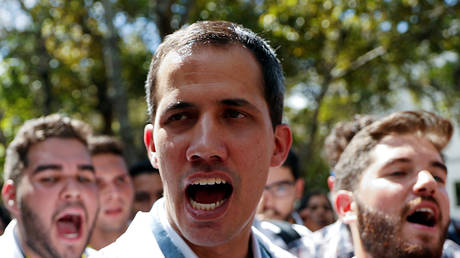 All opportunities for dialogue with Venezuelan President Nicolas Maduro have been exhausted, Venezuelan opposition parliament speaker Juan Guaido, who has proclaimed himself the country’s interim president, said on Monday, after declining Mexico and Uruguay’s offer to mediate a dialogue with Maduro.
“As for the initiative of Mexico and Uruguay, I must be sincere by telling you that all of Venezuela’s democratic forces believe that the opportunities for dialogue with Maduro government have been exhausted… The [Maduro] regime has rejected any chance to reach a political agreement within the framework of our constitution,” Guaido told Italy’s Corriere della Sera newspaper.
On January 31, the European Union and a number of Latin American countries decided to set up an international contact group “to create conditions for a political and peaceful process to emerge” in Venezuela.
China, Mexico, Russia, Turkey and Uruguay are among the countries that have voiced their support for Maduro.
Russian Foreign Minister Sergei Lavrov said earlier in the day that the European Union was giving an ultimatum to Caracas rather than mediating the Venezuelan crisis, and called for settlement talks that would include all relevant parties.
The Chinese Foreign Ministry said last month that Beijing was against any meddling in Venezuela’s internal affairs and supportive of the country’s government in its efforts to maintain stability.
Canada Doubles Down on Media Censorship of Lima Group Meeting
teleSUR | February 24, 2019
The Foreign Ministry of Canada has denied access to several media outlets to cover the Lima Group meeting taking place in Ottawa Monday. At that meeting, countries who are currently allied against Venezuela are expected to discuss further steps associated with their actions against the Bolivarian nation.
Canada’s foreign ministry issued the same terse response to Russian media outlets Sputnik News as it did Ria Novosti’s bid for press credentials for the meeting: “Thank you for your interest in the 10th ministerial meeting of the Lima Group in Ottawa. This letter is to inform you you have not been accredited as media.”
As with Canada’s rejection of teleSUR for media credentials as reported Feb. 3., the response provided no reason for the rejection, however, Canadian spokesperson for the Lima Group responded to Sputnik by saying that the news outlet was rejected for a “lack of respect to the Canadian Foreign Minister.”
This Russian agency has also not received credentials for the meeting in Canada. Arbitrary decisions. It’s not new, but we won’t stop calling it out.
The predominantly right-wing Lima Group which supports the coup attempt by self-proclaimed president Juan Guaido backed by the United States, has said they would not condone a military intervention to depose President Nicolas Maduro.
The group was created in 2017 at the behest of Peru. Recently, it has been highly engaged in promoting regime change in Venezuela with the backing of the United States and the European Union.
It is composed of Argentina, Brazil, Canada, Chile, Colombia, Costa Rica, Guatemala, Honduras, Mexico, Panama, Paraguay, Peru, Santa Lucia, and Guyana. All of its members, except for Mexico, Guyana, and Santa Lucia, have backed Guiado’s coup attempt. Ecuador — not a party to the association — has also backed the group’s stance on Venezuela.
What the mainstream media doesn’t tell you about Venezuela
By Yves Engler · February 3, 2019
The corporate media is wholeheartedly behind the federal government’s push for regime change in Venezuela. The propaganda is thick and, as per usual, it is as much about what they don’t, as what they do, report. Here are some important developments that have largely been ignored by Canada’s dominant media:
- At the Organization of American States meeting called by US Secretary of State Mike Pompeo on January 25 the Canadian-backed interventionist resolution was defeated 18-16.
- The “Lima Group” of governments opposed to Venezuela’s elected president was established 18 months ago after Washington, Ottawa and others failed to garner the votes necessary to censure Venezuela at the OAS (despite the head of the OAS’s extreme hostility to Venezuela’s President Nicolas Maduro).
- Most of the world’s countries, with most of the world’s population, have failed to support the US/Canada push to recognize National Assembly head Juan Guaidó as president of Venezuela.
- The UN and OAS charters preclude unilateral sanctions and interfering in other countries’ affairs.
- UN Human Rights Council Special Rapporteur for sanctions, Idriss Jazairy, recently condemned US/Canadian sanctions on Venezuela.
As well, here are some flagrant double standards in Canadian policy the media have largely ignored:
- “Lima Group” member Jair Bolsonaro won the recent presidential election in Brazil largely because the most popular candidate, Lula Da silva, was in jail. His questionable election took place two years after Lula’s ally, Dilma Rousseff, was ousted as president in a ‘parliamentary coup’.
- Another “Lima Group” member, Honduras president Juan Orlando Hernandez, defied that country’s constitution a year ago in running for a second term and then ‘won’ a highly questionable
- “At the same time”as Canada and the US recognized Juan Guaidó, notes Patrick Mbeko, “in Democratic Republic of Congo they refuse to recognize the massive recent victory of Martin Fayulu in the presidential election, endorsing the vast electoral fraud of the regime and its ally Félix Tshisekedi.”
Beyond what the media has ignored, they constantly cite biased sources without offering much or any background. Here are a couple of examples:
- The Globe and Mail has quoted Irwin Cotler in two recent articles on Venezuela. But, the decades-long anti-Palestinian and anti-Hugo Chavez activist lacks any credibility on the issue. At a press conference in May to release an OAS report on alleged rights violations in Venezuela, Cotler said Venezuela’s “government itself was responsible for the worst ever humanitarian crisis in the region.” Worse than the extermination of the Taíno and Arawak by the Spanish? Or the enslavement of five million Africans in Brazil? Or the 200,000 Mayans killed in Guatemala? Or the thousands of state-murdered “subversives” in Chile, Argentina, Uruguay, Brazil?
- CBC and Canadian Press (to a slightly lesser extent) stories about former Venezuelan Colonel Oswaldo Garcia, whose family lives in Montréal, present him as a democracy activist. But, notes Poyan Nahrvar, Garcia participated in a coup attempt last year and then launched raids into Venezuela from Colombia until he was captured by the Venezuelan military.
- The media blindly repeats Ottawa’s depiction of the “Lima Group”, which Prime Minister Justin Trudeau described as an organization established to “bring peace, democracy and stability in Venezuela.” One report called it “a regional block of countries committed to finding a peaceful solution” to the crisis while another said its members “want to see Venezuela return to democracy.” This portrayal of the coalition stands its objective on its head. The “Lima Group” is designed to ratchet up international pressure on Maduro in hopes of eliciting regime change, which may spark a civil war. That is its reason for existence.
As part of nationwide protests against the “Lima Group” meeting taking place in Ottawa on Monday, activists in Montréal will rally in front of Radio Canada/CBC’s offices. They will be decrying not only Canada’s interference in Venezuela but the dominant media’s effort to “manufacture consent” for Canadian imperialism.
Maduro proposes early parliamentary elections in Venezuela
RT | February 2, 2019
Venezuelan President Niсolas Maduro has called for early elections to the National Assembly – a legislative body dominated by the opposition and led by Juan Guaido who declared himself interim leader last week.
Maduro’s statement comes as thousands are rallying in the streets of Caracas both in support of and against his government.
Guaido’s coup received immediate support from the US and its allies in Latin America and Europe while Russia, Mexico, China and other countries urged not to interfere into the domestic situation in the country. The political turmoil comes as Venezuela’s economy has been plummeting due to low oil prices, sanctions and mismanagement leaving most of its population in poverty.
The regular parliamentary elections were expected to be held in Venezuela in 2020. However, Maduro said that the body needs to be “re-legitimized” as he addressed a large crowd of his supporters during a rally in Caracas.
The president said that he would consult the Venezuelan Constituent Assembly – a body elected in 2017 to draft the new constitution – on the issue. If the assembly backs the proposal the vote will be scheduled for some time this year. Earlier, Venezuela’s Supreme Court declared all acts of the National Assembly, headed by Guaido, as null and void.
Meanwhile, Venezuela continues to witness both pro and anti-government rallies. Tens of thousands of people took to the streets of the Venezuelan capital on Saturday to join a pro-government demonstration to celebrate 20 years since the late Venezuelan president, Hugo Chavez, launched the Bolivarian revolution.
A sea of people can be seen flooding a kilometers-long stretch of Bolivar Avenue in downtown Caracas to listen to Maduro’s speech. Crowds were waving Venezuela’s national flags and holding placards with portraits of Chavez.
Tens of thousands of people also gathered in the eastern part of the capital for a rally organized by the opposition. The national flag-waving crowds also occupied a long stretch in the city as they came to listen to Guaido.
In his speech, Maduro hailed the determination and “deep loyalty” of the people as demonstrated over the last 20 years, and called on Guaido-led opposition to engage in a dialog.
The president appealed to the reason of the opposition politicians and said he is ready to meet them “the day they want.” He also said economics and “national peace” would be the focus of the conversation.
The opposition leader’s statements were more belligerent, however. He declared that the upcoming month would become a “breaking point” in the opposition’s struggle for power and called for new massive protests on February 12. He also claimed that 90 percent of Venezuelans “want change” and “no one here fears a civil war.”
US Treasury to Foreigners: No More Venezuelan Oil Transactions
teleSUR | February 2, 2019
The United States Treasury Department announced Friday that non-U.S. companies that buy Venezuelan oil through the U.S. financial system or U.S. commodity brokers, will not be allowed to carry out any purchase after April 28.
“Transactions to purchase petroleum and petroleum products from PDVSA or any entity in which PDVSA owns, directly or indirectly… and that involve U.S. persons or any other U.S. nexus… must be wound down by April 28, 2019,” the U.S. Treasury states in a note, adding that “U.S. person employees and contractors of non-U.S. companies located in a country other the U.S. or Venezuela are authorized to engage in certain maintenance or wind-down transactions with PDVSA, or any entity in which PDVSA owns, directly or indirectly… through Mar. 29, 2019.”
The U.S. Treasury release follows the U.S. sanctions imposed, on Jan. 27, on the Venezuelan state-owned oil company, Petroleos de Venezuela (PDVSA). As a consequence, Venezuela’s oil revenues obtained from sales to the U.S. market will be confiscated de facto.
Since most of the international oil trade is done in dollars, the United States is able to continue economic warfare against Venezuela, a country whose income comes mainly from oil exports.
Before President Donald Trump’s measures were put in place against Venezuela, the U.S. was the destination of 40% of Venezuela’s oil exports.
The sanctions affect some US$7 billion in PDVSA assets and will cause other US$11 billion in losses for the Venezuelan company throughout the next year.
Your Complete Guide to the NY Times’ Support of US-Backed Coups in Latin America
By Adam H. JOHNSON | TruthDig | January 29, 2019
On Friday, The New York Times continued its long, predictable tradition of backing U.S. coups in Latin America by publishing an editorial praising Donald Trump’s attempt to overthrow Venezuelan President Nicolas Maduro. This will be the 10th such coup the paper has backed since the creation of the CIA over 70 years ago.
A survey of The New York Times archives shows the Times editorial board has supported 10 out of 12 American-backed coups in Latin America, with two editorials—those involving the 1983 Grenada invasion and the 2009 Honduras coup—ranging from ambiguous to reluctant opposition. The survey can be viewed here.
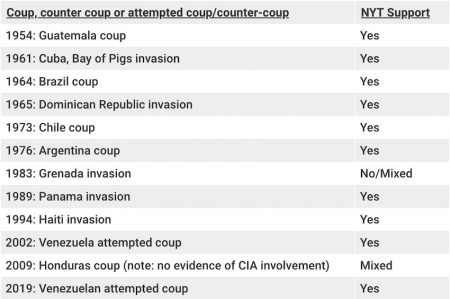
Covert involvement of the United States, by the CIA or other intelligence services, isn’t mentioned in any of the Times’ editorials on any of the coups. Absent an open, undeniable U.S. military invasion (as in the Dominican Republic, Panama and Grenada), things seem to happen in Latin American countries entirely on their own, with outside forces rarely, if ever, mentioned in the Times. Obviously, there are limits to what is “provable” in the immediate aftermath of such events (covert intervention is, by definition, covert), but the idea that the U.S. or other imperial actors could have stirred the pot, funded a junta or run weapons in any of the conflicts under the table is never entertained.
More often than not, what one is left with, reading Times editorials on these coups, are racist, paternalistic “cycle of violence” cliches. Sigh, it’s just the way of things Over There. When reading these quotes, keep in mind the CIA supplied and funded the groups that ultimately killed these leaders:
- Brazil 1964: “They have, throughout their history, suffered from a lack of first class rulers.”
- Chile 1973: “No Chilean party or faction can escape some responsibility for the disaster, but a heavy share must be assigned to the unfortunate Dr. Allende himself.”
- Argentina 1976: “It was typical of the cynicism with which many Argentines view their country’s politics that most people in Buenos Aires seemed more interested in a soccer telecast Tuesday night than in the ouster of President Isabel Martinez de Perlin by the armed forces. The script was familiar for this long‐anticipated coup.”
See, it didn’t matter! It’s worth pointing out the military junta put in power by the CIA-contrived coup killed 10,000 to 30,000 Argentines from 1976 to 1983.
There’s a familiar script: The CIA and its U.S. corporate partners come in, wage economic warfare, fund and arm the opposition, then the target of this operation is blamed. This, of course, isn’t to say there isn’t merit to some of the objections being raised by The New York Times—whether it be Chile in 1973 or Venezuela in 2019. But that’s not really the point. The reason the CIA and U.S. military and its corporate partisans historically target governments in Latin America is because those governments are hostile to U.S. capital and strategic interests, not because they are undemocratic. So while the points the Times makes about illiberalism may sometimes be true, they’re mostly a non sequitur when analyzing the reality of what’s unfolding.
Did Allende, as the Times alleged in 1973 when backing his violent overthrow, “persist in pushing a program of pervasive socialism” without a “popular mandate”? Did, as the Times alleged, Allende “pursue this goal by dubious means, including attempts to bypass both Congress and the courts”? Possibly. But Allende’s supposed authoritarianism isn’t why the CIA sought his ouster. It wasn’t his means of pursuing redistributive policies that offended the CIA and U.S. corporate partners; it was the redistributive policies themselves.
Hand-wringing over the anti-democratic nature of how Allende carried out his agenda without noting that it was the agenda itself—not the means by which it was carried out—that animated his opponents is butting into a conversation no one in power is really having. Why, historically, has The New York Times taken for granted the liberal pretexts for U.S. involvement, rather than analyzing whether there were possibly other, more cynical forces at work?
The answer is that rank ideology is baked into the premise. The idea that the U.S. is motivated by human rights and democracy is taken for granted by The New York Times editorial board and has been since its inception. This does all the heavy lifting without most people—even liberals vaguely skeptical of American motives in Latin America—noticing that a sleight of hand has taken place. “In recent decades,” a 2017 Times editorial scolding Russia asserted, “American presidents who took military action have been driven by the desire to promote freedom and democracy, sometimes with extraordinary results.” Oh, well, good then.
What should be a conversation about American military and its covert apparatus unduly meddling in other countries quickly becomes a referendum on the moral properties of those countries. Theoretically a good conversation to have (and one certainly ongoing among people and institutions in these countries), but absent a discussion of the merits of the initial axiom—that U.S. talking heads and the Washington national security apparatus have a birthright to determine which regimes are good and bad—it serves little practical purpose stateside beyond posturing. And often, as a practical matter, it works to cement the broader narrative justifying the meddling itself.
Do the U.S. and its allies have a moral or ethical right to determine the political future of Venezuela? This question is breezed past, and we move on to the question of how this self-evident authority is best exercised. This is the scope of debate in The New York Times—and among virtually all U.S. media outlets. To ante up in the poker game of Serious People Discussing Foreign Policy Seriously, one is obligated to register an Official Condemnation of the Official Bad Regime. This is so everyone knows you accept the core premises of U.S. regime change but oppose it on pragmatic or legalistic grounds. It’s a tedious, extortive exercise designed to shift the conversation away from the United States’ history of arbitrary and violent overthrows and into an exchange about how best to oppose the Official Bad Regime in question. U.S. liberals are to keep a real-time report card on these Official Bad Regimes, and if these regimes—due to an ill-defined rubric of un-democraticness and human rights—fall below a score of say, “60,” they become illegitimate and unworthy of defense as such.
While obviously not in Latin America, it’s also worth noting that the Times cheerled the CIA-sponsored coup against Iran’s President, Mohammad Mossadegh, in 1953. Its editorial, written two days after his ouster, engaged in the Times’ patented combination of victim-blaming and “oh dear” bloviating:
- “The now-deposed Premier Mossadegh was flirting with Russia. He had won his phony plebiscite to dissolve the Majlis, or lower House of Parliament, with the aid of the Tudeh Communists.”
- “Mossadegh is out, a prisoner awaiting trial. It is a credit to the Shah, to whom he was so disloyal, and to Premier Zahedi, that this rabid, self-seeking nationalist would have been protected at a time when his life would not have been worth the wager of a plugged nickel.”
- “The Shah … deserves praise in this crisis. … He was always true to the parliamentary institutions of his country, he was a moderating influence in the wild fanaticism exhibited by the nationalists under Mossadegh, and he was socially progressive.”
Again, no mention of CIA involvement (which the agency now openly acknowledges), which the Times wouldn’t necessarily have had any way of knowing at the time. (This is part of the point of covert operations.) Mossadegh is summarily demonized, and it’s not until decades later the public learns of the extent of U.S. involvement. The Times even gets in an orientalist description of Iranians, implying why a strong Shah is necessary:
[The average Iranian] has nothing to lose. He is a man of infinite patience, of great charm and gentleness, but he is also—as we have been seeing—a volatile character, highly emotional, and violent when sufficiently aroused.
Needless to say, there are major difference between these cases: Mossadegh, Allende, Chavez and Maduro all lived in radically different times and championed different policies, with varying degrees of liberalism and corruption. But the one thing they all had in common is that the U.S. government, and a compliant U.S. media, decided they “needed to go” and did everything to achieve this end. The fundamental arrogance of this assumption, one would think, is what ought to be discussed in the U.S. media—as typified by the Times’ editorial board—but time and again, this assumption is either taken for granted or hand-waved away, and we all move on to how and when we can best overthrow the Bad Regime.
For those earnestly concerned about Maduro’s efforts to undermine the democratic institutions of Venezuela (he’s been accused of jailing opponents, stacking the courts and holding Potemkin elections), it’s worth pointing out that even when the liberal democratic properties of Venezuela were at their height in 2002 (they were internationally sanctioned and overseen by the Carter Center for years, and no serious observer considers Hugo Chavez’s rule illegitimate), the CIA still greenlit a military coup against Chavez, and the New York Times still profusely praised the act. As it wrote at the time:
With yesterday’s resignation of President Hugo Chávez, Venezuelan democracy is no longer threatened by a would-be dictator. Mr. Chávez, a ruinous demagogue, stepped down after the military intervened and handed power to a respected business leader, Pedro Carmona.
Chavez would soon be restored to power after millions took to the streets to protest his removal from office, but the question remains: If The New York Times was willing to ignore the undisputed will of the Venezuelan people in 2002, what makes anyone think the newspaper is earnestly concerned about it in 2019? Again, the thing that’s being objected to by the White House, the State Department and their U.S. imperial apparatchiks is the redistributive policies and opposition to the United States’ will, not the means by which they do so. Perhaps the Times and other U.S. media—living in the heart of, and presumably having influence over, this empire—could try centering this reality rather than, for the millionth time, adjudicating the moral properties of the countries subject to its violent, illegitimate whims.
Featured Video
The Sordid History of the CIA – Part 2
or go to
Aletho News Archives – Video-Images
From the Archives
Rabbi Shmuel Eliyahu: Leave No Palestinian or Arab Alive
By Jonas E. Alexis | Veterans Today | July 23, 2017
Israeli Rabbi Shmuel Eliyahu seems to have picked up where the late Rabbi Ovadiah Yosef left off. The Israeli army, Eliyahu said, must slaughter the Palestinians “and leave no one alive.” The Palestinians, the good rabbi continued, must be “destroyed and crushed in order to end violence.” Here is Eliyahu’s algorithm:
“If they don’t stop after we kill 100, then we must kill 1,000. And if they do not stop after 1,000, then we must kill 10,000. If they still don’t stop we must kill 100,000, even a million.”
There is more to this “logic” than meets the eye and ear. Eliyahu even postulated that the Israeli army ought not to get involved in arresting Palestinians because “If you leave him alive, there is a fear that he will be released and kill other people. We must eradicate this evil from within our midst.”
You may say that this is just an isolated case. No Israeli official believes that, right? … continue
Blog Roll
Recent Comments


 Aletho News
- The Sordid History of the CIA – Part 2
- French FM under fire over ‘false’ claims about UN rapporteur
- Israel Wants ISIS-Linked Militias To Control Rafah Crossing — The New Order in Gaza
- ISIS never left Syria, it just changed uniforms
- Why ARE the US and Israel Obsessed With Eliminating Iran’s Ballistic Missiles?
- Kremlin comments on EU ‘myopia’ over dialogue with Russia
- Russia more adapted to contemporary military technology than NATO
- Germany puts caveat on more missiles for Ukraine
- UK High Court rules Palestine Action ban unlawful
- Populations in key NATO nations balk at sacrifices for military spending – poll
- If Americans Knew
- Noor’s short life of unimaginable suffering
- Israel Destroyed Gaza’s Hospitals. Now It’s Banning Doctors Without Borders.
- Is Spite of What Zionists Say, It’s a Good Thing to Criticize Governments
- Palestinian mother, daughter recount strip searches, harsh conditions in Israeli detention
- Israel used weapons in Gaza that made thousands of Palestinians evaporate
- ADL’s Stats Twist Israel’s Critics Into Antisemites
- Why Is the World Silent When the Gaza Genocide Is Not Over?
- In Gaza: 8,000 bodies under rubble, 3,000 missing – Not a ceasefire Day 126
- AZAPAC, the new PAC opposing Israeli domination of U.S policies
- Haim Saban: Billionaire for Israel
- No Tricks Zone
- German Gas Crisis…Chancellor Merz Allegedly Bans Gas Debate Ahead of Elections!
- Pollen Reconstructions Show The Last Glacial’s Warming Events Were Global, 10x Greater Than Modern
- Germany’s Natural Gas Storage Level Dwindles To Just 28%… Increasingly Critical
- New Study Rebuts The Assumption That Anthropogenic CO2 Molecules Have ‘Special’ Properties
- Climate Scientist Who Predicted End Of “Heavy Frost And Snow” Now Refuses Media Inquiries
- Polar Bear Numbers Rising And Health Improving In Areas With The Most Rapid Sea Ice Decline
- One Reason Only For Germany’s Heating Gas Crisis: Its Hardcore-Dumbass Energy Policy
- 130 Years Later: The CO2 Greenhouse Effect Is Still Only An Imaginary-World Thought Experiment
- New Study Affirms Rising CO2’s Greening Impact Across India – A Region With No Net Warming In 75 Years
- Germany’s Natural Gas Crisis Escalates … One Storage Site Near Empty …Government Silent
 Aletho News