Maduro: Spain’s Persecution of Catalan Leaders ‘Shameful’
teleSUR | March 27, 2018
After five Catalan pro-independence leaders were arrested Saturday, Venezuela’s President Nicolas Maduro slammed the Spanish authorities over persecution of the Catalan leaders and people simply for independence aspirations.
“What’s happening in Spain is shameful, Catalan politicians jailed only for their ideas… whether or not you agree with these elected lawmakers’ ideas, their persecution is an embarrassment,” Maduro warned in a speech during an international meeting on African decendents rights in the region in Caracas Saturday.
Spanish Prime Minister Mariano Rajoy has criticized Venezuela’s government on several occasions, calling it a “dictatorship” and played an important role in the European Union’s decision to levy economic sanctions on Venezuela over what Brussels calls Maduro’s “brutal decisions.”
In an interview this January Rajoy even talked about political prisoners in Venezuela, saying all he wants is for them to be able to go to the streets all while his government is cracking down on Catalan leaders and politicions for purely political reasons.
The Venezuelan leader stressed that unlike the U.S., Spain and the EU, his government was not meddling in the internal affairs of Spain but “outraged that they persecute people just for their ideas.”
At least nine pro-independence politicians and members of Catalan’s civil society groups are currently in jail for rebellion, a crime punishable with up to 30 years in prison. In total 25 Catalans will be tried for rebellion, embezzlement or disobedience for their participation in the Oct.1, 2017 independence referendum.
Rebellion charges are controversial because the crime requires the use of violence; last year’s Catalan independence referendum was a peaceful civic action. The Spanish State Attorney’s office had argued violence was exercised by pro-independence activists and politicians on Sept. 20, 2017, when they surrounded several Catalan government buildings to prevent the Spanish Civil Guard from entering.
Pro-independence leaders like Jordi Turull, the new candidate for regional president, former ministers Josep Rull, Raul Romeva and Dolors Bassa and former parliament speaker Carme Forcadell, are the latest prisoners in Madrid’s crackdown against pro-independence forces in Catalonia since the referendum.
Pro-independence sentiments are widespread in Catalonia and have grown after Madrid brutally repressed Catalans who went to the polls to cast their vote last year. The election resulted in Catalonia’s declaration of independence. Spanish Prime Minister Mariano Rajoy responded by removing Puigdemont and calling for a snap election, which pro-independence parties and politicians won.
In this context the Venezuelan president called on social movements and humanity “to fight against political persecution and political prisoners in Spain, and to accompany the people of Catalonia in their right to democracy and freedom.”
Animosity between Catalonia and Madrid is rooted in Catalan republicanism and rejection of monarchic rule. The Spanish crown was restored by former dictator Francisco Franco (1936-1975) who banned Catalan language and led a brutal persecution against Catalan republicanism.
Today, in Spain writing a song against the crown or burning an image of the royal family can land a person in jail.
UN seeks rare labor probe against Venezuela
Press TV – March 21, 2018
The UN’s labor body on Wednesday set up an investigation into alleged violations in Venezuela, following a request by a private-sector group long opposed to the Caracas government.
The United Nations’ International Labor Organization rarely creates this type of probe, known as a Commission of Inquiry. The last case was launched against Zimbabwe in 2008.
The entrepreneurial association, Fedecamaras, took its complaint to the Geneva-based ILO, alleging it was the victim of multiple violations committed by President Nicolas Maduro’s socialist government.
Those included breaching freedom of association rights of unions and trade groups seen as opposed to the government; and raising minimum wages without consulting employers — a violation of ILO rules.
In a statement, the ILO said its governing body “has discussed this complaint six times since 2015.”
It asked Caracas “to take measures to put an end to the alleged interference, aggression and stigmatization directed against Fedecamaras, its affiliated organizations and its leaders,” the statement said.
The ILO also noted that it had to cancel a high-level trip to the country scheduled for last year after the government objected to the mission.
“A Commission of Inquiry is generally set up when a member State is alleged to have committed persistent and serious violations of ratified International Labor Conventions, which are binding international treaties, and has repeatedly refused to address them,” the statement further said.
The ILO has only set up 12 such inquiries in its 100-year history.
Venezuela’s crushing economic and political crisis has caused widespread shortages of basic goods, in addition to hyperinflation.
Maduro’s government has at times portrayed certain private-sector groups as enemies and agents of foreign powers hostile to Venezuela’s interests.
Venezuelan Opposition Protests Proposed UN Electoral Observer Mission
Venezuelanalysis | March 13, 2018
Caracas – Supporters of Venezuela’s Democratic Unity Roundtable (MUD) opposition coalition marched on the headquarters of the United Nations in Caracas Monday to protest the possibility of the international body sending an observer mission to monitor the country’s upcoming May 20 elections.
In a letter addressed to UN Secretary-General Antonio Guterres, the opposition alleged that an observer mission would “give a veneer of legality to an [electoral] process that lacks it.”
Last month, the Venezuelan electoral authorities formally invited the UN to send an observer mission to monitor the upcoming elections as part of an agreement negotiated between the government and the MUD, which the latter ultimately refused to sign. The UN is yet to confirm whether it will send a delegation in May.
Following the breakdown of internationally-mediated talks, the main opposition coalition announced it would boycott the presidential elections – which were then set for April 22 – claiming the date and electoral guarantees were inadequate to ensure a free and fair contest.
However on March 1, several smaller opposition parties led by former Lara Governor Henri Falcon broke ranks with the MUD and signed a deal with the ruling United Socialist Party and its leftist allies moving the presidential election to May 20 and hold municipal and state legislative elections on the same day. Although the agreement featured various safeguards previously demanded by the MUD during talks – including observers from the UN and other international bodies, equal access to media, and an ample window for voter registration – the anti-government coalition dismissed the deal as a “farce” and vowed to go ahead with its boycott.
Turnout in Monday’s demonstration was, nonetheless, small in number, particularly in comparison to the mass protests organized by the MUD to demand early presidential elections last year, which frequently concluded in deadly acts of violence perpetrated by hardline anti-government groups.
The march was organized by the newly formed “Free Venezuela Broad Front” (FAVL), which includes the parties of the MUD alongside the Fedecameras business lobby, representatives of the Catholic and evangelical churches, several university student and professor organizations, as well as a group of ex-government loyalists led by former Interior Minister Miguel Rodriguez Torres.
Taking to Twitter Saturday, President Nicolas Maduro criticized the call for electoral boycott and rejection of UN observers from sections of the opposition.
“Why so much contradiction? What do they [the MUD] want? I want the secretary-general to send a strong commission of observers,” he declared.
Meanwhile, Maduro’s principal rival, Henri Falcon, was in New York Tuesday, where he was reportedly meeting with UN officials.
Himself a former Chavista, Falcon was expelled from the MUD last month after he registered his candidacy in violation of the coalition’s boycott.
While center-right pollster Datanalisis has reported that over 70 percent of Venezuelans intend to vote in the upcoming elections, Falcon and other opposition leaders remain concerned about low turnout among their ranks.
On Tuesday, a spokesperson for the opposition’s new Broad Front denied the organization was promoting abstention.
“We are not partisans of a policy of abstention. Of course, we think that as things are now, one cannot vote, because we want to vote to truly choose and not give the appearance of legality in the country that doesn’t exist,” explained Ramon Guillermo Aveledo, who was secretary general of the MUD between 2009 and 2014, during an interview with Globovision Tuesday.
However, the former MUD leader did not indicate that the FAVL would encourage its supporters to vote for Falcon.
On the contrary, he suggested that the opposition candidate could abandon his presidential bid.
“I don’t at all rule out that Falcon renounces his candidacy, withdraws from the process when he confirms what we, his friends, have told him… that it’s not a real election,” Aveledo added.
The FAVL has called for nationwide protests against the May 20 elections for this coming Saturday.
Venezuela Rejects Trump’s Renewal of Obama “Extraordinary Threat” Designation
Venezuelanalysis | March 5, 2018
Venezuela issued a statement Saturday slamming the Trump administration for its renewal of an executive order branding the South American country an “unusual and extraordinary threat” to U.S. national security.
“The government of the Bolivarian Republic of Venezuela denounces the continued aggression of the U.S. regime by extending the executive order that qualifies Venezuela as an ‘unusual and extraordinary threat’ to U.S. security,” reads the text of a communique issued by Venezuela’s Foreign Ministry.
On Friday, the White House opted to renew for a third time Executive Order 13692, which was originally signed by President Barack Obama on March 8, 2015. The decree declares a “national emergency with respect to the situation in Venezuela” and authorizes the application of U.S. sanctions.
Caracas hit back at Washington, describing the latest executive order as intended to “promote and justify the overthrow of the legitimate and constitutionally elected government of President Nicolas Maduro.”
“By extending the executive order, the U.S. regime intends to present itself as a victim, when the entire world recognizes it as the great victimizer. Washington assumes aggression and has transformed the world into an increasingly insecure place, which represents a real threat to international peace and security.”
Renewing the executive order, the statement continues, is a “crime of aggression punishable by international law” that seeks to encourage foreign intervention in Venezuela’s affairs and sway the outcome of May 20 elections.
At the same time, Bolivian President Evo Morales posted a message on Twitter deriding the U.S. government’s latest gesture against the government of President Nicolas Maduro.
“The United States qualifies our sister Venezuela as a ‘threat,’ but with the United States’ background of financing coups, manipulating elections in 81 countries and killing hundreds of thousands with atomic bombs in Nagasaki and Hiroshima, the United States is the real threat to the world,” Morales wrote.
The renewal of the executive order comes as the Trump administration says it is “considering a lot of different economic and diplomatic options in dealing with Venezuela.”
“We have said we are considering all options to restore democracy to Venezuela, including individual and potentially financial sanctions,” State Department spokesperson Heather Nauert said in a press conference on Thursday.
Edited and with additional reporting by Venezuelanalysis.com.
Source: teleSUR English
There Is No Humanitarian Crisis in Venezuela, Says UN Expert
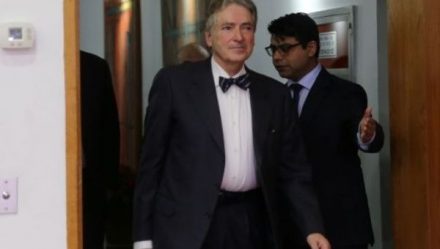
Alfred de Zayas: Sanctions and economic warfare aggravate the smuggling of medicines and food on the border with Colombia | Photo: AVN
teleSUR | February 20, 2018
The American lawyer and historian, Alfred de Zayas, an expert in the field of human rights, warned about the use of the term humanitarian crisis to intervene in Venezuela and overthrow the current government.
Alfred de Zayas, the independent expert of the United Nations (UN) on the Promotion of an International Democratic and Equitable Order, concluded after his visit to Venezuela that this country does not suffer a humanitarian crisis, unlike countries in Africa or Asia where there are wars and famine.
“I have compared the statistics of Venezuela with that of other countries and there is no humanitarian crisis, of course there is scarcity, anxiety and shortages but who has worked for decades for the United Nations and knows the situation of countries in Asia, Africa and some of America, knows that the situation in Venezuela is not a humanitarian crisis,” Zayas said in an interview for teleSUR.
The independent expert arrived in Venezuela on November 27 and held meetings with government officials, victims of human rights violations and the violence of the so-called guarimbas (violent protests by the opposition) in order to learn about the political, economic and social situation of the country.
He explained that although many think that the country is on the verge of disaster, as media outlets do, “Venezuela suffers an economic war, a financial blockade, suffers a high level of smuggling and, of course, needs international solidarity to solve these problems.”
He also believes that the international community should work in solidarity with Venezuela to lift the sanctions, “because these are the ones that worsen the shortage of food and medicine, it is unbearable to think that having a malaria crisis in the Venezuelan Amazon, Colombia has blocked the sale of medicines and Venezuela had to obtain it in India.”
The expert affirms that the current discourse of humanitarian crisis on the part of US spokespersons, besides being invalid, only pursues the change of regime in Venezuela, “since 1999, a series of States want regime change in Venezuela , that desire to destroy the Bolivarian Revolution and to repeal all the social laws adopted in the mandates of (Hugo) Chávez and (Nicolás) Maduro.”
Zayas denounced the invisibility of his visit to Venezuela in the dominant media, which in his opinion are not interested in disseminating a complete picture of the situation in this country.
The expert told teleSUR that the normal thing, being a senior official of the United Nations, secretary of the Human Rights Committee and head of the complaints department of the UN High Commissioner, is that when he pronounces on a subject, in general, media such as BBC and The New York Times collect and publish their statements.
However, “in the case of Venezuela both CNN and the BBC have ignored me, it is as if my visit to Venezuela had not taken place, as if I had not visited it”, which qualifies as public manipulation, adding that only teleSUR and Sputnik has interviewed him.
The American historian also noted that certain organizations called “non-governmental but whose loyalties are doubtful”, do not want independent experts, “they want experts to come to the country to condemn, that’s why when they name and know me internationally, they said that I was not the relevant rapporteur to talk about Venezuela.”
The United Nations office received letters of complaint from abroad about Zayas’ visit to Venezuela, in which the points he had to investigate were required, “I considered that an interference with my independence, I am the rapporteur, I determine my program I know what information is relevant to my report, but I do not want the report to be dictated to me and some non-governmental organizations suggested me in an uncourteous way with insulting letters, saying what I had to do when I was Venezuela.”
Amnesty International Winks at Trump’s Economic Attack on Venezuelans
By Joe Emersberger | CounterPunch | March 2, 2018
Amnesty International told me that it “does not take a position on the current application” of U.S. economic sanctions that Trump’s administration imposed on Venezuela in August “but rather emphasizes the urgent need to address the serious crisis of the right to health and food which Venezuela is facing. In terms of human rights, it is the Venezuelan state’s responsibility to resolve this.” Amnesty’s full reply to three questions I asked them by email can be read here.
The expression that “silence gives consent” applies perfectly to Amnesty’s stance which tacitly endorses Trump’s aggression against the Venezuelan people. To make this even more obvious, Amnesty also refused to condemn remarks by Rex Tillerson and Marco Rubio that encourage a military coup in Venezuela. Asked to comment on those remarks Amnesty replied that it ”believes that a responsible discussion on the current state of human rights in Venezuela should not be focused on statements made by parties outside the country and context”.
In the middle of an already grave economic crisis, the sanctions will cost Venezuela’s government billions of dollars this year. Its $64 billion USD in outstanding foreign currency bonds are all governed by New York Law, but the sanctions have outlawed Venezuela from borrowing or selling assets in the U.S. financial system. Debt restructuring is therefore made impossible and it blocks the government from rolling over its bonds (offsetting principal costs by issuing new debt). The sanctions also block CITGO, a U.S. based company owned the by the Venezuelan government, from sending its profits or dividends (which have totaled about $2.5 billion USD since 2015) back to Venezuela.
U.S. sanctions, which are illegal under of chapter 4 article 19 of the OAS Charter, are a direct assault on the Venezuelan peoples’ “right to health and food”. There is no avoiding this conclusion even if you believe the worst that has been said about Venezuela’s government. You’ll find it extremely hard to learn from the international media, but sanctions are not supported by most Venezuelans according to the same opposition-aligned pollster (Datanalisis) that the media has cited ad nauseam about Venezuelan President Nicolas Maduro’s approval rating.
According to Datanalisis, about 45% of the population received cash bonuses the government paid out over the past three months. Another opposition source – a group of Venezuelan academics who produce the annual ENCOVI surveys – claim that 87% of households have received direct food handouts from the government. The ENCOVI study is especially dubious as Jacob Wilson has explained, and its 87% figure is probably a wild exaggeration, but even if an accurate estimate is closer to 50%, the depravity of Trump’s sanctions and Amnesty’s refusal to denounce them should be clear from statistics produced by opposition sources.
Decent people were outraged by the sanctions that the U.S. and its allies imposed on Iraq during the 1990s – a country that really was ruled by a dictator. They should be even more outraged that the same gang of states that devastated Iraq has been able to target a democracy thanks to a propaganda system in which big NGOs like Amnesty play an important part.
Incidentally, the impact of the U.S. sanctions dwarfs any offers of humanitarian aid that have been made. That hasn’t stopped headlines like “Why won’t the country accept aid?”, and articles that invariably fail to explore what has been offered and how it compares to billions of dollars lost due to illegally imposed U.S. sanctions. The annual program expenditures of groups like Caritas ($4 million) and the Pan American Development Foundation ($81 million) are a drop in the ocean compared to the impact of the sanctions.
I was disgusted but not surprised by Amnesty’s tacit support for Trump’s aggression against Venezuela for several reasons.
In 2010, Amnesty put out a statement claiming that there was only one TV broadcaster in Venezuela that had not been shut down by the government – an absolutely preposterous claim. Could the world renowned organization not afford to pay somebody to watch some Venezuelan TV or do any basic research?
Amnesty refused to recognize Chelsea Manning as a Prisoner of Conscience on ridiculous grounds, but has given that designation to Leopoldo Lopez – a man involved with four different attempts to violently overthrow Venezuela’s democratically elected government. One of them, in April of 2002, was briefly successful.
When the US government (helped by its trusty allies Canada and France) overthrew Haiti’s democratically elected president in 2004 and installed a dictatorship that ruled with tremendous brutality for two years, Amnesty’s response was seriously marred by political cowardice and double standards. About the kindest thing you could say about Amnesty’s work in Haiti, and in general, is that Human Rights Watch (HRW) has been even worse. For example, it took HRW years longer than Amnesty to make any serious contribution to the fight to hold the UN mission in Haiti accountable for killing 10,000 Haitians by bringing cholera in to the country in 2010. The key facts were well known by at least 2011 (as you can see from this petition) years before Amnesty took any significant action in 2015.
Norman Finkelstein’s latest book “Gaza: An Inquest into its Martyrdom” has a chapter devoted to thoroughly dissecting Amnesty’s reports on Israel’s savage “Protective Edge” assault on Gaza in 2014. Finkelstein wrote “By supplying Israel with pretexts for atrocities that were among the most heinous it committed during Protective Edge, Amnesty conveniently eased the burden of Israeli hasbara [propagandists]”.
In an email exchange I had with Amnesty regarding Syria in 2012, Amnesty defended a position which told Saudi Arabia, perhaps the most brutal and backward government on earth, to merely be careful about which rebels it armed in Syria. At the same time, Amnesty called for an arms embargo on almost entirely defenseless Palestinians.
Amnesty has repeatedly showed that it is not willing or able to denounce the brutality of the U.S. government or its allies to anywhere near the extent that it should. One can have a long discussion about why that’s the case, but an appalling track record has been well established. People who live in United States, or in countries like Canada which regularly provide political cover for U.S. crimes abroad, will have to work around and even against NGOs like Amnesty International to prevent their governments from continuing to destroy one country after another.
WSJ’s Epic Distortion of Colombian and Venezuelan Refugees
By Joe Emersberger | FAIR | February 18, 2018
A Wall Street Journal article by Juan Forero (2/13/18) ran with the headline “Venezuela’s Misery Fuels Migration on Epic Scale.” The subhead stated, “Residents Flee Crumbling Economy in Numbers That Echo Syrians to Europe, Rohingya to Bangladesh.”
Forero’s article quoted a UN official: “By world standards, Colombia is receiving migrants at a pace that now rivals what we saw in the Balkans, in Greece, in Italy in 2015, at the peak of [Europe’s] migrant emergency.” Further on, Forero says, “The influx prompted Colombian officials to travel to Turkey last year to study how authorities were dealing with Syrian war refugees.”
Two enormous problems with the way Forero and his editors have framed this article should immediately stand out:
- Colombia’s population of internally displaced people is about 7 million, and has consistently been neck and neck with Syria’s. According to the UNHCR, as of mid-2016, Colombia is also the Latin American country which has the most number of refugees living outside its borders: over 300,000, mainly in Venezuela and Ecuador. Forero and his editors picked the wrong country to compare with Syria.
- Greece and Italy do not share a border with Syria, nor do the Balkans as they are generally defined. Colombia and Venezuela, by contrast, share a very long border. Forero’s comparison, therefore, excludes states that border Syria. Three of those bordering states—Lebanon, Jordan and Turkey—collectively absorbed 4.4 million Syrian refugees by 2016; five years after war broke out in Syria, Turkey alone took in almost 3 million.
It’s very important to expand on the first point. Colombia is a humanitarian and human rights disaster, and has been for decades, in very large part due to its close alliance with the United States. Thanks to Wikileaks (CounterPunch, 2/23/12), we know that US officials privately acknowledged estimates that hundreds of thousands of people were murdered by right-wing paramilitaries, and that the killings have nearly wiped out some indigenous groups. Those genocidal paramilitaries have worked closely with the Colombian military that Trump Chief of Staff John Kelly praised in 2014 as a “magnificent” US partner. “They’re so appreciative of what we did for them,” raved Kelly.
Praise for Colombia’s government has also come from the liberal end of the US establishment, albeit with much more subtlety than from Kelly. In 2014, a New York Times editorial (9/21/14) stated that “Colombia, Brazil and other Latin American countries should lead an effort to prevent Caracas from representing the region [on the UN Security Council] when it is fast becoming an embarrassment on the continent.” So to Times editors, Colombia is a regional good guy that must lead its neighbors in shunning Venezuela.
Colombia’s current president, Juan Manuel Santos, was minister of Defense from 2006 to 2009. From 2002 to 2008, the Colombian military murdered about 3,000 civilians, passing them off as slain rebels. As human rights lawyer Dan Kovalik explained (Huffington Post, 11/20/14) , the International Criminal Court (ICC) “concluded that these killings were systemic, approved by the highest ranks of the Colombian military, and that they therefore constituted ‘state policy.’” The murders occurred with the greatest frequency between 2004 and 2008, which Kovalik observed “also corresponds with the time in which the US was providing the highest level of military aid to Colombia.”
If Colombian and US officials evade prosecution for all of this, it will be with the help of corporate media—as well as the severe limitations powerful governments impose on international bureaucracies like the ICC. Kovalik remarked:
You might say, no official of the US can be prosecuted by the ICC because the US has refused to ratify the ICC treaty. While this may appear to be true, this did not stop the ICC from prosecuting officials from the Sudan—also not a signatory to the ICC.
The closest Forero came in his article to even hinting at any of these gruesome facts was when he wrote that “Colombia has long had troubles of its own, including integrating former Communist guerrillas from a civil conflict that only ended recently.” The “conflict” has not exactly “ended,” given that 170 leftist political leaders and activists were assassinated in 2017.
Putting aside Forero’s epic distortions by omission regarding Colombia, what about his reporting about migration from Venezuela? He wrote:
Nearly 3 million Venezuelans—a tenth of the population—have left the oil-rich country over the past two decades of leftist rule. Almost half that number—some 1.2 million people—have gone in the past two years, according to Tomás Páez, a Venezuelan immigration expert at Venezuela’s Central University.
In April 2002, Páez signed his name to a quarter-page ad in the Venezuelan newspaper El Nacional that welcomed the dictatorship of Pedro Carmona, then head of Venezuela’s largest business federation, who was installed after a US-backed military coup briefly ousted the late President Hugo Chavez. I’ve written before (ZNet, 1/16/17) about Western outlets—New York Times (11/25/16), Reuters (10/15/14) and Financial Times (8/22/16)—citing Páez without disclosing his anti-democratic record.
The World Bank has compiled data over the years on the numbers of Venezuelan-born people living abroad. The numbers point to far smaller migrations than Páez has estimated:

During the years Chavez was in office (1999–2013), the World Bank’s figures tell us Venezuelans living abroad increased by about 330,000. By 2013, Páez was estimating that about 1.3 million had left—about 1 million more than World Bank estimates. Would journalists ignore data published by the World Bank in favor of estimates by Páez if he were a staunch supporter of the Venezuelan government?
During those 1999–2013 years, the World Bank figures also say that the number of Colombian-born people living in Venezuela grew by 200,000. Forero’s article implies that migration from Colombia to Venezuela ended in the “late 20th century.”
The World Bank has not updated migration data past 2013, but there is no doubt there was a huge increase in migration from Venezuela since its economy entered into a very deep crisis starting in late 2014. (For an overview of the important role of US policy in creating the crisis and now deliberately making it much worse, see my op-ed, “US Policy a Big Factor in Venezuela’s Depression”—Tribune News Service, 2/2/18.)
According to a Colombian university study of Venezuelan migration to Colombia, it averaged about 47,000 per year from 2011–2014, then increased to 80,000 per year in 2015–16.
US government data show migration from Venezuela to the United States increasing from about 7,000 per year before 2013 to 28,000 per year by 2015, including Venezuelans who have entered without authorization.

From 2000 to 2013, the United States was the destination for about 30 percent of Venezuelan-born people who left to live abroad, according to the World Bank figures. If the Colombian university study and US government data are accurate, then the United States has been the destination for about 20 percent of Venezuelan migrants after 2013. That would mean about 140,000 Venezuelans per year were leaving to live abroad by 2016.
That is not remotely comparable to the 5 million Syrians who fled the country in the first five years following the civil war—and that doesn’t include over a million per year who fled their homes inside Syria (the internally displaced).
That Forero would even try to force this comparison into his article speaks volumes. It’s not hard to guess why it was made, given that US has bombed Syria regularly and has had Venezuela’s government in its crosshairs for almost two decades.
NDP marches with USA on Venezuela
By Yves Engler · February 13, 2018
Has it become NDP policy to support US-backed coups in Latin America?
The Canadian social democratic party’s foreign critic Hélène Laverdière has certainly remained silent regarding US leaders musing about a military coup or invasion of Venezuela and has openly supported asphyxiating the left-wing government through other means.
At the start of the month US Secretary of State Rex Tillerson called for the military to oust President Nicolás Maduro. “In the history of Venezuela and South American countries, it is often times that the military is the agent of change when things are so bad and the leadership can no longer serve the people,” Tillerson said in a speech, which included a quip about Maduro being sent to Cuba.
I found no criticism of Tillerson’s speech by Laverdière. The 15-year Foreign Affairs diplomat also stayed mum when Donald Trump threatened to invade Venezuela in the summer. “We have many options for Venezuela including a possible military option if necessary,” the US President said.
Laverdière has also failed to challenge Canadian sanctions on Venezuela, which followed a similar move by the US. In a move that probably violated the UN and OAS charters, in September the elected president, vice president and 38 other Venezuelan officials had their assets in Canada frozen and Canadians were barred from having financial relations with these individuals. Two months later 19 Venezuelan officials were sanctioned under the just adopted Magnitsky Act, which Laverdière and the NDP backed.
Nor did I find any criticism of Canada’s role in the so-called Lima Group of anti-Venezuelan foreign ministers. Laverdière remained silent when foreign minister Chrystia Freeland organized a meeting of the Lima Group in Toronto four months ago.
She also ignored Canada’s role in directly financing an often-unsavoury Venezuelan opposition. A specialist in social media and political transition, outgoing Canadian ambassador Ben Rowswell told the Ottawa Citizen in August: “We established quite a significant internet presence inside Venezuela, so that we could then engage tens of thousands of Venezuelan citizens in a conversation on human rights. We became one of the most vocal embassies in speaking out on human rights issues and encouraging Venezuelans to speak out.”
The NDP foreign critic also stayed mum when the federal government expelled Venezuelan diplomats’ from Canada in December.
Instead, Laverdière has repeatedly found cause to criticize Venezuela and call on Ottawa to do more to undermine Maduro’s government. She publicized and spoke to the weirdly themed “Demonstration for human and democratic rights in Venezuela in solidarity with Ukraine and Syria” and called Venezuela’s vice-president “a drug lord” from whom “the American government has seized billions of dollars of his assets for drug trafficking.”
Amidst opposition protests in the summer, Laverdière told CBC, “we would like to see the [Canadian] government be more active in … calling for the release of political prisoners, the holding of elections and respecting the National Assembly.”
Laverdière’s statement ignored the death and destruction caused by opposition protesters and the opposition’s effort to hamstring the government after it won control of the National Assembly in 2015.
At a foreign affairs committee meeting in June Laverdière responded to an anti-Venezuela screed by saying “I share many of his concerns.” Amongst a series of outrageous claims against the leftist government, Peter Kent told the committee: “As so many dictators have done over the centuries, Chávez blamed Venezuela’s small but dynamic Jewish community for stealing the wealth of the country. His henchmen endorsed the Holocaust.”
In June 2016 Laverdière put out a press release bemoaning “the erosion of democracy” and the need for Ottawa to “defend democracy in Venezuela”. In it Laverdière said, “the OAS Secretary General Luis Almagro has invoked the Inter-American Democratic Charter regarding Venezuela, and Canada, as a member of the OAS, should support his efforts.” But, the former Uruguayan Foreign Minister’s actions as head of the OAS were highly controversial. They even prompted Almagro’s past boss, former Uruguayan president José Mujica, to condemn his bias against the Venezuelan government.
Amidst three months of violent right wing protests at the start of 2014, then NDP Americas critic Laverdière presented a position to the House of Commons titled “Human Rights in Venezuela” and sponsored a House of Commons resolution (slightly re-worded and reintroduced two days later by then foreign critic Paul Dewar) asking, ” the Government of Canada to urge Venezuelan authorities to proactively de-escalate the conflict, protect the human rights and democratic freedoms of Venezuelan citizens, release all those detained during the protests, immediately cease all government interference with peaceful protesters, and ensure that those people who perpetrated the violence be brought to justice and bear the full weight of the law.”
After the opposition once again cried foul when they lost the 2013 presidential election, Laverdière accused the Stephen Harper government of being soft on Venezuela (only elections the right wing wins are fair, in the eyes of large swaths of the opposition and Laverdière). “Canada’s silence is striking,” she told Ipolitics. “They had views on President Chávez, but now they don’t seem to actually care what’s happening in the country.”
In what may be the first ever resolution to an NDP convention calling for the removal of a party critic, the NDP Socialist Caucus has submitted a motion to next weekend’s convention titled “Hands Off Venezuela, Remove Hélène Laverdière as NDP Foreign Affairs Critic.” It notes: “Be It Resolved that the NDP actively oppose foreign interference in Venezuela, defend Venezuela’s right to self-determination, reject alignment with U.S. policy in Europe, the Middle East, Africa and beyond, and request the immediate removal of MP Hélène Laverdière as NDP Foreign Affairs Critic.”
NDP members who oppose imperialism need to challenge Laverdière’s support for Washington and Ottawa’s efforts to topple Venezuela’s elected government.
Featured Video

The Sordid History of the CIA – Part 2
or go to
Aletho News Archives – Video-Images
From the Archives
Rabbi Shmuel Eliyahu: Leave No Palestinian or Arab Alive
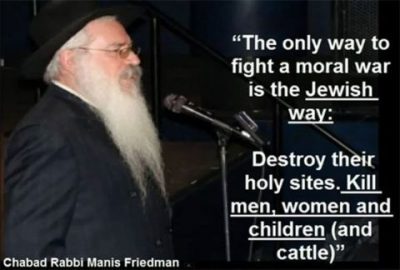
By Jonas E. Alexis | Veterans Today | July 23, 2017
Israeli Rabbi Shmuel Eliyahu seems to have picked up where the late Rabbi Ovadiah Yosef left off. The Israeli army, Eliyahu said, must slaughter the Palestinians “and leave no one alive.” The Palestinians, the good rabbi continued, must be “destroyed and crushed in order to end violence.” Here is Eliyahu’s algorithm:
“If they don’t stop after we kill 100, then we must kill 1,000. And if they do not stop after 1,000, then we must kill 10,000. If they still don’t stop we must kill 100,000, even a million.”
There is more to this “logic” than meets the eye and ear. Eliyahu even postulated that the Israeli army ought not to get involved in arresting Palestinians because “If you leave him alive, there is a fear that he will be released and kill other people. We must eradicate this evil from within our midst.”
You may say that this is just an isolated case. No Israeli official believes that, right? … continue
Blog Roll
Recent Comments


 Aletho News
- Jeffrey Epstein’s sinister shadow over West Asia
- The Sordid History of the CIA – Part 2
- French FM under fire over ‘false’ claims about UN rapporteur
- Israel Wants ISIS-Linked Militias To Control Rafah Crossing — The New Order in Gaza
- ISIS never left Syria, it just changed uniforms
- Why ARE the US and Israel Obsessed With Eliminating Iran’s Ballistic Missiles?
- Kremlin comments on EU ‘myopia’ over dialogue with Russia
- Russia more adapted to contemporary military technology than NATO
- Germany puts caveat on more missiles for Ukraine
- UK High Court rules Palestine Action ban unlawful
- If Americans Knew
- Noor’s short life of unimaginable suffering
- Israel Destroyed Gaza’s Hospitals. Now It’s Banning Doctors Without Borders.
- Is Spite of What Zionists Say, It’s a Good Thing to Criticize Governments
- Palestinian mother, daughter recount strip searches, harsh conditions in Israeli detention
- Israel used weapons in Gaza that made thousands of Palestinians evaporate
- ADL’s Stats Twist Israel’s Critics Into Antisemites
- Why Is the World Silent When the Gaza Genocide Is Not Over?
- In Gaza: 8,000 bodies under rubble, 3,000 missing – Not a ceasefire Day 126
- AZAPAC, the new PAC opposing Israeli domination of U.S policies
- Haim Saban: Billionaire for Israel
- No Tricks Zone
- Unfudging The Data: Dutch Meteorological Institute Reinstates Early 20th Centruy Heat Waves It Had Erased Earlier
- German Gas Crisis…Chancellor Merz Allegedly Bans Gas Debate Ahead of Elections!
- Pollen Reconstructions Show The Last Glacial’s Warming Events Were Global, 10x Greater Than Modern
- Germany’s Natural Gas Storage Level Dwindles To Just 28%… Increasingly Critical
- New Study Rebuts The Assumption That Anthropogenic CO2 Molecules Have ‘Special’ Properties
- Climate Scientist Who Predicted End Of “Heavy Frost And Snow” Now Refuses Media Inquiries
- Polar Bear Numbers Rising And Health Improving In Areas With The Most Rapid Sea Ice Decline
- One Reason Only For Germany’s Heating Gas Crisis: Its Hardcore-Dumbass Energy Policy
- 130 Years Later: The CO2 Greenhouse Effect Is Still Only An Imaginary-World Thought Experiment
- New Study Affirms Rising CO2’s Greening Impact Across India – A Region With No Net Warming In 75 Years
 Aletho News
