
Venezuelan authorities hit back at their counterparts in Panama and Switzerland this week after they approved new measures targeting Caracas.
Panama’s Economic and Finance Ministry announced this past March 27 that a warning was being issued to the Central American country’s banks advising them to limit and “diligently” supervise financial transactions involving 55 top Venezuelan officials as well as 16 private businesses allegedly associated with the Maduro government.
The list includes President Nicolas Maduro, National Electoral Council President Tibisay Lucena and rectors Tania D’Amelio and Socorro Hernandez, National Constituent Assembly members Diosdado Cabello and Hermann Escarra, Education Minister Elias Jaua, and Culture Minister Ernesto Villegas.
In an official statement, Panamanian authorities categorized the individuals and businesses as being “high risk in the area of money laundering, financing terrorism, and financing the proliferation of weapons of mass destruction.” No evidence was, however, presented to support the allegations.
Venezuela possesses no nuclear weapons and is a signatory of the Nuclear Non-Proliferation Treaty, as well as various other treaties banning the acquisition and development of nuclear, biological, and chemical weapons.
Similarly, many of those accused by Panama of allegedly financing terrorism belong to institutions which were themselves the objects of violent opposition attacks during last year’s anti-government protests – including the Supreme Court, the National Electoral Council, and regional government offices – which the Maduro administration has repeatedly described as “terrorism”.
Speaking Monday, Venezuelan Attorney General Tarek William Saab, who is included on Panama’s list, fired back, describing the accusations as “fake news” and calling on them to provide evidence.
“Show the accounts, my accounts for example, show where my name, my photo appears,” Saab challenged.
Penitentiary Affairs Minister Iris Varela, who also appears on the list, similarly denied the accusations and called on the Central American authorities to publish a “complete list” of all Venezuelan citizens who own assets in the country, placing special emphasis on those mentioned in the Panama Papers.
“Why don’t they do it [publish the complete list],” she questioned. “Simply because they have assets and fortunes that belong to the [Venezuelan] opposition.”
The recent measures follow close on the heels of an announcement last month that Panama will not recognise the results of Venezuela’s upcoming presidential election, mirroring steps taken by the Trump administration and other regional conservative governments in rejecting the May 20 vote.
Meanwhile, Switzerland also moved to apply sanctions against seven high-ranking Venezuelan functionaries last Wednesday, freezing their alleged assets in Swiss banks and applying travel bans.
In response, the Venezuelan government delivered an official letter of protest to the Swiss charge d’affaires Monday, calling the sanctions a violation of the UN Charter’s ban on unilateral coercive measures and charging Switzerland with “subordination” to Washington and Brussels’ hardline Venezuela policy.
“This erratic action… on the part of a historically neutral country like the Swiss Confederation does not create conditions for dialogue and strengthens extremist positions that seek violent solutions,” reads the text of the letter.
Venezuela’s Supreme Court also issued a declaration Monday rejecting the moves as “illegal”. Supreme Court President Maikel Moreno was named in both Swiss and Panamanian measures.
The latest international actions targeting Venezuela have, however, won praise from members the country’s right-wing opposition, including Popular Will party Political Coordinator Carlos Vecchio, who applauded the Panama measures as “the right path at this stage”.
Vecchio is currently in Paris meeting with center-right French President Emmanuel Macron as part of a European tour aimed at drumming up support for more sanctions against Caracas.
During the meeting Tuesday, Vecchio, together with First Justice party leader Julio Borges and ex-Caracas Mayor Antonio Ledezma – who is currently fleeing the Venezuelan justice system – called on Macron’s government to apply “more sanctions” against Venezuela and to “halt Petro, gold, and capital legitimation operations,” referring to the South American country’s new crypto-currency. They also urged the French president and other European leaders “not to dialogue” with Caracas.
Translation | We propose to the government of France to support Humanitarian Intervention, criminal court trial, more sanctions, stop operations with Petro, gold and legitimation of capital to get out of the dictatorship that oppresses our people. and Disregard electoral fraud. With a dictatorship there is no dialogue
Opposition presidential frontrunner Henri Falcon, who defied the main opposition in launching his candidacy and has opposed economic sanctions in the past, has yet to issue a public statement with regard to the latest measures from Panama and Switzerland.
So far, only the US and the UK have approved economic sanctions against Caracas, while Canada and the European Union have rolled out sanctions against top Venezuelan officials
International sanctions against Venezuela have been denounced by the UN Human Rights Council as well as by UN Independent Expert Alfred de Zayas, who labeled the US-led measures “crimes against humanity” and called for the International Court of Justice to investigate.
According to Datanalisis, 55.6 percent of Venezuelans oppose economic sanctions against their country, while just 42 percent support individual sanctions targeting top officials.
Edited and with additional reporting by Lucas Koerner from Caracas.
April 7, 2018
Posted by aletho |
Fake News, Mainstream Media, Warmongering | Latin America, Panama, Switzerland, UK, United States, Venezuela |
Leave a comment
Venezuelan authorities hit back at their counterparts in Panama and Switzerland this week after they approved new measures targeting Caracas.
Panama’s Economic and Finance Ministry announced this past March 27 that a warning was being issued to the Central American country’s banks advising them to limit and “diligently” supervise financial transactions involving 55 top Venezuelan officials as well as 16 private businesses allegedly associated with the Maduro government.
The list includes President Nicolas Maduro, National Electoral Council President Tibisay Lucena and rectors Tania D’Amelio and Socorro Hernandez, National Constituent Assembly members Diosdado Cabello and Hermann Escarra, Education Minister Elias Jaua, and Culture Minister Ernesto Villegas.
In an official statement, Panamanian authorities categorized the individuals and businesses as being “high risk in the area of money laundering, financing terrorism, and financing the proliferation of weapons of mass destruction.” No evidence was, however, presented to support the allegations.
Venezuela possesses no nuclear weapons and is a signatory of the Nuclear Non-Proliferation Treaty, as well as various other treaties banning the acquisition and development of nuclear, biological, and chemical weapons.
Similarly, many of those accused by Panama of allegedly financing terrorism belong to institutions which were themselves the objects of violent opposition attacks during last year’s anti-government protests – including the Supreme Court, the National Electoral Council, and regional government offices – which the Maduro administration has repeatedly described as “terrorism”.
Speaking Monday, Venezuelan Attorney General Tarek William Saab, who is included on Panama’s list, fired back, describing the accusations as “fake news” and calling on them to provide evidence.
“Show the accounts, my accounts for example, show where my name, my photo appears,” Saab challenged.
Penitentiary Affairs Minister Iris Varela, who also appears on the list, similarly denied the accusations and called on the Central American authorities to publish a “complete list” of all Venezuelan citizens who own assets in the country, placing special emphasis on those mentioned in the Panama Papers.
“Why don’t they do it [publish the complete list],” she questioned. “Simply because they have assets and fortunes that belong to the [Venezuelan] opposition.”
The recent measures follow close on the heels of an announcement last month that Panama will not recognise the results of Venezuela’s upcoming presidential election, mirroring steps taken by the Trump administration and other regional conservative governments in rejecting the May 20 vote.
Meanwhile, Switzerland also moved to apply sanctions against seven high-ranking Venezuelan functionaries last Wednesday, freezing their alleged assets in Swiss banks and applying travel bans.
In response, the Venezuelan government delivered an official letter of protest to the Swiss charge d’affaires Monday, calling the sanctions a violation of the UN Charter’s ban on unilateral coercive measures and charging Switzerland with “subordination” to Washington and Brussels’ hardline Venezuela policy.
“This erratic action… on the part of a historically neutral country like the Swiss Confederation does not create conditions for dialogue and strengthens extremist positions that seek violent solutions,” reads the text of the letter.
Venezuela’s Supreme Court also issued a declaration Monday rejecting the moves as “illegal”. Supreme Court President Maikel Moreno was named in both Swiss and Panamanian measures.
The latest international actions targeting Venezuela have, however, won praise from members the country’s right-wing opposition, including Popular Will party Political Coordinator Carlos Vecchio, who applauded the Panama measures as “the right path at this stage”.
Vecchio is currently in Paris meeting with center-right French President Emmanuel Macron as part of a European tour aimed at drumming up support for more sanctions against Caracas.
During the meeting Tuesday, Vecchio, together with First Justice party leader Julio Borges and ex-Caracas Mayor Antonio Ledezma – who is currently fleeing the Venezuelan justice system – called on Macron’s government to apply “more sanctions” against Venezuela and to “halt Petro, gold, and capital legitimation operations,” referring to the South American country’s new crypto-currency. They also urged the French president and other European leaders “not to dialogue” with Caracas.
Opposition presidential frontrunner Henri Falcon, who defied the main opposition in launching his candidacy and has opposed economic sanctions in the past, has yet to issue a public statement with regard to the latest measures from Panama and Switzerland.
So far, only the US and the UK have approved economic sanctions against Caracas, while Canada and the European Union have rolled out sanctions against top Venezuelan officials
International sanctions against Venezuela have been denounced by the UN Human Rights Council as well as by UN Independent Expert Alfred de Zayas, who labeled the US-led measures “crimes against humanity” and called for the International Court of Justice to investigate.
According to Datanalisis, 55.6 percent of Venezuelans oppose economic sanctions against their country, while just 42 percent support individual sanctions targeting top officials.
Edited and with additional reporting by Lucas Koerner from Caracas.
April 4, 2018
Posted by aletho |
Deception | Canada, Latin America, Panama, Switzerland, United States, Venezuela |
Leave a comment
Is there no voice in Parliament willing to denounce Canadian interference in another country’s electoral process?
The Trudeau government is engaged in a wide-ranging campaign to weaken Venezuela’s elected government. In a bid to elicit “regime change,” Ottawa has worked to isolate Caracas, imposed sanctions, and supported the country’s opposition.
Recently, foreign minister Chrystia Freeland endorsed Peru’s decision to block Venezuelan President Nicolas Maduro from attending the mid-April Summit of the Americas in Lima. “As Venezuela slides deeper into dictatorship, and as Venezuelans continue to suffer, Maduro’s participation at a hemispheric leaders’ summit would have been farcical,” Freeland noted. But, Freeland has no problem with the presence of Brazilian President Michel Temer, who doesn’t have any pretence of electoral legitimacy. Nor has she opposed the participation of Honduran president Juan Orlando Hernandez who defied that country’s constitution in running for a second term and then ‘won’ a highly questionable election.
Since the summer Freeland has participated in five meetings of the Lima Group, a collection of foreign ministers opposed to Venezuela’s elected government. As part of this initiative she declared that Canada wouldn’t recognize the upcoming presidential election. Two months ago she tweeted out that “we reject this decision by the Gov of Venezuela to call these elections, as they do not give a reasonable amount of time to ensure free and fair elections” and then three weeks later Canada’s foreign minister “demand[ed] that presidential elections be called with sufficient advance notice.” When the opposition and government agreed to push back the presidential election from April 22 to May 20, Freeland responded by tweeting “Maduro regime’s decision to postpone Venezuela’s elections until May changes nothing.”
Another demand Freeland has made of the Venezuelan authorities is that international observers be allowed to monitor the election. Yet, the Venezuelan government’s vocal request for UN observers has been opposed by the country’s opposition alliance. Behind the scenes the US is undoubtedly lobbying the international body to reject Caracas’ request.
(Notwithstanding the partisan attacks, Venezuela has among the world’s most efficient, secure and transparent electoral systems. In 2012 former US President and head of the Carter Center Jimmy Carter stated, “as a matter of fact, of the 92 elections that we’ve monitored, I would say the election process in Venezuela is the best in the world.”)
The third condition Freeland has imposed for respecting the election is “that all Venezuelan political players be included in the election.” But, the Maduro government doesn’t have the power to release those found guilty of crimes and repatriate political figures who have fled the country to avoid criminal charges.
Alongside its impossible-to-meet conditions, Canadian officials have prodded Caribbean countries to join its anti-Venezuela campaign. At a Jamaica-Canada bilateral consultation three weeks ago Canadian officials brought up Venezuela and earlier in the year Freeland tweeted that “Canada welcomes signatures by Saint Lucia & Guyana to Lima Group declaration.” Last month Freeland met Costa Rica’s vice minister of foreign affairs to discuss Venezuela and Canadian representatives were part of a recent session dealing with that country on the sidelines of a Group of 20 finance ministers meeting. Canadian officials are set to join an upcoming discussion of Venezuela called by US Treasury Secretary Steven Mnuchin.
Following Washington’s lead, Ottawa imposed two rounds of sanctions on Venezuelan officials in the Fall. Last week the United Nations Human Rights Council passed a resolution condemning the economic sanctions the US, Canada and EU have adopted against Venezuela. It urged “states to refrain from imposing unilateral coercive measures (and) condemn(s) the continued unilateral application and enforcement by certain powers of such measures as tools of political or economic pressure.”
As I, Anthony Fenton, Neil A. Burron and others have detailed, Ottawa has supported opposition groups inside Venezuela. In August outgoing Canadian ambassador Ben Rowswell told the Ottawa Citizen: “We established quite a significant internet presence inside Venezuela, so that we could then engage tens of thousands of Venezuelan citizens in a conversation on human rights. We became one of the most vocal embassies in speaking out on human rights issues and encouraging Venezuelans to speak out.”
In line with its policy of amplifying oppositional voices, on March 7 the Canadian Embassy in Caracas gave a human rights prize to Francisco Valencia, director of the Coalición de Organizaciones por el Derecho a la Salud y la Vida (CODEVIDA). Numerous media outlets reported on the award given to an aggressive opponent of the Venezuelan government. “I believe that we are facing a criminal State”, Valencia told Crisis en Venezuela.
The Embassy’s human rights prize is co-sponsored with the Centro para la Paz y los Derechos Humanos. The director of that organization, Raúl Herrera, has repeatedly denounced the Venezuelan government. Six months ago Herrera said, “the Venezuelan State systematically and repeatedly violates the Human Rights of Venezuelans and political prisoners.”
Clearly Ottawa is guilty of interfering in the electoral process of Venezuela. When Russia has been accused of (a much more mild) form of intervention every party in Parliament is quick to condemn them.
Has the NDP become so tied into the American Empire that it cannot point out this obvious hypocrisy?
April 3, 2018
Posted by aletho |
Progressive Hypocrite | Canada, Latin America, Venezuela |
Leave a comment
After five Catalan pro-independence leaders were arrested Saturday, Venezuela’s President Nicolas Maduro slammed the Spanish authorities over persecution of the Catalan leaders and people simply for independence aspirations.
“What’s happening in Spain is shameful, Catalan politicians jailed only for their ideas… whether or not you agree with these elected lawmakers’ ideas, their persecution is an embarrassment,” Maduro warned in a speech during an international meeting on African decendents rights in the region in Caracas Saturday.
Spanish Prime Minister Mariano Rajoy has criticized Venezuela’s government on several occasions, calling it a “dictatorship” and played an important role in the European Union’s decision to levy economic sanctions on Venezuela over what Brussels calls Maduro’s “brutal decisions.”
In an interview this January Rajoy even talked about political prisoners in Venezuela, saying all he wants is for them to be able to go to the streets all while his government is cracking down on Catalan leaders and politicions for purely political reasons.
The Venezuelan leader stressed that unlike the U.S., Spain and the EU, his government was not meddling in the internal affairs of Spain but “outraged that they persecute people just for their ideas.”
At least nine pro-independence politicians and members of Catalan’s civil society groups are currently in jail for rebellion, a crime punishable with up to 30 years in prison. In total 25 Catalans will be tried for rebellion, embezzlement or disobedience for their participation in the Oct.1, 2017 independence referendum.
Rebellion charges are controversial because the crime requires the use of violence; last year’s Catalan independence referendum was a peaceful civic action. The Spanish State Attorney’s office had argued violence was exercised by pro-independence activists and politicians on Sept. 20, 2017, when they surrounded several Catalan government buildings to prevent the Spanish Civil Guard from entering.
Pro-independence leaders like Jordi Turull, the new candidate for regional president, former ministers Josep Rull, Raul Romeva and Dolors Bassa and former parliament speaker Carme Forcadell, are the latest prisoners in Madrid’s crackdown against pro-independence forces in Catalonia since the referendum.
Pro-independence sentiments are widespread in Catalonia and have grown after Madrid brutally repressed Catalans who went to the polls to cast their vote last year. The election resulted in Catalonia’s declaration of independence. Spanish Prime Minister Mariano Rajoy responded by removing Puigdemont and calling for a snap election, which pro-independence parties and politicians won.
In this context the Venezuelan president called on social movements and humanity “to fight against political persecution and political prisoners in Spain, and to accompany the people of Catalonia in their right to democracy and freedom.”
Animosity between Catalonia and Madrid is rooted in Catalan republicanism and rejection of monarchic rule. The Spanish crown was restored by former dictator Francisco Franco (1936-1975) who banned Catalan language and led a brutal persecution against Catalan republicanism.
Today, in Spain writing a song against the crown or burning an image of the royal family can land a person in jail.
March 28, 2018
Posted by aletho |
Aletho News | Catalonia, European Union, Spain, Venezuela |
Leave a comment
The UN’s labor body on Wednesday set up an investigation into alleged violations in Venezuela, following a request by a private-sector group long opposed to the Caracas government.
The United Nations’ International Labor Organization rarely creates this type of probe, known as a Commission of Inquiry. The last case was launched against Zimbabwe in 2008.
The entrepreneurial association, Fedecamaras, took its complaint to the Geneva-based ILO, alleging it was the victim of multiple violations committed by President Nicolas Maduro’s socialist government.
Those included breaching freedom of association rights of unions and trade groups seen as opposed to the government; and raising minimum wages without consulting employers — a violation of ILO rules.
In a statement, the ILO said its governing body “has discussed this complaint six times since 2015.”
It asked Caracas “to take measures to put an end to the alleged interference, aggression and stigmatization directed against Fedecamaras, its affiliated organizations and its leaders,” the statement said.
The ILO also noted that it had to cancel a high-level trip to the country scheduled for last year after the government objected to the mission.
“A Commission of Inquiry is generally set up when a member State is alleged to have committed persistent and serious violations of ratified International Labor Conventions, which are binding international treaties, and has repeatedly refused to address them,” the statement further said.
The ILO has only set up 12 such inquiries in its 100-year history.
Venezuela’s crushing economic and political crisis has caused widespread shortages of basic goods, in addition to hyperinflation.
Maduro’s government has at times portrayed certain private-sector groups as enemies and agents of foreign powers hostile to Venezuela’s interests.
March 22, 2018
Posted by aletho |
Economics | United Nations, Venezuela |
Leave a comment
Caracas – Supporters of Venezuela’s Democratic Unity Roundtable (MUD) opposition coalition marched on the headquarters of the United Nations in Caracas Monday to protest the possibility of the international body sending an observer mission to monitor the country’s upcoming May 20 elections.
In a letter addressed to UN Secretary-General Antonio Guterres, the opposition alleged that an observer mission would “give a veneer of legality to an [electoral] process that lacks it.”
Last month, the Venezuelan electoral authorities formally invited the UN to send an observer mission to monitor the upcoming elections as part of an agreement negotiated between the government and the MUD, which the latter ultimately refused to sign. The UN is yet to confirm whether it will send a delegation in May.
Following the breakdown of internationally-mediated talks, the main opposition coalition announced it would boycott the presidential elections – which were then set for April 22 – claiming the date and electoral guarantees were inadequate to ensure a free and fair contest.
However on March 1, several smaller opposition parties led by former Lara Governor Henri Falcon broke ranks with the MUD and signed a deal with the ruling United Socialist Party and its leftist allies moving the presidential election to May 20 and hold municipal and state legislative elections on the same day. Although the agreement featured various safeguards previously demanded by the MUD during talks – including observers from the UN and other international bodies, equal access to media, and an ample window for voter registration – the anti-government coalition dismissed the deal as a “farce” and vowed to go ahead with its boycott.
Turnout in Monday’s demonstration was, nonetheless, small in number, particularly in comparison to the mass protests organized by the MUD to demand early presidential elections last year, which frequently concluded in deadly acts of violence perpetrated by hardline anti-government groups.
The march was organized by the newly formed “Free Venezuela Broad Front” (FAVL), which includes the parties of the MUD alongside the Fedecameras business lobby, representatives of the Catholic and evangelical churches, several university student and professor organizations, as well as a group of ex-government loyalists led by former Interior Minister Miguel Rodriguez Torres.
Taking to Twitter Saturday, President Nicolas Maduro criticized the call for electoral boycott and rejection of UN observers from sections of the opposition.
“Why so much contradiction? What do they [the MUD] want? I want the secretary-general to send a strong commission of observers,” he declared.
Meanwhile, Maduro’s principal rival, Henri Falcon, was in New York Tuesday, where he was reportedly meeting with UN officials.
Himself a former Chavista, Falcon was expelled from the MUD last month after he registered his candidacy in violation of the coalition’s boycott.
While center-right pollster Datanalisis has reported that over 70 percent of Venezuelans intend to vote in the upcoming elections, Falcon and other opposition leaders remain concerned about low turnout among their ranks.
On Tuesday, a spokesperson for the opposition’s new Broad Front denied the organization was promoting abstention.
“We are not partisans of a policy of abstention. Of course, we think that as things are now, one cannot vote, because we want to vote to truly choose and not give the appearance of legality in the country that doesn’t exist,” explained Ramon Guillermo Aveledo, who was secretary general of the MUD between 2009 and 2014, during an interview with Globovision Tuesday.
However, the former MUD leader did not indicate that the FAVL would encourage its supporters to vote for Falcon.
On the contrary, he suggested that the opposition candidate could abandon his presidential bid.
“I don’t at all rule out that Falcon renounces his candidacy, withdraws from the process when he confirms what we, his friends, have told him… that it’s not a real election,” Aveledo added.
The FAVL has called for nationwide protests against the May 20 elections for this coming Saturday.
March 15, 2018
Posted by aletho |
Aletho News | United Nations, Venezuela |
Leave a comment
Making nonsense of Fukuyama’s premature triumphalist screed, it is commonplace now to note that the United States corporate elites and their European and Pacific country counterparts are increasingly losing power and influence around the world. Equally common is the observation that these Western elites and the politicians who front for them have acted over the last twenty years to reassert their control in their respective areas of neocolonial influence. The European Union powers have done so in Eastern Europe and Africa, most obviously but not only, in Ukraine, Libya, Ivory Coast, Mali and the Central African Republic. Likewise, the United States has acted to reassert its influence in Latin America and the Caribbean, effectively declaring war on Venezuela, maintaining its economic and psychological warfare against Cuba and intervening elsewhere with varying degrees of openness.
Before they died, among the main Western media bogeymen were Fidel Castro, Hugo Chavez and Muammar al Gaddhafi. Now Vladimir Putin and Bashar al Assad have been joined by Xi Jinping and Nicolas Maduro. Along with these and other world leaders, Nicaragua’s Daniel Ortega has also constantly been the object of endlessly repetitive Western media hate campaigns. This longstanding, plain-as-day media strategy, regularly and blatantly prepares mass opinion to facilitate Western government aggression against the latest target government. No one following these processes with any attention will have failed to notice the leading role played by non governmental organizations in the Western elites’ offensive against resistance to them by political leaders and movements around the world.
In almost every case of recent Western provoked interventions, from Venezuela in 2002, through Haiti in 2004, Bolivia in 2008, Honduras in 2009, Ecuador in 2010, Ivory Coast, Libya and Syria in 2011, Ukraine in 2014, Western media have used deliberately misleading and downright deceitful reports from Western NGOs to support their own false misreporting of events. In Nicaragua’s case, the usual untrustworthy NGO suspects like Amnesty International, Transparency International and Global Witness constantly publish misleading reports and statements attacking or undermining President Daniel Ortega and his government. In general, their reporting is grossly biased and disproportionate given the regional context of incomparably horrific events and deplorable conditions elsewhere in Latin America, but, as often as not, it is also downright untrue.
In a recent example, Global Witness stated that Nicaragua’s proposed interoceanic canal “wasn’t preceded by any environmental impact reports, nor any consultation with local people”. Both those assertions are completely untrue. But this Big Lie repetition is the modus operandi of the Western elites who fund outfits like Global Witness, Amnesty International, and other influential NGOs like International Crisis Group and Transparency Intenational. For example, Amnesty International claims “We are independent of any government, political ideology, economic interest or religion”. But it bears constant repetition that many of Amnesty International’s board and most of its senior staff responsible for the organization’s reports are deeply ideologically committed with links to corporate dominated NGO’s like Purpose, Open Society Institute, Human Rights Watch, and many others.
Also worth repeating is that Global Witness in 2016 received millions of dollars from the George Soros Open Society Foundation, Pierre Omidyar’s Omidyar Network, the Ford Foundation and NATO governments. The boards and advisory boards of these NGOs are all made up overwhelmingly of people from the Western elite neocolonial non governmental sector. Many have a strong corporate business background as well. All move easily from one highly paid Western NGO job to the next, serving NATO country foreign policy goals. Cory Morningstar has exposed the pro-NATO global political agenda of organizations like US based Avaaz and Purpose, noting “the key purpose of the non-profit industrial complex is and has always been to protect this very system it purports to oppose”.
Back in 2017 it was already a truism to note that Western NGOS “operate as the soft, extramural arm of NATO country governments’ foreign policy psychological warfare offensives, targeting liberal and progressive audiences to ensure their acquiescence in overseas aggression and intimidation against governments and movements targeted by NATO. To that end, they deceitfully exploit liberal and progressive susceptibilities in relation to environmental, humanitarian and human rights issues.” What is now becoming even more clear in the current context is that these Western NGOs and their media accomplices are confident enough to publish downright lies because reporting the facts no longer matters. Western public discourse has become so debased, incoherent and fragmentary that the truth is almost completely irrelevant. All that matters is the power to impose a version of events no matter how false and untruthful it may be.
This sinister media reality is intimately related to the politicization of legal and administrative processes in the national life of countries across Latin America. The spurious legal processes against Dilma Rousseff and Lula da Silva in Brazil, against Milagro Sala and Cristina Fernandez in Argentina, against Jorge Glas and, no doubt very soon, Rafael Correa in Ecuador are all based on the same faithless virtual association and complete disregard for factual evidence as Western media and NGO propaganda reports attacking Venezuela, Bolivia, Cuba and Nicaragua. It is imperative to overcome the ridiculous liberal presupposition that the region’s elites, with the advantage of designing and controlling their countries’ legal systems and communications media for over 200 years, are somehow going to respect high falutin’ avowals about “separation of powers”.
Note: this article borrows from previous articles here and here.
March 12, 2018
Posted by aletho |
Deception, Environmentalism, Fake News, Mainstream Media, Warmongering, Timeless or most popular | Amnesty International, Global Witness, Human rights, Latin America, Transparency International, United States, Venezuela |
Leave a comment
With presidential elections announced in Venezuela, the US State Department moved quickly to declare that the contest was illegitimate and that its results would not be recognised. But less than a year ago the tune was quite different, as a cursory look through State Dept. briefings and press releases will show. We also examine how political developments from the past year have led to the current scenario, and how US demands for “free and fair” elections are not only arrogant and hypocritical but also misleading.
We begin by taking a look at what the US State Department was constantly saying less than a year ago. We could equally document the statements of the OAS and its secretary Luis Almagro, the Venezuelan opposition, US-allied regional governments, or the mainstream media. But it is easier to just go to the source. Sadly, when it comes to Venezuela, none of the mainstream actors and media will deviate from the State Department.
As violent opposition protests raged on in the Spring of 2017, there were repeated calls for immediate elections:
“President Maduro […] should hold elections as soon as possible.” (March 29)
“We call for the government of Venezuela to […] hold elections as soon as possible” (March 30)
“We […] echo the Venezuelan people’s calls for prompt elections” (April 10)
“We call again upon the Government of Venezuela to […] hold prompt elections” (April 18)
“It’s the Venezuelan people who should decide Venezuela’s future, which is why we once again call on the Venezuelan authorities to promptly hold free, fair, and transparent elections.” (May 2)
“…what people are asking for today, which is for national presidential elections to restore legitimacy to whomever might rule Venezuela moving forward.” (May 30)
“The United States has joined with a growing number of courageous democracies in our region to urge the Venezuelan Government to hold free elections” (June 20) (1)
US officials were adamant that elections were the only legitimate way forward.
“How is legitimacy defined in a democracy? Through elections.” (May 30)
“At the end of the day, it’s all about consensus. It’s about finding a way forward for Venezuelans to depolarize their situation, and the best way to do that is through elections.” (May 30)
“Venezuela needs consensus. It needs a genuine consensus or at least a legitimate path forward. That’s what elections provide.” (June 19)
So what happened since then to make the US no longer believe that elections should be held tomorrow? Maduro made a bold gambit of calling elections for a Constituent Assembly to solve the country’s problems. The Venezuelan opposition decided not to participate and vowed to stop those elections from taking place. They miserably failed, and on July 30 over 8 million people voted in what was a remarkable show of strength by chavismo.
From that point both the opposition and the US were trapped, unable to move on from their blunder. And soon cracks started to open. After months of violent protests claiming that the “dictatorship” was about to be overthrown, the opposition then turned to its supporters and asked them to go and vote in regional elections. The result was a disaster, with chavismo winning 18 out of 23 states. The opposition could not muster more than the usual vacuous claims of fraud, and then (mostly) boycotted the December municipal elections, which resulted in a chavista sweep of over 90% of the municipalities.
With the political momentum on its side, the government decided to schedule presidential elections for April 22. According to Jorge Rodríguez, head of the government’s delegation in the Dominican Republic dialogue, this date was agreed with the opposition MUD representatives. But with opposition figures more discredited than ever the US decided to pre-emptively unrecognise the vote, simply because an opposition victory is far from guaranteed.
In the end the main opposition parties followed suit in boycotting the election, but former Lara governor Henri Falcón broke ranks and registered as a candidate. The MUD promptly expelled him, and the US allegedly threatened him with sanctions to stop him from running. Ironically, as a former chavista, Falcón might be the ideal “moderate” opposition candidate to attract the votes of disaffected chavistas. But the imperial masters are past hedging their bets, they are all-in for regime change.
After talks with Falcón and the forces backing him, the vote was postponed to May 20. The MUD doubled down on their position that “there are no opposition candidates” in this election, and up to now there has been no reaction from the State Dept.. At the same time it is hard to read this as anything but a move to further sideline the MUD after they backed out of the dialogue to stick to the hardline coming from Washington.
“Free and fair” elections
We should also take a moment to refute the US assertions about elections not being “free and fair” and the presence of international observers. The “free and fair” demand means to discredit all previous electoral processes, whose results did not please the US. Nevertheless, as many people outside the mainstream media have explained, the Venezuelan voting system is as hard to fool as it gets. In all the elections where the opposition decided to take part they got to place their observers in every voting centre. Tens of thousands of audits took place to match the electronic and paper tallies, witnessed and approved by these opposition observers, and there has not been a single allegation of tampering with the vote count (2).
We could argue that the government makes use of state resources in its political campaigns. While this would hardly be exclusive to Venezuela, we should contend that the opposition has also made use of government resources, they just happened to come from the US government through its array of NED and USAID “democracy promoting”, “civil society building” programs, and that is just the overt part of it. Complaints about media coverage are also absurd when private media has the largest share of viewership and circulation and is overwhelmingly against the government, to say nothing about international media.
The demand for international monitoring is, at best, very dishonest from the State Department. First of all, despite the opposition walking away at the 11th hour, Maduro vowed to implement what had been agreed in the Dominican Republic dialogue, which included an open invitation for international observers to come to Venezuela for the upcoming election.
But that is not to say that previous elections did not have international observers. Organisations such as the Latin American Council of Electoral Experts (CEELA) have been present and endorsed the procedures, as well as other observers from multiple countries, Latin American and otherwise. The problem is that they do not dance to the tune of the US State Department.
It is absurd to claim that the presence of the OAS is a boost for fairness and transparency. We do not even have to look very far, just take the recent elections in Honduras. Massive, documented fraud allowed Juan Orlando Hernández to revert what was an irreversible trend in favour of his opponent. Having the US empire on your side will allow you to overrule statistics. This was so blatant that even the OAS and EU missions had to raise questions. But in the end Hernández was declared the winner, the State Dept. gave its approval and all these champions of democracy fell in line.
An even more shameful event took place in the Haiti presidential election of 2011. After the first round, the US (through the OAS), simply ordered the Haitian authorities to advance Michel Martelly to the second round, despite him not being one of the two most voted in the first round. They threatened to cut off all aid if this did not happen. So when these officials talk about the OAS as some guarantor of decency, not even they believe it themselves.
Democracy and elections
A small digression: we do not mean to equate democracy with elections like US officials constantly do in the above statements. The Venezuelan leaders have on occasion also fallen for this reductionism. Whether they believe it or not, it is the most obvious way to expose the western hypocrisy on the matter.
This reduction of democracy to voting has been one of the biggest triumphs of capitalist hegemony. People are effectively convinced that their entire political participation should be the single act of marking a cross on a ballot every 4 or 5 years. Politics is thus detached from the rest of society and “commodified” like everything else in capitalism, with campaigns becoming mere advertising shows and the wealthiest literally buying their influence.
The Bolivarian Revolution is revolutionary precisely because it challenged the inevitability of representative politics and opened new spaces for protagonist, participatory democratic experiments. From the communes to workers councils, even to the constituent processes, and despite the natural contradictions that have emerged, we have seen an expansion of democracy in its literal sense – popular power.
Hands Off Venezuela!
In the end it seems like the ideal scenario for the US would be something like the Yemeni model: a single, US-backed candidate on the ballot. With elections coming up this year in key US allied countries (Brazil, Colombia and Mexico), all of which have the potential to bring to power someone less friendly to US interests, the US cannot afford a defeat in Venezuela.
These arrogant, imperial demands that the Venezuelan elections should satisfy are just meant to provide cover for the growing threats and aggression against Venezuela, and the uncritical echo chamber that the media has become on this matter is a crucial asset. With suggestions of an upcoming oil embargo against Venezuela, at this point the goal is clearly to impose as much suffering as possible on the Venezuelans in order to topple the government.
For all its lofty rhetoric, the State Department is not looking out for the well-being of the Venezuelan people. Neither are its Venezuelan and regional puppets, nor the mainstream media, whose positions are simply State Dept. communiques with make-up. Standing up to these shameless imperialist attacks is essential if we wish to stand in solidarity with the Venezuelan poor and working-class, allowing them to freely choose their path, both in the upcoming elections and beyond.
Notes
(1) “Courageous” is not the first adjective that comes to mind regarding lapdogs
(2) A possible exception is the gubernatorial race in the state of Bolívar last October, where some electoral acts were circulated on social media showing a mismatch with regard to the electronic totals in the CNE website. But, perhaps because it would undermine the other constant claims of fraud, the opposition did not press the case.
March 7, 2018
Posted by aletho |
Civil Liberties, Deception, Timeless or most popular | Latin America, United States, Venezuela |
Leave a comment
Venezuela issued a statement Saturday slamming the Trump administration for its renewal of an executive order branding the South American country an “unusual and extraordinary threat” to U.S. national security.
“The government of the Bolivarian Republic of Venezuela denounces the continued aggression of the U.S. regime by extending the executive order that qualifies Venezuela as an ‘unusual and extraordinary threat’ to U.S. security,” reads the text of a communique issued by Venezuela’s Foreign Ministry.
On Friday, the White House opted to renew for a third time Executive Order 13692, which was originally signed by President Barack Obama on March 8, 2015. The decree declares a “national emergency with respect to the situation in Venezuela” and authorizes the application of U.S. sanctions.
Caracas hit back at Washington, describing the latest executive order as intended to “promote and justify the overthrow of the legitimate and constitutionally elected government of President Nicolas Maduro.”
“By extending the executive order, the U.S. regime intends to present itself as a victim, when the entire world recognizes it as the great victimizer. Washington assumes aggression and has transformed the world into an increasingly insecure place, which represents a real threat to international peace and security.”
Renewing the executive order, the statement continues, is a “crime of aggression punishable by international law” that seeks to encourage foreign intervention in Venezuela’s affairs and sway the outcome of May 20 elections.
At the same time, Bolivian President Evo Morales posted a message on Twitter deriding the U.S. government’s latest gesture against the government of President Nicolas Maduro.
“The United States qualifies our sister Venezuela as a ‘threat,’ but with the United States’ background of financing coups, manipulating elections in 81 countries and killing hundreds of thousands with atomic bombs in Nagasaki and Hiroshima, the United States is the real threat to the world,” Morales wrote.
The renewal of the executive order comes as the Trump administration says it is “considering a lot of different economic and diplomatic options in dealing with Venezuela.”
“We have said we are considering all options to restore democracy to Venezuela, including individual and potentially financial sanctions,” State Department spokesperson Heather Nauert said in a press conference on Thursday.
Edited and with additional reporting by Venezuelanalysis.com.
Source: teleSUR English
March 5, 2018
Posted by aletho |
Economics | Latin America, United States, Venezuela |
Leave a comment
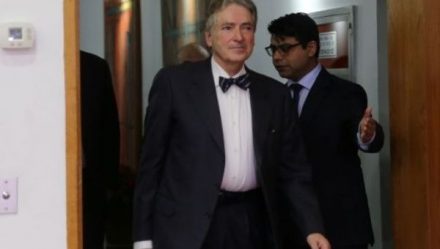
Alfred de Zayas: Sanctions and economic warfare aggravate the smuggling of medicines and food on the border with Colombia | Photo: AVN
The American lawyer and historian, Alfred de Zayas, an expert in the field of human rights, warned about the use of the term humanitarian crisis to intervene in Venezuela and overthrow the current government.
Alfred de Zayas, the independent expert of the United Nations (UN) on the Promotion of an International Democratic and Equitable Order, concluded after his visit to Venezuela that this country does not suffer a humanitarian crisis, unlike countries in Africa or Asia where there are wars and famine.
“I have compared the statistics of Venezuela with that of other countries and there is no humanitarian crisis, of course there is scarcity, anxiety and shortages but who has worked for decades for the United Nations and knows the situation of countries in Asia, Africa and some of America, knows that the situation in Venezuela is not a humanitarian crisis,” Zayas said in an interview for teleSUR.
The independent expert arrived in Venezuela on November 27 and held meetings with government officials, victims of human rights violations and the violence of the so-called guarimbas (violent protests by the opposition) in order to learn about the political, economic and social situation of the country.
He explained that although many think that the country is on the verge of disaster, as media outlets do, “Venezuela suffers an economic war, a financial blockade, suffers a high level of smuggling and, of course, needs international solidarity to solve these problems.”
He also believes that the international community should work in solidarity with Venezuela to lift the sanctions, “because these are the ones that worsen the shortage of food and medicine, it is unbearable to think that having a malaria crisis in the Venezuelan Amazon, Colombia has blocked the sale of medicines and Venezuela had to obtain it in India.”
The expert affirms that the current discourse of humanitarian crisis on the part of US spokespersons, besides being invalid, only pursues the change of regime in Venezuela, “since 1999, a series of States want regime change in Venezuela , that desire to destroy the Bolivarian Revolution and to repeal all the social laws adopted in the mandates of (Hugo) Chávez and (Nicolás) Maduro.”
Zayas denounced the invisibility of his visit to Venezuela in the dominant media, which in his opinion are not interested in disseminating a complete picture of the situation in this country.
The expert told teleSUR that the normal thing, being a senior official of the United Nations, secretary of the Human Rights Committee and head of the complaints department of the UN High Commissioner, is that when he pronounces on a subject, in general, media such as BBC and The New York Times collect and publish their statements.
However, “in the case of Venezuela both CNN and the BBC have ignored me, it is as if my visit to Venezuela had not taken place, as if I had not visited it”, which qualifies as public manipulation, adding that only teleSUR and Sputnik has interviewed him.
The American historian also noted that certain organizations called “non-governmental but whose loyalties are doubtful”, do not want independent experts, “they want experts to come to the country to condemn, that’s why when they name and know me internationally, they said that I was not the relevant rapporteur to talk about Venezuela.”
The United Nations office received letters of complaint from abroad about Zayas’ visit to Venezuela, in which the points he had to investigate were required, “I considered that an interference with my independence, I am the rapporteur, I determine my program I know what information is relevant to my report, but I do not want the report to be dictated to me and some non-governmental organizations suggested me in an uncourteous way with insulting letters, saying what I had to do when I was Venezuela.”
March 4, 2018
Posted by aletho |
Deception, Economics, Fake News, Mainstream Media, Warmongering, Timeless or most popular | Human rights, Latin America, United States, Venezuela |
Leave a comment
Amnesty International told me that it “does not take a position on the current application” of U.S. economic sanctions that Trump’s administration imposed on Venezuela in August “but rather emphasizes the urgent need to address the serious crisis of the right to health and food which Venezuela is facing. In terms of human rights, it is the Venezuelan state’s responsibility to resolve this.” Amnesty’s full reply to three questions I asked them by email can be read here.
The expression that “silence gives consent” applies perfectly to Amnesty’s stance which tacitly endorses Trump’s aggression against the Venezuelan people. To make this even more obvious, Amnesty also refused to condemn remarks by Rex Tillerson and Marco Rubio that encourage a military coup in Venezuela. Asked to comment on those remarks Amnesty replied that it ”believes that a responsible discussion on the current state of human rights in Venezuela should not be focused on statements made by parties outside the country and context”.
In the middle of an already grave economic crisis, the sanctions will cost Venezuela’s government billions of dollars this year. Its $64 billion USD in outstanding foreign currency bonds are all governed by New York Law, but the sanctions have outlawed Venezuela from borrowing or selling assets in the U.S. financial system. Debt restructuring is therefore made impossible and it blocks the government from rolling over its bonds (offsetting principal costs by issuing new debt). The sanctions also block CITGO, a U.S. based company owned the by the Venezuelan government, from sending its profits or dividends (which have totaled about $2.5 billion USD since 2015) back to Venezuela.
U.S. sanctions, which are illegal under of chapter 4 article 19 of the OAS Charter, are a direct assault on the Venezuelan peoples’ “right to health and food”. There is no avoiding this conclusion even if you believe the worst that has been said about Venezuela’s government. You’ll find it extremely hard to learn from the international media, but sanctions are not supported by most Venezuelans according to the same opposition-aligned pollster (Datanalisis) that the media has cited ad nauseam about Venezuelan President Nicolas Maduro’s approval rating.
According to Datanalisis, about 45% of the population received cash bonuses the government paid out over the past three months. Another opposition source – a group of Venezuelan academics who produce the annual ENCOVI surveys – claim that 87% of households have received direct food handouts from the government. The ENCOVI study is especially dubious as Jacob Wilson has explained, and its 87% figure is probably a wild exaggeration, but even if an accurate estimate is closer to 50%, the depravity of Trump’s sanctions and Amnesty’s refusal to denounce them should be clear from statistics produced by opposition sources.
Decent people were outraged by the sanctions that the U.S. and its allies imposed on Iraq during the 1990s – a country that really was ruled by a dictator. They should be even more outraged that the same gang of states that devastated Iraq has been able to target a democracy thanks to a propaganda system in which big NGOs like Amnesty play an important part.
Incidentally, the impact of the U.S. sanctions dwarfs any offers of humanitarian aid that have been made. That hasn’t stopped headlines like “Why won’t the country accept aid?”, and articles that invariably fail to explore what has been offered and how it compares to billions of dollars lost due to illegally imposed U.S. sanctions. The annual program expenditures of groups like Caritas ($4 million) and the Pan American Development Foundation ($81 million) are a drop in the ocean compared to the impact of the sanctions.
I was disgusted but not surprised by Amnesty’s tacit support for Trump’s aggression against Venezuela for several reasons.
In 2010, Amnesty put out a statement claiming that there was only one TV broadcaster in Venezuela that had not been shut down by the government – an absolutely preposterous claim. Could the world renowned organization not afford to pay somebody to watch some Venezuelan TV or do any basic research?
Amnesty refused to recognize Chelsea Manning as a Prisoner of Conscience on ridiculous grounds, but has given that designation to Leopoldo Lopez – a man involved with four different attempts to violently overthrow Venezuela’s democratically elected government. One of them, in April of 2002, was briefly successful.
When the US government (helped by its trusty allies Canada and France) overthrew Haiti’s democratically elected president in 2004 and installed a dictatorship that ruled with tremendous brutality for two years, Amnesty’s response was seriously marred by political cowardice and double standards. About the kindest thing you could say about Amnesty’s work in Haiti, and in general, is that Human Rights Watch (HRW) has been even worse. For example, it took HRW years longer than Amnesty to make any serious contribution to the fight to hold the UN mission in Haiti accountable for killing 10,000 Haitians by bringing cholera in to the country in 2010. The key facts were well known by at least 2011 (as you can see from this petition) years before Amnesty took any significant action in 2015.
Norman Finkelstein’s latest book “Gaza: An Inquest into its Martyrdom” has a chapter devoted to thoroughly dissecting Amnesty’s reports on Israel’s savage “Protective Edge” assault on Gaza in 2014. Finkelstein wrote “By supplying Israel with pretexts for atrocities that were among the most heinous it committed during Protective Edge, Amnesty conveniently eased the burden of Israeli hasbara [propagandists]”.
In an email exchange I had with Amnesty regarding Syria in 2012, Amnesty defended a position which told Saudi Arabia, perhaps the most brutal and backward government on earth, to merely be careful about which rebels it armed in Syria. At the same time, Amnesty called for an arms embargo on almost entirely defenseless Palestinians.
Amnesty has repeatedly showed that it is not willing or able to denounce the brutality of the U.S. government or its allies to anywhere near the extent that it should. One can have a long discussion about why that’s the case, but an appalling track record has been well established. People who live in United States, or in countries like Canada which regularly provide political cover for U.S. crimes abroad, will have to work around and even against NGOs like Amnesty International to prevent their governments from continuing to destroy one country after another.
March 4, 2018
Posted by aletho |
Deception, Economics | Amnesty International, Human rights, Latin America, United States, Venezuela |
Leave a comment
In late February, Venezuela’s government began accepting presidential candidate registrations and announced a snap legislative election for April. The country’s opposition denounces the process as a sham and Maduro as a dictator, both of which may be true.
Oddly, a third voice — the US government — also weighed in. Per US state media outlet Voice of America, “the United States, which under President Donald Trump has been deeply critical of Maduro’s leadership in crisis-torn and economically suffering Venezuela, on Saturday rejected the call for an early legislative vote.”
Given the perpetual public pearl-clutching over alleged Russian meddling in the 2016 US presidential election, that’s some major league chutzpah.
The US State Department wants “‘a free and fair election’ involving full participation of all political leaders, the immediate release of all political prisoners, credible international observation and an independent electoral authority.
Let’s take that one at a time.
Participation of all political leaders? In some US states, it’s harder for a third party to get on a ballot than in, say, Iran.
The immediate release of all political prisoners? Last I heard, US president Donald Trump hadn’t pardoned (among others) Leonard Peltier.
Credible international observation? The US proper committed to admitting international election observers in the Organization for Security and Co-Operation in Europe’s 1990 Copenhagen Document, but many US states forbid international observers or, for that matter, local observers who aren’t affiliated with one of the two ruling parties.
Electoral authorities? The two ruling parties control them all and routinely use them to suppress threatened competition, as do pseudo-private entities like the Commission on Presidential Debates, which makes giant illegal (but government approved) in-kind contributions to the Republican and Democratic candidates in the form of televised candidate beauty pageants which exclude the opposition parties.
Writing in The Atlantic, veteran election meddler Thomas O. Mela — formerly of the US State Department, the US Agency for International Development, the National Democratic Institute and Freedom House — argues that election meddling is different when the US does it, because … well, “democracy.”
Mela asserts a “difference between programs to strengthen democratic processes in another country (without regard to specific electoral outcomes), versus efforts to manipulate another country’s election in order to sow chaos, undermine public confidence in the political system, and diminish a country’s social stability.”
The US government spends a lot of time and money (USAID’s budget alone is about one-tenth the budget of the entire Russian government) on foreign election meddling, and somehow “democracy” always gets interpreted as “whatever outcome the US government prefers at the moment.”
Perhaps we should get our own democratic house in order instead of, or at least before, presuming to tell the rest of the world how democracy does or should work.
Thomas L. Knapp (Twitter: @thomaslknapp) is director and senior news analyst at the William Lloyd Garrison Center for Libertarian Advocacy Journalism (thegarrisoncenter.org).
February 28, 2018
Posted by aletho |
Civil Liberties, Mainstream Media, Warmongering, Timeless or most popular | Freedom House, Latin America, National Democratic Institute, The Atlantic, United States, USAID, Venezuela |
Leave a comment

 Aletho News