Korea and Venezuela: Flip Sides of the Same Coin
By Jacob G. Hornberger | Future of Freedom Foundation | August 14, 2017
By suggesting that he might order a U.S. regime-change invasion of Venezuela, President Trump has inadvertently shown why North Korea has been desperately trying to develop nuclear weapons — to serve as a deterrent or defense against one of the U.S. national-security state storied regime-change operations. In fact, I wouldn’t be surprised to see Venezuela and, for that matter, other Third World countries who stand up to the U.S. Empire, also seeking to put their hands on nuclear weapons. What better way to deter a U.S. regime-change operation against them?
Think back to the Cuban Missile Crisis. The U.S. national-security establishment had initiated a military invasion of the Cuba at the Bay of Pigs, had exhorted President Kennedy to bomb Cuba during that invasion, and then had recommended that the president implement a fraudulent pretext (i.e., Operation Northwoods) for a full-scale military invasion of Cuba.
That’s why Cuba, which had never initiated any acts of aggression against the United States, wanted Soviet nuclear missiles installed in Cuba. Cuba’s leader Fidel Castro knew that there was no way that Cuba could defeat the United States in a regular, conventional war. Everyone knows that the military establishment in the United States is so large and so powerful that it can easily smash any Third World nation, including Cuba, North Korea, Iraq, Afghanistan, and Venezuela.
Castro’s strategy worked. The Soviet nuclear missiles installed in Cuba drove Kennedy to reject the Pentagon’s and CIA’s vehement exhortations to bomb and invade Cuba. The way the Pentagon and the CIA saw the situation was that Kennedy now had his justification for effecting a violent regime-change operation in Cuba. The way Kennedy saw the situation was that a violent regime-change operation through bombing and invasion could easily result in all-out nuclear war between the United States and Russia.
It turned out that Kennedy was right. What the Pentagon and the CIA didn’t realize at the time is that Soviet commanders on the ground in Cuba had fully armed tactical nuclear weapons at their disposal and the battlefield authority to use them in the event of a U.S. bombing or invasion of the island. If Kennedy had complied with the dictates of the Pentagon and the CIA, it is a virtual certainty that the result would have been all-out nuclear war between the Soviet Union and the United States. To his ever-lasting credit, Kennedy struck a deal in which he vowed that the United States would cease and desist from invading Cuba in return for the Soviet Union’s withdrawal of its nuclear missiles from Cuba.
The point is this: If the Pentagon and the CIA had not been trying to get regime-change in Cuba, Cuba would never have felt the need to get those Soviet missiles. It was the Pentagon’s and CIA’s commitment to regime change in Cuba that gave us hte the Cuban Missile Crisis.
Equally important, the resolution of the crisis showed that if an independent, recalcitrant Third World regime wants to protect itself from a U.S. national-security-state regime-change operation, the best thing it can do is secure nuclear weapons. Thus, the current crisis over North Korea’s quest to get nuclear weapons to deter a U.S. regime-change operation is rooted in how Cuba deterred the U.S. national security establishment’s regime-change efforts in 1962.
Americans would be wise to regime change operations in North Korea and Venezuela in the context of the U.S. government’s overall foreign policy of military empire and interventionism.
Recall, first of all, that the U.S. government has a long history of interventionism in Latin America, where it has brought nothing but death, destruction, suffering, misery, and tyranny. Nicaragua, Guatemala, Chile, Brazil, Panama, and Grenada come to mind.
In fact, the situation in Chile that resulted in U.S. intervention was quite similar to today’s situation in Venezuela. In Chile, a socialist was democratically elected and began adopting socialist policies, which caused economic chaos and crisis. The CIA and Pentagon intentionally and secretly did everything they could to makes matters worse. U.S. officials even engaged in bribery, kidnapping, and assassination in Chile. They incited and encouraged a coup that succeeded in ousting the democratically elected socialist and replaced by a “pro-capitalist” military general, whose forces proceeded to round up, kidnap, torture, rape, or execute tens of thousands of people, including the murder of two Americans, all with the support and complicity of the Pentagon and the CIA.
Haven’t we seen the same types of results with the U.S. regime-change operations in Iraq, Afghanistan, Libya, Yemen, Syria, and elsewhere? Death, destruction, and chaos, not to mention a gigantic refugee crisis for Europe.
And look at what the pro-empire, interventionist system has done to the American people. Constant, never-ending crises and chaos, with North Korea being just the latest example. Out of control federal spending and debt that are threatening the nation with financial bankruptcy and economic and monetary crises. Totalitarian-like powers being exercised by the president and his national-security establishment, including assassination, torture, and indefinite detention. Weird, bizarre random acts of violence that reflect the same lack of regard for the sanctity of human life that U.S. officials display in faraway countries.
None of this is necessary. It’s entirely possible for Americans to live normal, healthy, free lives. All it takes is a change of direction — one away from empire and interventionism and toward a limited-government republic and non-interventionism in the affairs of other nations. That’s the way to achieve a free, prosperous, harmonious, and friendly society.
Shocking videos raise #Venezuela fake-news fears
SKWAWKBOX · 03/08/2017
All the mainstream news channels and publications have been running dramatic footage of a night-time police raid to arrest one of two Venezuelan opposition leaders as part of their odd clamour for the UK’s opposition leader to ‘condemn’ Venezuelan President Maduro’s actions.
The raid, which occurred earlier this week and was caught on apparent mobile phone footage inside the raided house, is certainly dramatic enough, with half a dozen police officers in camouflage uniforms bundling Antonio Ledezma out of his house at night:
Equally dramatic daytime footage, however, sheds new light on the incident – and raises fears that the presentation of events in Venezuela may involve fake news:
Of course, this video is not of a raid in Venezuela. It was taken on a smartphone in the Fallowfield area of Manchester as dozens of police raided the house of someone suspected of involvement in the Manchester Arena attacks.
Only exterior footage is available, but watching police surround the house in order to enter from all directions simultaneously, it’s not hard to see that the scene inside the house would have been even more dramatic than the Venezuelan footage.
But of course, there were no demands for Jeremy Corbyn to condemn the Fallowfield raid because, well – we’re the United Kingdom.
Police raid houses regularly, of course. What matters is whether they do so lawfully, act proportionately – and what happens after the arrest.
The way the Venezuelan video has been presented is a classic example of ‘framing’. How a thing is described and presented can dramatically affect how we perceive it – and we’re meant to perceive the Venezuelan footage in a very different way than we see the Fallowfield raid.
But was it really different? Look again at the Ledesma arrest video. There’s no apparent violence – he’s not struck, he doesn’t crack his head on the police car as they put him in it. The police officers are walking him out, not dragging him or going faster than he can keep up. There’s even an officer filming the arrest as if to prevent any later accusations of brutality:

Hardly something you’d expect in a ‘hard-line socialist dictatorship’ or however your preferred news source and various opportunistic politicians have described Venezuela under Maduro.
Nor is this the case of a man beyond reproach being summarily arrested.
Much of the UK media has, curiously, left it out of their coverage of the arrest, but Antonio Ledezma was jailed in 2014 for inciting violence – and in fact, is still serving his sentence. But Venezuelan authorities released him earlier this month to serve his sentence as ‘house arrest’.
Again, not exactly the behaviour of a repressive state.
Ledezma was being re-arrested, not summarily arrested. What was the cause? We don’t know – but ‘don’t know’ is the key point. The UK’s mainstream media and right-wing politicians don’t know either. But you’d never guess there might be a legitimate cause, from the way they’ve framed the issue.
And you don’t have to look too hard to find out what might be the cause. As noted, Ledezma was already convicted of incitement to violence and returned home to house arrest in early July. The other man arrested this week, Leopoldo Lopez, was released from prison to house arrest at the same time – and he ‘celebrated’ his return home to house arrest with a pledge to continue his fight:
If continuing my fight for freedom means going back to Ramo Verde [prison], I am ready to do it. … I reiterate to you my commitment to fight until we conquer
What does ‘continuing my fight’ mean? Again, we don’t yet know, although the Venezuelan government has said that both men had violated the terms of their house-arrest – but we do know (if we look, because the UK media are not telling us) that other opposition leaders have been calling for violent protest for months.
And got violent protests, including bombs used against police::
Evidence for the opposition plans to create violent riots and plant car-bombs includes audio of an alleged meeting discussing explosives and a plan to create a situation requiring foreign intervention to remove the Maduro government.
The SKWAWKBOX does not assert that Ledezma and Lopez have been fairly treated – we don’t know, nor do the mainstream media. That’s the whole point.
What we do know is that the evidence paints a different, less one-sided picture than has been presented to us by the UK mainstream media.
A night-time police raid to re-arrest two men – convicted of incitement to violence and released to serve house arrest – is not in itself evidence of anything. Especially when the arrest appears to have been non-violent, carried out with professional restraint – and filmed by one of the officers as well as by one of the familes of the arrested man.
The arrest video, when watched free of the media’s framing, looks very different – and that difference allows us to see that the framing of the events by the media may be designed to prevent a balanced view – in order to create a particular perception.
A perception skewed and one-sided enough to raise genuine concerns that we are – yet again – being fed fake news.
A perception that the Establishment can then weaponise to attack – for a change – one Jeremy Corbyn.
Amnesty International – weaponizing hypocrisy for the US and NATO
Tortilla con Sal | Telesur | August 12, 2017
Over the last year, in Latin America, Amnesty International have taken their collusion in support of NATO government foreign policy down to new depths of falsehood and bad faith attacking Venezuela and, most recently, Nicaragua. The multi-million dollar Western NGO claims, “We are independent of any government, political ideology, economic interest or religion”. That claim is extremely dishonest. Many of Amnesty International’s board and most of the senior staff in its Secretariat, which produces the organization’s reports, are individuals with a deeply ideologically committed background in corporate dominated NGO’s like Purpose, Open Society Institute, Human Rights Watch, and many others.
Mexico has over 36000 people disappeared and abuses by the security forces are constant. Colombia has over 4 million internally displaced people with over 53 community activists murdered just in 2017. Amnesty International generally puts that horrific reality in context by including criticism of forces challenging those countries’ authorities. By contrast, its reporting on Venezuela and Nicaragua, like those of other similar Western NGOs, reproduces the false claims of those countries’ minority political opposition forces, all supported one way or another by NATO country governments.
In Venezuela and Nicaragua, Western human rights organizations exaggerate alleged government violations while minimizing abuses and provocations by the opposition. This screenshot of Amnesty International’s three main news items on Venezuela from August 9th gives a fair idea of the organization’s heavily politicized, bad faith coverage of recent events.
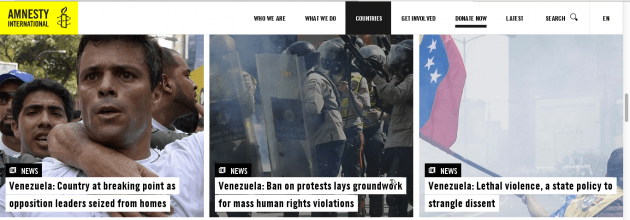
This is identical false coverage to that of Western mainstream corporate media and most Western alternative media outlets too. Amnesty International’s coverage minimizes opposition murders of ordinary Venezuelans, setting many people on fire, violent attacks on hospitals, universities and even preschools and innumerable acts of intimidation of the general population. That headline “Venezuela: Lethal violence, a state policy to strangle dissent” is a pernicious lie. President Nicolas Maduro explicitly banned the use of lethal force against opposition demonstrations from the start of the latest phase of the opposition’s long drawn out attempted coup back in early April this year.
Likewise, against Nicaragua, Amnesty’s latest report, kicking off their global campaign to stop Nicaragua’s proposed Interoceanic Canal, also begins with a demonstrable lie : “Nicaragua has pushed ahead with the approval and design of a mega-project that puts the human rights of hundreds of thousands of people at risk, without consultation and in a process shrouded in silence” That claim is completely false. Even prior to September 2015, the international consultants’ impact study found that the government and the HKND company in charge of building the Canal had organized consultations with, among others, over 5400 people from rural communities in addition to 475 people from indigenous communities along the route of the Canal and its subsidiary projects. There has been very extensive media discussion and coverage of the project ever since it was announced.
That extremely prestigious ERM consultants’ Environmental and Social Impact study, which together with associated studies cost well over US$100 million, is publicly available in Spanish and in English. Two years ago, it anticipated all the criticisms made by Amnesty International and was accepted by the Nicaraguan government, leading to a long period of analysis and revision that is still under way. Amnesty International excludes that information. Recently, government spokesperson Telemaco Talavera, said the continuing process involves a total of 26 further studies. Until the studies are complete, the government is clearly right to avoid commenting on the proposed Canal, because the new studies may radically change the overall project.
Amnesty International states, “According to independent studies of civil society organizations, along the announced route of the canal, approximately 24,100 households (some 119,200 people) in the area will be directly impacted.” But, the ERM study notes, “HKND conducted a census of the population living in the Project Affected Areas. The census determined that approximately 30,000 people (or 7,210 families) would need to be physically or economically displaced.” But Amnesty International’s report omits that contradictory detail, demonstrating how irrationally committed they are to the false propaganda of Nicaragua’s political opposition.
Amnesty International claim their research team interviewed “at least 190 people” concerned about the effects of the Canal. By contrast, the Nicaraguan government and the HKND company have discussed the project with around six thousand people in the areas along the route of the Canal. In that regard, even the local church hierarchy has criticized the way the Nicaraguan opposition have manipulated rural families on the issue of the Canal. But that fact too, Amnesty International omits. Their whole report is tailor made to supplement the political opposition’s campaign for US intervention via the notorious NICA Act.
The Nicaraguan government has made an express commitment to a fair and just resolution of the issue of expropriations. Its 2015 report on the Canal in the context of its National Development Plan, states : “The Nicaraguan government and HKND will guarantee that persons and families on the route of the Canal’s construction will have living conditions superior to those they currently have (without the Canal). To that end, the Government of Reconciliation and National Unity, via the Project’s Commission, will guarantee not just a fair and transparent indemnification of their properties, via negotiations and direct agreements with each family affected, but furthermore will promote actions to improve their economic conditions, health care, education, housing and employment.
But the Amnesty International report systematically excludes that and any other sources giving the government’s point of view, claiming it was unable to access primary sources either from the government itself or from among the Canal’s numerous advocates. However, secondary sources abound that categorically contradict Amnesty’s advocacy against the Canal. Their report specifically and extensively attacks the Law 840, facilitating the construction of the Canal and its sub-projects, but cynically omits a fundamental, crucial detail, while also failing completely to give relevant social and economic context.
The crucial detail is that Law 840’s Article 18 specifically states the Canal project “cannot require any Government Entity to take any action that violates the political Constitution of the Republic of Nicaragua or the terms of any international treaty of which the State of the Republic of Nicaragua is a party.” Amnesty International completely omit that absolutely crucial part of the Law 840 from their report because it makes redundant their advocacy of opposition claims attacking the equity and legality of the Canal’s legal framework. The same is true of the relevant political, social and economic context.
Nicaragua’s political culture is based on dialog, consensus and respect for international law. All the main business organizations and labor unions in Nicaragua and all the main international financial and humanitarian institutions acknowledge that. President Daniel Ortega and Vice President Rosario Murillo enjoy levels of approval of over 70%. There is good reason for that massive majority approval. Among many other factors, the precedents of how the Nicaraguan authorities have resolved relocating populations affected by large projects, for example the Tumarín hydroelectric project, completely contradict the scaremongering of the Nicaraguan opposition propaganda, so glibly recycled by Amnesty International.
Nicaragua’s current Sandinista government has been the most successful ever in reducing poverty and defending the right of all Nicaraguans to a dignified life. To do so, among many other initiatives, it has mobilized record levels of foreign direct investment. In that context, Law 840 explicitly protects the huge potential investments in the proposed Canal, while at the same time implicitly guaranteeing constitutional protections. Similarly, ever since the announcement of the Canal, President Ortega has repeatedly, publicly reassured people in Nicaragua that any families who may eventually be relocated should the Canal go ahead will get every necessary help and assistance from the government.
Just as it has done in the case of Venezuela, on Nicaragua, Amnesty International misrepresents the facts, cynically promoting the positions of the country’s right wing political opposition. In Latin America, under cover of phony concern for peoples’ basic rights, in practice Amnesty International, like almost all the big multi-millionaire Western NGOs, gives spurious humanitarian cover to the political agenda of the US and allied country corporate elites and their governments. The destructive, catastrophic effects of Amnesty International’s recent role in the crises affecting Syria, Ukraine and now Venezuela, are living proof of that.
Venezuela Brings Regional Elections Forward to October
teleSUR | August 12, 2017
Venezuela’s newly-elected National Constituent Assembly, ANC, has brought forward the regional elections by two months.
The polls, which had been scheduled to take place on December 10, will now be held in October following unanimous approval by the ANC.
The second vice president of the body, Isaias Rodriguez, said the process for the election of governors and state governors, will take place “within the framework of the electoral program already announced by the electoral power.”
ANC Constituent Tania Diaz explained that bringing the regional elections forward is a mandate of the people and added, “The recent elections to choose the members of the ANC represents a popular victory and a defeat of the violent actions promoted in the last four months by the right, which has triggered more than 100 fatalities.”
Another member of the ANC, Melvin Maldonado recalled that in 18 years of the Bolivarian Revolution, there have been 21 elections, which “shows the strength of our National Electoral Council, and it also shows the democratic nature and electoral power in our country.”
The president of the National Electoral Council of Venezuela, Tibisay Lucena, said the submission of nominations for the regional elections will start on Sunday August 13 and close the following day.
OAS Chief Almagro Praises Israel, Condemns Venezuela
teleSur | August 10, 2017
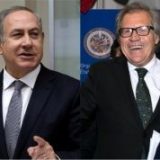 Secretary-General of the Organization of American States Luis Almagro used his one-day visit to Israel to condemn Venezuela’s leftist government while expressing “pride that Israel is a friend of the Americas,” praising what he called Tel Aviv’s record of respecting human rights and democracy.
The tour seemed less like the diplomacy of a “supra-president” representing the Western Hemisphere, and more like a roadshow for the OAS chief to reiterate Trump administration talking points.
“As friends, Israel and the Americas share key values such as democracy and human rights. We have opportunities to learn from each other,” he told a gathering of World Jewish Congress members in Jerusalem. Despite Tel Aviv’s globally unrecognized claims that the ancient city is its “national capital,” Jerusalem remains under illegal occupation.
The themes of democracy and human rights were repeated multiple times by the secretary-general during his time with Israeli officials, usually in such contexts as “Israeli … our essential partner in the Middle East — due to its commitment to democracy and to human rights.”
Israeli authorities face routine criticism from world legal bodies like the U.N. for their disregard of human rights standards, especially in their discriminatory treatment of the Palestinian population.
“Israel is a democratic state in which the institutions function,” Almagro told Haaretz. “The functionality of institutions and the balance of powers are fundamental for us and are the paradigm of the health of a democracy.”
Israeli institutions systematically deny the people of Palestine their right to self-determination, imposing stringent restrictions on their movement, travel, and trade. Israeli security forces have been criticized by rights organizations for resorting to excessive force, including extrajudicial killings, on a regular basis, while unarmed Palestinian demonstrators — adults and children — face imprisonment, torture, and abuse for taking part in protests against occupation activities. The construction of massive settlements deep in the occupied West Bank likewise is illegal under international law.
Almagro’s tone jars dramatically with his opinion five years ago as foreign minister of Uruguay, admitting in an interview that he voted on U.N. resolutions condemning Israeli settlements and human rights violations “with both hands” while arguing that the Israeli occupation’s crimes were irrefutable from a legal standpoint.
On the subject of Venezuela, Almagro struck an emphatic tone consistent with his prior calls to remove the country’s government through “regime change” efforts.
“It is a dictatorship, there’s no other definition for Venezuela today,” Almagro told Israeli daily Haaretz.
Seemingly oblivious to the irony in his words, he then condemned the left for having “flinched on democracy and human rights” in the South American nation.
Opining about U.S. unilateral sanctions on Venezuela, Almagro said, “no country feels comfortable in this situation … but that does not mean the sanctions don’t hit hard and hit those specific places that most affect the regime.”
Since becoming secretary-general of the OAS, Almagro has become a partisan of Venezuela’s right-wing opposition, railing against alleged abuses by the “ruling regime” and issuing thousands of tweets against the Bolivarian government, accompanied by calls for foreign intervention in the country.
In contrast, Almagro has been relatively silent in respect to the Western Hemisphere’s most pressing human rights crises — such as the Mexican government’s crackdowns on social movements resisting neoliberal structural reforms, assassinations of social movement leaders and paramilitary attacks on rural and Indigenous communities throughout Latin America, and the parliamentary coup against Brazilian President Dilma Rousseff.
The OAS chief’s contradictory messages underscore Bolivian President Evo Morales’ description of Almagro’s “submission to the North American empire.”
Moscow: Anti-Caracas Sanctions Hamper Normalization of Situation in Venezuela
Sputnik – 10.08.2017
The recently imposed sanctions against Venezuela do not contribute to the normalization of the situation in the country, pushing it back into deadlock instead, the Russian Foreign Ministry said in a statement Thursday.
On Wednesday, the US Department of Treasury announced the expansion of its sanctions on Venezuela. These measures included travel bans and asset freezes on eight people who played a role in convening the new legislative body, the Constituent Assembly.
“Certain internal and external political forces promote a destructive line aimed at dismantling the emerging dialogue and, in fact, at returning the situation to the initial impasse, contrary to the very logic of developments [in Venezuela] and their own calls for the democratization of the ongoing processes in Venezuela. The expansion of unilateral sanctions and restrictions, isolationist measures, pressure, and the ultimatum toward Caracas applied by a number of countries can hardly be seen in a different light,” the statement read.
The Russian Foreign Ministry stressed that the situation in Venezuela could only be addressed through direct negotiations between the government and opposition.
According to the statement, peace in Venezuela depends on the willingness of all parties to return to a dialogue within the Venezuelan Constitution, without any outside intervention, to form a common agenda.
The National Constituent Assembly, which proclaimed itself the main governing body of Venezuela, is a new legislature with the power to amend the country’s constitution. It was elected on July 30 amid mass protests across Venezuela, which resulted in 10 deaths on election day alone. Overall, the death toll has risen to more than 120 people since early April.
The Venezuelan opposition has refused to recognize the legitimacy of the Constituent Assembly, as it believes that Venezuelan President Nicolas Maduro’s plan for constitutional reform aims at sidelining the opposition-controlled National Assembly.
Military Base Attacked in Venezuela, Two Dead
By Katrina Kozarek and Rachael Boothroyd Rojas | Venezuelanalysis | August 7, 2017
The 41st Armored Brigade of Fort Paramacay in Carabobo State was attacked by civilians and ex-military officials in the early hours of Sunday morning as part of an unsuccessful attempt to provoke a military rebellion, Venezuelan President Nicolas Maduro has confirmed.
According to the president, the attack occurred at 3:50 am when 20 armed men entered the facilities and headed directly for the arms depository, where a confrontation ensued until approximately 8am. The confrontation left two dead and one injured. A further ten have been arrested in connection with the attack.
Moments before the coordinated assault, flyers were dropped outside the military base referring to the action as ‘Operation David’ and calling for all members of the armed forces to join the “military rebellion”. The messages also told the soldiers who refused to mutiny against the government that they should consider themselves a “military objective” and “face the consequences”.
The attack was also accompanied by a video released on social media by former military commander Juan Caguaripano Scott, who had reportedly fled the country during the 2014 opposition protests known as the guarimbas and has since lived between Miami, Costa Rica, Panama and Colombia.
“We declare ourselves in legitimate rebellion, united today more than ever, with the brave Venezuelan people, to refuse to recognize the murderous tyranny of Nicolás Maduro. This is not a coup d’état, this is a civic and military action to restore order and to save the country from total destruction,” states Caguaripano in the video.
It is not clear when nor where the video was recorded.
Though Caguaripano and several international media sources have referred to the attack as a civic-military rebellion, the majority of those captured were not active military personnel. One of the detained men was identified as ex-lieutenant Oswaldo José Gutiérrez Guevara who deserted the military after being investigated for theft. The remaining nine were paid civilians recruited from the states of Zulia, Yaracuy and Lara, and all had criminal records, said the Ministry of Defense. They were aided and abetted by First Lieutenant Yefferson Gabriel García Dos Ramos, who was in charge of the fort’s weapons depository.
Authorities are yet to release the names of the two fatalities, but it is known that both Caguaripano and Dos Ramos were on the ground at the time of the attack and managed to evade capture.
Government officials have since described the offensive as a terrorist attack as opposed to a military rebellion, citing the lack of serving military officials involved in the operation.
According to a tweet from Vice Minister of International Communication, William Castillo, the attack was a “propaganda operation” with “civilians disguised as current and former military officials”.
The Minister of Information and Communication Ernesto Villegas also announced that opposition forces in Venezuela were attempting to create and circulate “fake news” about the country, as well as “trying out the formula [used in] the Ukraine.”
Sunday’s assault on the military fort follows a helicopter attack against the Supreme Court by former investigative police official Oscar Pérez in June. Perez also called on the military to rise up against the Maduro government, echoing similar demands voiced by opposition spokespeople for the past 18 months. Over 120 people have also been killed in violent opposition-led unrest since the beginning of April.
On Sunday, Minister of Defense Padrino Lopez released an official communique on behalf of the Bolivarian National Armed Forces (FANB) in relation to the incident. Lopez said that although the group had been “immediately repelled” by army personnel, some of the attackers had managed to steal weapons from the fort’s depository and were currently at the centre of a manhunt by state security agencies.
The communiqué also stated that those responsible for the attack will face military charges.
“We will not accept under any circumstances the violation of our sovereignty, and even less that the social gains achieved for the benefit of the great majorities are undermined,” reads the statement.
The document finished by calling on the men and women of Venezuela to work together to find solutions to the current turmoil in the country within a legal framework.
Voting Machine Maker Says Venezuela Polls Rigged, Offers No Evidence
By Tony Cartalucci | Land Destroyer | August 3, 2017
London-based voting machine maker Smartmatic claims the recent polls carried out in Venezuela this week were rigged. In their 5 minute video statement, however, they failed to provide any evidence.
An AP article titled, “Election report: Venezuela vote ‘probably rigged’,” claims:
The number of Venezuelans who participated in the election for an all-powerful constituent assembly was tampered with – off by at least 1 million votes – in an official count, the head of a voting technology company asserted Wednesday, a finding certain to sow further discord over the super-body that has generated months of nationwide protests.
Smartmatic CEO Antonio Mugica said results recorded by his systems and those reported by Venezuela’s National Electoral Council indicate “without any doubt” that official turnout figure of more than 8 million participants was manipulated.
Mugica, however, claims in his full statement (video here) that (emphasis added):
Our automated election system is designed to make it evident when results are manipulated, however, there must be people auditing the system and watching for that evidence. During the National Constituent Assembly elections there were no auditors from the opposition parties as they did not want to participate.
Thus, at best Mugica and Smartmatic can warn that irregularities might have occurred, since no one from the opposition was there to audit the final tallies and report any potential inconsistencies.
Since no opposition auditors were there, no evidence has been provided that such irregularities occurred. Neither AP’s article nor Mugica’s full statement provide any evidence or explanation as to how Smartmatic “estimated” the final count regarding participation was off by “one million votes.” Mugica doesn’t even explain whether it was one million more than reported, or one million less.
Smartmatic either failed to reveal information it has regarding the final count, or has simply lied on behalf of the Venezuelan opposition and the powerful foreign interests sponsoring it from Washington, London, and Brussels.
This latest announcement, absent of any evidence to substantiate these accusations, calls into question Smartmatic’s professionalism, ethics, and impartiality. Other nations considering Smartmatic machines must consider the possibility that the company’s CEO may attempt to use his machines and their role in tallying votes to manipulate their internal politics as well.
This announcement also once again calls the Western media into question for failing to note the very obvious inconsistencies between Mugica’s conclusions and the lack of evidence provided to substantiate them.
US Regime Change in Venezuela: The Truth is Easy if You Follow the Money
By Tony Cartalucci | Land Destroyer | July 31, 2017
Venezuela’s ongoing crisis is not driven by political ideology – it is not a battle of socialism versus capitalism or dictatorship versus democracy – it is the result of two centers of political power possessing opposing interests and colliding geopolitically.
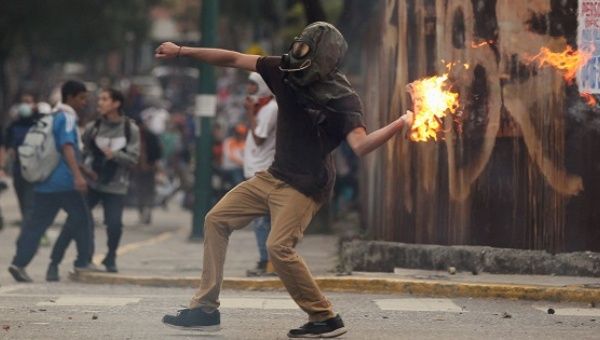
The nation of Venezuela is currently under the control of Venezuelans who derive their support, wealth, and power from Venezuela itself – its people and its natural resource. This political order also receives aid and support from Venezuela’s economic and military partners both in the region and around the globe.
The opposition opposed to the current political order and seeking to supplant it represents foreign interests and more specifically, the United States and its European allies.
The Opposition is Pro-Washington, Not “Pro-Democracy”
As early as 2002, US-backed regime change targeting then Venezuelan president Hugo Chavez, sought to violently overthrow Venezuela’s political order and replace it with one obedient to Washington. Current leaders of the opposition were not only involved in the 2002 failed coup, many are documented to have received political and financial support from the United States government ever since.

Maria Corina Machado, founder of Sumate, an alleged Venezuelan election monitoring group, funded by the US National Endowment for Democracy (NED), meeting with US President George Bush who presided over the failed coup attempt against President Hugo Chavez.
This includes several founders of the opposition party, Primero Justicia (Justice First), including Leopoldo Lopez, Julio Borges, and Henrique Capriles Radonski. The latter of the three has been prominently featured in Western media coverage lately.
US State Department documents reveal that the department itself along with US-funded fronts posing as nongovernmental organizations (NGOs) have been providing Venezuela’s opposition with support.
This includes a report titled, “Status of Capriles and Sumate Cases,” referring to the above mentioned Henrique Capriles Radonski and Sumate, a US National Endowment for Democracy (NED) funded front posing as an election monitor.

Currently, NED’s own website features an extensive list of activities it is engaged in within Venezuela’s borders. It includes leveraging human rights for political gain, electoral manipulation, building opposition fronts, and expanding pro-opposition media. While each activity is labelled with benign titles, it is clear that none of these activities are done impartially, and as State Department documents reveal, these activities are done specifically for the benefit of the US-backed opposition.
Wall Street and Washington’s Open Conspiracy
After the death of Chavez in 2013, US-based special interests openly conspired to finally overturn the political order he built. Corporate-financier policy think tank, the American Enterprise Institute (AEI) created a checklist of US foreign policy goals it sought to achieve in Venezuela. They included:
- The ouster of narco-kingpins who now hold senior posts in government
- The respect for a constitutional succession
- The adoption of meaningful electoral reforms to ensure a fair campaign environment and a transparent vote count in expected presidential elections; and
- The dismantling of Iranian and Hezbollah networks in Venezuela
In reality, AEI is talking about dismantling entirely the obstacles that have prevented the US and the corporate-financier interests that direct it, from installing a client regime and extracting entirely Venezuela’s wealth while obstructing, even dismantling the geopolitical independence and influence achieved by Chavez in Venezuela, throughout South America, and beyond.
The think tank would continue by stating:
Now is the time for US diplomats to begin a quiet dialogue with key regional powers to explain the high cost of Chávez’s criminal regime, including the impact of chavista complicity with narcotraffickers who sow mayhem in Colombia, Central America, and Mexico. Perhaps then we can convince regional leaders to show solidarity with Venezuelan democrats who want to restore a commitment to the rule of law and to rebuild an economy that can be an engine for growth in South America.
By “Venezuelan democrats,” AEI means proxies created, funded, and directed by Washington, including Primero Justicia and the street mobs and paramilitary units it commands.
More recently, another Wall Street-Washington policy think tank, the Brookings Institution, would publish in a paper titled, “Venezuela: A path out of crisis,” a 5-point plan toward escalating the crisis in Venezuela (emphasis added):
1. The United States could expand its assistance to countries that until now have been dependent on Venezuelan oil, as a means to decrease regional support for and dependence on the Maduro government.
2. The United States could increase monetary assistance to credible civil society organizations and nongovernmental organizations able to deliver food and medicines to Venezuelans. By doing so, the United States should make clear that international pressure aims to support democracy, not punish the Venezuelan people.
3. The United States could support efforts by the opposition in Venezuela to build an “off-ramp” that would split moderate elements of the government away from hardliners, encouraging the former to acquiesce to a transition to democracy by lowering their costs of exiting government.
4. The United States could coordinate with international institutions such as the International Monetary Fund (IMF) to offer financial incentives for holding free and fair elections in 2018, and for the opposition to unify and compete in those elections. Such coordination would also involve developing and publicizing a credible plan to restart Venezuela’s economy.
5. As a last resort, the United States could consider raising economic costs to the government through an expanded sanctions regime that aims to limit Venezuelan earnings from oil exports and block further financing. This policy is risky, given that the Maduro government would be able to more credibly shift blame for the economic crisis onto the United States, and should be accompanied by well-publicized efforts to deliver humanitarian aid through credible civil society and nongovernmental organizations.
While the Western media attempts to frame Venezuela’s crisis as a result of “socialism” and “dictatorship,” it is clear by reading the West’s own policy papers that it is owed instead to a systematic assault on Venezuela’s sociopolitical stability and economic viability, spanning decades.
Venezuela is not the first nation in South America that the United States has sought to overturn by undermining its economy.
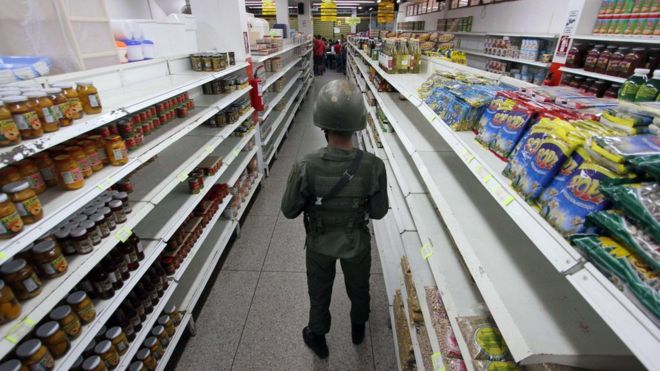
Within the CIA’s own online archives under a section titled, “CIA Activities in Chile,” it is admitted that in the 1970s, similar tactics were used to undermine and overturn the government of Chile. It states specifically: (emphasis added):
According to the Church Committee report, in their meeting with CIA Director Richard Helms and Attorney General John Mitchell on 15 September 1970 President Nixon and his National Security Advisor, Henry Kissinger, directed the CIA to prevent Allende from taking power. They were “not concerned [about the] risks involved,” according to Helms’ notes. In addition to political action, Nixon and Kissinger, according to Helms’s notes, ordered steps to “make the economy scream.”
These Cold War attitudes persisted into the Pinochet era. After Pinochet came to power, senior policymakers appeared reluctant to criticize human rights violations, taking to task US diplomats urging greater attention to the problem. US military assistance and sales grew significantly during the years of greatest human rights abuses. According to a previously released Memorandum of Conversation, Kissinger in June 1976 indicated to Pinochet that the US Government was sympathetic to his regime, although Kissinger advised some progress on human rights in order to improve Chile’s image in the US Congress.
Considering America’s extensive list of interventions, wars, and occupations it is currently involved in worldwide and the manner in which each was presented to the public – with ideology and humanitarian concerns used to manipulate public perception, and considering Venezuela’s opposition is a documented recipient of US support, it is clear that yet another intervention is under way, this time in South America.
Unipolar vs Multipolar
In a world moving toward multipolarism and greater decentralization on all levels, Venezuela’s collapse and a victory for Washington would undo an increasingly balanced distribution of geopolitical power – both in South and Central America, as well as across the world.
As a major oil producing nation, US control over its people and natural resources would further allow the US and its allies to manipulate energy prices toward achieving future goals – particularly in terms of encircling, isolating, and dismantling other centers of political power dependent on oil production for economic prosperity.

One needs not be a fan of “socialism” to understand that the ultimate outcome of Venezuela’s collapse will be a further concentration of power in Washington and Wall Street’s hands. Such power, regardless of whatever ideology it is superficially wielded behind, will always be abused. Regardless of the alleged form of government a nation may take, as long as it is a step away from unipolar globalization, it is a step in the right direction.
The crisis in Venezuela is not one of socialism versus capitalism or dictatorship versus democracy – it is one of hegemony versus national sovereignty, of centralized unipolar power versus an increasingly multipolar world.
A sovereign and independent Venezuela allowed to pursue its own destiny is one in which its own people will naturally seek to decentralize and distribute power. While the current government may not provide the ideal conditions to accomplish this, conditions under a US client regime – as US-wrecked Libya, Afghanistan, or Iraq prove – would be significantly less ideal.
For geopolitical analysts, moving away from ideological talking points and examining the actual government and opposition, their interests, associations, and funding, as well as their base motives reveals a much simpler and consistent narrative, one that any analyst could discern, and a discernment that will stand the test of scrutiny and time. Those entrenched in left/right ideology risk being betrayed by the government’s floundering desperation and the true nature of an opposition that most certainly is not “capitalist” or “pro-democracy.”
US sanctions President Nicolas Maduro as Washington meddles further in Venezuela’s democracy
By Adam Garrie | The Duran | August 1, 2017
The United States continues to meddle in Venezuela’s democracy after yesterday’s nation wide vote for a Constitutional Assembly that will proceed with constitutional reforms aimed at ending the political deadlock between President Maduro and the country’s National Assembly which since 2015 has been controlled by the US backed right-wing opposition.
Before the results of the vote were even counted (they have yet to be fully tallied), the United States made it clear that Washington did not accept the vote. Washington’s Ambassador to the UN, the overzealous Nikki Haley Tweeted the following on the day of the vote. “Maduro’s sham election is another step toward dictatorship. We won’t accept an illegit govt. The Venezuelan ppl & democracy will prevail.”
Today, the US Treasury released the following statement, confirming that President Maduro is being personally sanctioned by the US government.
“The following individual has been added to OFAC’s SDN List: MADURO MOROS, Nicolas… President of the Bolivarian Republic of Venezuela”.
Far from the beginning of US meddling in Venezuela, the United States for decades has funded right-wing opposition groups in Venezuela, most notoriously, that led by Henrique Capriles Radonski. For most of these years, the US has sought to undermine the Bolivarian socialist government of Hugo Chavez who died in what some call mysterious circumstances in 2013.
Since then, Chavez’s socialist successor has been Nicolas Maduro who has barely had a day in office free of US meddling of one sort or another.
Supporters of Maduro argue that the Bolivarian government has helped to redistribute the wealth of Venezuela’s considerable resources including its vast oil reserves which for years were run by foreign hands prior to nationalisation under President Savage. Maduro’s opponents attest that socialist rule has caused stagnation.
Whatever one’s views of Venezuela’s internal situation, it is a sovereign state that no nation, not least the United States has a right to interfere in.
It is ironic, verging on the surreal that while the United States political elites tear themselves to pieces over alleged meddling by Russia in the 2016 US Presidential election, meddling that is not backed up by a single shred of evidence, that same United States is openly and brazenly trying to interfere in the political process of Venezuela by pumping money into the right-wing opposition while unilaterally sanctioning the President.
While the United States attempts to isolate Venezuela, the country continues to maintain good relations with many other countries including Russia and China. In October of 2016, President Maduro awarded Russian President Vladimir Putin the Hugo Chavez Peace Prize which President Putin graciously accepted.
President Maduro insists he is ready for dialogue, but the US continues to act in ways which suggests it is ready for something far more dangerous: illegal regime change, possibly through the use of force.
What Mainstream Media Got Wrong About Venezuela’s Constituent Assembly Vote
teleSUR | July 30, 2017
Venezuelans voted Sunday for representatives of the National Constituent Assembly, amid what the government has called a targeted media campaign to destabilize the country and destroy its sovereignty.
International media outlets rushed to discredit the vote, sharing grossly misrepresentative accounts of the historic electoral process.
The U.S. newspaper Washington Post, for instance, wrote “the decision to hold the vote appeared set to prolong and deepen the suffering of the people of Venezuela” — despite assurances from Venezuelan President Nicolas Maduro that the purpose of the election was to ease economic and political conflicts with the opposition.
The Washington Post also insisted the nation’s 2.8 million state workers “risked losing their jobs if they did not vote.”
The media outlet went even further, claiming the internal and democratic election represented “a direct challenge” to the administration of U.S. President Donald Trump after it demanded that the government cancel the vote.
It said Maduro “defiantly followed through Sunday with his pledge” to hold the election, “creating a critical new stage in a long-simmering crisis that could mint the Western Hemisphere’s newest dictatorship.”
These inflammatory comments, however, do not acknowledge that the right to call a National Constituent Assembly is included in the country’s Constitution and supported by several articles of its text. Indeed the absolute independence of the members of the Constituent Assembly to make changes to the Constitution is protected under these articles.
Germany’s Deutsche Welle meanwhile said the election “will cement a socialist dictatorship” — ignoring the fact that Venezuelans have the right to call for a Constituent Assembly and that the new Constitution will need to be approved by the people.
The British media outlet BBC referenced the recent deaths during violent protests in Caracas, placing the full responsibility for the clashes on security forces.
But Venezuelan Armed Forces have denied these accusations. In a press conference Sunday, Minister of Defense Vladimir Padrino Lopez said that none of the injuries or deaths could be attributed to the Armed Forces. The article also ignores the eight members of the Armed Forces who were severely injured while protecting Venezuelans’ right to vote.
The CNN, a longtime critic of the Venezuelan government, argued the Constituent Assembly was controlled by Maduro and that the “vote would give the president immense political power.”
This statement fails to take into account that no other state institution may interfere in the new legislative body. Only the 545 officials elected by the citizens from different sectors of society can draft the new Constitution.
CNN also reported that Maduro would replace Venezuela’s National Assembly — a situation that has never been stated in the decree to call for an open and direct vote.
Canada’s Globe and Mail said “voters broadly boycotted” the election, ignoring the numerous of photos and videos of people lining up to vote at dawn and even wading through swamps to reach the voting centers. The article also does not include the countless reports of seniors and people with disabilities eagerly casting votes across the country.
“Caracas was largely shut down with deserted streets and polling stations were mostly empty, dealing a blow to the legitimacy of the vote,” said the Globe and Mail without any evidence.
The Guardian joined the mainstream criticism, calling the election an action that will “seal the demise of the oil-rich nation’s democracy.”
Again, the article failed to acknowledge the thousands of people who fought to earn the opportunity to be candidates in this historical event, including candidates from the LGBT community, student organizations and women and campesino groups.
Finally, the New York Times reported on the election with the headline: “As Venezuela Prepares to Vote, Some Fear an End to Democracy.”
The article reported, “Maduro is pushing a radical plan to consolidate his leftist movement’s grip over the nation,” forgetting that candidates are not voted for according to their political parties but through individual candidacies.
In one of the bluntest accusations, the newspaper argued Maduro “has refused to negotiate with street protesters,” a claim that blatantly ignores Maduro’s ongoing calls for peaceful dialogue and guidance from the Vatican.
It concludes by accusing the president of Venezuela of seeking an “unchecked authority not seen since the juntas that haunted Latin American countries in decades past,” as Maduro and the Bolivarian Revolution have vowed to fight the same external interference that brought the U.S. backed dictatorships to the region in the 60s.
Featured Video
The Sordid History of the CIA – Part 2
or go to
Aletho News Archives – Video-Images
Book Review
Jeffrey Epstein: A Jewish Individual?
The Occidental Observer | February 5, 2023
One Nation Under Blackmail: The Sordid Union between Intelligence and Organized Crime that Gave Rise to Jeffrey Epstein (Volume 1 & 2) by Whitney Webb
“Far from being an anomaly, Epstein was one of several men who, over the past century, have engaged in sexual blackmail activities designed to obtain damaging information (i.e., “intelligence”) on powerful individuals with the goal of controlling their activities and securing their compliance.”[1]
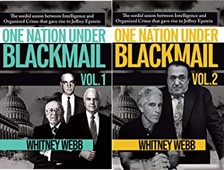
Jeffrey Epstein is dead and Ghislaine Maxwell is locked away in prison, and the thought-makers of our world seem keen to let the more explosive parts of the scandal dissipate from the public consciousness. As far as the mainstream media is concerned, Epstein and Maxwell were little more than well-connected socialites who ran a sex-trafficking ring for the rich and the powerful, and the focus has shifted instead to the criminal and civil cases seeking to achieve redress for the victims of sexual abuse.
On occasion some newspaper articles will mention the hidden cameras littered across Epstein’s properties, others the reams of CDs and hard drives found within them during the FBI raids. Altogether missing from the Netflix documentaries (Jeffrey Epstein: Filthy Rich [2020] and Ghislaine Maxwell: Filthy Rich [2022]) or the articles that spend their time narrowly focusing on the links between Epstein and Bill Gates, is the acknowledgement of the true nature of Epstein himself and the ultimate purpose of this sex-trafficking of minors — a sexual blackmail operation.
Not everyone is cowardly enough to let these controversial aspects lie untouched, as the newly released two-volume book One Nation Under Blackmail by independent reporter Whitney Webb seeks to blow wide open this media-enforced blackout. Utilizing primarily open-source information (that is, publicly accessible information such as books, newspapers articles and government reports),[2] Webb’s book delves into the life and times of Jeffrey Epstein and his deep ties to Jewish billionaires and Israeli intelligence. … continue
Blog Roll
Recent Comments


 Aletho News
- Russia and China Are Expanding Their Cooperation to Counter US Efforts to Bully Iran and Cuba
- NATO plotting maritime blockade of Russia – Moscow
- Jeffrey Epstein’s sinister shadow over West Asia
- The Sordid History of the CIA – Part 2
- French FM under fire over ‘false’ claims about UN rapporteur
- Israel Wants ISIS-Linked Militias To Control Rafah Crossing — The New Order in Gaza
- ISIS never left Syria, it just changed uniforms
- Why ARE the US and Israel Obsessed With Eliminating Iran’s Ballistic Missiles?
- Kremlin comments on EU ‘myopia’ over dialogue with Russia
- Russia more adapted to contemporary military technology than NATO
- If Americans Knew
- Israel battles Palestinian right of return, one Palestinian at a time – Not a ceasefire Day 127
- Noor’s short life of unimaginable suffering
- Israel Destroyed Gaza’s Hospitals. Now It’s Banning Doctors Without Borders.
- Is Spite of What Zionists Say, It’s a Good Thing to Criticize Governments
- Palestinian mother, daughter recount strip searches, harsh conditions in Israeli detention
- Israel used weapons in Gaza that made thousands of Palestinians evaporate
- ADL’s Stats Twist Israel’s Critics Into Antisemites
- Why Is the World Silent When the Gaza Genocide Is Not Over?
- In Gaza: 8,000 bodies under rubble, 3,000 missing – Not a ceasefire Day 126
- AZAPAC, the new PAC opposing Israeli domination of U.S policies
- No Tricks Zone
- Unfudging The Data: Dutch Meteorological Institute Reinstates Early 20th Centruy Heat Waves It Had Erased Earlier
- German Gas Crisis…Chancellor Merz Allegedly Bans Gas Debate Ahead of Elections!
- Pollen Reconstructions Show The Last Glacial’s Warming Events Were Global, 10x Greater Than Modern
- Germany’s Natural Gas Storage Level Dwindles To Just 28%… Increasingly Critical
- New Study Rebuts The Assumption That Anthropogenic CO2 Molecules Have ‘Special’ Properties
- Climate Scientist Who Predicted End Of “Heavy Frost And Snow” Now Refuses Media Inquiries
- Polar Bear Numbers Rising And Health Improving In Areas With The Most Rapid Sea Ice Decline
- One Reason Only For Germany’s Heating Gas Crisis: Its Hardcore-Dumbass Energy Policy
- 130 Years Later: The CO2 Greenhouse Effect Is Still Only An Imaginary-World Thought Experiment
- New Study Affirms Rising CO2’s Greening Impact Across India – A Region With No Net Warming In 75 Years
 Aletho News