A Venezuelan Tanker Is Stranded Off The Louisiana Coast
By Tyler Durden | Zero Hedge | August 17, 2017
A tanker loaded with 1 million barrels of Venezuelan heavy crude has been stranded for over a month off the coast of Louisiana, not because it can’t sail but as a result of Venezuela’s imploding economy, and its inability to obtain a bank letter of credit to deliver its expensive cargo. It’s the latest sign of the financial troubles plaguing state-run oil company PDVSA in the aftermath of the latest US sanctions against the Maduro regime, and evidence that banks are slashing exposure to Venezuela across the board as the Latin American nation spirals into chaos.
As Reuters reports, following the recently imposed US sanctions, a large number of banks have closed accounts linked to officials of the OPEC member and have refused to provide correspondent bank services or trade in government bonds. The stranded tanker is one direct casualty of this escalation.
The tanker Karvounis, a Suezmax carrying Venezuelan diluted crude oil, has been anchored at South West Pass off the coast of Louisiana for about a month, according to Marinetraffic data.
For the past 30 days, PBF Energy, the intended recipient of the cargo, has been trying unsuccessfully to find a bank willing to provide a letter of credit to discharge the oil, according to two trading and shipping sources.
The tanker was loaded with oil in late June at the Caribbean island of St. Eustatius where PDVSA rents storage tanks, and has been waiting for authorization to discharge since early July, according to Reuters. It is here that the delivery process was halted as crude sellers request letters of credit from customers that guarantee payment within 30 days after a cargo is delivered.
While the documents must be issued by a bank and received before the parties agree to discharge, this time this is impossible as the correspondent bank has decided to avoid interacting with PDVSA and running afoul of the latest US sanctions. It was not immediately clear which banks have denied letters of credit and if other U.S. refiners are affected.
In an ironic coincidence, these days the state energy company of Venezuela, PDVSA, is almost as much Venezuelan as it is Russian and Chinese. Chinese and Russian entities currently take about 40% of all PDVSA’s exports as repayment for over $60 billion in loans to Venezuela and the company in the last decade, as we reported last year and as Reuters recently updated. This has left U.S. refiners among the few remaining cash buyers. Meanwhile, as a result of these ongoing historical barter deals exchanging oil for refined products and loans, PDVSA’s cash flow has collapsed even as the company’s creditors resort to increasingly more aggressive measures to collect: just this April, a Russian state company took a Venezuelan oil tanker hostage in hopes of recouping $30 million in unpaid debt.
The first indication that the financial noose is tightening on the Caracas regime came earlier this month when Credit Suisse barred operations involving certain Venezuelan bonds and is now requiring that business with President Nicolas Maduro’s government and related entities undergo a reputation risk review. In a while publicized move, this past May Goldman Sachs purchased $2.8 billion of Venezuelan debt bonds at steep discount, a move criticized by the Venezuelan opposition and other banks.
While PDVSA owns the cargo, the actual tanker was chartered by Trafigura:
Since last year, the trading firm has been marketing an increasing volume of Venezuelan oil received from companies such as Russia’s Rosneft, which lift and then resell PDVSA’s barrels to monetize credits extended to Venezuela, according to traders and PDVSA’s internal documents.
Some barrels are offered on the open market, others are supplied to typical PDVSA’s customers including U.S refiners.
Meanwhile, even before this latest sanctions-induced L/C crisis, Venezuela’s oil exports to the US were already in freefall: PDVSA and its JVs exported only 638,325bpd to the US in July, more than a fifth, or 22% less, than the same month of 2016, according to Reuters Trade Flows data.
As for the recipient, PBF received just three cargoes for a total of 1.58 million barrels last month, the lowest figure since February. Other U.S. refineries such as Phillips 66 did not receive any cargo. The US refiner and PDVSA have a long-term supply agreement for Venezuelan oil signed in 2015 when PBF bought the 189,000-bpd Chalmette refinery from PDVSA and ExxonMobil Corp.
Earlier in the month, PBF’s Chalmette refinery received half a million barrels of Venezuelan crude on the tanker Ridgebury Sally B. This second delivery got stuck on tanker Karvounis.
It is likely that soon virtually all Venezuelan cargos bound for the US will share a similar “stranded” fate as one bank after another cease providing L/C backstops to the Venezuelan company, ultimately suffocating Maduro’s regime which is in dire need of dollars to keep the army on its side and prevent a revolution. As for how high the price of oil rises as Venezuela’s oil production is slowly taken offline, it remains to be seen. Three weeks ago, Barclays calculated that a “sharper and longer disruption” to Venezuela oil production could raise oil prices by at least $5-7/barrell. Such a disruption appears to now be forming.
Correcting Eva Golinger and Jeremy Scahill on Venezuela
By Stansfield Smith | Dissident Voice | August 18, 2017
As the class struggle heated up in Venezuela this year, fueled by interventionist threats by the pro-US Organization of American States (OAS) bloc, many former supporters of the Bolivarian revolution have remained sitting on the fence. Fed up with these fair-weather friends and their critiques which recycle corporate news propaganda, some defenders of Venezuela such as Shamus Cooke, Greg Wilpert, Maria Paez Victor, have come with articles clarifying the stakes and calling the so-called “left” to account.
Among the disaffected is Venezuelan-American lawyer Eva Golinger, the author of The Chávez Code: Cracking US Intervention in Venezuela and self-described friend and advisor to Hugo Chávez.
The day after Trump threatened to militarily intervene in Venezuela, Jeremy Scahill posted his interview with Eva Golinger on The Intercept, one reinforcing some corporate press distortions of Venezuela under President Maduro. Golinger hardly goes as far in this anti-Maduro campaign as Scahill, who more clearly fits what Shamus Cooke characterized as “the intellectually lazy ‘pox on both houses’ approach that has long-infected the U.S. left.”
To her credit, Golinger does emphasize the real class issue ignored by “pox on both your houses” liberals like Scahill: Washington’s and the Venezuelan right-wing’s goal is to crush the heart and backbone of the Chavista revolution, “the grassroots, the social movements, the workers, the community organizers, the people who are actually the ones trying, struggling to hold on to anything that’s left of this movement that they have been building and empowering themselves with now over the past fifteen years or so.”
And, counter to claims of Maduro “authoritarianism,” she correctly notes in her recent article:
Imagine if protestors were to use lethal weapons against security forces in the U.S., even killing some of them. In Venezuela, the anti-government protestors have even burned innocent bystanders to death because they suspected them of being ‘chavistas’. Were that to happen in the U.S., the repression and forceful action by the state would far exceed the leniency exercised by the Venezuelan government in the face of these deadly demonstrations.
Yet within her valuable analysis, and precisely because of her valuable analysis, both in the interview and in her article Golinger makes some statements that require correction.
(a) Golinger writes: “The demonstrations arose from the massive discontent throughout the country as food shortages, lack of access to medications, skyrocketing inflation and erosion of democratic institutions have intensified since Maduro won office by a slim margin in 2013.”
In fact, the violent demonstrations arose as part of a coordinated effort by OAS General Secretary Luis Almagro, the US government, and the right wing MUD opposition to generate a chaos in the streets that demanded OAS “humanitarian intervention’ to restore order and displace the Maduro government. While there is massive discontent due to food and medication shortages and inflation, those most affected by this, the working classes and poor, are not the ones participating in the anti-government protests.
(b) Golinger defends Attorney General Luisa Ortega, [“the judicial maneuvering by the country’s highest court to silence critics should cease.”] who was eventually removed by unanimous vote of the Constituent Assembly after recommendation by the Supreme Court. The issue was not simply being a critic; Ortega had failed to prosecute violent protesters and their financial backers, and lied to the public.
(c) Golinger writes: “A growing number of Venezuelans who supported Hugo Chávez and his policies have distanced themselves from his successor, dismayed by the country’s turn from a once vibrant participatory democracy towards a closed one-party state, intolerant of critics.”
She, as with other fair-weather friends, sees a divide between the Maduro and Chavez eras, when, in fact, the fundamental problems of oil dependence, corruption, bureaucracy existed throughout this period, in part overshadowed by Chavez’ charisma and high oil prices.
That the majority of opposition MUD parties are participating in the coming October regional elections clearly proves Venezuela is not a “one-party state, intolerant of critics.”
(d) She writes: “President Maduro’s convening of a constituent assembly to rewrite the nation’s constitution has been vehemently rejected by the opposition and has caused severe internal rifts within his own movement.”
Events have shown “severe internal rifts” to be false. The July 30 vote was a major victory for the Chavistas and a major defeat for the right wing. Now the violence has mostly ended and opposition parties say they will participate in the upcoming elections.
(e) Scahill dishonestly claimed the July 30 vote for the Constituent Assembly “was held after an order issued by Maduro. Why that was necessary was baffling even to former supporters of Chavez, as the Bolivarian movement has often celebrated its constitution as a revolutionary and meticulous document. For many seasoned observers, the whole affair reeked of an effort to consolidate power.”
Scahill’s “seasoned observers” is a euphemism for “professional corporate media propagandists.”
To clarify, Venezuela’s constitution Article 348 states:
The initiative for calling a National Constituent Assembly may emanate from the President of the Republic sitting with the Cabinet of Ministers; from the National Assembly by a two-thirds vote of its members; from the Municipal Councils in open session, by a two-thirds vote of their members; and from 15% of the voters registered with the Civil and Electoral Registry.
In other words, rather than being an act that violated the constitution, a little fact-checking would show Maduro’s action followed the constitution to the letter.
(f) Scahill claims: “The vote for the assembly was boycotted by many Venezuelans and when the official results were announced, it was clear that the tally had been tampered with.”
Like the claims of “no doubt” Russia interfered with the US election, Scahill’s “it was clear” comes with no evidence attached.
Golinger, who is not as hostile as Scahill, still says: “There’s a lot of indication that it wasn’t a free and fair vote — that the tallies are not accurate.” But she likewise gives no evidence for this “indication”.
In fact, international election observers have vouched for the validity of the vote, and the agreement of opposition parties to run in the upcoming regional elections implies they accept the integrity of the National Electoral Council.
(g) Golinger says the government chose the candidates for the Constituent Assembly, so it would have won regardless of how many voted. In fact, people were free to nominate anyone, and in the end, there were 6120 candidates for 545 seats. She does not mention that Chavista candidates won for the simple reason that the opposition boycotted the Assembly election, having planned to have overthrown Maduro by then.
(h) Scahill asserts: “Maduro’s forces have also conducted raids to arrest opposition figures and both government forces and opposition forces have been involved in lethal actions during protests. It must be pointed out that Maduro controls the country’s military and intelligence forces and those far outgun all of the combined masses of government opponents.”
Is he actually surprised that a country has armed forces that can outgun the civilian population? Scahill does not mention that army and police members have also been charged with killing opposition protesters.
(i) Golinger makes a series of misleading statements comparing the present Constituent Assembly process to the one that took place under Chavez. The Chavez one “was put to a vote after he was elected, to whether or not people actually wanted to proceed. More than 70 percent of those participating said yes. Then they elected the members. Then it was done in this extremely open, transparent way. You know, there were drafts of the constitution passed around and discussed in communities. And then it was put to another vote to actually ratify it by the people on a national level. So I mean, we’re missing almost all of those steps this time around and it lasted four months, it had a mandate of four months. And it wasn’t all-supreme, that it could be a legislator and an executor and an enforcer, which is what we’re seeing now.”
No mention that the Chavez era turnout to convoke an Assembly brought out 37.8% of the population (92% voted yes, not 70%). This July 30 voter turnout was higher, 41.5%. No mention that now, just as before, proposed changes to the constitution must be made public, discussed and voted on by national referendum. No mention that the present Assembly is all-supreme — even over Maduro — unlike the previous Assembly, because this is what the present constitution states, not the case before.
Article 349:
The President of the Republic shall not have the power to object to the new Constitution. The existing constituted authorities shall not be permitted to obstruct the Constituent Assembly in any way.
It is hard to believe Eva Golinger does not know this. She claims the present process is a “major rupture” from the Chavez era, when, in fact, the government and Constituent Assembly are simply following the Chavez 1999 constitution.
(j) She says: “I wish that they hadn’t moved forward with this rewriting of the constitution and creating this sort of supra government, because it does make it more difficult to find a solution to the crisis.”
We see that the opposite is the case. The vote for the Constituent Assembly has made it easier to find a solution.
Maduro did not act in an authoritarian manner. He did not quell the violent protests by declaring a national emergency and resorting to police and military repression. He did not use death squads, or torture, jail and exile the opposition. Instead he called for a Constituent Assembly, and with the mass show of support in the election, the violence has died down, and most of the opposition has returned to the electoral field.
We should call this for what it is: a humanitarian example for other governments when faced with social unrest.
With the July 30 Assembly vote, the US, the OAS Almagro bloc, and the opposition MUD have suffered a serious defeat, as even the hostile New York Times has noted. This gives the progressive forces an opening to resolve the serious problems the country faces. The extent it will make use of this opportunity to break out of the unresolved social, political and economic conflicts of the last few years remains to be seen.
Stansfield Smith, Chicago ALBA Solidarity, is a long time Latin America solidarity activist, and presently puts out the AFGJ Venezuela Weekly.
Korea and Venezuela: Flip Sides of the Same Coin
By Jacob G. Hornberger | Future of Freedom Foundation | August 14, 2017
By suggesting that he might order a U.S. regime-change invasion of Venezuela, President Trump has inadvertently shown why North Korea has been desperately trying to develop nuclear weapons — to serve as a deterrent or defense against one of the U.S. national-security state storied regime-change operations. In fact, I wouldn’t be surprised to see Venezuela and, for that matter, other Third World countries who stand up to the U.S. Empire, also seeking to put their hands on nuclear weapons. What better way to deter a U.S. regime-change operation against them?
Think back to the Cuban Missile Crisis. The U.S. national-security establishment had initiated a military invasion of the Cuba at the Bay of Pigs, had exhorted President Kennedy to bomb Cuba during that invasion, and then had recommended that the president implement a fraudulent pretext (i.e., Operation Northwoods) for a full-scale military invasion of Cuba.
That’s why Cuba, which had never initiated any acts of aggression against the United States, wanted Soviet nuclear missiles installed in Cuba. Cuba’s leader Fidel Castro knew that there was no way that Cuba could defeat the United States in a regular, conventional war. Everyone knows that the military establishment in the United States is so large and so powerful that it can easily smash any Third World nation, including Cuba, North Korea, Iraq, Afghanistan, and Venezuela.
Castro’s strategy worked. The Soviet nuclear missiles installed in Cuba drove Kennedy to reject the Pentagon’s and CIA’s vehement exhortations to bomb and invade Cuba. The way the Pentagon and the CIA saw the situation was that Kennedy now had his justification for effecting a violent regime-change operation in Cuba. The way Kennedy saw the situation was that a violent regime-change operation through bombing and invasion could easily result in all-out nuclear war between the United States and Russia.
It turned out that Kennedy was right. What the Pentagon and the CIA didn’t realize at the time is that Soviet commanders on the ground in Cuba had fully armed tactical nuclear weapons at their disposal and the battlefield authority to use them in the event of a U.S. bombing or invasion of the island. If Kennedy had complied with the dictates of the Pentagon and the CIA, it is a virtual certainty that the result would have been all-out nuclear war between the Soviet Union and the United States. To his ever-lasting credit, Kennedy struck a deal in which he vowed that the United States would cease and desist from invading Cuba in return for the Soviet Union’s withdrawal of its nuclear missiles from Cuba.
The point is this: If the Pentagon and the CIA had not been trying to get regime-change in Cuba, Cuba would never have felt the need to get those Soviet missiles. It was the Pentagon’s and CIA’s commitment to regime change in Cuba that gave us hte the Cuban Missile Crisis.
Equally important, the resolution of the crisis showed that if an independent, recalcitrant Third World regime wants to protect itself from a U.S. national-security-state regime-change operation, the best thing it can do is secure nuclear weapons. Thus, the current crisis over North Korea’s quest to get nuclear weapons to deter a U.S. regime-change operation is rooted in how Cuba deterred the U.S. national security establishment’s regime-change efforts in 1962.
Americans would be wise to regime change operations in North Korea and Venezuela in the context of the U.S. government’s overall foreign policy of military empire and interventionism.
Recall, first of all, that the U.S. government has a long history of interventionism in Latin America, where it has brought nothing but death, destruction, suffering, misery, and tyranny. Nicaragua, Guatemala, Chile, Brazil, Panama, and Grenada come to mind.
In fact, the situation in Chile that resulted in U.S. intervention was quite similar to today’s situation in Venezuela. In Chile, a socialist was democratically elected and began adopting socialist policies, which caused economic chaos and crisis. The CIA and Pentagon intentionally and secretly did everything they could to makes matters worse. U.S. officials even engaged in bribery, kidnapping, and assassination in Chile. They incited and encouraged a coup that succeeded in ousting the democratically elected socialist and replaced by a “pro-capitalist” military general, whose forces proceeded to round up, kidnap, torture, rape, or execute tens of thousands of people, including the murder of two Americans, all with the support and complicity of the Pentagon and the CIA.
Haven’t we seen the same types of results with the U.S. regime-change operations in Iraq, Afghanistan, Libya, Yemen, Syria, and elsewhere? Death, destruction, and chaos, not to mention a gigantic refugee crisis for Europe.
And look at what the pro-empire, interventionist system has done to the American people. Constant, never-ending crises and chaos, with North Korea being just the latest example. Out of control federal spending and debt that are threatening the nation with financial bankruptcy and economic and monetary crises. Totalitarian-like powers being exercised by the president and his national-security establishment, including assassination, torture, and indefinite detention. Weird, bizarre random acts of violence that reflect the same lack of regard for the sanctity of human life that U.S. officials display in faraway countries.
None of this is necessary. It’s entirely possible for Americans to live normal, healthy, free lives. All it takes is a change of direction — one away from empire and interventionism and toward a limited-government republic and non-interventionism in the affairs of other nations. That’s the way to achieve a free, prosperous, harmonious, and friendly society.
Shocking videos raise #Venezuela fake-news fears
SKWAWKBOX · 03/08/2017
All the mainstream news channels and publications have been running dramatic footage of a night-time police raid to arrest one of two Venezuelan opposition leaders as part of their odd clamour for the UK’s opposition leader to ‘condemn’ Venezuelan President Maduro’s actions.
The raid, which occurred earlier this week and was caught on apparent mobile phone footage inside the raided house, is certainly dramatic enough, with half a dozen police officers in camouflage uniforms bundling Antonio Ledezma out of his house at night:
Equally dramatic daytime footage, however, sheds new light on the incident – and raises fears that the presentation of events in Venezuela may involve fake news:
Of course, this video is not of a raid in Venezuela. It was taken on a smartphone in the Fallowfield area of Manchester as dozens of police raided the house of someone suspected of involvement in the Manchester Arena attacks.
Only exterior footage is available, but watching police surround the house in order to enter from all directions simultaneously, it’s not hard to see that the scene inside the house would have been even more dramatic than the Venezuelan footage.
But of course, there were no demands for Jeremy Corbyn to condemn the Fallowfield raid because, well – we’re the United Kingdom.
Police raid houses regularly, of course. What matters is whether they do so lawfully, act proportionately – and what happens after the arrest.
The way the Venezuelan video has been presented is a classic example of ‘framing’. How a thing is described and presented can dramatically affect how we perceive it – and we’re meant to perceive the Venezuelan footage in a very different way than we see the Fallowfield raid.
But was it really different? Look again at the Ledesma arrest video. There’s no apparent violence – he’s not struck, he doesn’t crack his head on the police car as they put him in it. The police officers are walking him out, not dragging him or going faster than he can keep up. There’s even an officer filming the arrest as if to prevent any later accusations of brutality:

Hardly something you’d expect in a ‘hard-line socialist dictatorship’ or however your preferred news source and various opportunistic politicians have described Venezuela under Maduro.
Nor is this the case of a man beyond reproach being summarily arrested.
Much of the UK media has, curiously, left it out of their coverage of the arrest, but Antonio Ledezma was jailed in 2014 for inciting violence – and in fact, is still serving his sentence. But Venezuelan authorities released him earlier this month to serve his sentence as ‘house arrest’.
Again, not exactly the behaviour of a repressive state.
Ledezma was being re-arrested, not summarily arrested. What was the cause? We don’t know – but ‘don’t know’ is the key point. The UK’s mainstream media and right-wing politicians don’t know either. But you’d never guess there might be a legitimate cause, from the way they’ve framed the issue.
And you don’t have to look too hard to find out what might be the cause. As noted, Ledezma was already convicted of incitement to violence and returned home to house arrest in early July. The other man arrested this week, Leopoldo Lopez, was released from prison to house arrest at the same time – and he ‘celebrated’ his return home to house arrest with a pledge to continue his fight:
If continuing my fight for freedom means going back to Ramo Verde [prison], I am ready to do it. … I reiterate to you my commitment to fight until we conquer
What does ‘continuing my fight’ mean? Again, we don’t yet know, although the Venezuelan government has said that both men had violated the terms of their house-arrest – but we do know (if we look, because the UK media are not telling us) that other opposition leaders have been calling for violent protest for months.
And got violent protests, including bombs used against police::
Evidence for the opposition plans to create violent riots and plant car-bombs includes audio of an alleged meeting discussing explosives and a plan to create a situation requiring foreign intervention to remove the Maduro government.
The SKWAWKBOX does not assert that Ledezma and Lopez have been fairly treated – we don’t know, nor do the mainstream media. That’s the whole point.
What we do know is that the evidence paints a different, less one-sided picture than has been presented to us by the UK mainstream media.
A night-time police raid to re-arrest two men – convicted of incitement to violence and released to serve house arrest – is not in itself evidence of anything. Especially when the arrest appears to have been non-violent, carried out with professional restraint – and filmed by one of the officers as well as by one of the familes of the arrested man.
The arrest video, when watched free of the media’s framing, looks very different – and that difference allows us to see that the framing of the events by the media may be designed to prevent a balanced view – in order to create a particular perception.
A perception skewed and one-sided enough to raise genuine concerns that we are – yet again – being fed fake news.
A perception that the Establishment can then weaponise to attack – for a change – one Jeremy Corbyn.
Amnesty International – weaponizing hypocrisy for the US and NATO
Tortilla con Sal | Telesur | August 12, 2017
Over the last year, in Latin America, Amnesty International have taken their collusion in support of NATO government foreign policy down to new depths of falsehood and bad faith attacking Venezuela and, most recently, Nicaragua. The multi-million dollar Western NGO claims, “We are independent of any government, political ideology, economic interest or religion”. That claim is extremely dishonest. Many of Amnesty International’s board and most of the senior staff in its Secretariat, which produces the organization’s reports, are individuals with a deeply ideologically committed background in corporate dominated NGO’s like Purpose, Open Society Institute, Human Rights Watch, and many others.
Mexico has over 36000 people disappeared and abuses by the security forces are constant. Colombia has over 4 million internally displaced people with over 53 community activists murdered just in 2017. Amnesty International generally puts that horrific reality in context by including criticism of forces challenging those countries’ authorities. By contrast, its reporting on Venezuela and Nicaragua, like those of other similar Western NGOs, reproduces the false claims of those countries’ minority political opposition forces, all supported one way or another by NATO country governments.
In Venezuela and Nicaragua, Western human rights organizations exaggerate alleged government violations while minimizing abuses and provocations by the opposition. This screenshot of Amnesty International’s three main news items on Venezuela from August 9th gives a fair idea of the organization’s heavily politicized, bad faith coverage of recent events.
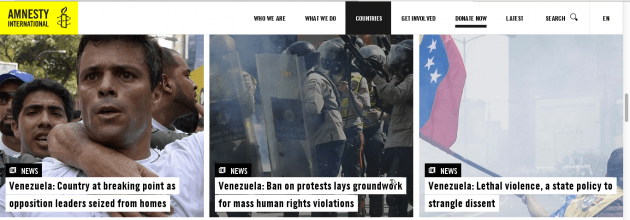
This is identical false coverage to that of Western mainstream corporate media and most Western alternative media outlets too. Amnesty International’s coverage minimizes opposition murders of ordinary Venezuelans, setting many people on fire, violent attacks on hospitals, universities and even preschools and innumerable acts of intimidation of the general population. That headline “Venezuela: Lethal violence, a state policy to strangle dissent” is a pernicious lie. President Nicolas Maduro explicitly banned the use of lethal force against opposition demonstrations from the start of the latest phase of the opposition’s long drawn out attempted coup back in early April this year.
Likewise, against Nicaragua, Amnesty’s latest report, kicking off their global campaign to stop Nicaragua’s proposed Interoceanic Canal, also begins with a demonstrable lie : “Nicaragua has pushed ahead with the approval and design of a mega-project that puts the human rights of hundreds of thousands of people at risk, without consultation and in a process shrouded in silence” That claim is completely false. Even prior to September 2015, the international consultants’ impact study found that the government and the HKND company in charge of building the Canal had organized consultations with, among others, over 5400 people from rural communities in addition to 475 people from indigenous communities along the route of the Canal and its subsidiary projects. There has been very extensive media discussion and coverage of the project ever since it was announced.
That extremely prestigious ERM consultants’ Environmental and Social Impact study, which together with associated studies cost well over US$100 million, is publicly available in Spanish and in English. Two years ago, it anticipated all the criticisms made by Amnesty International and was accepted by the Nicaraguan government, leading to a long period of analysis and revision that is still under way. Amnesty International excludes that information. Recently, government spokesperson Telemaco Talavera, said the continuing process involves a total of 26 further studies. Until the studies are complete, the government is clearly right to avoid commenting on the proposed Canal, because the new studies may radically change the overall project.
Amnesty International states, “According to independent studies of civil society organizations, along the announced route of the canal, approximately 24,100 households (some 119,200 people) in the area will be directly impacted.” But, the ERM study notes, “HKND conducted a census of the population living in the Project Affected Areas. The census determined that approximately 30,000 people (or 7,210 families) would need to be physically or economically displaced.” But Amnesty International’s report omits that contradictory detail, demonstrating how irrationally committed they are to the false propaganda of Nicaragua’s political opposition.
Amnesty International claim their research team interviewed “at least 190 people” concerned about the effects of the Canal. By contrast, the Nicaraguan government and the HKND company have discussed the project with around six thousand people in the areas along the route of the Canal. In that regard, even the local church hierarchy has criticized the way the Nicaraguan opposition have manipulated rural families on the issue of the Canal. But that fact too, Amnesty International omits. Their whole report is tailor made to supplement the political opposition’s campaign for US intervention via the notorious NICA Act.
The Nicaraguan government has made an express commitment to a fair and just resolution of the issue of expropriations. Its 2015 report on the Canal in the context of its National Development Plan, states : “The Nicaraguan government and HKND will guarantee that persons and families on the route of the Canal’s construction will have living conditions superior to those they currently have (without the Canal). To that end, the Government of Reconciliation and National Unity, via the Project’s Commission, will guarantee not just a fair and transparent indemnification of their properties, via negotiations and direct agreements with each family affected, but furthermore will promote actions to improve their economic conditions, health care, education, housing and employment.
But the Amnesty International report systematically excludes that and any other sources giving the government’s point of view, claiming it was unable to access primary sources either from the government itself or from among the Canal’s numerous advocates. However, secondary sources abound that categorically contradict Amnesty’s advocacy against the Canal. Their report specifically and extensively attacks the Law 840, facilitating the construction of the Canal and its sub-projects, but cynically omits a fundamental, crucial detail, while also failing completely to give relevant social and economic context.
The crucial detail is that Law 840’s Article 18 specifically states the Canal project “cannot require any Government Entity to take any action that violates the political Constitution of the Republic of Nicaragua or the terms of any international treaty of which the State of the Republic of Nicaragua is a party.” Amnesty International completely omit that absolutely crucial part of the Law 840 from their report because it makes redundant their advocacy of opposition claims attacking the equity and legality of the Canal’s legal framework. The same is true of the relevant political, social and economic context.
Nicaragua’s political culture is based on dialog, consensus and respect for international law. All the main business organizations and labor unions in Nicaragua and all the main international financial and humanitarian institutions acknowledge that. President Daniel Ortega and Vice President Rosario Murillo enjoy levels of approval of over 70%. There is good reason for that massive majority approval. Among many other factors, the precedents of how the Nicaraguan authorities have resolved relocating populations affected by large projects, for example the Tumarín hydroelectric project, completely contradict the scaremongering of the Nicaraguan opposition propaganda, so glibly recycled by Amnesty International.
Nicaragua’s current Sandinista government has been the most successful ever in reducing poverty and defending the right of all Nicaraguans to a dignified life. To do so, among many other initiatives, it has mobilized record levels of foreign direct investment. In that context, Law 840 explicitly protects the huge potential investments in the proposed Canal, while at the same time implicitly guaranteeing constitutional protections. Similarly, ever since the announcement of the Canal, President Ortega has repeatedly, publicly reassured people in Nicaragua that any families who may eventually be relocated should the Canal go ahead will get every necessary help and assistance from the government.
Just as it has done in the case of Venezuela, on Nicaragua, Amnesty International misrepresents the facts, cynically promoting the positions of the country’s right wing political opposition. In Latin America, under cover of phony concern for peoples’ basic rights, in practice Amnesty International, like almost all the big multi-millionaire Western NGOs, gives spurious humanitarian cover to the political agenda of the US and allied country corporate elites and their governments. The destructive, catastrophic effects of Amnesty International’s recent role in the crises affecting Syria, Ukraine and now Venezuela, are living proof of that.
Venezuela Brings Regional Elections Forward to October
teleSUR | August 12, 2017
Venezuela’s newly-elected National Constituent Assembly, ANC, has brought forward the regional elections by two months.
The polls, which had been scheduled to take place on December 10, will now be held in October following unanimous approval by the ANC.
The second vice president of the body, Isaias Rodriguez, said the process for the election of governors and state governors, will take place “within the framework of the electoral program already announced by the electoral power.”
ANC Constituent Tania Diaz explained that bringing the regional elections forward is a mandate of the people and added, “The recent elections to choose the members of the ANC represents a popular victory and a defeat of the violent actions promoted in the last four months by the right, which has triggered more than 100 fatalities.”
Another member of the ANC, Melvin Maldonado recalled that in 18 years of the Bolivarian Revolution, there have been 21 elections, which “shows the strength of our National Electoral Council, and it also shows the democratic nature and electoral power in our country.”
The president of the National Electoral Council of Venezuela, Tibisay Lucena, said the submission of nominations for the regional elections will start on Sunday August 13 and close the following day.
OAS Chief Almagro Praises Israel, Condemns Venezuela
teleSur | August 10, 2017
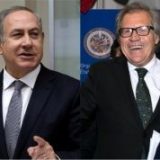 Secretary-General of the Organization of American States Luis Almagro used his one-day visit to Israel to condemn Venezuela’s leftist government while expressing “pride that Israel is a friend of the Americas,” praising what he called Tel Aviv’s record of respecting human rights and democracy.
The tour seemed less like the diplomacy of a “supra-president” representing the Western Hemisphere, and more like a roadshow for the OAS chief to reiterate Trump administration talking points.
“As friends, Israel and the Americas share key values such as democracy and human rights. We have opportunities to learn from each other,” he told a gathering of World Jewish Congress members in Jerusalem. Despite Tel Aviv’s globally unrecognized claims that the ancient city is its “national capital,” Jerusalem remains under illegal occupation.
The themes of democracy and human rights were repeated multiple times by the secretary-general during his time with Israeli officials, usually in such contexts as “Israeli … our essential partner in the Middle East — due to its commitment to democracy and to human rights.”
Israeli authorities face routine criticism from world legal bodies like the U.N. for their disregard of human rights standards, especially in their discriminatory treatment of the Palestinian population.
“Israel is a democratic state in which the institutions function,” Almagro told Haaretz. “The functionality of institutions and the balance of powers are fundamental for us and are the paradigm of the health of a democracy.”
Israeli institutions systematically deny the people of Palestine their right to self-determination, imposing stringent restrictions on their movement, travel, and trade. Israeli security forces have been criticized by rights organizations for resorting to excessive force, including extrajudicial killings, on a regular basis, while unarmed Palestinian demonstrators — adults and children — face imprisonment, torture, and abuse for taking part in protests against occupation activities. The construction of massive settlements deep in the occupied West Bank likewise is illegal under international law.
Almagro’s tone jars dramatically with his opinion five years ago as foreign minister of Uruguay, admitting in an interview that he voted on U.N. resolutions condemning Israeli settlements and human rights violations “with both hands” while arguing that the Israeli occupation’s crimes were irrefutable from a legal standpoint.
On the subject of Venezuela, Almagro struck an emphatic tone consistent with his prior calls to remove the country’s government through “regime change” efforts.
“It is a dictatorship, there’s no other definition for Venezuela today,” Almagro told Israeli daily Haaretz.
Seemingly oblivious to the irony in his words, he then condemned the left for having “flinched on democracy and human rights” in the South American nation.
Opining about U.S. unilateral sanctions on Venezuela, Almagro said, “no country feels comfortable in this situation … but that does not mean the sanctions don’t hit hard and hit those specific places that most affect the regime.”
Since becoming secretary-general of the OAS, Almagro has become a partisan of Venezuela’s right-wing opposition, railing against alleged abuses by the “ruling regime” and issuing thousands of tweets against the Bolivarian government, accompanied by calls for foreign intervention in the country.
In contrast, Almagro has been relatively silent in respect to the Western Hemisphere’s most pressing human rights crises — such as the Mexican government’s crackdowns on social movements resisting neoliberal structural reforms, assassinations of social movement leaders and paramilitary attacks on rural and Indigenous communities throughout Latin America, and the parliamentary coup against Brazilian President Dilma Rousseff.
The OAS chief’s contradictory messages underscore Bolivian President Evo Morales’ description of Almagro’s “submission to the North American empire.”
Moscow: Anti-Caracas Sanctions Hamper Normalization of Situation in Venezuela
Sputnik – 10.08.2017
The recently imposed sanctions against Venezuela do not contribute to the normalization of the situation in the country, pushing it back into deadlock instead, the Russian Foreign Ministry said in a statement Thursday.
On Wednesday, the US Department of Treasury announced the expansion of its sanctions on Venezuela. These measures included travel bans and asset freezes on eight people who played a role in convening the new legislative body, the Constituent Assembly.
“Certain internal and external political forces promote a destructive line aimed at dismantling the emerging dialogue and, in fact, at returning the situation to the initial impasse, contrary to the very logic of developments [in Venezuela] and their own calls for the democratization of the ongoing processes in Venezuela. The expansion of unilateral sanctions and restrictions, isolationist measures, pressure, and the ultimatum toward Caracas applied by a number of countries can hardly be seen in a different light,” the statement read.
The Russian Foreign Ministry stressed that the situation in Venezuela could only be addressed through direct negotiations between the government and opposition.
According to the statement, peace in Venezuela depends on the willingness of all parties to return to a dialogue within the Venezuelan Constitution, without any outside intervention, to form a common agenda.
The National Constituent Assembly, which proclaimed itself the main governing body of Venezuela, is a new legislature with the power to amend the country’s constitution. It was elected on July 30 amid mass protests across Venezuela, which resulted in 10 deaths on election day alone. Overall, the death toll has risen to more than 120 people since early April.
The Venezuelan opposition has refused to recognize the legitimacy of the Constituent Assembly, as it believes that Venezuelan President Nicolas Maduro’s plan for constitutional reform aims at sidelining the opposition-controlled National Assembly.
Military Base Attacked in Venezuela, Two Dead
By Katrina Kozarek and Rachael Boothroyd Rojas | Venezuelanalysis | August 7, 2017
The 41st Armored Brigade of Fort Paramacay in Carabobo State was attacked by civilians and ex-military officials in the early hours of Sunday morning as part of an unsuccessful attempt to provoke a military rebellion, Venezuelan President Nicolas Maduro has confirmed.
According to the president, the attack occurred at 3:50 am when 20 armed men entered the facilities and headed directly for the arms depository, where a confrontation ensued until approximately 8am. The confrontation left two dead and one injured. A further ten have been arrested in connection with the attack.
Moments before the coordinated assault, flyers were dropped outside the military base referring to the action as ‘Operation David’ and calling for all members of the armed forces to join the “military rebellion”. The messages also told the soldiers who refused to mutiny against the government that they should consider themselves a “military objective” and “face the consequences”.
The attack was also accompanied by a video released on social media by former military commander Juan Caguaripano Scott, who had reportedly fled the country during the 2014 opposition protests known as the guarimbas and has since lived between Miami, Costa Rica, Panama and Colombia.
“We declare ourselves in legitimate rebellion, united today more than ever, with the brave Venezuelan people, to refuse to recognize the murderous tyranny of Nicolás Maduro. This is not a coup d’état, this is a civic and military action to restore order and to save the country from total destruction,” states Caguaripano in the video.
It is not clear when nor where the video was recorded.
Though Caguaripano and several international media sources have referred to the attack as a civic-military rebellion, the majority of those captured were not active military personnel. One of the detained men was identified as ex-lieutenant Oswaldo José Gutiérrez Guevara who deserted the military after being investigated for theft. The remaining nine were paid civilians recruited from the states of Zulia, Yaracuy and Lara, and all had criminal records, said the Ministry of Defense. They were aided and abetted by First Lieutenant Yefferson Gabriel García Dos Ramos, who was in charge of the fort’s weapons depository.
Authorities are yet to release the names of the two fatalities, but it is known that both Caguaripano and Dos Ramos were on the ground at the time of the attack and managed to evade capture.
Government officials have since described the offensive as a terrorist attack as opposed to a military rebellion, citing the lack of serving military officials involved in the operation.
According to a tweet from Vice Minister of International Communication, William Castillo, the attack was a “propaganda operation” with “civilians disguised as current and former military officials”.
The Minister of Information and Communication Ernesto Villegas also announced that opposition forces in Venezuela were attempting to create and circulate “fake news” about the country, as well as “trying out the formula [used in] the Ukraine.”
Sunday’s assault on the military fort follows a helicopter attack against the Supreme Court by former investigative police official Oscar Pérez in June. Perez also called on the military to rise up against the Maduro government, echoing similar demands voiced by opposition spokespeople for the past 18 months. Over 120 people have also been killed in violent opposition-led unrest since the beginning of April.
On Sunday, Minister of Defense Padrino Lopez released an official communique on behalf of the Bolivarian National Armed Forces (FANB) in relation to the incident. Lopez said that although the group had been “immediately repelled” by army personnel, some of the attackers had managed to steal weapons from the fort’s depository and were currently at the centre of a manhunt by state security agencies.
The communiqué also stated that those responsible for the attack will face military charges.
“We will not accept under any circumstances the violation of our sovereignty, and even less that the social gains achieved for the benefit of the great majorities are undermined,” reads the statement.
The document finished by calling on the men and women of Venezuela to work together to find solutions to the current turmoil in the country within a legal framework.
Voting Machine Maker Says Venezuela Polls Rigged, Offers No Evidence
By Tony Cartalucci | Land Destroyer | August 3, 2017
London-based voting machine maker Smartmatic claims the recent polls carried out in Venezuela this week were rigged. In their 5 minute video statement, however, they failed to provide any evidence.
An AP article titled, “Election report: Venezuela vote ‘probably rigged’,” claims:
The number of Venezuelans who participated in the election for an all-powerful constituent assembly was tampered with – off by at least 1 million votes – in an official count, the head of a voting technology company asserted Wednesday, a finding certain to sow further discord over the super-body that has generated months of nationwide protests.
Smartmatic CEO Antonio Mugica said results recorded by his systems and those reported by Venezuela’s National Electoral Council indicate “without any doubt” that official turnout figure of more than 8 million participants was manipulated.
Mugica, however, claims in his full statement (video here) that (emphasis added):
Our automated election system is designed to make it evident when results are manipulated, however, there must be people auditing the system and watching for that evidence. During the National Constituent Assembly elections there were no auditors from the opposition parties as they did not want to participate.
Thus, at best Mugica and Smartmatic can warn that irregularities might have occurred, since no one from the opposition was there to audit the final tallies and report any potential inconsistencies.
Since no opposition auditors were there, no evidence has been provided that such irregularities occurred. Neither AP’s article nor Mugica’s full statement provide any evidence or explanation as to how Smartmatic “estimated” the final count regarding participation was off by “one million votes.” Mugica doesn’t even explain whether it was one million more than reported, or one million less.
Smartmatic either failed to reveal information it has regarding the final count, or has simply lied on behalf of the Venezuelan opposition and the powerful foreign interests sponsoring it from Washington, London, and Brussels.
This latest announcement, absent of any evidence to substantiate these accusations, calls into question Smartmatic’s professionalism, ethics, and impartiality. Other nations considering Smartmatic machines must consider the possibility that the company’s CEO may attempt to use his machines and their role in tallying votes to manipulate their internal politics as well.
This announcement also once again calls the Western media into question for failing to note the very obvious inconsistencies between Mugica’s conclusions and the lack of evidence provided to substantiate them.
Featured Video
Houthis Keep Advancing as the Red Sea Crisis Deepens
or go to
Aletho News Archives – Video-Images
From the Archives
15 Saudi ‘hijackers’ were CIA agents working for US: Scholar
Press TV – April 13, 2016
Fifteen of the 9/11 “hijackers” from Saudi Arabia were CIA agents working for the United States government, which was seeking to destroy the Middle East for Israel and to double the American military budget, says Dr. Kevin Barrett, an American academic who has been studying the events of 9/11 since late 2003…. continue
Blog Roll
 Aletho News
- Israel seeks ‘compensation’ from Washington over Saudi F-35 sale
- Saudi crown prince seeks dialogue with Ansarullah after Yemeni blows: Report
- Damascus rejects Saudi request for Syrian fighters to counter Yemen: Report
- South Korea says will not send troops to join terrorist US war on Iran
- Russia Just Struck the Eyes of NATO’s War Machine in Ukraine
- Russia summons UK charge d’affaires over Kiev drone support
- NATO member warns bloc seeking pretext for war with Russia
- Macgregor: We Haven’t Seen the Worst of the Iran War Yet
- ‘We are not like everyone else’ laws that bind other nations do not apply to Israel, says Likud lawmaker
- Report: Saudi Arabia seeks allies’ assistance as missiles deplete amid war on Yemen
- If Americans Knew
- CPJ demands release of arrested Palestinian-US journalist near Bethlehem
- Robert Kraft: The Billionaire Friend of Netanyahu Pulling The Strings Behind the Macklemore/Ed Sheeran Blow Up
- Columbia Administered Fund Gives Big Money to Pro-Israel Groups
- Deportation Case of Palestinian Activist Salah Sarsour Tests First Amendment
- ‘We Will Not Forget’: Palestinians Mark 44 Years since Sabra and Shatila
- Why do we let Zionists decide what we can and can’t say?
- US welcomes Israeli, Iranian delegations to UN, but not Palestinians – Daily Update
- Biden’s Genocide Accomplices Targeted by New Accountability Campaign
- AIPAC’s Network Has Already Spent $67.2 Million to Shape the Midterm Elections
- Jewish Supremacist Manufacturing a Civilizational Threat to License Bigotry
- No Tricks Zone
- New Study: ‘Global Drought Shows No Detectable Recent Acceleration Under Climate Warming’
- Economic Masterminds: German Socialists Suggest Taxing Productivity Gains Stemming From Using AI
- The South China Sea Has Not Been Cooperating With The Climate Change Narrative
- Energy Crisis: Germany Enters Heating Season With Historically Low Gas Reserve Fill Levels
- New Study: The Antarctic Ice Sheet Gained Mass From 2020-2024 Due To Staggering Snow And Ice Accumulation
- Study: Ocean Heating Rates From Thousands Of Years Ago ‘Dwarf’ Modern Ocean Heating Rates
- Climate Extremists Target, Attack Large-Scale Power Grid Infrastructure In Germany!
- New Study: Antarctic Ice Melt Has Contributed Less Than 1 Centimeter To Sea Level Rise In The Last 30 Years
- Fear Of Debate: Alarmist German Climate Scientist Calls On Mainstream Media To Discredit Skeptic Voices
- End-Of-August Arctic Sea Ice Extent Hasn’t Fallen In 20 Years, Official Data Show!
 Aletho News