Canada Rejects Venezuela Vote, EU Mulls Sanctions & Russia Congratulates Government
By Rachael Boothroyd Rojas | Venezuelanalysis | October 18, 2017
Twenty-eight European Ministers jointly agreed to “establish the legal framework” for pursuing sanctions against the Venezuelan government Monday in the wake of the country’s regional elections, Europa Press has reported.
Venezuela’s government won eighteen out of twenty-three states in regional elections this past Sunday, but the results have been disputed by the right-wing opposition, the US, Canada and France, on the basis of alleged foul play.
Opposition spokespeople have so far been unable to corroborate their allegations of fraud, while international electoral observers have testified to the veracity of the results. Venezuelan political commentators have said that mass abstention of opposition voters due to disillusionment with their leaders was the reason for the shock result.
Speaking at an EU meeting in Luxembourg Monday, EU Foreign Policy chief Federica Mogherini cautiously described the election results as a “surprise” and asked for investigations to “clarify what happened in reality”.
Ministers also agreed to advance in the preparation of “selective, gradual and reversible” sanctions against members of Venezuela’s Nicolas Maduro administration, with some apparent reticence from Portugal.
The EU has been discussing the potential implementation of sanctions against individuals within the Venezuelan government since the US imposed economic sanctions against Venezuela in August. Canada also followed suit shortly after with asset freezes targeting top Caracas officials.
Venezuelan President Nicolas Maduro responded to the decision Tuesday, accusing Mogherini of only listening to opposition voices in Venezuela, and inviting her to call him or arrange a meeting in Brussels.
Meanwhile, Canada officially added its voice to the international chorus of condemnation against the regional election results Tuesday.
In an official statement, Canadian Foreign Affairs Minister Chrystia Freeland said that “Sunday’s elections were characterized by many irregularities that raise significant and credible concerns regarding the validity of the results.”
She also added her government would continue to “stand for the Venezuelan people and for the defence and restoration of democracy in Venezuela.”
Freeland had already tweeted on Monday that her government was “”very concerned by yesterday’s polling centre closures & relocations – clearly favouring #Venezuela regime, hindering free + fair elections”. Her stance was criticized by Canada’s Communist Party.
Canada is a member of the so-called Lima Group – a regional organization made up of right-wing regional governments opposed to the Maduro administration, including Argentina, Brasil, Canada, Chile, Colombia, Costa Rica, Guatemala, Honduras, Mexico, Panama, Paraguay, and Peru.
On Tuesday, the Lima Group likewise claimed that the elections were marred by irregularities, and demanded a full “independent audit” of results. Venezuelan President Nicolas Maduro had already called for an audit of 100 percent of votes Sunday.
The Lima Group is due next to meet in Canada on October 26, when it will discuss Venezuela’s regional elections and the ongoing stand-off between the government and opposition.
But not all international governments have condemned the elections, and the Maduro administration has received supportive statements from Russia, Cuba, Bolivia and other Latin American leaders.
For its part, Russia said the elections represented a new opportunity to address the “pressing economic and social problems facing the country” and criticised the opposition’s refusal to accept the results.
“The population demonstrated its commitment to civilized, first of all electoral, ways of settling political differences,” reads a statement from the Russian Foreign Ministry.
“Given this, the opposition’s refusal to recognize the results of the voting and calls for more street protests and tougher international sanctions are fraught with negative consequences. This may frustrate the emerging scenario of compromise and trigger another spiral of violence and confrontation,” the ministry added.
In addition, Russia urged Venezuelan political forces to refrain from violence, and spoke in support of dialogue between the opposition and national government “to stop attempts at destructive interference from outside.”
“The counter-productiveness of force and sanction pressure on Venezuela is obvious,” the ministry underscored.
Meanwhile, the government of Cuba also congratulated the Maduro government on the election win.
“Dear Nicolas: I congratulate you for the results of state elections. Venezuela has shown another example of peace, democratic vocation, courage and dignity,” Cuban President Raul Castro said in a letter published by Cuba’s Foreign Relations Ministry.
Bolivian President Evo Morales also took to Twitter to say that “In Venezuela, peace triumphed over violence, the people triumphed over the empire. [Organization of American States Secretary-General] Luis Almagro lost, along with his boss [US President] Trump”.
En Venezuela triunfó la paz frente a la violencia, triunfó el pueblo frente al imperio. Perdió Luis Almagro con su jefe Trump.
— Evo Morales Ayma (@evoespueblo) October 16, 2017
In similar statements, former Ecuadorean President Rafael Correa said that the election results had “exposed” how biased international media coverage is on Venezuela.
Many international media outlets had predicted that Venezuela’s opposition would sweep to victory on Sunday, in a repeat of the 2015 National Assembly elections.
Venezuela Regional Elections: chavismo in triumph, opposition in disarray and media in denial
By Ricardo Vaz | Investig’Action | October 18, 2017
As the President of the Venezuelan Electoral Commission (CNE) read the results from the regional elections that took place on Sunday, October 15, one could feel the agony in the editorial rooms of mainstream media outlets. Chavismo had just won 18 out of 23 (1) governorships, a result that, according to them, could not have happened. International observers praised the electoral process and opposition claims of fraud, while uncritically echoed by the media, do not have a leg to stand on.
The United Socialist Party of Venezuela (PSUV) had a tremendous victory in these elections. Among the three quarters of the governorships secured, some were quite significant. Hector Rodríguez, a young and charismatic chavista leader, won the governorship of Miranda state back from the opposition. Miranda includes part of Caracas and was the main hotspot of opposition violence in recent months. Another example was Chávez’s home state of Barinas which also saw some unrest in recent months. Chávez’s younger brother Argenis was the candidate and the state was successfully held by the PSUV.
The opposition lost all three governorships won in 2012 (Miranda, Amazonas and Lara) and won five others (Anzoátegui, Mérida, Nueva Esparta, Táchira and Zulia), with three of them being on the border with Colombia and raising some fears of increased paramilitary activity. Overall participation was 61%, compared to 54% five years ago, and the PSUV had 54% of the vote, some 5.6M votes. This marked a complete reversal from the legislative elections of 2015. It showed that chavismo’s core support remains very strong, and that, due to its less than coherent actions, it was the opposition that failed to mobilise its supporters.

Electoral map after Sunday’s regional elections. Chavismo took 18 (red) governorships, and the opposition took five (blue).
The media reaction was one for the history books. Having not paid much attention to these elections, the run-up had just the same recycled narrative: “if the elections are free and fair, the opposition will win by a landslide”. Once the results came out, rather than look to understand them and figure out what had gone wrong in their predictions, the media simply went down the rabbit hole. According to their biased narrative and historically inaccurate polls, this simply was not possible!
The evidence to back this impossibility was also less than convincing. There were the usual unsubstantiated, or easily disproved, claims of “fraud” (more on that later). The New York Times added the very scientific claim that “turnout appeared to be lower”, while Reuters, with its ever decreasing credibility, went further and talked about voters being forced to vote at gunpoint! Several analysts were paraded to claim that this result was not possible, some even argued it was “inconceivable”. It seems like these journalists and analysts have violated one of the cardinal rules of (information) trafficking: don’t get high on your own supply. Simply put, they have started believing too much in their own propaganda.
A resounding defeat for the Venezuelan opposition
Let us look at the actions of the US-backed Venezuelan opposition in the recent past. First they kicked off a wave of street violence in April that left more than 100 dead (most of them caused by opposition violence). With the media propaganda in overdrive they claimed they were on the verge of “tumbling the dictatorship”. But barring a few isolated occasions, the violence never spread far beyond the opposition strongholds, mainly in eastern Caracas.
After Maduro proposed the Constituent Assembly, the opposition refused to participate and claimed that they would stop it from taking place. They even staged their own “referendum” to reject the Constituent Assembly and call for intervention of the armed forces. But in what was a massive chavista show of strength, as well as a rejection of opposition violence, more than 8M people voted on July 30th. All the opposition, and the media, could do was claim that the figure was false, based on shoddy exit polls and unsubstantiated claims from Smartmatic (2). These elections and the swearing in of the Constituent Assembly effectively brought peace to the streets.
So after all the talk of tumbling the dictatorship and demanding that Maduro step down tomorrow, the opposition turned to their supporters, and with a straight face asked them to go out and vote in the regional elections. Some of the more hardline factions refused to take part (and are now chiding the leadership for having done so) but most of the opposition parties carried on with the absurd discourse of “voting against the dictatorship”. In the end the absurdity caught up to them and the result was a resounding defeat. And then, like clockwork, the opposition claimed the results were fraudulent. Frankly, what else was left for them to do? They can send the defeated candidates to Washington DC and continue forming their “government in exile”. (3)

Opposition leader Julio Borges’ contradictions with regard to the regional elections (Translated from Misión Verdad)
Fraudulent “fraud” claims
If the media coverage of Venezuela had any vestige of honesty, articles would explain how the voting works, so that these “fraud” allegations can be put into context. In a nutshell, voters mark their vote in a machine, a paper ballot is printed, and if this matches the electronic vote, they deposit the paper ballot in a box. After the voting is completed, a audit is conducted in 54.4% of the voting centres, randomly selected. This consists of tallying up the paper ballots and seeing if they match, up to a very small margin, against the electronic tally. This ensures that statistically the results are pretty much final, and that is what the CNE President Tibisay Lucena means when she says the results are “irreversible”.
Chavista, opposition and international monitors take part in pre-voting checks, are present at voting centres during the day, and they are also present during this audit. At the end of this process they sign an act (acta). So it is very hard to claim there was actual electoral fraud. In fact, defeated opposition candidate in Miranda, Carlos Ocariz, said himself that he had the acts and that was not the problem. Therefore it is ridiculous for France and the US State Dept. to claim there is anything wrong with the tabulation process.
The main “fraud” complaint in the media were that over 200 voting centres (out of 13.500) had been relocated away from areas where the opposition is strongest and into traditionally pro-government areas. What, conveniently, was left unsaid, is that these were centres that could not open for the Constituent Assembly elections because of opposition violence, which makes the CNE’s security concerns more than justified.
There were also protests that opposition candidates that had lost a (contentious) primary vote were left on the ballot, with the CNE arguing that the requests to remove them from the ballot were not filed on time. But looking at the results, all the contests were virtually two-horse races, with hardly any votes for third-placed candidates and with the winner taking over 50% of the vote, so any consequence of this was negligible (with the possible exception of Bolívar).
Another complaint was that some of the voting centres did not open on time. But given that, even after polls close at 6PM, everyone who is standing in line still gets to vote, this complaint does not hold water. All in all, the Venezuelan opposition, their sponsors, and the media, would have the world believe the elections were fraudulent because middle-class voters did not want to wait in line and much less see poor people on their way to vote.

Chavista celebrations after the electoral triumph (photo by AVN)
The road ahead
It is hard to see where the Venezuelan opposition can go from here, with signs of in-fighting already clear. With their “doomsday cult” behaviour they are unlikely to have any success in reactivating the street violence, and thus their fate rests essentially on what the US empire can do. They will be hoping that (more) sanctions can inflict enough pain on the Venezuelan people to give them a chance of winning the presidential election next year. The most fanatical ones might hope that Trump follows through on the threats of military intervention.
One thing they can count on is the unwavering, unconditional support from the mainstream media. While opposition voters and supporters may use their memory and call out the inconsistencies and contradictions, no such thing is to be expected from the media. They will keep echoing claims that there was fraud in these elections, that the turnout on July 30th was inflated, and continue to milk the story of the former prosecutor who goes around saying she has proof of corruption involving high government officials. As with everything that can be used against the Bolivarian government, no evidence is ever needed.
As for chavismo, it is unquestionable that the two most recent electoral showings have been tremendous victories. Western analysts time and again fail to grasp the vitality of the Bolivarian Revolution, and belittle chavistas either as brainwashed zealots or people who simply fear losing their benefits (4). The reality is that, even through a deep economic war/crisis that has hit them hard, and regardless of what the leadership should have done differently, the Venezuelan poor and working-class still see this project as their own, one in which they are actors and not just spectators.
Maduro’s term has arguably seen chavismo playing defence all the time, with an economic war, a steep drop in oil prices, two incarnations of guarimba violence and constant international pressure and sanctions. Fresh off this electoral win and with the Constituent Assembly in place, it is imperative that chavismo seizes the moment to radicalise, to go on the offensive, with a year to go until the presidential elections. The support that it has retained through this storm should not be taken for granted, and there is now a window to fight corruption, increase working-class control in the economy, increase the influence of the communes, etc. This is not just a matter of keeping the grassroots involved, this is how the economic war will be won, this is how socialism will be built.
Notes
(1) The initial results were only final for 22 out of the 23 states. In the southern state of Bolívar the PSUV candidate was later confirmed to be the winner in a tight contest.
(2) Smartmatic, the company responsible for the software in the voting machines, claimed that “without any doubt” the turnout had been inflated by at least 1M votes. The claim was rejected by Venezuelan electoral authorities because the company does not have access to electoral data. Several solidarity organisations delivered a letter to Smartmatic CEO Antonio Mugica on September 8 demanding that the company either present evidence for its claims or issue an apology. There has been no response to this day.
(3) Right on cue, Maria Corina Machado has urged the opposition-controlled National Assembly, which has been in contempt of court since mid-2016, to nominate new electoral authorities. One hopes there is enough office space in OAS headquarters in Washington DC.
(4) If only they had a deep and mature political understanding such as the opposition and their “we do not want to be Cuba” slogans…
Cover photo: President Maduro lauded the election victory as a message against imperialism (photo by AVN)
International Electoral Observers Validate Venezuela Regional Vote as US, France Reject Results
By Lucas Koerner | Venezuelanalysis | October 16, 2017
Caracas – The Latin American Council of Electoral Experts (CEELA) has confirmed that Sunday’s vote in Venezuelan gubernatorial elections was clean and transparent.
“The vote took place peacefully and without problems… the vote reflects the will of [Venezuelan] citizens,” declared CEELA President Nicanor Moscoso during a press conference Monday morning.
The CEELA delegation was comprised of 1300 international observers, including former Colombian Electoral Court President Guillermo Reyes, ex-president of the Honduran Supreme Electoral Court, Augusto Aguilar, and former Peruvian electoral magistrate Gastón Soto.
According to the body’s report, the vote was held under conditions of “total normality” and the right to a secret ballot was “guaranteed”.
Sunday’s elections pitted President Maduro’s United Socialist Party of Venezuela against the right-wing MUD coalition, with the former scoring a surprise win in 17 of the nation’s 23 states.
The results have, however, been rejected by the MUD, which has alleged “fraud” and called on its supporters to take to the streets in protest.
The MUD has accused the National Electoral Council of attempting to suppress opposition turnout by relocating 334 voting centers previously targeted by anti-government violence during July 30’s National Constituent Assembly Elections.
Announced several weeks ago, the relocations were concentrated in the states of Anzoátegui, Aragua, Carabobo, Lara, Merida, Miranda, and Tachira. Nonetheless, in Merida and Tachira, the MUD emerged triumphant, despite there being 58 and 42 changes in voting centers, respectively.
For its part, CEELA has reported that it has yet to receive any formal denunciations from the opposition, which has issued its fraud allegations via the media.
President Maduro has requested a 100 percent audit of Sunday’s elections, a call that was subsequently echoed by the MUD.
Nothewstanding CEELA’s certification of the outcome, Venezuela’s regional elections have come under fire from Washington and Paris.
“We condemn the lack of free and fair elections yesterday in Venezuela. The voice of the Venezuelan people was not heard,” declared US State Department spokesperson Heather Nauert.
The diplomat did not, however, offer specific evidence explaining her government’s disavowal of the election result.
In recent months, the Trump administration has taken an increasingly aggressive stance against the Maduro government, imposing economic sanctions, decreeing a travel ban on Venezuelan officials, as well as threatening military intervention and an embargo.
France’s Foreign Ministry likewise issued a communique Monday in which it alleged “serious irregularities” and “lack of transparency in the verification and tabulation process”
“France deplores this situation and is working with its EU partners to examine appropriate measures to help resolve the serious crisis affecting the country,” the French government continued.
France’s newly elected president, Emmanuel Macron, has become an increasingly vocal critic of the Maduro government Caracas.
In September, the French leader met with senior Venezuelan opposition politicians during a tour by the MUD to drum up support for EU sanctions against Venezuela.
The European Parliament voted last month to explore the option of sanctioning top Venezuelan officials, following the lead of Washington and Ottawa.
In response to the statement by Paris, Venezuelan Foreign Minister Jorge Arreaza took to Twitter Monday, lambasting European interference in his country’s internal affairs.
“The EU and some of its member states (subordinate to Trump) question the will of the Venezuelan people,” he stated.
“In Europe, they’d only wish to have a real democracy, where their peoples can freely choose between two truly contrasting projects,” Arreaza added.
Chavistas Take 17 of 23 States in Venezuelan Regional Elections as Opposition Cries Fraud
By Lucas Koerner – Venezuelanalysis – October 16, 2017
Caracas – President Nicolás Maduro’s United Socialist Party of Venezuela (PSUV) won 17 of 23 states in Sunday’s gubernatorial elections, the National Electoral Council (CNE) has confirmed.
According to CNE President Tibisay Lucena, 61.14 percent of Venezuela’s eighteen-million-strong electorate came out to vote, marking a record participation in the country’s regional elections, second only to the 65.45 percent turnout in 2008.
The result defied forecasts of high abstention fueled by the current economic crisis as well as polls showing dissatisfaction with the leadership of both the government and political opposition.
With 95 percent of all votes counted, the governing PSUV won in the states of Amazonas, Apure, Aragua, Barinas, Carabobo, Cojedes, Falcon, Guarico, Lara, Miranda, Monagas, Sucre, Trujillo, Yaracuy, Delta Amacuro, and Vargas.
For its part, the opposition Democratic Action party triumphed in Anzoátegui, Merida, Tachira, and Nueva Esparta, while the First Justice party took the strategic northwestern border state of Zulia.
The CNE has yet to release final results for the mineral rich Amazonian state of Bolivar in the country’s southeast border.
The PSUV won 54 percent of the total vote, marking a significant recovery since the ruling party’s landslide defeat in the 2015 parliamentary elections when it garnered only 40.8 percent of the vote. The pro-government upswing follows on the heels of July 30 National Constituent Assembly (ANC) elections, which saw over eight million people turn out to vote amid deadly opposition protests and escalating US pressure.
The CNE indicated that the right-wing opposition coalition, the Democratic Unity Roundtable, won 45 percent of votes, amounting to a loss of 2.2 million votes relative to 2015.
Speaking late Sunday evening, President Maduro welcomed the result, vowing to work with the newly elected opposition governors.
“I extend my hand to the opposition governors to work with them for the peace and calm of the country,” he declared.
The head of state likewise called on the CNE to carry out a “100 percent audit” of all paper ballots from Sunday’s vote.
Under Venezuela’s electoral system, every electronic vote is backed up by a paper ballot, 50 percent of which are by law subject to recount in any given electoral cycle.
Despite scoring important victories in several key states, the MUD responded to the CNE announcement by refusing to recognize the results, alleging “fraud”.
In a press conference early Monday morning, MUD campaign head Gerardo Blyde rejected the outcome as “not reliable”.
Blyde cited the CNE’s controversial decision announced several weeks ago to relocate 334 voting centers – predominantly located in opposition areas and targeted by anti-government violence during the July 30 ANC vote– which he claimed impacted 700,000 people.
The Baruta mayor called on the CNE to “audit the whole process”, echoing President Maduro’s remarks several hours earlier.
Blyde urged opposition candidates to mobilize their supporters in the streets in the coming days to put pressure on the nation’s electoral authority.
Undermining Venezuela’s socialist government nothing new for Canada
By Yves Engler · September 23, 2017
Alongside Washington and Venezuela’s elite, the Trudeau government is seeking to oust President Nicolás Maduro. While Ottawa’s campaign has recently grown, official Canada has long opposed the pro-poor, pro-working class Bolivarian Revolution, which has won 19 of 21 elections since 1998.
Following a similar move by the Trump Administration, Global Affairs Canada sanctioned 40 Venezuelans on Friday. In a move that probably violates the UN charter, the elected president, vice president and 38 other officials had their assets in Canada frozen and Canadians are barred from having financial relations with these individuals.
In recent months foreign minister Chrystia Freeland has repeatedly criticized Maduro’s government. She accused Caracas of “dictatorial intentions”, imprisoning political opponents and “robbing the Venezuelan people of their fundamental democratic rights”. Since taking office the Liberals have supported efforts to condemn the Maduro government at the Organization of American States (OAS) and promoted an international mediation designed to weaken Venezuela’s leftist government (all the while staying mum about Brazil’s imposed president who has a 5% approval rating and far worse human rights violations in Mexico).
Beyond these public interventions designed to stoke internal unrest, Ottawa has directly aided an often-unsavoury Venezuelan opposition. A specialist in social media and political transition, outgoing Canadian ambassador Ben Rowswell told the Ottawa Citizen in August: “We established quite a significant internet presence inside Venezuela, so that we could then engage tens of thousands of Venezuelan citizens in a conversation on human rights. We became one of the most vocal embassies in speaking out on human rights issues and encouraging Venezuelans to speak out.” (Can you imagine the hue and cry if a Russian ambassador said something similar about Canada?) Rowswell added that Canada would continue to support the domestic opposition after his departure from Caracas since “Freeland has Venezuela way at the top of her priority list.”
While not forthcoming with information about the groups they support in Venezuela, Ottawa has long funnelled money to the US-backed opposition. In 2010 the foremost researcher on U.S. funding to the opposition, Eva Golinger, claimed Canadian groups were playing a growing role in Venezuela and according to a 2010 report from Spanish NGO Fride, “Canada is the third most important provider of democracy assistance” to Venezuela after the US and Spain. In “The Revolution Will Not Be Destabilized: Ottawa’s democracy promoters target Venezuela” Anthony Fenton details Canadian funding to anti-government groups. Among other examples, he cites a $94,580 grant to opposition NGO Asociación Civil Consorcio Desarrollo y Justicia in 2007 and $22,000 to Súmate in 2005. Súmate leader Maria Corina Machado, who Foreign Affairs invited to Ottawa in January 2005, backed the “Carmona Decree” during the 2002 coup against President Hugo Chavez, which dissolved the National Assembly and Supreme Court and suspended the elected government, Attorney General, Comptroller General, governors as well as mayors elected during Chavez’s administration. (Machado remains a leading figure in the opposition.)
Most Latin American leaders condemned the short-lived coup against Chavez, but Canadian diplomats were silent. It was particularly hypocritical of Ottawa to accept Chavez’s ouster since a year earlier, during the Summit of the Americas in Québec City, Jean Chrétien’s Liberals made a big show of the OAS’ new “democracy clause” that was supposed to commit the hemisphere to electoral democracy.
For its part, the Harper government repeatedly criticized Chavez. In April 2009 Prime Minister Stephen Harper responded to a question regarding Venezuela by saying, “I don’t take any of these rogue states lightly”. After meeting only with opposition figures during a trip to Venezuela the next year Peter Kent, minister of state for the Americas, said: “Democratic space within Venezuela has been shrinking and in this election year, Canada is very concerned about the rights of all Venezuelans to participate in the democratic process.”
The Bolivarian Revolution has faced a decade and a half of Liberal and Conservative hostility. While the NDP has sometimes challenged the government’s Venezuelan policy, the party’s current foreign critic has echoed Washington’s position. On at least two occasions Hélène Laverdière has demanded Ottawa do more to undermine the Maduro government. In a June 2016 press release Laverdière bemoaned “the erosion of democracy” and the need for Ottawa to “defend democracy in Venezuela” while in August the former Foreign Affairs employee told CBC “we would like to see the (Canadian) government be more active in … calling for the release of political prisoners, the holding of elections and respecting the National Assembly.” Conversely, Laverdière staid mum when Donald Trump threatened to invade Venezuela last month and she has yet to criticize the recently announced Canadian sanctions.
NDP members should be appalled at their foreign critic’s position. For Canadians more generally it’s time to challenge our government’s bid to undermine what has been an essentially democratic effort to empower Venezuela’s poor and working class.
Venezuela Rejects Imposition of Sanctions by Canada
teleSUR | September 22, 2017
The Venezuelan Foreign Ministry has issued a statement categorically rejecting the illegal sanctions imposed by Canada on 40 Venezuelan government officials, including President Nicolas Maduro.
It says this hostile action, whose only purpose is to attack Maduro’s government, breaks international law which is fundamental for the promotion of economic development and social, as well as for peace and security.
The statement said the objective is “to undermine the peace and social stability achieved in our nation after the formation of the National Constituent Assembly, as well as the continued efforts made by the National Executive in favor of dialogue and understanding between the different sectors that make life in the country. ”
“These are sanctions aimed at undermining efforts to establish dialogue between the government and the Venezuelan opposition, with the support and support of members of the international community.”
It went on to say that the measures are a violation of the purposes and principles enshrined in the Charter of the United Nations, the Charter of the OAS, and the rules governing friendly relations and cooperation between States.
The statement also warned they threaten to undermine efforts to initiate, with the support and support of members of the international community, the dialogue between the government and the Venezuelan opposition.
“On September 5, 2017, the government of Canada established an aberrant association of subordination to the government of President Donald Trump with the explicit purpose of overthrowing the constitutional government of Venezuela using economic sanctions as a political weapon.”
It ends, “This decision of the Canadian government profoundly damages the bonds of friendship and respect that for years have guided the relations between our countries and, consequently, will consider all the necessary measures to defend the national interest and sovereignty.”
Earlier Canada announced it would impose the sanctions as a punishment for “anti-democratic behavior.”
“Canada will not stand by silently as the government of Venezuela robs its people of their fundamental democratic rights,” the Canadian Foreign Minister Chrystia Freeland said in a statement, adding that the sanctions were “in response to the government of Venezuela’s deepening descent into dictatorship.”
The measures include freezing assets of the officials and banning Canadians from having any dealings with them.
As well as the sanctions on Maduro, the Venezuelan Vice President Tareck El Aissami and President of the National Constituent Assembly, Delcy Rodriguez have been added to the list.
The measures mirror those imposed on Venezuela by the United States which target Maduro and around 30 other officials.
Last month, the U.S. President Donald Trump also placed renewed sanctions on its Venezuela’s state oil company, while also issuing military threats against the country.
“Canada is a country that has a strong reputation in the world as a country that has very clear and cherished democratic values, as a country that stands up for human rights,” Freeland said. “To be sanctioned by Canada, I think has a real symbolic significance.”
The sanctions come in the wake of Trump’s comments criticizing Venezuela at the UN General Assembly, where he threatened to strengthen economic sanctions if Maduro “persists on a path to impose authoritarian rule.”
Human Rights: The Latest Weapon Against Venezuela
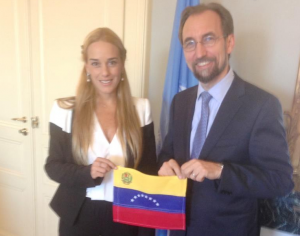
UN High Commissioner for Human Rights and Lilian Tintori, wife of opposition leader Leopoldo López who is currently serving a 13 year sentence (in house arrest) for his responsibility in the deadly violence of the 2014 guarimbas.
By Ricardo Vaz | Investig’Action | September 21, 2017
The mainstream media have a crucial role to play in the war against Venezuela, creating a distorted narrative and a constant frenzy that are crucial for any regime-change operation. With violent protests having failed to topple the government and to stop the Constituent Assembly, the plan switched to military threats and economic sanctions. But these come directly from an unpopular US administration, and a more impartial-looking figure was needed. The High Commissioner for Human Rights, Jordanian Prince Zeid bin Ra’ad al Hussein, stepped up to the plate with the backing of more than 100 NGOs. We tackle the manipulation of human rights for imperial purposes, but first we examine how the term “NGO” is woefully inadequate to describe these organisations.
*****
So much more than NGOs
On occasion of the 36th Session of the UN Human Rights Council, 116 “NGOs”1 signed a letter demanding that Venezuela be a priority for the Office of the High Commissioner for Human Rights (OHCHR). The effort was spearheaded by none other than Human Rights Watch (HRW). HRW has a long and documented history of bias and outright lies in their reports on Venezuela, which is no surprise given their blatant revolving door with the US government. Among the signatories are several usual suspects such as Provea or Foro Penal, whose president Alfredo Romero was a recent speaker in a “US Democracy Support” forum.
Another organisation on the list is Transparencia Venezuela, which includes as sources of funding the EU, several embassies and the parent organisation Transparency International. And although Transparency International is much shadier than it sounds, at least we can laud their transparency in listing their backers. The list includes the US State Department, the National Endowment for Democracy (NED), George Soros’ Open Society, even corporations such as Shell. One more that stands out, and is quoted regularly by the media, is the International Commission of Jurists, which sounds very noble and independent until you discover that they were initially funded by the CIA.
The issue here is with the term “non-governmental organisation”, which are always presented by the media as faultless, impartial actors. While there are many scenarios in which independent organisations can step in and provide invaluable services, this is hardly the case of groups funded by the NED (or USAID, or similar agencies) to “promote democracy” or “defend human rights” in countries like Venezuela. These are merely extensions of the US and western foreign policy apparatus, working as the local infrastructure that is necessary in regime change operations as well as a source for the media to build its biased narrative.
At the end of the day, it is the term “non-governmental organisation” that falls very short of describing the nature and activities of these groups. If an organisation in Venezuela, or anywhere else, is funded by the US government, in what world is it a “non-governmental organisation”? One cannot prove that all the “NGOs” standing with HRW are western-funded, but advancing western interests is very much advancing corporate interests, and it is doubtful that anyone would do that for free.
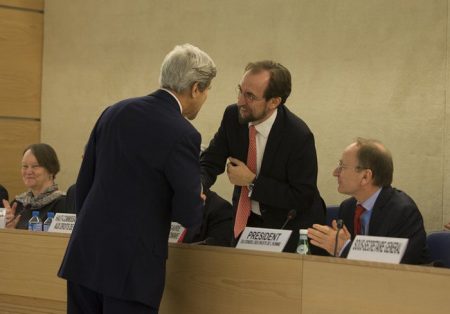
UN High Commissioner for HR shaking hands with former US Secretary of State John Kerry. (If by accident their speeches were switched nobody would notice!)
Weaponizing human rights
While one should not judge a book by the cover, it might be useful to consider the background of the UN High Commissioner for Human Rights, Prince Zeid bin Ra’ad al Hussein. A member of the royal family of Jordan, he comes from a Hashemite dynasty whose calling card has been its pliancy to imperial interests in the Middle East. And having served as ambassador to the US and permanent representative to the UN, he is, much like Jordan, someone the US can rely upon.
His most recent statement, which could just as well have been written by the US State Department, was delivered during the 36th Session of the Human Rights Council. It takes aim at every inconvenient country, from Iran to North Korea, while important US allies like Bahrain or Egypt are invited to “engage more productively” with his office. Israel is treated with kid gloves, and somehow the blame for the humanitarian crisis in Gaza is supposed to be shared between Israeli and Palestinian authorities. And there is no mention whatsoever of Saudi Arabia, where surely there are no human rights issues… Even when addressing the catastrophe in Yemen there is only a passing mention to “coalition airstrikes”.
And then the High Commissioner gets to Venezuela, sounding like any opposition leader or US official on “human rights violations” during anti-government protests or the “crushing [of] democratic institutions”, and suggesting an investigation into possible “crimes against humanity”. Never mind Colombia, where for years the army killed thousands of civilians and dressed them as rebels to collect rewards. Never mind Saudi Arabia, conducting double tap strikes2 against funerals in Yemen, or the US “torturing some folks,” or Israeli soldiers killing children because they were “running like terrorists.” The High Commissioner is worried that crimes against humanity have been committed in Venezuela!
This statement comes on the heels of a OHCHR report about Venezuela that Joe Emersberger described as “embarrassingly shoddy and biased.” It barely mentions any violence coming from the opposition ranks, and while offering a tally of deaths allegedly caused by government forces and the bogeyman colectivos, there is no detailed breakdown to be compared with other accounts such as the one by Venezuelanalysis. Remarkably, given the importance of the issue and the damning verdict that the OHCHR wishes to pass, no investigators from the UN body set foot in Venezuela. Instead the report relies on carefully selected testimonies and the “NGOs” we just discussed.
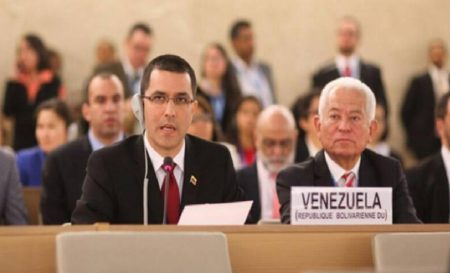
Venezuelan Foreign Minister Jorge Arreaza condemned the manipulation of human rights to attack Venezuela and the lies in the recent OHCHR report.
True NGOs strike back
While the amenable High Commissioner and the poorly-named “NGOs” put on their show to further the regime-change operation in Venezuela, others were not about to take it sitting down. True NGOs, independent organisations that are not pawns in imperialist machinations, and which are truly committed to human rights, condemned foreign meddling in Venezuela and the politicisation of human rights. One example was Swiss-based CETIM, an organisation focused on supporting social movements in the Global South. Concerning Venezuela, it released a statement that said:
[…] we declare ourselves for an immediate return to calm and to dialog, for the respect of Venezuelan peoples’ right to self-determination and the deepening of the process of democratic transformation that they have freely and courageously undertaken for two decades […]
Another organisation that reacted to the recent actions of the OHCHR was the International Association of Democratic Lawyers (IADL), through its representative at the UN, Micòl Savia, during one of the plenary meetings of the 36th Session of the Human Rights Council (intervention #35 in this link)
The IADL expresses its most profound dismay at the recent OHCHR report […]. Given its severity, we are particularly concerned by the High Commissioner’s mention of […] crimes against humanity, which lacks any legal grounds or sense of proportion. […]
The report is selective and biased, and represents a further example of the unfortunate politicisation that affects the work of the OHCHR, undermining its credibility and standing. Use of firearms, explosives, setting up barricades, people burned alive, attacks against hospitals, […], is this the model of “peaceful protests” that this council wants to promote?
Judge, jury and executioner
In the end the bias and lack of standards, or outright falsehood, of these claims and reports does not matter, because if the target is Venezuela they only have to look credible. The media will then do the rest, creating a background by repeating that “Venezuela has been accused by the UN of human rights abuses”, regardless of the shoddiness of the accusations, and this will be the basis to justify future escalations and aggressions as the empire pulls out all the stops to get rid of the biggest threat in its “backyard”.3
This is a good time to stress that legal systems are not moral or just by definition, but a reflection of who holds power, and this is especially true of international law. Though the struggle for an arena where all countries have the same weight is imperative, we are fooling ourselves if we are counting on international bodies to be impartial upholders of justice (just look at Palestine). Recent international tribunals have only served to reinforce the US/western narrative, either as a posteriori justification for past wars such as the one in Yugoslavia, or to justify upcoming ones against troublesome leaders like Gaddafi.
We should clarify that our argument is not some kind of moral relativism, whereby we defend that the alleged crime A should not be investigated until justice is served for (the much worse) crime B. We are not arguing that nobody can be guilty of crimes against humanity until Henry Kissinger is tried, although it is hard to take any international tribunal seriously if the most blatant crimes are immune from prosecution. But what is definitely absurd and unacceptable is to have the US empire, either directly or through its proxies, be the judge trying other people and countries.
Notes
- The HRW statement, and all pieces about it, refer to 116 NGOs; however, the organisations listed only total 115…
- Double tap strikes comprise an initial strike on a target followed by another one targeting first responders.
- In its article about this issue, the Guardian refers to a high-profile jailed opposition leader called Leonardo López (his name is Leopoldo López). Given the overall bias and lack of standards, this is probably fitting.
Odebrecht Denies $100 Million Bribe to Top Venezuelan Politician
By RACHAEL BOOTHROYD ROJAS | Venezuelanalysis | September 8 2017
The scandal-besieged company Odebrecht has refuted claims made by former Venezuelan Attorney General Luisa Ortega that it paid $USD100 million to Venezuelan politician Diosdado Cabello in exchange for lucrative state contracts.
The accusations against Cabello, who is the President of the United Socialist Party of Venezuela and is considered one of the most prominent members of the Chavista government, were made by Ortega in August. The former attorney general fled Venezuela last month after the Supreme Court removed her from her post pending an investigation into alleged “grave misconduct”.
In a widely reported press conference, Ortega said she had “many pieces of evidence” that proved the firm had made the million dollar payment to Cabello. But a statement released by the company Wednesday appeared to cast doubt on Ortega’s claims.
“After conducting a comprehensive search of its legacy systems and of the statements given by its former team members who collaborated in (investigations), Odebrecht denies the accusations that it made a $100 million payment to … Cabello,” reads the communiqué.
The leading Brazilian construction firm shot to the centre of a region-wide corruption scandal in 2015, when it emerged that company representatives had offered million dollar kickbacks to government officials across 12 countries to win public contracts. The firm agreed to cooperate with US authorities last year as part of a deal with US and Brazilian prosecutors.
As well as implicating Cabello in the scandal, Ortega told press that Venezuelan President Nicolas Maduro was also involved in the extensive corruption racket – though she has provided no proof to date. The former attorney general publicly broke with the Maduro administration earlier in March, leading to a heated stand-off played out in national and international media.
For its part the Venezuelan government announced in August that it would launch a probe into the Public Prosecution’s handling of financial crimes during Ortega’s ten year term in response to her accusations. Her replacement, Tarek William Saab, accuses her of having “buried” cases of corruption throughout her tenure.
Venezuelan State Reopens Investigations into Hundreds of Suspected Rural Activist Assassinations

By RACHAEL BOOTHROYD ROJAS | Venezuelanalysis | September 7, 2017
Bogota – Three hundred unresolved cases of rural land activists allegedly murdered at the hands of hired assassins will be re-opened by Venezuela’s Public Prosecution service in an effort to root out impunity for politically motivated crimes.
The measure was agreed in a high level meeting between the National Ombudsman’s office, the Public Prosecution service, the Public Defense, the Ministry of Eco-socialism and Water, the National Land Institute, and the Foundation for Victims of Politically Motivated and Rural Assassinations.
More than three hundred rural activists are estimated to have been killed at the hands of rightwing paramilitaries since 1999, when many land activists began to take collective action following the election of leftist president Hugo Chavez.
Most of the victims have been government supporters allegedly targeted for organizing in favor of the Land and Agrarian Development Law, passed by Chavez in November 2001. The legislation is aimed at breaking up the country’s centuries-old, privately-owned landed estates and allows rural workers to occupy unused land. While popular with rural communities, it has been strongly opposed by the country’s landowners.
Justice for murdered campesinos and activists has long been a demand of rural social movements such as the the Revolutionary Bolivar and Zamora Current. Despite the government’s official support for land reform, movements have strongly criticized state institutions for their lack of teeth in protecting social movement leaders from reprisals, as well as for failing to prosecute those responsible for political assassinations. To date, only a handful of cases have resulted in the successful prosecution of hired killers, while not a single landowner has been brought to trial.
The latest decision to reopen the cases means that some families will now have a second chance to win justice for their loved ones, after the majority of the cases were initially abandoned by the state prosecution, due to alleged lack of evidence.
Mate Garcia, a spokesperson for the Foundation for Victims of Politically Motivated and Rural Assassinations and daughter of murdered activist Armando Garcia, who was killed in 2002, welcomed the initiative as positive step.
“We are very hopeful about this work-group, where all of the cases of violence in our countryside are being taken up,” she said.
Garcia also confirmed that her organization had presented a series of recommendations to the National Constituent Assembly (ANC), which is currently holding session to draft up a new Constitution for the country.
Since being nominated as new Attorney General in August, Tarek William Saab has vowed to rid the state prosecution of impunity and combat classism in the Venezuelan justice service. He has accused his predecessor, Luisa Ortega, of having covered up violent political crimes and corruption during her ten year stint in office.
Ortega fled into self-imposed exile in August after an investigation was brought against her by the Supreme Court for “grave misconduct”. Ortega says she is the victim of political persecution due to her public break with the government of Nicolas Maduro earlier in March.
OHCHR’s Venezuela Report is Terrible and May Incite More Violence
By Joe Emersberger | ZNET | September 1, 2017
The OHCHR put out a press release a few weeks ago about violent protests in Venezuela in which the following words leapt off the page to anybody who has been following the situation without blinders on:
“security forces are allegedly responsible for at least 46 of those deaths, while pro-Government armed groups, referred to as ‘armed colectivos’ are reportedly responsible for 27 of the deaths. It is unclear who the perpetrators of the remaining deaths may be.” [my emphasis]
It was “unclear” to the OHCHR if protesters had killed a single person!
The OHCHR’s full report, which was just released, does not go to that extreme but is still an embarrassingly shoddy and biased report. In a section with the subheading “Violent anti-Government protesters”, the OHCHR report concedes that four murders have been perpetrated by protesters but hastens to add that protester violence has been a “reaction to the disproportionate use of force by security forces” and that the “level of violence by these groups increased as the use of force by security forces rose”.
Four is less preposterous than zero, but is still wildly off the mark. See the detailed timeline provided by VenezuelAnalysis.com.
Direct victims of opposition political violence: 23
Bryan Principal, Oliver Villa Camargo, Niumar Jose Sanclemente, Almelina Carrillo, Paola Ramirez, Jesus Leonardo Sulbaran, Luis Alberto Marquez, Efrain Sierra, Rexol Navas, Gerardo Barrera, Anderson Dugarte, Jorge David Escandon, Pedro Josue Carrillo, Danny José Subero, Orlando Figuera, Douglas Acevedo Sánchez, Ronny Alberto Parra, Alexander Rafael Sanoja Sanchez, Jose Luis Bravo, Ramses Martinez, Hector Anuel, Oneiver Quiñones Ramirez, Felix Pineda Marcano, Ronald RamirezDeaths indirectly linked to opposition barricades*: 8
Ricarda Gonzalez, Ana Colmenarez, Maria de los Angeles Guanipa, Angel Enrique Moreira Gonzalez, Carlos Enrique Hernández, José Amador Lorenzo González, Luis Alberto Machado, Miguel Angel Villalobos Urdaneta
Additionally, how were the murders of unarmed civilians like Orlando Figuera and Almelina Carrillo by protesters a “reaction” against the security forces? Similarly, how is the burning of food warehouses and ambulances, which the OHCHR also concedes took place, a reaction against the security forces?
Moreover, the first person killed by opposition protesters was the civilian bystander Brayan Principal on April 12, only eight days after the protests began. The VenezuelAnalysis timeline shows that, right from the beginning of the protests, when security forces have perpetrated crimes they have been arrested and charged. That’s quite a contrast with what frequently occurs in the United States which is not faced with violent foreign-backed protesters trying to oust the government. It was only four days after the protests began, on April 8, when protesters torched a Supreme Court building.
I would not advise Black Lives Matter protesters in the United States to torch a Supreme Court building and expect to have their actions excused by the OHCHR or any other high profile outfit as a “reaction to the disproportionate force by police”.
The extremely well documented case of Orlando Figuera also exposed some inexcusable sloppiness in the OHCHR report. It falsely stated that Figuera died the same day he was attacked. He actually died in hospital few weeks later. He claimed from his hospital bed that he had been killed for being a suspected Chavista.
Why were the protesters brazen enough to murder Figuera in broad daylight in front of numerous witnesses?
There have apparently been no arrests in the case though the government has identified one of the perpetrators (who was in hiding).
Here are a few reasons:
- 1) People in opposition strongholds – like the one where Figuera was murdered – would likely be afraid to name the perpetrators or, sadly, even supportive of the crime in some cases.
- 2) The Attorney General at the time, Luisa Ortega Diaz (who has now been fired and is who now collaborating with US prosecutors to target the Maduro government), was preoccupied with weakening the government and maneuvering to save her own skin should the opposition seize power.
- 3) Biased reporting promotes impunity. When the United States government wants to vilify a government and have it overthrown – which has been the case in Venezuela for the past fifteen years – numerous natural allies reflexively offer a helping hand: private media companies around the world, high profile NGOs and of course UN bodies like the OHCHR. The destruction of Iraq since 1990 does not happen without UN complicity even though neocons demand that the UN be even more subservient to the US.
There is a section in the OHCHR report on “Violations of the right to freedom of expression” and “Smear campaigns against journalists”. The OHCHR included a throwaway remark that “journalists were also targeted by demonstrators and supporters of both the opposition and the government.“
Prominent opposition supporters tried to get Abby Martin and Mike Prysner lynched by spreading allegations that they were working as informants for the government. Watching their report on the violent protesters the OHCHR whitewashed is something I highly recommend. The OHCHR’s bias not only makes opposition violence more likely, it makes honest journalism about it more dangerous.
The report “recommends” that opposition leaders condemn all violence by its supporters when the OHCHR itself goes out of its way to ignore that violence and deflect responsibility away from the perpetrators. The OHCHR also didn’t think to “recommend” that opposition leaders stop calling on the military to overthrow the government. An organization not at the service of the US Empire would also have “recommended” that the US government not violate international law by imposing economic sanctions or threatening the use of force against Venezuela. Have OHCHR investigators not reviewed the UN Charter recently?
Venezuela Pulls 2 Channels Off Air Over “Resign or Die” Comments
By Ryan Mallett-Outtrim | Venezuelanalysis | August 25, 2017
Venezuelan regulators ordered Thursday two cable networks be taken off air, after they were accused of promoting violence.
The country’s national telecommunications regulator CONATEL said Colombian broadcasters RCN and Caracol Television would be taken off air for “openly calling for [the] assassination [of the president].”
“The measure is within the bounds of the law, given that those stations over several months attacked Venezuela and [its] institutions,” CONATEL said in a statement, quoting former head regulator Andres Mendez.
The move was in response to comments by former Mexican president Vicente Fox aired by RCN and Caracol. Addressing Maduro, Fox warned “this dictator will leave through resignation, or with his feet in front of him, in a box”.
During RCN’s broadcast, the lower third beneath Fox simply read, “Dictator Maduro, resign or die.”
Fox’s comments were quickly condemned by Maduro ally and Bolivian President Evo Morales.
“If anything happens to our brother President Maduro, it will be Mexican ex-president Vicente Fox’s responsibility,” he said.
Fox made his comment during the “Thinking the 21st Century” conference in Baranquilla, Colombia. Last month, the ex-president was declared persona non grata in Venezuela after he participated as an observer in an unofficial opposition plebiscite asking citizens if they would support a “zero hour” campaign of protests aimed at overthrowing the government.
Neither RCN or Caracol appeared available in Venezuela at the time of writing, and at least one major cable provider has confirmed cutting one of the signals.
“We inform you that the 772 Caracol International channel is no longer available for Venezuela because we are complying with an order from … CONATEL,” cable provider DirecTV tweeted.
Some viewers have reported they can still access RCN through DirecTV, but not through most other major providers.
Venezuela’s opposition had condemned CONATEL’s decision as censorship.
“One more channel off the airwaves! Has that made crime go down? Is inflation any lower? Is there more food? More medicine? Has any problem been solved?” opposition leader Henrique Capriles stated.
The shutdowns are the second major regulatory action taken against broadcasters accused of promoting unrest in Venezuela. Earlier this year, CONATEL pulled CNN’s Spanish language channel, accusing the broadcaster of seeking to “undermine the image of the national executive branch”.
The decision came in the wake of CNN’s publication of an investigation that alleged to have uncovered evidence Venezuelan diplomatic officials in Iraq had sold Venezuelan passports to non-Venezuelans, including Iraqi and Syrian nationals. Venezuela’s government largely dismissed the report as US propaganda.
In 2014, another major Colombian broadcaster, RTN24, was also wiped from Venezuelan airwaves after CONATEL alleged it had “promoted violence”. Another major case also occurred in 2007, when the Caracas-based RCTV lost its broadcast concession, after regulators determined the station had played a role in a 2002 coup that temporarily overthrew the Chavez government.
Featured Video
Houthis Keep Advancing as the Red Sea Crisis Deepens
or go to
Aletho News Archives – Video-Images
From the Archives
15 Saudi ‘hijackers’ were CIA agents working for US: Scholar
Press TV – April 13, 2016
Fifteen of the 9/11 “hijackers” from Saudi Arabia were CIA agents working for the United States government, which was seeking to destroy the Middle East for Israel and to double the American military budget, says Dr. Kevin Barrett, an American academic who has been studying the events of 9/11 since late 2003…. continue
Blog Roll
 Aletho News
- Damascus rejects Saudi request for Syrian fighters to counter Yemen: Report
- South Korea says will not send troops to join terrorist US war on Iran
- Russia Just Struck the Eyes of NATO’s War Machine in Ukraine
- Russia summons UK charge d’affaires over Kiev drone support
- NATO member warns bloc seeking pretext for war with Russia
- Macgregor: We Haven’t Seen the Worst of the Iran War Yet
- ‘We are not like everyone else’ laws that bind other nations do not apply to Israel, says Likud lawmaker
- Report: Saudi Arabia seeks allies’ assistance as missiles deplete amid war on Yemen
- Fuel Crisis Deepens: Pakistan Warns Tanker Attack in Red Sea Would Be an ‘Act of War’
- ‘Bucha massacre’ a false flag orchestrated by UK – Moscow
- If Americans Knew
- Robert Kraft: The Billionaire Friend of Netanyahu Pulling The Strings Behind the Macklemore/Ed Sheeran Blow Up
- Columbia Administered Fund Gives Big Money to Pro-Israel Groups
- Deportation Case of Palestinian Activist Salah Sarsour Tests First Amendment
- ‘We Will Not Forget’: Palestinians Mark 44 Years since Sabra and Shatila
- Why do we let Zionists decide what we can and can’t say?
- US welcomes Israeli, Iranian delegations to UN, but not Palestinians – Daily Update
- Biden’s Genocide Accomplices Targeted by New Accountability Campaign
- AIPAC’s Network Has Already Spent $67.2 Million to Shape the Midterm Elections
- Jewish Supremacist Manufacturing a Civilizational Threat to License Bigotry
- US bans Palestinian president from speaking at the UN
- No Tricks Zone
- New Study: ‘Global Drought Shows No Detectable Recent Acceleration Under Climate Warming’
- Economic Masterminds: German Socialists Suggest Taxing Productivity Gains Stemming From Using AI
- The South China Sea Has Not Been Cooperating With The Climate Change Narrative
- Energy Crisis: Germany Enters Heating Season With Historically Low Gas Reserve Fill Levels
- New Study: The Antarctic Ice Sheet Gained Mass From 2020-2024 Due To Staggering Snow And Ice Accumulation
- Study: Ocean Heating Rates From Thousands Of Years Ago ‘Dwarf’ Modern Ocean Heating Rates
- Climate Extremists Target, Attack Large-Scale Power Grid Infrastructure In Germany!
- New Study: Antarctic Ice Melt Has Contributed Less Than 1 Centimeter To Sea Level Rise In The Last 30 Years
- Fear Of Debate: Alarmist German Climate Scientist Calls On Mainstream Media To Discredit Skeptic Voices
- End-Of-August Arctic Sea Ice Extent Hasn’t Fallen In 20 Years, Official Data Show!
 Aletho News