8 million Venezuelans vote for Constituent Assembly amid violence
Press TV – July 31, 2017
Over eight million Venezuelans have participated in the Sunday vote to elect a powerful new congress, which will be allowed to rewrite the constitution, with President Nicolas Maduro hailing the results as a victory for the country’s Bolivarian Revolution.
Venezuela’s National Electoral Council said Monday that the turnout was 41.5 percent– more than double the estimates of both the government’s political opponents and independent experts.
“Peace has won. If peace has won, Venezuela has won,” said Tibisay Lucena, the council’s president, at a televised press conference, the pan–Latin American Telesur television network reported. “Despite the violence and threats, Venezuelans were able to express themselves.”
Speaking at a large gathering of government supporters, Maduro thanked the nation for supporting the vote and said it was one of the highest voter turnouts in the history of the Bolivarian Revolution, with 8,089, 320 casting ballots to select their representatives.
“It is the biggest vote the revolution has ever scored in its 18-year history,” he said, referring to the year his late predecessor and mentor, Hugo Chavez, came to power.
“Eight million in the middle of threats, there were states where they crossed rivers and mountains, and they voted,” Maduro said.
He also hailed the Latin American and Caribbean countries for standing by Venezuela against “interventionist” moves by the United States.
“We don’t care what [US President Donald] Trump says, we care about what our people say,” said Maduro, referring to Trump’s promise that he would not accept the vote results.
The Venezuelan president said before the new legislative body begins the process to re-write the constitution, the government will in the first step call on the opposition to engage in dialog.
However, members of the opposition, which has boycotted the vote, reacted with mockery and anger to the count, which they say appears to be only two to three million.
The Sunday vote took place amid a wave of clashes and violence, which led to the deaths of ten people.
Anti-government protesters and security forces engaged in street battles across the country as voting got underway early Sunday morning. Those killed include a soldier and a regional opposition leader, according to prosecutors.
They also say one of the candidates running in the assembly election was also fatally shot by yet unknown gunmen.
Defense Minister General Vladimir Padrino Lopez said none of the deaths that occurred in the setting of Sunday’s vote were “attributable to the Bolivarian National Armed Forces.”
The anti-government protesters took to the streets despite a ban on such gatherings, which took effect on Friday and will continue through Tuesday.
The government had deployed more than 200,000 military officers to maintain order in more than 1,000 voting stations across the country.
The roads to polling stations had been sealed off and only those with registration cards were allowed to pass.
Several attacks happened in the capital city of Caracas, where one remote explosion occurred around noon and injured at least six police officers.
The opposition has urged further protests on Monday.
“We do not recognize this fraudulent process,” said opposition leader Henrique Capriles.
Maduro wants to replace the current legislative body— the National Assembly— with a new institution called the Constituent Assembly. The new assembly will have the power to override an opposition-led congress and re-write the constitution.
The opposition says the new assembly is a power grab by Maduro.
The president, however, argues that it is the only way to restore peace after months of opposition-backed political unrest, which has fueled the country’s economic woes.
The latest casualties brought the death toll from the unrest ongoing since early April to 123, authorities said.
US urges ‘swift actions’
Meanwhile, the US State Department officially condemned the Venezuelan government for holding the vote, and once again promised to “continue to take strong and swift actions against the architects of authoritarianism in Venezuela.”
The department called Maduro’s measure as a move to “undermine the Venezuelan people’s right to self-determination.”
US Ambassador to the United Nations Nikki Haley also took to Twitter on Sunday to offer Washington’s official response to the vote.
“Maduro’s sham election is another step toward dictatorship,” Haley tweeted. “We won’t accept an illegitimate govt. The Venezuelan ppl. [people] & democracy will prevail.”
The US and its allies, including the UK, Canada, Argentina, Peru, Colombia, Mexico, Spain, Panama and Paraguay, have said they would not recognize the vote results.
Washington also blamed Maduro for violence and urged regional and international governments to take strong action against his government.
Pence Talks with Opposition Leader Leopoldo Lopez over Venezuela’s ‘Dire Situation’
teleSUR | July 30, 2017
U.S. Vice President Mike Pence called Venezuelan opposition leader Leopoldo Lopez Friday “to address the dire situation in Venezuela,” as concern over U.S. interference in Venezuela’s internal affairs continues to grow.
In his phone conversation with Lopez, Pence praised “Mr. Lopez for his courage and outspoken defense of Venezuelan democracy,” according to the White House press statement.
Earlier this month, Lopez’s party Popular Will boycotted the dialogue process called by President Maduro to ease tensions between the government and the opposition.
Lopez also denounced Maduro’s call for the National Constituent Assembly, demanding the elections for the 545 representatives be canceled.
In the White House press statement, the vice president also reiterated, “President Trump’s pledge that if the Maduro regime imposes its Constituent Assembly on Sunday, July 30, the United States will respond with strong and swift economic actions.”
Lopez has a long and sordid history in Venezuelan politics, particularly for his involvement in the deadly “guarimba” protests. He gained prominence after becoming the mayor of the wealthy Caracas district of Chacao in Venezuela between 2000 and 2008.
According to investigative journalist Eva Golinger, in 2002 Lopez began frequenting Washington, D.C., to “visit IRI (International Republican Institute) headquarters and meet with officials in the Bush administration.” The IRI is one of the three foundations of the National Endowment for Democracy, NED, and has been pumping tens of millions of dollars to the opposition groups in Venezuela, including Justice First.
In 2014, Lopez was convicted and charged with plotting and promoting the violent street blockades, also known as “guarimbas” in Venezuela. The widespread violence led to the death of 43 people while hundreds more were injured. The violence also cost billions of dollars worth of damage to public buildings and infrastructure.
Lopez was sent to jail in 2015 and given a 13-year nine-month jail sentence for his role in leading the violent protests. He was recently allowed to serve his sentence under house arrest after citing “health concerns.”
In a video published by NBC Miami Wednesday, Lopez urged the Venezuelans to continue protesting on the streets, stating that Venezuela is facing a “clear and imminent threat” to its democracy.
The phone call between the opposition leader and the U.S. vice president comes as the United States escalates its threats against Venezuela.
Earlier this week, Washington issued a travel warning telling the U.S. citizens to avoid travel to the South American country and also ordered the relatives of all its diplomats to leave Caracas.
US Oil Industry Warns Washington Over Venezuela Sanctions
teleSUR | July 28, 2017
U.S. oil and petrochemicals makers are warning President Donald Trump that proposed oil sanctions against Venezuela could hurt domestic companies and consumers.
In a letter sent to Trump and published in La Tabla.com, the head of the American Fuel and Petrochemical Manufacturers, Chet Thompson, wrote that the measures would not help to solve the problems in the South American nation.
Venezuela now sells more than 700,000 barrels of oil a day to the U.S. out of a total production of roughly two million barrels a day, or just over 2 percent of world production.
The document indicates that some 20 U.S. refineries are supplied with heavy Venezuelan crude, for which they have made substantial processing adjustments.
It says there are practically no other sources of supply for this type of oil.
So a suspension of purchases to Venezuela, would destabilize the world market for hydrocarbons.
The manufacturers estimate that the search for additional quotas of heavy crude would be extremely complicated and could increase costs, resulting in higher prices for consumers.
The two countries’ economies are tightly bound by the oil that Venezuela sells to the United States: It accounts for roughly 10 percent of the oil imported by the U.S.
In Washington, U.S. Vice President Mike Pence has reiterated the White House’s threat to impose “strong and swift economic actions” if Sunday’s National Constituent Assembly vote goes ahead.
While Republican U.S. Senator Marco Rubio noted that the Trump administration had announced sanctions this week, and added, “You can expect more.”
Trump targeted 13 senior Venezuelan officials on Wednesday, including the Vice President of the state-owned Petroleos de Venezuela SA, Simon Zerpa.
Other oil industry experts have also expressed concerns about the possible consequences of more sanctions.
Patrick DeHaan, a senior petroleum analyst for price-tracker GasBuddy, and Phil Flynn, a senior market analyst for the PRICE Futures Group in Chicago, both told UPI this week a potential ban on Venezuelan oil might have unintended consequences.
“A cut of Venezuelan exports would add about 15 to 25 cents a gallon to U.S. gasoline prices,” Flynn said.
Platts added that, for the refiners concentrated on the U.S. Gulf Coast, Venezuela is the largest source of crude oil, ahead of Saudi Arabia, noting those reviewing sanctions in the Trump administration recognize the potential for repercussions.
The administration source told Platts that “many within the Trump administration view sanctions on Venezuelan crude imports as having a more devastating effect on the U.S. refining sector than on Venezuela’s economy.”
OAS Appoints Former ICC Prosecutor Ocampo to Look Into Venezuela ‘Crimes Against Humanity’

Luis Moreno Ocampo (L) discusses human rights with NYT columnist Nicholas Kristof (R) at the CFR Symposium on International Law and Justice sponsored by the Pitt-Jolie Foundation*
teleSUR | July 25, 2017
Luis Almagro, the secretary-general of the Organization of American States, has appointed former International Criminal Court Prosecutor Luis Moreno Ocampo as OAS special adviser on crimes against humanity.
Ocampo, who also served as a World Bank consultant, is a controversial figure who has been described as erratic and prone to grandstanding performances that undercut his own legal efforts.
According to a statement published by the OAS, Ocampo’s tasks will include analyzing, studying and discussing the situation in Venezuela with all interested parties and, consequently, making suggestions on possible courses of action by the OAS.
Almagro said the decision was made in light of an “escalation of human rights violations in Venezuela and the systematic attack on the civilian population includes murder, imprisonment and torture … it is evident in the eyes of the international community that we are witnessing crimes against humanity. ”
Caracas has repeatedly accused Almagro and the OAS of promoting intervention and destabilization in Venezuela, which ultimately led to the Bolivarian nation leaving the regional body on the grounds that its continued presence there posed a threat to the country’s sovereignty.
“The OAS can prevent impunity in Venezuela,” Ocampo said. “The secretary-general is creating a new space within the OAS, focusing on crime prevention and control, as well as gathering information that may be useful to the OAS in conducting an independent judicial investigation”
Luis Moreno Ocampo earned much of his recognition during his time as deputy prosecutor during the case of nine members of the military junta that ruled Argentina from 1976 to 1983. However, his time as ICC prosecutor is largely seen as a failure in which the global court lost a great deal of its credibility as some impartial body, largely thanks to Ocampo’s wild moves and desire to seek the media spotlight.
Ocampo drew criticism for his role in Colombia, where in 2008 he suggested that the ICC should begin investigating the Revolutionary Armed Forces of Colombia or FARC for crimes against humanity. At the time, then-President Alvaro Uribe was busy pursuing a bloody counterinsurgency campaign against the group, utilizing paramilitary death squads and security forces whose operations led to the execution of 2,364 civilians, a figure that dwarfed the death toll resulting from FARC actions during Uribe’s reign.
In recent years, Ocampo also drew negative attention for his proceedings against sitting heads of state, a pattern that also began in 2008 when he sought a warrant for the arrest of Sudanese President Omar Bashir amid the raging conflict in Darfur. Critics claim that the evidence cited by Ocampo was a spurious mix of fact and fiction, and such an intervention while the civil war raged would only stymie the possibility of an internationally-mediated peace process.
“My time in the ICC was a mixture of a fascinating time and a terrible time,” a former staffer for the Office of the Prosecutor said at the time, according to World Affairs Journal. “The prosecutor was erratic, so irrational sometimes that you felt despair. He uses his charisma in a negative way.
Since then, Ocampo has pursued the prosecution of Syrian President Bashar al-Assad on charges of genocide while likewise charging deceased former Libyan leader Muammar Gaddafi with crimes against humanity for alleged massacres committed against anti-government protests that became increasingly violent before culminating in an open “regime change” campaign spearheaded by the U.S. with European and Gulf Arab allies.
The court has largely been discredited among non-Group of 7 nations as a neocolonial tool of Western capitals seeking to control the Global south. Last October, Gambia’s Information Minister Sheriff Bojang noted that the ICC is, “in fact, an International Caucasian Court for the persecution and humiliation of people of color.”
Most recently, the former ICC prosecutor advised the Israelis on how to evade criminal charges for their perpetual expansion of illegal settlements. Ocampo noted that the settler-colonial state could successfully defend itself by manipulating international legal perceptions through arguments that the ongoing settlement construction is legal “once ratified by the country’s top court,” the Israeli High Court, which Ocampo argued “is highly respected internationally.”
* Photo: YouTube-Council on Foreign Relations
The Guardian’s Propaganda on Venezuela
By Ricardo Vaz | Investig’Action | July 25, 2017

With the Constituent Assembly elections due to take place on July 30th, the Guardian published a piece titled “Venezuela elections: all you need to know”. But instead of breaking through the fog of falsehood and misinformation that is typical of the mainstream media’s coverage of Venezuela, the Guardian comes up with another propaganda piece laden with lies, distortions and omissions. In this article we go through the Guardian’s piece, clarifying the falsehoods, adding the conveniently omitted information and questioning the whole narrative that is presented.
*****
What is happening on 30 July?
To be fair to the Guardian, there is one almost-informative paragraph, where the electoral procedure is explained. In a previous article the Guardian stated that
“[…] election rules appear designed to guarantee a majority for the government even though it has minority popular support”,
instead of presenting said electoral rules and letting the reader decide if they are so designed. This time they do present the rules, only omitting to say that everyone not currently holding public office can run for a seat. But then the Guardian brings in the propaganda artillery to ensure the reader’s conclusions do not stray too far off from those of the State Department.
“[…] voter turnout will be exclusively pro-government – and likely very low, given that Maduro’s approval rating hovers around 20%” 1
One assumes the Guardian is citing Datanalisis, their favourite Venezuelan anti-government pollster. Putting aside the fact that other, more reliable polls, demonstrate larger levels of government support, and the massive turnout for last Sunday’s dry-run, there are two obvious questions here. If turnout will be so low, why is the opposition hell-bent on stopping the vote from taking place, barricading streets and killing candidates? And if the opposition has such an overwhelming majority, why did they decide not to participate? This might have been their chance to introduce a Platt Amendment into the Constitution.
“The current constitution was written by an assembly called in 1999 by Maduro’s predecessor and political father, Hugo Chávez. But Chavez made sure he had popular support for the rewrite, by calling a referendum first. This time around, Maduro ordered the constituent assembly by decree.”
Chávez needed to call a referendum because he was working within the legal framework of the 1961 Constitution which did not have anything about such a mechanism. In the 1999 Constitution, article 348 states who can convene a Constituent Assembly.

Venezuelan president Nicolás Maduro has repeatedly urged opposition leaders to engage in dialogue and has backed the Constituent Assembly to guarantee peace.
“On 16 July, a symbolic plebiscite against Maduro’s initiative held by the opposition drew more than seven million people – more than those who voted for Maduro in the 2014 election.”
When it comes to the Venezuelan opposition, the Guardian checks all the journalism tools at the door. In a recent Investig’Action article we examined the opposition’s highly doubtful numbers, Venezuelanalysis did the same. At least the Guardian refrained from explicitly saying this vote could have recalled Maduro, something the opposition could not manage even with a lot of number-cooking (see footnote 2).
“Amid mounting pressure, Maduro vowed last month to hold a popular vote at the end of the process to approve or reject the new constitution.”
This was announced almost two months ago, and if it had been due to “mounting pressure” the mainstream media would have done a victory lap. Here another question springs up: why are the Venezuelan opposition and the Guardian so scared of this process? If they represent this huge majority, can they not just vote down the Constituent Assembly proposal?
Why did Maduro call this vote?
The final paragraph of this section contains the mandatory red-baiting and waving of the Cuban bogeyman.
“Venezuela has been rocked by nonstop street protests since the government’s attempt in late March to strip Congress of its right to legislate. Although the move was partially reversed, demonstrations have continued against an increasingly authoritarian government widely blamed for the country’s tanking economy and soaring crime rate.”
Again, there is very little journalism here to be found. It was not the government that overrode the National Assembly, but the Supreme Court. And they did it because the National Assembly is currently in contempt of court. Three legislators from Amazonas state are being investigated for electoral fraud, and despite repeated warnings from judicial authorities, the opposition went ahead and swore in these legislators. One can agree or disagree with the Supreme Court’s initiative, but omitting this fact is pure dishonesty.
This is also a good point to notice how only the “authoritarian” government and the “beleaguered” president have earned adjectives. “Protests” are referred to five times without a single reference to their violent nature, and a few adjectives (“divided”, “US-backed”, “coup-plotting”) also come to mind when describing the opposition.
“[…] violence and state repression have escalated since, with more than 100 people killed and hundreds arrested.”
Sophisticated newspapers like the Guardian are careful not to state directly that everyone was killed by state repression, only heavily implying it. A breakdown of the cases shows that it is the opposition’s political violence that has been responsible for the large majority of casualties.
What does the opposition say?
“The coalition of opposition forces known as the Democratic Unity Roundtable (known by its Spanish initials, MUD) rejected the move from the start. But criticism extends far beyond the political opposition. According to one pollster, eight out of 10 Venezuelans oppose a new constitution and would prefer general elections.”
One would think this would be an opportune moment to remind readers of the opposition’s constant, repeated calls for a Constituent Assembly in the recent past. And according to a different pollster, 79% of Venezuelans agree that the process should take place, 54% think the process will defend social gains of recent years, and 65% agrees with holding elections in 2018.

Opposition leaders Freddy Guevara and Maria Corina Machado had called for a Constituent Assembly in the past. (Tweets by Misión Verdad)
What happens next?
“Pressure is set to rise after the MUD called a two-day national strike for Wednesday and Thursday, and then mass protests dubbed the “taking of Caracas” on Friday.”
To anyone familiar with the recent history of Venezuela these announcements sound eerily like the events leading up to the failed 2002 coup. In fact, this would be the time to mention that many of the opposition leaders, including Henrique Capriles, Julio Borges, Leopoldo López and Maria Corina Machado, were directly involved in the 2002 coup attempt. Why is there never a mention that the opposition leadership is full of protagonists from that US-backed military coup that ultimately failed? Quite simply because it would undermine the entire “democracy vs. dictatorship” propaganda narrative.
“Maduro has been very vague about the scope of the new constitution – prompting fears that this is simply a move to tighten the government’s hold on power rather than to solve the country’s many problems.”
This is again a distortion. Maduro proposed nine issues to be tackled by the ANC, including the economy, national sovereignty, social missions, communes, and more. Granted, there is some ambiguity on what a “post-oil economy” stands for, with radical sectors looking for a deepening of the Revolution and business leaders looking for more incentives to private investment. But is down to the individual candidates to bring forward their proposals during the campaign. If Maduro specifically said what changes he wanted made to the Constitution, would he not fit into the “authoritarian” label that the Guardian loves to use?
“Maduro threatened to jail two high profile opposition leaders for “treason to the motherland”…”
Once more, it would be useful to put the actions of the Venezuelan opposition in context. There is hardly any other place in the world where opposition leaders openly call for a US military invasion or urge foreign agents to create a financial blockade against their own country!
“According to human rights groups…”
Which rights groups? Why not link to the reports and disclose who funds these groups? Because groups like Human Rights Watch have been beyond partisan when it comes to Venezuela, not to mention the revolving door that puts former US officials as human rights “guardians”. UNICEF, for example, has criticised the use of children in the opposition’s violent protests and the opposition’s attack against a maternity hospital.
“The next presidential elections – which Maduro seems likely to lose – are currently scheduled to be held in 2018, but it is unclear whether this would remain the case under a new constitution.”
Maduro has said that, rain or shine, there will be a presidential election in 2018. And he said it after convening the Constituent Assembly. The omission of this statement is again plain dishonest journalism.

Chavistas march on May 1st. The Venezuelan opposition is fearful of a large turnout for the Constituent Assembly elections on July 30th.
What is the international community doing?
“The Organization of American States has tried repeatedly to chastise Venezuela diplomatically, but Caracas has used oil diplomacy to ensure that small Caribbean states reliant on subsidised oil voted against critical resolutions or abstained.”
It is amazing that countries that are part of PetroCaribe are bullied by oil diplomacy, and yet countries that receive billions in US (military) aid and host US military bases are moved by a genuine love for democracy and human rights. Does it not occur to a journalist that, for a small Caribbean country, if a US-dominated organisation such as the OAS is dictating to Venezuela which elections can take place and when, then soon enough the same will happen to them? By rejecting this interference they are actually asserting their own independence.
It is precisely because this kind of bullying that Venezuela left the OAS. On the other hand, regional organisations that have been formed in the last decade precisely to counter US hegemony, like ALBA or CELAC, have come out in support of Venezuela and its sovereignty. International meetings like the People’s Summit or the Foro de São Paulo have also rejected the imperialist aggression against Venezuela.
“Previous US sanctions have targeted Venezuelan officials accused of drug trafficking or involvement in human rights abuses.”
These accusations have always been very big in terms of publicity and very thin in terms of evidence. They are always based on dubious sources mentioning all-powerful, yet unheard-of, drug cartels, Hezbollah training camps in Latin America and the like.
In summary, the Guardian is passing a pure propaganda piece under the guise of clarifying the upcoming Constituent Assembly elections in Venezuela. Quite clearly the next few days will be crucial, as the opposition ramps up its violent regime change efforts and the US blares out its threats, while on the other side chavismo is mobilising for this important step and (true) solidarity movements are standing with the Venezuelan poor and working-class.
As for the Guardian, whenever they ask you to support “quality, independent journalism”, you should look for it someplace else…)
- Even if this number were true, that would still make Maduro more popular than the presidents of Colombia, Mexico and Brazil, staunch US allies in the region.
Q & A: The National Constituent Assembly in Venezuela
Venezuela Solidarity Campaign | Venezuelanalysis | July 24, 2017
Elections for a National Constituent Assembly are being held in Venezuela on July 30th. Here are some common questions – with the answers – that are being asked about the Assembly. (21/07/17)
What is a National Constituent Assembly (ANC), under Venezuelan law?
A National Constituent Assembly is essentially a constitutional convention, a gathering for the purpose of writing a new constitution or revising an existing constitution. Apart from the famous examples from the 18th century America and France, a range of other countries have employed this mechanism. In Venezuela, Article 347 of its constitution says:
“The original constituent power rests with the people of Venezuela. This power may be exercised by calling a National Constituent Assembly for the purpose of transforming the State, creating a new juridical order and drawing up a new Constitution.”
Venezuela’s constitution is itself the product of a constitutional convention held in 1999, convened at the initiative of President Chávez to draft a new constitution. The constitution was later endorsed by referendum in December 1999. New general elections were held under the new constitution in July 2000. This marked the transition from the Fourth Republic of Venezuela to the present-day Bolivarian Republic of Venezuela
Is President Maduro allowed to call for the setting up of a Constituent Assembly?
Article 348 of the constitution provides for how a National Constituent Assembly is to be instigated:
“The initiative for calling a National Constituent Assembly may emanate from the President of the Republic sitting with the Cabinet of Ministers; from the National Assembly by a two-thirds vote of its members; from the Municipal Councils in open session, by a two-thirds vote of their members; and from 15% of the voters registered with the Civil and Electoral Registry.”
It is also important to note what Article 349 of the constitution says, bearing in mind (as explained later) that the right-wing opposition coalition, which has a majority in the National Assembly, is opposed to the calling of a National Constituent Assembly:
Article 349: “The President of the Republic shall not have the power to object to the new Constitution. The existing constituted authorities shall not be permitted to obstruct the Constituent Assembly in any way. For purposes of the promulgation of the new Constitution, the same shall be published in the Official Gazette of the Republic of Venezuela or in the Gazette of the Constituent Assembly.”
Why has President Maduro called for a National Constituent Assembly?
In a formal document which he signed in front of the National Electoral Council (CNE), President Maduro stated that the call for the Constituent Assembly was made in the context of the current social, political and economic circumstances in which there are severe internal and external threats against democracy and the constitutional order.
This refers to the right-wing opposition-led violence aimed at bringing down the elected Venezuelan President Nicolas Maduro. The violence began in early April, resulting so far in scores of deaths and over 1,200 people injured. A key tactic in the violent protests is the use of ‘guarimbas’ or street blockades created by masked protesters.
The current violence has involved attacks on state facilities and services such as maternity hospitals, electricity supplies, food depots and public transport, and also targeted assassinations of government supporters. A ramping up of the aggression occurred in late June when a police officer flying a stolen helicopter attacked the Ministry of Interior building and the Supreme Court, firing shots and dropping four grenades.
The purpose of the Constituent Assembly has been expounded on by former Education Minister Elias Jaua, who explained in an interview with Televen, a private Venezuela TV channel, that its aims were “to maintain political stability, to solve the economic issues, to broaden and to strengthen the system of social welfare [and] to heal the social wounds that have come up during the conflict”.
When and how will the Constituent Assembly be made up?
Elections for Constituent Assembly are scheduled to take place on 30 July 2017.
Anybody, regardless of political persuasion, can be nominated or nominate themselves to be a candidate for election to the Constituent Assembly.
Candidates may be nominated in one of the following ways:
• by their own initiative.
• by the initiative of groups of voters and voters.
• by the initiative of the sectoral groups comprising173 seats of the 545 seat Constituent Assembly (see infogram)

In order to run for office on their own initiative, 3% of voters and voters registered in the electoral registry of the municipalities are required to nominate the constituents. In the sector category, the candidates will be nominated by the corresponding sector, and should receive the backing of 3% of the sector to which they belong.
From these various ways of being nominated, there are over 6,000 candidates competing for Constituent Assembly seats.
In keeping with how previous elections have been organised, the National Electoral Council (CNE) organised a ‘trial run’ of voting arrangements for the Constituent Assembly, setting up nearly 2,000 voting booths in voting centres across the country, in order to be assured that on election day everything would run smoothly and efficiently..
How will a new constitution emerge?
Once elected, the National Constituent Assembly will be convened within 72 hours and will get to work.
The Assembly will set its agenda for discussion on the basis of what it sees as national priorities. As convenor of the Assembly, however, the President has proposed nine topics for the Assembly to consider:
• the nation’s right and need for peace
• improvements to the country’s economy
• constitutional recognition of the various ‘Missions’ (government social programmes)
• an extension of the justice system’s scope, to end impunity for crimes
• constitutional recognition of new forms of popular and participatory democracy in Venezuela, such as communal councils and communes
• the defence of Venezuela’s sovereignty and protection against foreign intervention
• reinvigorating the plural, multicultural character of Venezuela
• a guarantee for the future of Venezuela’s youth through enshrining in the constitution their rights and the need to preserve life on the planet
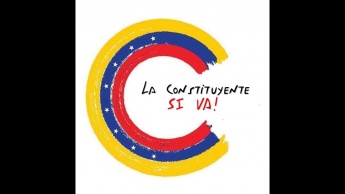
Symbol of the National Constituent Assembly from government media campaign. Text: “The constituent [assembly] is going ahead!”
What is the right-wing opposition’s response to the National Constituent Assembly initiative?
Venezuela’s right-wing opposition, the so-called ‘Roundtable of Democratic Unity’ (MUD) coalition, originally announced in May that it would boycott the National Constituent Assembly and denounced it as an illegitimate effort to rewrite the nation’s constitution.
This is seemingly in contrast to the position it held in 2013, when 55 opposition leaders signed a joint statement in support of setting up a constituent assembly.
Considering the opposition’s claim about the depth of the government’s unpopularity, echoed by most of the media, it is puzzling that opposition candidates will not be contesting all Constituent Assembly seats.
Instead of taking part in this legitimate constitutional process, the opposition held on July 16 their own unofficial plebiscite, asking whether voters recognised or rejected the Constituent Assembly process. Turnout levels for this exercise have been hotly disputed, since the process was not conducted under the auspices of the National Electoral Council and the voting was not independently audited.
How does this Constituent Assembly initiative fit with current peace and dialogue initiatives?
The convening of a Constituent Assembly is a key part of ongoing efforts by President Maduro to engage in constructive dialogue with the opposition.
The dialogue process was launched last year between the government and opposition sectors, but the right-wing MUD coalition has refused to participate.
Some opposition parties have accepted the offer of dialogue. Seventeen Venezuelan opposition parties met with the government to discuss the Constituent Assembly in May 2017. The parties who accepted the invitation included Citizenship Movement, Mopivene Movement, Republican Democracy, Republican Movement, Labour Power, Red Flag, Civilian Resistance, Renewable Democracy, Ecological Movement, Young Party and the Stone Party.
In an attempt to pursue dialogue, in early June Maduro sent a letter to Pope Francis asking him to mediate the political conflict with opposition sectors that have encouraged violence in the streets. Pope Francis has repeatedly urged dialogue between sectors in Venezuela, criticising part of the opposition for not being willing to sit down for talks, but without success. He has also called on Venezuelan bishops to denounce “any form of violence.”
President Maduro has followed this by again renewing his call for the opposition to agree to dialogue and peace, in order that solutions can be arrived at to meet the needs and well-being of the Venezuelan people. He has emphasised that these solutions can only be arrived at through cooperation and peace.
7 Dead as Venezuela Violence Escalates
By Ryan Mallett-Outtrim and Lucas Koerner – Venezuelanalysis – June 29, 2017
Seven people have died across Venezuela over the past 48 hours, as violent anti-government protests continue nationwide.
The latest deaths include Isael Macadan Aquino, who was shot while participating in a protest in Anzoategui. Details of the shooting remain unclear, though local media has reported the protest may have devolved into looting, and authorities have stated Aquino is believed to have been shot during an “irregular situation” inside a commercial property. Two men have been arrested in connection to the shooting, though authorities are yet to suggest a motive.
Meanwhile in Venezuela’s second largest city of Maracaibo, protester Luigin Paz (20) died Wednesday at an opposition barricade when, according to the Public Prosecution (MP), he was “run over by a tanker truck”. Further details have yet to be made public.
In a separate incident in Maracaibo that same day, an unnamed motorcyclist was also fatally run over by a truck at an opposition barricade.
The death occured when the truck came under attack by opposition protesters, according to local press reports.
“We came across the barricade .. and those who had blocked the way began throwing stones at us to loot the truck and when we went in reverse, we hit the motorcycle,” said Jose Bravo, a passenger in the truck.
“[The motorcyclist] lay injured on the road and then they threw Molotov cocktails at us and set the truck on fire. The boy burned to death and my colleague and I were rescued,” Bravo told reporters.
According to Emergency Services Director Jorge Galindo, Bravo suffered burns on 95 percent of his body and is currently hospitalized undergoing treatment.
A fourth death was also publicly announced in Caracas late Tuesday, when protester Jhonatan Jose Zavatti Serrano died of gunshot wounds sustained the day before. According to the MP, Zavatti was walking in Petare Monday evening when he came across a protest and was shot in the head. A district attorney has been dispatched to investigate.
A further death has been confirmed in the north-central state of Aragua. Alfredo Figuera (18) was walking down a street in Maracay Monday afternoon when he passed a demonstration and was hit in the head by a bullet allegedly fired by two suspects on a motorcycle, the MP has reported. The youth died in the hospital on Thursday. Maracay has been the scene of heavy anti-government rioting in recent days, which on Monday alone saw the looting of 68 businesses as well as attacks on public institutions and left-wing political party offices.
Two more deaths have also been reported in Venezuelan media, but haven’t been confirmed by authorities. These include Roberto Duran, who was allegedly killed during violence at a protest in Lara state, and Victor Betancourt in Sucre. The circumstances of Betancourt’s death remain fiercely disputed, with opposition supporters claiming he was killed during a protest, while at least one local journalist has suggested he may have been involved in a traffic incident while returning from buying bread.
The latest deaths bring the overall death toll in 13 weeks of violent anti-government protests to at least 92, including 13 dead at the hands of authorities and 24 attributable to opposition political violence.
More unrest has also been reported in Caracas, with the opposition-controlled National Assembly (AN) allegedly coming under attack late Tuesday. Opposition figures have accused government supporters of shooting fireworks at the assembly building, and there were reports of improvised explosives being used outside. Amid the chaos, a video went viral on social media of a military officer arguing with AN head and opposition leader Julio Borges. The argument ended with the National Guard’s Colonel Vladimir Lugo shoving an enraged Borges out of the room.
The latest unrest came in the wake of a high profile terrorist attack on Venezuela’s Supreme Court and the offices of the Ministry of Justice. Carried out by a rogue police officer, the assailant used a stolen helicopter to drop grenades and fire at government buildings. The helicopter was found abandoned in an isolated region of Vargas state, though the pilot remains at large.
Three National Guard Officials Arrested After Fatal Shooting of Protester
By Rachael Boothroyd Rojas | Venezuelanalysis | June 21, 2017
Caracas – Three Bolivarian National Guard (GNB) soldiers have been arrested following the fatal shooting of an anti-government protester in Caracas this past Monday.
First sergeant Raymon Ávila León and second sergeants Johan Rojas Díaz and Jesús Baez Rojas will be charged with the misuse of a firearm, according to national ombudsman, William Saab.
On Monday, 17 year old Fabian Urbina died from gunshot wounds when GNB soldiers opened fire on a crowd of protesters in the eastern district of Altamira. Five other demonstrators were also injured in the incident.
In footage of the confrontation circulated by the private media channel La Patilla on social media, hundreds of violent protesters can be seen attempting to attack several GNB officials prior to the shooting. At least one of the protesters was armed, leading some pro-government observers to speculate that the soldiers were acting in self defense.
But Saab condemned the incident Wednesday and stated that the national guard must only employ “proportional, progressive and differentiated use of force” to ensure their own safety at protests.
In a series of tweets, the national ombudsman reminded the public that the GNB are banned from using live ammunition or rubber bullets to control unrest. He also called on opposition sectors to cease their violent protests.
“We once again call on the organizers of demonstrations to carry them out peacefully and without the use of weapons,” he tweeted.
Following the incident, President Nicolas Maduro replaced Antonio Benavides Torres as the commander of the National Bolivarian Guard. The former commander of the People’s Guard, Major General Sergio José Rivero Marcano, will now take up the position.
The president also changed the commander-in-chiefs of the armed forces, navy, airforce, and people’s militia, as well as put Major General Juan de Jesús García Toussaintt and Admiral Orlando Maneiro Gaspar in charge of the Ministry of Transport and the Ministry of Fishing.
It is unknown if the high level reshuffle was related to Monday’s deadly shooting.
Eighty-four people have been killed since violence anti-government unrest broke out at the beginning of April. Protesters, national security personnel, pro-government activists and passersby are all amongst the dead.
2 Protesters, Opposition Politician Killed in Venezuela
By Ryan Mallett-Outtrim – Venezuelanalysis – June 16, 2017
Two opposition protesters were killed in Venezuela Thursday, in the wake of the assassination of a prominent right-wing politician.
The two latest deaths include 20-year-old protester Luis Enrique Vera Sulbaran and Jose Gregorio Perez Perez.
A university student, Vera died after being hit by a pick up truck while blocking a road in Venezuela’s second largest city, Maracaibo. The pick up truck was then torched by protesters.
Police believe the death occurred after the protesters attempted to loot the pick up truck, which was carrying medical supplies. According to Interior Minister Nestor Reverol, Vera was struck by the truck as the driver attempted to flee the robbery.
Opposition protesters are known to attempt to loot vehicles, and in some parts of the country there have been reports they demand bribes from motorists attempting to pass their barricades.
However, the official account of Vera’s death has been disputed by local opposition supporters, who have claimed the protesters didn’t try to loot the vehicle.
The driver has been charged with homicide.
Meanwhile, another protester has been killed in the violence-plagued state of Tachira. For weeks, Tachira has been one of the epicentres of opposition violence. On Thursday, protester Perez was shot by two unidentified assailants in Tachira’s Junin municipality shortly after taking part in a demonstration. According to El Universal, the two unknown attackers approached Perez in a cafe, and gunned him down without a word.
Some local opposition supporters have blamed government-backed groups for the killing, though they have yet to provide evidence to bolster the accusation.
The public prosecutor’s office has stated it is investigating the case.
“There was an irregular situation in which Perez … was shot in the face. Immediately, the young man was aided and transferred to the Padre Justo hospital in the municipality Junin, where he arrived without vital signs,” the prosecutor said in a statement.
Reverol has condemned the killing, and lamented it comes amid wider political violence in Tachira state. Bordering Colombia, Tachira has long struggled with paramilitary violence.
President Nicolas Maduro has also responded to the deaths, calling for calm and an end to violence.
“I call on the population, for the greatest calm, the greatest prudence and the greatest peace to avoid violence,” he said.
The deaths of Vera and Perez come just days after another high profile killing. On Monday, a prominent member of the right-wing Voluntad Popular party was killed in Puerto Ordaz, Bolivar state. The politician, Jose Santiago Molleton Quintero, was a pre-candidate for the position of mayor in the municipality of Soledad, according to the opposition-aligned El Nacional newspaper. He was also the head of a local union for heavy industrial workers.
According to local media reports, witnesses said Molleton was approached by an unidentified assailant in a restaurant. The attacker fired multiple shots, killing Molleton and injuring one other person.
Authorities say they are investigating the killing.
The latest killings bring the total death toll of the last two months of political unrest to 82, according to data compiled by venezuelanalysis.com. So far 22 of those deaths are suspected to be linked to the actions of opposition protesters, while 11 may have been caused by authorities. Thirteen were reportedly the result of looting, and two are suspected to have been linked to pro-government civilians. Two other deaths were accidents, while 30 took place under unclear or heavily disputed circumstances.
US Mulls Sanctioning Venezuelan Oil as ‘Economic War’ Continues
teleSUR | June 4, 2017
The Trump administration is debating imposing sanctions on Venezuela’s oil sector, while Washington has raised “concerns” about U.S. firms giving a “financial lifeline” to the South American nation.
Reuters reported Sunday that the White House could hit Venezuela’s vital oil and energy sector, including state-run oil company PDVSA, with a number of different sanctions, including the possibility of a blanket ban on Venezuelan oil imports — imports that the United States heavily relies on.
Since President Donald Trump took office in January, he has stepped up targeted sanctions against Venezuela, including against the vice president, the chief judge and seven other Supreme Court justices.
While Trump officials hem and haw over the move that would further incapacitate the Venezuela’s economy, other senior officials are raising concern about U.S. firms’ Venezuela investments.
After Goldman Sachs Group Inc. came under fire for purchasing US$2.8 billion of state oil company bonds, one official told Reuters, “We’re concerned by anything that provides a lifeline for the status quo.”
Last week, Venezuela’s right-wing opposition-controlled National Assembly threatened not to pay the PDVSA bonds purchased by Goldman Sachs through a third party broker.
The National Assembly’s head, Julio Borges, one of the most prominent opposition leaders in the country, claimed that in purchasing the bonds, Goldman Sachs was “extending a lifeline” to a “dictatorship” and funding “human-rights abuses.”
In response, Venezuelan Vice President Tareck El Aissami announced on Thursday that the government would be launching a lawsuit against him, condemning Borges’ attempt to cut off Venezuela from legal and transparent international investments.
“The deal with Goldman provides a desperately needed boost to Venezuela’s shrinking international reserves, which had fallen to US$10 billion amid stagnant global crude prices,” Venezuela Analysis reported.
Borges’ threats against Goldman Sachs are the latest in what the government has dubbed an “economic war” waged by international financial institutions and the right-wing opposition.
Last month, the National Assembly president sent over a dozen letters to various international banks requesting that they cut off all transactions with the Venezuelan government and state enterprises. The letters threatened that doing business in Venezuela “would be engaging in crimes, and that such contracts would be legally and morally unacceptable.”
This isn’t the first time the United States has pushed for sanctions against PDVSA. In 2011, the Obama administration punished the company for doing business with Iran, a country toward which the United States and its allies have long been hostile.
PDVSA and government officials have accused international financial institutions in the past of working in favor of right-wing groups to destabilize the country and its key economic driver, the oil sector.
What the Venezuelan government has called an “economic war” on the country parallels the financial destabilization targeting the socialist government of President Salvador Allende in Chile in the early 1970s ahead of the CIA-backed military coup that ousted him from office in 1973. The U.S.-backed economic warfare sought to weaken Chile by “making the economy scream,” as then-President Richard Nixon put it in orders to the CIA, in order to topple the Allende government.
Since taking office, Trump has continued a policy of U.S. hostility toward Caracas, including by meeting with opposition figure Lilian Tintori, wife of jailed opposition leader Leopoldo Lopez, in the White House in February.
The U.S. has also backed a campaign in the Organization of American States that President Nicolas Maduro’s government has slammed as attempted intervention. Top Venezuelan officials have accused the body of violating Venezuela’s sovereignty and have therefore initiated the process to withdraw from it.
After the most recent OAS meeting last week, Bolivian President Evo Morales strongly condemned the regional body and specifically OAS secretary general, Luis Almagro, warning that, “If not physically, he wants to politically eliminate the anti-imperialist presidents and governments” of Latin America.
Venezuelan Youth Burned for ‘Being Chavista’ Dies from Injuries
By Lucas Koerner – Venezuelanalysis – June 5, 2017
Caracas – A Venezuelan man burned alive by opposition protesters has died of his injuries as anti-government unrest claimed two more lives over the weekend.
Afro-Venezuelan Orlando Figuera died in the hospital on Saturday evening after suffering six knife wounds as well as first and second-degree burns on 54 percent of his body.
On May 20, the 21-year-old was passing through the opposition stronghold of Chacao when he was accused of being a government supporter by masked protesters, who brutally beat him before dousing him in gasoline and setting him on fire.
The death was made public by the national ombudsman, Tarek William Saab, who called for the “maximum sentence against the lynchers”.
“Orlando Figuera, beaten, stabbed, and burned alive by “protesters”, is the symbol of hate crimes in Venezuela,” the top human rights official declared via Twitter.
In an interview with state broadcaster VTV, Figuera’s mother, Ines Esparragoza blamed opposition leaders for the murder.
“Why does [National Assembly President] Julio Borges allow this? Why does [Miranda Governor] Henrique Capriles allow it? Who do I blame? The opposition, because they are the ones who doused my son in gasoline like an animal,” she stated.
Esparragoza has reported being fired from her job as a domestic worker in a private residence, which she has denounced as a reprisal over the VTV interview.
For its part, the Public Prosecutor’s office (MP) has indicated that investigations into the murder continue and that the alleged perpetrators have been identified.
In addition to Figuera, two more people have died of injures linked to violent protests that have rocked the country for the past two months.
On Friday, Luis Miguel Gutierrez Molina (20) died of a bullet wound he suffered during a protest on May 17 in Merida state. El Universal has reported that the incident took place during clashes between demonstrators and authorities.
The MP has dispatched a state prosecutor to investigate the homicide.
Meanwhile in Lara, another man died in the hospital on Saturday after being shot in the vicinity of a protest on April 11.
According to the preliminary MP report, Yoiner Peña (28) was shot in the back near a protest in Barquismeto by unknown assailants in a pickup truck who reportedly opened fire on those present.
However, the national ombudsman’s office has issued a conflicting account, suggesting that Peña was “mortally wounded in an [anti-government] barricade”.
According to Saab, Peña was the ninth person killed at opposition barricades since the violent protests began on April 4.
Seventy-three people have lost their lives as a result of the unrest, including at least 11 people killed by authorities and 22 deaths caused by demonstrators.
Opposition leaders have announced a fresh round of protests for this week, vowing to remain in the streets until the government meets their various demands, including holding presidential elections one year ahead of schedule.
Featured Video
The Sordid History of the CIA – Part 2
or go to
Aletho News Archives – Video-Images
Book Review
Jeffrey Epstein: A Jewish Individual?
The Occidental Observer | February 5, 2023
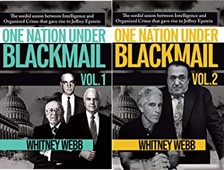
One Nation Under Blackmail: The Sordid Union between Intelligence and Organized Crime that Gave Rise to Jeffrey Epstein (Volume 1 & 2) by Whitney Webb
“Far from being an anomaly, Epstein was one of several men who, over the past century, have engaged in sexual blackmail activities designed to obtain damaging information (i.e., “intelligence”) on powerful individuals with the goal of controlling their activities and securing their compliance.”[1]
Jeffrey Epstein is dead and Ghislaine Maxwell is locked away in prison, and the thought-makers of our world seem keen to let the more explosive parts of the scandal dissipate from the public consciousness. As far as the mainstream media is concerned, Epstein and Maxwell were little more than well-connected socialites who ran a sex-trafficking ring for the rich and the powerful, and the focus has shifted instead to the criminal and civil cases seeking to achieve redress for the victims of sexual abuse.
On occasion some newspaper articles will mention the hidden cameras littered across Epstein’s properties, others the reams of CDs and hard drives found within them during the FBI raids. Altogether missing from the Netflix documentaries (Jeffrey Epstein: Filthy Rich [2020] and Ghislaine Maxwell: Filthy Rich [2022]) or the articles that spend their time narrowly focusing on the links between Epstein and Bill Gates, is the acknowledgement of the true nature of Epstein himself and the ultimate purpose of this sex-trafficking of minors — a sexual blackmail operation.
Not everyone is cowardly enough to let these controversial aspects lie untouched, as the newly released two-volume book One Nation Under Blackmail by independent reporter Whitney Webb seeks to blow wide open this media-enforced blackout. Utilizing primarily open-source information (that is, publicly accessible information such as books, newspapers articles and government reports),[2] Webb’s book delves into the life and times of Jeffrey Epstein and his deep ties to Jewish billionaires and Israeli intelligence. … continue
Blog Roll
Recent Comments


 Aletho News
- At The Munich Security Conference, AOC Gets It Wrong On Foreign Policy
- Europe Decided to Go to War With Russia by 2030, Already Preparing – Orban
- Russia and China Are Expanding Their Cooperation to Counter US Efforts to Bully Iran and Cuba
- NATO plotting maritime blockade of Russia – Moscow
- Jeffrey Epstein’s sinister shadow over West Asia
- The Sordid History of the CIA – Part 2
- French FM under fire over ‘false’ claims about UN rapporteur
- Israel Wants ISIS-Linked Militias To Control Rafah Crossing — The New Order in Gaza
- ISIS never left Syria, it just changed uniforms
- Why ARE the US and Israel Obsessed With Eliminating Iran’s Ballistic Missiles?
- If Americans Knew
- Israel battles Palestinian right of return, one Palestinian at a time – Not a ceasefire Day 127
- Noor’s short life of unimaginable suffering
- Israel Destroyed Gaza’s Hospitals. Now It’s Banning Doctors Without Borders.
- Is Spite of What Zionists Say, It’s a Good Thing to Criticize Governments
- Palestinian mother, daughter recount strip searches, harsh conditions in Israeli detention
- Israel used weapons in Gaza that made thousands of Palestinians evaporate
- ADL’s Stats Twist Israel’s Critics Into Antisemites
- Why Is the World Silent When the Gaza Genocide Is Not Over?
- In Gaza: 8,000 bodies under rubble, 3,000 missing – Not a ceasefire Day 126
- AZAPAC, the new PAC opposing Israeli domination of U.S policies
- No Tricks Zone
- Unfudging The Data: Dutch Meteorological Institute Reinstates Early 20th Centruy Heat Waves It Had Erased Earlier
- German Gas Crisis…Chancellor Merz Allegedly Bans Gas Debate Ahead of Elections!
- Pollen Reconstructions Show The Last Glacial’s Warming Events Were Global, 10x Greater Than Modern
- Germany’s Natural Gas Storage Level Dwindles To Just 28%… Increasingly Critical
- New Study Rebuts The Assumption That Anthropogenic CO2 Molecules Have ‘Special’ Properties
- Climate Scientist Who Predicted End Of “Heavy Frost And Snow” Now Refuses Media Inquiries
- Polar Bear Numbers Rising And Health Improving In Areas With The Most Rapid Sea Ice Decline
- One Reason Only For Germany’s Heating Gas Crisis: Its Hardcore-Dumbass Energy Policy
- 130 Years Later: The CO2 Greenhouse Effect Is Still Only An Imaginary-World Thought Experiment
- New Study Affirms Rising CO2’s Greening Impact Across India – A Region With No Net Warming In 75 Years
 Aletho News