The Hill Publishes Islamophobic Fake News on Venezuela
By Ryan Mallett-Outtrim | Venezuelanalysis | January 30, 2017
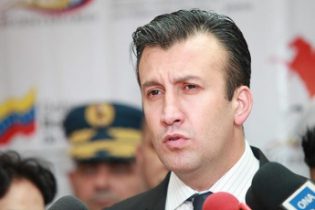 Love it or hate it, The Hill can be a pretty useful source of information on the goings on around DC, but its latest article on Venezuela comes from some disturbing places.
In a recent article, titled “Meet Venezuela’s new VP, fan of Iran and Hezbollah”, The Hill’s Emanuele Ottolenghi profiled the South American country’s new second in command, Tareck El Aissami.
Although El Aissami was appointed vice-president just a few weeks ago, he’s hardly a new face to anyone who has followed Venezuelan politics for a while. He previously served as Aragua’s governor, and also had a stint as interior minister a few years back.
So what’s so special about El Aissami? A lot, according to Ottolenghi, whose piece reads much like the biography of a minor goon from a Schwarzenegger flick, replete with semi-comical claims with the credibility, sophistication and nuance of Ninja Terminator.
Here’s a few highlights:
“Despite the Baathist family background — his father headed the Venezuelan branch of the Iraqi Baath Party — and his Lebanese Druze origins, El Aissami seems to prefer the Islamist Shiite revolutionary Hezbollah and Iran over the Baath’s supposedly secular pan-Arabism.
…
Like his Islamic revolutionary role models, he used violence to advance his politics.
Opposition figures have accused both El Aissami and Nassereddine of recruiting young Arab-Venezuelan members of the ruling party to undergo paramilitary training in South Lebanon with Hezbollah.
…
As if this were not enough, El Aissami reportedly facilitated drug trafficking, a crime for which he is being investigated in the U.S.”
In other words, El Aissami is every boogyman and right-wing scapegoat wrapped up in one nice little package, at least based on Ottolenghi’s depiction. He’s a mish-mash of Baathism, Sunni radicalism and Shiite extremism; plus he smuggles coke.
The obvious question is whether any of this is true. For one, El Aissami is indeed one of many suspects in a US investigation into Venezuela’s narcotics trade. We could discuss the politics of this investigation until the cows come home, but what about the juicier claims? For instance, the claim that El Aissami has been accused of sending young Venezuelans to Lebanon to train with Hezbollah, and that he has colluded with “guerrilla movements”?
If we follow the hyperlinks provided by Ottolenghi, we find that these claims were sourced from the Centre for Security Policy (CSP). It sounds credible, but has been widely dismissed by journalists as basically a joke. According to the Southern Poverty Law Centre, the Centre for Security Policy is “known for its accusations that a shadowy ‘Muslim Brotherhood’ has infiltrated all levels of government and warnings that ‘creeping Shariah,’ or Islamic religious law, is a threat to American democracy”.
“For the past decade, CSP’s main focus has been on demonising Islam and Muslims under the guise of national security,” the Southern Poverty Law Centre stated.
A cursory glance at the CSP’s homepage features ads for books with colourful titles like “CAIR is HAMAS”, “Civilisation Jihad”, “ObamaBomb” and “See No Sharia”. At the time of writing, some of their latest articles included one describing Islam as a “supremacist totalitarian ideology”, and another claiming Iran might already secretly have a “nuclear weapon” (which it doesn’t).
Well, that got weird fast.
So basically, Ottolenghi gets his best material from a website that is so far off the deep end, it has even been banned from the Conservative Political Action Conference.
As a side note, Donald Trump cited a report from the CSP back in 2015, when he falsely claimed one in four Muslims support violence against the US. At the time, the CSP’s claims were widely dismissed as junk.
But hey, that’s just one source – perhaps I’m not giving Ottolenghi’s narrative enough of a chance. Frustratingly though, Ottolenghi’s piece is very light on sources, and he provides no other references for his two most eyebrow raising claims.
Luckily, Ottolenghi is far from the first English language pundit to express this particular point of view on El Aissami. A few years ago, the Gatestone Institute published a piece that reads eerily similar to Ottolenghi’s more recent article. For example, the older piece details how El Aissami supposedly loved Saddam Hussein and Osama bin Laden. Ignoring the fact these two political figures espoused totally different and utterly incompatible political ideologies, the Gatestone article did a somewhat better job than Ottolenghi in terms of providing sources for their claims.
This is where things take a turn for the outright bizarre.
So, where did the Gatestone’s critical intelligence on El Aissami originate? According to the reference list they provided, the answer to that question is: Wikipedia and this obscure blog. Following the breadcrumbs, the blogger also provided a reference list for their sources. This list is extremely short for supposedly groundbreaking investigative reporting, and only features four different names: Al Arabiya, MEMRI, Jihad Watch and another blogspot blog called The Jungle Hut.
…. Okey-dokey then.
The trail runs dry over at The Jungle Hut, where there’s nothing more than a dead link and a nice photo of a waterfall. It’s not quite what I was expecting to find, so let’s look at the other two sources. Al Arabiya is Saudi Arabia’s state media outlet, though don’t let that bother you too much; they’ve actually produced some decent stuff in the past. Unfortunately, there’s no links to specific articles, so again, the trail runs dry. The same problem arises when we head to MERMI. Finally, we get to the El Dorado of anti-Islam trash: Jihad Watch, a blog created by the notorious Islamophobe Robert Spencer. For anyone who doesn’t know, Spencer is perhaps best known for co-founding two prominent anti-Muslim lobby groups, Stop Islamisation of America (SIOA) and the American Freedom Defence Initiative (AFDI). Both have been listed as hate groups by the Southern Poverty Law Centre. Spencer also garnered media attention in the wake of the 2011 Norwegian white supremacist terrorist attack carried out by Anders Behring Breivik. In his sprawling anti-Muslim manifesto, Breivik cited Spencer dozens of times.
This is where our journey down the rabbit hole ends; with an Islamophobe beloved by one of the worst white supremacist terrorists in recent years. I guess this is what I get for checking people’s sources: a browser history full of links to hate groups, anti-Islam garbage and one nice picture of a waterfall. I didn’t find much credible reporting, but I did learn that El Aissami is hated for one reason above all: he’s got a Muslim-ish sounding name.
That’s it.
You might think I’m being harsh on Ottolenghi.
And you’d be wrong.
Ottolenghi is a long time anti-Iran hardliner, and has authored books with names like “Under a Mushroom Cloud: Europe, Iran and the Bomb”. According to a review of this book over at The Jewish Chronicle, “Ottolenghi’s view that Iran, as an exceptional case, merits exceptional treatment, is perhaps unrealistically rigid. His argument is not helped by the absence from his text of source references by which the reader could cross-check the many, selective quotes he adduces in support of it.”
In other words, making far fetched claims based on no real evidence is something of a modus operandi for Ottolenghi.
Along with having an obvious disdain for the notion of providing sources, Ottolenghi seems like just another pundit with a bone to pick with Islam, and anyone who sounds like they might be Arab, Persian or any other ethnic group he doesn’t like. Ottolenghi’s writings seem better suited to publishers like Jihad Watch, and his presence at The Hill is surprising to say the least.
Unfortunately though, this whole saga is symptomatic of a deeper problem in the media. The fact that an article for The Hill can get away with featuring links to the Islamophobic fake news CSP is emblematic of the dismal state of international corporate media. Islamophobic rants are treated like credible political analysis, and conspiracy crackpots are put on pedestals. It’s a grim state of affairs, but the real question is: how much further will we slide?
US Congress Mulls New Sanctions against Venezuela over Alleged Food Corruption
By Lucas Koerner – Venezuelanalysis – January 23, 2017
Caracas – US congress members on both sides of the aisle have issued calls for new sanctions against top Venezuelan food ministry officials over corruption allegations.
Senator Marco Rubio, R-Florida, urged the new Trump administration to sanction Venezuela’s food minister, Gen. Marco Rodolfo Torres, and other leading officials charged with overseeing the country’s food imports.
“This should be one of President Trump’s first actions in office,” said Rubio, a hardline opponent of Venezuela and Cuba, who chairs the Latin America Foreign Relations subcommittee.
The statement comes in response to an AP report released last month that accused high-ranking military officials, including Rodolfo Torres and his predecessor Gen. Carlos Osorio, of receiving kickbacks from government contracts for food imports. The article relies largely on the testimony of retired military officers opposed to the government as well as internal ministry documents allegedly obtained by AP.
Senator Ben Cardin, D-Maryland, ranking member of the Foreign Relations Committee, echoed calls for further sanctions, citing unsubstantiated allegations of starvation in the country.
Republican congresswoman Ileana Ros-Lehtinen of Florida and Senator Bob Menendez, D-New Jersey, likewise stated that they would push for sanctions by the US State and Treasury Departments against the officials in question in addition to pressuring US companies to cut ties with Venezuelan firms linked to corruption.
In July, Rubio, Cardin, and Menendez co-authored a Senate resolution backing Organization of American States Secretary General Luis Almagro’s effort to suspend Venezuela from the body under the Inter-American Democratic Charter, citing “abuses of internationally recognized human rights”.
The latest drive for sanctions follows outgoing US President Barack Obama’s January 13 renewal of an executive order branding Venezuela an “unusual and extraordinary threat” to US national security. The decree was originally signed in March 2015 and included sanctions against seven Venezuelan government officials, freezing their assets and barring entry into the US.
More recently, Trump secretary of state nominee Rex Tillerson has indicated that if confirmed he would press for a “transition to democratic rule” in Venezuela, which has been widely interpreted as an endorsement of US-backed regime change efforts.
Obama extends national emergency on Iran
Press TV – January 14, 2017
US President Barack Obama has declared the continuation of his country’s national emergency against Iran, claiming that despite full commitment to its nuclear deal with the six world powers, the Islamic Republic still poses “an unusual and extraordinary threat” to America.
The outgoing president informed Congress of his decision in a letter on Friday, saying that the national emergency, which was declared on March 15, 1995, “is to continue in effect beyond March 15, 2017.”
The National Emergencies Act requires the president to extend a national emergency within 90 days of its anniversary date, before it is automatically terminated.
Obama admitted in his letter that Iran had delivered on its commitments pursuant to the Joint Comprehensive Plan of Action (JCPOA), a landmark nuclear deal that was struck between Iran and the P5+1 group of countries — the US, the UK, France, China, Russia, and Germany — on July 14, 2015.
Under the landmark deal, which entered into force on January 16 last year, Iran undertook to put restrictions on its nuclear program in exchange for the removal of nuclear-related sanctions imposed against the country.
“Since Implementation Day, the IAEA (International Atomic Energy Agency) has repeatedly verified, and the Secretary of State [John Kerry] has confirmed, that Iran continues to meet its nuclear commitments pursuant to the JCPOA,” Obama said in his notice.
“However, irrespective of the JCPOA, which continues to ensure that Iran’s nuclear program is and remains exclusively peaceful, certain actions and policies of the Government of Iran continue to pose an unusual and extraordinary threat to the national security, foreign policy, and economy of the United States,” the outgoing president added.
In November, Obama extended a separate national emergency against Iran, which was originally declared by former US President Jimmy Carter on November 14, 1979.
He also extended the state of emergency with respect to Libya, Ukraine, Zimbabwe, Cuba and Venezuela.
A state of emergency gives the US president special powers, including the ability to seize property, summon the National Guard and hire and fire military officers at will.
The state of emergency also forms the basis for most US sanctions against other countries.
How the WaPo Turned 111 Venezuelan Jewish Emigrants into a Mass Exodus
By Lucas Koerner | Venezuelanalysis | January 12, 2017
The international media has long peddled outlandish fake news about Venezuela aimed at presenting the economically-struggling South American democracy as a starvation-ridden communist dictatorship.
Faced with the reality that the elected socialist government of Nicolas Maduro has not been toppled by the highly unpopular opposition despite a severe economic crisis, corporate journalists have grown increasingly desperate for even the scantiest of evidence supporting their narrative of the country’s descent into apocalyptic ruin.
The Washington Post’s Ruth Eglash brings this pernicious race to the bottom to new, awe-inspiring depths.
In an article titled “Venezuelan Jews are moving to Israel to escape deepening poverty”, the Jerusalem-based reporter decries the shocking flight of Venezuelan Jews to Israel.
Just how many Venezuelan Jews constitute this mass exodus?
111, says Eglash, “more than double the number who arrived in 2012.”
Yes, you read right: 111 Venezuelan Jews emigrated to Israel in 2015, just about fifty more than in 2012 when there was no economic crisis and oil prices topped $100 per barrel.
Apparently, Israel is such a popular destination that Venezuelan Jews are packing their bags to move by the dozens.
However, 2016 appears on track to set records. Eglash quotes the International Fellowship of Christians and Jews, which has reported aiding a whopping 90 Venezuelan Jews emigrate this past year.
Eglash goes on to relay the jarring testimony of Venezuelan Jews who decided to move to Israel. Daniel Ortiz complains, “There was no meat, no sugar, no pasta.”
Indeed Venezuela has been hard hit by a deep economic crisis triggered by the collapse of global oil prices that has seen soaring inflation and chronic shortages, leading thousands to seek work in other countries.
However, the Washington Post correspondent never bothered to interview any of the approximately 9,000 Jews who have decided to remain in their country in spite of the economic difficulties. Not all Venezuelan Jews, she may be shocked to learn, view Israel as a promised land “filled with social innovation and opportunities”.
“I don’t think Israel is a very good option for emigration,” says Jaime Palacios, a Jewish student at Venezuela’s state-run Bolivarian University.
Palacios is a native of the Caracas neighborhood of Petare, which is one of the largest barrios in Latin America.
“There [in Israel] there is no freedom of religion and we see how the Israeli government attacks their Palestinian brothers and maintains constant conflict,” he told Venezuelanalysis, referring to Israel’s military occupation and its repression of the rights of Palestinian Muslims and Christians.
Nonetheless, Eglash insists on the apparently horrifying proportions of Venezuelan Jewish emigration. She notes that “about 50 percent of the 22,000 Jews who lived in the country when Chávez came to power have left,” as if to imply that this outflow was brought on by anti-Semitism that she says was “widespread under Chávez”.
Eglash’s only source for this charge of alleged anti-Semitism against the Chavista government is the Anti-Defamation League, which last year denounced a Venezuelan magazine for printing a cover suggesting that Orthodox Jews were behind illicit currency speculation in the country.
It’s no secret that the Anti-Defamation League has a long track record of dismissing any and all legitimate criticism of Israeli colonialism as “anti-Semitism”.
For example, in a 2014 report titled, “Venezuelan Government Fuels Incendiary Anti-Israel and Anti-Semitic Environment”, the ADL castigated President Nicolas Maduro– himself of Sephardi origin– for calling the Israeli-occupied Gaza Strip “a huge Auschwitz” during the Israeli government’s 50-day assault that left over 2,200 Palestinians dead, including 490 children.
These dubious charges of anti-Semitism were also leveled against late Venezuelan President Hugo Chávez over his condemnation of US-sponsored Israeli war crimes in Lebanon and Gaza, as well as his government’s geopolitical alliance with Iran.
While anti-Semitism is real in Venezuela, the ADL bases their claims exclusively on the government’s political stance vis-a-vis Israel, rather than seeking testimony from any Jews who may have experienced discrimination in the country.
“In Venezuela, you don’t see a large amount of anti-Semitism, though this isn’t to say that it doesn’t exist. The Jewish community in Venezuela has won the affection of many people,” explains Palacios.
Sadly, voices like Palacios’ are notably missing from the accounts of establishment journalists such as Eglash, whose confirmation bias leads them to systematically privilege the perspectives of upper class Venezuelans, such as 29 year-old Reisy Abramof, who studied for five years at a US university before emigrating to Israel.
Once again we note that basic journalistic standards seem simply not to apply when it comes to Venezuela.
Any story about the South American nation– whether it’s the emigration of several dozen Venezuelan Jews or the government’s confiscation of 4 million toys– is seamlessly woven into a preexisting narrative of the country’s catastrophic, socialism-inflicted collapse.
The era of post-truth has arrived, and international corporate media– as Glen Greenwald has observed– are its greatest purveyors.
Venezuelan Supreme Court: The President Has Not Abandoned His Post
By Rachael Boothroyd-Rojas – Venezuelanalysis – January 31, 2017
Caracas – Venezuela’s Supreme Court (TSJ) has blocked an attempt by Congress to oust President Nicolas Maduro over the allegation that he has “abandoned his post”.
Earlier in January, the opposition-controlled National Assembly (AN) approved an agreement stating that the president should be dismissed, accusing him of being responsible for a “serious rupture of the constitutional and democratic order,” the “devastation” of the country’s economy, and human rights abuses.
Opposition lawmakers argued that the declaration was based on Article 233 of the Bolivarian Constitution, which outlines the circumstances under which the president can be considered to have permanently vacated the position.
However, on Monday, Venezuela’s highest court released a statement confirming that there were no constitutional grounds for President Maduro’s removal from office, and criticised the AN’s interpretation of the article as “fraudulent and insurrectional”.
“The President of the Republic, citizen Nicolas Maduro Moros, has not been absent, nor separated in any moment, from the exercise of his post, nor has he ceased to exercise his constitutional responsibilities since the beginning of his mandate, which is a public, well-known and communicable indisputable fact,” reads the declaration.
In the official ruling, the high court describes opposition lawmakers’ actions as an attempt to set in motion a “coup d’etat” against the president of the Republic and to “subvert the established constitutional order”.
“(This) responds to their interest in destabilisation, with the only intention of changing the legitimately constituted government through an unconstitutional procedure,” continues the top judicial body.
TSJ judges also went on to reprimand the opposition coalition, the Democratic Unity Roundtable, for having continuously flouted the court’s previous orders demanding that congress remove three opposition legislators pending investigations into voter fraud. The court has released several statements declaring the National Assembly to be in contempt of court and consequently void, as well as warning the legislative body not to overstep its constitutional boundaries.
According to the Constitution, the Venezuelan president can be considered to have “abandoned his post” through his death, resignation, destitution by the TSJ or his “physical or mental incapacity” as corroborated by a medical committee.
Nonetheless, opposition legislators have prioritised removing Maduro from office through a variety of initiatives since winning a congressional majority in the legislative elections of December 2015.
Venezuela Expresses Concern Over Colombia-NATO Cooperation
By Jeanette Charles | Venezuelanalysis | December 26, 2016
La Ceiba – The Venezuelan Ministry of Foreign Relations released an official statement Monday expressing its concern over Colombian President Juan Manuel Santos’ announcement that Colombia and the North Atlantic Treaty Organization (NATO) are set to further military cooperation. Venezuela’s Bolivarian government recognizes the agreement as a threat against regional peace emphasizing Latin American institutions such as the Community of Latin American and Caribbean States’ (CELAC) commitment to peace of which Colombia is a member.
Santos celebrated the recently approved agreement and publicly reminisced how the process began nine years ago when he served as Defense Minister under former Colombian President Alvaro Uribe’s administration.
TELESUR reports that the agreement between the South American nation and Northern hemispheric military organization is based upon pre-existing cooperation tackling organized crime. In 2013, Colombia signed a cooperation memorandum with NATO in Brussels, Belgium the first of its kind for the military organization with a Latin American nation.
The 2013 memorandum was signed by former Colombian Defense Minister Juan Carlos Pinzón and NATO Vice-Secretary General Alexander Vershbow. Pinzón expressed then that the agreement sought to “access knowledge, experience, good practices in peace missions, humanitarian missions, human rights, military justice, transformation processes and improvement of the defense and security sector, in addition to help in the fight against drug trafficking.”
Venezuelan Foreign Relations Minister Delcy Rodríguez expressed her nation’s concern Monday via social media platform Twitter where she published the Bolivarian government’s official statement.
“The Venezuelan Government is strongly opposed to the attempt to introduce external factors with nuclear capability in our region, whose past and recent actions claim a policy of war, violate bilateral and regional agreements of which Colombia is a member (UNASUR, CELAC) and through which Latin America and the Caribbean have been declared a Peace Zone,” read the statement.
For the Bolivarian government, Santos’ announcement also “distorts the principles of Bandung that gave rise to the Non-Aligned Movement (NAM), which expressly prohibits member states from forming military alliances.”
Additionally, “the Bolivarian Government of Venezuela, for the sake of union and integration of the Patria Grande, urges the Colombian government to not generate elements of destabilization and war in South America and vows to attend to our Liberators’ historic call for peace and unity.”
NATO was founded in 1949 and has been most recently criticized for waging wars in Afghanistan, Iraq and Libya. Twenty-eight member states constitute the multi-governmental military organization.
News of Santos’ decision to build a stronger alliance with NATO comes after several tumultuous months for the Colombian people following the devastating results of the Peace Accords plebiscite.
In recent weeks, the Colombian government and Revolutionary Armed Forces of Colombia (FARC) reached consensus on revised peace accords which suggest potential opportunities for peace in the South American nation.
Stability Battles Chaos: From London to Aleppo
By Caleb Maupin – New Eastern Outlook – 17.11.2016
For over five years the leaders of the United States, Britain, France, and Germany have been working to topple the Syrian Arab Republic. In their efforts to remove the independent nationalist government led by the Baath Arab Socialist Party, the western imperialist powers have enlisted their collection of petroleum vassals and despots in the nearby area. The Kingdom of Saudi Arabia, Qatar, the United Arab Emirates, and Dubai; absolute monarchies that routinely behead, torture, and deny their populations even basic rights like freedom of speech are all sending weapons and training foreign fighters to destabilize Syria in what western leaders still pretend is a fight for “democracy.”
300,000 people are dead. Millions have become refugees. Among the fanatical colossus of anti-government forces in Syria, vile ISIL terrorist organization has emerged, unleashing horrors in Lebanon, Belgium, France, and elsewhere. Yet, western leaders do not end their mantra of “Assad Must Go!” and continue efforts to make the country less stable. It seems not to matter how many innocent people have to die, or how strong the dangerous terrorist “opposition” gets, western leaders seem unwilling to abandon their goal of regime change.
If the Syrian government were to fall, the results would be grim. The Al-Nusra Front, ISIL, and even a number of the forces the US has called “moderate” are devoted to establishing a Sunni caliphate. Syria’s religious minorities, the Christians, the Alawites, and others could face either forced deportation, or even outright extermination.
Russia, along with Iran, China, and Venezuela, have come to the aid of the secular, internationally recognized Syrian government, in the hopes of holding back the wave of extremism. The Syrian city of Aleppo is now divided, with the eastern section of the city under the control of various anti-government factions, including the US backed so-called “moderate” rebels, as well as the Al-Nusra terrorists, who were directly linked to Al-Queda until recent months.
Russia repeatedly requested that a humanitarian corridor be created so that civilians could flee Aleppo and escape the fighting, as the Iraqi forces did when fighting in Mosul. Neither the Al-Nusra terrorists, the US backed “moderate rebels”, or the United Nations, or the western powers would comply with Russia’s request. The call for a humanitarian corridor in Aleppo was denied. When speaking of the citizens of Aleppo, John Kirby of the US State Department insisted “they shouldn’t have to leave.”
Despite their efforts to protect innocent life, Russia and the Syrian government have been forced to fight against the Al-Nusra terrorists and their allies in close proximity to civilians. As Russia fights to retake the city from anti-government extremists, the US media suddenly has developed a concern for the civilian casualties of war. Allegations of Russian war crimes in Aleppo have filled the airwaves and the speeches of western leaders. Meanwhile, anti-government forces continue to shell civilian areas in the western side of the city. Western media ignores the cries of these civilians, while doing everything to demonize the Syrian government and Russia. The hypocrisy shouldn’t be missed by anyone. Some of very same individuals that backed the US invasion of Iraq which caused hundreds of thousands of innocent civilians to die, now voice “humanitarian” outrage about Aleppo. The leaders of NATO, who reduced Libya, then the most prosperous African country, to rubble, now bemoan the impact of war on civilian populations. The very same voices that long dismissed civilians killed by airstrikes, have now discovered that what they once called “collateral damage” indeed has human rights.
At the same time that Russia works with the Syrian government to retake Aleppo, the Kingdom of Saudi Arabia is conducting a relentless bombing campaign against the people of Yemen. There is no dispute that the Saudi attack on Yemen is violating human rights. The UN has documented that civilian targets are being intentionally hit. But no pressure whatsoever is being placed on Saudi Arabia to end its slaughter of Yemeni civilians. The western governments continue to actively assist their Saudi “allies” as they violate international law in Yemen, while demonizing Russia’s cooperation with Syria against terrorism.
When speaking of Aleppo, western leaders employ language that is quite similar to the kind often used by left-wing anti-war activists. The British Foreign Secretary, Boris Johnson, even called for anti-war protests targeting Russia when speaking before parliament on October 11th.
The November 3rd Provocation
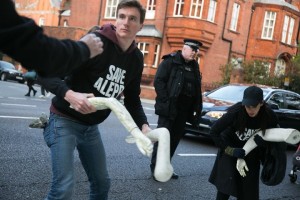 On November 3rd, a group of 25 people wearing “Save Aleppo” T-Shirt presented themselves outside of the Russian embassy in London, and appeared to be following Johnson’s directive. They brought with them a truck full of manikin arms and legs. They proceeded to dump these arms and legs in pile in front of the embassy, effectively blocking its doors and preventing anyone from leaving or entering.
The manikin arms and legs were said to symbolize the innocent people of Aleppo, whose deaths they blamed on Russia. The police did not halt this demonstration, which appeared to have barricaded a foreign mission. As the protest continued, some of the provocative individuals in “Save Aleppo” T-shirts are reported to have chained themselves to the fence surrounding the embassy’s perimeter. Yet, it appears that not a single arrest was made. The police, who were on hand, apparently did not stop the individuals.
So, who were these individuals? The money for the protest was supplied by “Syria Campaign.” This is a non-profit organization funded by a Syrian billionaire named Ayman Asfari, in addition to other anonymous sponsors. It makes sense that a billionaire of Syrian descent, residing in Britain, would want to topple the “Baath Arab Socialist Party” that has run his country for many decades. Parallels between Asfari and the many wealthy Cuban residents of Miami are easy to make. The Syrian government, like the Cuban government, has provided housing, healthcare, and education to its population, achieving this with policies that make the richest people quite uncomfortable.
But beyond Asfari’s well-funded “Syria Campaign” that uses its huge endowment to spread propaganda against the Syrian government and its allies, who were the individuals in the T-shirts? Very few of them appeared to be of Syrian origin, but one cannot assume they were merely hired stooges either.
The answer to this question can be found in the name of an organization that co-sponsored the malicious provocation. The organization “Syria Solidarity UK,” which took credit for the action on its website, is well known to be a front group for the Socialist Workers Party of Britain. This “socialist” organization follows the teachings of Tony Cliff and Leon Trotsky, has its grip on Britain’s “Stop The War Coalition” as well. It is safe to surmise that a decent percentage of those who barricaded the Russian embassy’s entrance were Trotskyites.
Two Currents of Communism
So, who are the Trotskyists? To answer this question we must begin to examine the anatomy of the political left throughout the course of the 20th century.
Within the mass movements associated with Marxism, there are a wide variety of sects, ideologies, and interpretations. However, among the individuals who envision and work toward the overthrow of capitalism there are two distinct personal or psychological categories. These two trends often work in concert with each other. The two trends often do not even intentionally dissociate with each other, and can often be found within the same political parties and movements, despite the huge differences between them. The differences are found in motivation.
Among the political left, the primary and constant current is an extremely alienated minority from within the privileged sectors of society. In Russia it was a current among the children of the aristocracy, as well as from within the emerging bourgeoisie, who made up much of the cadre of the Bolshevik Party in its early years. While they were born in relatively comfortable positions, they knew that things in society at large were deeply wrong. They saw the suffering of the poor, and the many other injustices that existed, and were filled with anger and motivation to correct them. While other members of their social caste could be at peace with society, they could not.
Whether it is due to their unique access to education, or the fact that they are encouraged to ponder political and philosophical questions while other strata are not; regardless of the reason, a section of the most privileged people always seems to be drawn to revolutionary anti-capitalist politics. The trend is not restricted to pre-revolutionary Russia. One can think of the young French radicals depicted in Victor Hugo’s novel Les Miserable, or even the radicals of Students for a Democratic Society or the Weather Underground in the United States, who came from some of the prestigious Universities. No matter how strong or weak the leftist current is in society at large, a certain sector of the privileged classes exists as a kind of “radical intelligentsia.” This is true even in under the most repressive anti-communist dictatorships.
The second current, which constitutes a very solid majority of those attracted to leftist and anti-capitalist currents around the world, are those among the working and impoverished classes. While in times of prosperity they are less politicized, as they see their conditions deteriorating, they become motivated to take action and embrace anti-capitalist and revolutionary ideology.
Unlike the first current, their motivation is not a moralistic impulse based on alienation, but rather the basic desire to see their lives improve. This does not mean that such people do not have political depth or brilliance. Often these forces are actually much more politically effective and ideological. However, their introduction to revolutionary politics originates in a basic material need.
While these two distinct political currents espouse the same phrases and philosophies, they seem to crave two different things. The privileged children of the wealthy who embrace revolutionary politics often have a deep desire to create chaos. They see the world as unjust and cruel. They want it to be smashed, shattered, burned to the ground, and rebuilt anew.
The second current, while espousing the same political line, tends to crave the opposite. They are motivated to take political action as society is becoming less stable. The economic crisis has made their lives more painful and unpredictable, intensifying the suffering all around them, pushing them toward a desperate need for radical change. They embrace anti-capitalism because it offers stability beyond the “anarchy of production.” The revolutionary left is for them, not the road to chaos and revenge, but the path toward a new order with a centrally planned economy, in which justice is created and the chaos is ended.
The Origins of “Trotskyism”
Lenin’s book “What Is To Be Done?,” which laid the foundation for the Bolshevik project of a Central Committee and a “Party of a New Type,” was largely directed at members of the first, moralistic, and privileged group. It urged them to look past their own motivations, abandon terrorism and tailism, and build an highly disciplined organization that could push the broader masses of Russian workers and peasants toward a full revolution.
The October Revolution of 1917 was successful because it merged the two trends. In a time of crisis, the revolutionary intelligentsia who longed to smash the old order, were able to mobilize the workers and peasants who were suffering and desperately wanted “Peace, Land and Bread.” The effective convergence of these two currents created a new political and economic system.
However, almost immediately after the Soviet Union was founded, political space began to develop between the two trends. Lenin banned factions in the Bolshevik Party during the early 1920s in order to hold an increasingly divided ruling party together. Despite the ban on factions, the two trends did not cease to exist. After Lenin’s death, the two poles became personified in Leon Trotsky and Joseph Stalin.
Trotsky, the son of wealthy landowners in Ukraine, who had lived in exile most of his life and was beloved among the world’s cosmopolitan intellectuals, called for “Permanent Revolution.” The Soviet Union, in his view, should exist simply as a temporary hold out in a global revolutionary explosion. In his view, Soviet society should be organized around the military, and focus primarily on seizing the western financial centers of Germany, Britain, and France for the global socialist project to remake all humanity.
Stalin on the other hand called for “Socialism in one country.” He advocated for the Soviet Union to focus on building a good society for the people of Russia and the surrounding countries, while offering limited support to revolutionary forces around the world. “Socialism in One Country” would require signing treaties with the western countries, restoring the traditional family, and eventually even legalizing the Russian Orthodox Church. For Stalin and the majority of the Communist Party of the Soviet Union, socialism did not mean an endless global crusade to behead every last king and capitalist, but rather, building a peaceful, prosperous society with a planned economy in Russia and the surrounding countries.
When Stalin was victorious, the world communist movement began to shed the most adherent members of the first revolutionary category. The Communist parties began building unemployment councils, trade unions, and other organizations dedicated to aiding working people and fighting for direct material gains as capitalism collapsed into a “great depression.” Eventually the “Stalinists” built a People’s Front of anti-fascists that played a decisive role in the Second World War.
Meanwhile, Trotsky took a significant number of western intellectuals out of the Communist International and into his “Fourth International.” The Trotskyists worked to antagonize and isolate the Soviet aligned Communist Parties, while at the same time presenting a negative perception of the Soviet Union as a “totalitarian” and “repressive” society that did to live up to the utopian dreams of middle class radicals.
Trotsky saw the USSR as a “degenerated workers state,” socialist in its economic foundations but “bureaucratized” in its politics. In the final years of his life, a number of Trotsky’s followers disagreed with this assessment and argued that the USSR was capitalist. Max Shachtman, Irving Kristol, and a number of the more middle class elements broke with Leon Trotsky, arguing that the USSR was not a “worker’s state” but rather “bureaucratic collectivism”, “state capitalism”, or fascism. These elements called themselves “Third Camp” or “Neo-Trotskyists.” The International Socialist Tendency, of which the British Socialist Workers Party is aligned, along with the US International Socialist Organization, is the largest group continuing these politics. It is “Third Camp Trotskyists” in Britain who have built the organization called “Syria Solidarity UK” which conducted the recent protests against the Russian embassy.
Interestingly, it is from within the “Trotskyists” who broke with Trotsky, and completely denounced the USSR, that one can find the origins of Neo-Conservative thought in the United States. James Burnham, Edmund Wilson, Max Eastman, and many of the leading right-wing intellectuals of the Cold War were era were originally Trotskyists.
Brzezinski’s Permanent Revolution
Zbigniew Brzezinski, one of the leading CIA strategists during the Cold War, can largely be credited for defeat of the Soviet Union. Brzezinski’s career involved fomenting dissent and unrest in Soviet aligned countries. The gap between revolutionary intellectuals who crave chaos and revolution, and the pragmatic approach of Soviet leaders who wanted a stable, planned economy was a great asset to his activities. The CIA launched the “Congress for Cultural Freedom” to fund anti-Soviet leftists and artists, and further the space between them and the USSR.
In Hungary, Poland, Czechoslovakia, East Germany, and many other socialist countries, the US Central Intelligence Agency enflamed and exploited the grievances of artists and intellectuals, who felt stifled by the Marxist-Leninist political set up, and longed for the “freedom” of the west. It has become almost cliché to talk about the role of Beatles music and other western counter-cultural icons in “the fall of Communism.”
Brzezinski openly bragged that he was “giving the USSR its Vietnam War” in Afghanistan. When the People’s Democratic Party took power in 1978, the CIA worked with the Saudi monarchy to launch a global campaign of Wahabbi Muslims against it. The USSR sent its forces into Afghanistan to protect the People’s Democratic Party.
In the global media, it was a different story. The press painted the Taliban and other forces organized by Osama Bin Laden as romantic guerilla fighters, battling against the USSR, portrayed as a crude, repressive invading force. The “Trotskyists” of the world embraced the Mujahadeen Wahabbi fanatics in much the same manner that such forces now embrace the Free Syrian Army and the Al-Nusra Front. Among the organized left, pro-Soviet sentiments were left only to a small minority, dubbed “Stalinists” and “Hardliners.” The long-haired, counter-cultural “New Left” bought into the CIA narrative, and believed that Osama Bin Laden was some kind of Che Guevara.
In the 21st century, Anti-imperialist governments, even those who completely reject Marxism-Leninism, have a lot in common with the political and economic system developed by Stalin during the 1930s. Anti-imperialist countries tend have five year economic plans or other mobilizations of the population toward raising the living standards. They tend to have a ruling party with a very complex and specific ideology, that sits at the center of a tightly organized and politicized population. The strength of the various anti-imperialist regimes is their ability to control the centers of economic power, raise the standard of living, and provide a comfortable life for the majority of their people.
In China, each child is given a red scarf when they begin their education. They are told that this red scarf is their own piece of the Chinese flag, and that it represents a political project toward building a prosperous society, which they are automatically part of it. Similar rituals exist in the Bolivarian countries, the Arab Nationalist states, and almost every other country where the government can trace its origin to an anti-capitalist revolution.
Meanwhile, the primary strategy of Wall Street for toppling these governments has been to employ the rhetorical style of Trotskyists, and appeal to the alienation and anxiety of the privileged elite. The CIA and its network of aligned NGOs has discovered key methods of manipulating and unleashing the desire for chaos among the middle class. Figures like Samantha Power talk about “mobilizing” for human rights around the world.
The primary way the US has attacked independent countries in recent years has been fomenting revolts such as Euro-Maiden in Ukraine, the “Green Movement” in Iran, the “revolution” in Libya. These uprisings are supported by Non-Governmental Organizations and carried out to serve the interests of the western financial elite. While they effectively maintain the global status quo, they are decorated with the most Guevara and Trotsky-esque propaganda on social media and western television. It seems pretty clear that the vaguely emotional lust for revolution and unrest among the alienated middle class has been effectively harnessed as a mechanism for defeating “Stalinism” and ensuring the rule of western capitalists.
Foreign Affairs: “Open International System” vs. “Populism”
The Council on Foreign Relations, the CIA-linked think tank, shed light on its worldview and strategy in the latest issue of their publication Foreign Affairs. In an essay by Anne-Marie Slaughter, one of the primary architects of the US backed regime change operation in Libya, she described her prescription for the ailments of the global situation.
“The people must come first,” she tells us, like a soap-box agitator. “When they do not, sooner or later they will overthrow their governments.” According to Slaughter, the job of western countries is to facilitate the free flow of information through social media, in order to allow these uprising to come about.
Furthermore, Slaughter argues that the Treaty of Westphalia, and the concept of the nation state is out of date. Rather “responsibility to protect” or R2P has replaced it. The NATO states and their military must intervene in order to strengthen these revolutions, and topple regimes that get in Wall Street’s way. The strategy is global revolution, endless destruction and chaos until “open governments, open societies and an open international system” can be erected. We can almost hear echoes of Trotsky’s fantasy of “permanent revolution” in Slaughter’s writing, though Trotsky’s stated goal was to overturn capitalism, not secure its grip on the planet.
And who are the villains in the CFR narrative? They are “Populists.” The entire issue of “Foreign Affairs” is titled “The Power of Populism.” Listed among them are Hugo Chavez, Evo Morales, the Supreme Leader of Iran, as well as Russian President Vladimir Putin and Chinese President Xi Jinping. According the analysis, it is these dangerous “demagogues” who reject the “open international system” of the World Bank and the International Monetary Fund, but instead mobilize their populations and preside over centrally planned economies that must be smashed. With the word “Populism”, the CFR seeks to link these governments to racism and anti-immigrant bigotry in western countries, and urge “progressive” and “enlightened” people to oppose them in the same manner.
Indeed, political navigation in the 21st Century can be quite difficult. The compass by which analysts have long determined left and right is broken. The defenders of free market capitalism and the rule of internationalist bankers have embraced the revolutionary blood-lust which was long a staple of the political left. Meanwhile, the anti-imperialists and advocates of planned economies now often position themselves as social conservatives and defenders of stability, morality, religion, and tradition.
While it is no longer exactly clear which way is “left” or “progressive,” it is blatantly obvious which way is better for the human race. The NATO regimes, despite mouthing left-sounding rhetoric in the process, have reduced Iraq, Afghanistan, Libya, and Syria to civil war and chaos. The fruits of their imposed vision of an “open society” with “free markets” is not prosperity and freedom but poverty, chaos, and endless civil war.
However right-wing and conservative the governments of China, Russia, and Iran may seem, the societies they have created are ones in which profits are not in total command, and providing a decent life for the masses of people remains a priority. In the anti-imperialist regimes, the state is independent of market forces, and has the ability to restrict and control their actions. Meanwhile, a sense of collective vision and obligation exists, and people are not left isolated to fend for themselves.
Yes, the CFR’s vision of a clash between the “open international community” and the “populists” is certainly accurate as it is playing out before the world. Syria is simply the most visible battlefield.
Caleb Maupin is a political analyst and activist based in New York. He studied political science at Baldwin-Wallace College and was inspired and involved in the Occupy Wall Street movement.
Vatican Mediation in Venezuela Changes Political Equation for Washington
By Mark Weisbrot | The Hill | November 6, 2016
The Vatican’s participation in the mediation effort in Venezuela poses an unusual challenge to US policy in Venezuela and the region. On Sunday, October 30, three of the four major opposition parties and other prominent opposition leaders met with the government, with mediators from the Vatican and UNASUR (the Union of South American Nations). Some progress was made. The government released four people who the opposition considers political prisoners, and the opposition called off a political trial against President Maduro and a planned demonstration that most observers believed ran a high risk of violence.
Thomas Shannon, the number three official in the US State Department, also went to Venezuela this week, met with President Maduro and opposition leaders, and supported the dialogue. I wish I could say that this represents an actual change in US policy in the region, but all evidence still points to the contrary.
The US government is not looking at Venezuela in terms of dialogue or compromise. The Obama administration has economic sanctions against Venezuela, which President Obama renewed last March. In renewing these sanctions, the executive order again declared that Venezuela presented “an unusual and extraordinary threat to US security.” The world knows what happens to countries that the US deems to be “an unusual and extraordinary” security threat. Look what happened to Iraq. Look what happened to Nicaragua in the 1980s. It doesn’t matter how many people are directly affected by the specific sanctions against Venezuela. The threat is what matters, and it is ugly and belligerent enough to keep many investors from investing in Venezuela and to raise the country’s cost of borrowing. (Not to mention that the whole premise of Venezuela as a “security threat” is absurd.) And the US government has also directly pressured financial institutions not to do business with Venezuela.
For all of these reasons, it is clear that Washington’s goal in Venezuela is currently the same as it has been for almost all of the past 15 years. Shannon’s support for dialogue is almost certain to turn out the same as previous diplomatic thaws in the past: a brief and insincere interlude. President Obama initiated the longest period (about five months) of calm US-Venezuela relations ― since the US-backed military coup of 2002 ―between March and July last year. It soon became clear that this was only because the Cubans ― with support from the rest of the region ― made it a condition of progress in their own negotiations for opening relations with the US. This was something that Obama wanted for his legacy. But as Venezuela’s National Assembly elections approached, the Obama administration went back to its regime change strategy, supporting an international campaign to delegitimize Venezuela’s elections. (This turned out to be unnecessary, since the opposition won in a landslide.)
The Venezuelan opposition pursued a “strategy of military takeover” for the first four years of the Chávez government, including the 2002 military coup. But since 2004, they have been divided on whether to pursue change through legal means. Whenever they had people in the streets supporting a violent or extralegal overthrow ― as in 2002–03, 2013, or 2014 ― the US government has taken their side. Washington has also led various campaigns to delegitimize the Venezuelan government, a vital part of any extralegal “regime change” strategy.
But for the moment, Pope Francis has altered everyone’s calculations. It is not good optics for the hard-line Venezuelan opposition to condemn the pope. And the Obama administration cannot exert the kind of pressure on the Vatican that it does on, e.g., European governments to support its sanctions against Russia, or various unpopular military adventures. Also, the international media cannot marginalize or ignore the pope in the way they do the rest of the hemisphere’s governments, e.g., when these governments resist Washington’s support for regime change in Venezuela, Honduras, and other countries.
The pope is likely to look at the Venezuelan crisis in a pragmatic way, rather than through the lens of Washington’s imperial and ideological imperatives. There is a divided government in Venezuela, with the chavistas controlling the presidency and to a large extent the judiciary. The fractious opposition controls the National Assembly. Until the next presidential election, there is no way to resolve the political conflict except through dialogue and negotiation.
Pope Francis can be a pragmatic diplomat, but he has certain principles and is not easily intimidated. He is likely to understand that Venezuela’s divided government is a result of a divided country. From 2003, when the Chávez government got control of the national oil industry, until 2014, the large majority of the population experienced enormous gains in their living standards. That is why, in December of last year, in the elections for National Assembly, the ruling PSUV still got more than 40 percent of the vote ― despite inflation running at 180 percent and widespread shortages of basic consumer goods.
A big part of the gains of the Chávez era have been lost in the past nearly three years, and especially over the past year. But the governing party still has a political base that remembers worse poverty and exclusion, if not worse shortages, in the pre-Chávez era. They do not see the political opposition, which is a right-wing political movement that has always represented the upper classes, offering solutions that will make their lives better.
The Vatican will therefore likely seek negotiation and compromise on both sides of the political divide. This poses a unique challenge to Washington and some of its closest allies in Venezuela.
Venezuelan Government Releases Five Opposition Activists in Goodwill Gesture
By Rachael Boothroyd-Rojas | Venezuelanalysis | November 1, 2016
Caracas – Venezuela’s national government has agreed to release five jailed opposition activists in a goodwill gesture as part of its official talks with the country’s opposition.
The liberation of the prisoners is the first concrete agreement to emerge from the Vatican-mediated dialogue, initiated Sunday with representatives of four opposition parties.
On Monday evening, opposition mayor Carlos Ocariz took to social media to announce the negotiated release, confirming the freed prisoners as Andrés Moreno, Marco Trejo, Carlos Melo, Ángel Coromoto Rodríguez, and Andrés Leon– all arrested for their participation in violent protests or for the incitement of political violence.
As former security chief to opposition National Assembly President Ramos Allup, Ángel Coromoto Rodríguez, was arrested in May for allegedly bankrolling anti-police violence during opposition protests, while Melo was detained on August 31 for the possession of explosives. Similarly Moreno and Trejo were both arrested in late September after creating a video calling for the rebellion of the armed forces.
The longest-serving inmate amongst the group is Andres Leon, who was arrested during the deadly 2014 street violence known as the “guarimbas”. He was granted house-arrest on health grounds in June last year.
“Not enough”
The announcement comes just three days ahead of an anti-government march on the Miraflores Presidential Palace, called by the opposition for this coming Thursday.
Opposition leaders had previously hinted that they would be willing to consider calling off the demonstration depending on the progress of the talks, which they say are contingent on the release of their activists from jail.
Nonetheless, the government’s gesture appears to have done little to dissuade the MUD leadership from going forward with the controversial march– despite the violence unleashed by their supporters during protests last week.
“The release of the political prisoners is important, but not sufficient,” MUD Secretary Jesus Chuo Torrealba told reporters.
On Tuesday morning, the MUD opposition coalition also retweeted a message from legislator Freddy Guevara insisting that Thursday’s march would “still go ahead”. Guevara is a lawmaker for the ultra-right Popular Will party, which is currently boycotting the talks.
The coalition has been deeply divided over the decision to partake in official negotiations with the government, with proponents describing the top-level talks as just “one more terrain of struggle” amongst many.
Meanwhile, the government has hailed the move as a sign of its willingness to negotiate with the opposition in a bid to ease tensions in the politically polarised country.
“We, who have been permanently waiting for opposition sectors to (commit to) dialogue, salute the fact that it has finally taken place,” Venezuela’s foreign minister, Delcy Rodriguez, told press at the United Nations Human Rights Council on Tuesday.
The opposition has stated that it will not negotiate on its demands for a presidential recall referendum this year or on the release of all of its activists from jail, regardless of their crime. The MUD has yet to release an official statement confirming the status of Thursday’s march.
Venezuela Police Officer Shot, Killed During Right-Wing Protest
teleSUR – October 26, 2016
A Venezuelan policeman died after being shot during an opposition protest late Wednesday in the province of Miranda, Minister of the Interior and Justice Nestor Reverol said, adding there were two other officers injured.
Reverol stated that the officer was shot after the police tried to disperse an opposition march to preserve public order on the Panamerican highway in San Antonio de los Altos, adding that two suspects were in custody.
“There are two people detained for questioning, and an order will be issued to begin investigations to clarify this murder,” said Reverol.
The wounded officers were taken to a private clinic, where Jose Alejandro Molina Ramirez died, shot in the abdomen and arm. Medouza Dany Daniel Briceno was shot in one hand, Davis Jose Laya Ayala was hit in one arm and Miguel Antonio Cuevas Pirela had a wound on his face from a blunt object, but all were out of danger, the doctors informed.
Reverol said the right-wing opposition was responsible for the death of officer Molina. He also confirmed that four policemen were injured in Zulia state during the protests.
“The officer killed is Jose Alejandro Molina Ramirez who was shot in the abdomen and arm.”
The right wing had called for a “Taking of Venezuela” march Wednesday, provoking clashes that led to more than a hundred injuries.
Despite some factions of the opposition agreeing to talks with the government, some of the splintered right wing have refused dialogue and instead called for a national strike on Friday and a more provocative march to the Miraflores presidential palace on Nov. 3.
Miranda’s governor is right-wing leader Henrique Capriles, who denied that opposition forces had agreed to talks with the socialist government Tuesday and has been instrumental in calling for street demonstrations and the ouster of President Nicolas Maduro.
“This needs to keep growing so that the government understands once and for all that we’re doing this for real,” said two-time presidential loser Capriles.
The National Assembly, that is in contempt of the constitution, voted Tuesday to start an impeachment process against Maduro, even though any actions it takes have been declared nulled by the Supreme Court in the country.
Crowds at the protests where the officer was shot chanted “This government is going to fall!”
Clashes also broke out in the western town of San Cristobal that was an epicenter of violence during 2014 anti-Maduro protests that left at least 40 people dead.
‘Venezuela opposition unable to overthrow Maduro’
Press TV – October 26, 2016
Venezuela’s opposition-led National Assembly has voted for impeaching President Nicolas Maduro accusing him for violating democracy. The anti-government vote came after the Supreme Court blocked the parliament’s plan to hold a referendum to try and recall President Maduro. The Venezuelan socialist government has dismissed the move as meaningless.
Lajos Szaszdi, a Latin America expert, told Press TV that President Maduro has the support of the Supreme Court, the security forces and people, as a result of which the National Assembly would not be able to remove President Maduro from power.
The executive branch of the government “has the upper hand” in the division of power in Venezuela; therefore, President Maduro will be able to survive attacks by the opposition, Szaszdi said.
The analyst went on to say that the president of Venezuela has control over police, security and military forces and “of course, there is a broad base of supporters,” and “there is no danger for his hold on power.”
The Supreme Court will not accept any anti-government resolution issued by the National Assembly of Venezuela until the parliament invalidates three opposition lawmakers who are being accused of having bought votes in the last general elections, he added.
“The opposition is desperate,” Szaszdi argued, adding that the opposition is trying to resort to “extreme measures,” but people, the armed forces and the Supreme Court would support President Maduro.
The desperation of the opposition has increased after the National Electoral Council put a stop to the opposition-driven plebiscite against Maduro when four state courts called the signature-gathering process fraudulent.
The Venezuela’s government, which is facing economic difficulties and all-out pressure from the opposition legislators, has said the country is the victim of an international plot against Socialism, led by the United States.
Selective Assassinations of Chavistas by paramilitaries, renegade police and criminal gangs continue
By Arturo Rosales | Axis of Logic | October 12, 2016
The assassination of followers of the late President Chavez continues to increase at a steady pace. From 2013 – when President Maduro was democratically elected – to the present, many local political leaders, public servants, journalists, bodyguards of left wing politicians, military personnel and operatives of the Bolivarian Intelligence Service (SEBIN) have been unfortunate enough to fall into the opposition’s murderous claws.
The ultra-right wing opposition that currently has control of the National Assembly continues with its aim of resurrecting the Fourth Republic in Venezuela. With opposition figures such as the governor of Miranda state, Capriles Radonski, telling his supporters “to take their anger to the streets” and Voluntad Popular’s Leopoldo Lopez whose plan called “The Exit” sparked violent street protests by paid thugs from February to June 2014 costing 43 lives, we can see that unconstitutional political means to gain power are at play here.
Added to these actions by the ultra right wing are assassinations of body guards of revolutionary leaders that are simulated as a robbery or violent street crime, then the right wing media plays its part by putting it all down to “insecurity” caused by an inept government.
Paramilitaries &Policemen
The links established between fascist leaders in Venezuela such as Leopoldo Lopez and ex-Metropolitan Mayor Antonio Ledezma with ex-Colombian President and enemy of Bolivarianism, Alvaro Uribe, since 2009 have resulted in political, economic and media support for the paramilitary gangs that have been infiltrating Venezuela since about 2005. These gangs expanded into the country from the western Colombo-Venezuelan border and reached the center of the country, including Caracas, in a few short years.
Political and legal support was lent by right wing parties such as Voluntas Popular and Alianza Bravo Pueblo. Economic support came from drug trafficking, contraband and a small sector of business; and finally support by electronic media that are financed from abroad such as La Patilla, NTN24 (both financed from Colombia) and Sumarium owned by the Vecchio-Lopez families. (Carlos Vecchio is now exiled in the US and Leopoldo Lopez is serving 14 years in jail). There were also other minor support groups from other political parties of the right such as UNT, Accion Democratica and Primero Justicia.
With the paramilitaries in place, there were various objectives: the political demobilization and demoralization of militant Chavistas in the popular areas (barrios); and take out of circulation valuable revolutionary cadres either by making them disappear or eliminating them physically. The right wing media would then step in and report on these events with the purpose of destroying the memory and reputation of the murdered comrades.
The aim of practicing this kind of politics is to create indignation, fear and anger in the population that lives in the shadow of such insecurity. For this reason each brutal homicide is dealt with immediately and sensationally by the opposition media. The idea is to have some sensational aspect of any given case covered on a daily basis to maintain the fear factor.
Let us not forget that since 2013 the whole population has been subject to the effects of a fourth generation war – a combination of selective assassinations as described above and an economic war making life increasingly difficult. Foods were hoarded, hidden or smuggled to Colombia creating shortages of basic goods and the resulting huge lines as people stood to buy food.
This, the fear factor plus frustration at not being able to buy basic subsidized goods plus induced galloping inflation, was all blamed on an inept President and his ministerial team, day-in day-out, by the local and international media who all combined to encourage voters to either abstain or switch to supporting the opposition. The latter had promised to “make the lines vanish” if they won control of the National Assembly on December 6 last year. They did win but the lines got worse … and according to the media this is still the fault of the government even though 86% of food distribution is in the hands of the private sector.
Of course, the “make the lines vanish” electoral promise was conveniently never mentioned again by the private media.
To achieve the goal of sensationalizing homicides and sowing fear and discord in the population, the opposition media has a team of “info-mercenaries” who in many cases have contacts with corrupt ranks of the security forces and therefore have access to the gory details before any investigation has even started. Such “inside” or “advance” information is illegal under Venezuelan law. There are also journalists that act in concert with the armed gangs especially in the case of “hits” against security personnel, as there is a higher economic incentive if the details are published in the media.
After the recent intervention of the police headquarters in the opposition-run municipality of Chacao in Caracas, it was discovered that this police force had been behind several high profile killings such as that of retired General Felix Velasquez and revolutionary journalist Ricardo Duran.
Obviously the Mayor of Chacao who is the Commander-in-Chief of this police force did not know anything about the activities in his own police headquarters. The opposition is never involved in these murders even though the police forces they control are never above suspicion. At present 4 policemen are awaiting trial for the assassination of General Velasquez and 14 more for the killing of Duran.
Wider Strategy
On repeated occasions President Maduro has stated that these assassinations “form part of a non-conventional war that is being waged against the country – and not just now but for many years. Criminal violence emerges when the right wing does not achieve its objectives”.
There follows a list of the revolutionaries and public servants murdered in contract killings due to the politics of violence of the ultra right wing:
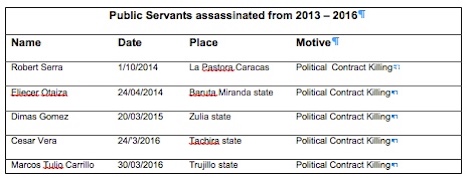


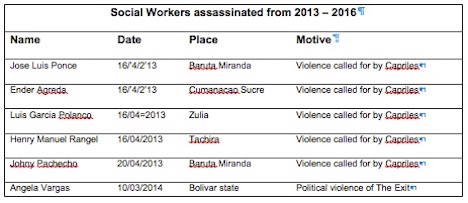
In addition to these politically motivated and contract killings by paramilitaries, police and paid thugs in the streets, there are at least 15 professional bodyguards of high-level Chavistas who have been assassinated from 2013–2016.
All the cases mentioned have proven to be contract killings and have been resolved or are under investigation.
It is worth highlighting the fact that no international human rights organization or any NGO affiliated to the US or Spain – countries that are supposedly democratic and believe in the freedom of expression – have taken any interest or made declarations condemning the persecution and assassination of Chavistas. All they have done is attack the government of President Maduro insinuating that it is he who is violating human rights!
Thus, we have a twisted situation where cases of murdered Chavistas are glossed over and no mention of the violation of their human rights is ever made. And on the other hand, the darling of the international right wing, Leopoldo Lopez, is allegedly having his human rights violated because his iPod was removed from his jail cell.
This is the late Eduardo Galeano’s “Upside Down World!”
© Copyright 2016 by AxisofLogic.com
Featured Video
Macgregor: We Haven’t Seen the Worst of the Iran War Yet
or go to
Aletho News Archives – Video-Images
From the Archives
15 Saudi ‘hijackers’ were CIA agents working for US: Scholar
Press TV – April 13, 2016
Fifteen of the 9/11 “hijackers” from Saudi Arabia were CIA agents working for the United States government, which was seeking to destroy the Middle East for Israel and to double the American military budget, says Dr. Kevin Barrett, an American academic who has been studying the events of 9/11 since late 2003…. continue
Blog Roll
 Aletho News
- Iran’s Plan to Shut Down AI in the Persian Gulf
- Israel seeks ‘compensation’ from Washington over Saudi F-35 sale
- Saudi crown prince seeks dialogue with Ansarullah after Yemeni blows: Report
- Damascus rejects Saudi request for Syrian fighters to counter Yemen: Report
- South Korea says will not send troops to join terrorist US war on Iran
- Russia Just Struck the Eyes of NATO’s War Machine in Ukraine
- Russia summons UK charge d’affaires over Kiev drone support
- NATO member warns bloc seeking pretext for war with Russia
- Macgregor: We Haven’t Seen the Worst of the Iran War Yet
- ‘We are not like everyone else’ laws that bind other nations do not apply to Israel, says Likud lawmaker
- If Americans Knew
- Debunking The Claim That Macklemore Has A “History Of Antisemitism”
- CPJ demands release of arrested Palestinian-US journalist near Bethlehem
- Robert Kraft: The Billionaire Friend of Netanyahu Pulling The Strings Behind the Macklemore/Ed Sheeran Blow Up
- Columbia Administered Fund Gives Big Money to Pro-Israel Groups
- Deportation Case of Palestinian Activist Salah Sarsour Tests First Amendment
- ‘We Will Not Forget’: Palestinians Mark 44 Years since Sabra and Shatila
- Why do we let Zionists decide what we can and can’t say?
- US welcomes Israeli, Iranian delegations to UN, but not Palestinians – Daily Update
- Biden’s Genocide Accomplices Targeted by New Accountability Campaign
- AIPAC’s Network Has Already Spent $67.2 Million to Shape the Midterm Elections
- No Tricks Zone
- New Study: ‘Global Drought Shows No Detectable Recent Acceleration Under Climate Warming’
- Economic Masterminds: German Socialists Suggest Taxing Productivity Gains Stemming From Using AI
- The South China Sea Has Not Been Cooperating With The Climate Change Narrative
- Energy Crisis: Germany Enters Heating Season With Historically Low Gas Reserve Fill Levels
- New Study: The Antarctic Ice Sheet Gained Mass From 2020-2024 Due To Staggering Snow And Ice Accumulation
- Study: Ocean Heating Rates From Thousands Of Years Ago ‘Dwarf’ Modern Ocean Heating Rates
- Climate Extremists Target, Attack Large-Scale Power Grid Infrastructure In Germany!
- New Study: Antarctic Ice Melt Has Contributed Less Than 1 Centimeter To Sea Level Rise In The Last 30 Years
- Fear Of Debate: Alarmist German Climate Scientist Calls On Mainstream Media To Discredit Skeptic Voices
- End-Of-August Arctic Sea Ice Extent Hasn’t Fallen In 20 Years, Official Data Show!
 Aletho News