Fact-checking the Heralded “End of the Latin American Left”
By Peter Bolton | Council on Hemispheric Affairs | May 27, 2016
Recent political developments across the region have prompted celebratory proclamations in the mainstream Western press that Latin America’s decades-long dominance by left-leaning governments is reaching its terminal stages. The landslide victory of the Venezuelan opposition in last December’s legislative elections, the impeachment of President Dilma Rousseff in Brazil, and the triumph of center-right candidate Mauricio Macri in Argentina’s presidential election do indeed seem to point to a region-wide decline in the fortunes of the parties of the Pink Tide. But as is so often the case in the mainstream media, commentators have been too quick to make current events fit neatly into overarching seismic shifts. The cursory and often incomplete news reports on which they are based simply do not provide sufficient support for such catchall explanations. While scholars have naturally initiated a more nuanced and detailed debate to consider whether the region is indeed witnessing the end of a progressive cycle, press analyses have struck a premature and in many cases triumphalist tone by declaring the collapse of the Latin American left both imminent and beyond serious doubt.
In reality, it is the exact opposite that is beyond serious doubt: it is far too early to write off the future of the left in Latin America. Moreover, more research is needed to understand the dynamics of these movements and how things might play out in the coming months and years. But what is most disconcerting about these knee-jerk press responses is that the people making them seem to not even have a strong grasp of the basic facts surrounding the political developments on which they base their claims, let alone of the nuance needed to develop a sophisticated analysis. In a survey of the media declarations of the purportedly imminent collapse of the Latin American left, COHA has found a shocking collection of glaring and demonstrably false statements over basic matters of fact that reveal the profoundly slipshod nature of their research.
The salience of these findings can hardly be overstated: if journalists in the mainstream media cannot even get basic facts correct, they can hardly be trusted to provide a meaningful analysis of the larger picture.
Jackson Diehl
As predictable as the jeers from the DC commentariat were, perhaps the one figure within the Beltway punditry class who could have been most counted on to react gloatingly to the recent setbacks of leftist governments in Latin America was The Washington Post’s deputy editorial page editor Jackson Diehl. Having been a reliable war hawk and right-wing militarist at the Post’s op-ed section since the late 1970s, Diehl was quick to turn his wrath on Pink Tide leaders and their supposedly grave threat to U.S. national security interests. In 2010 he repeated American Enterprise Institute scholar Roger Noriega’s accusation that then-President of Venezuela Hugo Chavez was collaborating with Iran in the development of nuclear capabilities.[1] In 2013 he accused the governments of Venezuela, Nicaragua and Ecuador of “gutting democratic institutions in their countries,” and described Ecuadorian President Rafael Correa as “Latin America’s chief caudillo and Yanqui-baiter.”[2]
His characterization of the latest political developments, inexplicably posted at the Charleston-based Post and Courier rather than his home publication, fits seamlessly with this record of hysterical hyperbole and dubious accuracy. In the article’s first sentence he triumphantly announces: “The encouraging news from Latin America is that the leftist populists who for 15 years undermined the region’s democratic institutions and wrecked its economies are being pushed out — not by coups and juntas, but by democratic and constitutional means.”[3] From this outrageously loaded misrepresentation he quickly moves on to outright falsehoods by claiming that Argentina’s Cristina Fernández de Kirchner was “vanquished in a presidential election.”[4] From a simple Google search one can learn that she was in fact not even a candidate in last year’s presidential election.[5] Apparently Diehl cannot even get past his article’s second sentence without revealing his stupefying ignorance of the most basic of facts.
Aside from blatant inaccuracies, he also makes the remarkable claim that “most of the Western hemisphere is studiously ignoring this meltdown,” despite the fact that Secretary-General of the Organization of American States (OAS), Luis Almagro, has been calling for months to invoke the OAS Democratic Charter against Venezuela.[6] If he is referring not to the OAS but rather to the leaders of the region’s governments, then he is simply confusing their indifference for Washington’s isolation in its condemnations of the Maduro government. Just as the United States was completely isolated in its refusal to recognize Maduro’s election victory in 2013, so it has been alone in calling for sanctions, for which it has lobbied on the basis of largely spurious allegations of human rights violations.
To round out his diatribe, Diehl then describes the “obstacles” to getting a recall referendum to remove President Maduro as “comically steep,” despite the fact that all of the figures he cites regarding the required numbers of petition signatures (which opposition activists need to gather to trigger the recall vote) are calculated from terms set out in Venezuela’s Constitution. By representing the recall referendum as offering the “slim remaining hopes for a democratic solution,” he implies that some sort of extra-democratic methods might be necessary, and presumably also justified.[7] Keep in mind that the provision for a recall referendum to remove a sitting president is a democratic mechanism that scarcely exists in any constitution besides Venezuela’s.
Rafael Ruiz Velasco
In an article published at the PanAm Post, Rafael Ruiz Velasco is just as hasty in his passage of judgment on the fate of Latin America’s left. He announces confidently that “the results are clear: the bet on socialism in Latin America has failed.”[8] But like Diehl, Velasco makes at least one glaring factual error that undermines his already highly suspect piece. He says of Brazil: “The Olympics will be held with a politically defeated Dilma Rousseff out of office, as she faces impeachment on corruption charges.”[9] The truth of the matter is that Rousseff is in fact one of the few leading Brazilian politicians not to be facing corruption charges.[10] Her impeachment was rather premised on vague accusations of fiscal mismanagement and budgetary irregularities[11]—hardly the high crimes that under normal circumstances would merit removal from office. Her replacement Michel Temer, on the other hand, does presently stand accused of corruption, and not over minor allegations either. In addition to being implicated in the country’s ongoing Petrobras scandal, he also stands accused of illegal financing during the 2014 elections[12]; the exact kinds of things, ironically, that would normally be legitimate grounds for impeachment.
Either Velasco is conveniently ignoring these facts, or else just has a very weak understanding of the details of what is taking place in Brazilian politics. Indeed, much else in his article makes one wonder whether he is engaging in willful misrepresentation or is just plain clueless. To give just one example, Velasco describes Rousseff and her predecessor, Luiz Ignácio da Silva, as Brazil’s “figureheads of failure,” in spite of the four electoral victories they have won between them. Leveling this smear against da Silva, whose widespread popularity led to him being affectionately known as Lula, is particularly absurd given that he won both of his presidential election victories with over 60 percent of the vote and left office with 80 percent approval ratings.[13]
Antonio Sampaio
In an article for Foreign Policy magazine, provocatively titled “How Brazil’s Left Destroyed Itself,” Antonio Sampaio pulls no punches in his characterization of Rousseff’s impeachment, claiming that it “marks the final fall from grace not only of the president but also of her ruling Workers’ Party, which has run the country for 13 years.”[14] But one can only feel confounded when Sampaio concedes further down the article that “supporters of the government are right to point out that Rousseff herself is one of the few high-profile political figures who has not been accused of abusing her office for personal enrichment. (Her impeachment is related to alleged manipulation of public accounts to disguise a deficit).”[15] This stands in blatant contradiction to how he begins the article, with the claim that “the biggest corruption scandal in national history is revealing the extent to which Rousseff and her allies actively contributed to the rot of Brazil’s democratic institutions.”[16] It is simply unfathomable how he can lay the blame for the damage done to Brazil’s institutions by this scandal at the feet of Dilma Rousseff when he concedes in the same article that her impeachment has nothing to do with corruption. But in the world of Western press coverage of Latin America, this kind Orwellian doublethink does not seem to matter even when such contradictory statements are being made in the very same article.
Chicago Tribune/Orlando Sentinel
In a “Guest Editorial” in the Orlando Sentinel, the editors of the Chicago Tribune (I’m confused too) argue that the next U.S. president “will need to engage Latin America with a lot more purpose and resolve,” or else “Russia, Iran and China will.”[17] To their credit, they do concede that the recent setbacks of leftist leaders “do not necessarily mean a complete, sweeping repudiation of leftist populism,” since “the gap between the impoverished masses and the few wealthy elite still defines life for much if not all of the continent.” But rather than providing legitimate justifications for progressive policies, this grinding poverty and gross inequality apparently makes these countries “susceptible” to what they term “leftist agendas.”
But in addition to this patronizing jeer, the Tribune editors also make the exact same factual error as Jackson Diehl by claiming that Cristina Fernández de Kirchner “lost her re-election bid to Argentine center-right leader Mauricio Macri last fall.”[18] At the risk of repeating it ad nauseam, Kirchner did not stand in the election, and, moreover, was not even able to since the Argentine Constitution sets a limit of two consecutive presidential terms. Granted, her ruling Justicialist Party lost control of the executive to Macri’s rival Republican Proposal party, but the candidate for the Justicialists was Daniel Scioli[19] (a former vice-president during the administration of Cristina Fernández de Kirchner’s husband and predecessor Nestor Kirchner). To those who might try to dismiss this correction as mere nitpicking, imagine what people in the United States would have thought if a foreign newspaper had reported in November 2008 that U.S. President George W. Bush had lost his re-election bid to Barack Obama. Such shoddy journalism would have surely delivered an instantly fatal blow to the publication’s credibility. But when a U.S. publication demonstrates an exactly analogous ignorance of basic facts about Latin America, its unfounded pronouncements and flimsy arguments still get taken seriously.
Further revealing their risible political illiteracy, the Tribune editors claim that the setbacks for the Latin American left have “all happened with virtually no coddling or stoking from the U.S.”[20] Either the authors have never read anything about the United States’ covert funding of Venezuelan opposition candidates and its threats of sanctions against the Maduro government, the meetings between major regional right-wing figures and allies in the U.S. Congress,[21] and the United States’ use of international organizations to weaken left-leaning governments, or else they are being deliberately duplicitous (and presumably take their readers for a bunch of idiots to boot). The Tribune editors conclude with the unbelievably sweeping statement that the region’s populations are “fed up with failed leftist policies.”[22]
No Alternative?
This last statement neatly sums up the central message that these articles wish to communicate: that any policies that don’t fit the Anglo-American model of unfettered neoliberal capitalism “don’t work” and that though people might at first naively support them, they end up getting disillusioned and begrudgingly come to the realization that neoliberalism is the only viable economic system after all. Though they might not spell it out quite so obligingly, the message is essentially a repetition of Margaret Thatcher’s infamous claim that “there is no alternative” to free markets, free trade, and capitalist globalization. The presentation of the recent setbacks of Latin American left governments as confirmation of this seems to be a deliberate jibe directed at the many people the world over who hold up Latin America as humanity’s beacon of hope for providing a more just, generous, and sustainable way of life.
But though these setbacks of the Pink Tide should not be reflexively explained away and the diminishment in popular support for its parties should not be discounted, there are important distinctions and qualifiers that cast doubt on such a rash declaration of victory for neoliberal orthodoxy. Lest we forget, it was less than a decade ago that an economic crash plunged world economies into disarray and prompted no less a figure than Alan Greenspan to admit that free market ideology is flawed.[23]
First, it is important to make the distinction between a decline in support for the Pink Tide’s parties and support for their policies. Research has suggested that voting publics in Latin America have not become any less supportive of such policies, but rather are becoming disaffected with how they are being administered by those in charge. A poll by Poliarquía in the run up to the 2015 Argentine presidential election, for instance, found that 50 percent of respondents were in favor not of a return to the policies of the pre-Kirchner years, but rather “continuity with change.”[24] As Raanan Rein, a professor of Latin American and Spanish history at Tel Aviv University, put it: “The left lost more than the right won.”[25] He added: “It wasn’t that Macri became so popular, it was simply that his predecessors, the Kirchners, destroyed Peronism.”[26] In other words, what is needed is not a relapse back to tooth and nail neoliberalism, but rather a new and more effective leadership to build on the alternatives that were first attempted by the leftist old guard. The many achievements that resulted from these policies include: expanded access to public services such as healthcare[27] and education;[28] radically reduced poverty[29] and child malnutrition;[30] widespread construction of new homes for those in need;[31] and a significant pushback against the brutal realities of income and wealth inequality[32] that have long plagued the region. Many of these policies’ merits have been recognized by international organizations including the United Nations,[33] the Carter Center,[34] and even the World Bank.[35] Perhaps the most revolutionary of all the changes implemented by the Pink Tide governments were the drafting of new constitutions that guarantee social, political and economic rights to all citizens,[36] and also include unprecedented protections for marginalized groups such as women[37] and indigenous people,[38] and even for nature.[39]
To be sure, legitimate feelings of betrayal exist throughout the region and it is important to hold progressive governments accountable for their share of errors in confronting the economic downturn or failing to prepare for a rainy day. But though many voters might express their anger at the governing Pink Tide parties for their mistakes and lack of foresight by abstaining or even casting a protest vote for the right-wing opposition, this does not indicate a wholehearted endorsement of these parties’ proposals, far less a desire for a return to neoliberalism and the structural adjustment era of the 1980s and 1990s.
Of course, there is also the natural and universal tendency in all societies for people to gradually tire of their governments (regardless of success or failure), to take for granted the gains that were made, and to forget the bad aspects of what came before. All governments, like all human enterprises generally, are deeply imperfect and are not, in Latin America least of all, immune from risks of corruption and other malign influences. But these negative factors are hardly unique to governments of the left. After all, plenty of governments of the right throughout the region have been not just corrupt, but in some cases even murderous. From the military dictatorship of Augusto Pinochet in Chile in which thousands of people were “disappeared”[40] to the torture and extrajudicial executions that took place during Venezuela’s Andres Perez administration,[41] such governments hardly compare favorably to those of the Pink Tide.
Secondly, it is important to make a distinction between left-leaning governments and the social movements and popular sectors that thrust them into power. The continued energy of these movements demonstrates that their drive to resist neoliberalism and fight for social change is as fierce as ever. Indeed, one of the most basic mistakes of these shallow op-ed columns is their failure to consider, let alone grasp, the workings of the internal dynamics of these movements and their relationships with their national governments. If anything, the fall in support for Chavismo in Venezuela among some of its traditional base has more to do with the failure of the Maduro government to maintain its engagement with the popular sectors rather than a newfound enthusiasm on their part for a return to neoliberalism and a repeat of so-called structural adjustment.
Thirdly, it is important to remember that the parties that have opposed the Pink Tide governments have been pressed to the left and have, at least publicly, adopted much of the language and ideas of their political adversaries. During the 2012 and 2013 presidential elections in Venezuela, for instance, opposition candidate Henrique Caprilles Radonski presented himself as a social democrat and the standard-bearer of the moderate left ideas of Brazilian President Luiz Ignácio da Silva[42] (who incidentally endorsed the Chavista candidate[43] in both cases[44]). His campaign also used some of the enduring symbols of Chavismo, calling itself the “Bolivarian Command” and promising to not discontinue the social missions, but rather make them more efficient and less ideological. Though leaked documents subsequently revealed his plan was to make a swift about-face after the election and impose a brutal neoliberal agenda once in office,[45] Caprilles at least understood that the immense popularity of then-President Chavez’s policies meant that he had to publicly present himself as a center-left progressive in order to stand a chance of winning. The Venezuelan opposition has also moved to the left on social issues and even fielded three LGBT candidates in the 2015 December legislative elections.[46] Likewise, Mauricio Macri presented himself during the presidential campaign in Argentina as a pragmatist and moderate technocrat rather than a free market absolutist.[47] As was the case with Caprilles, there is good reason to think such pronouncements were insincere (he has already rekindled Argentina’s relationship with Wall Street[48] and filled his cabinet with bankers[49]), but it at least demonstrates that the political center of gravity amongst Latin American publics is way to the left of the traditional forces of the right.
Fourth, we should not forget that circumstantial factors have created problems for left-leaning governments that are not of their own making. Global drops in commodity prices have made life difficult for all leaders in a region that has long been heavily based on extractivism. Whether it be oil in Venezuela, copper and zinc in Bolivia, or soybeans in Argentina, global downturns have caused problems for these governments which would have been just as pronounced had their right-wing rivals been in power instead. Dependence on exports of raw materials long predates the Pink Tide and moving out of this legacy would have been a challenge for any government.
Fifth, there is a tendency to characterize the policies of Pink Tide governments as “unsustainable.” The unsustainability argument appeals to basic intuition but is based on a false analogy—that a country’s financial situation is akin to a household budget. One could just as easily point out that with the resource wealth and technological sophistication of today’s world, there is clearly the means to provide for every person on planet earth many times over. That we are not doing so is not a failure of the left, but rather of capitalism and explicable largely in terms of the lasting legacy of colonialism and its lingering power structures. These pressures bear particularly heavily on Latin America given its long history of colonial oppression, not to mention its proximity to the major force in the world that has worked to maintain this status quo and long treated the region as its “backyard.”
Finally, therefore, it is important to consider the superpower’s lasting impact on the region. Meddling by the region’s hegemon and its internal allies has consistently caused damage to Pink Tide governments and their efforts at social reform. The United States’ aggressive stance against them is understandable given the threat they pose to its hemispheric dominance and the preeminence of its favored international organizations. Pink Tide governments have established new international bodies to realize the vision of the decades-long struggle for regional integration and provide a buffer against U.S. imperialism. The Bolivarian Alliance for the Peoples of Our America (ALBA) and the Community of Latin American and Caribbean States (CELAC) are attempts to transcend Washington’s “free” trade orthodoxies and forge an alternative to the Organization of American States (OAS). The Union of South American Nations (UNASUR) was founded to mediate regional conflicts and could in the future provide a framework for military cooperation or freedom of movement for citizens of member nations. The monetary fund BancoSur, though still in its nascent stages, is hoped to provide an alternative source of lending free from the dictates of the IMF and the World Bank. Taken together, these organizations have provided a hope that international relations can in the future be based more on international cooperation, rather than competition, and mutual, rather than solely national, interests. This phenomenon is essentially the expression in the international realm of what Roger Harris of the Taskforce on the Americas has described as “the threat of a good example.”[50]
Though it does not completely explain away the failures on the part of progressive governments, there has nonetheless been a clear pattern in terms of the treatment they have received from United States: the more successful Pink Tide governments have become at helping their citizenry and providing an alternative to Anglo-American neoliberalism, the greater the incentive has grown to crush this threat. When the sabotage is successful it provides a double benefit for the United States and its internal allies: in addition to making a different path unviable it also makes these policies appear as intrinsically unworkable, and thereby “proving” that the neoliberal status quo is the only way forward.
Clearly this ghost of Thatcher haunts the minds of mainstream media commentators, explaining both their lazy treatment of the facts and dogmatic commitment to making all news events fit the neoliberal agenda. What is truly important, therefore, is not so much the immediate electoral fortunes of the Pink Tide governments, but rather the efforts to defend the spirit of the movements on which they are based and the intellectual legacy of their principles. A heavy burden lies on those of us who strive to counter the new neoliberal offensive and the mendacity of its propaganda foot soldiers.
[1] Jackson Diehl, “Is Hugo Chavez a real threat to the U.S.?,” The Washington Post, September 27, 2010. http://www.washingtonpost.com/wp-dyn/content/article/2010/09/26/AR2010092603334.html
[2] Jackson Diehl, “Jackson Diehl: Will the Inter-American Commission on Human Rights be gutted?,” The Washington Post, March 3, 2013. https://www.washingtonpost.com/opinions/jackson-diehl-will-the-inter-american-commission-on-human-rights-be-gutted/2013/03/03/c018f9a6-81d0-11e2-b99e-6baf4ebe42df_story.html
[3] Jackson Diehl, “Stop ignoring the implosion in Venezuela,” The Post and Courier, May 4, 2016. http://www.postandcourier.com/20160504/160509752/stop-ignoring-the-implosion-in-venezuela
[4] Ibid.
[5] Simon Romero and Jonathan Gilbert, “Election Will End Kirchner’s Presidency, Not Her Hold on Argentina,” The New York Times, October 24, 2015. http://www.nytimes.com/2015/10/25/world/americas/election-will-end-kirchners-presidency-not-her-hold-on-argentina.html
[6] http://venezuelanalysis.com/news/11815
[7] Ibid.
[8] Rafael Ruiz Velasco, “The Jury Is In: Latin America’s 21st Century Socialism Has Failed,” The PanAm Post, May 19, 2016. https://panampost.com/rafael-ruiz-velasco/2016/05/19/21st-century-socialism-has-failed/
[9] Ibid.
[10] Marina Koren, “Brazil’s Impeachment Battle,” The Atlantic, April 17, 2016. http://www.theatlantic.com/international/archive/2016/04/brazil-impeachment-dilma-rousseff/478632/
[11] Matt Sandy, “Brazil’s Senate Votes to Impeach President Dilma Rousseff: What Happens Now?,” Time magazine, May 12, 2016. http://time.com/4327408/brazil-senate-dilma-rousseff-suspended/
[12] “Brazil President Corruption Scandal,” Open Source Investigations. http://www.opensourceinvestigations.com/corruption/petrobras-scandal-catching-up-to-brazil-president/
[13] Daniela Blei, “Is the Latin American Left Dead?,” The New Republic, April 16, 2016. https://newrepublic.com/article/132779/latin-american-left-dead
[14] Antonio Sampaio, “How Brazil’s Left Destroyed Itself,” Foreign Policy, May 13, 2016. http://foreignpolicy.com/2016/05/13/how-brazils-left-destroyed-itself-dilma-rousseff-impeachment/
[15] Ibid.
[16] Ibid.
[17] “As ‘pink tide’ ebbs, U.S. must engage: Guest Editorial,” Orlando Sentinel, May 17, 2016. http://www.orlandosentinel.com/opinion/os-ed-pink-tide-latin-america-20160516-story.html
[18] Ibid.
[19] Jonathan Watts and Uki Goñi, “Argentina shifts to the right after Mauricio Macri wins presidential runoff,” The Guardian, November 23, 2016. http://www.theguardian.com/world/2015/nov/22/argentina-election-exit-polls-buenos-aires-mauricio-macri
[20] “As ‘pink tide’ ebbs, U.S. must engage: Guest Editorial,” Orlando Sentinel, May 17, 2016. http://www.orlandosentinel.com/opinion/os-ed-pink-tide-latin-america-20160516-story.html
[21] Rachael Boothroyd, “US Republican Senator Meets with Venezuelan Opposition in Caracas,” Venezuela Analysis, July 1, 2015. http://venezuelanalysis.com/news/11432
[22] “As ‘pink tide’ ebbs, U.S. must engage: Guest Editorial,” Orlando Sentinel, May 17, 2016. http://www.orlandosentinel.com/opinion/os-ed-pink-tide-latin-america-20160516-story.html -america-20160516-story.html
[23] Brian Naylor, “Greenspan Admits Free Market Ideology Flawed,” NPR.org, October 24, 2008. http://www.npr.org/templates/story/story.php?storyId=96070766
[24] Daniela Blei, “Is the Latin American Left Dead?,” The New Republic, April 16, 2016. https://newrepublic.com/article/132779/latin-american-left-dead
[25] Ibid.
[26] Ibid.
[27] http://www.worldbank.org/en/results/2014/06/24/argentina-reduces-risk-and-improves-health
[28] Mark Weisbrot, “Why Ecuador Loves Rafael Correa,” The Guardian, February 15, 2013. http://www.theguardian.com/commentisfree/2013/feb/15/rafael-correa-ecuador-elections
[29] http://cepr.net/documents/publications/weisbrot_revista_fall_2008.pdf
[30] James Suggett, “Venezuela Reduces Malnutrition in Children to 4%,” Venezuela Analysis, July 7, 2008. http://venezuelanalysis.com/news/3626
[31] “Venezuelan Social Housing Project Delivers 700,000th Home,” TeleSur, April 19, 2015. http://www.telesurtv.net/english/news/Venezuelan-Social-Housing-Project-Delivers-700000th-Home-20150419-0019.html
[32] “Venezuela, Uruguay Register Lowest Inequality in Latin America,” TeleSur, April 29, 2015. http://www.telesurtv.net/english/news/Venezuela-Uruguay-Register-Lowest-Inequality-in-Latin-America-20150429-0006.html
[33] Antony Boadle, “Brazil’s Rousseff says extreme poverty almost eradicated,” Reuters, February 13, 2013. http://www.reuters.com/article/us-brazil-poverty-idUSBRE91I14F20130219
[34] http://www.cartercenter.org/countries/ecuador-health.html
[35] http://www.worldbank.org/en/results/2014/06/24/argentina-reduces-risk-and-improves-health; http://www.worldbank.org/en/country/venezuela/overview
[36] Sarah Wagner, “Women and Venezuela’s Bolivarian Revolution,” Venezuela Analysis, January 15, 2005. http://venezuelanalysis.com/analysis/877
[37] Michael Fox, “Women and Chavismo: An Interview with Yanahir Reyes,” NACLA. https://nacla.org/article/women-and-chavismo-interview-yanahir-reyes
[39] http://therightsofnature.org/ecuador-rights/
[40] “Chile recognises 9,800 more victims of Pinochet’s rule,” BBC News, August 18, 2011. http://www.bbc.com/news/world-latin-america-14584095
[41] https://www.hrw.org/sites/default/files/reports/Venez93O.pdf p. 8
[42] “Profile: Henrique Capriles,” BBC News, October 3, 2012. http://www.bbc.com/news/world-latin-america-16811723
[44] Tamara Pearson, “Ex Brazilian President Lula Supports Venezuela’s Maduro,” Venezuela Analysis, April 3, 2013. http://venezuelanalysis.com/news/8476
[45] Jody McIntyre, “Who is Henrique Capriles Radonski?,” New Internationalist. https://newint.org/blog/2012/09/25/venezuela-elections-capriles-chavez/
[46] Corina Pons, “Venezuela’s first transgender candidate to run for Congress,” Reuters, August 8, 2015. http://uk.reuters.com/article/uk-venezuela-politics-idUKKCN0QC25P20150808
[47] Daniela Blei, “Is the Latin American Left Dead?,” The New Republic, April 16, 2016. https://newrepublic.com/article/132779/latin-american-left-dead
[48] Benedict Mander, “Argentina rekindles its relationship with Wall Street,” The Financial Times, May 12, 2016. http://www.ft.com/intl/cms/s/2/6aeb9ae2-17aa-11e6-b8d5-4c1fcdbe169f.html
[49] Astrid Prange, “Macri to take Argentina in a new, neoliberal direction,” Deutsche Welle, December 6, 2015. http://www.dw.com/en/macri-to-take-argentina-in-a-new-neoliberal-direction/a-18898041
[50] Roger Harris, “Venezuela: Supporting A Once and Future Revolution,” Counterpunch, June 26, 2013. http://www.counterpunch.org/2013/07/26/venezuela-supporting-a-once-and-future-revolution/
To download a PDF version of this article, click here.
Russia Denounces External Forces for Crisis in Venezuela
By Rachael Boothroyd Rojas – Venezuelanalysis – May 24, 2016
Caracas – Russia’s Foreign Ministry has spoken out against “outside” efforts to destabilise Venezuela, warning against the consequences of imposing “colour scenarios” on the South American nation.
On Monday, Russian news agency Tass and Sputnik International reported that Russia’s Foreign Ministry had released an official statement addressing the current situation in Venezuela.
“The upsurge of tensions in Venezuela is being fed from outside,” asserted the Foreign Ministry statement.
“We are confident that a political solution to Venezuelan problems is to be found by the Venezuelan people who have elected its legitimate authorities… Destructive interference from outside is inadmissible,” it continued.
The South American country has been suffering from a worsening economic crisis for the past two years and is currently locked in a political stand-off between the executive branch and the opposition controlled legislature.
In firm language, the declaration also reminded other global powers that “no-one has the right to impose ‘color scenarios’ on Venezuela, referring to the outside financing of “proxy” organisations aimed at destabilising the national government.
Russia also warned that current tensions in Venezuela risk spilling over into open conflict on the nation’s streets, bringing “serious consequences” for the rest of the region.
Moscow’s remarks come as the Union of South American Nations (UNASUR) begins to take tentative steps towards opening up negotiations between Venezuela’s two warring political factions: the leftist government of Nicolas Maduro, and the rightwing political coalition, the MUD, which currently controls the National Assembly.
However, escalating rumours of a possible coup against the national government in recent weeks are threatening to dampen hopes of a rapprochement.
The MUD has pledged to remove Maduro through a variety of “constitutional” means since taking hold of the legislature last December.
Nonetheless, Russia said it backed a UNASUR negotiated solution to the crisis and asked both sides to “cool down” their emotions. It also confirmed it would be open to participating in negotiation efforts in Venezuela if requested.
“We are confident that the main challenge facing Venezuela at the moment is to find realistic ways out of the economic crisis, improve the social situation of broad layers of the population… It is obvious that this is possible only in conditions of internal political tranquility,” asserted the foreign ministry declaration.
Although Moscow didn’t name the “outside” influences which it cites as exacerbating tensions in Venezuela, it is possible that the US has caught the Kremlin’s eye.
Just last week, Russia’s Vice-minister for Foreign Affairs, Sergéi Ryabkov, said that his government believed that Washington was intensifying its attempts to directly “interfere” in Latin American affairs to the detriment of the region.
He cited a swing to the right in Argentina’s government, as well as the recent controversial impeachment of Brazil’s left leaning president, Dilma Rousseff, as examples.
Seven Arrested for Attacking Police in Violent Opposition Protests
Venezuelan authorities did not carry firearms to the protests in Caracas and several authorities were injured by violent protesters. (AVN)
By Lucas Koerner | Venezuelanalysis | May 19, 2016
Caracas – Seven individuals were arrested for allegedly attacking Venezuelan police during a violent opposition march in Caracas on Wednesday that left five officers injured.
The march was part of nationwide mobilizations convoked by the right-wing opposition coalition, the MUD, protesting alleged stalling by the National Electoral Council (CNE). The CNE is in the process of validating the 1.85 million signatures collected by the coalition for a recall referendum against President Nicolas Maduro.
The MUD called for supporters to march to the CNE headquarters in the heavily pro-government city center despite being refused a permit by the El Libertador municipality over concerns of violence.
Bolivarian National Police (PNB) personnel were dispatched to prevent demonstrators from marching along the principal Avenida Libertador where they were attacked by a group of men wielding sticks and rocks.
“A group of people came to attack us. One of the citizens became violent and hit me. The shield protected me the first time, but the second time I fell,” recounts 22 year-old PNB officer Dubraska Alvarez, who suffered post-trauma capsulitis in her right elbow and multiple traumatisms.
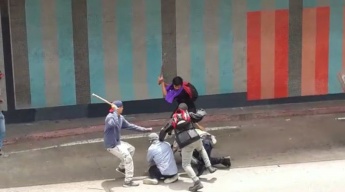
Unarmed police beaten by demonstrators (teleSUR)
In a video that has circulated widely on social media, another officer can be seen falling to the ground after receiving a blow from a stick-wielding demonstrator and subsequently being beaten while prostrate by five men with sticks.
Another police functionary, Genessis Llovera Mambie, suffered the dislocation of her right shoulder while officer Erick Escalante came away with post-trauma bursitis in his left shoulder and a knee lesion.
Despite international media reports of police repression against protesters, PNB personnel were prohibited from carrying armaments and were only permitted to use tear gas if authorized by superiors.
“Our only order was to prevent people from entering Avenida Libertador, and we didn’t even have any sort of arms… it was inevitable [that people entered] because we only had shields to protect ourselves physically,” added Alvarez, who declined to show her face to the camera for fear of reprisals.
Seven men suspected of perpetrating the attacks were arrested in the heart of the wealthy eastern Caracas municipality of Chacao on Wednesday afternoon and were subsequently transported to the July 26th Penitentiary in Guarico state where they will await charges.
According to authorities, one of the suspects, Jheremy Bastardo Lugo, is a repeat offender who was reportedly arrested during the 2014 anti-government protests that saw opposition supporters erect violent barricades across the country, leading to the death of 43 people, the majority of whom were state security personnel and passerby.
Student residences vandalized
In addition to the violent incident on Avenida Libertador, protesters are reported to have vandalized a government-constructed student residence in Plaza Venezuela, breaking windows and allegedly attempting to set the building on fire.
“With sticks, stones, and gasoline, they were going to burn down the residence and the guards. I was attacked by hooded men armed with stones and bottles,” said student resident Angel Rodriguez.
“For having a different political ideology, they broke the windows, my comrades were attacked,” another student told teleSUR.
El Libertador Mayor Jorge Rodriguez denounced the day’s violent episodes and vowed to press charges against those responsible.
“This is the reason why we didn’t give them a permit to march to the city center,” he stated, pointing to the broken windows of the student residence.
Capriles blames “infiltrators”
Former opposition presidential candidate Henrique Capriles publicly blamed the violence on “infiltrators”, calling the incidents a “set up” by the government.
“We know the plan, but we are not going to stop protesting. We are not afraid, we will [protest] in the face of the infiltrators, because it is our duty to fulfill the Constitution,” he stated.
However, Wednesday’s protest was not the only instance in which the Miranda state governor has condoned violent demonstrations.
Last week, the former presidential candidate was also involved in his own confrontation with police, as he and his supporters attempted to physically break a police line in Miranda state.
Following his narrow defeat in the 2013 elections, Capriles also refused to honor the internationally-recognized result, urging his supporters “vent their rage” in street protests that left seven people dead and saw numerous government health clinics and food markets burned.
In the lead up to Wednesday’s protests, Capriles issued a public statement to members of the Venezuelan armed forces, urging them to reject a state of exception expanded by President Maduro on Friday and oppose alleged attempts by the government to block the recall process.
“Prepare the tanks and war planes… the hour of truth is coming to decide whether you are with the constitution or with Maduro,” he declared on Tuesday.
Earlier this week, a special commission responsible for supervising the referendum process announced that 190,000 signatures collected by the opposition as part of the initial recall request belonged to deceased individuals.
The statement has been sharply denounced by opposition leaders who accuse the CNE of intentionally dragging out the process in order to prevent the recall referendum from being held this year.
Unless the referendum is held in 2016, a successful recall vote will not trigger new presidential elections, with the sitting vice-president instead taking over as president for the remainder of the term.
Venezuelan President Slams US “Double” Incursion into National Airspace
By Rachael Boothroyd Rojas | Venezuelanalysis | May 18, 2016
Caracas – Venezuelan President Nicolas Maduro has hit out at “mounting aggressions” against his government after it was confirmed that a US plane had twice violated Venezuelan airspace.
The US Boeing 707 E-3 Sentry is reported to have illegally entered Venezuela’s national airspace on May 11th at 6.09am, as well as on May 13th at 6.03 am.
Both incursions were detected by Venezuela’s Bolivarian airforce and have sparked rumours that the US might be conducting covert spying operations over Venezuela.
“This plane has all the mechanisms to carry out electronic espionage,” stated Maduro on his television programme Tuesday.
According to US Airforce information, the Boeing 707 E-3 Sentry provides an accurate, real-time picture of the battlespace to the Joint Air Operations Center, and possesses a powerful radar to “detect, identify and track enemy and friendly low-flying aircraft”.
The double incursion comes as rightwing politicians at home and abroad step up their demands for military intervention against Maduro’s government.
Last Thursday, a former Colombian president made headlines after publicly enquiring which “democratic country is willing to put its armed forces at the service of the protection of the Venezuelan opposition?”
Likewise, rightwing “Justice First” politician and former Venezuelan presidential candidate, Henrique Capriles Radonski, yesterday encouraged Venezuelan troops to form a mutiny against the national government.
“Prepare the tanks and war planes,” said the politician
“The hour of truth is coming to decide whether you are with the constitution or with Maduro,” he added.
A frenzy of international media reports over the last two weeks have painted an apocalyptic vision of the struggling South American country, citing a lack of access to basic food and medicine, skyrocketing inflation and devaluation of the national currency.
“I can say today that we are victims of the worst media, political and diplomatic aggression that our country has lived through in the past ten years,” stated Maduro.
The head of state has confirmed that his government will deliver an official complaint on the airspace incursions to US authorities.
Parliamentary Coups: the New Strategy of Latin America’s Right
By Pablo Vivanco – teleSUR – May 12, 2016
Like Honduras and Paraguay, Brazil’s elites used the legislature against Dilma Rousseff. Is Venezuela next?
For most, the decades of the 1970’s and 1980’s are regarded as a dark period for Latin America.
The majority of South American nations were taken over by brutal military juntas, while in Central America civil wars claimed the lives of hundreds of thousands. The armed forces in the region, often trained and financed by the United States, ruled through force and where civilian governments didn’t heed their agendas, these were ignored or overthrown.
Despite entailing the onslaught of disastrous neoliberal economic policies that exacerbated poverty and inequality, the 1990’s also ushered in an end to the military dictatorships in Latin America. Elected governments returned to Chile, Argentina, Brazil, Uruguay and Paraguay, while peace accords in Guatemala and El Salvador also meant that the militaries would see a diminished role in the politics of those countries (at least in theory).
Latin America did not solve its numerous problems, but a general consensus was arrived at — no coups or military regimes should be permitted again in the region.
Of course, this consensus began to break with the resurgence of Latin America’s left, beginning with the Bolivarian movement and Hugo Chavez in Venezuela. Even though he initially harbored very modest proposals for reforms, Venezuela’s ruling class almost immediately sought to topple Chavez’s government. In April 2002 they acted as Latin American elites had done in previous decades and enlisted the upper echelons of the military to stage a coup to remove Chavez. The results were predictable — Venezuelans revolted against the coup and its leaders and the region (except for the U.S. government led by George W. Bush), rejected the move.
The lesson: military coups make for bad PR.
As the decade and Latin America’s left advanced, the regional right adopted a different strategy to counter the trend. While in many countries the left was winning presidencies, in these countries the legislative branches remained largely under the control of traditional (and generally right-wing) parties. Far from providing checks and balances on the authority of the executive branch, opposition-controlled legislatures began to be used as the instrument to overthrow elected presidents.
The first test came in 2009, when Honduran President Manuel Zelaya was removed from office after calling for a non-binding referendum on changing the country’s constitution. The Honduran Congress had voted to remove Zelaya from office, and the country’s Supreme Court — dominated by figures connected to the previous military government — ordered his arrest. The Honduran military dutifully complied with their order, kidnapping Zelaya and forcing him onto a plane to Costa Rica.
Three years later, Paraguay’s parliament impeached President Fernando Lugo, a former bishop who ended 61 years of one-party rule in the country. The charges and process against Lugo were met with skepticism in Paraguay as well as in the region, prompting Paraguay to be suspended from the Mercosur pact.
The impeachment process against the president of Latin America’s largest nation mirrors the intentions of the coups of the 70’s and 80’s and the methods of those in the last decade. Despite the absence of evidence that could justify an impeach against Dilma Rousseff, a majority of Brazilian legislators — many of whom are implicated or being investigated in a massive corruption scandal — have approved removing her from the office she was elected to. The man who will fill the seat is one of those being investigated, but he faces no repercussions from his colleagues.
In neighboring Venezuela, the opposition-led National Assembly has the same objective and has initiated the “recall” clause in the country’s constitution in an attempt to oust Nicolas Maduro from the Miraflores presidential palace.
In all of these cases, the objective is not merely power, but what power facilitates. Since 1998, numerous left-leaning governments have been elected to redistribute wealth and decision-making power. Not only has this led to inequality and poverty being slashed, but the political dynamics in those countries have shifted and the region has become more unified and independent.
The new strategy to stem the Pink Tide builds from the same objectives as those employed by the dictatorships of Pinochet, Videla and others: stop the left from being able to implement its program. But while it uses one elected institution to subvert another, it should be clear that these maneuvers are no less undemocratic than their military predecessors.
Pablo Vivanco is Director of teleSUR English.
Venezuela’s Supreme Court Strikes a Blow to the Impunity of Liberal Terror
By LUCAS KOERNER | Venezuelanalysis | April 22, 2016
Last week, the Venezuelan Supreme Court blocked the extremely controversial Amnesty Law passed by the country’s opposition-controlled legislature, which would have pardoned scores of right-wing leaders convicted of violent political crimes.
The bill is applicable to all manner of felonies and misdemeanors committed since January 1, 1999, including “damage to the national electrical system”, “violence or resistance to authority” and even “conspiracy and terrorism”, provided that these crimes were perpetrated in the course of “demonstrations, protests, or meetings for political purposes”.
The opposition’s Amnesty Law even goes as far as to list specific incidents that qualify for amnesty, ranging chronologically from the 2002 US-sponsored coup to the 2014 violent opposition protests known as guarimbas.
In short, the law amounts to a hand-written confession of seventeen years of right-wing terror aimed at overthrowing the country’s democratically-elected Chavista government.
According to the high court, the legislation would enact a “scandalous impunity to the detriment of public morals, subverting the ethical and juridical order of the country”.
Despite the entirely reasonable character of this objection, the ruling was nonetheless derided as yet more evidence of Venezuela’s authoritarian collapse by of the self-anointed ideological guard-dogs of liberal democracy.
Western Apologia for Political Violence
On Thursday, Human Rights Watch Americas Director José Miguel Vivanco accused the top tribunal of “upholding abuse” in sanctioning the criminal prosecution of opposition leaders for “legitimate political activities”.
Given HRW’s highly dubious track record on Venezuela, it is unsurprising that they would categorize as “legitimate” universally outlawed offenses such as “individual terrorism”, “use of minors to commit crimes”, and “mutiny, civil rebellion, treason, military rebellion”.
In regurgitating the law’s perverse logic that these felonies merit amnesty since they were committed with “political purposes”, HRW’s alleged human rights advocacy begins to look more and more like a naked apology for anti-government political violence in Venezuela.
Even more predictable was the response of the Washington Post– the mouthpiece of the US neoconservative establishment– which in a recent editorial cited the Supreme Court ruling in its case for “political intervention” in Venezuela as if US imperial interference in the South American country’s internal affairs was not a long established practice over the last 17 years of leftwing Chavista governance.
Of course, the Western interventionist chorus would be incomplete without the US State Department weighing in on the matter.
In the lead-up to the parliamentary vote on the bill, Undersecretary of State for Western Hemisphere Affairs Roberta Jacobson met with Lilian Tintori, the wife of jailed far right politician Leopoldo Lopez, issuing a call for the “immediate release” of those she termed “political prisoners”.
Absent from her statement was any mention of the fact that Lopez was formally convicted of leading 2014’s violent anti-government protests known as “the exit”, which resulted in 43 dead and hundreds injured, the majority of whom passerby and state security personnel.
An Excess of Judicial Independence?
Following the ruling, the US State Department released its 2015 human rights report in which the body sharply castigated Venezuela for its alleged “lack” of judicial independence as well as its “use of the judiciary to intimidate and selectively prosecute government critics”.
For a moment, let’s bracket the obscene hypocrisy of these accusations coming from a country that has produced such shining examples of judicial independence such as Bush v. Gore and Citizens’ United and whose judiciary has gone to incredible lengths to guarantee due process to political prisoners such as Leonard Peltier, Mumia Abu Jamal, and Oscar López Rivera.
Let us be clear: Washington’s problem with the Venezuelan Supreme Court is not its lack of independence, but rather that it is too independent from the country’s neo-colonial oligarchy that it refuses to follow their dictates.
Prior to Chávez, a man of the aristocratic stature such as Leopoldo López– the Harvard-educated son of one of Venezuela’s wealthiest families– would never face conviction for his crimes, which include publicly inciting the violent ouster of the democratically-elected government.
In the eyes of the West, what is thus intolerable about the Supreme Court decision to strike down the Amnesty Law and uphold the conviction of López and dozens of others is not its supposed violation of the rule of law, but its full application against the most powerful elements of Venezuelan society.
Against Liberalism
In a word, the mortal sin of Venezuela’s judiciary was to defy the hegemonic ideology of liberal democracy for whom equality before the law is treated as a mere formalism that is professed but never practiced.
In this regard, the Venezuelan Constitution states that, “The law will guarantee the juridical and administrative conditions so that equality before the law is real and effective… it will especially protect those persons… who find themselves in circumstances of clear weakness and will punish the abuses and mistreatment committed against them.”
This conception of legal equality as a radical defense of the weak and oppressed openly clashes with the liberalism enshrined in the US Constitution in which the principle of “equal protection of the laws” codified in the 14th Amendment is formal in character, lending itself to appropriation by corporations who secured the right to personhood long before African-Americans.
Within this framework, the Venezuelan Supreme Court found that the Amnesty Law is unconstitutional primarily because it amounts to a sanctioning of “contempt for the life, integrity, and dignity of… those harmed by the amnestied acts, affecting their right to access justice.”
That is, the high court ruled that the rights of the victims of right-wing terror– mostly black, brown, and poor– take precedence over the privileges of the perpetrators, much to the outrage of the Venezuelan oligarchy and its US imperial masters.
What is at stake here is not some local politicized skirmish over separation of powers but a profoundly universal ethical dispute over what kind of world we want to live in: one in which the normative order guarantees the life and human dignity of the oppressed, or alternatively one in which their oppressors are given carte blanche to murder and terrorize.
Venezuela’s Supreme Court has been crucified by the powers that be for unacceptably choosing the former.
Venezuelan Parliament Goes on Offensive to Oust Maduro
By Lucas Koerner | Venezuelanalysis | April 21, 2016
Caracas – Venezuela’s opposition-controlled legislature passed a constitutional amendment in first discussion this Wednesday. If approved by popular referendum, the reform will cut short the terms of mayors, governors, and even the current president, triggering presidential elections later this year.
The proposed amendment seeks to modify articles 160, 174, 230, and 233 of the constitution, reducing gubernatorial, mayoral, and presidential terms from six to four years and prohibiting more than one consecutive reelection.
Supporters are billing the reform as a check on executive powers, but detractors have derided it as a ruse to force the country’s current leftist president from office before his term is up.
Controversially, the bill’s authors propose that the amendment would not only affect future elected terms, but retroactively be applied to Venezuelan President Nicolas Maduro’s current 2013-2019 term in office. The approved reform would see Maduro’s presidency come to an end on January 10, 2017.
The proposal is now awaiting final approval by the National Assembly, which would trigger a popular vote on the reforms within 30 days.
In line with the country’s constitution, all amendments to the Magna Carta must first be approved by a nation-wide referendum before coming into effect.
If the Venezuelan electorate approves the reform, the legislation would force presidential elections to choose Maduro’s successor before December 11th this year.
The amendment would also alter the transition procedure in the event that the president is recalled, impeached, or resigns, naming the National Assembly president and not the vice-president as president in the interim period. In such a situation, Venezuela would see veteran right-wing opposition leader Henry Ramos Allup take the reins over the country.
The amendment has however been met with sharp criticism by members of the minority socialist parliamentary bloc, who denounced the measure as unconstitutional.
“[The proposed amendment] violates articles 340, 341, and 342 of the constitution, according to which, an amendment is only a simple modification of one or various articles without altering the spirit of the document,” declared socialist party (PSUV) legislator Edwin Rojas.
“Amendments are not designed to reduce or revoke an elected mandate because the recall referendum already exists for that purpose,” he added, describing the move as a thinly veiled attempt to oust the country’s democratically-elected leftist president.
Recall Referendum
The pro-Maduro minority bloc also took aim at the Organic Referendum Law that was approved in second discussion on Wednesday.
According to its backers, the legislation seeks to streamline the process for convening recall referenda, shortening the time necessary for the procedure from eight months to five.
The right-wing parliamentary majority has accused the National Electoral Council (CNE) of obstructing its efforts to convene a recall referendum against President Maduro by allegedly stalling in turning over the official sheets for signature collection.
However, members of the leftist parliamentary coalition likewise condemned the proposed law as unconstitutional, as well as an attempt to override the country’s legally recognised electoral monitoring body, the CNE (National Electoral Council).
“The Referendum Law is an initiative of the opposition that is full of vices given that the Venezuelan Constitution clearly establishes that the electoral arena is the exclusive responsibility of the electoral authority [CNE],” argued the young PSUV lawmaker Jorge Perez.
Constitutional scholars have also raised doubts over whether the opposition-controlled chamber can pass the legislation given that the Venezuelan Constitution specifies that organic laws must be approved by a two-thirds super majority.
“We should realize the foolishness of the powerless opposition majority in the National Assembly promoting a law that it won’t be able to approve unless it miraculously convinces three Chavista legislators in order to reach the 112 required votes,” writes constitutional lawyer Jesus Silva on Aporrea.
If the law is approved without three-fourths backing, it will remain merely “symbolic” only to be subsequently struck down by the Supreme Court, he continued.
Although the rightwing Roundtable of Democratic Unity (MUD) coalition initially gained the 112 seats needed for a super-majority, three of their lawmakers and one Chavista were temporarily suspended following reports of vote-rigging.
Parliamentary Bloc Launches Offensive
Together the amendment and the recall referendum form part of a “roadmap” for ousting President Maduro announced by right-wing MUD coalition in March.
The simultaneous set of strategies also includes plans for street mobilizations to demand the resignation of the leftist president as well as a constituent assembly to rewrite the 1999 Constitution.
Critics have nevertheless held up the plan as an indication of the opposition’s sharp internal divisions, evidencing their failure to unite around a single strategy.
Is US-Funded Destabilization in Latin America Now Paying Off?
By Francisco Dominguez – teleSUR – April 14, 2016
Most progressive governments in Latin America find themselves under intense attack in what is evidently a well synchronized and well financed continental plan of destabilization.
Riots, street demonstrations, anti-corruption campaigns, protests about the domestic negative impact of the world economic crisis, general strikes, impeachment efforts, economic sabotage, and the like, have become the battle horses on which oligarchic forces in cahoots with Washington are riding to carry out “regime change.”
So far, conservative forces in Latin America have been successful in overthrowing President Manuel Zelaya in Honduras in 2009 and President Fernando Lugo in 2012 in Paraguay. Both presidents were ousted by oligarchic parliamentary majorities with mass support from middle class “civic associations”, in complicity with the judiciary, with the latter providing a veneer of legality.
The preconditions for “regime change” take, in some cases, years of careful preparation. This normally involves intoxicating media campaigns of demonization aimed to exacerbate political polarization to the maximum, through the instilling of fear, the staging of aggressive and sometimes violent, middle class mobilizations, the activating of many associations of civil society, and the setting up of, sometimes hundreds, of externally funded NGOs.
The aim is to question the legitimacy of the “target government” which usually involves the systematic discrediting of existing political institutions so as to foster chaos as the most conducive context for “regime change”. This strategy has been “theorized” in manuals that are mass-produced and get heavily promoted free of charge by establishment outfits.(1)
Despite the fastidiousness with which Washington and domestic perpetrators seek to enshrine their efforts at “regime change” in any one nation with the veil of legality, constitutionality, democracy promotion, regional autonomy, and virtuous legitimacy, always a powerful media apparatus is activated the world over, unleashing a barrage of negative reporting and demonization of the “target government” with one overriding message: the solution to created crisis is the ousting of the government.
The favorite demonization is to label the “target government” as a totalitarian dictatorship or in the process of becoming so, unless stopped. This is coupled with regular official condemnatory statements of the “target government” from the U.S. State Dept. and a barrage of U.S. official bodies.
In this “regime change” narrative, the ousting of the target government, being the cause of “civil society’s rebellion”, is fully justified. Thus for example the highly illustrative New York Times editorial of April13, 2002, on occasion of the brief ousting of Hugo Chavez: “Venezuelan democracy is no longer threatened by a would-be dictator.”
The NYT explained that Chavez had been ousted “after the military intervened and handed power to a respected business leader.” The key, therefore, is to portray the “ruler” of the target government as a threat to democratic civilization, thus the NYT editorial justifies the 2002 coup in Venezuela because Chavez “battled the media and alienated virtually every constituency from middle-class professionals, academics and business leaders to union members and the Roman Catholic Church.(2)
So, 21st century “regime change”, different from the more traditional 20th century U.S.-orchestrated coup d’état, involves an intense “battle for hearts and minds”, an essential component of the strategy.(3) Thus, huge financial, political and cultural resources are mobilized to bring about hegemony for “regime change” in society and in all state and civil society institutions, going as far, in some cases, as even co-opting sections of the downtrodden. Most of this is “facilitated” with generous NED and USAID grants awarded over many years.
Faced with its own steady decline and the rise of radical governments in the post-Soviet era, the U.S. seeks to destabilize and oust governments through “color revolutions” as in Georgia, 2003 and the Ukraine, 2004 and 2014. Consequently the U.S. has substantially reorganized its architecture for intervention with the CIA becoming a mere appendix but with USAID and the National Endowment for Democracy and their many associated bodies taking center stage and receiving the lion’s share of the resources. The modality may have changed but U.S. foreign policy remains pretty much what it was: to remove governments it does not like. U.S. State Dept. and USAID budget is bigger than the GPD of many states, in 2016 it was US$50.3 billion.
Among the key U.S. institutions involved in “regime change” is the U.S. State Department, the body with the biggest authority, but there is also the United States Southern Command, the Congress and Senate Foreign Affairs Committees, and the CIA. Then further down the food chain, there are USAID, NED, Office for Transition Initiatives, American Center for International Labor Solidarity and American Institute for Free Labor Development, among the most important ones.
They work closely together and in the pursuance of the same aims, with the International Republican Institute, chaired by John McCain of CHECK; the National Democratic Institute, chaired by Madeline Albright; Transparency International; and Centre for International Private Enterprise. They all channel huge sums to support civil (and when possible) military subversion to create the conditions for “regime change”. They also channel huge sums to fund “civil society” associations, political parties, media outfits, NGOs, professional bodies, trades unions, think tanks, business, student groups and so forth.(4)
These institutions are the field commanders that coordinate the national detachments in every target country around a regional perspective so as to maximize the results of every push for “regime change” in any individual Latin American nation. We are increasingly seeing former right-wing Latin American presidents acting jointly to contribute to the destabilization of Bolivarian Venezuela, for instance.
Additionally there is a raft of “private” or “independent” bodies concerned chiefly with Latin America, the most important of which are Inter-American Press Association; Fundacion para el Analisis y los Estudios Sociales – led by Jose Maria Aznar; the Instituto Prensa y Sociedad; hundreds of Think Tanks; and possibly thousands of NGOs that share the “regime change” aim but that do it from a specialist angle. To all of this architecture of U.S. intervention, the overwhelming majority of the world corporate media play a decisive role, making any U.S. led intervention, a lethal political threat to the survival of any “target government”.
Most progressive governments in Latin America have been or are subjected to systematic levels of traumatic and deliberately created social, economic and political chaos, politics and culture, which in many cases it can go on for years. In Cuba for five decades, in Nicaragua (on and off) nearly four decades and in Venezuela for 17 years thus far, with no end in sight.
Venezuela’s Bolivarian government is currently in the crosshairs of U.S. destabilization plans and “regime change” efforts through an economic war that has the Bolivarian process on the ropes. In Argentina, three years of an intense dirty war against Cristina Fernandez’s government, aspects of which had sinister overtones, paid off when at the November 2015 presidential election, the Right’s candidate, Mauricio Macri, won the election by a small margin of 1 percent. In Ecuador, a police mutiny in September 2010, obviously instigated from abroad and with huge U.S. support, nearly succeeded in ousting the government with with President Rafael Correa miraculously escaping with life.
The destabilization against Ecuador continues with the “revolt” of civil society and very violent street protests. And in Brazil, through a very intense and thoroughly intoxicating media campaign, a “regime change” push seeking to oust the democratically elected and legitimate president Dilma Rousseff is underway, as we write it is not clear whether the effort to oust Dilma will be successful or not.
By substantially reducing export revenues that fund progressive social programs, the persistent world economic crisis significantly helps the “regime change” efforts by the U.S. and its allies. It may be just coincidence but the U.S. ambassador in Paraguay when elected president Fernando Lugo was ousted by a right-wing parliamentary coup, was Liliana Ayalde. The current U.S. ambassador in Brazil, where a right-wing parliamentary coup against elected president Dilma Rousseff is in progress, is Liliana Ayalde.
Bolivar once said that the United States appears to be destined by Providence to plague America with misery in the name of liberty. Exactly, through the NED, USAID and others, the United States must stop destabilizing elected governments in the name of “democracy,” “good governance” and “national security.”
Francisco Dominguez is a senior lecturer at Middlesex University, where he is head of the Centre for Brazilian and Latin American Studies.
(1) See Gene Sharp, “From Dictatorship to Democracy,” Serpent’s Tail, 2011, first published in 2002.
(2) “Hugo Chavez Departs,” New York Times, April 13th, 2002
(3) The overthrow of Honduras President Manuel Zelaya, in June 2009, has led to the book with the very suggestive title “The Good Coup” (Mario Caceres di Iorio, CCB, Canada, 2010).
(4) See “Evolution of USAID and NED in Dominguez,” Lievesley and Ludlam, Right-Wing Politics in the New Latin America, Zed, 2011.
Venezuelan Opposition Rejects Truth Commission Despite Presence of UNASUR, Ex-Presidents
By Lucas Koerner | Venezuelanalysis | April 15, 2016
Caracas – Venezuela’s right-wing opposition coalition, the Roundtable of Democratic Unity (MUD), announced Tuesday it will not participate in the new Truth Commission established by the national government to investigate 2014’s violent anti-government protests known as the guarimbas.
The commission is a response on the part of the administration of President Nicolas Maduro to an amnesty law passed by the country’s right wing-controlled parliament, which was ruled unconstitutional by the Supreme Court (TSJ) Monday on the grounds that it would sanction impunity by freeing those convicted of violent crimes provided that they were committed “with a political end”.
Denouncing the TSJ ruling as politicized judicial activism, the MUD broadcast its refusal to participate in the Truth Commission, questioning its impartiality despite the presence of UNASUR Secretary General Ernesto Samper as well as ex-presidents from Panama, Spain, and the Dominican Republic.
“We’re not going to fall for their booby trap of offering to release a few political prisoners who have every right to be free in the context of some truth commission handpicked by the government and announced on television,” said National Assembly President Henry Ramos Allup.
In particular, the Democratic Action leader took aim at Samper, who he accused of “partiality” towards the government in refusing to take a stance on the Amnesty Law and the TSJ decision.
Samper, for his part, dismissed the criticisms, citing UNASUR’s commitment to non-interference in the internal affairs of its member states.
The former Colombian president praised the commission as “one of peace, not of war” that will “offer Venezuelans the possibility to find a path of sincere dialogue.”
In addition to the UNASUR chief, the commission will include Jose Luis Rodriguez Zapatero, Martin Torrijos, and Leonal Fernandez, the former presidents of Spain, Panama, and Dominican Republic, respectively.
The commission was officially opened on Tuesday. According to Vice-President Aristobolo Isturiz, it will be tasked with “visibilizing and hearing [the testimony of] people affected by the violent acts that occurred in the country [in 2014],” in which 43 people were killed and over 800 injured.
Washington Post Lies to Justify Intervention in Venezuela
teleSUR | April 13, 2016
The noted Brazilian political scientist and theologian Frei Betto recently said that “the Yankees will do everything so that our continent will go back to being their backyard.”
Despite the rhetoric about democratic values that emanates from Washington, the U.S. government has always been willing to use any means necessary to impose their will on Latin America. This has often translated into foreign intervention.
But the U.S. public has grown weary of their government’s imperialist adventures, which as of late have ended in utter disaster. Washington elites know they must first fool the public into believing that intervention is a necessity.
To accomplish this they turn to private media outlets and their editorial boards, who help drum up support for U.S. intervention in foreign countries.
Enter the latest example: a recent editorial by the Washington Post entitled: “Venezuela is in desperate need of a political intervention.”
This from the same paper that was once vilified by U.S. conservatives for its supposed leftist tilt.
The use of the word intervention is deliberate, the Post knows that the Bolivarian Revolution – started by Hugo Chavez and continued by his successor Nicolas Maduro – still commands enormous support. The Venezuelan people will not simply hand the state back over to the very same politicians that abused the working class for decades.
An intervention done in the name of the Organization of American States, as the editorial calls for, is still imperialist. And it’s not just Venezuelans who know it but the whole region, which has seen the OAS used time and again to legitimize the imperialist fancies of the U.S. in the region.
The Post also knows that deceiving their audience sometimes requires outright lies.
Like the New York Times editorial on Venezuela that proceeded the Post’s, the editorial team claims that lack of cooperation between the Maduro government and the opposition-controlled National Assembly is entirely the fault of Maduro.
The Post claimed that he “pursued scorched-earth warfare with the National Assembly,” while the Times claimed that it opposition only reluctantly settled on ousting the democratically-elected Maduro from power.
Lies. All of it.
From the moment they were declared the winners of the parliamentary election, the opposition said their goal was ousting Maduro from power.
There was never an opportunity for cooperation between the Venezuelan government and the opposition and the blame for that lies with the opposition. On the day the new parliament was sworn in, Henry Ramos Allup, a leading figure in the opposition, literally ran his finger across his throat to indicate his feelings about the government and its supporters.
Does that sound like a politician interested in dialogue? Hardly unsurprising that the Post would chose to leave that detail out.
But lying through omission isn’t enough for the Post editorial board. They fancy themselves legal experts, able to pass judgment on Venezuela’s division of powers and the decisions of its Supreme Court.
The Post took issue with the court’s decision to rule a highly controversial “amnesty” bill as unconstitutional. This bill doesn’t promote amnesty for so-called political prisoners, it affords impunity for people directly responsible for the deaths of dozens.
The objective of the opposition’s impunity bill was the release of politicians involved in efforts to oust Maduro by force, politicians like Leopoldo Lopez who was found guilty of inciting the violent protests that led to the deaths of 43 people.
Of course the truth doesn’t fit their narrative, so the Post brazenly claims that state security forces were largely responsible for the deaths during the 2014 protests. The truth is the vast majority of those killed were either innocent bystanders, government supporters, or state security officials.
It wasn’t the state that set up violent blockades, it wasn’t the state that strung up barbed wire so that passing motorists would be decapitated, it was Lopez’s supporters.
Venezuela is confronting a major economic crisis, that much is true, but the Post doesn’t bother with an investigation as to why. No, instead it blames everything on Maduro, including the drought that is affecting Venezuela’s ability to produce electricity. The same drought that is causing similar problems in neighboring Colombia. Is that too the fault of Maduro?
Seems as if the Post’s editorial board is also gifted with the power of premonition, predicting that the opposition’s efforts to prematurely end Maduro’s mandate would be declared void.
Media outlets made the same sort of predictions ahead of the 2015 parliamentary elections, claiming that the government would not recognize the results. Of course Maduro immediately recognized the results.
The opposition is free to pursue a recall referendum against Maduro, as they did with Chavez, which they lost. All that Venezuela’s electoral authority asks is that they follow the rules, something they seem unable to do.
As for an effort to pass a law to shorten Maduro’s term, well even the Post’s friends at the Times understands that “it would be hard to justify carrying out that change retroactively when Mr. Maduro was elected for a six-year term.”
Any foreign intervention, even one under the auspices of the OAS, would indeed result the kind of intense scenes the Post describes, but it would come as a result of millions of Venezuelans hitting the streets to reject it.
Venezuelans, and more broadly speaking Latin Americans, have lived through an era where the shackles of imperialism have been shed. They will not allow the region to become the backyard of the United States ever again.
Venezuela’s Political Killings: A Sign of the Repression to Come?
By Ryan Mallett-Outtrim | Venezuelanalysis | April 4, 2016
A mayor gunned down in a drive by shooting just meters from his own doorstep. A legislator shot by paramilitaries in plain sight outside a bodega. A solidarity activist butchered in a home invasion. Two police run over by militants in a stolen bus. These are just the latest in a wave of killings in Venezuela. The motives behind most of these killings remain unclear, though it’s hard to not be disturbed by what appears to be a growing wave of political violence gripping the country. In response, Venezuela’s right-wing, the mass media and even most human rights groups are all following a well worn script that seeks to downplay these killings, or at least deflect attention away from the context behind the violence. For example, Human Rights Watch’s latest report on Venezuela is basically just a call for Venezuela’s supreme court to be stacked with supporters of the right-wing political coalition, the MUD. Another of their recent reports focused on claims that imprisoned right-wing political figure Leopoldo Lopez didn’t receive a fair trial. Their third most recent report (at the time of writing) was another complaint about the Maduro administration’s human rights record, including false claims that “security forces violently cracked down on largely peaceful protests” in 2014. As I saw myself at the time, those suppressed “largely peaceful protests” included gangs of armed right-wing militants throwing Molotovs at hospitals, sniping at civilians from rooftops and setting up barricades to hold neighbourhoods hostage. Then and now, Venezuela is increasingly becoming a dangerous place for leftists.
Indeed, all the recent victims were either leftists, or police seeking to contain violent right-wing demonstrations. The latest victim was Marco Tulio Carrillo, the socialist mayor of a municipality in Trujillo state. Other victims include Haitian-Venezuelan solidarity activist Fritz Saint Louis, Tupamaro legislator Cesar Vera, and two police officers in Tachira state.
These killings take on a new dimension when contextualised: the right-wing MUD is preparing to oust Maduro, and wrestle control of all branches of the state from the left.
If they achieve this, the worst case scenario would be a return to the repression of the 20th Century, when leftists were all too often the targets of neoliberal regimes. Today’s right-wing has repeatedly shown it not only has no interest in disavowing violence, but is willing to turn on the Venezuelan people for their own political gain. From the 2002 coup to the violence of 2014, there has always been a sector of the right-wing that has never been afraid to use terror against ordinary Venezuelans. If it takes complete power, perhaps the MUD will learn to speak out against violence such as the recent killings, or perhaps not. After all, much of the MUD is generally slow to condemn violence against leftists, if they do so at all. So if they take complete power, will the right reign in their excesses, or rule with terror?
Featured Video

The Sordid History of the CIA – Part 2
or go to
Aletho News Archives – Video-Images
Book Review
Jeffrey Epstein: A Jewish Individual?
The Occidental Observer | February 5, 2023
One Nation Under Blackmail: The Sordid Union between Intelligence and Organized Crime that Gave Rise to Jeffrey Epstein (Volume 1 & 2) by Whitney Webb
“Far from being an anomaly, Epstein was one of several men who, over the past century, have engaged in sexual blackmail activities designed to obtain damaging information (i.e., “intelligence”) on powerful individuals with the goal of controlling their activities and securing their compliance.”[1]
Jeffrey Epstein is dead and Ghislaine Maxwell is locked away in prison, and the thought-makers of our world seem keen to let the more explosive parts of the scandal dissipate from the public consciousness. As far as the mainstream media is concerned, Epstein and Maxwell were little more than well-connected socialites who ran a sex-trafficking ring for the rich and the powerful, and the focus has shifted instead to the criminal and civil cases seeking to achieve redress for the victims of sexual abuse.
On occasion some newspaper articles will mention the hidden cameras littered across Epstein’s properties, others the reams of CDs and hard drives found within them during the FBI raids. Altogether missing from the Netflix documentaries (Jeffrey Epstein: Filthy Rich [2020] and Ghislaine Maxwell: Filthy Rich [2022]) or the articles that spend their time narrowly focusing on the links between Epstein and Bill Gates, is the acknowledgement of the true nature of Epstein himself and the ultimate purpose of this sex-trafficking of minors — a sexual blackmail operation.
Not everyone is cowardly enough to let these controversial aspects lie untouched, as the newly released two-volume book One Nation Under Blackmail by independent reporter Whitney Webb seeks to blow wide open this media-enforced blackout. Utilizing primarily open-source information (that is, publicly accessible information such as books, newspapers articles and government reports),[2] Webb’s book delves into the life and times of Jeffrey Epstein and his deep ties to Jewish billionaires and Israeli intelligence. … continue
Blog Roll
Recent Comments


 Aletho News
- Israeli army closes dozens of cases involving killing of Palestinians inside torture camps
- Europe creates a ‘Russian government-in-exile’, consisting of a bunch of losers
- Munich, 2007: The Day the West Was Told No
- At The Munich Security Conference, AOC Gets It Wrong On Foreign Policy
- Europe Decided to Go to War With Russia by 2030, Already Preparing – Orban
- Russia and China Are Expanding Their Cooperation to Counter US Efforts to Bully Iran and Cuba
- NATO plotting maritime blockade of Russia – Moscow
- Jeffrey Epstein’s sinister shadow over West Asia
- The Sordid History of the CIA – Part 2
- French FM under fire over ‘false’ claims about UN rapporteur
- If Americans Knew
- Israel battles Palestinian right of return, one Palestinian at a time – Not a ceasefire Day 127
- Noor’s short life of unimaginable suffering
- Israel Destroyed Gaza’s Hospitals. Now It’s Banning Doctors Without Borders.
- Is Spite of What Zionists Say, It’s a Good Thing to Criticize Governments
- Palestinian mother, daughter recount strip searches, harsh conditions in Israeli detention
- Israel used weapons in Gaza that made thousands of Palestinians evaporate
- ADL’s Stats Twist Israel’s Critics Into Antisemites
- Why Is the World Silent When the Gaza Genocide Is Not Over?
- In Gaza: 8,000 bodies under rubble, 3,000 missing – Not a ceasefire Day 126
- AZAPAC, the new PAC opposing Israeli domination of U.S policies
- No Tricks Zone
- Unfudging The Data: Dutch Meteorological Institute Reinstates Early 20th Centruy Heat Waves It Had Erased Earlier
- German Gas Crisis…Chancellor Merz Allegedly Bans Gas Debate Ahead of Elections!
- Pollen Reconstructions Show The Last Glacial’s Warming Events Were Global, 10x Greater Than Modern
- Germany’s Natural Gas Storage Level Dwindles To Just 28%… Increasingly Critical
- New Study Rebuts The Assumption That Anthropogenic CO2 Molecules Have ‘Special’ Properties
- Climate Scientist Who Predicted End Of “Heavy Frost And Snow” Now Refuses Media Inquiries
- Polar Bear Numbers Rising And Health Improving In Areas With The Most Rapid Sea Ice Decline
- One Reason Only For Germany’s Heating Gas Crisis: Its Hardcore-Dumbass Energy Policy
- 130 Years Later: The CO2 Greenhouse Effect Is Still Only An Imaginary-World Thought Experiment
- New Study Affirms Rising CO2’s Greening Impact Across India – A Region With No Net Warming In 75 Years
 Aletho News