Every social media company censoring for government – Elon Musk
RT | December 27, 2022
All social media platforms work with the US government to censor content, Twitter CEO Elon Musk claimed on Tuesday. Documents released by Musk following his purchase of Twitter showed that the platform colluded with the FBI, CIA, Pentagon and other government agencies to suppress information on elections, Ukraine, and Covid-19.
“*Every* social media company is engaged in heavy censorship, with significant involvement of and, at times, explicit direction of the government,” Musk tweeted, adding that “Google frequently makes links disappear, for example.”
Musk was referring to internal Twitter communications published by journalist Matt Taibbi, which suggested that the platform’s senior executives held regular meetings with members of the FBI and CIA, during which the agencies gave them lists of “hundreds of problem accounts” to suspend in the runup to the 2020 election.
In addition to Twitter, the government was in contact “with virtually every major tech firm,” Taibbi claimed. “These included Facebook, Microsoft, Verizon, Reddit, even Pinterest.” CIA agents “nearly always” sat in on meetings of these firms with the FBI’s Foreign Influence Task Force, Taibbi claimed, explaining that although this task force was convened to fight alleged election interference by foreign states, it made “mountains of domestic moderation requests.”
A lawsuit filed earlier this year by the attorneys general of Missouri and Louisiana alleges that officials from no fewer than 12 government agencies met weekly with representatives of Twitter, Facebook, and other Big Tech firms in 2020 to decide which narratives and users to censor, with topics ranging from alleged election interference to Covid-19.
A self-described “free speech absolutist,” Musk purchased Twitter for $44 billion in October. He has since released batches of documents shedding light on the platform’s previously opaque censorship policies. Published by several independent journalists, these document dumps have shown how Twitter suppressed information damaging to Joe Biden’s election campaign, colluded with the FBI to remove content the agency wanted hidden, assisted the US military’s online influence campaigns, and censored “anti-Ukraine narratives” on behalf of multiple US intelligence agencies.
The FBI said last week that correspondence between its agents and Twitter staff “show nothing more than examples of our tradition [of] longstanding and ongoing federal government and private sector engagements.”
The White House has refused to answer allegations that the FBI directed Twitter to censor information damaging to Joe Biden’s 2020 campaign.
House Democrats, Targeting Right-Wing Cable Outlets, Are Assaulting Core Press Freedoms
By Glenn Greenwald | February 23, 2021
Not even two months into their reign as the majority party that controls the White House and both houses of Congress, key Democrats have made clear that one of their top priorities is censorship of divergent voices. On Saturday, I detailed how their escalating official campaign to coerce and threaten social media companies into more aggressively censoring views that they dislike — including by summoning social media CEOs to appear before them for the third time in less than five months — is implicating, if not already violating, core First Amendment rights of free speech.
Now they are going further — much further. The same Democratic House Committee that is demanding greater online censorship from social media companies now has its sights set on the removal of conservative cable outlets, including Fox News, from the airwaves.
The House Energy and Commerce Committee on Monday announced a February 24 hearing, convened by one of its sub-committees, entitled “Fanning the Flames: Disinformation and Extremism in the Media.” Claiming that “the spread of disinformation and extremism by traditional news media presents a tangible and destabilizing threat,” the Committee argues: “Some broadcasters’ and cable networks’ increasing reliance on conspiracy theories and misleading or patently false information raises questions about their devotion to journalistic integrity.”
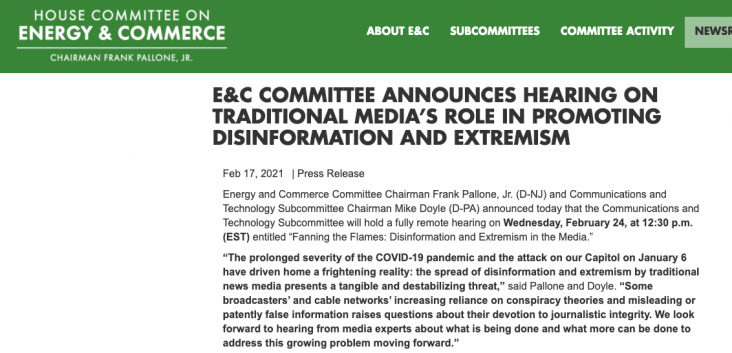
Since when is it the role of the U.S. Government to arbitrate and enforce precepts of “journalistic integrity”? Unless you believe in the right of the government to regulate and control what the press says — a power which the First Amendment explicitly prohibits — how can anyone be comfortable with members of Congress arrogating unto themselves the power to dictate what media outlets are permitted to report and control how they discuss and analyze the news of the day?
But what House Democrats are doing here is far more insidious than what is revealed by that creepy official announcement. Two senior members of that Committee, Rep. Anna Eshoo (D-Silicon-Valley) and Rep. Jerry McNerney (D-CA) also sent their own letters to seven of the nation’s largest cable providers — Comcast, AT&T, Spectrum, Dish, Verizon, Cox and Altice — as well as to digital distributors of cable news (Roku, Amazon, Apple, Google and Hulu) demanding to know, among other things, what those cable distributors did to prevent conservative “disinformation” prior to the election and after — disinformation, they said, that just so happened to be spread by the only conservative cable outlets: Fox, Newsmax and OANN.
In case there was any doubt about their true goal — coercing these cable providers to remove all cable networks that feature conservative voices, including Fox (just as their counterparts on that Committee want to ban right-wing voices from social media) — the House Democrats in their letter said explicitly what they are after: namely, removal of those conservative outlets by these cable providers:
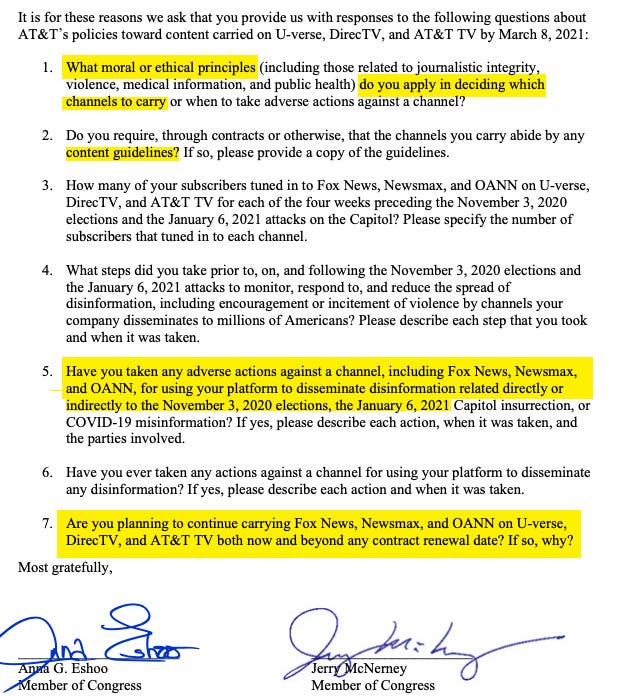
Congresswoman Eshoo boasted on her official site about these efforts, lauding herself and McNerney for “urging 12 cable, satellite, and streaming TV companies to combat the spread of misinformation and requesting more information about their actions to address misinformation, disinformation, conspiracy theories, and lies spread through channels they host.”
For the last four years, we were inundated with media messaging that Trump posed an unprecedented threat to press freedoms. The Washington Post even flamboyantly adopted a new motto to implicitly ratify that accusation (while claiming it was not Trump-specific). Other than the indictment of Julian Assange — which most Washington Democrats cheered — what did the Trump administration do in the way of attacking press freedoms that remotely compares to Democrats abusing their majoritarian power to force the removal of conservative cable outlets from the airwaves, just days after doing the same with dissident voices online?
There is not a peep of protest from any liberal journalists. Do any of the people who spent four years pretending to care so deeply about the vital role of press freedom have anything to say about this full frontal attack by the majority party in Washington on news outlets opposed to their political agenda and ideology?
Evidently not. While many conservative outlets are covering this story, it is difficult to find any liberal outlets writing about it at all. An article from The New York Times was one exception, though it largely attempted to justify these censorship efforts, with paragraph after paragraph purporting to demonstrate the dangerous misinformation spread by these channels. The only nods to the dangers for press freedoms in the article came from statements by Fox News and a GOP member of the Federal Communications Commission (FCC).
Revealingly, these same two members of Congress who sent this threatening letter to cable providers said during the Trump years that freedom of the press must be safeguarded at all costs. “The First Amendment prohibits Congress from making laws that abridge the freedom of the press, and we cherish our country’s culture of free expression,” they intoned when writing to the FCC in 2019 to complain that Russian news outlets were concealing their affiliation with the Kremlin. “We’re not requesting any press censorship,” they assured the FCC under Trump. Yet they are clearly doing exactly that now.
In a statement he emailed to me and publicly posted, FCC Commissioner Brendan Carr denounced the Democrats’ actions as a “marked departure from First Amendment norms.” He said “it is a chilling transgression of the free speech rights that every media outlet in this country enjoys.” In response to my inquiries, Commissioner Carr added in a separate statement to me:
The greatest threat to free speech in America today is not any law passed by the government—the First Amendment stands as a strong bulwark against that form of censorship by state action. The threat comes in the form of legislating by letterhead. Politicians have realized that they can silence the speech of those with different political viewpoints by public bullying. The letter sent by two senior Democrats on the House Energy and Commerce Committee to cable companies and other regulated entities, and the Committee’s own hearing this week on “disinformation in the media,” are the latest examples. They are singling out selected newsrooms for their coverage of political events and sending a clear message that these media outlets will pay a price if they do not align their viewpoints with Democrat orthodoxy. That is a chilling transgression of free speech and journalistic freedom. No government official has any business inquiring about the ‘moral principles’ that guide a private entity’s decision about what news to carry.
Carr’s GOP colleague on the FCC, Commissioner Nathan Simington, similarly accused House Democrats of seeking to “intimidate into silence those who would distribute on their platforms disfavored points of view.”
The way Democrats justify this to themselves is important to consider. They do not, of course, explicitly acknowledge that they are engaged in authoritarian assaults on free speech and a free press. Not even the most despotic tyrants like to think of themselves in that way. All tyrants concoct theories and excuses to justify their censorship as noble and necessary.
Indeed, the justifying script Democrats are using here is the one most commonly employed by autocrats around the world to silence their critics. Those they seek to silence are not merely expressing a different view, but are dangerous. They are not merely advocating alternative ideologies but are destabilizing society with lies, fake news, and speech that deliberately incites violence, subversion and domestic terrorism.
In her boastful posting, Rep. Eshoo says her efforts targeting these cable outlets are necessary because “misinformation on TV has led to our current polluted information environment that radicalizes individuals to commit seditious acts and rejects public health best practices, among other issues in our public discourse.” This is the rationale invoked by virtually every repressive state to imprison journalists and ban media outlets.
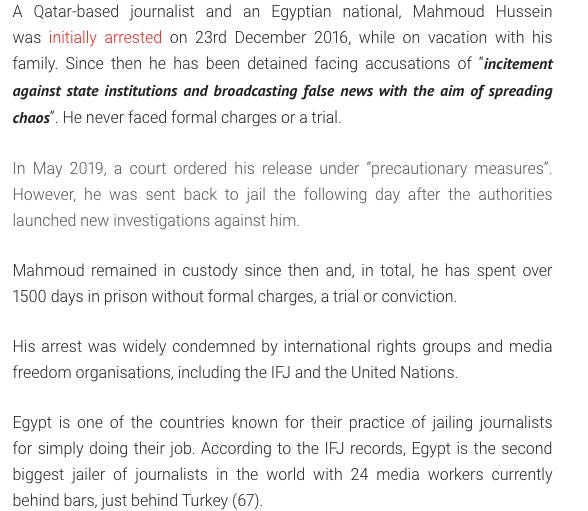
The Democrats sound a great deal like the Egyptian regime of Gen. Abdel el-Sisi. Just two weeks ago, Sisi’s regime finally released an Al Jazeera journalist who had been imprisoned for four years based on accusations that he had “spread false news” and was guilty of “incitement against state institutions and broadcasting false news with the aim of spreading chaos.” Sound familiar? It should, since that is precisely what House Democrats are saying to ennoble their multi-pronged assault on free expression.
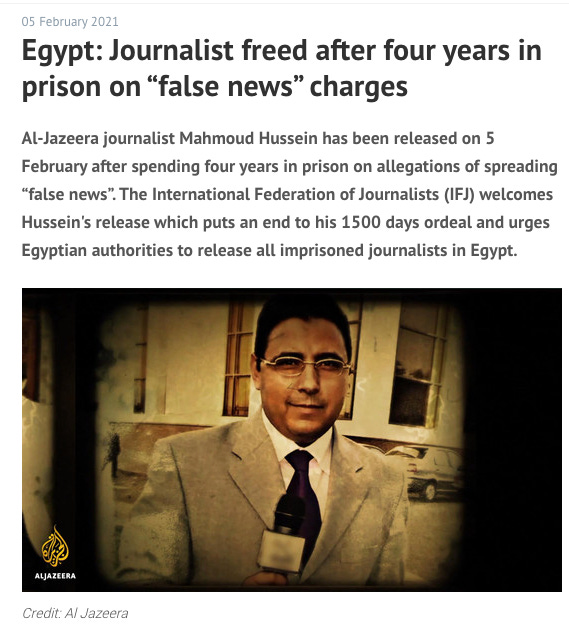
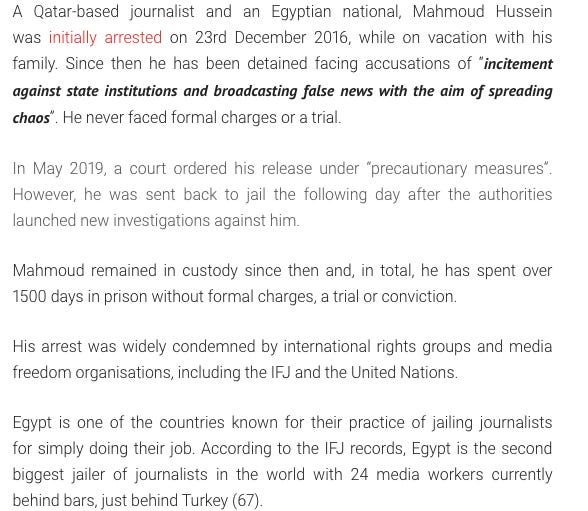 International Federation of Journalists, Feb. 5, 2021
Accusing one’s domestic opponents of being subversives and domestic terrorists is by far the most common way that despots on every continent justify their censorship and silencing campaigns of oppositional media outlets. In 2014, the French journalist Valeria Costa-Kostritsky warned in the Index on Censorship that anti-terrorism laws and accusations of promoting subversion were becoming the primary means which authoritarian states from Turkey and Jordan to Russia and the UAE use to justify the silencing of journalists:
Anti-terror legislation seems to be the perfect tool for a state seeking to crack down on opposition. “It’s so elusive. You can [see] anything as terrorist propaganda. There needn’t be any evidence of violence, any praise of violence. Plus, if you blame someone for having a connection with the [Kurdistan Workers’ Party] the public buys that argument easily, especially in a country that is suffering from terrorism, as Turkey is,” said Sevgi Akarçeşme, former editor-in-chief of Turkey’s Today’s Zaman (the English-language edition of daily Zaman), who had her newspaper taken over by the government in March 2016.
A similar means used by repressive governments to silence disfavored media outlets is to claim they are promoting “extremism.” As Costa-Kostritsky detailed:
There’s another word one can use to browse through reports published on the [Mapping Media Freedom] map: “extremism”. Anti-extremism legislation is used to intimidate journalists in post-Soviet countries, particularly in Russia. On the map, of the 35 incidents flagged with “extremism”, 11 took place in Russia, and seven in Crimea, others include Belgium, Italy, Hungary, France and Spain. Five reports connecting the media to “extremism” took place during the first half of 2016. They include website closures and journalists being put on a list of extremists. In Russia, most cases using anti-extremism legislations against journalists happen via Roskomnadzor, the national media regulator.
When China arrests journalists it typically justifies its actions by accusing them of fomenting extremism that jeopardizes national security.
And accusing journalists of spreading “fake news” — always a dangerously vague term from its inception — is equally commonplace when government authorities want to silence media outlets. The Washington Post reported that “as 2019 draws to a close, there are 30 journalists in jail worldwide on charges of ‘false news’ — or, as it’s also called these days, ‘fake news.’” In sum:
It has now become commonplace to throw around fake-news accusations in the United States. But in other countries around the world — like Egypt, Turkey, Somalia and Cameroon — such charges can have very chilling and stifling impacts on the press, according to an annual report by the New York-based Committee to Protect Journalists.
In Egypt — where General-turned-President Abdel Fatah al-Sissi has been overseeing a crackdown that human rights groups say is harsher than any before — there are 21 journalists in jail for allegedly publishing “false news,” according to the CPJ’s data. In practice, press freedom advocates say, these charges stem from a simple fact: The journalists published news that Sisi didn’t like.
In a passage that the Post would only publish about foreign countries but never about House Democrats, even though it now applies equally, they observed: “There is a serious global problem of disinformation spreading online and sowing distrust and sectarianism. The problem, say press advocates, is that the laws regulating fake news all too often are a means of stifling the media rather than fostering a more transparent environment online.”
This framework is hardly rare in the west either. When the Obama administration collaborated with the UK Government in 2013 to detain my husband David Miranda at Heathrow Airport in connection with the work he was doing in the Snowden reporting, they cited an anti-terrorism law to justify his detention, and repeatedly threatened to prosecute him for terrorism if he did not cooperate by providing all of his passwords to them. He ultimately prevailed in his lawsuit against the U.K. Government on the ground that it constitutes an illegal assault on press freedoms and human rights to abuse anti-terrorism frameworks to intimidate or silence journalists.
Justifying the silencing of journalists by accusing them of inciting domestic terrorism and extremism is now the most common means used globally for censorsing the press. The Committee to Protect Journalists in 2013 said they had “tracked a significant rise in journalist imprisonments.” The culprit, said the group, was “the expansion of anti-terrorism and national security laws worldwide” after the 9/11 attack, which had been repeatedly abused to criminalize media outlets. “The number of journalists jailed worldwide hit 232 in 2012, 132 of whom were held on anti-terror or other national security charges.” In sum: “CPJ’s analysis has found that governments have exploited these laws to silence critical journalists.”
Are there conspiracy theories and disinformation sometimes found on the conservative cable outlets which House Democrats want taken off the air? Of course there are: all media outlets disseminate conspiracy theories and fake news at times. MSNBC and CNN spent four years endorsing the most deranged conspiracy theory imaginable, one with very toxic roots in the Cold War: namely, the McCarthyite script that the Kremlin had taken over control of key U.S. institutions through sexual blackmail over the President, invasions into the nation’s heating system and electric grid, and criminal conspiracy between Moscow and the Trump campaign to hack into Democrats’ emails.
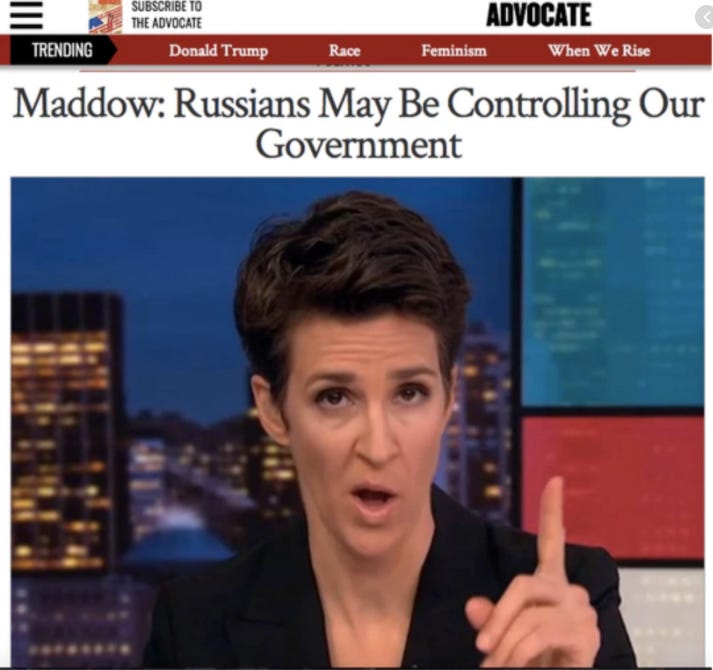
All of that was false, just as the one-month tale told over and over by the media about a pro-Trump mob murdering Brian Sicknick by bludgeoning him to death with a fire extinguisher was false — a story which remains unretracted or corrected by most who spread it.
Just imagine if, during the Trump years, the GOP Senate had abused its power to bully cable outlets into removing MSNBC from their platforms, or banning liberal journalists and activists from using social media platforms, on the grounds that they were spreading conspiracy theories and fake news. It is hard to overstate how extreme the rhetoric would have been that Trump and the Republicans were engaged in authoritarian measures to destroy free speech and a free press.
And I would have joined in those denunciations (as I did with the Assange prosecution): as much as I loathe so much of what those outlets do, it is not the role of the government to regulate let alone silence them. The corrective is for journalists to rebuild trust and faith with the public by exposing their misinformation and proving to the public that they will do accurate and reliable reporting regardless of which faction is aggrandized or angered.
But corporate media outlets and Democrats (excuse the redundancy) who spent the last four years posturing as virulent defenders of press freedoms never meant it. Like so much of what they claimed to believe, it was fraudulent. The proof is that they are now mute, if not supportive, as Democrats use their status as majority party to launch an assault against press freedoms far more egregious than anything Trump got close to doing.
Zuckerberg loses $7.2 BILLION after corporate ad boycott pressing Facebook to police ‘hate speech’
RT | June 27, 2020
Plummeting Facebook shares have wiped out billions of founder and CEO Mark Zuckerberg’s personal wealth. The impetus? Corporations such as Coca-Cola and Verizon have pulled their ads, demanding that Facebook censor hate speech.
Zuckerberg lost $7.2 billion, after Facebook’s shares fell by 8.3 percent on Friday, Bloomberg reported. The dive in value happened after Unilever, one of the largest advertisers in the world, joined the list of major companies that suspended their ad campaigns on Facebook and its subsidiary Instagram. At around the same time, Coca-Cola said it was also pulling all its social-media advertising for 30 days.
More than 120 corporations, including Verizon, Dove, Lipton, Hershey’s, and Honda joined the boycott organized by activists and civil-rights groups that demanded Facebook combat what they term hate speech and disinformation on its platform.
Responding to the criticism, Zuckerberg, whose remaining net worth is now being estimated at $82.3 billion by Bloomberg, has promised to ban ads with “hateful content.” The prohibited advertising will include materials that describe a specific demographic as “a threat to the physical safety, health or survival of others.” He also vowed to fight potential voter suppression, and to take down posts by politicians and government officials if the company deems them to be an incitement to violence.
While Zuckerberg did not explicitly mention the boycott, it was clear from the announcement he was trying to appease its critics. The US media landscape has been deluged by a wave of calls for advertiser boycotts that came in the wake of the ongoing Black Lives Matter protests. The action targeted primarily conservative outlets and speakers, and ended up being so widespread that it garnered the attention of US President Donald Trump, who considered making such behavior “illegal.”
Still, while Facebook has largely avoided explicit Twitter-style hounding of ‘wrong’ political opinions so far, the social-media platform has been frequently accused of censorship. Despite its proclaimed strive for “transparency,” Facebook is very vague on its policies about ‘forbidden’ content. It has been repeatedly caught flagging and removing certain posts for no obvious reason. One of the most recent scandals involved a colored version of an iconic World War II photo depicting a Soviet flag over the Reichstag – that was sanctioned on V-Day for showing “dangerous individuals and organizations.”
Other Silicon Valley giants, such as Twitter and Google-owned YouTube, have been waging an open war on comments deemed hateful or inflammatory. Twitter has been embroiled in a public spat with Trump, labeling several of his tweets as violating the company’s policy against “abusive behavior.”
While Facebook gets all the hate, Verizon continues to show it’s no better, and potentially much worse for privacy
By Karl Bode | TechDirt | May 2, 2018
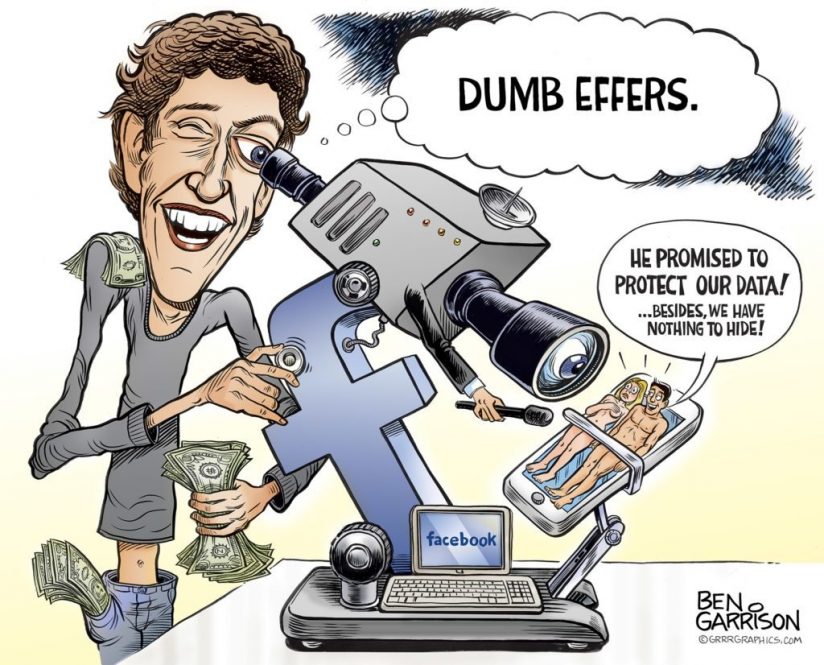
Facebook certainly deserves ample criticism for its lax privacy standards and its decision to threaten news outlets that exposed them. That said, we’ve noted a few times now that the uneven press fixation on Facebook obscures the fact that numerous industries routinely engage in much worse behavior. That’s particularly true of broadband providers (and especially wireless carriers), who routinely treat consumer privacy as a distant afterthought, with only a fraction of the total volume of media hyperventilation we saw during the Facebook kerfuffle.
Facebook’s casual treatment of your data isn’t some errant tech industry exception, it’s the norm, making #quitFacebook an arguably pointless gesture if you still own a stock mobile phone. In the telecom industry, a disdain for consumer privacy is a cornerstone of their entire business model(s). Companies like AT&T and Verizon aren’t just bone grafted to our government’s domestic surveillance apparatus, they collect and sell everything from browsing to location data to absolutely anyone and everyone–with little to no real oversight, and opt out tools that may or may not actually work.
Verizon has been particularly busy on the anti-privacy front. You’ll recall that the company was fined by the FCC for modifying wireless user data packets to track users around the internet without telling them. The company was engaging in this behavior for two years before security researchers even discovered it, and it took another six months of media criticism for Verizon to offer a simple opt out. Despite the wrist slap, a more powerful variant of this technology is still very much in play at Oath (AOL & Yahoo), Verizon’s effort to compete with Google and Facebook in the media advertising wars.
Not long after that, Verizon played a starring role in gutting modest FCC privacy rules protecting consumers (spurred in part by Verizon’s tracking tech). Those rules, which Verizon lobbyists dismantled last year, simply required that ISPs be transparent with what data they’re collecting and who they’re selling it to. When California tried to mirror the FCC’s discarded privacy policies, Verizon, Facebook and Comcast lied to lawmakers, falsely claiming that modest privacy protections would harm children, increase internet popups, and embolden extremism. None of it was true.
More recently, Verizon has been facing numerous lawsuits over Yahoo hacks that exposed the data of roughly three billion consumers. And while this was before Verizon’s ownership (Verizon wasn’t informed of the hacks during negotiations, netting it a $350 billion discount), the company has since been actively trying to prevent customers from suing Oath (Yahoo) or Verizon over future breaches by using fine print to mandate binding arbitration:
“The new Oath terms of service “contain a binding arbitration agreement and class action and jury trial waiver clauses…, which are applicable to all US users,” the terms say.
Congress has considered legislation to ban many mandatory arbitration clauses, but it hasn’t followed through yet and the practice remains legal.
The AOL terms already contained a binding arbitration clause and class-action waiver before Verizon bought that company. But the Yahoo terms didn’t previously contain such clauses.”
Thanks to AT&T’s Supreme Court victory in 2011 using contract fine print to erode consumer legal rights is now something we view as the norm. And while everybody can agree that the class action system has numerous problems, the system of binding arbitration is a terrible solution. Under binding arbitration, the arbiter rules for the company they work for the vast majority of the time, leaving consumers shit out of luck. While class actions often only net lawyers a nice new boat, they at least occasionally result in substantive change. Arbitration, in turn, is often more like consumer theater than justice.
The reality is that informed and empowered consumers are more likely to opt out of efforts to monetize their online behavior. And however breathlessly companies like Verizon and Facebook pretend to be dedicated to consumer privacy or policy solutions, they’re going to fight tooth and nail against any policies — even reasonable ones — that could potentially hamstring that revenue. But however bad Facebook is and has been on privacy, Verizon routinely offers a master class when it comes to undermining efforts at anything even vaguely resembling a solution.
‘Any Data They Can Intercept’: US Congress Will Let Companies Sell Browsing Data
Sputnik – 29.03.2017
Following in the Senate’s footsteps, the US House of Representatives has approved a piece of legislation that would allow massive telephone and cable companies to sell the data generated by internet users’ browsing habits.
On March 28, the US House narrowly passed a bill that analysts say is a huge win for the bloated telecommunications industry, and a commensurately large invasion on citizens’ privacy – or lack thereof. The resolution cleared its way through the lower chamber of the legislature by a 215-205 vote.
If US President Donald Trump signs the resolution into law, companies will legally be able to create profiles about every internet user, then sell those profiles to the highest bidder, the Electronic Frontier Foundation said in a statement.
“Considering how much access [internet service providers, or ISPs] already have to highly sensitive data, it is absolutely unacceptable for them to monetize personal information,” Representative Mike Pocan of Wisconsin said Tuesday.
The ability for service providers to collect “essentially any data they can intercept and read for themselves” was supposed to be an opt-in only policy, giving consumers a choice whether to disclose their data, but instead telecommunications companies will have the ability to generate revenue off of the public’s browsing habits, said Matt Erickson on Radio Sputnik’s By Any Means Necessary with Eugene Puryear. Erickson is a director with the Digital Privacy Alliance.
”Google and Facebook collect large amounts of information in ways that should be very concerning to people,” Puryear said.
The news comes as a major setback for privacy advocates and a major victory for Comcast, TimeWarner, AT&T and Verizon, which “will have free rein to hijack your searches, sell your data, and hammer you with unwanted advertisements,” the EFF said.
What’s more, at a time when nearly every major financial institution, electrical utilities company, defense and aerospace firm, and governmental agency is seeking to bolster its cyber defense systems, there are a host of reasons to think that these new rules would be detrimental to the US’ collective cybersecurity.
By recording your traffic and building a profile about you, for instance, hackers gain a new target database to breach.
Mass Surveillance is Driven by the Private Sector
By Bill Blunden | CounterPunch | April 23, 2015
Yet another report has surfaced describing how tools created by the malware-industrial complex are being deployed by U.S. security services. While the coverage surrounding this story focuses primarily on federal agencies it’s important to step back for a moment and view the big picture. In particular, looking at who builds, operates, and profits from mass surveillance technology offers insight into the nature of the global panopticon.
A report published by Privacy International as well as an article posted by Vice Motherboard clearly show that both the DEA and the United States Army have long-standing relationships with Hacking Team, an Italian company that’s notorious for selling malware to any number of unsavory characters.
Federal records indicate that the DEA and Army purchased Hacking Team’s Remote Control System (RCS) package. RCS is a rootkit, a software backdoor with lots of bells and whistles. It’s a product that facilitates a covert foothold on infected machines so intruders can quietly make off with sensitive data. The aforementioned sensitive data includes encryption keys. In fact, Hacking Team has an RCS brochure that tells potential customers:
“What you need is a way to bypass encryption, collect relevant data out of any device, and keep monitoring your targets wherever they are, even outside your monitoring domain”
[Note: Readers interested in nitty-gritty details about RCS can check out the Manuals online.]
It’s public knowledge that other federal agencies like the FBI and the CIA have become adept at foiling encryption. Yet this kind of subversion doesn’t necessarily bother high tech luminaries like Bruce Schneier, who believe that spying is “perfectly reasonable” as long as it’s targeted. Ditto that for Ed Snowden. Schneier and Snowden maintain that covert ops, shrouded by layers of official secrecy, are somehow compatible with democracy just so long as they’re narrow in scope.
But here’s the catch: RCS is designed and marketed as a means for mass collection. It violates the targeted surveillance condition. Specifically, a Hacking Team RCS brochure proudly states:
“’Remote Control System’ can monitor from a few and up to hundreds of thousands of targets. The whole system can be managed by a single easy to use interface that simplifies day by day investigation activities.”
Does this sound like a product built for targeted collection?
So there you have it. Subverting encryption en masse compliments of Hacking Team. The fact that there’s an entire industry of companies just like this should give one pause as there are unsettling ramifications regarding the specter of totalitarian control.
Corporate America is Mass Surveillance
Throughout the Snowden affair there’s a theme that recurs. It appeared recently in a foreword written by Glenn Greenwald for Tom Engelhardt’s book Shadow Government:
“I really don’t think there’s any more important battle today than combating the surveillance state [my emphasis]. Ultimately, the thing that matters most is that the rights that we know we have as human beings are rights that we exercise.”
There’s a tendency to frame mass surveillance in terms of the state. As purely a result of government agencies like the CIA and NSA. The narrative preferred by the far right is one which focuses entirely on the government (the so-called “surveillance state”) as the sole culprit, completely ignoring the corporate factions that fundamentally shape political decision making.
American philosopher John Dewey once observed that “power today resides in control of the means of production, exchange, publicity, transportation and communication. Whoever owns them rules the life of the country,” even under the pretense of democratic structures[1].
There are some 1300 billionaires in the United States who can testify to this fact. As can anyone following the developments around the secretive Trans-Pacific Partnership.
Dewey’s observation provides a conceptual basis for understanding how business interests drive the global surveillance apparatus. Mass surveillance is a corporate endeavor because the people who inevitably drive decisions are the same ones who control the resources. For example, the backbone of the internet itself consists of infrastructure run by Tier 1 providers like Verizon and Level 3 Communications. These companies are in a perfect position to track users and that’s exactly what they do.
Furthermore when spying is conducted it’s usually executed, in one form or another, by business interests. Approximately 70 percent of the national intelligence budget end up being channeled to defense contractors. Never mind that the private sector’s surveillance machinery dwarfs the NSA’s as spying on users is an integral part of high tech’s business model. Internet companies like Google operate their services by selling user information to the data brokers. The data broker industry, for example, generates almost $200 billion a year in revenue. That’s well over twice the entire 2014 U.S. intelligence budget.
From a historical vantage point it’s imperative to realize that high tech companies are essentially the offspring of the defense industry. This holds true even today as companies like Google are heavily linked with the Pentagon. For decades (going back to the days of Crypto AG) the private sector has collaborated heavily with the NSA’s in its campaign of mass subversion: the drive to insert hidden back doors and weaken encryption protocols across the board. Companies have instituted “design changes” that make computers and network devices “exploitable.” It’s also been revealed that companies like Microsoft have secret agreements with U.S. security services to provide information on unpublished vulnerabilities in exchange for special benefits like access to classified intelligence.
In a nutshell: contrary to talking points that depict hi-tech companies as our saviors, they’re more often accomplices if not outright perpetrators of mass surveillance. And you can bet that CEOs will devote significant resources towards public relations campaigns aimed at obscuring this truth.
Denouement
A parting observation: the current emphasis on Constitutional freedom neglects the other pillar of the Constitution: equality. Concentrating intently on liberty while eschewing the complementary notion of equality leads to the sort of ugly practices that preceded the Civil War. In fact there are those who would argue that society is currently progressing towards something worse, a reality by the way that the financial elite are well aware of. When the public’s collective misery reaches a tipping point, and people begin to mobilize, the digital panopticon of the ruling class will be leveraged to preserve social control. They’ll do what they’ve always done, tirelessly work to maintain power and impose hierarchy.
Bill Blunden is a journalist whose current areas of inquiry include information security, anti-forensics, and institutional analysis. He is the author of several books, including “The Rootkit Arsenal” and “Behold a Pale Farce: Cyberwar, Threat Inflation, and the Malware-Industrial Complex.” Bill is the lead investigator at Below Gotham Labs.
Notes.
[1] The Later Works of John Dewey, 1925-1953, Volume 9: 1933-1934, Essays, Reviews, Miscellany, and A Common Faith, Southern Illinois University Press, 2008, page 76.
AT&T’s First Transparency Report Reveals Warrantless Demands for Customer Data
By Matthew Cagle | ACLU | February 19, 2014
In the wake of our shareholder advocacy, AT&T has now joined Verizon and released its first transparency report. AT&T’s report shows how federal, state, and local governments have requested large volumes of customer information, typically without a warrant. While we welcome AT&T’s move, the American public remains in the dark about a lot of what’s happening behind the scenes. Greater transparency is still needed from AT&T and the federal government.
Here’s a breakdown of the many demands AT&T received in 2013. As we have long suspected, the vast majority of these demands lacked a warrant:
- AT&T received 301,816 demands related to criminal and civil litigation. Only 16,685 of these demands included a warrant based on probable cause.
- AT&T received 223,659 subpoenas for customer information. This is significantly more than the 164,184 subpoenas Verizon received during the same period.
- AT&T received 37,839 demands for location information. At least 21,000 of these demands lacked a warrant. AT&T’s full report says a warrant is “almost always required to obtain real-time location information.”
- AT&T also received 1,034 demands for “cell tower searches” last year, some of them compelling the company to identify the numbers of all phones that connected to a specific cell tower during a given period of time. Cell tower information is ripe for misuse—we know of at least one instance where a cell tower request was made for all phones within the vicinity of a planned labor protest.
AT&T also included information on national security requests (though, not the complete story):
- AT&T reported receiving between 2,000 and 3,000 National Security Letters (NSLs) from the federal government for customer information including name, address, length of service, and toll billing records. NSLs do not require prior approval from courts and the government has been criticized for misusing them. 4,000 to 4,999 AT&T customers were affected by NSLs last year. Note: Verizon has not yet revealed how many customers were affected by the NSLs it received.
- AT&T also released information about federal government demands for customer content under the Foreign Intelligence Surveillance Act (FISA), demands that may result in government access to the telephone and Internet communications of US citizens and persons abroad. For the first six months of 2013, AT&T received 0-999 requests for content that ultimately affected 35,000-35,999 customers. In fact, more AT&T customers were affected by FISA content requests in the first half of 2013 than the combined number of Facebook, Google, and Microsoft customers affected by the same sort of requests during that period.
- Unfortunately, the report omits important information on the metadata that the government reportedly obtains from AT&T under the call records program (currently being challenged by the ACLU in federal court). Phone metadata includes the phone numbers of parties to a conversation, a call’s duration, and device identifiers—information that can paint a very detailed picture of private lives. We know that the government justifies its access to phone metadata with a section of the FISA law, yet AT&T’s report states that only 0-999 customers were affected by such “non-content” requests. On its own, this lack of detail misleads the millions of AT&T customers whose phone metadata may be subject to these demands.
In addition to a clearer explanation of national security requests, we hope that AT&T’s future reports will also address the following shortcomings:
- The current report does not include the number of customers or individuals affected by all of the government demands. The company claims that it is “difficult” to tally this information.
- The report does not describe statistics on how often AT&T complies with demands.
- This report includes very limited information about demands from foreign governments.
AT&T’s transparency report, limited in what it reveals, also highlights just how essential it is for privacy laws to be updated in both the national security and law enforcement contexts. Technology has advanced exponentially and our privacy laws are still in the digital dark ages, enabling the government to engage in a largely unsupervised shopping spree of the personal data held by AT&T and other companies. This is why you should tell your member of Congress to support the USA Freedom Act and an update to the federal Electronic Communications Privacy Act. We also urge AT&T to play a larger role by pushing for greater transparency, including far more detail in its future reports, and advocating for stronger privacy protections.
Matthew Cagle is a Volunteer Attorney for Technology and Civil Liberties with the ACLU of Northern California.
Copyright 2014 American Civil Liberties Union of Northern California
Reprinted with permission of the American Civil Liberties Union of Northern California http://www.aclunc.org
Related articles

The NSA Black Hole: 5 Basic Things We Still Don’t Know About the Agency’s Snooping
By Justin Elliott and Theodoric Meyer | ProPublica | June 10, 2013

The headquarters of the National Security Agency at Fort Meade, Maryland
Last week saw revelations that the FBI and the National Security Agency have been collecting Americans’ phone records en masse and that the agencies have access to data from nine tech companies.
But secrecy around the programs has meant even basic questions are still unanswered. Here’s what we still don’t know:
Has the NSA been collecting all Americans’ phone records, and for how long?
It’s not entirely clear.
The Guardian published a court order that directed a Verizon subsidiary to turn over phone metadata — the time and duration of calls, as well as phone numbers and location data — to the NSA “on an ongoing daily basis” for a three-month period. Citing unnamed sources, the Wall Street Journal reported the program also covers AT&T and Sprint and that it covers the majority of Americans. And Director of National Intelligence James Clapper himself acknowledged that the “collection” is “broad in scope.”
How long has the dragnet has existed? At least seven years, and maybe going back to 2001.
Senate Intelligence Committee chair Dianne Feinstein, D-Calif., and vice chair Saxby Chambliss, R-Ga., said last week that the NSA has been collecting the records going back to 2006. That’s the same year that USA Today revealed a similar-sounding mass collection of metadata, which the paper said had been taking place since 2001. The relationship between the program we got a glimpse of in the Verizon order and the one revealed by USA Today in 2006 is still not clear: USA Today described a program not authorized by warrants. The program detailed last week does have court approval.
What surveillance powers does the government believe it has under the Patriot Act?
That’s classified.
The Verizon court order relies on Section 215 of the Patriot Act. That provision allows the FBI to ask the Foreign Intelligence Surveillance Court for a secret order requiring companies, like Verizon, to produce records – “any tangible things” – as part of a “foreign intelligence” or terrorism investigation. As with any law, exactly what the wording means is a matter for courts to decide. But the Foreign Intelligence Surveillance Court’s interpretation of Section 215 is secret.
As Harvard Law Professor Noah Feldman recently wrote, the details of that interpretation matter a lot: “Read narrowly, this language might require that information requested be shown to be important or necessary to the investigation. Read widely, it would include essentially anything even slightly relevant — which is to say, everything.”
In the case of the Verizon order — signed by a judge who sits on the secret court and requiring the company to hand over “all call detail records” — it appears that the court is allowing a broad interpretation of the Patriot Act. But we still don’t know the specifics.
Has the NSA’s massive collection of metadata thwarted any terrorist attacks?
It depends which senator you ask. And evidence that would help settle the matter is, yes, classified.
Sen. Mark Udall, D-Colo., told CNN on Sunday, “It’s unclear to me that we’ve developed any intelligence through the metadata program that’s led to the disruption of plots that we could [not] have developed through other data and other intelligence.”
He said he could not elaborate on his case “without further declassification.”
Sen. Feinstein told ABC that the collection of phone records described in the Verizon order had been “used” in the case of would-be New York subway bomber Najibullah Zazi. Later in the interview, Feinstein said she couldn’t disclose more because the information is classified. (It’s worth noting that there’s also evidence that old-fashioned police work helped solve the Zazi case — and that other reports suggest the Prism program, not the phone records, helped solve the case.)
How much information, and from whom, is the government sweeping up through Prism?
It’s not clear.
Intelligence director Clapper said in his declassified description that the government can’t get information using Prism unless there is an “appropriate, and documented, foreign intelligence purpose for the acquisition (such as for the prevention of terrorism, hostile cyber activities, or nuclear proliferation) and the foreign target is reasonably believed to be outside the United States.”
One thing we don’t know is how the government determines who is a “foreign target.” The Washington Post reported that NSA analysts use “search terms” to try to achieve “51 percent confidence” in a target’s “foreignness.” How do they do that? Unclear.
We’ve also never seen a court order related to Prism — they are secret — so we don’t know how broad they are. The Post reported that the court orders can be sweeping, and apply for up to a year. Though Google has maintained it has not “received blanket orders of the kind being discussed in the media.”
So, how does Prism work?
In his statement Saturday, Clapper described Prism as a computer system that allows the government to collect “foreign intelligence information from electronic communication service providers under court supervision.”
That much seems clear. But the exact role of the tech companies is still murky.
Relying on a leaked PowerPoint presentation, the Washington Post originally described Prism as an FBI and NSA program to tap “directly into the central servers” of nine tech companies including Google and Facebook. Some of the companies denied giving the government “direct access” to their servers. In a later story, published Saturday, the newspaper cited unnamed intelligence sources saying that the description from the PowerPoint was technically inaccurate.
The Post quotes a classified NSA report saying that Prism allows “collection managers [to send] content tasking instructions directly to equipment installed at company-controlled locations,” not the company servers themselves. So what does any of that mean? We don’t know.
For more on mass surveillance in America, read our timeline of loosening laws and practices.
Related articles
- Why Did Edward Snowden Go to Hong Kong?
- NSA Document Leak Proves Conspiracy To Create Big Brother Style World Control System
- DOJ launches criminal probe of NSA leaker
- US security officials said NSA leaker, journalist should be ‘disappeared’ – report
- Government Spying: Should We Be Shocked?
- Boundless Informant: NSA’s complex tool for classifying global intelligence
- The NSA’s Favorite Weasel Word To Pretend It’s Claiming It Doesn’t Spy On Americans
- The “Congress knew” defense
- NSA memo pushed to ‘rethink’ 4th Amendment
Featured Video

Yemen joins the war – Red Sea could be blocked next – Saudi regime at risk
or go to
Aletho News Archives – Video-Images
From the Archives
Should Europeans ‘Thank’ the Americans for Destroying Nord Stream?
By Robert Bridge | Strategic Culture Foundation | September 29, 2022
With an investigation continuing into the destruction of the Nord Stream gas pipeline that provided energy supplies to Europe from Russia, there appears to be just one prime suspect, and that should surprise nobody.
Following the sabotage of the Nord Stream 1 and 2 gas pipelines, former Polish Foreign Minister Radoslaw Sikorski already seemed to know the identity of the perpetrator when he tweeted out: “Thank you, USA.”
At first glance, it seemed that Sikorski was speaking sarcastically, berating Washington for carrying out an attack that will have severe repercussions for the people of Europe. After all, how could anyone see any good coming from the termination of Europe’s primary source of gas reserves with winter just around the corner? It was Sikorski’s homeland of Poland, after all, that urged its citizens to collect firewood in the face of dwindling gas reserves.
In fact, the Polish diplomat was speaking one-hundred percent literally… continue
Blog Roll
 Aletho News
- Growing insecurity, soaring prices fuel protests in north as regime bans evacuation: Sources
- Iran denies responsibility for ‘depraved’ attack on Kuwait desalination plant
- Bring The Troops Back. End This War Now!
- Can we please stop calling Israel the ‘only democracy in the Middle East’ now?
- US should start removing its troops for Germany, proposes AfD co-leader Chrupalla
- Iran Red Crescent: 600 educational centers attacked in US-Israeli ‘war crimes’
- Russian Oil Tanker Arrives in Cuba Amid U.S. Blockade
- America Racing to Strategic Defeat in Iran: Lt Col Daniel Davis
- FTC Warns Visa, Mastercard, PayPal, Stripe Over Political Debanking
- Russian tanker approaches Cuba despite US oil blockade
- If Americans Knew
- Israeli police block Catholic cardinal from entering Church of the Holy Sepulchre on Palm Sunday
- Israel is assassinating journalists again, more than any other nation, anywhere, ever – Not a ceasefire Day 170
- Over 300 US service members wounded, majority have brain injuries – Not a ceasefire Day 169
- Researchers at Human Rights Watch Resign Over Blocked Report on Palestinian Refugee Return
- Jewish Groups Are Backing a War Americans Don’t Want
- Eric Fingerhut Thinks He’s the President of the Jews
- Top Jewish Philanthropists, Rabbis Urge Israeli President to Take Action Against ‘Jewish Extremists’
- Don’t Be Fooled. Zionist Leaders Have Always Wanted to Control Southern Lebanon
- Israel’s widespread use of torture is a core element of its genocide against the Palestinian people
- In Israel’s War on Iran, Many Middle East US Bases Rendered “All But Uninhabitable”
- No Tricks Zone
- New Study Finds Warming Saves Lives…Cold Temperatures 12 Times More Deadly Than Excess Heat
- German Science Blog Accuses PIK Climate Institute Of Hallucinating Climate Tipping Points
- Devastating Assessment Of Comirnaty Vaccine By Former Senior Pfizer Europe Toxicologist
- New Study: CO2 Is ‘Effectively Negligible’ As An Explanatory Climate Change Factor Since 2000
- Former Pfizer Toxicologist Dr. Helmut Sterz Tells Bundestag Hearing Pfizer Vaccine Should Have Never Been Approved
- Energy Expert: Germany’s Nuclear Phaseout Was A “500 Billion Euro Mistake”
- New Research: South Australia’s Mid-Holocene Sea Surface Temperatures Were 4°C Warmer Than Today
- Storing Green Energy To Last Germany 10 Days Would Require A 60-Million Tonne Battery
- New Studies: UK Sea Levels Were 4 Meters Higher Than Today During The Mid-Holocene
- Destructive Green New Deal: German Energy And Metal Group Warns Of Drastic Crisis
 Aletho News