What the Hell is Obama Thinking?
Worst Man for the Job
By Daniel Patrick Welch – 3/01/2014
Nothing is quite as nauseating as watching the hypocrisy and hubris with which President Obama ‘warns’ the Russian president not to ‘interfere’ in Ukraine, telling the Russians there would be ‘costs to pay.’ It’s a surreal move, echoed by his equally creepy and out-of-touch consigliore and chief “diplomat,” the morally bankrupt John Kerry. Astonishing in its audacity and lack of regard for history, truth or facts, this bellicose blather seems aimed only at the idiots over whom he presides, the fools and tools in congress and the press, and his bought-and-paid-for lackeys in European capitals.
Outside the bubble, the sabre rattling is alarming and threatening. Having stood the issue completely on its head, No Drama Obama ignores how it looks to Russia, China and anyone with a skeptical mind. It is so jarring that it leaves only two options: is he crazy or does he really want war? That’s why the Russian Senate, offended to the core, asked President Putin to recall the US ambassador over Obama’s remarks.
How oblivious or arrogant do you have to be to spend $5 billion dollars destabilizing a country (the actual total is undoubtedly much higher), have your diplomats caught on tape planning a coup, bring a gang of fascist thugs to power on Russia’s doorstep–whose first order of business is to outlaw the Russian language, conduct a purge of opposing parties, threaten the Russian-speaking population, threaten to restore Ukraine’s nuclear status and provoke and threaten Russia non-stop… and have the *balls* to lecture anyone about interfering? Oh, add to the pot that you have done the same exact thing in several other countries in the past few years alone. It simply boggles the mind.
Continue poking Putin by suggesting he is being a “bully” when he moves to protect the Russian naval base, protect Russians, and listen to the wishes of the elected government of the region who ask for his support, as as new protests erupted across eastern Ukraine rejecting the putschists in Kiev, with Russian flags being raised over government buildings and protesters brandished signs saying “In Russia We Have Brothers. In Europe We Are Slaves” and “Where We Are, It is Also Russia.” This is called an ‘invasion’ by the people who bought and organized a fascist coup. Bizarro World.
But why do I focus on Obama? After all, he is little more than an irrelevant placeholder president, a sort of ventriloquist’s dummy for the vested interests and forces that put him where he is. Furthermore, I am not a fan of any Great Man theory of history that implies superhuman powers to people instead of historical forces. Accordingly, I don’t really go in for ad hominem attacks, which seems to be the only stock-in-trade of the western media, whose searing, eternal question seems to be who is the next Hitler.
Maybe it’s because I’m in the grip of the question the rest of the world is pondering: is he crazy or does he really want war? I can’t get past wondering whether he is sleepwalking through his presidency, having given over control of his administration to a foreign policy apparatus gone wild–or if he indeed believes the hypocritical warmongering crap that escapes his mouth. In short, Either he eats babies for breakfast or he has no clue that he is being led by the nose by psychopaths.
It’s important because in either case he is perhaps the most dangerous man who has ever held the office. His chief flaw is *exactly* the puzzle piece that is *least* amenable to being a leader at this historical juncture. It is a horrific perfect storm, and one that has allowed him to blunder disastrously close to World War III on at least two occasions.
The measure of the man has always told us he was an extremely glib politician. On watching an early speech of his, my wife was shocked at what all the fuss was about, and actually quoted King Herod out loud to the TV: “Take him away/ He’s got *nothing* to say!” Yeah, she’s funny like that. But still, glibness isn’t always hollowness. We got more of a glimpse when he joked casually about sending drones after any boys who had designs on his precious daughters. Later, referring to the boys he actual did mow down with his drones, he joked to aides–equally casually, we assume–that he never thought he ‘would wind up being so good at killing people.’
But the clincher for me is one memory which still haunts me from campaign 2008: a late rally in some Florida dump where Clinton explained (actually apologizing for going off script) that Obama was The Guy because he had said to the council of elders behind closed doors–you tell me what’s the right thing to do and I’ll sell it. At the time I did a double take, and it raised the hairs on the back of my neck. This is not a leader, a president, or even a thinker at all, but a glorified and willing Pitchman-in-Chief, a sort of real life Clayton Bigsby selling an ideology he is too blind to see.
It was a bit of the mask slipping… and it was incredibly ominous. I felt it and said so to my wife at the time, but she had checked out long before. Never thought he was anything more than a charlatan and a whore – from the first time she heard him, actually. Damn, I envy her clarity sometimes. It’s like they made a clone of Truman in a test tube, only this time not a hick… scary. Jimmy Burns led Truman around on a leash, and this misplaced trust in Wise Men led to war crimes such as Hiroshima and Nagasaki, among others.
In another famous example, Kennedy stupidly let the Bay of Pigs invasion proceed, as he was advised by ‘wiser men’ who told him it was already in the pipeline. However, he wisely vetoed air support, realizing that is was a stupid plan laid out by zealots. Obama has neither the balls nor the intelligence to pull off any such thing. There was a flicker over Syria in August, but it appears to have been a mirage brought on by Russian missiles and wiser generals. He has the fatal flaw which makes all smart men stupid: heeding the counsel of fools and those with their own secret agenda masquerading as Wise Men.
The zealots who have his ear have been in power for a long time, and they are the kind of fanatics who avoid scrutiny in public and accountability even to themselves, so stupid or proud that they still see chasing the Russians out of Afghanistan as their greatest triumph, and take no responsibility for having created, from the ground up, the very concept of militarized global jihad.
Even cutting him the most possible slack, he listens to them–and that makes him delusional, a hollow man issuing idle threats. As logic dictates, it is the US who should be worrying about costs, starting with billions to set the coup in motion. That will turn out to have been a pittance.
He is now a dangerous man being counseled by dangerous men. Just today, listening to his smug, arrogant self humiliate a heckler, someone trying to shout a tiny bit of truth through the noise, is truly chilling. The trouble is, Obama may not be lying. He really doesn’t know what the guy is talking about, and doesn’t know that this is the plan–at what may be the most dangerous moment in history–and will go along with whichever three loudest advisers tell him is the right thing. The saddest and scariest part is that he doesn’t even seem to know it–a true button pusher. Soulless.
But this is a measure of the man. At a friendly, fundraising event, with full control and no opposition, he could have said anything he wanted, could have made some sensible retort. Instead he chose to be mean and demeaning, calling the guy a drunk and implying that he is crazy. So now I have to add Bad Man to my list. No lie lives forever, and some day his uppance will come, as Stewie Griffin says. He richly deserves the place he has earned in history, and I have lost interest in splitting hairs: enabler, dupe or antichrist–take your pick.
Writer, singer, linguist and activist Daniel Patrick Welch lives and writes in Salem, Massachusetts, with his wife, Julia Nambalirwa-Lugudde. Translations of articles are available in in up to 30 languages.

Russian senators vote to use stabilizing military forces on Ukrainian territory
RT | March 1, 2014
Russia’s Federation Council has unanimously approved President Vladimir Putin’s request to use Russian military forces in Ukraine. The move is aimed to settle the turmoil in the split country.
The upper house of the Russian parliament has voted in favor of sending troops to the Autonomous Republic of Crimea, which would ensure peace and order in the region “until the socio-political situation in the country is stabilized.”
The debate in the Federation Council has revealed that Russian MPs are united on the issue, with many of them sharing concerns on the recent events in Ukraine. The common notion was that since power was seized in Kiev, the situation has only been deteriorating with radical nationalists rapidly coming to power and threatening the lives of those opposing their actions, most notably the Russian citizens living in Ukraine.
The developments follow an appeal by the Prime Minister of the Autonomous Republic of Crimea, Sergey Aksyonov, who requested that Russia help cope with the crisis and ensure “peace and calm” in the region.
Crimeans began protesting after the new self-proclaimed government in Kiev introduced a law abolishing the use of other languages in official circumstances in Ukraine. More than half the Crimean population are Russian and use only this language in their everyday life. The residents have announced they are going to hold a referendum on March 30 to determine the fate of the Ukrainian autonomous region.
Putin on Saturday requested the Federation Council to use the Army for normalizing the socio-political situation in Ukraine in connection with the “extraordinary situation” there. The events in Ukraine indicate there is a “threat to the lives of citizens of the Russian Federation… and the personnel of the armed forces of the Russian Federation on Ukrainian territory,” the Russian president said.
According to Putin’s spokesman, Dmitry Peskov, the president has not yet made a decision on sending the troops to Ukraine.
Moreover, taking the decision to use the Armed Forces in Ukraine does not mean that it will be carried out immediately, Grigory Karasin, Putin’s official representative in the Federation Council, has said.
“The approval, which the president will receive, does not literally mean that this right will be used promptly,” Karasin said.
Russian citizens are among the victims of the turmoil gripping Ukraine, the speaker of the Federation Council, Valentina Matvienko, has said. In Crimea, there were Russian casualties during the storming of the local Interior Ministry building by gunmen overnight, she added.
“During the attempts to seize the building of the Interior Ministry in Crimea some were injured, there were victims also, the people are being threatened, and in this situation they are naturally voicing concerns for the security of their lives and families. This compelled the government of Crimea to ask Russia for help,” Matvienko said.
The speaker’s words coincided with the statement issued by Russian Federal Migration Service noting that some 143,000 Ukrainians have sought asylum in Russia. The number represents a sharp rise in such requests, the authority said.
The new Ukrainian authorities have been formed “under the dictate of Maidan” and “continue to use force in the forming of the decision-making structures,” Karasin said.
“We are particularly concerned with the situation in the Autonomous Republic of Crimea, where, in accordance with the international treaty, the Black Sea Fleet is stationed; where 1.5 million Russian people live,” Putin’s representative stressed.
The Crimean population “resents” the attempts to seize local administration buildings and the threats thrown at regional authorities, and demands stability, he said.
At the same time, Karasin said he believes the international community and those states that backed the February 21 agreement between the opposition and the legitimate Ukrainian government “have the power” to influence the self-proclaimed Kiev authorities to bring the situation back to “constitutional ways.”
The Russian Foreign Ministry also said that Moscow is expecting that the international community will influence the self-proclaimed Kiev regime to normalize the situation in the country.
Vladimir Vladimirovich and the Grey Lady
By Robert Bonomo | The Cactus Land | December 26, 2013
Bill Keller, editorialist for the NY Times and former executive editor of the paper, has recently penned a strong attack on Vladimir Putin arguing that Putin’s leadership “deliberately distances Russia from the socially and culturally liberal West”, describing the Kremlin’s policies as “laws giving official sanction to the terrorizing of gays and lesbians, the jailing of members of a punk protest group for offenses against the Russian Orthodox Church, the demonizing of Western-backed pro-democracy organizations as ‘foreign agents’, expansive new laws on treason, limits on foreign adoptions.”
Keller, who during his tenure as executive editor of the NY Times argued for the invasion of Iraq and wrote glowingly of Paul Wolfowitz, makes no mention of Moscow’s diplomatic maneuvers that successfully avoided a US military intervention in Syria or the Russian asylum given to Eric Snowden. Keller, who had supported the US intervention in Syria by writing, “but in Syria, I fear prudence has become fatalism, and our caution has been the father of missed opportunities, diminished credibility and enlarged tragedy,” also made no mention of Seymour Hersh’s stinging dissection of the Obama administration’s misinformation campaign regarding the sarin attacks in Syria. Hersh’s piece, which drives grave doubts into the case against Assad actually having carried out the attacks, was not published in the New Yorker or in the Washington Post, publications that regularly run his work.
Keller focuses on a Russian law that bans the promotion of gay lifestyles in Russia, a far cry from “giving official sanction to the terrorizing of gays and lesbians”, while failing to mention that according to his own paper, 88% of Russians support the law.
Putin did expel the United States Agency for International Development (USAID) from Russia, cutting off the $50 million in aid, most of which went to pro-democracy and anti-corruption groups. The Kremlin believed that much of this money wound up supporting the protest movement against Putin that emerged in 2011. If Russian funding had been suspected in the Occupy Wall Street Movement, would the New York Times have supported Putin for promoting social equality in the US? If the punk band Pussy Riot had broken into a prominent Jewish temple in New York, instead of a Moscow cathedral, and defamed it to call attention to the millions of Palestinians living in refugee camps, would the young ladies have done some time? And if so, would they have received support from all corners of stardom?
The European Model
Quoting Dmitri Trenin, Keller argues that Putin sees Europe in decline, “it’s national sovereignty… is superseded by supranational institutions.” Is Putin mistaken in his assumption? Maybe ask the people of Greece, Spain, or Ireland. Keller also mentions “limits on foreign adoptions” but fails to mention the cause, the Magnitsky Act, which imposed “visa and banking restrictions on Russian officials implicated in human rights abuses.” The Kremlin saw this law as the perfect example of US meddling in internal Russian affairs.
The heart of the Magnistsky saga was the death in Russia, while under custody, of an attorney for Hermitage Capital, a hedge fund run by a British citizen William Browder, who renounced his US citizenship. Browder made billions in Russia before running afoul of Russian authorities. His Hermitage Capital was funded by the Lebanese national Edmond Safra and eventually claimed to have lost $300 million after having moved billions out of Russia. Browder lobbied hard in Washington to have the Magnitsky Act passed. Why was the US involved in passing a law to protect Lebanese and British capital and a Russian prisoner? America hasn’t enough trouble with its own prison system that it needs to legislate on the Russian penal system? Are there no American politicians who have been implicated in human rights abuses?
Keller’s final point is that Putin is being heavy handed over the Ukrainian/EU integration crisis, but Keller avoids discussing the deep historic and ethnic links between Russia and Ukraine. Most Americans would agree that Russia should stay out of NAFTA negotiations, seeing North America as clearly not within the Russian sphere of influence. Ukrainians are deeply divided over the integration with Europe, so why not let the Ukrainians and Russians work out their trade relations without the American government getting involved?
Khodorkovsky
Probably more than any other topic, the NY Times has repeatedly published articles in defense of the long imprisoned and recently freed Russian oligarch Mikhail Khodorkovsky, a man whose rise to power was filled with unsavory schemes to appropriate businesses which were once the property of the Russian people. The NY Times Sabrina Tavernese wrote in 2001 that he had “orchestrated a series a flagrant corporate abuses of minority shareholders unparalleled in the short history of modern Russian capitalism.”
Khdorkovsky eventually wound up the billionaire owner of Yukos Oil, which he planned to sell to Exxon Mobil. Khdorkovsky also had political ambitions, creating the Open Russian Foundation and putting Henry Kissinger and Lord Jacob Rothschild on the board of directors. He was clearly eyeing political power by making close ties with the West, even being named to the Advisory Board of the Carlyle Group, all of which made him a potential threat to the Kremlin.
The Khodorovsky affair was a complex battle for power in Russia with Khodorkovsky playing the Western powers against the strongly nationalistic Putin. But at the NY Times editorialist Joe Nocera in four pieces on Khodorkovsky never delves into the complexities of Putin’s strategy to keep Western interests at bay, preferring to present a black and white scenario of ‘western liberal’ rule of law against the ‘authoritarian’ Putin.
Curiously, the NY Times doesn’t seem so interested in Harvard’s Russia Project which ended in disgrace and professor Andrei Shleifer, Larry Summers protege, being forced to pay a $2 million fine for enriching himself under the guise of a USAID program where he was to ‘teach’ Russians about capitalism. He gave them an interesting lesson, yet was not forced to resign his post at Harvard, possibly due to his close relationship with Summers. Nocera hasn’t written one article on that scandal which is much more relevant to Americans and their iconic institutions, but which also might make him a few enemies closer to home.
Putin and American Values
Most Americans see Eric Snowden as whistleblower and not a traitor, yet the NY Times star editorialist, Thomas Friedman, isn’t so sure, “The fact is, he dumped his data and fled to countries that are hostile to us,” though he doesn’t elaborate on why Russia is a ‘hostile’ nation and he advises Snowden to come home and face the music if he’s truly a patriot, “It would mean risking a lengthy jail term, but also trusting the fair-mindedness of the American people.”
Putin is a social conservative and a fierce patriot who, like many Americans, opposes regime change in the name of democracy. The American people, after failed interventions in Iraq, Afghanistan and Libya, agree with him — both Putin and Americans, unlike the NY Times, vehemently opposed a US intervention in Syria. It seems Putin has more in common with the opinions of Americans than does the NY Times, which begs the question, why is the NY Times so hell bent on demonizing the President of the Russian Federation when he’s supported by more than 60% of the Russian people?
The New York Times has written extensively about the gay rights issue in Russia but 45% of Americans still think that homosexuality is a sin and as the ‘Duck Dynasty’ controversy has revealed, homosexuality in America is still a very divisive issue. Is the prohibition against publicly speaking in favor of gay lifestyles in Russia such an important stumbling block to ties between the two nations when the vast majority of Russians support the law?
Americans probably don’t approve of roads where members of one religion can drive while members of another religion must walk, as occurs in Hebron and reported on by Ynet, “Jewish residents are allowed to cross the road by vehicle, but Palestinians are now only permitted to cross by foot or by bicycle.” They probably wouldn’t look fondly on back of the bus seating for women, yet in spite of this type of segregation in a country that claims to be democratic, the NY Times doesn’t feel compelled to demonize Mr. Netanyahu and his ‘socially conservative’ Likud party.
The Interests of the American People
Just as the NY Times despises Putin and Russia, it’s equally enamored with Israel. Imagine if the millions of Palestinian refugees were not in camps because of their mother’s religion but instead because they were LGBT? What if Netanyahu were held to the same standard as Mr. Putin? How many millions of Palestinian Khodorkovsky’s are languishing in refugee camps in their own country? It seems that Mr. Keller, Mr. Friedman and Mr. Nocera are much more interested in the rights of Khodorkovsky and William Browder than they are in the rights of Palestinian children living in squalor under an Israeli blockade in Gaza.
Saudi Arabia and Israel, the latter through its surrogate AIPAC, lobbied hard for war in Syria and both supposed allies are furiously attempting to undermine peace talks with Iran. The government Putin leads brokered the deal to avoid US involvement in Syria, played an important role in the Iranian peace initiative and also allowed Americans a glimpse into the massive surveillance program the NSA has hoisted upon them by giving refuge to Eric Snowden.
Just as Americans would not look fondly at the Kremlin interfering in domestic American politics, so the Kremlin pushes back when it see US interference in it’s internal affairs, a good example being American aid to opposition groups during the 2011 Moscow protests against Putin. If the US can accept serious human rights violations by supposed allies Israel and Saudi Arabia, can’t it also accept that Russia has its own way of governing itself, based on its own history and culture?
The NY Times does not represent the best interests of most Americans, nor does it use its powerful voice to protect the millions persecuted within the realms of so called allies. The NY Times represents a small sector of US power, bent on propagating special interests at the expense of the vast majority of Americans.
Mr. Putin certainly acts in the best interests of Russia, but curiously enough, by working in his own interest, he has done more to protect the 4th Amendment than the constitutional law professor currently occupying the White House. In Syria he was protecting Russian interests, but by doing so he kept the US out of an intervention that could have easily developed into a major war. If it had been up to the NY Times, we would have intervened in Syria and Snowden would be behind bars awaiting the mercy of the Obama Administration.
So who is a better friend of the American people? There are no doubts that the NY Times is a better friend of the Khodorkovsky’s and William Browder’s of the world but Americans might actually be better off if their government listened more to Putin and less to the Grey Lady.
Putin Signs Law Punishing Terrorists’ Relatives
RIA Novosti | November 3, 2013
MOSCOW – President Vladimir Putin signed a law Sunday forcing the relatives of terrorists to pay for the damages caused by their attacks.
The law submitted by President Putin in September that includes measures to criminalize training in terrorist camps was approved by the country’s parliament in late October.
Effort to target the families of militants marks the latest attempt by Russian authorities to stamp out an insurgency in the turbulent North Caucasus that has claimed thousands of lives over more than a decade.
Under the law, material and moral damages inflicted as a result of a terrorist attack should be compensated “by the perpetrator and his or her family members, relatives, in-laws and other people, whose lives, health and well-being are significant to him or her because of established personal relations.”
The new law stipulates closer scrutiny toward property belonging to the relatives and loved ones of people who have “committed a terrorist act,” with the goal of verifying whether such money or goods were acquired legally.
People found guilty of training with the aim of carrying out terrorist activities will now face a maximum penalty of 10 years in prison and fines of up to 500,000 rubles ($15,700). Anybody found guilty of creating terrorist networks could be sentenced to 20 years behind bars and fines of up to one million rubles.
Individuals found to be parts of terrorist organizations can now be punished with 10-year jail sentences and 500,000 ruble fines.
The new legislation increases penalties for setting up, leading or financing armed groups to up to 10 years. Participation in such groups, including those based abroad, is punishable with up to six years in jail.
Syrian chemical weapons counter Israel’s nuclear threat, says Putin
MEMO | September 20, 2013
Syria has chemical weapons, claims Vladimir Putin, in order to counter Israel’s nuclear threat. The Russian president raised this point in a discussion with Western leaders on Thursday.
After admitting that he could not be 100 per cent certain that the Syrian regime would disclose all information about its chemical weapons, Putin suggested that Israel does not need nuclear weapons because of its “technical supremacy” in other areas.
The Russian president said that he does not oppose a military strike on Syria because of perceived Russian interests there; in fact, he does not want to see an international organisation like the United Nations misused for such an action.
“We do not have some exclusive interests in Syria which we would seek to protect by defending the current government,” he insisted. “We are striving to preserve the principles of international law.”
Putin asked his counterparts in the West about the opposition rebels affiliated to Al-Qaeda. In the absence of any reply, he asked, “What sense does it make to launch a strike if you do not know how it will end?”
Blaming rebels for the use of chemical weapons, Putin claimed that there is “every reason” to believe that it was done as a provocation
Obama, the US Liar-in-Chief
By Finian Cunningham | Press TV | September 10, 2013
Forget diplomatic protocol: When a government is outrageously pushing the world into a criminal war based on a crock of lies, that government and its representatives forfeit the customary right to diplomatic niceties.
When truth is being twisted with rhetoric and bombast, then it is incumbent to untwist it with simple words.
Russian President Vladimir Putin is right. The American Secretary of State John Kerry is a barefaced liar. And it’s not just Kerry. President Barack Obama is an even bigger liar, and so is the entire White House administration, including Defense Secretary Chuck Hagel and Chairman of the Joint Chief of Staff General Martin Dempsey.
All of them are lying through their teeth about the forthcoming American criminal war of aggression on Syria, claiming that it is “limited” and “punitive.” Not that such description would make a military assault on Syria any less criminal. But the fact is that the US is gearing up for an all-out war on the Arab country. That American leaders are trying to play down the onslaught they are intending to unleash on the people of Syria belies their depth of deception and their real criminal agenda.
If these leaders in Washington cannot even tell the American people about what the real military contingency plans are for Syria, why should we believe them on all their other claims about chemical weapons used in that country. It’s a con trick, and the American people know it. Moreover, Liar-in-Chief Barack Obama and his partners-in-crime know that the people know it.
That is why the White House is going on a “media blitz” this week, with Obama and his top aides saturating the television networks in a bid to convince the American public and Congress to back its plan to launch a military attack on Syria – a country of 22 million people, a third of whom are refugees, which does not pose any threat to the US.
This media bombardment of the American people ahead of the physical bombardment of the Syrian people speaks of a desperate move by the White House. Poll after poll shows that the US public does not believe what the politicians are telling them about the Syrian government’s alleged use chemical weapons.
It really is saying something of the collapsing legitimacy of the US presidency when foreign leaders such as Vladimir Putin or even Syria’s President Bashar al-Assad – the latter vilified as a despotic tyrant – project more moral authority and credibility to the American people than their own leaders do.
The American people are right. American governments, and the Obama administration in particular, are chronic liars. They have lied about every past and recent overseas military intervention, from Kosovo to Afghanistan, from Iraq to Libya, and the supposed humanitarian or security reasons that allegedly motivated these wars.
American wars have bankrupted the country’s economy, forcing millions of US citizens into poverty, and have greatly worsened the humanitarian suffering in the targeted countries. American wars have trashed international law and increased global insecurity. They have created the exact despicable opposite of what they claimed to seek.
The latest Big Lie is the White House telling the American people and the world that the US is “not going to war” in Syria.
President Obama says: “This would not be another Iraq or Afghanistan.
There would be no American boots on the ground. Any action we take would be limited, both in time and scope – designed to deter the Syrian government from gassing its own people again and degrade its ability to do so.”
US top diplomat John Kerry spun the lie to gossamer thinness while on a visit to London this week when he said: “We are not going to war. It is about holding [Syrian President] Bashar al-Assad accountable in a very limited, very targeted, very short-term action… on an unbelievably small scale.”
Right there, that is the pathetic, contemptible voice of a chronic liar who has lost the cognitive ability to realize how ridiculous he sounds.
What the US Congress is voting on this week is a resolution that would give Washington a 90-day period to strike Syria at will. The resolution also contains provisions for indefinite prolongation of the military attacks and for sending in US troops under the guise of “search and rescue missions.”
While on the one hand the White House talks about “very limited, targeted punitive strikes to deter chemical weapons” in order to con Congress to vote Yes, on the other hand the evidence and the White House’s own words speak of an all-out war on Syria.
Four US Navy destroyers off the coast of Syria are equipped to launch 200 Tomahawk cruise missiles [each]. On its way to Syrian waters are the USS Nimitz aircraft carrier and another battle group of three destroyers.
US officials have told The New York Times and others that the plan is to launch “the vast majority of those missiles.”
US Defense Secretary Chuck Hagel told Congress last week that the cost of the American military campaign would be “tens of millions of dollars.” Well, that’s another lie, aimed at playing down the crime. The above US navy launch of at least 400 cruise missiles at a cost of $1 million each puts the war bill at $400 million. And that’s not counting all the other costs to implement those strikes.
In addition, media reports say that the US is planning to deploy long-range B-52 and B-2 bombers from North America, as well as B-1s based in Qatar in the Persian Gulf. All of these aircraft are capable of launching cruise missiles from outside Syrian airspace to avoid Syria’s defense systems. At a conservative estimate that brings the cost of war up to near $1 billion – or a hundred-fold more than what Hagel claimed.
The point is that the White House and Pentagon are preparing for a full-scale war, not some kind of limited, punitive action.
The New York Times reports: “Mr Obama… is now determined to put more emphasis on the ‘degrade’ part of what the administration has said is the goal of a military strike against Syria – to ‘deter and degrade’ Mr Assad’s ability to use chemical weapons. That means expanding beyond the 50 or so major sites that were part of the original target list.”
Yet, incongruously, the American media quote Obama as saying elsewhere: “I’m not itching for a military action [in Syria].”
The ABC news channel reported more on the expanded list of targets in Syria that Obama is drawing up with his generals: “According to [General Martin] Dempsey military planners were focusing on targets directly linked to the control of chemical weapons but without exposing those chemical weapons to a loss of security. Secondly, the means of delivery and the third, those things that the regime uses – for example, air defense, long-range missiles and rockets – in order to protect those chemical weapons or in some cases deliver them.”
That open-ended list – wrapped up in false talk about chemical weapons – just about covers every military installation in Syria and much more, including obliteration of civilian infrastructure and mass murder. How many times have we heard this nonsensical cynical charade before?
Think about it. Even if American secret intelligence accusing the Assad government in Syria of using chemical weapons were true, which it is not according to independently verifiable Russian reports and many other international sources, the massive military American build-up is in no way plausibly “limited” or “punitive”?
It is absurd to claim otherwise. Yet, that is what Liar-in-Chief Barack Obama and his lieutenants are telling the American people and the world. They are telling barefaced lies about their criminal regime-change plan towards the sovereign government of Syria involving a full-scale war of aggression and possibly thousands of deaths due to “collateral damage.”
If Liar-in-Chief Barack Obama can’t even come clean on a war build-up that is staring the whole world in the eyes, nothing, absolutely nothing, he and his White House says should be given the slightest respect. Far from it; Obama and his cabal in Washington should be hauled off to face a Nuremberg trial.
Putin: US should present Syria evidence to Security Council
RT | August 31, 2013
Russian President Vladimir Putin has declared ‘utter nonsense’ the idea that the Syrian government has used chemical weapons on its own people and called on the US to present its supposed evidence to the UN Security Council.
Putin has further called the Western tactic a ‘provocation.’
Washington has been basing its proposed strategy of an attack on Syria on the premise that President Bashar Assad’s government forces have used chemical agents, while Russia finds the accusations unacceptable and the idea of performing a military strike on the country even more so. Especially as it would constitute a violation of international law, if carried out without the approval of the UN Security Council.
Further to this, Putin told Obama that he should consider what the potential fallout from a military strike would be and to take into consideration the suffering of innocent civilians.
The Russian president has expressed certainty that the strategy for a military intervention in Syria is a contingency measure from outside and a direct response to the Syrian government’s recent combat successes, coupled with the rebels’ retreat from long-held positions.
“Syrian government forces are advancing, while the so-called rebels are in a tight situation, as they are not nearly as equipped as the government,” Putin told ITAR-TASS. He then laid it out in plain language:
“What those who sponsor the so-called rebels need to achieve is simple – they need to help them in their fight… and if this happens, it would be a tragic development,” Putin said.
Russia believes that any attack would, firstly, increase the already existing tensions in the country, and derail any effort at ending the war.
“Any unilateral use of force without the authorisation of the U.N. Security Council, no matter how ‘limited’ it is, will be a clear violation of international law, will undermine prospects for a political and diplomatic resolution of the conflict in Syria and will lead to a new round of confrontation and new casualties,” said the Russian Foreign Ministry’s spokesman, Aleksandr Lukashevich, adding that the threats [have been] issued by Washington “in the absence of any proof” of chemical weapons use.
On Friday, Washington said a plan for a limited military response was in the works to punish Assad for a “brutal and flagrant” chemical attack that allegedly killed more than 1,400 people in the capital Damascus 10 days ago.
The Syrian government has been denying all allegations, calling the accusation preposterous and pointing its own accusations against rebel forces, especially Al-Qaeda-linked extremists who have wreaked havoc on the country in the two years since the start of the civil war.
Obama Calls For ‘Pause’ in US-Russia Ties
RIA Novosti | August 9, 2013
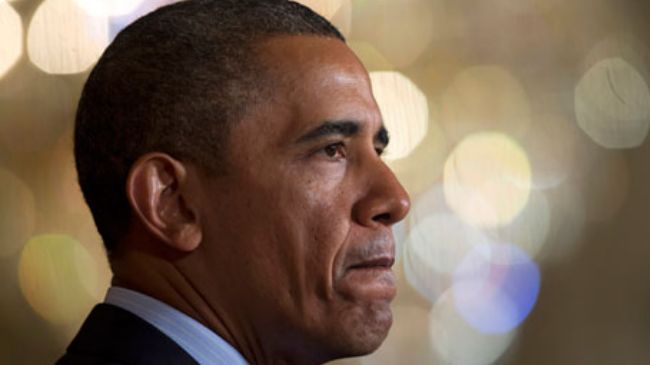
WASHINGTON – President Barack Obama on Friday called for “a pause” in US relations with Russia, even as both countries stressed that cooperation is crucial to their mutual interests and to the world despite sharp differences on a broad range of issues.
“It is probably appropriate for us to take a pause, reassess where it is that Russia is going, what our core interests are, and calibrate the relationship so that we’re doing things that are good for the United States and, hopefully, good for Russia as well,” Obama told a White House news conference Friday.
The comments came two days after the White House announced it had canceled Obama’s planned summit next month with Russian President Vladimir Putin, citing lack of prospects for progress in the bilateral agenda as well as Moscow’s harboring of accused US intelligence leaker Edward Snowden.
But they also coincided with talks in Washington between top US and Russian officials that both sides took pains to describe as constructive while largely downplaying discord over issues such as missile defense, the ongoing civil war in Syria and Russia’s decision to grant temporary asylum to Snowden, who is wanted by the United States to face espionage charges at home.
In his most expansive public discussion of frayed US-Russian relations since his reelection last November, Obama told Friday’s news conference that Putin’s return to the Kremlin last year has coincided with “more rhetoric on the Russian side that was anti-American, that played into some of the old stereotypes about the Cold War contest between the United States and Russia.”
“I’ve encouraged Mr. Putin to think forward as opposed to backwards on those issues – with mixed success” in the effort, Obama said.
He added that both countries should recognize “that there are just going to be some differences, and we’re not going to be able to completely disguise them.”
Obama denied that he had poor relations with Putin despite much public parsing of frosty looking images of their one-on-one meetings.
“I don’t have a bad personal relationship with Putin,” Obama said. “ … I know the press likes to focus on body language and he’s got that kind of slouch, looking like the bored kid in the back of the classroom. But the truth is, is that when we’re in conversations together, oftentimes it’s very productive.”
Officials from both countries on Friday downplayed the importance of the Snowden impasse in a bilateral agenda that includes US missile defense plans, which Russia sees as a threat to its security, and the violence in Syria, where the Kremlin warns that US military aid to rebel forces risks empowering terrorists and US officials accuse Moscow of propping up Syrian President Bashar Assad.
Obama said his decision to scrap the summit was not based “simply around Mr. Snowden,” but rather on what he described as Russia’s failure to move “on a whole range of issues where we think we can make some progress.”
Russian Foreign Minister Sergei Lavrov, meanwhile, told reporters following meetings with US Secretary of State John Kerry and the two countries’ top defense officials in Washington on Friday that Snowden “did not overshadow our discussions.”
“This was mentioned as a fact which we have on our hands,” Lavrov said of the standoff over Snowden. “But the main discussion was about the issues of the agenda, which are of huge interest to the United States, to the Russian Federation and to the entire world.”
Lavrov insisted that Russia had acted in accordance with its own laws and with international law in granting Snowden asylum last week, a position he said Moscow has consistently communicated to Washington since the fugitive former US intelligence contractor landed in Moscow on a flight from Hong Kong on June 23.
A senior US official told reporters during a conference call after Friday’s meetings that the Snowden affair did not “dominate or overshadow” the talks between Lavrov, Kerry, US Defense Secretary Chuck Hagel and Russian Defense Minister Sergei Shoigu.
“What we were able to agree on was the need to move forward on areas of mutual interest,” the official said, adding that the talks focused on missile defense, arms reduction, political and military cooperation, and regional security, including in Syria, Afghanistan, Iran and North Korea.
Both sides said Friday that they had agreed that a political settlement is the only acceptable resolution to the civil war in Syria and that they remain committed to holding the so-called so Geneva-2 conference aimed at bringing an end to the violence in Syria.
Speaking in Moscow on Friday, Putin’s top foreign policy aide, Yury Ushakov, said Obama’s invitation to meet the Russian president in Moscow remains open and that the Kremlin hopes the American president will accept the offer.
Talks between the two countries at the highest level are “very important … not only for both of our countries, but for guaranteeing global stability and security,” Ushakov said.
Obama said the United States said effective cooperation is possible if Russia “is looking forward into the 21st century” but that a “zero-sum” mindset is counterproductive for bilateral ties.
“If issues are framed as if the US is for it, then Russia should be against it, or we’re going to be finding ways where we can poke each other at every opportunity, then probably we don’t get as much stuff done,” Obama said.
Bolivia’s Morales Dissed and Pissed as France, Portugal, and Austria Violate Diplomatic Immunity
By Dave Lindorff | This Can’t Be Happening | July 3, 2013
Those of us who have been saying that the US has become a weak, or at least more ordinary power among many in the world because of its military failures in Iraq and Afghanistan, and because of its economic decline, will have to recalibrate our analysis after watching the pathetic behavior of the leaders of Russia, Germany and France under pressure from the Obama administration not to allow Edward Snowden to gain asylum in those countries or even to escape his purgatory in Moscow’s Sheremetyevo Airport.
Last night, in an astonishing display of fawning obedience to the demands of US leaders, France and Germany first announced that they would not grant asylum to Snowden, despite broad popular support by French and German people for such an offer of aid to the embattled whistleblower. Then, France and Portugal abruptly refused to allow a Bolivian aircraft carrying the country’s president, Evo Morales, from a state visit with Russia’s Vladimir Putin, to land for refueling in their countries, saying that they were concerned he might be flying Snowden to asylum in Bolivia.
Although Spain said eventually it would allow the Morales plane to refuel in the Canary Islands, it did not have enough fuel to get there and had to be diverted to Vienna, where, astonishingly, it was then searched like a drug-smuggling flight over Bolivian protests. Snowden was not aboard. A furious Morales immediately blamed the US Department of State for the whole incident — a charge that no one has disputed, though of course the US is refusing to comment.
Aircraft carrying national leaders have absolute diplomatic immunity under international law and moreover, Bolivia would have the absolute right to grant Snowden amnesty, and to bring him to its territory, whether or not he had a valid passport. As the leader of a sovereign nation, Morales has every right to carry anyone he wants on his plane with him back to his country.
Bolivian President Evo Morales, forced under US pressure to land in Vienna to have his returning plane searched for Snowden, calls the blocking of his flight from Russia to Bolivia a “kidnapping,” and “act of aggression” and an “offense against all the whole Latin region.”
That France, Portugal and Austria would so violate such basic diplomatic rules suggests that the US (which of course has long demonstrated that it views diplomatic rules and international law as applying only to others, but not itself) has some powerful leverage to exert behind the scenes. The more so because this whole incident makes leaders like French President Francois Hollande, who only the day before had suggested his country might consider Snowden’s asylum appeal, look foolish, and because this aggressive and hostile action taken against the leader of a sovereign nation makes France, as well as Portugal and Italy, look pathetic and ridiculous at a time that public sentiment across Europe is solidly in support of Snowden. (An activist friend in Germany reports that sentiment there in support of Snowden and even of granting him asylum is “probably at about 80%,” and that is probably also true in France.)
This latest incident, which has incredibly not been protested either by Russia’s Putin, from whose country the disrupted flight originated, and who was Morales’ official host, also exposes Putin and Russia as being under America’s thumb. Who could have imagined Putin allowing a meeting of leaders in his own country to be so shamed by US intervention involving diversion and impoundment of a foreign leader’s return flight home without a loud protest and even some counter action. At a minimum the US ambassador should have been called in to be tongue-lashed by the Russian president. Yet even Russian state television station RT-TV, in its report on the halting of Morales’ plane and the unprecedented search of a state leader’s plane in Austria, carried no comment from Putin or the Russian government on the insult and outrage.
Has the US, with its incomprehensibly massive spy network, just demonstrated that it now has a power greater than its nuclear arsenal: a dossier perhaps on almost every leader in the world with which it is able to blackmail even the likes of Hollande, Merkel and Putin? It is hard to come up with another explanation for the way this incident played out.
We will have to see now whether Morales, a popular leader from an impoverished indigenous background who is clearly no coward and who is probably too clean to be blackmailed, will make good on his assertion made in Moscow that Snowden would be welcome in Bolivia. Russia could recover a modicum of its self-respect by flying him there on a Russian plane to avoid similar US-orchestrated interference. Venezuela’s new president, Nicolás Maduro, who has also spoken favorably of granting asylum status to the National Security Agency whistleblower, should also step up at this point. Since he is still in Russia, he could offer to bring Snowden back home with him, and dare the nations of Europe to try and stop him.
Europeans are pissed off already at the US, in the wake of National Security Agency leaker Snowden’s latest revelation that the US was aggressively spying on its European allies, both at their and the European Union’s embassies in Washington, and in Europe itself, gleaning not information about terrorism, but inside-track knowledge about trade negotiation positions and other areas of disagreement or negotiation.
Leaders in Germany, France, Italy, and other European countries are demanding that the US cease its spying on them, and give a “full accounting” of the spying that it has been engaging in. But given the steady stream of lies coming from the NSA, the Obama Administration, Secretary of State John Kerry, and other American sources, why should they believe anything they are being told? Most Europeans understand now that all this bluster from their leaders is just that: bluster.
Europe’s leaders have shown themselves to their own people to be sell-outs in the pocket of the US. As several commenters on the website of the German magazine Der Spiegel, which last week ran a cover expose about the NSA spying program directed against European leaders, have written, Germany’s and France’s leaders have sold out their countries and people by caving in to US demands. As one person wrote: “Our government has sold us out and is beyond help.”
To be sure there was a wave of tough talk only days earlier, with, for example, Martin Schulz, the president of the European parliament, saying that the NSA is like the Soviet-era KGB, and with leaders of countries like Ireland and Norway saying that they might consider amnesty for Snowden, but only if he could reach their soil first — a ludicrous requirement, since there is no international law requiring such silliness. Any country can grant asylum to any person it wishes, wherever that person may be at the moment. They cannot offer protection, of course, except in an embassy or in-country, but that’s different from just offering a grant of amnesty. Indeed, the mere fact that the US has cancelled Snowden’s passport doesn’t mean his passport cannot be respected as a travel document by another country. How, in fact, when you think about it, would a country know that a person’s passport had been “cancelled” unless the issuing nation had issued some kind of news release about it as the US did in Snowden’s case? There’s no international registry of global passports. Those records are held closely by each country and in fact are supposed to be secure. Bolivia, Venezuela, Ecuador, Norway, Ireland or any other country that had said at any point that it would be willing to accept Snowden, could stamp their visa on his passport and accept him on their planes. (Even the US Passport Office accepts an old, expired passport as an identity document when one is applying for a new one.)
After this abject display of rank servitude in the interest of the US Imperium by some of Europe’s most powerful nations, if little Bolivia and/or Venezuela don’t step up and show Europe how sovereign nations are supposed to act, it will be up to the people of Europe and Latin America to act.
Already, Latin nations seem to be rallying, with protests across the continent, and with Argentina’s President Cristina Fernández de Kirchner, Ecuador’s President Rafael Correa, and Cuba’s retired leader Fidel Castro expressing anger at the diversion of the Morales plane. An “urgent” Latin American leadership meeting is planned over the crisis, and if it is not just talk, this could indicate that the US may have overstepped in insulting a region that has been growing increasingly assertive about resisting US diktats.
Certainly, following the latest revelations in the Guardian, Der Spiegel, and elsewhere showing that the NSA has been vacuuming up data on millions of Europeans, and with former NSA and CIA director Michael Hayden stating publicly that the Fourth Amendment to the US Constitution — the one that at least used to protect Americans’ right to privacy and from government search and seizure — “is not an international treaty,” the anger among Europeans at US spying is swelling too, and with it, support for the embattled whistleblower Snowden.
We can only hope that the revelations of outrageous US intelligence abuses and violation of Europeans’ privacy rights will continue, that the rage against the US among ordinary European citizens will grow. We can only hope that with that growing rage, a desire to stick it to the US by protecting Snowden will grow too, until some European leader finally sees it as a popular or necessary move to offer him asylum.
This latest abomination in the treatment of Bolivia and its leader, which has shamed France, Portugal, Austria, Italy and Russia, will be a great test of how angry the peoples of those countries are about their leaders’ servile behavior towards the US.
Of course, we in the US should be the most outraged of all, but sadly, there is probably even less chance that a majority Americans will get angry at all this than that Europeans will.
Related article
The US’s Afghan Exit May Depend on a Syrian One
By Sharmine Narwani | Al-Akhbar | 2013-06-25
Washington’s options in Syria are dwindling – and dwindling fast.
Trumped up chemical weapons charges against the Syrian government this month failed to produce evidence to convince a skeptical global community of any direct linkage. And the US’s follow-up pledge to arm rebels served only to immediately underline the difficulty of such a task, given the fungibility of weapons-flow among increasingly extremist militias.
Yes, for a brief few days, Syrian oppositionists congratulated themselves on this long-awaited American entry into Syria’s bloodied waters. They spoke about “game-changing” weapons that would reverse Syrian army gains and the establishment of a no-fly zone on Syria’s Jordanian border – a la Libya. Eight thousand troops from 19 countries flashed their military hardware in a joint exercise on that border, dangling F-16s and Patriot missiles and “superb cooperation” in a made-for-TV show of force.
But it took only days to realize that Washington’s announcement didn’t really have any legs.
Forget the arguments now slowly dribbling out about why the US won’t/can’t get involved directly. Yes, they all have merit – from the difficulties in selecting militia recipients for their weapons, to the illegalities involved in establishing a no-fly zone, to the fact that more than 70% of Americans don’t support an intervention.
The single most critical reason for why Washington will not risk entering the Syrian military theater – almost entirely ignored by DC policy wonks – may be this: the 2014 US military withdrawal from Afghanistan.
“Help, we can’t get out”
There are around 750,000 major pieces of American military hardware costing approximately $36 billion sitting in Afghanistan right now. The cost of transporting this equipment out of the country is somewhere close to the $7 billion mark. It would be easier to destroy this stuff than removing it, but given tightening US budgets and lousy economic prospects, this hardware is unlikely to be replaced if lost.
Getting all this equipment into Afghanistan over the past decade was a lot easier than getting it out will be. For starters, much of it came via Pakistani corridors – before Americans began droning the hell out of that country and creating dangerous pockets of insurgents now blocking exit routes.
An alternative supply route through Afghan border states Uzbekistan, Turkmenistan and Tajikistan called the Northern Distribution Network was set up in 2009, but is costlier and longer than going via Pakistan. And human rights disputes, onerous conditions on transport and unpredictable domestic sentiment toward the Americans places far too much leverage over these routes in the hands of regional hegemon Russia.
Unlike Iraq, where the US could count on its control over the main ports and Arab allies along the Persian Gulf border, Afghanistan is landlocked, mountainous and surrounded by countries and entities now either hostile to US interests or open to striking deals with American foes.
In short, a smooth US exit from Afghanistan may be entirely dependent on one thing: the assistance of Russia, Iran, and to a lesser degree, China.
All three countries are up against the US and its allies in Syria, refusing, for the better part of 18 months, to allow regime-change or a further escalation of hostilities against the state.
In the past few months, the Russian and Iranian positions have gained strength as the Syrian army – with assistance from its allies – pushed back rebel militias in key towns and provinces throughout the country.
Western allies quickly rushed to change the unfavorable equilibrium on the ground in advance of political talks in Geneva, unashamedly choosing to further weaponize the deadly conflict in order to gain “leverage” at the negotiating table.
But none of that has materialized. As evidence, look to the recent G8 Summit where western leaders sought to undermine Russian President Vladimir Putin, calling him “isolated” and referring to the Summit as “G7+1.”
In the meeting’s final communiqué, Putin won handily on every single Syria point. Not only was it clear that the international community’s only next “play” was the negotiations in Geneva, but there was no mention of excluding President Bashar al-Assad from a future Syrian transitional government, once a key demand of opponents. Furthermore, the declaration made it clear that there was no evidence linking chemical weapons use to the Syrian government – had there been any “evidence” whatsoever, it would have made it to paper – and Syrian security forces were empowered, even encouraged, to weed out extremist militias by all the G8 nations.
This was not an insignificant victory for the Russians – it was the first public revelation that Washington, London and Paris have conceded their advantage in Syria. And it begs the question: what cards do the Russians hold in their hand to bring about this kind of stunning reversal, just a week after Washington came out guns blazing?
America – choose your Afghan exit
The US military establishment has, for the most part, stayed out of the fray in Syria, where special ops have been ceded to the CIA and external contractors.
But as the gargantuan task of extricating the US from its decade-long occupation of Afghanistan nears, President Barack Obama has scrambled to accommodate the Pentagon’s top priority. Having assiduously avoided a negotiated political or diplomatic solution with the Taliban for years, he hopes to now pull a face-saving, 11th hour deal out of his hat with foes who will sell him down the river at a moment’s notice.
“The Americans are deeply worried that if the war continues the Kabul government and army might collapse while American bases, advisers, and special forces remain in the country, thereby putting the U.S. in an extremely difficult position,” says Anatol Lieven, a professor and Afghanistan expert at King’s College London, about the already-stalled US-Taliban talks in Doha last week. “They would obviously like to bring about a ceasefire with the Taliban.”
Even if Americans could get to the table, there are myriad issues that could conclusively disrupt negotiations at any time – in a process that “could take years,” as various US officials concede.
For starters, the involved parties – Afghan President Hamid Karzai’s government (which consists of competing ethnic and tribal leaders) and the “new Taliban” – now have multiple interests with regional players like Iran, Pakistan, Russia, China, and the neighboring “Stans” which puts a serious strain on any straightforward negotiation goals.
As an example, the very same Taliban delegation now sitting with the Americans in Doha, were traipsing through Tehran late last month – ostensibly with the knowledge of all parties. And this was certainly not the first visit between the two.
While the US arrogantly kept its Afghan foes at arm’s length for years, the Iranians were busy employing soft power in their neighborhood – a task facilitated by a decade of US regional policy mismanagement that has aggravated its own allies in and around Afghanistan.
This isn’t just a matter of Pakistan and Iran inaugurating a once-inconceivable gas pipeline, as they did earlier this year. Iran is now participating in infrastructure and social service projects in the heart of Kabul, has forged working relationships with Pakistani intelligence on a variety of mutual security issues, and has built deep networks within Afghanistan’s political and tribal elite – even with the Taliban, courtesy of mentors in Islamabad.
A US security expert and frequent advisor to US military forces inside Afghanistan and Iraq gives me the bottom line:
“Iran has basically exploited our vulnerabilities and filled those gaps well.
The US’s very presence in Afghanistan has helped Iran gain tremendous influence in both Afghanistan and Pakistan because of widespread disdain for US military activities and intervention, period. This is where Iranian diplomacy has excelled. Iran and Pakistan have ramped up their relationship both in military terms and with local insurgents during the past seven years. Iran has moved in and built mosques, schools in the middle of Kabul, for God’s sakes.”
The Iranians may be able to upset hopes of a smooth US military withdrawal from Afghanistan, but, this source warns, the Russians can potentially play “spoiler” in a big way as well:
“In Kyrgyzstan we have a base there to airlift a lot of supplies – mostly food, small scale things, not heavy equipment – for US soldiers and troops inside Afghanistan. Russia has so much influence there that at one point they threatened to give the Kyrgyz more money for the base that we were renting to kick us out and shut down that essential supply route. We were forced to heavily increase our rent payments to stay there.”
A few days ago, the Kyrgyz parliament voted overwhelmingly to shut down this very Manas base by July 2014, a full six months before the US withdrawal from Afghanistan is set to complete. Was it a coincidence that the vote came up around the time of the G8 huddle in Ireland, dominated almost entirely by news about a stand-off on Syria?
The US military source also explains how easily the Russians can sweeten the pot for the Pentagon:
“We have, concurrently, gained some support to withdraw from Afghanistan thru neighboring Tajikistan with the help of the Russians – and in return we are going to have to help build some infrastructure, like roads, under the auspices of US aid. These negotiations within and between the US and Tajik governments are ongoing. On this, the Russians have given their word that if we can find a way to exit through any of these countries, they will not interfere. Of course, the politics are fluid and anything can change at anytime.”
In April, NATO reached out to Moscow for help and advice on their military withdrawal from Afghanistan. NATO is keen to ensure the cleanest exit possible, but is also concerned about volatility in the aftermath of its departure – and desperately wants to avoid the perception of “mission defeat.”
What about the Chinese?
“China’s interests are a bit different. Less focused on our military withdrawal, more inclined to undermine our long-term influences and goals,” explains my source. “The Chinese are hell-bent on influencing countries for resource extraction and allocation, given their huge domestic demand. They are very competitive with the US and are going after the same resource pool. They undermine US influence because they play the game differently – they will bribe where we have strict rules on bidding, etc., and therefore enjoy more flexibility going after these same resources.”
In other words, like just about everybody else in that neighborhood, China will edge out any US gains made over the past decade – in both the political and economic sense.
In terms of near-term domestic and international political perception, however, that loss will pale in comparison to a failure by the Pentagon to secure the safe exit of its assets from Afghanistan.
“In the final analysis,” says the US military source with great irony, “if we want to get out of Afghanistan quickly and with minimum sacrifice to troops and hardware, it would save us a great deal of trouble if we could exit with the help of – and through – Iran.”
Enter James Dobbins, who was named Obama’s special envoy for Afghanistan and Pakistan in May. The veteran US diplomat, who I had the opportunity to interview in Washington three years ago, is an interesting choice for this position precisely because he has been so vocal in advocating for US-Iranian negotiations when few others dared.
Dobbins, notably, engaged actively with Iran in the aftermath of the US invasion of Afghanistan, based on a mutual interest of replacing the extremist Taliban with a more moderate, inclusive government. But further dealings came to an abrupt halt just weeks later, when then-US President George W. Bush delivered his infamous “Axis of Evil” speech, including Iran in this trio of top American foes.
It is doubtful that Dobbins or the Doha talks can work any miracles though. The kind of exit the US needs from Afghanistan must rely on a constellation of determined players and events that would be quite remarkable if amassed.
While it is obvious to all that the combined weight of Russia, Iran and China could tip that balance in favor of an expeditious American exit, what would motivate any of these three – who have all recently been at the receiving end of vicious US political and economic machinations – to help?
A grand bargain over Syria would surely be a sweetener: you and your allies exit Syria, we’ll help you exit Afghanistan.
The problem with Washington though, is that it never fails to botch up an opportunity – always striving for that one last impossible power-play which it thinks will help it gain dominance over a situation, a country, an enemy.
There remains the concern that the US’s oft-repeated Al Qaeda mantra – “disrupt, dismantle, defeat” – will prove to be its one-stop solution for every problem.
And that is the exception to my premise about a Syrian exit. That US spoilers who cannot accept even the perception of vulnerability – let alone an outright defeat – may instead choose to catapult the entire Mideast into a region-wide war for the sake of avoiding a painful compromise.
Sharmine Narwani is a commentary writer and political analyst covering the Middle East. You can follow Sharmine on twitter @snarwani.
Gazprom eyes Japanese expansion
RT | April 30, 2013
Seeking to expand in its export markets, Russia’s gas major Gazprom is now looking to develop terminals to process liquefied natural gas as well as distribution networks in Japan.
Japan is largely dependent on gas exports, as the country consumes above 100 billion cubic metres of gas a year while producing domestically no more than 4 billion. Since the Fukushima disaster in 2011 Japan is seeing a greater need for gas.
After the incident, “of 50 nuclear power units, only two are working – that’s a large drop in power generation, we understand that perfectly,” said Russia’s President Vladimir Putin at a press conference following talks with Japanese Prime Minister Shinzo Abe.
Given Russia’s abundant hydrocarbon reserves, the country is quite “capable of providing for the growing consumption of hydrocarbons in Japan without harm to our traditional partners and without harm to our own consumers,” Putin added.
Russia supplies about 6.5 million tonnes of gas to Japan each year, which is about 8% of the total need of the Japanese.
Russia must need closer energy cooperation with Japan to back its Eastern Gas Program, which exports to Asian – Pacific countries, says Michael Korchyomkin, a director at East European Gas Analysis.
Among the joint gas projects between Russia and Japan are Vladivostok LNG and Sakhalin–2, an oil and gas joint venture between Gazprom, Shell and Japanese companies Mitsui and Mitsubishi.
Gazprom’s chances to successfully compete in regasification in Japan look slim, as currently the country processes about 250 bn of cubic metres of liquifed gas. So, new LNG terminals are unlikely to have a huge effect on the country’s economy, analysts say.
Further cooperation between Gazprom and Japan should deal mainly with the latest projects aimed at increasing Russian gas exports to Japan, says Grigory Birg, an analyst from Investcafe.
The Sakhalin – 2 project should be more attractive for the Japanese, as the prime costs there are acceptable, Korchyomkin added. The situation around the Vladivostok LNG plant, that’s due to start operations in 2018, so far looks vague. The price of gas produced there could rise too much – to as much as $700 per a thousand cubic metres, the expert concluded.
Pricing it in
At the moment the price issue remains a key one for the Japanese. “Cutting prices for the fuel bought abroad is an urgent task for our country,” said Toshimitsu Motegi, the Japanese Minister of Economy, Trade and Industry.
People in Japan pay about $550 per thousand cubic metres of gas, which compares to the average of $365 in Europe.
The Japanese have started to ask for lower prices, Valery Nesterov, an analyst at Sberbank Investment Research, told Kommersant daily. This isn’t surprising, as the number of similar requests has increased, adds Mariya Belova, a senior analyst at the energy sector at Moscow School of Management, Skolkovo. Rosneft and Novatek are among other Russian companies offering their LNG (liquefied natural gas) projects, and looking for possible delivery contracts to the country.
Featured Video
No Threat Can Force Iran’s Surrender /Trita Parsi & Lt Cl Daniel Davis
or go to
Aletho News Archives – Video-Images
From the Archives
An Expert Military Analysis of War with China
Actually, None is Necessary
By Fred Reed • Unz Review • December 13, 2020
The Correlation of Armed Forces: U.S. goods and services trade with China totaled an estimated $634.8 billion in 2019. Exports were $163.0 billion; imports were $471.8 billion. The U.S. goods and services trade deficit with China was $308.8 billion in 2019. Trade in services with China (exports and imports) totaled an estimated $76.7 billion in 2019. Services exports were $56.5 billion; services imports were $20.1 billion. The U.S. services trade surplus with China was $36.4 billion in 2019.
There is talk within the Washingtoniat of a possible war with China. Steve Bannon, who apparently was dropped on his head as a child, actually favors such a war. We hear the usual shoo-the-boobs alarm about how the Chinese are doing something terrible and we must gird our loins and American values and show them what for, bow wow, woof. The danger is that the current game of who-blinks-first in Asian waters might actually provoke a shooting war. You know the kind of thing: One warship refuses to get out of the way of another, a collision ensues, some retard lieutenant who signed up on waivers opens fire, and we’re off and running. It is not a good idea to let children play with matches.
The said war is discussed either in emotional terms by idiots or in purely naval terms by those familiar with such things, so we hear of the First Island Chain and the Second Island Chain and whose missiles against the other’s missiles and so on. This would be appropriate if we were fighting World War Two again. Which we aren’t. Let’s take a quick-and-dirty look at how such a war might go.
To begin the war, America would overestimate itself and underestimate China. This is doctrine in the Pentagon. … continue
Blog Roll
 Aletho News
- Theodore Postol: Iran’s Missiles & Drones Were Underestimated
- Iran To Target Military Industrial-Tech Complex That Facilitated Gaza Genocide
- Collapsing Empire: The Resistance Disarms ‘Israel’
- Suicide Should Not Be a Government Service
- Rethinking America’s greatest threat: Iran vs. Israel-Firsters
- Iran accuses adversaries of false flags to strain Turkey ties
- Poland rules out sending Patriot missiles to US/Israel amid war on Iran
- Tehran approves new Hormuz plan with major restrictions
- No Threat Can Force Iran’s Surrender /Trita Parsi & Lt Cl Daniel Davis
- UK’s New Pandemic Plan Would Turn Big Tech Into a Mass Location Tracking Network
- If Americans Knew
- Ann Coulter Rips Into Fox News for Iran War Coverage, Compares to False Rigged 2020 Election Reporting
- Joe Kent Urges Americans To Call White House and Congress To Object To Sending Troops Into Iran
- DNC Resolution to Reject AIPAC Funding Puts Democratic Leaders in the Hot Seat
- Swedish foundation to build 400 schools as over 650,000 Gaza children remain without education for 2 years
- Israeli army admits photshopping image of slain Lebanese journalist
- This is how Israel is systematically killing health workers under the cover of war in Lebanon
- Carrying life under fire: Israeli invasion of Lebanon leaves pregnant women facing deadly risks
- Champagne all around for the new death penalty (for Palestinians) law – Not a ceasefire Day 172
- Why are Palestinian books struggling to be seen on Amazon?
- The Line Between Affinity and Conspiracy
- No Tricks Zone
- New Study Finds Warming Saves Lives…Cold Temperatures 12 Times More Deadly Than Excess Heat
- German Science Blog Accuses PIK Climate Institute Of Hallucinating Climate Tipping Points
- Devastating Assessment Of Comirnaty Vaccine By Former Senior Pfizer Europe Toxicologist
- New Study: CO2 Is ‘Effectively Negligible’ As An Explanatory Climate Change Factor Since 2000
- Former Pfizer Toxicologist Dr. Helmut Sterz Tells Bundestag Hearing Pfizer Vaccine Should Have Never Been Approved
- Energy Expert: Germany’s Nuclear Phaseout Was A “500 Billion Euro Mistake”
- New Research: South Australia’s Mid-Holocene Sea Surface Temperatures Were 4°C Warmer Than Today
- Storing Green Energy To Last Germany 10 Days Would Require A 60-Million Tonne Battery
- New Studies: UK Sea Levels Were 4 Meters Higher Than Today During The Mid-Holocene
- Destructive Green New Deal: German Energy And Metal Group Warns Of Drastic Crisis
 Aletho News