Scott Pruitt’s statement on climate change
By Judith Curry | Climate Etc. | March 11, 2017
My analysis of EPA Administrator Scott Pruitt’s recent statements on climate change, and the response to his statements.
Last week, there was a controversial interview of Scott Pruitt on CNBC. A sampling of the headlines reporting on his interview:
New Yorker : Scott Pruitt rejects climate change reality. A relatively thorough summary of the interview with Scott Pruitt.
Washington Post : On climate change, Scott Pruitt causes an uproar — and contradicts the EPA’s own website.
CNBC: Scott Pruitt’s climate denial is dangerous and out of step.
Guardian : EPA head Scott Pruitt denies that carbon dioxide causes global warming. Subtitle: Trump adviser shocks scientists and environmental advocates with statement that negates EPA policy and ‘overwhelmingly clear’ evidence on climate change
David Robert at Vox : Scott Pruitt denies basic climate science. But most of the outrage is missing the point. Subtitle: It’s not about Pruitt and it’s not about facts. Excerpt: The right’s refusal to accept the authority of climate science is of a piece with its rejection of mainstream media, academia, and government, the shared institutions and norms that bind us together and contain our political disputes.
A number of scientists have responded in various venues regarding their opinion on Scott Pruitt’s statements. Here I include the ‘official’ statement from the AGU:
AGU Responds to Statements from EPA Administrator Scott Pruitt on Climate Change. Excerpt: The position statement of the American Geophysical Union regarding climate change leaves no doubt that increasing atmospheric concentrations of carbon dioxide resulting from human activity is the dominant source of climate change during the last several decades.
You may recall my concerns about the AGU policy statement on climate change [link]
What Scott Pruitt actually said
Listen to what Scott Pruitt actually said on CNBC and then compare it to the portrayal in the media. Here is the key text:
I think that measuring with precision human activity on the climate is something very challenging to do and there’s tremendous disagreement about the degree of impact, so no, I would not agree that it’s a primary contributor to the global warming that we see. But we don’t know that yet. We need to continue the debate and continue the review and the analysis.
Can you square what Pruitt actually said with the distorted quotes and headlines about this? I can’t.
I think that these two statements made by Pruitt are absolutely correct:
I think that measuring with precision human activity on the climate is something very challenging to do and there’s tremendous disagreement about the degree of impact
We need to continue the debate and continue the review and the analysis.
The other two statements give slightly conflicting messages:
I would not agree that it’s a primary contributor to the global warming that we see. But we don’t know that yet.
The main statement of controversy is:
I would not agree that it’s a primary contributor to the global warming that we see.
You can interpret this in two ways:
1.Pruitt is denying that CO2 is a primary contributor to recent global warming
OR
2.Pruitt is saying that he does not accept as a ‘fact’ that CO2 is a primary contributor because we simply don’t know.
Since his subsequent statement is “But we don’t know that yet”, #2 is obviously the correct interpretation.
I think he is saying that he is not convinced that we know with certainty that humans have caused 100% of the recent warming (which is what some climate modelers are saying, see recent tweets from Gavin Schmidt), or that humans have caused ‘more than half’ of the recent warming (which was the conclusion from the IPCC AR5.
JC reflections
If I am interpreting Pruitt’s statements correctly, I do not find anything to disagree with in what he said: we don’t know how much of recent warming can be attributed to humans. In my opinion, this is correct and is a healthy position for both the science and policy debates.
Exactly what the Trump administration intends to do regarding funding climate science, energy policy and the Paris climate agreement presumably remain as subjects of debate within the administration. Looking at every little leak and quote out of context as a rationale for hysteria simply isn’t rational or useful.
The most interesting reaction to all this is David Robert’s Vox article:
The right’s refusal to accept the authority of climate science is of a piece with its rejection of mainstream media, academia, and government, the shared institutions and norms that bind us together and contain our political disputes.
The ‘problem’: a change of administration and party after 8 years, mainstream media no longer has a lock on the media’s message (given all of the new news sources on the internet), academia’s profoundly liberal bias is being challenged, and the consensus that has been negotiated and enforced by certain elite scientists is being challenged.
Three cheers for democracy, the internet and the scientific process.
Official Washington Hails an Anti-Russia Hawk
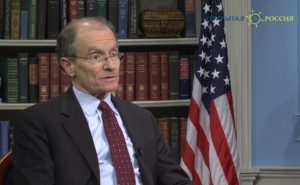
U.S. Ambassador Daniel Fried, who recently retired as the State Department’s coordinator for sanctions policy.
By James W Carden | Consortium News | March 7, 2017
It’s probably safe to wager that few people outside of Washington, and perhaps even quite a few people inside it, have ever heard of Ambassador Daniel Fried — at least not until very recently.
The longtime Ambassador, a 40-year veteran of the U.S. State Department, recently made headlines in Time, Newsweek, Reuters, Politico and NPR for a farewell speech he made to his State Department colleagues during which he took a parting shot at President Trump for the latter’s widely assumed (but yet to be acted upon) desire to come to an accommodation with Russia.
Fried’s address won praise from Establishment figures like former Deputy Secretary of State Antony Blinken (a “powerful defense of liberal international order”), Atlantic Council executive Damon Wilson ( a “clarion call for the U.S. to believe in itself and lead [a] liberal order”) and New York Times columnist Roger Cohen (“a superb summation of everything worth fighting for to keep this planet fit for human habitation”).
Why all the excitement? Well for one, Frieds’s farewell hit the many of Establishment’s erogenous zones:
–NATO expansion as an unalloyed good: NATO and the E.U. – grew to embrace 100 million liberated Europeans… this great achievement is now under assault by Russia
–Realists just don’t “get it”: George Kennan didn’t think much of what he termed America’s moralistic-legalistic tradition. But this foreign policy exceptionalism was the heart of our Grand Strategy through two World Wars, the Cold War and the post-1989 era, and it was crowned with success.
–And then there is Fried’s tendentious (and among neoconservatives and liberal interventionists widely shared) rendering of history and his puzzling conflation of the world situations as they obtained in 1940 and as it obtains currently, in 2017: In 1940, Germany offered Britain a sphere of influence deal: German recognition of the British Empire in exchange for London’s recognition of Germany dominance of continental Europe. Churchill didn’t take the deal then; we should not take similar deals now.
While there can be little doubt that Fried served loyally, with distinction and was in all likelihood an exemplary functionary of the U.S. foreign policy apparatus, what else explains the outpouring of praise for Fried?
Part of it of course is that in Washington, you get points for longevity regardless of your record. Recall the encomiums heaped upon Andrew Marshall a couple years ago when Marshall, who spent his career as the Pentagon’s chief policy hand, retired after four decades in 2015.
The Washington Post reverentially called Marshall “the Pentagon’s Yoda”; The Economist praised him as “the quiet American”; and that year a flattering book was released about Marshall entitled The Last Warrior: Andrew Marshall and the Shaping of Modern American Defense Strategy. In a review of the book, Notre Dame political scientist Michael Desch tartly noted that “at the end of the day, Marshall was not a saint but rather a public official who served too long and whose record was more mixed than his incense burners are prepared to admit.”
#Resistance to Trump
Another reason for the current praise for Fried’s address is that it combined two of the essential ingredients of the #Resistance that is currently so in vogue in today’s Washington: opposition to Trump and hostility to Russia – never mind whether the policy implications of such a stance are necessary or wise.
Days after he retired, Fried sat down with another tried-and-true Russia critic, former Moscow correspondent for The Washington Post Susan Glasser, and said that in his opinion, “Russia despises the West. And it is doing what it can to weaken the West.” Trump should not, said Fried, “be so desperate to rub up against a Russia which is busy trying to do us in all over the world.”
That Fried’s carries these opinions on Russia is unsurprising; a look at his career in the Foreign Service shows a diplomat who took the most hawkish positions possible regarding Russia in the post-Cold War period. Fried was a vocal champion of NATO enlargement, arguing, as U.S. Ambassador to Poland in January 1998 that “NATO membership had a stabilizing effect on Western Europe’s ‘ethnic rivalries’ and the prospect of membership in ‘the West’ has strengthened political moderates and weakened nationalists throughout Central Europe, to U.S. benefit.”
This assessment looks rather less than prescient in light of the recent rise in ethno-nationalist regimes in Poland, Hungary and, of course, Ukraine.
As U.S. Assistant Secretary for Europe under George W Bush, Fried declared that Russia’s defense of the ethnic Russian enclave of South Ossetia against the neoconservative puppet government of Mikheil Saakashvili was “not the sign of a strong nation. It is the sign of a weak one.”
Russia, said Fried, anticipating many of the same talking points we hear today, told the Washington Post in August 2008, “Russia is going to have to come to terms with the reality; it can either integrate with the world or it can be a self-isolated bully. But it can’t be both.”
Fried was one of the lead architects of U.S. sanctions against Russia in the aftermath of the Ukraine crisis and Crimean annexation. Having served as the State Department’s coordinator of sanctions policy, he recently argued that “without the sanctions the situation might well be much worse. And if you don’t think it can be worse then I think you just lack imagination. The Russians could have driven deeper into Ukraine and they could have tried to seize Mariupol or driven on land all the way to Crimea or attack Harkhiv. The sanctions may have stopped the Russians from going further.”
This summation is, to put it mildly, open to question, given that there is little evidence that the Russians even want the small part of Donetsk and Luhansk that they currently help to subsidize and support.
In the end, in judging the supposed wisdom of Fried’s recent fusillades against Trump and Russia we might look to the record of the man rather than his rhetoric.
James W Carden is a contributing writer for The Nation and editor of The American Committee for East-West Accord’s eastwestaccord.com. He previously served as an advisor on Russia to the Special Representative for Global Inter-governmental Affairs at the US State Department.
(Photo from YouTube)
How the Press Serves the Deep State
By Daniel Lazare | Consortium News | March 1, 2017
The New York Times has made it official. In a Sunday front-page article entitled “Trump Ruled the Tabloid Media. Washington Is a Different Story,” the paper gloats that Donald Trump has proved powerless to stop a flood of leaks threatening to capsize his administration.
As reporters Glenn Thrush and Michael M. Grynbaum put it: “This New York-iest of politicians, now an idiosyncratic, write-your-own-rules president, has stumbled into the most conventional of Washington traps: believing he can master an entrenched political press corps with far deeper connections to the permanent government of federal law enforcement and executive department officials than he has.”
Thrush and Grynbaum add a few paragraphs later that Trump “is being force-fed lessons all presidents eventually learn – that the iron triangle of the Washington press corps, West Wing staff and federal bureaucracy is simply too powerful to bully.”
Iron triangle? Permanent government? In its tale of how Trump went from being a favorite of the New York Post and Daily News to fodder for the big-time Washington news media, the Times seems to be going out of its way to confirm dark paranoid fears of a “deep state” lurking behind the scenes and dictating what political leaders can and cannot do. “Too powerful to bully” by a “write-your-own-rules president” is another way of saying that the permanent government wants to do things its way and will not put up with a president telling it to take a different approach.
Entrenched interests are nothing new, of course. But a major news outlet bragging about collaborating with such elements in order to cripple a legally established government is. The Times was beside itself with outrage when top White House adviser Steve Bannon described the media as “the opposition party.” But one can’t help but wonder what all the fuss is about since an alliance aimed at hamstringing a presidency is nothing if not oppositional.
If so, a few things are worth keeping in mind. One is that Trump was elected, even if only by an Eighteenth-Century relic known as the Electoral College, whereas the deep state, permanent government, or whatever else you want to call it was not. Where Trump gave speeches, kissed babies, and otherwise sought out the vote, the deep state did nothing. To the degree this country is still a democracy, that must count for something. So if the conflict between president and the deep state ever comes down to a question of legitimacy, there is no doubt who will come out ahead: The Donald.
A second thing worth keeping in mind is that if ever there was a case of the unspeakable versus the inedible (to quote Oscar Wilde), the contest between a billionaire president and billionaire-owned press is it.
Both sides are more or less correct in what they say about the other. Trump really is a strongman at war with basic democratic norms just as innumerable Times op-ed articles say he is. And giant press organizations like the Times and the Washington Post are every bit as biased and one-sided as Trump maintains – and no less willfully gullible, one might add, than in 2002 or 2003 when they happily swallowed every lie put out by the George W. Bush administration regarding Iraqi WMDs or Saddam Hussein’s support for Al Qaeda.
Riveting TV
Trump’s Feb. 16 press conference – surely the most riveting TV since Jerry Springer was in his prime – is a case in point. The President bobbed, weaved, and hurled abuse like a Catskills insult comic. He threw out pseudo-facts, describing his victory, for instance, as “the biggest Electoral College win since Ronald Reagan” when in fact George H. W. Bush, Bill Clinton and Barack Obama all got more votes. But commentators who panned the display as a “freak show” or simply “batshit crazy” didn’t get it. It wasn’t Trump who bombed that afternoon, but the press.
Why? Because reporters behaved with all the intelligence of a pack of Jack Russell terriers barking at a cat up a tree. Basically, they’ve been seized by the idée fixe that Russia is a predator state that hacks elections, threatens U.S. national security, and has now accomplished the neat trick of planting a Kremlin puppet in the Oval Office. It doesn’t matter that evidence is lacking or that the thesis defies common sense. It’s what they believe, what their editors believe, and what the deep state believes too (or at least pretends to). So the purpose of the Feb. 16 press conference was to pin Trump down as to whether he also believes the Russia-did-it thesis and pillory him for deviating from the party line.
More than half the questions that reporters threw out were thus about Russia, about Mike Flynn, the ex-national security adviser who got into trouble for talking to the Russian ambassador before the new administration formally took office, or about reputed contacts between the Trump campaign staff and Moscow. One reporter thus demanded to know if anyone from Trump’s campaign staff had ever spoken with the Russian government or Russian intelligence. Another asked if Trump had requested FBI telephone intercepts before determining that Flynn had not broken the law.
“I just want to get you to clarify this very important point,” said a third. “Can you say definitively that nobody on your campaign had any contacts with the Russians during the campaign?” A fourth wanted to get the President’s reaction to such “provocations” as a Russian communications vessel floating 30 miles off the coast of Connecticut (in international waters). “Is Putin testing you, do you believe, sir?” the reporter asked as if he had just uncovered a Russian agent in the Lincoln Bedroom. “… But do they damage the relationship? Do they undermine this country’s ability to work with Russia?”
When yet another journalist asked yet again “whether you are aware that anyone who advised your campaign had contacts with Russia during the course of the election,” Trump cried out in frustration: “How many times do I have to answer this question?” It was the most intelligent query of the day.
The press played straight into Trump’s hands, all but providing him with his best lines. “Well, I guess one of the reasons I’m here today is to tell you the whole Russian thing, that’s a ruse,” he responded at one point. “That’s a ruse. And by the way, it would be great if we could get along with Russia, just so you understand that. Now tomorrow, you’ll say, ‘Donald Trump wants to get along with Russia, this is terrible.’ It’s not terrible. It’s good.”
The prose may not be very polished, but the sentiments are unassailable. Ditto Trump’s statement a few minutes later that “false reporting by the media, by you people, the false, horrible, fake reporting makes it much harder to make a deal with Russia. … And that’s a shame because if we could get along with Russia – and by the way, China and Japan and everyone – if we could get along, it would be a positive thing, not a negative thing.”
If the Washington Post and the Times do not agree that bogus assertions about unauthorized contacts with Russia are not poisoning the atmosphere, they should explain very clearly why not. They should also explain what they hope to accomplish with a showdown with Russia and why it will not be a step toward World War III.
But they won’t, of course. The media (with encouragement from parts of the U.S. government) are working themselves into a fit of outrage against Vladimir Putin just as, in past years, they did against Daniel Ortega, Manuel Noriega, Saddam Hussein, Slobodan Milosevic, Saddam Hussein (again), Muammar Gaddafi, Bashar al-Assad, and Viktor Yanukovych. In each instance, the outcome has been war, and so far the present episode shows all signs of heading in the same direction as well.
Reporters may be clueless, but working-class Americans aren’t. They don’t want a war because they’re the ones who would have to fight it. So they’re not unsympathetic to Trump and all the more inclined to give the yapping media short shrift.
This is a classic pattern in which strongmen advance on the basis of a liberal opposition that proves to be weak and feckless. Today’s liberal media are obliging Trump by behaving in a way that is even sillier than usual and well ahead of schedule to boot.
A Fragile Meme
The anti-Russia meme, meanwhile, rests on the thinnest of foundations. The argument that Russia hacked the Democratic National Committee and thereby tipped the election to Trump is based on a single report by CrowdStrike, the California-based cyber-security firm hired by the DNC to look into the mass email leak. The document is festooned with head-spinning techno-jargon.
It says of Cozy Bear and Fancy Bear, the hackers who allegedly penetrated the DNC in behalf of Russian intelligence: “Their tradecraft is superb, operational security second to none, and the extensive usage of ‘living-off-the-land’ techniques enables them to easily bypass many security solutions they encounter. In particular, we identified advanced methods consistent with nation-state level capabilities including deliberate targeting and ‘access management’ tradecraft – both groups were constantly going back into the environment to change out their implants, modify persistent methods, move to new Command & Control channels, and perform other tasks to try to stay ahead of being detected. Both adversaries engage in extensive political and economic espionage for the benefit of the government of the Russian Federation and are believed to be closely linked to the Russian government’s powerful and highly capable intelligence services.”
Impressive? Not to independent tech experts who have already begun taking potshots. Sam Biddle, The Intercept’s extremely smart tech writer, notes that CrowdStrike claims to have proved that Cozy Bear and Fancy Bear are Russian because they left behind Cyrillic comments in their “metadata” along with the name “Felix Edmundovich,” also in Cyrillic, an obvious reference to Felix Edmundovich Dzerzhinsky, founder of the Cheka, as the Soviet political police were originally known.
But, Biddle observes, there’s an obvious contradiction: “Would a group whose ‘tradecraft is superb’ with ‘operational security second to none’ really leave behind the name of a Soviet spy chief imprinted on a document it sent to American journalists? Would these groups really be dumb enough to leave Cyrillic comments on these documents? … It’s very hard to buy the argument that the Democrats were hacked by one of the most sophisticated, diabolical foreign intelligence services in history, and that we know this because they screwed up over and over again.”
Indeed, John McAfee, founder of McAfee Associates and developer of the first commercial anti-virus software, casts doubt on the entire enterprise, wondering whether it is possible to identify a hacker at all. “If I were the Chinese,” he told TV interviewer Larry King in late December, “and I wanted to make it look like the Russians did it, I would use Russian language within the code, I would use Russian techniques of breaking into organizations. … If it looks like the Russians did it, then I can guarantee you: it was not the Russians.” (Quote starts at 4:30.)
This may be too sweeping. Nonetheless, if the press really wanted to get to the bottom of what the Russians are doing, they would not begin with the question of what Trump knew and when he knew it. They would begin, rather, with the question of what we know and how we can be sure. It’s the question that the press should have asked during the run-up to the 2003 invasion of Iraq, but failed to. But it’s the question that reporters should be asking now before the conflict with Russia spins out of control, with consequences that are potentially even more horrendous.
It’s not easy making Donald Trump seem like a peacenik, but that’s what the billionaire’s press has done.
Mainstream Media’s ‘Victimhood’
By Robert Parry | Consortium News | February 28, 2017
It’s heartwarming that The New York Times and The Washington Post are troubled that President Trump is loosely throwing around accusations of “fake news.” It’s nice that they now realize that truth does not reliably come from the mouth of every senior government official or from every official report.
The Times is even taking out full-page ads in its own pages to offer truisms about truth: “The truth is hard. The truth is hidden. The truth must be pursued. The truth is hard to hear. The truth is rarely simple. The truth isn’t so obvious. …” On Sunday, those truth truisms ran opposite an alarmist column by Jim Rutenberg entitled, “Will the Real Democracy Lovers Please Stand Up?” Meanwhile, The Washington Post launched its own melodramatic slogan, “Dies in Darkness.”
Yet, it was only weeks ago when the Post and Times were eagerly promoting plans for silencing or blacklisting independent news sites that didn’t toe the line on what the U.S. government and its allies were claiming was true.
On Nov. 20, the Times published a lead editorial calling on Facebook and other technology giants to devise algorithms that could eliminate stories that the Times deemed to be “fake.” The Times and other mainstream news outlets – along with a few favored Internet sites – joined a special Google-sponsored task force, called the First Draft Coalition, to decide what is true and what is not. If the Times’ editorial recommendations were followed, the disfavored stories and the sites publishing them would no longer be accessible through popular search engines and platforms, essentially blocking the public’s access to them. [See Consortiumnews.com’s “What to Do About ‘Fake News.’”]
On Thanksgiving Day, the Post ran a front-page story citing an anonymous group, called PropOrNot, blacklisting 200 Web sites, including Consortiumnews.com and other important sources of independent journalism, because we supposedly promoted “Russian propaganda.”
Although PropOrNot and the Post didn’t bother to cite any actual examples or to ask the accused for comment, the point was clear: If you didn’t march in lockstep behind the Official Narrative on, say, the Ukraine crisis or the war in Syria, you were to be isolated, demonized and effectively silenced. In the article, the Post blurred the lines between “fake news” – stories that are simply made up – and what was deemed “propaganda,” in effect, information that didn’t jibe with what the U.S. State Department was saying.
Back then, in November, the big newspapers believed that the truth was easy, simple, obvious, requiring only access to some well-placed government official or a quick reading of the executive summary from some official report. Over the last quarter century or so, the Times, in particular, has made a fetish out of embracing pretty much whatever Officialdom declared to be true. After all, such well-dressed folks with those important-sounding titles couldn’t possibly be lying.
That gullibility went from the serious, such as rejecting overwhelming evidence that Ronald Reagan’s Nicaraguan Contra rebels were deeply involved in drug trafficking, to the silly, trusting the NFL’s absurd Deflategate allegations against Tom Brady. In those “old” days, which apparently ended a few weeks ago, the Times could have run full-page ads, saying “Truth is whatever those in authority say it is.”
In 2002, when the George W. Bush administration was vouching for a motley crew of Iraqi “defectors” describing Saddam Hussein’s hidden WMDs, Iraq’s purchase of some “aluminum tubes” must have been for building nuclear bombs. In 2003, when Secretary of State Colin Powell showed some artist drawings of “mobile chemical weapons labs,” they must really exist – and anyone who doubted Powell’s “slam-dunk” testimony deserved only contempt and ridicule.
When the Obama administration issued a “government assessment” blaming the Syrian military for the sarin gas attack outside Damascus on Aug. 21, 2013, there was no need to scrutinize its dubious assertions or ask for actual proof. To do so made you an “Assad apologist.”
When a bunch of U.S. allies under the effective control of Ukraine’s unsavory SBU intelligence service presented some videos with computer-generated graphics showing Russians supplying the Buk missile that shot down Malaysia Airlines Flight 17 over eastern Ukraine on July 17, 2014, there was no need to examine the holes in the evidence or note that the realistic-looking graphics were fictional and based on dubious assumptions. To do so made you a “Moscow stooge.”
In other words, when the U.S. government was gluing black hats on an “enemy” and white hats on a U.S. “ally,” the Times never seemed to object. Nor did pretty much anyone else in the mainstream media. No one seemed to note that both sides usually deserved gray hats. With very few exceptions – when the State Department or other U.S. agencies were making the charges – the Times and its cohorts simply stopped applying responsible journalistic skepticism.
Of course, there is a problem with “fake news,” i.e., stories that are consciously made up for the purpose of making money from lots of clicks. There are also fact-free conspiracy theories that operate without evidence or in defiance of it. No one hates such bogus stories more than I do — and they have long been a bane of serious journalism, dating back centuries, not just to the last election.
But what the Times, the Post and the rest of the mainstream media have typically ignored is that there are many situations in which the facts are not clear or when there are alternative explanations that could reasonably explain a set of facts. There are even times when the evidence goes firmly against what the U.S. government is claiming. At those moments, skepticism and courage are necessary to challenge false or dubious Official Narratives. You might even say, “The truth is rarely simple. The truth isn’t so obvious…”
A Tough Transition
During the transition from the Obama administration to the Trump team, the Times, the Post and other mainstream media outlets got caught in their own transition from trusting whatever the outgoing officials said to distrusting whatever the incoming officials said. In those final days, big media accepted what President Obama’s intelligence agencies asserted about Russia supposedly interfering in the U.S. election despite the lack of publicly available evidence that could be scrutinized and tested.
Even something as squirrelly as the attack on Trump’s National Security Adviser Michael Flynn – with Obama holdovers citing the never-prosecuted Logan Act from 1799 as the pretext for ginning up some kind of criminal-sounding case that scared Trump into firing Flynn – was treated as legitimate, without serious questions asked. Since Obama officials were doing the feeding, the no-skepticism rule applied to the eating. But whatever statements came from Trump, even his few lucid moments explaining why war with nuclear-armed Russia wasn’t such a great idea, were treated as dangerous nonsense.
When Trump scolded the mainstream press for engaging in “fake news” and then applied the phrase “enemy of the people,” the Times, the Post and the rest went into full victimization-mode. When a few news companies were excluded from a White House news briefing, they all rushed to the barricades to defend freedom of the press. Then, Trump went even further – he rejected his invitation to the White House Correspondents Dinner, the black-tie/evening-gown event where mainstream media stars compete to attract the hottest celebrity guests and hobnob with important government officials, a walking-talking conflict-of-interest-filled evening, an orgy of self-importance.
So, the Times, the Post and their mainstream-media friends now feel under attack. Whereas just weeks ago they were demanding that Google, Facebook and other powerful information platforms throttle those of us who showed professional skepticism toward dubious claims from the U.S. government, now the Times, the Post and the others are insisting that we all rally around them, to defend their journalistic freedom. In another full-page ad on Sunday, the Times wrote: “Truth. It’s more important now than ever.”
I would argue that truth is always important, but especially so when government officials are leading countries toward war, when lives are at stake, whether in Iraq or Syria or Ukraine or the many other global hotspots. At those moments in the recent past, the Times did not treat truth – in all its subtlety and nuance – as important at all.
I would argue, too, that the stakes are raised even higher when propagandists and ideologues are risking the prospect of nuclear war that could kill billions and effectively end human civilization. However, in that case, the American people have seen little truly professional journalism nor a real commitment to the truth. Instead, it’s been much more fun to demonize Russian President Vladimir Putin and paint black-and-white pictures of the evil Russians.
At such moments, those New York Times’ truisms about truth are forgotten: “The truth is rarely simple. The truth isn’t so obvious. …”
Investigative reporter Robert Parry broke many of the Iran-Contra stories for The Associated Press and Newsweek in the 1980s.
US in Deep Turmoil as Trump Confronts the Establishment
By Salman Rafi Sheikh | New Eastern Outlook | 28.02.2017
With the departure of the Trump’s national security adviser, political crisis in the US has only depended and is likely to exacerbate into a full-fledged struggle for power and control between Trump and what some call ‘deep-state.’ While Donald Trump is an elected president of the United States of America, he doesn’t seem to be able to exercise power in actual terms. This is evident from the way a so-called ‘pro-Russian’ adviser has been forced to resign. Following this resignation an intense debate has emerged in the US, leading a considerable number of people, 48 per cent according to a recent poll, to reject the way Trump has performed in the first month of his presidency. Already Trump has retracted on Crimea. Accordingly, he is in no hurry to engage Russia in Syria nor does he consider NATO to be “obsolete.” In the same vain, his U-turn towards China is something that nobody could foresee during his election campaign. As of now, a great deal of Trump’s election rhetoric is dead and lies buried deep inside the rubric of deep structures of power, marking the very first instance of its sort when an American president has found himself deeply at odds with the system. And, there is no certainty that he can or may overcome this tussle and emerge as the American ‘knight in shining armour.’
While this may or may not happen, a lot of questions about Trump’s ability to steer the course of American foreign and domestic policies have emerged following Flynn’s resignation and with it the so-called crisis of legitimacy has deepened, leaving minimum to no space for Trump to freely determine the course of American policy making.
The crisis, or the power struggle, has deepened to an extent where an American elected president has been forced to publicly blame American intelligence agencies for feeding the media with information against him and claimed that today’s America was `just like Russia’.
The Russophobia campaign is, indeed, being fed to the American public and the declining support for Trump is more a direct result of this spread of false information than an outcome of actual ‘bad performance.’
The media leaks have already led to Michael Flynn’s resignation. The Washington Post has recently reported that Flynn had “discussed sanctions” with a Russian official during the transition period, although Flynn had assured Vice President Mike Pence that this did not happen.
In turn, The New York Times noted on February 14, 2017, that other officials of the Trump administration and his election campaign have had contacts with Russian intelligence agents as well.
Flynn’s departure just three weeks after Trump’s inauguration as president has allowed the media to claim that the White House was in total disarray.
The media’s propagandist claim has certainly irked Trump who went to his favourite medium of communication, Twitter, to fire off a series of tweets, attacking the media as well as the intelligence agencies. In at least two tweets, Trump named the agencies the Federal Bureau of Investigations (FBI) and National Security Agency (NSA) that he said were `running a campaign against him’.
`The real scandal here is that classified information is illegally given out by `intelligence’ like candy. ‘Very un-American’, he tweeted. `Information is being illegally given to the failing New York Times and Washington Post by the intelligence community.
The crisis that has thus ensued and which is being fanned out by the mainstream US media is asking for changes in the policies, particularly towards Russia about Crimea and co-operation in Syria, that Trump had advocated during his election campaign.
We have already seen that some of it has already changed. What this retraction implies, in political terms, is that the establishment has also shown that it has the ability and the grit to undermine Trump if he were to deviate from their script—a script that is premised on the existence of an enemy (Russia) and which the establishment and the deep-state can use to protect, enhance and materialize its own political and economic interests in both domestic and global political and economic arenas.
The “Russophobia” based containment of Donald Trump is, however, not going to remain exclusive to the US’ domestic political circles. On the contrary, it is likely to, and already has, expanded into international political arena and is going to define and shape Trump’s relations with the US’ European allies, who in turn are neither comfortable with Trump’s foreign policy nor are going to allow him to retract the US-NATO security system (read: NATO is no longer “obsolete”).
Interestingly enough, this ‘trans-Atlantic Russophobia’ is being transformed into a new Cold War. The NATO defence ministers have been recently been discussing the presence of their fleets in the Black Sea in a closed summit in Brusells. Clearly, the western bloc on the whole loathes Trump, creating an unprecedented disequilibrium within the Western alliance wherein Trump leads the alliance, but the partners do not know how far he is to be taken seriously due to his inability to control things (read: establishment’s course of action is more appealing to the NATO allies for its anti-Russia, pro-sanctions commitments).
The Trump administration has lost, by losing Flynn, its authority and the ability to guide the American public to its vision. On the contrary, the media-establishment nexus has hijacked Donald Trump’s own vision, forcing him to forget his election rhetoric promises and come out in the open to fight for his political survival through social media.
Just as Trump’s confrontation with the American establishment is causing unease in the domestic and European political arena, Trump’s fight with the establishment is being equally fought in both domestic and European arenas. Whereas Trump has resorted to twitter to fight back against a sustained media campaign, in the European arena he has hit back by re-casting doubts over the US’ commitment to NATO.
That is to say, while he no doubt has willy-nilly accepted NATO as the “bedrock” of American security, Mattis’ remarks at NATO defence ministers’ meeting show that the crisis is not yet over and that it will remain unsettled unless the dust of the tussle between Trump and American establishment remains in the air—something that may not happen overnight—and unless the all-powerful American establishment succeeds in modifying Trump into a typical Neo-Con hawk.
Salman Rafi Sheikh, research-analyst of International Relations and Pakistan’s foreign and domestic affairs.
How ‘New Cold Warriors’ Cornered Trump
By Gareth Porter | Consortium News | February 25, 2017
Opponents of the Trump administration have generally accepted as fact the common theme across mainstream media that aides to Donald Trump were involved in some kind of illicit communications with the Russian government that has compromised the independence of the administration from Russian influence.
But close analysis of the entire series of leaks reveals something else that is equally sinister in its implications: an unprecedented campaign by Obama administration intelligence officials, relying on innuendo rather than evidence, to exert pressure on Trump to abandon any idea of ending the New Cold War and to boost the campaign to impeach Trump.
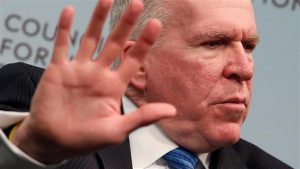 A brazen and unprecedented intervention in domestic U.S. politics by the intelligence community established the basic premise of the cascade of leaks about alleged Trump aides’ shady dealing with Russia. Led by CIA Director John Brennan, the CIA, FBI and NSA issued a 25-page assessment on Jan. 6 asserting for the first time that Russia had sought to help Trump win the election.
Brennan had circulated a CIA memo concluding that Russia had favored Trump and had told CIA staff that he had met separately with Director of National Intelligence James Clapper and FBI Director James Comey and that they had agreed on the “scope, nature and intent of Russian interference in our presidential election.”
In the end, however, Clapper refused to associate himself with the document and the NSA, which agreed to do so, was only willing to express “moderate confidence” in the judgment that the Kremlin had sought to help Trump in the election. In intelligence community parlance, that meant that the NSA considered the idea the Kremlin was working to elect Trump was merely plausible, not actually supported by reliable evidence.
In fact, the intelligence community had not even obtained evidence that Russia was behind the publication by Wikileaks of the e-mails Democratic National Committee, much less that it had done so with the intention of electing Trump. Clapper had testified before Congress in mid-November and again in December that the intelligence community did not know who had provided the e-mails to WikiLeaks and when they were provided.
The claim – by Brennan with the support of Comey – that Russia had “aspired” to help Trump’s election prospects was not a normal intelligence community assessment but an extraordinary exercise of power by Brennan, Comey and NSA Director Mike Rogers.
Brennan and his allies were not merely providing a professional assessment of the election, as was revealed by their embrace of the the dubious dossier compiled by a private intelligence firm hired by one of Trump’s Republican opponents and later by the Clinton campaign for the specific purpose of finding evidence of illicit links between Trump and the Putin regime.
Salacious Gossip
When the three intelligence agencies gave the classified version of their report to senior administration officials in January they appended a two-page summary of the juiciest bits from that dossier – including claims that Russian intelligence had compromising information about Trump’s personal behavior while visiting Russia. The dossier was sent, along with the assessment that Russia was seeking to help Trump get elected, to senior administration officials as well as selected Congressional leaders.
Among the claims in the private intelligence dossier that was summarized for policymakers was the allegation of a deal between the Trump campaign and the Putin government involving full Trump knowledge of the Russian election help and a Trump pledge – months before the election – to sideline the Ukraine issue once in office. The allegation – devoid of any verifiable information – came entirely from an unidentified “Russian emigre” claiming to be a Trump insider, without any evidence provided of the source’s actual relationship to the Trump camp or of his credibility as a source.
After the story of the two-page summary leaked to the press, Clapper publicly expressed “profound dismay” about the leak and said the intelligence community “has not made any judgment that the information in this document is reliable,” nor did it rely on it any way for our conclusions.”
One would expect that acknowledgment to be followed by an admission that he should not have circulated it outside the intelligence community at all. But instead Clapper then justified having passed on the summary as providing policymakers with “the fullest possible picture of any matters that might affect national security.”
By that time, U.S. intelligence agencies had been in possession of the material in the dossier for several months. It was their job to verify the information before bringing it to the attention of policymakers.
A former U.S. intelligence official with decades of experience dealing with the CIA as well other intelligence agencies, who insisted on anonymity because he still has dealings with U.S. government agencies, told this writer that he had never heard of the intelligence agencies making public unverified information on a U.S. citizen.
“The CIA has never played such a open political role,” he said.
The CIA has often tilted its intelligence assessment related to a potential adversary in the direction desired by the White House or the Pentagon and the Joint Chiefs of Staff, but this is the first time that such a slanted report impinges not only on domestic politics but is directed at the President himself.
The egregious triple abuse of the power in publishing a highly partisan opinion on Russia and Trump’s election, appending raw and unverified private allegations impugning Trump’s loyalty and then leaking that fact to the media begs the question of motive. Brennan, who initiated the whole effort, was clearly determined to warn Trump not to reverse the policy toward Russia to which the CIA and other national security organizations were firmly committed.
A few days after the leak of the two-page summary, Brennan publicly warned Trump about his policy toward Russia. In an interview on Fox News, he said, “I think Mr. Trump has to understand that absolving Russia of various actions that it’s taken in the past number of years is a road that he, I think, needs to be very, very careful about moving down.”
Graham Fuller, who was a CIA operations officer for 20 years and was also National Intelligence Officer for the Middle East for four years in the Reagan administration, observed in an e-mail, that Brennan, Clapper and Comey “might legitimately fear Trump as a loose cannon on the national scene,” but they are also “dismayed at any prospect that the official narrative against Russia could start falling apart under Trump, and want to maintain the image of constant and dangerous Russian intervention into affairs of state.”
Flynn in the Bull’s Eye
As Trump’s National Security Adviser, Michael Flynn presented an easy target for a campaign to portray the Trump team as being in Putin’s pocket. He had already drawn heavy criticism not only by attending a Moscow event celebrating the Russian television RT in 2016 but sitting next to Putin and accepting a fee for speaking at the event. More importantly, however, Flynn had argued that the United States and Russia could and should cooperate in their common interest of defeating Islamic State militants.
That idea was anathema to the Pentagon and the CIA. Obama’s Defense Secretary Ashton Carter had attacked Secretary of State John Kerry’s negotiating a Syrian ceasefire that included a provision for coordination of efforts against Islamic State. The official investigation of the U.S. attack on Syrian forces on Sept. 17 turned up evidence that CENTCOM had deliberately targeted the Syrian military sites with the intention of sabotaging the ceasefire agreement.
The campaign to bring down Flynn began with a leak from a “senior U.S. government official” to Washington Post columnist David Ignatius about the now-famous phone conversation between Flynn and Russian Ambassador Sergei Kislyak on Dec. 29. In his column on the leak, Ignatius avoided making any explicit claim about the conversation. Instead, he asked “What did Flynn say, and did it undercut the U.S. sanctions?”
And referring to the Logan Act, the 1799 law forbidding a private citizen from communicating with a foreign government to influence a “dispute” with the United States, Ignatius asked, “Was its spirit violated?”
The implications of the coy revelation of the Flynn conversation with Kislyak were far-reaching. Any interception of a communication by the NSA or the FBI has always been considered one of the most highly classified secrets in the U.S. intelligence universe of secrets. And officers have long been under orders to protect the name of any American involved in any such intercepted communication at all costs.
But the senior official who leaked the story of Flynn-Kislyak conversation to Ignatius – obviously for a domestic political purpose – did not feel bound by any such rule. That leak was the first move in a concerted campaign of using such leaks to suggest that Flynn had discussed the Obama administration’s sanctions with Kislyak in an effort to undermine Obama administration policy.
The revelation brought a series of articles about denials by the Trump transition team, including Vice President-elect Mike Pence, that Flynn had, in fact, discussed sanctions with Kislyak and continued suspicions that Trump’s aides were covering up the truth. But the day after Trump was inaugurated, the Post itself reported that the FBI had begun in late December go back over all communications between Flynn and Russian officials and “had not found evidence of wrongdoing or illicit ties to the Russian government….”
Two weeks later, however, the Post reversed its coverage of the issue, publishing a story citing “nine current and former officials, who were in senior positions at multiple agencies at the time of the calls,” as saying that Flynn had “discussed sanctions” with Kislyak.
The story said Flynn’s conversation with Kislyak was “interpreted by some senior U.S. officials as an inappropriate and potentially illegal signal to the Kremlin that it could expect a reprieve from sanctions that were being imposed by the Obama administration in late December to punish Russia for its alleged interference in the 2016 election.”
The Post did not refer to its own previous reporting of the FBI’s unambiguous view contradicting that claim, which suggested strongly that the FBI was trying to head off a plan by Brennan and Clapper to target Flynn. But it did include a crucial caveat on the phrase “discussed sanctions” that few readers would have noticed. It revealed that the phrase was actually an “interpretation” of the language that Flynn had used. In other words, what Flynn actually said was not necessarily a literal reference to sanctions at all.
Only a few days later, the Post reported a new development: Flynn had been interviewed by the FBI on Jan. 24 – four days after Trump’s inauguration – and had denied that he discussed sanctions in the conversation. But prosecutors were not planning to charge Flynn with lying, according to several officials, in part because they believed he would be able to “parse the definition of the word ‘sanctions’.” That implied that the exchange was actually focused not on sanctions per se but on the expulsion of the Russian diplomats.
Just hours before his resignation on Feb. 13, Flynn claimed in an interview with the Daily Caller that he had indeed referred only to the expulsion of the Russian diplomats.
“It wasn’t about sanctions. It was about the 35 guys who were thrown out,” Flynn said. “It was basically, ‘Look, I know this happened. We’ll review everything.’ I never said anything such as, ‘We’re going to review sanctions,’ or anything like that.”
The Russian Blackmail Ploy
Even as the story of the Flynn’s alleged transgression in the conversation with the Russian Ambassador was becoming a political crisis for Donald Trump, yet another leaked story surfaced that appeared to reveal a shocking new level of the Trump administration’s weakness toward Russia.
The Post reported on Feb. 13 that Acting Attorney General Sally Yates, an Obama holdover, had decided in late January – after discussions with Brennan, Clapper and FBI Director James Comey in the last days of the Obama administration – to inform the White House Counsel Donald McGahn in late January that Flynn had lied to other Trump administration officials – including Vice President Mike Pence – in denying that he discussed sanctions with Kislyak. The Post cited “current and former officials” as the sources.
That story, repeated and amplified by many other news media, led to Flynn’s downfall later that same day. But like all of the other related leaks, the story revealed more about the aims of the leakers than about links between Trump’s team and Russia.
The centerpiece of the new leak was that the former Obama administration officials named in the story had feared that “Flynn put himself in a compromising position” in regard to his account of the conversation with Kislyak to Trump members of the Trump transition.
Yates had told the White House that Flynn might be vulnerable to Russian blackmail because of the discrepancies between his conversation with the Ambassador and his story to Pence, according to the Post story.
But once again the impression created by the leak was very different from the reality behind it. The idea that Flynn had exposed himself to a potential Russian blackmail threat by failing to tell Pence exactly what had transpired in the conversation was fanciful in the extreme.
Even assuming that Flynn had flatly lied to Pence about what he had said in the meeting – which was evidently not the case – it would not have given the Russians something to hold over Flynn, first because it was already revealed publicly and second, because the Russian interest was to cooperate with the new administration.
The ex-Obama administration leakers were obviously citing that clumsy (and preposterous) argument as an excuse to intervene in the internal affairs of the new administration. The Post’s sources also claimed that “Pence had a right to know that he had been misled….” True or not, it was, of course, none of their business.
Pity for Pence
The professed concern of the Intelligence Community and Justice Department officials that Pence deserved the full story from Flynn was obviously based on political considerations, not some legal principle. Pence was a known supporter of the New Cold War with Russia, so the tender concern for Pence not being treated nicely coincided with a strategy of dividing the new administration along the lines of policy toward Russia.
All indications are that Trump and other insiders knew from the beginning exactly what Flynn had actually said in the conversation, but that Flynn had given Pence a flat denial about discussing sanctions without further details.
On Feb. 13, when Trump was still trying to save Flynn, the National Security Adviser apologized to Pence for “inadvertently” having failed to give him a complete account, including his reference to the expulsion of the Russian diplomats. But that was not enough to save Flynn’s job.
The divide-and-conquer strategy, which led to Flynn’s ouster, was made effective because the leakers had already created a political atmosphere of great suspicion about Flynn and the Trump White House as having had illicit dealings with the Russians. The normally pugnacious Trump chose not to respond to the campaign of leaks with a detailed, concerted defense. Instead, he sacrificed Flynn before the end of the very day the Flynn “blackmail” story was published.
But Trump appears to have underestimated the ambitions of the leakers. The campaign against Flynn had been calculated in part to weaken the Trump administration and ensure that the new administration would not dare to reverse the hardline policy of constant pressure on Putin’s Russia.
Many in Washington’s political elite celebrated the fall of Flynn as a turning point in the struggle to maintain the existing policy orientation toward Russia. The day after Flynn was fired the Post’s national political correspondent, James Hohmann, wrote that the Flynn “imbroglio” would now make it “politically untenable for Trump to scale back sanctions to Moscow” because the “political blowback from hawkish Republicans in Congress would be too intense….”
But the ultimate target of the campaign was Trump himself. As neoconservative journalist Eli Lake put it, “Flynn is only the appetizer. Trump is the entree.”
Susan Hennessey, a well-connected former lawyer in the National Security Agency’s Office of General Counsel who writes the Lawfare blog at the Brookings Institution, agreed. “Trump may think Flynn is the sacrificial lamb,” she told The Guardian, “but the reality is that he is the first domino. To the extent the administration believes Flynn’s resignation will make the Russia story go away, they are mistaken.”
The Phony “Constant Contacts” Story
No sooner had Flynn’s firing been announced than the next phase of the campaign of leaks over Trump and Russia began. On Feb. 14, CNN and the New York Times published slight variants of the same apparently scandalous story of numerous contacts between multiple members of the Trump camp with the Russian at the very time the Russians were allegedly acting to influence the election.
There was little subtlety in how mainstream media outlets made their point. CNN’s headline was, “Trump aides were in constant touch with senior Russian officials during campaign.” The Times headline was even more sensational: “Trump Campaign Aides Had Repeated Contacts with Russian Intelligence.”
But the attentive reader would soon discover that the stories did not reflect those headlines. In the very first paragraph of the CNN story, those “senior Russian officials” became “Russians known to U.S. intelligence,” meaning that it included a wide range Russians who are not officials at all but known or suspected intelligence operatives in business and other sectors of society monitored by U.S. intelligence. A Trump associate dealing with such individuals would have no idea, of course, that they are working for Russian intelligence.
The Times story, on the other hand, referred to the Russians with whom Trump aides were said to be in contact last year as “senior Russian intelligence officials,” apparently glossing over a crucial distinction that sources had made to CNN between intelligence officials and Russians being monitored by U.S. intelligence.
But the Times story acknowledged that the Russian contacts also included government officials who were not intelligence officials and that the contacts had been made not only by Trump campaign officials but also associates of Trump who had done business in Russia. It further acknowledged it was “not unusual” for American business to come in contact with foreign intelligence officials, sometimes unwittingly in Russia and Ukraine, where “spy services are deeply embedded in society.”
Even more important, however, the Times story made it clear that the intelligence community was seeking evidence that Trump’s aides or associates were colluding with the Russians on the alleged Russian effort to influence the election, but that it had found no evidence of any such collusion. CNN failed to report that crucial element of the story.
The headlines and lead paragraphs of both stories, therefore, should have conveyed the real story: that the intelligence community had sought evidence of collusion by Trump aides with Russia but had not found it several months after reviewing the intercepted conversations and other intelligence.
Unwitting Allies of the War Complex?
Former CIA Director Brennan and other former Obama administration intelligence officials have used their power to lead a large part of the public to believe that Trump had conducted suspicious contacts with Russian officials without having the slightest evidence to support the contention that such contacts represent a serious threat to the integrity of the U.S. political process.
Many people who oppose Trump for other valid reasons have seized on the shaky Russian accusations because they represent the best possibility for ousting Trump from power. But ignoring the motives and the dishonesty behind the campaign of leaks has far-reaching political implications. Not only does it help to establish a precedent for U.S. intelligence agencies to intervene in domestic politics, as happens in authoritarian regimes all over the world, it also strengthens the hand of the military and intelligence bureaucracies who are determined to maintain the New Cold War with Russia.
Those war bureaucracies view the conflict with Russia as key to the continuation of higher levels of military spending and the more aggressive NATO policy in Europe that has already generated a gusher of arms sales that benefits the Pentagon and its self-dealing officials.
Progressives in the anti-Trump movement are in danger of becoming an unwitting ally of those military and intelligence bureaucracies despite the fundamental conflict between their economic and political interests and the desires of people who care about peace, social justice and the environment.
NYT’s Fake News about Fake News
By Robert Parry | Consortium News | February 22, 2017
A grave danger from the Western mainstream media’s current hysteria about “fake news” is that the definition gets broadened from the few made-up stories that are demonstrably false – often fabricated by kids to get more clicks – to include reasonable disputes about the facts of a complex controversy.
This danger has grown worse because The New York Times, The Washington Post and other major Western news organizations have merged their outrage over “fake news” with the West’s propaganda campaign against Russia by claiming without evidence that the Russian government is somehow putting out false stories to undermine Western democracy.
However, when news organizations actually track down “fake news” outlets, they are usually run by some young entrepreneurs from outside Russia who saw made-up stories as a way to increase revenue by luring in more readers eager for “information” that supports their prejudices.
Yet, a front-page Times article on Tuesday, citing “fake news” as a threat to Europe, contains what arguably is “fake news” itself by claiming that many of the purported 2,500 stories “discredited” by the European Union’s East Stratcom operation have “links to Russia” although the Times doesn’t identify those links.
The article by Mark Scott and Melissa Eddy then goes on to blur these two separate concepts: “In a year when the French, Germans and Dutch will elect leaders, the European authorities are scrambling to counter a rising tide of fake news and anti-European Union propaganda aimed at destabilizing people’s trust in institutions.”
But it is this mushing together of “fake news” and what the Times describes as “anti-European Union propaganda” that is so insidious. The first relates to consciously fabricated stories; the second involves criticism of a political institution, the E.U., which is viewed by many Europeans as elitist, remote and disdainful of the needs, interests and attitudes of average citizens.
Whether you call such criticism “propaganda” or “dissent,” it is absurd to blame it all on Russia. When it comes to “destabilizing people’s trust in institutions,” the E.U. — especially with its inept handling of the Great Recession and its clumsy response to the Syrian refugee crisis — is doing a bang-up job on its own without Russian help.
Yet, rather than face up to legitimate concerns of citizens, the E.U. and U.S. governments have found a convenient scapegoat, Russia. To hammer home this point — to make it the new “groupthink” — E.U. and U.S. leaders have financed propaganda specialists to disparage political criticism by linking it to Russia.
Even worse, in the United States, the Times and other mainstream publications – reflecting the views of the political establishment – have editorialized to get giant technology companies, like Facebook and Google, to marginalize independent news sites that don’t accept the prevailing conventional wisdom.
There is an Orwellian quality to these schemes — a plan for a kind of Ministry of Truth enforced by algorithms to weed out deviant ideas — but almost no one whose voice is allowed in the mass media gets to make that observation. Even now, there is a chilling uniformity in the endless denunciations of Russia as the root of all evil.
Though the Times’ article treats the E.U.’s East Stratcom operatives as 11 beleaguered public servants sticking their fingers in the dike to protect the citizenry from a flood of Russian disinformation, “stratcom” actually is a euphemism for psychological operations, i.e., the strategic use of communications to influence the thinking of a target population.
In this case, the target populations are the European public and – to an ancillary degree – the American people who get to absorb the same propaganda from The New York Times. The real goal of stratcom is not to combat a few sleazy entrepreneurs generating consciously false stories for profit but to silence or “discredit” sources of information that question the E.U. and U.S. propaganda.
More Stratcom
NATO has its own Stratcom command based in Latvia that also is assigned to swat down information that doesn’t conform to Western propaganda narratives. The U.S. Agency for International Development and the U.S.-funded National Endowment for Democracy also pour tens of millions of dollars into media operations with similar goals as do major Western foundations, such as currency speculator George Soros’s Open Society. Last December, the U.S. Congress approved and President Obama signed legislation to create an additional $160 million bureaucracy to combat “Russian propaganda.”
In other words, the West’s stratcom and “psychological operations” are swimming in dough despite the Times’ representation that these “anti-disinformation” projects are unfairly outgunned by sinister forces daring to challenge what everyone-in-the-know knows to be true.
If these “stratcom” operations were around in 2002-2003, they would have been accusing the few people questioning the Iraq-has-WMD certainty of putting out “fake news” to benefit Saddam Hussein. Now, journalists and citizens who don’t buy the full-Monte demonization of Russia and its President Vladimir Putin are put into a similar category.
Instead of trusting in the free exchange of ideas, the new attitude at the Times, the Post and other Western news outlets is to short-circuit the process by smearing anyone who questions the official narratives as a “Putin apologist” or a “Moscow stooge.”
Beyond being anti-democratic, this anti-intellectual approach has prevented serious examination of the facts behind the West’s war or words against Russia. To shut down that debate, all you need to do is to say that any fact cited at a Russian news outlet must be false or “fake news.” Any Westerner who notes the same fact must be a “Putin puppet.”
Western “stratcom” doesn’t even want to allow Russian media to criticize politicians who are criticizing Russia. The Times article lamented that “Many false claims target politicians who present the biggest obstacles to Moscow’s goal of undermining the European Union.” The Times, however, doesn’t offer any examples of such “false claims.”
Instead, the Times writes that Russian news channels had “targeted the [French] presidential candidate Emmanuel Macron, who belongs to the party and is running on a pro-European Union platform.”
But what does that mean? Is it now an act of aggression when newscasts in one country criticize a leader of another country? If so, are the European news channels that have “targeted” U.S. President Donald Trump somehow deserving of U.S. government retaliation? Doesn’t the E.U. – and by extension The New York Times – accept the idea of political disagreement and debate?
This closed-mindedness is especially dangerous – indeed existentially risky – when applied to a confrontation between nuclear-armed powers. In such a case, the maximum amount of debate should be encouraged, instead of what amounts to blacklisting dissidents in the West who won’t toe the official propaganda lines.
Media Censors
Disturbingly, the leading forces in this suppression of skepticism are the most prestigious newspapers in the United States and Europe. Even after the disastrous experience with the Iraq War and the bogus WMD groupthink, Western news outlets that were party to that fiasco have virtually excluded well-reported articles and documentaries that question the U.S. and E.U. narratives of the New Cold War.
For instance, there has been almost no presentation in the mainstream Western media of an alternative – and I would argue more complete and accurate – narrative of the Ukraine conflict, taking into account the country’s complex history and deep ethnic divisions.
It is essentially forbidden to refer to the violent overthrow of elected President Viktor Yanukovych three years ago as a “coup” or a “putsch” or to cite evidence of a U.S.-backed “regime change,” such as an intercepted phone call between U.S. Assistant Secretary of State Victoria Nuland and U.S. Ambassador to Ukraine Geoffrey Pyatt in which they discussed how to “glue” and how to “midwife” the installation of a new leadership in Kiev.
In the supposedly “free” West, you can only refer to the post-coup events in Crimea, in which the people of the largely ethnic Russia area voted overwhelmingly to secede from Ukraine and rejoin Russia, as a “Russian invasion.” No skepticism is allowed even though there were no images of Russian troops wading ashore on Crimea’s beaches or Russian tanks crashing across borders. The “invasion” supposedly happened even though no invasion was necessary because Russian troops were already in Crimea under the naval basing agreement at Sevastopol.
Amid the West’s current hysteria about “Russian propaganda,” U.S. and E.U. citizens are not even given the opportunity to watch well-reported documentaries about key moments in the New Cold War, including an eye-opening investigative report debunking the Western propaganda myth constructed around the death of Russian accountant Sergei Magnitsky or a well-produced historical account of the Ukraine crisis.
Western news outlets and governments even take pride in blocking such dissenting views and contrary information from reaching the American and European publics. Like East Stratcom — the E.U.’s Brussels-based 11-member team of diplomats, bureaucrats and former journalists — establishment institutions see themselves bravely battling “Russian disinformation.” They see it as their duty not to let their people hear this other side of the story.
If that is what the West’s institutions have come to — dismissing reasonable criticism and thoughtful dissent as “Russian disinformation” — is it any wonder that they are losing the confidence of their people?
Investigative reporter Robert Parry broke many of the Iran-Contra stories for The Associated Press and Newsweek in the 1980s.
A Reprise of the Iraq-WMD Fiasco?
By James W Carden | Consortium News | February 3, 2017
The controversy over Russia’s alleged interference in the 2016 presidential election shows no sign of letting up. A bipartisan group of U.S. senators recently introduced legislation that would impose sanctions on Russia in retaliation for its acts of “cyber intrusions.”
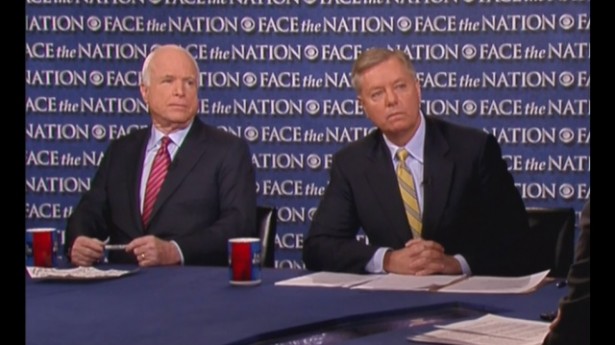
Senators John McCain and Lindsey Graham
At a press event in Washington on Tuesday, Sen. Dick Durbin, D-Illinois, called Election Day 2016 “a day that will live in cyber infamy.” Previously, Sen. John McCain, R-Arizona, called the Russian hacks of the Democratic National Committee “an act of war,” while Sen. Lindsey Graham, R-South Carolina, has claimed that there is near unanimity among senators regarding Russia’s culpability.
Despite all this, the question of who exactly is responsible for the providing WikiLeaks with the emails of high Democratic Party officials does not lend itself to easy answers. And yet, for months, despite the lack of publicly disclosed evidence, the media, like these senators, have been as one: Vladimir Putin’s Russia is responsible.
Interestingly, the same neoconservative/center-left alliance which endorsed George W. Bush’s case for war with Iraq is pretty much the same neoconservative/center-left alliance that is now, all these years later, braying for confrontation with Russia. It’s largely the same cast of characters reading from the Iraq-war era playbook.
It’s worth recalling Tony Judt’s observation in September 2006 that “those centrist voices that bayed most insistently for blood in the prelude to the Iraq war … are today the most confident when asserting their monopoly of insight into world affairs.”
While that was true then, it is perhaps even more so the case today.
The prevailing sentiment of the media establishment during the months prior to the disastrous March 2003 invasion of Iraq was that of certainty: George Tenet’s now infamous assurance to President Bush, that the case against Iraq was a “slam drunk,” was essentially what major newspapers and television news outlets were telling the American people at the time. Iraq posed a threat to “the homeland,” therefore Saddam “must go.”
The Bush administration, in a move equal parts cynical and clever, engaged in what we would today call a “disinformation” campaign against its own citizens by planting false stories abroad, safe in the knowledge that these stories would “bleed over” and be picked up by the American press.
WMD ‘Fake News’
The administration was able to launder what were essentially “fake news” stories, such as the aluminum tubes fabrication, by leaking to Michael R. Gordon and Judith Miller of The New York Times. In September 2002, without an ounce of skepticism, Gordon and Miller regurgitated the claims of unnamed U.S. intelligence officials that Iraq “has sought to buy thousands of specially designed aluminum tubes … intended as components of centrifuges to enrich uranium.” Gordon and Miller faithfully relayed “the intelligence agencies’ unanimous view that the type of tubes that Iraq has been seeking are used to make centrifuges.”
By 2002, no one had any right to be surprised by what Bush and Cheney were up to; since at least 1898 (when the U.S. declared war on Spain under the pretense of the fabricated Hearst battle cry “Remember the Maine!”) American governments have repeatedly lied in order to promote their agenda abroad. And in 2002-3, the media walked in lock step with yet another administration in pushing for an unnecessary and costly war.
Like The New York Times, The Washington Post also relentlessly pushed the administration’s case for war with Iraq. According to the journalist Greg Mitchell, “By the Post’s own admission, in the months before the war, it ran more than 140 stories on its front page promoting the war.” All this, while its editorial page assured readers that the evidence Colin Powell presented to the United Nations on Iraq’s WMD program was “irrefutable.” According to the Post, it would be “hard to imagine” how anyone could doubt the administration’s case.
But the Post was hardly alone in its enthusiasm for Bush’s war. Among the most prominent proponents of the Iraq war was The New Yorker’s Jeffrey Goldberg, who, a full year prior to the invasion, set out to link Saddam Hussein and Al Qaeda. Writing for The New Yorker in March 2002, Goldberg retailed former CIA Director James Woolsey’s opinion that “It would be a real shame if the C.I.A.’s substantial institutional hostility to Iraqi democratic resistance groups was keeping it from learning about Saddam’s ties to Al Qaeda in northern Iraq.”
Indeed, according to Goldberg, “The possibility that Saddam could supply weapons of mass destruction to anti-American terror groups is a powerful argument among advocates of regime change,” while Saddam’s “record of support for terrorist organizations, and the cruelty of his regime make him a threat that reaches far beyond the citizens of Iraq.”
Writing in Slate in October 2002, Goldberg was of the opinion that “In five years . . . I believe that the coming invasion of Iraq will be remembered as an act of profound morality.”
Likewise, The New Republic’s Andrew Sullivan was certain that “we would find weapons of mass destruction in Iraq. I have no doubt about that.” Slate’s Jacob Weisberg supported the invasion because he thought Saddam Hussein had WMD and he “thought there was a strong chance he’d use them against the United States.”
Even after it was becoming clear that the war was a debacle, the neoconservative pundit Charles Krauthammer declared that the inability to find WMDs was “troubling” but “only because it means that the weapons remain unaccounted for and might be in the wrong hands. The idea that our inability to thus far find the weapons proves that the threat was phony and hyped is simply false.”
Smearing Skeptics
Opponents of the war were regularly accused of unpatriotic disloyalty. Writing in National Review, the neoconservative writer David Frum accused anti-intervention conservatives of going “far, far beyond the advocacy of alternative strategies.” According to Frum, “They deny and excuse terror. They espouse a potentially self-fulfilling defeatism. They publicize wild conspiracy theories. And some of them explicitly yearn for the victory of their nation’s enemies.”
Similarly, The New Republic’s Jonathan Chait castigated anti-war liberals for turning against Bush. “Have Bush haters lost their minds?” asked Chait. “Certainly some have. Antipathy to Bush has, for example, led many liberals not only to believe the costs of the Iraq war outweigh the benefits but to refuse to acknowledge any benefits at all.”
Yet of course we now know, thanks, in part, to a new book by former CIA analyst John Nixon, that everything the U.S. government thought it knew about Saddam Hussein was indeed wrong. Nixon, the CIA analyst who interrogated Hussein after his capture in December 2003, asks “Was Saddam worth removing from power?” “The answer,” says Nixon, “must be no. Saddam was busy writing novels in 2003. He was no longer running the government.”
It turns out that the skeptics were correct after all. And so the principal lesson the promoters of Bush and Cheney’s war of choice should have learned is that blind certainty is the enemy of fair inquiry and nuance. The hubris that many in the mainstream media displayed in marginalizing liberal and conservative anti-war voices was to come back to haunt them. But not, alas, for too long.
A Dangerous Replay?
Today something eerily similar to the pre-war debate over Iraq is taking place regarding the allegations of Russian interference in the U.S. presidential election. Assurances from the intelligence community and from anonymous Obama administration “senior officials” about the existence of evidence is being treated as, well, actual evidence.
State Department spokesman John Kirby told CNN that he is “100% certain” of the role that Russia played in U.S. election. The administration’s expressions of certainty are then uncritically echoed by the mainstream media. Skeptics are likewise written off, slandered as “Kremlin cheerleaders” or worse.
Unsurprisingly, The Washington Post is reviving its Bush-era role as principal publicist for the government’s case. Yet in its haste to do the government’s bidding, the Post has published two widely debunked stories relating to Russia (one on the scourge of Russian inspired “fake news”, the other on a non-existent Russian hack of a Vermont electric utility) onto which the paper has had to append “editor’s notes” to correct the original stories.
Yet, those misguided stories have not deterred the Post’s opinion page from being equally aggressive in its depiction of Russian malfeasance. In late December, the Post published an op-ed by Rep. Adam Schiff and former Rep. Jane Harmon claiming “Russia’s theft and strategic leaking of emails and documents from the Democratic Party and other officials present a challenge to the U.S. political system unlike anything we’ve experienced.”
On Dec. 30, the Post editorial board chastised President-elect Trump for seeming to dismiss “a brazen and unprecedented attempt by a hostile power to covertly sway the outcome of a U.S. presidential election.” The Post described Russia’s actions as a “cyber-Pearl Harbor.”
On Jan. 1, the neoconservative columnist Josh Rogin told readers that the recent announcement of sanctions against Russia “brought home a shocking realization that Russia is using hybrid warfare in an aggressive attempt to disrupt and undermine our democracy.”
Meanwhile, many of the same voices who were among the loudest cheerleaders for the war in Iraq have also been reprising their Bush-era roles in vouching for the solidity of the government’s case.
Jonathan Chait, now a columnist for New York magazine, is clearly convinced by what the government has thus far provided. “That Russia wanted Trump to win has been obvious for months,” writes Chait.
“Of course it all came from the Russians, I’m sure it’s all there in the intel,” Charles Krauthammer told Fox News on Jan. 2. Krauthammer is certain.
And Andrew Sullivan is certain as to the motive. “Trump and Putin’s bromance,” Sullivan told MSNBC’s Chris Matthews on Jan. 2, “has one goal this year: to destroy the European Union and to undermine democracy in Western Europe.”
David Frum, writing in The Atlantic, believes Trump “owes his office in considerable part to illegal clandestine activities in his favor conducted by a hostile, foreign spy service.”
Jacob Weisberg agrees, tweeting: “Russian covert action threw the election to Donald Trump. It’s that simple.” Back in 2008, Weisberg wrote that “the first thing I hope I’ve learned from this experience of being wrong about Iraq is to be less trusting of expert opinion and received wisdom.” So much for that.
Foreign Special Interests
Another, equally remarkable similarity to the period of 2002-3 is the role foreign lobbyists have played in helping to whip up a war fever. As readers will no doubt recall, Ahmed Chalabi, leader of the Iraqi National Congress, which served, in effect as an Iraqi government-in-exile, worked hand in hand with the Washington lobbying firm Black, Kelly, Scruggs & Healey (BKSH) to sell Bush’s war on television and on the op-ed pages of major American newspapers.
Chalabi was also a trusted source of Judy Miller of the Times, which, in an apology to its readers on May 26, 2004, wrote: “The most prominent of the anti-Saddam campaigners, Ahmad Chalabi, has been named as an occasional source in Times articles since at least 1991, and has introduced reporters to other exiles. He became a favorite of hard-liners within the Bush administration and a paid broker of information from Iraqi exiles.” The pro-war lobbying of the American Israel Public Affairs Committee has also been exhaustively documented.
Though we do not know how widespread the practice has been as of yet, something similar is taking place today. Articles calling for confrontation with Russia over its alleged “hybrid war” with the West are appearing with increasing regularity. Perhaps the most egregious example of this newly popular genre appeared on Jan. 1 in Politico magazine. That essay, which claims, among many other things, that “we’re in a war” with Russia comes courtesy of one Molly McKew.
McKew is seemingly qualified to make such a pronouncement because she, according to her bio on the Politico website, served as an “adviser to Georgian President Saakashvili’s government from 2009-2013, and to former Moldovan Prime Minister Filat in 2014-2015.” Seems reasonable enough. That is until one discovers that McKew is actually registered with the Department of Justice as a lobbyist for two anti-Russian political parties, Georgia’s UMN and Moldova’s PLDM.
Records show her work for the consulting firm Fianna Strategies frequently takes her to Capitol Hill to lobby U.S. Senate and Congressional staffers, as well as prominent U.S. journalists at The Washington Post and The New York Times, on behalf of her Georgian and Moldovan clients.
“The truth,” writes McKew, “is that fighting a new Cold War would be in America’s interest. Russia teaches us a very important lesson: losing an ideological war without a fight will ruin you as a nation. The fight is the American way.” Or, put another way: the truth is that fighting a new Cold War would be in McKew’s interest – but perhaps not America’s.
While you wouldn’t know it from the media coverage (or from reading deeply disingenuous pieces like McKew’s) as things now stand, the case against Russia is far from certain. New developments are emerging almost daily. One of the latest is a report from the cyber-engineering company Wordfence, which concluded that “The IP addresses that DHS [Department of Homeland Security] provided may have been used for an attack by a state actor like Russia. But they don’t appear to provide any association with Russia.”
Indeed, according to Wordfence, “The malware sample is old, widely used and appears to be Ukrainian. It has no apparent relationship with Russian intelligence and it would be an indicator of compromise for any website.”
On Jan. 4, BuzzFeed reported that, according to the DNC, the FBI never carried out a forensic examination on the email servers that were allegedly hacked by the Russian government. “The FBI,” said DNC spokesman Eric Walker, “never requested access to the DNC’s computer servers.”
What the agency did do was rely on the findings of a private-sector, third-party vendor that was brought in by the DNC after the initial hack was discovered. In May, the company, Crowdstrike, determined that the hack was the work of the Russians. As one unnamed intelligence official told BuzzFeed, “CrowdStrike is pretty good. There’s no reason to believe that anything that they have concluded is not accurate.”
Perhaps not. Yet Crowdstrike is hardly a disinterested party when it comes to Russia. Crowdstrike’s founder and chief technology officer, Dmitri Alperovitch, is also a senior fellow at the Washington think tank, The Atlantic Council, which has been at the forefront of escalating tensions with Russia.
As I reported in The Nation in early January, the connection between Alperovitch and the Atlantic Council is highly relevant given that the Atlantic Council is funded in part by the State Department, NATO, the governments of Latvia and Lithuania, the Ukrainian World Congress, and the Ukrainian oligarch Victor Pinchuk. In recent years, it has emerged as a leading voice calling for a new Cold War with Russia.
Time to Rethink the ‘Group Think’
And given the rather thin nature of the declassified evidence provided by the Obama administration, might it be time to consider an alternative theory of the case? William Binney, a 36-year veteran of the National Security Agency and the man responsible for creating many of its collection systems, thinks so. Binney believes that the DNC emails were leaked, not hacked, writing that “it is puzzling why NSA cannot produce hard evidence implicating the Russian government and WikiLeaks. Unless we are dealing with a leak from an insider, not a hack.”
None of this is to say, of course, that Russia did not and could not have attempted to influence the U.S. presidential election. The intelligence community may have intercepted damning evidence of the Russian government’s culpability. The government’s hesitation to provide the public with more convincing evidence may stem from an understandable and wholly appropriate desire to protect the intelligence community’s sources and methods. But as it now stands the publicly available evidence is open to question.
But meanwhile the steady drumbeat of “blame Russia” is having an effect. According to a recent you.gov/Economist poll, 58 percent of Americans view Russia as “unfriendly/enemy” while also finding that 52 percent of Democrats believed Russia “tampered with vote tallies.”
With Congress back in session, Armed Services Committee chairman John McCain is set to hold a series of hearings focusing on Russian malfeasance, and the steady drip-drip-drip of allegations regarding Trump and Putin is only serving to box in the new President when it comes to pursuing a much-needed detente with Russia.
It also does not appear that a congressional inquiry will start from scratch and critically examine the evidence. On Friday, two senators – Republican Lindsey Graham and Democrat Sheldon Whitehouse – announced a Senate Judiciary subcommittee investigation into Russian interference in elections in the U.S. and elsewhere. But they already seemed to have made up their minds about the conclusion: “Our goal is simple,” the senators said in a joint statement “To the fullest extent possible we want to shine a light on Russian activities to undermine democracy.”
So, before the next round of Cold War posturing commences, now might be the time to stop, take a deep breath and ask: Could the rush into a new Cold War with Russia be as disastrous and consequential – if not more so – as was the rush to war with Iraq nearly 15 years ago? We may, unfortunately, find out.
James W Carden is a contributing writer for The Nation and editor of The American Committee for East-West Accord’s eastwestaccord.com. He previously served as an advisor on Russia to the Special Representative for Global Inter-governmental Affairs at the US State Department.
Ukraine Sabotages Trump’s Russia Detente
By Jonathan Marshall | Consortium News | February 1, 2017
Less than two weeks into office, President Trump faces one of the first big tests of his non-confrontational policy toward Russia. As new fighting erupts in Eastern Ukraine, the Kiev regime and its U.S. supporters are predictably demanding a showdown with Vladimir Putin.
Initial evidence suggests, however, that the latest flare-up in this nearly three-year-old conflict was precipitated by Kiev, possibly in the hope of forcing just such a confrontation between Washington and Moscow. It’s looking more and more like a rerun of a disastrous stunt pulled by the government of Georgia in 2008, which triggered a clash with Russia with the expectation that the George W. Bush administration would come to its rescue and bring Georgia into the NATO alliance.
After months of relative quiet, the fighting in Ukraine erupted on Jan. 28 around the city of Avdiivka, a now-decrepit industrial center. Eight pro-government fighters and five separatists apparently died in the first two days of hostilities. Meanwhile, residents of the city are struggling to survive heavy shelling and sub-zero weather with no heating.
Perennial critics of Russia were quick to blame Moscow for the renewed bloodshed. “We call on Russia to stop the violence (and), honor the cease-fire,” declared a State Department official.
The Washington Post’s reliably neo-conservative editorial page suggested that Russia felt liberated to unleash rocket and artillery barrages after Putin spoke with Trump by phone, with the goal of wrecking a meeting between Ukrainian President Petro Poroshenko and German Chancellor Angela Merkel.
The Russian onslaught “look(s) a lot like a test of whether the new president will yield to pressure from Moscow,” the Post declared, as if this were Czechoslovakia, 1938, all over again.
Poroshenko was quick to take advantage of the clash by asking, rhetorically, “Who would dare talk about lifting the sanctions in such circumstances?” Just last month, Austria’s foreign minister called for an easing of sanctions on Russia in return for “any positive development” in Ukraine. President Trump has been noncommittal about sanctions in the face of full-throated demands by congressional hawks in both parties to keep them in place.
Who’s to Blame?
The jury is still out on who provoked the latest violence, but Radio Free Europe/Radio Liberty, established by the U.S. government to broadcast propaganda during the height of the Cold War, reported Monday:
“Frustrated by the stalemate in this 33-month war of attrition, concerned that Western support is waning, and sensing that U.S. President Donald Trump could cut Kyiv out of any peace negotiations as he tries to improve fraught relations with Moscow, Ukrainian forces anxious to show their newfound strength have gone on what many here are calling a ‘creeping offensive.’
“Observers say the Ukrainians appear to be trying to create new facts on the ground . . . In doing so, the pro-Kyiv troops have sparked bloody clashes with their enemy, which has reportedly made advances of its own — or tried to — in recent weeks.”
A senior member of Europe’s Special Monitoring Mission to Ukraine warned, “The direct result of forward moves is escalation in tension, which often turns to violence.” How right he was.
It’s hard to see what Putin gains from new fighting, at a time when Trump faces an army of skeptics at home for his go-easy-on-Russia strategy. Poroshenko has everything to gain, on the other hand, by pressing Americans and West Europeans to reaffirm their support for his government, which took power after a 2014 coup that ousted elected President Viktor Yanukovych, who was strongly supported in eastern Ukraine and Crimea.
The Georgia Playbook
The situation is reminiscent of the August 2008 conflict between Russia and its neighbor on the Black Sea, Georgia. A bloody clash between the two countries’ armed forces in the tiny enclave of South Ossetia prompted a blast of militant rhetoric from American hawks.
Vice President Richard Cheney declared, “Russian aggression must not go unanswered.” Richard Holbrooke, who would become a senior adviser to the future President Obama, said, “Moscow’s behavior poses a direct challenge to European and international order.”
It may have been significant that the Georgian president’s paid U.S. lobbyist was also presidential candidate John McCain’s chief foreign policy adviser. As one analyst commented at the time, “McCain’s swift and belligerent response to the Soviet actions in Georgia has bolstered his shaky standing with the right-wing of the Republican Party. . . . Since the crisis erupted, McCain has focused like a laser on Georgia, to great effect. According to a Quinnipiac University National Poll released on August 19 he has gained four points on Obama since their last poll in mid-July and leads his rival by a two to one margin as the candidate best qualified to deal with Russia.”
Yet when the smoke settled, it turned out that Georgia, not Russia, had started the war by launching an artillery barrage against South Ossetia’s capital city. It was a ploy by Georgia’s President Mikheil Saakashvili to drag the West into supporting his campaign to take over the enclave.
The independent International Crisis Group had warned in 2007 that Georgia’s risky strategy of provoking “frequent security incidents could degenerate into greater violence.”
A year later, following the brief war with Russia, an ICG investigation reported authoritatively that it began with a “disastrous miscalculation by Georgian leadership,” who “launched a large-scale military offensive” into the Russian-occupied enclave, killing dozens of civilians and causing severe damage to South Ossetia’s capital from artillery barrages.
The report also criticized “Russia’s disproportionate counter-attack,” which it deemed a response to “the decade-long eastward expansion of the NATO alliance” and other grievances.
Putting blame aside, the ICG report observed that “The Russia-Georgia conflict has transformed the contemporary geopolitical world, with large consequences for peace and security in Europe and beyond.” Indeed, it marked one of the greatest setbacks in post-Cold War relations between Moscow and the West until the 2014 Ukraine crisis.
If the 2017 Ukraine crisis gets out of hand, the consequences for peace and security may be just as great or greater. It will be informative to see whether President Trump and his national security team get the straight facts before capitulating to the interventionists who want to see U.S.-Russian relations remain strained and volatile.
Featured Video
The Source of America’s Wars – Kristol Clear
or go to
Aletho News Archives – Video-Images
From the Archives
Is Israel to blame for the Iraq War?
American Goy | March 10, 2008
I am so tired of this old canard that “Israel had nothing to do with USA’s war with Iraq – in fact, it officially advised America against it”.
Bullshit. … continue
Blog Roll
 Aletho News
- Ceasefire for all or for none: Iran shuts Hormuz over Lebanon attacks
- Strait of Hormuz is Iran’s ‘nuclear weapon’ that forced US retreat: Medvedev
- Energy crisis will last for months – Kremlin envoy
- Europe’s quiet role in the war on Iran
- Forty days that shook the Empire: How Iran turned the tables on US and prevailed
- Netanyahu unilaterally declares Lebanon outside of ceasefire deal
- Israeli leaders: ‘Not a single goal’ achieved in war with Iran
- What on earth just happened? Trump, Iran, and the unlikely ceasefire
- Alberta Bill Would Fine Political Deepfakes $10,000 Without Satire Exemptions
- Iran declares ‘historic victory’ over US, says enemy forced to accept its proposal
- If Americans Knew
- A sigh of relief over Iran, but Gaza and Lebanon in dire straits – Daily Update
- Thousands dead and neighborhoods razed to the ground: Aid agencies fear southern Lebanon is becoming the new Gaza
- The war the US is fighting for Israel could cost trillions
- ‘Cigarette Burns, Nail Wounds’: Toddler Tortured in Gaza to Coerce Father
- Trump Says US Sent ‘a Lot of Guns’ to Protesters in Iran
- Israeli forces destroy 17 UN peacekeeper cameras in south Lebanon
- US-Israeli strikes ‘completely destroy’ synagogue in Tehran
- Archbishop for US Military Says Iran War Is Unjust Under Catholic Teaching
- Iranian leaders’ Open Letters to the American People
- Trump says Iranians appreciate bombs, WHO warns of nuclear risks – Daily Update
- No Tricks Zone
- An Inconvenient Tree: Uncovered In Alps… Europe Much Warmer Than Today 6000 Years Ago
- New Study Reports A 60% Slowdown In Greenland’s Ice Loss Rate In The Last Decade
- Low Intensity Tornado Wrecks Major Solar Farm, Creating A Potential Toxic Dump
- New Study Finds Warming Saves Lives…Cold Temperatures 12 Times More Deadly Than Excess Heat
- German Science Blog Accuses PIK Climate Institute Of Hallucinating Climate Tipping Points
- Devastating Assessment Of Comirnaty Vaccine By Former Senior Pfizer Europe Toxicologist
- New Study: CO2 Is ‘Effectively Negligible’ As An Explanatory Climate Change Factor Since 2000
- Former Pfizer Toxicologist Dr. Helmut Sterz Tells Bundestag Hearing Pfizer Vaccine Should Have Never Been Approved
- Energy Expert: Germany’s Nuclear Phaseout Was A “500 Billion Euro Mistake”
- New Research: South Australia’s Mid-Holocene Sea Surface Temperatures Were 4°C Warmer Than Today
 Aletho News