The Washington Post serves up some Thanksgiving ‘fake news’ of its own
RT | November 25, 2016
America’s once venerable Washington Post has launched a Thanksgiving attack on the Russian media. Sadly for our friends on the Potomac, it turned out to be a bit of a turkey.
This month, the mainstream media’s primary narrative has shifted toward ‘fake news’ and its role in the US election. We’ve seen internet giants like Facebook pressured to get their act together on the issue and a series of investigations into the creators of misleading content.
Predictably, the “blame Russia for everything” constituency of the establishment press has tried to connect Moscow to this development.
Take the folks at the Washington Post, for instance, who have published a sensationalist and scaremongering piece about fake news stories that itself turned out to be, well, full of fakes. To be blunt, the Washington Post has lied about RT and presented zero proof to support its allegations. What’s more, it never even asked for a comment!
This means that its strangely crafted attempt to defend journalistic principles has effectively disobeyed the two most important rules of the business: namely “always double-check your sources” and “make sure to ask the subject of your story for a comment.”
Pundit problems
To start, WashPo references “researchers” to claim that some of the fake news and conspiracy theories plaguing the media coverage of the US election “originated with RT.” Mind you, not a single example is provided to support this lunacy – no link, no tweet, no article title.
Then the reporter, one Craig Timberg, quotes Michael McFaul – one of the ‘talking heads’ du jour for criticism of Russia – as saying RT expressed overt support for Donald Trump during the US election – which is pure fiction, apparent to anyone remotely familiar with RT’s actual programming. As regular readers know, RT has published many articles which indicated that Moscow had no clear preference in the contest, covered Trump scandals, and interviewed guests from all over the American political spectrum – Republican and Democrat, Libertarian and Green. We’ve invited Hillary Clinton too, and the invite still stands.
McFaul then concludes his contribution with the statement that RT used “the #CrookedHillary hashtag pushed by the candidate (Trump)” on its social media services. Like with the “origin story,” this claim is presented not as subjective opinion, but as unquestionable fact. In reality, this is another complete lie, one that WashPo would have had no trouble fact-checking with a simple search. Alas.
Thus, the Washington Post has hinged a piece about fake news on falsehoods. The irony is astounding.
Absence of proof
Timberg’s entire supposition is built around a collection of “suspicious episode” yarns, not facts or evidence. His argument revolves around tenuous social media interaction and unsubstantiated third-party claims. Outlets as diverse as AntiWar, Counterpunch, Sputnik, Drudge Report, Off Guardian and Unz Review are attacked alongside RT, not to mention internationally popular entities including WikiLeaks, Zerohedge and Truthout. Basically, anybody critical of US foreign policy is accused of “echoing Russia.”
Also telling is the two external “research” sources the article relies on: PropOrNot and FPRI. “PropOrNot” is described as “a nonpartisan collection of researchers with foreign policy, military and technology backgrounds.” In reality, this group’s modus operandi is to smear any news source outside of the mainstream as “reliably echo(ing) Russian propaganda.” Meanwhile, Foreign Policy Research Institute is a US think-tank with a very clear agenda of “advanc[ing] U.S. national interests,” funded by massive corporations, such as Boeing, who profit from east-west tension through increased military spending and still mired in the Cold War-era worldview.
With every day and every new wave of hysterical publications, it becomes difficult to deny that the real point of the current media campaign is to brand everything that runs counter to the establishment narrative as “fake news” and “Russian propaganda.” Perhaps in the hope that once criticism and adversarial journalism is removed, the general public will no longer lash out at the tight little club that has ruled the roost for so long.
Read more:
The Washington Post & The “Super Hot” Arctic
By Paul Homewood | Not A Lot Of People Know That | November 20, 2016

Daily mean temperature and climate north of the 80th northern parallel, as a function of the day of year.
http://ocean.dmi.dk/arctic/meant80n.uk.php
There has been much excitement about much of the Arctic being warmer than usual at the moment.
The Washington Post describes it as “insane”. (The 36 degrees is Fahrenheit, by the way).

Chris Mooney is well known for biased and misleading reporting where climate change is concerned, but it is always sad to see otherwise respectable meteorologists such as Jason Samenow, one of the Capital Weather Gang, roped in as well, something that has become more frequent in recent years.
The simple reality, as Samenow should know, is that such departures above “normal” are not unusual during the colder months in the Arctic.
DMI have records back to 1954 for Arctic temperatures, and a quick trawl uncovers several similar instances, for instance 1972, 1974 and 1976:


http://ocean.dmi.dk/arctic/meant80n.uk.php
The only difference was that these occurrences took place in January/February, rather than November. We should bear in mind that the 1970s were a time of expanding Arctic ice.
The Washington Post article actually explains what has been going on:
The Arctic is super-hot, even as a vast area of cold polar air has been displaced over Siberia…..
It’s about 20C [36 degrees Fahrenheit] warmer than normal over most of the Arctic Ocean, along with cold anomalies of about the same magnitude over north-central Asia,” Jennifer Francis, an Arctic specialist at Rutgers University, said by email Wednesday.
“The Arctic warmth is the result of a combination of record-low sea-ice extent for this time of year, probably very thin ice, and plenty of warm/moist air from lower latitudes being driven northward by a very wavy jet stream.”

The key is the comment about warm/moist air. Because of latent heat, when that moist air turns back to water, heat is given off, thus warming the atmosphere disproportionately.
Jennifer Francis has long claimed that the “wavy jetstream” is caused by melting Arctic ice. Yet HH Lamb found the same phenomenon in the 1960s and 70s, and believed it was caused by a colder Arctic!
Indeed, if we check out the GISS global temperature maps for the three years I have highlighted above, 1972, 1974 and 1976, we find very similar weather patterns, with very cold polar air displaced over Siberia and North America, along with warm air invading the Arctic.


http://data.giss.nasa.gov/gistemp/maps/
The truth is that there is nothing unusual or unprecedented going on here. It is simply weather.
Is Obama Staging a Color Revolution in the US?
By Martin Berger – New Eastern Outlook – 12.11.2016
The recent victory of now President-elect Donald Trump has taken a lot of Americans by surprise. But it would be safe to say that the corporate ruling elites that went all in on Hillary Clinton were literally shocked by her defeat. Without her at the head of the state they fear they may not be able to carry on spreading the corruption, which is believed to be at the foundation of the Clinton clan, or carry on waging wars upon other states which includes arming terrorists responsible for killing thousands of civilians around the world.
And even though the corporate elites have formally acknowledged Trump’s victory, they are pressuring the current government to fight the next US President tooth and nail, until all resources are exhausted.
Over the last eight years, the Obama administration has acquired a long list of tricks that were used against undesired governments in various parts of the world, while the most effective among them is the so-called “color revolutions,” where essentially a coup d’etat is achieved by media manipulation and large mobs. US intelligence services are now prepared to unleash such a revolution on the home front, since they are fairly concerned about their future under Trump, as the Washington Post would report.
The fact that Obama still believes in Trump’s inability to replace him in the White House has already been announced by the White House Press Secretary Josh Earnest. At the same time, he would point out, while commenting on the anti-Trump protests in the US, that the right for freedom of expression must be exercised without violence, clearly alluding to the current administration’s arsenal of “peaceful” tools that would allow it to get rid of Trump.
That is why we already are witnessing a wave of “protests” being unleashed under the control of the Obama administration. The corporate media and social networks are openly arrayed against the incoming 45th US President. These very tactics have been used by US intelligence agencies in Brazil, Nicaragua, Hong Kong, Thailand, as well as across the Middle East and Eastern Europe to unleash a “color revolution”. In some countries, such actions have brought foreign government under the direct control of the White House, as we can see it in Ukraine, Brazil and several other countries.
As a result, we are now being told about thousands of protesters in US cities rallying against the Trump election victory. These claims were followed by a petition published on Change.org that demands the US authorities change the results of the recent election, demanding the electoral college be revised, and that the election results be overturned on December 19. It is being reported that this petition has already been signed by a total of two million people.
It goes without saying that an attempt to launch a “color revolution” in the United States is being supported by a number of Europe states in addition to the US, including France and Germany, since the political order there is concerned about the impunity they’ve been enjoying coming to an end, with Trump failing to openly signal continued open US support for them. The British Independent wants Trump to be impeached, citing law professor Christopher Peterson, who would claim that there is a strong case for the beginning of legal proceedings that would stop Donald Trump from being president. The impeachment process is usually initiated when a president of a state has committed some sort of a serious offense, but Trump hasn’t been able to do anything yet, since he hasn’t been inaugurated. Still the Independent believes there must be some legal ground for his impeachment.
It’s clear the train of “color revolution” is under full steam in the US today. What will come up from this attempt to ignore the US Constitution, remains to be seen.
Taking a Page from Joe McCarthy
By Robert Parry | Consortium news | November 1, 2016
One trick of the original McCarthyism from the Old Cold War was to take some innocuous or accurate comment from a leader in Moscow — saying something like “poverty is a cruel side of capitalism” or “racism persists in the U.S.” — and to claim that some American reformer who says much the same thing must be a Kremlin tool.
Now, in the New Cold War, we are seeing a similar trend in the way some Democrats and the mainstream U.S. media are citing accurate assessments from Russian President Vladimir Putin and claiming that Republican presidential nominee Donald Trump is somehow in league with Putin for observing the same realities.
A case in point is Tuesday’s editorial in The Washington Post, entitled “The Putin-Trump worldview” (in print) and “Trump and Putin share a frightening worldview” (online). The editorial quotes Putin as “observing that Mr. Trump ‘represents the interests of the sizable part of American society that is tired of the elites that have been in power for decades now … and does not like to see power handed down by inheritance.’”
The Post’s editorial writers then snidely note that “Mr. Putin and Mr. Trump have an uncanny way of echoing each other’s words.”
But that is a classic example of McCarthyistic sophistry. Just because some demonized figure like Putin says something that is undeniably true and an American sees the same facts doesn’t make that American a “Putin puppet” or a “Moscow stooge” or any of the other ugly names now being hurled at people who won’t join in today’s trendy Russia bashing and guilt by association.
Putin is not wrong that many of Trump’s supporters – along with many Americans who backed Sen. Bernie Sanders – are “tired of the elites” that have behaved arrogantly and stupidly for decades. Many Americans also don’t believe that a family’s name should decide who becomes the leader of the United States, whether that be the Bushes or the Clintons.
Indeed, what Putin is saying amounts to almost a truism, yet here is The Washington Post not only suggesting that because Putin is saying something that it must be false but then smearing Trump (or anyone else) who detects the same reality.
Double Standards
The same Post editorial also goes to great lengths to reject any comparisons between the Russian and Syrian government airstrikes on the Syrian neighborhoods of east Aleppo — to root out Al Qaeda-connected jihadists and their supposedly “moderate” rebel allies — and U.S. and Iraqi government airstrikes on the Iraqi city of Mosul under the control of Al Qaeda’s spinoff group, the Islamic State.
Insisting that the two similar operations are nothing alike, the Post’s editors white-out the central role of Al Qaeda in commanding the rebel forces in east Aleppo. While ignoring Al Qaeda’s dominance of those neighborhoods and its terror rocket attacks on civilian areas of west Aleppo, the Post only says, “the rebel forces in Aleppo include Western-backed secular groups who seek only to overturn the blood-drenched Assad regime.”
Note the Post’s characterization that rebel forces “include Western-backed secular groups” rather than an honest admission that those supposedly “secular groups” have served mostly as cut-outs in diverting sophisticated U.S. military weapons, such as TOW missiles, to the jihadist cause, a reality recognized by U.S. military advisers on the ground. [See Consortiumnews.com’s “How the US Armed-up Syrian Jihadists.“]
Many of these supposedly “secular groups” have openly allied themselves with Al Qaeda’s recently rebranded Nusra Front (now called the Syria Conquest Front). This so-called “marbling” of the “moderates” in with the jihadists was one of the sticking points in the failed limited cease-fire in which the Post’s beloved “secular groups” rebuffed Secretary of State John Kerry’s plea that they separate themselves from Al Qaeda.
An intellectually honest newspaper would have at least admitted some of these inconvenient truths, but that is not the modern-day Washington Post with its own “blood-drenched” editors who played a crucial role in rallying support behind President George W. Bush’s 2003 invasion of Iraq under false pretenses.
The Post and its editors have on their hands the blood of hundreds of thousands of Iraqis who died as a result of that illegal aggressive war, but those editors have not suffered a whit for their participation in war crimes. Instead, exactly the same senior editorial-page editors – Fred Hiatt and Jackson Diehl – are still there, touted on the newspaper’s masthead, still misleading the Post’s readers.
By contrast, The Wall Street Journal (of all places) did some serious reporting on the key question of “moderate” rebels allied with Al Qaeda. The Journal reported on Sept. 29: “Some of Syria’s largest rebel factions are doubling down on their alliance with an al Qaeda-linked group, despite a U.S. warning to split from the extremists or risk being targeted in airstrikes. The rebel gambit is complicating American counterterrorism efforts in the country at a time the U.S. is contemplating cooperation with Russia to fight extremist groups.”
If even Rupert Murdoch’s Wall Street Journal can acknowledge this important context, why can’t The Washington Post ?
Dangerous Terrain
But the whipping up of a New Cold War with Russia and the demonizing of Vladimir Putin extend beyond The Washington Post to virtually the entire U.S. political/media establishment which has plunged into this dangerous terrain without any more serious thought and analysis than preceded the Iraq invasion, except now the target for “regime change” is nuclear-armed Russia and this adventurism risks the extermination of life on the planet.
Despite these grave dangers, the Democrats and the Clinton campaign have settled on a strategy of exploiting the New McCarthyism of the New Cold War to discredit Trump through “guilt by association” to Putin even though the two men have apparently never met.
Mostly this New McCarthyism has been used to divert attention from developments threatening to Hillary Clinton’s electoral chances, such as the release of embarrassing emails among Democratic insiders hacked from the personal account of Clinton adviser John Podesta and, since last Friday, the statement by FBI Director James Comey that he has reopened the investigation into Clinton’s use of an unsecured email server because of emails found on a computer in the home of Clinton aide Huma Abedin and her estranged husband, Anthony Weiner.
In the first instance, the Clinton campaign sought to redirect attention from the content of the emails, including the text of speeches that Clinton gave to Goldman Sachs and other financial interests, to the assessment of U.S. intelligence agencies that Russia was probably behind the hack.
‘A Witch Hunt’
In the Comey situation, Sen. Harry Reid, D-Nevada, has sought to counter Comey’s stunning announcement last Friday by calling on the FBI director to also disclose whatever the FBI may have discovered about links between Trump’s aides and the Kremlin.
The New York Times reported on Tuesday that Democrats have raised suspicions about Carter Page, an early-on Trump adviser and former Merrill Lynch banker who gave a speech last summer criticizing the United States and other Western nations for a “hypocritical focus on ideas such as democratization, inequality, corruption and regime change” in Russia and other parts of the old Soviet Union.
Page termed Reid’s efforts to transform a political disagreement into a criminal case “a witch hunt,” a phrase familiar from Sen. Joe McCarthy’s Red-scare investigations of the late 1940s and early 1950s into the loyalty of Americans.
Another Trump adviser caught up in the Democrats’ attempts to smear the Trump campaign over alleged ties to Moscow is Roger Stone. The Times reported that Democrats have accused Stone “of being a conduit between the Russian hackers and WikiLeaks,” which published Podesta’s hacked emails, because Stone has said he had contacts with WikiLeaks founder Julian Assange and seemed to anticipate the damaging disclosures, though Stone has denied any prior knowledge.
An irony from this case of “trading places” – with the Democrats now darkly suggesting Republican ties to Moscow rather than the opposite during the McCarthy era – is that Roger Stone was a longtime associate of the late Roy Cohn, who was the controversial counsel on Sen. McCarthy’s Red-hunting investigations.
Stone derided the Democratic attempts to discredit Trump and himself with claims of ties to Moscow as “the new McCarthyism.”
Despite the irony, Stone is not wrong in his assessment. Rarely in American politics since the dark days of Joe McCarthy have so many unsubstantiated accusations of disloyalty been directed at any major political figure as the Democrats have done to Donald Trump.
In the third debate, Clinton even accused Trump of being a Putin “puppet.” If such a remark were made by Joe McCarthy or his Red-baiting ally Richard Nixon, there would have been understandable outrage. But Clinton’s ugly charge passed without controversy.
Though there are plenty of legitimate reasons to oppose the eminently unqualified Donald Trump for President, Hillary Clinton and the Democrats risk setting in motion dangerous international forces with their promiscuous Russia-bashing. Recognizing the terrifying potential of nuclear war, a more responsible course would be to tone down the rhetoric and address the legitimate questions raised by the email issues.
Trump’s Doubt of US Intel’s Groundless Claims of Russian Hack ‘Defies Logic’
Sputnik – 17.10.2016
US security officials are bewildered that GOP presidential candidate Donald Trump has dared to doubt their allegations against the big bad russkies. Who would have thought?
Any statement made by US intelligence should be perceived as unquestionable truth, and shouldn’t be interrogated for proof. And should someone, like Republican presidential candidate Donald Trump for instance, dare to put such statements to doubt, he should be burned on a pyre as a heretic and blasphemer.
Sound absurd?
Not to many current and former US security officials, according to The Washington Post.
In the first US presidential debate on September 26, Trump openly doubted US intel’s allegations that it was Russia that conducted the hack on Democratic National Committee servers that exposed some dark truths about the party.
“I don’t think anybody knows it was Russia that broke into the DNC,” he said. “I mean, it could be Russia, but it could also be China. It could also be lots of other people. It also could be somebody sitting on their bed that weighs 400 pounds, okay?”
According to the Post, which consulted several former intelligence officials, “Trump is either willfully disputing intelligence assessments, has a blind spot on Russia, or perhaps doesn’t understand the nonpartisan traditions and approach of intelligence professionals.”
Of course, we can’t know whether Trump has a “blind spot” on Russia (he might have, but he hasn’t let us know). And, of course, the “approach of intelligence professionals” is undoubtedly “nonpartisan,” as both Democrats and Republican seem to be in unanimous agreement in their anti-Russian hysteria. But does that mean that intelligence “assessments” are inherently unbiased and cannot be willfully disputed?
Let’s be real. No proof of Russian involvement in the hacks has yet been presented. And it wouldn’t be far-fetched to assume that it is unlikely to ever materialize, as groundless accusations about Moscow for these kinds of breaches has become old hat for US officials on both sides of the political aisle. Everyone, from Congress to the US mainstream media, has chosen to be content with officials’ assurances that “we are confident.”
Sorry, guys, but that’s just not good enough for everyone.
According to basic principles of logic, when accusations are made, the accuser should be expected to furnish evidence of their claims. Otherwise, depending on the severity of the finger-pointing, it might be called defamation or libel and it’s a crime that’s subject to legal prosecution.
Challenging this basic principle, it would seem, defies logic. Remarkably, however, General Michael V. Hayden, former director of the CIA and the National Security Agency, seems to believe that it’s “defying logic” not to.
“He seems to ignore [intelligence officials’] advice,” Hayden added, referring to the fact that Trump has been accused of lacking expertise in certain arenas.
And his candidacy is certainly diverging from the expectations of many — the US intelligence community, it turns out, is no exception.
“In my experience, candidates have taken into account the information they have received and modulated their comments,” the Post quoted former acting CIA director John McLaughlin as saying.
“I don’t recall a previous candidate saying they didn’t believe” information from an intelligence briefing, John Rizzo, a former CIA lawyer who served under seven presidents, added.
Well, gentlemen, believe it or not, this candidate does.
“It’s remarkable that [Trump] refused to say an unkind syllable about Vladimir Putin,” General Hayden added. It would seem, too, that hurling accusations at Putin, regardless of the grounds, has likewise become a norm of good behavior — and American political correctness.
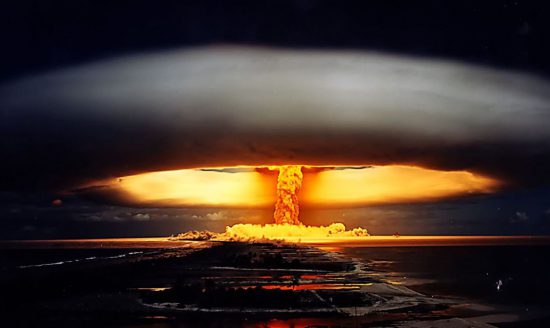
Going Beyond Propaganda. Nuclear Conflict: Deception or Real Threat?
By Federico PIERACCINI | Strategic Culture Foundation | 16.10.2016
The events in the Middle East, Syria and Aleppo are the focus of global attention. Rarely has a battle been so decisive to the outcome of a war and the fate of hundreds of millions of people around the world
Hillary Clinton in the last presidential debate repeatedly called for the establishment of a no-fly zone (NFZ) in Syria. The concept, reiterated several times, clashes with the revelation contained in her private emails admitting that the implementation of a NFZ would entail the increased deaths of Syrian civilians. In a recent hearing before the Senate Armed Services Committee, General Philip Breedlove was asked what kind of effort would be required for the US armed forces to impose a NFZ over Syrian skies. With obvious embarrassment, the General was forced to admit that such a request would involve hitting Russian and Syrian aircraft and vehicles, opening the door to a direct confrontation between Moscow and Washington, a decision the General was simply not willing to take. The military leadership has always shown a readiness to implement the military option; so this time they must have sniffed the danger of a direct conflict with Moscow.
The Kremlin has publicly admitted to deploying in Syria the S-400 and S-300V4 advanced anti-aircraft and anti-missile systems respectively. The presence of the defense complex was intentionally announced as a factor of deterrence and is a logical strategy. The message to Washington is clear: any unidentified object in Syrian skies will be shot down. The United States bases much of its military strength on the constant need to project power, making its opponents believe that it possesses capabilities that others do not hold. Therefore it is very unlikely that the Pentagon would want to reveal to the world the worth of their stealth systems and their ‘legendary‘ American cruise missiles when faced with the S-300V4 or S-400. The Kosovo War serves to remind us of the F-117 that was shot down by Soviet systems (S-125) dating from the 1960s.
Hillary Clinton’s threats against Moscow were not the only ones. The present policy makers in Washington continue to make aggressive statements demonstrating their total loss of touch with reality. In recent weeks, hysterical reactions were recorded by the Pentagon, the State Department, top military generals, and even representatives of American diplomacy. To emphasize the unhappiness prevalent in some Washington circles, several articles appeared in The Washington Post and The New York Times calling for the imposition of a US no-fly zone in Syria, ignoring the consequences highlighted by Dunford. There are two hypotheses under consideration: hitting the Syrian army air bases with cruise missiles, or the use of stealth planes to bomb Damascus’s A2/AD installations.
Behind Washington’s frantic reactions and vehement protests is the probability of military defeat. The US does not have any ability to prevent the liberation of Aleppo by the Syrian Arab Army (SAA) and the Russian Federation. In the last fifteen days, the SAA and Russia have achieved significant progress, and it is this that has led to an escalation of tensions. Some of the most significant episodes reflecting this over the last few days include: jets of the international coalition hitting the SAA, causing 90 deaths; US government officials threatening Russia with the downing of her planes and the bombings of her cities, resulting in Russian civilian deaths; and the blaming of Moscow for an attack on a humanitarian convoy. The climax seemed to have been reached at the United Nations where the US representatives prevented a Russian resolution condemning the terrorist attacks on the Russian embassy in Damascus. It is interesting to note that fifteen years after the attacks of September 11, 2001, Washington finds itself defending Al Nusra Front (AKA Al Qaeda) in an official United Nations meeting; something to ponder. But apparently there is no limit to provocations, and a few days after this incredible denouement, the Pentagon was keen to point out that the possibility of a preventive nuclear strike against Russia is still valid.
It therefore seems almost simplistic to emphasize that because of the success of the SAA, Washington, Ankara, Riyadh, Doha and Tel Aviv are showing unprecedented signs of weakness and nervousness. Their commitment to overthrowing the legitimate government of Assad has failed. The combined action of the Syrian and Russian ground, air and sea forces pushed Washington and the corporate media to move from words of condemnation to increasingly open threats.
Last month the situation against the terrorists quickly changed in the north of Syria thanks to the Syrian Arab Army and its allies supported by the West. In Aleppo, the SAA continues to work every day with great success toward the city’s liberation. Neighborhoods and large areas are back under government control. The relentless advances of the troops loyal to Assad are altering the course of the war in Syria in favor of Damascus, eliminating the US attempts to remove the legitimate Syrian government. A victory in Aleppo would mean the near certainty of defeat for the terrorists in the remaining areas of the country. The closing of the border with Turkey would cut the supply lines, with consequences and repercussions throughout Syria. What would still remain open are a few crossing areas in the south of the country near the border with Jordan that have always been a supply source for terrorists. However, it would be very difficult for this supply line alone to sustain the conflict or adequately replace the one closed north of Aleppo. Especially in the north through Turkey, and to the west through the uncontrolled border with Iraq, the terrorists receive continuous supplies. The liberation of Mosul by the Iraqi army, Aleppo by the SAA, and Der Al-Zur in the near future, will pave the way for the strategic recapture of Raqqa, the last bastion of Daesh, thereby defeating even the Plan B to partition the country.
With the failure of the northern front, the terrorists will be faced with the probable prospect of the complete collapse of their operations nationwide. Some will continue to fight, but most will throw down their weapons knowing that they have lost the war. Once this is achieved, the liberation of the rest of Syria should be a matter of a few months. It should be remembered that the recapture of Aleppo would guarantee a crushing defeat for the regional sponsors of international terrorism (Qatar and Saudi Arabia).
Still, it is not only the advance of Aleppo that is cause for concern for enemies of Syria. Obama and his administration are now irrelevant, also because of one of the most controversial presidential elections in recent history. The uncertain future of Washington’s foreign policy has prompted partners such as Riyadh, Doha, Ankara and Tel Aviv not to hesitate in further adding fuel to the Syrian conflagration, worried about any future inactivity from Washington and eager to advance their own military solution to the conflict.
In the case of Ankara, the invasion of Iraq and Syria is a serious danger that risks plunging the region into further chaos and destruction, with the Iraqi prime minister not hesitating to label the Turkish move reckless and warning of the conflict expanding into a regional conflict. Saudi Arabia’s problems are even greater, as it does not have the ability, in terms of men and means, to intervene directly in Syria because of its disastrous involvement in the war in Yemen. The speed with which confidence in Riyadh is crumbling is unprecedented. Her large currency reserves are dwindling, and it seems it is because tens of billions of dollars have been squandered in financing the military action against Yemen. Another example of independent military action concerns Israel. Four years into the Syrian conflict, Israel continues its secret war against Hezbollah and Iranian troops, who are engaged in areas bordering Israel in fighting al-Nusra Front and Daesh. For Tel Aviv, there are still two options desirable to the Syrian crisis, both in line with their strategy, namely, the continuation of chaos and disorder, or a balkanization of Syria. In both cases, the objective is to expand Israel’s sphere of influence far beyond the Golan Heights, which were occupied illegally years ago.
The unsuccessful attempts of Turkey, Israel and Saudi Arabia to change events in Syria have highlighted the growing strategic misunderstandings between the United States and regional partners, misunderstandings that often oblige Ankara, Riyadh and Tel Aviv to turn to the Russian Federation for confidential dialogue, since Moscow is the only player able to adjust the delicate Middle East equilibrium.
In the near future, it remains evident to Moscow and Damascus that some risks still exist, despite a well-considered overall strategy. The acceleration in the liberation of Aleppo also has an ancillary purpose that aims to minimize maneuverability for the next American administration. In a certain way, it is a race against time: Aleppo must be liberated in order to chart the way towards the end of the conflict before the next US president comes into office in January 2017. It is yet to be seen whether Clinton or Trump plan to go beyond Obama’s empty threats, but understandably Damascus and Moscow have no intention of being caught off guard, especially with a probable Clinton presidency.
After years of negotiations with the schizophrenic diplomacy of the US, Moscow and Damascus have decided to protect themselves against any sudden decisions that may come from the American «deep state». Deploying the most advanced systems existing in air defense, Moscow has called Washington’s bluff as no one has done in years. The red line for Moscow was crossed by the tragic events of September 17 in Der al-zur. The creation by the Russians of a no-fly zone over Syrian skies has been repeatedly suggested. But incredibly, in the hours immediately after the cowardly attack against Syrian troops, the US Department of Defense and the State Department proposed the creation of a no-fly-zone that would serve to ground Russian and Syrian planes. It was a brazen and provocative proposal for Damascus and Moscow if there ever was one.
Sensing the danger in these words, Moscow acted immediately, deploying cutting-edge systems to protect Syrians skies with equipment that can shoot down cruise missiles, stealth aircraft, and even ballistic missiles (S-300 and S-400). To make sure Washington fully understood the message, the Russian Ministry of Defence (MoD) reiterated what was already publicly announced, namely that any unidentified object would be shot down immediately, as there would not be any sufficient time for Russian operators to verify the original launch, trajectory and final target of any objects detected. It is a clear warning to the US and its long-standing strategy that requires the use of large amounts of cruise missiles to destroy anti-aircraft systems in order to pave the way for a no-fly zone as was seen in Libya. The Russian MoD has even specified that American fifth-generation stealth aircraft could be easily targeted, alluding to a radius of operation of the S-200 systems, S-300 and S-400 (and all variants) that would surprise many international observers. This statement also seems to indirectly confirm another theory that remains pure speculation, which is that during the September 17 attack by the US on the SAA in Der Al-Zur seem, some jets from the international coalition were targeted by Russian or Syrian air-defense systems (perhaps S-200s or S-400s), forcing the airplanes to retreat before facing the prospect of being shot down.
Whatever the intentions that are hidden behind Washington’s hysterical threats, Moscow has suggested several asymmetrical scenarios in response to a direct attack on its personnel in Syria. In addition to the S-300 and S-400 systems, the MoD has openly declared its knowledge of the exact locations of US special forces in Syria, a clear reference to the Syrian and Russian ability to strike US soldiers operating alongside terrorists or ‘moderate’ rebels.
All of Major-General Igor Konashenkov’s recent press conferences have clearly shown new systems deployed in Syria for air defense, a more than intentional advertisement. Aside from deterrence continuing to be one preferred instrument adopted by Moscow, the unusually strong, direct and unambiguous words of the Russian MoD easily show how the patience of Moscow and Damascus has been exhausted, especially following the recent sequence of events as well as repeated threats.
In such a scenario, the US can only rely on one weapon: complaints, threats and hysterical crying amplified by the mainstream media, generals and the official spokespeople of dozens of agencies in Washington. Nothing that can actually stop the liberating action of the SAA and its allies.
The United States has no alternatives available to prevent an outcome to the conflict that is undesirable for it. Whichever route it chooses, there is no way to change the events in Syria. Even American generals had to admit that a no-fly zone in Syria is out of the question. It is easy for US State Department spokesperson Admiral Kirby to launch empty threats, but it is more difficult for the military to act on these threats while avoiding a nuclear apocalypse. Whatever the outcome of the upcoming presidential elections, the war in Syria for the United States and its regional partners is irretrievably lost, and the hysteria and provocations of recent weeks is symptomatic of the frustration and nervousness that has not been common for Americans in recent years.
Key Neocon Calls on US to Oust Putin
By Robert Parry | Consortium News | October 7, 2016
The neoconservative president of the U.S.-taxpayer-funded National Endowment for Democracy [NED] has called for the U.S. government to “summon the will” to engineer the overthrow of Russian President Vladimir Putin, saying that the 10-year-old murder case of a Russian journalist should be the inspiration.
Carl Gershman, who has headed NED since its founding in 1983, doesn’t cite any evidence that Putin was responsible for the death of Anna Politkovskaya but uses a full column in The Washington Post on Friday to create that impression, calling her death “a window to Vladimir Putin, the Kremlin autocrat whom Americans are looking at for the first time.”
Gershman wraps up his article by writing: “Politkovskaya saw the danger [of Putin], but she and other liberals in Russia were not strong enough to stop it. The United States has the power to contain and defeat this danger. The issue is whether we can summon the will to do so. Remembering Politkovskaya can help us rise to this challenge.”
That Gershman would so directly call for the ouster of Russia’s clearly popular president represents further proof that NED is a neocon-driven vehicle that seeks to create the political circumstances for “regime change” even when that means removing leaders who are elected by a country’s citizenry.
And there is a reason for NED to see its job in that way. In 1983, NED essentially took over the CIA’s role of influencing electoral outcomes and destabilizing governments that got in the way of U.S. interests, except that NED carried out those functions in a quasi-overt fashion while the CIA did them covertly.
NED also serves as a sort of slush fund for neocons and other favored U.S. foreign policy operatives because a substantial portion of NED’s money circulates through U.S.-based non-governmental organizations or NGOs.
That makes Gershman an influential neocon paymaster whose organization dispenses some $100 million a year in U.S. taxpayers’ money to activists, journalists and NGOs both in Washington and around the world. The money helps them undermine governments in Washington’s disfavor – or as Gershman would prefer to say, “build democratic institutions,” even when that requires overthrowing democratically elected leaders.
NED was a lead actor in the Feb. 22, 2014 coup ousting Ukraine’s elected President Viktor Yanukovych in a U.S.-backed putsch that touched off the civil war inside Ukraine between Ukrainian nationalists from the west and ethnic Russians from the east. The Ukraine crisis has become a flashpoint for the dangerous New Cold War between the U.S. and Russia.
Before the anti-Yanukovych coup, NED was funding scores of projects inside Ukraine, which Gershman had identified as “the biggest prize” in a Sept. 26, 2013 column also published in The Washington Post.
In that column, Gershman wrote that after the West claimed Ukraine, “Russians, too, face a choice, and Putin may find himself on the losing end not just in the near abroad but within Russia itself.” In other words, Gershman already saw Ukraine as an important step toward an even bigger prize, a “regime change” in Moscow.
Less than five months after Gershman’s column, pro-Western political activists and neo-Nazi street fighters – with strong support from U.S. neocons and the State Department – staged a coup in Kiev driving Yanukovych from office and installing a rabidly anti-Russian regime, which the West promptly dubbed “legitimate.”
In reaction to the coup and the ensuing violence against ethnic Russians, the voters of Crimea approved a referendum with 96 percent of the vote to leave Ukraine and rejoin Russia, a move that the West’s governments and media decried as a Russian “invasion” and “annexation.”
The new regime in Kiev then mounted what it called an “Anti-Terrorism Operation” or ATO against ethnic Russians in the east who had supported Yanukovych and refused to accept the anti-constitutional coup in Kiev as legitimate.
The ATO, spearheaded by neo-Nazis from the Azov battalion and other extremists, killed thousands of ethnic Russians, prompting Moscow to covertly provide some assistance to the rebels, a move denounced by the West as “aggression.”
Blaming Putin
In his latest column, Gershman not only urges the United States to muster the courage to oust Putin but he shows off the kind of clever sophistry that America’s neocons are known for. Though lacking any evidence, he intimates that Putin ordered the murder of Politkovskaya and pretty much every other “liberal” who has died in Russia.
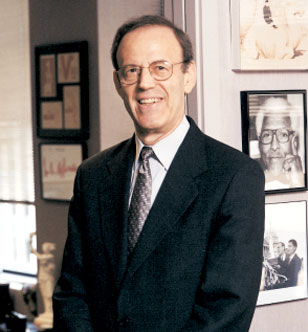
Carl Gershman, president of the NED
It is a technique that I’ve seen used in other circumstances, such as the lists of “mysterious deaths” that American right-wingers publish citing people who crossed the paths of Bill and Hillary Clinton and ended up dead. This type of smear spreads suspicion of guilt not based on proof but on the number of acquaintances and adversaries who have met untimely deaths.
In the 1990s, one conservative friend of mine pointed to the Clintons’ “mysterious deaths” list and marveled that even if only a few were the victims of a Clinton death squad that would be quite a story, to which I replied that if even one were murdered by the Clintons that would be quite a story – but that there was no proof of any such thing.
“Mysterious deaths” lists represent a type of creepy conspiracy theory that shifts the evidentiary burden onto the targets of the smears who must somehow prove their innocence, when there is no evidence of their guilt (only vague suspicions). It is contemptible when applied to American leaders and it is contemptible when applied to Russian leaders, but it is not beneath Carl Gershman.
Beyond that, Gershman’s public musing about the U.S. somehow summoning “the will” to remove Putin might — in a normal world — disqualify NED and its founding president from the privilege of dispensing U.S. taxpayers’ money to operatives in Washington and globally. It is extraordinarily provocative and dangerous, an example of classic neocon hubris.
While the neocons do love their tough talk, they are not known for thinking through their “regime change” schemes. The idea of destabilizing nuclear-armed Russia with the goal of ousting Putin, with his 82 percent approval ratings, must rank as the nuttiest and most reckless neocon scheme of all.
Gershman and his neocon pals may fantasize about making Russia’s economy scream while financing pro-Western “liberals” who would stage disruptive protests in Red Square, but he and his friends haven’t weighed the consequences even if they could succeed.
Given the devastating experience that most Russians had when NED’s beloved Russian “liberals” helped impose American “shock therapy” in the 1990s — an experiment that reduced average life expectancy by a full decade — it’s hard to believe that the Russian people would simply take another dose of that bitter medicine sitting down.
Even if the calculating Putin were somehow removed amid economic desperation, he is far more likely to be followed by a much harder-line Russian nationalist who might well see Moscow’s arsenal of nuclear weapons as the only way to protect Mother Russia’s honor. In other words, the neocons’ latest brash “regime change” scheme might be their last – and the last for all humanity.
A Neocon Slush Fund
Gershman’s arrogance also raises questions about why the American taxpayer should tolerate what amounts to a $100 million neocon slush fund which is used to create dangerous mischief around the world. Despite having “democracy” in its name, NED appears only to favor democratic outcomes when they fit with Official Washington’s desires.

CIA Director William Casey
If a disliked candidate wins an election, NED acts as if that is prima facie evidence that the system is undemocratic and must be replaced with a process that ensures the selection of candidates who will do what the U.S. government tells them to do. Put differently, NED’s name is itself a fraud.
But that shouldn’t come as a surprise since NED was created in 1983 at the urging of Ronald Reagan’s CIA Director William J. Casey, who wanted to off-load some of the CIA’s traditional work ensuring that foreign elections turned out in ways acceptable to Washington, and when they didn’t – as in Iran under Mossadegh, in Guatemala under Arbenz or in Chile under Allende – the CIA’s job was to undermine and remove the offending electoral winner.
In 1983, Casey and the CIA’s top propagandist, Walter Raymond Jr., who had been moved to Reagan’s National Security Council staff, wanted to create a funding mechanism to support outside groups, such as Freedom House and other NGOs, so they could engage in propaganda and political action that the CIA had historically organized and paid for covertly. The idea emerged for a congressionally funded entity that would serve as a conduit for this money.
In one undated letter to then-White House counselor Edwin Meese III, Casey urged creation of a “National Endowment,” but he recognized the need to hide the strings being pulled by the CIA. “Obviously we here [at CIA] should not get out front in the development of such an organization, nor should we appear to be a sponsor or advocate,” Casey wrote.
The National Endowment for Democracy took shape in late 1983 as Congress decided to also set aside pots of money — within NED — for the Republican and Democratic parties and for organized labor, creating enough bipartisan largesse that passage was assured.
But some in Congress thought it was important to wall the NED off from any association with the CIA, so a provision was included to bar the participation of any current or former CIA official, according to one congressional aide who helped write the legislation.
This aide told me that one night late in the 1983 session, as the bill was about to go to the House floor, the CIA’s congressional liaison came pounding at the door to the office of Rep. Dante Fascell, a senior Democrat on the House Foreign Affairs Committee and a chief sponsor of the bill.
The frantic CIA official conveyed a single message from CIA Director Casey: the language barring the participation of CIA personnel must be struck from the bill, the aide recalled, noting that Fascell consented to the demand, not fully recognizing its significance – that it would permit the continued behind-the-scenes involvement of Raymond and Casey.
The aide said Fascell also consented to the Reagan administration’s choice of Carl Gershman to head NED, again not recognizing how this decision would affect the future of the new entity and American foreign policy.
Gershman, who had followed the classic neoconservative path from youthful socialism to fierce anticommunism, became NED’s first (and, to this day, only) president. Though NED is technically independent of U.S. foreign policy, Gershman in the early years coordinated decisions on grants with Raymond at the NSC.
For instance, on Jan. 2, 1985, Raymond wrote to two NSC Asian experts that “Carl Gershman has called concerning a possible grant to the Chinese Alliance for Democracy (CAD). I am concerned about the political dimension to this request. We should not find ourselves in a position where we have to respond to pressure, but this request poses a real problem to Carl.
“Senator [Orrin] Hatch, as you know, is a member of the board. Secondly, NED has already given a major grant for a related Chinese program.”
Neocon Tag Teams
From the start, NED became a major benefactor for Freedom House, beginning with a $200,000 grant in 1984 to build “a network of democratic opinion-makers.” In NED’s first four years, from 1984 and 1988, it lavished $2.6 million on Freedom House, accounting for more than one-third of its total income, according to a study by the liberal Council on Hemispheric Affairs that was entitled “Freedom House: Portrait of a Pass-Through.”
Over the ensuing three decades, Freedom House has become almost an NED subsidiary, often joining NED in holding policy conferences and issuing position papers, both organizations pushing primarily a neoconservative agenda, challenging countries deemed insufficiently “free,” including Syria, Ukraine (in 2014) and Russia.
Indeed, NED and Freedom House often work as a kind of tag-team with NED financing “non-governmental organizations” inside targeted countries and Freedom House berating those governments if they crack down on U.S.-funded NGOs.
For instance, on Nov. 16, 2012, NED and Freedom House joined together to denounce legislation passed by the Russian parliament that required recipients of foreign political money to register with the government.
Or, as NED and Freedom House framed the issue: the Russian Duma sought to “restrict human rights and the activities of civil society organizations and their ability to receive support from abroad. Changes to Russia’s NGO legislation will soon require civil society organizations receiving foreign funds to choose between registering as ‘foreign agents’ or facing significant financial penalties and potential criminal charges.”
Of course, the United States has a nearly identical Foreign Agent Registration Act that likewise requires entities that receive foreign funding and seek to influence U.S. government policy to register with the Justice Department or face possible fines or imprisonment.
But the Russian law would impede NED’s efforts to destabilize the Russian government through funding of political activists, journalists and civic organizations, so it was denounced as an infringement of human rights and helped justify Freedom House’s rating of Russia as “not free.”
Another bash-Putin tag team has been The Washington Post’s editors and NED’s Gershman. On July 28, 2015, a Post editorial and a companion column by Gershman led readers to believe that Putin was paranoid and “power mad” in worrying that outside money funneled into NGOs threatened Russian sovereignty.
The Post and Gershman were especially outraged that the Russians had enacted the law requiring NGOs financed from abroad and seeking to influence Russian policies to register as “foreign agents” and that one of the first funding operations to fall prey to these tightened rules was Gershman’s NED.
The Post’s editors wrote that Putin’s “latest move … is to declare the NED an ‘undesirable’ organization under the terms of a law that Mr. Putin signed in May [2015]. The law bans groups from abroad who are deemed a ‘threat to the foundations of the constitutional system of the Russian Federation, its defense capabilities and its national security.’
“The charge against the NED is patently ridiculous. The NED’s grantees in Russia last year ran the gamut of civil society. They advocated transparency in public affairs, fought corruption and promoted human rights, freedom of information and freedom of association, among other things. All these activities make for a healthy democracy but are seen as threatening from the Kremlin’s ramparts.
“The new law on ‘undesirables’ comes in addition to one signed in 2012 that gave authorities the power to declare organizations ‘foreign agents’ if they engaged in any kind of politics and receive money from abroad. The designation, from the Stalin era, implies espionage.”
However, among the relevant points that the Post’s editors wouldn’t tell their readers was the fact that Russia’s Foreign Agent Registration Act was modeled after the American Foreign Agent Registration Act and that NED President Gershman had already publicly made clear — in his Sept. 26, 2013 column — that his goal was to oust Russia’s elected president.
In his July 28, 2015 column, Gershman further deemed Putin’s government illegitimate. “Russia’s newest anti-NGO law, under which the National Endowment for Democracy … was declared an “undesirable organization” prohibited from operating in Russia, is the latest evidence that the regime of President Vladimir Putin faces a worsening crisis of political legitimacy,” Gershman wrote, adding:
“This is the context in which Russia has passed the law prohibiting Russian democrats from getting any international assistance to promote freedom of expression, the rule of law and a democratic political system. Significantly, democrats have not backed down. They have not been deterred by the criminal penalties contained in the ‘foreign agents’ law and other repressive laws. They know that these laws contradict international law, which allows for such aid, and that the laws are meant to block a better future for Russia.”
The reference to how a “foreign agents” registration law conflicts with international law might have been a good place for Gershman to explain why what is good for the goose in the United States isn’t good for the gander in Russia. But hypocrisy is a hard thing to rationalize and would have undermined the propagandistic impact of the column.
Also undercutting the column’s impact would be an acknowledgement of where NED’s money comes from. So Gershman left that out, too. After all, how many governments would allow a hostile foreign power to sponsor politicians and civic organizations whose mission is to undermine and overthrow the existing government and put in someone who would be compliant to that foreign power?
And, if you had any doubts about what Gershman’s intent was regarding Russia, he dispelled them in his Friday column in which he calls on the United States to “summon the will” to “contain and defeat this danger,” which he makes clear is the continued rule of Vladimir Putin.
Establishment Media Caught Promoting Fake Russian Story On #TrumpWon Hashtag
By Dan Wright | ShadowProof | September 29, 2016
There is a specter haunting the establishment media, the specter of a Trump presidency. This idea is apparently so terrifying that no unethical and hypocritical action is too extreme for “mainstream” journalists to take if it they believe it will damage Trump’s presidential prospects.
Enter the Russian threat. Russian President Vladimir Putin has become this election cycle’s boogeyman with the campaign of former Secretary of State Hillary Clinton constantly invoking him as if he is her actual opponent. She invokes Putin, even though Clinton has extensive connections to Putin and his inner circle.
The establishment media, taking its cues from the Clinton campaign, is now peddling any unhinged conspiracy theory if it somehow connects Donald Trump and Vladimir Putin. The theories collapse under the slightest of scrutiny, but that seems to make no difference in the rapidity with which they are published.
The latest backfire was a claim that the Twitter hashtag “#TrumpWon” was started in Russia before it trended. This would, in theory, prove Russia was trying to meddle in the U.S. election.
Not long after the story went viral, it became undeniably clear it was hoax. The Washington Post, a major center for unhinged conspiracy theories about Russia, had to concede the claim was “probably false.”
But this admission is unlikely to stop the Washington Post from publishing deranged ramblings from Legatum Institute’s Anne Applebaum, who recently speculated that Putin is engaging in a covert action program to help Trump win the presidential election. (Whether Applebaum believes her own statements is unclear, but they are nonetheless very self-serving.)
That these Manchurian candidate stories keep falling apart, or are exposed as Clinton campaign propaganda, is irrelevant to the establishment media because Trump is such an existential threat so the rules no longer matter.
Recently, a columnist for the New York Times admitted it was not possible to cover Trump objectively, that “you have to throw out the textbook American journalism has been using for the better part of the past half-century.”
What this ultimately translates into is doing the bidding of the Clinton campaign, which the establishment media has done with glee. So, as long as the Clinton campaign peddles paranoia about Russia, regardless of how this hearkens back to the Cold War, expect numerous journalists to follow suit.
Featured Video
The Source of America’s Wars – Kristol Clear
or go to
Aletho News Archives – Video-Images
From the Archives
Is Israel to blame for the Iraq War?
American Goy | March 10, 2008
I am so tired of this old canard that “Israel had nothing to do with USA’s war with Iraq – in fact, it officially advised America against it”.
Bullshit. … continue
Blog Roll
 Aletho News
- Ceasefire for all or for none: Iran shuts Hormuz over Lebanon attacks
- Strait of Hormuz is Iran’s ‘nuclear weapon’ that forced US retreat: Medvedev
- Energy crisis will last for months – Kremlin envoy
- Europe’s quiet role in the war on Iran
- Forty days that shook the Empire: How Iran turned the tables on US and prevailed
- Netanyahu unilaterally declares Lebanon outside of ceasefire deal
- Israeli leaders: ‘Not a single goal’ achieved in war with Iran
- What on earth just happened? Trump, Iran, and the unlikely ceasefire
- Alberta Bill Would Fine Political Deepfakes $10,000 Without Satire Exemptions
- Iran declares ‘historic victory’ over US, says enemy forced to accept its proposal
- If Americans Knew
- Gazans face a triple crisis: severe shortages of water and bread, healthcare in tatters
- NY Times reports how Netanyahu took the US into Iran War
- A sigh of relief over Iran, but Gaza and Lebanon in dire straits – Daily Update
- Thousands dead and neighborhoods razed to the ground: Aid agencies fear southern Lebanon is becoming the new Gaza
- The war the US is fighting for Israel could cost trillions
- ‘Cigarette Burns, Nail Wounds’: Toddler Tortured in Gaza to Coerce Father
- Trump Says US Sent ‘a Lot of Guns’ to Protesters in Iran
- Israeli forces destroy 17 UN peacekeeper cameras in south Lebanon
- US-Israeli strikes ‘completely destroy’ synagogue in Tehran
- Archbishop for US Military Says Iran War Is Unjust Under Catholic Teaching
- No Tricks Zone
- An Inconvenient Tree: Uncovered In Alps… Europe Much Warmer Than Today 6000 Years Ago
- New Study Reports A 60% Slowdown In Greenland’s Ice Loss Rate In The Last Decade
- Low Intensity Tornado Wrecks Major Solar Farm, Creating A Potential Toxic Dump
- New Study Finds Warming Saves Lives…Cold Temperatures 12 Times More Deadly Than Excess Heat
- German Science Blog Accuses PIK Climate Institute Of Hallucinating Climate Tipping Points
- Devastating Assessment Of Comirnaty Vaccine By Former Senior Pfizer Europe Toxicologist
- New Study: CO2 Is ‘Effectively Negligible’ As An Explanatory Climate Change Factor Since 2000
- Former Pfizer Toxicologist Dr. Helmut Sterz Tells Bundestag Hearing Pfizer Vaccine Should Have Never Been Approved
- Energy Expert: Germany’s Nuclear Phaseout Was A “500 Billion Euro Mistake”
- New Research: South Australia’s Mid-Holocene Sea Surface Temperatures Were 4°C Warmer Than Today
 Aletho News