When Protests and Violence Are Important to the U.S. Media
By Nate Singham | CEPR Americas Blog | February 28, 2014
In light of the recent political demonstrations that have swept the country, Venezuela has received considerable attention from both the US State Department and mainstream media. In recent days, President Obama, U.S. Secretary of State John Kerry and several others have issued numerous statements regarding the protests. In the US major media, The New York Times has published articles nearly every day since the protests began. Extensive reporting can also be found in the Wall Street Journal, USA Today and The Washington Post.
It is worth comparing the extent of this coverage to protests of similar importance next door to Venezuela. In August of last year, Colombian farmers launched large-scale demonstrations in opposition to Colombian trade policies that are strongly supported by the U.S. government.
Unlike the protests in Venezuela, the Colombian protests received very little coverage from mainstream media, as CEPR pointed out at the time. The graph below compares the amount of coverage, in total number of articles published, given by four of the United States’ most influential newspapers to the protests and violence in Colombia and Venezuela. The difference ranges from more than two times to 14 times as many articles devoted to the Venezuelan protests as compared with Colombia, despite the fact that the period covered for Colombia is twice as long.
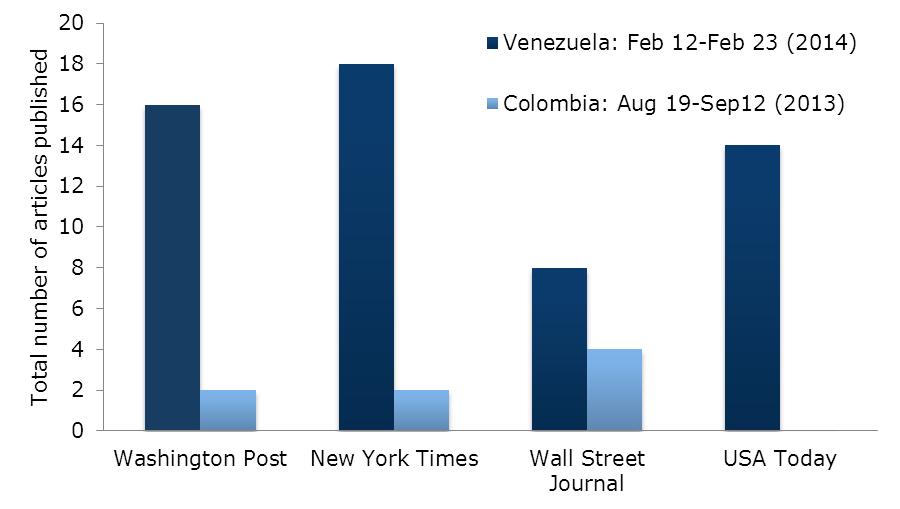
This is especially remarkable if we consider the high levels of repression carried out by the Colombian police and military in response to these protests. The International Office for Human Rights Action in Colombia described the violence as “unprovoked” and “indiscriminate” and attributes all of the violence to state forces.
The incidence of deaths in both Colombia and Venezuela[i], so far, is only slightly higher in Venezuela, with 13 deaths versus 12 deaths in Colombia.[ii] Yet there was very little coverage, and almost no criticism of the Colombian government as compared to the harsh attacks on the Venezuelan government in the U.S. media.
As mentioned earlier, US Secretary of State John Kerry and President Obama made public statements regarding the protests in Venezuela. Both demanded that students arrested in Venezuela be released, without regard as to whether any had been arrested for allegedly committing crimes such as arson and assault. There were no such statements from U.S. officials regarding the hundreds arrested in Colombia.
It is possible that both the huge differences in the amount of media coverage, and the responses to these two sets of protests by both the media and U.S. government officials has to do with the protesters and their aims, and the respective governments. The Colombian farmers were protesting against policies strongly supported by the U.S. government; they were also protesting against a government that the U.S. sees as a strategic ally, home to U.S. military bases and receiving billions of dollars in U.S. aid. The Venezuelan protesters are demanding the ouster of a government that the U.S. government has [spent] millions of dollars trying to get rid of, including U.S. support for the 2002 military coup against the government.
[i] The total amount of deaths reflects data from the most recent figures from Venezuela Transparencia, as of Monday, February 24 2014.
[ii] It is important to note that so far only six of the 13 deaths in Venezuela are confirmed to be opposition protesters.

How the Washington Post Distorts Colombia
What Dana Priest Left Out
By JACK L. LAUN | CounterPunch | January 2, 2014
On December 21, 2013 the Washington Post published an article titled “Covert action in Colombia” by reporter Dana Priest. Ms. Priest is a veteran reporter who has over the course of her career produced significant reports on important topics. However, in her report on the role of the United States government in supporting the Colombian state’s war on the FARC guerrillas she has overlooked or ignored some very basic aspects of this relationship.
The most significant of these is that she ignores the nature and history of the paramilitary forces’ activities and the link of these to the United States government. As Father Javier Giraldo, S.J., correctly observed years ago, the paramilitaries in Colombia are a strategy of the Colombian state. Furthermore, this strategy was suggested to the Colombian government by a United States military mission to Colombia in February 1962, in response to fear of the spread of influence of the Castro Revolution in Cuba. The mission was led by Lieutenant General William Yarborough, the Commander of the U.S. Army Special Warfare Center. A Wikipedia entry cites a secret report to the Joint Chiefs of Staff quoting Yarborough as recommending “development of a civilian and military structure…to pressure for reforms known to be needed, perform counter-agent and counter-propaganda functions and as necessary execute paramilitary, sabotage and/or terrorist activities against known Communist proponents. It should be backed by the United States.” (See this citation and more information at Wikipedia.org/wiki/William_P_Yarborough.) The basic idea behind the reliance upon paramilitaries has been to keep the Colombian military from being involved directly in the Colombian government’s dirty war against the guerrillas and rural noncombatants and thus avoid having “dirty hands”. As Father Giraldo observed back in 1996, “Paramilitarism becomes, then, the keystone of a strategy of “Dirty War”, where the “dirty” actions cannot be attributed to persons on behalf of the State because they have been delegated, passed along or projected upon confused bodies of armed civilians.” (Colombia: The Genocidal Democracy, Common Courage Press, 1996, p. 81). There are many examples of the paramilitary death squad actions. One of these was a terrible slaughter by machetes and chainsaws of an estimated 30 civilians in the town of Mapiripan in Meta Department on July 15-20, 1997, in which paramilitary forces under the command of Carlos Castano in northern Colombia were allowed to travel by airplane with Colombian military acquiescence to reach their target community in southeast Colombia. A second example of the vicious attacks of paramilitary forces upon civilians was the slaughter on February 21, 2005 of 8 persons of the Peace Community of San Jose de Apartado in Antioquia Department, including a founder and leader of that Community, Luis Eduardo Guerra. The latter massacre was carried out with the assistance of Colombian Army soldiers from the Seventeenth and Eleventh Brigades.
While Ms. Priest approvingly suggests that Colombia “with its vibrant economy and swanky Bogota social scene” is far removed from Afghanistan, she fails to recognize that most of Bogota’s nearly 8 million residents are very poor, while a great majority of the country’s rural residents are impoverished. To be accurate in her portrayal of present-day Colombia, Ms. Priest should recognize and acknowledge that the distribution of land among Colombia’s population is the second worst in South America, after Paraguay, and the 11th worst in the world. (Oxfam Research Reports, “Divide and Purchase: How land ownership is being concentrated in Colombia”, 2013, p.7. See http://www.oxfam.org.) In rural areas paramilitary forces, supposedly demobilized in a sham proceeding during Alvaro Uribe’s Presidency, continue to threaten and murder campesinos (small-scale farmers) and force them and their families off their lands, so they can be taken over by large landowners or multinational corporations with mining and petroleum plans encouraged by the government of President Juan Manuel Santos. Paramilitary activity also continues to account for murders of labor union leaders and organizers, more of whom are killed in Colombia year after year than in any other country in the world.
It is also disappointing that Ms. Priest makes no mention of the fact that there are some 6 million internally-displaced persons in Colombia, more than any other country in the world. In his December 27-29 article in Counterpunch, titled “Mythmaking in the Washington Post: Washington’s Real Aims in Colombia”, Nick Alexandrov correctly calls attention to Ms. Priest’s failure to take into account these displaced persons. And he also properly focuses criticism upon Ms. Priest’s failure correctly to acknowledge one of the most important links of the United State to Colombia and one of the most damaging: the drug trade and the effects of coca crop spraying (fumigation) upon Colombia’s rural population. Here again the responsibility of the United States government is clear and direct. As Mr. Alexandrov points out, tens of thousands of Colombia’s campesinos have been decimated economically as their legal food crops are destroyed through fumigation under direct control of the United States government. As a Colombia Support Network delegation was told by U. S. Embassy personnel while Anne Patterson was Ambassador there, the crop-spraying campaign using Round-Up Ultra has been controlled from the Embassy itself. Indeed, mayors of towns in Putumayo Department (province) told us they are not informed in advance and have no control over when fumigation of farm fields in their municipalities occurs.
Furthermore, the assertion that the FARC are principally responsible for Colombia’s production of illicit drugs is questionable. Right-wing paramilitaries, protected by the Colombian Army and linked to many Colombian political figures, have been involved in the drug trade for decades, and continue to benefit from this trade, as do their benefactors in the private sector, such as owners of large cattle ranches, merchants, and banana plantation owners. And the United States government has supported and even idealized one of the persons most responsible for corruption of the political process in Colombia, Alvaro Uribe Velez. Before his election as President in 2002, Alvaro Uribe had been identified by the United States government as linked to drug-trafficking. As Virginia Vallejo, a Colombian television journalist and sometime love interest of Pablo Escobar, suggested to me in a telephone conversation and mentioned in her book, Amando a Pablo, Odiando a Escobar (Random House Mondadori, September 2007), Alvaro Uribe was favored by Escobar. He allegedly approved the opening of drug-transit airstrips as Director of Civil Aeronautics. Later, as Governor of Antioquia Department, Uribe promoted the formation of so-called “self-defense” forces, which morphed into cut-throat, illegal paramilitaries who ravaged the countryside. His cousin Mario Uribe, with whom he has been particularly close, was convicted of corrupt actions and spent time in prison, while his brother Santiago Uribe Velez is about to be prosecuted for organizing and training illegal paramilitary forces on a Uribe family ranch. When Alvaro Uribe ran for re-election in 2004, his agents bribed Congresswoman Yidis Medina to get her to change her vote in committee so that Uribe could be re-elected (not permitted at that time by the Colombian Constitution). Yidis Medina went to prison for having received the bribe, but neither Alvaro Uribe nor his staff members who offered the bribe have been convicted and sentenced for the offenses they committed.
What was the reaction of the United States government to President Uribe’s alleged promotion of illegal activities? He was awarded the Presidential Medal of Freedom by President George W. Bush, the highest honor a President can convey upon any person! (For a detailed account of Alvaro Uribe’s purported misdeeds, see the Master’s thesis of Francisco Simon Conejos at the University of Valencia, Spain, of December 2012, titled, in English translation, “Crimes Against Humanity in Colombia: Elements to Implicate Ex-President Alvaro Uribe Velez before Universal Justice and the International Criminal Court”.)
No analysis of the United States’ role in Colombia can properly ignore the relationships and responsibilities outlined above. But even beyond these points if one is to consider whether the United States’ actions toward and in Colombia have been beneficial for that country and its people, one must look at the effect of the United States government’s support for corporate interests of companies from this country and their actions in Colombia. The policies of Presidents Clinton, Bush and Obama in the past two decades have advanced the agendas of mining and petroleum companies— such as Exxon Mobil, Occidental Petroleum, and Drummond— and food companies— such as Chiquita Banana and, most recently, Cargill— while these companies’ activities in rural Colombia have caused environmental damage, massive displacement of residents of these areas and destruction of the campesino economy. One wishes that Ms. Priest had treated the Colombian context much more broadly to provide a much more complete and honest view of how United States government actions and policies have affected the population of this important country, with Latin America’s third largest population (after Brazil and Mexico).
John I. Laun is president of the Colombia Support Network.
Vladimir Vladimirovich and the Grey Lady
By Robert Bonomo | The Cactus Land | December 26, 2013
Bill Keller, editorialist for the NY Times and former executive editor of the paper, has recently penned a strong attack on Vladimir Putin arguing that Putin’s leadership “deliberately distances Russia from the socially and culturally liberal West”, describing the Kremlin’s policies as “laws giving official sanction to the terrorizing of gays and lesbians, the jailing of members of a punk protest group for offenses against the Russian Orthodox Church, the demonizing of Western-backed pro-democracy organizations as ‘foreign agents’, expansive new laws on treason, limits on foreign adoptions.”
Keller, who during his tenure as executive editor of the NY Times argued for the invasion of Iraq and wrote glowingly of Paul Wolfowitz, makes no mention of Moscow’s diplomatic maneuvers that successfully avoided a US military intervention in Syria or the Russian asylum given to Eric Snowden. Keller, who had supported the US intervention in Syria by writing, “but in Syria, I fear prudence has become fatalism, and our caution has been the father of missed opportunities, diminished credibility and enlarged tragedy,” also made no mention of Seymour Hersh’s stinging dissection of the Obama administration’s misinformation campaign regarding the sarin attacks in Syria. Hersh’s piece, which drives grave doubts into the case against Assad actually having carried out the attacks, was not published in the New Yorker or in the Washington Post, publications that regularly run his work.
Keller focuses on a Russian law that bans the promotion of gay lifestyles in Russia, a far cry from “giving official sanction to the terrorizing of gays and lesbians”, while failing to mention that according to his own paper, 88% of Russians support the law.
Putin did expel the United States Agency for International Development (USAID) from Russia, cutting off the $50 million in aid, most of which went to pro-democracy and anti-corruption groups. The Kremlin believed that much of this money wound up supporting the protest movement against Putin that emerged in 2011. If Russian funding had been suspected in the Occupy Wall Street Movement, would the New York Times have supported Putin for promoting social equality in the US? If the punk band Pussy Riot had broken into a prominent Jewish temple in New York, instead of a Moscow cathedral, and defamed it to call attention to the millions of Palestinians living in refugee camps, would the young ladies have done some time? And if so, would they have received support from all corners of stardom?
The European Model
Quoting Dmitri Trenin, Keller argues that Putin sees Europe in decline, “it’s national sovereignty… is superseded by supranational institutions.” Is Putin mistaken in his assumption? Maybe ask the people of Greece, Spain, or Ireland. Keller also mentions “limits on foreign adoptions” but fails to mention the cause, the Magnitsky Act, which imposed “visa and banking restrictions on Russian officials implicated in human rights abuses.” The Kremlin saw this law as the perfect example of US meddling in internal Russian affairs.
The heart of the Magnistsky saga was the death in Russia, while under custody, of an attorney for Hermitage Capital, a hedge fund run by a British citizen William Browder, who renounced his US citizenship. Browder made billions in Russia before running afoul of Russian authorities. His Hermitage Capital was funded by the Lebanese national Edmond Safra and eventually claimed to have lost $300 million after having moved billions out of Russia. Browder lobbied hard in Washington to have the Magnitsky Act passed. Why was the US involved in passing a law to protect Lebanese and British capital and a Russian prisoner? America hasn’t enough trouble with its own prison system that it needs to legislate on the Russian penal system? Are there no American politicians who have been implicated in human rights abuses?
Keller’s final point is that Putin is being heavy handed over the Ukrainian/EU integration crisis, but Keller avoids discussing the deep historic and ethnic links between Russia and Ukraine. Most Americans would agree that Russia should stay out of NAFTA negotiations, seeing North America as clearly not within the Russian sphere of influence. Ukrainians are deeply divided over the integration with Europe, so why not let the Ukrainians and Russians work out their trade relations without the American government getting involved?
Khodorkovsky
Probably more than any other topic, the NY Times has repeatedly published articles in defense of the long imprisoned and recently freed Russian oligarch Mikhail Khodorkovsky, a man whose rise to power was filled with unsavory schemes to appropriate businesses which were once the property of the Russian people. The NY Times Sabrina Tavernese wrote in 2001 that he had “orchestrated a series a flagrant corporate abuses of minority shareholders unparalleled in the short history of modern Russian capitalism.”
Khdorkovsky eventually wound up the billionaire owner of Yukos Oil, which he planned to sell to Exxon Mobil. Khdorkovsky also had political ambitions, creating the Open Russian Foundation and putting Henry Kissinger and Lord Jacob Rothschild on the board of directors. He was clearly eyeing political power by making close ties with the West, even being named to the Advisory Board of the Carlyle Group, all of which made him a potential threat to the Kremlin.
The Khodorovsky affair was a complex battle for power in Russia with Khodorkovsky playing the Western powers against the strongly nationalistic Putin. But at the NY Times editorialist Joe Nocera in four pieces on Khodorkovsky never delves into the complexities of Putin’s strategy to keep Western interests at bay, preferring to present a black and white scenario of ‘western liberal’ rule of law against the ‘authoritarian’ Putin.
Curiously, the NY Times doesn’t seem so interested in Harvard’s Russia Project which ended in disgrace and professor Andrei Shleifer, Larry Summers protege, being forced to pay a $2 million fine for enriching himself under the guise of a USAID program where he was to ‘teach’ Russians about capitalism. He gave them an interesting lesson, yet was not forced to resign his post at Harvard, possibly due to his close relationship with Summers. Nocera hasn’t written one article on that scandal which is much more relevant to Americans and their iconic institutions, but which also might make him a few enemies closer to home.
Putin and American Values
Most Americans see Eric Snowden as whistleblower and not a traitor, yet the NY Times star editorialist, Thomas Friedman, isn’t so sure, “The fact is, he dumped his data and fled to countries that are hostile to us,” though he doesn’t elaborate on why Russia is a ‘hostile’ nation and he advises Snowden to come home and face the music if he’s truly a patriot, “It would mean risking a lengthy jail term, but also trusting the fair-mindedness of the American people.”
Putin is a social conservative and a fierce patriot who, like many Americans, opposes regime change in the name of democracy. The American people, after failed interventions in Iraq, Afghanistan and Libya, agree with him — both Putin and Americans, unlike the NY Times, vehemently opposed a US intervention in Syria. It seems Putin has more in common with the opinions of Americans than does the NY Times, which begs the question, why is the NY Times so hell bent on demonizing the President of the Russian Federation when he’s supported by more than 60% of the Russian people?
The New York Times has written extensively about the gay rights issue in Russia but 45% of Americans still think that homosexuality is a sin and as the ‘Duck Dynasty’ controversy has revealed, homosexuality in America is still a very divisive issue. Is the prohibition against publicly speaking in favor of gay lifestyles in Russia such an important stumbling block to ties between the two nations when the vast majority of Russians support the law?
Americans probably don’t approve of roads where members of one religion can drive while members of another religion must walk, as occurs in Hebron and reported on by Ynet, “Jewish residents are allowed to cross the road by vehicle, but Palestinians are now only permitted to cross by foot or by bicycle.” They probably wouldn’t look fondly on back of the bus seating for women, yet in spite of this type of segregation in a country that claims to be democratic, the NY Times doesn’t feel compelled to demonize Mr. Netanyahu and his ‘socially conservative’ Likud party.
The Interests of the American People
Just as the NY Times despises Putin and Russia, it’s equally enamored with Israel. Imagine if the millions of Palestinian refugees were not in camps because of their mother’s religion but instead because they were LGBT? What if Netanyahu were held to the same standard as Mr. Putin? How many millions of Palestinian Khodorkovsky’s are languishing in refugee camps in their own country? It seems that Mr. Keller, Mr. Friedman and Mr. Nocera are much more interested in the rights of Khodorkovsky and William Browder than they are in the rights of Palestinian children living in squalor under an Israeli blockade in Gaza.
Saudi Arabia and Israel, the latter through its surrogate AIPAC, lobbied hard for war in Syria and both supposed allies are furiously attempting to undermine peace talks with Iran. The government Putin leads brokered the deal to avoid US involvement in Syria, played an important role in the Iranian peace initiative and also allowed Americans a glimpse into the massive surveillance program the NSA has hoisted upon them by giving refuge to Eric Snowden.
Just as Americans would not look fondly at the Kremlin interfering in domestic American politics, so the Kremlin pushes back when it see US interference in it’s internal affairs, a good example being American aid to opposition groups during the 2011 Moscow protests against Putin. If the US can accept serious human rights violations by supposed allies Israel and Saudi Arabia, can’t it also accept that Russia has its own way of governing itself, based on its own history and culture?
The NY Times does not represent the best interests of most Americans, nor does it use its powerful voice to protect the millions persecuted within the realms of so called allies. The NY Times represents a small sector of US power, bent on propagating special interests at the expense of the vast majority of Americans.
Mr. Putin certainly acts in the best interests of Russia, but curiously enough, by working in his own interest, he has done more to protect the 4th Amendment than the constitutional law professor currently occupying the White House. In Syria he was protecting Russian interests, but by doing so he kept the US out of an intervention that could have easily developed into a major war. If it had been up to the NY Times, we would have intervened in Syria and Snowden would be behind bars awaiting the mercy of the Obama Administration.
So who is a better friend of the American people? There are no doubts that the NY Times is a better friend of the Khodorkovsky’s and William Browder’s of the world but Americans might actually be better off if their government listened more to Putin and less to the Grey Lady.
Ex-DHS Director Michael Chertoff: The Public Spying On Famous People With Their Smartphones Is A Bigger Issue Than NSA Spying
By Mike Masnick | Techdirt | November 1, 2013
Former director of Homeland Security (and current profiteer off of any “security” scare) Michael Chertoff has penned quite an incredible op-ed for the Washington Post, in which he argues that the real threat to privacy today is not the NSA spying on everyone, but rather all you people out there in the public with your smartphones, taking photos and videos, and going to Twitter to post things you overheard more important people say. Seriously. It starts out by claiming this is a “less-debated threat”:
So it is striking that two recent news stories illustrate a less-debated threat to privacy that we as a society are inflicting on ourselves. Last week, a passenger on an Acela train decided to tweet in real time his summary of an overheard phone conversation by Gen. Michael Hayden, a former director of the National Security Agency (NSA) and the CIA (and my current business partner). The same day, a photo was published of Maryland Attorney General Douglas Gansler at a summer party where he was surrounded by underage youths who apparently were drinking.
But he then goes on to argue that this kind of thing is more troubling than the NSA revelations, which Chertoff suggests is no big deal:
Of course, the delicious irony is obvious: In one case, the former NSA chief becomes a victim of eavesdropping. In the other, a politician critical of teen drinking fails to intervene when he is surrounded by it. But both stories carry a more troubling implication. The ubiquitousness of recording devices — coupled with the ability everyone has to broadcast indiscriminately through Twitter, YouTube and other online platforms — means that virtually every act or utterance outside one’s own home (or, in Gansler’s case, inside a private home) is subject to being massively publicized. And because these outlets bypass any editorial review, there is no assurance that what is disseminated has context or news value.
It would appear that Chertoff seems to believe that there should be no expectation of privacy for the things you actually do in private — generating metadata about who you call, where you go, what websites you visit, etc. But, stuff that you actually do in public should never be “broadcast” because it might embarrass famous people.
And, yes, it’s the famous people being embarrassed that seems to most concern Chertoff:
If a well-known person has an argument with a spouse or child at a restaurant, should it be broadcast? If a business personality expresses a political opinion at a private party, should that opinion (or a distortion of it) be passed on to the rest of the world? If a politician buys a book or a magazine at an airport, should a passerby inform everyone?
See? Think of those poor well-known people, having people telling others about what they do. What a shame! Incredibly, he argues that it’s this exposing of the public actions of famous people that creates real chilling effects — and not the NSA’s spying, which he calls “exaggerated.”
Are we creating an informant society, in which every overheard conversation, cellphone photograph or other record of personal behavior is transmitted not to police but to the world at large? Do we want to chill behavior and speech with the fear that an unpopular comment or embarrassing slip will call forth vituperative criticism and perhaps even adversely affect careers or reputations? Do we need to constantly monitor what we say or do in restaurants, at sporting events, on public sidewalks or even private parties?
I don’t know what clueless PR flack thought this was a good strategy, but the clear connotation is hard to miss: Look, we the powerful people get to spy on everyone, but the second you turn the tables and spy on us and the things we do in public, what a horrible shame! Something must be done!
US media failed to cite pundits’ ties to defense industry in Syria strike debate
RT | October 11, 2013
Nearly two dozen of the commentators who appeared on major media outlets to discuss a possible US military strike on Syria had relationships with contractors and other organizations with a vested interest in the conflict, according to a new report.
The Public Accountability Initiative, a non-profit research group dedicated to “investigating power and corruption at the heights of business and government,” determined that 22 of the pundits who spoke to the media during the public debate over whether the US should bomb Syria appeared to have conflicts of interest. Seven think tanks with murky affiliations were also involved in the debate.
Some analysts held board positions or held stock in companies that produce weapons for the US military, while others conducted work for private firms with the relationships not disclosed to the public.
Perhaps the most notable example is that of Stephen Hadley, a former national security advisor to President George Bush who argued in favor of striking Syria in appearances on CNN, MSNBC, Fox News and Bloomberg TV. He also wrote an editorial in The Washington Post with the headline, “To stop Iran, Obama must enforce red lines with Assad.”
Nowhere in those appearances was it disclosed, according to the report, that Hadley is a director with Raytheon, a weapons manufacturer that produces the Tomahawk cruise missiles the US almost certainly would have used had it intervened in Syria. Hadley earns an annual salary of $128,5000 from Raytheon and owns 11,477 shares of Raytheon stock. His holdings were worth $891,189 as of August 23.
“We found lots of industry ties. Some of them are stronger than others. Some really rise to the level of clear conflicts of interest,” Kevin Connor, co-author of the report, told The Washington Post. “These networks and these commentators should err on the side of disclosure.”
The report found that, out of 37 appearances of the pundits named, CNN attempted to disclose that individual’s ties a mere seven times. In 23 appearances on Fox News there was not a single attempt to disclose industry ties. And in 16 appearances on NBC or its umbrella networks, attempts at disclosure were made five times.
Retired General Anthony Zinni, former Commander-in-Chief of US Central Command, made multiple appearances on CNN and CBS. He is an outside director at BAE Systems, which is among the largest military service companies in the world and one that received $6.1 billion in federal contracts in 2012, serves on the Advisory Board of DC Capital Partners, a private equity firm that invests in defense contractors, and a Distinguished Senior Advisor at the Center for Strategic and International Studies.
Zinni advocated a strike not just on Syria, but told CNN’s Candy Crowley that American hesitation in the Middle East has pushed US adversaries to act.
“Knowing the Iranians, they see everything as a potential opportunity to exploit,” he said. “And I’m sure they are calculating much how they could take advantage of this and maybe push the edge of the envelope.”
The retired general, speaking to the Post via email, said his membership is publicly available online.
“The media who contact me for comment should post any relevant info re my background including my board positions if they desire,” he wrote.
This report comes after Syria researcher Elizabeth O’Bagy was fired from the Institute for the Study of War think-tank for lying about her credentials. Multiple US lawmakers, most notably Secretary of State John Kerry, cited an opinion piece O’Bagy wrote in the Wall Street Journal when calling for a military intervention. It was soon revealed that O’Bagy did not disclose her ties to a lobby group advocating for Syrian opposition forces when penning the column for the Journal.
Related article
- they’re shameless, mindless, unprecedented nitwits, all of them (niqnaq.wordpress.com)
Mainstream Media’s Ongoing Misinformation Campaign on Iran
By Nima Shirazi | Wide Asleep in America | September 30, 2013
As the United States and Iran carefully embark on a renewed push for diplomacy, including direct contact between the presidents of each country for the first time in 34 years, the mainstream media continues to stymie any chance for an honest assessment of Iran’s nuclear program, engaging instead in the misinformation, misrepresentation and misleading reporting that has long characterized coverage of the issue.
In just the past month alone, numerous networks, newspapers and websites have referred, both implicitly and overtly, to an Iranian “nuclear weapons program,” despite the fact that, for years now, United States intelligence community and its allies have long assessed that Iran is not and never has been in possession of nuclear weapons, is not building nuclear weapons, and its leadership has not made any decision to build nuclear weapons. Iran’s uranium enrichment program is fully safeguarded by the IAEA and no nuclear material has ever been diverted to a military program. Iranian officials have consistently maintained they will never pursue such weapons on religious, strategic, political, moral and legal grounds.
The August 27, 2013 broadcast of NPR‘ “All Things Considered,” featured correspondent Mara Liasson claiming that the tragic civil war in Syria is “a proxy war” and that “Iran, who is developing its own weapons of mass destruction, is currently backing the Syrian regime, and it is watching very carefully to see what the U.S. does.”
The same day, an editorial in USA Today similarly advocated the U.S. bombing of Syria, stating that it “would demolish U.S. credibility” were Obama not to order a campaign of airstrikes, “not just in Syria but also in Iran, which continues to pursue nuclear weapons despite repeated U.S. warnings.”
Neither Liasson, who has a history of getting things wrong about Iran, nor the editors of USA Today were being honest with their audience, presenting what are hysterical allegations unsupported by any evidence as fact.
In a TIME magazine article published online at the end of August, Michael Crowley wrote, “If another round of negotiations with Tehran should fail, Obama may soon be obliged to make good on his vow to stop Iran from developing a nuclear weapon.”
New York Times staff writer Robert Worth assessed the Obama administration’s push for bombing Syria on September 3, explaining, “If the United States does not enforce its self-imposed “red line” on Syria’s use of chemical weapons… Iran will smell weakness and press ahead more boldly in its quest for nuclear weapons.”
On September 4, the website Foreign Policy posted a shrill piece of propaganda in which former AIPAC official and accused Israeli spy Steven Rosen claimed that not bombing Syria “would certainly undermine the campaign to prevent Iran from completing its nuclear weapons program.”
On September 5, Politico revealed that “some 250 Jewish leaders and AIPAC activists will storm the halls on Capitol Hill beginning next week to persuade lawmakers that Congress must adopt the resolution or risk emboldening Iran’s efforts to build a nuclear weapon. They are expected to lobby virtually every member of Congress, arguing that “barbarism” by the Assad regime cannot be tolerated, and that failing to act would “send a message” to Tehran that the U.S. won’t stand up to hostile countries’ efforts to develop weapons of mass destruction, according to a source with the group.”
On September 6, Peter Baker wrote in the New York Times that stepping back from a military assault on Syria would signal a lack of willingness on the part of Obama to counter the nonexistent “the development of a nuclear bomb by Iran.”
On September 10, the Washington Post reported uncritically on the same story, identifying AIPAC’s position that there exists “a direct connection between the Syria crisis and Iran’s effort to get nuclear weapons.” The Post quoted an unnamed AIPAC official as warning of grave consequences were the United States not to bomb Syria, noting that “it will send the wrong message to Tehran about their effort to obtain unconventional weapons.”
The Post was back at it on September 15, stating in an article that “Israel’s security establishment fears that a failure to punish Syria for its use of chemical weapons could encourage Tehran, Syria’s ally, to continue to enrich uranium for a bomb.”
When this erroneous conclusion was brought to the attention of Patrick Pexton, Washington Post‘s former ombudsman, he agreed that the “should be corrected,” as no government, agency or organization on the planet has ever claimed Iran is enriching uranium “for a bomb.”
Editors for the Times and Foreign Policy allowed those statements to be published. Neither Politico nor the Post challenged these absurd presumptions.
USA Today published another misleading article on September 22, which stated that President Obama is “trying to take advantage of a diplomatic opening–created by the installation of a new, more moderate president in Iran–to persuade Tehran to abandon its nuclear weapons program.”
Peter Hart of the media watchdog organization Fairness and Accuracy in Reporting (FAIR) caught this bit of misinformation and added that the USA Today editing staff are “not the only ones who should consider clarifying the record.” He quotes CBS Face the Nation host Bob Schieffer smugly opining on September 22, “Rouhani says that Iran does not want and is not pursuing a nuclear weapon. Does anybody take that at face value?”
Hart noted:
Actually, the burden of proof should be the other way around: Politicians who claim that Iran has such a program should have to prove it. Schieffer obviously doesn’t see the world that way. He’s interviewed people like Israeli Prime Minister Benjamin Netanyahu and failed to challenge their claims about Iran’s weapons. Indeed, Schieffer presented them as facts, telling viewers about Iran’s “continuing effort to build a nuclear weapon” (FAIR Blog, 7/15/13).
Even more alarming, though, was a claim from NBC Nightly News anchor Brian Williams, which opened his Friday evening broadcast on September 27. Speaking of the surprising telephone conversation between Presidents Obama and Rouhani, Williams said, “This is all part of a new leadership effort by Iran – suddenly claiming they don’t want nuclear weapons! – what they want is talks and transparency and good will. And while that would be enough to define a whole new era, skepticism is high and there’s a good reason for it.”
Really, Brian? Suddenly? In truth, the Iranian government has constantly reiterated its wholesale condemnation of nuclear weapons and refusal to ever acquire them – for over twenty years. Apparently the host of what is often the most-watched evening newscast in the country believes pretending the statements by Rouhani represent a sea change in Iranian policy, rather than undeniable consistency, is good for ratings.
There is literally no way Brian Williams believes this is breaking news unless he has both short-term and long-term memory loss. Why not? He himself has reported on Iran’s repudiation of nuclear weapons for years now.
On September 19, 2006, Williams asked Iranian President Mahmoud Ahmadinejad to respond to what he deemed the U.S. government position that Iran “[s]top enriching uranium toward weapons,” which made now sense in the first place since no one on the planet – including the United States – had ever claimed Iran was enriching uranium to weapons-grade levels.
Ahmadinejad replied, “We have said on numerous occasions that our activities are for peaceful purposes… Did Iran build the atomic bomb and use it? You must know that, because of our beliefs and our religion, we’re against such acts. We are against the atomic bomb.”
Williams interviewed Ahmadinejad again in late July 2008 and asked the Iranian president, “Is Iran’s goal to have nuclear power or to be a nuclear power in the sense of possessing weapons?”
Ahmadinejad again was clear: “We are not working to manufacture a bomb. We don’t believe in a nuclear bomb… Nuclear energy must not be equaled to a nuclear bomb… A bomb, obviously, is a very bad thing. Nobody should have such a bomb.”
Williams’ NBC colleague Ann Curry also conducted a number of interviews with Ahmadinejad over the past few years during which the Iranian president expressed identical sentiments.
Nevertheless, as The Guardian‘s Glenn Greenwald puts it, “NBC News feels free to spout such plainly false propaganda – ‘suddenly claiming they don’t want nuclear weapons!’ – because they know they and fellow large media outlets have done such an effective job in keeping their viewers ignorant of these facts. They thus believe that they can sow doubts about Iran’s intentions with little danger that their deceit will be discovered.”
Despite the increasingly rapid pace of renewed Iranian and American communication and cooperation, the media’s misinformation campaign against Iran has yet to slow down. The journalists, editors, analysts and anchors who traffic in dishonest reporting should be held accountable.
Media researchers Jonas Siegel and Saranaz Barforoush recently wrote in the Cairo Review of Global Affairs:
If the goal of news media is to act in the public interest, to hold public officials accountable, and to permit an informed public to play a constructive role in the foreign policy decisions made by their governments—in their name—then journalists ought to consider more carefully how they go about framing the facts and assessments that animate complex policy issues such as Iran’s nuclear program and how the international community could and should respond. Without considering these fundamental characteristics more carefully and reflecting a broader spectrum of viewpoints and policy possibilities in their coverage, they are liable to repeat the mistakes that contributed to disastrous policy choices in the past.
Related article
- What is Kerry actually negotiating with Iran? (alethonews.wordpress.com)
A ‘Message’ to Iran–or Misinformation?
By Peter Hart | FAIR | September 10, 2013
There’s plenty of discussion about how the threatened U.S. military attack on Syria is really a way of sending a “message” to Iran. And some media accounts inaccurately portray what is known about Iran.
Take this Washington Post news story (9/10/13), by Paul Kane and Ed O’Keefe, about the pro-war lobbying underway by AIPAC (American Israel Public Affairs Committee):
An AIPAC official said the group is playing an active role because it sees a direct connection between the Syria crisis and Iran’s effort to get nuclear weapons. “If America is not resolute with Iran’s proxy Syria on using unconventional weapons, it will send the wrong message to Tehran about their effort to obtain unconventional weapons,” said the AIPAC official, who spoke on the condition of anonymity to talk frankly about the effort.
The Post would seem to be portraying “Iran’s effort to get nuclear weapons” as if it were a fact. It’s not–it’s an allegation. Either that, or the Post is granting a source anonymity to make a claim that goes further than the facts allow.
This isn’t a new problem for the Post; in December 2011 the group Just Foreign Policy noted that the Post was running a Web feature with the headline, “Iran’s Quest to Possess Nuclear Weapons.” After readers sent messages to Post ombud Patrick Pexton, the headline was changed (“Iran’s Quest to Possess Nuclear Technology”).
As Pexton wrote (12/9/11), the International Atomic Energy Agency “does not say Iran has a bomb, nor does it say it is building one, only that its multiyear effort pursuing nuclear technology is sophisticated and broad enough that it could be consistent with building a bomb.”
The Post no longer has an ombud, but Douglas Feaver is acting as the paper’s “Reader Representative.” He can be reached at readers@washpost.com.
Related article
- AIPAC to go all-out on Syria (dailypaul.com)
Snowden Accuses UK Gov’t Of Leaking Documents He Never Leaked To Make Him Look Bad
By Mike Masnick | Techdirt | August 23, 2013
The UK’s Independent newspaper today had an “exclusive” article, in which they claim that documents from Ed Snowden’s leaks revealed a secret internet surveillance base in the Middle East run by the UK government. There’s just one problem. While the article implies (though does not state) that it got those documents from Snowden, Snowden says he’s never talked to nor given anything to The Independent. Instead, he argues, that he’s worked carefully with key journalists (namely, Glenn Greenwald, Laura Poitras, and Barton Gellman) to make sure that the things they publish don’t reveal anything that might put anyone in danger. Snowden suggests, instead, that this is the UK government itself releasing this information in an attempt to “defend” the detention of David Miranda.
I have never spoken with, worked with, or provided any journalistic materials to the Independent. The journalists I have worked with have, at my request, been judicious and careful in ensuring that the only things disclosed are what the public should know but that does not place any person in danger. People at all levels of society up to and including the President of the United States have recognized the contribution of these careful disclosures to a necessary public debate, and we are proud of this record.
It appears that the UK government is now seeking to create an appearance that the Guardian and Washington Post’s disclosures are harmful, and they are doing so by intentionally leaking harmful information to The Independent and attributing it to others. The UK government should explain the reasoning behind this decision to disclose information that, were it released by a private citizen, they would argue is a criminal act.
If you read the Independent’s coverage carefully, they never actually claim they got the documents from Snowden, even if they leave that impression. Instead, they claim that “information on [the base’s] activities was contained in the leaked documents obtained from the NSA by Edward Snowden.” In other words, they got that information from someone else — almost certainly the UK government. And, yes, that’s convenient timing for the UK government to claim that some of the documents that Snowden downloaded might contain useful information to terrorists, so that they can then turn around and argue that they detained Miranda and took all of his electronics (and destroyed a Guardian hard drive) to avoid having this information “fall into the hands of terrorists.”
The Independent article also implies that the UK government is afraid that Greenwald is going to start revealing this type of info in response to the Miranda detention, even though there’s no basis to believe that all. Greenwald has been quite careful so far not to reveal any information that puts anyone at risk, so it’s odd to believe that he’d start doing so now. Of course, it’s fairly bizarre since the Independent story itself contains tons of details — the kinds of details that Greenwald has avoided.
If Snowden’s assertion is correct — and it does seem like the most plausible argument at this point — then it highlights the ridiculous lengths to which the UK government is going: releasing potentially damaging information that Snowden himself has avoided revealing just to suggest that Snowden was leaking damaging information. Incredible.
Related articles
Erasing Palestine From the Map
By ROBERT ROSS | August 20, 2013
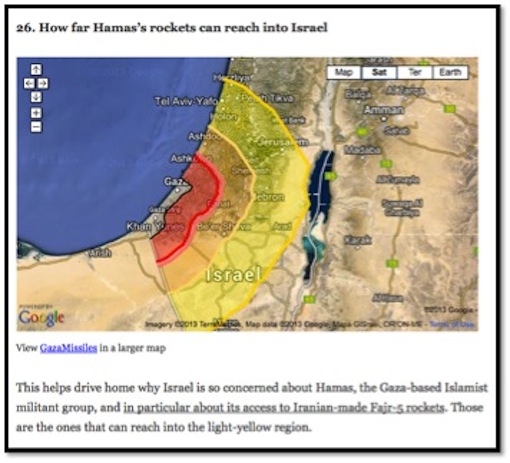
A foreign affairs blogger for The Washington Post recently posted “40 Maps that explain the world.” Some of the maps are important (“Economic inequality around the world”), some are interesting (“Meet the world’s 26 remaining monarchies”), but others grossly distort the reality they purportedly represent. Chief among this latter category is “How far Hamas’s rockets can reach into Israel” .
All about Hamas’s rockets
There are two principal problems with this map. First, the map attempts to “explain” the Israeli-Palestinian conflict by pointing exclusively to the capacity of Hamas’s rockets to reach ever-extensive points within Israel. Four color-coded, concentric semi-circles spread out from the Gaza Strip, each showing the distance different rockets could travel, the furthest making it all the way to the Dead Sea. Max Fisher, the Post’s chief foreign affairs blogger, writes in a caption to the map, “This helps drive home why Israel is so concerned about Hamas, the Gaza-based Islamist group, and in particular about its access to Iranian-made Fajr-5 rockets. Those are the ones that can reach into the light-yellow region.”
Erasing Palestine from the Map
The second major problem with this map is that Palestine—both historic and contemporary—is erased from it. A white dotted line traces the border between the West Bank and Israel but the line is barely visible beneath the yellow-shaded ring. Moreover, “West Bank” (not “occupied West Bank,” or “occupied Palestinian territory,” or “Palestinian West Bank” or “Palestine,” mind you) appears in font so small that it seems to designate some tiny city northeast of Jerusalem, not the Palestinian territory occupied by Israel since 1967. And while Israeli municipalities such as Arad, Ashdod, Holan, and Hrzliya, among others, are included, nowhere can one find the Palestinian cities of Ramallah, Nablus, Bethlehem, or Jericho, much less al-Bira, Jenin, or Qalqilia. Only Jerusalem and Hebron, West Bank cities that are significant to both Israelis and Palestinians, are featured. Even Jaffa, the coastal Palestinian city north of Tel Aviv, has been replaced by the Israeli-Hebrew version, “Yafo.”
So what does this map tell us about the Israel-Palestine conflict? It’s not apparent what or where Palestine is, or that it even exists, but the map suggests that an ever-menacing, Iranian-supported Islamist group threatens more than half of Israel. And therefore, Israel is “concerned.” Presumably, the reader might conclude, that “concern” forces Israel to periodically defend itself, launching its own counter-attacks into the Gaza Strip. The West Bank, meanwhile, appears for all intents and purposes, part of Israel and in no way related to the Gaza Strip or the cartographically cleansed “Palestine.” So Israel’s geography is simplified into a need to defend itself and Palestine is wiped off the map.
Concealing more than it reveals
The Washington Post’s map (which is actually just a simple google map lifted from someone named “Gene,” whose cartographic resume also includes google maps of “Richmond Bars/Restaurants” and “Jane Austin’s England”) doesn’t reveal how and to what extent Israel has “defended” itself against the perceived threat of Hamas’s rockets. The threat is all that is deemed important; a map showing where and with what deadly ramifications Israel’s responses have taken place, such as this one produced by the Alliance for Justice in the Middle East at Harvard University and the MIT Center for Future Civic Media, didn’t make the Post’s list.
Any attempt to cartographically represent the context within which Hamas’s rockets and Israel’s “response” may have been launched, such as this UN map, is also entirely missing from the Post’s compilation.
In addition to nearly erasing the Palestinian West Bank altogether, the Post’s map reveals nothing about the multiple ways in which the territory is occupied by Israel. Maps of Israeli-only roads, checkpoints, the separation barrier, settlements, and the ethnically-based divisions of the West Bank (such as these from Btselem, the Israeli Committee Against Home Demolitions, and The Applied Institute for Research – Jerusalem) don’t, according to the Washington Post, help explain this part of the world as much as Gene’s map of Hamas’s rocket-firing potential.
The Washington Post’s map of choice sheds no light on the Palestinian villages within Israel that were ethnically cleansed and destroyed in 1948-1949. References to these maps from the Palestinian Academic Society for the Study of International Affairs (PASSIA) and Visualizing Palestine could have at least begun to cartographically resurrect these erased landscapes.
The Dangers of Distorted Cartography
In sum, The Washington Post’s map explains very little about this part of the world. But what the map does reveal is The Washington Post’s myopic view of Israel and Palestine. The ongoing colonization of Palestine by Israel is reduced and reversed, in this map’s representation, to a normal country that must fend off existential threats from its shadowy neighbors. The effects of this distorted cartography are dangerous—erasing the geographies of Palestine is yet another step in the ongoing occupation and ethnic cleansing of Palestine.
Robert Ross is an Assistant Professor of Global Cultural Studies at Point Park University, in Pittsburgh, Pennsylvania. His research and teaching focus upon the political-economic geographies of Israel, Palestine, Lebanon and the United States. He is also a member of the Pittsburgh Palestine Solidarity Committee and the Israel-Palestine Mission Network of the Presbyterian Church (USA).
Featured Video
Laith Marouf: Hezbollah’s position on US-Iran ceasefire
or go to
Aletho News Archives – Video-Images
From the Archives
The Dirty Little Secret behind the “Global Terrorism Index”
The Omission of Israeli Terrorism in the Occupied Palestinian Territories
By Karin Brothers | Global Research | December 6, 2014
… The Israeli settlements — all of which are illegal – have been identified as a major impediment to peace. The refusal of a major “global” terrorism report to name the Israeli settlers as one of the groups most responsible for terrorism not only misrepresents a major source of regional violence but exposes the Global Terrorism Index as a propaganda tool that supports a U.S. agenda.
In recent years, governments have been attempting to thwart terrorism by blocking supportive fund-raising. When it comes to Israeli settlements, however, the US and Canada actually encourage fund-raising by giving organizations (such as Christian Friends of Israeli Communities (CFOIC) and the Jewish National Fund) financial support in the form of donor tax-deductions.
Charities which provide funds for the Israeli settlements should be regarded as terror-financing organizations. They should not only lose their tax-deductible status, but they should be banned because they support the violation of international humanitarian law. The terror-financing laws that are being strictly enforced for Muslim charities should be applied to Christian and Jewish charities as well. … Read full article
Blog Roll
 Aletho News
- How UK Regulator Ofcom Quietly Bypassed International Law to Police American Speech
- The Black Cube Files: How Former Mossad Operatives Flipped a Nation
- Laith Marouf: Hezbollah’s position on US-Iran ceasefire: What you’re not being told
- Israel’s priority lies in destroying chances of peace between Iran, US: Ex-UN nuclear chief
- Ceasefire for all or for none: Iran shuts Hormuz over Lebanon attacks
- Strait of Hormuz is Iran’s ‘nuclear weapon’ that forced US retreat: Medvedev
- Energy crisis will last for months – Kremlin envoy
- Europe’s quiet role in the war on Iran
- Forty days that shook the Empire: How Iran turned the tables on US and prevailed
- Netanyahu unilaterally declares Lebanon outside of ceasefire deal
- If Americans Knew
- This is ceasefire? Israel’s biggest massacre yet in Lebanon, another journalist killed in Gaza – Daily Update
- Tucker Carlson on Israel: This Is the Behavior of an Ally? Really?
- Gazans face a triple crisis: severe shortages of water and bread, healthcare in tatters
- NY Times reports how Netanyahu took the US into Iran War
- A sigh of relief over Iran, but Gaza and Lebanon in dire straits – Daily Update
- Thousands dead and neighborhoods razed to the ground: Aid agencies fear southern Lebanon is becoming the new Gaza
- The war the US is fighting for Israel could cost trillions
- ‘Cigarette Burns, Nail Wounds’: Toddler Tortured in Gaza to Coerce Father
- Trump Says US Sent ‘a Lot of Guns’ to Protesters in Iran
- Israeli forces destroy 17 UN peacekeeper cameras in south Lebanon
- No Tricks Zone
- An Inconvenient Tree: Uncovered In Alps… Europe Much Warmer Than Today 6000 Years Ago
- New Study Reports A 60% Slowdown In Greenland’s Ice Loss Rate In The Last Decade
- Low Intensity Tornado Wrecks Major Solar Farm, Creating A Potential Toxic Dump
- New Study Finds Warming Saves Lives…Cold Temperatures 12 Times More Deadly Than Excess Heat
- German Science Blog Accuses PIK Climate Institute Of Hallucinating Climate Tipping Points
- Devastating Assessment Of Comirnaty Vaccine By Former Senior Pfizer Europe Toxicologist
- New Study: CO2 Is ‘Effectively Negligible’ As An Explanatory Climate Change Factor Since 2000
- Former Pfizer Toxicologist Dr. Helmut Sterz Tells Bundestag Hearing Pfizer Vaccine Should Have Never Been Approved
- Energy Expert: Germany’s Nuclear Phaseout Was A “500 Billion Euro Mistake”
- New Research: South Australia’s Mid-Holocene Sea Surface Temperatures Were 4°C Warmer Than Today
 Aletho News


