Powering up the WHO: be alert and alarmed
Why proposed changes to the International Health Regulations are a VERY BAD idea
By Libby Klein | Reclaim Ethical Medicine | December 18, 2022
One might think that of course we need an international body that can help everyone around the world to work together in times of crisis to combat pandemics and other scary global things.
Well that sounds sensible.
One might think that’s what we have the World Health Organisation (WHO) for.
Well that may have been the original idea, but it turns out there’s a few issues with the WHO. How effective is it and what role should it have?
Seems the world has skipped past those questions and gone straight to: let’s give the WHO all the power it needs so that it can do a better job of controlling pandemics.
And let’s not just tweak one or two things here and there. Let’s have a whole new treaty. And let’s call it something really long, like Convention, Agreement or Other International Instrument on Pandemic Prevention, Preparedness and Response and give it a confusing acronym, like CA+.
AND let’s also simultaneously amend the existing International Health Regulations. In ways that overlap. Through forums which are supposedly transparent but which are largely conducted in secret.
There’s a lot going on here. But don’t be fooled by the flowery language or put off by the density and complexity of the documents. Be assured there are some big issues which warrant your attention.
I’ve listed some of the issues in the most recent proposals to amend the International Health Regulations below. Please add your comments and share your insights!
Note: they don’t call a spade a spade and they don’t call a pandemic a pandemic. They call it a “Public Health Emergency of International Concern”. There’s 2 reasons for that:
- they like to use long confusing names and make up impressive acronyms (“PHEIC”)
- they want to have power to do all sorts of things whether or not there’s actually a pandemic and even where they think there might be something happening which one day may result in a pandemic.
The scope of WHO’s powers is to be broadened significantly, from “public health risk” to “all risks with a potential to impact public health” (Article 2)
- Proposed new article 13A recognises the WHO as the authority of public health response during a Public Health Emergency of International Concern. (Note: none of the published submissions make this suggestion. Where did it come from?)
- Article 13A includes an undertaking by all Member States, that they will follow WHO’s “recommendations”. Earlier in the document, “recommendations” are defined to be legally binding.
- Countries are also required to ensure they have regulatory agency with legal authority to implement WHO’s dictates. (Article 4 para 1)
- Countries can contest the legally binding recommendations but the Emergency Committee’s review decision will be final, following which the country must report to the WHO that it has complied. (Article 43 para 6).
- The World Health Assembly can make decisions “on the strengthening of the implementation of these Regulations and improvement of compliance” – obscure language – does this mean the World Health Assembly can decide on sanctions?
- Developed countries must provide funding (Article 44 para 2(f); Annex 1 new para “1 bis”)
- The World Health Assembly will oversee expenditure of funds that Member States are required to provide (Article 44A para 2).
- WHO decides on allocation of health products (Article 13A).
- WHO requires Member States to scale up production (Article 13A para 4), and to supply health products to the WHO or other Member States as directed by the WHO (Article 13 para 5).
- The Director General – a single person – can make temporary, binding “recommendations” on the basis that an event has the potential to become a Public Health Emergency of International Concern, and those recommendations can continue in force beyond the end of a Public Health Emergency of International Concern (Article 15).
- The concept of public health measures which are aimed at achieving “the appropriate level of health protection” is to be removed. The new objective is to attain the “highest achievable level of health protection” without any consideration of proportionality.
- WHO can impose restrictions on international travel – and may not even disclose the information it has relied on in doing so – Article 11.
- Any discussions that countries have amongst themselves must be reported to the WHO (Article 44 para 3).
- Countries must comply with requests by WHO or other countries (Annex 10).
- Governments will be required to enforce compliance with WHO health measures by all actors including NGOs (Article 42).
- Countries must cooperate in censorship of information which the WHO deems to be “false and unreliable (Article 44 para 1(h)).
- WHO will strengthen capacities to counter misinformation and disinformation (Annex 1 para 7).
- The Director General – a single person – unilaterally determines whether there is a (potential or actual) Public Health Emergency of International Concern in a particular location. (Article 12 para 1).
- In deciding whether to declare a Public Health Emergency of International Concern, the Director General does not have to consult with the country concerned or its own Emergency Committee (Article 12 para 2). (And at any rate the Director General chooses the members of the Emergency Committee – Article 48 para 2.)
- The ability of the country to object to the WHO’s declaration of a Public Health Emergency of International Concern has been removed (Article 12 para 3).
- There is to be “secure global digital exchange of health information” (Article 44 para 2(d))
- Centralised data sharing is to be controlled by the WHO (Article 11)
- Governments can agree to share and store your personal health data (Article 45 para 4).
- Regulatory dossiers submitted by manufacturers concerning safety and efficacy, and manufacturing and quality control measures, have to be shared, but countries can only use that information for accelerating the manufacture and supply of those products and technologies. There is no reference to using the data to make their own assessment of safety and efficacy, betraying a blind spot on the part of the drafters: they are so focussed on facilitating the imposition of pharmaceutical products on everybody that they don’t even think to make provisions regarding sharing of information for the purpose of assessing or monitoring safety and efficacy.
- There is a requirement to adopt “legal, administrative and technical measures to diversify and increase production of health products” (Annex 1 para 7) (but not to promote development of early treatment protocols for example).
- Rules of engagement: Malaysia (article 12 para 7) and Africa (article 13A para 7) have proposed new wording which ostensibly puts some guard rails around how the WHO engages with non-State actors, by requiring the WHO to comply with paragraph 73 of the Framework for Engagement of Non-State Actors (FENSA). However, that paragraph in FENSA does not impose any constraints on the WHO. On the contrary, it grants the Director-General complete flexibility: “… the Director-General may exercise flexibility as might be needed in the application of procedures of this framework in those responses, when he/she deems necessary, in accordance with WHO’s responsibilities as health cluster lead.” This complete flexibility is given to a single individual, the Director-General of the WHO.
- In terms of disclosure, the new article 13A does require the WHO to report all its engagements with other stakeholders to the World Health Assembly, and to “provide documents and information relating to such engagements upon request of State Parties.” However, this is far from requiring full disclosure. The WHO could supply summary documents and information, rather than making full disclosure. The WHO has not disclosed who has proposed this new article 13A.
The Myth of Pandemic Preparedness
The entire effort is based on the false assumption that pandemic preparedness would actually work. In fact, all it has done is create new pandemics.
1. The most recent WHO-declared Public Health Emergencies of International Concern (PHEICs) for SARS-CoV-2 and Monkeypox were both caused by lab-created viruses, based on many careful analyses of their genomes.
2. There is no evidence that pandemic preparedness ever benefited anyone but the preparedness industry, and substantial evidence that it led to the creation of the COVID pandemic.
3. The Democrat majority staff report, “Preparing for and preventing the next public health emergency.” echoes the WHO Amendments.
4. The Global Preparedness Monitoring Board has also geared up to push the identical program as the WHO: surveillance, One Health, and investment — “all topics that the GPMB has long recognised are crucial for the advancement of resilient pandemic preparedness mechanisms.”
5. The G20 nations agreed last April to a $50 Billion dollars a year price tag for gloval pandemic preparedness.
6. The Globalist agenda is out in the open for all to see.
The pandemic preparedness concept is based on fantasy; it is a dangerous money grab for a new biodefense industry. It brought:
· Many more high-containment BSL-3 and BSL-4 labs,
· 15,000 new scientists trained to research biowarfare pathogens,
· Poorly tested drugs and vaccines for which the manufacturers had no liability
· More corruption and pork for politicians to distribute.
· Nathan Wolfe’s company: biolabs in Ukraine, squire to Ghislaine Maxwell, funding by Hunter Biden’s investment group
· Peter Daszak’s ‘nonprofit’ that collected dangerous viruses from over 30 countries to bring to the US Defense Threat Reduction Agency (DOD’s DTRA) for further investigation
· Extremely dangerous anthrax, smallpox and COVID vaccines
· The COVID drug paxlovid, which led to relapses of COVID in President Biden, CDC Director Rochelle Walensky and NIAID Director and Presidential COVID adviser Anthony Fauci and millions of Americans, presumably prolonging their infectiousness and causing more cases of COVID
· Expensive new federal agencies (ASPR, BARDA in DHHS, and subagencies within DHS and within DOD) and new funding streams to the NIH
· An excuse to censor alternate medical/scientific views
One Health: what is it and why is it important?
One Health is being embedded into the WHO’s International Health Regulations (IHRs) and Pandemic Treaty/Accord
By Meryl Nass | December 5, 2022
First, what is One Health? It is essentially a meaningless concept that is important to the WHO, CDC and the new pandemic regulations being negotiated, as I heard it mentioned several times by country representatives discussing the new IHR amendments. My best guess is that One Health will be invoked as the justification to move people off the land in certain rural communities. The authors of a June 2019 article titled “The One Health Approach—Why Is It So Important?” provide 3 definitions and a graphic to try and explain the term:
The most commonly used definition shared by the US Centers for Disease Control and Prevention and the One Health Commission is: ‘One Health is defined as a collaborative, multisectoral, and transdisciplinary approach—working at the local, regional, national, and global levels—with the goal of achieving optimal health outcomes recognizing the interconnection between people, animals, plants, and their shared environment’. A definition suggested by the One Health Global Network is: ‘One Health recognizes that the health of humans, animals and ecosystems are interconnected. It involves applying a coordinated, collaborative, multidisciplinary and cross-sectoral approach to address potential or existing risks that originate at the animal-human-ecosystems interface’. A much simpler version of these two definitions is provided by the One Health Institute of the University of California at Davis: ‘One Health is an approach to ensure the well-being of people, animals and the environment through collaborative problem solving—locally, nationally, and globally’. Others have a much broader view, as encapsulated in Figure 1.
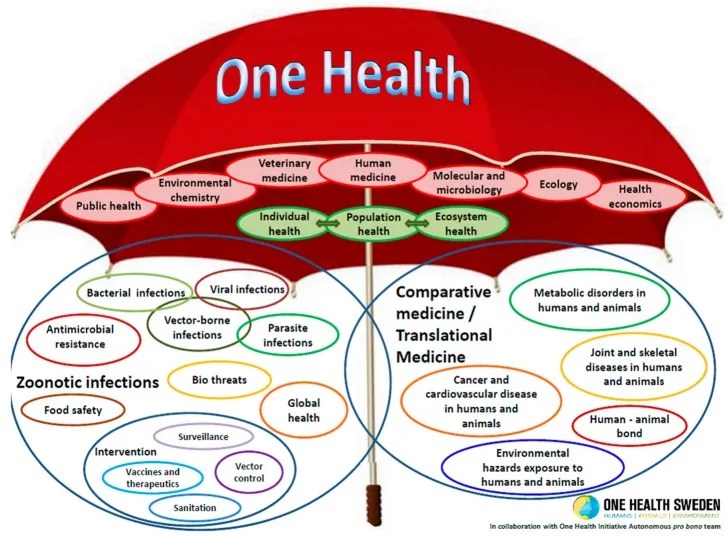
I hope you agree that these definitions shed no light on the meaningfulness of this concept, nor how it might be relevant to public health. However, the definitions seem to rope a lot of other things into a consideration of “health” which I fear is its main objective—eventually to justify social engineering under the rubric of health, or rather ‘One Health.’
The authors of the piece cited above note that they have not gotten buy-in from the medical community:
“Interdisciplinary collaboration is at the heart of the One Health concept, but while the veterinarian community has embraced the One Health concept, the medical community has been much slower to fully engage, despite support for One Health from bodies such as the American Medical Association, Public Health England, and WHO. Engaging the medical community more fully in the future may require the incorporation of the One Health concept into the medical school curricula so that medical students see it as an essential component in the context of public health and infectious diseases.”
And so cheap fixes are being applied. November 3 has been designated “One Health Day” since 2016 by the One Health Commission, the One Health Platform Foundation, and the One Health Initiative. One Health Day is celebrated through One Health educational and awareness events held around the world. Students are especially encouraged to envision and implement One Health projects, and to enter them into an annual competition for the best student-led initiatives in each of four global regions.
After titling their article as if it was going to explain why One Health is important, in the end all we get is a spurious sentence asserting that it is so:
Today’s health problems are frequently complex, transboundary, multifactorial, and across species, and if approached from a purely medical, veterinary, or ecological standpoint, it is unlikely that sustainable mitigation strategies will be produced.
I went to the WHO website to see if I could get a more satisfying explanation of this concept, but was left with the same sense—that it was simply an attempt to throw every living thing, plus every ‘ecosystem’ on the planet into the One Health basket, where pretty much everything might in future be manipulated under the guise of public health. See if you get a different take:
https://www.who.int/health-topics/one-health#tab=tab_1
One Health is an integrated, unifying approach that aims to sustainably balance and optimize the health of people, animals and ecosystems.
It recognizes that the health of humans, domestic and wild animals, plants, and the wider environment (including ecosystems) are closely linked and interdependent.
While health, food, water, energy and environment are all wider topics with sector-specific concerns, the collaboration across sectors and disciplines contributes to protect health, address health challenges such as the emergence of infectious diseases, antimicrobial resistance, and food safety and promote the health and integrity of our ecosystems.
By linking humans, animals and the environment, One Health can help to address the full spectrum of disease control – from prevention to detection, preparedness, response and management – and contribute to global health security.
The approach can be applied at the community, subnational, national, regional and global levels, and relies on shared and effective governance, communication, collaboration and coordination. Having the One Health approach in place makes it easier for people to better understand the co-benefits, risks, trade-offs and opportunities to advance equitable and holistic solutions.
It matters because One Health appears to be a necessary part of the globalist, WEF plan to corral the earth’s people, akin to vaccine passports. Please help educate those who have ears to hear and eyes to see. This needs to be stopped. The best way is by exiting the WHO. Trump started the process, which was immediately reversed by the Biden administration. We can do it again. Or they will keep coming up with cockamamie programs designed to control us under the guise of health.
World Health Organization meets to discuss granting of increased surveillance powers under pandemic treaty
By Tom Parker | Reclaim The Net | December 6, 2022
The unelected global health agency the World Health Organization (WHO) is currently meeting to consider a draft version of a controversial international pandemic treaty that will give the WHO increased surveillance powers.
The new surveillance powers are detailed in Article 10 (“Strengthening and sustaining capacities for pandemic prevention, preparedness, response and recovery of health systems”) and Article 17 (“One Health”) of the draft treaty. They include requirements for the WHO’s member states to “build and reinforce surveillance systems” across both the public and private sector and to strengthen the WHO’s “One Health surveillance systems.”
In its fact sheet on One Health, the WHO cites Covid-19 as one of the main drivers for expanding its One Health approach and notes that the COVID-19 pandemic “put a spotlight on the need for a global framework for improved surveillance and a more holistic, integrated system.”
While the draft treaty doesn’t mention contact tracing and testing, these were two of the main surveillance tools that were used to track the spread of Covid-19 during the pandemic and create a mass surveillance dragnet. Not only did this result in many citizens being forced to use surveillance apps and devices but the data was often abused by governments and third parties.
Not only does this treaty grant the WHO new surveillance powers but it also recognizes “the central role of WHO” and deems it to be “the directing and coordinating authority on international health work.”
We obtained a copy of the draft international pandemic treaty for you here.
The three-day meeting to discuss this draft treaty began on Monday (December 5) and ends Wednesday (December 7). Members of an intergovernmental negotiating body (INB) that was created by the WHO’s decision-making body, the World Health Assembly (WHA), are in attendance and have been tasked with drafting and negotiating this international pandemic treaty.
The INB is projecting that it will finalize this international pandemic treaty by May 2024 and present a final report to the seventy-seventh WHA meeting.
We obtained a copy of the INB’s current proposed timeline for you here.
If it passes, the treaty will be adopted under Article 19 of the WHO Constitution. This provision allows the WHA to impose legally binding conventions or agreements on the WHO’s 194 member states (which represent 98% of all the countries in the world) if two-thirds of the WHA vote for them.
Unlike the lawmaking process within many democratic nations, where officials are elected to implement national laws that reflect the will of the people in the country and voted out if they fail to achieve this goal, the WHO empowers a small number of global representatives, who are often unelected diplomats, to decide on international laws that are imposed on the WHO’s 194 member states.
Before these meetings took place, the WHO demonstrated its love of mass surveillance. It has publicly supported vaccine passports multiple times. The WHO also initially commended China’s response to Covid, which relies heavily on digital surveillance, and only recently changed its stance to criticize China’s zero-Covid policy.
Many powerful nations support this WHO power grab including the United States (US), United Kingdom (UK), Canada, Australia, New Zealand, and the European Council (EC) (which represents 27 European Union (EU) member states).
While some politicians in these countries have opposed this treaty, the pushback has so far failed to stop or slow down the progress of this international pandemic treaty and the May 2024 finalization is still very much in play.
Four Myths about Pandemic Preparedness

By David Bell | Brownstone Institute | November 24, 2022
We are assured by the World Health Organization (WHO), the World Bank, the G20, and their friends that pandemics pose an existential threat to our survival and well-being. Pandemics are becoming more common, and if we don’t move urgently we will have ourselves to blame for more mass death of the ‘next pandemic.’
The proof of this is the catastrophic harm done to the world by COVID-19, a repeat of which can only be prevented by transferring unprecedented funds and decision-making power to the care of public health institutions and their corporate partners. They have the resources, experience, knowledge and technical know-how to keep us safe.
This is a no-brainer, all of it, and only a fool who desires mass death would oppose it. But there are still people who claim that the link between the public health establishment and large corporations appears to be the only part of this narrative that withstands scrutiny.
If true, this would imply that we are being systematically deceived by our leaders, the health establishment, and most of our media; a ludicrous allegation in a free and democratic society. Only a fascist or otherwise totalitarian regime could run such a broad and inclusive deception, and only people with truly bad intent could nurture it.
So let’s hope such ‘appearances’ are deceptive. To believe that the premise behind our leaders’ Pandemic Preparedness and Response agenda is knowingly based on a set of complete fabrications would be a conspiracy theory too far. It would be too uncomfortable to accept that we are being deliberately misled by people we elected and the health establishment we trust; that the assurances of inclusivity, equity and tolerance are mere facades hiding fascists. We should examine the key claims supporting the pandemic agenda carefully and hope to find them credible.
Myth #1: Pandemics are becoming more common
In its 2019 pandemic influenza guidelines, the WHO listed 3 pandemics in the century between the 1918-20 Spanish flu and COVID-19. The Spanish flu killed mainly through secondary bacterial infections at a time before modern antibiotics. Today we would expect most of these people, many relatively young and fit, to survive.
The WHO subsequently recorded pandemic flu outbreaks in 1957-58 (‘Asian flu’) and 1968-69 (‘Hong Kong flu’). The Swine flu outbreak that occurred in 2009 was classed by WHO as a ‘pandemic’ but caused just 125,000 to 250,000 deaths. This is far less than a normal flu year and so hardly deserving of the pandemic label. Then we had COVID-19. That’s it for a whole century; one outbreak the WHO classifies as a pandemic per generation. Rare, or at least highly unusual, events.
Myth #2: Pandemics are a major cause of death
The Black Death, the Bubonic Plague that swept Europe in the 1300s, killed perhaps a third of the entire population. Repeat outbreaks over the following centuries caused similar harm, as had plagues known from Greek and Roman times. Even the Spanish flu did not compare with these. Life changed prior to antibiotics – including nutrition, accommodation, ventilation and sanitation – and these mass-mortality events subsided.
Since the Spanish flu we have developed an array of antibiotics that remain extremely effective against community-acquired pneumonia. Fit young people still die from influenza through secondary bacterial infection, but this is rare.
The WHO tells us there were 1.1 million deaths from the 1957-58 ‘Asian flu,’ and a million from the 1968-69 Hong Kong flu. In context, seasonal influenza kills between 250,000 and 650,000 people every year. As the global population was 3 to 3.5 billion when these two pandemics occurred, they classify as bad flu years killing about 1 in 700 mostly elderly people, with little influence on total deaths. They were treated as such, with the Woodstock Festival proceeding without super-spreader panic (regarding the virus, at least…).
COVID-19 has a higher associated mortality, but at an old average age equivalent to that of all-cause mortality, and is nearly always associated with comorbidities. Much mortality also occurred in the presence of the withdrawal of normal supportive care such as close nursing and physiotherapy, and intubation practices may have played a role.
Of the 6.5 million that the WHO records as dying from COVID-19, we don’t know how many would have died anyway from cancer, heart disease or the complications of diabetes mellitus and just happening to have a positive SARS-CoV-2 PCR result. We don’t know because most authorities decided not to check, but recorded such deaths as being due to COVID-19. The WHO records about 15 million excess deaths throughout the COVID-19 pandemic, but this includes lockdown deaths (malnutrition, rising infectious disease, neonatal death etc).
If we take the 6.5 million toll as likely, we can understand its context by comparing it with tuberculosis, a globally endemic respiratory disease that few worry about in their day-to-day lives. Tuberculosis kills about 1.5 million people every year, which is almost half the annual COVID-19 toll in 2020 and 2021. Tuberculosis kills far younger on average than COVID, removing more potential life-years with each death.
So based on normal metrics for disease burden, we could say they are roughly equivalent – COVID-19 has had an impact on life expectancy overall fairly similar to TB – worse in older populations in Western countries, far less in low-income countries. Even in the US COVID-19 was associated with less (and older) deaths in 2020-21 than normally occur from cancer and cardiovascular disease.
COVID-19 has not therefore been an existential threat to the life of many people. The infection mortality rate globally is probably around 0.15%, higher in the elderly, much lower in healthy young adults and children. It is not unreasonable to think that if standard medical knowledge had been followed, such as physiotherapy and mobility for frail elderly people and micronutrient supplementation for those at risk, the mortality rate may have been even lower.
Whatever one’s views on COVID-19 death definitions and management, it is unavoidable that death is rare in healthy younger people. Over the past century all pandemic deaths have been very low. Averaging less than 100,000 people per year inclusive of COVID-19, they are a small fraction of that caused by seasonal flu.
Myth #3: Diversion of resource to pandemic preparedness makes public health sense
The G20 has just agreed with the World Bank to allocate $10.5 billion annually to its pandemic prevention and response Financial Intermediary Fund (FIF). There is, in their view, about $50 billion needed in total per year. This is the annual, holding budget for pandemic preparedness. As an example of their preferred response when an outbreak occurs, Yale University modelers estimate that to vaccinate people in low and middle income countries with just 2 doses of COVID-19 vaccine would cost about $35 billion. Adding one booster would total $61 billion. Over $7 billion has thus far been committed to COVAX, the WHO’s Covid vaccine financing facility, vaccinating most who are already immune to the virus.
To put these sums in context, the annual budget of the WHO is normally below $4 billion. The entire world spends about $3 billion annually on malaria – a disease that kills well over half a million young children each year. The largest financing facility for tuberculosis, HIV/AIDS and malaria, the Global Fund, spends less than $4 billion per year on these three diseases combined. Other and larger preventable killers of children, – such as pneumonia and diarrhea, receive still less attention.
Malaria, HIV, tuberculosis and diseases of malnutrition are all increasing, while economies globally – the main long-term determinant of life expectancy in lower-income countries – decline. Taxpayers are being asked, by institutions that themselves will benefit, to spend vast resources on this problem rather than on diseases that kill more and younger people. The people pushing this agenda do not appear to be dedicated to reducing annual mortality or improving overall health. Alternatively, they either cannot manage data or have a window on the future that they are keeping to themselves.
Myth #4: COVID-19 caused massive harm to health and the global economy
The age-skewing of COVID mortality has been unmistakable since early 2020, when data from China demonstrated almost no mortality in healthy young to middle-aged adults and children. This has not changed. Those contributing to economic activity, working in factories, farms and transport, were never at great risk.
The economic and personal harm arising from the restrictions on these people, unemployment, destruction of small businesses and supply-line disruption, was a choice made against orthodox policy of the WHO and public health in general. The prolonged school closures, locking in generational poverty and inequality on both a sub-national and international level, was a choice to perhaps buy months for the elderly.
The 2019 WHO pandemic guidelines advised against lockdowns due to the inevitability that they would increase poverty, and poverty drives illness and reduces life expectancy. The WHO noted this disproportionately harms poorer people. This is not complicated – even those at the center of the lockdown and future digital ID agenda such as the Bank of International Settlements (BIS) acknowledge this reality. If the aim of poverty-promoting measures had been to reduce elderly death, the evidence for success is poor.
There seems little reasonable doubt that growing malnutrition and long-term poverty, rising endemic infectious disease, and the impacts of education loss, increased child marriage and increased inequality will far outweigh any possible mortality reduction achieved. UNICEF’s estimation of a quarter-million child deaths from lockdowns in South Asia in 2020 provides a window into the enormity of the harm lockdowns wrought. It was the novel public health response that caused the massive harm associated with this historically mild pandemic, not the virus.
Facing truth
It seems unavoidable that those advocating for the current pandemic and preparedness agenda are intentionally misleading the public in order to achieve their aims. This explains why, in the background documents of the WHO, the World Bank, G20 and others, detailed cost-benefit analyses are avoided. The same absence of this basic requirement characterized the introduction of Covid lockdowns.
Cost-benefit analyses are essential for any large-scale intervention, and their absence reflects either incompetence or malfeasance. Prior to 2019, the resource diversion being contemplated for pandemic preparedness would have been unthinkable without such analysis. We can therefore reasonably assume that their continued absence is based on fear or certainty that their outcomes would scupper the program.
A lot of people who should know better are going along with this deceit. Their motives can be surmised elsewhere. Many may feel they need a good salary, and the resultant dead and impoverished will be far enough away to be considered abstract. The media, owned by the same investment houses who own the Pharma and software companies sponsoring public health, are mostly silent. It is hardly a conspiracy to believe that investment houses such as BlackRock and Vanguard work to maximize return for their investors, using their various assets to do so.
A few decades of our elected leaders trooping off for closed-door sessions at Davos, together with a steady concentration of wealth with the individuals they were meeting, could not really have landed us anywhere else.
We knew this 20 years ago, when the media still warned of the harm that increasing inequality would bring. When individuals and corporations richer than medium-sized countries control major international health organizations such as Gavi and CEPI, the real question is why so many people struggle to acknowledge that conflicts of interest define international health policy.
The subversion of health for profit runs contrary to the entire ethos of the post-World War Two anti-fascist, anti-colonialist movement. When people across politics can acknowledge this reality, they can put aside the false divisions that this corruption has sown.
We are being deceived for a reason. Whatever that is, going along with a deception is a poor choice. Denial of truth never leads to a good place. When public health policy is based on a demonstrably false narrative, it is the role of public health workers, and the public, to oppose it.
David Bell, Senior Scholar at Brownstone Institute, is a public health physician and biotech consultant in global health. He is the former Program Head for malaria and febrile diseases at the Foundation for Innovative New Diagnostics (FIND) in Geneva, Switzerland.
The Lancet reports on Human Rights failures during the COVID-19 pandemic. Is the tide turning? Think again.
The Naked Emperor’s Newsletter | November 24, 2022
When I first read the title of an article in The Lancet last week, I thought, this might be interesting, some acknowledgement about how bad lockdowns and mandates were. The title ‘Human rights and the COVID-19 pandemic: a retrospective and prospective analysis’ made me read on.
Maybe, I shouldn’t have been so naïve and maybe I should have looked at who the authors were first but I read on anyway.
I was still hopeful during the summary.
When the history of the COVID-19 pandemic is written, the failure of many states to live up to their human rights obligations should be a central narrative.
Which states will they talk about? The UK? America? I’d put money on Canada, Australia and New Zealand.
Since then, COVID-19’s effects have been profoundly unequal, both nationally and globally. These inequalities have emphatically highlighted how far countries are from meeting the supreme human rights command of non-discrimination, from achieving the highest attainable standard of health that is equally the right of all people everywhere, and from taking the human rights obligation of international assistance and cooperation seriously.
Rubbing my hands together, I scrolled on, expecting to see scathing criticism of citizens being locked at home and how Covid mandates were completely unjust.
We propose embedding human rights and equity within a transformed global health architecture as the necessary response to COVID-19’s rights violations. This means vastly more funding from high-income countries to support low-income and middle-income countries in rights-based recoveries, plus implementing measures to ensure equitable distribution of COVID-19 medical technologies.
We also emphasise structured approaches to funding and equitable distribution going forward, which includes embedding human rights into a new pandemic treaty. Above all, new legal instruments and mechanisms, from a right to health treaty to a fund for civil society right to health advocacy, are required so that the narratives of future health emergencies—and people’s daily lives—are ones of equality and human rights.
Oh, here we go – high-income countries imposing their views on low-income countries. Distribution of mRNA vaccines and a new pandemic treaty.
Deflated, I finally checked the authors. The lead author works for the WHO and many of the other authors championed vaccine passports.
Realising this isn’t going to be the article I thought it was going to be, I skipped to the conclusion.
Equity demands treating health as a global public good and creating new legal instruments grounded in rights and equity. A reimagined, strengthened global health architecture, with human rights as its foundation, would be a fitting monument to the tens of millions who have died and suffered grievously—and would better prepare the world to address climate change, antimicrobial resistance, and other global threats. Furthermore, it would enable a swift, effective response the next time a novel or emerging infection threatens the globe—honouring the dignity of each of us.
I’ve seen that language before. “Equity demands”, “global public good”, “grounded in rights and equity”, “human rights as its foundation”. And whilst it all sounds lovely, it never ends well and the only human rights that are respected are those belonging to the humans that agree with what is being proposed.
You don’t want a pandemic treaty, forced vaccinations and mandates? Think of the tens of millions who have died and suffered grievously, you monster. Think of climate change, you devil in disguise. This is being done to honour the dignity of each of us. Well, not your dignity, you don’t agree with us, you stay locked in the quarantine camp thinking about the lovely dignity you could have if you did agree with us.
It was a struggle but I forced myself to read the rest of the article.
Many authoritarian regimes and populist leaders, however, have disregarded science, and have imposed harsh restrictions on human freedoms
One again, my hopes were raised. Maybe there is a small section on lockdowns etc. I saw the letters U.S.A. Maybe it will discuss how it is ridiculous that unvaccinated people still can’t travel there. Nope, it criticised the USA for opposing risk-mitigation measures such as business closures and mask or vaccine mandates.
It continued to get worse.
Public health officials have not always followed the science. The Public Health Agency of Sweden chose to allow a large portion of the country’s population to become infected, aiming to achieve herd immunity through eschewing basic scientific guidance of physical distancing and mask-wearing. This course was so fundamentally unsuccessful in protecting people’s health that it was beyond the discretion permissible under the right to health. By the end of 2020, Sweden’s mortality rate was ten times that of its neighbours, four-times higher than Denmark’s, and higher than in most European countries.
I agree with much of this section to a large extent, impacts of COVID-19 does disproportionately affect people with little money due to a plethora of risk factors. But so does any disease. And by locking people up, making them unhealthier and poorer, you only exacerbate this inequality.
But carry on with the virtual signalling and keep blaming it on systemic racism. Or Covid racism, I’m not quite sure. Either way, by not investigating why certain races disproportionately filled critical care units meant that more ethnic minorities carried on dying. Congratulations, by trying not to be racist, you actually ended up being racist.
Service disruptions were responsible for an estimated 47,000 additional malaria deaths in 2020 compared with 2019, and 100,000 additional tuberculosis deaths. 121 (93%) of 130 countries reported mental health service disruptions, as depression and anxiety levels greatly increased. By 2022, more than 200 million additional people faced acute hunger compared with in 2019, while COVID-19 forced nearly 80 million people into extreme poverty.
One word – Lockdowns.
Governments exercised vast emergency health powers, including business closures, cordon sanitaire, and full lockdowns, which are warranted only if supported by science, and are necessary, proportionate, and non-discriminatory.
So lockdowns are warranted if supported by science. Still no acknowledgement of the terrible harms they have caused.
authoritarian leaders have used the pandemic as an excuse to violate human rights, including suppressing information, punishing whistleblowers, arresting and detaining opponents and citizen journalists, and undermining democratic rights
I recognise all of those things having happened in many Western countries but are they mentioned? Of course not. China, Tanzania, Egypt, Russia, Pakistan, Madagascar, Bangladesh, Venezuela, Cayman Islands, Burundi, India, Hungary, Malaysia, Zambia, El Salvador, Thailand, Kazakhstan, Morocco, Ethiopia and Uganda all get a mention but nothing about the US, UK, Australia, Canada or New Zealand.
France and Greece get a brief mention. Maybe they haven’t been sending enough funding to the WHO recently.
And there we have it. Now we know exactly where this article has come from!
A new rights-based national and global governance for the right to health would respond to the daily health emergency of health inequities that COVID-19 revealed and reinforced. Future governance, and the mechanisms that underpin it, must ensure equitable and effective responses to health emergencies by embedding the right to health, accountability, participation, and equity in global and national policies and international responses.
A new right-based global governance. Where have we heard that before? Nothing to see here. It all sounds completely reasonable and not sinister or dystopian at all.
These people don’t have a clue. That don’t recognise the harms they have caused and they wouldn’t recognise a human right if it jabbed them in the arm.
But they are calling the shots and they want global governance based around the greater good. Not enough countries did as they were told during this pandemic, so next time they want a structure in place that means your democratically elected leaders can’t decide if lockdowns are appropriate or not, the whole world will be locking down together.
Don’t get in the way of the greater good because if you do, you aren’t good and that means we can lock you up. Nobody likes not-good people and everyone will cheer your incarceration because it will keep them safe.
If these recommendations are allowed to go ahead, not only is it dangerous but also stupid. Never again will we know if a certain measure was the correct one to take or if a vaccine or treatment has a particular side effect because everybody in every country will have to do the same thing.
Swissmedic and Vaccinating Doctors Criminally Sued for Authorizing and Administering Covid-19 mRNA Jabs
Do not underestimate the Swiss diligence
By Andreas Oehler | Live To Fight Another Day | November 14, 2022
The detail-oriented Swiss are taking their medical establishment to task in a big way for authorizing and administering the Covid-19 mRNA jabs, in a formal criminal complaint.
“That is what the criminal complaint against Swissmedic is about” (SRF, 2022.11.14):
That’s what it’s all about: On July 14, 2022, a lawyer submitted a 300-page criminal complaint to the responsible cantonal public prosecutor’s office on behalf of six people allegedly injured by mRNA vaccinations. It is directed against three representatives of the Swiss licensing and supervisory authority for medicinal products and medical devices (Swissmedic) and five vaccinating doctors from the Inselspital in Bern. A criminal investigation is to be opened against them. The lawyer has now gone public with a media conference.
These are the plaintiffs: The lawyer for those affected, Philipp Kruse, is a declared opponent of vaccination and Covid measures. He represented people who refused to wear masks or parents who didn’t want their children to take part in pool tests. Doctors who were noticed as corona skeptics also appeared at the media conference.
This is what the indictment says: The defendants are accused of violating basic drug law due diligence by allowing and administering the Covid 19 vaccination. There are a number of other charges listed, including intentional or possibly negligent bodily harm, endangering life, killing and abortion.
These are the alleged damages: According to lawyer Kruse, the damages range from circular hair loss, derailment of the menstrual cycle to polyarthritis, muscle weakness and chronic exhaustion to the death of a 20-year-old person. Some of the six victims listed are still unable to work. The connection to the Covid 19 vaccination was confirmed by experts in five cases. In the case of the deceased, the causal connection must be proven on the basis of pathological examinations. However, these investigations are not yet complete.
What Swissmedic says: Nothing. Swissmedic does not want to comment on the ongoing court proceedings. The Federal Office of Public Health and the Federal Vaccination Commission also do not want to comment.
What may fly under the radar in other countries, in terms of the lack of accountability and responsibility for Covid-19 jabbing injuries, is unlikely to pass muster in Switzerland. The Swiss pride themselves on being OBJECTIVE, diligent, thorough and just. Because of these very high public expectations, it is impossible to sweep under the carpet, gaslight, or outright ignore the laws on the books over there, let’s hope:
It is about these articles of the Medicines Act
Art. 3 Duty of care 1 Anyone who handles medicinal products must take all the necessary measures based on the current state of science and technology to ensure that the health of humans and animals is not endangered.
Chapter 8: Penal Provisions Art. 86233 Crimes and misdemeanors 1 Anyone who willfully: a. manufactures, places on the market, uses, prescribes medicinal products without the necessary authorization or authorization, contrary to the terms and conditions associated with an authorization or authorization or contrary to the due diligence obligations stipulated in Articles 3, 7, 21, 22, 26, 29 and 42, imports, exports or trades abroad; (…).
Link to the Medicines Act .
Also of note here is that Swissmedic is the key conduit of the global vaccination programmes in partnership with Bill&Melinda Gates Foundation and WHO, and also FDA.
Good luck in court!
WHO’S DRIVING THE PANDEMIC EXPRESS?
By Dr David Bell and Emma McArthur | PANDA | September 4, 2022
Sceptics of the growing ‘pandemic prevention, preparedness and response’ (PPR) agenda celebrated recently, heralding a perceived ‘defeat’ of the World Health Organization’s (WHO) controversial amendments to the International Health Regulations (IHR). Although the proposed amendments would have undoubtedly expanded the WHO’s powers, this focus on the WHO reflects a narrow view of global health and the pandemic industry. The WHO is almost a bit-player in a much larger game of public-private partnerships and financial incentives that are driving the pandemic gravy train forward.
While the WHO works in the spotlight, the pandemic industry has been growing for over a decade and its expansion accelerates unabated. Other major players such as the World Bank, coalitions of wealthy nations at the G7 and G20 and their corporate partners work in a world less subject to transparency; a world where the rules are more relaxed, and a conflict of interest receives less scrutiny.
If the global health community is to preserve public health, it must urgently understand the wider process that is underway and take action to stop it. The pandemic express must be halted by the weight of evidence and basic principles of public health.
Funding a global pandemic bureaucracy
“The FIF could be a cornerstone in the construction of a truly global PPR system in the context of the International Treaty on Pandemic Prevention, Preparedness and Response, sponsored by the World Health Assembly.” (WHO, 19 April 2022)
The world is being told to fear pandemics. Ballooning socio-economic costs of the COVID-19 crisis are touted as justification for increased focus on PPR funding.
Calls for ‘urgent’ collective action to avert the ‘next’ pandemic are predicated on systemic ‘weaknesses’ supposedly exposed by COVID-19. As the WHO steamed ahead with its push for a new pandemic ‘treaty’ during 2021, G20 members agreed to establish a Joint Finance & Health Task Force (JFHTF) to ‘enhance the collaboration and global cooperation on issues relating to pandemic prevention, preparedness and response’.
A World Bank-WHO report prepared for the G20 joint task force estimates that US$ 31.1 billion will be required annually for future PPR, including US $ 10.5 billion per year in new international financing to support perceived funding gaps in low- and middle-income countries (LMICs). Surveillance-related activities comprise almost half of this, with US $4.1 billion in new funding required to address perceived gaps in the system.
In public health terms, the funding proposed to expand the global PPR infrastructure is enormous. By contrast, the WHO’s approved biennium programme budget for 2022-2023 averages US $3.4 billion per year. The Global Fund, the main international funder of malaria, tuberculosis and AIDS – which have a combined annual mortality of over 2.5 million – currently dispenses just US $ 4 billion annually for the three diseases combined. Unlike COVID-19, these diseases cause significant mortality in lower income countries and in younger age groups, year in, year out.
In April 2022, the G20 agreed to establish a new ‘financial intermediary fund’ (FIF) housed at the World Bank, to address the US $10.5 billion PPR financing gap. The FIF is intended to build upon existing pandemic funding to ‘strengthen health systems and PPR capacities in low-income and middle-income countries and regions’. The WHO is predicted to be the technical lead, landing them with an assured role irrespective of the outcome of current ‘treaty’ discussions.
The establishment of the fund has proceeded with breathtaking speed, and it was approved on June 30 by the World Bank Board of Executive Directors. A short period of consultation precedes an expected launch in September 2022. To date, donations totalling US $1.3 billion dollars have been pledged by governments, the European Commission and various private and non-government interests, including the Bill and Melinda Gates Foundation, Rockefeller Foundation, and the Wellcome Trust. The initial areas for the fund are somewhat all-encompassing, including country-level ‘disease surveillance; laboratory systems; emergency communication, coordination and management; critical health workforce capacities; and community engagement’.
In scope, the fund has the appearance of a new ‘World Health Organization’ for pandemics – to add to the existing (and ever-expanding) network of global health organisations such as the WHO; Gavi; the Coalition for Epidemic Preparedness Innovations (CEPI); and the Global Fund. But is this increased expenditure on PPR justified? Are the escalating socio-economic costs of COVID-19 due to a failure to act by the global health community, as is widely claimed; or are they due to negligent acts of failure by the WHO and global governments, when they discarded previous evidenced-based pandemic guidelines?
COVID-19: failure to act or acts of failure?
In the debate surrounding the growing pandemic industry, much attention is being directed towards the central role of the WHO. This attention is understandable given the WHO’s position as the agency responsible for global public health and its push for a new international pandemic agreement.
However, the WHO’s handling of the response to COVID-19 creates serious doubts about the competency of its leadership and raises questions about whose needs the organisation is serving.
The WHO’s failure to follow its own pre-existing pandemic guidelines by supporting lockdowns, mass-testing, border closures and the multi-billion-dollar COVAX mass-vaccination program, has generated vast revenue for vaccine manufacturers and the biotech industry, whose corporations and investors are major contributors to the WHO. This approach has crippled economies, damaged existing health programs and further entrenched poverty in low-income countries. Decades of progress in children’s health are likely to be undone, together with the destruction of the long-term prospects of tens of millions of children, through loss of education, forced child marriage and malnutrition. In abandoning its principles of equality and community-driven healthcare, the WHO appears to have become a mere pawn in the PPR game, beholden to those with the real power; the entities who are providing its income and who control the resources now being directed to this area.
Corporatizing global public health
Recently established health agencies devoted to vaccination and pandemics, such as Gavi and CEPI, appear to have been highly influential from the beginning. CEPI, is the brainchild of Bill Gates, Jeremy Farrar (director of the Wellcome Trust), and others at the pro-lockdown World Economic Forum. Launched at Davos in 2017, CEPI was created to help drive the market for epidemic vaccines. It is no secret that Bill Gates has major private financial ties to the pharmaceutical industry, in addition to those of his foundation. This clearly places a question mark over the philanthropic nature of his investments.
CEPI appears to be a forerunner of what the WHO is increasingly becoming – an instrument where individuals and corporations can exert influence and improve returns by hijacking key areas of public health. CEPI’s business model, which involves taxpayers taking most of the financial risk for vaccine research and development whilst big pharma gets all the profits, is notably replicated in the World Bank-WHO report.
Gavi, itself a significant WHO donor that exists solely to increase access to vaccination, is also under direct influence of Bill Gates, via the Bill and Melinda Gate Foundation. Gavi’s involvement (alongside CEPI) with the WHO’s COVAX program, which diverted vast resources into COVID-19 mass-vaccination in countries where COVID-19 is a relatively small disease burden, suggests the organisation is tied more strongly to vaccine sales than genuine public health outcomes.
Pandemic funding – ignoring the big picture?
At first glance, increased PPR funding to LMICs may seem a public good. The World Bank-WHO report claims that ‘the frequency and impact of pandemic-prone pathogens are increasing.’ However, this is belied by reality, as the WHO lists only 5 ‘pandemics’ in the past 120 years, with the highest mortality occurring in the 1918-19 H1N1 (‘Spanish’) influenza pandemic, before antibiotics and modern medicine. Apart from COVID-19, the ‘Swine Flu’ outbreak in 2009-10, which killed less people than a normal flu year, is the only ‘pandemic’ in the past 50 years.
Such a myopic focus on pandemic risk will do little to address the most serious causes of illness and death, and it can be expected to make matters worse for people experiencing the most extreme forms of socio-economic disadvantage.
Governments of low-income countries will be ‘incentivised’ to divert resources to PPR related programs, further increasing the growing debt crisis. A more centralised, top-down public health system will lack the flexibility to meet local and regional needs. Transferring support from higher burden diseases, and drivers of economic growth, has a direct impact on mortality in these countries, particularly for children.
The WHO-World Bank report states that the pillars of the global PPR architecture must be built on the ‘foundational principles of equity, inclusion and solidarity’. As severe pandemics occur less than once per generation, increased spending on PPR in LMICs clearly violates these basic principles as it diverts scarce resources away from areas of regional need, to address the perceived health priorities of wealthier populations. As demonstrated by the damage caused by the COVID-19 response, in both high and low-income countries, the overall harm of resource diversion from areas of greater need is likely to be universal. In failing to address such ‘opportunity costs’, recommendations by the WHO, the World Bank, and other PPR partners cannot be validly based in public health; nor are they a basis for overall societal benefit. .
One thing is certain. Those who will gain from this expanding pandemic gravy train will be those who gained from the response to COVID-19.
The pandemic gravy train – following the money
The new World Bank fund risks compounding existing problems in the global public health system and further compromising the WHO’s autonomy; although it is stated that the WHO will have a central ‘strategic role’, funds will be channelled through the World Bank. In essence, it financially side-steps the accountability measures at the WHO, where questions of relative worth can be raised more easily.
The proposed structure of the FIF will pave the way for organisations with strong ties to pharmaceutical and other biotech industries, such as CEPI and Gavi, to gain even greater influence over global PPR, particularly if they are appointed ‘implementing entities’ – the operational arms that will carry out the FIF’s work program at country, regional and global level.
Although the initial implementing entities for the FIF will be UN agencies, multilateral development banks and the IMF, plans are already underway to accredit these other international health entities. Investments are likely to be heavily skewed towards biotechnological solutions, such as disease surveillance and vaccine development, at the cost of other, more pressing, public health interventions.
Protecting public health rather than private wealth
If the world truly wants to address the systemic weakness exposed by COVID-19, it must first understand that this pandemic gravy train is not new; the foundations for the destruction of community- and country-based global public health began long before COVID-19.
It is unarguable that COVID-19 has proved to be a lucrative cash cow for vaccine manufacturers and the biotech industry. The public-private partnership model that now dominates global health enabled vast resources to be channelled into the pockets of corporate giants, through programs they directly influence, or even run. CEPI’s ‘100 days Mission’ to make ‘safe and effective’ vaccines against ‘viral threats’ within 100 days – to ‘give the world a fighting chance of containing a future outbreak before it spreads to become a global pandemic’ – is a permit for pharmaceutical companies to appropriate public money on an unprecedented scale, based on their own assessments of risk.
The self-fulfilment of the ‘increasing frequency of pandemic’ prophecy will be ensured by the push for increased disease surveillance – a priority area for the FIF. To quote the World Bank-WHO report:
“COVID-19 highlighted the need to connect surveillance and alert systems into a regional and global network to detect zoonotic transmission events, raise the alarm early to enable a swift public health response, and accelerate the development of medical countermeasures.”
Like many claims being made about COVID-19, this claim has no evidence base – the origins of COVID-19 remain highly controversial and the WHO’s data demonstrate that pandemics are uncommon, whatever their origin. None of the ‘countermeasures’ have been shown to significantly reduce the spread of COVID-19, which is now globally endemic.
Increased surveillance will naturally identify more ‘potentially dangerous pathogens’, as variants of viruses arise constantly in nature. Consequently, the world faces a never-ending game of seek and ye shall find, with never-ending profits for industry. Formerly once per generation, this industry will make ‘pandemics’ a routine part of life, where rapid fire vaccines are mandated for every new disease or variant that arrives.
Ultimately, this new pandemic fund will help to hook low- and middle-income countries into the growing global pandemic bureaucracy. Greater centralisation of public health will do little to address the genuine health needs of people in these countries. If the pandemic gravy train is allowed to keep growing, the poor will get poorer, and people will die in increasing numbers from more prevalent, preventable diseases. The rich will continue to profit, while fuelling the main driver of ill-health in lower income countries – poverty.
Dr. David Bell is a clinical and public health physician with a PhD in population health and background in internal medicine, modelling and epidemiology of infectious disease. Previously, he was Director of the Global Health Technologies at Intellectual Ventures Global Good Fund in the USA, Programme Head for Malaria and Acute Febrile Disease at FIND in Geneva, and coordinating malaria diagnostics strategy with the World Health Organisation. He is a member of the Executive Committee of PANDA.
Featured Video

Seyed M. Marandi: Negotiations Collapsed – Return to War
or go to
Aletho News Archives – Video-Images
From the Archives
The US-Iran Scenario That Most Scares Israel
By Ali Haydar | Al-Akhbar | October 9, 2013
Israeli Prime Minister Benjamin Netanyahu issued a series of threats toward Iran and its interlocutors in the West, including the US, as serious negotiations on Iran’s nuclear program seem more plausible.
As a possible rapprochement looms between the US and Iran, Netanyahu has attempted to impose impossible Israeli conditions on the negotiators, such as the full dismantling of Iran’s nuclear program, not to mention threatening military force.
Whatever the deal that could materialize between Iran and the West, Israel is going to find itself before an open-ended path. One can foresee three possible scenarios… continue
Blog Roll
 Aletho News
- Trump’s desperate bombasts amount to war crimes
- Most Israelis oppose Iran ceasefire, reject talks: Poll
- Iran to charge ships from ‘hostile’ nations to cross Hormuz – security chief
- UK, Spain reject Trump’s new scheme to blockade Hormuz Strait
- Russian frigate ‘resurfaces’, chases off NATO pirates days after Kiev ‘sank’ it
- Ukraine Targets Russian Merchant Fleet With NATO Intel Support – Presidential Aide
- Russia’s ‘shadow fleet’ makes mockery of UK naval power
- Ukraine plans to attack Russian ships with Norwegian support
- US’s ‘Very Foolish’ Double Blockade of Hormuz Strait Makes Absolutely No Sense: Here’s Why
- China issues rules on countermeasures against foreign states’ unlawful extraterritorial jurisdiction
- If Americans Knew
- Israeli prison authorities are blocking hundreds of solidarity postcards being sent to female Palestinian prisoners
- ‘I wished for death’: Sexual violence in Israel’s prisons is an ‘organized state policy’
- Israeli army shoots, kills 9-year-old girl in her Gaza classroom
- Israel is attacking Lebanon to sabotage the Iran ceasefire, but the media is hiding its true motivation
- Israel’s restriction of aid into Gaza leads to critical shortages in bread, baby formula, and water
- Critical shortages in Gaza, Lebanon in ruins, “piracy” in Iran – Daily Update
- US-Iran ceasefire negotiations make zero progress – Daily Update
- Pro-Israel ‘Thinktanks’ and Individuals who Influence U.S. Foreign Policy
- Mearsheimer reveals how Israel dictates US policies on Iran, Gaza – video
- After killing 350+, Israel still has a “score to settle” with Lebanon before ceasefire – Daily Update
- No Tricks Zone
- Cave Discovery Reveals Today’s Desert Climates Were Recently Far Warmer, Wetter, Teeming With Life
- German Expert: Heat Dome Led To Record Temps In Western USA…Warmer In 1934, 1936
- New Study: No Linear Warming Or Glacier Retreat Along Northern Antarctic Peninsula Since 1980s
- An Inconvenient Tree: Uncovered In Alps… Europe Much Warmer Than Today 6000 Years Ago
- New Study Reports A 60% Slowdown In Greenland’s Ice Loss Rate In The Last Decade
- Low Intensity Tornado Wrecks Major Solar Farm, Creating A Potential Toxic Dump
- New Study Finds Warming Saves Lives…Cold Temperatures 12 Times More Deadly Than Excess Heat
- German Science Blog Accuses PIK Climate Institute Of Hallucinating Climate Tipping Points
- Devastating Assessment Of Comirnaty Vaccine By Former Senior Pfizer Europe Toxicologist
- New Study: CO2 Is ‘Effectively Negligible’ As An Explanatory Climate Change Factor Since 2000
 Aletho News