Key Neocon Calls on US to Oust Putin
By Robert Parry | Consortium News | October 7, 2016
The neoconservative president of the U.S.-taxpayer-funded National Endowment for Democracy [NED] has called for the U.S. government to “summon the will” to engineer the overthrow of Russian President Vladimir Putin, saying that the 10-year-old murder case of a Russian journalist should be the inspiration.
Carl Gershman, who has headed NED since its founding in 1983, doesn’t cite any evidence that Putin was responsible for the death of Anna Politkovskaya but uses a full column in The Washington Post on Friday to create that impression, calling her death “a window to Vladimir Putin, the Kremlin autocrat whom Americans are looking at for the first time.”
Gershman wraps up his article by writing: “Politkovskaya saw the danger [of Putin], but she and other liberals in Russia were not strong enough to stop it. The United States has the power to contain and defeat this danger. The issue is whether we can summon the will to do so. Remembering Politkovskaya can help us rise to this challenge.”
That Gershman would so directly call for the ouster of Russia’s clearly popular president represents further proof that NED is a neocon-driven vehicle that seeks to create the political circumstances for “regime change” even when that means removing leaders who are elected by a country’s citizenry.
And there is a reason for NED to see its job in that way. In 1983, NED essentially took over the CIA’s role of influencing electoral outcomes and destabilizing governments that got in the way of U.S. interests, except that NED carried out those functions in a quasi-overt fashion while the CIA did them covertly.
NED also serves as a sort of slush fund for neocons and other favored U.S. foreign policy operatives because a substantial portion of NED’s money circulates through U.S.-based non-governmental organizations or NGOs.
That makes Gershman an influential neocon paymaster whose organization dispenses some $100 million a year in U.S. taxpayers’ money to activists, journalists and NGOs both in Washington and around the world. The money helps them undermine governments in Washington’s disfavor – or as Gershman would prefer to say, “build democratic institutions,” even when that requires overthrowing democratically elected leaders.
NED was a lead actor in the Feb. 22, 2014 coup ousting Ukraine’s elected President Viktor Yanukovych in a U.S.-backed putsch that touched off the civil war inside Ukraine between Ukrainian nationalists from the west and ethnic Russians from the east. The Ukraine crisis has become a flashpoint for the dangerous New Cold War between the U.S. and Russia.
Before the anti-Yanukovych coup, NED was funding scores of projects inside Ukraine, which Gershman had identified as “the biggest prize” in a Sept. 26, 2013 column also published in The Washington Post.
In that column, Gershman wrote that after the West claimed Ukraine, “Russians, too, face a choice, and Putin may find himself on the losing end not just in the near abroad but within Russia itself.” In other words, Gershman already saw Ukraine as an important step toward an even bigger prize, a “regime change” in Moscow.
Less than five months after Gershman’s column, pro-Western political activists and neo-Nazi street fighters – with strong support from U.S. neocons and the State Department – staged a coup in Kiev driving Yanukovych from office and installing a rabidly anti-Russian regime, which the West promptly dubbed “legitimate.”
In reaction to the coup and the ensuing violence against ethnic Russians, the voters of Crimea approved a referendum with 96 percent of the vote to leave Ukraine and rejoin Russia, a move that the West’s governments and media decried as a Russian “invasion” and “annexation.”
The new regime in Kiev then mounted what it called an “Anti-Terrorism Operation” or ATO against ethnic Russians in the east who had supported Yanukovych and refused to accept the anti-constitutional coup in Kiev as legitimate.
The ATO, spearheaded by neo-Nazis from the Azov battalion and other extremists, killed thousands of ethnic Russians, prompting Moscow to covertly provide some assistance to the rebels, a move denounced by the West as “aggression.”
Blaming Putin
In his latest column, Gershman not only urges the United States to muster the courage to oust Putin but he shows off the kind of clever sophistry that America’s neocons are known for. Though lacking any evidence, he intimates that Putin ordered the murder of Politkovskaya and pretty much every other “liberal” who has died in Russia.
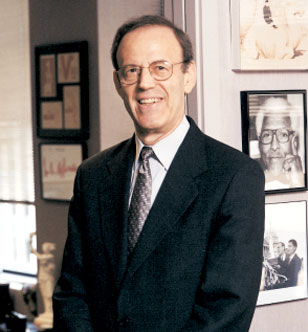
Carl Gershman, president of the NED
It is a technique that I’ve seen used in other circumstances, such as the lists of “mysterious deaths” that American right-wingers publish citing people who crossed the paths of Bill and Hillary Clinton and ended up dead. This type of smear spreads suspicion of guilt not based on proof but on the number of acquaintances and adversaries who have met untimely deaths.
In the 1990s, one conservative friend of mine pointed to the Clintons’ “mysterious deaths” list and marveled that even if only a few were the victims of a Clinton death squad that would be quite a story, to which I replied that if even one were murdered by the Clintons that would be quite a story – but that there was no proof of any such thing.
“Mysterious deaths” lists represent a type of creepy conspiracy theory that shifts the evidentiary burden onto the targets of the smears who must somehow prove their innocence, when there is no evidence of their guilt (only vague suspicions). It is contemptible when applied to American leaders and it is contemptible when applied to Russian leaders, but it is not beneath Carl Gershman.
Beyond that, Gershman’s public musing about the U.S. somehow summoning “the will” to remove Putin might — in a normal world — disqualify NED and its founding president from the privilege of dispensing U.S. taxpayers’ money to operatives in Washington and globally. It is extraordinarily provocative and dangerous, an example of classic neocon hubris.
While the neocons do love their tough talk, they are not known for thinking through their “regime change” schemes. The idea of destabilizing nuclear-armed Russia with the goal of ousting Putin, with his 82 percent approval ratings, must rank as the nuttiest and most reckless neocon scheme of all.
Gershman and his neocon pals may fantasize about making Russia’s economy scream while financing pro-Western “liberals” who would stage disruptive protests in Red Square, but he and his friends haven’t weighed the consequences even if they could succeed.
Given the devastating experience that most Russians had when NED’s beloved Russian “liberals” helped impose American “shock therapy” in the 1990s — an experiment that reduced average life expectancy by a full decade — it’s hard to believe that the Russian people would simply take another dose of that bitter medicine sitting down.
Even if the calculating Putin were somehow removed amid economic desperation, he is far more likely to be followed by a much harder-line Russian nationalist who might well see Moscow’s arsenal of nuclear weapons as the only way to protect Mother Russia’s honor. In other words, the neocons’ latest brash “regime change” scheme might be their last – and the last for all humanity.
A Neocon Slush Fund
Gershman’s arrogance also raises questions about why the American taxpayer should tolerate what amounts to a $100 million neocon slush fund which is used to create dangerous mischief around the world. Despite having “democracy” in its name, NED appears only to favor democratic outcomes when they fit with Official Washington’s desires.

CIA Director William Casey
If a disliked candidate wins an election, NED acts as if that is prima facie evidence that the system is undemocratic and must be replaced with a process that ensures the selection of candidates who will do what the U.S. government tells them to do. Put differently, NED’s name is itself a fraud.
But that shouldn’t come as a surprise since NED was created in 1983 at the urging of Ronald Reagan’s CIA Director William J. Casey, who wanted to off-load some of the CIA’s traditional work ensuring that foreign elections turned out in ways acceptable to Washington, and when they didn’t – as in Iran under Mossadegh, in Guatemala under Arbenz or in Chile under Allende – the CIA’s job was to undermine and remove the offending electoral winner.
In 1983, Casey and the CIA’s top propagandist, Walter Raymond Jr., who had been moved to Reagan’s National Security Council staff, wanted to create a funding mechanism to support outside groups, such as Freedom House and other NGOs, so they could engage in propaganda and political action that the CIA had historically organized and paid for covertly. The idea emerged for a congressionally funded entity that would serve as a conduit for this money.
In one undated letter to then-White House counselor Edwin Meese III, Casey urged creation of a “National Endowment,” but he recognized the need to hide the strings being pulled by the CIA. “Obviously we here [at CIA] should not get out front in the development of such an organization, nor should we appear to be a sponsor or advocate,” Casey wrote.
The National Endowment for Democracy took shape in late 1983 as Congress decided to also set aside pots of money — within NED — for the Republican and Democratic parties and for organized labor, creating enough bipartisan largesse that passage was assured.
But some in Congress thought it was important to wall the NED off from any association with the CIA, so a provision was included to bar the participation of any current or former CIA official, according to one congressional aide who helped write the legislation.
This aide told me that one night late in the 1983 session, as the bill was about to go to the House floor, the CIA’s congressional liaison came pounding at the door to the office of Rep. Dante Fascell, a senior Democrat on the House Foreign Affairs Committee and a chief sponsor of the bill.
The frantic CIA official conveyed a single message from CIA Director Casey: the language barring the participation of CIA personnel must be struck from the bill, the aide recalled, noting that Fascell consented to the demand, not fully recognizing its significance – that it would permit the continued behind-the-scenes involvement of Raymond and Casey.
The aide said Fascell also consented to the Reagan administration’s choice of Carl Gershman to head NED, again not recognizing how this decision would affect the future of the new entity and American foreign policy.
Gershman, who had followed the classic neoconservative path from youthful socialism to fierce anticommunism, became NED’s first (and, to this day, only) president. Though NED is technically independent of U.S. foreign policy, Gershman in the early years coordinated decisions on grants with Raymond at the NSC.
For instance, on Jan. 2, 1985, Raymond wrote to two NSC Asian experts that “Carl Gershman has called concerning a possible grant to the Chinese Alliance for Democracy (CAD). I am concerned about the political dimension to this request. We should not find ourselves in a position where we have to respond to pressure, but this request poses a real problem to Carl.
“Senator [Orrin] Hatch, as you know, is a member of the board. Secondly, NED has already given a major grant for a related Chinese program.”
Neocon Tag Teams
From the start, NED became a major benefactor for Freedom House, beginning with a $200,000 grant in 1984 to build “a network of democratic opinion-makers.” In NED’s first four years, from 1984 and 1988, it lavished $2.6 million on Freedom House, accounting for more than one-third of its total income, according to a study by the liberal Council on Hemispheric Affairs that was entitled “Freedom House: Portrait of a Pass-Through.”
Over the ensuing three decades, Freedom House has become almost an NED subsidiary, often joining NED in holding policy conferences and issuing position papers, both organizations pushing primarily a neoconservative agenda, challenging countries deemed insufficiently “free,” including Syria, Ukraine (in 2014) and Russia.
Indeed, NED and Freedom House often work as a kind of tag-team with NED financing “non-governmental organizations” inside targeted countries and Freedom House berating those governments if they crack down on U.S.-funded NGOs.
For instance, on Nov. 16, 2012, NED and Freedom House joined together to denounce legislation passed by the Russian parliament that required recipients of foreign political money to register with the government.
Or, as NED and Freedom House framed the issue: the Russian Duma sought to “restrict human rights and the activities of civil society organizations and their ability to receive support from abroad. Changes to Russia’s NGO legislation will soon require civil society organizations receiving foreign funds to choose between registering as ‘foreign agents’ or facing significant financial penalties and potential criminal charges.”
Of course, the United States has a nearly identical Foreign Agent Registration Act that likewise requires entities that receive foreign funding and seek to influence U.S. government policy to register with the Justice Department or face possible fines or imprisonment.
But the Russian law would impede NED’s efforts to destabilize the Russian government through funding of political activists, journalists and civic organizations, so it was denounced as an infringement of human rights and helped justify Freedom House’s rating of Russia as “not free.”
Another bash-Putin tag team has been The Washington Post’s editors and NED’s Gershman. On July 28, 2015, a Post editorial and a companion column by Gershman led readers to believe that Putin was paranoid and “power mad” in worrying that outside money funneled into NGOs threatened Russian sovereignty.
The Post and Gershman were especially outraged that the Russians had enacted the law requiring NGOs financed from abroad and seeking to influence Russian policies to register as “foreign agents” and that one of the first funding operations to fall prey to these tightened rules was Gershman’s NED.
The Post’s editors wrote that Putin’s “latest move … is to declare the NED an ‘undesirable’ organization under the terms of a law that Mr. Putin signed in May [2015]. The law bans groups from abroad who are deemed a ‘threat to the foundations of the constitutional system of the Russian Federation, its defense capabilities and its national security.’
“The charge against the NED is patently ridiculous. The NED’s grantees in Russia last year ran the gamut of civil society. They advocated transparency in public affairs, fought corruption and promoted human rights, freedom of information and freedom of association, among other things. All these activities make for a healthy democracy but are seen as threatening from the Kremlin’s ramparts.
“The new law on ‘undesirables’ comes in addition to one signed in 2012 that gave authorities the power to declare organizations ‘foreign agents’ if they engaged in any kind of politics and receive money from abroad. The designation, from the Stalin era, implies espionage.”
However, among the relevant points that the Post’s editors wouldn’t tell their readers was the fact that Russia’s Foreign Agent Registration Act was modeled after the American Foreign Agent Registration Act and that NED President Gershman had already publicly made clear — in his Sept. 26, 2013 column — that his goal was to oust Russia’s elected president.
In his July 28, 2015 column, Gershman further deemed Putin’s government illegitimate. “Russia’s newest anti-NGO law, under which the National Endowment for Democracy … was declared an “undesirable organization” prohibited from operating in Russia, is the latest evidence that the regime of President Vladimir Putin faces a worsening crisis of political legitimacy,” Gershman wrote, adding:
“This is the context in which Russia has passed the law prohibiting Russian democrats from getting any international assistance to promote freedom of expression, the rule of law and a democratic political system. Significantly, democrats have not backed down. They have not been deterred by the criminal penalties contained in the ‘foreign agents’ law and other repressive laws. They know that these laws contradict international law, which allows for such aid, and that the laws are meant to block a better future for Russia.”
The reference to how a “foreign agents” registration law conflicts with international law might have been a good place for Gershman to explain why what is good for the goose in the United States isn’t good for the gander in Russia. But hypocrisy is a hard thing to rationalize and would have undermined the propagandistic impact of the column.
Also undercutting the column’s impact would be an acknowledgement of where NED’s money comes from. So Gershman left that out, too. After all, how many governments would allow a hostile foreign power to sponsor politicians and civic organizations whose mission is to undermine and overthrow the existing government and put in someone who would be compliant to that foreign power?
And, if you had any doubts about what Gershman’s intent was regarding Russia, he dispelled them in his Friday column in which he calls on the United States to “summon the will” to “contain and defeat this danger,” which he makes clear is the continued rule of Vladimir Putin.
Featured Video
America Racing to Strategic Defeat in Iran
or go to
Aletho News Archives – Video-Images
From the Archives
An Expert Military Analysis of War with China
Actually, None is Necessary
By Fred Reed • Unz Review • December 13, 2020
The Correlation of Armed Forces: U.S. goods and services trade with China totaled an estimated $634.8 billion in 2019. Exports were $163.0 billion; imports were $471.8 billion. The U.S. goods and services trade deficit with China was $308.8 billion in 2019. Trade in services with China (exports and imports) totaled an estimated $76.7 billion in 2019. Services exports were $56.5 billion; services imports were $20.1 billion. The U.S. services trade surplus with China was $36.4 billion in 2019.
There is talk within the Washingtoniat of a possible war with China. Steve Bannon, who apparently was dropped on his head as a child, actually favors such a war. We hear the usual shoo-the-boobs alarm about how the Chinese are doing something terrible and we must gird our loins and American values and show them what for, bow wow, woof. The danger is that the current game of who-blinks-first in Asian waters might actually provoke a shooting war. You know the kind of thing: One warship refuses to get out of the way of another, a collision ensues, some retard lieutenant who signed up on waivers opens fire, and we’re off and running. It is not a good idea to let children play with matches.
The said war is discussed either in emotional terms by idiots or in purely naval terms by those familiar with such things, so we hear of the First Island Chain and the Second Island Chain and whose missiles against the other’s missiles and so on. This would be appropriate if we were fighting World War Two again. Which we aren’t. Let’s take a quick-and-dirty look at how such a war might go.
To begin the war, America would overestimate itself and underestimate China. This is doctrine in the Pentagon. … continue
Blog Roll
 Aletho News
- Rethinking America’s greatest threat: Iran vs. Israel-Firsters
- Iran accuses adversaries of false flags to strain Turkey ties
- Poland rules out sending Patriot missiles to US/Israel amid war on Iran
- Tehran approves new Hormuz plan with major restrictions
- No Threat Can Force Iran’s Surrender /Trita Parsi & Lt Cl Daniel Davis
- UK’s New Pandemic Plan Would Turn Big Tech Into a Mass Location Tracking Network
- Growing insecurity, soaring prices fuel protests in north as regime bans evacuation: Sources
- Iran denies responsibility for ‘depraved’ attack on Kuwait desalination plant
- Bring The Troops Back. End This War Now!
- Can we please stop calling Israel the ‘only democracy in the Middle East’ now?
- If Americans Knew
- The Line Between Affinity and Conspiracy
- As Iran targets US military bases, will they be relocated to Israel? Not a ceasefire Day 171
- Will Trump Go Kamikaze?
- Is the University of Florida Shutting Down College Republicans over Israel Criticism?
- Jewish extremist arrested over alleged plot to firebomb Palestinian activist Nerdeen Kiswani’s home
- More than half of Palestinian child detainees have no charges
- The More Murderous Israel Gets, The More We Hear About “Antisemitism”
- Land Day and the Palestinian struggle after 30 months of genocide
- The Iran War Is About Palestine
- Israeli soldiers echo settler ideology, talk of revenge after targeting Palestinians and detaining CNN crew in the West Bank
- No Tricks Zone
- New Study Finds Warming Saves Lives…Cold Temperatures 12 Times More Deadly Than Excess Heat
- German Science Blog Accuses PIK Climate Institute Of Hallucinating Climate Tipping Points
- Devastating Assessment Of Comirnaty Vaccine By Former Senior Pfizer Europe Toxicologist
- New Study: CO2 Is ‘Effectively Negligible’ As An Explanatory Climate Change Factor Since 2000
- Former Pfizer Toxicologist Dr. Helmut Sterz Tells Bundestag Hearing Pfizer Vaccine Should Have Never Been Approved
- Energy Expert: Germany’s Nuclear Phaseout Was A “500 Billion Euro Mistake”
- New Research: South Australia’s Mid-Holocene Sea Surface Temperatures Were 4°C Warmer Than Today
- Storing Green Energy To Last Germany 10 Days Would Require A 60-Million Tonne Battery
- New Studies: UK Sea Levels Were 4 Meters Higher Than Today During The Mid-Holocene
- Destructive Green New Deal: German Energy And Metal Group Warns Of Drastic Crisis
 Aletho News