Yemen between two wars: A fragile truce and the shadow of a regional escalation
By Mawadda Iskandar | The Cradle | November 4, 2025
Since mid-October, Yemen has returned to the forefront of the regional scene. Political and military activity has intensified across several governorates, exposing the limits of the current ceasefire. From Sanaa’s view, the phase of “no war and no peace” cannot continue.
Any attack, it warns, will be met with a direct response. Deterrence, it insists, is now part of its core strategy.
Saudi Arabia, meanwhile, is trying to juggle two tracks – military pressure and renewed dialogue through Omani mediation. Riyadh wants to keep its weight on the ground while testing the possibility of a broader settlement.
The US and Israel have again inserted themselves into the mix, each working to block a negotiated outcome that might strengthen the Sanaa government. Washington has revived coordination channels with the coalition, while Tel Aviv watches the Red Sea front and pushes for the containment of Ansarallah-aligned armed forces. Yemen has once more become an overlapping arena of peace talks, foreign manoeuvring, and military threats.
Negotiations under fire
Oman has returned as the main regional mediator, moving to calm tensions after both Sanaa and Riyadh accused each other of violating the 2024 economic truce – the backbone of the UN “road map.” On 28 October, Muscat announced new diplomatic efforts to prevent a wider clash and reopen a political track.
But the situation on the ground shows little restraint. In Saada governorate alone, monitors recorded 947 violations this year, leaving 153 dead and nearly 900 injured. On 29 October, Saudi artillery shelled border villages in Razeh.
Sanaa affirmed that the “reciprocal equation” remains in place, staging a large military parade near Najran to display readiness. Riyadh, in turn, tested civil-defence sirens in its major cities – a move mocked by Ansarallah figure Hizam al-Assad, who said no siren would protect Saudi cities while the aggression and siege continue.
Speaking to The Cradle, Adel al-Hassani, head of the Peace Forum, points out that the crisis is worsening due to the deterioration of the economic situation and sanctions, which have affected more than 25 million Yemenis, while Oman is intervening as a mediator for the de-escalation.
According to Hasani, the roadmap includes two phases: the first is humanitarian, including the lifting of the blockade, the payment of salaries, and the resumption of oil exports; the second is political – to form a unity or coalition government that would coincide with a declared coalition withdrawal. Only that, he says, could stabilize the situation.
Washington and Tel Aviv’s new strategy
After Operation Al-Aqsa Flood and the ensuing war on Gaza, the US-Israeli approach to Yemen has shifted toward hybrid operations – mobilizing local partners, information warfare, and targeted strikes rather than any open intervention.
Sanaa’s recent warning about hitting Saudi oil sites came after detecting moves to create a US-Israeli front against Ansarallah. Israeli Prime Minister Benjamin Netanyahu called the resistance movement “a very big threat,” and Defense Minister Israel Katz threatened airstrikes on Sanaa itself.
The idea is to keep Saudi Arabia under pressure while allowing Israel to act indirectly. Israeli Finance Minister Bezalel Smotrich said the “Yemeni threat” is unresolved and urged Arab allies to take part in containing it.
Western think tanks have echoed this, urging Washington to rebuild Riyadh’s military role after the failure of the Red Sea naval alliance. The head of Eilat Port, Gideon Golber, admitted that maritime trade has been badly hit, adding that “We need a victory image by restarting the port.” A US Naval Institute report also noted that despite spending over $1 billion on air defense and joint operations, control over the corridor remains weak.
Between November 2023 and September 2025, Yemeni forces carried out more than 750 operations in the Red Sea, Gulf of Aden, and Indian Ocean – part of what Sanaa calls a defensive response. Head of the Supreme Political Council, Mahdi al-Mashat, urged Saudi Arabia to “move from the stage of de-escalation to ending aggression, siege, and occupation and implementing the clear entitlements of peace.”
He further accused Washington of using regional tensions to serve Israel. National Council member Hamid Assem added that an earlier de-escalation deal, signed a year and a half ago in Sanaa, was dropped by Riyadh under US direction after Operation Al-Aqsa Flood.
A source close to Sanaa tells The Cradle:
“The movement’s leadership is firmly convinced that the responsibility for these tools cannot be separated from those who created, armed, and trained them since 2015. Therefore, Sanaa affirms that any movement of these tools in Marib, the west coast, or the south of the country will not remain isolated, and will carry with it direct consequences that will affect the parties that supported and supervised the preparation of these groups.”
The source adds that:
“America has long experience with Yemen and may be inclined to avoid direct ground intervention, as its priorities appear to be focused on protecting Israel by striking Ansarallah’s missile and naval capability without extensive land friction. Therefore, it has begun to implement a plan that adopts hybrid warfare: intensifying media pumping, distortion, information operations, and psychological warfare, in addition to logistical and coordination preparations to move internal fronts through local pro-coalition tools.”
This hybrid strategy may coincide with Israeli military and media steps, the source points out, through threats and statements by officials in Tel Aviv, so that the desired goal becomes to “blow up the scene from within” and weaken Sanaa through internal chaos that paves the way for pressing options or strikes targeting its arsenal without direct American ground intervention.
US and UAE movements in the south
Throughout October, the US, Saudi Arabia, and the UAE expanded their presence in the south, west coast, and Al-Mahra to reorganize coalition factions and tighten control. US and Emirati officers arrived in Lahj Governorate, supervising the restructuring of Southern Transitional Council (STC) units from Al-Kibsi Camp in Al-Raha to Al-Mallah district. Security around these areas was reinforced with barriers and fortifications.
In Shabwa and Hadhramaut, joint committees of American and Emirati officers inspected Ataq Airport and nearby camps, counting recruits, running medical checks, reviewing weapons stock, and mapping command chains. Sources say Latin American contractors and private military firms assisted, ensuring resources stayed under external supervision.
In Taiz, another committee visited Jabal al-Nar to evaluate the Giants Brigades, their numbers, and armaments. On the west coast – from Bab al-Mandab to Zuqar Island – construction work is ongoing: terraces, fortifications, and outposts operated by “joint forces” hostile to Sanaa, including Tariq Saleh’s formations. Coordination reportedly extended to naval meetings aboard the Italian destroyer ‘ITS Caio Duilio’ to secure sea routes and “protect Israeli interests” in the Red Sea.
Hasani, who follows these movements, informs The Cradle that “These committees are evaluation and supervisory, not training, and are directly supervised by the US to ensure the readiness of the forces and perhaps as a signal to pressure Sanaa.”
He adds that British teams have appeared in Al-Mahra, while groups trained on Socotra Island are being redeployed to Sudan and Libya under UAE management.
Saudi-aligned Salafi units known as “Homeland Shield” now operate from Al-Mahra to Abyan and Hadhramaut. “These forces are today a pillar of the coalition to reduce the ability of Ansarallah, taking advantage of its religious beliefs, as part of the coalition’s tendency to turn the conflict into a sectarian war,” Hasani explains.
In Al-Mahra, local discontent is growing. Ali Mubarak Mohamed, spokesman for the Peaceful Sit-in Committee, tells The Cradle that Al-Ghaydah Airport remains closed after being converted into a joint US-British base.
“The committee continues to escalate peacefully through field trips and meetings with sheikhs to raise awareness of the community about the danger of militias,” he says, noting that the US presence has been ongoing since the coalition was established, though the exact nature of its presence is unknown.
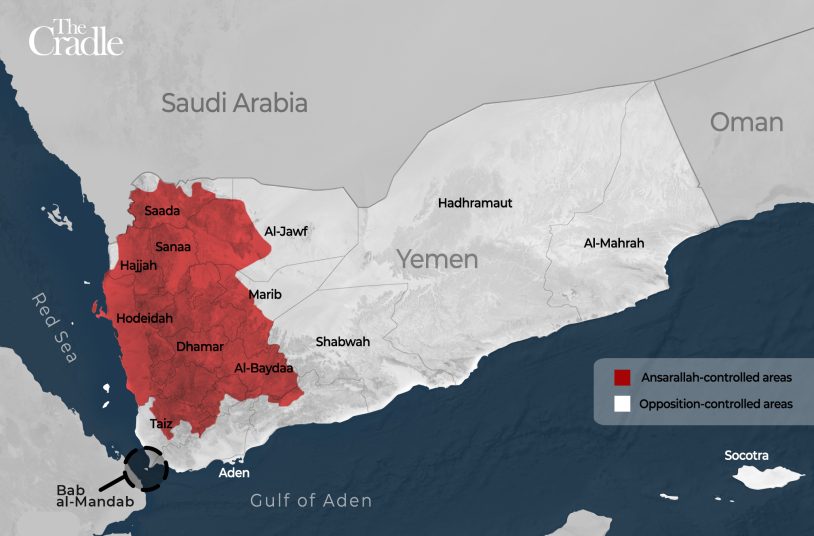
A map showing the distribution of control in Yemen
Where is Yemen heading?
These field movements are taking place as Washington and Abu Dhabi coordinate more closely with Tel Aviv. After meetings in October between the US CENTCOM commander and the Israeli chief of staff, a new plan began to take shape: build a joint ground network across southern Yemen to contain Sanaa and safeguard the Bab al-Mandab Strait – one of the world’s most critical shipping lanes.
At the same time, the US State Department appointed its ambassador to Aden’s Saudi-backed government, Steven Fagin, to lead a “Civil-Military Coordination Center” (CMCC) linked to ceasefire efforts in Gaza. Regional observers see this as a move to integrate the Palestinian and Yemeni fronts into one framework of US security control stretching from the Mediterranean to the Arabian Sea.
Reports circulating in Shabwa and Al-Rayyan say Emirati officers have been dispatched to Gaza to help organize local brigades – a claim still unconfirmed but consistent with the UAE’s wider operational pattern. Investigations by Sky News Arabia noted similarities in the slogans and structure of UAE-backed militias in Yemen and armed factions in Gaza, hinting at shared logistics and training links.
Adnan Bawazir, head of the Southern National Salvation Council in Hadhramaut, tells The Cradle that the scenario of recruiting mercenaries to fight in Gaza is not proven, but is possible – especially with the assignment of the interim administration in Gaza by Fagin, linking local moves to broader regional plans.
In Hadhramaut, Fagin’s visits to Seiyun, which includes the First Military Region, indicate preparations for a possible confrontation, especially since the area is still under the Saudi-backed Islah’s control in the face of the STC conflict, while Riyadh seeks to reduce Islah’s influence by transferring brigades and changing leadership.
Bawazir also points to suspicious movements in Shabwa and at Ataq airport, where field reports indicate flights transporting weapons to strengthen the front, given the governorate’s proximity to Marib and the contact fronts with Ansarallah, which makes it a hinge point for any regional or local escalation.
The moves are therefore part of three interrelated scenarios.
First, shifting pressure from Gaza to Yemen to compensate for the political and moral losses of Tel Aviv and Washington, while using the pro-coalition factions as a pressure arena against Sanaa. Second, preparing for possible military action in the event of the failure of the negotiations. Third, reorganizing the pro-coalition factions and building a central command that can be directed by Washington, thus turning the brigades into executive tools, ready to escalate the situation internally with a sectarian character.
Each scenario positions Yemen once again as a test field for foreign ambitions. The country remains divided between two trajectories: the possibility of a political settlement through Oman’s diplomacy, and the risk of a new conflict fed by regional competition and foreign control over its coasts and resources.
Whether the coming months bring a deal or another war will depend less on what Yemenis want and more on how their neighbors choose to use their soil.
The UAE’s War on Muslims: From Sudan to the Gaza Genocide
By Robert Inlakesh | The Palestine Chronicle | October 30, 2025
While the United Arab Emirates advertises itself as both a peacemaker and opponent of so-called “Islamic radicalism”, it is currently involved in genocide in both Gaza and Sudan. Connecting these dots is key to understanding the overarching goals of the regime.
The United Arab Emirates has created its image in the world as an innovator, a builder, and a peacemaker, a carefully calibrated illusion as artificial as the buildings that mesmerize onlookers in Dubai. But behind the architecture and lavish outer shell is a rotten core that continues to aid in the erosion of the surrounding region.
While claiming to oppose “radical Islam” and paying talentless influencers to attack groups like the Muslim Brotherhood, they foster extremist ideologies and back ISIS-linked militant groups to carry out their regional ambitions.
For all of the critiques that can be offered of groups like the Muslim Brotherhood and of Qatar, they are nothing like the orientalist depictions of them that are spread far and wide through Emirati propaganda.
The reason why the UAE attacks the ideology belonging to groups that are either linked to or part of the Muslim Brotherhood has nothing to do with their religious motivations and everything to do with the Emirati opposition to their political agenda.
For them, they fear any politically engaged Islamic movement that is capable of successfully leading a country and organizing democratic institutions, because they are a dictatorship fully beholden to their Western handlers, including Israel.
The reason why the Islamic element of such movements threatens them the most is that it is popular and the religion that the majority of the region adheres to in some shape or form.
If any Islamic anti-imperialist movement proves successful and leads a democratic process, then this could threaten their rule. So, they seek to undermine, infiltrate, and destroy these movements wherever they rear their heads, including inside the Gaza Strip.
Hamas, or the Islamic Resistance Movement, was an outgrowth of the Egyptian Muslim Brotherhood. Its origins begin in the 1970s and the formation of the social/civil-society movement known as the Mujamma al-Islamiyya in the Gaza Strip, at the time colloquially referred to as the Muslim Brotherhood, as it represented Palestine’s wing of the movement.
Therefore, the success and popularity of Hamas, as part of what is viewed by the Emiratis as a wider body of Islamic political movements, is interpreted as a threat to its rule in the region.
As a means of dismantling the prospects of Democratic oriented Islamic political leaderships, the UAE has engaged in military confrontations and intense propaganda campaigns. On the propaganda front, they are joined by other Gulf leaderships who have their own agendas, also and not only fund direct anti-Hamas or anti-Muslim Brotherhood propaganda, but also fuel religious division.
One of the most powerful means of divisive propaganda is directly targeting Muslims themselves, in particular the Sunni Muslim majority of the region. While they certainly push sectarian rhetoric against the Shia too, they seek to pacify the Sunni population, deter them from engaging in anti-imperialist and anti-occupation struggles, or redirect their anger at fellow Muslims.
They do this through pushing divisions between mainstream Sunni schools of thought and employing their Madkhali propagandists to deter action against the so-called Muslim rulers. Without going too deep into the Madkhalis, as with each group of Muslims, there is always nuance; they are a group of Salafist Muslims who adhere to the dictates of their rulers and sometimes will even justify actions taken by those rulers that are prohibited in Islam.
The primary goal here is to fund and fuel division across the Muslim world, channeling hatred and creating debates around any issue that can distract from what Israel, the United States, and their allies are doing to the region. Another major tactic employed here is to Takfir (declare a disbeliever) or undermine any Muslim group that sides with the likes of Iran, Hezbollah, Ansarallah, or any other Shia groups.
Again, none of this opposition has anything to do with any substance that may be behind said arguments they make; these are well-funded propaganda campaigns designed for political purposes to undermine resistance to imperialism, occupation, and genocide. This is where we can begin looking at Gaza and then Sudan.
The UAE professes to oppose so-called “Islamic radicalism”, yet it now stands accused of providing support to the ISIS-linked gangs operating in the Israeli-occupied portion of the Gaza Strip. Not only has the UAE been accused of directly coordinating with these militia groups – composed of hardline Salafists who have links to ISIS and al-Qaeda, drug traffickers and murderers – but there is even evidence of these death squad members driving around in vehicles with registered UAE license plates.
In opposition to Hamas, the UAE is more than happy to back Israeli proxy collaborator groups that contain ISIS and Al-Qaeda minded elements within them.
Going back to the sorts of divisive propaganda that is encouraged by the Emiratis, a leading member of the Israel-backed so-called “Popular Forces” militia in Gaza, Ghassan Duhine, has openly cited ISIS Fatwas declaring Hamas apostates as a justification for killing them. ISIS officially declared war on Hamas back in 2018.
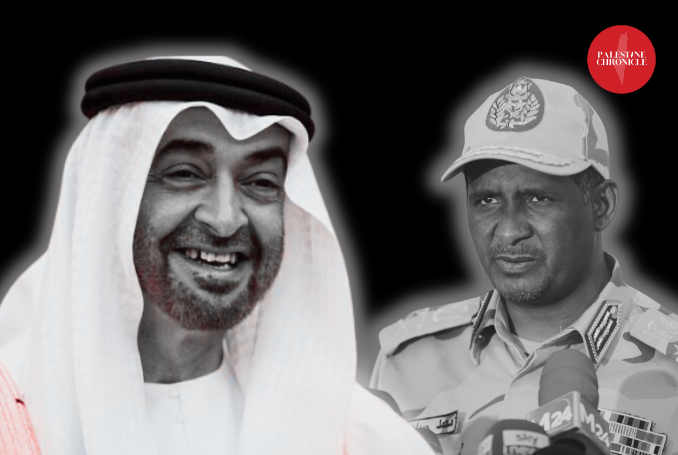
Meanwhile, the UAE has long been backing the Rapid Support Forces (RSF) in Sudan, the group currently accused of committing genocide, and which has re-entered the headlines after it captured Al-Fasher and other areas in North Darfur, resulting in the murder of around 527 people, including civilians who were butchered while sheltering in refugee camps.
RSF leader, Mohamed Hamdan Dagalo (Hemedti), has long collaborated with the Emiratis, and it was even previously pointed out that his official Facebook page was controlled out of the UAE.
Without getting into all of the complexities of the Sudanese civil war, Hemedti is a warlord who has long maintained power over the majority of Sudan’s Gold Mines, slaughtering anyone who dares to get in his way.
His forces have also been accused by the UN and prominent rights groups of committing widespread mass sexual violence, including horrific forms of rape.
Hemedti was additionally supplied with battle-changing technologies through his Israeli Mossad contacts, and despite there being documented rights violations on both the Sudanese Army and RSF sides of the war, there is no doubt that Hemedti’s forces have the most blood on their hands and carry out the most horrific crimes seen in the conflict.
The UAE is not just one of many actors involved in Sudan; it is the primary supporter of the RSF. According to a scoop published by The Guardian this Tuesday, British weapons sold to the United Arab Emirates were even discovered to have been used by the RSF to carry out its genocide.
Despite the United States declaring the horrors in Sudan as a genocide, during the Biden administration, no action has been taken against the UAE for its role in fueling the war. Similarly, the UAE has been involved in countless crimes committed throughout the Horn of Africa and in North Africa too, backing a whole range of extremist militant groups who stand accused of indiscriminately targeting civilians.
Although it is also hidden from the Western corporate media, the UAE even used members of the Sudanese RSF to fight on its behalf as proxy forces against Ansarallah in Yemen, where they were accused of playing a role in what many declared a genocide. Keep in mind that nearly 400,000 people in Yemen were killed due to the inhuman blockade and war of aggression, led by both the UAE and Saudi Arabia.
The Emiratis push propaganda about the Sudanese Military being “Islamists”, accusing them of being part of the Muslim Brotherhood and then linking them to all sorts of other organizations. Ansarallah in Yemen is also branded as “Islamists”, but in their case are accused of being “Iranian proxies”. In essence, this line of propaganda is the typical Israeli-style Hasbara argument for committing egregious war crimes.
Throughout the Gaza genocide, the UAE was one of the only nations that continued its routine flights to Ben Gurion airport and transported materials to aid the Israelis. The Emiratis also turned Dubai into an Israeli safe haven, where soldiers implicated in genocide can go to party, engage in activities like consuming narcotics or hiring escorts, and live in luxury.
The UAE did not lift a finger to force the Israelis to let aid into Gaza, as they blocked all humanitarian aid trucks entering for around three months earlier this year, but will then point to the trickles of aid that they do supply as proof they are helping the people. In their defense, they argue that they were key in achieving a ceasefire, for which there is no evidence, just like there was no evidence that they stopped West Bank annexation when normalized ties with Israel.
Viewing the Emiratis as operating on their own whims, blaming them solely for the actions they commit, is incorrect. These are rulers installed by the West, who work for the West and are simply used as pawns to do the bidding of their masters. If any of their leaders stand up to the crimes that the UAE is inflicting, they will be assassinated and replaced with other members of the ruling bloodline who choose to play ball. They are hostages, posing as rulers and playing their part in the dismantlement of the surrounding region.
US sent $21.7 billion to Israel to back Gaza genocide: Study
Press TV – October 7, 2025
An academic study has revealed that the United States has funneled $21.7 billion in financial and military assistance to Israel since the onset of the Gaza genocide on October 7, 2023.
The report released on Tuesday by the Costs of War Project at Brown University’s Watson Institute for International and Public Affairs details how the US State Department and the newly renamed Department of War, under both Joe Biden and Donald Trump administrations, have collectively transferred at least $21.7 billion to support Israel’s genocide in Gaza.
According to the study, the United States supplied $17.9 billion to Israel in the first year of the genocide, during former US president Joe Biden’s tenure, and $3.8 billion in the second year.
A large portion of the assistance has already been delivered, while the remainder will be distributed in the coming years, the report added.
The study notes that Washington is expected to allocate tens of billions of dollars in future funding to Israel through various bilateral deals.
Another analysis, also published by the Costs of War Project, states that the United States has spent approximately $9.65 – $12.07 billion on military operations in West Asia over the past two years.
US spending in the region, such as strikes on Yemen in March and May 2025 and attacks on Iranian nuclear sites on June 22, estimates total costs between $9.65 billion and $12 billion since October 7, 2023, including $2 billion to $2.25 billion for operations against Iran.
Although both reports rely on open-source data, they present detailed assessments of US military support for Israel and estimates of the cost of direct American involvement in the region.
Meanwhile, the State Department has not commented on the amount of military assistance given to Israel since October 2023. The White House referred inquiries to the Pentagon, which oversees only a part of the aid that is given to the Zionist entity.
The studies argue that without US backing, the regime would have been unable to maintain its genocidal campaign in Gaza for two years.
The principal study was produced in collaboration with the Washington-based Quincy Institute for Responsible Statecraft.
Pro-Israel groups have accused the institute of isolationism and anti-Israel bias, allegations the organization firmly denies.
Meanwhile, Israel’s war machine continues its campaign of destruction, claiming countless civilian lives across Gaza and the wider region.
Since October 7, 2023, when Israel launched its genocidal war on the besieged Gaza Strip, more than 76,000 Palestinians, including over 20,000 children and 12,500 women, have been killed or gone missing, while in its 12-day war with Iran last June, the regime killed at least 1,604 people.
Israeli Strikes on Media Offices Kill At Least 25 Journalists in Yemen
By Kyle Anzalone | The Libertarian Institute | September 12, 2025
An Israeli attack on Yemen hit the offices of two newspapers in Sanaa, killing dozens of journalists and civilians. The Yemeni Journalists Union condemned the attack, labeling it a heinous war crime.
According to the Yemeni Health Ministry, the Israeli strikes hit the offices of the 26 September newspaper and Al-Yemen newspaper, killing at least 25 journalists. 26 September is the military’s media outlet, and Al-Yemen is one of the most read newspapers in Yemen.
The Yemeni Journalists Union said it “strongly condemns the heinous war crime committed by the brutal Israeli aggression on Wednesday, 10 September 2025, through its direct targeting of the offices of 26 September newspaper and Al-Yemen newspaper in the capital.”
Yemeni authorities report that at least 46 people were killed in strikes across Sanaa. A military facility and a fuel station were targeted along with media offices. The death toll is expected to rise as rescue and recovery efforts are ongoing. More than 165 people were injured.
The majority of those killed, 38, died in the strikes on Sanaa, which targeted residential areas.
The latest Israeli strikes in Yemen are part of the ongoing conflict between Tel Aviv and Ansar Allah. Ansar Allah, or the Houthis, control most of Yemen, including the capital city. After Israel began its onslaught and siege of Gaza, Ansar Allah placed a blockade of Israeli-linked shipping in the Red Sea.
In response to the blockade, Israel and the US have repeatedly bombed Yemen, killing a large number of civilians. The strikes have failed to break the blockade, and Ansah Allah has responded by direct attacks on Israel with missiles and drones.
The blockade has caused significant Financial losses to Israel’s Red Sea port. In July, the head of the Port of Eilat warned that the facility may have to shut down without additional financial assistance from Tel Aviv.
Yemeni leaders opposed to Ansar Allah warned US Senators that the strikes in Yemen have only empowered the Houthis. The warning was sent following an Israeli attack that killed political leaders, including the prime minister.
Assassination of Yemeni Ministers: How the Media Normalizes Israel’s Crimes
Israel carried out the unprecedented act of assassinating the head of the Sanaa government and 11 of his ministers to punish Yemen for its unwavering solidarity with Gaza, making it one of the few countries in the world to take seriously the obligation to prevent the crime of genocide. The media, complacent or even complicit, never deem it necessary to point out that targeting a civilian administration constitutes a blatant war crime. This silence only encourages Israel to push ever further the limits of its monstrosity.
By Alain Marshal | September 6, 2025
On August 28, a massive Israeli strike on Sanaa, the Yemeni capital, targeted a council of ministers of the de facto authority in Yemen, assassinating Prime Minister Ahmed Ghaleb Nasser al-Rahawi and 11 members of his government: Secretary of the Council of Ministers Zahid Mohammed Al-Amdi, the Prime Minister’s Chief of Staff Mohammed Qasim Al-Kabsi, as well as the Ministers of Foreign Affairs (Jamal Ahmed Ali Amer), Economy (Moeen Hashim Ahmed al-Mahaqri), Justice (Ahmed Abdullah Ali), Energy (Dr. Ali Saif Mohammed Hassan), Information (Hashim Ahmed Abdulrahman Sharaf Al-Din), Agriculture (Dr. Radwan Ali Ali Al-Rubai’i), Social Affairs and Labor (Samir Mohammed Ahmed Baja’ala), Tourism and Culture (Dr. Ali Qasim Hussein Al-Yafei), and Youth and Sports (Dr. Mohammed Ali Ahmed Al-Mawlid).
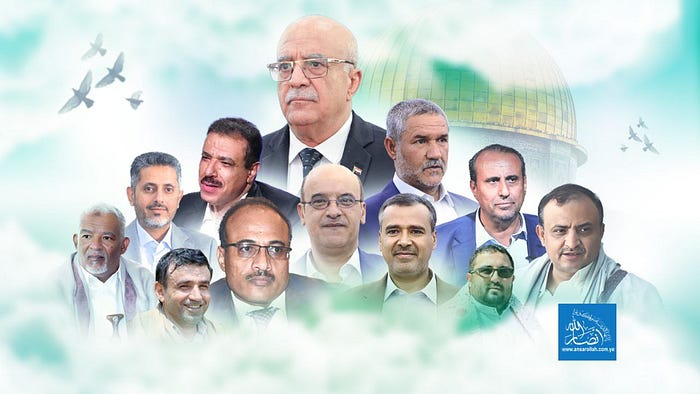
Yemen’s Martyrs
Israel, which has been perpetrating an openly acknowledged genocide in Gaza and the West Bank — broadcast live for nearly two years — and which has attacked no fewer than five other countries during this period (Lebanon, Syria, Yemen, Iran, Iraq, not to mention all the countries whose airspace it has violated), has clearly claimed responsibility for this attack. War Minister Israel Katz declared that Israel had delivered “an unprecedented knockout blow against the senior-most figures of the Houthi security-political leadership in Yemen, in a daring and brilliant operation […]. The fate of Yemen is the fate of Tehran — and this is only the beginning.” There is therefore little doubt about Israel’s intentions.
Despite this deliberate and acknowledged attack, the word “assassination” was nowhere to be found in the Western media: the AFP dispatch, reprinted by Mediapart (allegedly the most prominent French media outlet supporting Palestine) and many other newspapers, refers only to the “death” of the head of government and members of his cabinet, “killed” in Israeli raids, as if the causal link between the bombings and the deaths were indirect. AFP adopts the terms “Houthis,” “rebels,” and “Iranian-backed,” noting that “the internationally recognized Yemeni government, driven out of Sanaa, has its headquarters in Aden, the major city in the south.” Without specifying that the Aden regime, supported by Saudi Arabia (which itself has been waging a genocidal war against Yemen since 2015, with Western backing), has no more legitimacy to represent Yemen and its people than the Taiwan-based Kuomintang had to occupy China’s seat at the UN (which it did from 1945 to 1971).
Moreover, Israel’s action was rationalized, even legitimized, with AFP categorically stating that the strikes against Yemen were “in response to missile and drone attacks by rebels against Israeli territory.” As for Yemen’s own position — that its attacks are nothing more than a response aimed at ending the genocide in Gaza and the blockade starving its two million inhabitants — the article distances itself and places full responsibility on the Houthis: “The houthis claim to be launching these attacks in ‘solidarity’ with the Palestinians in the Gaza Strip, who are caught up in the war triggered by Hamas’ attack on Israel on October 7, 2023.”
The pattern is recurring: whatever Israel says, however grotesque, is taken at face value (Israel is only defending itself, retaliating against Hamas, against Yemen, and against all of humanity if need be), while whatever its adversaries say — even when it is self-evident — is treated with suspicion and put in quotation marks to signal distance. The underlying suggestion is that Israelis are not being targeted as occupiers who dispossess Palestinians of their rights and subject them to systematic extermination, but as Jews, out of pure anti-Semitism or out of hatred for “freedom” and “Western values,” a recurring discourse from Reagan, Bush, Netanyahu, and others. In the media and civil society, so-called “reactionary” voices openly adopt this vocabulary, while so-called “progressive” voices generally do so implicitly — even though the French CGT union spelled it out in its magazine Ensemble, La Vie Ouvrière №19 (November 2023), which described Hamas’ action of October 7 as “ignoble,” denouncing, with regard to the Nova rave party held at the gates of the Gaza concentration camp, a targeting “by religious fanaticism [of] youth and [of] the expression of freedom […] At least 260 people were killed, by gunfire or explosives, because they were Jewish.”
In a recent article, Mediapart’s founder Edwy Plenel himself described Israel’s genocidal campaign in Gaza as “Israel’s war in retaliation for October 7,” a blatantly negationist statement that obscures more than a hundred years of Zionist history — a colonial movement explicitly aimed at the expulsion, even the annihilation, of the indigenous people, a sine qua non condition for its success. The total destruction of the Gaza Strip and the will to empty it of its population are clearly in continuity with the ethnic cleansing of the Nakba (1948) and the Naksa (1967), October 7 having been nothing more than a catalyst, a pretext seized Machiavellianly by Netanyahu’s fanatical government to liquidate the Palestinian cause once and for all and to work openly towards “Greater Israel.” Until then, the sham “peace process” had allowed colonization to progress slowly but surely, but now the time has come for the “final solution.” The media’s complicity in the liquidation of the Palestinian cause did not begin on October 7, and rather than acknowledging their errors, they persist in denial — even as the Israelis have dropped the mask and are stating more clearly than ever that they will never tolerate a Palestinian state or Palestinian sovereignty, even symbolic.
Just as they flout history to pander to Zionist propaganda, our journalists have no regard for international law — otherwise they would point out that targeting a political leadership, even one not recognized by the international community, even in wartime, is an egregious crime. Israel Katz proudly underscores the “unprecedented” nature of these assassinations and fully assumes the targeting of civilians, but our “journalists” do not care. They have thoroughly internalized their duty of loyalty to Israeli talking points, even going so far as to condone the systematic targeting of hospitals (by taking seriously the alleged existence of Hamas command centers beneath them), medical personnel, and even journalists (by crediting their supposed links to the Palestinian Resistance). Corporatism no longer applies when it comes to covering the war crimes and crimes against humanity committed by the occupying army, the armed wing of Western imperialism. Let us recall that the attack on Hezbollah’s pagers was praised by our media — including Mediapart, which described it as “a stroke of tactical genius by the Israeli military and spies” (before discreetly retracting this statement, calling it a mere “strategic success”). Yet, with its implications — potentially turning any everyday object into a bomb — this terrorist attack is even more dangerous than 9/11, threatening to transform the entire world into a dystopia.
To grasp how utterly unacceptable the absence of political reaction (with the exception of the Axis of Resistance) and the complacent media coverage following the decapitation of the Yemeni government — whose role is purely administrative — really are, let us imagine for a moment that a Western head of government and his cabinet were targeted by a foreign power: François Bayrou in France, Friedrich Merz in Germany, Keir Starmer in the United Kingdom, for example. Let us even imagine that Zelensky, whose country is at war (NATO and the EU are regarded as co-belligerents), were killed in a Russian strike. Who would dare doubt the international outrage that this would provoke? Who could ignore the ensuing diplomatic, economic, or even military apocalypse? Who would not be moved to tears at the mere thought of the mournful hagiographies that would flood editorial columns?
A simple alleged GPS jamming of the plane carrying Ursula von der Leyen to Bulgaria (to visit a munitions factory — an act of the highest neutrality), without any evidence (Flight Radar denied any interference with the GPS signal from takeoff to landing), provoked indignation among our politicians and media, who set aside fact-checking and exhausted the vocabulary of outrage: “victim,” “blatant Russian interference,” “We are of course aware of, and in a sense accustomed to, the threats and intimidation that form an integral part of Russia’s hostile behavior,” “The head of European diplomacy, Kaja Kallas, announced that she would summon the Russian ambassador in the wake of the incident.”
But when it comes to Yemeni leaders, the structural racism of our societies — especially entrenched among our journalists and editorialists — combined with the abject submission of our capitals and their media echo chambers to Israeli and American interests, suffices to relegate this flagrant war crime to a mere footnote, a veritable carte blanche granted to Israel, encouraging it to continually push back the red line of its crimes and atrocities. Israel’s impunity is guaranteed unconditionally.
Bound only by the demands of our conscience, and not by the fear of losing our job for failing to comply with a tacit or assumed pro-Israeli editorial line, we take the liberty of forcefully reminding everyone that international humanitarian law prohibits the targeting of civilian leaders, by virtue of the fundamental principle of distinction between civilians and combatants:
1949 Geneva Conventions (1977 for the Additional Protocols):
- “Persons taking no active part in the hostilities […] shall in all circumstances be treated humanely […]. To this end, the following acts are and shall remain prohibited at any time and in any place whatsoever with respect to the above-mentioned persons: violence to life and person, in particular murder of all kinds […].” (Fourth Geneva Convention, Article 3)
- “In order to ensure respect for and protection of the civilian population and civilian objects, the Parties to the conflict shall at all times distinguish between the civilian population and combatants and between civilian objects and military objectives and accordingly shall direct their operations only against military objectives.” (Additional Protocol I, Article 48)
- “A civilian is any person who does not belong to [the Armed forces]. In case of doubt whether a person is a civilian, that person shall be considered to be a civilian.” (Additional Protocol I, Article 50)
- “The civilian population and individual civilians shall enjoy general protection against dangers arising from military operations. […] Civilians shall enjoy the protection afforded by this section, unless and for such time as they take a direct part in hostilities.” (Additional Protocol I, Article 51)
International Criminal Tribunal for the former Yugoslavia, 1993:
- “If essentially the total leadership of a group is targeted, it could also amount to genocide. Such leadership includes political and administrative leaders, religious leaders, academics and intellectuals, business leaders and others — the totality per se may be a strong indication of genocide regardless of the actual numbers killed. […] Thus, the intent to destroy the fabric of a society through the extermination of its leadership, when accompanied by other acts of elimination of a segment of society, can also be deemed genocide.” (Final Report of the Commission of Experts Established Pursuant to Security Council Resolution 780 (1992), Annex to the Letter dated 24 May 1994 from the Secretary-General to the President of the Security Council, S/1994/674)
Rome Statute of the International Criminal Court, 1998:
- “The Court shall have jurisdiction in respect of war crimes in particular when committed as part of a plan or policy or as part of a large-scale commission of such crimes. For the purpose of this Statute, ‘war crimes’ means: […] Intentionally directing attacks against the civilian population as such or against individual civilians not taking direct part in hostilities.” (Rome Statute, Article 8, “War Crimes”)
It therefore appears that, even in times of war, a Minister of Defense or a President of the Republic, as head of the armed forces, only loses civilian status if they take a direct part in hostilities — something that remains extremely rare, since operational command lies with military officers. What then can be said of a Prime Minister, a Minister of Justice, or a Minister of Culture? These are purely and simply extrajudicial killings, which by definition have no legal basis.
Furthermore, a “combatant” is only recognized as such on the battlefield or in barracks, and regains civilian status as soon as he is at home. If, as Israel does, we consider that members of Lebanese Hezbollah, Ansar Allah in Yemen, the Palestinian resistance, or Iranian commanders remain combatants even while asleep in their family homes, it would logically follow that targeting soldiers and reservists of regular armies would also be legitimate wherever they are found — even when on leave with their families — even if it means killing, injuring, or maiming their wives and children along with them.
Similarly, Israel’s declared intention to “eliminate” — a term used by certain “journalists,” such as in this article in Le Figaro — the entire Ansar Allah command structure, because of its unwavering support for Gaza, combined with its repeated strikes against the country’s civilian infrastructure (ports, airports, power grids, fuel depots, the presidential palace, industry, residential neighborhoods, etc.), clearly amounts to a war crime or even an intent to commit genocide, as defined by the jurisprudence of the International Criminal Tribunal for the former Yugoslavia.
Robert Fisk, Middle East correspondent for Time (1976–1988) and later for The Independent (1989–2020), held, like Amira Hass (Haaretz), that the role of journalists is to challenge established authority and centers of power, particularly in the context of war. Yet the overwhelming majority of the media does precisely the opposite, working to rationalize, legitimize, and even normalize the unacceptable — from the assassination of political leaders (see this Mediapart article entitled In Iran, the Twilight of the Supreme Leader, a textbook case of incitement to murder), to the mass murder of starving women and children as they try to find food, to ethnic cleansing and genocide.

In conclusion, let us recall that the Convention on the Prevention and Punishment of the Crime of Genocide (1948) establishes in its first article that: “The Contracting Parties confirm that genocide, whether committed in time of peace or in time of war, is a crime under international law which they undertake to prevent and to punish.”
Faced with the inaction of the international community, is it not Yemen, through its naval blockade of Israel and its active support for the Palestinian cause, that takes the obligation to prevent the crime of genocide most seriously? By contrast, the “civilized West” not only fails to impose sanctions on Israel, but refuses to stop providing it with military, economic, and diplomatic support, thereby becoming complicit in the extermination of the Palestinians.
As Israel’s frenzy of bloodshed and destruction continues daily, not only in Gaza but also in the West Bank, Lebanon, Syria, and of course Yemen, it is difficult not to recall the lessons of history: any regime founded on barbarism and hubris is doomed to an ignominious end — and its sycophants and apologists to an equally humiliating fate.
Contact: alainmarshal2@gmail.com
Israel Bombs Presidential Palace in Sanaa, Prepares For Large-Scale War in Yemen
By Kyle Anzalone | The Libertarian Institute | August 24, 2025
Israel conducted dozens of strikes in Yemen, including striking the presidential palace. Tel Aviv is collecting a large bank of targets for a widespread bombing campaign in Yemen.
On Sunday, the IDF said more than ten Israeli warplanes dropped 35 bombs in Yemen. Along with the presidential palace, Israel targeted the Hizaz and Asar power plants.
Officials in Tel Aviv said the strikes were in response to a missile fired by Ansar Allah, or the Houthis, at Israel on Friday. The IDF reports it was a new type of missile that contained submunitions.
Ansar Allah, the group that has ruled most of Yemen since 2015, stated a blockade of Israeli-linked shipping in the Red Sea in response to the ongoing genocide in Gaza. Ansar Allah has expanded the operations to missile and drone strikes against Israel and US warships in response to Israel and the US bombing Yemen.
Ansah Allah has maintained that it will not end attacks on Israel or the blockade until Tel Aviv ends the onslaught in Gaza. Following the Israeli strikes, a Yemeni official explained that Ansar Allah will “not retreat from it until the aggression is lifted, the siege is broken, and the starvation of Gaza’s people is stopped.”
Walla, an Israeli outlet, reports that Tel Aviv is preparing for large-scale strikes against Yemen. “A very large effort is underway by the Intelligence and Security Service (MNA) and the Mossad to build a broad target bank in order to strike the Houthis’ centers of gravity,” the outlet explains.
Israeli political officials told Walla, “We need to simultaneously hit their military intelligence system, ports, military capabilities, and defense industry.”
From March to May, President Donald Trump ordered the military to attack Yemen to break the blockade of Israeli-linked shipping. Over ten weeks, the US dropped over 1,000 bombs on Yemen, killing hundreds of civilians.
However, the strikes failed to break the blockade. Ansar Allah downed seven US drones and caused an F-18 to fall off an aircraft carrier. Trump agreed to a truce with Ansar Allah in May to end the attacks on American warships in the Red Sea. The ceasefire did not expand to Israel.
The officials argued to Walla that the Israeli strikes on Yemen must do more damage than the American operations. “It is necessary to accumulate many targets whose combined effects can cause very heavy damage, unlike the American operation that failed to defeat them,” they said.
With Gaza as its compass, Yemen rewrites the rules of naval warfare
By Stasa Salacanin | The Cradle | August 1, 2025
After the Ansarallah-aligned Yemeni Armed Forces (YAF) announced that it would resume attacks on merchant ships linked to companies operating with Israeli ports, tensions in the Red Sea and beyond have reignited, as Tel Aviv’s ongoing genocide in Gaza fuels instability across West Asia.
As part of the fourth phase of the blockade, the Yemeni army sank two commercial vessels earlier this month, showcasing not only its enduring capabilities but also the failure of US-led strikes to curb its maritime campaign.
On 6 May, US President Donald Trump claimed, “The Houthis have declared they no longer want to fight. They simply don’t want to fight anymore. And we will honor that. We will stop the bombings, and they have surrendered.”
Yemeni officials immediately dismissed the claim, reiterating that Sanaa had not negotiated with Washington nor agreed to halt operations in support of Gaza. The Sanaa government’s naval campaign resumed soon after, with fresh attacks targeting Israeli-linked vessels – undermining Trump’s attempt to declare victory.
New red lines in the Red Sea
In a statement on Sunday, explaining the latest phase of the naval operations, YAF spokesman Brigadier General Yahya Saree said:
“This escalation includes targeting all ships belonging to any company that deals with Israeli ports, regardless of their nationality and wherever they may be, within our forces’ reach. We warn all companies to cease their dealings with Israeli ports, starting the hour this statement is issued.”
The new escalation comes just several weeks after the sinking of two Liberian-flagged, Greek-owned bulk carriers – the Magic Seas and the Eternity C. In the latter attack, four sailors were killed and two others wounded, while 11 other crew members were taken captive.
Following the sinking of the two ships, Ansarallah leader Abdul Malik al-Houthi revealed that the YAF had carried out over 1,679 attacks since November 2023 using missiles, drones, and warships in support of Gaza, warning of further escalation if the war does not end.
Although the Sanaa government agreed in May to a ceasefire with Washington, halting attacks on US warships, it maintains that this truce does not apply to vessels linked to the occupation state. These ships, Sanaa argues, continue to serve Israeli ports, part of “occupied Palestine.”
Contrary to western media narratives of indiscriminate aggression, maritime data from Lloyd’s List confirmed that both targeted vessels had routinely docked in Israeli ports over the past year.
The ongoing attacks have prompted international concern. The UN Security Council recently approved continued reporting on Red Sea maritime assaults. Twelve members of the 15-member council voted in favor, while Russia, China, and Algeria abstained over concerns about breaches of Yemen’s sovereignty.
China’s deputy UN Ambassador Geng Shuang called tensions in the Red Sea “a major manifestation of the spillover from the Gaza conflict.” At the same time, the Russian UN representative also stressed the link between normalizing the situation in the Red Sea and the need for a ceasefire in Gaza.
Challenging naval supremacy
Despite the presence of five major foreign military bases in Djibouti – home to US, French, Japanese, Chinese, and Italian forces – the Ansarallah-aligned army has continued to strike commercial vessels with precision. This raises uncomfortable questions about western and allied naval efficacy.
Speaking to The Cradle, Senior Research Fellow at The Soufan Center, Colin P. Clarke – who also teaches at Carnegie Mellon’s Institute for Politics and Strategy – says Yemen ranks among the most potent forces within the Axis of Resistance and shows no sign of retreat:
“Out of all the ‘Axis’ proxies, the Houthis are among the most potent and also have a lot to prove. I don’t expect them to wind down their military campaign at any point soon.”
Nicholas Brumfield, a Washington-based analyst on Yemen and maritime security, concurs. He tells The Cradle that Yemen’s campaign has remained largely undiminished despite nearly two years of US and Israeli airstrikes:
“The Houthi attacks since early July have thus far been limited to areas of the Red Sea where they have attacked before, so it’s unclear if there’s been any increase in their range. As for Trump’s claims of capitulation, that was always viewed by most researchers focused on Yemen as a bit of hot air. The US–Houthi ceasefire was a limited de-escalation between two parties, and the Houthis have more or less been continuing what they were doing before the truce in terms of attacking Israel directly.”
Clarke adds that Trump’s reluctance to escalate against Yemen stemmed from electoral optics and strategic caution against bogging the US down in “endless wars,” which is one of the reasons why the US involvement in bombing Iran was so circumscribed. “Trump believes, perhaps correctly so, that it would be extremely difficult to engage with the Houthis without being sucked into a quagmire from which it would be difficult to escape from. And the results would be hard to measure.”
According to Mohamed Aliriani of the Yemen Policy Center, the May ceasefire secured safe passage for US, UK, Chinese, and Russian vessels – thanks to the latter two’s ties with Iran. But ships from other nations remain exposed. European-led operations, he argues, are largely ineffectual in safeguarding their cargoes.
Aliriani tells The Cradle that “the current situation has created a two-tiered, protectionist system that benefits powerful states while driving up global insurance and shipping costs, setting a dangerous precedent for other strategic chokepoints.”
Persistently high insurance premiums reflect the enduring risk. “Had the threat been perceived as eliminated, traffic would have resumed, and rates would have dropped,” he explains. The Yemeni army’s targeting of oil and chemical carriers has introduced environmental and financial perils that keep insurers wary.
Redefining control at sea
These facts point to a stark reality: The Ansarallah-led naval campaign has largely succeeded in imposing an effective blockade on Israeli-linked maritime traffic.
Still, Aliriani cautions against overstating the extent of Sanaa’s control. “The Houthis do not exercise Sea Control over the Red Sea, as they lack a surface fleet capable of patrolling and commanding the waterways. What they have successfully achieved is Area Denial.” By demonstrating a credible capability to hold any vessel transiting the Bab al-Mandab Strait at risk, they have made passage through this critical chokepoint prohibitively dangerous for any vessel:
“Their strike range has proven to extend for hundreds of kilometers and given the information available about the weapons used, range likely exceeds 1,000 kilometers, effectively denying the use of a vast area without needing to control it physically.”
Independent force, not Iranian proxy
Western narratives often depict Ansarallah as mere Iranian proxies. Yet, there is scant evidence that Tehran directed these maritime attacks.
Brumfield points out that while Iran continues to supply advanced weaponry to its ally – as evidenced by a 750-ton arms shipment intercepted en route to Yemen – there is no indication of Iranian command over Ansarallah operations.
Former UN envoy to Yemen Jamal Benomar has consistently emphasized Sanaa’s autonomous decision-making, noting that they “have their own agendas and decision-making mechanisms.”
Palestine remains the compass
The timing of recent Yemeni operations suggests a clear link to developments in Gaza. Brumfield observes that Sanaa was notably quiet during last month’s 12-day war between Iran and Israel, only to escalate following reports of worsening conditions in the besieged enclave:
“When there was a ceasefire in Gaza, the Houthis completely stopped their maritime attacks. Recent reports of deteriorating humanitarian conditions in Gaza may have contributed to the group’s decision to re-escalate in this file.”
While some analysts suggest that Ansarallah’s pro-Palestinian rhetoric is a political maneuver to boost legitimacy amid domestic challenges, Benomar insists their stance on Palestine is ideologically embedded. “They’re not just being opportunistic as Palestine is a core part of their ideology.”
Although Tel Aviv has urged Washington to relaunch strikes on Yemen, most experts, including Aliriani, believe the US is unlikely to escalate unless the Ansarallah-allied military crosses a significant red line. So far, the YAF has targeted only vessels tied to Israeli trade.
However, Ansarallah’s recent decision to strike all ships linked to Israeli ports, regardless of nationality, may drag new actors – such as Egypt – into the fray. Cairo’s deepening logistical ties to Israeli trade may soon make it a target of Yemen’s expanding campaign.
“The Houthis” may not control the seas, but they have undeniably changed the rules of engagement.
Yemeni army announces ‘new phase’ of attacks on Israel-linked ships
Press TV – July 27, 2025
The Yemeni Armed Forces have announced plans to escalate military operations against Israel in response to the ongoing humanitarian crisis in Gaza.
In a statement issued on Sunday evening, the Yemeni Armed Forces called on nations around the world to exert pressure on the Israeli regime to cease its aggression and lift the blockade on Gaza to prevent further escalation.
They emphasized that their decision to intensify attacks on Israel stems from their moral and humanitarian obligation to address the suffering of the Palestinian people.
The Yemeni Armed Forces highlighted the rapid developments in occupied Palestine, particularly in the Gaza Strip, where the ongoing conflict has resulted in the deaths of thousands of Palestinians amid a prolonged siege and military assault.
They said that in light of the continued, horrific massacres occurring in our contemporary history, Yemen finds itself facing a profound religious, moral, and humanitarian responsibility toward the oppressed people who are subjected daily to relentless killing and destruction by air, land, and sea bombardments.
The severe blockade has led to starvation and thirst in steadfast and proud Gaza, which is unacceptable to any human being, especially Arabs and Muslims, the statement read.
Consequently, the Yemeni Armed Forces said they have decided to escalate military support operations and implement a fourth phase of a naval blockade against Israel. This phase includes targeting all ships belonging to any company that engages with Israeli ports, regardless of the company’s nationality, in locations accessible to the Yemeni armed forces.
The Yemeni Armed Forces have issued a warning to all companies to cease dealings with Israeli ports immediately upon the announcement of this statement. Failure to comply will result in their vessels being targeted anywhere within reach of Yemeni missiles and drones.
The Armed Forces reiterated their call for countries to intervene to prevent this escalation, urging them to pressure Israel to halt its aggression and lift the blockade on the Gaza Strip. “There is no free person on this earth who can accept what is happening,” they stated.
The actions of the Yemeni Armed Forces reflect a moral and humanitarian commitment to stand against the injustice faced by the Palestinian people. They declared that all military operations would cease immediately upon the cessation of aggression against Gaza and the lifting of the blockade, the statement said.
The Yemeni army condemned the persistent aggression against Gaza, attributing it to what they described as the shameful silence of the Arab, Islamic, and international communities.
Since the onset of the conflict in Gaza, the Yemeni Armed Forces have launched numerous attacks on vessels bound for Israel and have targeted locations deep within the occupied Palestinian territories using missiles and drones.
‘Peacemaker’ Trump beats Biden’s bombing record since return to office: Report
The Cradle | July 23, 2025
US President Donald Trump has ordered hundreds of airstrikes across West Asia and Africa since his return to office, carrying out more attacks in the first five months of his second term than former president Joe Biden did during his entire presidency, according to the Armed Conflict Location & Event Data (ACLED).
“In just five months, Trump has overseen nearly as many US airstrikes (529) as were recorded across the entire four years of the previous administration (555),” said ACLED President Clionadh Raleigh.
Among the countries bombed by Trump are Iran, Iraq, Syria, Somalia, and Yemen. The majority of strikes were carried out against Yemen.
“The US military is moving faster, hitting harder, and doing so with fewer constraints. Syria, Iraq, Afghanistan, Yemen, Somalia, and now Iran are all familiar terrain, but this isn’t about geography – it’s about frequency,” Raleigh added.
The surge in attacks contradicts Trump’s campaign promises, which framed him as “anti-war.”
In March this year, Trump renewed the Biden government’s campaign against Yemen with much greater intensity.
Months of brutal and deadly attacks struck the country in response to the Yemeni Armed Forces’ (YAF) naval operations against Israeli interests and its missile and drone strikes in support of Palestine.
Yemeni forces consistently responded to US attacks by targeting US warships in the Red Sea, during both Biden and Trump’s terms.
A ceasefire between Sanaa and Washington was reached in May, after the US campaign burned through munitions and failed to impact Yemeni military capabilities significantly.
However, the campaign took a heavy toll on civilians and compounded the humanitarian crisis the country has faced due to over a decade of war.
An investigation released by Airwars last month revealed that Trump’s war on Yemen killed almost as many civilians in less than two months as in the last 23 years of Washington’s military action in the country combined.
“In the period between the first recorded US strike in Yemen to the beginning of Trump’s campaign in March, at least 258 civilians were allegedly killed by US actions. In less than two months of Operation Rough Rider … at least 224 civilians in Yemen [were] killed by US airstrikes – nearly doubling the civilian casualty toll in Yemen by US actions since 2002,” it said.
In Iraq, Syria, and Somalia, Trump has also continued to strike what Washington says are ISIS and Al-Shabab targets.
Despite vowing to end “forever wars,” Trump has recently threatened to expand them.
On 22 July, the US president threatened to launch new attacks on Iran, after late June bunker-buster strikes on Iranian nuclear facilities which were carried out on behalf of Israel.
Yemen’s naval blockade forces closure of Israel’s only Red Sea port
Press TV – July 16, 2025
Israel says its only Red Sea port in Eilat will shut down next week, as a deepening debt crisis—triggered by a months-long naval blockade by Yemen’s Ansarullah movement—brings the strategic facility to a standstill.
The regime’s Ports and Shipping Authority said in a statement Wednesday that the port will permanently close on July 20.
Authorities acknowledged that the crippling blockade by Yemeni forces has effectively paralyzed operations at Eilat, once a key hub for maritime trade.
“Due to the shutdown of the Port of Eilat and its deteriorating financial situation amid the ongoing crisis, the Eilat Municipality has notified port management of the seizure of all bank accounts over unpaid debts,” Israel’s National Emergency Authority said in a memo.
“As a result, the Shipping and Ports Authority announced that the port will cease all operations starting this Sunday.”
Local media described the move as “a dramatic step” that could severely undermine Israel’s maritime logistics in the Red Sea.
Situated at Israel’s southernmost tip, the Port of Eilat has long functioned as a vital alternative to the Suez Canal. But since late last year, after Yemen’s Ansarullah resistance movement imposed a naval blockade in response to Israel’s war on Gaza, commercial activity at the port has come to a halt.
Shortly after the Gaza war began in November 2023, Ansarullah enforced a blockade on key maritime routes—the Red Sea, Gulf of Aden, and Arabian Sea—aimed at disrupting military shipments to Israel.
Yemeni forces have since stepped up drone and missile attacks on Israeli and commercial vessels, vowing that operations will not stop until Israel ends its devastating war on Gaza.
Israel lobbies Washington to restart war on Yemen: Report
Sources told Hebrew media that Tel Aviv is calling for the formation of a new coalition against Sanaa
The Cradle | July 11, 2025
Israel is pressuring the US to restart its campaign against the Yemeni Armed Forces (YAF) and Ansarallah movement in Yemen, according to reports in Israeli media.
According to Israel’s Broadcasting Corporation (KAN), Yemeni attacks on vessels headed to Israeli ports “can no longer remain solely an Israeli problem.”
Sources told the outlet that Tel Aviv has been calling for “more intense combined attacks against Houthi regime targets – not just [Israeli] air force fighter jet strikes, but also a renewal of American attacks and the formation of a coalition including additional countries,” an informed source told KAN.
Another anonymous security official said that “a broad coalition is needed to convey to the Houthi regime that it is in danger.”
The report comes after the YAF sunk two Greek-owned, Liberian-flagged vessels which were en route to Israeli ports.
Yemen had briefly refrained from attacking commercial vessels headed to Israel following a ceasefire that ended the US campaign against the country in May. However, it never rescinded the blockade it imposed after the start of the war in Gaza, and is now escalating its enforcement.
It has also continued to target Israel with ballistic missiles in support of the people and resistance in Gaza.
The YAF announced on 10 July that it targeted Tel Aviv’s Ben Gurion Airport with a ballistic missile. The attack came hours after Sanaa released footage of its second operation targeting a commercial ship within 24 hours. The Eternity C vessel was headed to the southern Israeli port of Eilat in violation of the Yemeni naval blockade.
The attack took place on Monday, with the ship finally sinking on Wednesday. Yemeni forces captured footage of the operation. Several crewmembers were reportedly killed, and others remain missing. The YAF said it evacuated some of the crew for medical treatment.
A day earlier, on Sunday, Yemen targeted and sank the Magic Seas vessel – also releasing footage of the operation.
Friday’s KAN report coincides with anticipation for a potential Israeli escalation against Yemen.
On 7 July, Israel carried out widespread attacks on Yemen. Tel Aviv said its latest attack on Yemen marked the start of a military operation against the country, dubbed Operation Black Flag. The YAF announced a large-scale missile and drone attack on several Israeli targets that day in response to heavy Israeli airstrikes.
Following the start of Yemen’s naval campaign in 2023, Washington attempted to muster up a coalition to stop Sanaa’s operations.
The US formed an international naval coalition under the name Prosperity Guardian, which gained little traction and failed to deter Sanaa from continuing its attacks.
Very few nations offered to contribute warships, and others only deployed a mere handful of staff officers.
An EU military mission in the Red Sea called Operation Aspides also suffered a similar failure.
“We didn’t necessarily expect this level of threat. There was an uninhibited violence that was quite surprising and very significant,” the commander of a French warship said in April 2024 after running out of munitions and being forced to turn tail and exit the Red Sea.
Last year, US Navy officials acknowledged that confrontations with Yemeni forces marked the most intense naval combat Washington had faced since the Second World War.
During US President Donald Trump’s latest campaign against Yemen, which killed an unprecedented number of civilians, Washington burned through around $1 billion in munitions and failed to significantly impact Yemeni military capabilities, sources have confirmed to western media.
Featured Video
Laith Marouf: Hezbollah’s position on US-Iran ceasefire
or go to
Aletho News Archives – Video-Images
From the Archives
The Dirty Little Secret behind the “Global Terrorism Index”
The Omission of Israeli Terrorism in the Occupied Palestinian Territories
By Karin Brothers | Global Research | December 6, 2014
… The Israeli settlements — all of which are illegal – have been identified as a major impediment to peace. The refusal of a major “global” terrorism report to name the Israeli settlers as one of the groups most responsible for terrorism not only misrepresents a major source of regional violence but exposes the Global Terrorism Index as a propaganda tool that supports a U.S. agenda.
In recent years, governments have been attempting to thwart terrorism by blocking supportive fund-raising. When it comes to Israeli settlements, however, the US and Canada actually encourage fund-raising by giving organizations (such as Christian Friends of Israeli Communities (CFOIC) and the Jewish National Fund) financial support in the form of donor tax-deductions.
Charities which provide funds for the Israeli settlements should be regarded as terror-financing organizations. They should not only lose their tax-deductible status, but they should be banned because they support the violation of international humanitarian law. The terror-financing laws that are being strictly enforced for Muslim charities should be applied to Christian and Jewish charities as well. … Read full article
Blog Roll
 Aletho News
- The ‘Opposition Party’ Has Done Nothing to Stop the Iran War and Much to Goad Trump Into Continuing It
- Moscow backs Tehran on status of Lebanon in US-Iran deal
- How UK Regulator Ofcom Quietly Bypassed International Law to Police American Speech
- The Black Cube Files: How Former Mossad Operatives Flipped a Nation
- Laith Marouf: Hezbollah’s position on US-Iran ceasefire: What you’re not being told
- Israel’s priority lies in destroying chances of peace between Iran, US: Ex-UN nuclear chief
- Ceasefire for all or for none: Iran shuts Hormuz over Lebanon attacks
- Strait of Hormuz is Iran’s ‘nuclear weapon’ that forced US retreat: Medvedev
- Energy crisis will last for months – Kremlin envoy
- Europe’s quiet role in the war on Iran
- If Americans Knew
- This is ceasefire? Israel’s biggest massacre yet in Lebanon, another journalist killed in Gaza – Daily Update
- Tucker Carlson on Israel: This Is the Behavior of an Ally? Really?
- Gazans face a triple crisis: severe shortages of water and bread, healthcare in tatters
- NY Times reports how Netanyahu took the US into Iran War
- A sigh of relief over Iran, but Gaza and Lebanon in dire straits – Daily Update
- Thousands dead and neighborhoods razed to the ground: Aid agencies fear southern Lebanon is becoming the new Gaza
- The war the US is fighting for Israel could cost trillions
- ‘Cigarette Burns, Nail Wounds’: Toddler Tortured in Gaza to Coerce Father
- Trump Says US Sent ‘a Lot of Guns’ to Protesters in Iran
- Israeli forces destroy 17 UN peacekeeper cameras in south Lebanon
- No Tricks Zone
- An Inconvenient Tree: Uncovered In Alps… Europe Much Warmer Than Today 6000 Years Ago
- New Study Reports A 60% Slowdown In Greenland’s Ice Loss Rate In The Last Decade
- Low Intensity Tornado Wrecks Major Solar Farm, Creating A Potential Toxic Dump
- New Study Finds Warming Saves Lives…Cold Temperatures 12 Times More Deadly Than Excess Heat
- German Science Blog Accuses PIK Climate Institute Of Hallucinating Climate Tipping Points
- Devastating Assessment Of Comirnaty Vaccine By Former Senior Pfizer Europe Toxicologist
- New Study: CO2 Is ‘Effectively Negligible’ As An Explanatory Climate Change Factor Since 2000
- Former Pfizer Toxicologist Dr. Helmut Sterz Tells Bundestag Hearing Pfizer Vaccine Should Have Never Been Approved
- Energy Expert: Germany’s Nuclear Phaseout Was A “500 Billion Euro Mistake”
- New Research: South Australia’s Mid-Holocene Sea Surface Temperatures Were 4°C Warmer Than Today
 Aletho News