Leaders Condemn Ansarallah Attack on Saudi Arabia While Ignoring Illegal War Against Yemen
By Kurt Nimmo | Another Day in the Empire | October 11, 2026
Following the attack on the King Khalid International Airport in Riyadh, Saudi Arabia, the usual suspects emerged from the social media muck to condemn Ansarallah. “These reprehensible attacks demonstrate a blatant disregard for innocent civilian life. They must stop now,” demanded Trump’s secretary of state, Marco Rubio.
Bibi Netanyahu, “on behalf of the people of Israel,” condemned the attack and declared the Zionist state “looks forward to a strong Middle East—one that stands united against threats, protects its people, and builds a future of security, cooperation, and prosperity for all the peoples of our region,” never mind the 200,000-680,000 people of the region he butchered over the last three years.
Kaja Kallas, the former president of Estonia and current High Representative of the European Union for Foreign Affairs and Security Policy, denounced the airport attack. “The Houthi attack on Riyadh’s international airport is an appalling act of terror. There can be no justification for indiscriminate attacks on civilians and civilian infrastructure,” she said.
Kallas, like most European leaders, insists Israel has a “right to defend itself” against Hamas, Hezbollah, and the Houthis, and yet “self-defense” is not a legitimate response for the people of Gaza, the West Bank, Lebanon, Syria, and Yemen, all victims of Israeli and US aggression.
António Guterres, the Secretary-General of the United Nations, is “deeply shocked” by the Yemeni retaliation, and criticized the attack on the Saudi airport as a violation of international law.
If Guterres is concerned about international law and the bombing of civilian infrastructure, why hasn’t the UN invoked Chapter VII of the UN Charter in regard to Gaza? “The UN’s member states collectively have a bad track record when it comes to preventing genocide,” writes Sean Matthews. “In the case of genocides in Rwanda and Bosnia, the UN only declared officially that genocides took place after the fact.”
G7 foreign ministers also weighed in on the attack, declaring the response to Saudi attacks poses an “unacceptable threat to regional stability and security, to global energy security,” as well as to security in the Red Sea and the Bab al-Mandab Strait.
In June, during a globalist conclave in Évian, the G7 issued a dilatory statement calling for an acceleration of “humanitarian and reconstruction efforts and the swift implementation of relevant political and security measures” in Gaza, the West Bank, and Lebanon, while knowing full well Zionist Israel will ignore international law and continue to murder and starve Palestinians while ethnically cleansing the Shi’a in southern Lebanon.
The official censure by the United States, the EU, UN, and G7, as well as the skewed reportage of the corporate media, overlooks the reason why Ansarallah is bombing Saudi airports and oil infrastructure.
Forgotten, or ignored, are the crimes of the Saudi coalition during and after the Yemen War of 2015. The coalition included the United Arab Emirates, Bahrain, Egypt, Jordan, Kuwait, Morocco, and Sudan.
The Sunni coalition attacked after President Abd Rabbu Mansour Hadi fled house arrest into exile in Saudi Arabia. Hadi, who died earlier this year, stood accused of secretly working with al-Islah, described as the Muslim Brotherhood’s Yemeni branch. The former president was also accused of being a Saudi puppet. Saudi Arabia views Ansarallah—followers of the Shi’a branch of Zaydism—as a threat to its national security.
A detailed United Nations report estimated approximately 377,000 deaths by the end of 2021 from the Saudi-led campaign. This total includes direct losses from combat and indirect deaths linked to malnutrition, disease, and the decline of health care and essential services.
The United States was involved in the Yemen humanitarian crisis. US personnel provided logistical support, information, training, and advisers after the Saudi-led intervention. US tankers refueled coalition aircraft, increasing their range over Yemen. Saudi forces relied heavily on US-supplied aircraft, munitions, spare parts, maintenance, and technical support.
Jeff Bachman, a professor and genocide scholar at the School of Information Services, said during an interview with the American University in Washington that the Saudi-led coalition has been able to engage violence against Yemenis thanks to the complicit material and political support of the United States.
UN Security Council Resolution 2216 established a UN arms embargo. The restrictions implemented delayed or curtailed commercial imports and humanitarian shipments of food, fuel, medicines, and medical supplies. Because Yemen is dependent on imports, disruptions to port and airport operations rapidly worsened hunger, health-system strain, water and sanitation breakdowns, and prices, according to Human Rights Watch.
“The Saudi-led coalition’s military strategy in Yemen has been increasingly built around preventing desperately needed aid and essential goods from reaching civilians, risking millions of lives,” said James Ross, legal and policy director at Human Rights Watch. “The Security Council should urgently sanction Saudi and other coalition leaders responsible for blocking food, fuel, and medicine, causing hunger, sickness, and death.”
During a full closure in November 2017, UN agencies noted that aircraft and ships delivering aid could not secure clearance, while commercial cargo encountered major hurdles. Human Rights Watch stated that the coalition had maintained a naval and air blockade since March 2015, with restrictions producing a disproportionate impact on civilians in direct violation of international law.
Yemen remains one of the world’s most serious humanitarian emergencies. As of 2026, more than 22 million people need assistance or protection and 18.3 million people are acutely food insecure. Malnutrition levels remain critically high, with over 2.2 million children under five acutely malnourished, including 516,157 suffering from malnutrition, according to the United Nations. “Even before the latest escalation, an estimated 12.2 million children in Yemen needed humanitarian assistance,” UNICEF reported in September.
Article 51 of the UN Charter is a determining provision that addresses the right of self-defense for member states. It represents an exception to the general prohibition on the use of force outlined in Article 2(4) of the UN Charter, which mandates that all member states refrain from using force against the territorial integrity or political independence of any state, as the Saudis did in 2015 in Yemen.
On October 10, following the Ansarallah attacks, Trump announced the US may rejoin the latest Saudi onslaught on Yemen. “We’re going to look at it,” he told reporters. “We just found out about the recent attack. We will make a decision. We move very quickly.”
Prior to Trump’s announcement, Democrat Ro Khanna, who was detained during a visit to Israel in July, introduced a joint Yemen War Powers Resolution along with Republican Representative Thomas Massie on October 9. The resolution directs “the President pursuant to section 5(c) of the War Powers Resolution to remove United States Armed Forces from hostilities against the Houthis in Yemen that have not been authorized by Congress.”
Congress is unable to decide whether to rejoin the Saudi effort to destroy Ansarallah and maintain the illegal war on the people of Yemen. In addition to debate on the constitutional legality of the Trump administration’s military assistance to the Saudis without a congressional consultation, members of Congress are concerned about the continued slaughter of civilians and the ongoing humanitarian crisis, considered one of the worst in the world, with around 24 million people, or nearly 80% of the population, needing assistance and protection.
Yemeni Armed Forces Warn Airlines Against Using Saudi Airports, Exempt Mecca and Medina
Al-Manar | October 11, 2026
Yemeni Armed Forces reiterated on Sunday a warning to airlines, aviation personnel, airport workers, and travelers against using Saudi airports and airspace, declaring them potential targets and a theater of military operations, with the exception of airports in Mecca and Medina.
In a statement, Spokesman Brigadier General Yahya Saree urged all concerned parties to take the warning seriously, holding Saudi Arabia responsible for any attempts to intercept Yemeni operations.
The Yemeni Armed Forces reaffirmed their commitment to pursuing the strategy previously announced as “an airport for an airport, a blockade for a blockade, and escalation for escalation,” vowing to continue until their objectives are achieved.
Earlier on Saturday, Member of Yemen’s Ansarullah Politburo Mohammad Al-Bakhiti warned that Saudi regime plots to target holy sites in Mecca and Medina and to blame Yemen for attacks.
In exclusive remarks to Al-Manar on Friday, Al-Bakhiti revealed that Riyadh had supplied Saudi-backed mercenaries in Yemen with missiles and drones to carry out attacks and blame them on Yemeni Armed Forces.
Hormuz and the Looming Economic Catastrophe
The Trump administration is missing the bigger picture
By Philip Pilkington | The American Conservative | October 9, 2026
In the classic martial arts film Enter the Dragon, Bruce Lee’s character is instructing a young, aspiring fighter. Irritated at the lack of progress his student is making, he points to the sky. “It’s like a finger pointing away to the moon,” he says as the student tries to focus on what his teacher is saying. “Don’t concentrate on the finger,” Lee says, slapping him on the head, “or you will miss all that heavenly glory.” The quote is derived from an old Buddhist text called the Śūraṅgama Sūtra, and the point is clear: Sometimes if you focus on what is immediately in front of you, you can miss the point entirely.
Something like this is happening in Washington, DC, right now. For almost two weeks, the debate around the progress or lack thereof in the Iran War has been focused on activity in the Strait of Hormuz. A whole host of maritime experts have emerged suddenly to inform us that the Trump administration has succeeded in reopening the crucial waterway to shipping. Maximalists are claiming that this means the United States has effectively won the war in the Middle East. Others are making the more modest claim that this reopening of the Strait will solve the looming energy crisis.
These were the two perspectives that most people who were not deeply involved in the debate heard. There was, however, a small but vocal minority who questioned whether the Strait had been opened at all. If Iran had effective fire control over the Strait in spring and summer, they asked, then why would they suddenly lose it now? Almost immediately after this question was raised, Iran settled the debate by striking an enormous number of ships: 12 and counting in less than a week.
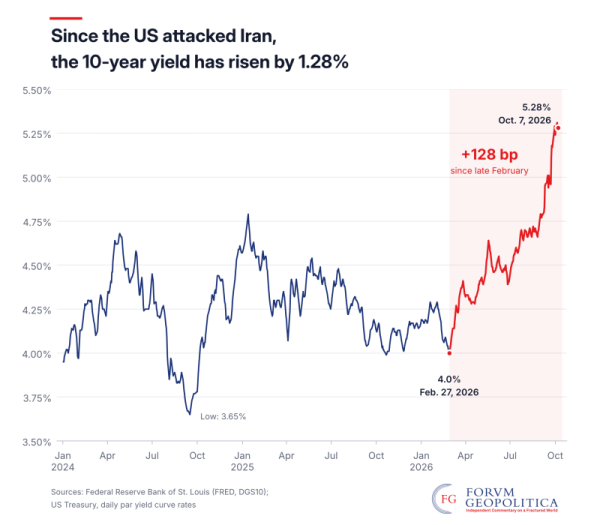
To those of us who were paying attention, the whole exercise felt like looking at Lee’s finger as he points to the moon. As these debates unfolded, the market for U.S. Treasury debt continued an epic sell-off. Bloomberg quoted an investment banker who stated that Treasuries were “trading like a meme stock.” U.S. Treasury bonds have now experienced their worst long-run returns in history.
Treasury bonds are not just any old asset. For one, they are the debt of the U.S. government. If they become uninvestable, the capacity for Washington to live beyond its means through debt issuance is open to question. Treasuries are also the benchmark asset for the entire global dollar system that has allowed the U.S. to run enormous deficits for decades. If this asset starts “trading like a meme stock” and generating awful returns, foreigners will opt for something else. This week, the president of the German central bank stated that “the case for further diversification into gold remains significant.” People are talking.
In mid-September, the speaker of the Iranian parliament, Mohammed Bagher Ghalibaf, posted an equation on X. Unusually for an obscure piece of algebra, the post garnered nearly 7 million views. The equation was a modified version of what economists call the “Taylor Rule,” a method that economists and central bankers use when setting central bank interest rates. In normal times, the equation factors in expected future inflation and how much slack is in the economy. But Ghalibaf’s equation—which he called the “Straits Taylor Rule” —included two new variables: the Strait of Hormuz and the Bab el-Mandeb, the two waterways currently under fire from Iran and the Houthis in Yemen, respectively.
The equation is a stripped-down representation of Iran’s strategy. By controlling these waterways, Iran and its allied groups have gained control over the global energy market. By squeezing these chokepoints, Iran can assert de facto control over America’s financial markets by pushing up expected inflation. Central banks like the Federal Reserve realize that this is no mere bluff and have already started raising interest rates. Ghalibaf’s equation explains, to a very large extent, why American government debt is currently trading like a meme stock.
Meanwhile, at the same time as these pressures are felt in American financial markets, the real economy is undergoing a squeeze too. Recent reports from the Energy Information Agency suggest that American heating-oil bills are expected to rise by 21 percent this winter. Diesel markets are entering into a genuine crisis, with President Donald Trump floating the prospect of banning diesel exports to ensure that there are no shortages. Diesel is the lifeblood of the American logistics chain. If there are shortages, trains and trucks will not run and goods will not be delivered to shelves. Trump has walked back the diesel export ban for now, after strong-arming the Europeans to dump their oil and diesel reserves, but there is every chance that this option appears back on the table as the crisis worsens. Food prices are rising too, with sugar prices looking particularly worrisome.
Once again, Ghalibaf outlined how this is part of Iran’s overall strategy. In an X post this week, the speaker published a rudimentary graph—coupled with a haunting image of a ghost—showing rising commodity prices and interest rates on one side, and falling consumer confidence, foreign interest in U.S. Treasuries, hyperscaler investment, and housing affordability on the other. The Iranians are not just trying to squeeze the American financial system—they are aiming to put extreme stress on the entire economy—and it looks increasingly like they intend on making this pressure felt before American voters go to the polls on November 3.
The Trump administration has become fixated on the Strait of Hormuz, seeing it as a decisive battlefield on which the U.S. can win the war. But the Strait is merely a means to an end. For Iran, that end is to slowly demolish the American economy and financial system until the pressure becomes too much and the U.S. backs off. The idea that you can “win” such a battle is delusional.
The Strait is merely the finger in Lee’s analogy. It is Iran’s overall economic strategy—the moon—that we should focus on. And when we do, we come to the worrying conclusion that by the time the Trump administration cries uncle, the damage done to the American economy and financial system will be so severe that it could take many, many years to recover.
Original article: www.thea
Dhubab offensive, media blitz and the rapid unraveling of Saudi-backed coalition’s new gambit
By Arman Shariati | Press TV | October 10, 2026
In the early hours of October 5, Saudi-backed mercenaries launched an offensive along Yemen’s southwestern coastal road toward Dhubab, which overlooks the Bab al-Mandeb Strait.
By evening, their affiliated media networks were proclaiming Dhubab’s fall. Hours later, they falsely claimed to have captured Al-Mokha as well.
Within a single day of operations, the Yemeni military forces had encircled the incursion, recaptured the ground, and released timestamped footage showing their troops standing undisturbed along the Bab al-Mandeb coastline.
Meanwhile, local residents openly ridiculed the reported advance of the Saudi mercenaries.
The attacking forces retreated to their original positions. The events along that coastal road – the assault, the media triumphalism, the rapid military reversal, and the collapse of the narrative – offer a revealing case study of how information warfare has become structurally embedded in Saudi Arabia’s disastrous military campaign in Yemen.
The Pressure Behind the Push
To understand the events of October 5, it is necessary to examine the developments that preceded them. Yemeni military had been consolidating significant territorial gains across southern and southwestern Taiz province – not marginal advances, but the seizure of areas spanning thousands of square kilometers.
The encirclement of Taiz city was tightening along its northern and eastern approaches, applying deliberate strategic pressure that could pave the way for a handover of the city from the Saudi-backed mercenary factions holding it.
More symbolically damaging still, the residence of Rashad al-Alimi, chairman of the Saudi-backed so-called Presidential Leadership Council (PLC), had fallen.
The Saudi-led coalition and its local allies were rapidly losing ground. An operation that could be portrayed as a decisive advance toward the Bab al-Mandeb Strait would offer PLC forces a much-needed military and propaganda victory.
The Bab al-Mandeb is precisely the kind of strategic objective whose association with a military operation can generate outsized media attention, regardless of what the operation actually achieves on the ground.
The attacking forces
The offensive was led by two formations: the Southern Giants Brigades (Al-Amaliqa al-Janubiyya) and the Dira’ al-Watan (Shield of the Nation) Brigades, supplemented by approximately 100 Saudi mercenary fighters, according to Saudi-affiliated media.
Both formations have histories that complicate their portrayal as straightforward Yemeni forces operating under the so-called Presidential Leadership Council (PLC). The Giants Brigades are a Salafi-oriented southern force whose origins are firmly rooted in Emirati patronage. Armed, trained, and financed by Abu Dhabi, they were institutionally shaped as part of the UAE’s parallel military architecture in Yemen – a network of forces, including separatist formations, that operated with considerable autonomy from the Saudi-led coalition’s command structure.
Their nominal realignment under the PLC framework following the UAE’s partial strategic withdrawal from the Yemeni theater has not necessarily erased the command relationships, patronage networks, or ideological orientation established during their formative years.
They remain among the coalition’s most combat-capable formations, but their relationship with the PLC is better understood through overlapping interests and patronage ties than through assumptions of unified institutional loyalty.
Dira’ al-Watan, by contrast, operates with a more direct orientation toward Riyadh, functioning closer to Saudi Arabia’s traditional mercenary structure in Yemen. The deployment of both formations along a single coastal axis, accompanied by a contingent of Saudi mercenaries, suggests a deliberately assembled force package rather than an improvised advance.
The media apparatus accompanying the operation, as we shall see, reinforces this interpretation.
The assault itself
The attacking forces advanced along the coastal road south of Al-Mokha toward Dhubab district. The coastal approach traverses relatively open terrain, and accounts of the local military disposition suggest that the Yemeni military’s forward garrison presence in the immediate coastal zone was limited. The defensive logic, under such conditions, favors concentrating forces at defensible chokepoints in the adjacent highlands rather than maintaining a thin, linear deployment across exposed ground.
Yet despite heavy Saudi supporting fire, the advancing forces failed to push beyond the outer perimeter of Dhubab along the coastal road. They reached the perimeter of Dhubab airport but did not enter Dhubab city.
At the airport perimeter, invading forces filmed themselves running over wounded members of the small Yemeni military garrison. The footage, subsequently circulated through pro-Saudi Telegram channels, appeared to have been published by the mercenaries themselves as evidence of momentum and fighting spirit.
Instead, it documented abuses against combatants in an isolated position, including the mutilation of dead bodies, turning apparent battlefield content into evidence of conduct that warrants independent human rights scrutiny.
The footage also carried a consequence beyond its grave humanitarian implications. Militarily, it documented a localized engagement against an isolated position—not a breakthrough along the coastal axis. The distinction would become critical within hours, as the broader operation stalled and the coalition’s claims of progress began to unravel. Material intended to project battlefield momentum would instead complicate the narrative surrounding an offensive whose advertised scale and strategic significance far exceeded its demonstrated territorial gains.
The encirclement and the reversal
Field sources report that within hours of the attacking force reaching the coastal road’s edge, Sana’a forces had encircled the limited area of the incursion and begun pressing to retake the ground. The timeline is critical. This was not a gradual reversal unfolding over several days. The encirclement and counterattack took place within the same operational day as the advance.
The reversal has a clear geographic dimension. Yemeni military, led by the Ansarullah movement, controls the Al-Omari mountain range and the Al-Omari base, situated east of Al-Mokha and west of Taiz. This elevated terrain offers observation over much of the coastal corridor and positions from which movement along the coastal road can be interdicted.
Any force advancing along the coast without first neutralizing Al-Omari risks operating under persistent observation, with its flanks and supply lines exposed to forces holding the dominant heights. The attacking force did not capture Al-Omari. Nor was it positioned to do so: securing the mountain range and its associated base would have required a substantially larger and more complex operation than the one assembled for the coastal advance.
At the same time as the encirclement was developing on the ground, Yemeni military forces launched missile and drone strikes against concentrations of Al-Amaliqa and Dira’ al-Watan personnel in the Ras al-Ara area. Field sources report casualties among the brigades’ ranks and the destruction of several military vehicles.
Crucially, Saudi-affiliated media correspondents were embedded with the attacking force when these strikes occurred. Some were recorded in real time on the scene. The media apparatus deployed to document a military triumph was thus capturing a very different story: an operation losing momentum under pressure, with its setbacks unfolding before the cameras intended to celebrate its success.
The media campaign
Saudi-affiliated news outlets began publishing accounts of Dhubab’s fall before any territorial gain had been consolidated on the ground. The claims escalated through the day: from entry into the airport perimeter, to control of Dhubab district, to the fall of Dhubab city, to the reported fall of Al-Mokha as well.
The maximum extent of the Saudi-backed advance against the Yemeni military was the perimeter of Dhubab airport. Located outside the district’s urban center, the airport lies on open, flat terrain adjacent to the coastal road.
Reaching its perimeter, as the attacking forces did, is materially different from establishing control over Dhubab district or the Bab al-Mandeb coastline – a distinction that Saudi-affiliated media systematically obscured in their October 5 coverage.
Sana’a’s counter-messaging response was swift. Its forces released footage showing their deployment along the Bab al-Mandeb coast and east of Al-Mokha, imagery that directly challenged claims of a lost coastline. By the time Saudi-affiliated sources began denying or walking back their claims about Al-Mokha, the damage to their credibility had already been done.
Escalation Deep Inside Saudi Arabia
Yemeni military response to the October 5 offensive extended beyond the immediate Yemeni battlefield. In a series of operations that Yemeni military officials had signaled in prior public announcements, strikes reportedly targeted military and economic facilities deep inside Saudi Arabia, including in Khamis Mushait, Riyadh, and Jeddah.
The East–West Pipeline was struck again, significantly disrupting operations. Air traffic at King Abdulaziz International Airport in Jeddah was suspended, marking another interruption to airport operations. Saudi refineries also came under separate attacks, with impacts on Aramco facilities raising the prospect of suspended refining operations and associated financial losses. The full extent of the damage, operational disruption, and economic costs are reported to be high.
Taken together, these operations widened the confrontation beyond the coastal front in Yemen, bringing Saudi military infrastructure, energy assets, and civil aviation into the broader picture.
Sana’a also formally announced the imposition of a no-fly zone over Saudi airspace. The Humanitarian Operations Coordination Center issued notices advising airlines to avoid the area, presenting the declaration as a reciprocal measure in response to intensified Saudi airstrikes against Yemeni population centers.
Regardless of its practical enforceability, the declaration carried political significance: it sought to portray Saudi airspace as a contested domain rather than an uncontested sanctuary.
It also introduced another variable into the risk calculations of third-party commercial operators, whose decisions on flight routing, insurance coverage, and overflight costs could create additional economic and political pressure on Riyadh.
The structural problem of Saudi Arabia’s military posture in Yemen
The October 5 operation failed to achieve its territorial objectives. The attacking force did not capture Dhubab, establish control over the Bab al-Mandeb coastline, or retain the ground it had temporarily entered. Within a single operational day, it had retreated to its starting positions.
The accompanying media campaign faltered alongside the military advance. The speed of the reversal was central to that failure. When a narrative collapses within the same news cycle in which it is constructed, and footage contradicting the initial claims circulates through the same information environment, the result is not simply a return to the status quo. It can produce a net loss of credibility.
In this case, the gap between the territory reportedly reached and the territory claimed exposed the central vulnerability of the messaging strategy – the declaration of victory preceded the establishment of durable control.
Once the advance stalled and the attacking forces withdrew, the initial claims became liabilities, leaving subsequent clarifications and retractions to compete with the very footage that had been intended to demonstrate success.
But the October 5 episode also illuminates a structural constraint extending well beyond a single failed operation. The Saudi-led coalition’s military options appear increasingly constrained as it struggles to reverse the Yemeni military’s territorial advances despite its substantial advantages in funding, equipment, and external support.
The pattern raises serious questions about the mercenary coalition’s ability to translate material superiority into sustained battlefield gains against a force whose strategic planning, local positioning, and combat motivation have repeatedly complicated its opponents’ campaigns. Meanwhile, reports of precision strikes against critical targets inside Saudi Arabia underscore the continuing challenge of protecting the Kingdom’s strategic infrastructure and deterring retaliatory attacks on its territory.
The Saudi-backed war on Yemen is far from resolved. Taiz remains a central point of military pressure, with the encirclement shaping the strategic calculations of the forces holding the city.
Ma’rib remains a key, and renewed fighting is a possibility in the weeks ahead. Saudi infrastructure continues to face the threat of further long-range attacks, while the operational and economic consequences of strikes require careful assessment.
The October 5 episode, meanwhile, demonstrated the limits of projecting territorial control through media messaging before that control has been secured on the ground.
For Saudi Arabia’s media apparatus, the consequences extend beyond one news cycle. Credibility cannot be restored through messaging alone; it depends on the consistency between public claims and verifiable battlefield developments.
Any subsequent operation will be judged not only by the territory it gains, but also by the gap, or alignment, between what its accompanying media campaign promises and what the evidence ultimately shows.
The battle for Yemen continues. The Bab al-Mandeb remains a strategic focal point, and the struggle to shape both the battlefield and the narrative surrounding it is far from over.
Syria May Send Troops to Saudi Arabia Amid War with Ansar Allah
By Kyle Anzalone | The Libertarian Institute | October 8, 2026
A US and Syrian official said Syria is considering sending troops to Saudi Arabia as the kingdom battles Ansar Allah in Yemen.
Reuters reported on Thursday that a US official and a Syrian defense official said that Damascus may send Syrian forces to Saudi Arabia. Riyadh has reached out to several allies for support in its war against Ansar Allah.
On Monday, Turkey and Pakistan agreed to provide military support to Saudi Arabia under the Mecca Accords, a mutual defense pact signed by the three countries earlier this year.
A joint statement released by the Mecca Accords members explained, “The Committee decided to move immediately to the practical implementation of the collective defense commitments and to take the necessary measures to provide the agreed military forces and capabilities and ensure their rapid deployment in the Kingdom, in accordance with the approved arrangements and the national legislation of the Parties, thereby enhancing readiness, military integration, and the collective capacity to confront and counter threats.”
Turkey indicated it would provide Saudi Arabia with military capabilities rather than ground troops, which would require parliamentary approval, while Pakistan did not provide details on the forces or capabilities it plans to deploy.
The statement was released following an emergency meeting of the alliance to discuss the situation in Saudi Arabia. The fighting between Ansar Allah and Saudi Arabia reignited in July after the kingdom attacked the Sanaa airport. In recent weeks, Ansar Allah has taken a significant amount of territory from the Saudi-backed forces in Yemen and attacked several energy sites in Saudi Arabia.
Riyadh has reached out to international partners for support. Crown Prince Mohammed bin Salman requested that President Donald Trump order direct attacks on Ansar Allah positions. So far, Trump has limited US involvement to intelligence sharing and battlefield planning, and refused to conduct direct strikes on Ansar Allah.
Saudi Arabia has also asked China and Pakistan to place pressure on Iran to rein in Ansar Allah. According to three Iranian sources speaking with Reuters, Beijing privately asked Tehran to rein in Ansar Allah after receiving a request from Riyadh. The sources told the outlet that Iran responded that stability in the region depended on US and Israeli aggression.
While Saudi Arabia’s ties to the US and Ansar Allah’s relationship with Tehran allow the war between the two to appear to be a part of a larger regional war, the conflict began over a decade ago. Additionally, Ansar Allah did not begin its offensive following the US and Israeli surprise attack on Iran, but rather after Saudi-backed forces attacked the Sanaa airport, prompting Ansar Allah to resume attacks on Saudi Arabia.
Western officials and media often label Ansar Allah as a proxy of Iran. However, while Iran has provided support to Ansar Allah, there is little public evidence that Tehran directs the group’s military operations.
While Syria was a long-time [resistance] ally under the rule of Bashar al-Assad and his father, Damascus fell to rebels, led by former al-Qaeda members, in 2024. Syria is now led by President Ahmed al-Sharaa, formerly known as Abu Mohammad al-Jolani, who previously led al-Qaeda’s Syrian affiliate.
Houthis Don’t Have to Conquer Saudi Arabia to Make It Pay
Daniel Davis / Deep Dive – October 7, 2026
Johnson, Marandi say Yemen holds upper hand over Saudi Arabia
Al Mayadeen | October 7, 2026
Former CIA analyst Larry Johnson and Professor Mohammad Marandi said that Yemen holds the upper hand in its war with Saudi Arabia, and that neither Turkey nor Pakistan is likely to change that by sending forces to the kingdom’s aid.
Speaking on Al Mayadeen’s The Grand Standoff: Iran and the World on Tuesday, both guests also noted that Tehran is working on the assumption that the US will restart its war on Iran, while Johnson argued that Washington has less capacity to carry one out than its rhetoric suggests.
Yemen advances as Saudi-backed forces falter
Marandi said that the past weeks have shown a one-sided war. He stated that the Saudi camp’s claims that it could retake significant territory proved to be empty talk, as Yemeni forces, led by Ansar Allah and the Yemeni government, kept moving forward. “The liberation of Taiz is near,” he said.
Johnson stressed that Yemen “has every advantage in this war.” He put Saudi Arabia’s dependable fighting strength at about 75,000 soldiers, the Presidential Leadership Council (PLC) at another 100,000, and the Yemeni Armed Forces’ at 350,000. He described the Saudi army as “basically a group of mercenaries,” while Yemeni fighters have the motivation of defending their own land.
Johnson highlighted that the PLC’s latest offensive showed a lack of military competence. “Successful military attacks are usually not announced in advance, they usually prefer not to give the opposing side a heads up about what you’re going to do,” he said, noting that this one was announced beforehand. He added that the PLC launched it “even without what’s called close air support.”
Saudi aircraft carried out a number of bombing runs along the front lines, Johnson said, “but they were not coordinated.” He explained that “normally you want somebody on the front lines who can actually be in communication with the pilots or with the air controllers, the combat air controllers, to identify specifically along the front lines where bombs need to be dropped.”
“What we’ve seen is that [the Yemeni Armed Forces] operate at a more sophisticated level,” he said. He rejected the Western line that this is Iran’s doing. “Contrary to Western propaganda that this is all just the work of Iran, this is not the work of Iran,” he said. “Anybody that’s had any dealings at all with the Houthis knows that they are quite independent.” He said the movement sees Iran as a friend, but “they don’t let Iran dictate its choices or what it does.”
Johnson added that he believes Saudi Arabia attacked Sanaa after the funeral of Sayyed Ali Khamenei because the US encouraged it. He explained that Washington wrongly saw Yemen as a paper tiger, and described its approach to West Asia as “a combination of ignorance and arrogance.”
Turkey, Pakistan face a logistical nightmare
Both guests dismissed the idea of a Turkish or Pakistani deployment. Johnson said the announcement that Turkey and Pakistan would effectively declare war on Yemen “was laughable.”
He clarified that air power would not solve the problem either. “Dropping bombs without effective ground controllers is just, it’s a waste of bombs,” Johnson said. “It’s just punching holes in landscape without accomplishing anything.” He called the announcement “more Western hype” that “speaks to the desperation of the Saudis,” adding, “I don’t see Turkey or Pakistan intervening in any significant way.”
Marandi said he does not know whether Riyadh, Ankara and Islamabad have even decided to send forces. “It’s possible,” he said. “But as Larry said, this would be a logistical nightmare, and the cost would be extraordinary. And even troop movements inside Saudi Arabia would not be easy.”
He stated that neither country has the capacity. “Pakistan, of course, its military is on the border with India, and they have very bad relations with the Taliban in Afghanistan,” Marandi said, adding that Turkey has difficult relations with almost all of its neighbors. “The armed forces of Pakistan and Turkey are not designed for such mass movements of troops.”
Marandi asserted that Turkey and Pakistan are also harming themselves by letting the narrative spread that they stand with Saudi Arabia. “Turkey and Pakistan are not doing themselves any favors by pushing or allowing this narrative to be pushed that they are on the side of Saudi Arabia,” he said. He pointed to their stance on Gaza, which he said made them popular across the region. “They’ve become heroes across the region,” he said, and “it’s clear that their sympathies lie with [Ansar Allah].”
Saudi Arabia exposed on oil, infrastructure
“The Saudis are in real trouble,” Johnson said. He said the East-West oil pipeline is down and that reports of oil getting through, including through the Strait of Hormuz, are false. “They have lots of infrastructure that can be targeted and is being targeted by Ansar Allah,” he noted, while “Ansar Allah doesn’t sit there with an abundance of infrastructure that can be targeted by the Saudis or the Western helpers.” His conclusion was that “Yemen holds the upper hand.”
Marandi pointed to the weight of the kingdom’s finances. “The Saudis have nothing but their oil exports and their oil industry to sustain themselves, and it is a country that has very high costs,” he stressed. “The government spends a lot of money, so the economy is doing very poorly.” He warned that “the longer this war lasts, the more Saudi infrastructure will be destroyed.”
Marandi argued that the way out is obvious. “The smart thing to do would be for Saudi Arabia to end this war, to do a deal with the people of Yemen, and to lift the siege, and to recognize the government, and stop interfering in Yemen’s internal affairs,” he said. “But Mohammed bin Salman is not the wisest of leaders, to say the least.” He compared the crown prince to Trump. “I think both are very arrogant, neither are wise, and the people around them are yes-men,” he asserted. “Otherwise the Saudis would have ended this by now.”
Johnson put the responsibility on Riyadh. “This is a fight that the Saudis chose to initiate,” he insisted, adding that Ansar Allah “was content to live side by side with the Saudis” and “abiding by the ceasefire” until the Saudis broke it. For Johnson, the kingdom now has a single option. “The choice is settle, make peace with Yemen, or risk the absolute destruction of the government and the country of Saudi Arabia.”
Tehran plans for a renewed US war on Iran
Marandi told the program that Tehran is planning around the assumption that Trump will restart the war. “I’m not saying that war is inevitable, but the working assumption is definitely that we’re going to have war,” he stated. Iran “has been preparing itself for a major confrontation, a very heavy war that would take perhaps weeks,” he noted, and it has warned US-aligned countries that helped Washington that “this time around the Iranian response will be much more devastating for them as well.”
He detailed upgrades to Iran’s missile and drone capabilities, improved air defenses, expanded underground bases and strengthened command and control meant to protect its leaders from targeted strikes. The remaining question, he argued, is timing. “Will there be conflict before Netanyahu’s election, or between the two elections, or after the US midterm elections? That is basically the real question.”
Marandi also pointed to deepening energy shortages. “Trump can pretend that the Strait of Hormuz is open and that more oil is getting through than ever before,” he said. “But the reality is that that’s not the case. The shortages are accumulating.”
Flows reached 11 to 12 million barrels a day for a couple of weeks, when Iran avoided escalation around President Masoud Pezeshkian’s planned US trip, but even then they fell short of demand. Shortages of diesel, gasoline, helium, sulfur and LNG are growing faster than the oil shortage, he explained.
He questioned why Trump keeps threatening to wipe out Iran if, as Trump has claimed for over seven months, the country is already defeated. “I don’t think anyone in Iran takes him seriously anymore,” Marandi added.
Johnson points to limits on US firepower
Johnson argued that Washington’s capacity is thinner than its threats suggest. “I wouldn’t characterize it as a wider escalation, because the United States is limited in what it can do to escalate,” he stated. He noted that the US lacks a robust supply of Tomahawk and JASSM cruise missiles and that its air defense stocks are depleted. “They’ve exhausted their air defense systems. Patriot missiles and THAAD missiles are, I mean, they’re out.”
He cited the evacuation of 12 B-1 bombers from RAF Fairford as evidence. Washington blamed a possible Iranian drone threat, but Johnson countered that “if they still had an adequate number of Patriot missiles, they wouldn’t have evacuated 12 B-1 bombers from the Fairford RAF airfield.” Even against drones, he added, the US does not have enough PAC-3 missiles.
Johnson dismissed press reports of 10,000 US troops being surged to the region, pointing out that 50 to 60 percent of them are the crews of aircraft carriers, escort destroyers and a Marine Expeditionary Unit. The USS Theodore Roosevelt is replacing the USS George H.W. Bush, which is docked in Phuket, Thailand, and due to depart on October 9. “So it doesn’t look like there’s a buildup on that front,” he observed, adding that it is unclear whether the Bush will return to waters off Iran.
Johnson believes the bomber withdrawal followed a secret meeting last Friday at Camp David involving J.D. Vance, Pete Hegseth and John Ratcliffe. In his view, they recognized that “the United States really is in a limited position to carry out any kind of effective or sustained strikes against Iran that are risk-free.” He expects Iran to act preemptively if it judges strikes are imminent, for example against aircraft deployed to al-Udeid.
For Washington, he concluded, “the United States stands to lose much, much more than they’ve already lost if they decide to renew conflict and war with Iran.”
The Makkah Pact Enters Into Force: The End of American Dominance or Its New Form?
By Salman Rafi Sheikh – New Eastern Outlook – October 7, 2026
On October 5, Saudi Arabia, Türkiye and Pakistan activated the Makkah Pact, taking their new alliance to war for the first time, and potentially revealing the future of American power in the Middle East: Washington provides the security umbrella while regional partners increasingly do the fighting.
From treaty to military alliance
Only two months after Saudi Arabia, Pakistan and Türkiye signed the Makkah Joint Defence Agreement, the new alliance has been activated. As representatives of the three countries met in Riyadh and Houthi missiles and drones targeted Saudi territory, Saudi-backed Yemeni forces launched a major counteroffensive around the strategically important Bab al-Mandeb Strait. Despite hundreds of strikes, the Saudi offensive has not been enough to push the Houthis back to their original position. In this context, the alliance’s Strategic-Political and Defense Committee agreed to move “immediately” toward implementing its collective-defence commitments and to provide agreed military forces and capabilities for rapid deployment in Saudi Arabia. The meeting also appointed retired Pakistani Lieutenant General Nauman Mahmood as the alliance’s first secretary-general.
The significance goes beyond additional military assistance for Riyadh. The Yemen war is transforming – and that, too, very rapidly – a remarkably young agreement into an operational military alliance. Signed on August 7, the Makkah Pact contains a collective-defence commitment under which an armed attack against one member is regarded as an attack against all three. Pakistan describes the agreement as defensive and grounded in the right to collective self-defense under Article 51 of the UN Charter.
That inevitably invites comparisons with NATO. The analogy should not be exaggerated. NATO possesses 32 members, an integrated command structure and more than seven decades of institutional development. The Makkah Pact possesses none of that depth.
But its institutional development has been unusually rapid. On August 31, the three governments established mechanisms for political and military coordination, agreed to create a permanent secretariat in Saudi Arabia and committed themselves to joint activities, defence-industrial cooperation and joint technology development and production. Now comes the most important stage in the evolution of any military alliance: responding to an actual threat.
Pakistan and Türkiye were already assisting Saudi Arabia before formal activation. Reports show that Pakistan had supplied air-defence systems, drones, anti-drone equipment and light artillery, while Pakistani advisers were working with Saudi counterparts supporting Yemeni forces. Türkiye had supplied drones. The October 5 decision potentially integrates such capabilities into something larger: collective military action undertaken because one alliance member has come under attack.
The distinction between defensive and offensive action consequently becomes blurred. Defending Saudi airspace against Houthi missiles is clearly defensive. Destroying the launchers firing those missiles from Yemen would involve offensive operations undertaken for a defensive purpose. Pakistani Defence Minister Khawaja Asif has deliberately avoided ruling out that possibility, saying Pakistan would make “whatever means are available” at its disposal available to defend Saudi Arabia.
America stays, but its role changes
It would be tempting to interpret this development as evidence that Saudi Arabia is preparing for a post-American Middle East. That conclusion would be premature. The more interesting possibility is almost the opposite: the Makkah Pact may fit remarkably well into the kind of Middle Eastern security order the Trump administration itself wants to create. Trump welcomed the agreement shortly after it was signed. He called it’s a “big, bold and important first step” and argued that it demonstrated how regional countries could “defend themselves in a more meaningful way.” That language closely matches the administration’s formal defence strategy.
The 2026 National Defense Strategy says Washington wants regional allies and partners to assume “primary responsibility” for deterring and defending against Iran and its proxies, while the United States supports them and deepens cooperation with Gulf partners. The administration’s arms-transfer strategy similarly argues that allies should assume more responsibility for regional security while Washington equips them with advanced American military capabilities. Yemen now offers an unusually clear illustration of what this division of labour can look like.
Saudi Crown Prince Mohammed bin Salman sought direct American military intervention against the Houthis in September. Trump declined to order US strikes. But Washington did not withdraw from the conflict. Instead, it offered intelligence and targeting assistance, while CENTCOM commander Admiral Brad Cooper travelled to Saudi Arabia for consultations. As the Saudi-backed offensive subsequently began, the same pattern continued. Saudi aircraft provided extensive air support to Yemeni government forces, while the United States supplied intelligence and targeting support. America therefore remains deeply involved. What has declined, at least for now, is direct participation in the fighting. This distinction matters.
The choice facing Washington is not simply between dominating Middle Eastern security and abandoning it. There is a third possibility: remaining the indispensable strategic enabler while shifting more of the immediate military burden onto regional states. That is precisely where the Makkah Pact becomes useful.
Saudi Arabia brings financial resources, geography and enormous investments in advanced weaponry. Türkiye contributes a large, NATO-trained military and a rapidly expanding defence industry. Pakistan brings substantial conventional forces, longstanding military relations with Saudi Arabia and extensive operational experience. Together, they can potentially perform missions that previously might have generated demands for more direct American intervention. The United States can remain above this architecture rather than outside it: supplying intelligence, weapons, logistical assistance, strategic deterrence and diplomatic backing while allies provide more of the personnel and firepower required to confront regional threats. Seen this way, the pact is not necessarily a rebellion against American primacy. It could become one mechanism through which that primacy is made less militarily expensive for the US.
A different kind of American order
This model also helps explain why describing the emerging Middle East as “post-American” can be misleading. American power has traditionally been measured partly through deployments, bases and direct military intervention. But primacy does not require Washington to fight every regional war itself. The Makkah Pact could push this transformation considerably further.
Its future significance will depend less on what its three members call the alliance than on what they build after Yemen, and whether their first experiment in collective defence proves sufficiently successful to encourage deeper cooperation. Regular military planning, interoperable forces, integrated air and missile defence, intelligence-sharing arrangements and joint weapons production would gradually give the agreement institutional substance.
Yet therein lies a paradox for Washington. The same burden-sharing that reduces America’s military responsibilities could eventually reduce its leverage. More capable allies are not necessarily more dependent allies. As regional powers acquire the institutions, experience and capabilities to conduct military operations with diminishing direct American involvement, they may also acquire greater freedom to pursue threats and strategic objectives that do not fully correspond with Washington’s preferences. An arrangement that initially reinforces the US security architecture could therefore gradually produce greater regional strategic autonomy.
The consequences could extend to military technology. Saudi Arabia’s armed forces remain heavily equipped with American weapons, but neither Pakistan nor Türkiye operates exclusively within a US defence ecosystem. Pakistan, for example, operates the JF-17 fighter aircraft jointly developed with China. In fact, Islamabad has deployed this jet in Saudi Arabia as part of the pact. While Türkiye has built an increasingly indigenous defence industry. A more deeply integrated Makkah alliance could therefore eventually combine American, Turkish, Pakistani and Chinese-origin military technologies rather than reproduce an exclusively US-centred weapons architecture.
That may prove more consequential for American primacy than the pact itself. If the Makkah alliance fades once the immediate Houthi threat recedes, it will remain another temporary regional alignment. But if Yemen produces permanent military integration, Washington could confront an unexpected consequence of its own burden-sharing strategy: the more successfully regional allies learn to defend the American-led order themselves, the less dependent that order may eventually become on America.
Salman Rafi Sheikh, research analyst of international relations and Pakistan’s foreign and domestic affairs
Follow new articles on our Telegram channel
The Saudi-Israeli war on Yemen’s resistance: Intelligence sharing, civilian targets & sectarian propaganda
By Robert Inlakesh | MintPress News | October 2, 2026
Scrambling to halt the ongoing offensive of Yemen’s Armed Forces, Israel and Saudi Arabia have strengthened ties through a joint covert campaign aimed at salvaging what remains of their supremacy in the Red Sea region. Tel Aviv and Riyadh’s losses of key military strongholds in Yemen’s Western coast, has ushered in a new era of soft-normalisation.
Saudi Arabia has carried out hundreds of airstrikes in Yemen, resulting in thousands of casualties since its renewed bombing campaign began this July. It now heavily relies on Israeli targeting intelligence backing in order to conduct dozens of strikes across Yemeni territory on a daily basis, including attacks on civilian market places and residential buildings.
Meanwhile, Israeli officials heaped praise on Riyadh this Wednesday for facilitating the first ever commercial flight between Israel and Saudi, following the Kingdom’s intervention to aid Israeli passengers on-board a Flydubai plane that was forced to undergo an emergency landing.
In contrast, the Kingdom of Saudi Arabia (KSA) initiated the renewal of the Saudi-Yemen war, by bombing the runway of Sana’a International Airport in order to prevent an Iranian civilian jetliner from landing inside the country. This measure was taken to enforce a long-standing aerial blockade on Yemen, while Israeli aircraft freely use Saudi airspace.
Riyadh’s pivot to the Israeli orbit entails a covertly coordinated campaign centered around Yemen, bearing regional consequences – from joint intelligence operations, target bank sharing, direct meetings between officials and a calibrated propaganda campaign.
In early September, Israel’s national broadcaster Kan News reported that Tel Aviv had begun supplying intelligence to aid Saudi Arabia in building up a target bank to strike inside of Yemen. Neither side has any formal diplomatic ties and yet Israel is already aiding Saudi Arabia in the military sphere — a development that would usually be a major regional scandal, yet the primarily Gulf State funded Arabic-language media has all but ignored it.
Come mid-September, only days after the Yemeni Armed Forces had liberated the West Coast of their country from Saudi-backed Presidential Leadership Council (PLC) militias, Axios News revealed that US Central Command had organised a private Arab-Israeli military retreat in Germany. At the private retreat, both Israeli and Saudi military officials were able to directly discuss issues concerning Iran and Yemen’s Ansarallah-led government.
Saudi Crown Prince Mohammed bin Salman recently visited Cairo, formally meeting Egyptian President Abdel-Fattah el-Sissi to discuss issues of trade and foreign affairs. On the sidelines of this trip, CENCTOM officials repeatedly presented a proposal to form a regional command structure and coordination mechanism, that would include Israel, in order to properly confront the Ansarallah-led forces in Yemen.
Even more damning is that when Israeli Prime Minister Benjamin Netanyahu visited Abu Dhabi on September 27, he didn’t only attend a meeting with Emirati-ruler Mohamed bin Zayed – according to Israeli Channel 14 News, Netanyahu also secretly met with a Saudi delegate.
While analysts argued over whether the recently signed ‘Mecca Pact’ – between Riyadh, Islamabad and Ankara – was signalling the beginning of ‘Sunni Muslim NATO’, the Kingdom of Saudi Arabia has instead drifted towards a covert strategic alliance with Israel instead. Collusion between the two leaderships – which between them rule over all three of the Islamic Holy Sites – has reached historic heights.
Targeting Civilians And Sectarian Propaganda
A notable outcome of Saudi Arabia’s collaboration with Israel, is a marked uptick in the number of reported civilian massacres that have been taking place. The corporate media’s reporting on such attacks have drawn enormous parallels to the way similar strikes were covered in the Gaza Strip.
Take for example a recent strike carried out by Saudi fighter jets in the Taiz governorate, which killed at least seven civilians in a marketplace and destroyed a food storage site. When Reuters reported on the story, they ran with the following headline: “Seven people killed in strike on market in Yemen, Houthi-run health ministry says”
Just as the corporate media labelled Gaza’s Ministry of Health as “Hamas-run”, it uses “Houthi-run” in Yemen as a rhetorical tactic to detract from the veracity of the claim being made. In Gaza, Hamas is indeed the political Party that heads the local government of the territory, technically making this linguistic trick somewhat accurate, despite it being clear cut propaganda. However, in the case of Yemen it isn’t even vaguely accurate, as the political Party that controls the government is called Ansarallah, “the Houthis” are a family from northern Yemen.
Saudi Airstrikes also targeted other civilian locations such as residential buildings in the Mokha Port area, recently taken over by the Ansarallah-led government’s forces, killing at least 6. While US Central Command has been cited as arguing that Tel Aviv’s targeting data provided to Riyadh is essential, there has been no evidence that the intelligence provided has led to any material change on the battlefield.
It is not currently possible to verify whether the civilian infrastructure struck by Saudi Arabia’s airforce were targets located by Israeli intelligence gathering efforts or not, it is clear that Israel’s own strikes on Yemen have killed overwhelmingly civilians.
Both Israel and Saudi Arabia do indeed have shared interests in Yemen. Both seek the overthrow of the nation’s Sana’a based government. The recent capture of the Bab al-Mandab coastline by the Yemeni Armed Forces threatens both Tel Aviv and Riyadh, as they are the only two nations which Sana’a has reason to impose a blockade on.
The Yemeni imposed blockade on Israel, beginning in late 2023, completely bankrupted the southern Israeli Port of Eilat. This measure was taken in support of Gaza and the blockade ended with the implementation of the October 8, 2025 ceasefire. In the case of Saudi Arabia, a blockade has been imposed upon them in the Red Sea as a retaliatory measure against the long-standing Saudi blockade of Yemen.
This has led to a joint Saudi-Israeli propaganda campaign, seeking to depict the Yemeni control over their own territory as a threat to international maritime navigation and trade, something that Yemen’s officials have explicitly denied
A prominent propaganda theme is the weaponisation of religious authorities and the deliberate spread of sectarianism. Take prominent Saudi Islamic Scholar Dr. Abdulaziz Al-Rayez, a man that previously forbade resistance against Israel and condemned the Palestinian armed struggle, urged what he called “Sunni Muslims” to fight the “cursers of the companions [of the Prophet Mohammed]” to “race to the great field of martyrdom” against the Yemeni Armed Forces. Al-Rayez promotes factually inaccurate sectarianism, deeming the Sana’a based government as an evil Shia opposition to a righteous Saudi-backed Sunni force.
Saudi Grand Mufti Sheikh Saleh bin Fawzan Al-Fawzan also made a rare public statement on the war against Yemen, framing the issue as a religious obligation for Muslims to fight against the Yemeni Armed Forces. Additionally a top Saudi-linked Pakistani cleric, infamous for praising Osama bin Laden as “a Muslim warrior”, deemed Ansarallah to be “terrorists” and claimed that they are not even Muslims.
Across Gulf State owned Arabic-language media there has been a virulently anti-Ansarallah coverage of the war, with various pundits attempting to claim that the Zaydi Muslim sect in Yemen are conspiring with Iran to usher in a Shia Muslim tyranny across West Asia; aimed oppressing the Sunni majority.
While Saudi Arabia conspires alongside Israel to strike targets across Yemen and its officials meet with their Israeli counterparts, a concerted propaganda effort attempts to convince the region’s public that Riyadh is the victim; weaponising sectarianism as a means of distracting from its continued pivot towards the Israeli sphere of influence.
Robert Inlakesh is a political analyst, journalist and documentary filmmaker currently based in London, UK. He has reported from and lived in the occupied Palestinian territories and hosts the show ‘Palestine Files’. Director of ‘Steal of the Century: Trump’s Palestine-Israel Catastrophe’. Follow him on Twitter @falasteen47
10K More U.S. Troops Deploy as Trump Weighs New Iran Strikes /Suliaman Ahmed
Daniel Davis / Deep Dive – October 3, 2026
Houthis condemn Saudi claims of attack on Medina
RT | October 2, 2026
Yemen’s Houthis have denied targeting a power station in the city of Medina. A Saudi-led coalition earlier accused the militant group of targeting the facility supplying power to the Prophet’s Mosque – one of the holiest sites in the Muslim world.
A senior Houthi official branded the accusation a “lie” aimed at tarnishing the group’s image and reinforcing similar claims made by the coalition in the past.
On Thursday, the Saudi coalition’s spokesman, Major General Turki al-Maliki, accused the Yemeni militants of striking the Taibah electricity distribution station in Medina earlier this week in what he called a “cowardly terrorist act” and a part of an alleged broader campaign by the Houthis to “target the Two Holy Mosques.”
In mid-September, Saudi Arabia accused the Houthis of launching a drone towards the holy city of Mecca. The unmanned aerial vehicle was intercepted and destroyed, it added. The Yemeni movement’s leader, Abdel-Malik al-Houthi, dismissed that claim as a “heinous lie” in a televised address at the time, claiming Riyadh was “weaponizing lies” to advance its own agenda.
The developments have sparked concerns in Türkiye and Pakistan, which signed a joint defense agreement with Saudi Arabia in August. Speaking to the United Nations General Assembly last week, Pakistani Prime Minister Shehbaz Sharif called any “threat to the sanctity” of the Muslim holy cities of Mecca and Medina a “red line that must never be crossed.”
Ankara denounced this week’s alleged Medina attack. “Any attack targeting the sanctity, peace, and security of the Two Holy Mosques is an unacceptable affront directed at the shared sensitivities of the entire Islamic world,” the Turkish government spokesman, Burhanettin Duran, said on X on Friday. He vowed that Türkiye “will continue to stand by Saudi Arabia.”
The developments come amid the continued escalation between the Houthis and the Saudi-led coalition. Riyadh has backed Yemen’s internationally recognized government against the Houthis since intervening in the country’s civil war in 2015.
Large-scale fighting largely subsided after a UN-brokered truce in 2022, but the conflict erupted again this summer after an airport in the Houthi-controlled Yemeni capital of Sanaa was bombed to prevent a returning Houthi delegation that had flown to Iran from landing.
Burnham’s UN debut… A masterclass in British disinformation
By Finian Cunningham | Strategic Culture Foundation | September 26, 2026
So, “Britain is back” and ready to provide glorious leadership to the rest of the world, to “solve shared problems we face.”
British Prime Minister Andy Burnham made his debut at the United Nations this week, addressing the 81st session of the General Assembly in New York.
“You can count on us,” assured Burnham. “Count on us to stand up for those long-standing British values of fairness and justice – our shared values – and for the UN Charter.”
Please, don’t make me vomit. Burnham was oozing noble values on the podium of the UN while Saudi warplanes were massacring Yemeni civilians in their homes – warplanes that are directed and refuelled by Britain (and the United States).
This week, Yemeni media reported that over 100 people, including women and children, were killed as Saudi F-15 and Typhoon fighter jets intensified air strikes on residential areas in the Red Sea cities of Mocha and Taiz. Al Masirah TV showed bloody images of two children killed by a Saudi airstrike in Mocha
On his way to the UN, Burnham announced that he had ordered the deployment of RAF refuelling planes to enable the Saudi air assault on Yemen. Of course, the British media described the move as “defensive aid”.
Earlier this month, Downing Street also approved the dispatch of British military advisors to Saudi Arabia. American advisors are also stationed there to assist in the war of aggression against its southern neighbor.
Yemen’s armed forces and the Ansar Allah militia are hitting back hard. They have overrun Saudi forces in key Red Sea positions and have shut down the Saudi oil industry and pipelines with drone and missile attacks.
But make no mistake, this is a Saudi war of genocidal aggression fully supported by the United States and Britain. The war has been going on since 2015, together with a blockade on Yemen that has resulted in an estimated 400,000 Yemeni deaths. A lull in fighting from 2022 was broken when the Saudis launched air strikes on the Yemeni capital’s airport in July. The Yemenis have hit back with a vengeance, targeting Saudi oil installations.
The Saudi monarchy has begged Trump to give more military assistance. But Trump is bogged down and out of his depth with his losing seven-month war with Iran.
This is where Burnham has entered the fray, responding to Saudi pleas for help by signing off on military deployment. This could prove to be a disastrous strategic blunder. No doubt Burnham is trying to ingratiate himself with Washington. His decision to send the RAF into battle this week came ahead of his first meeting with Trump on the sidelines of the UN. The American president gave him a symbolic pat on the head, saying, “he’s going to be a great prime minister.”
Trump had often ridiculed Burnham’s predecessor, Keir Starmer, for supposedly not offering more military support to the U.S. war aims in the Middle East. Burnham is showing himself to be more amenable, that is, pliable.
The British Butler is slaughtering his way into favor with Washington. Women and children are sacrificed in Yemen all to satisfy the sick “special relationship” between the U.S. and Britain.
Burnham is a fraud with this working-class Manchester accent and glib talk about the “need to do more to help people with the everyday cost of living.”
If you can bear to listen to his speech at the UN, it is a masterclass in British disinformation. It takes a special kind of person to deliver such arrant nonsense with a pose of sincerity.
The thrust of his whole address was to blame Russia for everything. From poverty and inequality in British society, to seething discontent among Britons towards their ruling class, to the war in Ukraine. It truly was a consummate performance in misdirection, the kind of charade that British politicians excel at.
He announced that Britain was launching a new National Centre for Information Defence, purportedly to combat Russian disinformation, which he claimed was “a poisonous tide” sowing division and instability among Britons.
According to Burnham, all that is broken and dysfunctional in British society is due to Russian infiltration. Nothing was said about bankrupt British capitalism and the warmongering of the British state fuelling a proxy war in Ukraine or aggression in the Middle East at the expense of social conditions in Britain.
Burnham’s “solution” to Britain’s endemic problems is to increase “national security” and state control over public information – all under the guise of “defending” Britons from being manipulated by Russian propaganda.
The Orwellian condition that Britain is sliding into is awesome.
This British prime minister dares to speak about British values and leadership and condemn Russia while he is approving the supply of long-range air strikes against Russia with British cruise missiles and drones.
The proof of Burnham’s fraudulence and moral bankruptcy is his decision to materially support Saudi warplanes in committing atrocities in Yemen. Murderous aggression is labelled “defense”.
Burnham’s dubious asset as a politician is his ability to articulate justification for slaughter and war with empty platitudes.
A particularly odious point in his UN speech was his claim that English workers allied with Abraham Lincoln in the American Civil War against slavery. As if English mill workers were representative of British “values”. What Burnham conveniently omitted was the much more heinous role of the British ruling class in creating the Atlantic slave trade.
Britain’s historic role in global exploitation and waging genocidal wars is something that damns its governments forever. Its ongoing role in enabling the slaughter in Ukraine and in Yemen is but two of the latest episodes of this British systemic criminality.
These are the British “values” that Burnham deftly concealed this week with his performative debut at the UN.
Featured Video

Iran’s Next Strike May Not Explode. It Could Shut You Down
or go to
Aletho News Archives – Video-Images
From the Archive
Zionism’s Violent Legacy
By Donald Neff | Washington Report On Middle East Affairs | January 1996
On January 4, 1948, Jewish terrorists drove a truck loaded with explosives into the center of the all Arab city of Jaffa and detonated it, killing 26 and wounding around 100 Palestinian men, women and children.[1] The attack was the work of the Irgun Zvai Leumi – the “National Military Organization,” also known by the Hebrew letters Etzel – the largest Jewish terrorist group in Palestine. The Irgun was headed by Revisionist Zionist Menachem Begin and had been killing and maiming Arabs, Britons and even Jews for the previous ten years in its efforts to establish a Jewish state.
This terror campaign meant that at the core of Revisionist Zionism there existed a philosophical embrace of violence. … continue
Blog Roll
 Aletho News
- Trump’s Iran war is on an Israeli leash
- Saudi oil boss issues global supply warning
- Riyadh Says Its Oil System Is Intact. The Numbers Say Otherwise.
- Trump and Netanyahu Want to “Finish the Job” on Iran
- US ‘one-sided dictation’ not Iran’s beliefs makes rational talks impossible: Baghaei
- Iran’s Next Strike May Not Explode. It Could Shut You Down /Col Doug Macgregor
- Iran: US political targets legitimate if assassinations return
- Iraq shuts key border crossing with Iran under US pressure: Report
- Undersea Internet cables could be targeted in retaliation for attacks on Iran: IRGC deputy chief
- EU sending ‘biased’ observers to interfere in Serbian election – president
- If Americans Knew
- The Israel Lobby’s Changing Fortunes
- AIPAC has become such a political liability that it’s shifting to a more “nimble” approach to buying politicians
- At least 160 Israeli settler attacks in 2 weeks
- Will Gaza’s Ancient Christian Community Disappear Forever?
- Israel’s vision of regional security rests on keeping Arab states weak
- Heidi Levine recounts how Palestinian youths helped save her in settler attack
- DAILY UPDATE: Latest essential news on Palestine, Israel, & region
- Trump’s Intensifying Sabotage of the ICC, for Israel’s Sake
- Israeli military detain US and UK volunteers in West Bank including Democratic NY politician Brad Lander
- Americans at National Conservatism Conference held in Israel this year criticize Israel
- No Tricks Zone
- E-Cars Reduce CO2 Emissions By Only 41% Compared To Internal Combustion Engine Vehicles
- Predictions Made By Renowned Climate Professor Over Past Decades Have Been Proven To Be Poor
- New Study Suggests Large Regions Of The Pacific Ocean Have Been Cooling For The Last 80 Years
- Germany’s Green Energy Debacle: High Energy Costs Force Kahla Porzellan to Close After 182 Years!
- New Study: 50 Years Of The Most Aggressive ‘Net Zero’ Policies Can Only Affect The Global Climate By 0.03°C
- US September “Heat” Was No Record…Many Records Set Decades Ago
- Latest European Green Energy Debacle; Portugal’s Largest Flagship Solar Park Insolvent!
- Green Energy Debacle: German Expert Professor Fritz Vahrenholt Warns Of Severe Economic And Social Consequences
- Two More Paleo Reconstructions Affirm Meters-Higher Sea Levels Across Ireland, Brazil 7000-6000 Years Ago
- New Study: Earth And Venus Surface Warmth Largely Explained By Convection And Lapse Rate, Not CO2 Or Radiation

