House Leadership Pulls a Fast One for al Qaeda
By Connor Freeman | The Libertarian Institute | November 7, 2017
House Concurrent Resolution 81 (H.Con.Res.81) is sponsored by Representatives, Ro Khanna (D-Calif.), Walter Jones (R-NC), Mark Pocan (D-Wisc.), Thomas Massie (R-KY), and 39 other lawmakers. The resolution commands an end to U.S. participation in the Saudi-led war in Yemen.
The sponsors of this resolution contend that such participation, which began in March 2015, was never authorized under the War Powers Act of 1973. Per the War Powers Act, any congressman can pose a legal challenge and is guaranteed a floor vote on the issue. This is known as a privileged resolution.
On November 1st, the night before the vote was scheduled to take place, House leadership swiftly pushed through a Rules Committee vote, denying the resolution’s privileged status. Thus, preventing the guaranteed floor vote.
What was their justification? Apparently, the House Rules Committee feels that the war in Yemen has yet to ‘rise to a level’ where the War Powers Act is applicable.
After preventing the vote on H.Con.Res.81, the House Leadership has said it shall permit a ‘compromise’ resolution on the war in Yemen. The debate, scheduled for the week of November 13th, will discuss the legality of U.S. involvement in the war. The vote will be non-binding.
Five peace activist groups, heavily engaged in promoting the resolution, said just after the Rules Committee vote:
“We remind the House leadership that under the War Powers Resolution of 1973,
“‘introduction of United States Armed Forces ’includes the assignment of member of such armed forces to command, coordinate, participate in the movement of, or accompany the regular or irregular military forces of any foreign country or government when such military forces are engaged…’
U.S. refueling of Saudi-UAE planes bombing Houthi targets in Yemen meets that definition.’”
Therefore the War Powers Act, clearly applies to the war on Yemen.
The House leadership is lying to the American people, supporting the continuation of the world’s worst humanitarian crisis, violating the War Powers Act, and attempting to prevent Congress from stopping yet another illegal and unconstitutional war.
Conservatively, since the beginning of 2017, at least 10,000 people have been killed in this war. The heroic and indispensable Yemeni journalist Nasser Arrabyee has said the toll could be as high as 60,000 deaths.
The Saudis are ruthlessly bombarding the Yemenis and their civilian infrastructure. The coalition wants to cripple the people of Yemen to the point of submission. Their end goal is to force Yemen’s civilians to stop supporting the northern tribesmen if only to alleviate their suffering.
U.S. involvement is most critical to the Saudi effort in this war. The U.S. military is training Saudi Arabian forces. The U.S. is refueling the coalition’s warplanes not just in the air with tanker sorties, but also on its bases peppered throughout the region.
As of February, according to an article written by Oriana Pawlyk for Military.com :
“Saudi Arabian coalition jets bombing Houthi rebel sites in Yemen increasingly turn to U.S. Air Force tankers for refueling support almost two years after the conflict began. Since April 2015, the Air Force has logged 1,778 tanker sorties for the operation, Air Forces Central Command spokeswoman Capt. Kathleen Atanasoff told Military.com on Tuesday. That includes 1,069 over the past year, an increase of 360, or 50 percent, from the 709 in the previous period. ‘These operations are ongoing, with aircraft refueling occurring daily,’ Atanasoff said in an email. The service’s tankers such as KC- 135 Stratotankers and KC-10 Extenders participated in 7,564 refueling ‘events’ with coalition aircraft, with ‘about 54 million pounds of fuel off-loaded in support of Saudi operations in Yemen,’ Atanasoff said.”
Donald Trump, doing his best Barack Obama impression, has been more than happy to sell the Saudis hundreds of billions of dollars worth of weapons to continue their genocide. These include planes, ships, rockets, precision-guided bombs, cluster bombs, etc. American defense contractors, particularly Lockheed Martin and Boeing, are likewise more than happy to rake in their handsome profits from Yemen’s destruction. With Jared Kushner playing the role of matchmaker for Mohammed bin Salman and Marillyn A. Hewson (CEO of Lockheed), the profits will surely escalate.
However, the Saudis have another powerful ally in this war, al Qaeda. This certainly makes the upcoming debate on Yemen a great opportunity for the House to finally get around to discussing the legality of high treason. Or more specifically, fighting another war for al Qaeda.
In addition to the coalition’s sadistic air campaign, Yemini civilians are threatened and attacked on the ground day in and day out by Sudanese mercenaries, al Qaeda in the Arabian Peninsula (AQAP), and a local Islamic State affiliate. All of whom support the coalition.
In an article published in The Hill, Gareth Porter and retired Col. Lawrence Wilkerson (former Secretary of State Colin Powell’s Chief of Staff) said:
“U.S. intelligence and counter-terrorism officials have regarded AQAP as even more of a foreign terrorist threat to the United States than ISIS. It mounted efforts to bring down U.S. airlines three times between 2009 and 2012, and nearly succeeded twice. But the Saudi/UAE war in Yemen has made them the most powerful indigenous armed group in southern Yemen, with more money, arms and territorial control than ever before. The Saudi-led coalition and the forces of the Saudi backed former regime have allied openly with AQAP and even fought alongside them. As a result of the war AQAP is now poised for the first time to compete for national power in Yemen.”
See the map below of the military situation in Yemen as of this July for an idea of just how much territory AQAP has consolidated. The areas shaded white are controlled by AQAP, the pink areas are controlled by Hadi-loyal forces, and the green areas are controlled by the Houthi/Saleh alliance:

This is further evidence that U.S. involvement in the Saudi war is illegal. When asked for a justification for U.S. involvement in the Saudi/UAE war, both Barrack Obama and Donald Trump’s administrations have cited the 2001 Authorization for the Use of Military Force (AUMF). That AUMF permits military action only against those entities who perpetrated the attacks on 9/11. In other words, military action is only permitted against al Qaeda. Yet, this war is being fought on behalf of al Qaeda against their enemies, the Houthis.
Indeed, Asher Orkaby made the point in Foreign Affairs that, “far from being aligned with extremists, the Houthi movement has repeatedly clashed with the Islamic State and AQAP”. So, in addition to the fact that this war was never authorized under the War Powers Act, it is also clearly not covered under the current AUMF.
Since the Obama administration, this is at least the third major conflict wherein the U.S. has found itself aligned with, fighting along side, arming, and/or supporting al Qaeda. This was official policy notably during the regime change operation in Libya and in the failed regime change operation in Syria. It is very important to note that if things had gone to plan in Syria, al Qaeda would have almost certainly taken Damascus.
Neoconservatives are now calling for a new AUMF to explicitly define ‘the enemy’ more broadly as proponents of so called, ‘radical Islam’. The ‘radical Islam’ handle is a red herring callously promoted by the fake news establishment. It is meant to dumb down and obscure the realities of these conflicts for domestic audiences. The cynical neoconservatives are pleased to have Americans view all Arabs and Muslims as one homogenous and terrifying collective. Most Americans are designedly oblivious to the differences between Sunnis, Shiites, and other branches of Islam. It is in the interests of the War Party for American voters to see such radically opposed groups as Daesh and Hezbollah as cut from the same cloth. This is obviously done in order to prevent rational discussion of these conflicts from ever taking place. For if the American people were well informed of the consequences of U.S. policy abroad, especially in the Middle East, they would probably not even passively support their regime’s policies.
In 2013, popular sentiment from people of all political stripes helped to prevent Obama’s would have been Iraq-style invasion of Syria. I believe one of the primary reasons for this was the effectiveness of the famous ‘I will not fight for al Qaeda in Syria’ social media campaign undertaken by active military personnel. Americans do not want to support and subsidize al Qaeda in Syria, Libya, Yemen, or anywhere else for that matter. The reason these horrific policies persist is not the peoples’ apathy, it’s their ignorance.
This is a particularly indefensible war, even by U.S standards. If they choose to, this is a war the American people can end. The establishment is certainly not comfortable publicly debating and defending their Yemen policy. Exposing the realities of this conflict and ending the war in Yemen could trigger an anti-war domino effect. Not since the Vietnam War has there been more fertile soil for an American anti-war movement.
Please continue to call your Congressmen and women and tell them to vote against the war on November 13th. Give them some good talking points for the debate. Please share, retweet posts from Yemenis on the ground, post news items, write blog posts, write articles, and speak your mind about the war in Yemen on social media. Do not be afraid to talk about the U.S.-Saudi/AQAP alliance. We have the truth on our side.
Rouhani urges Saudis to end hostilities, befriend Iran instead of US

Al-Manar | November 8, 2017
President Hasan Rouhani on Wednesday dismissed recent threats and accusations by Saudi Arabia against the Islamic Republic, stressing that Riyadh is unable to do anything against the Iranian might.
As he stressed that Iran has nothing but good intentions towards countries and people in the Middle East, Rouhani said that the recent missile attack near the Saudi Arabian capital’s airport was a legitimate response by the Yemeni people to Saudi bombings.
“You know the might and place of the Islamic republic. People more powerful than you have been unable to do anything against the Iranian people,” Rouhani was quoted by Iranian media as addressing Saudi regime.
“The United States and their allies have mobilized all their capabilities against us and achieved nothing.”
“How should the Yemeni people react to the bombardment of their country? So they are not allowed to use their own weapons? You stop the bombardment first and see if the Yemenis would not do the same,” the Iranian president said.
He was apparently commenting on Saudi Crown Prince Mohammed Bin Salman remarks a day earlier. Bin Salman accused the Islamic Republic of supporting Yemen Houthi revolutionaries, and of staging a “direct aggression” against the Gulf Kingdom.
Rouhani meanwhile, reiterated that Iran wanted a peaceful settlement of the conflict in Yemen, Syria and Iraq, accusing Saudi leaders of meddling in these countries’ domestic affairs and of strengthening ISIL Takfiri group.
“We want the welfare and development of Yemen, Iraq and Syria, and of Saudi Arabia too. There are no other paths forward than friendship, brotherhood and mutual assistance,” he said.
“If you think that Iran is not your friend and that the United States and the Zionist regime are, you are making a strategic and analytical error,” Rouhani said, addressing the Saudi regime.
On the other hand, the Iranian president said “great powers and the West have always sought to create gaps and differences among nations and countries of the region,” hoping that “rulers in certain countries of the region will understand the reality.”
Iran slams Saudi lies over Yemen missile strike
By Adam Garrie Adam Garrie | The Duran | November 5, 2017
Saudi Arabia and Donald Trump have both accused Iran of providing Yemen’s Houthi rebels with the missile that was launched at the Saudi capital Riyadh yesterday evening.
Saudi Arabia in particular, has accused Iran of supplying the Houthis with new missiles capable of longer distances than those previously thought to be in their possession.
However, Saudi’s accusation is inconsistent with the fact that Yemen is totally besieged from both land and sea.
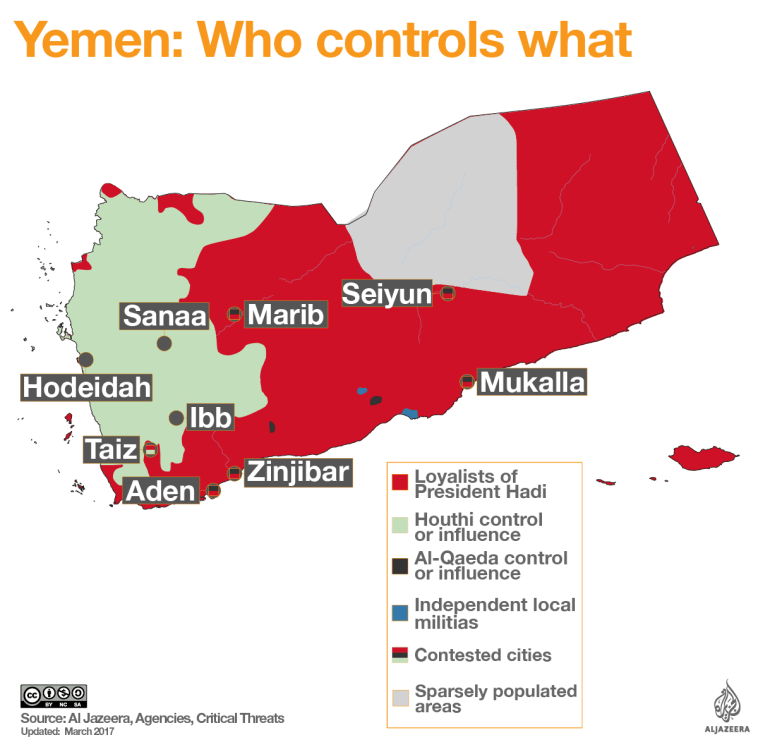
Yemen is bordered by Saudi Arabia and fellow Gulf Cooperation Council Oman, a state which would never allow shipments of Iranian weapons to Houthis and could not easily do in any case as Oman borders areas of Yemen controlled either by the pro-Saudi Hadi government or by anti-Iranian al-Qaeda and ISIS fighters.
Yemen’s north-west maritime borders have been cut off from the world, including from crucial medical and food supplies by a Saudi naval blockade that has caused a man-made famine and a cholera epidemic.
If the UN cannot even get foodstuffs past the Saudi blockade, it goes without saying that Iran could not get ballistic missiles to Houthi controlled areas.
The Houthis themselves claimed that they modified their missiles to achieve longer ranges, a claim which Iran acknowledges as the most likely scenario in respect of yesterday’s launch. Others have stated that the launch was a Saudi false flag, but as the Houthis themselves took credit for the launch and with video emerging which appears to back up Houthi claims, the only remaining credible scenario is that the Houthi fighters were indeed able to modify their missiles to reach Riyadh.
In any case, it would appear that Saudi’s US made defensive missile systems shot the Houthi rocket down, although some reports on social media from the Arab world contradict this.
At the end of the day, the facts hardly matter to the spokesmen and leaders of Saudi, Israel and United States who have all accused Iran of having a direct hand in the missile launch.
The fact of the matter is that while Iranian sympathies and limited support are certainly with the Houthis, the blockade means that this support amounts to very little in terms of material support, including and especially military support.
The facts on the ground and more important on the sea, dictate that accusations of Iran meddling in Yemen are de-facto baseless.
Unlike Syria, in which militants could be supplied on virtually all sides from ISIS controlled Iraq to the large Turkish border as well as the borders with Jordan and Israel, Yemen’s Houthis are not in any such position to be so easily supplied.
The fact that many in the media have conspired to hide this patently obvious reality means that one either is not engaging in honest journalism or one is simply repeating mythical Saudi claims.
Yemen war ‘unconstitutional’ says trio of US lawmakers
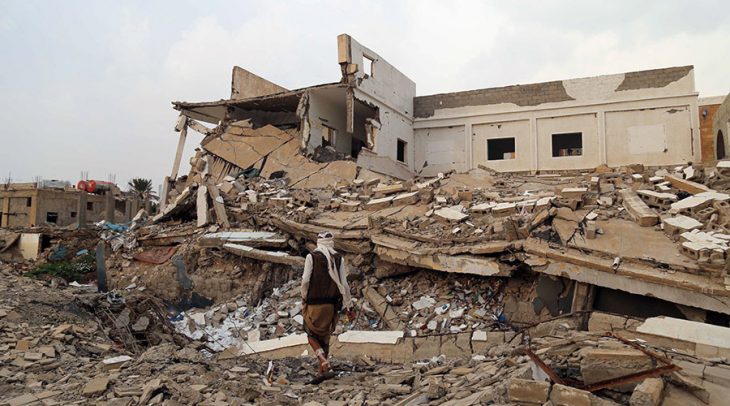
A Yemeni man walks past a destroyed school building on March 16, 2017, that was damaged in an air strike in the southern Yemeni city of Taez. © Ahmad Al-Basha
RT | October 11, 2017
A group of Congressmen from both major parties is hoping to force a vote over Washington’s involvement in Yemen, with a resolution invoking the War Powers Act to force the US to stop aiding the Saudi-led coalition in its bombing campaign.
Three members of the US House of Representatives tried to illustrate the horrors of the Yemen conflict by comparing it to a hypothetical war affecting the US state of Washington ‒ with a population of 7.3 million ‒ “on the brink of starvation, with the port city of Seattle under a naval and aerial blockade, leaving it unable to receive and distribute countless tons of food and aid that is waiting offshore.”
“This nightmare scenario is akin to the obscene reality occurring in the Middle East’s poorest country, Yemen, at the hand of the region’s richest, Saudi Arabia, with unyielding support from the US military that Congress has not authorized and therefore violates the Constitution,” wrote Representatives Ro Khanna (D-California), Mark Pocan (D-Wisconsin) and Walter Jones (R-North Carolina) in a New York Times op-ed Tuesday.
In March 2015, the Obama administration began aiding the coalition led by Saudi Arabia in its war against the Houthis, a rebel group that took control of Yemen’s capital Sanaa. Since then, Washington has supported the coalition’s military campaign in Yemen, by providing the Saudis with logistical support, intelligence and ammunition used in airstrikes.
This has led to the deaths of over 10,000 civilians and has plunged much of Yemen into a humanitarian crisis.
The three lawmakers teamed up with colleague Thomas Massie (R-Kentucky) to introduce House Resolution 81, invoking the War Powers Act to guarantee a full House vote to withdraw US armed forces from the unauthorized war.
“We believe that the American people, if presented with the facts of this conflict, will oppose the use of their tax dollars to bomb and starve civilians,” the three representatives wrote.
Several more lawmakers have expressed support for the proposal as well.
UNHRC Yemen Inquiry is Doomed to Fail Magnanimously
By Salman Rafi Sheikh | New Eastern Outlook | 09.10.2017
The United Nations Human Rights Council (UNHRC) seems to have finally awakened up to the brazen human rights violations that the Saudia led Arab coalition forces have been blamed to have committed in the conflict in Yemen that has been going on for more than two years now, and has consumed thousands of lives, and destroyed the country, its polity and economy alike. While UNHRC has resolved to find out the atrocities that have been committed, the question that remains unanswered is if this ‘fact-finding’ mission would lead to an end of the war, let alone punish the antagonists?A compromise has been achieved from the very beginning, which will allow the House of Saud to not only to manipulate or dispute the results, but also escape any consequences whatsoever. As a matter of fact, Saudi Arabia was able to steer things to a course of its own advantage by simply altering the original resolution adopted by the Council, making the UNHRC look like a meaningless and worthless house of cards.
Let’s consider what the original resolution had called for and what is actually going to happen now. The original resolution had called for the establishment of an independent inquiry commission. However, thanks to Saudi Arabia’s intense lobbying and coercive diplomacy, the amended version is now restricted only to sending some “eminent experts”. According to reports, Riyadh had threatened to restrict and even cut trade and diplomatic ties with the council members which had backed the much more robust version. The House of Saud also publicly appreciated the UK, US and France for their cooperation in securing a compromise on resolution. The three countries also support Saudi Arabia’s deadly military aggression against the impoverished Yemen. The UK and the US had no reason to criminalize Saudi Arabia not only because they are allies but also because the US is itself a party to destroying Yemen.
This is evident from the way the US president Donald Trump has almost doubled the number of covert US airstrikes in Yemen. According to the data compiled by The Bureau of Investigative Journalism, the US has carried out about 100 strikes in Yemen in 2017. While the official narrative is that these strikes target Al-Qaeda in the Arabian Peninsula (AQAP), there are evidences that suggest that the US has been equally targeting the Houthis as well. Nothing perhaps could illustrate this ‘US vs Houthis’ phenomenon more than the fact that a US drone was attacked and shot down by the Houthis in western Yemen as recently as October 2, 2017. While the US officials said that the matter was under investigation, the Houthi-controled Defense Ministry announced that it had downed an American drone in the outskirts of Yemen’s capital Sanaa, thus rejecting the US claim that it was mainly involved in non-combatant missions in the aid of the Arab coalition.
On the other hand, what really explains the reason for the Trump administration’s decision to increase drone attacks is the policy of isolating and defeating Iran that the US and Saudi Arabia are following. Interestingly enough, perusal of this policy has caused political tension in the UK as well, where the parliament’s joint committee on human rights has raised strong concerns about the UK’s involvement in the US targeted killing programme, noting that the UK’s intelligence agencies work “hand in glove” with the US.
Given the extent of co-operation between the West and its key ally in the Middle East, an independent inquiry into war atrocities committed by the self-declared regional hegemon is unlikely to take place ever, let alone punish the wrongdoers. Besides the current UNHRC debacle, this is also evident from the way the House of Saud was able, back in July 2016, to turn upside down a UN report that had blacklisted the country after it found out that the Kingdom was responsible for 60 percent of the 785 deaths of children in Yemen in 2015. A few days later, however, the world body announced that the Riyadh regime would be scratched off the list, pending a joint review with the Arab kingdom. Sounds like really independent and impartial!
Once again Riyadh has been able to manipulate inquiry into atrocities by radically altering the resolution that had called for an independent inquiry. Could there be a greater irony than the fact that the new resolution that decided to set up a committee of experts had been set up by Riyadh itself? How can an accused set up, or even influence, a committee to investigate into his own crimes? Can such a body be expected to be impartial and truly reveal what the Arab coalition has done in Yemen?
Answers to all of these questions have, unfortunately, to be in the negative. It is not that we are expressing pessimism, there are certainly concrete basis for what we have said. Besides the above given arguments with regard to the co-operation between the US, the UK and Saudi Arabia, the fact remains that not even the EU, the so-called champion of human rights, is able to leave a decisive impact on the situation and turn things against Saudia. For instance, the European human rights organisation had to face a lot of ridicule when, despite its earlier statement that had confirmed that airstrikes carried out by the Arab coalition in the past two months had killed 39 civilians, including 26 children, the resolution was amended and the bid for constituting an independent inquiry was replaced by a committee of “experts.” Not only were their reports and arguments not accepted, but their demand that the matter be brought before the International Criminal Court (ICC) was squarely rejected, thanks again to the Saudi lobbying and the help it received from its key allies in the West i.e., the US and UK and France and the way it coerced countries into backing down on this demand.
According to a Reuters report, in a letter seen by one of the diplomats, Saudi Arabia – the world’s biggest oil exporter – had warned some states of possible consequences should they support the Dutch resolution, submitted jointly with Canada, calling for a full commission. This lobbying was the perfectly echoed by French diplomatic source who was reported to have said that “there is room to satisfy everybody.”
It appears that no other party is more satisfied now than the House of Saud, the principal accused in the scene. The accused stands vindicated as it is well “satisfied” with the way things have ended in the UNHRC session and the way things will proceed in the future. It is possible that by the time the committee of experts is constituted, does its investigation and submits its report in a year from now on, the Arab coalition, which believes that airstrikes killing civilians are legally justifiable, might end up killing thousands of innocent people. Who will then the UNHRC blame for the loss?
Americans Can Stop America’s War on Yemen
By Shireen Al-Adeimi | CounterPunch | October 5, 2017
Yemen continues to suffer in silence as the world turns away from its ongoing misery. Despite two and a half years of brutal war, the average American remains oblivious to the inconvenient truth that the United States has been helping Saudi Arabia and the United Arab Emirates destroy a sovereign country that posed a threat to no one. While rich Arab states bombard the Middle East’s poorest country, creating the world’s largest humanitarian crisis and an unprecedented cholera outbreak, our government (starting with the Obama administration and continuing with Trump’s) has continued to support them not only through the sale of weapons, but also through mid-air refueling, targeting intelligence, and other logistical support.
The international community has betrayed Yemenis over and over again – examples include the United Nation’s capitulation to Saudi pressure by removing it from the list of child killers and allowing the Saudi-led Coalition to investigate (and clear) itself from any wrongdoing. Even as an inquiry into Yemen war crimes was finally agreed upon this week, the word “investigation” was dropped, and it remains to be seen which “regional experts” will comprise the committee.
But have we, the American people, turned our backs to our government’s involvement in Yemen’s destruction? Yemenis are not seeking refuge in Europe or America because of a land, air, and sea blockade that has kept food and medicines out, while trapping people in. Unlike those fleeing the war in Syria, Yemenis may be ‘out of sight, of mind.’ But those of us who do know about the plight of Yemenis may feel helpless or unclear about what can be done to help. The truth is, we have to act, and we have to act fast.
We can no longer stand by and watch as Yemeni children die of curable diseases like cholera (with 750,000 cases and counting) because they can’t access clean water. Nor can we stand by and watch them die of hunger in a time of immense global wealth because their parents can’t afford what little food is available. We can no longer watch as Yemeni children, women, and men are killed by US-supported, Saudi and Emirati airstrikes that target homes, schools, funeral gatherings, and hospitals alike. We must confront our government’s role in creating this “man-made catastrophe” that has pushed this already-impoverished nation to its utmost limit.
Now, 30 months into this aimless war, there’s an opportunity for the United States to finally withdraw from Yemen. Congress will soon debate and vote on House Concurrent Resolution 81, a bipartisan bill introduced by Representatives Ro Khanna (D-CA), Thomas Massie (R-KY), Mark Pocan (D-WI), and Walter Jones (R-NC), that aims to end the United States’ support for the Saudi-led Coalition in Yemen.
If we don’t act now, we may find ourselves looking back and wondering what could have been done to save millions of people from certain death. We have an opportunity to end this destructive war by urging our political leaders to stop supporting the Saudi-led Coalition. And we have a moral and legal obligation to extricate ourselves from aiding an ally that has worked with terrorists to achieve its goals, and has continued to commit what may amount to several and ongoing war crimes in Yemen.
Let’s email and call our representatives and urge them to vote in favor of H.Con.Res.81 and put an end to the atrocities committed in our name. For the sake of Yemen’s tiniest victims, whose little bodies gave up fighting hunger and disease in the time it took you to read this piece, let’s end the war on Yemen.
Protests against UK arms sales to UAE at arms expo
MEMO | September 8, 2017
Campaign groups are teaming up tomorrow to protest against UK arms sales to the UAE in front of one of the largest arms expos in the world at the London ExCel Centre.
Activists and campaigners from the International Campaign for Freedom in the UAE (ICFUAE) will be joining a host of other campaigning organisations such as the Campaign Against the Arms Trade (CAAT) at the Defence and Security Equipment International exhibition (DSEI) arms fair to protest against millions of dollars of arms trade with a regime, activists describe as being a notorious human rights violator.
The week of campaigning, which began with a protest against Israeli arms sales, will see crowds of people calling on the UK government to end arms sales to the UAE. The trade deals with Britain are said to involve highly sophisticated and invasive cyber surveillance technology which the UAE government uses to spy on its own citizens, and weaponry used to commit war crimes in Yemen.
Campaign groups say that between 2012 and 2016 the UAE was listed as the world’s third largest importer of weaponary; during this period, the UK licensed around £350 million worth of arms for export to the UAE. At the same time the UAE has become increasingly dismissive towards international treaties, human rights laws and UN conventions.
The UAE’s war in Yemen, which has caused untold death and destruction, is a major focal point for protestors. The Gulf alliance has been charged with committing war crimes in Yemen, where they hold a significant naval, ground and air presence. It was also recently revealed that UAE forces have been running clandestine prisons where there have been numerous reports of extreme torture.
Campaigners also claim that within their own borders, the Emirati authorities have committed numerous human rights violations against their own citizens and foreign nationals. Human rights organisations have documented numerous cases of torture, arbitrary detention, lack of freedom of speech and repression of political dissidents in the UAE.
The UK-registered BAE systems, who will be vying for new trade deals at the ExCel Centre is thought to have provided the cyber surveillance technology which was used in connection with the enforced disappearance of human rights defender Ahmed Mansoor.
Campaigners are calling on the British government to revise their close trading relationship with the UAE. They say that by providing arms and weaponry to this authoritarian regime, the UK is being complicit in war crimes and human rights violation. Furthermore they say that the trade deal between the two nations is set to increase as the UK leaves the EU and having set itself an ambitious target of doubling bilateral trade to up to £25 billion by 2020.
How Media Obscure US/Saudi Responsibility for Killing Yemeni Civilians
By Ben Norton | FAIR | August 31, 2107
A coalition of Saudi Arabia, the United States, the United Kingdom and the United Arab Emirates, with minor support from several other Middle Eastern nations, has relentlessly bombed Yemen since March 2015. This August, the coalition ramped up the ferocity of its airstrikes, killing dozens of civilians.
On August 23, the US/Saudi coalition bombed a hotel near Yemen’s capital Sanaa, killing 41 people, 33 of whom—80 percent—were civilians, according to the United Nations.
Then on August 25, the coalition bombed homes in Sanaa, massacring a dozen civilians, including eight members of the same family.
Major Western media outlets have, however, obscured the responsibility Saudi Arabia, and its US and European supporters, bear for launching these airstrikes.
There are no other parties presently bombing Yemen, so media cannot feign ignorance as to who is responsible for the attacks. But reports on the bloody US/Saudi coalition airstrikes were nonetheless rife with ambiguous and downright misleading language.

It seems worth mentioning that the airstrike was
supported by the same government that supports NPR.
“Dozens of People Killed as Airstrike Hits Hotel Near Yemen’s Capital,” wrote NPR (8/23/17), in a masterwork of euphemism. Apparently dozens of Yemenis mysteriously died of unknown causes at the exact moment a generic, unaffiliated airstrike hit the hotel. NPR only indirectly mentioned, in the story’s fifth paragraph, that the “Saudi-led coalition” was “blamed” for the attack.
AFP‘s news wire (8/23/17), which was republished by Yahoo, the Daily Mail and Breitbart, used the headline “Air Raids on Outskirts of Yemen Capital Kill ‘at least 30,’” again obscuring who was responsible for those air raids. France 24 (8/23/17) ran the wire with the headline “Air Raids on Yemen Capital Kill Dozens.”
The BBC (8/23/17) wrote, “Yemen War: Air Strike on Hotel Outside Sanaa ‘Leaves 30 Dead.’” “Dozens Killed in Airstrike on Yemeni Hotel,” the Guardian headline (8/23/17) read.
The London-based Middle East Eye (8/23/17) was just as ambiguous, with “Yemen Air Attack Destroys Hotel, Killing at Least 35 People,” as was Qatar-owned Al Jazeera (8/23/17), with “Air Raid in Yemen Kills at Least 35 people” and the Turkish TRT World (8/24/17), which wrote, “At Least 60 people Killed in Airstrikes on Hotel in Yemen.”
Whose airstrike was it? What party was responsible? This remains unknown to those who only glanced at the headlines—that is to say, to most readers.
The 29-month war has killed thousands of Yemeni civilians, with tens of thousands more injured and millions facing famine. And the United Nations has repeatedly reported that the US/Saudi coalition is responsible for a majority of the civilian casualties.
Even when Saudi Arabia’s guilt is acknowledged by media, the crucial role of the US is typically ignored (FAIR.org, 8/31/15, 10/14/16, 2/27/17). Readers miss out on crucial context that is needed to understand the war, and their governments’ contributions to it: Saudi Arabia is flying US-made planes, full of fuel provided by the US Air Force, dropping US- and UK-made bombs, with intelligence and assistance from American and British military officials.
Non-Yemeni ‘Yemeni Airstrikes’

Neither the headline nor the accompanying story mention who conducted
the airstrike—though the photo caption refers to the “Saudi-led airstrike.”
Two days later, reports were just as obfuscatory, and even used the term “Yemeni airstrike,” to refer to an airstrike that was carried out by non-Yemenis.
“Yemen Airstrike Kills 12, Including Six Children: Rescuers,” Reuters reported on August 25. This brief two-paragraph wire did not once mention the US/Saudi coalition was responsible.
“After Yemeni Airstrike, Little Girl Is Family’s Only Survivor,” the international news agency wrote the next day (8/26/17). This Reuters piece noted that the “Saudi-led coalition” was “blamed,” though even that language seems designed to deflect; blamers can be wrong, after all.
Major newspapers were similarly misleading. “Young Yemeni Girl Is Sole Survivor After Airstrike Topples Her Home,” the New York Times (8/26/17) reported. The lead provided no further information: “An airstrike toppled their apartment building.” In fact, it was not until the seventh paragraph, after three large photos, that the Times finally conceded, “A Saudi Arabia–led coalition took responsibility for the airstrike a day after the attack, citing a ‘technical mistake.’” The Times did not once mention American or British support for the coalition.
Al Jazeera (8/25/17) likewise used the headline “Children Among Dead in Latest Attack on Yemen Civilians.” And TRT World (8/26/17) reported, “Yemen Airstrike Kills 12, Including Six Children.”
Even when Saudi Arabia admitted responsibility for killing Yemeni civilians, media watered down the language. “Saudi-Led Force Admits Strike in Yemen’s Capital Hit Civilians,” Reuters (8/26/17) headlined its news wire. Note the airstrike hit civilians, not killed them.
The attack was also reduced to a mere “mistake.” Larger context was not provided: namely that more than one-third of US/Saudi coalition airstrikes have hit civilian areas, and that there is a growing body of evidence that the coalition has intentionally targeted civilian infrastructure in Yemen.
Not all media were equally misleading; some were more forthright. AP‘s news wire (8/23/17), which was republished by the Chicago Tribune, New York Daily News, Houston Chronicle and San Francisco Chronicle, used a headline that told readers who was responsible for the deadly attack: “Saudi-Led Airstrikes Hit Yemen Hotel, Killing at Least 41.”
The Washington Post was similarly direct, with its reports “Saudi-Led Coalition Airstrike Kills Dozens in Yemen Ahead of Major Rally” (8/23/17) and “Saudi-Led Airstrikes Kill 14 Civilians in Yemen’s Capital” (8/25/17).
The Art of Obfuscation
To justify this ambiguity in reporting, media might claim it is sometimes not immediately clear who launched the airstrikes. But, again, there are no other parties flying warplanes in Yemen.
Yemeni Houthi-Saleh forces, who govern the north of the country and roughly 80 percent of the population, have not been bombing their country. Moreover, the US/Saudi coalition has imposed an air blockade on the impoverished country since March 2015 (another significant fact that is rarely reported by corporate media).
In Syria, where numerous rival countries have been launching airstrikes, it is understandable that media may sometimes have to exercise caution before apportioning blame. But this is not the case with Yemen.
In the 29-month war in Yemen, there is one party that has been responsible for thousands of air raids: the Saudi air force, as part of a coalition with the US, the UK and the UAE.
Yet Yemen is not an isolated case of this ambiguity. Media frequently obfuscate and downplay the culpability for bombing when the US and its allies are responsible.
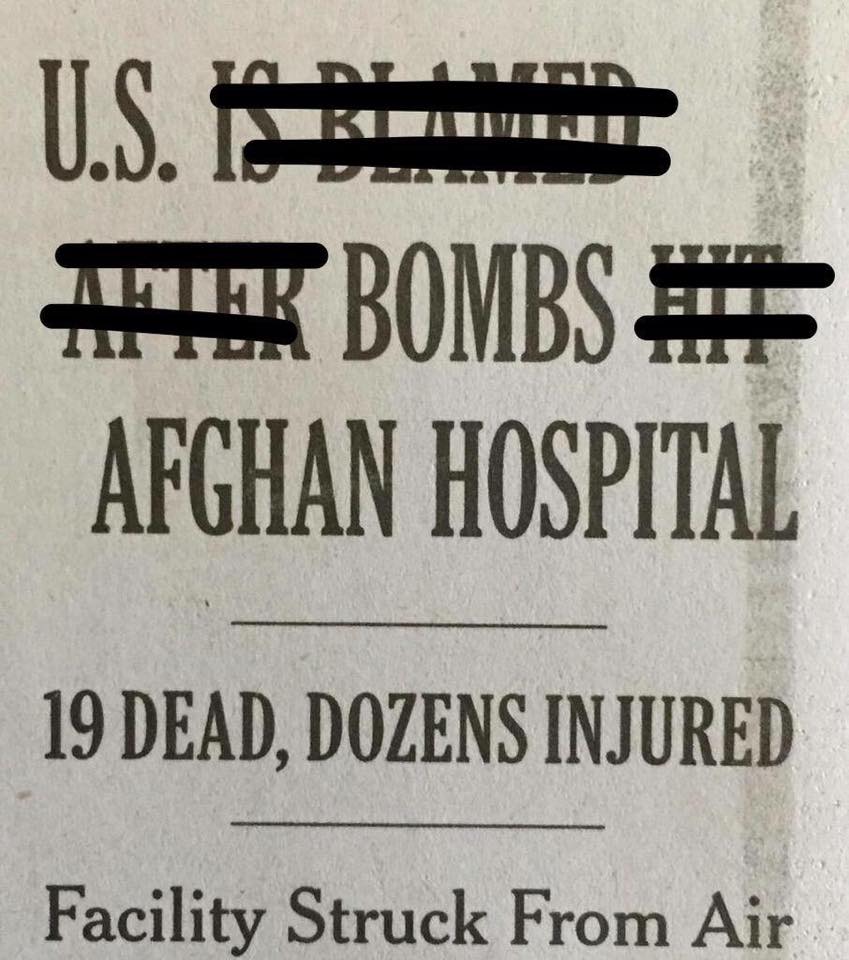
NYT headline (10/3/15) improved by Twitter user @OneKade
When the US bombed a hospital in Kunduz, Afghanistan, in October 2015, killing dozens of civilians, media scrambled to craft almost laughable euphemisms. FAIR (10/5/15) documented at the time how news outlets used circuitous headlines like “US Is Blamed After Bombs Hit Afghan Hospital.” Also seen in the August 23 NPR report cited above, this brand of misleading, ambiguous rhetoric is the “officer-involved shooting” of war reporting.
On the other hand, the responsibility of US enemies for killing civilians is rarely if ever obscured.
It is instructive to compare Western media coverage of Yemen to that of Syria, where attacks are “Assad bombing” (Fox News, 2/15/17), “Assad airstrikes” (Breitbart, 4/28/16), “Assad regime airstrikes” (Times of Israel, 10/16/12; Australian, 8/18/15), “regime airstrikes” (NBC, 8/19/16) or “regime bombing” (Daily Caller, 8/17/15).
Media have even written of a “pro-Assad drone” that was “displaying hostile intent,” and thus just had to be shot down by the US (Guardian, 6/20/17; Independent, 6/20/17; The Hill, 6/20/17), as if the robot were personally a fan of the Syrian leader.
The phrases “Salman bombing,” “Salman airstrikes” or “Saudi regime airstrikes” are, however, nowhere to be found in reports on Yemen.
Downplaying the Key US Role
Media calling US/Saudi coalition attacks “Yemeni airstrikes” is at best misleading, and at worst flat-out false. Yet this language also has a political effect: It obscures the character of the war. This framing is part of the “civil war” trope media have propagated for two-and-a-half years.
When Yemen is discussed, it is virtually always through the lens of a “civil war.” As FAIR (7/25/17) has detailed before, this exceedingly widespread myth, which has permeated media discourse, denies the extent to which the conflict is actually a foreign war on Yemen, led by Saudi Arabia, the UAE and their US and European sponsors.
Even the term “Saudi-led” coalition is misleading. The New York Times editorial board (8/17/16) acknowledged, in a little-noted editorial on Yemen, “Experts say the coalition would be grounded if Washington withheld its support.”
That is to say, if the US wanted the war in Yemen to end, it would end overnight. The “Saudi-led” coalition is only led by Saudi Arabia in name.
Surprisingly, in the midst of intensified coalition attacks, the New York Times published another rare editorial on Yemen on August 25. In the piece, dramatically titled “The Slaughter of Children in Yemen,” the editorial board forcefully warned of exactly what critics have been saying for 29 months:
The Saudi coalition—and its American enablers, who provide military equipment, aerial refueling and targeting—simply cannot be allowed to continue killing civilians and destroying what little is left of Yemen. That is why it is imperative to publicly identify the unconscionable slaughter of innocents for what it is, and to hope that this will shame Saudi Arabia and its American backers to search for a humane end to Yemen’s hell.
Reporters at the Times and elsewhere should heed this call to demonstrate journalistic responsibility by clearly conveying their governments’ responsibility for the slaughter in Yemen—not just in editorials, but in news articles, every time.
Israel’s Alarm over Syrian Debacle
By Daniel Lazare | Consortium News | August 22, 2017
There’s a rumor going around that the Syrian civil war is finally winding down and that the Baathist government is nearing its goal of driving out thousands of ISIS-Al Qaeda head-choppers financed and supplied – directly or indirectly – by the U.S., Turkey, Saudi Arabia, and the other Persian Gulf oil monarchies.
(Screenshot from White House video)
It would be good news if true. But most likely it’s not. While one stage in the Syrian conflict is coming to an end, another is beginning, and this time the results could be even worse.
The reason is Israel, until now the odd man in the latest Mideast wars. Despite intervening sporadically on the rebel side in Syria, the Jewish state generally held itself aloof from the conflict in the belief that events were breaking its way regardless of whether it stepped in or not. After all, why go to war when your enemies are doing a fine job of tearing each other apart on their own?
With President Bashar al-Assad expected to step down eventually, Israel figured that it only had to wait and watch as a hostile regime collapsed under its own weight as it thrashed about unable to restore order to Syria. Never in the Arab-Israeli hundred years’ war had Israel seemed stronger and the Arabs weaker and in greater disarray.
But then the unthinkable happened. Assad not only survived but prevailed. Backed by Russia, Iran and the Lebanese Shi‘ite militia Hezbollah, he has bottled up Al Qaeda in East Ghouta and Idlib province in the extreme northwest and is racing to lift ISIS’s siege on Deir-Ezzor along the Euphrates. If successful, the effect will be to clear a path straight through to the Iraqi border some 30 miles to the east.
U.S. military enclaves may remain in the northeast and in the southern border town of Al-Tanf. But it’s hard to see how they’ll have much of an impact as the Damascus regime tightens its grip on the country as a whole.
Israeli Outrage
But rather than making a wider war less likely, the upshot is to make it even more. Having bet on the wrong horse, Prime Minister Benjamin Netanyahu now finds himself facing a nightmare scenario in which Iran takes advantage of Assad’s winning streak to extend its reach from Iraq and Syria into Lebanon beyond. It’s not just a question of political influence, but of the emergence of a powerful Iranian-led military bloc.
Eleven years after fighting a vicious 34-day war in southern Lebanon, Israel thus finds itself facing not only Hezbollah but the Syrian Arab Army, Iran’s Islamic Revolutionary Guards, and Iraqi Shi‘ite militias – all backed by Russian military might – in a front extending across its entire northern border. All are battle-hardened after years of combat, better armed, better led, and more self-confident to boot. Israel finds itself confronting a new threat that is many times more powerful than Hezbollah (or Syria) alone.
Israeli consternation is not to be underestimated. One news outlet says the official attitude is one of “grave concern” while an anonymous government minister heaped blame on the U.S. for sacrificing Israeli interests:
“The United States threw Israel under the bus for the second time in a row. The first time was the nuclear agreement with Iran, the second time is now that the United States ignores the fact that Iran is obtaining territorial continuity to the Mediterranean Sea and Israel’s northern border. What is most worrisome is that this time, it was President Donald Trump who threw us to the four winds – though viewed as Israel’s great friend. It turns out that when it comes to actions and not just talk, he didn’t deliver the goods.”
Netanyahu is meanwhile off to the Black Sea resort of Sochi to confer with Russian President Vladimir Putin while, in Washington, Israeli military and intelligence officials are meeting with top Trump officials such as National Security Adviser H.R. McMaster and special Mideast envoy Jason Greenblatt.
Israel has also engaged in saber-rattling with regard to a missile factory that it says Iran is building in the Syrian port city of Baniyas. Gadi Eisenkot, the Israeli military’s chief of staff, said that stopping efforts by Iran, Syria, and Hezbollah to equip themselves with accurate missiles capable of striking deep inside the Jewish state “is our top priority.”
Adds Avigdor Lieberman, Israel’s hard-right defense minister: “We know what needs to be done…. We won’t ignore the establishment of Iranian weapons factories in Lebanon.”
Neocon Chorus
Words like that should not be taken lightly. Meanwhile, influential neoconservatives are joining the me-too chorus. At the Atlantic Council – the hawkish Washington think tank partly funded by the United Arab Emirates and pro-Saudi interests that functioned as an arm of Hillary Clinton’s 2016 presidential campaign – former Obama administration official Frederic C. Hof recently argued that the U.S. wouldn’t be in such a pickle if it had invaded Syria years ago:
“A Syrian opposition recognized by Washington in December 2012 as the ‘legitimate representative of the Syrian people’ should have been tasked with preparing for post-ISIS governance, and assisted to that end by an American-organized, multi-national effort. An all-Syrian stabilization force should have been built in a protected eastern Syria to pacify the area, facilitate humanitarian aid, and spur reconstruction.”
But now the U.S. is seemingly “indifferent” to what comes next once Islamic State is gone. As a consequence, Hof said, the Trump administration is effectively “install[ing] Iran as Syria’s suzerain, with the Assad entourage sifting through the country’s ruins for spoils and setting the stage for successive waves and varieties of extremism arising in response.” The only solution, according to Hof, is a radical strategic change “to prevent Iran and Assad doing their worst for the security of the United States, its allies, and its partners.”
With the Zionists and their neocon yes-men agreeing that something must be done, it seems that something WILL be done sooner rather than later.
Of course, a few complications could get in the way. One involves Russian President Vladimir Putin who, despite his close alliance with Assad, enjoys a solid working relationship with Israel and is none too eager to see war break out between the two countries. Another is the Syrian government in Damascus, which, under the leadership of the careful and cautious Assad, is none too eager to rush into a conflict that could conceivably prove even more ruinous than the one it is trying to finish up.
A Sick Kingdom
But even sober politicians like Putin and Assad may be unable to cope with the forces raging across the Middle East. The sectarian war that the Saudis unleashed more than a decade ago with U.S, help shows no signs of letting up. The kingdom is mired in an anti-Shi‘ite crusade in Yemen that it is desperate to escape, but doesn’t know how. It has suppressed a Shi‘ite uprising in Awamiyah, a city of 25,000 people in its own oil-rich Eastern Province, killing dozens according to Iranian sources and flattening an entire neighborhood, but dissent continues to bubble up ominously.
Saudi Arabia also has imposed an economic blockade on Qatar, and it is backing a repressive regime in Bahrain that has imposed a reign of terror on the country’s 70-percent Shi‘ite majority. Riyadh continues to engage in a dangerous war of words with Iran, which the royal family believes is engaged in an Elders of Zion-like Shi‘ite conspiracy to dismember the kingdom and wrest away control of Mecca and Medina.
The more paranoid Saudi leaders become, the more threatening Saudi Arabia grows – and the more resolved Iran becomes to make the most of its victory in Syria by fulfilling the ancient Persian goal of opening a corridor to the Mediterranean Sea. Aggression on one side leads to counter-aggression on the other, a process of mutual escalation that seems impossible to reverse.
Finally, there is the question of political stability – or, rather, an increasing lack thereof. In Iran, newly re-elected President Hassan Rouhani is locked in a growing confrontation with hardline Shi‘ite Islamists with little appetite for compromise.
In Saudi Arabia, power is in the hands of Crown Prince Muhammad bin Salman, a rambunctious 31-year-old who launched the disastrous war in Yemen in March 2015 – and then disappeared on a vacation in the Maldives as U.S. officials tried desperately to reach him by phone – and who more recently unveiled an ambitious economic reform program that so far has done nothing to stem the kingdom’s alarming decline. Despite vows to diversify the economy, non-oil revenue actually shrank by 17 percent this spring while foreign reserves have fallen by nearly a third since 2014. But that didn’t stop MbS, as he’s known, from committing himself to $110 billion in U.S. arms purchases in May or his father, King Salman, from spending a reported $100 million on a summer vacation in Morocco.
Saudi Arabia is thus becoming the sick man of the Middle East, one whose collapse could trigger a “geopolitical tsunami” sweeping across much of the region.
Trump’s Imbalance
Then there is the United States, where politics are even more unsettled. As President Trump careens from one disaster to another, foreign policy has grown both unpredictable and bellicose. One day, America’s second popular-vote-losing president in 16 years is calling for regime change in Tehran, the next he’s threatening Pyongyang with “fire and fury,” and then he’s blustering about some unspecified “military option” with regard to Venezuela.
The fact that Trump has so far demonstrated little follow-through is hardly reassuring. Sooner or later, rash rhetoric can only lead to rash actions, if not on America’s part then someone else’s. The shakier Trump grows, the greater the likelihood that he will engage in some risky adventure in order to strengthen his grip.
A number of forces are thus converging: political instability in Tehran, Riyadh and Washington, a growing thirst for more war on the part of Israel and the U.S. foreign-policy establishment, and a growing defensiveness on the part of a “Shi‘ite crescent” stretching from Yemen to southern Tehran. The United States, Turkey, Saudi Arabia, and others have already plunged Syria into death and destruction by sponsoring a murderous Sunni Salafist assault on one of the most diverse populations in the Middle East. The big question now is whether, with Israeli help, they are about to impose another.
Given the vicious cycle of violence in the Middle East, one that the U.S. has done its level best to worsen at every step of the way, it’s hard not to believe that even worse may be ahead.
Daniel Lazare is the author of several books including The Frozen Republic: How the Constitution Is Paralyzing Democracy (Harcourt Brace).
House GOP Seeks to Curb Yemen War
By Dennis J Bernstein | Consortium News | July 26, 2017
Republicans are taking the lead in blocking U.S. participation in the Saudi slaughter in Yemen, which has plunged that country to the brink of starvation and sparked a cholera epidemic. Surprising to many, there was a vote by the Republican-led House of Representatives to block U.S. participation in the Saudi-led war.
The key amendment to the National Defense Authorization Act — prohibiting U.S. military support for the Saudi-led coalition’s bombing of Yemen — was sponsored by Rep. Warren Davidson, R-Ohio. Though the amendment gained bipartisan support — and another restrictive amendment was sponsored by Rep. Dick Nolan, D-Minnesota — the Republican leadership on this issue reflects the changing places in which Democrats have become the more hawkish party in Congress.
I spoke to Kate Gould, Legislative Representative for Middle East Policy for the Friends Committee on National Legislation about this pressing issue of life and death in Yemen. We spoke on July 17.
Dennis Bernstein: Well, this is a terrible situation and getting worse by the day. Could you please remind everyone what it looks like in Yemen on the ground?
Kate Gould: It is a catastrophic situation. According to the United Nations, it is the largest humanitarian crisis in the world right now. And despite the fact that this humanitarian crisis has been a direct result of the Saudi/United Arab Emirate-led war in Yemen, backed by the United States, most Americans have no idea that we are so deeply involved in this war.
A conservative estimate is that seven million people are on the verge of starvation, half a million being children. The people in Yemen are experiencing the world’s largest cholera outbreak. A child under the age of five is dying every ten minutes of preventable causes. Every 35 seconds a child is infected.
This is all preventable with access to clean water and basic sanitation. This war has destroyed the civilian infrastructure in Yemen. We’re talking about air strikes that have targeted warehouses of food, sanitation systems, water infiltration systems. The World Health Organization points out that cholera is not difficult to prevent. The problem is that so many Yemenis lack access to clean water as a result of the infrastructure being in ruins.
DB: What about the medical infrastructure, what about the ability to deal with this kind of epidemic, or is it just going to get worse?
KG: Well, unless we do something to change the situation, it is definitely going to get worse. In Yemen, 90% of food is imported and the Saudis have made this much more difficult. They imposed more restraints on one of the major ports and have refused to allow Yemen to repair the damage caused by air strikes. Often it is difficult for ships to get permission to berth. All these complications have driven up the price of food so that even when food manages to be imported it is too expensive, even for those earning decent incomes. So what we are seeing is a de facto blockade as well as a war.
DB: Could you say a few words about the campaign of the Saudi military and what kind of weaponry they are using? Later I would like to discuss US support for all of this.
KG: The Saudi-led war began about two and a half years ago in March, 2015. At that time they asked for US support and got it from the Obama administration. The air campaign has resulted in the carpet bombing of Yemen. It is the Saudis and the United Arab Emirates who have been driving this massive bombardment. There has been an all-out assault on civilians and civilian infrastructure.
And, of course, as Senator Chris Murphy (D-CT) has pointed out, the Saudis would not have been able to carry out this bombing without full US support. Their planes cannot fly without US refueling capacity. In fact, since October the US has actually doubled the amount of fuel it provides to Saudi and Emirati bombers. Last October is significant because at that time there was a major bombing of mourners coming out of a funeral hall which killed about 140 civilians and wounded another six hundred. Since that atrocity, the US has doubled its refueling support.
DB: How does the US justify its support for the Saudis, from a human rights perspective?
KG: We’ve heard very little discussion of the human rights angle from the Trump administration. The Obama administration claimed to be pressuring the Saudis to take precautions to prevent civilian casualties, that this is why the US has provided precision-guided smart bombs, to limit civilian casualties. There has never been an official US response to the fact that the Saudis and Emiratis are deliberately pushing millions to the verge of starvation. They are using hunger as a political tool to get better leverage on the battlefield and at the negotiating table. This is really what is driving the humanitarian nightmare.
DB: We know that Trump was just in Saudi Arabia and signed a massive weapons contract. Will this weaponry contribute to the coming famine and cholera epidemic?
KG: Certainly. It is providing the Saudis a blank check for this devastating war in which direct casualties from airstrikes are conservatively estimated at around 10,000 and millions of people have been displaced. It sends the message that the United States is willing to support the Saudis despite massive human rights violations.
DB: There is no way the US or the Saudis can deny the tragedy. This has been thoroughly documented by US and international rights groups.
KG: But what they will often say is that a lot of the fault lies with the Houthi rebel groups. And it is certainly true that the Houthi rebels have committed massive human rights violations. But as far as the mass devastation of public infrastructure is concerned, which is leading to the humanitarian crisis, the majority of the blame can be assigned to the Saudi-led war and the US backing.
Repeatedly, Amnesty International and Human Rights Watch, responding to the scene of unlawful airstrikes against civilian targets, have found either unexploded US-made bombs or identifiable fragments of US bombs. This was the case with the bombing of the funeral procession last October. Still, the US government claims that it is trying to limit civilian casualties.
DB: It is interesting that the Republican-led House has voted to block US participation in the war in Yemen. It seems somewhat counter-intuitive.
KG: It is definitely surprising. Although I’ve been working around the clock on this recently, even I was surprised. What happened is that last week [week of July 9] the House of Representatives voted on the major military policy bill for fiscal year 2018. This is a major piece of national security legislation which authorizes funding for the Pentagon. It has to get passed every year and it provides an opportunity for members to vote on amendments that have to do with national security.
Two of these amendments were particularly consequential for Yemen. One was introduced by a Republican, Warren Davidson of Ohio, and the other by Rick Nolan, a Democrat from Minnesota. They added language that would require the Trump administration to stop providing refueling for Saudi and Emirati bombers, as well as to stop intelligence sharing and other forms of military support. It wouldn’t stop the weapons sales, which is another process, but it would stop military support for this indiscriminate war.
The Davidson amendment would prohibit US military action in Yemen that is not authorized by the 2001 Authorization for Use of Military Force. Given that US participation in the Saudi-led war in Yemen is not targeting Al-Qaeda, it is not authorized by the 2001 AUMF and is prohibited by this amendment. The Nolan amendment prohibits the deployment of US troops for any participation in Yemen’s civil war.
This means that the House just voted to end US funding of our military for the Saudi-led war in Yemen. This is really unprecedented and it builds on the wave of congressional momentum that we saw last month when 47 senators voted against sending more of what we call “weapons of mass starvation” to Yemen. So we have clear signals from both the House and the Senate that there is no support for Trump’s blank check to Saudi Arabia for this devastating war.
DB: So now this goes to the Senate?
KG: Yes, and there we are going to face a more difficult fight. We’re preparing for that now. We definitely will see some important Yemen votes in the Senate. It could come up right after a health care vote in early August or it might not be voted on until the fall. But we will see votes on Yemen. It is unclear whether a Senate member will offer amendments similar to the Davidson or Nolan amendments.
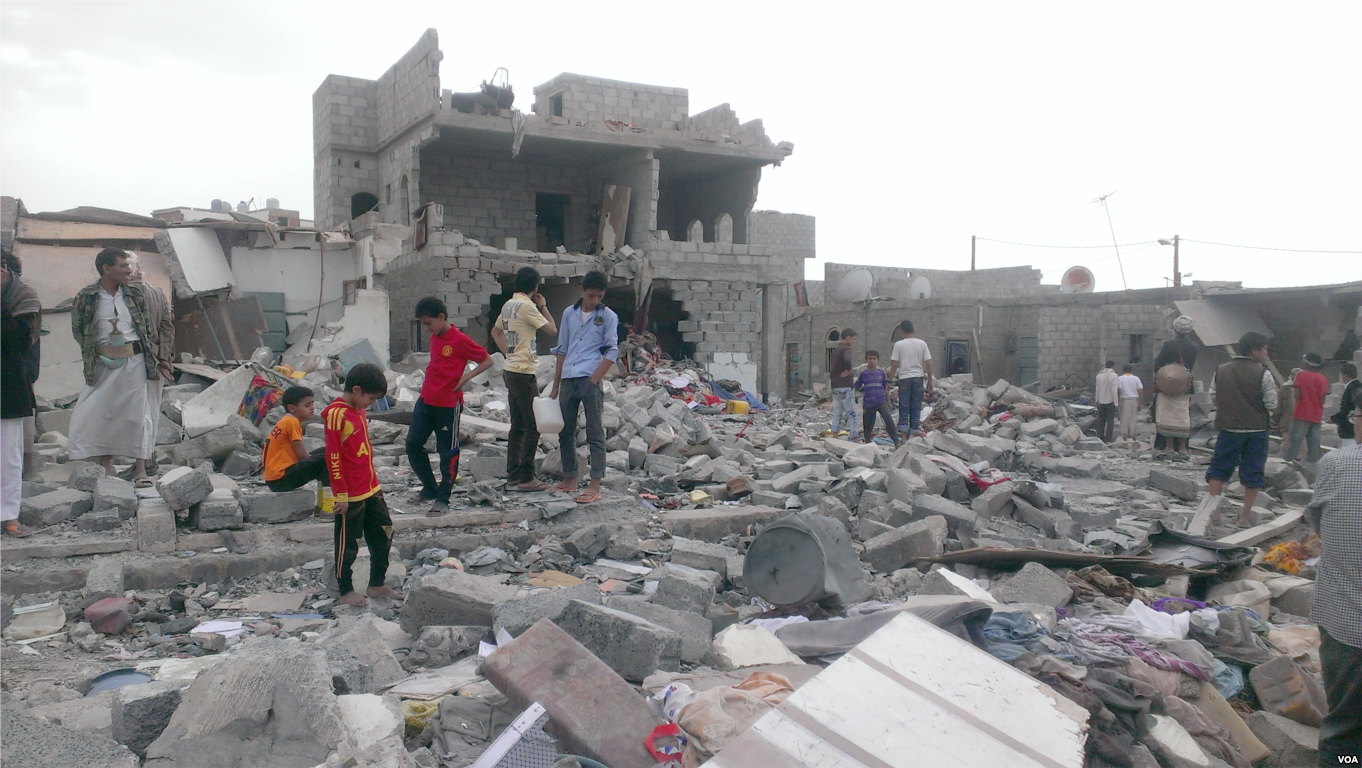
Yemeni capital of Sanaa, Oct. 9, 2015 (Wikipedia)
After the Senate votes on the various amendments, they will both have versions of this and they will have to come back and conference a final version to send to the president. This is definitely a time to push our senators to follow suit with the House and oppose US involvement in this devastating war in Yemen.
DB: Finally, who are some of these Republican Congressional members who stood up in this effort to restrain this oncoming famine? Who were some of the surprise votes?
KG: Actually, this was added in a whole block of legislation so we can’t point to exactly who supported and who opposed it. It was good to see Warren Davidson taking a leadership role on this issue. He is relatively new in the Senate, having taken [Former House Speaker John] Boehner’s seat. It is noteworthy also that the Chairman of the House Armed Services Committee, Mac Thornberry from Texas, allowed this amendment to go forward. Just that the House Republican leadership allowed this to move forward is really interesting in itself.
DB: Yes, it is. It seems to me that the Democrats have really become out-of-control Cold Warriors, either lost in Russia-gate or dropping the ball on this very important foreign policy issue. We thank you, Kate Gould, Legislative Representative for Middle East Policy with the Friends Committee on National Legislation.
KG: And I just want to say that we can win on this one and we need everybody to get involved. You can go to our website, fcnl.org, to get more information. Again, 47 Senators voted last month to block these bomb sales and we only need 51 votes. And with Trump’s massive arms deal with Saudi Arabia, I’m sure we will have more votes on this. But it is really important to stay engaged and we need everybody to get involved and contact your members of Congress.
Dennis J Bernstein is a host of “Flashpoints” on the Pacifica radio network and the author of Special Ed: Voices from a Hidden Classroom. You can access the audio archives at www.flashpoints.net.
Featured Video
Seyed M. Marandi: Negotiations Collapsed – Return to War
or go to
Aletho News Archives – Video-Images
From the Archives
Wartime internment camps in Australia
National Archives of Australia
World War I
During World War I, for security reasons the Australian Government pursued a comprehensive internment policy against enemy aliens living in Australia.
Initially only those born in countries at war with Australia were classed as enemy aliens, but later this was expanded to include people of enemy nations who were naturalised British subjects, Australian-born descendants of migrants born in enemy nations and others who were thought to pose a threat to Australia’s security.
Australia interned almost 7,000 people during World War I, of whom about 4,500 were enemy aliens and British nationals of German ancestry already resident in Australia.
Records of World War I internment camps
World War II
During World War II, Australian authorities established internment camps for three reasons – to prevent residents from assisting Australia’s enemies, to appease public opinion and to house overseas internees sent to Australia for the duration of the war.
Unlike World War I, the initial aim of internment during the later conflict was to identify and intern those who posed a particular threat to the safety or defence of the country. As the war progressed, however, this policy changed and Japanese residents were interned en masse. In the later years of the war, Germans and Italians were also interned on the basis of nationality, particularly those living in the north of Australia. In all, just over 20 per cent of all Italians resident in Australia were interned. … continue
Blog Roll
 Aletho News
- Seyed M. Marandi: Negotiations Collapsed – Return to War
- Tomorrow’s naval blockade showdown
- ‘Israel’ attacks civilians to hide its embarrassing military failures & out of pure sadism
- Any Foreign Military Vessel Approaching Hormuz Under Any Pretext ‘Will Be Dealt With Severely’: IRGC
- Diplomats slam US negotiators’ performance in Iran talks
- Trump Refuses Exit Ramp, War with Iran will Continue
- Trump Says US Naval Blockade in Strait of Hormuz Will Begin Shortly
- US, Iran end 21-hour talks without agreement
- US IRAN TALKS: Who Are the Crazy Ones Here? /Lt Col Daniel Davis
- Talks with the US end without a deal over excessive US demands: Iran
- If Americans Knew
- US-Iran ceasefire negotiations make zero progress – Daily Update
- Pro-Israel ‘Thinktanks’ and Individuals who Influence U.S. Foreign Policy
- Mearsheimer reveals how Israel dictates US policies on Iran, Gaza – video
- After killing 350+, Israel still has a “score to settle” with Lebanon before ceasefire – Daily Update
- Military aid to Israel emerges as the latest political litmus test for Democrats
- The only Palestinian children’s rights organization closes following years-long Israeli campaign against it
- ‘I Can’t Forget the Smell’: Lebanese Reel After Israel Kills Over 300 in Single Day
- DNC Shoots Down Resolutions Calling Out AIPAC and Limiting Arms to Israel
- TCN: Is Israel Blackmailing President Trump?
- Israel killed at least 303 Lebanese yesterday – who were they? Daily Update
- No Tricks Zone
- German Expert: Heat Dome Led To Record Temps In Western USA…Warmer In 1934, 1936
- New Study: No Linear Warming Or Glacier Retreat Along Northern Antarctic Peninsula Since 1980s
- An Inconvenient Tree: Uncovered In Alps… Europe Much Warmer Than Today 6000 Years Ago
- New Study Reports A 60% Slowdown In Greenland’s Ice Loss Rate In The Last Decade
- Low Intensity Tornado Wrecks Major Solar Farm, Creating A Potential Toxic Dump
- New Study Finds Warming Saves Lives…Cold Temperatures 12 Times More Deadly Than Excess Heat
- German Science Blog Accuses PIK Climate Institute Of Hallucinating Climate Tipping Points
- Devastating Assessment Of Comirnaty Vaccine By Former Senior Pfizer Europe Toxicologist
- New Study: CO2 Is ‘Effectively Negligible’ As An Explanatory Climate Change Factor Since 2000
- Former Pfizer Toxicologist Dr. Helmut Sterz Tells Bundestag Hearing Pfizer Vaccine Should Have Never Been Approved
 Aletho News