Ansarullah rejects US mediation in efforts to resolve Yemen conflict
Press TV – October 31, 2018
The Houthi Ansarullah movement has opposed a US proposal for mediation in efforts to resolve the conflict in Yemen, holding Washington responsible for the Saudi-led aggression against Yemen.
Mohammed al-Bakhiiti, a member of Ansarullah’s Political Council, told Iran’s Arabic-language Al-Alam news network on Wednesday that peace would be restored to Yemen if the US ended its war on the impoverished country.
He also expressed his objection to any solution to the Yemen crisis that ignores the country’s independence and sovereignty.
On Tuesday, American officials called for a ceasefire in Yemen and demanded that the sides to the conflict come to the negotiating table within a month.
US Defense Secretary Jim Mattis said the US had been watching the conflict “for long enough,” and that he believed Saudi Arabia and the UAE were ready for talks.
“We have got to move toward a peace effort here, and we can’t say we are going to do it sometime in the future,” he said. “We need to be doing this in the next 30 days.”
Mattis’ call was later echoed by US Secretary of State Mike Pompeo, who urged the coalition to stop airstrikes in Yemen’s populated areas, saying the “time is now for the cessation of hostilities.”
Bakhiti further stressed that Washington’s proposed solution for the Yemen conflict included dividing the country.
Mattis’ plan, supported by Saudi Arabia and the UAE, is meant to achieve goals that have not been attained during the war on Yemen, he added.
The only solution to the crisis is intra-Yemeni talks and non-interference by foreign parties, the Houthi official said.
In March 2015, Saudi Arabia and its allies launched a brutal war against Yemen in an attempt to reinstall the country’s former Riyadh-allied regime and crush the Houthis.
The Western-backed war, however, has so far failed to achieve its stated goals, thanks to stiff resistance from Yemeni troops and allied Houthi fighters.
The offensive, coupled with a naval blockade, has destroyed Yemen’s infrastructure and led to famine as well as a cholera outbreak in the import-dependent state. Tens of thousands of people have also lost their lives in the conflict.
There is No “Proxy War” in Yemen
By Rannie Amiri | CounterPunch | October 19, 2018
Those in the Western media too busy to be bothered trying to understand the complexities, intricacies and nuances of the Middle East often resort to concluding nearly all conflicts there are some kind of “proxy war” between Saudi Arabia and Iran.
This is usually out of ignorance, reducing disputes to the lowest common dominator of Sunnis versus Shiites or to that between their two most prominent patron states. Often though there is deliberate obfuscation; there must be justification for a US ally to cause regional mayhem on the pretext of containing an enemy. The easiest and most convenient scapegoat has been Iran and efforts to contain its alleged expansionism by Saudi Arabia, the United Arab Emirates and of course, Israel, go unchecked.
One of the most devastating and tragic episodes occurring in the Middle East today is in Yemen. But this is not a de facto proxy war its bankrollers hope we have all grown too weary of hearing to investigate further.
Despite the constant disclaimers by a lazy media, there is no proxy war in Yemen.
The war which has ravaged the Arab world’s poorest country since March 2015 is a Saudi-led, unilateral onslaught which has so devasted the nation, its economy, infrastructure and social services that malnutrition has become widespread and cholera epidemic.
Ostensibly, the Saudi-UAE military campaign was to oust Houthi-led rebels who unseated the deeply unpopular Saudi-backed puppet-president Abdu Rabbu Mansour Hadi in January 2015 (elected on a ballot in which he was the only candidate and who remained in power even after the expiration of a one-year mandate that had extended his term). The Houthis, a politico-religious group officially known as Ansarullah and named after their founder, Hussein Badreddin al-Houthi, initially formed in opposition to late Yemeni president Ali Abdullah Saleh.
The Houthis generally belong to the Zaidi school in Islam, a branch of the larger Shiite sect. Branding the Houthis as “Iranian-backed Shiite rebels” as is now routine, makes for easy and convenient categorization of who the “bad guys” are in Western and Gulf media. But this is disingenuous. The inconvenient fact is Zaidis are generally closer to Sunni Islam than Shiite (and the longtime military, Saudi-backed dictator Saleh was Zaidi). More significantly, other than voicing solidarity with the Houthis, there has been no substantive evidence of Iranian military intervention or that of affiliated parties in Yemen. On the contrary, and starkly so, it has been the Saudi and Emirati governments’ inhumane bombing campaign which has been the most glaring example of foreign interference in the internal affairs of another country.
When a school-bus was struck during an air raid that killed 40 children, it was initially justified as a “legitimate military target” by the Saudi coalition before international outrage finally led to the conclusion it was otherwise. On the other hand, intermittent Houthi missiles launched at Saudi military installations and considered evidence of foreign military supply belie the Houthis as a legitimate, capable, battle-hardened fighting force. Apparently, the regime cannot fathom that despite daily attack, they have had the muster to retaliate and demonstrate offensive, rather than strictly defensive, capabilities.
Yemen is not a sectarian conflict or one of proxies, but a war stemming from the fallout of removing yet another Saudi-backed ruler from power.
Since 2015, at least 10,000 Yemenis have been killed, 22 million are now in need some form of relief (out of a total population of approximately 29 million) and eight million are malnourished. These numbers can only be expected to climb after evidence has shown Saudi Arabia is targeting food supplies.
The war waged in Yemen by Saudi Arabia and its allies and their wanton use of US and UK-supplied arms is everything short of a formal invasion. It is a one-sided, vicious military adventure which has rendered millions destitute and to date, has proven completely unsuccessful in fulfilling its stated objectives. The only proxies in this struggle are the victims of its war crimes; innocent men, women and children starved or killed, stand-ins for an apparition of a foreign power waiting to be found.
Guardian Watch – Freedland Remembers Yemen is a Thing
By Kit Knightly | OffGuardian | October 20, 2018
Jonathan Freedland has weighed in on the Khashoggi case. He’s outraged, of course. Because they all are. Every single voice in the mainstream world has suddenly realised just how appalled they are that Saudi Arabia does bad things.
They weren’t appalled a few weeks ago, when the Saudis blew up a bus full of school children.
But they are appalled now, because Mike Pompeo was told by the Turkish government, who were told by the Turkish secret service, that a reporter who may or may not be dead, might have been killed by a super-secret Saudi Arabian hit squad (who then died in a car accident). There are video and audio recordings to prove all of this but we’re not allowed to see them yet.
Freedland recounts these alleged gory details with po-faced prurience. Apparently, they might have used a chainsaw. But that’s not really what his article is about – his article is about attempting to claw back some credibility in the face of (perfectly justified) accusations of massive hypocrisy, and deeper questions about the motivations of the media and the agenda of the Deep State.
You see, Yemen is a thing.
It’s the poorest country in the Middle-East and it’s being systematically destroyed by its vastly richer neighbours, with the full backing and cooperation of NATO. In fact, we’re making a fortune out of it. Bombs are expensive, the Saudis need a lot of them, and you can only use them once. Ker-ching.
Domestically, Saudi Arabia is an absolute monarchy with a laughable track-record when it comes to human rights. This has been known for decades, it is talked about a lot. Barely a week goes by without some author, somewhere in the alternate media, writing up a story about the crimes of the House of Saud – either international or domestic. So why are we just now hearing about them in the mainstream?
When he was selling wars in Libya and Syria, did Freedland ever once suggest the “humanitarian bombing” of Riyadh?
Did he object to his paper selling ad space to promote the Muhammed bin Salman, “the great reformer”?
Did he boycott events or protest arms deals or in any way speak out?
Did he devote even a single one his columns to the war in Yemen?
People all over the world are asking: “Why are the Saudis suddenly the bad guys? Why can’t Jamal Khashoggi be brushed under the carpet as if he’s nothing but a burning bus full of children or a napalm-strewn wedding reception?”
It’s a question no one in the media has an answer for. They are aware of the contradiction though, and they are busily trying to get around it.
This is Freedland’s attempt:

I can understand the frustration of campaigners for Yemen that the death of one man has captured a global attention that has so rarely focused on the tens of thousands killed…But sometimes it takes the story of a single individual to break through. So it has proved with Khashoggi.
That’s it. A simple brush-off.
That’s the new narrative – nobody really realised just how bad the Saudis were until now. This is the big reveal. The “oh shit” moment. None of them had been on twitter, or read the alternate news or even looked at the comments BTL on their own articles. Yes, Yemen was there in the background but – through forces beyond everyone’s control – it just never broke through to the public consciousness. Oops.
He’s trying to imply that the news just sort of happens, like it’s an organic process beyond the control of the mere mortals writing the stories or filming the segments or thinking up the headlines.
That is patently absurd. We know how the media works, and it’s not some Jungian expression of the collective will. To suggest as much is insulting and ridiculous.
The news is a system by which a handful of mega-corporations distribute propaganda and manipulate public opinion. It is rigidly controlled. They push some issues to the front page and shovel others down the memory hole. When they need to, they make stuff up. Every headline is picked for a purpose, every omission deliberately made. Cogs turn and push the constantly-evolving agenda forward. There are no accidents, and the process is anything but organic.
It’s mechanical. And like all machines, it lacks a soul. There has been no grand awakening of the media conscience. There is no such thing.
There was a reason Yemen was banished to the far reaches of the press for four years. There was a reason the mainstream media were happy to white-wash the Saudi Arabians as they pummelled school buses and weddings with bombs British and American arms companies probably over-charged them for.
There’s a reason every big newspaper on both sides of the Atlantic was happy to serve as Muhammad bin Salman’s PR agency…. and there’s a reason they stopped. A real reason, that has nothing to do with Jamal Khashoggi.
We just don’t know what it is yet.
Kit Knightly is co-editor of OffGuardian. The Guardian banned him from commenting. Twice. He used to write for fun, but now he’s forced to out of a near-permanent sense of outrage.
American mercenary boasts of role in ‘targeted assassination program’ in Yemen
RT | October 17, 2018
A Hungarian-Israeli security contractor based in the US, Abraham Golan, has claimed he ran a targeted assassination program in Yemen as part of the Saudi-led coalition currently waging a proxy war against Iran-backed Houthis.
The US is supplying weapons, intelligence, and other support to the coalition, but Golan’s account, as told to BuzzFeed, reads like something out of a spy thriller.
Golan claims the United Arab Emirates (UAE), part of the coalition, hired his mercenary company, Spear Operations Group, to kill specific enemies, including Anssaf Ali Mayo, leader of the Yemeni political party Al-Islah, which the UAE considers a terrorist group. The Mayo assassination was ultimately unsuccessful – Mayo disappeared from Yemeni politics for a while, and the Spear crew even thought he was dead, but he is currently serving in the Yemeni government, alive and well.
The botched assassination of December 29, 2015 is seen by observers from both sides as the opening salvo in a “targeted campaign,” which former UN investigator Gregory Johnsen says eventually took out 25 to 30 members of Al-Islah and other clerics.
Golan claims responsibility for several of the high-profile assassinations in Yemen, though he refuses to share which ones. Not because of remorse – he’s a mercenary, after all – but because his business inhabits a legal gray area, and perhaps because he doesn’t want his professional secrets getting out. Golan is trying to sell his business model to the US military.
Experts have cast doubt on the idea that the US, which essentially armed and trained the UAE’s military from the ground up, didn’t know the UAE had hired Americans to conduct assassinations in a war in which the US is deeply involved. The CIA claimed ignorance of the matter, but one agency official – after categorically denying the government would allow such a thing – confirmed the story, himself shocked that American mercenaries had been allowed to operate “almost like a murder squad.”
The US does enjoy a privileged place within UAE military circles, having sold the Arab nation $27 billion in arms and defense services since 2009. While the US theoretically bars mercenaries from participating in combat, it hires them to do everything else in the military, and one man’s security detail is another man’s firefight.
Private contractors are supposed to be regulated by the State Department, which claims it has never permitted mercenaries to work for another government, and US law forbids any who would “conspire to kill, kidnap, [or] maim” a foreign citizen. But the publication cites multiple sources who claim Spear mercenaries were given military rank by the UAE, providing them legal cover for their actions (US citizens are allowed to serve in foreign militaries, with some exceptions).
BuzzFeed was admittedly unable to verify much of Golan’s biography, which allegedly includes a stint in the French Foreign Legion and friendships with notorious figures like former Mossad head Danny Yatom and Serbian militant Arkan. A CIA acquaintance calls him “prone to exaggeration.” The details of his story – “target cards” handed out with names, photographs, even phone numbers; a Jolly-Roger-esque company flag – are Hollywoodesque.
Golan supposedly offered the UAE his company’s services as targeted assassins, explicitly tasked to “disrupt and destruct” Al-Islah. On top of $1.5 million a month, they would receive kill bonuses and train UAE soldiers. He claims to have declined missions targeting individuals outside the party, but those claims are unverified, and his partner admits that some targets may have simply been enemies of the UAE’s ruling family.
However much truth there may be to Golan’s tale, it illuminates the consequences of War on Terror mission creep – an overabundance of highly-trained special forces, lax oversight regarding war crimes and international law, an increasingly privatized fighting force, and the notion that enemy combatants are anyone a government deems them to be mean Spear’s business model could strike US commanders’ fancy after all.
Saudi-led military aggression left over 15,000 civilians dead: Rights group
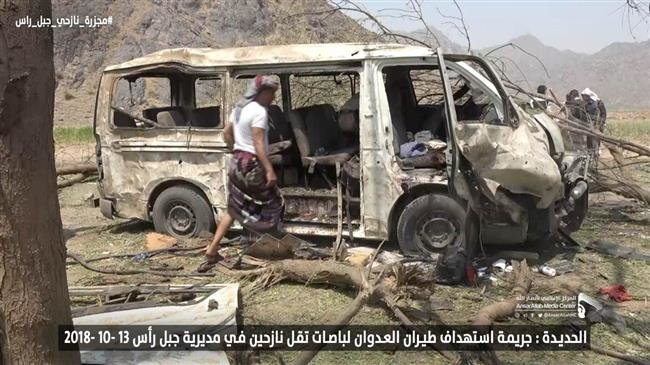
Picture, provided by Yemen’s Houthi Ansarullah movement, shows aftermath of Saudi airstrike against Gabal Ras area in Yemen’s western coastal city of Hudaydah on October 13, 2018.
Press TV – October 16, 2018
The Legal Center for Rights and Developments in Yemen says the ongoing Saudi-led military campaign against the impoverished and conflict-plagued Arab country has claimed the lives of more than 15,000 civilians.
The center, in a statement released on Monday, announced that the aggression has resulted in the death of 15,185 civilians, including 3,527 children and 2,277 women.
A total of 23,822 civilians, among them 3,526 children and 2,587 women, have also sustained injuries, and are currently suffering from the lack of medicine, medical supplies and poor treatment due to the crippling Saudi siege.
The center further noted that the Saudi military aggression has also caused the death of nearly 2,200 Yemenis from cholera.
It highlighted that aerial assaults being conducted by the Saudi-led alliance have resulted in the destruction of 15 airports and 14 ports, and damaged 2,559 roads and bridges in addition to 781 water storage facilities, 191 power stations and 426 telecommunications towers.
The statement went on to say that the incessant Saudi-led bombardment campaign has destroyed more than 421,911 houses, 930 mosques, 888 schools, 327 hospitals and health facilities plus 38 media organizations, halted the operation of 4,500 schools and left more than 4 million people internally displaced.
In addition, the Saudi-led coalition has targeted 1,818 government facilities, 749 food storehouses, 621 food trucks, 628 shops and commercial compounds, 362 fuel stations, 265 tankers, 339 factories, 310 poultry and livestock farms, 219 archaeological sites, 279 tourist facilities and 112 playgrounds and sports complexes.
The Legal Center for Rights and Developments in Yemen then called on the United Nations to shoulder its responsibilities concerning protection of human rights and the rules of international humanitarian law in Yemen.
It also called on the international community to take on its legal, moral and humanitarian responsibilities, stressing the need for urgent international and regional actions to end the Saudi-led aggression against Yemen.
The center finally asked the United Nations Human Rights Council (UNHRC) to conduct a professional and impartial investigation into the crimes being perpetrated against civilians in Yemen.
Saudi Arabia and a number of its regional allies launched a devastating military campaign against Yemen in March 2015, with the aim of bringing the government of former president Abd Rabbuh Mansur Hadi back to power and crushing the country’s popular Houthi Ansarullah movement.
‘Evidence’ Saudi-led coalition aims to destroy food production in Houthi-controlled Yemen – report
RT | October 13, 2018
As the war in Yemen rages on, a new report says there is “strong evidence” that the Saudi-led coalition has aimed to destroy food production and distribution in areas of the country controlled by Houthi rebels.
The report, titled ‘Strategies of the Coalition in the Yemen War: Aerial Bombardment and Food War’, is a compilation of data from various sources on the impact of the coalition’s bombing campaign on the production and distribution of food in rural Yemen, and on fishing along the Red Sea coast.
“If one places the damage to the resources of food producers (farmers, herders, and fishers) alongside the targeting of food processing, storage and transport in urban areas and the wider economic war, there is strong evidence that Coalition strategy has aimed to destroy food production and distribution in the areas under the control of Sanaa,” the report, published earlier this week by the World Peace Foundation, says.
It goes on to explain that the deliberate destruction of “family farming and artisanal fishing” is a war crime.
The report includes data collected by several organizations within Yemen, including the Yemen Data Project, the Ministry of Agriculture and Irrigation, and the Ministry of Fish Wealth.
Read more
Yemenis grieve beside the grave of a child killed in last month’s coalition airstrike on a school bus © Naif Rahma Pompeo says Saudi coalition exercising caution in Yemen – facts show that’s not true
“Together, the data detail the overall levels of targeting civilian, military and unknown sites… the systematic targeting of agricultural areas including the character of the site, and the frequency and timeline of targeting.”
It goes on to document the killing of fishermen along Yemen’s Red Sea coast, and the destruction of boats and infrastructure required to support small-scale fishing which “otherwise could provide life-saving food for a civilian population on the brink of famine.”
The report cites data from the General Authority of Fishing in the Red Sea when it states that 146 fishermen have died as a result of coalition airstrikes from the beginning of the war until December 2017.
Yemen has seen major civilian loss and suffering since the country’s civil war broke out in 2015, with many on the brink of starvation. The country has also endured a major cholera outbreak and a severe lack of medical supplies which has led to many cancer patients having to forego treatment.
Over 16,000 civilians are believed to have perished since the start of the civil war. Meanwhile, the UN and rights groups have repeatedly accused the Saudi-led coalition of not sparing the lives of civilians during its aerial bombardment of Yemen. Up to 50 people were killed when a wedding was bombed in April, while an attack on a bus saw dozens, including many children, die in August.
FILE PHOTO A displaced Yemeni woman from Hodeida cooks food outside a shelter © AFP / Essa Ahmed
The coalition has denied allegations that it is targeting civilians. It did, however, express regret over the bus attack. Such an admission is rare for the coalition, particularly after it previously referred to the bus attack as being “legitimate.”
The Saudi-led coalition intervened in the conflict in Yemen in 2015, in an effort to restore the internationally recognized government after it was driven out by Houthi rebels.
US foreign military sales for 2018 total $55.66B, up 33 percent
Press TV – October 9, 2018
Sales of US military equipment to foreign governments have increased by 33 percent compared to the previous year’s total, a US administration official says.
Lieutenant General Charles Hooper, director of the Defense Security Cooperation Agency, told Reuters on Tuesday that the US foreign military sales hit 55.6 billion dollars in the fiscal year ending September 30.
According to Reuters, the increase in foreign military sales came in part because the Trump administration rolled out a new “Buy American” plan in April that relaxed restrictions on sales while encouraging US officials to take a bigger role in increasing business overseas for the US weapons industry.
Hooper said the $55.6 billion figure represented signed letters of agreement for foreign military sales between the United States and allies.
The United States sold over $40 billion worth of weapons last year, maintaining its position as the world’s dominant arms supplier.
A report by the Stockholm International Peace Research Institute (SIPRI) revealed in March that the US has increased its arms sales by 25 percent over the past five years.
It also said some half of US arms exports during that period have gone to the Middle East, and that Saudi Arabia registered a 225-percent rise in military purchases – almost all from the US and Europe.
Saudi Arabia was the first country US President Donald Trump visited after taking office last year. It was announced during his visit to Riyadh that Washington could sell $110 billion in military equipment to Saudi Arabia in a period of 10 years. The State Department said at the time that the deal could grow to $350 billion over a decade.
The massive arms sales come despite repeated international calls on the US to stop supporting the Saudis with modern weaponry, which the kingdom has, according to many reports, used in its devastating war on Yemen.
The White House has also been criticized by both human rights groups and US lawmakers in Congress from both political parties for allowing its Saudi ally to bomb Yemen.
Some 15,000 Yemenis have been killed and thousands more injured since the onset of the Saudi-led aggression in March 2015.
Washington has denied it is directly supplying the Saudis with weapons in the war but numerous reports have suggested that US arms have played a part in massive civilian casualties.
The Lies of our (Financial) Times
By James Petras | Dissident Voice | October 4, 2018
The leading financial publications have misled their political and investor subscribers of emerging crises and military defeats which have precipitated catastrophic political and economic losses.
The most egregious example is the Financial Times (FT) a publication which is widely read by the business and financial elite.
In this essay we will proceed by outlining the larger political context that sets the framework for the transformation of the FT from a relatively objective purveyor of world news into a propagator of wars and failed economic policies.
In part two we will discuss several case studies which illustrate the dramatic shifts from a prudent business publication to a rabid military advocate, from a well-researched analyst of economic policies to an ideologue of the worst speculative investors.
The decay of the quality of its reportage is accompanied by the bastardization of language. Concepts are distorted; meanings are emptied of their cognitive sense; and vitriol covers crimes and misdemeanors.
We will conclude by discussing how and why the ‘respectable’ media have affected real world political and market outcomes for citizens and investors.
Political and Economic Context
The decay of the FT cannot be separated from the global political and economic transformations in which it publishes and circulates. The demise of the Soviet Union, the pillage of Russia’s economy throughout the 1990s and the US declaration of a unipolar world were celebrated by the FT as great success stories for ‘western values’. The US and EU annexation of Eastern Europe, the Balkan and Baltic states led to the deep corruption and decay of journalistic narratives.
The FT willingly embraced every violation of the Gorbachev-Reagan agreements and NATO’s march to the borders of Russia. The militarization of US foreign policy was accompanied by the FT conversion to a military interpreter of what it dubbed the ‘transition to democratization’.
The language of the FT reportage combined democratic rhetoric with an embrace of military practices. This became the hallmark for all future coverage and editorializing. The FT military policies extended from Europe to the Middle East, the Caucasus, North Africa and the Gulf States.
The FT joined the yellow press in describing military power grabs, including the overthrow of political adversaries, as ‘transitions to democracy’ and the creation of ‘open societies’.
The unanimity of the liberal and right-wing publications in support of western imperialism precluded any understanding of the enormous political and economic costs which ensued.
To protect itself from its most egregious ideological foibles, the FT included ‘insurance clauses’, to cover for catastrophic authoritarian outcomes. For example they advised western political leaders to promote military interventions and, by the way, with ‘democratic transitions’.
When it became evident that US-NATO wars did not lead to happy endings but turned into prolonged insurgencies, or when western clients turned into corrupt tyrants, the FT claimed that this was not what they meant by a ‘democratic transition’ – this was not their version of “free markets and free votes”.
The Financial and Military Times (?)
The militarization of the FT led it to embrace a military definition of political reality. The human and especially the economic costs, the lost markets, investments and resources were subordinated to the military outcomes of ‘wars against terrorism’ and ‘Russian authoritarianism’.
Each and every Financial Times report and editorial promoting western military interventions over the past two decades resulted in large scale, long-term economic losses.
The FT supported the US war against Iraq which led to the ending of important billion-dollar oil deals (oil for food) signed off with President Saddam Hussein. The subsequent US occupation precluded a subsequent revival of the oil industry. The US appointed client regime pillaged the multi-billion dollar reconstruction programs – costing US and EU taxpayers and depriving Iraqis of basic necessities.
Insurgent militias, including ISIS, gained control over half the country and precluded the entry of any new investment.
The US and FT backed western client regimes organized rigged election outcomes and looted the treasury of oil revenues, arousing the wrath of the population lacking electricity, potable water and other necessities.
The FT backed war, occupation and control of Iraq was an unmitigated disaster.
Similar outcomes resulted from the FT support for the invasions of Afghanistan, Libya, Syria and Yemen.
For example the FT propagated the story that the Taliban was providing sanctuary for bin Laden’s planning the terror assault in the US (9/11).
In fact, the Afghan leaders offered to turn over the US suspect, if they were offered evidence. Washington rejected the offer, invaded Kabul and the FT joined the chorus backing the so-called ‘war on terrorism which led to an unending, one trillion-dollar war.
Libya signed off to a disarmament and multi-billion-dollar oil agreement with the US in 2003. In 2011 the US and its western allies bombed Libya, murdered Gaddafi, totally destroyed civil society and undermined the US/EU oil agreements. The FT backed the war but decried the outcome. The FT followed a familiar ploy; promoting military invasions and then, after the fact, criticizing the economic disasters.
The FT led the media charge in favor of the western proxy war against Syria: savaging the legitimate government and praising the mercenary terrorists, which it dubbed ‘rebels’ and ‘militants’ – dubious terms for US and EU financed operatives.
Millions of refugees, resulting from western wars in Libya, Syria, Afghanistan and Iraq fled to Europe seeking refuge. FT described the imperial holocaust – the ‘dilemmas of Europe’. The FT bemoaned the rise of the anti-immigrant parties but never assumed responsibility for the wars which forced the millions to flee to the west.
The FT columnists prattle about ‘western values’ and criticize the ‘far right’ but abjured any sustained attack of Israel’s daily massacre of Palestinians. Instead readers get a dose of weekly puff pieces concerning Israeli politics with nary a mention of Zionist power over US foreign policy.
FT: Sanctions, Plots and Crises — Russia, China and Iran
The FT like all the prestigious media propaganda sheets have taken a leading role in US conflicts with Russia, China and Iran.
For years the scribes in the FT stable have discovered (or invented) “crises” in China’s economy- always claiming it was on the verge of an economic doomsday. Contrary to the FT, China has been growing at four times the rate of the US; ignoring the critics it built a global infrastructure system instead of the multi-wars backed by the journalist war mongers.
When China innovates, the FT harps on techno theft — ignoring US economic decline.
The FT boasts it writes “without fear and without favor” which translates into serving imperial powers voluntarily.
When the US sanctions China we are told by the FT that Washington is correcting China’s abusive statist policies. Because China does not impose military outposts to match the eight hundred US military bases on five continents, the FT invents what it calls ‘debt colonialism” apparently describing Beijing’s financing large-scale productive infrastructure projects.
The perverse logic of the FT extends to Russia. To cover up for the US financed coup in the Ukraine it converted a separatist movement in Donbass into a Russian land grab. In the same way a free election in Crimea is described as Kremlin annexation.
The FT provides the language of the declining western imperial empires.
Independent, democratic Russia, free of western pillage and electoral meddling is labelled “authoritarian”; social welfare which serves to decrease inequality is denigrated as ‘populism’ —linked to the far right. Without evidence or independent verification, the FT fabricates Putinesque poison plots in England and Bashar Assad poison gas conspiracies in Syria.
Conclusion
The FT has chosen to adopt a military line which has led to a long series of financially disastrous wars. The FT support of sanctions has cost oil companies billions of dollars, euros and pounds. The sanctions, it backed, have broken global networks.
The FT has adopted ideological postures that threaten supply chains between the West, China, Iran and Russia. The FT writes in many tongues but it has failed to inform its financial readers that it bears some responsibility for markets which are under siege.
There is unquestionably a need to overhaul the name and purpose of the FT. One journalist who was close to the editors suggests it should be called the “Military Times” – the voice of a declining empire.
UAE recruiting Africans for Saudi-led war: Report
Press TV – October 3, 2018
The United Arab Emirates (UAE), Saudi Arabia’s key partner in the ongoing Riyadh-led invasion of Yemen, has reportedly been recruiting tribesmen from northern and central parts of Africa to fight in the war.
The campaign features Emirati envoys “seducing” the tribesmen across a vast area spanning southern Libya as well as entire Chad and Niger, who earn a living by herding as well as human and material smuggling, the Middle East Monitor (MEMO) press monitoring organization reported on Wednesday.
“This campaign is supervised by Emirati officials who gained material profits in collaboration with human traffickers,” the report added.
An awareness campaign has been launched by Chadian activists, led by campaigner Mohamed Zain Ibrahim, to warn the tribesmen against joining the Saudi-led war.
“The Arabs of the [Persian] Gulf region, especially the UAE and Saudi Arabia, have never bothered to get to know the Arabs of the desert, and today they are asking for their support and seducing them to fight by their side in Yemen!” MEMO cited Ibrahim as telling pan-Arab Arabi21 electronic newspaper.
The envoys offer potential mercenaries such incentives as sums ranging from $900 to $3,000, in addition to acquiring UAE citizenship in return for their applying for jobs in Emirati security companies.
Ibrahim said the job opportunities were “an actual military recruitment campaign to gather mercenaries for the Yemeni war and use them to fight the people of Yemen, who are Arabs and Muslims as well, and all that for a bunch of dollars.”
“A delegation of Emirati people in business visited Niger in January 2018, where they met Arab tribal leaders and recruited 10,000 tribesmen living between Libya, Chad, and Niger,” MEMO said.
The Emirates has been contributing heavily to the 2015-present war, which seeks to reinstall Yemen’s former Saudi-allied officials.
In addition to their own forces, both Riyadh and Abu Dhabi have deployed thousands of militants across the violence-scarred country to intensify the invasion.
The Emirati side began beefing up its contribution in June, when the coalition launched a much-criticized offensive against al-Hudaydah, Yemen’s key port city, which receives the bulk of its imports.
As Saudis Defend Against War Crimes Allegations, Saudi Airstrike in Yemen Kills Entire Family
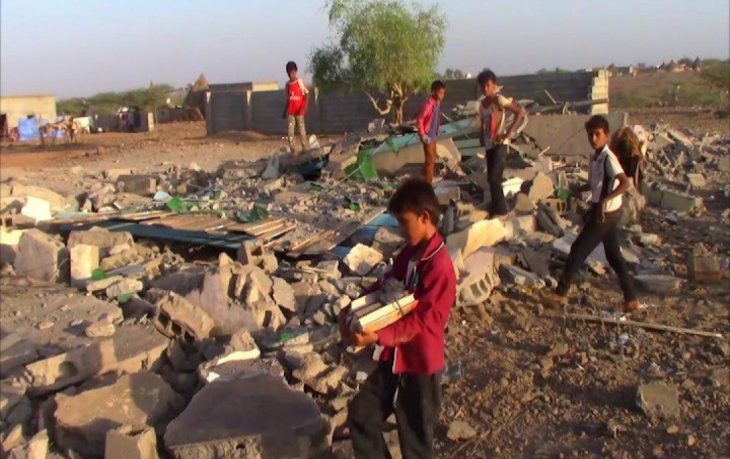
Locals walks among the rubble of Hussein al-Hajouri`s brick and mud home which was destroyed by a Saudi airstrike on October 3, 2018. Photo | Ahmed AbdulKareem
By Ahmed Abdulkareem | MintPress News | October 2, 2018
HAJJAH, YEMEN – Saudi Arabia, backed by the United States, carried out an airstrike targeting a displaced family in the Mustaba district in the province of Hajjah, southwestern Yemen early Tuesday morning. A man, his wife, and their nine-year old only-daughter were killed in the strike, along with 10 others.
A 30-year-old witness told MintPress News :
Two airstrikes targeted Hussein al-Hajouri`s house at 2 a.m., killing Hussein and his wife and daughter. We found some parts of their bodies 100 meters from the house that was bombed; some of it is still under the rubble.”
Rescue efforts were complicated by fear of additional strikes, as Saudi warplanes continued to circle the area after the initial strikes. Saudi Arabia has been known to use double-tap strikes in Yemen, carrying out an initial airstrike and then circling back to target rescuers.
The latest attack comes just hours after Saudi Arabia admitted that its forces have committed what it called “certain mistakes” in Yemen, after increasing pressure from international bodies and human-rights groups that accuse the kingdom of carrying out war crimes in the country.
Saudi Defense Ministry spokesman Osaiker Alotaibi told a panel of 18 independent experts on Monday that a coalition investigation had uncovered “the existence of certain unintentional mistakes in a number of these operations,” adding that “the task force recommended that perpetrators should be held to account and victims should enjoy redress.”
In her response to the Saudi Defense Ministry, the panel’s chairwoman, Renate Winter, wondered why schools and hospitals had been targeted repeatedly:
You say it’s an accident. How many such accidents can you bear and how many such accidents can people in Yemen bear?”
Last month, investigators launched an international inquiry into war crimes in Yemen and found evidence of such crimes committed in the country. Their August 28 report said Saudi airstrikes had caused most of the documented civilian casualties.
Since the war began in 2015, the U.S.-backed, Saudi-led coalition has repeatedly targeted displaced civilians. In the most recent such attack before today, airstrikes targeted displaced families near the port city of Hodeida on August 24, killing or wounding 31 people, 24 of whom were children. Many of the victims of the strike belonged to a single family.
More recently, at least two Yemeni civilians were killed and three others wounded when Saudi warplanes struck a vehicle in the city of Abs in Hajjah, on Tuesday.
This week, one person was killed and a number of others sustained injuries after Saudi fighter jets conducted an airstrike on Munirah city in Hodeida, western Yemen. Saudi jets also conducted an airstrike on the residential area of Ghaferah in the Dhahir district in the northern province of Saada, killing a child and wounding several others.
Over 600,000 civilians have been killed or injured in Yemen since the Saudi-led coalition began its attacks in 2015, according to Yemen’s Ministry of Human Rights based in Sana’a. The U.S.-backed coalition’s blockade on Yemen has also triggered an epidemic of disease and famine across the country.
Ahmed AbdulKareem is a Yemeni journalist. He covers the war in Yemen for MintPress News as well as local Yemeni media.
UN: one child dies every 10 minutes in Yemen

A malnourished baby receives medical treatment at al Sabeen Maternal Hospital in Sanaa, Yemen [Mohammed Hamoud/Anadolu Agency]
MEMO | September 26, 2018
At least one child dies every ten minutes as a result of the conflict in Yemen, a senior UN official said.
The United Nations humanitarian coordinator in Yemen, Lise Grande, warned at the end of a high-level meeting held on the sidelines of the UN General Assembly that ten million more Yemenis will face pre-famine conditions by the end of this year if the status quo does not change.
She explained that three quarters of Yemen’s population need some form of protection and assistance.
For his part, the Under-Secretary-General for Humanitarian Affairs and Emergency Relief Coordinator, Mark Lowcock, said the humanitarian situation in Yemen has reached extremely dangerous levels. “I will ask you for resources to cover our humanitarian operations, so that the suffering of the Yemeni people will not continue,” he said.
The United Nations has launched an appeal to donor countries and institutions to increase financial support to cover what it has termed the world’s worst humanitarian crisis.
Featured Video
Trita Parsi: Israel Set a Trap for Total War in the Region
or go to
Aletho News Archives – Video-Images
From the Archive
Zionism’s Violent Legacy
By Donald Neff | Washington Report On Middle East Affairs | January 1996
On January 4, 1948, Jewish terrorists drove a truck loaded with explosives into the center of the all Arab city of Jaffa and detonated it, killing 26 and wounding around 100 Palestinian men, women and children.[1] The attack was the work of the Irgun Zvai Leumi – the “National Military Organization,” also known by the Hebrew letters Etzel – the largest Jewish terrorist group in Palestine. The Irgun was headed by Revisionist Zionist Menachem Begin and had been killing and maiming Arabs, Britons and even Jews for the previous ten years in its efforts to establish a Jewish state.
This terror campaign meant that at the core of Revisionist Zionism there existed a philosophical embrace of violence. … continue
Blog Roll
 Aletho News
- Trita Parsi: Israel Set a Trap for Total War in the Region
- Trump’s Iran war is on an Israeli leash
- Saudi oil boss issues global supply warning
- Riyadh Says Its Oil System Is Intact. The Numbers Say Otherwise.
- Trump and Netanyahu Want to “Finish the Job” on Iran
- US ‘one-sided dictation’ not Iran’s beliefs makes rational talks impossible: Baghaei
- Iran’s Next Strike May Not Explode. It Could Shut You Down /Col Doug Macgregor
- Iran: US political targets legitimate if assassinations return
- Iraq shuts key border crossing with Iran under US pressure: Report
- Undersea Internet cables could be targeted in retaliation for attacks on Iran: IRGC deputy chief
- If Americans Knew
- The Israel Lobby’s Changing Fortunes
- AIPAC has become such a political liability that it’s shifting to a more “nimble” approach to buying politicians
- At least 160 Israeli settler attacks in 2 weeks
- Will Gaza’s Ancient Christian Community Disappear Forever?
- Israel’s vision of regional security rests on keeping Arab states weak
- Heidi Levine recounts how Palestinian youths helped save her in settler attack
- DAILY UPDATE: Latest essential news on Palestine, Israel, & region
- Trump’s Intensifying Sabotage of the ICC, for Israel’s Sake
- Israeli military detain US and UK volunteers in West Bank including Democratic NY politician Brad Lander
- Americans at National Conservatism Conference held in Israel this year criticize Israel
- No Tricks Zone
- E-Cars Reduce CO2 Emissions By Only 41% Compared To Internal Combustion Engine Vehicles
- Predictions Made By Renowned Climate Professor Over Past Decades Have Been Proven To Be Poor
- New Study Suggests Large Regions Of The Pacific Ocean Have Been Cooling For The Last 80 Years
- Germany’s Green Energy Debacle: High Energy Costs Force Kahla Porzellan to Close After 182 Years!
- New Study: 50 Years Of The Most Aggressive ‘Net Zero’ Policies Can Only Affect The Global Climate By 0.03°C
- US September “Heat” Was No Record…Many Records Set Decades Ago
- Latest European Green Energy Debacle; Portugal’s Largest Flagship Solar Park Insolvent!
- Green Energy Debacle: German Expert Professor Fritz Vahrenholt Warns Of Severe Economic And Social Consequences
- Two More Paleo Reconstructions Affirm Meters-Higher Sea Levels Across Ireland, Brazil 7000-6000 Years Ago
- New Study: Earth And Venus Surface Warmth Largely Explained By Convection And Lapse Rate, Not CO2 Or Radiation

