Docs: US trained UAE pilots for combat in Yemen, signaling deeper involvement in conflict
RT | January 19, 2019
The American military has trained UAE fighter pilots for combat missions in Yemen, indicating Washington’s deeper involvement into the ongoing conflict, a recent report citing US Air Force documents claims.
The papers were obtained through a Freedom of Information Act request by Yahoo News. They appear to show how United Arab Emirates (UAE) pilots and crew were prepared for the Yemen conflict by US instructors under the UAE’s “F-16 pilot training program.”
It was completed at the USAF’s Warfare Center in Al Dhafra, just south of the UAE capital, Abu Dhabi.
The training which, according to the documents, took place between January 1, 2016 and December 31, 2017, resulted in four new instructors and 29 combat wingmen prior to their immediate deployment “for combat operations in Yemen.”
Also revealed was the escorting of four UAE F-16s to the USAF’s Red Flag exercises in the Nevada desert. The two-week advanced aerial combat training oversaw 150 Emirati personnel participate in “challenging exercises” with the goal to “prepare” them for combat action in Yemen.
The UAE has been involved in Yemen’s civil war as part of a Western-backed, Saudi-led coalition battling Houthi rebels who rose up against the government in 2015.
While Saudi Arabia’s bombing campaign in the country has garnered the most international criticism, the UAE’s role has received less coverage. However, it has been an active partner in the coalition, contributing both troops on the ground in addition to planes in the sky.
When pressed for comment on the UAE training by Yahoo News, both a US Central Command (CENTCOM) spokesperson and a second CENTCOM official, Lt. Col. Josh Jacques, repeatedly denied the claims of prepping pilots for Yemen sorties.
“We do not conduct exercises with members of the [Saudi-led coalition] to prepare for combat operations in Yemen,” Jacques said.
US officials have long been coy regarding the true extent of their support for the coalition, insisting that arm sales, air-to-air refueling, as well as intelligence training and sharing constitute the extent of their involvement.
However, in November, the US government said it would end mid-air refueling of coalition aircraft in response to growing outrage that the Saudi-led bombing campaign was unlawfully targeting civilians and putting the country on the brink of famine. For its part, Riyadh has repeatedly denied targeting civilians and not military related infrastructure on purpose.
In December, top US military brass reiterated Washington’s lack of involvement. Speaking at a Washington Post event, General Joseph F. Dunford, chairman of the Joint Chiefs of Staff, insisted that the US was not participating in the civil war, “nor are we supporting one side or the other.”
READ MORE:
Life in fear: Report says 1 in 3 US drone-strike deaths in Yemen are civilians, including children
Imperialism Abhors a Void: Guest: Sarah Abed
The Rabbit Hole | January 3, 2019
Cindy Sheehan’s Soapbox
Guest: Sarah Abed
Topic: US “Withdrawal” from Syria
On this episode of Cindy Sheehan’s Soapbox we discussed Trump’s announcement to withdraw US troops from Syria, the media’s reaction, and the impact this will have on Kurdish militias and Syria’s ultimate fight against imperialism.
Below are some of the points that I made during our chat (this is not a full transcript) or some thoughts I would like to expand on.
Cindy asked what I make of Trump’s announcement to withdraw 2,000 troops from Syria.
My response:
Trump had stated during his campaign and his presidency and even prior to that during Obama’s presidency in 2013 that he did not think we should be in Syria, nor should we be bombing Syria, that it was a waste of money and lives and that the Arab League and neighboring countries should be the ones to step up to the plate.
I think this was one of the reasons that many people voted for him, because of his non-interventionist foreign policy, which was in stark contrast to that of Hillary Clinton.
In April, of this year he had announced that he wanted to pull the US out of Syria and then just days later there was an alleged chemical weapons attack that was pinned on the Syrian government in Douma, to which Trump responded with attacking multiple targets along with his allies the UK and France.
This of course derailed his plan to pull out US troops, which is the exact outcome that the terrorists that staged the whole theatrical performance had wanted. And we have seen this sort of thing happen time and time again during the war. Whenever the Syrian army and government have made significant progress new allegations and attacks are made against them in corporate media in order to garner international support for military, political intervention as well as increased sanctions.
There are other factors at play with this latest withdraw announcement which was made on December 19th, in addition to standing by his America first promise, campaign statements, saving money and lives, there’s the fact that Turkey’s president Erdogan had threatened to attack the Kurdish militias on his border, if the US didn’t have them removed. He sees the YPG (People’s Protection Units) which was rebranded at the request of the US into the SDF (Syrian Democratic Forces) as an extension of the PKK (Kurdistan workers party) which is a terrorist group that has been in conflict with the Turkish state for decades.
As I had written about back in March the Olive branch operation in Afrin proved that NATO alliances are stronger than any other alliances and that the US will choose Turkey over the Kurds and that’s what we are seeing happen right now. Some have also speculated that Israel may have given the US a heads up that it would be engaging in an intense bombing campaign and that US troops should be sent home so that they are not caught in the crosshairs.
Cindy asked what I make of the reaction by democrats, liberals, celebrities etc.
My response:
It would be comical if it wasn’t actually dangerous. In their blind opposition to anything and everything that Trump says these overnight analysts and pundits started claiming that if US troops were to withdraw from Syria then Kurds would be annihilated by Turkey or succumb to some other equally horrible fate.
What we have seen over the past few days however is that leaders of Kurdish militias have actually reached out to the Syrian government and asked that they step in and take back Manbij and all the territory under their control west of the Euphrates in order to protect them against Turkey. This is a clear shift in their political alliance away from the US and towards Syria and Russia. Turkey will not directly confront the Syrian army so Trump’s announcement could actually signify a big step towards peace in this almost eight-year western imposed insurrection.
The US entered Syria illegally and has since set up over a dozen military bases and supported the Kurdish militias during the last few years only. Prior to using the Kurdish militias as a tool to create chaos and division in Syria, the US was predominately supporting the hardcore Al Qaeda-linked terrorists in the Free Syrian Army and an assortment of other alphabet soup groups who they affectionately referred to as “moderate rebels” to topple the secular Syrian government.
Had the US not supported the Kurdish militias they would have not had the motivation to turn against the Syrian state. During the beginning of the war, the Kurds were fighting with the Syrian army against terrorists, by the way some still are and many Kurds in Syria are not in agreement with the separatist ambitions of the Kurdish militias.
I want to stress the fact that before 2011 Kurds, Arabs, and Christian minorities lived peacefully in Syria and till now they are NOT the majority. They do not have any justifiable claims to the north eastern region (which also happens to be the most agriculturally and oil rich part of the country) or any other part of Syria. They are a nomadic people and I do not mean that in a condescending way at all but to illustrate that they came into Syria in waves to escape mistreatment in neighboring countries and were treated fairly and given equal rights. Not all Kurds envision a unified Kurdistan that would span four different sovereign countries (Turkey, Iraq, Syria, and Iran). Most Kurdish movements and political parties are focused on the concerns and autonomy of Kurds within their respective countries. Within each country, there are Kurds who have assimilated and whose aspirations may be limited to greater cultural freedoms and political recognition.
It’s also worth noting that only Israel is their main and really only supporter and their plans for an independent Kurdistan align almost perfectly with Israel’s greater Israel plan. They have historically been used by Israel and NATO.
Cindy asked about the demands being made that Russia or Iran should withdraw from Syria if US troops are to be withdrawn.
My response was basically that Russia, Iran, and Hezbollah are there with the Syrian government’s permission. Whereas the US, UK, France, and Turkey are there illegally and need to leave. Cindy noted and I agreed that it’s a false equivalency and a logical fallacy.
We also spoke about fasting to raise awareness #illuminateYemen for the entirely man-made and avoidable Saudi war and genocide that’s been going on for over three years and nine months. We discussed the latest developments and how Saudi Arabia is outsourcing their front line fighters with children and men from Dafur, Sudan and paying their families $10,000.
My response:
Fasting for seven days was a very humbling experience. The war on Yemen is truly heartbreaking especially because it is entirely man-made and avoidable. It’s so important for us to continue to raise awareness and get people to talk about it to literally everyone they know. For the past 3 years and nine months the murderous Al Saud regime, has been bombing civilians using weapons bought from the US, UK, and Germany, what they are doing is nothing short of committing genocide and deliberately starving Yemeni’s them through blockades. Tens of thousands have been killed since it began.
There was actually a report in the New York Times today that Saudi Arabia was recruiting children from Darfur to fight on the front lines and paying their families $10,000. Sudan has been part of the Saudi-led alliance, and deployed thousands of ground troops to Yemen. In the NYT report they said that five Sudanese fighters who had returned from Yemen told them that that children made up 20-40 percent of their units in Yemen.
The fact that House of Saud is on the UN human and woman’s rights council while also being the leading violator in crimes against humanity and the main sponsor of terror in the world shows the western worlds blatant hypocrisy. A United Nations-sponsored peace agreement was signed in Sweden earlier this month, and was agreed upon by both sides to implement a ceasefire in Hodeida. The panel will be meeting again on January 1 to discuss “detailed plans for full redeployment”. Every effort needs to be made for this conflict to end.
Presence of Foreign Forces in Yemen Unjustifiable: Ansarullah
Al-Manar | December 12, 2018
Spokesman for Yemen’s revolutionary Ansarullah movement Mohammad Abdulsalam, who heads a delegation in the ongoing peace talks in Sweden, said the presence of foreign forces in the Arabian Peninsula country cannot be justified.
Speaking to the Arabic-language al-Masirah TV on Tuesday night, Abdulsalam said the foreign troops’ presence in Yemen is contrary to the country’s constitution and UN Security Council resolutions.
“The presence of foreign forces in Yemen is not justified as long as our approach is political settlement (of the crisis),” he said.
Yemen’s occupied areas are now controlled by foreigners such as British, Saudi and Emirati forces, not a group that calls itself “legitimate”, he added, referring to the Yemeni exiled government which claims legitimacy.
The Ansarullah spokesman went on to say that no party could demand the presence of foreign forces in Yemen.
Abdulsalam further said that in the UN-brokered peace talks in Stockholm, Sweden, the two sides have reached some agreements on ceasefire in some areas.
The talks opened Thursday on an upbeat note, with the warring sides agreeing to a broad prisoner swap, boosting hopes that the talks would not deteriorate into further violence as in the past.
Yemen has been since March 2015 under brutal aggression by Saudi-led Coalition, in a bid to restore control to fugitive president Abd Rabbu Mansour Hadi who is Riyadh’s ally.
Tens of thousands of people have been killed and injured in the strikes launched by the coalition, with the vast majority of them are civilians.
The coalition, which includes in addition to Saudi Arabia and UAE: Bahrain, Egypt, Morocco, Jordan, Sudan and Kuwait, has been also imposing a harsh blockade against Yemenis.
Some 8.4 million Yemenis are facing starvation as a result of the Saudi-led aggression, although the United Nations has warned that will probably rise to 14 million.
Three-quarters of impoverished Yemen’s population, or 22 million people, require aid.
Yemen: Houthis Urge Transitional Gov’t With All Parties
teleSUR | December 10, 2018
The Houthi’s main negotiator, Mohammed Abdusalam, said Saturday that any political solution to the Saudi-led war on Yemen should start with outlining a transitional period with an exact timeframe that should include all political parties.
Abdusalam also said the city of Hodeidah should be declared a “neutral zone” and that the United Nations could play a role in managing the Sanaa airport. His comments were made in the context of U.N.-sponsored peace talks that seek to put an end to almost four years of conflict.
The Houthis control major population centers in Yemen, including the capital Sanaa and the Red Sea port of Hodeidah, a lifeline for millions of people. The Saudi coalition’s siege on the port this year has caused food and medicine shortages, leading to widespread cases of starvation.
“It (Hodeidah) should be a neutral zone apart from the conflict, and the military brigades that came from outside Hodeidah province should leave,” Abdusalam told Reuters.
Asked if Houthi forces would then withdraw from Hodeidah, Abdusalam said: “There will be no need for military presence there if battles stop … Hodeidah is an economic hub and it should stay that way for the sake of all Yemenis.”
“We have proposed to the U.N. to oversee the port and supervise its logistics… inspections, revenues, and all the technical issues,” he said.
It is unclear who will control the city if both forces leave but Yemen’s internationally-recognized government of President Abd-Rabbu Mansour Hadi is sticking to its position that Hodeidah should be under its control.
On the issue of reopening the Sanaa airport, Abdusalam said the Houthis were open to the possibility of a U.N. role at the airport to secure an agreement to reopen it. The Houthis hold control of the airport, but Saudi-led forces have secured control of the airspace and have bombed the facility several times.
Yemen’s Saudi-backed government has proposed reopening the Houthi-held airport in the capital Sanaa on condition planes are inspected in the airports of Aden or Sayun which are under its control, two government officials said Friday.
The Houthi delegation rejected the proposal but insist they are open to a U.N. role.
Many Yemeni factions are involved in the war that pits the Houthis against a Saudi-led coalition that intervened in Yemen in 2015 to restore the government of Abd-Rabbu Mansour Hadi.
Yemen’s war and the ensuing economic collapse has left 15.9 million people, 53 percent of the population, facing “severe acute food insecurity.” According to a recently-published study by the Armed Conflict Location and Event Data Project (ACLED), the armed conflict has claimed the lives of over 50,000 people.
Humanitarian groups say peace is the only way of ending the world’s largest humanitarian crisis. The areas hit with extreme hunger are also the areas where there is active fighting.
No peace talks have been held since 2016, and the last attempt in Geneva in September failed when the Houthis did not attend [*]. These peace talks are due to last until Dec. 13.
* Saudi-backed delegates leave Yemen peace talks
Press TV – September 8, 2018
A delegation from Yemen’s former government has left UN-brokered talks in Geneva after representatives of the Houthi movement were prevented by Saudi Arabia from attending the negotiations.
“The government delegation is leaving today,” said an official from the Saudi-backed team on Saturday, referring to the former Yemeni administration. “There are no expectations the Houthis are coming,” he added.
UN envoy to Yemen Martin Griffiths told a news conference that the Houthis were “keen” to get to Geneva.
“They would have liked to get here. We didn’t make conditions sufficiently correct to get them here,” he said.
Ansarullah accused the Saudis of planning to strand the delegation in Djibouti, where their plane was to make a stop en route to Geneva.
The Saudis were “still refusing to give permission to an Omani plane” to land at the Yemeni capital Sana’a and take the delegation to Geneva, the movement said.
It posted a statement, saying the Houthis needed to “ensure the safety of the delegation” and require a guarantee that they would be allowed to return “smoothly” to Sana’a airport. … Full article
Loophole in Bernie Sanders’ Yemen Bill Actually Allows Continued US Involvement in Yemen
By Whitney Webb | Mint Press News | December 3, 2018
Last week, many celebrated the advancement of Senate Joint Resolution (SJR) 54, which had been introduced by Senator Bernie Sanders (I-VT), as a sign that the U.S. Congress was finally willing to act to reduce the U.S.’ culpability for the situation in Yemen, currently the world’s worst humanitarian crisis.
The bill, which will be voted on by the Senate this week, has been praised by many within the anti-war movement for its bid to “end” U.S. military involvement in Yemen. Passage of the bill would, however, do no such thing.
Much of the media coverage of the bill has noted that the resolution invokes the 1973 War Powers Resolution, which prohibits the president from deploying U.S. troops into armed conflicts without congressional approval. Though that resolution has been ignored many times since its passage, particularly since the War on Terror began in 2001, SJR 54 has been promoted as a “progressive” effort to bring the U.S.’ military adventurism to heel at a time when Saudi Arabia — one of the two countries leading the war against Yemen – is under increased scrutiny.
Yet, the text of the bill itself reveals that SJR 54 invokes the War Powers Resolution in name only. Indeed, while the bill claims to be aimed at achieving “the removal of United State Armed Forces from hostilities in the Republic of Yemen that have not been authorized by Congress,” it contains a major loophole that will allow the majority of U.S. troops in Yemen – if not all – to stay.
As the bill states, it will require the president to remove troops “except United States Armed Forces engaged in operations directed at al Qaeda or associated forces.” Notably though, the only U.S. troops “on the ground” in Yemen that are involved in “hostilities” (i.e., combat operations) are those that are allegedly involved in operations targeting Al Qaeda — operations that the U.S. frequently conducts jointly with the countries waging war against western Yemen, such as the United Arab Emirates.
U.S. troops deployed in Yemen to target Al Qaeda in the Arabian Peninsula (AQAP) also collaborate with the UAE and Saudi Arabia in “intelligence sharing,” “midair refueling,” and “overhead reconnaissance” for forces involved in counterterrorism operations that the U.S. is leading. This cooperation is what the very text of SJR 54 claims to want to end, but only in regard to the coalition’s war in western Yemen. However, the current text of the bill would allow all of this cooperation to continue, just not in areas where there are no claims of AQAP presence.
Thanks to the loophole in SJR 54, all that would need to change for the U.S. military’s assistance to the Saudi/UAE coalition to remain as is would be for either the Saudis, Emiratis or the U.S. to claim that there is an AQAP presence – however small – in an area they wish to target. Given that AQAP regularly collaborates with coalition forces elsewhere in Yemen, the coalition would only need move AQAP forces near a site in western Yemen that they wish to bomb in order for U.S. military involvement in its war against Yemen’s resistance to continue unimpeded.
 Alternatively, either of those countries could supply “intelligence” that would seek to link Yemen’s resistance movement Ansarullah or the Houthis to AQAP, thus allowing U.S. involvement in the coalition’s war in Yemen to continue unchanged. This is a very likely scenario if SJR 54 is passed given that some top Trump administration officials have a history of providing false intelligence in order to justify aggressive policies and push for military intervention abroad. Furthermore, the Trump administration also has experience linking countries it doesn’t like to Al Qaeda without evidence in order to justify such policies. Thus, linking Yemen’s resistance movement to AQAP despite a lack of evidence is something the Trump administration would likely pursue were this bill to pass in its current form.
In addition, the Sanders-introduced bill will do nothing to stop the U.S.’ use of drone strikes that regularly kill scores of civilians in Yemen. Indeed, a recent investigation conducted by the Associated Press found that at least one-third of all Yemenis killed by U.S. drone strikes in Yemen were civilians, many of them children. Even though U.S. intelligence has regularly shown that the U.S. drone war in Yemen actually strengthens AQAP, this bill would do nothing to stop the U.S. military’s deadliest practice in Yemen, with a documented history of murdering civilians.
The bill’s failure to touch on the U.S. drone war in Yemen is unsurprising given that Bernie Sanders — who introduced SJR 54 — supported drone strikes and the controversial “kill lists” during the Obama administration. Furthermore, when asked on Meet the Press in 2015 if his foreign policy if elected President would involve the use of drones and Special Forces in military operations overseas, Sanders stated that it would involve “all of that and more.”
SJR 54 as mostly kabuki
Given the fact that SJR 54 provides a huge loophole that would prevent it from having the advertised effect, it seems that the measure is meant to serve other purposes, namely political, instead of its stated purpose of ending U.S. military involvement in Yemen. The bill appears to be little more than a PR stunt by Democrats and Democratic-aligned senators to distance themselves from Republicans.
This is supported by the fact that not a single Democrat in the Senate voted against the bill last week, while several Senate Democrats had voted against it earlier this year, setting up the case that only Republicans are against halting the U.S.-backed war in Yemen. Another suggestion that this is the case is how the media widely reported the vote as a “rebuke” of President Trump, as is the fact that 2020 Democratic presidential hopefuls, such as Cory Booker and Elizabeth Warren, co-sponsored this bill even though they both hold pro-war positions regarding another Middle Eastern country, Iran.
The “anti-war” credentials of Warren — as well as Bernie Sanders, who wrote SJR 54 — have long been questionable, particularly after they both backed James Mattis as Secretary of Defense even though he had led the U.S. assault on the Iraqi city of Fallujah in 2004, an attack that killed thousands of civilians and used chemical weapons that still cause birth defects in those born in Fallujah over a decade later.
Though the death of Saudi journalist and U.S. resident Jamal Khashoggi has been blamed for the change of heart of Senate Democrats and some Republicans, reporting from MintPress and others has shown that the “outrage” regarding Khashoggi’s death is not about “human rights” but about money and pushing Saudi Crown Prince to move forward with expensive weapons deals and the neoliberalization of Saudi state assets that he had tried to back away from. Viewing the situation from this lens, SJR 54 seems little more than a PR effort to cast Democrats as “anti-war” when they are just as beholden to the military-industrial complex as the Republicans.
Yet, most importantly, the toothless text of SJR 54 shows that relying on either of the corporate, war-loving political parties in the U.S. to end the country’s involvement in the war in Yemen is misguided, as such action if more likely to come about from sustained public pressure or grassroots activism than from politicians beholden to special interests such as the Saudi or weapons lobbies.
Whitney Webb is a staff writer for MintPress News and a contributor to Ben Swann’s Truth in Media. Her work has appeared on Global Research, the Ron Paul Institute and 21st Century Wire, among others. She has also made radio and TV appearances on RT and Sputnik. She currently lives with her family in southern Chile.
Pro-Israel groups attack Rand Paul for blocking $38 billion to Israel
If Americans Knew | November 27, 2018
Free Beacon reports that “pro-Israel groups in America are mobilizing against Sen. Rand Paul (R., Ky.) for blocking the continuation of U.S. aid to Israel.”
Paul has placed a “block” on legislation to give Israel $38 billion over the next 10 years – $23,000 per every Jewish Israeli family of four. This is the largest military aid package in U.S. history and amounts to $7,230 per minute to Israel, or $120 per second. A stack of $38 billion dollar bills would reach ten times beyond the international space station.
A block is a legislative procedure in which a senator calls on the floor leader not to move forward with a bill and indicates that the senator may filibuster against it.
Jewish News Syndicate reported last week that the American Israel Public Affairs Committee (AIPAC) had sent an action alert to its members calling on them to pressure Paul to remove his block on the bill, ‘‘S. 2497 Ileana Ros-Lehtinen United States-Israel Security Assistance Authorization Act of 2018.’
Now, according to Free Beacon, a right-wing pro-Israel website, AIPAC has also been purchasing advertisements on Facebook attacking Paul “as the primary Senate force blocking the reauthorization of the U.S.-Israel security pact.”
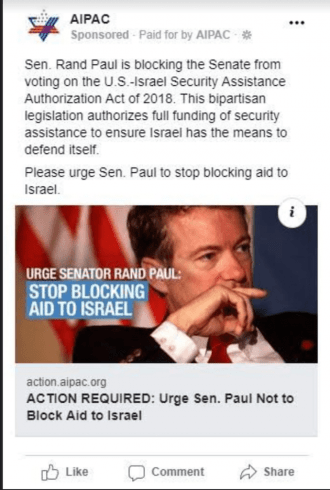
AIPAC Facebook ad against Rand Paul
Another pro-Israel group, Christians United for Israel (CUFI), has also reportedly organized an email blitz to pressure Paul to remove his hold, and has “invested heavily” in ads in Kentucky targeting Rand’s constituents.
According to Free Beacon, “Paul, a proponent of ending U.S. aid across the globe, has had multiple confrontations with the pro-Israel community over the years as result of his views. Paul has sought to hold up U.S. aid to Israel multiple times over the years, creating friction between him and top U.S. pro-Israel lobbying shops.”
Yesterday CUFI sent an email to supporters around the country saying: “Sen. Rand Paul is blocking the U.S.-Israel Security Assistance Authorization Act, S.2497. This bill is the cornerstone of U.S. support for Israel.”
In the message, CUFI calls Paul the “last obstacle to getting this bill signed into law.”
Free Beacon reports that Paul has also recently proposed suspending U.S. arms sales to Saudi Arabia and Bahrain over their attacks on what the Free Beacon calls “pro-Iran militants in Yemen.” Paul has long opposed U.S. support for the attacks on Yemen, which is on the brink of famine and has 50,000 dead.
Israel has long targeted Yemen as one of the countries that must be controlled in its quest for hegemony in the region.
Yemeni Houthis halt missile strikes, offer wider ceasefire if Saudi-led coalition really wants peace
RT | November 18, 2018
After years of bloodshed, Yemen’s Houthi movement is urging the Saudi Arabia-led coalition to join a comprehensive ceasefire if it really “wants peace,” the leader of the rebel group Mohammed Ali al-Houthi said Sunday.
At the request of Martin Griffiths, the United Nations special envoy for Yemen, the group is stopping ballistic missile and drone attacks on the coalition countries.
Al-Houthi also stressed the rebels’ readiness to freeze military operations on all fronts in an effort to reach a “just and honorable” peace.
Earlier this week the UN official told the UN Security Council that Yemen’s warring parties had agreed to hold talks in Sweden “shortly.”
Yemen has been the scene of mass casualties and civilian suffering throughout the civil war, especially after the coalition intervention in 2015.
While much of the population remains on the brink of starvation, the nation has also endured a cholera outbreak and a severe lack of medical supplies.
According to recent estimates, around 56,000 people died in the conflict.
Symbolic outrage? US senators seek to stop arms sales to Saudis… after killing Bahrain ban bill

A boy stands next to a house destroyed by an air strike in the old quarter of Sanaa, Yemen. © Reuters / Khaled Abdullah
RT | November 15, 2018
A newly proposed bill in the US Senate would suspend the sale of weapons to Saudi Arabia and block refueling of Saudi warplanes bombing Yemen, as punishment for the death of a Washington Post columnist.
A group of senators on the Foreign Relations Committee, led by Bob Menendez (D-New Jersey) and Lindsey Graham (R-South Carolina) introduced the “Saudi Arabia Accountability and Yemen Act of 2018.” It was sponsored by three Democrats and two Republicans.
Menendez, who is the top Democrat on the committee, said that sanctions against 17 Saudi nationals introduced earlier on Thursday by the Trump administration were “not enough” to ensure a credible investigation of the murder of journalist Jamal Khashoggi, and pressure Riyadh into ending the war in Yemen.
“This legislation is an important way to hold Saudi Arabia accountable for various acts in Yemen as well as the death of Jamal Khashoggi,” said Graham.
“We are putting teeth behind these demands with regular oversight, sanctions and suspension of weapons sales and refueling support,” Menendez said.
The US currently supplies Saudi Arabia with billions of dollars’ worth of tanks, airplanes and ammunition, and offers in-flight refueling and other logistical support to the Saudi-led coalition operating in Yemen. Riyadh has waged war on its southern neighbor since March 2015, to overthrow the Houthi-led government, which Saudi Arabia accuses of being a proxy of Iran.
The bill introduced by Menendez and Graham would also impose US sanctions on anyone blocking humanitarian aid deliveries to Yemen, but also on anyone providing support to the Houthis.
Khashoggi, a Saudi journalist who lived in Turkey and was an outspoken critic of the Crown Prince Mohammed bin Salman, was last seen entering the Saudi consulate in Istanbul on October 2. Turkey quickly accused the Saudis of murdering Khashoggi, which Riyadh spent weeks denying until it eventually blamed it on a “fight” inside the consulate.
Earlier on Thursday, the Senate voted 77-21 to kill a proposal by Rand Paul (R-Kentucky) to block US arms sales to Bahrain, another member of the Saudi coalition. Menendez led the opposition to Paul’s proposal, arguing that Bahrain is a “critical ally” of the US and hosts the US Navy’s Fifth Fleet, and that the sale of multiple rocket launchers and missile systems had nothing to do with the war in Yemen.
US using Khashoggi’s assassination to lessen influence of Muhammad bin Salman: Analyst
Press TV – November 15, 2018
American writer and academic James Petras says the United States is using journalist Jamal Khashoggi’s assassination to create an environment that can lessen the influence of Saudi Crown Prince Mohammed bin Salman (MBS).
James Petras, author and political commentator, made the remarks in an interview with Press TV on Thursday while commenting on a report which says the US Senate is expected to vote on legislation aimed at punishing Saudi Arabia over its brutal war on Yemen as well as the murder of the Saudi dissident journalist at its consulate in Istanbul, Turkey.
Senator Bob Corker, the Republican chairman of the Senate Foreign Relations Committee, said Tuesday that the upper chamber could vote on the resolution within weeks prior to the end of the year.
Corker said that the legislation seeks to stop all assistance to the Kingdom, adding measures to end arms sales to Riyadh would also be discussed at the Senate.
Petras said that it’s “very clear that there is a great deal of indignation in the US about the behavior of the so-called crown prince in Saudi Arabia, Muhammad bin Salman, who has been involved in a number of assassinations, including of someone very close to the US government, and a very prominent participant in the Washington Post.”
“Some observers think he was collaborating with the CIA on keeping them informed on the inside struggles inside Saudi Arabia, and that was one of the reasons that Prince Salman murdered him,” he added.
“Now the fact the US felt that the Saudis were undermining US operations in Saudi-underlined region. The Yemen invasion by the Saudis has been going on for three years. The US has supplied the Saudis with arms, advisors, and signing of a major agreement with the support of President Trump,” he noted.
“This is all part of the background. I think the feeling is with Khashoggi’s assassination that Washington can create an environment that can lessen the influence of Prince Salman,” he argued.
“And I think that his purge inside Saudi Arabia has caused too much instability. They think that the Yemen war can be used against him even though Washington has continued to support the Saudis in decimating the population,” the analyst said.
“So I think the Senate will be fighting the pro-Saudi element in the government, particularly President Trump. President Trump wants to punish the Saudis but not too much, maybe a slap in the wrist and perhaps creates countervailing powers,” he said.
“I don’t expect the US to force the Saudis to withdraw from Yemen. I think that that’s what they want, to open up some negotiations between the Saudis and the Houthis and the pro-Saudi Yemenites who have been operating on the periphery,” he observed.
Saudi Arabia has come under fierce criticism after journalist Jamal Khashoggi was killed inside its consulate in Istanbul on October 2.
Khashoggi, a prominent commentator on Saudi affairs who wrote for The Washington Post’s Global Opinions section, had lived in self-imposed exile in the US since September 2017, when he left Saudi Arabia over fears of the Riyadh regime’s crackdown on critical voices.
Crown Prince Salman is a prime suspect in the murder plot.
President Trump’s Iran Policy – Is It ‘Normal’?
By Ron Paul | November 12, 2018
It’s not often that US Government officials are honest when they talk about our foreign policy. The unprovoked 2003 attack on Iraq was called a “liberation.” The 2011 US-led destruction of Libya was a “humanitarian intervention.” And so on.
So, in a way, Secretary of State Mike Pompeo was refreshingly honest last week when, speaking about newly-imposed US sanctions, he told the BBC that the Iranian leadership “has to make a decision that they want their people to eat.” It was an honest admission that new US sanctions are designed to starve Iranians unless the Iranian leadership accepts US demands.
His statement also reveals the lengths to which the neocons are willing to go to get their “regime change” in Iran. Just like then-Secretary of State Madeleine Albright said it was “worth it” that half a million Iraqi children died because of our sanctions on that country, Pompeo is letting us know that a few million dead Iranians is also “worth it” if the government in Tehran can be overthrown.
The US Secretary of State has demanded that Iran “act like a normal country” or the US would continue its pressure until Iran’s economy crumbles. How twisted is US foreign policy that Washington considers it “normal” to impose sanctions specifically designed to make life miserable – or worse – for civilians!
Is it normal to threaten millions of people with starvation if their leaders refuse to bow down to US demands? Is the neoconservative obsession with regime change “normal” behavior? Is training and arming al-Qaeda in Syria to overthrow Assad “normal” behavior? If so, then perhaps Washington’s neocons have a point. As Iran is not imposing sanctions, is not invading its neighbors, is not threatening to starve millions of Americans unless Washington is “regime-changed,” perhaps Iran is not acting “normal.”
So what is normal?
The continued Saudi genocide in Yemen does not bother Washington a bit. In fact, Saudi aggression in Yemen is viewed as just another opportunity to strike out at Iran. By making phony claims that Yemen’s Houthis are “Iran-backed,” the US government justifies literally handing the Saudis the bombs to drop on Yemeni school busses while claiming it is fighting Iranian-backed terrorism! Is that “normal”?
Millions of Yemenis face starvation after three years of Saudi attacks have destroyed the economy and a Saudi blockade prohibits aid from reaching the suffering victims, but Secretary Pompeo recently blamed Yemeni starvation on, you guessed it: Iran!
And in a shocking display of cynicism, the US government is reportedly considering listing Yemen’s Houthis as a “terrorist” organization for the “crime” of fighting back against Saudi (and US) aggression. Labeling the Yemeni resistance a “terrorist” organization would effectively “legalize” the ongoing Saudi destruction of Yemen, as it could be justified as just another battle in the “war on terror.” It would also falsely identify the real culprits in the Yemen tragedy as Iran, which is repeatedly and falsely called the “number one sponsor of terrorism” by Pompeo and the rest of the Trump Administration neocons.
So yes, Secretary of State Mike Pompeo told one wicked truth last week. But before he demands that countries like Iran start acting “normal” or face starvation, perhaps he should look in the mirror. Are Pompeo and the neocons “normal”? I don’t think so.
Washington Post Publishes Article of Yemen’s Houthi Leader

Head of Yemen’s Revolutionary Committee, Mohammad Ali Al-Houthi
Al-Manar | November 10, 2018
The Washington Post has published on Friday the first article of the head of the Supreme Revolutionary Committee, Mohammad Ali Al-Houthi.
Houthi leader: We Want Peace for Yemen, But Saudi Airstrikes Must Stop
The continued escalation of attacks against the port city of Hodeida in Yemen by the U.S.-Saudi-Emirati coalition confirms that the American calls for a cease-fire are nothing but empty talk. The recent statements are trying to mislead the world. Saudi leaders are reckless and have no interest in diplomacy. The United States has the clout to bring an end to the conflict — but it has decided to protect a corrupt ally.
Any observer of the crimes committed in Yemen by Saudi Arabia — a campaign that has been accompanied by disinformation and a blockade of journalists trying to cover the war — can offer an account of the indiscriminate killing thousands of civilians, mostly through airstrikes. Their attacks have led to the greatest humanitarian crisis on earth.
The brutality of the Saudi regime was reflected in the murder of the journalist Jamal Khashoggi. And it can be seen in the military escalation and airstrikes in Hodeida and other cities, in defiance of all international warnings.
The blockade of the port city is meant to bring the Yemeni people to their knees. The coalition is using famine and cholera as weapons of war. It is also extorting the United Nations by threatening to cut their funds, as if it were a charity and not a responsibility required under international law and Security Council resolutions.
The United States wants to be viewed as an honest mediator — but it is in fact participating and sometimes leading the aggression on Yemen.
We are defending ourselves — but we don’t have warplanes like the ones that bomb Yemenis with banned ammunition. We can’t lift the blockade imposed on Yemeni imports and exports. We cannot cancel the air embargo and allow daily flights, or end the ban of importing basic commodities, medicines and medical equipment from any place other than the United Arab Emirates, as it is imposing on Yemeni business executives.
And the list goes on. These repressive practices are killing and destroying Yemen.
Yemen was not the one who declared the war in the first place. Even Jamal Benomar, the former United Nations envoy to Yemen, said we were close to a power-sharing deal in 2015 that was disrupted by the coalition airstrikes. We are ready to stop the missiles if the Saudi-led coalition stops its airstrikes.
But the United States’ calling to stop the war on Yemen is nothing but a way to save face after the humiliation caused by Saudi Arabia and its spoiled leader, Crown Prince Mohammed bin Salman, who has ignored Washington’s pleas to clarify Khashoggi’s murder.
Moreover, Trump and his administration clearly prefer to continue this devastating war because of the economic returns it produces — they drool over those arms sales profits.
We love peace — the kind of honorable peace defended by our revolution’s leader, Abdulmalik al-Houthi. We are ready for peace, the peace of the brave. God willing, Yemenis will remain the callers of peace and lovers of peace.
Featured Video
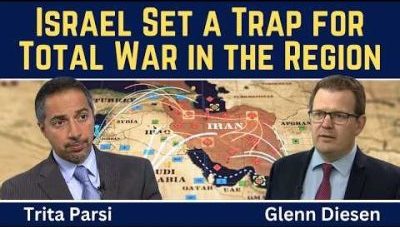
Trita Parsi: Israel Set a Trap for Total War in the Region
or go to
Aletho News Archives – Video-Images
From the Archive
Zionism’s Violent Legacy
By Donald Neff | Washington Report On Middle East Affairs | January 1996
On January 4, 1948, Jewish terrorists drove a truck loaded with explosives into the center of the all Arab city of Jaffa and detonated it, killing 26 and wounding around 100 Palestinian men, women and children.[1] The attack was the work of the Irgun Zvai Leumi – the “National Military Organization,” also known by the Hebrew letters Etzel – the largest Jewish terrorist group in Palestine. The Irgun was headed by Revisionist Zionist Menachem Begin and had been killing and maiming Arabs, Britons and even Jews for the previous ten years in its efforts to establish a Jewish state.
This terror campaign meant that at the core of Revisionist Zionism there existed a philosophical embrace of violence. … continue
Blog Roll
 Aletho News
- Trita Parsi: Israel Set a Trap for Total War in the Region
- Trump’s Iran war is on an Israeli leash
- Saudi oil boss issues global supply warning
- Riyadh Says Its Oil System Is Intact. The Numbers Say Otherwise.
- Trump and Netanyahu Want to “Finish the Job” on Iran
- US ‘one-sided dictation’ not Iran’s beliefs makes rational talks impossible: Baghaei
- Iran’s Next Strike May Not Explode. It Could Shut You Down /Col Doug Macgregor
- Iran: US political targets legitimate if assassinations return
- Iraq shuts key border crossing with Iran under US pressure: Report
- Undersea Internet cables could be targeted in retaliation for attacks on Iran: IRGC deputy chief
- If Americans Knew
- The Israel Lobby’s Changing Fortunes
- AIPAC has become such a political liability that it’s shifting to a more “nimble” approach to buying politicians
- At least 160 Israeli settler attacks in 2 weeks
- Will Gaza’s Ancient Christian Community Disappear Forever?
- Israel’s vision of regional security rests on keeping Arab states weak
- Heidi Levine recounts how Palestinian youths helped save her in settler attack
- DAILY UPDATE: Latest essential news on Palestine, Israel, & region
- Trump’s Intensifying Sabotage of the ICC, for Israel’s Sake
- Israeli military detain US and UK volunteers in West Bank including Democratic NY politician Brad Lander
- Americans at National Conservatism Conference held in Israel this year criticize Israel
- No Tricks Zone
- E-Cars Reduce CO2 Emissions By Only 41% Compared To Internal Combustion Engine Vehicles
- Predictions Made By Renowned Climate Professor Over Past Decades Have Been Proven To Be Poor
- New Study Suggests Large Regions Of The Pacific Ocean Have Been Cooling For The Last 80 Years
- Germany’s Green Energy Debacle: High Energy Costs Force Kahla Porzellan to Close After 182 Years!
- New Study: 50 Years Of The Most Aggressive ‘Net Zero’ Policies Can Only Affect The Global Climate By 0.03°C
- US September “Heat” Was No Record…Many Records Set Decades Ago
- Latest European Green Energy Debacle; Portugal’s Largest Flagship Solar Park Insolvent!
- Green Energy Debacle: German Expert Professor Fritz Vahrenholt Warns Of Severe Economic And Social Consequences
- Two More Paleo Reconstructions Affirm Meters-Higher Sea Levels Across Ireland, Brazil 7000-6000 Years Ago
- New Study: Earth And Venus Surface Warmth Largely Explained By Convection And Lapse Rate, Not CO2 Or Radiation

