While all eyes are on Syria’s Idlib, US continues to decimate Yemen
By Darius Shahtahmasebi | RT | September 14, 2018
The US is ready to defend Syria from a brutish assault launched by Syria’s own government and its allies – or so Washington wants you to believe. In the backdrop, Yemen continues to burn in silence.
On September 3, US ambassador to the UN, Nikki Haley – eloquent diplomat that she is – retweeted a tweet from the warmonger in chief that is the US president, with the caption “All eyes on the actions of Assad, Russia and Iran in Idlib.” This is the same US administration who just facilitated the bombing of a school bus in Yemen, slaughtering at least 40 children in the process.
Maybe, just maybe, Nikki Haley should keep her eyes on herself.
If the world did direct its eyes to what is taking place in Yemen, they would know that the United Nations has just warned of an “incalculable human cost” in the works, as the US and its allies press forward with an offensive to retake the Yemeni port city of Hodeida from the Houthi rebels.
That’s right. The US, currently waving its arms in despair about human rights abuses and chemical weapons attacks that have not even taken place in Syria yet, is supporting a major offensive of its own that will lead to a humanitarian crisis of monumental proportions.
Yemen, a country already deeply in crisis, relies on the port of Hodeida for at least 70 percent of its humanitarian aid. It therefore makes sense from a humanitarian perspective to turn its location into a major war zone, am I right?
The small minority of people who are inclined to care about innocent Yemenis need not fret though. US Secretary of State Mike Pompeo has just this week certified that the Saudi-led coalition is taking sufficient steps to protect civilians. According to Pompeo, the Gulf nations involved are “undertaking demonstrable actions to reduce the risk of harm to civilians.”
“They are taking steps, in the view of the US government and this administration, in the right direction,” State Department spokeswoman Heather Nauert told a briefing, according to Reuters. “We see them taking steps. Is it perfect? No absolutely not. Do we see them doing what they can to mitigate civilian casualties? Absolutely we do.”
Thank God – I was getting worried there for a second. The US-backed Saudi-led coalition may be killing children as if they were ants, but they are taking steps to mitigate the number of children they are killing at the same time.
A seven-page memo sent to Congress and obtained by the Intercept further confirmed Pompeo’s delusional thinking, as the memo called Saudi Arabia and the UAE “strong counterterrorism partners.” Never mind that just last month, the Associated Press reported the US and its allies were actually recruiting Al-Qaeda fighters to join the coalition.
Oops.
While the Trump administration is taking a horrifying and bloody war and taking it to new depths, the truth of the matter is that this war did not begin under Donald Trump. The war in Yemen, the Arab world’s poorest nation, fast becoming the world’s worst humanitarian crisis, was started by none other than peace-prize laureate Barack Obama himself.
But why did this war start, and why has the US continued to support it?
In an overlooked interview with the Real News’ Aaron Maté, Rob Malley, President of the International Crisis Group and former Special Assistant to President Obama, gave a disturbing glimpse into who actually pulls the strings on US foreign policy.
According to Malley:
“To try to understand what the Obama administration was about, and I’ve tried to- just to try to, to explain it to myself, to try to understand how we got to where we are, let’s not forget at the time we were in the middle of these negotiations with Iran, trying to reach a nuclear deal which was extremely unpopular with our traditional allies in the region, from Israel to Saudi Arabia to the UAE and others. And the Saudis came to us and said that they were about to intervene in Yemen, to attack the Houthis that had toppled the legitimate government of the internationally recognized government at the time. And they asked for our assistance…”
“So there was on the one hand a number of voices expressing concern about that. But on the other hand were many people saying the relationship with Saudi Arabia is almost at breaking point. They believe we’d betrayed their trust for a number of reasons. But Iran, Iran negotiating the Iran deal, or the negotiations over the Iran deal was one of them. We needed to protect that deal and make sure that we could get it done, because if we didn’t have a deal there was a risk of a war with Iran. And so I think the decision was made in the end by President Obama to say we’re going to be, to support parts of this war…”
Only a peace prize laureate could pull off a feat like that. But all joking aside, the human cost of the war in Yemen is nothing short of shameless.
On October 8, 2016, an aerial bombardment targeted a crowded funeral in Sana’a, the capital of Yemen, the aftermath of which was aptly described as a “lake of blood.” According to the UN, more than 140 Yemenis were killed and at least 525 others were injured.
To date, the US-backed Saudi-led coalition has struck well over 100 hospitals, as well as wedding parties, refugee camps, food trucks, factories, transport routes, agricultural land, residential areas, and schools, to name a few. Yes, you read that right. Yemen, with only 2.8 percent of its land being cultivated, is actively targeted by the US-backed coalition. According to Martha Mundy, professor emeritus at the London School of Economics, “to hit that small amount of agricultural land, you have to target it.”
Prior to spiralling into chaos, Yemen was already dependent on imports for 90 percent of its staple foods and almost all of its fuel and medical supplies. Putting aside the mass amount of violence that the US-backed coalition has enacted, the rest of Yemen’s population is suffering due to the Saudi-imposed blockade, which has put half the population at risk of starvation. According to the UN, over 462,000 children under the age of five are suffering from severe acute malnutrition.
This is done completely on purpose. At the end of August this year, Saudi Arabia’s Crown Prince, Mohammed Bin Salman, threatened that he would continue targeting women and children in Yemen and allegedly said that he wants to “leave a big impact on the consciousness of Yemeni generations.”
“We want their children, women and even their men to shiver whenever the name of Saudi Arabia is mentioned,” the Crown Prince reportedly said.
The idea, advanced by Pompeo and his cohorts at the State Department, that the coalition has taken steps to avoid civilian casualties is by all accounts, complete nonsense. As the New York Times openly acknowledged:
“The first problem was the ability of Saudi pilots, who were inexperienced in flying missions over Yemen and fearful of enemy ground fire. As a result, they flew at high altitudes to avoid the threat below. But flying high also reduced the accuracy of their bombing and increased civilian casualties,” American officials said.
“American advisers suggested how the pilots could safely fly lower, among other tactics. But the airstrikes still landed on markets, homes, hospitals, factories and ports, and are responsible for the majority of the 3,000 civilian deaths during the yearlong war, according to the United Nations.”
In addition to supplying billions of dollars’ worth of arms to the Saudi kingdom, US personnel provide overwhelming assistance to the Saudi-led coalition to help bring Yemen to its knees by sitting in the Saudi’s command and control center, providing lists of targets, refuelling planes, running intelligence missions, and so forth.
If Donald Trump is so concerned with migrants and refugees, perhaps he should stop creating them. If he really cares about ‘America first’ and making America great again, perhaps racking up notches to America’s war crime belt is not the way to go. Legal experts have already warned the US government that its complicity in these attacks can make them a co-belligerent in Saudi Arabia’s vast, extensive list of war crimes. This warning has fallen completely on deaf ears and has not helped at all in deterring the Trump administration from continuing some of Barack Obama’s worst policies; and even now the US continues to shelter the Saudi-led coalition so that it can continue its bloodthirsty policies unabated.
Make no mistake, if the US pulled its support for Saudi Arabia, Yemen’s suffering could stop tomorrow.
Watch out for Assad though; I heard he was about to retake a Syrian city from an Al-Qaeda affiliate. Remember Al-Qaeda, the notorious terror group the US claimed was the mastermind behind the September 11 attacks? Apparently, the entire US government doesn’t, as it allies itself with Al-Qaeda in just about every battlefield that counts.
In the meantime, ordinary Yemenis continue to suffer by the millions. If you can absorb all of this and still believe the US is genuinely concerned about human rights abuses in places like Syria, then you probably deserve what’s to come next.
Saudi-led airstrikes kill 15 civilians in Yemen’s Hudaydah
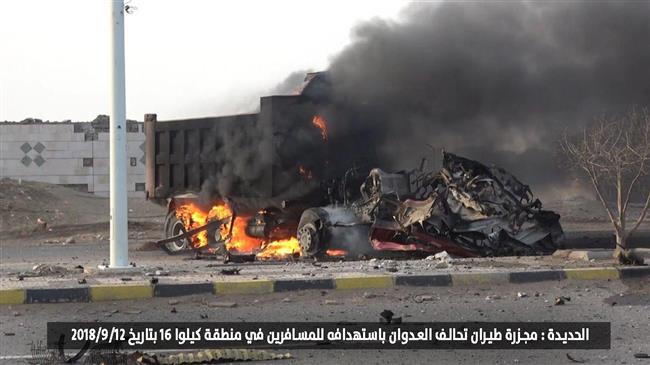
Yemeni truck targeted by a Saudi fighter jet on the outskirts of the port city of Hudaydah on September 12, 2018. (Photo by al-Masirah)
Press TV – September 12, 2018
At least 15 civilians, including one child, have been killed as the Saudi-led coalition resumed its airstrikes on the outskirts of Yemen’s port city of Hudaydah despite widespread international criticism over the war’s impact on civilians.
According to reports by Yemen’s Arabic-language al-Masirah television, about 20 civilians were also injured during Wednesday’s bombings that were launched after a brief truce since July.
The Saudi-backed forces also captured a number of towns as well as two main supply routes linking Hudaydah to the capital Sana’a and Ta’izz province, the report added.
The bombings resumed after UN-brokered peace efforts failed in Geneva last week. The talks were aborted after the UN failed to meet conditions set by Yemen’s Ansarullah movement, including transfer of wounded people to hospital for proper treatment and guarantees on the safety of the Yemeni delegation. Ansarullah also accused Saudi Arabia of planning to strand the delegation in Djibouti, where their plane was to make a stop en route to Geneva.
Delegates from Yemen’s former government and representatives of the Houthi movement held their last UN-sponsored negotiations in Kuwait in 2016 in a bid to hammer out a “power-sharing” deal, but they fell apart after the Saudi-backed side left the venue.
Saudi Arabia and a number of its regional allies launched a devastating military campaign against Yemen in March 2015, with the aim of bringing the government of former president, Abd Rabbuh Mansur Hadi, back to power and crushing Ansarullah.
Some 15,000 Yemenis have been killed and thousands more injured since the onset of the Saudi-led aggression.
More than 2,200 others have died of cholera, and the crisis has triggered what the United Nations has described as the world’s worst humanitarian disaster.
Saudi-backed delegates leave Yemen peace talks
Press TV – September 8, 2018
A delegation from Yemen’s former government has left UN-brokered talks in Geneva after representatives of the Houthi movement were prevented by Saudi Arabia from attending the negotiations.
“The government delegation is leaving today,” said an official from the Saudi-backed team on Saturday, referring to the former Yemeni administration. “There are no expectations the Houthis are coming,” he added.
UN envoy to Yemen Martin Griffiths told a news conference that the Houthis were “keen” to get to Geneva.
“They would have liked to get here. We didn’t make conditions sufficiently correct to get them here,” he said.
Ansarullah accused the Saudis of planning to strand the delegation in Djibouti, where their plane was to make a stop en route to Geneva.
The Saudis were “still refusing to give permission to an Omani plane” to land at the Yemeni capital Sana’a and take the delegation to Geneva, the movement said.
It posted a statement , saying the Houthis needed to “ensure the safety of the delegation” and require a guarantee that they would be allowed to return “smoothly” to Sana’a airport.
Yemenis took to the streets in Sana’a on Friday, blaming the United States, Britain, and Saudi Arabia for preventing the Houthis from joining the peace talks.
“The decision not to send an Omani plane (for the Houthi delegation) was made by the US and it is an American conspiracy with the help of Saudi Arabia,” senior Houthi official Abdulrahman al-Motawakel said.
“The US meant to delay the delegation from leaving, and the UN is helpless, and cannot do anything about it,” he added.
Loay al-Shamy, a senior Information Ministry official in Sana’a, said, “Regarding the peace talks, the delegation was formed and their names were announced and were ready to go but the UN, under pressure from the United States and Britain could not fulfill what was agreed on.”
The agreement was “to provide an Omani plane for the delegation that will participate in Geneva and offer the assurances required for the return of the delegation,” he said.
“We saw during the last talks that the delegation was stuck abroad and the UN could not bring them back home,” he added.
The two sides held their last UN-sponsored negotiations in Kuwait in 2016 in a bid to hammer out a “power-sharing” deal but they fell apart after the Saudi-backed side left the venue.
Yemen has been in turmoil since 2015 when former president Abd Rabbuh Mansur Hadi stepped down and then fled to Riyadh.
Hadi then asked Saudi Arabia to launch a military campaign against Yemen, leading to a crisis which has continued to this day.
Thousands have been killed in the Saudi-led invasion which has also pushed Yemen to the edge of famine.
A cholera outbreak, resulting from the devastation of Yemen’s health infrastructure, has also claimed more than 2,000 lives.
Supporters of Apartheid Israel Abuse Sydney Anti-War Student
By Tim Anderson | American Herald Tribune | September 2, 2018
Media, parliamentary, academic and other supporters of apartheid Israel have abused University of Sydney doctoral student Jay Tharappel for his outspoken support of Yemen, opposition to Israel and his consistent stance against the long wars 0n Syria and Korea.
Much of the western media falsely pretend that the massively internationalized war on Syria is a “civil war”. Most also refuse to recognize the simple fact that, over the past 65 years, the USA has never agreed to a peace agreement with North Korea.
The personal attacks on Jay reveal a shallow recognition of free speech in Australia. It is extraordinary that so much abuse has been heaped on one dissident voice. Demands for censorship of his political comments have come from various sources, but many of them supporters of the apartheid state of Israel.
First came the bully and smear media, from Murdoch’s Daily Telegraph, and from Channel Seven. The Murdoch tabloid, in a torrent of personal abuse, attacked Jay for rejecting the false chemical weapons claims against Syria, in April 2017. It then falsely claimed that Jay’s criticism of Murdoch journalist Kylar Loussikian was a racist attack.
In August 2018 Channel Seven manufactured another scandal about Jay, falsely claiming that a Yemeni badge he wore in China was ‘anti-semitic’. One part of that badge, seen on Jay’s shirt in one of my social media posts, said ‘death to Israel’.
The photo was simply one of the friends at lunch. Channel Seven, using the false translation “death to Israeli”, claiming it was a racist incitement. I posted in response that the Channel Seven piece ‘promotes ignorance, apartheid, and war’.
In fact ‘death to Israel’ is a political statement by the Yemeni group Ansarallah, which calls for an end to apartheid Israel, the regime that is reported to have killed a Palestinian child every three days for the past 18 years. The Australian government sells arms to the Saudis to bomb Yemen, as they ignore that terrible war and try to suppress any news about Yemen.
Later, the University of Sydney told the Sydney Morning Herald that I was “under investigation” for refusing to take down that photo of Jay and friends at lunch. After a Sydney Morning Herald [allegation] against me, I made a social media statement explaining my position.
For Channel Seven’s principal sources journalist, Bryan Seymour used two people (to represent “many in the Jewish and Muslim community”). First was a well-known supporter of Israel, Vic Alhadeff. Vic was previously a chair of the NSW Community Relations Commission but resigned in 2014 after posting in support of Israel’s bloody reign of terror in Gaza.
The other was Jordanian-Australian Jamal Daoud, who claimed to represent a Palestinian group but is best known for his repeated attacks on those who support Syria. He has abused many supporters of Syria as ‘spies’ and ‘prostitutes’. In 2017 he took an Israeli propagandist to Syria, and since then has been wanted for questioning in Syria. Earlier, in 2015, he began an online petition to challenge a security ban on him entering Lebanon.
The corporate media came back to abuse Jay after he wrote a thoughtful piece on his visit to North Korea (DPRK) in the student newspaper Honi Soit. The article defended independent Korea while it described in some detail what he had seen there. On social media pages, many appreciated the unusual article, while others responded with censorial outrage.
The Daily Telegraph added another abusive piece, which copied much of Jay’s article while adding invective. Even the state-owned ABC wrote in support of the demand that the article be taken down, simply because it was seen as too favorable to North Korea.
Why the hysteria over criticism of Israel? Well, both the Murdoch media and Channel Seven have deep business links with Israel’s occupation forces, including those who regularly demolish Palestinian homes in their ethnic cleansing purges.
Pro-Israel figures and some Jewish media in Australia predictably and falsely tried to conflate Jay’s and my opposition to Israel with anti-Jewish racism. I have made my position on Israel and racism very clear on many occasions, most recently in an article called The Future of Palestine.
A selection of pro-Israel types jumped on the bandwagon. They included federal Labor MP Tim Watts, who attacked Jay’s article and Honi Soit, saying ‘everyone associated with this article ought to be ashamed’.
Everyone associated with this article ought to be ashamed https://t.co/SJ1jDeMqrP
— Tim Watts MP (@TimWattsMP) August 26, 2018
When he was criticized for picking on a student newspaper he said, by way of justification, that he was trying to get at me (‘the professor’).
I’m picking on the professor that has long been enabling this dangerous rubbish
— Tim Watts MP (@TimWattsMP) August 26, 2018
In fact, Tim Watts is yet another supporter of apartheid Israel. In late 2015 he went on an Israeli-government paid junket to Israel, in a group led by conservative minister Christopher Pyne. The group seemed to toe the Israeli line because Palestinian minister Dr. Sabri Saidam described them as “rude” and “not well educated” on Palestine.
Subsequently, Tim Watts took his Israel connection seriously. He strongly recommended the book ‘My Promised Land’ by Ari Shavit, which explains how Israel created “something unique and quite endearing” in a tough neighborhood.
This “unique and quite endearing” creation was described by an authoritative 2017 report to the United Nations as an ‘apartheid state’ and therefore ‘a crime against humanity’. US academic lawyers Richard Falk and Virginia Tilley wrote that “the situation in Israel-Palestine constitutes an unmet obligation of the organized international community to resolve a conflict, partially generated by its own actions”.
Professor Ariadne Vromen, a professor in Government at the University of Sydney, and opponent of the BDS campaign against Israel, jumped in, inexplicably, attacking the former Syrian Ambassador to Australia Tammam Sulayman. Ambassador Sulayman is now Syria’s envoy to North Korea, and it was he who invited us to visit that country.
Ariadne claimed that Ambassador Tammam had failed her research design course, 15 years ago. “He didn’t pass first year”, she said. After some criticism, she removed her post.

Of course, it is inappropriate for academics to abuse students or former students, or to humiliate them for their grades or results. In this case, Ariadne’s comments were also false. When I enquired, Ambassador Sulayman spelled out to me the reason why he had left Ariadne’s class and his doctoral studies at the University:
“Of course I didn’t complete at that time with Ariadne because [his supervisor, another academic] started the war on me and I complained against her to the university. So I stopped everything … in my [thesis] preface I stated there is no linkage between the secular Baath party and al Qaeda … but she said ‘that does not exclude links between Saddam and al Qaeda’, and I said but we are talking about the Baath party … Then she started returning every paper I sent her … she is a clear Zionist … It is silly for [Ariadne] to say that I didn’t finish even one year without mentioning the reason.”
Professor Vromen’s abuse of a former student and ambassador is strange. Why would an academic jump in to abuse a former student, in the context of an abusive media campaign against another student? What is wrong with honest discussion?
Unfortunately, this is not an isolated incident. The University of Sydney is well known for harboring pro-apartheid-Israel academics. It hosts a research project backed by US Government-funded agencies, called ‘The Electoral Integrity Project’. That project rates the electoral democracy of many countries. As it happens, they rate Israel’s ‘democracy’ very highly (17/127), even though the Jewish state is notorious for its institutionalized racism.
In 2007-08 the University of Sydney accepted a large grant from the American Australian Association, to establish a ‘United States Studies Centre’. This was mostly Australian Government money but came at the suggestion of media mogul Rupert Murdoch. The idea of the Centre came from a desire to repair the damage done to the image of the USA in the wake of its 2003 invasion of Iraq. I wrote an article about this scandal, back in 2010.
Washington remains the major funder and arms provider to apartheid Israel, providing the racist state with more than three billion dollars every year, mostly in military subsidies.
US Military Presence in Africa: All Over Continent and Still Expanding
By Arkady SAVITSKY | Strategic Culture Foundation | 30.08.2018
Around 200,000 US troops are stationed in 177 countries throughout the world. Those forces utilize several hundred military installations. Africa is no exemption. On August 2, Maj. Gen. Roger L. Cloutier took command of US Army Africa, promising to “hit the ground running.”
The US is not waging any wars in Africa but it has a significant presence on the continent. Navy SEALs, Green Berets, and other special ops are currently conducting nearly 100 missions across 20 African countries at any given time, waging secret, limited-scale operations. According to the magazine Vice, US troops are now conducting 3,500 exercises and military engagements throughout Africa per year, an average of 10 per day — an astounding 1,900% increase since the command rolled out 10 years ago. Many activities described as “advise and assist” are actually indistinguishable from combat by any basic definition.
There are currently roughly 7,500 US military personnel, including 1,000 contractors, deployed in Africa. For comparison, that figure was only 6,000 just a year ago. The troops are strung throughout the continent spread across 53 countries. There are 54 countries on the “Dark Continent.” More than 4,000 service members have converged on East Africa. The US troop count in Somalia doubled last year.
When AFRICOM was created there were no plans to establish bases or put boots on the ground. Today, a network of small staging bases or stations have cropped up. According to investigative journalist Nick Turse, “US military bases (including forward operating sites, cooperative security locations, and contingency locations) in Africa number around fifty, at least.” US troops in harm’s way in Algeria, Burundi, Chad, Congo, Djibouti, Egypt, Eritrea, Ethiopia, Kenya, Libya, Somalia, Sudan, South Sudan Tunisia, and Uganda qualify for extra pay.
The US African Command (AFRICOM) runs drone surveillance programs, cross-border raids, and intelligence. AFRICOM has claimed responsibility for development, public health, professional and security training, and other humanitarian tasks. Officials from the Departments of State, Homeland Security, Agriculture, Energy, Commerce, and Justice, among other agencies, are involved in AFRICOM activities. Military attachés outnumber diplomats at many embassies across Africa.
Last October, four US soldiers lost their lives in Niger. The vast majority of Americans probably had no idea that the US even had troops participating in combat missions in Africa before the incident took place. One serviceman was reported dead in Somalia in June. The Defense Department is mulling plans to “right-size” special operations missions in Africa and reassign troops to other regions, aligning the efforts with the security priorities defined by the 2018 National Defense Strategy. That document prioritizes great power competition over defeating terrorist groups in remote corners of the globe. Roughly 1,200 special ops troops on missions in Africa are looking at a drawdown. But it has nothing to do with leaving or significantly cutting back. And the right to unilaterally return will be reserved. The infrastructure is being expanded enough to make it capable of accommodating substantial reinforcements. The construction work is in progress. The bases will remain operational and their numbers keep on rising.
A large drone base in Agadez, the largest city in central Niger, is reported to be under construction. The facility will host armed MQ-9 Reaper drones which will finally take flight in 2019. The MQ-9 Reaper has a range of 1,150 miles, allowing it to provide strike support and intelligence-gathering capabilities across West and North Africa from this new base outside of Agadez. It can carry GBU-12 Paveway II bombs. The aircraft features synthetic aperture radar for integrating GBU-38 Joint Direct Attack Munitions. The armament suite can include four Hellfire air-to-ground anti-armor and anti-personnel missiles. There are an estimated 800 US troops on the ground in Niger, along with one drone base and the base in Agadez that is being built. The Hill called it “the largest US Air Force-led construction project of all time.”
According to Business Insider, “The US military presence here is the second largest in Africa behind the sole permanent US base on the continent, in the tiny Horn of Africa nation of Djibouti.” Four thousand American servicemen are stationed at Camp Lemonnier (the US base located near Djibouti City) — a critical strategic base for the American military because of its port and its proximity to the Middle East.
Officially, the camp is the only US base on the continent or, as AFRICOM calls it, “a forward operating site,” — the others are “cooperative security locations” or “non-enduring contingency locations.” Camp Lemonnier is the hub of a network of American drone bases in Africa that are used for aerial attacks against insurgents in Yemen, Nigeria, and Somalia, as well as for exercising control over the Bab-el-Mandeb Strait. In 2014, the US signed a new 20-year lease on the base with the Djiboutian government, and committed over $1.4 billion to modernize and expand the facility in the years to come.
In March, the US and Ghana signed a military agreement outlining the conditions of the US military presence in that nation, including its construction activities. The news was met with protests inside the country.
It should be noted that the drone attacks that are regularly launched in Africa are in violation of US law. The Authorization for Use of Military Force (AUMF), adopted after Sept. 11, 2001, states that the president is authorized to use force against the planners of those attacks and those who harbor them. But that act does not apply to the rebel groups operating in Africa.
It’s hard to believe that the US presence will be really diminished, and there is no way to know, as too many aspects of it are shrouded in secrecy with nothing but “leaks” emerging from time to time. It should be noted that the documents obtained by TomDispatch under the United States Freedom of Information Act contradict AFRICOM’s official statements about the scale of US military bases around the world, including 36 AFRICOM bases in 24 African countries that have not been previously disclosed in official reports.
The US foothold in Africa is strong. It’s almost ubiquitous. Some large sites under construction will provide the US with the ability to host large aircraft and accommodate substantial forces and their hardware. This all prompts the still-unanswered question — “Where does the US have troops in Africa, and why?” One thing is certain — while waging an intensive drone war, the US is building a vast military infrastructure for a large-scale ground war on the continent.
Saudis want Imran Khan to back ‘anti-terror alliance’
By Kunwar Khuldune Shahid | Asia Times | August 24, 2018
Riyadh wants Imran Khan to openly support the Saudi-led Islamic Military Counter-Terrorism Coalition, after formally taking over as Prime Minister of Pakistan last week. Well-placed diplomatic sources say the Saudi rulers conveyed their desire in recent communications with the new Pakistani leadership.
The latest among these came on Tuesday, when Saudi Crown Prince Mohammad bin Salman met Pakistan Chief of Army Staff General Qamar Javed Bajwa in Mina. The Inter-Services Public Relations chief Maj Gen Asif Ghafoor tweeted that Crown Prince Salman helped General Bajwa to perform the Hajj ritual, and expressed support for the new government in Islamabad.
Senior military officials confirmed that Pakistan’s cooperation with Saudi Arabia on multiple fronts was discussed, including the security of the kingdom. Among these was the Islamic Military Counter-Terrorism Coalition (IMCTC), headed by former Pakistan Army Chief General Raheel Sharif, as Riyadh would like the new Pakistani government to be more involved.
“The Saudi leadership wants Prime Minister Imran Khan to publicly back the coalition because they see the benefit of someone with his global reputation to provide more credence to the alliance, which has been accused of having a sectarian tinge,” a senior diplomat told Asia Times. “The Saudis want to maintain that the absence of Iran and Iraq from the Islamic military coalition is because of political differences rather than religious or ideological [factors], and they believe Pakistan’s vocal support would help in this regard, especially given recent diplomatic developments.”
Anti-terror alliance or anti-Iran?
Saudi Arabia announced the anti-terror alliance in December 2015, when it described the Islamic State as a disease tarnishing the Muslim faith. However, critics have said the alliance, which has about 40 members, appears to be aimed at Iran as much as terrorists.
Earlier this month, Saudi Arabia expelled the Canadian ambassador after the Government of Canada called for the release of human rights activists. That was followed by an immediate message of support by the government of Pakistan, which said it stood with Saudi Arabia over its row with Canada. The caretaker government issued that statement, but Riyadh is hoping for similar vocal support from the Imran Khan-led administration sworn in last week.
Prince Muhammad Bin Salman called Khan last week to congratulate him on winning the election, and invited him to Saudi Arabia, an offer which the Pakistani premier accepted. The trip is likely to take place early next month. Bilateral ties between Riyadh and Islamabad will be discussed in detail, along with Pakistan’s role in the IMCTC.
Khan has previously opposed Pakistan getting involved in the Saudi war on Yemen, which is aided by the kingdom’s ties with the Pakistani military. “After the meeting in September [Khan] will say that Pakistan is very supportive of Saudi Arabia and is willing to do everything to safeguard the holy places from any attacks, which is usually interpreted as an intent of maintaining neutrality, but is accepted by the Saudis as Pakistan being willing to provide all kinds of military cooperation,” a retired military officer said to Asia Times. “However, it’s Pakistan’s support for the military coalition that will determine how many billion dollars the Saudis give us,” he said.
Pakistan is eying a $4-billion loan from the Saudi-backed Islamic Development Bank to address its balance of payments crisis. Riyadh could provide further economic favors as well, depending on how much Islamabad toes the Saudi line, as was the case for Khan’s predecessors.
Sharif prioritized ties with Saudi royals
Nawaz Sharif felt indebted to the Saudi leaders due to their support for the former premier in exile when he was ousted in a coup by former Army Chief General Pervez Musharraf, and critics have long noted how Sharif prioritized Islamabad’s relations with Riyadh over others, which helped alienate Pakistan’s neighbors in Iran.
Sharif’s pro-Saudi stance and his party’s alliances with sectarian groups in Punjab meant that Khan’s PTI had wide backing from the country’s Shia population, which forms around a fifth of Pakistan’s Muslim population. “Unlike Nawaz Sharif, Imran Khan is much better placed to balance relations between Iran and Saudi Arabia, which has been a long-held – but perpetually unfulfilled – goal of Pakistani foreign policy,” says Shameem Akhtar, a veteran foreign policy analyst, columnist and former dean of International Relations at Karachi University.
“Imran Khan doesn’t feel personally obliged towards the Saudis, who have long bought Pakistan and considered it their satellite state. If there’s anything that could push his hand it’s the economic support provided by Riyadh, given Pakistan’s fiscal needs.”
The first indication of the new government’s position on the IMCTC will come if it provides a No Objection Certificate for General Raheel Sharif to continue to command the coalition, after the Supreme Court noted earlier this month that the previous federal cabinet had not done so.
In court proceedings, Defense Secretary Lieutenant General Zamirul Hassan (Retired) said the defense ministry had granted a No Objection notice to Gen Sharif, but the Chief Justice of Pakistan underscored that the law required approval from the cabinet.
Lieutenant General Talat Masood, a former secretary of Pakistan’s Ministry of Defense Production, said he expects a No Objection Certificate to be granted to Gen Sharif. He also confirmed that a lot of Pakistan’s current support to the IMCTC is tacit, but “getting vocal” would be problematic for the new PM.
“The Saudi demand for open backing of the Islamic military coalition puts Imran Khan in a difficult position. I don’t think he would like to openly back the coalition, even though we support it in many ways, but not quite as openly,” Masood told Asia Times.
However, the Lieutenant General maintained that Khan would not have much of a say in the matter given the military leadership’s control over foreign policy. “I don’t think there will be much difference between the policy that Nawaz Sharif was pursuing vis-a-vis Saudi Arabia to what Imran Khan will pursue. Because it all depends on what the military feels and the policy that it decides,” he said.
Saudi-US Propaganda by PBS NewsHour in Houthi-held Yemen

By William Boardman | Reader Supported News | July 24, 2018
One of the poorest countries in the Middle East, Yemen’s war has pushed it to the brink of famine. A Saudi blockade has slowed the flow of food and helped push prices up. Markets and businesses are ruined from airstrikes. Millions are destitute. Special correspondent Jane Ferguson smuggled herself across front lines to report on what’s happening inside the world’s worst humanitarian disaster.
— PBS NewsHour summary, July 2, 2018
This is what American tax-supported propaganda looks like when an organization like the PBS NewsHour wants to maintain a semblance of credibility while lying through its intimidated teeth. Yes, Yemen is one of the poorest countries in the world, long dependent on imported food and other life support. But to say “Yemen’s war” is major league deceit, and PBS surely knows the truth: that the war on Yemen is American-backed, initiated – illegally – in March 2015 by a Saudi-led coalition that includes the UAE (United Arab Emirates). The US/Saudi war is genocidal, creating famine and a cholera epidemic for military purposes. These are American and Arab war crimes that almost no one wants to acknowledge, much less confront.
The “Saudi blockade” is also a US Navy blockade. The blockade is a war crime. Starving civilians is a war crime.
The most amazing sentence is: “Markets and businesses are ruined from airstrikes.” Seems rather bland. But this is a tacit admission of more war crimes – Saudi bombing of civilian businesses, as well as civilian hospitals, weddings, and funerals. But PBS makes it sound like the airstrikes sort of come out of nowhere, like the rain. PBS omits the American culpability that makes the airstrikes possible: mid-air refueling, targeting support, intelligence sharing, and the rest. Think of Guernica, the fascist bombing of civilians that inspired Picasso’s painting. Now think of Guernica lasting three years. That’s what the US has supported in Yemen and that’s what PBS helps cover up.
Yes, “Millions are destitute,” and yes, this is “the world’s worst humanitarian disaster.” But an honest news organization might go on to note that the destitution and the disaster are deliberate results of the world’s most relentless war crime.
From a journalistic perspective, getting the perky blonde reporter Jane Ferguson into northern Yemen, where the Houthis have been in control since 2014, is an accomplishment of note. There has been little firsthand reporting from Houthi Yemen, where the worst war crimes have been committed and the worst suffering continues. Ferguson’s presence was certainly an opportunity for serious independent reporting. PBS didn’t allow that. Based on no persuasive evidence, PBS NewsHour host Judy Woodruff framed the report as coming from “territory held by the Iranian-backed Houthi rebels.” There is no credible evidence of meaningful Iranian support for the Houthis. To believe there is, one has to believe the Iranians are consistently getting through the US-Saudi blockade. PBS ignores such realities, as do most Washington policy-makers. Woodruff does acknowledge in her weaselly way that it’s “a brutal war that the United States is supporting through a Saudi-led coalition,” which is still a long way from the truth that it’s a genocidal bombing campaign made possible by the US.
Reporter Ferguson adds to the distraction by focusing on the poverty and suffering as if they came from nowhere:
Life is slipping away from Maimona Shaghadar. She suffers the agony of starvation in silence. No longer able to walk or talk, at 11 years old, little Maimona’s emaciated body weighs just 24 pounds. Watching over her is older brother Najib, who brought her to this remote hospital in Yemen, desperate to get help. The nurses here fight for the lives of children who are starving….
You were never supposed to see these images of Maimona. A blockade of rebel-held Northern Yemen stops reporters from getting here. Journalists are not allowed on flights into the area. No cameras, no pictures.
That last bit of self-dramatization of the daring journalist glosses over a harsh reality: in addition to waging a genocidal war on a trapped population, the US-Saudi axis is also enforcing isolation and censorship on the victim population. It is a US-Saudi blockade that keeps reporters out, preventing firsthand reporting of endless war crimes. Who says? Jane Ferguson says:
The Houthis cautiously welcomed me in and, once I was there, watched me closely.
Ferguson’s coverage of the hunger and starvation is heart-wrenching, journalism at its most moving but least informative. She frames her narrative falsely:
In the midst of political chaos in Yemen after the Arab Spring, Houthi rebels from the north captured the capital, Sanaa, in 2014, before sweeping south and causing the country’s then president to flee. Neighboring Sunni, Saudi Arabia, views the Houthis, from a Yemeni sect close to Shia Islam and backed by rival Iran, as an unacceptable threat along their border.
Political chaos is Yemen is decades if not centuries old, often fomented by the Saudis and other outside powers. The Houthis have been there for thousands of years (as Ferguson later acknowledges) and their dispute with the Saudis is ancient and territorial. The Houthis’ religion is independent. The influence of Iran is largely a Saudi night-fright made increasingly real by the war the Saudis say is supposed to stop Iran. This is contrary to the official story. Ferguson does not acknowledge it.
Ferguson pitches the second part of her three-part series, deceitfully understating American responsibility for the carnage. She doesn’t mention that the war would not have started without a US green light, saying only:
But there is a role played by the U.S. military, one that is sort of more passively behind, not quite as visible. And so we’re going to be looking at that role.
This is the official position of the Pentagon, which has claimed the US is not involved in combat in Yemen. The US role that is “more passively behind, not quite so visible” is still crucial to killing Yemenis on a daily basis. The war on Yemen began with US blessing and continues only because of US political, logistical, and materiel support. Jane Ferguson begins this segment with a reasonably accurate albeit morally numb description:
Inside rebel territory in Yemen, the war rains down from the sky. On the ground, front lines have not moved much in the past three years of conflict. Instead, an aerial bombing campaign by the Saudi-led and American-backed coalition hammers much of the country’s north….
Treating war crimes against defenseless people as a kind of natural disaster is barren of journalistic integrity and gives the war criminals a pass when they need calling out. Ferguson goes on in her antiseptic, no-one’s-responsible manner to illustrate the killing of civilians and the destruction of civilian facilities, including a Doctors Without Borders cholera clinic. She also documents US-made weaponry, including an array of unexploded bombs and a collection of cluster bombs. She doesn’t mention that cluster bombs are banned by most of the world and constitute a war crime in themselves. She does note that cluster bombs often wound civilians, then follows this fact with the gratuitously propagandistic comment: “The Houthis have also targeted civilians, throwing anyone suspected of opposing them in jail.” She has no follow-up, leaving the audience with a false moral equivalence between blowing off a child’s arm and throwing someone in jail. But it gets worse. Ferguson later gets off this political judo move:
Most people here, whether they support the Houthis or not, know that many of the bombs being dropped are American. It provides a strong propaganda tool for the Houthi rebels, who go by the slogan “Death to America.”
What does that even mean, “go by the slogan ‘Death to America’?” Again Ferguson has no follow-up. Later she shows a crowd chanting “Death to America” as if that has relevance. Why wouldn’t the defenseless victims wish death on the country that murders them without surcease? The main purpose of introducing “Death to America” (with all its Iran-hostage resonance) seems propagandistic, to inflame American audiences that remain in denial about their own very real war guilt. American-supported bombing of Yemen is a fact. It is, quite literally, “Death to Yemen.” For Ferguson to call it a “strong propaganda tool” is a Big Lie in classic propaganda tradition. For PBS to broadcast this lie is to engage in propaganda. PBS and Ferguson not only blame the victim, they characterize their very real victimization as if it weren’t true but mere propaganda. At the end of the segment, Ferguson once again engages in false moral equivalence:
Both the Houthis and the Saudi-led coalition have disregarded innocent civilian life in this war. Every bomb that falls on a hospital, office building or home causes more unease about where they come from.
While it may well be true that “both sides” have killed or wounded civilians, there is absolutely no comparison in scale. The US-Saudi coalition comprises mass murderers; the Houthis don’t come close. “Every bomb that falls,” Ferguson should have said, is dropped by the US-Saudi side on the Houthi side. There is no doubt where the bombs come from.
In her third and last PBS segment, Ferguson foregoes any effort to explore the reality of hundreds of years of Houthi-Saudi territorial conflict. Instead, she goes to bed with US propaganda, opening with a crowd of Yemenis chanting “Death to America” and then stating:
These rebels, known as Houthis, seized control of Sanaa City and much of the north of the country in 2014. They are of Yemen’s Zaydi sect and closest to Shia Islam. Their growing power caused alarm across the border in Sunni Saudi Arabia, so the Saudis formed a coalition of Arab countries to defeat them, a coalition backed by the United States.
This is so twisted it amounts to intellectual fraud. Yemen has a long, tortured history of foreign interference. In the years before 2014, Yemen served (without much choice) as a base for US drone bases. At the same time, the international community imposed a Saudi puppet as Yemen’s president (presently in exile in Saudi Arabia). In 2014, the Houthi uprising, widely popular among Yemen’s 28 million people, drove out both the US drone bases and the Saudi puppet president. The Houthis represented something like Yemeni independence, which the US, Saudis, and others opposed with lethal force.
US support for the war in Yemen constitutes an impeachable offense for two American presidents. So do continuing drone strikes, also known as presidential assassinations. The war began because President Obama approved it and the Saudis were willing to bomb a defenseless population. But according to Ferguson:
The Saudis and the United States say the Houthis are puppets for Tehran, a proxy form of Iranian military power right on Saudi Arabia’s doorstep.
This is real propaganda. There is no evidence that the Houthis are anyone’s puppets (which is one reason they need to be oppressed). Historically, the Houthis are an oppressed people who keep rising up again and again to re-establish their own freedom and independence. There is no credible evidence of significant Iranian presence in Yemen. PBS and Ferguson certainly present none, and neither have the US or Saudi governments. American demonization of Iran has been a fixed idea since 1979, rooted in two psychopathologies: American unwillingness to accept responsibility for imposing a police state on Iran and American inability to see the hostage-taking of 1979 as a rational response to past American predation. American exceptionalism is a sickness that punishes others, currently millions of innocent Yemenis.
Ferguson concludes her series with a dishonest use of journalistic balance, first with a quote from Senator Bernie Sanders arguing that the US role in the Yemen war is unconstitutional. Rather than assess that straightforward argument, Ferguson turns to an Idaho Republican, Senator James Reich, who offers fairy dust and lies:
The Iranians are in there and they are causing the difficulty that’s there. If the Iranians would back off, I have no doubt that the Saudis will back off. But the Saudis have the absolute right to defend themselves.
Imaginary Iranians aren’t there now and they weren’t there when the Saudis attacked in 2015. No one attacked Saudi Arabia. The Saudis are not defending themselves, they are waging aggressive war.
By balancing these quotes, Ferguson creates yet another false moral equivalence. There is no meaningful equivalence between Bernie Sanders challenging the president’s right to take the country to war on his own and James Reich using a lie to defend war-making that disregards Congress. PBS should be ashamed. Jane Ferguson offers a fig leaf with another quote from Bernie Sanders:
I don’t know that I have ever participated in a vote which says that the United States must be an ally to Saudi’s militaristic ambitions. This is a despotic regime which treats women as third-class citizens. There are no elections there. They have their own goals and their own ambitions.*
All this is true, but Ferguson has no follow up. Instead she again offers spurious analysis: “American support for Saudi Arabia is a major propaganda tool for the Houthis.” No, it’s not. American support for the Saudis is not propaganda, it’s a lethal reality for the Houthis and a crime against humanity for the world. Ferguson completes her piece with a soppy lament for civilian victims, as if no one is responsible for their suffering. That’s one last lie. There are many people responsible for the horror in Yemen today and leading the list is the US-Saudi coalition. It doesn’t take much intelligence to see that, but apparently it takes more courage than PBS has to report the obvious.
*[Yet Sanders campaigned on using Saudi troops to depose Syria’s legitimate and secular government – Aletho News ]
May, Hunt silent as UK’s best arms customer kills dozens of children in Yemen bus attack
RT | August 11, 2018
After a Saudi-led attack in Yemen killed and injured dozens of children, the public is again questioning London’s arms sales to Riyadh. Officials have kept silent, helped by the MSM which fails to question the UK’s involvement.
According to the International Committee of the Red Cross, the body count from Thursday’s attack sits at 51, including 40 children. Seventy-nine others were also injured in the attack, 56 of whom were children. It is understood that the bus was bringing children home from a picnic when it was attacked.
According to figures compiled by the Campaign Against Arms Trade, the United Kingdom has supplied the Saudi government with approximately £5 billion (US$6.38 billion) worth of arms – weapons, fighter jets, and even air strike training – since the war in Yemen began in March 2015. The UK government sells more arms to Saudi Arabia than any other country in the world.
Spokesman for the Campaign Against Arms Trade Andrew Smith told RT that “UK fighter jets and bombs have played a central role in the ongoing destruction,” and called for a full investigation “into if UK arms have been used in this appalling bombing.”
Foreign Office Minister Alistair Burt took to Twitter to say he was “deeply concerned by reports of yesterday’s attack in Sa’ada, Yemen resulting in tragic deaths of so many children.”
UK Prime Minister Theresa May, Foreign Secretary Jeremy Hunt, and the Foreign Office have issued no statements on the atrocities, and ignored RT when approached for comment. The prime minister’s office refused to accept a list of questions from an RT journalist, or provide an email address for other future queries. Neither the PM, Foreign Secretary, or Foreign Office have provided comment to the media on the Yemen bus attack.
Shadow Foreign Secretary Emily Thornberry condemned the attacks, and lashed out at the Tory government for “arming and advising a Saudi air force that cannot tell or does not see the difference between a legitimate military target and a bus full of children.”
“It is five months to the day since the Crown Prince of Saudi Arabia left London with the fawning praise of Theresa May ringing in his ears, and a renewed commitment from her government to supply the arms to support his disastrous military intervention in Yemen,” Thornberry said on Thursday.
“In those five months, while all sides in this conflict have continued to behave with a wilful disregard for human life, it is the Saudi-led coalition that has inflicted the bulk of civilian casualties… how many more children in Yemen need to be killed by Saudi air strikes or die from malnutrition, cholera or other diseases before Theresa May will stop supporting this catastrophic, murderous war, and start taking action to end it?”
Mainstream media in the United Kingdom have broadly failed to take UK PM Theresa May and Foreign Secretary Jeremy Hunt to task over the government’s hand in the brutal slaying of the 51 Yemenis killed in the attack. Those on social media, however, were quick to question why such a horrific bombing failed to make more headlines across the mainstream press.
Media pundit George Galloway got straight to the point. “Why isn’t the murder of dozens of children in #Yemen by #Saudi war-planes dropping UK and US bombs creating waves in the media today?”
Other Twitter users highlighted the US-UK government’s complicity in the Yemeni war as a potential reason for the lack of coverage from mainstream outlets: “the UK Govt is providing Saudi Arabia with training, intelligence, logistical support and weapons in their war in Yemen yet the BBC decided not to mention any of this in their report of yesterday’s massacre,” one user said, with another adding: “this is a real, verified #Yemen massacre by a US UK ally, and using US UK arms, it’s receiving almost no US UK front page coverage at all.”
Others who were outraged by the tragic slaughter of the Yemeni bus children, many of whom were under 10 years old, attacked the UK’s state-funded broadcaster, the BBC, for omitting the UK government’s complicity in their coverage.
Some jumped on a viral campaign calling out the BBC for alleged media bias and a lack of impartiality with the hashtag #BBCswitchoff. The campaign, organized to highlight the publicly funded broadcaster’s perceived bias against Labour leader Jeremy Corbyn, began at 6pm to coincide with the TV station’s news program. The Twittersphere soon jumped on board to spread their frustration with the lack of coverage from the UK’s state broadcaster.
Saudi-led coalition ‘victories’ achieved by striking deals with Al-Qaeda in Yemen – AP report
RT | August 6, 2018
An investigation has found that the US-backed, Saudi-led intervention in Yemen has cut secret deals with jihadists from al-Qaeda in the Arabian Peninsula (AQAP), paying them to leave cities rather than dislodging them by force.
The startling revelations come in stark contrast to the long-running US policy of trying to eliminate the jihadist organization with the help of allies from the Arabian peninsula, however, the more pressing aim of defeating Iranian-backed Houthi rebels in Yemen has seen AQAP effectively be on the same side as the Saudi-led coalition — and, by extension, the US, according to Associated Press (AP).
AP based their findings on reporting from the war-torn nation and interviews with two dozen officials, including Yemeni security officers, militia commanders, tribal mediators and four members of al-Qaeda’s branch. All but a few of those sources spoke on condition of anonymity, fearing reprisals. Emirati-backed factions, like most armed groups in Yemen, have been accused of abducting or killing their critics.
The US and their allies have maintained that the last two years has seen them dislodge AQAP from their strongholds in Yemen and limiting their capability to launch attacks on the West.
What the investigation reveals, however, is that this was often done without firing a shot, with key participants saying the US was aware of the arrangements and held off on any drone strikes.
Due to the lack of reliant and effective partners on the ground, coalition partners have also reportedly hired al-Qaeda militants, or at the very least recent members, to fight in militias due to their reputation as “exceptional fighters,” AP said. They added that AQAP members have intertwined with the “dizzying mix of militias, factions, tribal warlords and tribes with very local interests.”
While there is no evidence to suggest that the US itself has given money to AQAP militants, partners involved in the Saudi-led coalition have. The aide of one militia commander recently added to Washington’s terrorism watch list for al-Qaeda ties told AP that the UAE continues to fund his operation.
Another militia commander who has an al-Qaeda figure as his closest aide was recently given $12 million by Yemen’s President Abdrabbuh Mansour Hadi.
While the US does not fund the Saudi-led coalition, it along with the UK, have sold billions of dollars in weapons to Arab partners, as well as providing logistical and targeting support.
While there is awareness and “angst” by “elements of the US military” that its activities in Yemen is strengthening AQAP, “supporting the UAE and the Kingdom of Saudi Arabia against what the US views as Iranian expansionism takes priority,” Michael Horton, a fellow at the analysis group Jamestown Foundation, told AP.
In an email to AP about their investigation, a Pentagon spokesperson denied any US support for AQAP or that they have been soft on drone strikes, and backed up its Arab allies’ commitment to tackling extremism.
“Since the beginning of 2017, we have conducted more than 140 strikes to remove key AQAP leaders and disrupt its ability to use ungoverned spaces to recruit, train and plan operations against the US and our partners across the region,” spokesman Navy Cmdr. Sean Robertson wrote.
“Our regional partners have a proven track record of aggressively pursuing terrorist organizations and denying them safe haven in Yemen and DOD does not have any reason to doubt their resolve,” he added.
Saudi Arabia meanwhile says it has continued its commitment to combating extremism and terrorism. The UAE did not respond to AP’s request for comment.
UNICEF Says Drinking Water Systems in Yemen under Repeated Attacks
Al-Manar | August 1, 2018
UNICEF, on Wednesday, called for immediate halt to attacks on water facilities and civilian infrastructure in Yemen.
UNICEF Executive Director Henrietta Holsman Fore, said that attacks against civilian facilities and services “are unacceptable, inhumane and in breach of the basic laws of war.
“Ongoing violence and repeated attacks on lifesaving civilian infrastructure in Hodeida are a direct threat to the survival of hundreds of thousands of children and their families,” the official said.
“Yet the past few days have seen an escalation in the targeting of systems and facilities that are essential to sustaining the lives of children and families.”
Fore said UNICEF had received, in the past two days, reports that a UNICEF-supported warehouse containing humanitarian provisions, including hygiene and water-related supplies, was hit by two airstrikes.
“Yemen is already facing a severe shortage of drinking water, which is directly linked to outbreaks of cholera and acute watery diarrhea. Attacks on water infrastructure jeopardize efforts to prevent another outbreak of cholera and acute watery diarrhea in Yemen,” she warned, calling “on all parties to the conflict to protect civilians and civilian infrastructure.”
“The war in Yemen has no winners. It is robbing Yemeni children of their futures.”
Featured Video
Trita Parsi: Israel Set a Trap for Total War in the Region
or go to
Aletho News Archives – Video-Images
From the Archive
Zionism’s Violent Legacy
By Donald Neff | Washington Report On Middle East Affairs | January 1996
On January 4, 1948, Jewish terrorists drove a truck loaded with explosives into the center of the all Arab city of Jaffa and detonated it, killing 26 and wounding around 100 Palestinian men, women and children.[1] The attack was the work of the Irgun Zvai Leumi – the “National Military Organization,” also known by the Hebrew letters Etzel – the largest Jewish terrorist group in Palestine. The Irgun was headed by Revisionist Zionist Menachem Begin and had been killing and maiming Arabs, Britons and even Jews for the previous ten years in its efforts to establish a Jewish state.
This terror campaign meant that at the core of Revisionist Zionism there existed a philosophical embrace of violence. … continue
Blog Roll
 Aletho News
- Trita Parsi: Israel Set a Trap for Total War in the Region
- Trump’s Iran war is on an Israeli leash
- Saudi oil boss issues global supply warning
- Riyadh Says Its Oil System Is Intact. The Numbers Say Otherwise.
- Trump and Netanyahu Want to “Finish the Job” on Iran
- US ‘one-sided dictation’ not Iran’s beliefs makes rational talks impossible: Baghaei
- Iran’s Next Strike May Not Explode. It Could Shut You Down /Col Doug Macgregor
- Iran: US political targets legitimate if assassinations return
- Iraq shuts key border crossing with Iran under US pressure: Report
- Undersea Internet cables could be targeted in retaliation for attacks on Iran: IRGC deputy chief
- If Americans Knew
- The Israel Lobby’s Changing Fortunes
- AIPAC has become such a political liability that it’s shifting to a more “nimble” approach to buying politicians
- At least 160 Israeli settler attacks in 2 weeks
- Will Gaza’s Ancient Christian Community Disappear Forever?
- Israel’s vision of regional security rests on keeping Arab states weak
- Heidi Levine recounts how Palestinian youths helped save her in settler attack
- DAILY UPDATE: Latest essential news on Palestine, Israel, & region
- Trump’s Intensifying Sabotage of the ICC, for Israel’s Sake
- Israeli military detain US and UK volunteers in West Bank including Democratic NY politician Brad Lander
- Americans at National Conservatism Conference held in Israel this year criticize Israel
- No Tricks Zone
- E-Cars Reduce CO2 Emissions By Only 41% Compared To Internal Combustion Engine Vehicles
- Predictions Made By Renowned Climate Professor Over Past Decades Have Been Proven To Be Poor
- New Study Suggests Large Regions Of The Pacific Ocean Have Been Cooling For The Last 80 Years
- Germany’s Green Energy Debacle: High Energy Costs Force Kahla Porzellan to Close After 182 Years!
- New Study: 50 Years Of The Most Aggressive ‘Net Zero’ Policies Can Only Affect The Global Climate By 0.03°C
- US September “Heat” Was No Record…Many Records Set Decades Ago
- Latest European Green Energy Debacle; Portugal’s Largest Flagship Solar Park Insolvent!
- Green Energy Debacle: German Expert Professor Fritz Vahrenholt Warns Of Severe Economic And Social Consequences
- Two More Paleo Reconstructions Affirm Meters-Higher Sea Levels Across Ireland, Brazil 7000-6000 Years Ago
- New Study: Earth And Venus Surface Warmth Largely Explained By Convection And Lapse Rate, Not CO2 Or Radiation

