The internet once offered a promise of free speech for everyone; Big Tech has since turned it into a prison
By Nebojsa Malic | RT | May 5, 2021
I once thought the internet would have the same effect on corporate media gatekeepers as the AK-47 had on colonial empires in Africa. That was before Big Tech turned that promise of freedom into the second coming of feudalism.
Wednesday’s decision by Facebook’s “oversight board” – a transparent attempt to outsource responsibility for censorship to an international committee – to extend the ban on 45th US President Donald Trump is just the latest example, but by no means the most egregious. Earlier this week, the banhammer descended on RT’s digital project Redfish over posts criticizing… Italian fascist leader Benito Mussolini and the Holocaust, of all things.
How did it come to this? Years ago, in an argument over media censorship, I had brought up the internet as the modern version of the AK-47. While the European colonial armies were able to conquer Africa in the 19th century, using machine guns and repeating rifles, they became unable to hold it once the Kalashnikov automatic rifle put the peasants in places like Congo, Angola and Vietnam on equal footing with Western armies seeking to keep them down.
Or, if you want a more peaceful metaphor, it was the promise of open pasture extended to people who had previously been treated like cattle, penned up in factory barns and fed slop from a trough.
That was in March 2011. Facebook, YouTube and Twitter were already around, but they were challenging the gatekeepers and offering their platforms to the common people like myself. In 2016, everything changed. That was the year Trump was able to bypass the corporate gatekeepers, using those platforms to speak to the American people directly.
Having consolidated the internet between them, and under pressure from politicians they already supported, the corporations running these platforms began censoring content and users – first gradually, then suddenly. The pretext for this was “Russiagate,” the conspiracy theory pushed by Democrats and their corporate media allies to explain Hillary Clinton’s 2016 fiasco, delegitimize Trump’s presidency, and – as it turns out – justify censorship.
As demonstrated by the recent example of Twitter’s clash with Russia over illegal content, or Facebook’s standoff with Australia over paying for news, these mega-corporations aren’t opposed to censorship or committed to property on principle. Rather, their only “principle” is the Who-Whom reductionism, a world in which they and those they agree with can do no wrong, while anyone else can do no right.
The long march from banning Alex Jones in 2018 to banning the sitting president of the United States in 2021 was completed with surprising alacrity. The collusion within Silicon Valley to ban Trump on the blatantly false pretext of “inciting insurrection” on January 6 may have been the political Rubicon, but Big Tech had begun putting their finger, fist and even elbow on the political scales long before.
Does banning the New York Post over Hunter Biden ring any bells? How about the “pre-bunking” of the 2020 election outcome, arranged by Democrat activists more than a year prior? It’s in the infamous February TIME article, the one about the heroic “fortifiers” of the “proper” election outcome, buried among other bombshells and easy to miss. There was also Facebook CEO Mark Zuckerberg literally donating millions to Democrats in certain key cities and counties, to help collect and count mail-in ballots. The list goes on.
“But my private company!” facetiously proclaims the brigade that literally cheered Barack Obama’s “you didn’t build that” speech just a few short years before. Corporations shouldn’t be people, no one is above the law, Citizens United is bad – except when it helps us get into power, in which case it’s just fine, carry on.
These are the same “experts” on the US Constitution who believe the Second Amendment applies only to muskets, the First only to the government, the Fourth is optional, the Fourteenth trumps all of them, and the Tenth is vestigial and doesn’t apply to anything.
Believing that “American values” ought to apply to businesses incorporated in the US, under protection of US laws – Section 230, looking at you here – and benefiting from US power when muscling governments abroad is downright quaint, considering these companies don’t actually care about that constitutional republic, but back Our Democracy that has replaced it instead.
I still think I was correct in 2011, arguing that the internet had broken the information monopoly of cable channels and newspapers. The plummeting ratings and newspaper revenues have borne that out. Unfortunately, Big Tech figured it out as well – and succumbed to the temptation to turn the promise of open pastures into the very factory farms it was supposed to replace.
Now we’re not just back to eating slop from the corporate trough, but everything we’ve said while believing in freedom has been harvested and can and will be weaponized to “cancel” us at any time. One might call this called techno-feudalism, except the overlords have no obligations and the serfs have no rights.
Way back in 2019, Trump had tweeted a meme: “In reality, they’re not after me, they’re after you. I’m just in the way.” Can you honestly say now that he was wrong?
Silicon Valley Algorithm Manipulation Is The Only Thing Keeping Mainstream Media Alive
By Caitlin Johnstone | May 3, 2021
The emergence of the internet was met with hope and enthusiasm by people who understood that the plutocrat-controlled mainstream media were manipulating public opinion to manufacture consent for the status quo. The democratization of information-sharing was going to give rise to a public consciousness that is emancipated from the domination of plutocratic narrative control, thereby opening up the possibility of revolutionary change to our society’s corrupt systems.
But it never happened. Internet use has become commonplace around the world and humanity is able to network and share information like never before, yet we remain firmly under the thumb of the same power structures we’ve been ruled by for generations, both politically and psychologically. Even the dominant media institutions are somehow still the same.
So what went wrong? Nobody’s buying newspapers anymore, and the audiences for television and radio are dwindling. How is it possible that those same imperialist oligarchic institutions are still controlling the way most people think about their world?
The answer is algorithm manipulation.
Last month a very informative interview saw the CEO of YouTube, which is owned by Google, candidly discussing the way the platform uses algorithms to elevate mainstream news outlets and suppress independent content.
At the World Economic Forum’s 2021 Global Technology Governance Summit, YouTube CEO Susan Wojcicki told Atlantic CEO Nicholas Thompson that while the platform still allows arts and entertainment videos an equal shot at going viral and getting lots of views and subscribers, on important areas like news media it artificially elevates “authoritative sources”.
“What we’ve done is really fine-tune our algorithms to be able to make sure that we are still giving the new creators the ability to be found when it comes to music or humor or something funny,” Wojcicki said. “But when we’re dealing with sensitive areas, we really need to take a different approach.”
Wojcicki said in addition to banning content deemed harmful, YouTube has also created a category labeled “borderline content” which it algorithmically de-boosts so that it won’t show up as a recommended video to viewers who are interested in that topic:
“When we deal with information, we want to make sure that the sources that we’re recommending are authoritative news, medical science, et cetera. And we also have created a category of more borderline content where sometimes we’ll see people looking at content that’s lower quality and borderline. And so we want to be careful about not over-recommending that. So that’s a content that stays on the platform but is not something that we’re going to recommend. And so our algorithms have definitely evolved in terms of handling all these different content types.”
Progressive commentator Kyle Kulinski has a good video out reacting to Wojcicki’s comments, saying he believes his (entirely harmless) channel has been grouped in the “borderline” category because his views and new subscribers suddenly took a dramatic and inexplicable plunge. Kulinski reports that overnight he went from getting tens of thousands of new subscriptions per month to maybe a thousand.
“People went to YouTube to escape the mainstream nonsense that they see on cable news and on TV, and now YouTube just wants to become cable news and TV,” Kulinski says. “People are coming here to escape that and you’re gonna force-feed them the stuff they’re escaping like CNN and MSNBC and Fox News.”
It is not terribly surprising to hear Susan Wojcicki admit to elevating the media of the oligarchic empire to the CEO of a neoconservative publication at the World Economic Forum. She comes from the same elite empire management background as all the empire managers who’ve been placed in charge of mainstream media outlets by their plutocratic owners, having gone to Harvard after being literally raised on the campus of Stanford University as a child. Her sister Anne is the founder of the genetic-testing company 23andMe and was married to Google co-founder Sergey Brin.
Google itself also uses algorithms to artificially boost empire media in its searches. In 2017 World Socialist Website (WSWS) began documenting the fact that it, along with other leftist and antiwar outlets, had suddenly experienced a dramatic drop in traffic from Google searches. In 2019 the Wall Street Journal confirmed WSWS claims, reporting that “Despite publicly denying doing so, Google keeps blacklists to remove certain sites or prevent others from surfacing in certain types of results.” In 2020 the CEO of Google’s parent company Alphabet admitted to censoring WSWS at a Senate hearing in response to one senator’s suggestion that Google only censors right wing content.
Google, for the record, has been financially intertwined with US intelligence agencies since its very inception when it received research grants from the CIA and NSA. It pours massive amounts of money into federal lobbying and DC think tanks, has a cozy relationship with the NSA, and has been a military-intelligence contractor from the beginning.
Then you’ve got Facebook, where a third of Americans regularly get their news. Facebook is a bit less evasive about its status quo-enforcing censorship practices, openly enlisting the government-and-plutocrat-funded imperialist narrative management firm The Atlantic Council to help it determine what content to censor and what to boost. Facebook has stated that if its “fact checkers” like The Atlantic Council deem a page or domain guilty of spreading false information, it will “dramatically reduce the distribution of all of their Page-level or domain-level content on Facebook.”
All the algorithm stacking by the dominant news distribution giants Google and Facebook also ensures that mainstream platforms and reporters will have far more followers than indie media on platforms like Twitter, since an article that has been artificially amplified will receive far more views and therefore far more clicks on their social media information. Mass media employees tend to clique up and amplify each other on Twitter, further exacerbating the divide. Meanwhile left and antiwar voices, including myself, have been complaining for years that Twitter artificially throttles their follower count.
If not for these deliberate acts of sabotage and manipulation by Silicon Valley megacorporations, the mainstream media which have deceived us into war after war and which manufacture consent for an oppressive status quo would have been replaced by independent media years ago. These tech giants are the life support system of corporate media propaganda.
Why is Britain handing huge new powers of censorship to tech giants to control what we write and say?
By Damian Wilson | RT | May 3, 2021
The UK is turning its broadcast regulator into the Hatefinder General, with a new law compelling social media companies to enforce an authoritarian crackdown on our behaviour that’s ‘unprecedented in any democracy’.
As the British nanny state widens its scope with the government’s new Online Safety Bill it is a sign that the German concept of wehrhafte Demokratie – or militant democracy – has arrived on our shores, dictating that some of our rights are sacrificed in the interests of order.
Once enshrined in law, the bill will ensure that true, online freedom of speech will follow the dial-up modem and those once omnipotent AOL subscription CDs into the dustbin of internet history. According to the authors of ‘You’re on Mute”, a briefing document from the Free Speech Union (FSU), the government’s plans “will restrict online free speech to a degree almost unprecedented in any democracy”.
But I have to admit, I’m a bit sceptical how this brand new plan is going to work. So far, it seems that Ofcom, the broadcaster regulator, will be asked to draw up a code of practice setting out the rules which social media companies will be legally obliged to follow. Ofcom will then enforce the rules with fines of up to £18 million or 10% of turnover levied on those who break them.
And what are the rules? Well, taking the guide to what constitutes hate speech as a starting point, it means not saying anything that might spread, incite, promote or justify hatred based on intolerance on the grounds of disability, ethnicity, social origin, sex, gender, gender reassignment, nationality, race, religion or belief, sexual orientation, colour, genetic features, language, political or any other opinion, membership of a national minority, property, birth or age. Phew!
Under the new bill, however, alongside the no-go areas, it will also become an offence to deliberately create and disseminate “false and/or manipulated information that is intended to deceive and mislead audiences, either for the purposes of causing harm, or for political, personal or financial gain”.
As well, the yet-to-be-revealed code will also insist that “legal but harmful” activity be blocked. How “harmful” that might be is to be judged upon the psychological impact it might cause. So be careful of those clown pics you’re posting on Facebook.
If someone told me these were the rules governing access to the internet in China, I would not bat an eyelid, so authoritarian and freedom-smothering they are even at first glance. But look at them a little closer and, well, they’re even scarier.
Ofcom’s list of hate speech minefields now includes one of the gender gestapo’s favourite areas of victimhood – gender reassignment, apparently putting a cordon around it so it may no longer be debated – and also “political, personal or financial gain”.
So how is this ever going to work in the realm of political campaigns, where the whole point is to offer flip-side views diametrically opposed to each other? As the authors of the FSU briefing point out: “No UK Government or Opposition should support proposals which give internet censors, whether this be a state regulator or ‘fact-checkers’ employed by social media companies, the power to censor the sometimes-offensive free speech which is part of any democracy. Political parties should also note that this will inevitably result in the censorship of their own activists.”
While Ofcom will act as Hatefinder General in policing its code of practice, the government is looking to tech giants like YouTube, Facebook and Twitter to rise to the challenge and monitor their users for breaches of the new rules.
You may have noticed that these are the very same companies the UK continually fines and rails against over non-payment of taxes. Now they’re being asked to step up to a massive new role overseeing the way British people treat each other. Who dreamt up this model and thought it was a good idea?
Digging further, what exactly counts as disinformation or even misinformation under the new codes, which seem specifically drawn up with Covid-19 in mind and the various controversies of its origins, vaccine efficacy and countless hoaxes?
The internet is full of lies, we all know that. Not all are deliberate, but you could be caught out under the code’s definition of misinformation – “inadvertently spreading false information” – by sharing something that is not factually correct.
That this is something the government feels it needs to legislate is extraordinary. The whole thing should have been binned once Theresa May – who introduced the idea – was waved out the door of Downing Street.
Because what we need to help us navigate to the truth online is not less but more information. It’s the easy access to a diversity of views from one end of the scale to the other that is the whole point of the internet. It is not a problem that needs solving. Otherwise, we are stuck with a sanitised, government-approved version of truth that has ticked all the boxes and is now considered safe for human consumption even while some of what we are being asked to swallow is just too much.
And why are we asking tech companies to monitor this? It’s mad. The FSU has thrown up an interesting insight it gleaned from the White Paper on the proposed bill as the government extolled the virtues of YouTube’s censorship rules.
In its efforts to counter disinformation during the coronavirus pandemic, YouTube decided that any posts on its platform that offered a view that flew in the face of the opinions of the World Health Organisation would be taken offline in a bid to counter disinformation, including junk cures.
That made the worldview of the WHO the only version of the truth. And that is doubly weird because, in its efforts to suck up to China, the organisation now officially recognises traditional Chinese herbal medicine – known everywhere else as quack cures – alongside evidence-based medicine.
So we have the situation where YouTube is cracking down on junk cures expounded by users, while simultaneously promoting them through slavish adherence to the policy directives of the WHO. And now we want YouTube to take responsibility for the safety of their users across Britain? I’m not so sure this state-sponsored, tech giant-monitored censorship is such a good idea.
It allows those with no moral authority to trample over our freedoms while attempting to convince us it is for the greater good, while at the same time it patronises us, wraps debate up in a cosy blanket and whispers ‘night-night’ and rocks us to sleep protected from a world where, god forbid, we might be asked to think for ourselves.
There’s rubbish on the internet? So what? Let’s talk about it.
As the FSU says, “This is precisely why we have freedom of speech: to encourage debates about controversial issues, including the expression of unorthodox ideas that challenge what people currently believe to be true.”
This discourse is how we progress and the government needs to pause and think about that. Because the Online Safety Bill, in terms of that precious freedom of speech, is a retrograde step.
Damian Wilson is a UK journalist, ex-Fleet Street editor, financial industry consultant and political communications special advisor in the UK and EU.
Russian Media Watchdog Demands That Google Remove Restrictions on RT’s YouTube Channel
Sputnik – 24.04.2021
MOSCOW – Russia’s Service for Supervision of Communications, Information Technology and Mass Media (Roskomnadzor) on Saturday demanded that Google lift restrictions on the English-language YouTube channel of the RT broadcaster.
“Roskomnadzor sent a letter to the leadership of Google LLC demanding that all restrictions be lifted from the RT YouTube Channel as soon as possible”, the statement said.
YouTube previously made a number of videos on RT’s English YouTube channel inaccessible to viewers, and also restricted the channel’s ability to make live broadcasts, citing alleged COVID-19 disinformation.
According to Roskomnadzor, such actions by YouTube’s administration violate the key principles of free distribution of information and constitute an act of censorship against the Russian media outlet.
The watchdog has repeatedly pointed to restrictions that YouTube imposes on access to certain Russian video content. Last autumn, the watchdog sent several letters to Google, demanding that it stop censoring videos published by Russian media, including a documentary about the 2004 Beslan tragedy.
Mission Accomplished: The Corbett Report Removed From YouTube
By James Corbett – Corbett Report – April 11, 2021
I posted Episode 398 of The Corbett Report podcast, “Science Says,” around 10 PM Japanese Standard Time on Friday, April 9th, 2021, and then went to bed. Sometime shortly after midnight, the main Corbett Report channel was removed from YouTube.
And, just like that, 14 years of work—some 1700+ videos, 569,000+ subscribers and 90 million+ video views—was erased from the digital ether. . . . Well, the GooTube portion of that digital ether, anyway.
Given that I’ve been promoting YouTube alternatives since at least 2009, and given that I have made video after video after video after video after video warning my audience that I would be banned from GooTube, and given that I even delivered a presentation last year noting that The Library of Alexandria is on Fire, it’s safe to say that this news did not catch me off guard. Learning about the banning after waking up on Saturday morning, my only thought was, “Well, that took longer than I expected.”
Indeed, it was not surprising in any sense that this was the report that led to GooTube purging my main channel. When you release a video on an account that already has two strikes for information that “contradicts the World Health Organization (WHO) or local health authorities’ medical information about COVID-19” and that video itself contains information calling those very authorities’ pronouncements into question, you better believe the thought that this might be your last YouTube upload crosses your mind when you push that publish button. Heck, the “offending” podcast even centers around an op-ed comparing COVID skeptics to terrorists and calling for the UN to mount a “counteroffensive” against them. Of course this video was going to be censored.
What’s more, this had been a particularly difficult report to post in the first place. After rendering and uploading to GooTube, the GooTube censorship copyright check flagged the 30-second clip of “Bill Nye Saves the World” embedded in my commentary on The Weaponization of Science and refused to post the video. So I had to cut the offending 30 seconds (specifically, the extremely scientific video for Rachel Bloom’s highly educational song, “My Sex Junk,” which can still be enjoyed in the audio version of the podcast), re-render the episode and re-upload it. Then, after that video processed, I performed one quick check before hitting “publish” and noted that the fancy transitions that Corbett Report video editor Broc West had used for this episode (which had worked perfectly fine in the previous two renders) were now suddenly glitching. Banging my head on the keyboard in dismay, I went back into the project, manually changed all of the transitions and rendered and uploaded the entire episode for the third time.
And in the span of those three renders, my initial excitement at the prospect that I would actually get a podcast episode rendered, uploaded and published before 5 PM on a Friday night evaporated. Venting my spleen at Broc over my bad luck, I made the obvious “joke”:
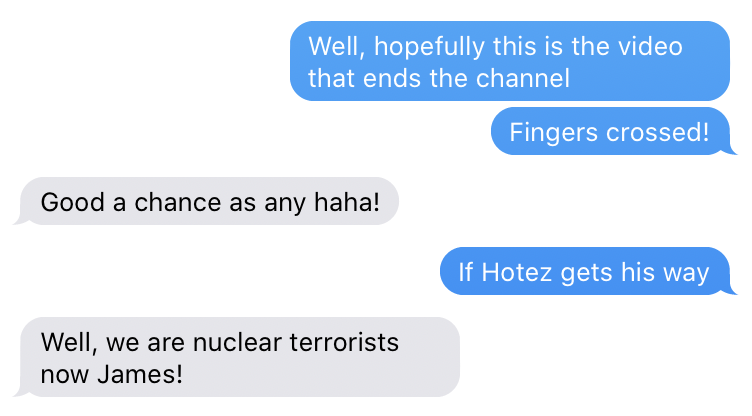
So, as you can see, this turn of events was not unexpected.
In a sense, it’s even more fitting that it was specifically a video about the philosophy of science that ended the channel. Not a documentary about the central banking system. Not an expose of false flag terrorism. Not a hard-hitting report on geopolitics or hidden history. No, a podcast about science that quotes Thomas Kuhn and highlights the growing politicization of science.
I say it’s “fitting” that such a report would be the one to do in the channel not only because I have been exploring this theme over and over in different ways since the very earliest days of The Corbett Report (since at least Episode 006 of the podcast, to be precise), but because in a sense the removal of The Corbett Report’s YouTube channel provides the ironically hilarious answer to a question that I had as a bright-eyed, bushy-tailed and naive undergrad over two decades ago.
You see, as I explained at the beginning of The Weaponization of Science video, I began my university career as an aspiring physics major. But after a semester spent in chemistry labs, applied mathematics courses and physics tutorials, I decided one day that I wanted to take my life in a completely different direction. So I dropped all my science courses for the upcoming semester and replaced them with English courses.
As one of the very, very few scientifically inclined students in the entire English department, I found that I was particularly on guard against all the eye-rollingly ignorant ways that those in the humanities attempted to add gravitas to their arguments by shoehorning inaccurate analogies about poorly understood scientific concepts (like “relativity” and “quantum mechanics”) into their lectures and papers. And so it was that I found myself approaching one professor during his office hours after he made a remark about how science was “politically determined.”
“How can science be politically determined?” I demanded of him indignantly. “If I drop this tape dispenser off your desk it’s going to fall at 9.81 m/s2 regardless of who is in political office.”
My professor, for his part, had only to prompt me to consider the inquisition’s investigation of Galileo for me to realize his point. Yes, scientists can be intimidated into proclaiming whatever the authorities—political, religious or otherwise—tell them to proclaim, even if it goes against their experimental results. The Galileo example may have been a particularly blunt one (and may or may not be apocryphal), but it hit the mark.
I never forgot that lesson. It is part of what has informed my work on the various pseudoscience fads, trends and hoaxes that have been foisted on the masses over the preceding century, from eugenics to Malthusian fearmongering to the catastrophic anthropogenic climate change myth.
Fast forward 20+ years and here I am daring to point out how the neo-inquisitionists are purging all criticism of their pseudoscientific pronouncements and . . . poof. Channel gone. Which kind of proves my point, doesn’t it?
Now, as I do not need to tell my regular audience, none of the videos are actually gone. Every single video has been backed up to LBRY. Years worth of videos are also backed up to BitChute, and, to a lesser extent, Minds and Archive.org. Every video since 2011 is downloadable directly from my servers. But if you don’t know that by this point, perhaps you’re not really ready to follow The Corbett Report into the Brave New (post-YouTube) Internet. Newsflash: this is 2021. If you’re still using YouTube to get your news, history and political information then you’ve got bigger problems than just the loss of The Corbett Report.
I’ve said it before and I’ll say it again: the “infowar” is not an analogy but a stone cold sober reality, and the fact that The Corbett Report was able to use a major enemy information platform to propagate the truth to the slumbering masses for 14 years is a major victory in and of itself.
So long, GooTube. Thanks for helping me to unlock so many minds. You will not be missed.
Google renews attack on YouTube account of Iran’s Press TV
Press TV – March 30, 2021
Google has for the seventh time targeted Iranian broadcaster Press TV, blocking the English-language news network’s access to its official YouTube account without any prior notice.
The US tech giant shut YouTube accounts of Press TV late on Tuesday, citing “violations of community guidelines.”
“We have reviewed your content and found severe or repeated violations of our Community Guidelines. Because of this, we have removed your channel from YouTube,” Google said in a message.
The community guidelines, as YouTube says, are designed to ensure the video-sharing platform stays protected and set outs what is allowed and not allowed on YouTube. The guidelines apply to all types of content, including videos, comments, links, and thumbnails.
The last time Google blocked Press TV’s access to its official YouTube account was last September, again without any prior notice but citing “violations of export laws.”
The United States export laws and regulations prohibit the use of and access to controlled information, goods, and technology for reasons of national security or protection of trade.
Over the past years, the US tech giant has recurrently been opting for such measures against Iranian media outlets. It has taken on Press TV more than any other Iranian outlet given the expanse of its viewership and readership.
The measure comes hot on the heels of another hostile move and aggression on the Iranian media outlets, with Facebook having permanently shut down the page of Press TV news network.
The US-based social media giant informed Press TV on Friday that its account had been shut down for what it claimed to be the Iranian news channel’s failure to “follow our Community Standards.”
Facebook has on a number of occasions attacked Press TV, despite its claim of providing space for freedom of expression.
The Tehran-based English-language news network has repeatedly fallen victim to censorship on multiple fronts, including Twitter and Instagram besides Google and its services.
Press TV’s website can also be accessed at the following alternate addresses:
House Republicans Propose Legislation to Allow Biden to Ban Sanctioned Foreign Leaders From Social Media
By Kirill Kurevlev – Sputnik – 03.03.2021
US House Republicans are introducing legislation that would broaden US sanctions law to ban social media platforms from letting foreign persons or organizations which were put under sanctions for terrorism from using their services, Fox News reported Tuesday citing a copy of the bill.
The law bill is reportedly proposed by representatives Andy Barr, Jim Banks, and Joe Wilson, and is reportedly co-sponsored by 40 other members of the House Republican Study Committee. The social media platforms mentioned in the proposed law include Twitter, Facebook, Instagram and YouTube.
“US law gives big tech a free pass to provide platforms to terrorist groups and dictators,” Representative Barr of Kentucky is quoted in the report as saying. “Social media companies should not provide a vehicle for terrorist groups like ISIS to raise money or for dictators like the Ayatollah of Iran to spread propaganda.”
The bill reportedly aims to clarify the current sanctions legislation by empowering the president with authority to limit the “provision of services,” including the management of accounts by Big Tech platforms to foreign persons or organizations sanctioned for terrorism by the US, and top officials of states, which are listed as sponsors of terrorism.
“Economic sanctions prohibiting the provision of services to individuals and entities sanctioned for terrorism should apply to social media platforms, while still supporting the free flow of information and maintaining the important principle that information should remain free of sanctions,” the legislation reportedly reads.
The bill also reportedly encourages the Treasury Department to “ensure that consumer communications technologies, as well as tools to circumvent government censorship, are available to civil society and democratic activists in such countries.”
Representative Jim Banks of Indiana, chairman of the Republican Study Committee, a conservative caucus within the House, claimed because of “outdated sanctions laws, social media platforms are able to ban President Trump and other conservatives but let the Iranian Supreme Leader and President Bashar Assad of Syria continue having accounts on Twitter, Instagram, Facebook and YouTube.”
“Thanks to Rep. Barr, we have a bill that would fix this double standard and hold Big Tech accountable to the same sanctions laws other American companies are required to follow,” Banks said.
Controversially enough, the lawmakers claim at the same time that the US Department of Treasury “should encourage the free flow of information in Iran, Syria, North Korea, Cuba, and other countries,” which, according to Washington, are “controlled by authoritarian regimes,” in order to counter them.
Under the existing law, the US president does not have the authority to compel social networks to comply with US sanctions law as it pertains to designated terrorists due to the International Economic Emergency Powers Act of 1976, and especially the so-called Berman Amendments, adopted in 1988 and revised in 1994 to include electronic media. Those amendments forbid the president from even implicitly restricting or banning anything that deals with the free flow of informational services.
Republicans have repeatedly challenged social media’s liability protections under Section 230 that shield social networks from being held responsible for the content posted on their platforms, while enabling them to moderate it.
Tech giants have incurred criticism for the permanent suspension of then-President Trump’s accounts from social media platforms in the aftermath of the violent events on January 6 at the US Capitol. Particularly, Trump’s ban on Twitter has raised concerns that Big Tech could silence practically everybody online, even a country leader.
Following the criticism, Twitter suspended the account of Iranian Supreme Leader Ayatollah Ali Khamenei and removed the tweet where he said that Western COVID-19 vaccines were “completely untrustworthy.”
YouTube Removes RT’s Video of Trump’s ‘Violative’ CPAC Speech – yet it’s ok when posted by Western outlets
By Nebojsa Malic | RT | March 2, 2021
Having a video of former US President Donald Trump’s speech at CPAC may get you warnings and a deletion from YouTube, but apparently only if you’re RT, as the platform seems to selectively apply its arbitrary and capricious rules.
On Tuesday, RT and its German-language channel RT DE got a notice from YouTube that the video of Trump speaking at the Conservative Political Action Conference (CPAC) in Florida on Sunday was being flagged for a “strike” under the platform’s rules on “supporting the 2020 US presidential election” announced in December.
Those rules say any questioning of the 2020 US presidential elections or claims of fraud is verboten. However, YouTube explicitly says “news coverage and commentary on these issues can remain on our site if there’s sufficient education, documentary, scientific or artistic [EDSA] context.”
A live-streamed public address by a former US president is the very definition of “news coverage.” According to one estimate, over 31 million people watched in on various social media platforms.
Yet when asked for a clarification, YouTube responded that the video lacks “enough context that additionally describes and demonstrates that this is Trump’s violative CPAC speech” and that “more details and explanatory information must be provided.”
There was no answer as to how such details and explanations should be provided in a live feed that did not have a correspondent commenting, or if it would be enough to include it in the text description underneath – something RT and our video news agency Ruptly have repeatedly asked about, without ever getting a response.
After RT’s inquiry YouTube proceeded to delete the video outright, for violating its “spam, deceptive practices and scams policy.”
Meanwhile, Trump’s speech was posted on YouTube by multiple other outlets – Reuters, ABC and The Independent, for example – without any of the aforementioned “context” or disclaimers. While it’s impossible for us to know if they also got warnings or strikes, their videos are still up, so it certainly appears that RT was singled out for enforcement.
Back in December, YouTube said it would boost “authoritative news” and suppress “problematic misinformation.” It now seems that the same exact video is treated as “problematic misinformation” when it comes from RT or RT DE, but as “authoritative news” when it comes from a Western corporate outlet.
It would be one thing if YouTube demanded that anything showing what Trump says be labeled as lies, or come with a disclaimer. Admittedly, that is the behavior of a publisher and not a platform, as YouTube claims to be in order to enjoy the protections of the infamous Section 230. Singling out RT channels for enforcement, while giving Western establishment outlets a free pass, however, is far more troubling. If that is indeed the case, then the Alphabet subsidiary is telling the world it does not judge videos on the basis of their content, but on the identity of their uploader.
That this sort of discrimination is posing as YouTube’s “community guidelines” and policies aimed at “supporting” – or would that be “fortifying”? – the US presidential elections, speaks volumes about the platform, but also the state of American democracy.
FBI laments that deplatforming of ‘extremists’ makes it harder to spy on Americans
RT | January 22, 2021
Law enforcement is complaining about social media platforms’ full-frontal assault on American political dissidents’ freedom of speech, crying that removing so-called ‘extremists’ from the internet makes it harder to spy on them.
A former FBI profiler recently took to NBC to complain that while Big Tech restricting Americans’ ability to freely communicate was all well and good, it was making it harder for the US intelligence apparatus to properly snoop on every aspect of these people’s lives.
FBI alum Clint Van Zandt complained that a 70-year-old man involved in the raid on the Capitol earlier this month was totally unknown to the bureau, showing up with a truck full of Molotov cocktails, a rifle, and some “improvised grenades” unheralded by any sort of presence on social media.
Leaving aside the laughable image of the US’ deep-pocketed intelligence apparatus being thwarted by a 70-year-old man from Alabama – who, it’s worth pointing out, is not known to have even entered the Capitol building (!) – FBI agents like Van Zandt and their local counterparts in small-town sheriffs’ offices are really worried that if social media keeps purging Trump supporters and other undesirables, these platforms will create an unstoppable army of Lonnie Coffmans.
Lonnie Coffman, the man in question, had no criminal record or ties to any extremist groups, but “was struggling financially and fixated on right-wing views,” Van Zandt explained, adding – in all seriousness – that the senior citizen was the sort of threat that keeps FBI agents “up at night.”
“The purging of people with radical views from popular social platforms, which has escalated in recent weeks, deprives investigators of a crucial tool in tracking people who might move along the continuum of ideation to action,” the former agent said.
In plain English, the profiler lamented that mass deplatforming prevents FBI agents from both spying on the majority of Americans whom it considers to be potential domestic terrorism threats and entrapping wannabe criminals by posing as terrorists, militia members, and other law-breakers.
Indeed, given that nearly all high-profile FBI cases involve the bureau entrapping suspects, and that this work is increasingly done online, Facebook, Twitter, and YouTube have become crucial tools in what the FBI describes as its fight against domestic extremism. Ordinary Americans might describe the agency’s work, however, as an unjustifiable effort to lure ordinary people into committing crimes in order to make the FBI and the rest of the US’ sprawling intelligence apparatus seem indispensable.
So please, Twitter and Facebook, the next time you highlight a bunch of users whose views fall outside the ever-more-stifling claustrophobia of the mainstream media and prepare to hit ‘delete’, think of the FBI.
Now that – according to such free-speech-loathing figures as former CIA director John Brennan and House intel committee chair Adam Schiff – the War on Terror is coming home, the FBI is going to need all the help it can get to manufacture the terror statistics that could possibly justify criminalizing political dissent in a nation whose Bill of Rights includes an ironclad guarantee to protect the individual right to free speech. The bureau certainly isn’t going to get that if it hasn’t been cultivating a pool of bored young men with no economic future across multiple platforms, stringing them along with promises of things that go boom.
Trump’s been deleted from internet, and any one of us could be next
By Kit Knightly | OffGuardian | January 14, 2021
Donald Trump has been deleted from the internet. He hasn’t been put behind a warning or had his followers reduced, or been forced to switch platforms. He’s gone.
Snapchat. Twitter. Facebook. YouTube. Google. Amazon. Instagram. Shopify. Twitch. Tiktok. Gone.
And he’s the President of the United States. If they can do it to him, they can do it to anyone.
Indeed, that’s the message being sent. It’s an intimidation move, designed to frighten people into policing themselves.
Many people have picked up on this already.
But unfortunately, many more are still lost in what they falsely believe to be the heady scent of victory. They’ll realise their mistake eventually, but it may be too late for us all by then.
It didn’t even stop at Trump, either. Tens of thousands of other people were banned in the following days.
For years the refrain from people defending censorship on social media – ironically, people who would usually identify as “socialists” – has been that private companies have the right to police their platforms as they see fit, and if you don’t like it you can switch to another social network.
… but now those other social networks are being shut down too.
It started with Gab a few years ago, but the recent assault on Parler was even stronger. Gab survived, Parler has not. The tech giants got together and stamped the life out of a smaller competitor. (Pretty sure antitrust laws are there to prevent exactly that scenario, but nevermind.)
The whole week since the “Capitol Hill Riot” has been one long display of dominance. A peacock fanning its tail or a silverback banging on tree trunks.
They are telling us who’s in charge, but some people are refusing to listen.
A common meme doing the rounds among “liberal” voices – who are these days well-schooled in missing the point – goes something like this: “If he’s too dangerous to have a twitter account, why does he have the nuclear codes?”
But, of course, the real question is – if they don’t even let him have a Twitter account, do you honestly think they let him anywhere near the nuclear codes?
Do you really think he has, or had, any power at all? Do you think Joe Biden does?
Do you think the same architecture that just publically castrated the “most powerful man on Earth” and the “leader of the free world” will suddenly start doing what it’s told when a “progressive” voice is in charge?
If they don’t bow to the will of the people now, why should they ever?
They won’t. They never have.
We’ve been told, in very clear terms, who has the power. And it is certainly not us, nor is it our elected representatives.
In fact, it’s not anyone with either democratic mandate or legal accountability, but rather a series of nameless executives, faceless bureaucrats and a succession of tech-billionaires forming a new breed of royalty.
Deleting Donald Trump wasn’t just a “panic response” to the “violence” on Capitol Hill, and it wasn’t a punishment for the man himself – It was a calculated display of honesty. A declaration of intent.
A notification of the limitations we’re all going to face as the increasingly dystopian new normal shapes a different kind of society.
It’s all been clearly co-ordinated. The Deep State and big business and the media working together. Police are instructed to create unrest on Capitol Hill, allow “rioters” into the building. The media report it as an “attempted coup”, while the social networks remove all of Trump’s denunciations so he can be blamed for “inciting violence”.
They created the lie. They spread the lie. They silenced anyone who would gainsay the lie. They have, as Karl Rove would put it, “created reality”, and now we’re here analysing it.
It was a big lie, this time, because it had to be. Because the man – or rather the office – was big. But for Joe Bloggs it can be a small lie. “he posted child porn” or “he was spreading hate” or “he was denying the pandemic”.
The precedent has been created. They can ban anyone they want and make up the reasons later.
Frank Zappa famously said:
The illusion of freedom will continue as long as it’s profitable to continue the illusion. At the point where the illusion becomes too expensive to maintain, they will just take down the scenery, they will pull back the curtains, they will move the tables and chairs out of the way and you will see the brick wall at the back of the theater.
Well, we’ve been shown the wall, and we’re being encouraged to cheer because the first person to run into it was Donald Trump. Rather predictably, millions have fallen for it.
Featured Video

Marandi: Threat of Seizing Kharg Island & the Use of Nuclear Weapons
or go to
Aletho News Archives – Video-Images
Frlom the Archives
Iran War: United States Military Versus Israel Firsters
By James Petras | November 27, 2007
Why must Jewish organizations be and be seen as the loudest drum-beaters of all? Why can we not bring ourselves to say that military intervention is not on the table at all? Why not stash it under the table, out of sight and mount instead a diplomatic assault? – Leonard Fein, Forward
Introduction
As the White House and Congress escalate their economic sanctions and military threats against Iran, top military commanders and Pentagon officials have launched a counter-offensive, opposing a new Middle East War. While some commentators and journalists, like Chris Hedges (Truthdig, November 13, 2007), privy to this high stakes inter-elite conflict, attribute this to a White House cabal led by Vice President Cheney, a more stringent and accurate assessment puts the Zionist Power Configuration (ZPC) in the center of the Iran war debate.
There is a great deal riding in this conflict – the future of the American empire as well as the balance of power in the Middle East. Equally important is the future of the US military and our already heavily constrained democratic freedoms. The outcome of the continuous and deepening confrontation between top US military officials and the Israel Firsters over US foreign policy in the Middle East has raised fundamental questions over self-determination, colonization, civilian primacy and military political intervention, empire or republic. These and related issues are far from being of academic interest only; they concern the future of the United States. … continue
Blog Roll
 Aletho News
- Iran warns it may target US missile launch sites in UAE cities
- American Military Failure in Afghanistan
- Friendly Skies of Georgia: Are Israeli-Linked Drones Launching False Flags from Georgian Territory?
- The Three Big Lies about Mammography Screening
- Ukrainian Embassy in Beirut sheltering top Mossad agent
- Palestinian family displaced after settlers violently attack them in Humsa, Jordan Valley
- The EU never learns – except for the wrong lessons
- Iran attacks on UAE leaves RSF militia high and dry
- Hosting Washington’s war: Bahrain faces the consequences
- The US fell for its own Iran propaganda
- If Americans Knew
- ‘Of Course’: IDF Drops Case Against Soldiers Accused of Raping Palestinian Prisoner
- Don’t Fall for the Regime Change Talk. Israel Is ‘Mowing the Lawn’ in Iran
- Will Israel and the US wreck the Gulf States along with Iran?
- US so far burned through ‘years’ of munitions in Iran war: Report
- How the Israeli Tail Wags the American Dog
- Outdated intel likely led to deadly U.S. strike on Iranian elementary school, sources say
- Pentagon insider says high U.S official Douglas Feith reported to Netanyahu
- In fond memory of Walid Khalidi, the historian of Palestine
- 6 more Americans killed, as Israel ‘mows the lawn’ in Iran – Not a ceasefire Day 154
- Are we on the precipice of World War III?
- No Tricks Zone
- New Studies: UK Sea Levels Were 4 Meters Higher Than Today During The Mid-Holocene
- Destructive Green New Deal: German Energy And Metal Group Warns Of Drastic Crisis
- New Study Documents A 20-Year Pause In Arctic Sea Ice Decline – Driven By Internal Variability
- Wake-up Call: Survey Shows Majority Of Germans Now Favor Postponing Climate Targets!
- Televised! Leading German Political Candidate Tells Schoolchildren CO2 Makes Sun Hotter!
- New Study: A Century Warming Of 1.1°C Is ‘Commonplace’ And ‘Not Unusual’ During This Interglacial
- New Study: ‘Internal Noise’ And Volcanic Forcing Can Trigger 10-15°C Warming Within Decades
- Glaciers Worldwide Are Suddendly Surging, Experts Blame Warming!
- Surprising Discovery: Sahara Is Greening…Billions Of Trees Where Once Thought To Be Barren
- New Research Reaffirms Clouds, Aerosols, And Surface Solar Radiation Are ‘Driving The Climate System’
 Aletho News