Google DeepMind workers push for unionization over company’s Israeli ties
Press TV – April 27, 2025
Employees at Google DeepMind’s London office have initiated efforts to unionize in response to the tech giant’s decision to provide its artificial intelligence (AI) technology to defense entities and maintain connections with the Israeli regime.
Reports on Saturday indicated that around 300 workers at DeepMind, the AI division of Google in London, have sought membership with the Communication Workers Union in recent weeks.
DeepMind employees’ decision began when Google updated its approach to AI technology and dropped its militarization clause from its ethical pledge (AI Principles).
In its previous version of AI Principles, Google had included a commitment clause to not pursue AI technologies that “cause or are likely to cause overall harm”, especially in weapons and surveillance that violate “internationally accepted norms.”
The revised version of AI Principles, states that the company pursues AI “responsibly” and in line with “widely accepted principles of international law and human rights”, but does not include the previous language about weapons and surveillance.
The tension between DeepMind and its parent company further increased when a whistle-blower revealed that Israel had been using their technology to generate targets for assassinations and attacks in Gaza, where close to 51,500 Palestinians have been killed so far.
After the revelation about the Israeli regime’s use of DeepMind AI in the Gaza war, several employees quit the company.
“We’re putting two and two together and think the technology we’re developing is being used in the [Gaza war],” said one engineer involved in the unionization effort.
“This is basically cutting-edge AI that we’re providing to an ongoing [war]. People don’t want their work used like this,” he added.
The effort to unionize needs to be recognized by the company through a vote among DeepMind employees in the UK. The company has around 2,000 staff in London.
If the unionization effort succeeds, the employees will demand that Google nullify its military contracts.
If Google still decides to sell its technologies for military purposes, then the employees have the right to go on strike.
“What I hope and what people who are active are hoping is that we stay away from any military contracts,” said one of the organizers of the unionization effort.
The Israeli regime already has a $1.2bn cloud computing agreement with Google and Amazon, called Project Nimbus.
‘Israel’ continues war on Palestinian journalism: 343 attacks in 2025

Al Mayadeen | April 27, 2025
The Palestinian Journalists’ Syndicate disclosed on Sunday alarming findings on the condition of press freedom in Palestine, documenting widespread violations committed by the Israeli occupation during the first three months of 2025.
The report highlights a brutal and systematic campaign against Palestinian journalists, marked by lethal attacks, arrests, and the destruction of property.
According to data from the syndicate’s Freedom Committee, 15 journalists were martyred in the Gaza Strip as a result of direct targeting by the Israeli occupation forces: Seven in January and Eight in March 2025. Alongside the targeting of media workers, 17 family members and relatives of journalists were also killed. Additionally, 12 journalists’ homes were destroyed in missile and artillery strikes, while 11 journalists sustained severe injuries.
The targeting of journalists did not stop at physical attacks. The report documented 49 incidents in which press crews came under live fire, with death narrowly avoided. These attacks were often carried out under the pretext of issuing warnings or clearing journalists from specific areas, underscoring the deliberate nature of the occupation’s strategy to silence media voices.
The wave of detentions also persisted during the first quarter of 2025, with 15 journalists detained either during home raids or while reporting in the field. While some remain imprisoned, others were released after hours or days in custody. These arrests form part of a broader campaign to stifle media coverage of ongoing events in occupied Palestine.
Repression of journalistic freedoms
The report outlines further forms of repression faced by Palestinian journalists, including systematic obstruction and targeted persecution. Approximately 117 journalists endured various measures designed to prevent them from performing their duties, particularly in al-Quds and Jenin. These included arbitrary detention, intimidation, and physical assaults.
In al-Quds and Jenin, 14 journalists were subjected to violent attacks involving gunstock blows and kicking. The destruction and seizure of equipment were also widespread, with 16 cases recorded. Moreover, 31 journalists suffered from respiratory trauma after exposure to poisonous tear gas, forcing some to seek emergency medical care.
Legal harassment and administrative restrictions also increased. Around 13 journalists in al-Quds were summoned for interrogation and subsequently banned from reporting in the vicinity of Al-Aqsa Mosque and the Old City. These measures are part of a broader effort by the occupation to control narratives and suppress the Palestinian media, according to the Syndicate.
In total, the Palestinian Journalists’ Syndicate documented approximately 343 violations, which included verbal abuse, threats, incitement, deletion of footage, legal prosecutions, and financial penalties. Given the scale and intensity of these violations, the syndicate has urged field teams to exercise extreme vigilance and adhere to strict safety protocols.
The syndicate concluded by reaffirming its commitment to documenting these crimes and presenting them to international institutions. It emphasized the importance of exposing the Israeli occupation’s actions and pursuing accountability to put an end to the aggression against Palestinian journalists and media freedom.
Gaza’s Missing
TRT World | March 1, 2025
In Gaza, where loss is immeasurable and grief beyond expression, families search for their missing children—some lost in the rubble, others in the silence of war. TRT World’s new documentary Gaza’s Missing uncovers their stories, revealing a generation slipping away and the fight to keep their memory alive.
Subscribe:
http://trt.world/subscribe
Livestream: http://trt.world/ytlive
Facebook: http://trt.world/facebook
Twitter: http://trt.world/twitter
Instagram: http://trt.world/instagram
Visit our website: http://trt.world
The case of Raffi Berg and BBC: Zionist infiltration of the mainstream media
By David Miller | Press TV | April 26, 2025
British journalist Owen Jones recently wrote at length about the background, commitments, and active role that Raffi Berg plays in enforcing the pro-Zionist line at the BBC.
Berg is the Middle East (West Asia) editor at BBC Online, but he appears to have a much greater gatekeeping role in practice.
Jones’ research amply bears out the view that anti-Zionists have been encouraging for some time now, which is that Zionist infiltration of the media and other public institutions is a significant problem and amounts to colonization of public space on behalf of a genocidal foreign entity.
But this is not how Jones sees things, with the result that he markedly pulls his punches.
It is clear from what Jones writes that Berg is a fanatical, genocidal Jewish supremacist. Jones also makes it clear that Berg plays a pivotal enforcement role inside the corporation, such that all stories about the ‘Middle East’ have to be checked with him. Jones writes:
In addition to what they see as a collective management failure, journalists expressed concerns over bias in the shaping of the Middle East index of the BBC News website. Several allege that Berg “micromanages” this section, ensuring that it fails to uphold impartiality. “Many of us have raised concerns that Raffi has the power to reframe every story, and we are ignored,” one told me… “Almost every correspondent you know has an issue with him,” one said. “He has been named in multiple meetings, but they just ignore it.”… Berg’s influence has a ripple effect, the journalists say. While BBC broadcasters write and produce their own reports, editors and reporters across the organization frequently draw on web articles such as those edited by Berg to flesh out their stories.
Jones also notes the fact that Berg had written a book on the notorious Israeli spy agency Mossad, which is simply a propaganda tract for the agency.
In 2013, Berg became Middle East editor for BBC News Online. It was in this role that he encountered material that would form the basis for his book, “Red Sea Spies: The True Story of Mossad’s Fake Diving Resort,” an account of the Israeli spy services’ efforts to evacuate Jews from Ethiopia between 1979 and 1983. In the book, Berg describes Mossad in glowing terms, calling the agency “much vaunted.” Berg received extensive cooperation from Mossad for the book, including “over 100 hours of interviews” of “past and present agents and Navy and Air Force personnel.” It was published in 2020. In an interview to promote the book, Berg said he collaborated on the project with “Dani,” a former senior Mossad commander he described as a “legend” who later became “a very close friend.”
Berg, gushingly, tweeted in 2020 about the book being sighted on the bookshelf of Israeli premier Benjamin Netanyahu.
Jones was unsurprisingly attacked by the genocidal Zionist enforcer Dave Rich of the Community Security Trust for writing about how a ‘Jewish editor’ is ‘secretly manipulating’ the BBC’s output.
In response, Jones wrote that ‘The fact he’s Jewish isn’t mentioned.’ This is correct. But we might ask, why not?
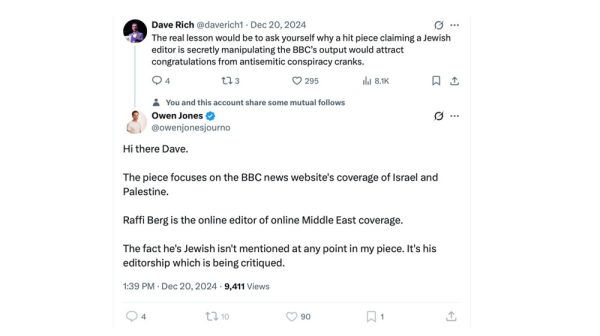
Nor does Jones state that Berg is a Zionist. In fact, the ‘Z word’ is only used twice in the whole piece: once (‘Zionist’) to describe the ‘right wing’ Zionism of Likud-Herut (an organization with whom Berg’s lawyer Mark Lewis is strongly affiliated); and once (‘Zionism’) in a quotation from Mark Lewis emphasizing the importance of “unapologetic Zionism.”
But surely Berg’s Zionism and the fact that he is Jewish — a Jewish supremacist no less — are in fact relevant to this discussion? And surely pretending they are not only undermines the punches that Jones appears to be trying to throw?
How is it that Berg occupies this pivotal location within the BBC? Can we imagine a Catholic, a Hindu, or a Sikh (let’s not even mention a Muslim) being in such a pivotal role on coverage of Palestine? Of course not.
Berg has not been granted or put in that position by the BBC because he is a Zionist. It’s, subconsciously at least, because he is a Jew that he is deferred to. Of course, if he were an anti-Zionist Jew, he would never get into such a position.
Identity politics runs deep in British public institutions — the idea that a Jewish person (or at least the correct type of Jewish person) is the appropriate arbiter of how to cover the occupation of Palestine is seen as common sense.
It is worth extending this analysis to other conflicts. Would a Hindu be asked to adjudicate in BBC HQ on the reporting of Hindutva crimes or a Protestant on Loyalist death squads in the north of Ireland?
We need not even ask about the prospects of the BBC appointing a Palestinian (Muslim, or Christian) to adjudicate coverage of the genocide in Gaza. Extending the analysis says something about the selective implementation of identity politics in the forcefield created by Western official sources and Zionist movement intimidation and bullying of the media.
Recognition that Berg is a genocidal Zionist is crucial to naming the problem and beginning to push back against this kind of Zionist infiltration and subversion of our public institutions.
Of course, Owen Jones appears to want no part of that struggle.
Zionist infiltration at the BBC
There are, of course, many other Zionists (whether Jewish or not) in the BBC, especially in news and current affairs. John Mitchell listed a few very senior employees some years ago:
● James Harding – Director of News & Current Affairs, BBC News (2013–2018) and past editor of the Times, was a hardline Zionist. At a Jewish Chronicle event in 2011, he declared:
“I am pro-Israel. I believe in the state of Israel. I would have had a real problem if I had been coming to a paper with a history of being anti-Israel. And, of course, Rupert Murdoch is pro-Israel.”
● Danny Cohen – Controller of BBC 1, 3, and Director of BBC Television (2007-2015) wrote a letter while still a BBC executive condemning the Boycott, Divestment, and Sanction (BDS) movement, which campaigns to end the Israeli occupation of the Palestinian West Bank and Gaza.
● James Purnell – BBC Director of Radio and BBC’s Director of Strategy (2013-2020) was the chairman of Labour Friends of Israel during his parliamentary career.
We can add to that list some further issues with the most senior management at the BBC.
● Richard Sharp, the former Chairman of the BBC, is a hardline Zionist, former Goldman Sachs and JP Morgan banker, director of the International Rescue Committee, an organization set up with the aid of the CIA, and donor to the British intelligence-created and Zionist-funded Quilliam Foundation.
● Robbie Gibb is reportedly not Jewish, but his brother, the minister, reportedly spent time on a Kibbutz in the Zionist entity when he was young. Both brothers were also part of a Western intelligence operation in the Soviet Union in the 1980s. Gibb went on to lead the consortium to buy out the failing Jewish Chronicle and became the sole director of the company that runs it. He did take a step back from that after concerted pressure was applied over his continuing role at the BBC on the editorial standards committee.
Also on that committee is the CEO of BBC News, the Director General, and the Chair of the BBC (which was Richard Sharp from February 2021 to June 2023 — it is now Samir Shah) and an ‘independent’ member who is currently Nicholas Serota.
Serota has had a long career in the art world and is also a Zionist and opponent of BDS. The ‘CEO’ of the BBC news division, Deborah Turness, is also cited by the BBC as “standing in the way of change” on the question of coverage of Palestine.
Of the five members, either 2 (or 3 when Sharp was in position) are Zionists, and one has blocked complaints on Zionist bias. Given that Director General, Tim Davie, is a former Conservative candidate who has worked for a CIA-supported front group, it is little surprise that the BBC is completely unwilling to cover the genocide properly.
Structural discrimination against Muslims in the BBC
The context of the dominance of Zionism is not just that there are Jewish Zionists in key positions exercising a gatekeeping function, as well as non-Jewish Zionists who provide cover and support for them (such as Robbie Gibb or James Purnell), but that overall there is in the BBC a notable over-representation of Jews and a notable under-representation of Muslims (in relation to their proportion in the population).
Research conducted by the BBC in 2022 shows the corporation at that time employed some 1% of staff who are Jewish, which is twice their proportion in the population, and 3.1% of staff who are Muslim, which is 48% of their proportion in the population.
The differences are more marked when we turn to the News and Current Affairs division of the BBC where Jews make up 2.2% of all staff and 2.5% of leadership staff (proportionally 4.4 times and five times more than their proportion in the population).
By contrast, Muslims are 3% of all News and Current Affairs staff (which is 46% of their proportion in the population) and at the leadership level, there are simply no Muslims at all.
This is itself a problem of structural discrimination, quite apart from what impact it might have on coverage of the genocide. And that impact is not inconsequential. It’s perfectly clear that the Zionists among the BBC News and Current Affairs staff are an aid, as opposed to a hindrance, to the enforcement of Zionist rationality across the BBC.
The gatekeeper
The scandal at the BBC on which Jones reported, is a scandal of Zionist infiltration and gatekeeping. And it’s a scandal that appears to exist in varying ways throughout the media landscape. As the journalist Rivkah Brown has put it:
“I have seen this trend in almost every mainstream media outlet I’ve worked at or reported on: One hardline Zionist who either has decision-making power or aggressively lobbies decision-makers, often with threats of antisemitism. Fearful of scandal, editors cave.”
Brown was reacting to the case of Sky News, which was one of the few media outlets to properly report the violence of Israeli fans in Amsterdam in 2024. Sky then promptly reversed itself. The role of Sandy Rashty as News Editor at Sky was then noted. Rashty is a committed Zionist and writes for the Jewish Chronicle.
It may, as Brown says, take only one advantageously placed Zionist to act as a gatekeeper, but in many news organizations, there are many such placeholders at all levels of the organization, as we have seen with the BBC.
But are these gatekeepers an incidental feature of accidentally employing genocidal Zionists in the newsroom, or is there a wider strategy of infiltration by the Zionist movement?
The strategy of infiltration — The Jerusalem Program
The reality is that the Zionist movement has been involved in a massive push to infiltrate public life in the UK at least since the 1950s, when the movement determined, having reached its objectives in creating a state in 1948, that it would not dissolve itself.
Instead, it adopted the so-called Jerusalem Program, which remains its aim to this day and was most recently revised in 2004. The “foundations” of Zionism, it states, include: the “bond” of the Jewish people to “Eretz Yisrael” which should be settled “as an expression of practical Zionism.”
Every Zionist organization that signs up to the WZO thus supports settler colonialism in “Eretz Israel” (a term usually meaning land far beyond the current occupation, spreading into Lebanon, Syria, Jordan, Iraq, and Egypt); to support a “Jewish” state and “defend” the “right of Jews… as a nation” — meaning structural privileges for Jews — a clearly racist proposition.
Individuals are no longer able (since 1960) to join the WZO directly and must join one of its member organisations. But membership in any Zionist organisation also requires certain “Duties of the individual Zionist”, adopted in 1978. These enjoin Zionists:
“To implement Aliyah [the Zionist term for settler colonialism] to Israel”; and “bring [children] up towards Aliyah”; to “be an active member of the [Zionist Federation]”; “contribute to … Zionist Funds”; and “strengthen Zionist influence within the community.”
In other words, individual Zionists are required to affirm the racist settler colonial ideology and to practically support it. What’s more, they are required to help popularise it in the community.
How this works today can be seen in the approach of the United Jewish Israel Appeal (UJIA), the largest Zionist “charity” group in the UK. UJIA is an anodyne-sounding “charity” which is actually the UK branch of one of the Zionist regime’s four “national institutions,” all based in the same building in King George Street in occupied Jerusalem/Al-Quds.
A 1997 Institute for Jewish Policy Research report, “The Attachment of British Jews to ‘Israel’”, raised an alarm:
“If current trends prevail, attachment to Zionism and the Jewish state could become the concern of only a minority with a mostly Traditional or Orthodox religious outlook.”
As a result, the UJIA refers to their approach as building a ‘lifelong connection’ to “Israel.”
Ruth Wisse: the Army of words
This strategy was memorably enunciated by Harvard professor Ruth Wisse, an open supporter of genocide. The clip on YouTube is just over two minutes long and it’s worth watching in full. For our purposes, the following excerpt is germane:
“American Jews, what do you have to worry about? Your job is to make us [Israel] look good and here’s how you do it: Every one of us has to serve three years in the Army … and then for the rest of our lives you have got to serve two or three years in the army of words you’ve got to learn to fight the political battle which is even more important at this point than the military battle… We’ll fight the military battle we’re not asking you necessarily to come and be lone soldiers although some of you can you’ve got to learn how to fight back on the campuses how to make the arguments now … Don’t let the war of words ever be fought about Israel’s nature, let it be fought about why you can’t accept Israel? Why you have to single out this tiny people? … Push them, teach them how to defend by attacking… You’ve got to make demands on them. They’ve got to serve for three years in the army of words.”
Enrolling all Jews in the ‘army of words’ is the aim of the Zionist movement. They don’t get everyone. But it seems plain they get more than enough to be effective in very many circumstances.
Are You Tired of Hearing About Antisemitism?
Simply stop killing Gazans and the anger directed at Jews might end
By Philip Giraldi • Unz Review • April 26, 2025
One might well ask how a group composed of little more than 3% of the US population has managed to gain control of the nation’s foreign policy, its legislature and executive branches, its media, its entertainment industry, its financial institutions, and its elite universities while also making the United States subservient to the wishes of a monstrous small state located seven thousand miles away and composed of its coreligionists? Well, it helps to have a great deal of money liberally applied to corrupt the existing political and economic systems, but that is not necessarily a good place to start as one might reflexively be accused of wielding a trope much favored by antisemites when discussing Zionist Jews, the group of which we are speaking. Alternatively perhaps, one might take an oblique approach by observing how the highly privileged and protected Zionists in question get rich living in America while having true loyalty to apartheid Israel, something that normally might be considered untenable if not borderline treasonous.
Recent reports suggest that there are upwards of 23,000 Americans serving in the Israeli Army (IDF), most of whom are presumably dual nationals with Israeli citizenship. Under existing law, they should all lose their US citizenship but that will not happen as Congress and the White House have both been bought. Indeed, they are being given a golden handshake by the US Congress with a new bill currently in Congress which would extend some US military benefits to the notional American citizens who are currently carrying out the Gaza genocide as members of the IDF. One such clown Congressman Brian Mast, who served in the IDF, even parades around Congress in his Israeli military uniform and no one says squat.
Beyond the Americans in the IDF, there have been several odd appointments at high levels in the US civilian bureaucracy, including the latest naming of a former Israeli Defense Department and UN Israeli Embassy employee whose husband still works at the embassy to a top position on the National Security Council. Merav Ceren will be the Director for the development of the relationship between Israel, Iran and the US. It is a highly sensitive position and one can only speculate on how she got a clearance, though it is presumed that she is a dual national, which in and of itself should have been a warning sign. Her appointment gives Israel an unusual advantage in internal policy discussions just as the Israeli government has launched a new campaign to pressure the American government to start a war with Iran rather than continue with negotiations toward a nuclear deal. Ceren previously worked at Senator Ted Cruz’s office in Washington, which may have been her stepping stone to the job as Cruz’s loyalty to Israel and all that pertains to it should be unquestioned and he is the recipient of millions of dollars in pro-Israel political “donations.” She also worked for the neocon Iran-hating Foundation for the Defense of Democracies. How she was named to the position she now holds should be considered in itself a huge security breach, one of many already experienced in Trump’s first hundred days, where loyalty to Israel trumps all other factors, as the expression might go.
The trajectory of Meyav Ceren reminds one of another Israeli woman dual national who truly stood out when it came to serving Israeli interests from inside the United States government. Sigal Pearl Mandelker might be worthy of the nickname “Queen of Sanctions” because she was the Department of the Treasury’s Under Secretary for Terrorism and Financial Intelligence (OTFI) under the first Trump administration. She handed out the punishment and cranked up the economic pain up for countries like Iran, Venezuela, Cuba and Russia during her time in office from June 2017 until October 2019 when she finally resigned after being under pressure from people like me.
OFTI’s website proclaims that it is responsible for “safeguarding the financial system against illicit use and combating rogue nations, terrorist facilitators, weapons of mass destruction (WMD) proliferators, money launderers, drug kingpins, and other national security threats,” but it has from its founding been really all about safeguarding Israel’s perceived interests. Grant Smith notes how “the secretive office has a special blind spot for major terrorism generators, such as tax-exempt money laundering from the United States into illegal Israeli settlements and proliferation financing and weapons technology smuggling into Israel’s clandestine nuclear weapons complex.”
To be sure most of the Jews with whom I am in touch are appalled by that activism of the Mandelkers and the Cerens and even more so by what is happening in Gaza, Syria and Lebanon at the hands of Prime Minister Benjamin Netanyahu and his extremist enablers, but what we are talking about here is institutional and tribal Jewry which together have the distinction of being referred to as the Israel Lobby, which an increasing number of observers have to come to believe to be something like all powerful and the unofficial government of the United States in many relevant areas.
Ron Unz’s recent article recent article Trump vs. Harvard in a Political Wrestling Match examines the issue of Jewish supremacism and, among other factors, identifies the various mechanisms used by Jews to enhance their enrollment at top universities. He mentions in passing how Donald Trump’s son-in-law Jared Kushner got into Harvard without having the level of academic achievement that normally would have been a prerequisite. It was possibly accomplished through an institutionalized “Harvard Price,” an under the table donation of several million dollars from the wealthy Kushner family. I personally recall attending an elite university in the 1960s and hearing Jewish classmates boast of how “they” comprised 40% of the first-year students. A friend of mine at Yale told me of similar boasting among the “Sons of Eli.” Forty per cent participation for 3 per cent of the population is certainly an astonishing rate of success.
Unz uses available educational data bases to demonstrate that the disparity was not due to greater intelligence or academic performance among the Jewish applicants. He concludes that “Based on these figures, Jewish students were roughly 1,000% more likely to be enrolled at Harvard and the rest of the Ivy League than white Gentiles of similar ability. This was an absolutely astonishing result given that under-representation in the range of 20% or 30% is often treated by courts as powerful prima facie evidence of racial discrimination.”
Based on my own contact with Jews in the academic world and in government, I would prefer to describe the Jewish success with universities as a product of gaming the system, i.e. producing incentives outside academia itself to make the candidates more attractive. Whether such maneuvering might be described as corruption of the process depends pretty much on where someone stands outside the system, but the fact is that it is far easier for a Jewish high school graduate to get into an elite university than it is for a comparably educated and intelligent white Christian. And if you throw into the hopper all the “minority” other applicant groups that get preferential treatment, white males who are not Jews are definitely at the bottom of list when acceptance time comes around.
Beyond cash incentives, one might also conclude that Jews are exceptionally good at self-promoting and on translating their largely fictional collective victimhood into a sympathy vote that gives them a considerable edge as they move through education and high-profile careers. The problem is that that aggressive self-promotion does not stop at the level of personal aggrandizement and opens the door to large scale group interference in both foreign and domestic government policies that run strongly contrary to the interests of most Americans. I am of course referring to groups like the American Israel Political Action Committee (AIPAC) and the Anti-Defamation League (ADL) which serve as lobbies and support structures for the apartheid Jewish state Israel, which is currently carrying out a genocide in Gaza, without any accountability or consequences as required by current US law under the Foreign Agents Registration Act of 1938 (FARA). President John F. Kennedy was trying to get such groups to register when he was assassinated in 1963.
Other Jewish national organizations are also on board in supporting Israel as are the numerous Christian Zionists, which means that killing tens of thousands of people in the Middle East is a matter of no consequence, except that once more the Israeli Jews must be and are widely portrayed as the victims. The US is complicit in the arming of Israel and the killing and actually condones it even though a majority of American voters do not support the Jewish state. Likewise, the Jewish dominated press and other media looks the other way as the slaughter goes on, as it no doubt will, and one expects that upwards of 2 million Palestinians will eventually be deported to whatever shithole is willing to accept them under pressure from the US. Otherwise, the “Justice” recommended by Israel’s Security Minister Itamar Ben-Gvir, who is now in the United States on a “visit,” will likely be pursued, i.e. a bullet to the back of the head of every Palestinian.
And then there is the issue of the “crime” of antisemitism, which is the only thing that the Justice Department seems to think is worth addressing, to the point where people who have done nothing beyond expressing their concern over what is going on in the Middle East are being arrested without any charges being filed and detained while being processed for deportation. Secretary of State Marco Rubio has publicly announced that he has authorized the arrest and deportation of 300 students for their criticism of Israel. The US House of Representatives has obligingly passed a measure equating criticism of the racist, Jewish supremacist ideology of Zionism with what they describe as a hate crime “antisemitism.” Meanwhile the Israel Lobby and its politician choral society are constantly using the Jew-controlled media to sing about how Hebrew students fear going to school due to the presence of all the “antisemites.”
This is, of course, largely a convenient fiction largely created by the media, and it is rather Jews who have been beating up peaceful demonstrators. And it is extremist Jewish-funded groups that have been stirring the pot, going after anyone who is perceived as anti-Israeli. One of the groups, Canary Mission, has run a massive disinformation operation for years, publishing the names and photos of thousands of alleged pro-Palestine activists, while another group, Betar, openly encourages targeting of student activists and brags that it has “provided names of hundreds of terror supporters” to the Trump administration. Ross Glick, the head of Betar’s US branch, believes that “Foreign students on visas in the US shouldn’t have the right to free speech.” Jews, however, should be allowed to behave with complete freedom to include carrying out murder, war crimes, and human rights violations targeting those it sees as opponents.
To be sure, protesting against any of the horrors that Israel is engaged in is regarded to be one symptom of “antisemitism” which is ipso facto considered to be something like a capital offense, even though it is pretty much generated in America by the impunity and savagery with which Israel behaves towards the rest of the world. And the parameters of what might constitute a legitimate search for “antisemites” is expanding. The US State Department will now demand from foreigners wishing to travel to the United States information on their social networking sites. Those sites will be screened for anti-Israel content and the visas will be refused. This is an extension of the anti-Boycott, Divestment and Sanctions (BDS) policies now in place in 38 states in the US where a job or services will be denied to citizens if they will not sign a pledge or promise not to support the movement to boycott or punish Israel. The situation is even worse for those foreigners who are currently going through screening to become US permanent residents as it is the issue of one’s views of Israel alone that could easily determine who is allowed to become a future citizen and who is rejected.
Indeed, protecting Jews is a full-time job of the Trump Administration, even more so that under Genocide Joe Biden. Antisemitism comes up in speech after speech and fully ninety per cent of the discretionary Homeland Security Agency grants already go to Jewish groups or buildings, to the tune of more than $400 million. Interestingly, the government also appears to be constructing a data base of Jews to protect them further. The personal cellphones of dozens of current and former Barnard College employees rang last Monday evening with a text message that said it was from the Equal Employment Opportunity Commission, part of a review of the employment practices of Barnard. A link led to a survey that asked respondents if they were Jewish or Israeli, and if they had been subjected to harassment.
Another attack on free speech in America that is Israel related, apart from what is going on at the universities which are being destroyed from within by the government demands to protect Jews, is the role of how research institutes have traditionally been able to engage in fraternal discussions to seek action and share information with any country or government entity in the world. But researchers and university employees who engage in certain nonviolent protests or political expression over human rights conditions in Israel and Gaza may now risk loss of employment and other civil and criminal penalties, according to a new policy unveiled by the National Institutes of Health on April 21st. The agency, the largest public funder of biomedical research in the world, touches virtually every corner of the scientific community but it will now be silent over what is happening in Gaza, where every hospital has now been destroyed by Israeli-American bombs.
So there you have it. Let’s stop making excuses for Israeli behavior that depicts Jews as the perpetual victims while seeking to falsely label Israel’s enemies as the war criminals and racists. We will leave those attributes to Israel itself. Better still, arch-Zionist Donald Trump should pick up the phone in the Oval Office and call Prime Minister Benjamin Netanyahu to tell him that America has become tired and the game is over. America will no longer be sacrificing its own interests to support a genocide and no longer will be footing the bill and providing the weapons to carry out the slaughter. “Goodbye Bibi! And don’t let the door hit you in the ass on the way out!”
Philip M. Giraldi, Ph.D., is Executive Director of the Council for the National Interest, a 501(c)3 tax deductible educational foundation (Federal ID Number #52-1739023) that seeks a more interests-based U.S. foreign policy in the Middle East. Website is councilforthenationalinterest.org, address is P.O. Box 2157, Purcellville VA 20134 and its email is inform@cnionline.org.
Israeli Occupation Forces Assassinate Journalist, His Wife and Daughter in Deir al-Balah
Palestinian Centre for Human Rights – April 24, 2025
 The Palestinian Centre for Human Rights (PCHR) condemns in the strongest terms the assassination crime committed by the Israeli Occupying Forces (IOF) that killed a Palestinian journalist, his wife and daughter while they were walking near their house in Deir al-Balah.
PCHR believes that the ongoing targeting and surging killing of journalists undoubtedly reveal that the killing is deliberate and intentional aimed to intimidate and terrorize journalists preventing them from unveiling the truth to the world.
Such targeted attacks are part of the crime of genocide Israel is committing in the Gaza Strip. PCHR emphasizes that IOF’s unabated impunity encourages them to commit more violations and crimes against journalists and their families without any deterrence for their actions.
According to PCHR’s documentation, on Wednesday, 23 April 2025, an Israeli warplane fired a missile at journalist Sa’id Amin Abu Hasanein (42), targeting and killing him, his wife, Asmaa’ Jihad Abu Hasanein and their 15-year-old daughter, Sarah, while they were walking on al-Bee’ah Street, central Deir al-Balah. Hasanein worked in sound engineering and audio mixing at Al-Aqsa Voice Radio in Gaza.
With this crime, the number of journalists killed by IOF since 07 October 2023 has risen to 212, according to Gaza’s Government Media Office. This war has taken a record toll since the recording of journalist fatalities started in 1992.
Among those killed were 13 female journalists. Meanwhile, the majority of journalists were killed in Israeli warplane and drone airstrikes, and the remaining were shot dead by Israeli snipers. Most journalists were killed alongside their families in targeted attacks on their homes, while others were killed in indiscriminate bombings throughout the ongoing genocide.
Some journalists were directly targeted and killed while others were killed on duty. Additionally, 194 journalists have been injured under various circumstances during the aggression.
Moreover, a large number of social media activists have been targeted by the IOF, who systematically incite against them and threaten to kill them if they do not remain silent.
PCHR asserts that the targeting of journalists intends to isolate the victim and prevent the documentation of Israel’s genocidal acts against Palestinian civilians in the Gaza Strip.
Thus, PCHR calls on the international community to openly condemn the targeting of journalists, to exert pressure on Israel, the occupying power, to immediately stop these attacks, and to urgently provide international protection for civilians, including journalists, in the Gaza Strip.
PCHR emphasizes that the deliberate killing of journalists is a war crime under the jurisdiction of the International Criminal Court (ICC), according to Article 8 of the ICC’s Rome Statute. It also constitutes arbitrary deprivation of life under Article 6 of the International Covenant on Civil and Political Rights, and the perpetrators must be held accountable.
Moreover, targeting journalists constitutes a violation of the right to freedom of the press and freedom of expression, which are guaranteed under international human rights law, especially Article 19 of the Universal Declaration of Human Rights and Article 19 of the International Covenant on Civil and Political Rights.
PCHR calls on the international community to pressure the occupying power to immediately stop targeting journalists and to take immediate action to provide international protection for civilians, including journalists, in the Gaza Strip.
PCHR also urges the international community to exert pressure on Israel to stop its crimes, comply with the rules of international law, and provide protection for civilians.
PCHR also calls upon the international journalists’ organizations, including the International Federation of Journalists, to act urgently to push towards holding Israel accountable for the killing and targeting of journalists in Palestine, particularly in the Gaza Strip.
PCHR also calls on the ICC Prosecutor to expedite the issuance of tangible measures to accomplish the investigation into the situation of the State of Palestine, including killings of journalists who pay their lives as a cost for exposing the truth especially that the victims in Palestine have long awaited justice and accountability.
PCHR also urges the United Nations Special Rapporteur on the right to freedom of opinion and expression to scale up efforts to protect the right to freedom of opinion and expression and investigate crimes committed by IOF against journalists and media outlets in the occupied Palestinian territory.
Iran, US conclude third round of indirect talks in Oman
Press TV – April 26, 2025
The third round of indirect talks between Iran and the United States has concluded in Muscat, the capital of Oman, with both parties agreeing to continue consultations.
The discussions began on Saturday and were facilitated by Omani Foreign Minister Badr bin Hamad al-Busaidi.
As in the previous two rounds, Iranian Foreign Minister Abbas Araghchi and US President Donald Trump’s envoy Steve Witkoff led the negotiations.
Earlier in the day, technical-level talks between Iranian and American experts also took place in Muscat. The primary goal was to establish a framework for a potential agreement on Tehran’s civilian nuclear program.
Michael Anton, the State Department’s head of policy planning, led Washington’s expert-level delegation, while Iranian Deputy Foreign Ministers Kazem Gharibabadi and Majid Takht-e-Ravanchi led Tehran’s team. The expert-level discussions focused on details of expectations and demands.
Both delegations are set to return to their respective capitals for further consultations as part of the negotiation process.
Next round of talks to be held next Saturday: Oman FM
In a post on his X account, the Omani foreign minister said today’s talks between Iran and the US identified a shared aspiration to reach an agreement based on mutual respect and enduring commitments.
“Core principles, objectives, and technical concerns were all addressed,” Busaidi wrote.
He noted that the sides agreed to continue the negotiations “with a further high-level meeting” provisionally scheduled for May 3.
Iran insists on its peaceful nuclear right: Foreign Ministry spokesman
Iranian Foreign Ministry spokesman Esmaeil Baghaei reiterated Tehran’s insistence on its legitimate right to use nuclear energy for peaceful purposes during the indirect talks with the United States.
In a post on his X account on Saturday, Baghaei said the Iran-US talks were proceeding in a “serious” atmosphere.
He noted that the parties exchanged views on terminating sanctions effectively, building confidence in the peaceful nature of Iran’s nuclear program, and safeguarding Tehran’s right to civilian nuclear energy, facilitated by Oman.
Baghaei also dismissed claims from certain Western media outlets, emphasizing that Iran’s defense and missile capabilities were not raised in the talks and will never be a topic of negotiation.
The previous rounds of indirect talks between Iran and the United States were held in Muscat and Rome on April 12 and 19, respectively, and were similarly aimed at finding common ground on Tehran’s nuclear program.
Al Mayadeen receives Hamas’ vision for Gaza ceasefire
Al Mayadeen | April 26, 2025
Hamas is presenting a comprehensive approach aimed at achieving a permanent ceasefire in Gaza and securing a prisoner exchange deal, a senior Palestinian Resistance official told Al Mayadeen on Saturday.
The official explained that the proposal calls for an all-in-one agreement between the two parties, ensuring a full prisoner exchange.
The Resistance is open to a long-term ceasefire lasting up to five years, under regional and international guarantees, according to the official, who maintained that once the framework is agreed upon, the situation on the ground would revert to the status prior to March 2.
Immediately following the agreement, military operations would cease, Israeli occupation forces would withdraw from the Gaza Strip, and humanitarian aid would be allowed to enter the Palestinian enclave in accordance with an established humanitarian protocol, the official emphasized.
As part of the proposal, Hamas suggests the formation of a local committee composed of independent technocrats to administer Gaza, granting it full jurisdiction and responsibilities, the official noted.
The governance committee would be established based on the Egyptian proposal for the community support committee.
The senior official also said that Hamas’ proposal aims to pave the way for achieving a broader national consensus within the framework of previous agreements reached between Palestinian factions, the latest of which is the Beijing Agreement.
Israeli Military and Civilian Losses Surge, Questions Linger over Casualty Count
Discrepancies in casualty figures and internal military disagreements underscore the escalating human cost of Israel’s ongoing war in Gaza

Palestine Chronicle | April 25, 2025
More than 300 Israeli soldiers have been killed during the last 12 months alone, according to new figures released on Friday by the Israeli Defense Ministry—part of a rising toll that coincides with growing domestic discontent and calls to end the war on Gaza.
Quoting the Ministry, the Israeli newspaper Haaretz reported that 316 soldiers and other members of the security and military establishment have been killed since April 2024. An additional 79 Israeli civilians were also killed in the same period.
However, a significant discrepancy emerged in the same report: the Ministry of Defense now counts nearly 6,000 new bereaved families since the start of the war in Gaza in October 2023.
The term “bereaved families” typically refers to the immediate relatives of individuals killed in military service or in attacks classified as “hostile acts”.
The gap between the number of confirmed military deaths and the number of bereaved families has raised questions about how the figures are calculated—and whether they reflect additional, unreported losses or cumulative deaths from multiple timeframes.
In total, the ministry now records a total of 58,617 bereaved families in Israel, including 5,944 added since the war began.
These revelations come as tensions escalate within Israel’s military establishment.
According to the Israeli newspaper Yedioth Ahronoth, sharp disagreements have surfaced between the Israeli Air Force and the Southern Command over the high number of civilian casualties in Gaza.
A senior security official reportedly told the paper that Air Force pilots are dissatisfied with the human cost of strikes on targets chosen by the Southern Command, also stating that civilian death tolls often exceed initial estimates.
Meanwhile, public sentiment continues to shift. In a recent editorial, the Israeli newspaper Ma’ariv argued that Israel is “drowning in the Gaza quagmire” and urged the government to reach a deal—even at a steep price.
Yair Golan, leader of Israel’s Labor Party, echoed this call, warning that the country is “still paying a heavy price in blood” and cannot afford an indefinite war. He advocated for a regional political and security agreement to bring the war to an end and return the remaining hostages.
According to Haaretz, 139 prisoners have been returned alive from Gaza, while 38 bodies have been recovered. Another 40 Israelis remain in captivity, not including soldiers or police officers.
British MPs challenge ‘outrageous’ claims as legal adviser defends Israel and rejects Palestinian statehood
MEMO | April 25, 2025
Members of the UK Parliament’s Foreign Affairs Committee were left visibly exasperated during a tense hearing this week, after UK Lawyers for Israel advocate, Natasha Hausdorff, claimed that Palestinians have no right to statehood under international law and that Israel has “flooded” Gaza with humanitarian aid. The remarks, delivered as part of an official inquiry into prospects for a two-state solution, drew widespread incredulity and sharp rebuttals from MPs.
The most pointed exchange came when Hausdorff claimed there were no UK or US concerns about Israel’s conduct in Gaza. Labour MP, Emily Thornberry, interrupted to warn her bluntly: “Be careful what you’re saying.” Thornberry called the assertion “an extraordinary allegation … be careful what you’re saying” and challenged Hausdorff’s implication that Israeli operations have not breached international humanitarian law (IHL).
Thornberry repeatedly pressed Hausdorff to describe what a peaceful future would look like for Palestinians living in Gaza or the West Bank. “If I’m a Palestinian mother, what is the best thing that could happen to me?” Thornberry asked, her tone increasingly incredulous as Hausdorff blamed Western governments for allegedly “encouraging extremism” among Palestinians and insisted the main goal should be “defeating Hamas”.
When Hausdorff eventually claimed Palestinians do not have a legal entitlement to statehood, Thornberry asked for a clear answer. Hausdorff replied that, while Palestinians may enjoy a form of self-determination, this does not amount to a “right to a state” under international law. The claim flatly contradicts decades of UN resolutions affirming Palestinians’ right to statehood and the 2004 International Court of Justice advisory opinion that upheld this view.
In another remarkable moment, Labour MP, Alex Ballinger, who served in the British Army, directly challenged Hausdorff’s statement that the Israeli army operates with the highest standards of international humanitarian law in history. The MP called the assertion “outrageous”, referencing his own military experience and accusing Hausdorff of presenting a distorted version of reality.
Further exchanges focused on the devastation in Gaza. One MP cited UN statistics showing that 91 per cent of the population is facing severe food insecurity, one-third of hospitals are completely out of action, and over 92 per cent of housing units have been destroyed or damaged. When asked how Israel could justify blocking aid under such conditions, Hausdorff maintained that Israel had previously “flooded” Gaza with aid, claiming that shortages were the fault of Hamas diverting supplies.
MPs were visibly frustrated by this response, with one reminding Hausdorff that the UN and major humanitarian organisations have warned of an imminent man-made famine. Hausdorff dismissed these warnings saying “UN reports … have been consistently found to be wrong.” Her claim is disputed by overwhelming evidence from international agencies, including the World Food Programme, UNICEF and OCHA.
Hausdorff described her work with UK Lawyers for Israel as a fight against what she termed “the international legal war against Israel”, and accused human rights groups of weaponising international law. Her combative rhetoric, however, did little to win over the committee, whose members repeatedly challenged her assumptions and highlighted the discrepancy between her claims and the evidence provided by aid agencies and international courts.
She also took aim at United Nations Relief and Works Agency (UNRWA), calling for its defunding and claiming the Agency fuels extremism, a charge rejected by both the UN and the British Foreign Office, which has praised UNRWA’s humanitarian work, while conducting its own investigations.
While the hearing was convened to assess steps toward peace in Israel and Palestine, Hausdorff’s testimony, focused largely on justifying military actions and denying Palestinians a path to statehood, exposed the divisions between the Israeli position and the UK. MPs from multiple parties questioned how her positions could ever support a two-state solution, or even a framework for lasting peace.
The session concluded with visible frustration among MPs, several of whom appeared astonished by Hausdorff’s remarks.
A ‘Trump deal’? Juggling war, ‘easy war’ and negotiation
By Alastair Crooke | Strategic Culture Foundation | April 24, 2025
Trump clearly is in the midst of an existential conflict. He has a landslide mandate. But is ringed by a resolute domestic enemy front in the form of an ‘industrial concern’ infused with Deep State ideology, centred primarily on preserving U.S. global power (rather than on mending of the economy).
The key MAGA issue however is not foreign policy, but how to structurally re-balance an economic paradigm in danger of an extinction event. Trump has always been clear that this forms his primordial goal. His coalition of supporters are fixed on the need to revive America’s industrial base, so as to provide reasonably well-paid jobs to the MAGA corps.
Trump may for now have a mandate, but extreme danger lurks – not just the Deep State and the Israeli lobby. The Yellen debt bomb is the more existential threat. It threatens Trump’s support in Congress, because the bomb is set to explode shortly before the 2026 midterms. New tariff revenues, DOGE savings, and even the upcoming Gulf shake-down are all centred on getting some sort of fiscal order in place, so that $9 trillion plus of short-term debt – maturing imminently – can be rolled over to the longer term without resort to eye-watering interest rates. It is Yellen-Democrat’s little trip wire for the Trump agenda.
So far, the general context seems plain enough. Yet, on the minutiae of how exactly to re-balance the economy; how to manage the ‘debt bomb’; and how far DOGE should go with its cuts, divisions in Trump’s team are present. In fact, the tariff war and the China tussle bring into contention a fresh phalanx of opposition: i.e. those (some on Wall Street, oligarchs, etc.) who have prospered mightily from the golden era of free-flowing, seemingly limitless, money-creation; those who were enriched, precisely by the policies that have made America subservient to the looming American ‘debt knell’.
Yet to make matters more complex, two of the key components to Trump’s mooted ‘re-balancing’ and debt ‘solution’ cannot be whispered, let alone said aloud: One reason is that it involves deliberately devaluing ‘the dollar in your pocket’. And secondly, many more Americans are going to lose their jobs.
That is not exactly a popular ‘sell’. Which is probably why the ‘re-balance’ has not been well explained to the public.
Trump launched the Liberation ‘Tariff Shock’ seemingly minded to crash-start a restructuring of international trade relations – as the first step towards a general re-alignment of major currency values.
China however, wasn’t buying into the tariff and trade restrictions ‘stuff’, and matters quickly escalated. It looked for a moment as if the Trump ‘Coalition’ might fracture under the pressure of the concomitant crisis in the U.S. bond market to the tariff fracas that shook confidence.
The Coalition, in fact, held; markets subsided, but then the Coalition fractured over a foreign policy issue – Trump’s hope to normalise relations with Russia, towards a Great Global Reset.
A major strand within the Trump Coalition (apart from MAGA populists) are the neocons and Israeli Firsters. Some sort of Faustian bargain supposedly was struck by Trump at the outset through a deal that had his team heavily peopled by zealous Israeli-Firsters.
Simply put, the breadth of coalition that Trump thought he needed to win the election and deliver an economic re-balance also included two foreign policy pillars: Firstly, the reset with Moscow – the pillar by which to end the ‘forever wars’, which his Populist base despised. And the second pillar being the neutering of Iran as a military power and source of resistance, on which both Israeli Firsters – and Israel – insist (and with which Trump seems wholly comfortable). Hence the Faustian pact.
Trump’s ‘peacemaker’ aspirations no doubt added to his electoral appeal, but they were not the real driver to his landslide. What has become evident is that these diverse agendas – foreign and domestic – are interlinked: A set-back in one or the other acts as a domino either impelling or retarding the other agendas. Put simply: Trump is dependent on ‘wins’ – early ‘wins’ – even if this means rushing towards a prospective ‘easy win’ without thinking through whether he possesses a sound strategy (and ability) to achieve it.
All of Trump’s three agenda objectives, it turns out, are more complicated and divisive than he perhaps expected. He and his team seem captivated by western-embedded assumptions such as first, that war generally happens ‘Over There’; that war in the post Cold War era is not actually ‘war’ in any traditional sense of full, all-out war, but is rather a limited application of overwhelming western force against an enemy incapable of threatening ‘us’ in a similar manner; and thirdly, that a war’s scope and duration is decided in Washington and its Deep State ‘twin’ in London.
So those who talk about ending the Ukraine war through an imposed unilateral ceasefire (ie, the faction of Walz, Rubio and Hegseth, led by Kellogg) seem to assume blithely that the terms and timing for ending the war also can be decided in Washington, and imposed on Moscow through the limited application of asymmetric pressures and threats.
Just as China isn’t buying into the tariff and trade restriction ‘stuff’, neither is Putin buying into the ultimatum ‘stuff’: (‘Moscow has weeks, not months, to agree a ceasefire’). Putin has patiently tried to explain to Witkoff, Trump’s Envoy, that the American presumption that the scope and duration of any war is very much up to the West to decide simply doesn’t gel with today’s reality.
And, in companion mode, those who talk about bombing Iran (which includes Trump) seem also to assume that they can dictate the war’s essential course and content too; the U.S. (and Israel perhaps), can simply determine to bomb Iran with big bunker-buster bombs. That’s it! End of story. This is assumed to be a self-justifying and easy war – and that Iran must learn to accept that they brought this upon themselves by supporting the Palestinians and others who refuse Israeli normalisation.
Aurelien observes:
“So we are dealing with limited horizons; limited imagination and limited experience. But there’s one other determining factor: The U.S. system is recognised to be sprawling, conflictual – and, as a result, largely impervious to outside influence – and even to reality. Bureaucratic energy is devoted almost entirely to internal struggles, which are carried out by shifting coalitions in the administration; in Congress; in Punditland and in the media. But these struggles are, in general, about [domestic] power and influence – and not about the inherent merits of an issue, and [thus] require no actual expertise or knowledge”.
“The system is large and complex enough that you can make a career as an ‘Iran expert’, say, inside and outside government, without ever having visited the country or speaking the language – by simply recycling standard wisdom in a way that will attract patronage. You will be fighting battles with other supposed ‘experts’, within a very confined intellectual perimeter, where only certain conclusions are acceptable”.
What becomes evident is that this cultural approach (the Think-Tank Industrial Complex) induces a laziness and the prevalence of hubris into western thinking. It is assumed reportedly, that Trump assumed that Xi Jinping would rush to meet with him, following the imposition of tariffs – to plead for a trade deal – because China is suffering some economic headwinds.
It is blandly assumed by the Kellogg contingent too that pressure is both the necessary and sufficient condition to compel Putin to agree to an unilateral ceasefire – a ceasefire that Putin repeatedly has stated he would not accept until a political framework was first agreed. When Witkoff relays Putin’s point within the Trump team discussion, he stands as a contrarian outside the ‘licensed discourse’ which insists that Russia only takes détente with an adversary seriously after it has been forced to do so by a defeat or serious setback.
Iran too repeatedly has said that it will not be stripped naked of its conventional defences; its allies and its nuclear programme. Iran likely has the capabilities to inflict huge damage both on U.S. forces in the region and on Israel.
The Trump Team is divided on strategy here too – crudely put: to Negotiate or to Bomb.
It seems that the pendulum has swung under intense pressure from Netanyahu and the Jewish institutional leadership within the U.S.
A few words can change everything. In an about face, Witkoff shifted from saying a day earlier that Washington would be satisfied with a cap on Iranian nuclear enrichment and would not require the dismantling of its nuclear facilities, to posting on his official X account that any deal would require Iran to “stop and eliminate its nuclear enrichment and weaponization program … A deal with Iran will only be completed if it is a Trump deal”. Without a clear reversal on this from Trump, we are on a path to war.
It is plain that Team Trump has not thought through the risks inherent to their agendas. Their initial ‘ceasefire meeting’ with Russia in Riyadh, for example, was a theatre of the facile. The meeting was held on the easy assumption that since Washington had determined to have an early ceasefire then ‘it must be’.
“Famously”, Aurelien wearily notes, “the Clinton administration’s Bosnia policy was the product of furious power struggles between rival American NGO and Human Rights’ alumni – none of whom knew anything about the region, or had ever been there”.
It is not just that the team is insouciant towards the possible consequences of war in the Middle East. They are captive to manipulated assumptions that it will be an easy war.
Our 2002 Redux
By Matt Wolfson | The Libertarian Institute | April 22, 2025
In the detention of Mahmoud Khalil and the ensuing crackdown on pro-Palestinian activism by Donald Trump’s administration, a recognizable model for governance is emerging. The model is from 2002. During that year, as American citizens were distracted by the aftermath of a recession and energized from a terrorist attack, the Geoge W. Bush administration and its allies took actions to mute opposition to its Global War on Terror. These moves provoked charges from a vocal minority of Americans that the administration was acting in an unconstitutional, even a fascistic, way; and that U.S. citizens would be next to be detained or even disappeared.
What happened instead was a subtler and more insidious silencing of speech. This silencing would have been familiar to the Founders, who limited America’s government in order to encourage speech, since they knew that the mere awareness of menacing state power might be enough to forestall citizens’ willingness to speak openly in dissent. In 2002, America’s research universities and establishment media proved the Founders right. They noticed the Bush administration’s hard line and self-policed. Their silence smoothed the way for the invasion of Iraq, warrantless wiretapping, and much else we still live with today.
The 2002 plays occurred mostly behind the scenes. But they have been extensively documented by journalists sorting through their detritus.
Between September 2001 and August 2002, the Justice Department detained 762 aliens, some of them based on “minor immigration offenses,” often without proof of any actual ties to terrorism, and held them in indefinite detention rather than deporting them. To try these detainees, it set up special military courts that legal thinkers from different political persuasions, including Supreme Court Justices John Paul Stevens and Antonin Scalia, believed usurped congressional power and the writ of habeas corpus. The administration created an Information Awareness Office in the Pentagon focused on “story telling, change detection, and truth maintenance” and “biologically inspired algorithms for agent control”: e.g. on the surveillance of American citizens for spreading government narratives. The Pentagon’s Office of Special Plans began releasing narratives through more traditional channels, including leaking to The New York Times about purported links between Saddam Hussein and Al Qaeda.
The players pushing these policies and narratives were deeply linked to Israel and Saudi Arabia, which had interests in American involvement in the Middle East as a bulwark against Iraq and Iran. Powerful supporters in the media echoed them.
The Weekly Standard vociferously attacked those urging a cautious response after 9/11, including by offering “Susan Sontag awards.” These amounted to a regular bludgeoning of America’s foremost leftwing intellectual, after she argued in a 450 word article in The New Yorker that “a few shreds of historical awareness” might help prevent future 9/11s. The New Republic, whose literary editor publicly dropped his friendship with Sontag, began publishing an “Idiot Watch” about opponents of the rumored invasion of Iraq. Harvard Law School’s Laurence Tribe, who had just represented Al Gore in his losing litigation before the Supreme Court over the 2000 election, argued in The New Republic in favor of detaining prisoners via military tribunals, the position later argued against by Justice Scalia. New Republic contributor and Harvard president Larry Summers argued that petitions for American divestment in Israeli settlements, arguably a key driver of Islamic anger at America, could be “anti-Semitic in their effect if not their intent.”
In the face of the push, knowledge producing institutions cooperated. The New York Times, dependent on White House sources, reduced a series of reports that cast doubt on the connection between Saddam Hussein and weapons of mass destruction (WMDs) to one back page story. (The story’s author, James Risen, said later that “It’s like any corporate culture, where you know what management wants, and no one has to tell you.”) The Washington Post, similarly dependent on White House sources, backed the invasion of Iraq. University presidents and many eminent professors held a generally skeptical view as to the Iraq War’s plausible success—but they kept their dissent private.
Together, these operators created a bipartisan intelligentsia invested in or at least acceding to the Bush Administration’s “democracy agenda” in the Middle East, the “hope and change” agenda of its day.
The people resisting these moves were undone by either their even-handedness or their attention-seeking. The late Ronald Dworkin, one of America’s most eminent legal minds, wrote lucid critiques of these policies that were nonetheless unlikely to bring people to the barricades. The filmmaker Michael Moore aimed his hit documentary Fahrenheit 9/11, as its title suggests, to cash in on provocation at the expense of crossover appeal. Instead of making a difference in the debate, Moore made money as a cult hero, which he poured into progressive identity politicking. Meantime, the majority of the country supported the invasion of Iraq.
Within three years of the invasion—even before the loss of $3 trillion dollars, 7,000 Americans, and at least 80,000 Middle Eastern civilians—almost all of the liberal centrists who had backed it had bailed out, sort of. They expressed their “regret—but no shame” as well as their “pain” at their “mistake”: a mistake that was nonetheless “impossible” for them “to denounce,” since they had made the mistake for good reasons. They also expressed their disappointment with the Bush administration—and were duly featured in the pages of The New Republic, Slate, and The New Yorker. They turned their support to the Democratic Party and Barack Obama’s hope and change agenda. Obama’s Democrats, afraid of being called soft on terror, continued most of Bush’s policies, most of which continue to this day.
Since the beginning of March 2025, we appear to be in a 2002 repeat.
The Trump Administration has revoked the visas of 300 visa holders, among them college students and medical students who have expressed their opposition to American policy in the Middle East. It has equipped the State Department with artifical intelligence (AI) tools that scan the social-media posts of foreign students for posts that equate, in the administration’s view, support for Hamas. It has cancelled the appointment of a prominent anti-interventionist to the Department of Homeland Security and stalled the appointment of another to the Department of Defense. It has deepened ties with Saudi Arabia, and has likely committed to the project of razing, relocating, and rebuilding Gaza. It has started bombing the Saudis’ and Israelis’ enemies in Yemen—even though the trade benefits from this bombing mostly accrue, as Vice President J.D. Vance said, to Europe. The president has also taken a hard line on Iran, threatening bombings.
Powerful media players, like in 2002, have lent their support to these moves. The prime driver is The Atlantic, which has succeeded The New Republic as establishment Washington’s go-to magazine—and the promoter of many new bad ideas from psychological racism to restorative justice. Not only does the magazine’s majority investor have ties to Saudi Arabia but its editor is a former Israeli Defense Forces guard who, as a journalist in the 2000s, reinforced the Bush administration’s case for the Iraq War. Recently it’s become clear that The Atlantic has a line to National Security Adviser Mike Waltz, the Trump Administration’s resident interventionist. Echoing The Atlantic’s line are its contributors: many former government operators who teach at international schools of prestigious American research universities and appear at the Aspen Institute.
Universities are taking the hint. Columbia University set up an Office of Institutional Equity which has investigated students under a troublingly sweeping definition of anti-semitism. Columbia also “placed the Middle Eastern, South Asian, and African studies department and the Center for Palestine Studies under review.” And it fired its interim president, Katrina Armstrong, for failing to propitiate the Trump administration. Meantime, reportedly under similar pressure, the two leaders of Harvard University’s Center for Middle Eastern Studies left their positions. New York University canceled a speech by a medic from Doctors Without Borders about Gaza which included images of injured children because these “slides about Gaza could be perceived as anti-Semitic.”
Unlike in 2002, there is broad resistance to these moves on the left and on the right. But the resisters are making many different arguments which entail complex questions; about the rights of citizens versus non-citizens; about the use of judicial review. The real issue remains what it was in 2002: the shutting down of debate inside knowledge-producing institutions with major influence over information flows. Democracy, as Susan Sontag said in 2001, promotes “candor” and “disagreement.” At least it should.
Like then, today’s shutting down is not widespread enough to provoke widespread resistance. But it’s enough to create a chill. That chill can persuade a third year college student, after a call home to worried parents, not to write an op-ed about campus speech for a school paper. It can persuade a Middle Eastern studies professor, mindful of Washington’s new interest in her classroom, to water down her lesson plan. It can persuade a second-year columnist at The Washington Post, now owned by recent Trump accomodator Jeff Bezos, not to touch the Yemen issue in her column that week or month or year. It can lead an influencer on Instagram, owned by other recent Trump accomodator Mark Zuckerberg, not to talk about Saudi human rights abuses. Anti-intervention protests will likely get smaller; the space for doubt in establishment newspapers will likely shrink. All of this amounts to the insidious silencing the Founders imagined. It probably already is.
[Some of] Trump’s genuinely populist supporters support this crackdown on the same logic as they support other Trump policies: Trump is silencing voices who aren’t citizens, who don’t seem to like America, and who are extracting resources—in this case education—from Americans. But this operation is not like the others. It affects American citizens by casting a chill on speech; and its function is to shut down opposition to an American involvement abroad.
What’s more, the people backing this play are no friends to America First. They are liberal and neoconservative centrists who, when the administration runs into difficulty, will repeat their play from the early 2000s. They will use the failure to usher into power a set of Democratic politicians who are already moving to the political center. Larry Summers is already making the play clear. Even as he applauds Harvard for changing its approach to the Middle East in response to Trump, he accuses Trump of being “dictatorial” towards universities and predicts “catastrophic” economic results from Trump’s presidency.
These centrists are dedicated above all to the maintenance of institutional power. Their rising influence in a presidency that was a referendum for popular constitutional government is cause for alarm, and for public pushback, and for debate—all of the things the institutions are trying to deny.
Featured Video

AIDS Inc. by Gary Null (2007)
or go to
Aletho News Archives – Video-Images
From the Archives
Clash of Civilization, Iran Part II
By Jamal Kanj – Intifada-Palestine.com – January 14, 2011
Israel’s survival kit is: perpetuate conflict, insecurity to rationalize collective hate and finally playing victim.
Devoid of conflict, Israel implodes internally; without hate, Zionism loses its justification; and playing eternal victim to continue blackmailing the West. Absence of this holy trinity, Israel ceases to exist.
From its inception, the house of Zion has mastered exploiting adversarial powers to advance Israel’s cause. For instance, their influence over the Democratic Party in the US began with President Truman’s bid for 2nd term election in 1948.
Responding to strong opposition from Secretary of State General George Marshall and Department experts urging against recognition of Israel, President Truman replied: “I’m sorry gentlemen but I have to answer to hundreds of thousands [Jewish voters] who are anxious for the success of Zionism. I do not have hundreds of thousands of [voting] Arabs among my constituents”
Zionists influence over liberal American politics was matched with the doctrinal school of Conservative theoreticians aligning the Republican Party’s platform with Israel’s objectives. The Neoconservative Zionists, coined Zioncons, invented the “Clash of Civilization” concept to fight Israel’s wars. … continue
Blog Roll
 Aletho News
- 12 Things Your Psychiatrist Was Trained Not to Tell You
- From Unipolar Universalism to Multipolar Civilizational Distinctiveness
- RSF military group defects, joins Sudanese army: State media
- Ireland goalkeeper refuses to play ‘Israel’ as squad weighs boycott
- China pushes back against US on Cuba, Iran
- Ukrainian Soldiers, Potential Mercenaries: Have Gun, Will Travel!
- Burnham’s UN debut… A masterclass in British disinformation
- Iran flights continue despite US aviation sanctions
- Global Tipping Points Lead the World Into a State of Entropy
- The day-after at the White House: USA and Xi Jinping
- If Americans Knew
- Israel forces Gazans to live in constant peril – Daily Update
- Deconstructing Netanyahu’s pants-on-fire UN rant – Daily Update
- Trump betrayed voters with his campaign lies and prioritized a foreign country once he took office
- Netanyahu calls Israel’s war in Gaza ‘opposite of genocide’ in UN speech to near-empty hall
- Settler Kidnappings: Torture, Sexual Abuse and Terrorisation of Palestinian Abductees as Israel Deepens Annexation of West Bank
- Gaza winter nears as 162,000 tents become unusable, raising fears of humanitarian crisis
- Netanyahu says, “It’s the opposite of genocide”; UN says Gaza economy is world’s ‘most severe crisis on record’ – Daily Update
- Israel’s US-Backed Assault on Gaza Has Created the ‘World’s Most Severe Economic Crisis on Record’: UN
- ‘Protecting U.S. Citizens’… From Israel
- ‘This is where I live now, the back of a truck’: a day in the life of a grandmother in Gaza
- No Tricks Zone
- New Study: Earth And Venus Surface Warmth Largely Explained By Convection And Lapse Rate, Not CO2 Or Radiation
- 2025 Nature Paper Claiming Worsening Global Drought Gets RETRACTED …Heavily Flawed
- New Study: ‘Global Drought Shows No Detectable Recent Acceleration Under Climate Warming’
- Economic Masterminds: German Socialists Suggest Taxing Productivity Gains Stemming From Using AI
- The South China Sea Has Not Been Cooperating With The Climate Change Narrative
- Energy Crisis: Germany Enters Heating Season With Historically Low Gas Reserve Fill Levels
- New Study: The Antarctic Ice Sheet Gained Mass From 2020-2024 Due To Staggering Snow And Ice Accumulation
- Study: Ocean Heating Rates From Thousands Of Years Ago ‘Dwarf’ Modern Ocean Heating Rates
- Climate Extremists Target, Attack Large-Scale Power Grid Infrastructure In Germany!
- New Study: Antarctic Ice Melt Has Contributed Less Than 1 Centimeter To Sea Level Rise In The Last 30 Years

