Israel is pressing for the Lebanese Armed Forces (LAF) to launch raids into civilian homes in south Lebanon in search of weapons belonging to Hezbollah, Lebanese sources told Reuters on 10 November.
The report coincided with new drone strikes on southern Lebanon, and came hours after an Israeli army force raided near the Lebanese town of Hula and blew up two homes.
“Israel is pressing Lebanon’s army to be more aggressive in disarming … Hezbollah by searching private homes in the south for weaponry,” three Lebanese security sources said.
The demand “has been rejected” by the LAF, the sources added. Army leadership fears such a move could trigger civil strife and derail its overall disarmament plan, which the Lebanese military views as “cautious but effective.”
Israel requested these “raids” indirectly in October via the ceasefire mechanism, which includes Washington, Tel Aviv, Beirut, Paris, and the UNIFIL.
The request was followed by an increase in Israeli attacks and ground operations in the south, where Israeli forces have established an occupation in violation of the ceasefire deal.
The escalation was seen “as a clear warning that failure to search more intrusively could prompt a new full-blown Israeli military campaign,” the sources went on to say.
“They’re demanding that we do house-to-house searches, and we won’t do that … we aren’t going to do things their way,” one of the officials told Reuters. “Residents of the south will see house raids as subservience to Israel.”
Since the start of the year, the Lebanese army has been dismantling Hezbollah infrastructure and confiscating arms south of the Litani River in line with the ceasefire deal reached in November 2024.
But Israel is accusing Lebanon of “dragging its feet,” and says Hezbollah is rearming faster than the Lebanese army is dismantling.
The US is pressuring Lebanon to establish direct channels of communication with Israel, a violation of the country’s own laws.
Washington has also threatened Lebanon with a new Israeli war if Hezbollah is not disarmed immediately.
The resistance says it would eventually be willing to discuss incorporating its arms into the Lebanese military as part of a defensive strategy that would keep the weapons available for use if Lebanon is attacked.
However, it rejects any discussion of the matter while Israel continues to attack Lebanon and occupy several areas along the southern border.
The Reuters report on Monday coincided with new Israeli attacks.
An Israeli drone strike targeted the outskirts of the town of Hmayri in the Tyre district in south Lebanon.
Earlier, an Israeli drone strike on a vehicle in Bisariyeh, on the Sidon–Tyre highway, claimed the life of Lebanese citizen Samir Faqih.
The night before, Israeli troops raided an area near the southern Lebanese town of Hula, rigging and detonating two homes.
“Israeli soldiers entered the Subeih hill in northeast Hula (south Lebanon), planted explosives in two homes, and detonated them. The hill is near a Lebanese army checkpoint, where several soldiers stand with one or two vehicles,” Lebanese journalist Khalil Nasrallah wrote.
“It is the only checkpoint. The army personnel are not to be blamed under any circumstances. Believe me, those who know the area know what I mean. The army personnel are not weak, and their blood is not cheap to us, but precious. The blame lies with those who gave the army orders to confront without reinforcing it and strengthening its presence in many sensitive areas near the border,” he added.
Over 40 Lebanese people have been killed by Israel in the past month and a half. Tel Aviv has vowed to continue escalating.
Iran’s top security official says the West is using the country’s missile capabilities as a means of pressure, stressing it is in no position to comment on the issue.
“The current debate on Iran’s missiles is not out of genuine security concerns but rather serves as a tool to exert pressure and restrict the country’s defensive power,” Secretary of Iran’s Supreme National Security Council Ali Larijani said on Monday.
He added that it is irrelevant for the West to comment on the range of Iran’s missiles, questioning their involvement in the matter.
“What does it have to do with the West that it comments on the range of Iran’s missiles?” he asked.
Larijani, who was a former nuclear negotiator, emphasized that Western countries also use the nuclear issue as a pretext to harbor animosity towards the Iranian nation, saying the US and Europe are raising issues about the range of Iran’s missiles with the aim of imposing control and dominance.
“No country is entitled to interfere in the Iranian nation’s defensive power,” which is a matter of independence, Larijani pointed out.
The United States and its European allies have repeatedly called for any future agreement on Iran’s nuclear activities to include its ballistic missile program as well.
Tehran has consistently rejected that demand, saying its military capabilities are non-negotiable.
Iran held five rounds of talks on a replacement for the 2015 nuclear deal prior to the US-Israeli airstrikes on the country and its nuclear facilities in mid-June.
In his remarks, Larijani further pointed to Iran-West relations and the Islamic Revolution’s stance on the country’s political, cultural, and economic independence, adding, “Iran is neither seeking control [over other nations] nor is submissive to the dominance of any power.”
Larijani further pointed to Iran-West relations and the Islamic Revolution’s stance on the country’s political, cultural, and economic independence, adding, “Iran is neither imperialistic nor submissive to the dominance of any power.”
Since the victory of the Islamic Revolution, Iran has increased its trade relations with the East, Muslim countries, and the neighbors, although for years the West was Iran’s primary trading partner, the SNSC secretary noted.
He slammed the West’s arrogant policies with respect to political and security issues, saying the policy resulted in a crisis in its cooperation with Iran.
Larijani stressed the importance of maintaining Iran’s independence “because freedom, culture, and economy will not remain stable in the absence of independence.”
The West, under the guise of advocating human rights and peace, has been the main obstacle to the independence of nations for centuries, he asserted.
Iran’s top security official described national unity as the “greatest asset” of the country, warning of plots to weaken the will of the Iranian people.
He said the Iranian nation has proved over the past four decades, particularly during the US-Israeli war in mid-June, that it will never compromise over its independence.
“Iran will not retreat from its path of independence and dignity, even if it means facing full-scale confrontation,” he emphasized.
He reaffirmed the Iranian nation’s will to stand strong and rational in the face of “modern brutality.”
On the streets of Jerusalem, Abby Martin interviews Jewish Israeli citizens from all walks of life. In several candid interviews, disturbing comments reveal commonly-held views about Palestinians and their future in the region.
Israeli-born human rights activist and anti-Zionist, Ronnie Barkan, explains why these attitudes dominate Israeli society.
British energy company Energean, which operates natural gas reservoirs of Karish, Tanin, and Katlan in the occupied Palestinian territories in favor of “Israel”, is preparing to build a $400 million pipeline to transport natural gas from an offshore rig in disputed Palestinian waters to Cyprus.
According to media reports, the project requires only governmental approval, with Cypriot energy company Cyfield having already endorsed the initiative. If finalized, Cyprus would become the first European nation to import gas from Israeli-occupied maritime territory, raising questions about the project’s legality and its breach of the Boycott, Divestment, and Sanctions (BDS) campaign and international law.
Critics argue that the pipeline reinforces “Israel’s” control over resources in occupied waters while providing financial and strategic benefits to both “Israel” and its corporate partners.
“Our proposal offers a practical and efficient solution to reduce Cyprus’s energy isolation by providing direct access to natural gas from a neighbouring source, thereby enhancing regional energy cooperation and supporting the transition to cleaner, more sustainable energy,” said Energean CEO Mathias Rigas.
Not first case of complicity
This isn’t the first example of Britain and Cyprus working together in support of Israeli operations. During the ongoing genocide in Gaza, the UK has reportedly used territory it still controls in Cyprus to launch surveillance missions that aid “Israel” in gathering intelligence over the Strip.
RAF Akrotiri has served as the main base for these flights, and in some periods over the past two years, Britain has conducted more such missions than “Israel” itself. This level of coordination goes beyond mere complicity; it reflects direct involvement.
DropSite News even cited senior British military sources confirming that Israeli F-35 jets are capable of receiving “technical assistance” at the RAF Akrotiri base in Cyprus.
‘Israel’-Cyprus energy axis: Pipeline plans, historical controversies
“Israel’s” betrothal with Cyprus is not a recent development. Zionist thinkers, including Theodore Herzl, historically regarded the island as a potential site for settlement and strategic influence. Ancient Hebrew communities were cited as historical precedents justifying a long-term presence beyond Palestine.
At the turn of the 20th century, the Jewish Colonization Association established settlements in Cyprus for Jews fleeing Russia. While small, these colonies set a precedent for expansionist ambitions, often disregarding local populations’ rights.
While Cyprus historically aligned with Palestinian solidarity, hosting refugees and resisting Israeli encroachment, relations with “Israel” have warmed over the past 15 years, driven by energy and strategic interests. Critics argue that modern Israeli projects on the island, including property acquisitions and intelligence operations, reflect a continuation of expansionist policies that undermine Palestinian rights and international law.
Cyprus ‘is no longer ours’
This recent sharp rise in Israeli real estate acquisitions across Cyprus has sparked growing concern over national sovereignty and affordability, with political debate intensifying after a recent congress by AKEL, Cyprus’ second-largest party, where criticism of the purchases was quickly met with accusations of antisemitism, a familiar Israeli tactic to silence legitimate scrutiny.
In July 2025, Party leader Stefanos Stefanou warned of what he called a growing “national security threat,” citing Israeli land purchases near sensitive sites and highlighting a coordinated effort, led by the buyers, to establish closed communities, Zionist schools, and influence over key economic sectors.
“If we don’t take effective action now, one day we’ll find that this country is no longer ours,” he stressed, urging government intervention.
Stefanou rejected claims of xenophobia following his reference to historical parallels with how Israelis settled the land of Palestine after occupying its territories. This instantly drew backlash, with critics waving the antisemitic card, again, though supporters argue his comments reflected concerns over sovereignty, not ethnicity, and were aimed at highlighting patterns of unregulated land acquisition.
Media reports further suggest Israeli property investments in Cyprus, often in high-end “gated communities” and Mossad safehouse operations, raise ethical and legal questions.
Viral clips of ‘promised land’ dissected
At the time, one viral clip shows a man impersonating an ultra-Orthodox Jew, declaring in Hebrew: “God promised us Cyprus after Israel,” while saying that Israelis are buying up property “non-stop”. Another shows him replying to a question about “stealing homes” with the line: “If we don’t steal them, someone else will,” as Hava Nagila plays in the background. A third video features the same character in a prayer shawl, stating, “Cyprus was promised to us 3,500 years ago; finally, I’m home.”
The statements in the viral Cyprus videos mirror patterns seen in occupied Palestine, where some settlers justify taking land and homes through historical or religious claims, often framing settlement expansion as a competitive or preemptive act, and invoking biblical or ancestral narratives to legitimize their presence on Palestinian territory.
Moreover, these posts tap into a growing online grievance that Israeli investors are driving up real estate prices and displacing locals, with one widely shared claim asserting, “Cypriots can’t afford homes for themselves or their children anymore. The Israelis are buying everything.”
Official statistics count about 2,500 Israelis in Cyprus, though many enter using European passports, making true figures difficult to track. Some estimates suggest the number could be as high as 15,000, with many purchasing property reportedly for investment purposes rather than residence, as per Israeli media.
Strategic, defense cooperation
“Israel” and Cyprus have significantly deepened their strategic and military cooperation, often in close alignment with Greece. This trilateral partnership has included joint military exercises, intelligence-sharing, and advanced interoperability programs, positioning Cyprus as a key player in regional security coordination. Notably, Cyprus has hosted multiple training sessions centered on maritime security, urban warfare, and “counter-terrorism”, frequently involving Israeli occupation forces.
Media reports have pointed to specific acquisitions by the Cypriot military, including Israeli-made air-defense systems and Tavor assault rifles, further signaling an expanding defense relationship.
The trilateral partnership, reinforced by US engagement, underscores “Israel’s” intent to consolidate influence in the Eastern Mediterranean, creating a corridor of strategic depth extending from Cyprus to its Mediterranean borders.
Energy projects, economic ties
Offshore gas discoveries have made energy cooperation a central feature of “Israel”–Cyprus relations. These resources are seemingly recognized as strategically important for regional security and international markets.
Last week, Israeli Energy and Infrastructure Minister Eli Cohen emphasized the strategic importance of such projects. “Selling gas to Cyprus will strengthen Israel’s diplomatic standing in the region and among European countries, contribute to greater stability and prosperity in our area, and generate billions of shekels in revenue for the state. I intend to continue advancing the expansion of Israeli gas export targets,” he said.
The Energean pipeline, which would link the Karish gas field to Cyprus, sits within contested maritime territory, once a subject of disputes between “Israel” and Lebanon. However, an agreement brokered by the United States in 2022 resolved the dispute, with “Israel” gaining rights to Karish and Lebanon’s rights to the nearby Qana field being recognized.
Accepting the state’s deal, especially after long declining to directly participate in any negotiations between Lebanon and “Israel” regarding the maritime border demarcation issue, Hezbollah, protecting Lebanon’s oil rights and expecting foul play from “Israel”, announced that it would target energy fields if Lebanon was prevented from extracting gas. It expressed readiness to intervene the minute “Israel” violated the agreement.
Gas theft from disputed fields ongoing
Natural gas began flowing from the Karish North field on February 22, 2024, roughly sixty miles off the northern coast of occupied Palestine, to the Energean Power, a massive floating production and storage vessel (FPSO) operated by Energean. The gas is processed onboard before being piped ashore near Haifa, while gas liquids, essentially oil, are stored for export to international markets. This operation allows “Israel” to exploit resources from disputed maritime areas, further consolidating control over offshore energy fields at Lebanon’s expense.
The Karish and Karish North fields, though smaller than the Leviathan and Tamar fields, are being used strategically to secure “Israel’s” energy supply, including during the genocide in Gaza when production from Tamar stalled.
Corporate involvement, controversy
Critics argue that companies such as Energean and British BP p.l.c. play a role in sustaining “Israel’s” occupation. Energean has partnered with “Israel” since 2012 on projects including the Tanin Field and Karish facility. BP has expanded exploration in Palestinian maritime zones, which critics say are illegally exploited.
In July 2025, Francesca Albanese described such corporate involvement as part of the “economy of genocide,” insisting that there were firms and people “that have profited from the violence, the killing, the maiming, the destruction in Gaza and other parts of the occupied Palestinian territory”.
“One people enriched, one people erased,” she said.
“Clearly, for some, genocide is profitable,” Albanese declared.
Regional geopolitics
“Israel’s” energy and strategic projects have broader regional implications. Agreements to supply gas to Egypt and Cyprus not only generate revenue but also consolidate “Israel’s” influence in neighboring countries with weak economies.
Palestinian authorities and rights groups maintain that Israeli energy projects in disputed waters violate Gaza’s maritime zones, underscoring the intersection of strategic, economic, and human rights concerns. The Eastern Mediterranean is a seemingly complex legal and political landscape, but specific legal challenges to projects such as the Energean pipeline remain largely documented by NGOs and media outlets.
Looking ahead
The “Israel”–Cyprus axis is set to deepen, encompassing defense, energy, and economic cooperation.
For Palestinians and Lebanese, these developments are more than geopolitical maneuvering; they reflect the ongoing dispossession and resource exploitation inherent in “Israel’s” occupation.
The Energean pipeline, along with the corporate and governmental actors enabling it, exemplifies the broader challenges to Palestinian and Lebanese sovereignty in the Eastern Mediterranean.
The Football Association of Ireland (FAI) has overwhelmingly passed a resolution calling on the Union of European Football Associations (UEFA) to suspend Israel from international competitions.
The resolution, proposed by Dublin club Bohemians, says that the Israel Football Association (IFA) failed to enforce an effective anti-racism policy and continues to organize clubs in Israeli settlements in the occupied West Bank without the consent of the Palestinian Football Association.
The motion passed Saturday with 74 votes in favor, seven against, and two abstentions, according to the FAI. The association confirmed that it plans to submit a formal motion to UEFA’s executive committee requesting Israel’s immediate suspension from its competitions.
The Irish resolution follows similar calls from the Turkish and Norwegian football associations, which urged Israel’s suspension from international competitions.
These requests came after United Nations experts appealed to FIFA and UEFA to act, citing a UN Commission of Inquiry report that concluded Israel was actively committing genocide against Palestinians.
In a letter to UEFA president Aleksander Ceferin, the experts described banning Israel as “imperative” and urged the football governing body and its members to “fulfil their legal and moral obligations to uphold international law and move forward with an immediate and complete ban of Israeli football.”
The letter highlighted the devastating impact of Israel’s actions on football in Gaza as at least 421 Palestinian footballers have been killed since the regime launched its war on the Palestinian territory in October 2023.
Revolutions are funny things. They start out almost imperceptible. The final straw itself may be as inconsequential as a single voice in the crowd whose words unleash a tidal wave that sweeps aside the seemingly intractable old order forever.
Even as the cracks in the Eastern Bloc began to materialize in 1989, starting in June in Hungary, Nicolae and Elena Ceausescu’s Romania seemed impervious to the winds of change. They maintained a cult-like grip on power aided by the notorious and ubiquitous Securitate, the secret police.
On 21 December 1989 Ceausescu decided that the best way to quell a bubbling cauldron of unrest in Transylvania over the past several weeks was to appear, himself, with his wife Elena, above Bucharest’s Palace Square. Workers were bussed in and given red banners to wave in support of the regime. It was to be a show of force that would solidify the existing order.
After all, no one would dare challenge Ceausescu to his face.
As he confidently approached the microphone from the balcony and began mechanically repeating the tired old slogans of communism, suddenly a voice broke through with a high pitched scream, followed by an increasing din. The discordant sounds of protest rendered Ceausescu speechless and confused.
That second, when the false edifice of his rule was punctured and the impossibility of his position exposed, communist rule died in Romania.
America’s foreign policy has been a lot like the rule of Nicolae and Elena Ceausescu. Since President Reagan opened the door to the gang of “former” Trotskyites from New York who were hell bent on worldwide revolution while being ideologically driven by their absolute devotion to the state of Israel, US foreign policy has been dominated by an equivalent of Ceausescu’s Partidul Comunist Român.
Anyone who attempted to challenge the neocon dominance over US foreign policy was drummed out of society by the equivalent of Ceausescu’s Securitate. One by one, Pat Buchanan, Joseph Sobran, Sam Francis, the John Birch Society, Ron Paul, and any voice raised in opposition to neocon dominance over foreign policy was brutally attacked by the likes of William F. Buckley, Jr. and his minions of enforcers in the media and the think tanks, and the corridors of power and influence.
Trotsky is reputed – perhaps apocryphally – to have said that, “to oppose the state is to die a slow starvation,” and that is certainly true for any foreign policy analyst over the past 40-plus years who has spoken out against neocon dominance. No jobs, no publications, no way to be heard or even exist.
But suddenly that Berlin Wall has fallen.
Future history may record America’s “Ceausescu Moment” as November 6th, 2025.
The same mainstream/”alt” media and conservatism-industrial-complex that has refused to acknowledge Turning Point USA founder Charlie Kirk’s sharp turn against neocon, pro-Israel foreign policy have done their best to harness and re-direct the Charlie-less TPUSA back onto the foreign policy reservation. With a doubting Charlie conveniently gone, they assumed they could ascend the “Palace Square Bucharest” balcony, grab the microphone, and return America’s conservative youth to the “wisdom” of Bill Kristol, Marco Rubio, Lindsey Graham, John Bolton, Dick Cheney, Mark Levin, and the rest of the blood-soaked dinosaurs.
However our own “high-pitched scream” that deflated Ceausescu came on November 6th not from a Mamdani “communist,” or from an “America-hating” Muslim, nor Hamas-devoted foreign student, nor tortured trans-genderist…or even a generic leftist.
No, it came from a corn-fed, conservative, earnest, American student at Auburn University in Alabama with the slow drawl of our great country’s 250 year history. In other words, the epitome of the Red, White, and Blue that burns in the soul of every American patriot.
The young man approached the open microphone and addressed President Trump’s son Eric and his wife Laura – ambassadors of the President’s claim to be the most pro-Israel Administration in US history – with a respectful set of questions.
I’d like to ask about your father’s relationship with Israel. He’s taken over $230 million from pro-Israel groups. In the summer even though the US advised against it, Israel attacked Iran and the US still bombed on behalf of Israel…Israel has not been a good ally to the US since the 1960s when they bombed the USS Liberty.
The crowd of CONSERVATIVE young Americans erupted into wild applause.
Israel is a nation where Christians are constantly under attack… We talk about America first and defending Christians, but how can we do this if we align ourselves with a nation that does not do that itself?
At this point the applause among TPUSA’s conservative youth was deafening.
Deer-in-the-headlights Eric Trump does a Ceaucescu, repeating the slogans of the old order and hoping their magic will still quell the restive population.
You have a nation chanting ‘death to America’ every single day on the streets of Tehran. You have a nation that will develop a nuclear weapon and that will use that nuclear weapon.
These are standard Benjamin Netanyahu talking points from 30 years ago. Laura looked like Elena. Arranging her perfect hair as the crowd remained silent at Eric Trump’s well-rehearsed applause lines. Silence. They’ve heard it all before and they have done their own research and know that these are neocon lies.
Guys: Iran wanted to destroy our way of live they wanted to hurt us they wanted to inflict real pain.
Silence. They’ve done their own research.
Eric then repeats the absurd claim that his father solved eight wars (involving countries whose names he cannot pronounce) and the silence continued. The bumper sticker slogans no longer worked with Charlie Kirk’s kids just as Ceaucescu’s slogans no longer worked with a Romania sick to death with it’s subservience to a dying Communist bloc.
This is a genie that can no longer be put back into the bottle. Toothpaste out of the tube. The same social media harnessed early on by the US “regime change” operatives seeking to fulfil the neocon project has been captured by young American conservatives who are revolting against the destructive “Israel-first” party line of their boomer forebears and no underhanded sale of TikTok to pro-Israel fanatics will change the fact.
From this point on, like Ceaucescu, Trump’s people dare not address openly the number one youth movement of their ideological base. They dare not risk stop after stop being questioned by earnest young conservatives about America’s toxic and self-destructive supplication to the state of Israel. They will go back into Nicolae Ceaucescu’s bunker. Terrified of the very “America First” movement they have launched.
Daniel McAdams
Executive Director of the Ron Paul Institute for Peace and Prosperity and co-Producer/co-Host, Ron Paul Liberty Report. Daniel served as the foreign affairs, civil liberties, and defense/intel policy advisor to U.S. Congressman Ron Paul, MD (R-Texas) from 2001 until Dr. Paul’s retirement at the end of 2012. From 1993-1999 he worked as a journalist based in Budapest, Hungary, and traveled through the former communist bloc as a human rights monitor and election observer.
This Thursday, US President Donald Trump announced that Kazakhstan will be joining his so-called Abraham Accords project, which seeks to bring together Arab and Muslim-majority nations in a quest to normalize ties and form a regional alliance. Yet, this move reflects desperation rather than a significant advancement.
On the Kazakhstan move, Trump took to Truth Social to explain that “We will soon announce a Signing Ceremony to make it official, and there are many more Countries trying to join this club of STRENGTH”.
The countries that Kazakhstan will join are the UAE, Bahrain, and Morocco.
While the Trump administration has been engaged in talks with the new Syrian leadership to bring them into the fold of the agreement, with its primary goal being the facilitation of a deal between Israel and Saudi Arabia, the US government is now settling with a non-Arab country that will have little bearing on the overall project.
Kazakhstan’s joining the so-called Abraham Accords makes no sense, not only due to its irrelevance when it comes to regional affairs, but the Central Asian country had normalized ties with Israel back in 1992.
A far cry from Riyadh or Damascus, Astana appears like a rather desperate attempt to keep the ball rolling and demonstrate that the normalization process is ongoing.
Although Saudi Arabia appeared poised to normalize ties with Israel, as its leader, Mohammed bin Salman, even hinted at, prior to October 7 of 2023, it remains clear that achieving such a deal now will prove very difficult.
This also seems to have been a factor in Riyadh’s recent military pact with Islamabad, which could serve as protection in the event of another regional escalation between the US-Israeli-led alliance and Iran.
Contrary to Donald Trump’s framing of the “Abraham Accords” as a peace alliance, the very opposite is the truth. It was, in fact, an initiative that was born out of the desire to kill Saudi Arabia’s ‘Arab Peace Initiative’, a project which entailed the Arab and Muslim-majority nations agreeing to sign onto normalization deals in exchange for a viable Palestinian State.
Ultimately, due to the weakness of the Palestinian Authority (PA), the Arab Peace Initiative served as the only remaining bargaining chip for achieving a Palestinian State inside the territories occupied by Israel during the June 1967 war.
Taking this chip off the table means the collapse of the PA’s leverage, hence putting them in the position where they must choose between two options: to disband and relaunch the liberation struggle, or to submit and accept the end of their role in the Palestinian cause.
Out of the three nations that committed themselves to the Trump normalization agenda, the only one that has seen any benefit has been the United Arab Emirates. However, even in the UAE’s case, the deal only works in favour of its rulers.
Bahrain is irrelevant and was likely only included due to Saudi Arabia’s testing of the waters, while Morocco was forced into the agreement through ultimatums.
There was not only immense pressure placed upon Rabat by the US, but also the UAE, which used all kinds of pressure points, such as port projects and the issue of Western Sahara, to force Morocco’s hand.
Similarly, following the ousting of former Sudanese President Omar Bashir, the new military leadership was blackmailed and pressured into committing itself to the accords. Sudan was stripped of its state sponsor of terrorism designation, had its sanctions removed, and offered financial relief, yet descended into a horrifying war that Israel played a role in helping to start.
Saudi Arabia knows the potential consequences of joining this alliance and that it would pit them against their neighbour Iran, in a way that sets them on the war path. The UAE is also rapidly becoming a Pariah for its role in Sudan, but also its overt collaboration with the Israelis in their genocide against the people of Gaza.
When it comes to Syria, its new leadership has attempted to reach a so-called “security agreement” with the Israelis, which, despite the best efforts of Damascus to frame it as falling short of normalization, is in essence a recognition agreement.
Yet, due to Syria’s leadership being so incredibly weak and proving incapable of running the country, the Israelis themselves have expressed doubts about the viability of such an agreement. If a deal with Tel Aviv is going to be struck, it will be on Israel’s terms and could cause enormous issues for Damascus.
Trump resorting to dragging along Kazakhstan comes off as desperate; it indicates that the Abraham Accords are far from attractive to regional countries at this time and adds no value to the strategy. More than anything, it serves as a public humiliation ritual that implicates Kazakhstan in the Gaza genocide.
On Monday, November 3, a group of Israeli soldiers stood outside the Supreme Court in West Jerusalem wearing black masks. They weren’t there to apologize; they were there to defend themselves.
The soldiers, accused of torturing and raping a Palestinian detainee at the notorious Sde Teiman prison, demanded “gratitude” for their actions.
“Instead of appreciation, we received accusations,” one said defiantly. Israeli media covered the scene while Western outlets mostly ignored it.
The same soldiers are part of a criminal case that Israeli prosecutors reluctantly opened in 2024 after video evidence surfaced showing Palestinian detainees stripped, beaten, and sexually assaulted at Sde Teiman.
One Palestinian man was hospitalized with seven broken ribs and a rectal tear, injuries consistent with violent sexual abuse.
The Times of Israelreported the indictment of five reservists for “severe abuse,” while other sources cited evidence of sodomy inside the facility.
Yet, in Western coverage, the word rape almost never appeared. Headlines spoke of “abuse” or “mistreatment,” as though sexual torture were a matter of workplace misconduct.
Contrast this silence with the wall-to-wall coverage of October 7, when Israel accused Hamas fighters of “mass rape.” Those claims, still unproven, became the moral foundation of Israel’s campaign of annihilation in Gaza.
In his latest interview with American journalist Candace Owens, political scientist Norman Finkelstein called the Israeli allegations “genocidal atrocity propaganda.”
After examining more than 5,000 photographs and fifty hours of footage from that day, Finkelstein said he found “not a single shred of evidence of even one rape.” Yet those unverified stories, repeated endlessly by Western outlets, were enough to cast an entire population as subhuman and to legitimize the killing of more than 68,000 Palestinians.
In December 2023, the New York Times published a sprawling investigation titled “Screams Without Words: How Hamas Weaponized Sexual Violence on Oct. 7.”
The article claimed Hamas fighters had systematically raped Israeli women during the attack. Its pages were filled with graphic descriptions and lurid imagery. The story relied on anonymous witnesses, unverified videos, and second-hand testimony, yet it was presented as conclusive evidence of mass rape.
Within days, it shaped international discourse. Then US President Joe Biden, European leaders, and prominent feminists invoked the Times’ story to condemn Hamas and morally justify Israel’s “retaliation”.
But when journalists and scholars began checking the evidence, the story fell apart. Forensic experts found no physical proof of rape. Several of the supposed witnesses cited by the Times contradicted one another or were later discredited.
In April 2024, more than 50 journalism professors sent a public letter demanding an independent review of the article’s sourcing and editorial process. The Washington Postreported internal dissent within the Times newsroom itself, where reporters said the piece had been “rushed” to meet political expectations.
Meanwhile, the Sde Teiman scandal, an Israeli atrocity supported by video evidence, medical reports, and judicial proceedings, has never received a fraction of the attention that the Times story did. This imbalance is not merely linguistic. It is structural, reflecting the hierarchy of human worth built into Western coverage of the war.
This is how “atrocity propaganda” works. It does not require lies to function, only selective truth. By repeating unverified claims of Hamas rape while downplaying verified Israeli sexual crimes, Western media transformed journalism into a weapon of war.
Romana Rubeo is an Italian writer and the managing editor of The Palestine Chronicle. Her articles appeared in many online newspapers and academic journals. She holds a Master’s Degree in Foreign Languages and Literature and specializes in audio-visual and journalism translation.
A German court has ruled that authorities in Berlin acted unlawfully when they barred British-Palestinian surgeon Dr Ghassan Abu Sitta from participating in a conference on Palestine held in the German capital in April 2024.
The Berlin Administrative Court’s decision, reaffirmed this week, declared that the immigration authorities’ actions were illegal, upholding a lower court ruling issued in July. The Higher Administrative Court rejected an appeal by the Berlin state government, stating that it did not meet the legal criteria required for a retrial.
According to the court’s findings, immigration authorities had no legal grounds to prohibit Dr Abu Sitta from attending the conference, giving media interviews, or making public statements. The ruling emphasized that the restrictions imposed lacked adequate justification related to national security or the protection of public order.
Authorities had originally justified the ban by suggesting that Abu Sitta might express support for the 7 October 2023 Hamas-led Al-Aqsa Flood operation against Israel, or make statements perceived as threatening to the existence of the Israeli state. However, the court concluded that there was no evidence that his participation or remarks posed any danger to Germany’s democratic order.
Dr Abu Sitta, who has treated victims of the Israeli genocide in Gaza and other war zones, has become a prominent advocate for Palestinian medical and human rights. The latest ruling is seen as a significant legal victory for freedom of expression in Germany amid growing debates over restrictions on pro-Palestinian speech.
For over a century, the Tata Group has been celebrated as the conscience of Indian capitalism — a family of companies that fused profit with philanthropy, progress with ethics. To millions of Indians, “Tata” evokes trust: a brand woven into the very narrative of modern India. Yet behind this carefully cultivated image of virtue lies a darker reality – one that now links Tata directly to the Israeli war machine devastating Gaza.
A new report released by the U.S.-based South Asian collective Salam, titled “Architects of Occupation: The Tata Group, Indian Capital, and the India–Israel Alliance,” alleges that Tata is “at the heart” of the India–Israel military partnership and is “fundamentally embedded in the architecture of occupation, surveillance, and dispossession.” TRT World’s coverage of the report further details how the conglomerate’s various subsidiaries feed directly into Israel’s military-industrial complex.
The findings: A web of complicity
The report identifies several subsidiaries of the Tata Group as active participants in Israel’s defence and security ecosystem.
Tata Advanced Systems Limited (TASL), one of India’s largest private defence manufacturers, has long-standing partnerships with Israel Aerospace Industries (IAI). Together, they manufacture key components for the Barak-8 surface-to-air missile system, which forms the backbone of Israel’s naval defence and is used in strikes on Gaza. TASL also produces aerostructures for F-16 fighter jets and fuselages for Apache attack helicopters, both extensively deployed by the Israeli Air Force.
Jaguar Land Rover (JLR), another Tata subsidiary, is alleged to provide the chassis for MDT David light armoured vehicles used by Israeli forces in West Bank patrols and urban crowd-suppression.
Tata Consultancy Services (TCS), the IT giant, is reportedly involved in building digital infrastructure for Israel’s governmental and financial sectors, including participation in Project Nimbus — the controversial cloud-computing contract co-run by Google and Amazon that facilitates Israeli state surveillance.
The Salam report argues that these are not isolated commercial arrangements but part of a systemic integration of Indian capital within Israel’s “occupation economy.”
Tata’s public sponsorship of global events, such as the New York City Marathon, is described as “sports-washing” — a means of masking its participation in war profiteering behind gestures of global modernity and social responsibility. Despite repeated inquiries, Tata Group has not issued a public response to the allegations.
From state to corporation: The India–Israel nexus
Tata’s complicity does not exist in a vacuum. It is the corporate mirror of a larger state transformation in India’s foreign and defence policy.
Since the 1990s, and more assertively under Narendra Modi, India has shifted from quiet engagement with Israel to a full-blown strategic partnership. India is now the largest buyer of Israeli arms, accounting for roughly 40–45 per cent of Israel’s defence exports.
Joint ventures proliferate:
The Barak-8 missile project, co-developed by DRDO and IAI, is assembled in part at Tata facilities.
India’s purchase of Heron drones, Phalcon AWACS systems, and Spike anti-tank missiles are products of the same industrial network that sustains Israel’s occupation of Palestine.
Several of these systems are used by India in Kashmir, linking one occupation to another — and revealing a disturbing symmetry between the surveillance of Palestinians and Kashmiris.
In this geopolitical alignment, Hindutva nationalism and Zionism converge on the ideological front. Both justify domination through a rhetoric of “security” and “counter-terrorism.” Both normalise militarism as a form of patriotism. And both have turned their societies into laboratories of digital surveillance and ethno-religious control.
Thus, the Tata Group’s partnerships are not merely commercial. They are the economic expression of a shared political project — where corporate capital, state power, and ideology intertwine.
Corporate complicity and ethical evasion
Tata is hardly alone. Global corporations have long buttressed the Israeli state’s apparatus of control. Hewlett-Packard, Caterpillar, and now Google and Amazon have all been accused of enabling occupation and surveillance. What makes Tata’s case particularly striking is its moral posture.
A company that invokes Gandhi and philanthropy in its advertising now profits from an economy of death. Its own code of conduct commits it to the UN Guiding Principles on Business and Human Rights, which prohibit participation in human-rights violations. Yet there is no visible accountability mechanism — no disclosure of its defence revenues, no public audit of ethical compliance, and no internal oversight on the human impact of its contracts.
The Salam report calls this “ethical evasion through corporate nationalism”: the idea that Indian companies can deflect scrutiny by invoking patriotism and “Make in India” rhetoric. This is a convenient cover for profiteering from war.
Silence and complicity in India
Mainstream Indian media have barely reported on the Tata revelations. Nor has the Indian government shown any interest in investigating them. On the contrary, officials continue to trumpet the India–Israel “strategic embrace” as a model of technological progress.
Civil society, too, has grown hesitant. Decades ago, India was a vocal defender of the Palestinian cause. Today, solidarity has been replaced by silence, fear, and a dangerous normalization of genocide. Universities that once hosted discussions on occupation now avoid the subject. Protesters risk arrest under draconian laws.
The corporate capture of conscience mirrors a broader moral collapse in public life.
What accountability looks like
International law is clear: any company knowingly supplying equipment or services that enable war crimes may be complicit in those crimes. The Rome Statute of the International Criminal Court and the UN Guiding Principles both outline corporate responsibilities in situations of armed conflict.
Tata’s alleged manufacturing of components for weapons used in Gaza should therefore be subject to independent investigation. Investors, trade unions, and consumers have the right — and duty — to demand transparency.
There are precedents: in the 1980s, global campaigns pressured companies to divest from apartheid South Africa. A similar moral movement must emerge against those profiteering from Israeli apartheid. The boycott, divestment, and sanctions (BDS) campaign is one such call, and Indian civil society should not remain absent from it.
When conscience is outsourced
Tata’s silence in the face of genocide is not just a corporate failure; it reflects the hollowness of India’s moral claim to be the land of Gandhi. What remains of that heritage when its flagship corporation contributes to the machinery of ethnic cleansing?
As Gaza’s children starve and entire families are buried under rubble, the Tata empire continues to sell technology to the state that kills them — while its advertisements preach compassion and “building a better tomorrow.”
No nation can claim moral leadership while its corporations build profit from the blood of the oppressed. The time for polite silence is over. India must confront what it has become — and reclaim the humanity it once pledged to the world.
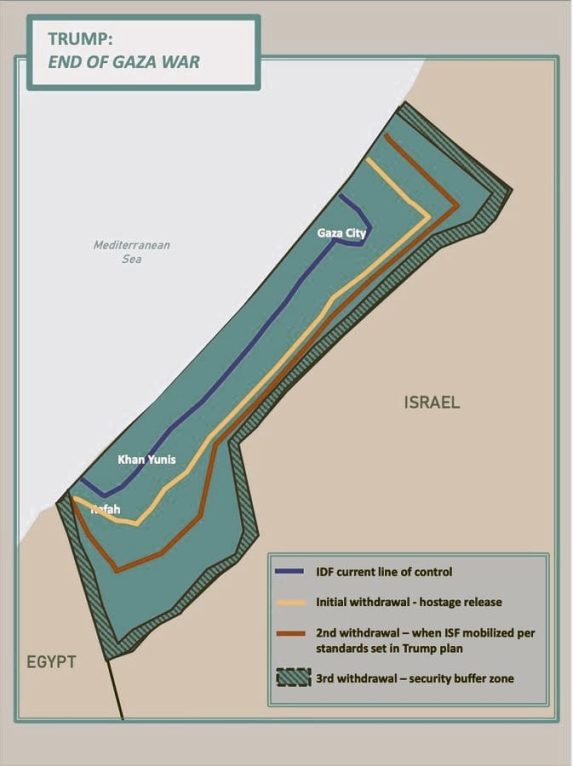
Given that the US is bankrolling Israel’s genocide and has made no effort whatsoever to stop Israel from bombing, starving, and sniping Palestinian civilians for the past two years, skeptics of Trump’s “20 point proposal to end the war in Gaza” published on September 29 can be forgiven for doubting that it will end the genocide, much less that it will be a just proposal for Palestinians.
Recall that earlier this year, while Israel continued its ongoing genocide of Gaza, Donald Trump callously boasted about the US desire to own Gaza.
The 20 points can be read in full at this link, but it’s worth mentioning some of the most important key takeaways from the plan:
Fighting would stop immediately and the Israeli captives would be released within 72 hours once both parties agree.
Israel will free 250 prisoners serving life sentences along with 1,700 Palestinians from Gaza detained after 7 October [Note: Israel imprisons nearly 11,000 Palestinians (as of early August 2025), including more than 450 children and 49 women. Since October 7, 2023, Israel has abducted over 2,300 Palestinians from Gaza, including numerous doctors. From October 2023 to early August 2025, 76 prisoners have died in prison, most having been tortured. Three doctors from Gaza were tortured to death, including by raping].
Israel will withdraw and refrain from annexing the territory.
“Security” will be provided by regional and international forces, who will also help train Palestinian police, while aid will be delivered to Gaza at agreed levels. The US will oversee dialogue between Palestinians and Israelis if the Palestinian Authority (PA) implements “reforms” according to US-Israeli demands.
Gaza will be administered by a temporary technocratic government, with oversight and supervision by a new international transitional body headed and chaired by Trump and Former Prime Minister Tony Blair, among others.
No forced displacement from Gaza, and reconstruction of the Strip as a “de-radicalized terror-free zone” will begin.
All ‘military operations’ will be halted during this period for a phased withdrawal of Israeli forces. Hamas members who commit to ‘peace’ will be granted amnesty, while those who do not will be offered safe passage to third countries.
Hamas and other factions agree to not have any role in the governance of Gaza, directly, indirectly, or in any form.
Aid will be delivered to Gaza at agreed levels, through the United Nations and other international institutions. [Note: In May 2025, Israel imposed the so-called Gaza Humanitarian Foundation (GHF) as a sole replacement for the UN;s aid distribution, claiming Hamas hinders the humanitarian mission of the foundation. This claim was not true and not proven.]
Unfair, unjust, unrealistic proposal
While lauded in legacy media and by Western leaders, Trump’s proposal is an insincere plan not for peace but which really amounts to a surrender ultimatum to Hamas.
Shortly after its announcement, Netanyahu said that the Israeli army will not withdraw from the Gaza Strip. “No way, that’s not happening.”
He also said, “If Hamas refuses [the proposal], Trump will give Israel full backing to complete the military operation and eliminate them.”
The US has already given Israel full backing to commit its genocide in Gaza, so in that regard Netanyahu is correct. But for any who thought he would abide by Trump’s proposal to pull out of Gaza, there was never a chance of that.
On October 3, 2025, Hamas agreed to the release of all Israeli hostages, but did not accept the proposal unconditionally, with other elements to be negotiated.
“After negotiations, Israel has agreed to the initial withdrawal line, which we have shown to, and shared with, Hamas. When Hamas confirms, the Ceasefire will be immediately effective, the Hostages and Prisoner Exchange will begin, and we will create the conditions for the next phase of withdrawal…”
He urged Israel to “immediately stop bombing Gaza” to allow for the safe release of hostages.
The important nuances written out of legacy media reporting on the proposal include:
Hamas does not accept that the affairs of Gaza, as a part of Palestine, be managed by any non-Palestinian party.
The entry of foreign forces or a foreign administration into the Gaza Strip is an issue that is not acceptable to Palestinians.
Israel has no intention to fully withdraw from Gaza.
Demanding the dissolution of Hamas is to deny the Palestinian people their right to political self-determination.
Further, Trump’s proposal to appoint Former Prime Minister Tony Blair to chair a board overseeing Gaza’s transition is not acceptable to Palestinians, nor to people who opposed the invasion and slaughter of Iraqis.
Enabling continued genocide and Israeli expansion
The Trump proposal doesn’t consider what Palestinians want. It speaks of peace, but in reality proposes a full surrender to an occupying power and giving control to foreign decision makers and forces. Trump and Netanyahu want Hamas to capitulate, drop their weapons, and hand over control to the US and Israel, in the name of “peace”.
In addition to the above points, it must be stressed that Israel never honours ceasefires or its word, instead violating the ceasefires immediately, resulting in the slaughter or more Palestinians (and Lebanese).
Case in point, just hours after President Trump ordered Israel to stop bombing Gaza, Israeli bombing killed a 3-month-old baby and 14 other members from her family in Gaza City, leaving 20 more people buried beneath the rubble.
“This is a peace plan that was never discussed with the Palestinians who have to have something to say about peace. Either they benefit from peace or they don’t. There’s no benefit to them in this plan… It is the same old demands from Israel: exile yourself, leave or be killed. This is an exercise in colonial rule.”
Indeed, the proposal comes at a time when global condemnation is high of the Israeli genocide and starvation campaign in Gaza. Pitching such a proposal gives the veneer of Trump trying to stop the killing, but in reality, he gives Netanyahu carte blanche to continue killing.
Over the past month since parts of the proposal were enacted, Israel has continued violating the ceasefire with more bombing. On October 29, it was reported that Israel says it has “resumed enforcing ceasefire”. In the 24 hours prior, at the last 104 people were killed in strikes across Gaza, including at least 46 children.
Israel’s vaunted commitment to justice—and its long-held brag of having “the most ethical army in the world”—collapsed spectacularly this week. The scandal traces back to July 2024, when surveillance footage from the Sde Teiman detention centre captured Israeli soldiers raping a Palestinian detainee, who later suffered severe injuries. Earlier this month—more than a year after the incident—the IDF’s top legal officer, Yifat Tomer-Yerushalmi, was arrested after admitting, perhaps in a belated awakening of conscience, that she had authorised the release of the footage
When the criminal soldiers were arrested back in 2024, Israelis took to the streets—not to condemn the crime, but to support the soldiers. Among the demonstrators were politicians, including Finance Minister Bezalel Smotrich, an illegal settler in the West Bank, who declared that the soldiers should be treated as heroes.
When it was Prime Minister Benjamin Netanyahu’s turn to comment on the scandal, he said that the leaking of the video—not its content—was “perhaps the most serious public relations attack that the State of Israel has experienced since its establishment.” Clearly, the ICC-indicted Netanyahu is more concerned about Israel’s reputation and the army’s legal standing than about the fact that an atrocious crime has taken place. How low can the Prime Minister of “democratic and peaceful” Israel go?
Israel’s response to the Sde Teiman scandal reflects a broader pattern: in both peace and war, it treats compromise, scrutiny, and accountability as threats. Every call or attempt at reconciliation or international oversight is immediately framed as an attack on national security or the army’s reputation. In practice, this mindset turns peace itself into a liability. Even international scrutiny or demands for accountability are routinely branded as anti-Semitism or “Jew-hatred,” rarely acknowledged as genuine concerns about preventing crimes or upholding justice—including those voiced by staunch allies such as Donald Trump.
The Israeli military and political elite operate under a logic in which restraint is suspect and moral exceptionalism is weaponised. Soldiers are celebrated for loyalty, brutality, and toughness, while ethical violations are either minimised or justified. Public and political reactions—cheering arrested soldiers, politicians lauding them as heroes, and leaders prioritizing reputation over accountability—reinforce a culture in which the pursuit of peace, justice, or transparency is regarded as weakness.
On the international stage, when faced with widespread public condemnation, Israel first resorts to its usual defense: anyone criticizing its inhumane treatment of Palestinians is labelled anti-Semitic. As that label loses its force and fails to intimidate critics, Israel reverts to its favourite defence in times of emergency: accusing anyone who dares to oppose its genocide of being pro-Hamas or, at least, supportive of its agenda—from the recently elected Mayor of New York, Zohran Mamdani, to US Congresswoman Rashida Tlaib. This systemic defence mechanism ensures that atrocities are treated as public relations crises rather than legal or moral failures. It also cements a cycle in which both conflict and the appearance of peace are subordinated to a narrow conception of survival and honour. The lesson is clear: in Israel, war and peace are judged not by justice or reconciliation, but by the army’s image, the state’s narrative, and the perceived threat to its moral and political supremacy.
Many wrongly believe that it is the State of Israel—and, more precisely, its extremist government—that drives Israeli society, which, such pundits argue, is peaceful in nature and humanly accommodating. The reality, however, is the opposite: it is the very nature of Israeli society that underpins these policies by supporting politicians like Itamar Ben-Gvir and Benjamin Netanyahu.
A poll in May this year revealed how rotten Israeli society is. The Penn State / Geocartography survey asked Israelis a blunt question: when the IDF conquers a city, should it kill all its inhabitants? A plurality — 47 per cent — said yes. The same poll reported that 82 percent of Israelis believe Gaza should be ethnically cleansed and all Gazans transferred outside historical Palestine — in other words, expelled to nowhere. And, in case there is any doubt, the same majority agreed that the expulsions should also include Arab citizens of Israel.
Another poll, conducted by Hebrew University in June 2025, asked: are there any innocent people in Gaza? Not surprisingly, the majority — 64 per cent — said there are no innocent people in Gaza. According to this view, everyone in Gaza, including babies, newborns, the elderly, and the disabled, is considered a criminal of some sort. This belief has been further reinforced by the IDF’s propaganda machine, which almost daily claims that every structure it destroys contains a tunnel or a tunnel shaft underneath. The message has been so consistent that it has been applied even to hospitals, schools, and kindergartens. The same narrative was conveyed to BBC World News when reporter Lucy Williamson was given a highly restricted, IDF-controlled access to Gaza. She asked the IDF spokesperson about the level of destruction she observed, and the answer was: “almost every house had a tunnel shaft” — though, of course, the spokesperson failed to show a single one.
Back in 2016, research by Pew Research Center found that six in ten Israeli Jews (61 per cent) believe that the whole of historic Palestine—not just part of it—is land promised to them by God Himself. They also believe that Israel should never give up an inch of Palestine, even if such a concession could bring long-term peace and an end to the century-old conflict.
To further show how deeply rotten Israeli society is, it may be enough to recall that the genocide in Gaza has been repackaged as a tourist attraction. From observation hills overlooking Gaza, visitors pay as little as five shekels to mount binoculars and watch live bombing raids, including flying debris and, in some reports, fragments of human bodies among the victims.
Overall majorities of Israeli Jews also strongly reject the idea of two state solutions which is supported by almost all United Nations member states—with the exception of few like United States and Israel itself of course. In a Gallup poll, published in December 2023, a majority of 65 per cent of Israeli Jews said they are opposed to the idea of two state solution.
Israeli children are taught from an early age to look down on Palestinians and the very idea of Palestinian identity. Studies show that many state school textbooks either omit the Palestinian narrative or present it in marginalised and demeaning terms, while reinforcing Jewish‑Israeli territorial claims. For example, the IMPACT‑SE Special Report 2022‑23 found that the majority of maps in Israeli textbooks did not indicate Palestinian territories or the Green Line, and that Palestinian history and culture are often erased or reduced to stereotypes.
The evidence is clear: from early education to public policy, Israeli society and its institutions treat Palestinians not as a people with rights, but as obstacles to be erased—showing that in Israel, peace is never an option, only control and domination.
… What is known about 9/11 is that there are many incredible facts that continue to be ignored by the government and the mainstream media. Here are fourteen.
An outline of what was to become the 9/11 Commission Report was produced before the investigation began. The outline was kept secret from the Commission’s staff and appears to have determined the outcome of the investigation.
The 9/11 Commission claimed sixty-three (63) times in its Report that it could find “no evidence” related to important aspects of the crimes.
One person, Shayna Steiger, issued 12 visas to the alleged hijackers in Saudi Arabia. Steiger issued some of the visas without interviewing the applicants and fought with another employee at the embassy who tried to prevent her lax approach.
This site is provided as a research and reference tool. Although we make every reasonable effort to ensure that the information and data provided at this site are useful, accurate, and current, we cannot guarantee that the information and data provided here will be error-free. By using this site, you assume all responsibility for and risk arising from your use of and reliance upon the contents of this site.
This site and the information available through it do not, and are not intended to constitute legal advice. Should you require legal advice, you should consult your own attorney.
Nothing within this site or linked to by this site constitutes investment advice or medical advice.
Materials accessible from or added to this site by third parties, such as comments posted, are strictly the responsibility of the third party who added such materials or made them accessible and we neither endorse nor undertake to control, monitor, edit or assume responsibility for any such third-party material.
The posting of stories, commentaries, reports, documents and links (embedded or otherwise) on this site does not in any way, shape or form, implied or otherwise, necessarily express or suggest endorsement or support of any of such posted material or parts therein.
The word “alleged” is deemed to occur before the word “fraud.” Since the rule of law still applies. To peasants, at least.
Fair Use
This site contains copyrighted material the use of which has not always been specifically authorized by the copyright owner. We are making such material available in our efforts to advance understanding of environmental, political, human rights, economic, democracy, scientific, and social justice issues, etc. We believe this constitutes a ‘fair use’ of any such copyrighted material as provided for in section 107 of the US Copyright Law. In accordance with Title 17 U.S.C. Section 107, the material on this site is distributed without profit to those who have expressed a prior interest in receiving the included information for research and educational purposes. For more info go to: http://www.law.cornell.edu/uscode/17/107.shtml. If you wish to use copyrighted material from this site for purposes of your own that go beyond ‘fair use’, you must obtain permission from the copyright owner.
DMCA Contact
This is information for anyone that wishes to challenge our “fair use” of copyrighted material.
If you are a legal copyright holder or a designated agent for such and you believe that content residing on or accessible through our website infringes a copyright and falls outside the boundaries of “Fair Use”, please send a notice of infringement by contacting atheonews@gmail.com.
We will respond and take necessary action immediately.
If notice is given of an alleged copyright violation we will act expeditiously to remove or disable access to the material(s) in question.
All 3rd party material posted on this website is copyright the respective owners / authors. Aletho News makes no claim of copyright on such material.





 Aletho News