Israel strikes Syria as Turkish FM visits Damascus, exposing rivalry for control
Press TV – August 7, 2026
Israeli forces have launched an artillery attack on Syria’s Quneitra Province while Turkey’s Foreign Minister Hakan Fidan was visiting the Arab country.
The attack, reported by Syria’s state news agency SANA, targeted agricultural land surrounding the village of al-Samadaniyah al-Gharbiyah.
Israeli military incursions and aggressions in southern Syria, along with harassment of local citizens, have become recurrent amid inaction from Syria’s Hay’at Tahrir al-Sham (HTS) regime led by former Daesh and al-Qaeda deputy Abu Muhammad al-Jolani.
No injuries were reported on Thursday, but the timing was no coincidence. Israel appeared to be sending a clear message that while Turkey’s proxy regime sits in the capital, Israel’s military boots are on the ground, and its artillery is within range.
In his remarks in Damascus on Thursday, Foreign Minister Fidan warned that Israeli attacks on Syria are among the greatest threats to the country’s stability.
“Israel’s attacks targeting Syria’s sovereignty and territorial integrity are among the greatest threats to the country’s stability,” he said.
Fidan urged the international community to respond more strongly to Israel’s occupation policy and press the regime to ensure compliance with the 1974 Disengagement Agreement and respect for Syria’s sovereignty.
The agreement’s Demilitarized Buffer Zone—a UN-monitored strip of land separating Israeli and Syrian forces—was unilaterally renounced by Israel following the fall of Bashar al-Assad in December 2024.
Israeli prime minister Benjamin Netanyahu declared the agreement “collapsed” and ordered his military to invade and occupy the buffer zone, along with additional Syrian territory beyond it.
Since the Turkish-backed coup that installed Jolani’s al-Qaeda-affiliated militants in Damascus, Israeli occupation forces have waged a systematic campaign of agricultural terror across southern Syria—poisoning croplands with chemical sprays deployed from aircraft, bulldozing orchards and olive groves, and abducting local farmers.
In a deliberate strategy of ecocide and economic strangulation, Israeli troops have sealed off entire communities from their ancestral lands, blocking hundreds of families from accessing their fields and grazing grounds while destroying agricultural infrastructure that once sustained the region’s rural population.
“Around 100 families are completely barred from accessing their land. Most of the agricultural roads have been destroyed by Israeli tanks. Furthermore, the occupation forces have take control of large areas of grazing land,” Hassan al-Din Ahmed, a farmer, told Al Jazeera.
Ahmed, whose son was kidnapped by Israeli forces, stressed that “farmlands aren’t the only things Israelis have taken.”
He was grazing cattle when “occupation forces came and arrested my child Saddam from the land”, he told the broadcaster.
“It has been two years, four months without any charge being brought against him,” the farmer added.
According to director of agriculture in Quneitra Mohammad Rahal, Israeli occupation forces used glider aircraft to spray herbicides on agricultural land in the area, causing very significant damage.
The Israeli violations have affected the entire Arab country and triggered a hunger crisis there.
In May, the World Food Programme halved emergency assistance from 1.3 million people to just 650,000, amid critical funding shortfall.
It also halted a nationwide bread subsidy that helped about four million Syrians afford bread every day.
Thursday’s shelling was just the latest chapter in Israel’s systematic dismantling of Syria.
Since Assad’s fall, the Zionist regime has conducted hundreds of airstrikes against military installations, arsenals, and civilian infrastructure—reducing Syria’s defenses to rubble while its military advances beyond the occupied Golan Heights, seized since 1967.
Netanyahu has instructed his military to advance further into Syrian territory, surpassing the Golan Heights occupied since 1967, and to capture multiple strategic sites.
Despite the HTS’s commitments to collaborate with Tel Aviv, Israel has shown no inclination to retreat from Syria.
The two parties have engaged in intermittent discussions aimed at reaching a “security agreement”, but no agreement or significant progress has been reported.
Tel Aviv’s real grievance lies not with Jolani’s al-Qaeda pedigree, which Israel has historically tolerated or even exploited, but with his absolute dependence on Turkey—a patron that armed his militants, bankrolled his coup, and now dictates the political direction of Damascus.
Fidan’s visit laid bare the cynical rivalry between two occupying powers. Israel views Turkey’s growing influence in Damascus with deep suspicion—fearing that Ankara’s ambitions may eventually challenge Zionist expansionist plans.
Turkey, meanwhile, is consolidating its grip on Jolani’s regime, signing military cooperation agreements and training Syrian security forces to ensure Damascus remains a compliant satellite.
Mossad shakes up top ranks after failed Iran regime-change scheme
Al Mayadeen | August 6, 2026
The head of the Mossad dismissed two senior officials from the agency, the head of its Intelligence Directorate and the head of its Iran Division, following the failure of an operational plan designed to facilitate regime change in Iran, Israeli Channel 12 reported.
According to the channel, the Mossad chief’s decision was based on the assessment that the officials who formulated the operational concept and oversaw its development should be held accountable for its failure. The two dismissed officials were reportedly directly involved in the intelligence planning, development, and operationalization of the strategy, which was presented to US President Donald Trump.
The channel added that the plan hinged on establishing cooperation with groups from ethnic minority communities inside Iran to generate conditions for regime change and facilitate the installation of a new Iranian leadership. However, the operation was never translated into action on the ground.
The channel quoted security sources as saying that relations between the Mossad chief and the dismissed officials had been strained from the outset and that their departures were agreed upon.
Nevertheless, the timing of the dismissals was not coincidental, the sources said, given that the two officials had played leading roles in developing the operational plan that ultimately failed, according to the Israeli account.
The US-Israeli aggression on Iran was reportedly built in part around a Mossad assessment that Israeli strikes, assassinations and armed riots would trigger a “popular uprising and ultimately topple the Iranian government.”
However, months into the war, the anticipated regime change has failed to materialize, while US and Israeli intelligence assessments indicate that Iran’s government remains intact.
The plan reportedly faced skepticism from US military commanders and Israeli intelligence officials even before the aggression began. A parallel strategy involving Kurdish armed groups also faltered after opposition from the US, Turkey, Iraq and Kurdish leaders, raising questions over the assumptions underpinning the campaign.
Tucker Carlson lays out 10-point platform amid MAGA split
Al Mayadeen | August 6, 2026
Former Fox News host Tucker Carlson presented a 10-point political program during a widely promoted livestream on Wednesday, offering what he described as the foundations of a new political movement emerging from growing divisions within the MAGA coalition.
Carlson did not announce the creation of a party or confirm plans to run for office. Instead, he said the proposals could serve as the basis for “whatever comes next” and could “find all kinds of expressions.”
The address followed Carlson’s declaration last month that he intended to “help build a third party.” Speculation surrounding his political ambitions intensified after several figures critical of US President Donald Trump reportedly gathered at Carlson’s home in Maine and encouraged him to seek the 2028 presidency.
Carlson argued that any alternative to the existing US political system must first establish a common understanding of what the country “should be”, organizing his proposals around ten principles.
Equal laws and national sovereignty
Under his first principle, which he called fairness, Carlson demanded that presidents, federal agencies, and powerful political figures be subjected to the same legal standards as ordinary citizens.
He pointed to Jeffrey Epstein and those he described as belonging to an “Epstein class” as examples of wealthy and connected individuals who had benefited from a political and economic system that shields elites from accountability.
Carlson also placed national sovereignty at the center of his platform, condemning foreign lobbying, corporate influence over government and high-interest debt.
He accused “Israel” of pushing Washington into its war against Iran through “bribery or threat or both,” describing foreign interference and economic dependency as forms of “slavery.”
His remarks reflected widening anger among sections of the MAGA movement over Trump’s foreign policy and his administration’s relationship with “Israel”.
Rebuilding production, cities and public health
Carlson called for the revival of US agriculture, industry and skilled trades, arguing that the country’s economy had become excessively dependent on financial markets, property speculation, surveillance technologies and weapons production.
He also criticized the physical condition of American cities, claiming urban planners had deliberately “uglified” them through brutalist architecture and neglect.
Graffiti, public drug consumption and violent crime, he suggested, were not merely signs of decline but attacks on the population’s sense of dignity and social order.
On public health, Carlson backed Health Secretary Robert F. Kennedy Jr.’s campaign against unhealthy food and promoted widespread sobriety. He also criticized the extensive use of prescription drugs, including Xanax, Adderall and selective serotonin reuptake inhibitors, claiming that Americans had become “half-addled”.
Government secrecy and social conservatism
Carlson’s program called for penalties against government officials who deliberately mislead the public and demanded the release of most classified state records. He specifically cited files connected to the assassination of President John F. Kennedy and the attacks of September 11, 2001, as documents that should be made available to the public.
The former television host also emphasized marriage, childbirth and family life, describing having children as essential to both human biology and long-term political thinking. He blamed older and childless members of the ruling class for supporting policies that, in his view, ignore the interests of future generations.
On education, Carlson said schools should prioritize practical knowledge, the physical world and what he regarded as permanent features of human nature, including innate differences between men and women. He criticized an education system centered on academic credentials, digital devices and technological trends.
Carlson denounces US wars, calls for immigration halt
Carlson said the United States should accept responsibility for civilians killed in its military operations and pay restitution to the families and communities affected. He also called for reversing Trump’s “Department of War” rebrand and ending US financial and military support for allies responsible for what he described as genocide, specifically citing “Israel.”
His final principle focused on national unity and immigration.
Carlson proposed suspending immigration until the consequences of artificial intelligence for the US labor market become clearer, ending government benefits for undocumented migrants and requiring federal documents and election ballots to be published only in English.
Anti-war MAGA faction challenges Trump
Carlson has increasingly become a leading voice among former Trump supporters who argue that the president abandoned the original “America First” agenda. The group has criticized Trump over the war against Iran, his handling of documents related to Epstein and Washington’s continuing support for “Israel.”
Prominent figures associated with the dissident faction include Representative Thomas Massie, former Representative Marjorie Taylor Greene and Joe Kent, who resigned as Trump’s counterterrorism chief in March in protest over the war on Iran.
The White House rejected the group’s criticism, describing its members as an “embarrassing collection of mostly whiny turncoats who dramatically overestimate their influence and relevance”. It also insisted that Trump remained the “unequivocal leader” of the Republican Party.
Although Carlson’s address stopped short of establishing a formal political organization, the manifesto marked his clearest attempt yet to define a post-Trump political project capable of appealing to conservatives disillusioned with the administration’s domestic and foreign policies.
US lawmakers seek terror designation for Polisario Front over alleged ‘Iran ties’

The Cradle | August 6, 2026
Two US lawmakers introduced a bill on 30 July calling on the State Department to consider designating the Polisario Front, a group fighting for independence for Western Sahara from Morocco, as a “foreign terrorist organization.”
US Congressmen Josh Gottheimer of New Jersey and Ronny Jackson of Texas introduced the Polisario Front Terrorist Designation Act, claiming the group is receiving assistance from Iran and poses a threat to US national security.
“The Iranian regime and its terrorist proxies are working overtime to open a new front against the United States and our allies, and the Polisario Front has become one of their instruments,” claimed Congressman Gottheimer.
However, the congressman acknowledged that no such link between Iran and the Polisario Front has been confirmed.
“This bipartisan bill makes sure that once that cooperation is confirmed, we can bring the full weight of America’s counterterrorism sanctions down on the Polisario Front,” Gottheimer added.
The Polisario Front seeks to make Western Sahara an independent country free from Moroccan control. The front was founded in May 1973 to fight Spanish colonial rule in Western Sahara. After the Spanish left the region in 1976, it proclaimed the Sahrawi Arab Democratic Republic (SADR) with a government-in-exile in Algeria.
However, Morocco quickly occupied much of Western Sahara, claiming it as part of its territory.
The name Polisario Front comes from Spanish words for the Popular Front for the Liberation of Saguia el-Hamra and Rio de Oro.
This bill follows similar initiatives introduced in Congress during 2025, including one by Republican Senator Ted Cruz.
In 2020, US President Donald Trump recognized Morocco’s claim to sovereignty over Western Sahara as part of a deal for the kingdom to normalize relations with Israel through the Abraham Accords.
France, Britain, Germany, the Netherlands, and Spain followed Washington’s lead in recognizing Morocco’s claim.
Morocco is a major non-NATO ally of the US. According to the Hudson Institute, “designating the Polisario Front as a foreign terrorist organization would solidify the US-Morocco alliance.”
In July, Morocco became the first Arab and African nation to deploy its military to the International Stabilization Force (ISF), which is set to occupy Gaza under the direction of Trump’s “Board of Peace.”
Morocco signed an agreement in Rabat on 15 July to formalize its participation in the ISF, which will work in collaboration with the Israeli military.
Commenting on Morocco’s role in the ISF, a pro-Palestine Moroccan activist stated that “I don’t know what Morocco’s role will be [in the ISF] other than perhaps disarming the resistance [Hamas] and even supervising a new colonization of the Gaza Strip by the American-Zionist entity.”
Since signing the Abraham Accords, Morocco has continued to expand military and security ties with Israel.
In May 2025, Israeli forces publicly participated in the kingdom’s annual “African Lion” military drill, which brought together 10,000 troops from more than 40 participating countries.
During the opening ceremonies of the yearly exercise, jointly organized by Rabat and the US Africa Command, the Israeli flag was openly displayed for the first time.
Last week, the Moroccan government organized tens of thousands of Moroccan migrant men to storm the Spanish enclave of Ceuta on the coast of North Africa.
In July, a budget report approved by the US Congress for the first time described Ceuta and Melilla as Spanish-administered cities “located in Moroccan territory” that “remain the subject of Morocco’s longstanding claim.”
Israeli Prime Minister Benjamin Netanyahu has called for Spain to be punished for trying to prevent the US military from delivering weapons to the Israeli military for use in its genocide of Palestinians in Gaza.
Israelis widely celebrated the storming of Ceuta by Moroccan men on social media.
Responsible Statecraft wrote that the Moroccan government may have been deploying “migration blackmail” to punish European nations. “But this time, Israel and the United States appear to be the principal beneficiaries.”
Another Strange Week in Trumpland
By Philip Giraldi | Unz Review | August 5, 2026
Some weeks it is difficult to pick out the most shocking stories symptomatic of decline and fall of American governmental integrity both in Washington and often at state levels. The White House and Congress frequently lead in that reckoning given the complete abandonment of any United States government’s effort to make its policies and legislation responsive to actual national interests. Wars are being fought without any reason to do so and domestic policies are derived from “feelings” that President Donald Trump has when he gets up on the morning. The result is chaos when the policies are actually developed and implemented.
Last week we long suffering Americans were forced to witness pure Trumpean flip-flops on major pronouncements relating to foreign policy. First came the pronouncements that Iran had more-or-less reached out to Trump and sought a return to negotiations for a ceasefire and peace agreement. The claim was immediately denied by Tehran and nearly all observers agreed that the Iranians would have to be crazy to trust Washington and its “word” over any issue given Trump’s history of subsequently disregarding documents signed and agreements reached. Trump then responded to the Iranian denial by threating to unleash hellfire in his usual fashion, replete with obscenities and threats of obliteration for the Persian people in a holocaust more devastating than World War 2.
Some observers have noted that Trump’s threats of annihilation are clearly unachievable in practical terms given the rundown of US munitions stocks and the difficulty in manufacturing replacements due to Chinese refusal to sell exotic metals to the Americans and the loss of Saudi and Emirate refineries that produced high grade aluminum for fuselages of warplanes. So if Trump really seeks to act out his schoolboy fantasies of death and destruction he will have to go nuclear. It is ironic that he has based the war against Iran on his oft repeated stated intention to prevent Iranian development of a nuclear weapon, a program which US intelligence has insisted does not exist. Only the US both possesses and has used nukes to kill civilians and that was in 1945.
Given all the mixed signals coming out of Washington, it is perhaps unnecessary to point out that a war that was pointless and unnecessary in the first place is still sputtering along with Israel and its Prime Minister Benjamin Netanyahu pushing for its expansion from the sidelines using lies crafted to convince a clueless Trump. “Far better at this point,” says Netanyahu, “to see American soldiers die to destroy Iran rather than waste any of our wonderful Jewish boys, each of whom is worth 1,000 goyim.” Actually, we Americans are lucky to be only 1/1,000th times in terms of Jewish relative value. One Israeli Lawyer calculates that each Jewish life is worth 10 million Palestinians!
That Trump is deep into a war that is destroying his presidency and only benefiting Israel is the ultimate tragedy for the American public and also vis-à-vis the other nations in the world that once looked up to the United States for its commitment to democracy and rule of law. Israel is now rightly the most hated nation in the world, but the US is number two! And the rot regarding who is doing what to whom runs particularly deep if one regards the confusion in the US military role that the Trump Administration has clearly encouraged.
One story that appeared in the Washington Post last week was particularly painful, describing the concerns of the US General Alexus Grynkewich, who is head of the US European Command. He described in a memo his concerns over his insufficient stock of defensive-capable Naval destroyers. The article elaborated how Grynkewich “… sent written notification to senior Pentagon officials saying that without another Navy destroyer he will be forced to choose defense of the United States ‘homeland’ over that of Israel, …” My reading of this is that the general is personally perplexed over whether his orders emanating from the White House would prioritize his defending the United States rather than Israel. That he is apparently unable to clearly understand that defending his own country is and must always be his top priority is both incomprehensible and a clear sign how the unconscionable love of the Jewish state by the Joe Biden and Donald Trump regimes has destroyed any sense of the actual raison d’etre for having any military at all!
Indeed, Donald Trump and his friends in power are quick to play soldiers whenever it suits them. I love watching Trump the draft dodger standing to attention and saluting without taking his funky red hat off, a military posture he once upon a time chose to avoid in Vietnam by way of fraudulent medical claims of bone spurs when his draft board called him up for service after he graduated from college in 1968. To add to the irony, Trump has a number of times stated that he should be awarded the Congressional Medal of Honor (CMH) for his largely fictional “peacemaking role,” a medal that in actuality is the highest award for soldiers who demonstrated valor in combat, which does not include Donald Trump.
But even given that bit of regular play acting, Trump’s AI posting on his Truth Social last week exceeds all decency in the eyes of those of us, including myself, who went into the army after college instead of Trump, who had the both the money and lack of patriotism to pay a doctor for his fake medical report. In the posting, Trump portrayed himself in full dress uniform flanked by World War 2 Generals Douglas MacArthur and George S Patton. He is standing in front of the two men and has four general stars on his shoulders plus a chest full of medal ribbons, a higher rank and more awards that either MacArthur or Patton in the AI photoshop. One medal on Trump appears to be a CMH. It is an insult to the memories of those two brave men depicted and to describe the imposture as both disgraceful and obscene would not be going too far!
One more tale out of last week demonstrates the president’s continuing willingness to enrich his family and supporters out of behavior that is generally conceded to be illegal “insider trading.” It has frequently been observed how the president has a tendency to make pronouncements of a political or economic nature on Mondays and Fridays, i.e. to impact on the opening and closing of Wall Street and other investment markets. Investors armed with that advanced information can and have benefited financially greatly by playing the predictable surges caused by White House actions. Those with prior knowledge of what is going to happen benefit particularly, to include Trump personally and his family.
In the latest version of that reality, Trump is selling through his family company Trump Media & Technology Group early access to premium data product released on its new subscription service to his Truth Social posts, where the pronouncements will appear. The cost is $100,000 per month to investors, who will then be able to benefit substantially from the shifts in the stock market. So far five investor firms have signed up and its is already expected that Trump personally will benefit directly from his ownership share of Truth Social distribution to the tune of 41% of the $6 million of existing committed revenue. Critics have observed that Trump “must have invented a new theory of ‘insider trading’ based on publicly available information.”
In conclusion and ironically, Trump sometimes boasts how he accepts no government salary as president but in 2025 he declared “more than $2 billion in personal income last year—nearly quadruple his 2024 total—with the bulk flowing from ventures that sit directly at the intersection of his office and his balance sheet. He earned roughly $1.4 billion from cryptocurrency alone, including $635 million in royalties from his $TRUMP meme coin and more than $500 million from World Liberty Financial, the crypto venture run by his sons.”
Want to corruptly earn a couple of billion dollars while killing a whole bunch of people in fighting wars and supporting genocides that didn’t need to happen? Ask US President Donald Trump how it is done!
Philip M. Giraldi, Ph.D., is Executive Director of the Council for the National Interest, a 501(c)3 tax deductible educational foundation (Federal ID Number #52-1739023) that seeks a more interests-based U.S. foreign policy in the Middle East. Website is https://councilforthenationalinterest.org address is P.O. Box 2157, Purcellville VA 20134 and its email is inform@cnionline.org.
60-DAY HORMUZ ARRANGEMENT CONFIRMED BY TEHRAN & OMAN — w/ Prof. Seyed Mohammad Marandi
Mario Nawfal | August 5, 2026
AIPAC spends $30m but fails to stop El-Sayed in Michigan
MEMO | August 5, 2026
The American Israel Public Affairs Committee (AIPAC) has suffered a major electoral defeat after Dr Abdul El-Sayed won Michigan’s Democratic Senate primary, crushing pro-Israel congresswoman Haley Stevens despite an unprecedented spending campaign on her behalf.
AIPAC’s super political action committee, the United Democracy Project, spent more than $30 million promoting Stevens and attacking El-Sayed, according to Federal Election Commission filings analysed by the New York Times. NBC News projected El-Sayed as the winner on Wednesday, dealing a major blow to the pro-Israel lobby’s efforts to determine the outcome of one of the most closely watched Democratic contests in the country.
El-Sayed campaigned against US military assistance to Israel and repeatedly highlighted AIPAC’s intervention in the race. Stevens, by contrast, received the backing of AIPAC and the Democratic Party establishment.
The result is seen as providing some of the clearest evidence yet that association with Israel and its powerful lobby groups is becoming a political liability among Democratic voters as opposition grows to Israel’s genocide in Gaza and the unconditional support it receives from Washington.
A New York Times investigation published before the primary result was announced revealed the scale of AIPAC’s transformation from a traditional lobbying organisation into one of the largest spenders in US elections.
Spending by AIPAC-affiliated political action committees on campaign advertising and voter outreach has more than doubled in less than five years, rising from $29.3 million to $67.2 million. Much of the money has been directed towards Democratic primaries, where the lobby has sought to defeat candidates who criticise Israel or question US military assistance to the occupation state.
However, the investigation uncovered a striking feature of AIPAC’s campaign strategy: it rarely reveals its connection to Israel.
Between April 2022 and the end of July, AIPAC-funded groups produced 109 television and digital adverts. Only six mentioned Israel. Instead, the adverts focused on issues such as abortion rights, the economy and the cost of living, despite being financed specifically to elect politicians who support Israel.
AIPAC’s reluctance to mention Israel is seen as a reflection of a deeper political problem: open association with the Israeli government has become increasingly toxic following the mass killing, displacement and starvation of Palestinians in Gaza.
The lobby is effectively asking voters to support Israel’s preferred candidates without making Israel itself part of the public argument.
AIPAC has also channelled approximately $22 million into five smaller super PACs with innocuous names that make no reference to Israel. These include Elect Chicago Women, Affordable Chicago Now!, Voters for Responsive Government and Blue Wave Action.
The Michigan contest became the lobby’s largest gamble. United Democracy Project spent more than $10 million promoting Stevens and over $20 million attacking El-Sayed through advertising and voter outreach.
Nevertheless, El-Sayed prevailed.
El-Sayed’s victory is thought to be particularly significant because Michigan is home to one of the largest Arab-American populations in the US and became the centre of the “Uncommitted” movement, which challenged former President Joe Biden’s support for Israel’s assault on Gaza.
Signs of the political backlash were already visible in April when Stevens and another AIPAC-backed politician were booed during the Michigan Democratic Party Convention. El-Sayed and his former primary rival, Mallory McMorrow, had both pledged to reject AIPAC funding.
AIPAC has previously succeeded in removing several prominent critics of Israel, spending millions of dollars to defeat former Democratic representatives Jamaal Bowman and Cori Bush. It has also targeted Republicans who questioned US military support for Israel.
However, the lobby has faced a growing number of defeats. Summer Lee survived repeated AIPAC-funded attempts to remove her, while candidates in Illinois and New Jersey successfully used their opponents’ links to the lobby against them.
Polls have also documented a rapid decline in support for Israel. A majority of Americans now oppose providing economic and military assistance to Israel, while Democratic voters have become increasingly critical of both Israel’s conduct in Gaza and the influence of pro-Israel lobbying organisations.
Abdul el-Sayed defeats AIPAC-backed rival in Michigan primary, defying millions in lobby spending
The Cradle | August 5, 2026
Abdul el-Sayed, a former public health official, has won Michigan’s Democratic Senate primary, defeating AIPAC-backed Representative Haley Stevens in a close race, NBC News reported on 5 August.
Sayed won despite being heavily outfunded, with outside groups pouring close to $65 million into the race to stop him.
More than $30 million of the television advertising behind Stevens came from a group affiliated with the pro-Israel lobbying group AIPAC.
Taken together, Stevens and her allies outspent Sayed and the groups supporting him on advertising by a factor of nine to one, according to the ad-tracking firm AdImpact.
Sayed pointed to the imbalance in his closing argument, saying during a debate, “If you need a $60 million crutch, you probably can’t be elected on your own terms.”
He also went after Stevens’ support for aid to Israel, and stated outright that Israel is committing genocide against Palestinians in Gaza, a position that carries particular weight in Michigan, home to large Muslim and Arab communities.
Sayed made Stevens’ backing from AIPAC and corporate political action committees a central charge against her, attacking both the funds she accepted directly and the advertising her big-spending allies bought on her behalf.
Stevens, a four-term congresswoman, ran with the backing of the Democratic establishment, positioning her campaign squarely within the party leadership alongside Senate Minority Leader Chuck Schumer.
Governor Gretchen Whitmer endorsed her on 24 July in a late move seen as an attempt to stifle Sayed’s rise. Outgoing Senator Gary Peters, whose seat is at stake, also endorsed her after deciding not to seek a third term.
Despite the cumulative hurdles, Sayed’s victory follows a run of defeats for AIPAC-funded candidates in Democratic primaries this cycle.
On 30 June, Democratic socialist Melat Kiros unseated Diana DeGette in Colorado’s 1st congressional district by nearly 10 percentage points, ending a 30-year congressional career built in part on well over $1.6 million from AIPAC.
A week earlier, in New York, Brad Lander defeated Dan Goldman after attacking his refusal to call the assault on Gaza a genocide or to back restrictions on arms sales to Israel, while Darializa Avila Chevalier unseated Adriano Espaillat in a campaign centered on his acceptance of AIPAC money.
A senior House Democrat called the Colorado result a wake-up call, with support for Israel turning from an asset into a liability. Strategist Jon Paul Lupo told POLITICO that candidates opposing the war on Gaza held a massive political advantage this cycle.
Pew Research Center polling released in April found 60 percent of US citizens now view Israel unfavorably, with very unfavorable sentiment nearly tripling since 2022, while a Gallup poll in February recorded more US citizens sympathizing with Palestinians, at 41 percent, than with Israelis, at 36 percent – the first such result in US history.
El-Sayed Wins Michigan Democratic Primary for Senate

Al-Manar – August 5, 2026
Abdul El-Sayed, a progressive public health advocate, has won the Democratic nomination for the United States Senate, overcoming more than $60m in campaign spending, mostly from pro-Israel groups, NBC has projected.
The result on Tuesday represents an enormous blow to the American Israel Public Affairs Committee (AIPAC), which led the way in the effort to defeat El-Sayed, backing his opponent, US Congresswoman Haley Stevens, with more than $30m.
El-Sayed will face former Republican Congressman Mike Rogers in November. The race is considered one of a handful of competitive Senate contests in the November midterms and could determine which party controls the chamber for the rest of President Donald Trump’s term.
If El-Sayed – who is of Egyptian descent – wins in November, he would become the first Muslim senator in US history.
Tuesday’s result in Michigan – a swing state that voted for Trump in 2024 – will have major implications for the Democrats’ policies on conflicts in the Middle East.
El-Sayed recognizes Israel’s atrocities in Gaza as a genocide and argues that money spent on conflicts that benefit ‘Israel’ should be invested in local communities in the US to address healthcare, housing and infrastructure problems.
Maya Berry, executive director of the Arab American Institute, a non-partisan advocacy group that does not endorse candidates, called El-Sayed’s victory a “big deal”.
She said voters “did not buy” the avalanche of ads that did not talk about policies and only launched negative attacks “about an Arab American Muslim man named Abdul”.
When Palestinian injuries are dubbed “fake”
By Eva Karene Bartlett | August 5, 2026
 I followed up on this story, because some were sceptical and didn’t believe it was real or possible, and loudly insisted it was fake. One man who fancied himself an expert because he likes to shoot a gun now or then claimed this was fake, impossible.
First, I will say that Palestinians don’t need to create fake stories, Israel is doing the impossible to them every day and has been doing so for not only the last 3 years—even when I lived in Gaza, we’d see injured Palestinians and situations that didn’t seem possible but were very real—but certainly in the last three years of Israel’s ongoing genocide of Palestinians in Gaza, we’ve seen things that seemed impossible but were very, brutally, bloodily, real for Palestinians.
Second, a good friend of mine from Jabaliya told me he knew the man who filmed the video. I have no reason to believe he lied to me.
But for clarity on logistics of the situation— how this youth came to have a bullet in his hand when others said his hand would have been blown off (though I already guessed the answer)—I reached out to a couple of others I knew in Gaza. Dr. Ihab replied to me:
“This is a fallen shot, that is, it was fired from a long distance and fell. These shots caused the killing of many people: when the bullet settled in their neck and chest, it may be fatal. But in this case, it is easily removed by a short surgery. We hope that it has not caused fractures in the palm of the hand or tears in the tissues and nerves.”
He went on to say that his own friend was killed by such a stray bullet fired by an Israeli soldier, hitting the friend in his neck as he sat in a chair, killing him. “These may be from the Zionist machine gun or from drones, or the launches carried out by the army randomly.”
A journalist who had shared the initial photo also replied to me: “This child was sitting in a learning tent west of Gaza City. The bullet fell from the sky after being fired from the eastern part of Gaza City, where Israeli forces were positioned. Although it came from a considerable distance, it struck the tent and hit the child while he was seated at his school desk. Yes, it’s unbelievable, but in Gaza anything is possible.”

I refer back to Dr. Mimi Syed, who I interviewed a year ago. She went twice to Gaza as an emergency doctor, and one of the patients she was able to save, a young girl named Mira, had a bullet lodged in her head. “When I showed the CT image to the world, I was accused of fabricating it.”
Dr. Tarek Loubani, who I’ve known from Canada since before I first went to Gaza in 2008, likewise faced accusations that he had lied or forged an x-ray of one of his patients.
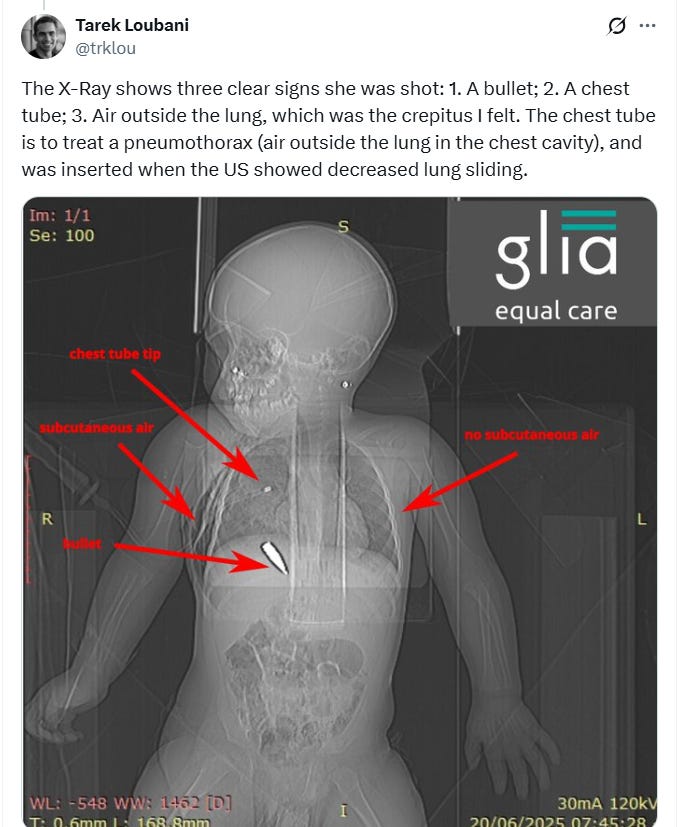
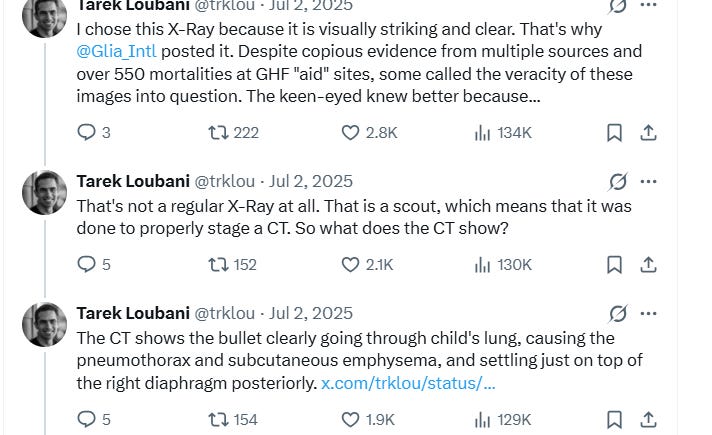
He didn’t lie or manipulate, of course, but people couldn’t accept that what it showed was real.
Israel has long treated Gaza as its testing ground for new weapons and technology and also for how much Israel can get away with while the world watches. If your immediate reaction at seeing an injury or seemingly impossible photo or video from Gaza is to accuse Palestinians (or non-Palestinians who managed to enter Gaza) of fabricating footage or x-rays, etc, then you are the problem. Your life experience shooting a gun in your back yard does not equip you to understand the circumstances in Gaza. Palestinians in Gaza don’t have the luxury of debating this, they’re living in truly unreal circumstances.
Mainstream Western institutions view Jewish lives as more important than Palestinian Lives

By Caitlin Johnstone | August 3, 2026
The BBC recently interviewed an Israeli settler who said that all the Palestinians in four surrounding villages should be exterminated to avenge an Israeli who was killed while terrorizing a Palestinian village last month, adding that just a single Jewish life is worth ten million Palestinian lives.
“I think now after they kill one Israeli people, we need to kill all the people in Tal and Sarra, even Jit and Farata,” lawyer Yehuda Shimon told the BBC.
“It sounds like you’re saying one Jewish life is worth hundreds or thousands of Palestinian lives,” replied the BBC’s Lucy Williamson in the interview.
“Million,” Shimon corrected her. “One Jewish life, it’s ten million, okay?”
“That just sounds racist,” Williamson responded, to which Shimon replied, “Yes, I know, I know. But this is the truth.”
The interaction has been going viral on social media as people react to the blatant display of the extremist ideology held by the settlers who are working to gradually squeeze Palestinians off their land in the West Bank. And while it is true that Shimon’s comments are extremely evil and racist, that’s not what I personally found interesting about the interview. What I found interesting was Williamson’s response.
I mean, it is a bit rich watching a BBC reporter act shocked and offended by somebody saying they think Jewish lives are worth more than Palestinian lives. After all, the premise that Jewish lives are worth more than Palestinian lives has colored every aspect of Western news media reporting on Israel and Palestine for generations.
[IAK notes: See this]
That’s why the Western press expressed disproportionately more shock and horror at October 7 than the far more egregious Israeli abuses which led up to it and the far more egregious Israeli abuses which followed. It’s why you saw howling outrage at the Bondi shooting in Sydney last year when the same number of Palestinians getting killed on any given day in Gaza never even makes a blip in the news.
On the 26th of March 2025, 15 Palestinians were killed by the IDF during a ceasefire in Gaza. On the 14th of December that same year, 15 people were killed at Bondi Beach in Sydney in a mass shooting by ISIS members directed at Jewish Australians.
Two instances of mass murder. Same exact number of victims. But you only heard about one of them.
Why did you only hear about one of them? Because only one of them made the news.
The mainstream press spent weeks urgently reporting on the Bondi shooting, frenetically working to falsely associate an ISIS terrorist attack with pro-Palestine demonstrations by uniformly repeating the line “This is what globalize the intifada looks like” in news outlets throughout the Western world. Report after report after report was published about how Jews are being attacked, how Jews are feeling unsafe, and what new laws and free speech restrictions must be rolled out in order to stomp out pro-Palestine sentiment to protect the Jews.
Nothing remotely similar happened on the 26th of March, 2025. As far as the Western press were concerned, 15 Palestinians getting killed in Gaza was just another Wednesday.
This is because all mainstream Western media outlets hold the same racist opinions about Palestinians as those that were voiced by Yehuda Shimon. So do all mainstream Western political parties. So do all other mainstream Western institutions. So do all supporters of the state of Israel. They all believe Jewish lives are worth more than Palestinian lives, as evidenced by the policies they support and the news stories they pay attention to.
The BBC has a well-documented history of extensive pro-Israel bias, with its own reporters complaining that they’ve been performing PR for the Israeli government and its own editor losing a libel lawsuit against a journalist who exposed his pro-Israel slant. They spent years running cover for an active genocide with “Hamas-run health ministry says” headlines and passive-language verbal gymnastics to protect Israeli information interests, so you know that when Lucy Williamson objects “That sounds racist!” to an Israeli settler claiming Jewish lives are worth far more than Palestinian lives, she’s not actually upset at his belief system. She just knows you’re not supposed to say such things out loud.
The Problem Is Israel, Not Netanyahu
By Kevin Barrett | American Free Press | August 2, 2026
Israel, and its wanted-for-genocide Prime Minister Benjamin Netanyahu, are increasingly unpopular. Gemini estimates that about 80% of the world’s soccer fans cheered for Spain over Argentina in the World Cup, and the primary reason was that Spanish leader Pedro Sanchez is pro-Palestine while Argentina’s president Javier Milei is a rabid Zionist.
Even the United States, laboring under the weight of a pro-Israel media and political donor class, is turning against the Zionists. Recent polls show an astonishing 70-point collapse in support for Israel over the past eight years. During Trump’s first term, Israel’s net favorability hovered at over plus 50. Today it has dropped to minus 20 according to Marquette University Law School and minus 23 according to Pew Research Center.
Even AIPAC-money-loving politicians can sense which way the wind is blowing. Thomas Massie’s bill to end US military support for Israel, which a few years ago would have struggled to find two or three brave supporters, garnered 103 Democratic “yes” votes against only 98 “no” votes. (Massie was the only Republican voting in favor.)
Even many of Israel’s strongest supporters agree that their “chosen nation” needs a facelift. In June, Donald Trump, huddling with his Israel-loyal Jewish handlers Witkoff and Kushner, screamed at Netanyahu on the phone: “Everyone hates you now! Everyone hates Israel!”
As Trump’s outburst implied, many people identify the things they hate about Israel with one man, Benjamin Netanyahu. Swapping Bibi for a prettier face, or at least one that is not on the world’s most wanted list, is on the Zionist agenda.
At some point, the ancient Jewish ritual of scapegoating will likely be applied to Netanyahu. The term “scapegoat” (Azazel) originates from the ancient Hebrew ritual of Yom Kippur (Day of Atonement). Every year, on that high holiday—the holiest single day on the Jewish calendar—the ancient Jews ritually transferred the collective sins, guilt, and impurities of their community onto a goat, and then expelled or destroyed it to achieve symbolic purification.
Soon the scapegoated Netanyahu will be removed from office. Perhaps he will die suddenly or go to prison. His replacement will be celebrated by the Epstein class media as a reasonable man, a moderate, someone who will restore Israel to its pre-Netanyahu status as “a light unto the nations” and “the only democracy in the Middle East.” But will that really solve the problem?
Consider who is likely to replace Netanyahu. Until recently, his main rival was Naftali Bennett, who, like Netanyahu, is a fanatical Zionist extremist. Bennett cut his teeth in Netanyahu’s Likud Party, and served as Netanyahu’s Chief of Staff from 2005 to 2008. His positions haven’t shifted since then. Bennett is every bit as genocidal—and as committed to dragging the US into endless war on Iran—as Netanyahu himself.
During the past two months, Gadi Eisenkot has eclipsed Bennett as Netanyahu’s main challenger, and the likely next Prime Minister of Israel. And Eisenkot, like Bennett, is as bad as Netanyahu.
Eisenkot is the man who created the Dahiyeh Doctrine—Israel’s official policy of genocidally mass murdering civilians. Eisenkot created that “Genocide Doctrine” in 2008 when he was head of the Israeli Defense Forces. He named it the Dahiyeh Doctrine after his mass murder of civilians in the Dahiyeh suburb of Beirut in 2006.
Eisenkot is an enthusiastic supporter of Israel’s mass murder of tens of thousands of children, and additional tens of thousands of women, in its leveling of Gaza. His open support of that mass slaughter makes him one of the most evil political leaders who have ever lived.
Astonishingly, Eisenkot even thinks Netantyahu is too much of a peacenik! The genocidal “moderate” has strongly criticized Netanyahu for being too submissive to US ceasefire demands in the current Israeli-instigated war on Iran. In other words, Eisenkot is even more determined to force the US to destroy itself for Israel than Netanyahu is!
Netanyahu may be evil, but he is not the source of Israel’s problem. Zionism is. That pernicious ideology holds that God “chose” the Jews 3000 years ago and gave them all of the land between the Nile and Euphrates rivers in perpetuity. Most Zionists don’t even believe in God, but they believe God gave them the right to steal other people’s property and rape and murder anyone who resists. How crazy is that?
Israelis have made national heroes of prison guards who sodomize people to death, train dogs to rape prisoners, and engage in other unspeakable atrocities. Their soldiers proudly celebrate shooting pregnant women in the belly to get “one shot two kills.” They hunt children for sport, as Chris Hedges detailed in “A Gaza Diary.”
In short, Israel is criminally insane, and Netanyahu is just a symptom.
Featured Video
Trita Parsi: Israel Set a Trap for Total War in the Region
or go to
Aletho News Archives – Video-Images
From the Archive
Zionism’s Violent Legacy
By Donald Neff | Washington Report On Middle East Affairs | January 1996
On January 4, 1948, Jewish terrorists drove a truck loaded with explosives into the center of the all Arab city of Jaffa and detonated it, killing 26 and wounding around 100 Palestinian men, women and children.[1] The attack was the work of the Irgun Zvai Leumi – the “National Military Organization,” also known by the Hebrew letters Etzel – the largest Jewish terrorist group in Palestine. The Irgun was headed by Revisionist Zionist Menachem Begin and had been killing and maiming Arabs, Britons and even Jews for the previous ten years in its efforts to establish a Jewish state.
This terror campaign meant that at the core of Revisionist Zionism there existed a philosophical embrace of violence. … continue
Blog Roll
 Aletho News
- Trita Parsi: Israel Set a Trap for Total War in the Region
- Trump’s Iran war is on an Israeli leash
- Saudi oil boss issues global supply warning
- Riyadh Says Its Oil System Is Intact. The Numbers Say Otherwise.
- Trump and Netanyahu Want to “Finish the Job” on Iran
- US ‘one-sided dictation’ not Iran’s beliefs makes rational talks impossible: Baghaei
- Iran’s Next Strike May Not Explode. It Could Shut You Down /Col Doug Macgregor
- Iran: US political targets legitimate if assassinations return
- Iraq shuts key border crossing with Iran under US pressure: Report
- Undersea Internet cables could be targeted in retaliation for attacks on Iran: IRGC deputy chief
- If Americans Knew
- The Israel Lobby’s Changing Fortunes
- AIPAC has become such a political liability that it’s shifting to a more “nimble” approach to buying politicians
- At least 160 Israeli settler attacks in 2 weeks
- Will Gaza’s Ancient Christian Community Disappear Forever?
- Israel’s vision of regional security rests on keeping Arab states weak
- Heidi Levine recounts how Palestinian youths helped save her in settler attack
- DAILY UPDATE: Latest essential news on Palestine, Israel, & region
- Trump’s Intensifying Sabotage of the ICC, for Israel’s Sake
- Israeli military detain US and UK volunteers in West Bank including Democratic NY politician Brad Lander
- Americans at National Conservatism Conference held in Israel this year criticize Israel
- No Tricks Zone
- E-Cars Reduce CO2 Emissions By Only 41% Compared To Internal Combustion Engine Vehicles
- Predictions Made By Renowned Climate Professor Over Past Decades Have Been Proven To Be Poor
- New Study Suggests Large Regions Of The Pacific Ocean Have Been Cooling For The Last 80 Years
- Germany’s Green Energy Debacle: High Energy Costs Force Kahla Porzellan to Close After 182 Years!
- New Study: 50 Years Of The Most Aggressive ‘Net Zero’ Policies Can Only Affect The Global Climate By 0.03°C
- US September “Heat” Was No Record…Many Records Set Decades Ago
- Latest European Green Energy Debacle; Portugal’s Largest Flagship Solar Park Insolvent!
- Green Energy Debacle: German Expert Professor Fritz Vahrenholt Warns Of Severe Economic And Social Consequences
- Two More Paleo Reconstructions Affirm Meters-Higher Sea Levels Across Ireland, Brazil 7000-6000 Years Ago
- New Study: Earth And Venus Surface Warmth Largely Explained By Convection And Lapse Rate, Not CO2 Or Radiation

