Netanyahu rejects Trump’s post-genocide 15-point plan for Gaza
Press TV – August 9, 2026
Israeli prime minister Benjamin Netanyahu says Israel has rejected US President Donald Trump’s Board of Peace 15-point plan and will not withdraw forces from the territory until the Palestinian resistance group Hamas fully disarms.
“Israel rejects the 15-point document,” Netanyahu said at a cabinet meeting on Sunday, referring to a US-backed Gaza peace plan.
The Israeli army “will not carry out any withdrawal until Hamas is genuinely disarmed and will continue to thwart threats against our forces”, he added.
“And when I say disarm Hamas, that means heavy weapons, less-heavy weapons, all weapons. And we are talking about real disarmament, not a fictitious disarmament,” Netanyahu said.
This comes days after the US-backed board made Israeli withdrawal from the blockaded Palestinian territory conditional on Hamas’s complete disarmament, in a move that runs counter to the terms of last year’s agreement, even as Israel has yet to fulfill its own withdrawal commitments.
In a statement last week, the board said Israeli forces would not withdraw beyond the so-called “Yellow Line” until the Palestinian resistance movement had fully completed the decommissioning of its weapons.
Meanwhile, Hamas on Sunday reaffirmed its commitment to a roadmap agreed upon with mediators and the Board of Peace to complete the second phase of the plan for Gaza.
In a statement, the Palestinian movement said it remains serious about “responsibly engaging” in the implementation of the 15-point plan and establishing a clear timetable for its execution.
“The priority at this stage must be to ensure the implementation of all phases and obligations of the agreement,” Hamas said.
The group added that the process should lead to a complete ceasefire, an end to Israeli attacks, the completion of Israel’s withdrawal, the reopening of crossings, the entry of humanitarian aid and shelter supplies, the start of reconstruction, and the enabling of the National Committee for the Administration of Gaza to begin its duties.
Hamas called on the mediators, guarantors and the Board of Peace to “shoulder their responsibilities,” ensure that all parties comply with the agreement, and prevent violations that could obstruct its implementation or undermine the ceasefire.
Under last year’s agreement, the “Yellow Line” was designated as the initial withdrawal boundary for Israeli occupying forces, with further pullbacks to take place alongside the gradual decommissioning of resistance weapons.
Israeli forces, however, did not carry out the planned withdrawals. Instead, they continued their military aggression, moved beyond the “Yellow Line” and established permanent military positions after Washington launched the initiative in October 2025.
Meanwhile, the Hamas resistance movement has announced that it would dissolve the emergency committee administering Gaza but declined to disarm its military wing.
Palestinian resistance groups have made clear that surrender is not an option in the face of the US-led effort to reshape Gaza’s future.
Reconstruction has barely begun across most of Gaza, with only a fraction of the estimated $17 billion in pledged funds actually secured. Wealthy donors have largely refused to finance projects in areas still under Israeli control, viewing such efforts as legitimizing the occupation.
Israel has continued to carry out near-daily deadly attacks across the besieged Palestinian strip since agreeing to a ceasefire with Hamas last October.
The Israeli genocide has already killed more than 73,375 Palestinians, wounded over 171,000, and destroyed around 90 percent of Gaza’s infrastructure, according to Gaza authorities.
Since the so-called ceasefire deal was signed, at least 1,250 Palestinians have been killed and another 4,110 injured in Israeli attacks, according to Gaza’s Health Ministry.
Israeli broadcaster Channel 12 reported on July 4 that Israel could resume a full-scale military offensive in Gaza within two months.
Saudi-Turkish-Pakistani military alliance shaped by fear of Israel, not Iran: Analyst
Press TV – August 9, 2026
Underlying regional calculations behind the new military alliance between Saudi Arabia, Turkey and Pakistan have been shaped by fear of Israel, not Iran, says an analyst.
Speaking to the Press TV website, Anusar Farooqui, a US-based writer and commentator who is also the founder and CEO of Systematic Portfolios LLC, said the newly signed “Mecca Joint Defense Agreement” is aimed at the Israeli regime.
“The alliance politics of the Sunni Arab powers is driven by fear of Israel, not Iran,” he said.
“The Saudis and especially the Turks are very fearful of Israeli plans,” he added, noting that Israeli discussions about confronting Turkey, including talk of a possible surprise attack intended to cripple the Turkish air force, had contributed to Ankara’s concerns.
The agreement was signed on Friday in Mecca by Turkish President Recep Tayyip Erdogan, Saudi Crown Prince Mohammed bin Salman and Pakistani Prime Minister Shehbaz Sharif.
The three countries said an armed attack against any one of them would be regarded as an attack against all, while describing the pact as a means of strengthening collective deterrence and regional stability.
The agreement did not specify the practical obligations of its members. A Turkish official said it was not directed against any particular actor, remained open to other regional countries and did not replace existing bilateral or multilateral arrangements.
Farooqui said the absence of Egypt from the initial agreement was particularly significant.
“The important thing about the announcement is the conspicuous absence of Egypt,” he told the Press TV website, adding that the possibility of a Turkish-Egyptian military pact was central to understanding the regional balance.
“The Egyptian question is paramount: why has it taken a pass,” the analyst asked.
He added that such a pact would represent a much stronger counterweight to Israel and said the United States understood the implications.
“So it seems to have intervened to prevent the nightmare from happening,” he said.
Egypt’s position, however, has not been presented as permanently outside the arrangement. Turkish Foreign Minister Hakan Fidan said Saturday Egypt could eventually join the pact after several technical issues were resolved.
He described Egypt as Ankara’s “natural partner” and said other countries had also expressed interest in joining, although the founding members were still discussing how expansion should be handled.
The new military alliance comes amid US-Israeli destabilizing actions in the region. Since October 2023, Israel has waged a genocidal war on Gaza, invaded southern Lebanon and occupied territory in Syria, while also launching two wars of aggression with the United States against Iran that triggered massive retaliatory strikes against US and Israeli assets in the region.
Meanwhile, the regime’s bellicose agenda has raised concerns about the so-called “Greater Israel” scheme that regards Israeli-occupied Palestinian territories as well as parts of Egypt, Jordan, Syria, and Lebanon as part of the Zionist entity.
Israeli regime prime minister Benjamin Netanyahu said in October 2025 that he feels a deep connection to “this vision”, describing it as “a historical and spiritual mission.”
On the other hand, some analysts have linked the growing Turkish-Israeli rivalry to a broader contest over regional influence. Turkey and Israel have maintained diplomatic relations since 1949 and their strategic and commercial ties have survived tense rhetoric.
Yet tensions seem to have intensified recently over Gaza, Syria, energy routes, maritime issues and Ankara’s expanding regional role.
Pakistan’s position has added another dimension to the emerging security alignment.
Pakistani Defense Minister Khawaja Asif said on Saturday, following the signing of the agreement, that Israel was “a threat to the entire Muslim world” and called for “a united military front” against it, while noting that the regime poses a direct threat to countries across the region.
The broader security environment has also been affected by changes in the US military posture. Washington has reportedly withdrawn warplanes and other military equipment from countries including Qatar and the United Arab Emirates following Iranian retaliatory strikes.
Asked whether the new alliance could eventually contribute to a region without US military presence and with Israel more contained, Farooqui said the current arrangement is insufficient.
“Not without Egypt,” he told the Press TV website. “The Saudi-Turkish-Pakistan pact is mostly for show. By itself, it is not an effective balancing coalition against Israel.”
Bipartisan Senate bill ties LAF funding to Hezbollah disarmament
Al Mayadeen | August 8, 2026
US Senators Jeanne Shaheen and James Lankford introduced legislation late on Thursday authorizing $1.2 billion in security assistance to the Lebanese Armed Forces over five years, with the funding structured around a condition that the Lebanese state actively disarms Hezbollah and enforces a state monopoly on weapons.
The bill sets an annual allocation of $240 million, including $200 million through Foreign Military Financing. Up to half of that amount would be withheld until the US Secretary of State certifies that Lebanon has met the disarmament and weapons monopoly conditions, though LAF special operations units and associated enabling forces are exempted from the freeze.
The legislation also authorizes sanctions, including asset blocks, financial restrictions and visa bans, against foreign persons who support Iran’s financing of Hezbollah or who obstruct the Lebanese state’s disarmament efforts.
A separate reconstruction fund under the bill, administered by the State Department, would rebuild government services, municipal institutions and civilian infrastructure. It explicitly bars funds from reaching the Council for South Lebanon, the state body with the most experience in building and rebuilding infrastructure in the South.
Sovereignty conditioned on US certification
Shaheen, the top Democrat on the Senate Foreign Relations Committee, said in a statement that Lebanon has “a real chance to reclaim its sovereignty, disarm Hezbollah and break free from Iran’s malign influence” with US support. Lankford said a “sovereign Lebanon protects Lebanese, Israeli, and American citizens living in the region.”
Despite its alleged aim of restoring Lebanese sovereignty, the bill gives the US Secretary of State, rather than the Lebanese government or LAF command, the authority to assess the Lebanese Armed Forces’ performance. It also leaves the definition of who qualifies as “obstructing” disarmament, and therefore subject to sanctions, to the same US determination.
Both sponsors have received financial support from pro-“Israel” PACs over their careers. OpenSecrets records $574,295 in career contributions to Shaheen and $365,560 to Lankford from PACs and individuals in its broad pro-“Israel” donor category, which spans AIPAC alongside J Street, NORPAC, Pro-Israel America and other groups; a separate tracker counts $284,002 in pro-“Israel” PAC contributions to Shaheen since 2016, more than three-quarters of it from J Street PAC.
Not a marginal movement
The bill, like the broader US disarmament push it builds on, treats Hezbollah as a foreign-directed militia to be dismantled rather than as an outgrowth of Lebanon’s own political and social fabric.
Hezbollah holds seats in parliament and remains one of Lebanon’s largest political and social organizations, with a base that extends well beyond an armed wing.
Its financial institution, Al-Qard Al-Hassan, continued paying out depositors through Lebanon’s 2019 banking collapse, when commercial banks froze accounts and locked account holders out of their own savings. The group also runs hospitals, clinics and schools concentrated in the South and Bekaa, areas that have received limited investment from the Lebanese state for decades.
Hezbollah is a symptom of both an expansionist settler-colonial project on Lebanon’s southern border and a Lebanese state that has never built a national defense strategy capable of securing the South on its own. It emerged directly from “Israel’s” 1982 invasion of Lebanon and the nearly two-decade occupation of the South that followed, and the group has framed its arsenal since as a deterrent against a state that has invaded Lebanon repeatedly and continues to occupy Lebanese territory and attack areas of the South under the current ceasefire.
A fraction of what ‘Israel’ receives
US funding to the LAF has fluctuated between roughly $200 million and $285 million annually in recent years, following a $230 million package approved in late 2025.
The pending FY2027 defense authorization draft in the Senate would cut that to $36 million, tied to a stricter recertification process every 90 days. A separate House bill, the PAGER Act, would cut off all LAF funding entirely pending eight conditions, including the delegitimization of Hezbollah, Loyalty to the Resistance Bloc and Amal as political parties; it remains stalled without a floor vote.
By comparison, the Israeli regime receives $3.8 billion annually in US military financing under its current ten-year agreement, plus $21.7 billion in supplemental funding since October 2023, with none of the equipment restrictions applied to Lebanon.
Egypt and Jordan each receive over $1 billion a year under multi-year agreements that provide budget predictability the LAF has never had.
The gap traces to the Qualitative Military Edge doctrine, codified into US law in 2008, which requires that any US arms sale to a regional state other than “Israel” include a formal determination that the sale will not erode “Israel’s” military superiority over its neighbors.
In practice, the LAF has never received air defense systems, advanced anti-tank weapons, or offensive strike platforms, regardless of the threat Lebanon faces on its southern border. The new bill does not alter that restriction.
Col Doug Macgregor: All Out War w/Iran Getting Unavoidable
Daniel Davis / Deep Dive – August 7, 2026
AIPAC eyes another push against El-Sayed after $32 million defeat in Michigan primary

Press TV – August 7, 2026
US pro-Israel lobbyists are considering spending millions on propaganda to boost the popularity of pro-Israel Republican Mike Rogers against Democrat Abdul El-Sayed in Michigan’s Senate race.
The American Israel Public Affairs Committee (AIPAC) and other special-interest groups have already wasted tens of millions of dollars in a failed attempt to stop El-Sayed during Michigan’s Democratic Senate primary.
On Wednesday, El-Sayed defeated his rival Haley Stevens, who enjoyed overwhelming backing from AIPAC as well as the Democratic Party establishment.
Stevens, who openly described herself as a “proud pro-Israel Democrat,” had received substantial campaign funding from AIPAC in return for her support of the Israeli regime.
To secure the nomination, El-Sayed not only overcame Stevens, a four-term Democratic congresswoman, but also the full weight of pro-Israel groups and Michigan’s Democratic power brokers, including Governor Gretchen Whitmer, who had endorsed Stevens.
AIPAC reportedly spent $32 million trying to promote her.
El-Sayed’s victory stunned the US political system. If he wins the Senate seat, he will become the first Muslim to serve in the US Senate. Immediately after the primary, US President Donald Trump rushed to label him a “Communist loser who hates Jews and Israel.”
“[I]f we come through this, when we come through this, Inshallah, we’ll have taken $70 million on the chin and kept fighting back,” El-Sayed said after his win, referring to the massive spending deployed against him.
Senator Bernie Sanders called the result the “most extraordinary victory” in modern US politics.
The win carries special weight because El-Sayed prevailed in a statewide race in a swing state that voted for Trump less than two years ago, despite the flood of money and establishment endorsements lined up against him.
Pennsylvania progressive Representative Chris Rabb said the victory sends a clear message to the Democratic establishment: “The things that used to work are old and arcane and do not reach the types of people that will come out who won’t vote for normal traditional Democrats.” Rabb added that El-Sayed’s ability to expand the party’s voter base will help defeat Rogers in November.
El-Sayed’s campaign slogan is direct: “Money out of politics. Money in your pockets. Medicare for All.” He has consistently argued that taxpayers’ money currently wasted on wars should instead be used to support communities across the United States and Michigan.
His victory demonstrates that when a candidate runs on a clear anti-war platform and is prepared to confront special-interest groups like AIPAC, American voters will support them, said Michigan Democratic Representative Alabas Farhat.
El-Sayed, a former public health official, will now face Republican former congressman Mike Rogers, a close Trump ally, in the November midterm elections. AIPAC’s heavy involvement and the growing unpopularity of the Israeli regime among Americans over wars in West Asia have become central issues in the race.
“AIPAC can try dumping millions of dollars into propaganda, but at the end of the day, American voters don’t want our tax dollars to go toward bombing families abroad. We want to fund healthcare, not warfare,” said Iman Abid, political director of the US Campaign for Palestinian Rights Action.
Sally Howell, a history professor at the University of Michigan-Dearborn who has pioneered research on Arab-American and Muslim-American communities, described El-Sayed’s win as “genuine change” for Michigan.
“It tells us that voters are very frustrated with the establishment – the establishment in Washington and the establishment in the Democratic Party,” she said. “They want leaders who are going to bring change, not more of the same.”
Undeterred, AIPAC has already announced it will escalate its efforts and push for significantly higher campaign spending in a desperate bid to defeat El-Sayed in November.
“Our members remain determined to ensure that voters reject Dr El-Sayed and his radical anti-Israel agenda in November,” the group declared in a statement on Wednesday.
Yet social media commentator Russell Ellis, known as Jolly Good Ginger, observed that the more AIPAC pours into pro-Israel propaganda, the fewer votes it is likely to win. American voters across the country are showing they are fed up with the Israeli regime and its powerful lobby.
The Telegraph: ‘US and Israel Have Lost, Iran Has Won’ in Historic Strategic Reversal
Al-Manar | August 7, 2026
A leading British broadsheet has declared that the United States and ‘Israel’ have effectively lost their strategic confrontation with the Islamic Republic, asserting that Tehran has emerged from the prolonged standoff with its regional influence not merely intact, but substantially fortified.
In a pointed analysis, The Telegraph argues that the maximum-pressure campaign championed by former President Donald Trump and Israeli Prime Minister Benjamin Netanyahu to either topple or incapacitate Iran’s regime is concluding in a clear reversal of fortunes. The newspaper points to a prospective Omani-brokered arrangement concerning the strategic Strait of Hormuz as tangible evidence that Tehran has outlasted the offensive and consolidated its geopolitical foothold.
More critically, the publication frames this moment as a potential historical inflection point, signaling an accelerating decline in U.S. global supremacy. “Peace agreements ultimately reflect the results of battles on the ground,” the paper observed, adding that Washington’s efforts to reshape those battlefield realities have demonstrably fallen short. In a stark concluding assessment, The Telegraph suggested that the protracted confrontation with Iran may one day be recorded among history’s most profound strategic miscalculations.
Echoing that somber prognosis, the Financial Times has cautioned that a renewed escalation under Trump does not portend a decisive U.S. victory. Instead, the newspaper warns that intensifying hostilities are likely to cast a long shadow over his second term, imposing heavy economic, political, and diplomatic costs on an administration already navigating treacherous waters.
With high-stakes midterm congressional elections looming in the autumn, the FT suggests the White House faces a precarious balancing act one where the perceived geopolitical dividends of confrontation are becoming increasingly overshadowed by domestic blowback and deepening international isolation.
Taken together, the dual assessments from both publications paint a portrait of a conflict whose outcomes, far from securing American interests, may instead accelerate a structural shift in global power dynamics a transition for which Washington appears ill-prepared to counter.
British trade union leaders urge PM to stop UK support for illegal US-Israeli war on Iran
Press TV – August 7, 2026
British trade union leaders have urged UK Prime Minister Andy Burnham to stop rendering support to the United States and Israel in their illegal war on Iran, demanding he reverse his decision to allow the use of UK bases for aggression against Iran.
In an open letter to the PM run by the media on Friday, leaders of ten British trade unions, representing more than 2.3 million workers, urged Burnham to stop rendering support to the illegal US-Israeli war on Iran, and instead focus on the nation’s cost of living crisis.
“[T]he US and Israel’s devastating, illegal war on Iran is deepening the cost of living crisis faced by our members and the British public,” the open letter to Burnham stated, pointing out in continuation that the disruption caused by the war is worsening the cost of living crisis in the UK.
“Disruption to the world’s food and energy supplies is hurting communities here in Britain and having a catastrophic impact in the global south,” it said.
British trade union leaders said they were encouraged by the new Labour government’s focus on the cost of living crisis, but voiced deep concern over any authorization granted to the US to use its bases against Iran.
“We are encouraged by the new government’s focus on the cost of living and the measures it is taking to make life more affordable. However, we are deeply concerned that the same government has authorized US air strikes to be conducted from bases on British territories as part of the war against Iran,” the representative of the large group of British laborers said in the letter to the UK Labour Party prime minister.
They called on Burnham to put pressure on US President Donald Trump to bring the US-Israeli war on Iran to a quick end.
Burnham, right after he took office last month, allowed the use of RAF Fairford in Gloucestershire and the Indian Ocean territory of Diego Garcia to assist the US in the illegal war of aggression against Iran.
On July 21, Burnham approved the continued use of British military bases by the United States for military aggression against Iran, maintaining a policy established under his predecessor, Keir Starmer.
Burnham’s approval of ongoing contribution to American aggression against the Islamic Republic came after another hostile decision by the British government to designate the Islamic Revolution Guards Corps (IRGC) under Britain’s so-called “State Threats legislation.”
Late last month, Iran’s Foreign Minister Abbas Araghchi warned the UK against contributing support to the aggressors waging war against the Islamic Republic.
Iran’s top diplomat issued the warning in a direct telephone call to his British counterpart Ed Miliband on July 31.
Israel orders uprooting of trees on 316 dunums in West Bank for settlement expansion
MEMO | August 7, 2026
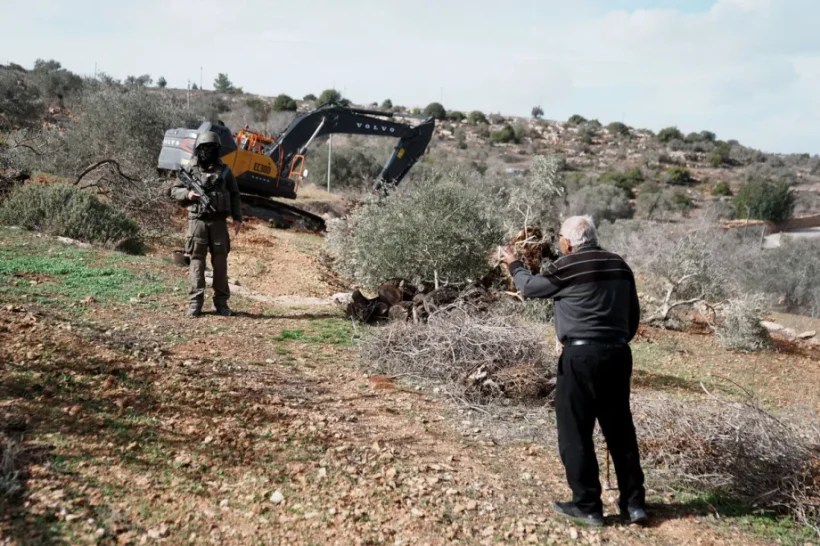
The Israeli military has issued eight orders to uproot trees and remove vegetation from 316 dunums of land across the occupied West Bank for settlement-related purposes, the Colonisation and Wall Resistance Commission (CWRC) said on Thursday.
A dunum is equivalent to 1,000 square metres.
In a statement issued on Thursday evening, the Palestinian government body said the orders require the removal of wild vegetation and olive trees from land identified in attached maps.
The eight orders cover a total of 316.636 dunums. Six of them target about 311 dunums in the northern governorate of Jenin, while the remaining two apply to the Nablus governorate and occupied East Jerusalem.
The commission said the vegetation clearance does not target isolated farmland but areas alongside main roads, expanding Israeli control on both sides of the roads and causing direct damage to olive trees and neighbouring agricultural land.
It warned that the Israeli authorities are using the orders to facilitate the establishment of settlements, saying the measures are intended to prepare the land for settlement infrastructure while restricting landowners’ access to and use of their property.
According to the commission, Israel has issued 59 orders since the beginning of 2026 to remove tree cover from 2,480 dunums of Palestinian-owned land. It added that around 60,000 dunums of Palestinian land have been seized during the 1,000 days of the Gaza war, which began on 8th October 2023.
Palestinians warn that such measures are paving the way for Israel to formally annex the occupied West Bank, which they say would undermine the possibility of establishing a Palestinian state as envisaged in relevant United Nations resolutions.
Rome talks fail as Israeli artillery rains death on Lebanon
Press TV – August 7, 2026
The seventh round of US-brokered negotiations between Lebanon and Israel have concluded in Rome without any breakthrough, marked by Israeli forces unleashing their most intense artillery barrage on southern Lebanon since the signing of a controversial framework agreement in June.
As diplomats met at the US Embassy in Rome, Israeli artillery and warplanes pounded Lebanese villages with increasing ferocity.
The United Nations Interim Force in Lebanon (UNIFIL) recorded 120 projectiles fired by Israeli forces between midnight and 4 p.m. on Thursday alone—surpassing the previous day’s total of 113 and marking the highest single-day figure observed since June 21.
UNIFIL described the escalation as the “sharpest” surge in Israeli military aggression since the announcement of the US-mediated trilateral framework in late June.
Crucially, UNIFIL reported that it did not detect any projectile launches by Hezbollah during the period, underscoring the one-sided nature of the ongoing Israeli violence.
The framework agreement signed in Washington on June 26, which the talks in Rome were ostensibly meant to implement, has been condemned by broad swathes of Lebanon’s political class as a national catastrophe that compromises Lebanese sovereignty while extracting no binding commitments from Israel.
Critics point to the agreement’s fundamental imbalance: Lebanon is required to deploy its army to “pilot zones,” dismantle resistance infrastructure, and verify disarmament—all before Israeli forces begin their gradual redeployment.
No binding timetable exists for Israel’s withdrawal from occupied Lebanese territory.
Israeli prime minister Benjamin Netanyahu has publicly presented the agreement as an achievement for Israel, a framing that has intensified the backlash in Beirut and reinforced the view that Lebanon has made outrageous concessions without securing even an immediate ceasefire.
Lebanon’s prominent Mufti, Ahmad Qabalan, declared the agreement the “worst national catastrophe” in Lebanon’s history, asserting that it effectively grants the Israeli military a form of guardianship over the Lebanese army and implicitly recognizes Israeli sovereignty over occupied areas.
Hezbollah Secretary-General Naim Qassem has described it as “a humiliation, a disgrace and a surrender of sovereignty”.
Even the Free Patriotic Movement, one of the largest Christian parties and not traditionally aligned with Hezbollah, has warned against “surrendering to Israeli demands”.
The Rome negotiations, held over three days including two days of intensive meetings at the US Embassy, failed to produce any tangible progress.
Sources close to the negotiations said the sessions, the seventh round overall, were divided into three tracks—military, political, and legal-border—but yielded no clear results.
While negotiators talked, Israeli forces intensified their assault on southern Lebanon with devastating effect.
On Wednesday alone, Israeli forces fired 113 projectiles into southern Lebanon, with 77 of them striking the town of al-Mansuri and surrounding areas. On Thursday, the bombardment increased to 120 projectiles in just 16 hours.
The Israeli military issued urgent evacuation warnings to residents of al-Mansuri, forcing families to flee their homes.
Two Israeli soldiers were killed and several injured in an explosion in the al-Mansuri area on Wednesday, reportedly after forces entered a facility ahead of a planned demolition.
UNIFIL confirmed it did not directly observe the explosion but noted the subsequent Israeli evacuation order.
The Lebanese Ministry of Health reported that eight civilians were injured in Israeli airstrikes on the town of Burj al-Shamali near Tyre on Thursday.
Israeli warplanes also flew at low altitude over the southern suburbs of Beirut, the Bekaa Valley, and the northern region of Akkar, with drones maintaining continuous flights over the capital.
Since March 2, when Israel escalated its military aggressions in Lebanon, the attacks have killed 4,333 people, injured 12,250 others, and displaced more than 1 million Lebanese citizens, according to Lebanese Health Ministry figures.
Israel’s negotiating position, as reported by sources familiar with the humiliating talks, is to preserve its military’s freedom of action as long as Hezbollah “continues to pose a threat”—a determination Israel makes unilaterally.
Israel has refused to agree to any operational restrictions until Lebanon fully implements its commitments under the framework agreement.
This position effectively grants Israel a perpetual veto over Lebanese sovereignty, with the Israeli military retaining the right to strike Lebanese territory at will, even as Lebanese forces are expected to disarm and dismantle Hezbollah’s infrastructure.
The Lebanese government, led by Prime Minister Nawaf Salam, has defended the negotiations as an assertion of independence. But critics argue that in practice, the agreement has only deepened Lebanon’s subjugation to Washington’s agenda while providing Israel with diplomatic cover for continued aggression.
The next round of talks is tentatively scheduled for September 1.
IOF obstruct Lebanese Army entry into al-Mansouri, wound soldier

Al Mayadeen | August 7, 2026
A Lebanese Army soldier was wounded on Friday as Israeli forces escalated efforts to block the army’s entry into the town of al-Mansouri in the Tyre district, attacking personnel and equipment with artillery and drone strikes, Al Mayadeen’s correspondent reported.
The soldier was wounded when a stun grenade was dropped by an Israeli drone onto an army bulldozer as it worked to clear roads and remove rubble in the town. Israeli artillery also shelled the town on more than one occasion throughout the day.
Lebanon’s National News Agency had reported that overnight into Friday, Lebanese Army units entered al-Mansouri and began reopening roads blocked by the latest Israeli attacks, working to facilitate the return of residents displaced by the aggression.
Attacks on Tyre, Bint Jbeil districts
Elsewhere in the Tyre district, Israeli forces set fire to the Wadi al-Salouqi water station near the Shaqra junction, while IOF artillery shelled the Zibqin valley at dawn.
In the Bint Jbeil district, Israeli occupation forces carried out a controlled demolition in the town of Hadatha, continuing a pattern from the overnight hours, when occupation forces had already carried out a controlled demolition in the same town at around 3 am.
Israeli forces additionally carried out a sweep from Hadatha toward the outskirts of Aita al-Jabal, advancing military vehicles near the area before withdrawing back toward Hadatha, according to local sources.
Israeli forces separately carried out a controlled demolition in the town of Kounine, also in Bint Jbeil district.
Along the border with occupied Palestine, Israeli artillery shelled the town of Mays al-Jabal, and Israeli forces opened machine-gun fire toward the town of Beit Yahoun. Al Mayadeen’s correspondent further reported that the IOF set ablaze several houses in Houla.
“Israel” also continues to violate Lebanese airspace, whereby an Israeli drone was also seen flying over Beirut and its southern suburb.
Israeli media: Hezbollah acted independently of Iran
Israeli newspaper Yedioth Ahronoth, citing a senior security source, reported that Hezbollah made its own decision to rejoin the fighting, without direction from Iran, seeing it as a chance to break the pattern of Israeli assassinations and attacks against the party.
Israeli military officials told the paper that the Lebanese Resistance had been preparing to return to war, viewing the prospect of a broader war on Iran as an opening to do so.
According to the senior security official, Iran gave Hezbollah no such order; if anything, Tehran simply understood the precarious position Hezbollah found itself in. The official revealed that Hezbollah had reached its own conclusion that it could no longer keep absorbing Israeli attacks without striking back, as it had done for the 15 months since the ceasefire took effect.
Al-Mansouri under repeated attack
Friday’s events mark the latest chapter in a mounting Israeli campaign against al-Mansouri specifically.
On Wednesday, Israeli warships had targeted the town, with the sound of explosions reaching Tyre, while Israeli warplanes separately struck it in airstrikes. That escalation followed an Israeli “evacuation” order instructing al-Mansouri’s residents to move at least 1,000 meters north of the town, the first such warning issued since the ceasefire took effect in April.
The same day, Israeli drones bombed the nearby Burj al-Shamali area three times in succession, wounding eight people, and Israeli forces carried out a controlled demolition in Hadatha as artillery shelled the vicinity of the Ali al-Taher hill, Majdal Zoun, and the outskirts of al-Mansouri and Hanniyeh.
Talks continue in Rome while ‘Israel’ offers no concessions
The attacks continue as Lebanese and Israeli officials held a seventh round of direct talks in Rome, described by Al Mayadeen’s correspondent as the “most difficult round” yet.
While the US State Department called the talks “fruitful” at the technical level, the Lebanese presidency has said no response has been received from the Israeli political level on committing to the ceasefire, and has ruled out the likelihood that “Israel” will approve a proposed new “pilot zone” in the south.
The Loyalty to the Resistance Bloc condemned the continued negotiations with the Israeli regime as a policy of “submission, surrender, and humiliating negotiations,” calling for the talks to end amid the ongoing aggression.
The bloc highlighted that Lebanese officials were meeting with Israeli representatives in Rome even as occupation forces continued to “kill, shell, bulldoze, and destroy” across the south, pointing to the threats and forced evacuation of al-Mansouri’s residents as further evidence of what it called the authorities’ “miserable choices.”
Featured Video
Trita Parsi: Israel Set a Trap for Total War in the Region
or go to
Aletho News Archives – Video-Images
From the Archive
Zionism’s Violent Legacy
By Donald Neff | Washington Report On Middle East Affairs | January 1996
On January 4, 1948, Jewish terrorists drove a truck loaded with explosives into the center of the all Arab city of Jaffa and detonated it, killing 26 and wounding around 100 Palestinian men, women and children.[1] The attack was the work of the Irgun Zvai Leumi – the “National Military Organization,” also known by the Hebrew letters Etzel – the largest Jewish terrorist group in Palestine. The Irgun was headed by Revisionist Zionist Menachem Begin and had been killing and maiming Arabs, Britons and even Jews for the previous ten years in its efforts to establish a Jewish state.
This terror campaign meant that at the core of Revisionist Zionism there existed a philosophical embrace of violence. … continue
Blog Roll
 Aletho News
- Trita Parsi: Israel Set a Trap for Total War in the Region
- Trump’s Iran war is on an Israeli leash
- Saudi oil boss issues global supply warning
- Riyadh Says Its Oil System Is Intact. The Numbers Say Otherwise.
- Trump and Netanyahu Want to “Finish the Job” on Iran
- US ‘one-sided dictation’ not Iran’s beliefs makes rational talks impossible: Baghaei
- Iran’s Next Strike May Not Explode. It Could Shut You Down /Col Doug Macgregor
- Iran: US political targets legitimate if assassinations return
- Iraq shuts key border crossing with Iran under US pressure: Report
- Undersea Internet cables could be targeted in retaliation for attacks on Iran: IRGC deputy chief
- If Americans Knew
- The Israel Lobby’s Changing Fortunes
- AIPAC has become such a political liability that it’s shifting to a more “nimble” approach to buying politicians
- At least 160 Israeli settler attacks in 2 weeks
- Will Gaza’s Ancient Christian Community Disappear Forever?
- Israel’s vision of regional security rests on keeping Arab states weak
- Heidi Levine recounts how Palestinian youths helped save her in settler attack
- DAILY UPDATE: Latest essential news on Palestine, Israel, & region
- Trump’s Intensifying Sabotage of the ICC, for Israel’s Sake
- Israeli military detain US and UK volunteers in West Bank including Democratic NY politician Brad Lander
- Americans at National Conservatism Conference held in Israel this year criticize Israel
- No Tricks Zone
- E-Cars Reduce CO2 Emissions By Only 41% Compared To Internal Combustion Engine Vehicles
- Predictions Made By Renowned Climate Professor Over Past Decades Have Been Proven To Be Poor
- New Study Suggests Large Regions Of The Pacific Ocean Have Been Cooling For The Last 80 Years
- Germany’s Green Energy Debacle: High Energy Costs Force Kahla Porzellan to Close After 182 Years!
- New Study: 50 Years Of The Most Aggressive ‘Net Zero’ Policies Can Only Affect The Global Climate By 0.03°C
- US September “Heat” Was No Record…Many Records Set Decades Ago
- Latest European Green Energy Debacle; Portugal’s Largest Flagship Solar Park Insolvent!
- Green Energy Debacle: German Expert Professor Fritz Vahrenholt Warns Of Severe Economic And Social Consequences
- Two More Paleo Reconstructions Affirm Meters-Higher Sea Levels Across Ireland, Brazil 7000-6000 Years Ago
- New Study: Earth And Venus Surface Warmth Largely Explained By Convection And Lapse Rate, Not CO2 Or Radiation

