IOF storm Kamal Adwan Hospital in northern Gaza, set fire to premises
Israel detonated explosive-laden robots, destroyed hospital facilities
Al Mayadeen | December 27, 2024
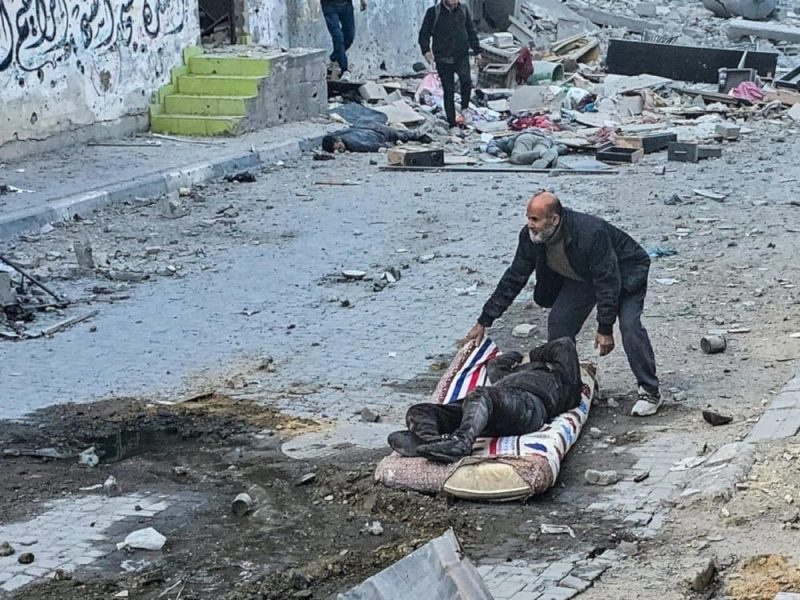
Israeli occupation forces (IOF) conducted Friday a harrowing assault on Kamal Adwan Hospital in northern Gaza, setting five of its sections on fire after raiding it, abducting patients and medical staff, and forcing them to strip.
The Ministry of Health in Gaza said that the fire had begun spreading to all buildings of the hospital, adding that the occupation forces burned the operations and surgery sections, as well as the laboratory, maintenance, and emergency units.
In an alarming escalation, the IOF launched an airstrike in the vicinity of the hospital, after storming its premises and forcibly displacing 300 patients. Many of these patients, who were dependent on life-saving medical devices, were left in the open, exposed to the harsh cold, further endangering their fragile health.
IOF also thoroughly searched the patients and medical staff, adding to the trauma.
After forcibly displacing the patients and hospital staff, the IOF abducted the patients, along with residents from surrounding areas, and gathered them in the yard of al-Fakhoura School amid harsh weather conditions.
The move has been condemned as a grave violation of international humanitarian law, highlighting the Israeli military’s disregard for the sanctity of medical facilities and the welfare of the vulnerable in Gaza.
Inevitable fate of northern Gaza people will be death
Al Mayadeen’s correspondent in Gaza noted that with the targeting of Kamal Adwan Hospital, all hospitals in the northern Gaza Strip have gone out of service.
On his part, the director of hospitals in the Gaza Strip underlined that “the free world must intervene immediately to stop the Israeli war on the Gaza Strip,” pointing out that medical staff are being subjected to abuse by Israeli forces in various hospitals across the strip that they are storming.
The suspension of services at Kamal Adwan Hospital deprives the people of northern Gaza of medical care, the director said, warning that under the current situation, the inevitable fate of the people in the area will be death.
The Ministry of Health in Gaza said that the director of the Kamal Adwan Hospital, Dr. Hussam Abu Safiya, received a clear threat from the occupation that he will be arrested this time.
Hamas condemns the attack as a war crime
In response to the latest Israeli assault, Hamas condemned the actions as a “war crime” added to a growing list of atrocities committed by “Israel” against the Palestinian people. The group slammed the international community for its continued inaction on protecting civilians and medical facilities.
It further accused the US of complicity in the ongoing aggression, calling the Israeli military’s actions “Zionist war crimes” committed amid global silence.
The movement held the Israeli occupation and the US administration fully responsible for the lives of patients, the injured, and the medical staff working in the hospital. This follows their complete isolation from means of communication and reports of abuse, the arrest of several individuals, and their transfer to an unknown location.
Hamas urged the international community, including the United Nations, to break its silence and take immediate action to halt the Israeli ongoing genocide in Gaza. The group called for measures to ensure accountability for the Israeli entity’s atrocities, demanding that Israeli officials face justice for their crimes against humanity.
IOF target al-Awda Hospital with direct gunfire
In yet another attack on hospitals in Gaza, IOF fired on the al-Awda Hospital and its surrounding areas in northern Gaza earlier today. The bombardment followed the detonation of a remote-controlled explosive device near the facility in the early morning hours.
Concurrently, the Ministry of Health in Gaza has confirmed the death of Dr. Ahmed al-Zaharneh, a physician at the European Gaza Hospital, who passed away due to the extremely cold conditions in Gaza, with his body discovered in his tent in the Mawasi area, west of Khan Younis in southern Gaza.
Over 10 Palestinians killed in ongoing Israeli airstrikes
Al Mayadeen’s correspondent reported that more than 10 Palestinians have been killed, with at least 30 others injured, most of them women and children, in a series of Israeli airstrikes on Gaza since the early hours of Friday morning, amid intensified attacks on the northern part of the Strip.
Among the targeted areas was the Halawah land in Jabalia al-Balad, northern Gaza, where several Palestinians were injured. Additionally, Israeli forces targeted a home in the al-Sabra neighborhood of Gaza City, killing five Palestinians and injuring three others.
In the al-Zaytoun neighborhood, southeast of Gaza City, another home was hit. However, Civil Defense teams were unable to reach the site to rescue the injured, as the occupation had previously and categorically refused any coordination with the Red Cross.
The scale of destruction and loss of life continues to escalate as the humanitarian crisis in Gaza deepens, with medical and civilian facilities increasingly under attack.
In America It’s Another Week to be Proud of!
By Philip Giraldi • Unz Review • December 26, 2024
Something good happened in Washington last week, suggesting that the year might actually end on a high note without Joe Biden starting World War 3 and opening up all the country’s prisons for the on-the-street rehabilitation of the inmates where they will undoubtedly learn new skills. The good thing was the signing by Biden of a bill, perhaps with a little bit of help from his friends to make sure he spelled his name correctly, to make the Bald Eagle the official bird of the United States of America. The Eagle has been around the American Republic virtually since its foundation, appearing on the Great Seal and on various documents and even on currency, but it has never been officially dubbed the national bird.
All honor of place is due to the great bald eagle, but one might recall that Benjamin Franklin once suggested that the best choice for the national bird would be the wild turkey. And Biden still has time for mischief, including possibly ennobling turkeys or even the issuance of a pardon to himself for ignoring the United States Constitution for four years. And Joe might well choose to go preemptive by pardoning Hillary Clinton for all those classified emails and other documents that somehow disappeared from her home and office ten years ago. But apart from that, it is somehow reassuring to be able to keep repeating “only three more weeks of Biden and Harris” even though the potential for more damage to the Bill of Rights remains enormous.
Joe is well remembered for his open borders invitation which has produced huge crowds of happy American voters who were clearly not delighted to share the burden of millions of uneducated and unskilled foreigners who have demonstrated their ability to burn to death women sleeping on subway trains in New York City just to see what a flaming human body looks like. Oh, and the new Americans have to be housed and fed by the existing population as the process grinds on, but that is what the Democrats running nearly all the major US cities have come to expect from a cowed population that now understands that opposing government policies puts one on the FBI enemies list.
Joe and his stalwart band of liars have also connived in pulling together two wars in which the United States had no actual interest, arming and funding both Ukraine and Israel. Israel has said thank you by adroitly engaging in genocide against the Palestinian people while Kiev is somewhat clumsily occupied in trying to draw the US and NATO into open warfare against Russia, which would become a nuclear World War 3, so there is still time Joe! And then there is the new war going on in Syria where the US armed and trained militias are fighting similarly armed and trained militias controlled by the Turks, who are poised to divide what once was a place called Syria with the Israelis. The Zionists have for many years been planning to exterminate Lebanese and Syrians as well as Palestinians to create a Greater Israel.
But Joe and his buddies apparently are not satisfied with having started two wars when there are so many other places that need a stern dose of the old “rules based international order” to get their houses in order. China is number one on the list as it is outperforming the United States and the Europeans economically. And one can always use the excuse that it is threatening good old Taiwan to crank up a shooting war. And then there is Iran, everyone’s favorite when it comes to “who is next on the list?” Israel has eliminated Hezbollah and Syria, with US connivance and approval, to open the door to destroying the Iranian non-existent nuclear weapons program. Both Biden and Israeli Prime Minister Benjamin Netanyahu have been openly discussing that option as it would mean bombing Iran’s military bases as well as its technical research facilities. Donald Trump has been involved in similar discussions with Netanyahu.
How the attacks on Iran might play out is interesting to contemplate and might follow something like the model of what happed to Syria. Recent reports indicate that something unexpected took place during an Israeli bombing attack directed against a Syrian strategic military site located near the city of Tartus. Israel has been bombing Syria constantly since the government of Bashar al-Assad fell and it has particularly targeted any sites or weapons warehouses that the new government can use to defend itself or establish its territorial integrity. The bombing in question used what many suspect to be a tactical nuclear weapon in an effort to completely obliviate the Syrian military installation that houses scud surface-to-surface missiles among other high-level ordnance. A huge explosion was noted on seismographs located five hundred miles away, as far as Iznik in Turkey. The blast might have been caused by the detonation of the many weapons stored in the facility, but the suspicion grows that Israel, protected as always by Washington even when it commits mass murder or defies international conventions on banned weapons, continues to believe that it can do and get away with anything.
Even if Biden does not open any new doors to further deploy the US military, there is considerable danger that he will succeed in locking new President Donald Trump in the conflicts currently going on. Trump is not averse to using force when it is what he considers the best option. He has lately said some ridiculous things, arguing that the United States considers the “ownership and control of Greenland” to be an “absolute necessity” for maintaining American “national security” and “freedom throughout the world.” This has naturally riled the people who actually live in Greenland who now are wondering how they are blocking freedom globally.
The statement on Greenland came after Trump in a conversation at Mar-a-Lago demoted Prime Minister Trudeau of Canada by giving him the title of “Governor”, calling Canada the 51st State of the United States “union,” which would “save on taxes and military protection.” Trump also has threatened to take over the Panama Canal and tweeted “we’ll see about that!” in response to the President of Panama’s declaration that every inch of the Panama Canal belongs to Panama. Trump then posted up a graphic on his website featuring “Welcome to the United States Canal!” above a picture of the American flag flying over a lock in the Panama Canal. Trump has also allegedly privately considered invading Mexico in order to combat the drug cartels on the US border and using American soldiers to block illegal immigrants seeking to cross.
Trump’s ignorance over who is doing what in the Middle East is astonishing but largely derives from his own personal and family attachment to Zionism and more particularly to his reliance on billionaire Jewish donors. The serial appointments of pro-Israel nominees to the key cabinet posts where decisions impacting Israel will be made for the next four years both will shape policy and guarantee that Trump stays on track with Israel, just as Joe Biden did when surrounded by his own Jewish neocons. Trump has already vowed that there will be “hell to pay” in the Middle East if the remaining Israeli hostages held in the Gaza Strip are not released by his January 20th inauguration.
Likewise, Israeli government officials, including Netanyahu, cannot wait for current Secretary of State Antony Blinken to be replaced by Florida congressman Marco Rubio. Blinken has been a complete tool of Israel but he projects a certain timidity. Rubio shows no such restraint and is very clear on what he believes to be true. He recently called Hamas “animals” and made clear that they are “100% to blame” for everyone killed in Israel and in Gaza during the current war. The moment he assumes control, there will be the “maximum pressure” that Trump often cites on Hamas to surrender or face the consequences. The Trump administration will supply Israel with bunker-busting bombs and whatever else is needed to kill anyone perceived to be an enemy of the Jewish state. Trump’s nominee for defense secretary, Pete Hegseth, has said, “If you love America, you should love Israel.” He will back that up by delivering on Israel’s military needs as defined by Netanyahu.
So there you go! The old year is ending on both a bang and a whimper. Joe Biden still has plenty of opportunity to raise hell and tie Trump to certain policies, particularly when it comes to continuing “useless” wars. Trump for his part will enter office owned by Israel and led by the nose by his belligerent cabinet. The actual needs and interests of the American people will be, as usual, invisible to the politicians and lost in the shuffle.
Philip M. Giraldi, Ph.D., is Executive Director of the Council for the National Interest, a 501(c)3 tax deductible educational foundation (Federal ID Number #52-1739023) that seeks a more interests-based U.S. foreign policy in the Middle East. Website is councilforthenationalinterest.org, address is P.O. Box 2157, Purcellville VA 20134 and its email is inform@cnionline.org.
A Palestinian year in review: Genocide, resistance and unanswered questions
By Ramzy Baroud | MEMO | December 26, 2024
Massive Israeli attacks pummel Yemen’s main airport, Sanaa pledges ‘response in kind’

Al Mayadeen | December 26, 2024
The Israeli occupation launched a large-scale attack on Yemen while the leader of the Ansar Allah movement, Sayyed Abdul Malik al-Houthi, was delivering his speech.
A source told Al Mayadeen on Thursday that the Israeli aggression on Sanaa and Hodeidah targeted civilian facilities and was carried out with the US and UK’s coordination and support.
The source also said that targeting civilian facilities is evidence of the occupation’s failure to have a clear target list within the country, stressing that this “will not change the course of the war and will be met with a similar response.”
Al Mayadeen’s correspondent, in turn, also confirmed that the Israeli occupation’s aggression targeted a gathering of travelers, including patients, at the Sanaa International Airport terminal, and also targeted airport control towers.
Significantly, sources told Al Mayadeen, that the Israeli aggression on Sanaa International Airport took place during the presence of two UN personnel in the airport: the WHO’s Director and the UN’s resident coordinator.
Moreover, the sources reported that the UN airplane’s co-captain had been injured and was transported to a hospital after the Israeli aggression on the airport, adding that two other airport employees were also killed as a result of the attack.
The source emphasized that the Israeli entity should “not lie in wait for a response from Sanaa because its military operations will continue.”
Al Mayadeen’s correspondent then added that the Israeli airstrikes hit Sanaa International Airport in the northern part of the capital, as well as two airstrikes on the Hiziz Central Power Plant south of Sanaa.
The correspondent further noted power outages in parts of Hodeidah Province due to the Israeli attack on the Ras Kathib Central Power Plant in the northern part of the coastal city on the Red Sea in western Yemen.
Additionally, our correspondent underscored that the Israeli occupation’s aggression on Hodeidah was executed with the US Navy’s participation through their warships.
Yemen likely to intensify operations against ‘Israel’: Israeli media
Meanwhile, Israeli media outlets reported that officials in “Israel” expect an increase in attacks from Yemen, especially after this assault.
Channel 14 confirmed that the attack targeted three central sites: Sanaa Airport, a power plant in Sana’a, and the Hodeidah port, noting that “this is not an ordinary attack, but the opening of a battle that could be prolonged.”
Israeli Channel 14’s correspondent also mentioned that Israeli aircraft disabled Sanaa International Airport by destroying the control towers and also disrupted the Hodeidah seaport.
According to Israeli Channel Kan, this was “Israel’s” fourth attack on targets in Yemen, adding that the United States had been informed of the operation.
In response, Ansar Allah’s spokesperson, Mohammed Abdulsalam, condemned the targeting of Sanaa International Airport and other civilian infrastructure, describing it as a Zionist crime against the entire Yemeni people.
He pointed out that if the Zionist enemy thinks its crimes will stop Yemen from supporting Gaza, it is mistaken, affirming that Yemen will not abandon its religious and humanitarian principles.
Lavrov warns Israel against ‘sowing a storm’ in Syria

RT | December 26, 2024
Israel should refrain from solving its geopolitical problems at the expense of war-torn Syria, Russian Foreign Minister Sergey Lavrov has cautioned. Reckless actions by the Jewish state could erode the security framework in the Middle East, he warned, during an online press conference on Thursday.
Lavrov stressed that Russia insists on Syria remaining an independent country following the demise of former President Bashar Assad, reiterating that Moscow maintains contact both with Damascus and other regional partners. “The disintegration of Syria must not be allowed,” he said.
In light of this, the minister urged Israel, which has established a so-called ‘buffer zone’ in internationally recognized Syrian territory, “to understand its responsibility in these collective [stabilization] efforts and refrain from ensuring its security at the expense of others.”
“One cannot expect to destroy all military facilities in a neighboring country and then live in peace and harmony forever. This is like sowing a storm that will inevitably come back to haunt those who engage in such actions.”
After Assad’s removal and subsequent asylum in Russia, Israel has launched multiple airstrikes across the border, targeting Syrian airbases, weapons depots, and other military facilities to prevent arms from reaching “the wrong hands.” West Jerusalem claimed to have destroyed 70-80% of its neighbor’s strategic military capabilities, with the Syrian navy essentially being eliminated as an operational force.
According to Lavrov, another facet of Syria’s well-being hinges on the situation in the oil-rich eastern part of the country. The US, the minister charged, has “illegally occupied a significant part of the territory, including areas with major oil fields and fertile lands,” adding that revenues from the export of these resources is being funneled to “separatist structures” that the Americans have created in the country.
He also addressed remarks by Turkish President Recep Tayyip Erdogan, who recently vowed to “bury” Kurdish militants – whom Ankara considers terrorists – in Syria if they fail to lay down their arms. “We understand the legitimate concerns of the Turkish leadership… regarding security along the border,” Lavrov said, adding that Türkiye’s “legitimate security interests must be ensured in a way that preserves Syria’s sovereignty, territorial integrity, and unity.”
Earlier media reports claimed that Türkiye and the new leadership in Damascus were considering a joint military operation to expel Kurds from border areas if they failed to integrate with the Syrian military. Russian President Vladimir Putin did not rule out that Ankara could proceed with such an action, while urging both sides to resolve their differences peacefully.
The future of the West Bank hangs in the balance
Despite concentrated efforts to eliminate resistance strongholds, ethnic cleansing, mass displacement, and escalation of violence, will the West Bank witness a Third Intifada?
By Robert Inlakesh | Al Mayadeen | December 25, 2024
On the cusp of West Bank annexation and a settler-militia war on Palestinian civilians, the future of the territory will ultimately be determined by the course of grassroots resistance to Israeli conspiracies. While the Zionist Entity will likely soon see a territorial gain, its project could tremendously backfire.
As the Genocide in Gaza, the war on Lebanon, and regime change in Syria have stolen the headlines over the course of the past 14 months, the West Bank has also experienced a period of hardship that may soon land it top news story status.
Since October 7, 2023, the Israeli occupation army and its allied settler militants have murdered over 720 Palestinians across the West Bank, making it the deadliest period there since the Second Intifada (2000-2005). In addition, hundreds of thousands of jobs have disappeared in the territory, as the local economy has continued to decline.
Making things even worse is the fact that Israeli settlers have established over 60 new settlement outposts on Palestinian lands, while they also worked alongside the occupation army to ethnically cleanse at least 26 villages and communities. Settler violence is at a historic high, as the Israeli regime continues to arm their extremist militias, has set up the Desert Frontier settler extremist military unit as part of their army, and allowed for continual assaults against Palestinian property, farmlands, and lives.
Meanwhile, the Israeli military has installed hundreds of new roadblocks, walls, and gates, while maintaining a more imposing presence throughout the territory and adopting a very aggressive posture towards West Bank civilians. This has meant that traversing even small pockets of the territory has become more dangerous and challenging for Palestinians.
Palestinians now must act with great caution at checkpoints and makeshift roadblocks that are set up for them, where they could be randomly robbed of various items, deprived of the ability to travel to work, or worse, face arbitrary detainment, humiliation, beatings, and execution. Civilians have grown increasingly cautious about traveling at night due to the high likelihood of random settler attacks, against which they receive no protection.
Palestinians living in the West Bank endure financial, physical, and psychological torment, compounded by a heightened sense of horror over the events unfolding nearby in the Gaza Strip.
Many West Bank residents have remained relatively quiet during the Genocide in Gaza, driven by a sense of hopelessness and fear – a situation influenced by various factors that are poised to change dramatically.
So far, the refugee camps in the northern West Bank have proven to be the real centers of resistance and revolutionary action. The Jenin Camp, Nour al-Shams Camp in Tulkarem, and refugee camps like Balata and al-Ain in Nablus, have been isolated islands of armed resistance. However, without popular action, their capabilities remain confined to defensive maneuvers within their camps.
With US support, the Palestinian Authority (PA) is intensifying its crackdown on the Jenin Brigades resistance groups, signaling a concerted effort to eliminate resistance strongholds in the West Bank. This crackdown coincides with a critical moment for the PA, as it faces an existential threat from “Israel’s” looming pledge to annex the territory.
The Zionist regime seeks to conquer areas C and parts of area B, inside the West Bank, aiming to establish de jure governing control over these regions, placing around 70% of the territory under their civil control.
If this scenario unfolds, the Palestinian Authority will be confronted with three viable options: dissolve itself entirely, transform into a resistance movement, or attempt to strike some sort of deal that would keep it afloat as a mere contractor that manages the major Palestinian enclaves.
As the PA currently enjoys recognition at the United Nations as the representative of the State of Palestine and is poised to play a role in any post-war Gaza scenario, it still retains some relevance. Yet, without the ability to pave the way to a Palestinian State in the West Bank, East Jerusalem, and Gaza through negotiations, it will face the inevitable challenge of pursuing armed resistance as its only option, which the PA has denounced for now.
Israeli annexation will inevitably destabilize the West Bank and the PA’s President Mahmoud Abbas has already named a transitional-phase successor, indicating that his old age will soon prevent him from fulfilling his duties. If Hamas succeeds – through a prisoner exchange – at liberating senior figures of the Fatah movement, which rules the Ramallah-based PA, it is possible that they could play a constructive role in unifying the Palestinian movement from abroad and pave an alternative path forward.
Another factor could be the potential unrest that could occur within Jordan, along with the unpredictable emergence of Palestinian resistance groups from the volatile climate inside Syria.
However, the Israelis understand well all of these elements and will seek to prevent any regional developments from working in the favor of the Palestinian people. Therefore, these possibilities should be acknowledged, but the primary focus here must be placed upon the inevitable response of the West Bank’s population at large.
With a severely weakened PA, escalation of violence, ethnic cleansing of villages, and inevitable mass displacement of civilians, amidst Israeli annexation, the people of the West Bank could be forced into a predicament that necessitates a Third Intifada. If the PA collapses altogether, this will force the Israeli army to deploy into the major Palestinian cities, which will lead to daily conflicts on a much larger scale than has been witnessed for decades.
A mass popular revolt from the West Bank will be needed to thwart Israeli plans at further land confiscation and ethnic cleansing, which will then plunge the entire territory into chaos. The main question is whether the Zionist Entity is capable of dealing with such a situation for a long period of time if a full-scale revolt occurs. Dealing with this scenario could require the deployment of army personnel, private security, border and police officers, totaling in the hundreds of thousands.
Not only would this be a massive financial burden, but it would also pose a potential security risk in the event that other fronts again activate in the future. As an example, at various points in the war against Gaza, the Israeli military had actually deployed more soldiers to the West Bank than it had been operating in the Gaza Strip.
The Zionist regime has never declared its borders for a reason, as it has always sought to further occupy territory at the expense of neighboring nations, a goal it is currently achieving at a rapid pace. While it is succeeding in the short term, the ultimate fate of this usurper project will be determined by the will of the masses.
‘Israel’ Struggles to Deter Threat by Yemen’s Ansarullah
Al-Manar | December 24, 2024
Facing the escalating challenges from Yemen’s Ansarullah revolutionary group, the Zionist entity weighs its options, with no clear resolution yet to the significant threat posed by the intensified actions in support of Gaza over the past year.
Zionist officials and experts are deliberating strategies to counter these threats, with recent military responses proving ineffective at best, Al-Akhbar Lebanese newspaper reported on Monday.
Ansaruallah, having pledged its support to the Palestinian resistance, has disrupted maritime activity by targeting commercial ships heading to Israeli ports through the Bab al-Mandab Strait, the Gulf of Aden, and the Arabian Sea. This strategy aims to pressure Israel to stop its genocidal war on Gaza.
Israel initially relied on US intervention, citing limited resources due to the Israeli Occupation Forces (IOF) spreading themselves thin across the northern and southern fronts.
However, US responses have remained tactical, with strikes limited to retaliation for disruptions to trade and supplies, their insufficiency as deterrence is highlighted by a recent friendly fire incident that destroyed one of their own jets.
Remarking on the US aggression, Yemen’s Defense Minister Mohammed Nasser Al-Atifi warned Washington that the country was capable of sinking the US’s naval fleets, and was in possession of weapons yet to be revealed.
Despite Israeli airstrikes on Yemen, analysts agree these efforts have failed to deter Ansarullah, Al-Akhbar’s Yahya Dbouk wrote. The group has intensified its operations, reiterating its support for Gaza and vowing further action unless ‘Israel’ halts its genocide against Palestinians.
Israeli experts suggest alternative strategies, including targeting Yemeni leadership in Sanaa, weapon production facilities, and economic hubs such as ports and energy sites, as well as bombing Saada for its symbolism in the Yemeni public’s consciousness according to Dbouk, who added that proposals to strike Sanaa and Saada aim to weaken Ansarullah’s influence and mobilize opposition forces within Yemen.
As he considered that these measures are seen as unlikely to achieve decisive results, the Lebanese writer noted that Tel Aviv has also considered reviving the Saudi-Emirati led war against Yemen with Zionist support.
However, doubts remain about its feasibility, given the previous failures of the coalition to secure a military victory during the war waged by the Saudi-led coalition on the Arab impoverished country since March 2015, according to the author.
Another debated approach involves targeting Iran, viewed as Ansarullah’s so-called “primary supporter”, Dbouk reported, noting that this strategy, however, raises questions about the Zionist entity’s capacity to address broader regional threats in wartime.
On the other hand, a ceasefire in Gaza has been proposed as a potential solution to ease Yemeni attacks. Ansarullah themselves have said on multiple occasions that as long as the war on Gaza continues, so will the attacks from Yemen and the maritime trade disruptions.
Such option “seems likely to break quickly, due to a possible failure in the second phase of a potential swap deal between Gaza and ‘Israel’, which is widely believed in Tel Aviv will never see the light,” Dbouk wrote.
The Zionist entity continues to weigh its options, with no clear resolution yet to the significant threat posed by Ansarullah and its broader implications for regional security.
Five Syrians injured by Israeli army gunfire in Quneitra countryside
By Ahmad Karakira | Al Mayadeen | December 25, 2024
Israeli forces have established new positions in the countryside of Quneitra in Syria, specifically along the axes of Rasm al-Rawadi, Umm al-Edam, and al-Mantara Dam.
The village of Swisah in the southern countryside of Quneitra witnessed a protest against the Israeli occupation forces that had advanced into the village, entering barracks within and around it, local sources told Al Mayadeen.
The Israeli forces, consisting of bulldozers and tanks, stormed a barracks in the center of the village, carrying out acts of vandalism and cutting down trees in its surroundings but without approaching residential homes, the sources indicated.
Subsequently, the occupation forces moved to a barracks west of the village, continuing their acts of destruction, which prompted residents to gather near the site in protest against the incursion and raise the Syrian flag.
The Israeli forces then opened fire to prevent the protesters from approaching, injuring five individuals.
According to the sources, the Israeli forces transported equipment, including bulldozers, to the al-Tallayn al-Homr area, where they have been stationed for some time.
IOF give Jubatha al-Khashab residents ultimatum to turn in weapons
In a related context, Israeli occupation forces have given the residents of the town of Jubata al-Khashab in the northern countryside of Quneitra a 48-hour deadline to hand over all types of weapons.
This has sparked appeals to the new administration in Damascus, which has yet to take any action.
In response to Israeli threats, the elders of the town indicated that they would only hand over weapons to the Syrian authorities.
They urged active officials on the ground to address their demands “so they would not later be accused of treachery, especially after the Israeli forces claimed responsibility for the area’s security and its arms.”
IOF establishing posts on top of Mount Hermon
A couple of days ago, local sources told Al Mayadeen that the Israeli occupation forces are combing the entirety of Mount Hermon’s peak, and are establishing a new post overlooking Damascus’ southwestern countryside.
According to exclusive sources, the Israeli army seized military equipment in the area, as well as the wreckage of an Israeli helicopter downed during the 1973 war.
Earlier, a local source told Al Mayadeen that Israeli tanks and armored patrols infiltrated the al-Hamidiyah axis in the countryside of Quneitra towards the provincial center in the town of al-Baath, southwest of Syria, coinciding with inspection campaigns carried out by Israeli forces, which targeted some homes and farms in the villages of the central countryside.
Israel seeks to occupy south Lebanon past 60-day truce period
The Cradle | December 24, 2024
Israeli forces are unhappy with the Lebanese army’s efforts to implement the ceasefire agreement announced on 27 November and are planning to maintain a presence in south Lebanon, according to exclusive information.
“The French conveyed to the Lebanese army that the Israeli military is not satisfied with what is happening [in south Lebanon] and that it will not leave before destroying all of Hezbollah’s infrastructure [south of Litani River, even after the 60-day implementation period ends],” Lebanese security sources told The Cradle on 23 December.
The information came as an Israeli attack killed two people in the town of Taybeh in southern Lebanon’s Marjayoun District.
The Lebanese National News Agency’s (NNA) correspondent in Marjayoun reported on Monday afternoon that “two people were killed and another was injured in an enemy raid that targeted a group of people near the official school in Taybeh.”
Israeli ground troops continued their campaign of mass detonations and destruction of homes and buildings across southern Lebanon, blowing up houses in Al-Bustan and Al-Zaloutieh in the Tyre District.
They also put up an Israeli flag on a hill in the Naqoura area overlooking the main entrance to the town, in violation of the ceasefire announced last month.
Israeli troops are required to withdraw from Lebanon within 60 days of the ceasefire’s announcement. So far, it has been four weeks, leaving only a month before the Israeli army must withdraw, according to the agreement that is based on UN Resolution 1701.
The Lebanese Armed Forces (LAF) has deployed across south Lebanon with the aim of dismantling Hezbollah infrastructure south of the Litani River – which is required to take place within the 60-day period.
Tel Aviv has violated the ceasefire over 100 times since it took effect with deadly airstrikes, arrests of Lebanese citizens, troop advancements, and mass detonation campaigns in southern villages.
Israeli forces have exploited the ceasefire to advance into areas they were unable to during recent ground battles with Hezbollah.
Hezbollah responded once to dozens of violations in early December with a limited rocket attack on an Israeli site in occupied Lebanese territory, prompting a massive and deadly Israeli response in south Lebanon.
Israel claims it is acting in line with the ceasefire agreement by targeting what it says is Hezbollah infrastructure. However, according to the agreement, dismantling the resistance’s presence in southern Lebanon is the responsibility of the Lebanese state and army. Earlier this month, the Israeli army bombed Khiam after the LAF entered the city to clear rubble and prepare for civilian entry.
A secret side letter between Washington and Tel Aviv reportedly guarantees that Israel can act with force against “threats.”
Israel’s Defense Minister Israel Katz vowed on 22 December that Tel Aviv would “crush” Hezbollah’s “head” if the Lebanese resistance group violates the ceasefire, coming during a visit to an Israeli army position in southern Lebanon.
Two days earlier, Hezbollah MP Ali Fayyad said that “the resistance will not be dragged into confronting Israeli violations and aggressions militarily, because its priority is the Israeli withdrawal from our land without giving it any pretext to exceed the 60-day deadline, and because we take into consideration the situation of our people who need shelter, reconstruction, and to clean up the effects of the war.”
“We want the Lebanese government and army to play their role in protecting the land and preserving sovereignty, based on the [agreement] based on Resolution 1701,” Fayyad added.
Lebanese Prime Minister Najib Mikati and UNIFIL called on Israel on Monday to hasten its withdrawal from southern Lebanon. Mikati called for the US and France to pressure Israel on the matter.
Frustrated by Incessant Missile Attacks, Israel Threatens to Start Assassinating Houthi Leaders
By Ilya Tsukanov – Sputnik – 24.12.2024
Israeli terror bombing attacks targeting Yemen’s port and energy infrastructure and a year-long US-led naval deployment in the Red Sea at Tel Aviv’s urging have failed to deter Ansar Allah (better known as the Houthis) from launching increasingly impactful drone and missile attacks.
Israeli Defense Minister Israel Katz has threatened to start targeting the Houthis’ leaders.
“We will inflict a devastating blow to the Houthi terrorist organization in Yemen,” Katz said.
“Just as we took care of Sinwar in Gaza, Haniyeh in Tehran and Nasrallah in Beirut, we will deal with the heads of the Houthis in Sanaa or anywhere in Yemen,” Katz warned, referring to the leaders of Hamas and Hezbollah assassinated by Israel this year. “We will act both against their infrastructure and against them to remove the threat.”
Katz also took a pot shot at Iran, whom the US and Israel have regularly accused of backing the Yemeni militia, warning that “whoever sponsors the Houthi terror in Hodeidah or Sanaa will pay the full price.”
Iran, which has long denied providing direct military support for the Houthis, said Tuesday that the militia’s operations have forced Israel and the US to alter their calculations.
“Even under the heaviest bombardments from the American-Israeli coalition, they target the heart of the occupied territories with their homemade missiles,” Foreign Minister Abbas Araghchi said at a press conference in Tehran. “The Yemenis have proven they need no external assistance. Despite dire economic and military conditions, they have stood firm and resisted,” he added.
The Israel Defense Forces reported early Tuesday morning that they had intercepted a Houthi missile outside Israel’s airspace. Sirens wailed across central Israel amid fears of the missile reaching its target, with over two dozen people injured (one seriously) while running for cover in the panic.
Houthi official Hezam al-Asad vowed the group would continue its attacks “until the aggression against our people in Gaza stops.”
On the diplomatic front, Israeli Foreign Minister Gideon Sa’ar on Monday instructed Israel’s diplomats in the EU and the UK to label the Houthis as a terrorist organization (currently, only Israel, the US, several Gulf states, Australia, Canada, New Zealand and Malaysia do so).
“The direct threat to freedom of navigation in one of the world’s busiest shipping lanes is a challenge to the international community and the world order. The first and most basic thing is to define them as a terrorist organization,” Sa’ar said in the directive.
On Tuesday, Sa’ar sent a letter to US UN Ambassador Linda Thomas-Greenfield asking her to convene an emergency session of the Security Council to condemn the Houthis for their “flagrant violation of international law.”
In addition to their drone and missile campaign, the Houthis have done major damage to Israel’s merchant shipping fleet by imposing a partial blockade of the Red and Arabian Seas targeting Israeli-linked and Israel-allied shipping.
A Houthi missile penetrated Israel’s much-touted missile defenses Saturday, injuring 16 people in Jaffa, just south of Tel Aviv. The IDF probe into the incident found that the warning system “was activated late for reasons that cannot be detailed.”
Another Houthi missile landed a direct hit in Tel Aviv last week, again overwhelming air defenses, with the militia characterizing the attack as their “natural and legitimate” right to respond to Israeli aggression.
The militia also scored a major PR victory against Israel’s US allies last week, reporting the shootdown of an F/A-18 jet during an attack on the USS Harry Truman supercarrier. The Pentagon said the jet was downed in a friendly fire incident. Whatever the case, the Houthis have confirmed kills of nearly a dozen US Reaper drones, and are known to have downed a number of US and NATO-made helicopters and fighter jets from the mid-2010s onward in their war against a US-backed Gulf State coalition.
The West Bank’s CIA men: Why is the PA killing Palestinians in Jenin?
By Ramzy Baroud | MEMO | December 23, 2024
Following a ten-day siege, the Palestinian Authority began a violent raid on the Jenin refugee camp in the northern West Bank on 14 December. The PA security forces used tactics similar to those used by the Israeli occupation forces in their routine attacks on the area.
The camp, which is a mere half a square kilometre in size, hosts an ever-growing population of 24,000 refugees, mostly the descendants of Palestinians ethnically cleansed by Zionist militias during the great catastrophe, the 1948 Nakba.
The raid began with a tight siege, followed by an attack from multiple directions that resulted in the killing of an unarmed youth, Rebhi Al-Shalabi, 19, then a 13-year-old boy, Muhammad Al-Amer. The PA forces also killed Yazid Ja’ayseh, the commander of the Jenin Brigades, who had evaded Israeli assassination attempts for his leadership role in unifying all Palestinian Resistance fighters under the umbrella of a single group.
Unsurprisingly, Israel is largely pleased with the PA’s action against the Palestinian Resistance, although it expects more. “The Palestinian Authority has been acting resolutely against the Hamas and Islamic Jihad fighters over the past several weeks, army and Shin Bet sources said, but the Israeli officials expressed the hope that their effectiveness could be enhanced,” reported Haaretz.
Indeed, Israel has attempted to subdue Jenin 80 times in the past year alone, killing more than 220 people, Al Jazeera has reported, citing Palestinian Ministry of Health sources.
By attacking Jenin, the PA is helping the Israeli army in more than one way.
It is killing and detaining anti-Israeli occupation Resistance fighters, for example; consuming the energy and resources of the Resistance; and allowing Israel to spare thousands of soldiers so that they may carry on with the genocide in Gaza.
For many, especially supporters of Palestine around the world, the PA’s action is confusing, to say the least. Those surprised by the anti-Resistance policies of Mahmoud Abbas and his Ramallah-based authority, however, are driven by the erroneous assumption that the PA is a legitimate representative of the Palestinian people, and that it behaves in ways consistent with the collective aspirations of all Palestinians.
Nothing could be further from the truth. For many years, the PA has ceased to play any role that deviates from the interests of a small clique of a pro-US and pro-Israel wealthy elite who have enriched themselves, while millions of Palestinians continue to suffer an Israeli genocide in Gaza, and a violent system of apartheid and military occupation in the West Bank and East Jerusalem.
The most telling and recent example is that, less than 70 kilometres from Jenin, illegal and violent Israeli Jewish settlers have burned the Bir Al-Walidin Mosque in the town of Murda, near Salfit. The PA security services did nothing whatsoever to confront the armed Jewish militias, nor any of the hundreds of settlers’ pogroms carried out against Palestinians in the West Bank in the past year and before; nor, of course, did the occupation army.
How did the PA turn from a supposed national project — at least in theory — into another branch of the Israeli occupation?
It could be argued that the PA was structured from the day of its establishment in 1994 as a body whose existence catered solely for the benefit of the Israeli occupation. There is much evidence to substantiate this claim, including the arrests, torture and killing of dissenting Palestinians soon after the creation of the PA.
The US Central Intelligence Agency (CIA) became directly involved in supporting the PA from the very beginning, expanding its role as early as 1996 following a series of retaliatory Palestinian attacks on Israeli targets in major cities. It was then that CIA director George Tenet became an important player in shaping the policies of the PA security forces, preparing them for massive crackdowns on Palestinian Resistance groups. This involvement was a condition of US financial support under the Bill Clinton administration, the kind of support that sowed the seeds of the Fatah-Hamas conflict, which reached its zenith in the summer of 2007.
The involvement of the US — and other armed forces of US client regimes in the region — became even more apparent under the leadership of Lieutenant General Keith Dayton, who helped train, prepare and equip the Palestinian Authority Security Forces (NSF), producing several battalions of young recruits (between 20 and 22 years old) to fight fellow Palestinians in the name of restoring law and order.
That supposed restoration of “law and order” began in earnest as early as 2005 and continues to this day. Interestingly, this is the same language that the PA is currently using to justify its war on the Jenin refugee camp. A spokesman for the PA security forces, Anwar Rajab, told Al Jazeera recently that the objective of the raid on Jenin is to “pursue criminals” and lawbreakers, and to “prevent the camp from becoming a battleground like Gaza.”
Equating Resistance fighters with criminals and linking that supposed criminality to the Gaza Resistance is the typical PA discourse on legitimate resistance against the Israeli occupation of Palestine. It is a discourse that took the US and Israel years to craft and perfect, making the PA arguably the greatest achievement of the occupation state and Washington in recent decades.
This behaviour and language can be traced to a famous statement by Dayton himself who, in a 2009 speech, celebrated the US’s greatest creation in Palestine: “And what we have created — and I say this in humility — what we have created are new men… upon the return of these new men of Palestine, they have shown motivation, discipline and professionalism, and they have made such a difference.”
Indeed, the “new men of Palestine” are making all the difference required by the US and Israel; they are fighting the very Palestinian Resistance that is defending Jenin against the Israeli onslaught, Nablus against the pogroms of armed settlers and Gaza against genocide.
None of these “new men” — whose numbers are counted in the tens of thousands — have lifted a finger to help their fellow Palestinians as they continue to starve to death in the Gaza Strip, are tortured and raped en masse, and are burned alive in Jabaliya and Khan Yunis while fighting and dying in their thousands without any assistance from the Ramallah Authority.
To say that the PA has betrayed Palestinians, however, is inaccurate.
The PA was never set up, financed and armed by the US and Israel as a liberation force; it was always intended to be an obstacle to Palestinian freedom. We are witnessing the final proof of this claim. It is taking place in Jenin now; in fact, all over the occupied West Bank.
Of course, the PA will not be able to crush the Palestinian Resistance, which the supposedly mighty Israeli army has failed to subdue over the course of many years. But the question remains: how long will the PA be allowed to serve the role as the enforcer of the Israeli occupation and the protector of illegal Jewish settlers, while simultaneously promoting itself as the guardian of Palestinian rights, freedom and statehood?
“Greater Israel” Metastasizes
By Kevin Barrett | American Free Press | December 22, 2024
“Israel is a cancer on the Middle East.” Resistance leaders across the region have used that metaphor for generations. The Zionists who dominate American politics, finance and media have attacked it as inappropriate.
But is the metaphor inaccurate? Cancer occurs when a diseased cell or cells begin uncontrollably expanding at the expense of neighboring cells and organ systems. Israel, a malignant body of extremist fanatics implanted into the heart of the Middle East, keeps mindlessly and voraciously expanding, not unlike a virulent tumor. Such pathological Zionist growth has caused untold pain, suffering, and hardship for the people of Palestine, the region, and the world.
Let’s chart Israel’s malignant growth. The original version of modern Israel, as set forth in the Balfour Declaration (1917) consisted of a mere “Jewish homeland” (not a state) guaranteed not to impinge on the rights of non-Jews—who constituted the vast majority of the population and owned virtually all of the land of historic Palestine. After the invading Jewish terrorists began running amok, as recounted in Thomas Suarez’s magisterial State of Terror: How Terrorism Created Modern Israel, Britain rewarded them with the 1937 Peel Commission partition plan, which would have created Israel on 33% of Palestine, leaving the other 67% for Palestinians.
The Peel Commission plan was outright theft. Palestinians owned well over 90% of the land of Palestine, yet the Commission wanted to steal almost one-third of their land and hand it to Eastern European Jewish terrorist invaders. But even such grand larceny wasn’t enough for the Zionists. They held out for more, and got it in 1948 by bribing US President Truman with a suitcase containing two million dollars in cash (as recounted by John F. Kennedy to Gore Vidal). That bribe, and others like it, produced the UN’s partition plan, which almost doubled the size of the Peel Commission’s Israel.
But even that outrageous robbery did not satisfy the Zionist terrorists, who immediately began massacring Palestinians and invading territory outside their UN borders. When the Nakba (Palestinian Holocaust) was over, untold thousands of Palestinians were dead, and more than 750,000 survivors had been robbed of their land and property and forced into exile as permanent refugees. After perpetrating the 1948 holocaust the Zionists refused to return to their UN-approved borders, which would have given them more than 55% of Palestine, and instead continued occupying almost 80%.
But even that didn’t satisfy them. The Zionist leadership spent the next two decades plotting what would become the 1967 war of aggression, in which they stole another 77,000 square kilometers consisting of the West Bank including Jerusalem, the Gaza Strip, the Golan Heights, and the Sinai Peninsula. Together, those stolen territories are almost four times the size of pre-1967 Israel.
After 1967, Zionist leaders split between those willing to return stolen territory in return for peace, and those dedicated to endless wars of expansion. With the assassination of the land-for-peace Prime Minister Yitzhak Rabin in 1995, the issue was definitively settled in favor of the “forever wars” party.
Rabin was an anomaly—a mere speed bump on the road to Greater Israel. The Zionist leadership has always tacitly agreed that Israel will keep expanding to its Biblical mandate and beyond. David Ben-Gurion defined Zionism’s goal as follows: “to create a Jewish state in the whole of the Land of Israel.” That “whole” includes Palestine, Lebanon, Jordan, and part of Egypt, Syria, Iraq, northern Arabia, and arguably Turkey. Such conquests will require genocidal war against those countries and peoples.
2024 will go down in history as the year the Zionist cancer metastasized, sending its toxic tendrils even further into northern Gaza, the West Bank, southern Lebanon, and Syria. Netanyahu’s minister Smotrich is calling for the full annexation of the West Bank and Gaza and the murder or expulsion of all Palestinians from historic Palestine. That process is already underway as northern Gaza is being emptied and Israel has grabbed a full 6000 acres of the West Bank. Meanwhile Israel is violating its ceasefire agreement with Lebanon in an attempt to steal all of south Lebanon up to the Litani River. And in the wake of the US-Turkish-Israeli overthrow of the Syrian government, Israel has massively attacked Syria and grabbed vast swathes of Syrian land.
The ever-expanding cancer of Zionism poses a clear and present danger to the region and the world. The driving force behind Zionism is a virulent version of Jewish messianic millenarianism whose endgame is a Jewish military leader conquering not just the region, but the whole world, and then establishing a Jewish global dictatorship based in Occupied Jerusalem.
First they came for the Palestinians. Israel’s neighbors are next. But this isn’t just a regional problem. Metastasizing Israel threatens all of us.
Featured Video

New positive ivermectin evidence
or go to
Aletho News Archives – Video-Images
From the Archives
Fanatical Followers of the Covid Regime: A Jim Jones-Style Cult?
By Professor Roger Watson and Dr. Niall McCrae | The Daily Sceptic | November 15, 2021
As scholars at leading British universities over recent decades, we witnessed the replacement of critical thinking and debate by narrative: facts are discrimination and scientific method is imperialism; truth, instead, is derived from ‘progressive’ values. This educational trend may be a major contributory factor to the ease in which society has been inculcated to the Covid ‘new normal’ of masking, testing, and repeated doses of vaccines for a disease of similar risk to severe influenza.
One doesn’t need much critical reasoning to observe the flawed logic of some vaccination enthusiasts, such as people who respond to experiencing any side effects, however debilitating, by saying “at least I know it’s working”, or, after contracting the disease despite their promised inoculation (over 90% effective, according to initial drug company claims), “I’d have been worse off without the jab.” … continue
Blog Roll
 Aletho News
- Merck Virologists Admitted to Falsely Certifying Vaccine Efficacy
- Mandatory Folic Acid for every man, woman & child
- Pro-Palestine protesters arrested outside UK’s ruling Labour Conference in Liverpool
- Mauritius denies landing permit to flight from Israel, forcing cancellation: Tour operator
- Israeli finance minister calls for genocidal war on West Bank, annexation of south Lebanon
- 12 Things Your Psychiatrist Was Trained Not to Tell You
- From Unipolar Universalism to Multipolar Civilizational Distinctiveness
- RSF military group defects, joins Sudanese army: State media
- Ireland goalkeeper refuses to play ‘Israel’ as squad weighs boycott
- China pushes back against US on Cuba, Iran
- If Americans Knew
- Israel forces Gazans to live in constant peril – Daily Update
- Deconstructing Netanyahu’s pants-on-fire UN rant – Daily Update
- Trump betrayed voters with his campaign lies and prioritized a foreign country once he took office
- Netanyahu calls Israel’s war in Gaza ‘opposite of genocide’ in UN speech to near-empty hall
- Settler Kidnappings: Torture, Sexual Abuse and Terrorisation of Palestinian Abductees as Israel Deepens Annexation of West Bank
- Gaza winter nears as 162,000 tents become unusable, raising fears of humanitarian crisis
- Netanyahu says, “It’s the opposite of genocide”; UN says Gaza economy is world’s ‘most severe crisis on record’ – Daily Update
- Israel’s US-Backed Assault on Gaza Has Created the ‘World’s Most Severe Economic Crisis on Record’: UN
- ‘Protecting U.S. Citizens’… From Israel
- ‘This is where I live now, the back of a truck’: a day in the life of a grandmother in Gaza
- No Tricks Zone
- New Study: Earth And Venus Surface Warmth Largely Explained By Convection And Lapse Rate, Not CO2 Or Radiation
- 2025 Nature Paper Claiming Worsening Global Drought Gets RETRACTED …Heavily Flawed
- New Study: ‘Global Drought Shows No Detectable Recent Acceleration Under Climate Warming’
- Economic Masterminds: German Socialists Suggest Taxing Productivity Gains Stemming From Using AI
- The South China Sea Has Not Been Cooperating With The Climate Change Narrative
- Energy Crisis: Germany Enters Heating Season With Historically Low Gas Reserve Fill Levels
- New Study: The Antarctic Ice Sheet Gained Mass From 2020-2024 Due To Staggering Snow And Ice Accumulation
- Study: Ocean Heating Rates From Thousands Of Years Ago ‘Dwarf’ Modern Ocean Heating Rates
- Climate Extremists Target, Attack Large-Scale Power Grid Infrastructure In Germany!
- New Study: Antarctic Ice Melt Has Contributed Less Than 1 Centimeter To Sea Level Rise In The Last 30 Years

