‘Israel’ deploys additional forces, armored patrols in Syria
“Israel” continues illegal operations in Syrian territories, expanding its occupation in different areas, particularly Mount Hermon.
Al Mayadeen | January 4, 2025
Local sources told Al Mayadeen that the Israeli occupation deployed reinforcements in the al-Jazeera barracks in the village of Maariya, in the Daraa countryside, near the Syrian-Jordanian border, erected high concrete barriers and paved all roads leading to the barracks.
Moreover, the source stated that for the first time, the Israeli occupation army is deploying armored patrols on the hills of the recently occupied areas of Mount Hermon, overlooking the territories in the Nabatieh region of Lebanon.
This comes after Israeli media reported that the Israeli military is preparing for an extended presence in Syria.
According to Walla, “Despite pressure from European parties on Israel, political leaders have instructed the Israeli army to brace for a prolonged stay in Syrian territory.”
Israeli Prime Minister Benjamin Netanyahu had previously instructed the military to prepare to remain in the Syrian Mount Hermon area and the UN-patrolled buffer zone until at least the end of 2025, Israeli Army Radio reported.
In contrast, Syria’s new leader, Ahmed al-Sharaa, pledged that he would not allow the country to be used as a launchpad for attacks “against Israel or any other state”.
What US mediation? 1000 Israeli violations in Lebanon go unchecked
The Cradle | January 2, 2025
Under the supervision of US special envoy and former Israeli soldier Amos Hochstein, Beirut and Tel Aviv reached a ceasefire agreement on 27 November after almost 14 months of intense conflict against the backdrop of the war on Gaza.
The Israeli military pledged to withdraw from Lebanese territory within 60 days of the agreement’s enactment.
To ensure compliance, a monitoring committee led by US General Jasper Jeffers was established, focusing on enforcing the cessation of hostilities and the full implementation of UN Security Council Resolution 1701.
Rampant Israeli violations
But Israel immediately undermined the truce, committing nearly 1,000 violations within the first month alone – one of many cases of the occupation state’s disregard for international agreements.
Additionally, occupation forces have continually obstructed the Lebanese army’s deployment at key points in southern Lebanon, and have leaked plans that Tel Aviv intends to maintain control over strategic areas in the country. Reports suggest there is an Israeli effort underway to establish a security buffer zone spanning from Abbad to the villages of Odaisseh and Kfar Kila.
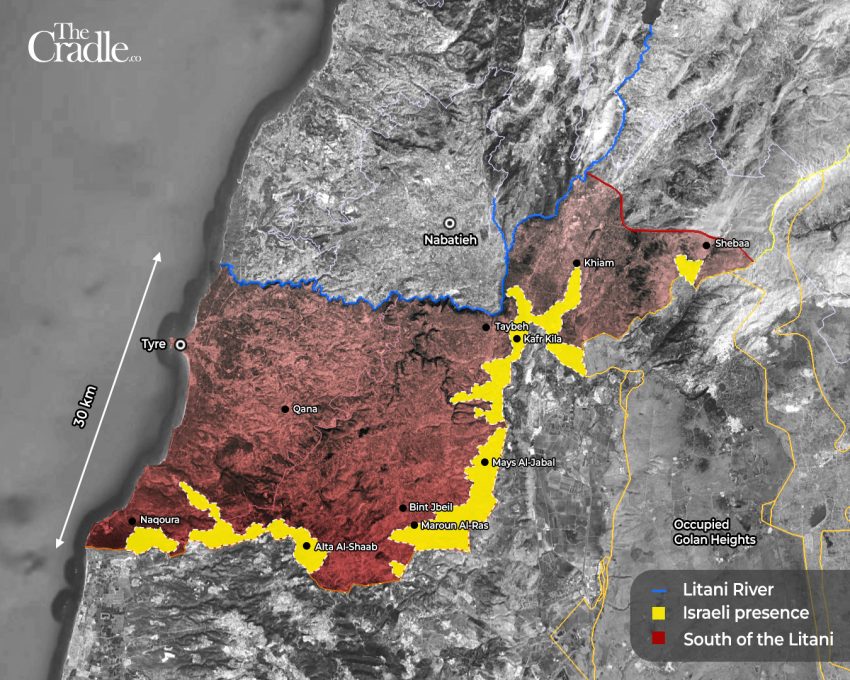
Map showing areas of Israeli military presence (in yellow) south of the Litani River in southern Lebanon, following the declared ceasefire. (Updated December 2024)
Meanwhile, from the onset of the ceasefire, Hezbollah assured the Lebanese government that it would not retaliate during the 60-day truce period, adhering strictly to the agreement terms and allowing the government and army to address Israel’s daily provocations.
The ceasefire followed intense internal and international pressure on the resistance movement to halt its battle with Israel, especially as the latter began to dangerously expand its bombing targets across the country. Simultaneously, the Israelis – having failed to achieve their stated war objectives and taken daily troops losses in their ground invasion – were pushing hard for a truce, citing the need to prevent an escalation that could extend to Beirut, risking mass civilian casualties.
This agreement may not be ideal for either party, but it is feasible to implement. Israel achieved tangible successes but failed to crush Hezbollah or eliminate it as an organization. For Hezbollah, the priority was ending the war to halt the destruction, despite the damages it sustained.
Consequently, both sides reached an agreement that Hezbollah described as a reiteration of the 1701 Resolution. It was not a deal of humiliation or defeat, contrary to how the group’s adversaries are eager to portray it.
It is important to note that Hezbollah chose a middle path between Hamas’ call to ignite a broader conflict under the banner of “Al-Aqsa Flood” and a policy of non-intervention, given that the Palestinian movement’s leadership did not involve Hezbollah in its decision to go to war.
Ethically, Hezbollah opted to open a limited support front, clearly defining its objectives: to exhaust the Israeli military and pressure it into halting the assault on Gaza. However, this calculation later proved to be flawed.
When the support front escalated into a full-fledged war, Hezbollah declared that its aim was to stop the conflict. When Israel requested a cessation of hostilities, Hezbollah agreed under acceptable conditions.
Ultimately, after over a year of conflict sparked by the Hamas-led Operation Al-Aqsa Flood, Hezbollah and Israel reached a 13-point agreement mediated by the US and France. While Tel Aviv agreed to withdraw from Lebanese territory within 60 days, its actions during the ceasefire depict a relentless drive to achieve militarily what it could not during the war.
The destruction of Lebanese homes and towns during the first month of the truce already far exceeds that caused during the conflict, with villages such as Bani Hayyan, Markaba, Shama, Al-Bayada, and Wadi al-Hujayr suffering devastating damage.
Israel’s brazen violations are not just restricted to border towns. Its truce violations include the prohibited operation of war drones over Beirut and its southern suburbs, and substantial military strikes in villages across the eastern Bekaa Valley.
The US looks the other way
The ceasefire monitoring committee, led by Tel Aviv’s staunchest allies, has faced significant challenges, largely due to Israel’s unwillingness to comply with the terms of the truce.
Sources reveal to The Cradle that so far, two meetings have been held at the United Nations Interim Force in Lebanon (UNIFIL) headquarters in Naqoura, southern Lebanon, with Israeli officers present, followed by a third meeting attended by Lebanese Prime Minister Najib Mikati – without the Israelis present.
The sources added that the first meeting lasted just 40 minutes, limited to introductory discussions on core topics. The second session, however, was marked by discord, as the Israeli side failed to uphold previously agreed-upon terms.
During that meeting, it became apparent to all that while the Lebanese army had finalized and approved a deployment plan for the western, central, and eastern axes, the Israelis refused to present any withdrawal strategy. Instead, they shifted blame to the Lebanese army for what they called “slow deployment,” further suggesting that the 60-day truce deadline was merely symbolic, not binding for the withdrawal of Israeli forces, and intended only for the withdrawal of Hezbollah troops from south of the Litani River.
Israeli representatives went further, baselessly claiming that the Lebanese army had no intention of implementing the agreement’s provisions to withdraw Hezbollah from south of the Litani.
During the discussions, Lebanese General Edgar Lowndes is said to have stormed out of the meeting after heated exchanges with the Israeli side, which downplayed its repeated attacks in Lebanon as insignificant and refused to classify them as breaches of the agreement. The Israeli delegation specifically argued that their use of drones in Lebanese airspace was not a violation of the truce, suggesting that the air breaches would continue unchecked.
The lead US official – a general – brought Lowndes back to the meeting and tried to keep the proceedings more formal thereafter. Following the session, high-level contacts took place between various committee members, with Lebanese caretaker Prime Minister Najib Mikati gathering French and American officers and the UNIFIL Commander to emphasize the need for Israel to respect the signed agreement that the Israeli army would withdraw from Lebanese territory within the agreed upon deadline.
In this context, the US general confirmed that envoy Hochstein would participate in the next committee meeting on 6 January to confirm the ambiguous issues, and agreed with his Lebanese counterparts that Israel is violating the ceasefire through its actions.
Patience amid provocation
While Hezbollah has exercised restraint and refrained from delivering any significant response beyond a single retaliation at the “Ruwaisat al-Alam site belonging to the Israeli enemy army in the occupied Lebanese Kfar Shuba Hills,” Israeli provocations have continued to test the limits of the ceasefire on a daily basis. As a source close to Hezbollah informs The Cradle :
“We will be patient until the 60-day period expires and diplomatic opportunities are exhausted, and after that there is no solution but resistance.”
International mediators now face growing pressure to enforce the agreement, with Lebanese Parliamentary Speaker Nabih Berri emphasizing the importance of French involvement in the monitoring process, given US partiality toward Israel.
The Lebanese Ministry of Foreign Affairs filed a formal complaint with the UN Security Council, citing 816 violations between 27 November and 22 December. Prime Minister Mikati has called for the swift and complete implementation of Resolution 1701, cautioning that delays could destabilize the region further.
Beirut also called for “enhanced support for UNIFIL and the Lebanese army to guarantee the protection of its sovereignty and to create the necessary security conditions for restoring stability and normalcy in the south of the country.”
It is evident that Israel is leveraging its perceived upper hand to manipulate the ceasefire agreement, interpreting its terms to align with its strategic objectives. By acting as if the balance of power has irreversibly shifted in its favor, the occupation state not only challenges the Lebanese side but openly flouts the agreement with actions such as air violations, justified under the guise of self-defense.
These provocations, coupled with threats to reignite hostilities and forcibly expel Hezbollah, reveal a calculated effort to establish new facts on the ground that were never part of the original accord.
How likely is a ceasefire In Gaza?
By Robert Inlakesh | Al Mayadeen | January 2, 2025
As the Gaza ceasefire talks stall yet again, some analysts argue that Donald Trump’s inauguration could be the key. However, the prospects for ending the war are dependent upon a variety of other factors that are making an Israeli victory impossible.
Despite the recent progress towards securing a ceasefire in the Gaza Strip, the Zionist regime has again employed its delaying tactics in order to find the opportune moment. While the Resistance in Gaza has proven flexible on the fine details of a prisoner exchange and cessation of hostilities, it has also proven steadfast on the battlefield, making an Israeli victory declaration implausible.
The popularly accepted analysis at this stage is that with the start of Donald Trump’s second term in office, the possibility of a Gaza ceasefire will increase greatly. It is believed that Israeli Prime Minister Benjamin Netanyahu could even present the implementation of such a deal as a gift to Trump; kick-starting his Presidency with a diplomatic breakthrough.
It is also true that the Zionist Entity’s richest billionaire, Miriam Adelson, had pledged 100 million dollars to the Trump campaign, with the quid pro quo that in return for bankrolling his presidential bid, he would permit an Israeli annexation of the occupied West Bank.
What Could Make or Break A Gaza Ceasefire
The reality that must be accepted when it comes to the Israeli approach to a Gaza ceasefire/prisoner exchange agreement is that the United States will not use its leverage to secure one and instead only seeks to support the Zionist entity towards securing the best possible deal. Therefore, arguments presented about the possibility of the Trump administration actually using Washington’s leverage are ludicrous and should be discarded as fanciful.
The reason why Donald Trump could make a difference in this case comes down to two major factors: His support within the Zionist regime and his willingness to permit them to completely crush the idea of a so-called “Two-State solution”.
There is no one that commands quite as much public support amongst Israelis as Donald Trump, in fact, he is more loved by them than his own population in the United States. This means that his word carries weight and him throwing his support behind the Netanyahu-led coalition could force the more fundamentalist elements of his government to fall into line. In addition to this, there will be no hesitancy when it comes to permitting an Israeli annexation of the occupied West Bank.
These two components are essential for ensuring that a Gaza deal will not collapse the current Israeli coalition. If the Israeli PM is going to secure the support he needs for such a ceasefire, he needs the extremists on his side and can only do this by fulfilling the pledge to annex the West Bank.
Another major issue, besides the domestic Israeli political divisions is the activity and risk of battle across a variety of fronts. In order to annex the West Bank, the Israeli military will need to deploy enormous numbers of soldiers, private security forces and occupation police into the territory. In the event of mass civil unrest, or even a worse scenario for them like the collapse of the Palestinian Authority, they will need to send a force that could amount to hundreds of thousands of fighters, into the territory in order to control the situation.
Already the Zionist military is in a State of exhaustion, with many of its soldiers refusing to show back up when called upon to redeploy into the Gaza Strip. They have tens of thousands of wounded fighters and countless others suffering from psychological disorders, all of which place a burden on the regime alone. There’s also a deficit that has to be filled in the rank and file that the Israelis need in order for their military to function at proper capacity, which has led to desperate attempts to draw in new reserve soldiers and force the Ultra-Orthodox population to draft their young.
In the best case scenario for the Israelis – when carrying out their annexation – they will still need to dedicate a tremendous amount of resources and manpower to fulfilling the task properly. This is essential to understanding why the annexation will prove extremely difficult in the event that one of the various war fronts expands, particularly the Lebanon or Syria fronts.
While the future of resistance inside Syrian territory is unclear and not certain, if such a force does manage to rise and challenge the occupation of their territory in the south, it will require major investments to combat it and will be greatly draining for the Zionist armed forces. Although this appears to be the least likely of the fronts to again deteriorate into war, it is certainly still a question mark.
Then we have Lebanon. The Israelis have not respected the ceasefire for a single day since its announcement, committing hundreds of violations. The Zionist regime is not only continuing to maintain its presence in southern Lebanon, but has even penetrated further into the country during this period, forcing their way into territories that they couldn’t reach due to the fierce resistance against them.
The Israelis now discuss re-occupying southern Lebanon, blow up homes, mosques and other infrastructure daily, murder civilians, bomb targets deeper into the country and provocatively fly their flags in the south. Such a situation has not occurred since Hezbollah kicked the Zionist regime out of their nation in 2000, battering the Israelis again in 2006 and liberating their land. There is no conceivable way that the situation in Lebanon can remain like this, either the Israelis decide to leave the country altogether, or they will eventually face a response from Hezbollah.
If these fronts ignite, or tensions escalate with Iran, annexation will prove a difficult task for the decision makers in “Tel Aviv”, as they will be faced with a potentially dangerous predicament. Again, without the annexation of the West Bank, it is hard to imagine the Zionist regime being able to conclude a Gaza ceasefire.
On top of this, the Palestinian Resistance in Gaza has shocked everyone and is not only continuing to fight, it still possesses the rocket capabilities to strike occupied Jerusalem and Tel Aviv. In fact, the last burst of long-range rockets from the Gaza Strip towards occupied Jerusalem were fired from Beit Hanoun, an area in the besieged enclave that the Israelis have been stationed in throughout almost the entirety of the war.
Palestinian Resistance fighters continue to kill and injure Israeli soldiers, destroy and damage their military vehicles, while also firing rockets and drones. This is happening almost 15 months into the fighting and with no known supply lines to Gaza. Yet, the people continue to remain steadfast, while the resistance continues to recruit more fighters and manufacture new weapons.
Because of the refusal of the people of Gaza to lessen their cause, they have thwarted several attempts to impose a new rule upon them. Despite suffering through a Genocide and losing everything around them, they have not allowed for a foreign regime and fighters to be imposed. Also, the Zionists have not come up with any valid strategy to allow for a takeover of the Palestinian territory, having failed to destroy Hamas.
This is another issue that rears its head, what will the day after look like? There is no clear answer to this question yet and none of the proposals on the table will give the Zionists the image of a full victory that they have proposed from the start.
Netanyahu Ordered the 2003 Invasion of Iraq
Tales of the American Empire | January 2, 2025
Recent revelations prove the primary reason for America’s 2003 unprovoked invasion of Iraq was because Israel wanted seven Muslim nations destroyed to allow for its expansion. This war was part of a plan for Greater Israel. This Zionist plan to massively expand Israel was ignored by sane people for decades because it is unrealistic and would require the ethnic cleansing of tens of millions of native Arabs.
The key proponent of this plan is long-time Israeli Prime Minister Benjamin Netanyahu. There is no doubt that he is mostly responsible for the 2003 American invasion of Iraq. Netanyahu is now demanding the corrupt American government make Greater Israel possible by helping destroy Lebanon and Iran.
________________________________________________
Related Tale: “Stealing Oil from Iraq”:  • Stealing Oil From Iraq
Related Tale: “Conquering the Middle East”: • Conquering the Middle East
“Greater Israel: The Zionist Plan for the Middle East”; Michel Chossudovsky; GlobalResearch; June 7, 2020; https://www.globalresearch.ca/greater…
“A Clean Break: A New Strategy for Securing the Realm”; Wikipedia; https://en.wikipedia.org/wiki/A_Clean…
“One way to counter Iran’s aggression. Change the map of the Middle East”; Fox News Opinion; Michael Makovsky; December 28, 2017; https://www.foxnews.com/opinion/one-w…
“CIA Spy on 9/11, Enhanced Interrogation, AI, Jeffrey Epstein | John Kiriakou |”; Dalton Fischer; YouTube; November 19, 2023; • CIA Spy on 9/11, Enhanced Interrogati…
“CMD CMSgt Dennis Fritz: Why the US Invaded Afghanistan and Iraq”; Judge Napolitano; YouTube; October 30, 2024; • CMD CMSgt Dennis Fritz : Why the US…
“Oil Wars: Exposing US Foreign Policy in Middle East | Gary Vogler Interview”; Counter Currents; YouTube; October 12, 2024; • Oil Wars: Exposing US Foreign Policy …
“Worth the Price?” New Film Shows How Biden Played Leading Role in Push for U.S. to Invade Iraq; Democracy Now; February 18, 2020; • “Worth the Price?” New Film Shows How…
Related Tales: “Conquering the Middle East” playlist: • Conquering the Middle East
Israeli demolition campaign intensifies in southern Lebanon
The Cradle | January 2, 2025
Israeli troops advanced into and heavily attacked the southern Lebanese village of Beit Lif on 2 January, in violation of the fragile ceasefire that Tel Aviv has been continuously breaching since it took effect in late November last year.
“The Roumieh area between Beit Lif and Yater was subjected to enemy artillery shelling,” Lebanon’s National News Agency (NNA) reported on Thursday afternoon, coming as Israeli forces entered and searched homes in the area.
According to Al Manar’s correspondent in the south, the Israeli army pushed into Beit Lif with several Merkava tanks, military hummers, a bulldozer, and infantry forces and began demolitions in the town. The sounds of heavy explosions and gunfire were heard.
Earlier on Thursday, an Israeli drone targeted the vicinity of a farm between the towns of Beit Lif and Yater with two missiles.
The new ceasefire violations occurred a day after the Israeli military set fire to homes in the Aitaroun-Bint Jbeil district.
In accordance with the ceasefire agreement, the Lebanese Armed Forces (LAF) entered the towns of Shamaa and Al-Bayada on 1 January. The two towns are among those that witnessed fierce clashes between the Lebanese resistance and the Israeli army during Tel Aviv’s failed ground operation in Lebanon, which began in early October and ended with the ceasefire on 27 November.
Al-Bayada and Shamaa were also heavily bombarded throughout the war that began in October last year.
NNA reported massive destruction of infrastructure – with entire neighborhoods and even the electricity network ravaged. “Everything was razed to the ground.”
Israel has violated the ceasefire – which is based on the implementation of UN Resolution 1701 – over 100 times since it took effect with deadly airstrikes, arrests of Lebanese citizens, troop advancements, and mass detonation campaigns in southern villages. Entire villages have been wiped out as a result of the demolition campaign.
Tel Aviv claims to be targeting Hezbollah infrastructure in the south, which the LAF was tasked to dismantle as per the agreement.
Israeli troops are required to withdraw from Lebanon within 60 days of the ceasefire’s announcement. So far, it has been over four weeks, leaving less than a month before the Israeli army must retreat, according to the agreement.
Security sources in Lebanon told The Cradle on 23 December that the Israeli army is unhappy with the LAF’s efforts to implement the ceasefire and is planning to maintain a presence in the south past the 60-day implementation period.
“Now is the opportunity for the Lebanese state to prove itself through political action,” Hezbollah’s Secretary-General Naim Qassem said in a speech on Wednesday, echoing recent comments by the resistance group’s MPs and officials.
Hezbollah officials have recently said that the current period represents a test for the Lebanese state regarding whether or not it will be able to protect the south from Israeli attacks and violations once the resistance is no longer present south of the Litani River.
“If the occupation takes any steps against Lebanon from the eastern front due to its expansion in Syria, we will carry out our national duty … anyone who believes that the resistance in Lebanon has weakened is deluded … We possess the resources and intellect to be in a position to confront the occupation. On the 61st day after the ceasefire, we will be in a position to make the Israeli enemy taste our wrath,” Hezbollah MP Ihab Hamadeh told Al Mayadeen on Wednesday.
Under the radar: ‘Israel’s’ ruthless expansion and Syrians’ struggle
By Sara Salloum | Al Mayadeen | January 2, 2025
“Israel” capitalized on the fall of the Syrian regime on the 8th of this month, launching a wide-scale operation to destroy the qualitative capabilities of the Syrian Arab Army. The operation targeted missile weapons stores, manufacturing and development sites, air force facilities, air defense systems, radar installations, research centers, and naval combat assets. Israeli warplanes are still freely parading in Syrian airspace, with Syrian citizens always hearing the sounds of Israeli reconnaissance planes overhead.
In this scenario, the Syrian Arab Army would have lost the majority of its weaponry. If reconstituted, it would become a fragile and symbolic army force, incapable of effectively facing an overwhelming, American-backed Israeli military that occupies whatever land it wants, and bombs whatever it wants, whenever it wants.
While the head of the new Syrian administration, Ahmad al-Sharaa, (formerly Abu Muhammad al-Julani), was busy receiving political and security delegations from various countries, “Israel” initiated a large-scale ground incursion into southern Syria. This action was justified by the new governor of Damascus who stated, “Recently, Israel might have felt afraid, so it advanced a little and bombed a little. These fears are natural, but Syria’s problem is not with Israel, and we do not wish to tamper with Israel’s security.”
In full view of the UN Disengagement Observer Force (UNDOF) posts, Israeli forces violated the 1974 agreement and took control of more than 10 Syrian villages, covering an area of more than 20,000 km²,
Abu Muhammad, a resident of the Quneitra countryside, told Al Mayadeen English what happened:
“The Israeli forces raised their flag on the Quneitra Governorate building, and destroyed numerous houses in the surrounding countryside, along with small farms in various towns. They bulldozed lands and farms and uprooted trees, and erected earthen barriers and fortifications around the Mantara Dam, Syria’s second-largest dam, cutting off our water supply. Additionally, they installed extensive surveillance cameras and communication devices. When civilians protested against their actions, the Israeli forces fired live ammunition directly at them, resulting in numerous injuries.”
Neocon Sanctions Architect Beats Drums of War With Iran Amid Trump’s Looming Return
By Ilya Tsukanov – Sputnik – 02.01.2025
Donald Trump will be back in the White House in less than three weeks. While he’s expressed opposition to regime change in Iran, and pride in being the first president in decades not to start any new wars during his first term, his adamant support for Israel, and the tapping of hawks for his new administration have sparked fears of US aggression.
The United States “should give diplomacy a final shot – while preparing to use military force” against Iran to destroy its nuclear program, prominent Iran sanctions cheerleader and former State Department deputy special envoy Richard Nephew has suggested.
In a new piece for Foreign Affairs magazine, Nephew argues that while there are plenty of “good reasons not to bomb Iran,” like engulfing the Middle East in even greater turmoil and “undermin[ing] US credibility if the attacks don’t succeed,” the “case against military action is not so neat,” given Washington’s paranoia about ‘Iranian nuclear weapons’, and the limited prospects for sanctioning Tehran into submission given its newfound economic and security partnerships with BRICS allies.
Unless the Trump administration is “prepared to live in the world that Iranian nuclear weapons would create, it may have little choice but to attack Iran – and soon,” Nephew claims, even while admitting that “Iranian nuclear weapons would not present a near-term existential threat” to the US as much as it would its regional “partners” (i.e. Israel).
Nephew isn’t the first to float an attack on Iran following Trump’s reelection in November, with DC Beltway media running opinion pieces like “Israel should strike Iran now, paving way for Trump 2.0,” and sources telling the Wall Street Journal that Trump’s transition team is weighing an attack on Iran’s nuclear program. In November, former CIA chief Leon Panetta warned that Trump could give Israel a “blank check” on Iran and ultimately spark a war between the regional powers.
The brainstorming about a direct attack on Iran comes in the wake of the abject failure of the US’s 40+ year strategy of crushing the Islamic Republic through sanctions, saber-rattling and attempts at regime change, which have pushed the country to strive for economic and military self-sufficiency, and to expand its strategic footprint regionally.
Will Trump Attack Iran?
Trump is a well-known Iran hawk, pulling the US out of the Joint Comprehensive Plan of Action nuclear deal in 2018 at Israel’s behest, and expressing full-throated support for Tel Aviv amid its conflict with the Iran-led Axis of Resistance over the past 15 months. He’s also staffed his new administration with a number of avowedly pro-Israel Iran hawks, including Marco Rubio and Mike Waltz.
At the same time, Trump’s past frustrations with Benjamin Netanyahu, who rushed to congratulate Joe Biden after the highly contentious 2020 election, combined with resistance to advice from aides to escalate militarily against Iran, and support for initiatives to scale back the US military footprint in the Middle East during his first term, make the future of US policy vis-a-vis Iran and the Middle East region uncertain.
UK doctor suspended over posts praising slain Hamas and Hezbollah leaders as ‘legends’
MEMO | January 1, 2025
 Dr Rehiana Ali, a British neurologist, was been suspended last week by the Medical Practitioners Tribunal Service (MPTS) following complaints about social media posts on Israel’s genocidal war on Gaza. The interim suspension, lasting 18 months and subject to review, prevents her from practising medicine pending a full investigation by the General Medical Council (GMC).
Numerous US-British airstrikes target Yemeni capital Sanaa
Al Mayadeen | December 31, 2024
A US-British aggression targeted Tuesday the capital, Sanaa, amid continuous airstrikes, Al Mayadeen’s correspondent in Yemen reported.
Our correspondent indicated that the US-British airstrikes targeted the September 21st Park, located in the northwestern part of Sanaa, which previously housed the First Armored Division.
He also noted that the aggression targeted, with eight airstrikes, a complex that includes the Ministry of Defense and military administrative offices in the Bab al-Yemen area in central Sanaa, as well as the May 22nd Military Industrial Complex in the al-Nahda neighborhood, northwest of Sanaa.
The spokesman for the Yemeni Ansar Allah movement, Mohammad Abdelsalam, pointed out that the aggression against Yemen represents “a blatant violation of the sovereignty of an independent state” and comes in support of “Israel”.
Abdelsalam affirmed that “Yemen will continue to defend itself against any aggression and remains steadfast in supporting Gaza.”
The latest aggression comes a couple of hours after the spokesperson of the Yemeni Armed Forces (YAF), Brigadier General Yahya Saree, announced that the YAF missile force carried out two top-tier military operations against Israeli targets.
The first targeted Ben Gurion Airport in the city of Yafa (Tel Aviv) in occupied Palestine using a hypersonic ballistic missile of the Palestine-2 type, Saree said, adding that the second operation targeted a power station in southern occupied al-Quds with a Zulfiqar-type ballistic missile.
According to the spokesperson, both missiles successfully hit their targets.
Saree pointed out that the two operations coincided with a joint operation conducted by the YAF’s naval, missile, and UAV forces, targeting the US aircraft carrier USS Harry S. Truman with a large number of drones and cruise missiles, while US forces were preparing to launch a major aerial attack against Yemen.
He confirmed that the operation successfully achieved its objectives, thwarting the planned American aerial assault on Yemen.
Elsewhere, Saree reiterated that the operations of the YAF will only cease with the cessation of the Israeli aggression against Gaza and the lifting of the blockade imposed on the Palestinian strip.
Israel’s collateral killing of civilians is finally in the spotlight
The New York Times’ recent “bombshell” presents facts that have been known for a long time – and does its best to sanitize them
By Robert Inlakesh | RT | December 30, 2024
The New York Times recently published a piece admitting that an unprecedented amount of “collateral damage” was permitted by the Israeli military. However, it omits key statistics that were previously revealed in order to sanitize the revelations it claims to be uncovering.
Presented as a bombshell piece, the December 26 article reveals that Israel had sent through an order that permitted killing up to 20 civilians for each low-level Hamas target. “The order, which has not previously been reported, had no precedent in Israeli military history,” the article reads.
However, in early April of 2024, an Israeli media outlet called +972 Magazine had not only published this fact, citing sources within Israel’s military, but uncovered much more damning figures detailing what was to be considered “acceptable” collateral damage.
The +972 article revealed that the Israeli airstrike that killed Hamas’ Shujaiya Battalion Commander, Wisam Farhat, was authorized to kill 100 civilians. Even more shocking was the infamous case of Ayman Nofal, the commander of Hamas’ Central Gaza Brigade, where, according to the sources, “the army authorized the killing of approximately 300 civilians.”
The +972 report was mentioned in passing by The New York Times, with the caveat that Israel’s military had denied it. However, +972 Mag’s investigative work on this topic did not begin in April. In fact, a piece published in November of 2023 cited a source who claimed the following:
“The numbers increased from dozens of civilian deaths [permitted] as collateral damage as part of an attack on a senior official in previous operations, to hundreds of civilian deaths as collateral damage.”
So, while a big deal is made of the fact that such high numbers of collateral damage have “no precedent in Israeli military history,” the IDF has been knowingly writing off civilians as collateral damage for years. One need only look at literally any UN report on Israel’s past military conduct to see it.
It isn’t only in Gaza that such horrendous “collateral damage” has been normalized, it has also been the case in Lebanon. When Israel carried out the assassination of Hezbollah’s Secretary General Seyyed Hassan Nasrallah, it openly announced that it estimated the total death toll to be around 300, as a result of leveling a number of civilian buildings in southern Beirut.
There is literally nothing in the article published by The New York Times that is new; all it does is affirm what has already been reported, yet it is done in a way that works to water the killings down by omitting key facts and repeating old tropes.
For example, it repeats as proven fact the widespread allegation that Hamas purposely embeds itself amongst civilians to use them as human shields, a point that has been found at least questionable before.
What is undeniable however, is that Israel uses Palestinians as human shields, as has been copiously documented throughout the war and used to be an accepted part of Israel’s military doctrine.
“From November 2023 onward, amid a global outcry, Israel began to conserve ammunition and tighten some of its rules of engagement, including by halving the number of civilians who could be endangered when striking low-ranked militants who posed no imminent threat” states the NYT. The question here is, where did this information come from? According to the article itself, the sources are all Israeli soldiers and officials.
The only evidence presented is the words of the Israelis. Was there any analysis done or examples cited to prove that the IDF would only kill ten civilians on average for every low-ranking Hamas fighter? Absolutely not, because not even Israel can present this information to the public, nor the names of the thousands of supposed “Hamas fighters” it has targeted.
If we go by Israel’s official figures for the number of alleged Hamas militants killed, they rise at such a rate that it doesn’t match the death toll figures accepted by the United Nations. While the official death toll in Gaza is nearly 46,000, with 10,000 missing and presumed dead, the only way Israeli “Hamas fighter” figures make sense is if the toll is much higher. However, accepting a higher death toll in order to give Israel’s claims about Hamas fighters more legitimacy would mean that The New York Times would face another issue: they would then have to wrestle with the fact that the killing only escalated in November of 2023.
In addition to this all, the +972 article from April 3 provides a much more in-depth insight into the artificial intelligence systems used by the Israeli army and points out that the targets it generated were highly inaccurate. The investigation discovered that when the Lavender system chose junior Hamas targets, the Israeli army would actually use its more lethal unguided munitions, because “you don’t want to waste expensive bombs on unimportant people.”
Furthermore, +972 noted that while a human has to verify targets chosen by the AI before a strike is ordered, eventually this boiled down to simply making sure the target is male – spending about 20 seconds on average before pulling the trigger.
Nowhere in the New York Times article is there any mention of the slaughter of civilians where no military target is located, there is no mention of the mass torture, sexual abuse, or demolition of homes for the pure vanity of soldiers. Everything is framed as a military that went a little overboard after the Hamas-led October 7 attack.
Robert Inlakesh is a political analyst, journalist and documentary filmmaker currently based in London, UK. He has reported from and lived in the Palestinian territories and currently works with Quds News. Director of ‘Steal of the Century: Trump’s Palestine-Israel Catastrophe’.
More than Dozen Martyred in Israeli Strike on Syria’s Adra
Al-Manar | December 30, 2024
At least ten people were martyred on Sunday in an Israeli strike on Syria’s Adra Industrial City in rural Damascus, Syrian and Arab media reported.
Reports said there was an explosion in the city of Adra, on the eastern outskirts of the capital.
An Israeli drone had reportedly fired two missiles at a building in the vicinity Adra industrial zone.
Arab media outlets reported that 11 people were killed, while other reports put the death toll at 17, with a number of others being injured.
A video shared on social media showed the aftermath of the attack. The video showed a building reduced to rubble with several bodies scattered among the debris.
The Zionist entity has been taking advantage of the former Syrian regime’s fall earlier this month, with the occupation military launching hundreds of strikes in the last weeks on several areas across the Arab country, and seizing positions including the summit of a mountain with an uninterrupted sightline to the capital Damascus.
Featured Video

Iran is (probably) collecting tolls, and why Asia stopped buying oil from the US
or go to
Aletho News Archives – Video-Images
From the Archives
The Great Recycling Scam
By Dr. Vernon Coleman – 21st Century Wire – September 2, 2022
Recycling was introduced, worldwide, as a tool to teach citizens to become compliant.
Forcing citizens to sort their rubbish into up to nine separate bags or boxes every week had absolutely nothing to do with ‘saving the planet’ and everything to do with teaching citizens (through a mixture of fines and shame) to behave ‘responsibly’ i.e. to do as they were told without looking too closely at the rationale of what they were being told to do.
The recycling never had anything to do with protecting the planet, of course. Most of the rubbish sorted, washed and collected in the UK was taken abroad, by lorry or ship or train, and burnt or dumped. It was, quite simply, impractical and not cost effective to recycle the material that had been collected. And, of course, collecting the sorted rubbish involved massive costs in terms of cash and pollution.
Today, the recycling business has reached an apogee of lunacy. Councils introduce ever more complex rules and fees. They refuse to take away much of the waste that is collected. And those wanting to take their rubbish to a ‘recycling’ centre will probably have to make an appointment and answer a host of questions.
It is no surprise that fly-tipping has become a major problem. The biggest causes of plastic in the sea are dumped fishing gear and plastic waste (much of it officially designated as recycled) which has been dumped by ships.
The good news, however, is that in Britain, recycling rates are falling. More and more people have become aware that the whole recycling movement was just another piece of manipulative trickery.
Blog Roll
 Aletho News
- Beyond Netanyahu: what Israel’s election means for Palestinians
- Lithuania plans universal conscription
- Lies, Damn Lies, and Ukraine News
- Financial Times rejects Nordic demands to correct Putin call story – media
- The Case for Less Unity in Europe
- Ukraine expands minority rights under EU pressure – but Russians remain excluded
- Albania takes anti-riot crackdown cue from France
- The interest of the House of Rothschild in Ukraine
- Pentagon fires top military planner
- Three tankers hit mines on unauthorized Hormuz route: IRGC Navy
- If Americans Knew
- An error has occurred; the feed is probably down. Try again later.
- No Tricks Zone
- Germany’s Green Energy Transition Becoming Increasingly Expensive…Another 6 Trillion Euros!
- Sudden Stratospheric Warming, Powerful El Niño Combination May Lead To Extreme Europe Cold, Energy Crisis!
- Two New Studies Find Thwaites Glacier Melt Cannot Be Driven By Human Activity Or A Warming Ocean
- E-Cars Reduce CO2 Emissions By Only 41% Compared To Internal Combustion Engine Vehicles
- Predictions Made By Renowned Climate Professor Over Past Decades Have Been Proven To Be Poor
- New Study Suggests Large Regions Of The Pacific Ocean Have Been Cooling For The Last 80 Years
- Germany’s Green Energy Debacle: High Energy Costs Force Kahla Porzellan to Close After 182 Years!
- New Study: 50 Years Of The Most Aggressive ‘Net Zero’ Policies Can Only Affect The Global Climate By 0.03°C
- US September “Heat” Was No Record…Many Records Set Decades Ago
- Latest European Green Energy Debacle; Portugal’s Largest Flagship Solar Park Insolvent!

