West Bank is Defenseless – This is Why Israeli Settler Attacks Continue
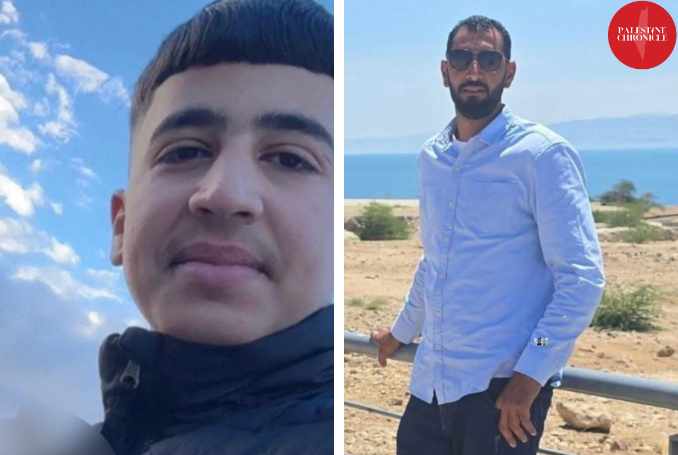
Israel killed 14-year-old Aws al-Naasan, along with 32-year-old Jihad Abu Naim, who tried to help him. (Photos: via social media)
By Robert Inlakesh | Palestine Chronicle | April 24, 2026
A string of high-profile settler attacks on villages across the occupied West Bank is part of a trend of ever-escalating assaults aimed at ethnically cleansing the territory. These extremists, backed by the Israeli army, are emboldened by the refusal of the Palestinian Authority to act.
Earlier this week, an Israeli settler assault on a school in the village of al-Mughayyer, near Ramallah, resulted in the killing of a 14-year-old school boy, Aws al-Naasan, along with 32-year-old Jihad Abu Naim, who had attempted to come to the aid of the children who had been opened fire upon.
The incident caused an uproar, yet only a day later, another Palestinian man was executed by a settler in the village of Deir Dibwan, after which the Israeli military rounded up dozens of men and placed them under humiliating detention.
These assaults and ongoing series of pogroms, where settlers alongside their army comrades will burn down homes, businesses, and vehicles, are part of a larger effort aimed at ethnic cleansing.
Since October of 2023, at least 75 Palestinian villages and communities have been partially or completely ethnically cleansed, according to the latest statistics published by Israeli rights group B’tselem. Life in general has been greatly impacted throughout the occupied West Bank as a result of the ultra-emboldened settler violence problem.
However, there is a deeper-rooted issue at play here. There is nobody there to help protect or respond to these violent assaults and killing sprees, with the exception of the occasional lone-wolf operations carried out by individuals who grow frustrated with their predicament. Even these kinds of attacks have greatly decreased over the past year or so, however.
There were armed resistance groups that had independently formed in places like Jenin Refugee Camp and Nour al-Shams Refugee Camp, yet they have been largely crushed or driven into hiding for now.
The unescapable fact about how these groups were dismantled was the pernicious role of the corrupt Palestinian Authority, which worked to do Israel’s dirty work for it, even slaughtering Palestinians who dared to pick up arms and fight, including killing innocent bystanders, including children.
Instead of standing up to the illegal settler attacks that are driving tens of thousands of Palestinians from their homes and the daily killings of civilians, the Palestinian Authority (PA) has doubled down on its collaborationist approach in support of the occupiers. Even arresting and then extraditing a 75-year-old Palestinian, Mahmoud Khader Abed Adra, who was accused of attacking a Jewish restaurant in Paris back in 1982.
The priority of this PA is to protect Israeli interests as they enrich themselves, having completely thrown their national project into the dustbin in search of pleasing the West and Arab despots. Yet, some 30% of the West Bank population is employed by the PA, with another 18% finding employment amongst Israeli settlers and Israeli businesses.
If we consider now that up to 35% of the West Bank population is considered to be unemployed and that the Western NGOs have a major influence on the territory, also employing a considerable number of people, then it begins to become more understandable why the situation remains as it is. The majority of employed Palestinians work for the PA or their occupiers directly.
The PA is said to have around 60,000 men as part of their overall security apparatus, trained by the British, Jordanians, US, and others, yet they aren’t there to protect Palestinians; they are there as another layer of occupation. If you stand up to the PA, you will be arrested and tortured, perhaps even brutally killed in front of your family, like the famous dissident Nizar Banat.
Understanding this is key to comprehending why the territory’s people have been left so incredibly defenseless and why an Intifada has not yet occurred. If such an uprising is to begin, it will mean that it will be totally organic and completely outside the fold of the PA, perhaps even collapsing its corrupt system altogether.
Even on the international level, the Palestinian cause has only been used to drive the selfish interests of a small group of Palestinian elites, while completely abandoning the people’s project. Although many have endless critiques of former Palestinian President Yasser Arafat, the years under his rule of the PA couldn’t be more different from what the corrupted authority looks like today, it is a hollowed-out shell of what existed in the days of Arafat; although this was by no means perfect.
Unfortunately, the PA is now the main obstacle to Palestinians resisting the ethnic cleansing of the West Bank. It may be so that Gaza’s destruction was quicker and more brutal because it chose to fight, but if the West Bank had risen up, the Israelis would have been in a very tough position.
Unlike Gaza, the West Bank is saturated with Israeli settlers, and the price that they would pay in the event that a real resistance would emerge would be much more painful, which is precisely why the Israelis have gone to great lengths to strengthen their positions and prevent freedom of movement there to such an extent since October 2023.
To the Israelis, they see the West Bank as ‘Judea and Samaria’ – the Israeli biblical heartland – while the Gaza Strip is an afterthought. The senior Israeli leadership, from its PM Benjamin Netanyahu to the opposition leader Yair Lapid, is all in agreement on developing a “Greater Israel” that is currently attempting to expand further into Lebanon and Syria.
As for the fate of the West Bank, left completely defenseless, with a PA that is actively working for its occupier, it appears to be grim. These settler attacks are only going to accelerate and grow more violent. The only way that this will ever be forced to change is in the event of a mass uprising, because individual acts alone are not going to alter the current predicament.
Attempting to predict the future is a difficult task; however, with the ever-growing unemployment rate, alongside the overall decline in living standards and constant settler/occupation army violence against the civilian population, an uprising is only a matter of time away.
– Robert Inlakesh is a journalist, writer, and documentary filmmaker. He focuses on the Middle East, specializing in Palestine.
Systematic Israeli targeting of Gaza police seen as deliberate prelude to chaos
Palestinian Information Center – April 24, 2026
GAZA – The Gaza Center for Human Rights has strongly condemned the escalating targeting of police and security personnel in the Gaza Strip by Israeli forces, describing it as part of a recurring pattern aimed at weakening the structure of public order and creating conditions conducive to chaos and lawlessness. This, the Center warned, facilitates the movement of collaborators and armed gangs at the expense of civilian safety and security.
According to documentation by the center’s field teams, an Israeli drone strike on Friday, April 24, 2026, killed two police officers and injured others after targeting a police patrol near Sheikh Radwan police station in northwest Gaza City. The attack occurred in a densely populated area, placing civilians at direct risk.
In a related incident, on the evening of Thursday, April 23, 2026, a drone strike targeted a group of young men at a security checkpoint in the al-Maslakh area, southwest of Khan Yunis, killing one of them, identified as Yahya Marwan Youssef Abu Shalhoub, 22, and injuring others.
Shortly after midnight on Tuesday, April 21, 2026, an Israeli airstrike hit a security post north of the Al-Amal neighborhood in western Khan Yunis, killing three people. Medical sources later confirmed a fourth death from injuries sustained in the attack.
On April 20, 2026, an Israeli drone targeted a gathering of security personnel near Joudeh roundabout in the Bureij refugee camp, killing one officer and injuring another.
Since the ceasefire in October 2025, the Gaza Center for Human Rights has recorded an increase in Israeli attacks on security posts, police checkpoints, and officers performing civilian duties related to maintaining order and protecting public and private property. The Center stated that this reflects a clear policy aimed at undermining law enforcement authority and deliberately creating a security vacuum.
The situation has enabled groups of collaborators and militias to enter displacement areas and commit serious violations, including kidnapping civilians and attacking property, as well as facilitating the looting of humanitarian aid amid the absence of effective protection.
The Center stressed that targeting police and security personnel carrying out purely civilian functions in maintaining public order, as well as targeting civilian gatherings in densely populated areas with displaced persons, constitutes a grave violation of international humanitarian law, particularly the principles of distinction and necessity. Such acts may amount to war crimes under the Rome Statute of the International Criminal Court. Furthermore, the deliberate undermining of public order and the spread of chaos constitute internationally prohibited collective punishment policies.
The Center warned that the continuation of this pattern of attacks threatens not only individual lives but also undermines the societal foundations of governance and erodes the population’s right to personal security and legal protection.
Accordingly, the Center called on the international community to take urgent action to halt the targeting of civilian law enforcement bodies, ensure effective protection for civilians, and open independent international investigations into these crimes, with a view to holding those responsible accountable and ending impunity.
Netanyahu destabilizing region, US hindering talks: Pakistani official
Al Mayadeen | April 24, 2026
In an exclusive interview with Al Mayadeen, former Pakistani Information Minister and Senator Mushahid Hussain Sayed highlighted Pakistan’s diplomatic efforts in facilitating indirect and direct communication between Iran and the United States, describing the process as a rare breakthrough in regional diplomacy.
Sayed stated that Pakistan “achieved something close to the impossible” in the initial round of discussions by helping bring Iranian and US representatives to the same table. He emphasized that the significance of the effort lay in “bringing the Iranian and American sides into the same room,” describing it as a notable diplomatic achievement.
According to Sayed, expectations remain high for a second round of talks between Tehran and Washington, though he stressed that such progress depends on the lifting of the US naval blockade on Iran.
He also told Al Mayadeen that the continuation of dialogue is contingent on a shift in US policy, adding that Pakistan remains in active contact with both Tehran and Washington. He also noted that communication channels include engagement with Pakistan’s military leadership, which has played a facilitating role.
Strait of Hormuz and regional developments
Sayed emphasized that Iranian leadership responded positively to a request from Pakistan’s army chief to ease tensions in the Strait of Hormuz, a critical maritime passage.
He said Iran’s position initially expected relief from US-imposed restrictions, which had not materialized. He added that Iran’s decision to show flexibility regarding the Strait of Hormuz reflects its willingness to support de-escalation efforts.
According to Sayed, the “ball is now in the Americans’ court,” stressing that Washington must make the next move if negotiations are to continue.
He further warned that if restrictions on Iranian ports continue, Iran’s negotiating delegation may not participate in future talks scheduled in Islamabad.
US policy obstructs negotiations
Sayed identified the US blockade on Iran as the central obstacle to a second round of negotiations, describing it as “legally and morally wrong.”
He expressed the view that former US President Donald Trump may eventually reconsider this position, suggesting that lifting the blockade could open the way for renewed dialogue.
He also argued that ongoing US policy has failed to achieve its objectives, claiming that Washington is under pressure to find an exit strategy from the current regional tensions.
Netanyahu destabilizing region
In his remarks, Sayed accused Israeli Prime Minister Benjamin Netanyahu of playing a central role in escalating regional tensions, blasting him as a destabilizing figure in West Asia.
He further said that Netanyahu influenced US policy and dragged it into war through political “blackmail” and the notorious Epstein files, in which Trump is extensively mentioned.
Moreover, Sayed stated that “Israel” does not seek peace, adding that Zionism pursues the idea of a “Greater Israel,” a concept rejected in the region. Regional resistance, he said, including Iran’s stance, has challenged the feasibility of such projects.
Lebanon ceasefire central to regional peace
The former minister also referred to developments in Lebanon, stating that a ceasefire was achieved following pressure on Israeli leadership.
He claimed that Trump played a role in urging Netanyahu toward de-escalation, based on diplomatic advice, and said that Iran had also rightfully insisted on a ceasefire in Lebanon, which he stressed was a victim of aggression.
Sayed emphasized that peace in the region is interconnected, stating that stability in Iran and the wider West Asia region is directly linked to peace in Lebanon. He added that discussions reportedly include a broader framework in which Lebanon is not treated as a separate issue but as part of a wider regional settlement.
Pakistan’s regional position
Sayed underscored Pakistan’s role as a key regional actor, highlighting its status as the only nuclear power in the Islamic world and a consistent supporter of the Palestinian cause.
He suggested that Pakistan is positioned to play a continued mediating role in facilitating dialogue between regional and global powers.
Looking ahead, Sayed expressed cautious optimism that an agreement between Tehran and Washington could eventually be reached, stating that such a deal might even be signed in Pakistan if negotiations succeed.
He concluded by reiterating that the Strait of Hormuz is not the root cause of tensions but rather a consequence of broader geopolitical disputes, which he attributed to US and Israeli regional policies.
Somalia bans Israeli-linked vessels from Bab al-Mandab Strait
The Cradle | April 24, 2026
The Somali government announced on 22 April that it will impose a ban on Israeli shipping passing through the Bab al-Mandab Strait, framing the move as a response to Tel Aviv’s recognition of the breakaway Republic of Somaliland.
The announcement was made by Somalia’s ambassador to Ethiopia and the African Union, Abdullah Warfa.
He warned that violations of his country’s sovereignty “would not be tolerated.”
“External meddling could lead to countermeasures, such as restricting access to the key maritime route of Bab al-Mandab,” Warfa added, according to Yemen Press Agency (YPA), Mehr News Agency, and IRNA.
The UK Maritime Trade Operations (UKMTO) reported a day later that a cargo ship 83 nautical miles southeast of Eyl, Somalia, was approached by two small armed boats, one of which came within 600 meters of the vessel.
“Warning shots were fired and the suspicious craft returned fire. The suspicious small craft moved away and made clear of the reporting cargo ship. All crew are safe and accounted for,” the UKMTO report added.
While analysts question Somalia’s ability to enforce the ban due to limited naval capacity, they say the decision carries major political weight, potentially reshaping regional alignments and pushing Somalia toward closer coordination with Sanaa over control of the strategic chokepoint.
Late last year, Israel became the first state to recognize the breakaway Somaliland region as an independent state. Somaliland had functioned as a de facto state since declaring independence in 1991, with its own governing institutions and security structures – despite receiving no recognition from any UN member state and facing sustained opposition from Somalia.
The Somali government slammed the move along with several regional countries, including Turkiye.
Earlier this month, Somalia condemned Israel’s appointment of an ambassador to Somaliland.
The announcement comes as tensions between Tehran and Washington remain high despite the ceasefire. The Strait of Hormuz remains closed, and Tehran has retaliated to an ongoing US blockade and seizure of its vessels – capturing two ships this week.
Yemen’s Ansarallah resistance movement, which has threatened to close the Bab al-Mandab Strait given its close proximity, carried out several operations during the US-Israeli war on Iran.
Ansarallah recently vowed it would resume operations if the US–Iran ceasefire collapses.
“We have more serious winning cards; the US must understand that, with the help of our Yemeni brothers, the issue of the Bab al-Mandab Strait is also under consideration and action,” said Behnam Saeedi, a member of the Iranian parliament’s national security and foreign policy committee, earlier this month.
The Bab al-Mandab Strait is the passageway for approximately 12 percent of global oil and eight percent of worldwide liquefied natural gas (LNG).
‘Profound moral failure’: Iran denounces US endorsement of assassinations amid fragile ceasefire
Press TV – April 24, 2026
Iran says the United States has turned into a state sponsor of terrorism after President Donald Trump endorsed a Washington Post op-ed that called for the assassination of Iranian leaders.
The op-ed by Marc Thiessen suggested giving Iran’s government a 72-hour ultimatum before ending the current ceasefire, resuming attacks, and “killing the ones who don’t want a deal.”
“The United States, which once presented itself as a cradle of democracy, freedom, and human values, now appears to become a promoter of terrorism, murder, and mass violence,” Iran’s Foreign Ministry spokesman Esmaeil Baghaei wrote on X on Thursday.
“What should one call this, if not a profound moral failure?” he asked.
Peace talks in Islamabad fell through due to US maximalist demands, and the Islamic Republic has said it will not rejoin the diplomatic process unless Washington lifts an illegal blockade it has imposed against Iranian vessels and ports.
The United States and Israel launched an unprovoked war of terrorism against Iran on Feb. 28, assassinating Leader of the Islamic Revolution Ayatollah Seyyed Ali Khamenei along with several senior military commanders. In response, Iran’s armed forces carried out retaliatory missile and drone operations against US and Israeli military assets for more than 40 days, forcing Washington and Tel Aviv to declare a ceasefire.
Faced with Tehran’s unflinching response to the blockade, the United States has recently attempted to suggest a lack of unity among Iranian officials over peace talks.
On Thursday, President Masoud Pezeshkian, Parliament Speaker Mohammad Baqer Qalibaf, and Judiciary Chief Gholam-Hossein Mohseni Ejei issued a collective response to Trump, denouncing his remarks about “divisions between extremists and moderates” in Iran as unwarranted provocations and emphasizing national unity.
Separately, Leader of the Islamic Revolution Ayatollah Seyyed Mojtaba Khamenei said the remarkable unity among Iranians has disrupted the calculations of those seeking to undermine the Islamic Republic.
“Due to the remarkable unity created among compatriots, a fracture has occurred in the enemy,” the Leader wrote on X. He warned that the enemy’s media operations are targeting the minds and psyches of the people to undermine national unity and security.
ELNET taking UK journalists on secret pro-‘Israel’ propaganda tours
Al Mayadeen | April 24, 2026
A lobbying organization, ELNET, has been quietly arranging trips to “Israel” for British journalists and retired military personnel, according to an investigation published by Declassified. The tours coincide with the Israeli military’s ongoing campaign that has killed over 259 Palestinian and Lebanese journalists since 2023.
The investigation noted that on Wednesday, journalist Amal Khalil and photographer Zeinab Faraj were reporting from southern Lebanon when an Israeli airstrike targeted them. Khalil was killed and Faraj was seriously injured. The Israeli military is responsible for two-thirds of all journalist killings globally in 2025, the report states.
While systematically killing Palestinian journalists, Declassified reported that the Israeli government has blocked foreign media workers from entering Gaza, effectively creating a blackout of its military operations.
ELNET created to counter criticism of ‘Israel’
According to the investigation, ELNET was founded in 2007 with the stated aim of “countering the widespread criticism of Israel in Europe.” The group is increasingly viewed as the European equivalent of AIPAC, the powerful American-Israeli lobby.
Declassified found that journalists who participated in ELNET delegations have written for major British publications including the Telegraph, Spectator and Mail on Sunday. The group has also taken former British military officers to “Israel”, who subsequently portrayed the IOF’s operations in Gaza in a favourable light.
Professor Des Freedman of Goldsmiths told Declassified that such trips are not genuine fact-finding missions but rather “junkets specifically designed to generate pro-Israel coverage.” He added that embedded journalism of this kind is “utterly scandalous during a genocide when the rest of the world’s media have been locked out of Gaza.”
ELNET has close links to Israeli government
The investigation reveals that ELNET maintains close ties to the Israeli government. Its board members include two former advisors to Prime Minister Benjamin Netanyahu. The group was invited to a 2024 meeting with foreign minister Gideon Sa’ar to discuss improving “public diplomacy”, and its delegations are frequently organized “in partnership” with the Israeli Foreign Ministry.
Emmanuel Navon, who directed ELNET’s “Israel” office between 2023 and 2025, described “Israel’s” offensive into Rafah as “necessary” and dismissed concerns about Palestinian civilians, Declassified reports.
ELNET’s UK branch is directed by former MP Joan Ryan, who once chaired Labour Friends of Israel. Under her leadership, the group has sought to cast doubt on casualty figures from Gaza, calling them “demonstrably unreliable and strategically manipulated.” The UK branch has also condemned British recognition of a Palestinian state as a “PR win” for Hamas and urged the restoration of arms exports to “Israel.”
Journalist declared ‘war must go on’ after ELNET trip
Declassified identified British journalist Zoe Strimpel, who writes for the Sunday Telegraph, as one participant in an ELNET delegation. Days after returning from “Israel”, she wrote in The Spectator that “most people” in “Israel” agree that “the war must go on until Hamas is completely destroyed.”
In a separate Telegraph article, Strimpel dismissed accusations of “Israeli ‘genocide’ in Gaza” as “grotesquely false”. When approached by Declassified about her participation in the ELNET trip, she declined to offer any defensive response, stating, “The more pro-Israel the better in my view.”
Another participant, David Rose, wrote for the Jewish Chronicle after his trip that “the trauma experienced throughout Israeli society means serious consideration of the longer-term relationship between Israel and the Palestinians is almost impossible to contemplate.”
Former British generals toured Gaza with ELNET
The investigation also revealed that former British military officers have joined ELNET delegations. Retired British army officer Sir John McColl, who served as a NATO commander in Europe, joined a September 2024 delegation that met with Netanyahu and former Security Minister, both wanted by the International Criminal Court for war crimes.
The group received briefings from Israeli military commanders and spent time in Gaza “observing troops in action.” Shortly after returning, McColl wrote in The Times that the Israeli military’s “rules of engagement in Gaza are at least as rigorous as those of the British army.” ELNET subsequently listed McColl’s article as one of its “recent successes” in an impact report.
Three other former British military figures on that delegation were Johnny Mercer, Colonel Richard Kemp and Major Andrew Fox. Fox later wrote on Substack, “When does a journalist become a legitimate military target? Many not often enough.”
#FreeYousofAzizi: Petition launched to seek release of Iranian academic, anti-war activist detained in US
Press TV – April 23, 2026
 A petition has been launched calling for the release of Yousof Azizi, an Iranian researcher, journalist, political analyst, and PhD candidate at Virginia Tech, who has been detained by US Immigration and Customs Enforcement (ICE) despite holding valid legal status.
According to a website launched by his supporters, Azizi was taken into custody in front of his home in Maryland on April 13 and denied access to a lawyer.
Press TV was the first media outlet to report on his arbitrary arrest by ICE.
A day later, he was held at the Baltimore ICE Detention Center, and visitation was prohibited to his family or lawyers.
On April 15, Azizi was transferred to Louisiana against his will. His lawyer immediately requested his release by posting bond.
Two days later, on April 17, he was transferred again to Arizona against his will, as he informed his wife over a short phone call, notes the website.
Azizi is a father of two young children and an active member of the Iranian community in the US who has publicly and unapologetically spoken against the unprovoked and illegal US-Israeli war of aggression against the Islamic Republic of Iran.
A media personality with regular appearances on multiple international English and Persian media outlets, including Press TV, Azizi has been one of the few voices in the Persian media sphere to openly and vociferously oppose the Zionist lobby’s influence on US foreign policy.
His media commentary has consistently criticized US military aggression against Iran and the Israeli genocidal war against Palestinians in Gaza, the occupied West Bank and Lebanon.
His case has alarmed civil rights advocates in the US, who view it as an example of politically driven immigration enforcement, which has become common under the Trump administration.
“When no clear legal violation is presented, we must ask: on what basis is he being held,” the change.org petition that has garnered significant attention notes.
Supporters of the campaign say the case raises serious concerns about due process, justice, and the increasingly blurred line between law and politics in the US.
They stress that silence does not serve justice and that awareness matters, demanding a fair review of Azizi’s case and his immediate release from ICE custody.
Hundreds of foreign nationals, including Iranians, have been detained or deported by immigration authorities in the US in recent months on flimsy pretexts.
You can join the petition to press for Azizi’s release here.
Confusion, delusion, and how Israel drives the Iran War
By Jamal Kanj | MEMO | April 23, 2026
The closure of the Strait of Hormuz following the temporary ceasefire is the culmination of an American policy defined by strategic incoherence. At the center stands Donald Trump, whose shifting positions, confused war objectives, and conflicting actions have not only failed to ease regional tensions but have actively deepened them.
Nowhere is this clearer than in Trump’s threats to blow up the whole country, including its bridges and power plants. At the same time, he touted a military “big day,” presenting potential war crimes as diplomatic tool, aggression as diplomacy, and destruction as leverage.
Trump’s inflated, almost delusional, promises ahead of potential talks come across less as statesmanship and more as a calculated sales pitch to the American public. His vows “to end up with a great deal,” coupled with an almost obsessive focus on Barack Obama by insisting his agreement will be “far better” than the one negotiated over a decade ago. An approach that reflects a tendency toward messaging driven less by policy depth and more by projection, comparison, and to frame outcomes in terms of self-aggrandizement and personal glory.
Instead of articulating clear strategic objectives, his policy relies on distinguishing himself and image cultivation to project authority and superiority, leaving the underlying substance vague and open to question.
By manufacturing optimism and exaggerating progress while promising an imminent “great deal,” Trump appears to be negotiating with himself—or detached from reality—seeking to construct a narrative of success regardless of the facts on the ground. The performative optimism stands in sharp contrast to his simultaneous threats and pompous rhetoric, suggesting not confidence but a measure of desperation.
Trump’s rationale for extending the ceasefire because of “internal divisions” within Iran is unconvincing. If internal debate within Iran is seen as warranting a pause, what should be said of a policy where direction shifts from one moment to the next? Differing political views are the essence of a normally functioning political system, whereas impulsive, erratic, personalized decision-making is not.
All of this unfolds as Trump continues issuing maximalist demands for conditions he helped create. For instance, he demands the surrender of enriched uranium that would not exist had he not abandoned the Joint Comprehensive Plan of Action (JCPOA). Likewise, the Strait of Hormuz was closed as a consequence of his and Netanyahu’s war, not as its cause.
The consequences of these Israel-driven U.S. policies are felt by ordinary Americans at the gas pump and in grocery stores. The Strait of Hormuz has become a battleground, destabilizing global energy supply chains and economies worldwide. Yet despite these cascading effects, the core strategy remains unchanged. Trump continues to operate within an echo chamber of Israel-first sycophants that assume military might alone can deliver results, even as the policy falters and the war spills across the region, threatening roughly one-fifth of the world’s energy infrastructure.
This is not merely a political flaw or a matter of mismanagement. It is rather a strategic vulnerability shaped by Israel-first loyalists pulling U.S. strategy in directions that ultimately undermine U.S. national interests. In the absence of clearly defined national objectives, as in the first Israel’s war in Iraq, each step risks drawing the U.S. deeper into the polluted water of the Gulf, while simultaneously advancing an environment of chaos that serves only Israel’s calculated aims.
In this framework, was Israeli Prijamame Minister Benjamin Netanyahu’s recent statement that the war with Iran is “not over” an embedded message to Trump ahead of the proposed peace talks in Pakistan?
Negotiation between countries, especially in the context of war is not selling real estate deals, where haggling and the threat of retracting an offer are routine tactics. The craft of negotiation in this case operates on an entirely different level. Culture, national dignity, historical memory, and political positioning shape both the process and the outcome.
Leaders are not merely bargaining over financial assets or credit ratings, they are navigating domestic demands, legitimacy, and the perception of strength or weakness on the global stage.
In this regard, threats or the constant withdrawal and reintroduction of proposals are not leverage, they are weakness. Unlike commercial transactions where the “Art of the Deal” is largely concluded at the moment of signing, international agreements mark the beginning of an ongoing, often long-term relationship. What may pass as hard-nosed bargaining in business can, in international diplomacy, be interpreted as bad faith, an approach that tends to invite resentment and resistance instead of compromise. This is why since last Tuesday, Trump was left waiting for Iran to come to the negotiation table.
Effective diplomacy requires serious leadership, consistency, and an understanding of the symbolic as much as the substantive. Agreements endure not because one side is pressured into submission, but because all parties can present the outcome as preserving their dignity and advancing mutual interests.
The lack of strategic maturity is indicative in a proclamation in the morning signaling openness to de-escalation; by midday, the message splinters, issuing threats and ultimatums while simultaneously hinting at imminent breakthrough deals; by the middle of the night, amid his insomnia, it escalates to threats of total destruction. This constant shifting of positions is not a minor stylistic quirk. It is possible that, at least some of this, is associated with his nocturnal communications with Netanyahu, who is apparently wagging him left and right.
This yo-yoing of positions does more than create confusion; it erodes credibility. Diplomacy depends on a baseline of predictability and mental stability. When signals shift faster than the wind, uncertainty breeds mistrust, and negotiations drift from closed rooms into fiery statements played out for public consumption, creating an opening for Israel to drive the war and breed destruction and more chaos.
After the ceasefire illusion: Why Gaza’s “Day After” still has no buyer?
By Dr Mustafa Fetouri | MEMO | April 23, 2026
The international community remains fixated on a phantom: Gaza’s “Day After.” While Washington, Cairo, and Doha debate elaborate governance frameworks and the “Board of Peace,” these plans share a fatal flaw—they lack a viable “buyer” on the ground.
This diplomatic theatre has been eclipsed by the US-Israeli aggression against Iran that began on 28th February. Since then, Gaza has been sidelined globally, yet the genocide—begun in October 2023—has never stopped. Even before the Iran escalation, the 10th October ceasefire was a hollow promise; Israel violated the agreement over 2,400 times through near-daily air raids and shelling.
Since that supposed de-escalation, nearly 1,000 Palestinian civilians have been killed, pushing the total death toll past 72,300. This grim reality proves the “Day After” is not a sincere peace plan, but a cynical mask for a permanent, lethal status quo. Far from transitioning to Phase II, the current impasse suggests the ceasefire was merely a tactical suspension of a conflict Israel refuses to end. With the occupation intact and violations occurring daily, Gaza is not moving toward a post-war era. Instead, it is being forced into a state of managed catastrophe, where “peace” serves as a placeholder for the next phase of destruction.
The “Day After” blueprints—specifically the Trump-led Board of Peace and the National Transitional Committee (NTC)—envision technocratic governance for Gaza but face a wall of refusal. For the Israeli government, any plan offering a pathway to Palestinian sovereignty is a non-starter; Netanyahu’s coalition instead prioritises “forward defence” and indefinite military hegemony. Conversely, the Palestinian Authority (PA) remains wary of being “parachuted” into the ruins on the back of Israeli tanks, a move that would permanently strip them of national legitimacy.
The vacuum is further complicated by the survival of the Resistance on the ground. Despite the fanfare surrounding the Board of Peace’s “Phase II,” Hamas has explicitly rejected any form of international guardianship, viewing the NTC not as a governing partner, but as a Trojan horse for disarmament. Meanwhile, the wealthy Arab states—the intended financiers of a reconstruction effort now estimated to cost $71.4 billion—have failed to commit any tangible funds.
Their hesitance is rooted in a grim economic reality: the regional losses they have accumulated, and continue to accumulate, from the spillover of the war on Iran have depleted the very sovereign wealth once earmarked for Gaza.
Without a “buyer” willing to assume the immense security and political risks of governing a site of ongoing genocide, the various “roadmaps” coming out of Washington and Brussels serve as little more than academic exercises in a theater of the absurd. The international community continues to pitch governance models to a phantom audience, while the reality on the ground remains one of systematic destruction, leaving Gaza caught in a loop where “reconstruction” is discussed as a future hope but never funded as a present necessity.
The “Day After” illusion is further sustained by the inflammatory rhetoric of Nickolay Mladenov, the High Representative for the Board of Peace. In his recent April 2026 briefings, Mladenov has essentially weaponised Gaza’s reconstruction, explicitly linking the release of the $71.4 billion in aid to the immediate and total disarmament of Palestinian factions.
By framing the situation as a binary choice—disarm or continue to suffer—Mladenov has abandoned the role of a neutral mediator.
Hamas has responded by accusing Mladenov of siding with the Israeli occupation and ignoring the thousands of ceasefire violations that have occurred since October 2026 effectively freezing the process in Phase II. By prioritizing the “decommissioning of weapons” over the immediate cessation of the genocide and the lifting of the blockade, Mladenov’s framework has become a symbol of international bias rather than a bridge to peace. This disconnect is why the “Day After” has no buyer: the brokers are selling a plan that demands the surrender of the victims while the aggressor continues its military operations with impunity.
Sensing that the Resistance groups are not convinced by his frameworks, Mladenov has recently attempted to soften his public tone while maintaining his rigid demands. In an interview with Reuters on 20th April, he admitted that negotiations with Hamas are “not easy,” yet he struck a jarringly optimistic note, claiming he is “optimistic that we will be able to come up with an arrangement that works for all sides and, most importantly, works for the people in Gaza.” Since neither Israel—which continues its strikes—nor the Resistance—which has rejected international guardianship—has publicly shifted their positions, Mladenov’s forward-looking posture appears increasingly detached from the ground reality.
In recent high-level meetings in Cairo (ending 17th April), Hamas negotiators, led by Khalil al-Hayya, delivered a firm list of prerequisites to the Egyptian mediators. They made it clear that they will not consider any decommissioning of weapons without:
- A definitive and irreversible plan toward a sovereign Palestinian State.
- The complete and immediate lifting of the 19-year blockade.
- A full Israeli withdrawal to the pre-October lines (specifically removing the “Yellow Line” military zones).
- The prior implementation of all Phase I humanitarian commitments, including the reopening of all commercial crossings and the restoration of Gaza’s power plant.
By insisting on these core national rights as a baseline, the Resistance has effectively neutralized Mladenov’s “aid-for-arms” trade-off, exposing the Board of Peace as a seller with a product that the actual stakeholders refuse to buy.
Ultimately, the “Day After” is failing because it has lost its primary architect. Donald Trump, once the loudest champion of these regional “deals,” is now completely bogged down by the escalating war on Iran, a conflict that is siphoning away the political capital and attention once directed toward Gaza. His schedule for next month confirms this pivot: a rescheduled state visit to China (May 14-15) and a high-stakes reception for the UK’s King Charles later this month, both of which were delayed specifically by his war on Iran.
With Trump preoccupied by a naval blockade in the Strait of Hormuz and a domestic battle over war powers, Gaza has been relegated to a secondary theatre.
This lack of American bandwidth means the “Board of Peace” is effectively a rudderless ship. For the people on the ground, this means the “Day After” is not just a geopolitical myth, but a casualty of a larger regional fire that the White House is currently more interested in fuelling than extinguishing.
Featured Video
Trita Parsi: Israel Set a Trap for Total War in the Region
or go to
Aletho News Archives – Video-Images
From the Archive
Zionism’s Violent Legacy
By Donald Neff | Washington Report On Middle East Affairs | January 1996
On January 4, 1948, Jewish terrorists drove a truck loaded with explosives into the center of the all Arab city of Jaffa and detonated it, killing 26 and wounding around 100 Palestinian men, women and children.[1] The attack was the work of the Irgun Zvai Leumi – the “National Military Organization,” also known by the Hebrew letters Etzel – the largest Jewish terrorist group in Palestine. The Irgun was headed by Revisionist Zionist Menachem Begin and had been killing and maiming Arabs, Britons and even Jews for the previous ten years in its efforts to establish a Jewish state.
This terror campaign meant that at the core of Revisionist Zionism there existed a philosophical embrace of violence. … continue
Blog Roll
 Aletho News
- Trita Parsi: Israel Set a Trap for Total War in the Region
- Trump’s Iran war is on an Israeli leash
- Saudi oil boss issues global supply warning
- Riyadh Says Its Oil System Is Intact. The Numbers Say Otherwise.
- Trump and Netanyahu Want to “Finish the Job” on Iran
- US ‘one-sided dictation’ not Iran’s beliefs makes rational talks impossible: Baghaei
- Iran’s Next Strike May Not Explode. It Could Shut You Down /Col Doug Macgregor
- Iran: US political targets legitimate if assassinations return
- Iraq shuts key border crossing with Iran under US pressure: Report
- Undersea Internet cables could be targeted in retaliation for attacks on Iran: IRGC deputy chief
- If Americans Knew
- The Israel Lobby’s Changing Fortunes
- AIPAC has become such a political liability that it’s shifting to a more “nimble” approach to buying politicians
- At least 160 Israeli settler attacks in 2 weeks
- Will Gaza’s Ancient Christian Community Disappear Forever?
- Israel’s vision of regional security rests on keeping Arab states weak
- Heidi Levine recounts how Palestinian youths helped save her in settler attack
- DAILY UPDATE: Latest essential news on Palestine, Israel, & region
- Trump’s Intensifying Sabotage of the ICC, for Israel’s Sake
- Israeli military detain US and UK volunteers in West Bank including Democratic NY politician Brad Lander
- Americans at National Conservatism Conference held in Israel this year criticize Israel
- No Tricks Zone
- E-Cars Reduce CO2 Emissions By Only 41% Compared To Internal Combustion Engine Vehicles
- Predictions Made By Renowned Climate Professor Over Past Decades Have Been Proven To Be Poor
- New Study Suggests Large Regions Of The Pacific Ocean Have Been Cooling For The Last 80 Years
- Germany’s Green Energy Debacle: High Energy Costs Force Kahla Porzellan to Close After 182 Years!
- New Study: 50 Years Of The Most Aggressive ‘Net Zero’ Policies Can Only Affect The Global Climate By 0.03°C
- US September “Heat” Was No Record…Many Records Set Decades Ago
- Latest European Green Energy Debacle; Portugal’s Largest Flagship Solar Park Insolvent!
- Green Energy Debacle: German Expert Professor Fritz Vahrenholt Warns Of Severe Economic And Social Consequences
- Two More Paleo Reconstructions Affirm Meters-Higher Sea Levels Across Ireland, Brazil 7000-6000 Years Ago
- New Study: Earth And Venus Surface Warmth Largely Explained By Convection And Lapse Rate, Not CO2 Or Radiation

