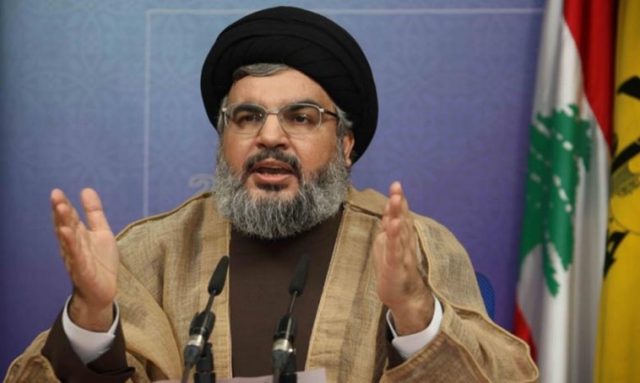
Nasrallah: US did what it could to help Daesh in Syria’s Bukamal
Press TV – November 20, 2017
The secretary general of the Lebanese Hezbollah resistance movement says despite the US claims about fighting terrorism, it spared no effort to help Daesh forces in the Syrian town of al-Bukamal.
Sayyed Hassan Nasrallah made the remarks in a televised address to the Lebanese nation in capital city of Beirut on Monday.
Nasrallah noted that recapturing Bukamal was a major victory over Daesh, because Bukamal was the last Syrian city occupied by Daesh.
“The US helped Daesh as much as it could in Bukamal short of directly engaging forces that fought to liberate the town from Daesh,” the Hezbollah leader noted.
Nasrallah went on to note that the US provided Daesh terrorists with full air cover in Bukamal.
The US sent its drones to Bukamal and provided Daesh with accurate information about what was going on, Nasrallah said, adding that American forces also waged electronic warfare against forces that were fighting to liberate Bukamal.
American forces also provided air transfer for Daesh commanders and facilitated their escape to eastern shores of the Euphrates, he said. The Hezbollah leader stated that even Turkey’s President Recep Tayyip Erdogan slammed the US for helping Daesh.
Nasrallah emphasized that recapturing Bukamal led to unity of Syria and ended Daesh’s self-proclaimed state in the country.
Following recent victories in Iraq and Syria, he added, the military structure of Daesh collapsed in the two countries and Iraqi forces have reached the Syrian border.
Hezbollah leader noted that the victory over Daesh was victory of Islamic values over terrorists’ savagery.
Nasrallah also highlighted the role played by Commander of the Islamic Revolution Guards Corps’ Quds Force Major General Qassem Soleimani in anti-terror operations in both Iraq and Syria.
He noted that Soleimani was commanding anti-Daesh operations in the two countries at the frontline and was never a commander to issue orders from behind the lines.
Elsewhere in his remarks, Nasrallah referred to the latest meeting of the Arab League foreign ministers in Cairo, who designated the Lebanese Hezbollah as a terrorist group, saying that this was not the first time that such accusations were leveled against Hezbollah.
Arab League Secretary General Ahmad Aboul Gheit announced at a press conference in the Egyptian capital of Cairo on Sunday that Arab states had agreed to designate Lebanon’s Hezbollah resistance movement a “terrorist organization.”
The Arab League’s extraordinary general meeting on Sunday was held at the request of Saudi Arabia, which has assumed an aggressive stance against Hezbollah for its alleged links to Iran, Riyadh’s powerful rival in the region. Riyadh associates Hezbollah with Iran and has been trying to weaken the resistance movement, which is Lebanon’s de facto deterrent force against Tel Aviv.
In its concluding resolution, the Arab League announced that Arab foreign ministers, excluding those of Lebanon and Iraq, would hold Hezbollah responsible for supporting “terrorist groups” across the region.
Nasrallah said the Arab League statement has labeled Hezbollah’s council, which is part of the Lebanon’s government, as a terrorist outfit, alleging that it provides missiles to terrorist groups in the region.
He added that accusations about Hezbollah sending missiles to regional countries were false and undocumented, emphasizing that the group has never sent any missiles or even light weapons to Kuwait, Yemen, Iraq or Bahrain or any other country in the region.
The leader of Hezbollah went on to say that the Arab League has warned Lebanon that if Hezbollah is not disarmed, security of the country would be in jeopardy.
Hezbollah rejected the accusation, noting that the main threat to security of Lebanon was the Zionist regime of Israel.
He added that the resistance front’s weapons were the main factor restoring security and stability to Lebanon, because they were used for defensive purposes in the face of the Israeli aggression.
Nasrallah emphasized that Hezbollah’s weapons were used only against terrorist groups such as Daesh and posed no threat to security of Lebanon.
A United Nations Security Council-appointed panel says it has seen no evidence to support Saudi Arabia’s claims that missiles have been transferred to Yemen’s Houthis by external sources.
Nasrallah stated that the main reason behind the recent Arab League meeting was not to discuss the issue of Palestine or other problems facing the Islamic world, but its main reason was the recent missile attack against a Saudi airport near the country’s capital, Riyadh.
Refusing Saudi Arabia and Arab League claims that the missile was provided to Yemeni Ansarullah fighters by Iran or the Lebanese Hezbollah, Nasrallah said Iran or Hezbollah had not sent any missiles to Yemen and Yemeni forces made their own missiles in the country.
He categorically rejected Arab League’s claims in this regard, noting that Saudi Arabia and its allies must admit that they have been defeated by Yemeni forces in their war of aggression against the country.
Nasrallah emphasized that Arab countries must put an immediate end to their support for terror groups, and do not fill the Middle East region with such outfits.
He reiterated that no member of Hezbollah was involved in the November 5 Yemeni missile strike against King Khalid International Airport of Riyadh.
The Hezbollah leader then took the Arab League to task for failing to address Saudi Arabia’s devastating aerial bombardment of the “Arab country of Yemen,” saying, “Saudi Arabia is bombing Yemeni people day and night.”
Strongly denouncing the Riyadh regime over perpetrating outrageous atrocities against millions of “Arab Muslims” in Yemen, Nasrallah lashed out at the Arab world’s “deafening silence” over the grim situation in Yemen.
“The turmoil we are witnessing in the Arab world is a cover for the announcement of normalization of relations with Israel,” he commented.
Nasrallah then called on Arabs to do their best to maintain their national unity in the face of all divisive efforts.
The Hezbollah secretary general also praised Lebanese officials and politicians for their firm stance regarding Prime Minister Saad Hariri’s shock resignation, calling on him to return to Lebanon as soon as possible.
Lebanon has right to resist, foil Israeli plans: Aoun

Lebanese President Michel Aoun
Press TV – November 20, 2017
Lebanese President Michel Aoun says his nation has the absolute “right to resist and foil” Israel’s aggressive plans by “all available means” as Tel Aviv continues “targeting” the Mediterranean country.
President Aoun made the remarks via his official Twitter account on Monday, a day after Arab League Secretary-General Ahmad Aboul Gheit announced at a press conference in the Egyptian capital of Cairo that Arab states had agreed to designate Lebanon’s Hezbollah resistance movement a “terrorist organization.”
Being a member of Lebanon’s coalition government, the popular Hezbollah movement, which currently holds 14 of the 128 seats at the parliament of Lebanon, has been a strong aid to the Lebanese army in thwarting any Israeli aggression against the country. Back in 2000, the resistance movement successfully forced Israel to withdraw from southern Lebanon.
Hezbollah is also playing a major role in fighting against foreign-backed Takfiri terrorist groups, which have been wreaking havoc in neighboring Syria for the last six years.
The Arab League’s extraordinary general meeting on Sunday was held at the request of Saudi Arabia, which has assumed an aggressive stance against Hezbollah for its alleged links to Iran, Riyadh’s powerful rival in the region. Riyadh associates Hezbollah with Iran and has been trying to weaken the resistance movement, which is Lebanon’s de facto deterrent force against Tel Aviv.
In its concluding resolution, the Arab League announced that Arab foreign ministers, excluding those of Lebanon and Iraq, would hold Hezbollah responsible for supporting “terrorist groups” across the region.
Furthermore, it also blamed the Lebanese government for aiding and supporting the resistance group, accusing Beirut of being an accomplice to what Hezbollah is doing.
However, in a separate tweet on Monday, Aoun strongly defended Hezbollah, saying he “cannot accept suggestions that Lebanon’s government is a partner in acts of terrorism.”
Foreign Minister Gebran Bassil says he refused to list Hezbollah as a terror group as it is a “fundamental component of the Lebanese state.”
The accusations leveled by Saudi-dominated Arab League against Hezbollah echoes exactly what Israel alleges against the resistance movement, strongly suggesting Riyadh is trying hard to help the Israeli entity by weakening Hezbollah.
The developments came some two weeks after Lebanese Prime Minister Saad Hariri announced his shock resignation in a televised address aired from the Saudi capital, shortly after he arrived there for a visit, repeating the same accusations against Hezbollah. After resigning, Hariri spent two more weeks in Saudi Arabia amid rumors he was under house arrest there, before traveling to Paris on Saturday.
After meeting with French President Emmanuel Macron, Hariri promised to be in Lebanon in time to mark its independence day on Wednesday. His awkward decision, however, has already plunged the country into political turmoil.
Meanwhile, the Arab League’s head said that Lebanon should be “spared” from spiraling regional tensions after arriving in Beirut to meet with Aoun.
“Arab countries understand and take into account the situation in Lebanon and want to spare it … from any dispute,” said Aboul Gheit.
Hamas slams Arab League for terrorist labeling of Hezbollah
Later on Monday, Palestinian Hamas movement slammed Arab League for labeling Lebanon’s Hezbollah as a terrorist organization.
A statement released by the Gaza-based Hamas said it “rejects the description of the Lebanese Hezbollah resistance movement as terrorist.”
The Palestinian movement added that instead of Hezbollah, Israel’s actions against Palestinians should be labeled “terrorism.”
Hamas also called on Arab states to “support the legitimate struggle of the Palestinian people,” urging them to work together to solve their differences through dialogue.
Here’s why Saudi Arabia, Israel and the US are not going to invade Iran
By Adam Garrie | The Duran | November 20, 2017
Members of the Arab League have met in Cairo at the behest of the Saudi regime, to discuss the supposed “threat of Iran”. The meeting featured all the crude, undiplomatic and nonfactual language about Iran that one has come to expect from American, Israeli and Saudi Arabian spokesmen.
Highlights from the meeting included a statement from the Saudi Foreign Minister Adel al-Jubeir who stated,
“We will not stand idly by in the face of Iran’s aggression….Showing leniency toward Iran will not leave any Arab capital safe from those ballistic missiles….
Iran created agents in the region, such as the Houthi and Hezbollah militias, in total disregard for all international principles”.
These meritless statements are almost identical to that which is frequently said by the US White House and Tel Aviv. In this sense, there was nothing novel about the meeting. What was remarkable was how hastily the meeting was organised as if to demonstrate Saudi’s commitment to its “clear and present danger” narrative about Iran.
Furthermore, a statement was released at the Arab League meeting, saying that there are no immediate plans to go to war with Iran but that at the same time, such plans have not been ruled out.
To quickly sum-up just how ridiculous the statements made during the Arab League meeting were
1. Iran’s missile programme is perfectly legal and is not covered by the JCPOA. The UN has said this many times.
2. Iran is currently at war with zero nations while Saudi is at war with Yemen causing one of the largest humanitarian disasters in the 21st century. Saudi Arabia has also been exposed as a major source of terrorist sponsorship, including in Iraq, Syria, Libya and beyond.
3. Iran has come to the legal assistance of Syria and Iraq in fighting terrorists groups including ISIS and al-Qaeda, while Saudi Arabia has known links to ISIS and al-Qaeda.
Of course, for the states with an obscene anti-Iranian agenda, none of this has ever mattered.
What does matter to the rest of the world though is whether the threats from the Arab league, indicated a short and/or medium-term readiness for war against Iran?
The short answer is, they almost certainly do not.
The Arab League today is a shadow of its former self. With the Syrian Arab Republic’s membership suspended, Qatar facing a boycott from proponent members, Iraq having better relations with Iran than most Arab states and Lebanon being deprived of its Prime Minister due to Saudi political meddling, the Arab League is hardly a united body of strong nations. It has declined so much so, that it is increasingly little more than a Saudi and GCC dominated organisation which is used in attempts to gain some form of broader international legitimacy for Riyadh’s often ridiculous foreign policy statements.
However, Riyadh’s ability to unite the Arab world over any matter, let alone an act of war, amounts to little. Syria, Iraq and due to its multi-confessional history, Lebanon, would never go to war against Iran. In fact, the Iraqi armed forces, Syrian Arab Army, Hezbollah and other volunteers from Lebanon would almost certainly fight with Iran, during the course of any Saudi led military action against Tehran.
Qatar, whose armed forces are small as it is, would never join any military ‘crusade’ led by its Saudi opponent and the fact remains that Doha’s slowly expanding relations with Iran have been one of the reasons for the Saudi led boycott of Qatar. Libya can no longer be called a functional state, while further into the Maghreb, Tunisia, Algeria and Morocco are far removed from Iran issue, in spite of their Arab league membership. Saudi’s GCC allies, Kuwait, UAE, Bahrain and to a lesser degree Oman, simply have little to offer in respect of any military coalition.
The biggest question mark which remains, is Egypt. Egypt is the largest country in the Arab world and likewise, boasts the biggest Army in the Arab world.
In order to even approach effectiveness, Egypt would have to join any would be anti-Iranian Arab League coalition. As to whether Egypt would join, one can objectively say that the incentives for not joining, far outweigh those that might compel Egypt to enter into a war pact with Saudi Arabia, against Iran.
Ever since secular rule was restored to Egypt in 2013, after US backed regime change against former President Hosni Mubarak briefly brought the once again illegal Muslim Brotherhood to power, Egypt has been in a position wherein promoting internal stability has been far more important than international outreach. Furthermore, while the Egyptian government is disproportionately dependent on Saudi cash injections in order to stay afloat, Cairo continues to show surprising amounts of foreign policy independence at times.
Egypt recently expressed disapproval of US attempts to extend a UN mandate for investigating “chemical weapons” in Syria. Egypt has further made strong statements in favour of Syria’s territorial unity, backed up by remarks that only a political solution can bring peace to Syria. This language is very similar to that used by Russian diplomats which should come as no surprise, as the foreign ministries of Egypt and Russia have a very good relationship. Furthermore, when it comes to Egypt’s most pressing international issue, that of terrorists in neighbouring Libya, Russia appears far more inclined to support the Cairo backed Libyan National Army than the fledgling Government of National Accord which is supported by the US and EU.
Furthermore, Egypt recently rejected calls from Riyadh to economically sanction the Lebanese party Hezbollah, in a move which shows a clear divergence from Saudi policies on Hezbollah.
While Egypt is compromised by its financial ties to Saudi Arabia, Egypt still seeks to balance out its old Arab Nationalist history as a fiercely independent and anti-imperialist nation with the modern realities of being far less influential than in the days of Nasser and the early days of Sadat.
Furthermore, in spite of its formal diplomatic ties with Israel, Cairo is all too aware that if the situation inside Egypt, especially in respect of the Sinai Peninsula were to become destabilised, Egypt could not afford to have its armed forces in distant Iran. This is especially true as Israel is ready to exploit any instability on Sinai to its own advantage. If anyone thinks that Israel somehow respects Egypt just because diplomatic relations were established, this view is, to put it mildly, delusional. Israel will exploit any country and any situation it can and Egypt is no exception. The same is true of Jordan, the only other country which has formal relations with Tel Aviv. Jordan, like Egypt is far more concerned with its own immediate neighbourhood than with Iran.
In this sense, in spite of whatever financial incentives Saudi might offer Egypt for backing military efforts against Iran, the preponderance of evidence would demonstrate that Egypt would refrain from actively participating.
When asked to consider the position of the Vatican in geo-political affairs, Josef Stalin is thought to have said, “The Pope? How many divisions has he got?”.
In this sense, looking at the disunity in the Arab world, Iran could easily turn to Riyadh and say “how many divisions have you got”? The answer is not enough to seriously challenge Iran, while Iran certainly has enough divisions and enough regional allies to challenge and beat Saudi Arabia and its Persian Gulf allies.
Then there is the matter of Israel, the US and Turkey.
When it comes to antagonising regional powers that Tel Aviv doesn’t like, the Israeli regime’s military is all too happy to conduct strikes and even occupy territory. Israel occupied party of Egypt between 1967 and 1982 and part of Lebanon between 1982 and 2006. Israel continues to occupy Syria and military strikes from Israel against Syria have happened on and off for the last several decades.
Likewise, Israel attacked Iraq in 1981 in a short airstrike against a French built Iraqi nuclear reactor.
All of these actions have been illegal and Tel Aviv simply doesn’t care. Why should they care about Iran in this case? The answer is because Iran today is far more powerful than any of the aforementioned countries that Israel attacked and it also has many regional allies stretching from Iran itself to the borders of Israeli regime controlled territory.
Israel has not attacked Iran in the way it has so frivolously attacked parts of the Arab world. Israel has not done this because Tel Aviv knows Iran would strike back and so too would Iran’s allies in southern Lebanon. Furthermore, with Turkey becoming ever more distant with NATO, the west and Israel, all the while growing ever closer to its Eurasian partners, including neighbouring Iran, there is no guarantee that Turkey would remain neutral in such a conflict.
Turkey does not want any instability on its border with Iran. This is one of the reasons that both countries cooperated in the building of an anti-terrorist rampart on their borders. Turkey knows that any further regional instability would only hurt Turkey’s short term security prospects and its long term financial prospects. If Turkey even gave air support to Iran, the entire conflict would be ‘game over’ for the anti-Iranian powers, unless Israel decided to use its nuclear weapons.
As Hezbollah leader Sayyed Hassan Nasrallah recently stated, Israel prefers short blitzkrieg style conflicts that it can win rapidly at little material cost or bloodshed from its own side. History has shown such an analysis to be absolutely correct. Furthermore, as Israel’s last attempt to conduct such a war against Lebanon in 2006 failed, Israel has reverted to measures which from its perspective are more realistically “productive” such as short, illegal airstrikes against Syria and military manoeuvres intended as provocations against Lebanon.
Any war with Iran would be much more difficult for Israel to conduct. In many ways it would be impossible, short of Tel Aviv using its nuclear weapons in what Israel watchers know to be called the “Samson Option”.
Such extreme measures would likely be opposed even by the United States. While the Trump administration continues to turn up the volume on anti-Iranian rhetoric, many more level headed individuals in the Pentagon and State Department are totally opposed to war on Iran. These people know that the cost of such a war would be incredibly high and that the US might ultimately lose.
In this sense, with Israel too afraid to attack Iran and while still too restrained by the US to go nuclear, with the Pentagon generally opposed to direct military action against Iran and with Saudi Arabia incapable of pulling together a genuine Arab coalition capable of fighting against Iran, there is little chance that any nation short of one on a suicide mission, would attempt to declare war on Iran.
Much like any war on North Korea, a war on Iran would bring unparalleled destruction to the entire region, and no invading party’s victory would be assured. In other-words, Iran has more or less checkmated the situation, largely in its favour and all without firing a shot, while if anything gaining rather than losing allies.
The Arab League, Israel and the US can certainly blow smoke, but when it comes to attacking Iran directly, even these countries are not quite foolish enough to start that fire.
Lebanon, Palestinian groups rap Arab League for labeling Hezbollah
Press TV – November 20, 2017
The Lebanese government and Palestinian resistance forces have strongly condemned a decision by the Arab League to designate the Hezbollah resistance movement as a terrorist organization.
Lebanon’s Foreign Minister Gebran Bassil said in a statement that he had refused to list Hezbollah as a terror group as it was a “fundamental component of the Lebanese state.”
Arab League Secretary-General Ahmad Aboul Gheit announced at a media conference in Cairo on Sunday that Arab states agreed to designate Hezbollah a terrorist organization, adding that he would not “rule out going to the United Nations Security Council as a next step.”
Lebanon’s representative to the Arab League, Antoine Azzam, rejected the statement, saying Hezbollah represents a large part of the Lebanese people. He said the resistance group has representatives in the Lebanese parliament.
Lebanon abstained from Sunday’s communiqué that labeled Hezbollah as a terror group. Iraq also expressed reservations about the designation.
The details of the resolution were not made public. However, media reports said the only concrete measure from the meeting was for Arab telecommunications satellites to ban Iranian-financed stations for allegedly posing a threat to Arab security.
Palestinian resistance groups also denounced the Arab League’s decision, saying it serves the interests of Israel and the US and aims to satisfy the Saudi regime.
The alliance of the Palestinian resistance forces described the decision as “dangerous”, stressing that “Hezbollah represents the most important resistance force against Israel and terrorism.”
The decision was issued during an emergency Arab League summit, which Saudi Arabia called to discuss “confronting” Iran and Hezbollah.
Riyadh associates Hezbollah with Iran, and has been trying to weaken the resistance movement which is Lebanon’s de facto deterrent force against any Israeli aggression.
Hezbollah, both a military force and a political movement, is part of a Lebanese government made up of rival factions.
The Saudi request for the Arab League meeting “was based on a missile it says its air defenses intercepted near Riyadh after being fired from Yemen on November 4,” according to a document seen by AFP last week.
Saudi Arabia has claimed that the missile had been manufactured in Iran but Tehran has vehemently rejected the allegation.
After PLO halts ties with US, Arab League steps in to salvage peace process
Ma’an – November 20, 2017
BETHLEHEM – The Arab League has reportedly approached the United States government regarding its recent decision to punitively shut down the office of the Palestine Liberation Organization (PLO) in Washington D.C, over the Palestinian leadership’s efforts to bring Israel before the International Criminal Court (ICC).
Official Palestinian Authority (PA)-owned Wafa news agency reported on Sunday, shortly after the US State Department announced its decision, that the Arab League — a regional organization of 22 Arab countries — announced that its Secretary General Ahmed Aboul Gheit approached the US President Donald Trump’s administration over the closure.
The league is reportedly attempting to do damage control and resume US-led peace negotiations following the PLO’s reaction to the closure, in which the group’s secretary general, Saeb Erekat, threatened to “put on hold all our communications with this American administration” if the US did in fact close the PLO Washington office.
According to Wafa, Aboul Gheit met with the league’s foreign minister, Riyad al-Maliki, where the two discussed the the official position of the PLO and the PA, “saying it will harm the peace process and the role of the US as peace broker.”
The PLO announced in September its decision to submit a request to the ICC to investigate illegal Israeli settlement activity in the occupied West Bank and East Jerusalem.
Separately, four Palestinian human rights organizations submitted a 700-page communication to the ICC alleging that Israeli officials have committed war crimes and crimes against humanity in the West Bank, including East Jerusalem.
International media reported that the PLO’s plans would breach conditions previously imposed by US Congress on the PLO, preventing it from taking any cases to the ICC.
The PLO office could allegedly be reopened 90 days after closure if Trump believes the PLO has entered into “direct, meaningful negotiations with Israel.”
The events came amid weeks of speculation in Israeli and Palestinian media over the Trump administrations “ultimate peace plan” for the region, which is set to be presented soon.
Israeli news daily Haaretz quoted Palestinian President Mahmoud Abbas’ spokesperson Nabil Abu Rudeina as calling the US move to shut down the PLO office as “a dangerous threat… that leads (to the conclusion that (the United States is losing its position as a negotiator” and that it was “withdrawing from its role as a sponsor of the diplomatic process for peace as promised by President Trump.”
While Trump has maintained on many occasions that, under his auspices, the decades-long Palestinian-Israeli conflict will be solved, his administration has painted a rather unclear picture regarding Trump’s plans in the region, while a number of high-profile US officials are known to be staunch supporters of Israel.
In February, Trump said that when it came to a solution for the decades-long conflict he could “live with either” a one- or two-state solution, in a significant departure from the US’ publicly held position in favor of a two-state solution to the conflict.
However, his elusiveness has not belied the fact that Trump and his administration have maintained their pro-Israel stance, despite stated efforts to renew the Israeli-Palestinian peace process, which he said in the past was “not as difficult as people have thought over the years.”
Remembering Ishaq Maragha: Martyr of the battle of empty stomachs
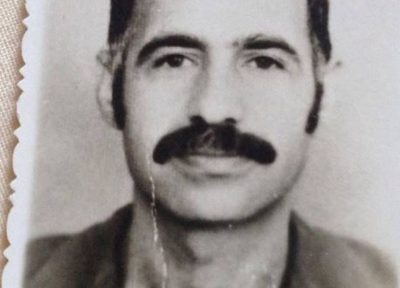
Ishaq Maragha
Samidoun Palestinian Prisoner Solidarity Network – November 19, 2107
16 November 2017 marks the 34th anniversary of the death of Palestinian prisoner Ishaq Maragha, one of four Palestinians whose lives were taken – three through forced-feeding – during a hunger strike for justice inside Israeli prisons. Maragha, who died in 1983, three years after he was grievously wounded by Israeli forced feeding, was not only a martyr but a longtime leader of the Palestinian prisoners’ movement and the Palestinian liberation struggle.
Along with Ali al-Jaafari and Rasim Halawa, he was martyred by Israeli force feeding aimed at breaking the hunger strike of Nafha prison in 1980. Fellow prisoner Anis al-Dawla also lost his life in 1980 from fatigue, malnutrition and disease caused by his solidarity strike in Ashkelon prison in support of the prisoners of Nafha.
Born in the town of Silwan near Jerusalem in 1942, he became a member of the Arab Nationalist Movement – the movement founded by George Habash, Wadie Haddad and other Arab and Palestinian young people looking towards liberation, unity and socialism – and was considered one of the first members of the movement in Palestine, joining in 1959 at the age of 17. He had four children, Jamal, Amal, Amina and Musa.
As a member of the ANM, he traveled to Egypt for military training in 1964. He joined the ranks of the Popular Front for the Liberation of Palestine from the very beginning of its foundation on December 11, 1967 from the Palestine Section of the ANM. Shortly over one year later, in February 1969, he was arrested by Israeli occupation forces on charges of being a leader in the PFLP in the Jerusalem area. After three years in Israeli prison including a period of intense torture under occupation, he was released from prison in August 1972.
As Abdel-Nasser Ferwana, Palestinian researcher on prisoners’ affairs notes, this was only a “fighter’s rest” for Maragha. In February 1975 he was once again seized by occupation forces and accused of participating in the resistance to occupation; he was sentenced to 20 years imprisonment.
Ferwana recalled meeting Maragha several times while visiting his imprisoned father, who would laer be released in the 1985 prisoner exchange with the Palestinian resistance. Maragha said to him as a young man, “The prisons will be destroyed and your father and I will be liberated.”
During his time in prison, he was transferred to Ramle, Beersheba and Nafha prisons; he was well-known among the prisoners as an example of a dedicated worker and a revolutionary leader. Ferwana caled him a “distinguished leader, loved by everyone, a brilliant instigator and a dedicated fighter…one of the pillars of the prisoners’ movement.” He became one of the leaders of the prison organization of the PFLP, responsible for international relations.
In 1980, Nafha prison was opened as an “exile and cemetery for the prisoners’ movement leaders;” Maragha was one of the first to be transferred there. The prisoners began their strike that year, on 14 July 1980. One of the hunger strikers, Abdel-Rahim al-Noubani, chronicled the development of the strike.
The prisoners demanded:
1. The prisoners demand the installation of beds
2. The prisoners demand access to a radio and television
3. The prisoners demand the improvement of the quality and quantity of food
4. The prisoners demand access to Arabic and Hebrew books and newspapers
5. The prisoners demand the expansion of windows, allowing more sun and air into the cell
6. The prisoners demand an end to the policy of collective and individual punishment, solitary confinement, depriving them food during their isolation, and only providing them with bread and water.
7. The prisoners demand the visiting allowance to be prolonged to one hour every two weeks
8. The prisoners demand access to winter and summer clothes, as well as blankets
9. The prisoners demand permission to buy food and vitamins from the prison canteen, which has been hitherto denied
10. The prisoners demand their walk allowance extend from 15 minutes to an hour
As Shahd Abusalama wrote chronicling her own father’s history in the Nafha strike, “Whenever Palestinian prisoners have gone on hunger strike, the Israeli authorities have responded by punishing them collectively. The Nafha hunger strike was no exception.”
After 10 days of hunger strike which drew growing international and Palestinian support, the Israeli occupation attempted a particularly cruel and dangerous form of force-feeding against 26 prisoners in which boiling water and salt were poured down tubes forced down the prisoners’ throats. In the case of Ishaq Maragha, Rasem Halawi and Ali al-Jaafari, the tube was not fully inserted and instead entered their lungs; the boiling water poured into the tube burned and destroyed their lungs. Halawi and Jaafari died almost immediately, killed by Israeli force feeding on their hunger strike.

Ishaq Maragha, Ali al-Jaafari, Rasem Halawa
Maragha later related the experience to al-Noubani:
“When we were put in the waiting room, the three of us collapsed onto a wooden bench, overcome with extreme exhaustion and fatigue. The pain was ripping our chest and gut apart. But it seemed that Ali Jaafari was the suffering the most; he grabbed the bars of the iron door, his drained voice shouting out to the section’s jailer and clinic doctor alternately, asking them to provide us with emergency assistance and treatment. He then turned to me suddenly and said, ‘Abu Jamal, I’m dying, I’m dying!’ I tried to calm him and raise his spirits, and boost his strength – for I had noticed something in him that I myself did not feel, despite the fact that we had both gone through the same torment.
Ali al-Jaafari started shouting again, ‘Abu Jamal, my legs have died, I can no longer feel them, they’re as cold as ice.’ I was helpless, and could do nothing but say to him, ‘Don’t be afraid, Ali, here comes the doctor, don’t worry.’ He suddenly shouted again, for the third and last time: ‘My arms have died, Abu Jamal.’ I was as drained as he was, and as he said this to me, my eyes filled with tears; I saw his last gasp escape from his deteriorated lung to his broken nose by the zonda hose; canals filled with blood and pain opened up inside him. His head was slightly bent over to his right shoulder and his cold hands were still holding onto the bar of that damned iron door. His gracious self slid away, and his pure soul left his body, and all the while he stood there, like a palm tree that had lasted a hundred years drying out. We rested the body of our martyr on the ground, shaking with sobs. In that moment, Rasem and I forgot we shared the same fate as he.”
Maragha also reported that the prison doctor swore that he would not let him die, not out of concern for his life, but because “I will not let them make you a national hero.”
The strike continued after the martyrdom of al-Jaafari and Halawa; Maragha became a key spokesperson for the strike to lawyers and before the world. After 33 days, the prisoners’ ended their strike with a victory in all of their demands.
Maragha was then transferred to Beersheba prison as his health deteriorated further and without the provision of any treatment until he died on 16 November 1983 of his ongoing injuries and wounds caused by his torture under forced feeding during the Nafha strike, leaving a legacy of struggle, sacrifice and commitment above all to the liberation of Palestine, his land and his people.
Ishaq Maragha was a beloved leader of the Palestinian prisoners’ movement and a symbol of the leading role of Palestinian prisoners in the struggle for the liberation of Palestine, whose bodies and lives are on the line on a daily basis in a direct confrontation with occupation. The hunger strikes of Palestinian prisoners are a collective means of struggle and immense self-sacrifice for dignity and freedom.
On the 34th anniversary of the passing of Ishaq Maragha, Samidoun Palestinian Prisoner Solidarity Network remembers him, Ali al-Jaafari, Rasim Halawa and the long legacy of the martyrs of the prisoners’ struggle – and their commitment to Palestinian and global liberation. Their deepest and most precious sacrifice must urge all of us around the world who stand with Palestinian rights, freedom and liberation to intensify and escalate our work for the freedom of the imprisoned leaders of the Palestinian people today. As plans for regional warfare and a so-called “deal of the century” promulgated by the United States and Israel with the backing of Saudi Arabia and reactionary forces threaten the Palestinian people, the people of the region and the world, the legacy of Ishaq Maragha and his fellow Palestinian prisoners can and must inspire us all to struggle at this critical moment to defend the Palestinian cause and struggle to achieve their goals of return and liberation.
Zionism’s Violent Legacy
By Donald Neff | Washington Report On Middle East Affairs | January 1996
On January 4, 1948, Jewish terrorists drove a truck loaded with explosives into the center of the all Arab city of Jaffa and detonated it, killing 26 and wounding around 100 Palestinian men, women and children.[1] The attack was the work of the Irgun Zvai Leumi – the “National Military Organization,” also known by the Hebrew letters Etzel – the largest Jewish terrorist group in Palestine. The Irgun was headed by Revisionist Zionist Menachem Begin and had been killing and maiming Arabs, Britons and even Jews for the previous ten years in its efforts to establish a Jewish state.
This terror campaign meant that at the core of Revisionist Zionism there existed a philosophical embrace of violence. It was this legacy of violence that contributed to the assassination of Israeli Prime Minister Yitzhak Rabin on November 4, 1995.
The Irgun was not the only Jewish terrorist group but it was the most active in causing indiscriminate terror in pre-Israel Palestine. Up to the time of the Jaffa attack, its most spectacular feat had been the July 22, 1946, blowing up of the King David Hotel in Jerusalem, with the killing of 91 people – 41 Arabs, 28 Britons and 17 Jews.[2]
The other major Jewish terrorist group operating in Palestine in the 1940s was the Lohamei Herut Israel – “Fighters for the Freedom of Israel,” Lehi in the Hebrew acronym – also known as the Stern Gang after its fanatical founder Avraham Stern. Two of its more spectacular outrages included the assassination of British Colonial Secretary Lord Moyne in Cairo on November 6, 1944, and the assassination of Count Folke Bernadotte of Sweden in Jerusalem on September 17, 1948.[3]
Both groups collaborated in the massacre at Deir Yassin, in which some 254 Palestinian men, women and children were slain on April 9, 1948. Palestinian survivors were driven like ancient slaves through the streets of Jerusalem by the celebrating terrorists.[4]
Yitzhak Shamir was one of the three leaders of Lehi who made the decision to assassinate Moyne and Bernadotte. Both he and Begin later became prime ministers and ruled Israel for a total of 13 years between 1977 and 1992. They were both leaders of Revisionist Zionism, that messianic group of ultranationalists founded by Vladimir Zeev Jabotinsky in the 1920s. He prophesied that it would take an “iron wall of Jewish bayonets” to gain a homeland among the Arabs in Palestine.[5] His followers took his slogan literally.
Begin and the Revisionists were heartily hated by the mainline Zionists led by David Ben-Gurion. He routinely referred to Begin as a Nazi and compared him to Hitler. In a famous letter to The New York Times in 1948, Albert Einstein called the Irgun “a terrorist, rightwing, chauvinist organization” that stood for “ultranationalism, religious mysticism and racial superiority.”[6] He opposed Begin’s visit to the United States in 1949 because Begin and his movement amounted to “a Fascist party for whom terrorism (against Jews, Arabs, and British alike), and misrepresentation are means, and a ‘leader state’ is the goal,” adding:
The IZL [Irgun] and Stern groups inaugurated a reign of terror in the Palestine Jewish community. Teachers were beaten up for speaking against them, adults were shot for not letting their children join them. By gangster methods, beatings, window smashing, and widespread robberies, the terrorists intimidated the population and exacted a heavy tribute.
Ben-Gurion considered the Revisionists so threatening that shortly after he proclaimed establishment of Israel on May 14, 1948, he demanded that the Jewish terrorist organizations disband. In defiance, Begin sought to import a huge shipment of weapons aboard a ship named Altalena, Jabotinsky’s nom de plume.[7]
The ship was a war surplus US tank landing craft and had been donated to the Irgun by Hillel Kook’s Hebrew Committee for National Liberation, an American organization made up of Jewish-American supporters of the Irgun.[8] Even in those days it was Jewish Americans who were the main source of funds for Zionism. While few of them emigrated to Israel, Jewish Americans were generous in financing the Zionist enterprise. As in Israel, they were split between mainstream Zionism and Revisionism. One of the best known Revisionists was Ben Hecht, the American newsman and playwright. After one of the Irgun’s terrorist acts, he wrote:[9]
The Jews of America are for you. You are their champions … Every time you blow up a British arsenal, or wreck a British jail, or send a British railroad train sky high, or rob a British bank, or let go with your guns and bombs at British betrayers and invaders of your homeland, the Jews of America make a little holiday in their hearts.
The Altalena was loaded with $5 million worth of arms, including 5,000 British Lee Enfield rifles, more than three million rounds of ammunition, 250 Bren guns, 250 Sten guns, 150 German Spandau machine guns, 50 mortars and 5,000 shells as well as 940 Jewish volunteers. Ben-Gurion reacted with fury, ordering the ship sunk in Tel Aviv harbor. Shell fire by the new nation’s armed forces set the Altalena afire, killing 14 Jews and wounding 69. Two regular army men were killed and six wounded during the fighting.[10] Begin had been aboard but escaped injury. Later that night he railed against Ben-Gurion as “a crazy dictator” and the cabinet as “a government of criminal tyrants, traitors and fratricides.”[11]
Ben-Gurion’s deputy commander in the Altalena affair was Yitzhak Rabin, the same man who as prime minister was assassinated by one of the spiritual heirs of Menachem Begin’s Irgun terrorist group. All his life, and especially in his last years, Rabin had opposed Jewish-Americans and their radical allies in Israel who continued to embrace the philosophy of the Irgun and who fought against the peace process, thereby earning their enduring hatred.
Thus at the heart of the Jewish state there has been a long and violent struggle between mainline Zionists and Revisionists that continues today. Despite cries after Rabin’s assassination that it was unknown for Jew to kill Jew, intramural hatred and occasional violence have marked relations between Zionism’s competing groups.
The core of that conflict, one that continues to divide Israel and its American supporters as well, lies in the different philosophies of David Ben-Gurion and Vladimir Jabotinsky. Both were from Eastern Europe, born in the 1880s, and both sought an exclusivist Jewish state. But while Ben-Gurion was pragmatic and secular, Jabotinsky was impatient and messianic, a leader who glorified in the heroic trappings of fascism. Ben-Gurion was usually willing to take less now to get more later, and thus he was content to accept partition of Palestine as a necessary stepping stone toward a larger Jewish state. Jabotinsky, on the other hand, impatiently preached the right of Jews not only to all of Palestine but to “both sides of the Jordan,” meaning the combined area of Jordan and Palestine, or as he called it, Eretz Yisrael, the ancient land of Israel.[12]
Ben-Gurion was a gruff realist who carefully calculated his moves with a wary eye toward the interests of the great European powers and the United States. Time magazine, in a profile of Ben-Gurion in August 1948, described him as “premier and defense minister, labor leader and philosopher, hardheaded, unsociable and abrupt politician, a prophet who carries a gun.[13] Wrote his biographer, Michael Bar-Zohar: “Obstinacy and total dedication to a single objective were the most characteristic traits of David Ben-Gurion.”[14]
Jabotinsky, by contrast, was flamboyant and a devoted admirer of Italy’s fascist leader Benito Mussolini. His disciple, Menachem Begin, described him as “a speaker, a writer, a philosopher, a statesman, a soldier, a linguist … But to those of us who were his pupils, he was not only their teacher, but also the bearer of their hope.” Begin’s biographer, Eric Silver, added: “There was a darker side to [Jabotinsky’s] philosophy: blood, fire and steel, the supremacy of the leader, discipline and ceremony, the manipulation of the masses, racial exclusivity as the heart of the nation.[15] One of Jabotinsky’s slogans was: “We shall create, with sweat and blood, a race of men, strong, brave and cruel.”[16]
Jabotinsky died in 1940, and it was Menachem Begin who refined his wild nationalism into practical political action. Begin concluded: “The world does not pity the slaughtered. It only respects those who fight.” He turned Descartes’ famous dictum around, saying: “We fight, therefore we exist.”[17] Central to Begin’s outlook was the concept of the “fighting Jew.” As he wrote:[18]
Out of blood and fire and tears and ashes, a new specimen of human being was born, a specimen completely unknown to the world for over 1,800 years, the “FIGHTING JEW.” It is axiomatic that those who fight have to hate …. We had to hate first and foremost, the horrifying, age-old, inexcusable utter defenselessness of our Jewish people, wandering through millennia, through a cruel world, to the majority of whose inhabitants the defenselessness of the Jews was a standing invitation to massacre them.
From these early leaders of Zionism (Ben-Gurion died in 1973 and Begin in 1992) have emerged their direct descendants in the Israeli political spectrum. Rabin and his successor, Shimon Peres, were both protégés of Ben-Gurion, and have carried on his mainstream secular Zionism. On Jabotinsky’s and Begin’s side, the followers have been Yitzhak Shamir, Ariel Sharon and, now, Benjamin Netanyahu, the current leader of the Likud.
Rabin’s Strategy
While the two major factions of Zionism disagree on tactics, their ultimate aim of maintaining a Jewish state free of non-Jews was the same. Rabin explained his strategy shortly before his death during an interview with Rowland Evans and Robert Novak:[19]
I believe that dreams of Jews for two thousand years to return to Zion were to build a Jewish state and not a binational state. Therefore I don’t want to annex the 2.2 million Palestinians who are a different entity from us – politically, religiously, nationally – against their will to become Israelis. Therefore I see peaceful coexistence between Israel as a Jewish state – not all over the land of Israel, on most of it, its capital the united Jerusalem, its security border the Jordan River – next to it a Palestinian entity, less than a state, that runs the life of the Palestinians. It is not ruled by Israel. It is ruled by the Palestinians. This is my goal not to return to the pre-Six-Day-War lines, but to create two entities. I want a separation between Israel and the Palestinians who reside in the West Bank and the Gaza Strip, and they will be a different entity that rules itself.
In the Revisionist’s vocabulary, the goal was the same, if more expansionist and expressed in more direct and pugnacious words. Former Defense Minister Ariel Sharon, a leading spokesman of Zionism’s right wing, commented in 1993: “Our forefathers did not come here in order to build a democracy but to build a Jewish state.”[20]
The occupation of all of Palestine, including Jerusalem, in the 1967 war and the coming to power a decade later of Menachem Begin gave a profound boost to Revisionism and its radical philosophy. During this period there arose the firebrand Meir Kahane, a Brooklyn-born rabbi who openly espoused the removal of the Palestinians from all of Palestine. Under the influence of his fiery rhetoric, thousands of Orthodox Jewish Americans were encouraged to emigrate to Israel as settlers on occupied Palestinian land, adding to the radicalization of Israeli politics. After Kahane’s assassination in New York in 1990 by an Arab, New York Times correspondent John Kifner reported that Kahane had been successful in the sense that many of his ideas “had crept into the mainstream” in Israel.
Dr. Ehud Sprinzak, an Israeli expert on the far right in Israel, observed: “Where [Kahane] has succeeded is in changing the thinking of many Israelis toward anti-Arab feelings and violence. He forced the more respectable parties to change. In the 1970s Kahane was in the political wilderness, but in the 1980s the center had moved toward Kahane.” Observed the Jewish Telegraph Agency : “Rabbi Kahane could die satisfied that his message has impacted deeply and widely throughout Israeli society.”[21]
By the mid-1990s, even Kahane’s violent ideas seemed somewhat mild in the context of the radicalized politics of Israel. A new strain of religious extremism has been added to the Revisionist ranks. This became obvious on February 25, 1994, when Brooklyn-born Dr. Baruch Goldstein, a Kahane disciple, walked into the Ibrahim mosque, called the Cave of Machpela by Jews, in Hebron and killed 29 and wounded upwards of 150 Palestinian worshippers.[22] While Rabin and labor Zionists condemned him, Goldstein became a hero for Revisionist Zionists. A shrine was made of his grave and a group of Revisionists grew up called “Goldsteiners.” They are dedicated to the “sublime ideals of Goldstein” and urge “all true Jews to follow his footsteps.”[23]

Baruch Goldstein wore a yellow Star of David with the German word for “Jew” to show his ardent concern for the “lessons of the Holocaust” and its meaning for all Jews. Today many hardline Zionists revere this mass murderer of Palestinians as a Jewish hero and martyr.
While the Revisionists had always had an element of religious messianism, the most radical of their current heirs come from ultrareligious Orthodox Jews who are less consumed by politics than religion.[24] They believe they are God’s messengers. Thus Rabin’s assassin, Yigal Amir, cited the authority of God to explain the murder.
This is a sea change in the mindset – if not the violence – of the traditional Revisionists. For instance, in 1943 Yitzhak Shamir ordered the assassination of one of his closest Sternist friends, but offered an entirely different rationale that had nothing to do with God. Mainly the motive stemmed from political and tactical reasons. Shamir wrote in his memoirs, In the Final Analysis, that Stern commander Eliyahu Giladi had become “strange and wild” and had wanted to shoot at crowds of Jews and urged the assassination of David Ben-Gurion, acts that would have been highly unpopular. Wrote Shamir: “I was afraid that he had gone completely crazy. I knew that I had to take a fateful decision, and I didn’t evade it.”[25] Giladi was fatally shot in the back on a beach south of Tel Aviv and his killer was never found.[26]
The new Revisionists have now expanded the right to kill claimed by the early Revisionists in the name of nationalism to include a divine right. In the end, they are less interested in foreign and domestic affairs than in justifying man’s acts to God. It is a powerful and inflammatory mix of nationalism and religion that is almost certain to lead to more violence unless Israel is able to look into its own soul.
Recommended Reading
- Bar-Zohar, Michael, Ben-Gurion: A Biography, New York: Delacorte, 1978. Begin, Menachem, The Revolt, Los Angeles: Nash, 1972. Bell, J. Bowyer, ‘/error Out of Zion, New York: St. Martin’s, 1977. Ben-Gurion, David, Israel: A Personal History, New York: Funk & Wagnalls, Inc., 1971.
- Bethell, Nicholas, The Palestine Triangle: The Struggle for the Holy Land, 1935-48, New York: G.P. Putnam’s Sons, 1979.
- Brenner, Lenni, Zionism in the Age of the Dictators, Westport, Conn.: Lawrence Hill, 1983.
- Brenner, Lenni, The Iron Wall: Zionist Revisionism from Jabotinsky to Shamir, London: Zed Books, 1984.
- Halsell, Grace, Prophesy and Politics: Militant Evangelists on the Road to Nuclear War, Westport, Conn.: Lawrence Hill, 1986.
- Khalidi, Walid (ed.), Before Their Diaspora: A Photographic History of the Palestinians 1876-1948, Washington, DC: Institute for Palestine Studies, 1984.
- Khalidi, Walid, From Haven to Conquest: Readings in Zionism and the Palestine Problem until 1948, Washington, DC: Institute for Palestine Studies, second printing, 1987.
- Marion, Kati, A Death in Jerusalem, New York: Pantheon, 1994.
- Nakhleh, Issa, Encyclopedia of the Palestine Problem (2 vols.), New York: Intercontinental, 1991.
- Palumbo, Michael, The Palestinian Catastrophe: The 1948 Expulsion of a People from their Homeland, Boston: Faber and Faber, 1987.
- Rubinstein, Ammon, The Zionist Dream Revisited, New York: Schocken, 1984.
- Sachar, Howard M., A History of Israel: From the Rise of Zionism to Our Time, Tel Aviv: Steimatzky’s Agency, 1976.
- Silver, Eric, Begin: The Haunted Prophet, New York: Random House, 1984.
- Tillman, Seth, The United States in the Middle East: Interests and Obstacles, Bloomington: Indiana Univ. Press, 1982.
Notes
[1] Sam Pope Brewer, New York Times, Jan. 5, 1948, and Khalidi, Before Their Diaspora, p. 316. Also see Palumbo, The Palestinian Catastrophe, pp. 83-4. Initial reports put the death toll at 34.
[2] Bethell, The Palestine Triangle, p. 263; Sachar, A History of Israel, p. 267. Details on the bombing and reaction of British officials are in Nakhleh, Encyclopedia of the Palestine Problem, pp. 269-70.
[3] Bethell, Palestine Triangle, pp. 181-87, 263; Sachar, A History of Israel, p. 267; Marion, A Death in Jerusalem, p. 208.
[4] Khalidi, From Haven to Conquest, pp. 761-78; Silver, Begin, pp. 88-96; Nakhleh, Encyclopedia of the Palestine Problem, pp. 271-72.
[5] Silver, Begin, p. 12.
[6] New York Times, Nov. 27, 1948.
[7] Bar-Zohar, Ben-Gurion, p. 175.
[8] Silver, Begin, p. 98.
[9] Bethell, The Palestine Triangle, pp. 308-9. An interview reflecting Hecht’s views appeared in The New York Times, May 28, 1947.
[10] Silver, Begin, p. 108.
[11] Silver, Begin, p. 108.
[12] In Hebrew, Eretz Yisrael means the “Land of Israel,” a phrase invested with strong nationalist feelings.
[13] Time, August 16, 1948.
[14] Bar-Zohar, Ben Gurian, pp. 77, xvii.
[15] Silver, Begin, p. 11.
[16] Elfi Pallis, “The Likud Party: A Primer,” Journal of Palestine Studies, Winter 1992, p. 45.
[17] Begin, The Revolt, pp. 36, 46. Also see Tillman, The United States in the Middle East, p. 20.
[18] Begin, The Revolt, pp. xi-xii. Also see Elfi Pallis, “The Likud Party: A Primer,” Journal of Palestine Studies, Winter 1992, p. 45.
[19] Evans and Novak, CNN, Oct. 1, 1995.
[20] Menachem Shalev, Forward, May 21, 1339.
[21] John Kifner, New York Times, Nov. 11, 1990.
[22] David Hoffman, Washington Post, Feb. 28, 1994.
[23] Khalid M. Amayreh, “Six Months On,” Middle East International, Sept. 9, 1994.
[24] Halsell, Prophecy and Politics, p. 75, provides an excellent analysis of the extremist beliefs of Jabotinsky and his followers and their alliance with American fundamentalist Christians such as Jerry Falwell, leader of the Moral Ml\iority.
[25] Clyde Haberman, New York Times, Jan. 15, 1994.
[26] Glenn Frankel, Washington Post, Nov. 6, 1995.
From The Journal of Historical Review, Jan.-Feb. 1996 (Vol. 16, No. 1), pages 42-45. This item is reprinted from the January 1996 issue of The Washington Report on Middle East Affairs (Washington, DC).
About the Author
Donald Neff is an American journalist and author. For 16 years he worked for Time magazine, including a period as its Bureau Chief in Israel. He also worked for the Washington Star daily newspaper. He is the author of Fallen Pillars: U.S. Policy Towards Palestine and Israel Since 1945 (1995), as well as of the 1988 trilogy, Warriors at Suez: Eisenhower Takes America Into the Middle East in 1956, Warriors for Jerusalem: The Six Days that Changed the Middle East, and Warriors Against Israel: America Comes to the Rescue.
Israel’s Ploy Selling a Syrian Nuke Strike
By Gareth Porter | Consortium News | November 18, 2017
In September 2007, Israeli warplanes bombed a building in eastern Syria that the Israelis claimed held a covert nuclear reactor that had been built with North Korean assistance. Seven months later, the CIA released an extraordinary 11-minute video and mounted press and Congressional briefings that supported that claim.
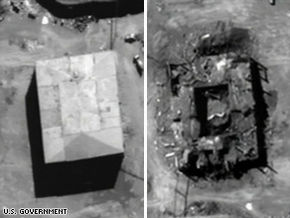
Supposed Syrian nuclear site before and after Israeli airstrike
But nothing about that alleged reactor in the Syrian desert turns out to be what it appeared at the time. The evidence now available shows that there was no such nuclear reactor, and that the Israelis had misled George W. Bush’s administration into believing that it was in order to draw the United States into bombing missile storage sites in Syria. Other evidence now suggests, moreover, that the Syrian government had led the Israelis to believe wrongly that it was a key storage site for Hezbollah missiles and rockets.
The International Atomic Agency’s top specialist on North Korean reactors, Egyptian national Yousry Abushady, warned top IAEA officials in 2008 that the published CIA claims about the alleged reactor in the Syrian desert could not possibly have been true. In a series of interviews in Vienna and by phone and e-mail exchanges over several months Abushady detailed the technical evidence that led him to issue that warning and to be even more confident about that judgment later on. And a retired nuclear engineer and research scientist with many years of experience at Oak Ridge National Laboratory has confirmed a crucial element of that technical evidence.
Published revelations by senior Bush administration officials show, moreover, that principal U.S. figures in the story all had their own political motives for supporting the Israeli claim of a Syrian reactor being built with North Korean help.
Vice President Dick Cheney hoped to use the alleged reactor to get President George W. Bush to initiate U.S. airstrikes in Syria in the hope of shaking the Syrian-Iranian alliance. And both Cheney and then CIA Director Michael Hayden also hoped to use the story of a North Korean-built nuclear reactor in Syria to kill a deal that Secretary of State Condoleezza Rice was negotiating with North Korea on its nuclear weapons program in 2007-08.
Mossad Chief’s Dramatic Evidence
In April 2007 the chief of Israel’s Mossad foreign intelligence agency, Meir Dagan, presented Cheney, Hayden and National Security Adviser Steven Hadley with evidence of what he said was a nuclear reactor being constructed in eastern Syria with the help of the North Koreans. Dagan showed them nearly a hundred hand-held photographs of the site revealing what he described as the preparation for the installation of a North Korean reactor and claimed that it was only a few months from being operational.
The Israelis made no secret of their desire to have a U.S. airstrike destroy the alleged nuclear facility. Prime Minister Ehud Olmert called President Bush immediately after that briefing and said, “George, I’m asking you to bomb the compound,” according to the account in Bush’s memoirs.
Cheney, who was known to be a personal friend of Olmert, wanted to go further. At White House meetings in subsequent weeks, Cheney argued forcefully for a U.S. attack not only on the purported reactor building but on Hezbollah weapons storage depots in Syria. Then-Secretary of Defense Robert Gates, who participated in those meetings, recalled in his own memoirs that Cheney, who was also looking for an opportunity to provoke a war with Iran, hoped to “rattle Assad sufficiently so as to end his close relationship with Iran” and “send a powerful warning to the Iranians to abandon their nuclear ambitions.”
CIA Director Hayden aligned the agency clearly with Cheney on the issue, not because of Syria or Iran but because of North Korea. In his book, Playing to the Edge, published last year, Hayden recalls that, at a White House meeting to brief President Bush the day after Dagan’s visit, he whispered in Cheney’s ear, “You were right, Mr. Vice-President.”
Hayden was referring to the fierce political struggle within the Bush administration over North Korea policy that had been underway ever since Condoleezza Rice had become Secretary of State in early 2005. Rice had argued that diplomacy was the only realistic way to get Pyongyang to retreat from its nuclear weapons program. But Cheney and his administration allies John Bolton and Robert Joseph (who succeeded Bolton as the key State Department policymaker on North Korea after Bolton became U.N. Ambassador in 2005) were determined to end the diplomatic engagement with Pyongyang.
Cheney was still maneuvering to find a way to prevent the successful completion of the negotiations, and he saw the story of a Syrian nuclear reactor built secretly in the desert with help from the North Koreans as bolstering his case. Cheney reveals in his own memoirs that in January 2008, he sought to sandbag Rice’s North Korea nuclear deal by getting her to agree that a failure by North Korea to “admit they’ve proliferating to the Syrians would be a deal killer.”
Three months later, the CIA released its unprecedented 11-minute video supporting the entire Israeli case for a North-Korean-style nuclear reactor that was nearly completed. Hayden recalls that his decision to release the video on the alleged Syrian nuclear reactor in April 2008 was “to avoid a North Korean nuclear deal being sold to a Congress and a public ignorant of this very pertinent and very recent episode.”
The video, complete with computer reconstructions of the building and photographs from the Israelis made a big splash in the news media. But one specialist on nuclear reactors who examined the video closely found abundant reason to conclude that the CIA’s case was not based on real evidence.
Technical Evidence against a Reactor
Egyptian national Yousry Abushady was a PhD in nuclear engineering and 23-year veteran of the IAEA who had been promoted to section head for Western Europe in the operations division of agency’s Safeguards Department, meaning that he was in charge of all inspections of nuclear facilities in the region. He had been a trusted adviser to Bruno Pellaud, IAEA Deputy Director General for Safeguards from 1993 to 1999, who told this writer in an interview that he had “relied on Abushady frequently.”
Abushady recalled in an interview that, after spending many hours reviewing the video released by the CIA in April 2008 frame by frame, he was certain that the CIA case for a nuclear reactor at al-Kibar in the desert in eastern Syria was not plausible for multiple technical reasons. The Israelis and the CIA had claimed the alleged reactor was modeled on the type of reactor the North Koreans had installed at Yongbyon called a gas-cooled graphite-moderated (GCGM) reactor.
But Abushady knew that kind of reactor better than anyone else at the IAEA. He had designed a GCGM reactor for his doctoral student in nuclear engineering, had begun evaluating the Yongbyon reactor in 1993, and from 1999 to 2003 had headed the Safeguards Department unit responsible for North Korea.
Abushady had traveled to North Korea 15 times and conducted extensive technical discussions with the North Korean nuclear engineers who had designed and operated the Yongbyon reactor. And the evidence he saw in the video convinced him that no such reactor could have been under construction at al-Kibar.
On April 26, 2008, Abushady sent a “preliminary technical assessment” of the video to IAEA Deputy Director General for Safeguards Olli Heinonen, with a copy to Director General Mohamed ElBaradei. Abushady observed in his memorandum that the person responsible for assembling the CIA video was obviously unfamiliar with either the North Korean reactor or with GCGM reactors in general.
The first thing that struck Abushady about the CIA’s claims was that the building was too short to hold a reactor like the one in Yongbyon, North Korea.
“It is obvious,” he wrote in his “technical assessment” memo to Heinonen, “that the Syrian building with no UG [underground] construction, can not hold a [reactor] similar [to] NK GCR [North Korean gas-cooled reactor].”
Abushady estimated the height of the North Korean reactor building in Yongbyon at a 50 meters (165 feet) and estimated that the building at al-Kibar at a little more than a third as tall.
Abushady also found the observable characteristics of the al-Kibar site inconsistent with the most basic technical requirements for a GCGM reactor. He pointed out that the Yongbyon reactor had no less than 20 supporting buildings on the site, whereas the satellite imagery shows that the Syrian site did not have a single significant supporting structure.
The most telling indication of all for Abushady that the building could not have been a GCGM reactor was the absence of a cooling tower to reduce the temperature of the carbon dioxide gas coolant in such a reactor.
“How can you work a gas-cooled reactor in a desert without a cooling tower?” Abushady asked in an interview.
IAEA Deputy Director Heinonen claimed in an IAEA report that the site had sufficient pumping power to get river water from a pump house on the nearby Euphrates River to the site. But Abushady recalls asking Heinonen, “How could this water be transferred for about 1,000 meters and continue to the heat exchangers for cooling with the same power?”
Robert Kelley, a former head of the U.S. Department of Energy’s Remote Sensing Laboratory and former senior IAEA inspector in Iraq, noticed another fundamental problem with Heinonen’s claim: the site had no facility for treating the river water before it reached the alleged reactor building.
“That river water would have been carrying debris and silt into the reactor heat exchangers,” Kelley said in an interview, making it highly questionable that a reactor could have operated there.
Yet another critical piece that Abushady found missing from the site was a cooling pond facility for spent fuel. The CIA had theorized that the reactor building itself contained a “spent fuel pond,” based on nothing more than an ambiguous shape in an aerial photograph of the bombed building.
But the North Korean reactor at Yongbyon and all 28 other GCGM reactors that had been built in the world all have the spent fuel pond in a separate building, Abushady said. The reason, he explained, was that the magnox cladding surrounding the fuel rods would react to any contact with moisture to produce hydrogen that could explode.
But the definitive and irrefutable proof that no GCGM reactor had been present at al-Kibar came from the environmental samples taken by the IAEA at the site in June 2008. Such a reactor would have contained nuclear-grade graphite, Abushady explained, and if the Israelis had actually bombed a GCGM reactor, it would have spread particles of nuclear-grade graphite all over the site.
Behrad Nakhai, a nuclear engineer at Oak Ridge National Laboratory for many years, confirmed Abshuady’s observation in an interview. “You would have had hundreds of tons of nuclear-grade graphite scattered around the site,” he said, “and it would have been impossible to clean it up.”
IAEA reports remained silent for more than two years about what the samples showed about nuclear-grade graphite, then claimed in a May 2011 report that the graphite particles were “too small to permit an analysis of the purity compared to that normally required for use in a reactor.” But given the tools available to laboratories, the IAEA claim that they couldn’t determine whether the particles were nuclear grade or not “doesn’t make sense,” Nakhai said.
Hayden acknowledged in his 2016 account that “key components” of a nuclear reactor site for nuclear weapons were “still missing.” The CIA had tried to find evidence of a reprocessing facility in Syria that could be used to obtain the plutonium for a nuclear bomb but had been unable to find any trace of one.
The CIA also had found no evidence of a fuel fabrication facility, without which a reactor could not have gotten the fuel rods to be reprocessed. Syria could not have gotten them from North Korea, because the fuel fabrication plant at Yongbyon had produced no fuel rods since 1994 and was known to have fallen into serious disrepair after the regime had agreed to scrap its own plutonium reactor program.
Manipulated and Misleading Photographs
Hayden’s account shows that he was ready to give the CIA’s stamp of approval to the Israeli photographs even before the agency’s analysts had even begun analyzing them. He admits that when he met Dagan face-to-face he didn’t ask how and when Mossad had obtained the photographs, citing “espionage protocol” among cooperating intelligence partners. Such a protocol would hardly apply, however, to a government sharing intelligence in order to get the United States to carry out an act of war on its behalf.
The CIA video relied heavily on the photographs that Mossad had given to Bush administration in making its case. Hayden writes that it was “pretty convincing stuff, if we could be confident that the pictures hadn’t been altered.”
But by his own account Hayden knew Mossad had engaged in at least one deception. He writes that when CIA experts reviewed the photographs from Mossad, they found that one of them had been photo-shopped to remove the writing on the side of a truck.
Hayden professes to have had no concern about that photo-shopped picture. But after this writer asked how CIA analysts interpreted Mossad’s photo shopping of the picture as one of the questions his staff requested in advance of a possible interview with Hayden, he declined the interview.
Abushady points out that the main issues with the photographs the CIA released publicly are whether they were actually taken at the al-Kibar site and whether they were consistent with a GCGM reactor. One of the photographs showed what the CIA video called “the steel liner for the reinforced-concrete reactor vessel before it was installed.” Abushady noticed immediately, however, that nothing in the picture links the steel liner to the al-Kibar site.
Both the video and CIA’s press briefing explained that the network of small pipes on the outside of the structure was for “cooling water to protect the concrete against the reactor’s intense heat and radiation.”
But Abushady, who specializes in such technology, pointed out that the structure in the picture bore no resemblance to a Gas-Cooled Reactor vessel. “This vessel cannot be for a Gas-Cooled Reactor,” Abushady explained, “based on its dimensions, it thickness and the pipes shown on the side of the vessel.”
The CIA video’s explanation that the network of pipes was necessary for “cooling water” made no sense, Abushady said, because gas-cooled reactors use only carbon dioxide gas — not water — as a coolant. Any contact between water and the Magnox-cladding used in that type of reactor, Abushady explained, could cause an explosion.
A second Mossad photograph showed what the CIA said were the “exit points” for the reactor’s control rods and fuel rods. The CIA juxtaposed that photograph with a photograph of the tops of the control rods and fuel rods of the North Korean reactor at Yongbyon and claimed a “very close resemblance” between the two.
Abushady found major differences between the two pictures, however. The North Korean reactor had a total of 97 ports, but the picture allegedly taken at al-Kibar shows only 52 ports. Abushady was certain that the reactor shown in the photograph could not have been based on the Yongbyon reactor. He also noted that the picture had a pronounced sepia tone, suggesting that it was taken quite a few years earlier.
Abushady warned Heinonen and ElBaradei in his initial assessment that the photo presented as taken from inside the reactor building appeared to an old photo of a small gas-cooled reactor, most likely an early such reactor built in the U.K.
A Double Deception
Many observers have suggested that Syria’s failure to protest the strike in the desert loudly suggests that it was indeed a reactor. Information provided by a former Syrian air force major who defected to an anti-Assad military command in Aleppo and by the head of Syria’s atomic energy program helps unlock the mystery of what was really in the building at al-Kibar.
The Syrian major, “Abu Mohammed,” told The Guardian in February 2013 that he was serving in the air defense station at Deir Azzor, the city nearest to al-Kibar, when he got a phone call from a Brigadier General at the Strategic Air Command in Damascus just after midnight on Sept. 6, 2007. Enemy planes were approaching his area, the general said, but “you are to do nothing.”
The major was confused. He wondered why the Syrian command would want to let Israeli fighter planes approach Deir Azzor unhindered. The only logical reason for such an otherwise inexplicable order would be that, instead of wanting to keep the Israelis away from the building at al-Kibar, the Syrian government actually wanted the Israelis to attack it. In the aftermath of the strike, the Damascus issued only an opaque statement claiming that the Israeli jets had been driven away and remaining silent on the airstrike at al-Kibar.
Abushady told this writer he learned from meetings with Syrian officials during his final year at the IAEA that the Syrian government had indeed originally built the structure at al-Kibar for the storage of missiles as well as for a fixed firing position for them. And he said Ibrahim Othman, the head of Syria’s Atomic Energy Commission, had confirmed that point in a private meeting with him in Vienna in September 2015.
Othman also confirmed Abushady’s suspicion from viewing satellite photographs that the roof over the central room in the building had been made with two movable light plates that could be opened to allow the firing of a missile. And he told Abushady that he had been correct in believing that what had appeared in a satellite image immediately after the bombing to be two semi-circular shapes was what had remained of the original concrete launching silo for missiles.
In the wake of the Israel’s 2006 invasion of Southern Lebanon, the Israelis were searching intensively for Hezbollah missiles and rockets that could reach Israel and they believed many of those Hezbollah weapons were being stored in Syria. If they wished to draw the attention of the Israelis away from actual missile storage sites, the Syrians would have had good reason to want to convince the Israelis that this was one of their major storage sites.
Othman told Abushady that the building had been abandoned in 2002, after the construction had been completed. The Israelis had acquired ground-level pictures from 2001-02 showing the construction of outer walls that would hide the central hall of the building. The Israelis and the CIA both insisted in 2007-08 that this new construction indicated that it had to be a reactor building, but it is equally consistent with a building designed to hide missile storage and a missile-firing position.
Although Mossad went to great lengths to convince the Bush administration that the site was a nuclear reactor, what the Israelis really wanted was for the Bush administration to launch U.S. airstrikes against Hezbollah and Syrian missile storage sites. Senior officials of the Bush administration didn’t buy the Israeli bid to get the United States to do the bombing, but none of them ever raised questions about the Israeli ruse.
So both the Assad regime and the Israeli government appear to have succeeded in carrying out their own parts in a double deception in the Syrian desert.
Gareth Porter is an independent investigative journalist and historian on U.S. national security policy and the recipient of the 2012 Gellhorn Prize for journalism.
Anniversaries of major events promote political interests not the public spirit
By Greg Felton | November 18, 2017
To all intents and purposes, our political, economic and moral world begins with World War I, the seminal event of the 20th century. The carnage, devastation and psychological trauma of Europe’s first total war did to the old political order what a certain asteroid did to the dinosaurs 65 million years ago: it wiped out an existing hierarchy and forced the creation of another that would ultimately be dominated by the U.S., which emerged from that war as the world’s new apex predator.
Now, in the early stages of the 21st century, anniversaries of events that have defined our concept of modernity are going to come in profusion, events like the Russian revolutions, League of Nations, stock market crash, the Great Depression; World War II, atomic weapons, plastics, the United Nations, McCarthyism and the Cold War.
Which events we commemorate, how we commemorate them, and which ones we ignore or gloss over have less to do with their intrinsic importance than with their propaganda value in support of, if you’ll pardon the cliché, The New World Order. The selective use of history to prop up our post-war hierarchy can be seen in attitudes toward two events that have anniversaries this month.
The Balfour Declaration, Nov. 2, 1917
Defenders and detractors of the Declaration both made much of its centenary, yet neither side seemed to understand its general worthlessness. The document in question is simply a letter from British Foreign Secretary James Arthur Balfour to Lord Rothschild expressing the British government’s favourable view of “the establishment in Palestine of a national home for the Jewish people.” It does not, as is widely believed, have anything to do with the creation of Israel. It amounted to nothing.
 On its face, the Declaration is absurd as well as politically and legally indefensible. “National home” has no meaning in international law; Jews do not constitute “a people” and therefore not “a nation”; Palestinians were not consulted on the matter; and the Declaration betrayed the British government’s support for Arab independence as outlined in the Hussein–McMahon correspondence.
In one letter dated Oct. 25, 1915, the British High Commissioner to Egypt, Lt.–Col. Sir Henry McMahon, openly promised Palestine, inter alia, to the Sharif of Mecca. The Hussein–McMahon correspondence was a meaningful exchange between governments; the Balfour Declaration was merely a private letter addressed to a special-interest group, the Zionist Federation.
Regarding its contents, nothing in the Declaration was special or revelatory regarding British attitudes. Upper-class twits, er Brits, like Josiah Wedgwood had been lionizing zionism since at least Feb. 7, 1917. As Wedgwood would say a decade or so later, “Zionism is now doing for the Jews what the Labour Party seeks to do for the British working-class—creating self-confidence and corporate self-respect.”
For Wedgwood, Balfour and others, zionism was a benign illusion borne of ignorance and Western hubris. Wedgwood even praised Jewish colonization of Palestine as being wholly beneficial. Such a misguided understanding is also reflected in the Declaration’s naïve insistence that nothing in the zionist enterprise should be allowed to harm or prejudice the civil or religious rights of existing non-Jewish communities.
In truth, the Zionist Federation, to whom Balfour addressed the letter, had no intention of respecting Palestinian rights. In fact, such respect is anathema to zionism As anyone can see, the modern “state” of Israel is an abomination of the spirit of the Balfour Declaration. Therefore, the Declaration must be seen as either a conscious act of U.K. complicity in a genocide or an expression of sentimental Judeophilic nonsense. Either way, it does not deserve to be celebrated.
UNGA Resolution 181, (“The Partition Plan”) Nov. 29, 1947
The disconnect between zionist fantasy in the Balfour Declaration and zionist reality in Palestine would be proven 30 years later when the UN General Assembly caved in to blackmail to “create” Israel. The following account of how UNGA Resolution 181 came to pass is taken from my 2011 essay UN must again choose between capitulation and credibility.
By Nov. 25, 1947, the Zionist lobby realized that it did not have the requisite two-thirds majority in the General Assembly to support partition [Palestine]. Extraordinary measures had to be taken.
Vijayalakshmi Pandit, head of India’s UN delegation and sister of India’s Prime Minister Jawaharlal Nehru, received daily death threats warning her to change her vote. Nehru, though, refused to buckle in the face of threats or lucrative bribes. (Najma Heptulla, Indo-West Asian relations: the Nehru era, Allied Publishers, 1991, p. 158.)
Other, smaller, countries could not afford to stand on principle. In Palestine and Israel—A Challenge to Justice, Professor John Quigley recounts how Liberia, the Philippines, and Haiti—all financially dependent on the U.S.—were coerced into switching their votes:
“Liberia’s ambassador to the United Nations complained that the U.S. delegation threatened aid cuts to several countries. Some delegates charged U.S. officials with ‘diplomatic intimidation.’ Without terrific pressure from the United States on governments which cannot afford to risk American reprisals, said an anonymous editorial writer, the resolution would never have passed. The fact such pressure had been exerted became public knowledge, to the extent a State Department policy group was concerned that ‘the prestige of the UN’ would suffer because of ‘the notoriety and resentment attendant upon the activities of U.S. pressure groups, including members of Congress, who sought to impose U.S. views as to partition on foreign delegations.’” (p. 37)
On Nov. 29, the Partition Plan, known as UNGA Resolution 181 narrowly gained the required two thirds—33 in favor, 13 opposed, 10 abstaining and 1 absent—yet the resolution was a violation of the UN Charter since the UN has no authority to take land from one people and give it to another.
As a result, 726,000 Arabs were made refugees in their own land from November 29, 1947, until the end of 1948, according to the UN Relief and Works Agency for Palestine. Walter Eytan, Director General of the Israeli Foreign Ministry, referred to the UNRWA’s figure as “meticulous” and believed that the real number was closer to 800,000. Moshe Dayan would later admit: “There is not one single place built in this country that did not have a former Arab population.” (Ha’aretz, April 4, 1969).…
Thomas Reid, British MP for Swindon, called Resolution 181 “an iniquitous scheme”: “Let us be frank about it. One of the chief motives is that the Jews have a controlling voice in the election for the President in the States of New York, Illinois, Ohio and elsewhere in America. I suggest that the chief reason for this evil proposal of U.N.O. is that the political parties in America, or their party machines, are partly at the electoral mercy of the Jews. That is public knowledge.” (Hansard, Dec. 11, 1947)
So much for the relevance of the Balfour Declaration and its pious concern for the civil and religious rights of non-Jewish groups! In fact, the cruelty of the invading Jews toward the native Palestinians was so great that U.S. President Harry Truman refused to let UNGA Resolution 181 go to the Security Council for ratification, and at one point was prepared to rescind U.S. support for partition. In a March 25, 1948 statement, Truman declared support for trusteeship, albeit temporarily, to stabilize the region and maintain law and order:
It has become clear that the partition plan cannot be carried out at this time by peaceful means. We could not undertake to impose this solution on the people of Palestine by the use of American troops, both on Charter grounds and as a matter of national policy.
The consequence of this admission, of course, is that without ratification UNGA Resolution 181 does not exist: GA resolutions are only recommendations and have no force of law unless accepted by all parties. Therefore, Israel has no legal, moral or political legitimacy. This illegitimacy is what celebrating the centenary of the Declaration amounted to.
There is, though, one irony to the Declaration that is worthy of note. There was one lone voice against the Declaration in David Lloyd-George’s government. It belonged to Edwin Samuel Lord Montagu, who wrote to the British Cabinet on Aug. 23, 1917, one day after the Balfour Declaration was drafted. Here is a short excerpt:
[A] religious test of citizenship seems to me to be only admitted by those who take a bigoted and narrow view of one particular epoch of the history of Palestine, and claim for the Jews a position to which they are not entitled.
If my memory serves me right, there are three times as many Jews in the world as could possible get into Palestine if you drove out all the population that remains there now. So that only one-third will get back at the most, and what will happen to the remainder?
… I feel that the Government are asked to be the instrument for carrying out the wishes of a Zionist organisation largely run, as my information goes, at any rate in the past, by men of enemy descent or birth, and by this means have dealt a severe blow to the liberties, position and opportunities of service of their Jewish fellow-countrymen.
Montagu was also the government’s only Jew.
Palestine: Saudi Arabia, Egypt using Rafah crossing to pressure us
MEMO | November 17, 2017
The Rafah crossing between the besieged Gaza Strip and Egypt is being used a tool to pressure Palestinian President Mahmoud Abbas to enter into US-backed peace talks with Israel, a Palestinian Authority official has said.
“The Rafah crossing has become a tool that Egypt and Saudi Arabia use to pressure Palestinian President Mahmoud Abbas to accept the entry into a new round of US-backed negotiations with Israel,” the PA official said, warning that “the negotiations could reach results that may affect the rights of the Palestinians.”
According to the Cairo agreement which was signed on 12 October, Egypt agreed with Fatah and Hamas to reopen the Rafah border crossing last Tuesday, but the official said that “Saudi Arabia seemed to have pressured Egypt to retreat until the PA approves the two-state solution deal.”
The official described the exploiting of the only humanitarian crossing for Gaza’s residents as “suspicious”.
“They [Arab countries] are using the crossing to strengthen their ties with the US and Israel” he added.
Israel has maintained a blockade on Gaza for a decade, with tight restrictions in place on the movement of people and goods at its crossings, citing the need to control Hamas and stop Islamic groups from obtaining weapons or materials that could be used against Tel Aviv. Egypt has supported the blockade by closing the Rafah crossing, leaving Palestinian in Gaza no access to the outside world.
Gaza’s two million residents suffer from worsening humanitarian conditions, with only a few hours of power a day and a lack of clean water. Control of the Rafah crossing at Gaza’s southern border has long been a sticking point between the two Palestinian factions, and between Egypt and the Palestinians in Gaza for whom the crossing represents a vital gateway to the outside world.
Featured Video

Trump asks Iran not to retaliate after he strikes Pickaxe Mountain
or go to
Aletho News Archives – Video-Images
Book Review
‘Why Fauci Must Rot in Prison’: A Tale of Two Diaries
By Jill Erzen | The Defender | October 13, 2026
Dr. Anthony Fauci’s private diary reveals a “mind-numbing” contradiction between what the former top U.S. infectious disease official knew about COVID-19 and what he told the public, senior White House adviser Peter Navarro, Ph.D., said last week on “American Thought Leaders.”
In his new book, “Why Fauci Must Rot in Prison,” due out Oct. 20, Navarro compares Fauci’s private entries to his own pandemic-era diary, and uses what he calls “a tale of two diaries” to argue that Fauci should face criminal prosecution.
“I show, actually, how a prosecution can and should happen … at the state level, most likely,” Navarro said. “He should wind up in prison, and we’ve got the receipts in this book to put him there.”
Navarro said Fauci repeatedly acknowledged important facts in private, then publicly pursued policies that contradicted those facts — with devastating consequences.
“What he says many times privately in his diary is so at odds with both his public behavior and public statements that it’s mind-numbing,” Navarro said.
Navarro examines the lasting damage caused by lockdowns and other pandemic policies, and the ongoing toll of long COVID.
His book also addresses questions about vaccine safety, including why healthy young people faced COVID-19 vaccination mandates despite concerns about myocarditis, and why women were not warned about miscarriage risks linked to the shots. … continue
Blog Roll
 Aletho News
- Yemen denounces international community’s silence on Saudi aggression, siege
- UAE and Saudi Arabia move toward renewed coordination against Sanaa
- How Iran’s two-week retaliatory strikes exposed cracks in US military architecture in Persian Gulf
- The mother of all propaganda: Why the hype over US MOAB strike against Iran is nothing but theater
- Iran says it possesses technology behind US 14-ton GBU bunker-buster
- Trump asks Iran not to retaliate after he strikes Pickaxe Mountain – w/ Prof. Marandi
- Vice President J.D. Vance’s Deceptive ‘Antiwar’ Campaign Speech
- Iran: Palestinians’ rights must not be compromised in Gaza’s future; US, Israel to blame for Hormuz situation
- Ongoing tales of Syrian chemical weapons
- Moscow blasts UN for ignoring torture of Russian POWs
- If Americans Knew
- Israeli rabbi permits occupiers to steal Palestinian olive harvest in West Bank
- Netanyahu’s spin on latest settler attack is laughable – Daily Update
- Israeli soldiers debunk Israel’s talking points
- In West Bank, Israeli settlers are totally out of control – Daily Update
- NPR investigation finds evidence of widespread fraud at mall kiosks tied to Israeli skincare brand
- Tucker Carlson exposes Israeli Lies about the Oct 7th attack, Charlie Kirk, and the U.S.
- Israel has detained thousands of Palestinian children since Oct 7th – over half spent time in solitary, many uncharged
- Israeli Analysis: Is Netanyahu Planning an ‘October Surprise’ Attack Before Israel’s Election?
- Israeli settlers brutally attack Palestinians and Washington Post female photographer, 65
- Words Have Changed, Occupation Continues: The Reality of the Gaza Ceasefire
- No Tricks Zone
- Predictions Made By Renowned Climate Proifessor Over Past Decades Have Been Proven To Be Poor
- New Study Suggests Large Regions Of The Pacific Ocean Have Been Cooling For The Last 80 Years
- Germany’s Green Energy Debacle: High Energy Costs Force Kahla Porzellan to Close After 182 Years!
- New Study: 50 Years Of The Most Aggressive ‘Net Zero’ Policies Can Only Affect The Global Climate By 0.03°C
- US September “Heat” Was No Record…Many Records Set Decades Ago
- Latest European Green Energy Debacle; Portugal’s Largest Flagship Solar Park Insolvent!
- Green Energy Debacle: German Expert Professor Fritz Vahrenholt Warns Of Severe Economic And Social Consequences
- Two More Paleo Reconstructions Affirm Meters-Higher Sea Levels Across Ireland, Brazil 7000-6000 Years Ago
- New Study: Earth And Venus Surface Warmth Largely Explained By Convection And Lapse Rate, Not CO2 Or Radiation
- 2025 Nature Paper Claiming Worsening Global Drought Gets RETRACTED …Heavily Flawed