Israel looks to buy three new nuke-capable subs
Palestine Information Center – October 21, 2106
OCCUPIED JERUSALEM – Israel is seeking to buy three more advanced submarines from Germany at a combined price of $1.3 billion, an Israeli newspaper reported Friday
The planned purchase aims to replace within the next decade the oldest submarines in its existing Dolphin fleet, which began entering service in 1999, the Maariv daily reported.
Contacted by AFP, the “Defense Ministry” declined to comment on the report.
Israel already has five of the state-of-the-art German submarines, with a sixth due for delivery in 2017.
Foreign military sources and governments say the Dolphins can be equipped with missiles armed with nuclear warheads.
They believe Israel has between 100 and 200 warheads and missiles capable of delivering them.
The new submarines are said to be more advanced, longer, and equipped with better accessories, the newspaper added.
“No Palestinians during the holiday”: Palestinian man harassed during Sukkot
International Solidarity Movement | October 21, 2016
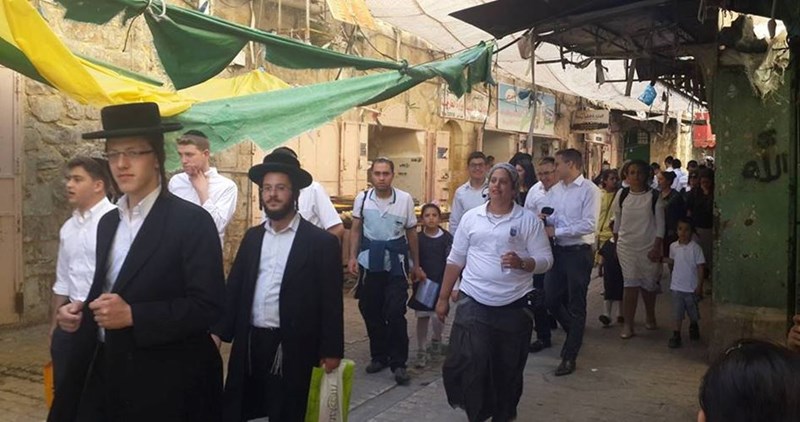
Hebron, Occupied Palestine – Late Thursday morning, as Palestinian schools in the Old City of occupied al-Khalil (Hebron) were dismissing their students early due to enhanced settler activity, Israeli forces harassed a Palestinian man and denied him his right of movement through the large parking lot near the base of al-Ibrahimi Mosque. The reason for this incident, as well as the increase in settler activity, was due to the week-long Jewish holiday of Sukkot, the Feast of the Tabernacles. Throughout this entire week, Israeli Forces have increased their numbers stationed around the Mosque, and it was one of these members of the occupation forces that decided to harass this Palestinian civilian.
The man, a local tour guide in the Old City of al-Khalil, entered the parking lot in order to reach a group of Turkish tourists who had just arrived. Upon setting foot in the lot, two members of the Israeli Border Police approached him, with one using his hands to physically shove him away from the cordoned off entrance. As he tried to explain that he merely wanted to pass through to reach the tourists, the border policeman raised his voice and shouted at him to get back. When the man asked why he was not allowed to pass through when so many tourists were permitted to, the answer he received was, “You are Palestinian. No Palestinians pass through here during the holiday.” The man had no choice but to turn around and walk around the parking lot.
The denial towards Palestinians of their right to movement by Israeli forces is a fundamental weapon of the occupation. By preventing Palestinians from entering historical and religious sites, and working to minimize their presence around Jewish festivities, Israel uses the excuse of the holidays to continue its process of ethnically cleaning al-Khalil of its indigenous Palestinian population. On Wednesday, Israeli Forces came out in force to block off a road in the so-called Palestinian controlled H1 area to allow settlers from the illegal Israeli settlements to have access to a supposed prayer site in the city. This is merely one of the many examples of how Jewish holidays act as a cover for forceful intimidation of Palestinians.
The harassment of this man this morning is symptomatic of the devaluation of Palestinian life under the Israeli occupation across the land of Palestine.
Sukkot, feast of intimidation, oppression and illegal annexation
International Solidarity Movement | October 20, 2016
Hebron, Occupied Palestine – This past week marked the feast of Sukkot, which brought settlers from illegal settlements all over the occupied West Bank to al-Khalil (Hebron). There, with restrictions, harassment, collective punishment and intimidation of Palestinians – all in favor of the illegal settlers – the spirit of the Jewish holiday was turned into a feast of intimidation and oppression for the Palestinian residents, going hand in hand with increasing illegal annexation of their land.
With bus-loads of settlers from all over the illegally occupied Palestinian West Bank pouring into al-Khalil, Israeli forces stepped up the movement-restrictions and checkpoint closures for Palestinians even more, thus making the maze of checkpoints, already almost impossible to navigate into a maze that ends mainly in dead-ends. For several days, the main checkpoint connecting the Palestinian market with the area around the Ibrahimi Mosque was closed for Palestinians, and Palestinian shop-owners in the mosque-area were forced shut by the Israeli forces – all to facilitate settler movement in areas that lack any presence of Palestinians.
The road connecting the settlements in the heart of al-Khalil with the Kiryat Arba settlement on the outskirts of al-Khalil – where only settlers are allowed to drive – has largely been cordonned off with police-barriers.
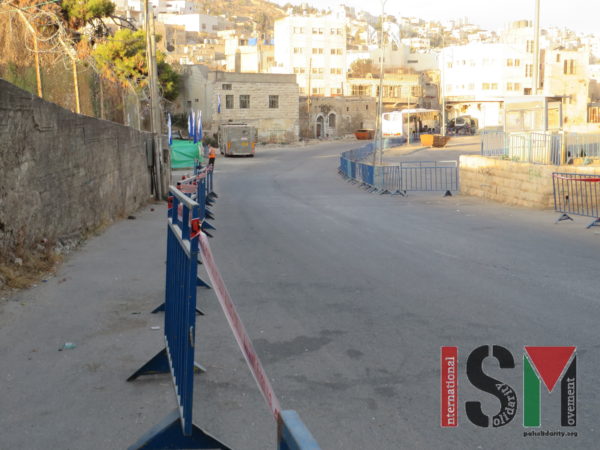
The area cordonned off by Israeli forces
Thus, school-children were not only forced to pass an even larger amount of heavily-armed military and police forces, but also navigate the maze of complete closures for Palestinians, areas to avoid due to excessive settler presence and the gates put up preventing movement in certain directions.
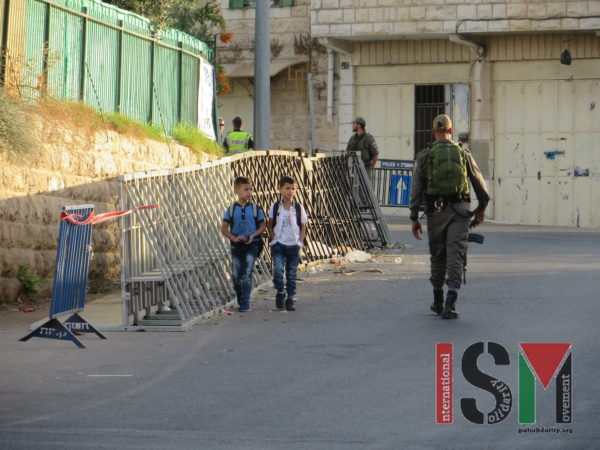
School-children forced to pass heavily-armed Israeli forces and the maze of police-barriers
Students of al-Faihaa girls school in the Ibrahimi Mosque area, where just recently a new CCTV surveillance tower was put up following and recording every step of the Palestinian residents movement, are now studying right next to a military encampment. The building right next to the girls school entrance has already been mis-used and turned into a military encampement during last year’s Sukkot celebrations.
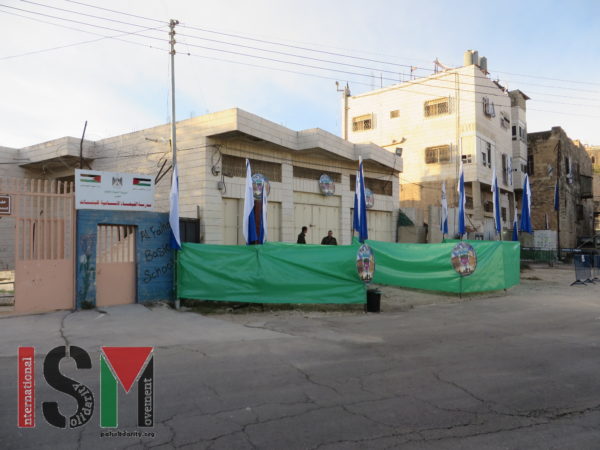
Building illegally occupied by Israeli forces for a military base
On Tuesday, many of the settlers arriving to al-Khalil on the occassion of the holiday, were ‘guided’ through the Palestinian market by Israeli forces, preventing Palestinians’ access in their own marketplace for hours. Just a day later, soldiers effectively imposed a curfew on the tiny strip of Shuhada Street where Palestinians are still allowed to walk, the Tel Rumeida neighborhood and the Bab al-Zawwiya area. The latter is located in the H1 area of al-Khalil, supposedly under full Palestinian control. With the closure of Shuhada checkpoint for six hours, Palestinian civilians were either locked inside or outside their houses, while settlers were accompanied by heavily armed military forces to a tomb located in the H1-area, forcing shop-owners to close.
On Thursday morning, Israeli forces marched through the streets of al-Khalil, with drums and music, in a pure show of force and power. The march went on the settler only road, that has been ethnically cleansed from Palestinian cars (but does still allow Palestinian pedestrians), illustrating the continuous plans and attempts to connect the illegal settlements in an area ethnically cleansed of any Palestinian presence.
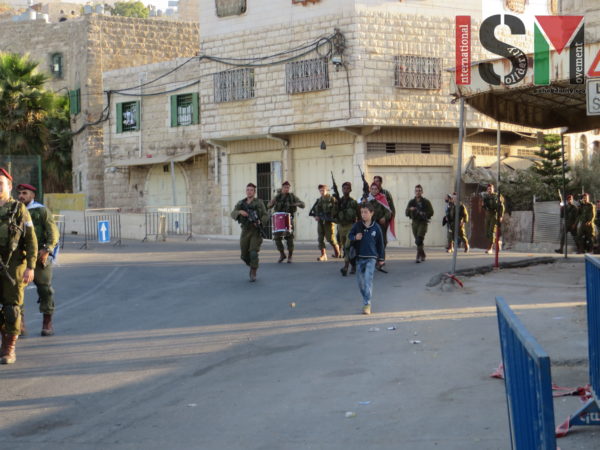
Soldiers marching through al-Khalil
Throughout the increasing efforts to illegally annex more and more strips of land, and erase first the memory of the Palestinian heritage as a step to then erase the whole Palestinian population, Israeli forces are employing the ‘power of words’. More and more areas, streets and houses that belong to Palestinians, but in which settlers have already moved in (and were succinctly kicked out by the army), are given Hebrew names, eradicating the Palestinian names. This is just one small step of illegal annexation that even goes so far to call the illegal Israeli settlements in the city center of al-Khalil “Jewish neighborhoods”.
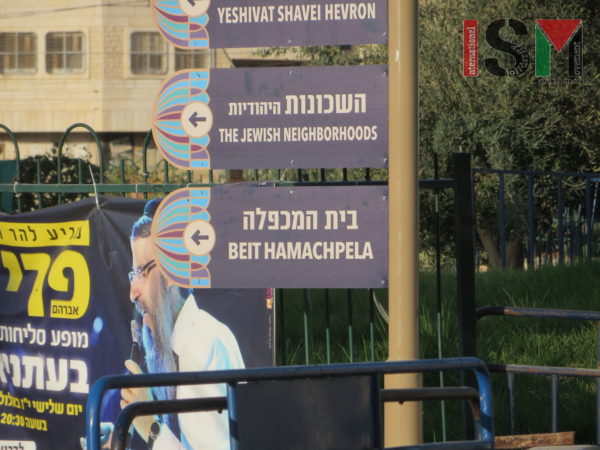
Signs put up for ‘tourist settlers’ in al-Khalil by Israeli forces
With the holiday of Sukkot lasting for another three days, more restrictions and harassment are expected. And even with the end of the holiday, the restrictions, harassment and intimidation of Palestinian civilians solely and deliberately on the ground of their ethnic group, with the continuous illegal annexation of the land, will not stop as long as the illegal occupation is allowed by the international community to continue their efforts of ethnic cleansing.
Muzzling Israeli Dissent in the NYT
B’Tselem’s Hard Hitting Testimony Lost in the Telling
By Barbara Erickson | TimesWarp | October 18, 2016
Israeli rights advocate Hagai El-Ad spoke eloquently last week before the United Nations Security Council, appealing to the world body for action on the brutal occupation of Palestine, but according to The New York Times little of what this courageous activist said was fit to print: The real news was Israeli Prime Minister Benjamin Netanyahu’s outraged response.
Thus we find a story on the speech appearing two days after the event under the headline “Settlement Debate Flares Again in Israel’s Quarrel With Rights Group.” The article by Isabel Kershner has much to say about Israeli government criticism of the human rights group B’Tselem, which documents and publicizes Israeli abuses in the West Bank and Gaza.
She says as little as possible, however, about El-Ad’s actual comments. Of his 2,000 word speech she quotes no more than two dozen: “Anything short of decisive action will achieve nothing but ushering in the second half of the first century of the occupation… [Living under occupation] mostly means invisible, bureaucratic, daily violence.”
The heart of the address is missing: El-Ad’s devastating deconstruction of the Israeli justice system as “a legal guise for organized state violence,” the daily indignities and suffering under Israeli military rule, the demolitions of homes, theft of land and water and the impunity surrounding trigger happy security forces.
His words become lost in the framing of this story, glossed over in the tit for tat between attackers and defenders of B’Tselem. Other media reports, however—in Israel and the United States—give readers more substantial excerpts from his address, and they also provide links to the actual speech, something the Times conveniently omits.
The Times also fails to say that amidst the turmoil over B’Tselem’s UN appearance, the U.S. State Department declared its gratitude to the organization for providing information on “fundamental issues that occur on the ground.” Times readers, however, are denied these same benefits.
El-Ad was not the only speaker to criticize Israel at a special session titled “The Settlements as the Obstacle to Peace and the Two-State Solution,” but he bore the brunt of the furious denunciations from Netanyahu and other government officials. He and his organization were also the focus of the Times story.
All this attention is a sign that El-Ad’s performance was a direct hit on Israeli efforts to whitewash their occupation. Much of the time B’Tselem’s reports and press releases, well-buttressed with detailed research, receive no mention either in the Times or in government circles. But now that El-Ad has managed to bring the group’s message to the highest international level, the backlash has been swift and harsh.
The Times has become a willing partner in this effort, working to distract readers from El-Ad’s eloquent appeal to the Security Council by framing the story as a two-sided debate between rival points of view.
Discerning readers will take notice, however, and realize that El-Ad’s speech is worth searching out in spite of the Times’ efforts to draw attention away from his actual words. They can find the text and a video of his address at the B’Tselem website—if they haven’t already found his performance posted on social media.
So it comes to this: Times readers need to read between the lines for clues to the reality deemed unfit to print, and then they must use their skills to search elsewhere for the story behind the words. This is not what we should expect from a newspaper like the Times, with pretenses to the highest standards of ethics and performance, but readers beware: Use this journalistic product with care and a hefty dose of skepticism.
Follow @TimesWarp on Twitter
Five years on: The Wafa al-Ahrar agreement and prisoner exchange
Samidoun Palestinian Prisoner Solidarity Network – October 19, 2016
On 18 October 2011, 477 Palestinian prisoners were released from Israeli occupation prisons in the Wafa al-Ahrar (“Dedication to the Free”) prisoner exchange with the Israeli occupation. One week prior, hundreds of Palestinian prisoners were engaged in an open-ended hunger strike against the solitary confinement and isolation of Palestinian leaders, especially Ahmad Sa’adat, the imprisoned General Secretary of the Popular Front for the Liberation of Palestine. The strike was suddenly interrupted with stunning news: a prisoner exchange agreement had been released between the Palestinian resistance and the Israeli occupation, for the release of 1,027 Palestinian prisoners in exchange for the release of captured occupation soldier Gilad Shalit. The exchange was completed with the release of 550 fellow Palestinian prisoners in December 2011. In the agreement, among the first set of 477 prisoners released, 131 were released to Gaza and 110 to the West Bank, as well as six Palestinians holding Israeli citizenship returning to Palestine ’48. 203 more were deported from Palestine. This group were the prisoners with lengthy sentences.
This was, of course, not the first time that the Palestinian resistance secured the release of Palestinian prisoners through prisoner exchanges. Throughout Palestinian history, large numbers of Palestinian prisoners in Israeli jails with lengthy sentences have found freedom in prisoner exchanges negotiated by Palestinian resistance organizations.
Since the 2011 Wafa al-Ahrar exchange, dozens of released prisoners have been re-arrested, many with their original sentences reimposed. 57 former prisoners have been re-imprisoned by the Israeli occupation, out of 74 who have been arrested; 50 prisoners have had their original sentences re-imposed on allegations of “violating their terms of release” through “association or support for” prohibited organizations, including all major Palestinian political parties. Three more re-arrested prisoners are serving sentences lower than their original sentences, including Nael Barghouthi (30 months), Nayef Shawamreh (4 years), and Bassam Natsheh (3 years). Israeli Military Order 1651 allows the re-imprisonment of former Palestinian prisoners on prior charges for arbitrary re-arrests, on the basis of secret evidence.
Palestinian prisoners re-arrested include Samer Issawi, who was previously re-arrested and freed after a 265-day partial hunger strike and then re-arrested once more in the raids in June and July 2014 alongside the Israeli assault on Gaza; Samer Mahroum, originally a co-defendant of Omar Nayef Zayed; and Nasser Abed Rabbo, a Jersualemite ex-prisoner prevented from seeing his newborn son by the re-arrest.
Historical precedents for the release of prisoners through resistance actions have been noted on multiple occasions, including exchanges between the Israeli state and Arab states, Hezbollah, the Palestine Liberation Organization and other Palestinian resistance organizations.
On 23 July 1968, the first exchange was successfully completed between the Palestinian revolution and the Israeli occupation. The Popular Front for the Liberation of Palestine hijacked a plane from Rome to Tel Aviv, releasing the passengers in exchange for 37 Palestinian prisoners, some with high sentences imprisoned before 1967.
On 28 February 1971, Palestinian prisoner Mahmoud Bakr Hijazi was exchanged for an Israeli soldier in an exchange agreement between Fateh and the Israeli occupation.
On 14 March 1979, the Popular Front for the Liberation of Palestine – General Command conducted an exchange agreement with the Israeli occupation for the release of 76 Palestinian prisoners, including 12 women prisoners.
In 1980, Palestinian prisoner Mehdi Bseiso was released in exchange for a collaborator captured by the Fateh movement.
On 23 November 1983, 4560 Palestinian detained Palestinian and Lebanese prisoners in southern Lebanon, including 65 Palestinian women prisoners were exchanged for six Israeli occupation soldiers arrested in southern Lebanon, in an exchange with the Palestine Liberation Organization.
In June 1984, 291 Syrians imprisoned by the Israeli state and 72 Syrians’ remains, as well as 20 Palestinian prisoners, were exchanged for six captive Israeli soldiers and five soldiers’ remains in an exchange with Syria.
On 20 May 1985, 1155 Palestinian prisoners were released in an exchange for three Israeli soldiers captured by the PFLP-GC. Many of the Palestinian prisoners released later became leaders in the intifada that arose in 1987.
In September 1997, the Mossad attempted to assassinate Hamas leader Khaled Meshaal in Jordan with a poisonous injection. Two Mossad agents were arrested in Jordan and in exchange for those agents, the Israeli state released Sheikh Ahmed Yassin, the founder and leader of the Hamas movement, then serving a life sentence in Israeli prisons. (Yassin had been previously released in the 1985 prisoner exchange.)
In January 2004, the Israeli occupation released 436 prisoners, including 400 Palestinians, 23 Lebanese, two Syrians, three Moroccans, three Sudanese, one Libyan and one German prisoner, and returned the remains of 59 soldiers in exchange for the remains of three Israeli occupation soldiers and the release of drug dealer, businessman and potential intelligence agent Elhanan Tannenbaum, in an exchange with Hezbollah in Lebanon.
In 2008, Samir Kuntar of the Palestine Liberation Front and four Hezbollah fighters were released in exchange for the remains of two Israeli occupation soldiers in southern Lebnon, in an exchange with Hezbollah in Lebanon.
Today, there are four Israelis, including two Israeli soldiers missing in action, held by the Palestinian resistance. The two soldiers, Hadar Goldin and Oron Shaul, were captured by the Palestinian resistance during the massive Israeli assault on Palestinians in Gaza in 2014, when over 2,300 Palestinians were killed, tens of thousands wounded, and hundreds of thousands displaced by the massive occupation assault on the besieged Palestinian strip. The Israeli media originally declared them killed in action after a massive bombardment under the so-called “Hannibal directive” mandating the massive bombardment of the Palestinian civilian population in order to kill any captured soldier; however, Shaul’s status has been changed to “missing in action.” Also captured by Palestinian resistance organizations are Avera Mengistu and Hashem al-Sayyed, who entered Gaza without permission.
In total, over 8,000 Palestinian prisoners have been released through exchanges, which is why the capture of Israelis and especially Israeli soldiers or settlers has been such a high priority for the Palestinian resistance in the past and at present. Palestinian resistance organizations, including Hamas, have demanded the release of the 57 re-arrestees of the Wafa al-Ahrar agreement as a condition to begin negotiations for an exchange of the four Israelis they currently hold. Palestinian prisoners’ organizations and human rights groups have been urging the release of the 57 prisoners since their re-arrest, including calling on Egypt, which served as a mediator in the exchange, to pressure the Israeli state for their release as part of its commitments to Egypt as part of the exchange agreement.
The 57 re-arrestees have been identified as follows:
1. Nidal Zaloum
2. Abd El-Men’em Othman To’meh
3. Majdi Atieh Suleiman ‘Ajouli
4. Ayed Khalil
5. Samer El-Mahroum
6. Alaa El-Bazyan
7. Adnan Maragha
8. Nasser Abedrabbo
9. Safwan Oweiwi
10. Rabee’ Barghouthi
11. Suleiman Abu Eid
12. Ibrahim Shalash
13. Ibrahim Al-Masri
14. Zuheir Sakafi
15. Ahmad Al-‘awawdeh
16. Bassam Na’im Al-Natsheh Abu Eid
17. Mahmoud Al-Swaiti
18. Mu’amar Al-Ja’bari
19. Khaled Makhamra
20. Abbas Shabaneh
21. Rasmi Maharik
22. Nayef Shawamreh
23. Na’eem Masalmeh
24. Mu’az Abu Rmouz
25. Amer Moqbel
26. Ashraf Al-Wawi
27. Muhamad Barakat
28. Ya’koub Al-Kilani
29. Aref Fakhouri
30. Waheeb Abu Al-Rob
31. Muhamad Saleh El-Rishek
32. Mu’amar Ghawadra
33. Imad Mussa
34. Abdelrahman Salah
35. Ashraf Abu El-Rob
36. Wael Jalboush
37. Nidal Abdelhaq
38. Taha Al-Shakhsheer
39. Zaher Khatatbeh
40. Hamza Abu Arkoub
41. Mahdi El-Assi
42. Shadi Zayed Odeh
43. Jamal Abu Saleh
44. Ismail Hijazi
45. Rajab Tahan
46. Samer Issawi
47. Khader Radee
48. Imad Fatouni
49. Muhamad Issa Awad
50. Suleiman Abu Seif
51. Ahmad Hamad
52. Khaled Ghizan
53. Ismail Musalam
54. Yousri Joulani
55. Nael Barghouthi
56. Imad Abdul-Rahim
57. Fahd Sharaya
Samidoun Palestinian Prisoner Solidarity Network salutes the freed prisoners on the fifth anniversary of their liberation, and joins in the call for pressure and action to free the 57 re-arrested prisoners of Wafa al-Ahrar, and for the liberation of all 7,000 Palestinian prisoners in Israeli jails.
Antisemitism Report tries to Whitewash Zionism
By Stuart Littlewood | Dissident Voice | October 18, 2016
The House of Commons Home Affairs Select Committee has just issued its report ‘Antisemitism in the UK’ in response to concerns about “an increase in prejudice and violence against Jewish communities” and “an increase in far-right extremist activity”. It was also prompted by allegations of antisemitism in political parties and university campuses.
*****
The following observations are based on the report’s Conclusions and Recommendations, which is as far as most people will read.
- Israel is an ally of the UK Government and is generally regarded as a liberal democracy.
Hardly. It is no friend of the British people. Nor is it remotely a Western-style liberal democracy. We share few if any values.
- Those claiming to be “anti-Zionist, not antisemitic”, should do so in the knowledge that 59% of British Jewish people consider themselves to be Zionists. If these individuals genuinely mean only to criticise the policies of the Government of Israel, and have no intention to offend British Jewish people, they should criticise “the Israeli Government”, and not “Zionists”. For the purposes of criminal or disciplinary investigations, use of the words ‘Zionist’ or ‘Zio’ in an accusatory or abusive context should be considered inflammatory and potentially antisemitic.
The Israeli regime’s inhuman policies are driven by Zionist doctrine. I doubt if justice-seekers are in the least swayed by how many Jews consider themselves Zionists. Or how many Christians do, for that matter.
- Universities UK should work with appropriate student groups to produce a resource for students, lecturers and student societies on how to deal sensitively with the Israel/Palestine conflict, and how to ensure that pro-Palestinian campaigns avoid drawing on antisemitic rhetoric.
For the sake of even handedness, who will ensure that pro-Israel campaigns avoid drawing on hasbara lies and false claims to Palestinian lands and resources?
- Jewish Labour MPs have been subject to appalling levels of abuse, including antisemitic death threats from individuals purporting to be supporters of Mr Corbyn. Clearly, the Labour Leader is not directly responsible for abuse committed in his name, but we believe that his lack of consistent leadership on this issue, and his reluctance to separate antisemitism from other forms of racism, has created what some have referred to as a ‘safe space’ for those with vile attitudes towards Jewish people.
The abusers, and others with vile attitudes, may well be provocateurs bent on making Corbyn look bad. In any case why should he or anyone else feel obliged to “separate” antisemitism from other forms of racism?
- The Chakrabarti Report is clearly lacking in many areas; particularly in its failure to differentiate explicitly between racism and antisemitism… [its recommendations] are further impaired by the fact that they are not accompanied by a clear definition of antisemitism, as we have recommended should be adopted by all political parties.
Who needs a special definition or actually cares about differentiating antisemitism from racism? They are two of the same stripe, and I suspect most of us regard them with equal distaste and have no reason to put one above the other. In short, we know racism when we see it and that’s enough.
- The Labour Party and all political parties should ensure that their training on racism and inclusivity features substantial sections on antisemitism. This must be formulated in consultation with Jewish community representatives, and must acknowledge the unique nature of antisemitism.
Unique? Racism is racism.
- The acts of governments abroad are no excuse for violence or abuse against people in the United Kingdom. We live in a democracy where people are free to criticise the British Government and foreign governments. But the actions of the Israeli Government provide no justification for abusing British Jews.
We tend to take a dim view of those who support states that terrorise others. Jews themselves have warned that Jews everywhere may suffer as a result of the Jewish State’s unacceptable behaviour. This is unfortunate as many Jews are fiercely critical of the regime’s misconduct and, to their great credit, actively campaign against it. By the way, how does the Select Committee suggest we treat those inside our Parliament who promote the interests of a foreign military power with an appalling human rights record?
- In an article for The Daily Telegraph in May, the Chief Rabbi criticised attempts by Labour members and activists to separate Zionism from Judaism as a faith, arguing that their claims are “fictional”. In evidence to us, he stressed that “Zionism has been an integral part of Judaism from the dawn of our faith”. He stated that “spelling out the right of the Jewish people to live within secure borders with self-determination in their own country, which they had been absent from for 2,000 years—that is what Zionism is”. His view was that “If you are an anti-Zionist, you are anti everything I have just mentioned”.
The Chief Rabbi is flatly contradicted by the Jewish Socialists’ Group which says:
Antisemitism and anti-Zionism are not the same. Zionism is a political ideology which has always been contested within Jewish life since it emerged in 1897, and it is entirely legitimate for non-Jews as well as Jews to express opinions about it, whether positive or negative. Not all Jews are Zionists. Not all Zionists are Jews.
Criticism of Israeli government policy and Israeli state actions against the Palestinians is not antisemitism. Those who conflate criticism of Israeli policy with antisemitism, whether they are supporters or opponents of Israeli policy, are actually helping the antisemites. We reject any attempt, from whichever quarter, to place legitimate criticism of Israeli policy out of bounds.
On the Chief Rabbi’s other point, what right in law do the Jewish people have to return after 2000 years, forcibly displacing the Palestinians and denying them the same right? Besides, scholars tells us that most returning Jews have no ancestral links to the Holy Land whatsoever.
- CST and the JLC describe Zionism as “an ideological belief in the authenticity of Jewish peoplehood and that the Jewish people have the right to a state”. Sir Mick Davis, Chairman of the JLC, told us that criticising Zionism is the same as antisemitism, because: “Zionism is so totally identified with how the Jew thinks of himself, and is so associated with the right of the Jewish people to have their own country and to have self-determination within that country, that if you attack Zionism, you attack the very fundamentals of how the Jews believe in themselves.”
The Select Committee is careful to say that “where criticism of the Israeli Government is concerned context is vital”. The Committee therefore need to understand that the so-called Jewish State is waging what amounts to a religious war against Christian and Muslim communities in the Holy Land. Ask anyone who has been on pilgrimage there. And read The Jerusalem Declaration on Christian Zionism, a joint statement by the heads of Palestinian Christian churches. It says:
We categorically reject Christian Zionist doctrines as false teaching that corrupts the biblical message of love, justice and reconciliation.
We further reject the contemporary alliance of Christian Zionist leaders and organizations with elements in the governments of Israel and the United States that are presently imposing their unilateral pre-emptive borders and domination over Palestine. This inevitably leads to unending cycles of violence that undermine the security of all peoples of the Middle East and the rest of the world.
We reject the teachings of Christian Zionism that facilitate and support these policies as they advance racial exclusivity and perpetual war rather than the gospel of universal love, redemption and reconciliation…..
In seeking to defend Zionism the Select Committee fails to put the opposing case – for example, that many non-Jews regard it as a repulsive concept at odds with their own belief. There is no reason to suppose that Zionist belief somehow trumps all others.
- Research published in 2015 by City University found that 90% of British Jewish people support Israel’s right to exist as a Jewish state and 93% say that it forms some part of their identity as Jews….
Did researchers ask British Muslims and Christians about the Palestinians’ right to their own state?
This research sounds like a swipe at people who are accused of ‘delegitimising’ Israel by questioning its right to exist. Actually Israel does a very good job of delegitimising itself. The new state’s admission to the UN in 1949 was conditional upon honouring the UN Charter and implementing UN General Assembly Resolutions 181 and 194. It failed to do so and repeatedly violates provisions and principles of the Charter to this day.
Israel cannot even bring itself to comply with the provisions of the EU-Israel Association Agreement of 1995 which makes clear that adherence to the principles of the UN Charter and “respect for human rights and democratic principle constitute an essential element of this agreement”.
In 2004 the International Court of Justice at The Hague ruled that construction of what’s often referred to as the Apartheid Wall breached international law and Israel must dismantle it and make reparation. The ICJ also ruled that “all States are under an obligation not to recognize the illegal situation resulting from the construction of the wall and not to render aid or assistance in maintaining the situation created by such construction”. Israel nevertheless continues building its hideous Wall with American tax dollars, an act of hatred against the Palestinians and a middle-finger salute to international law.
Here at home powerful Friends of Israel groups are allowed to flourish in all three main parties in the UK. Their presence at the centre of government and in the fabric of our institutions is considered unacceptable by civil society campaign groups and a grave breach of the principles of public life. The backlash to growing criticism of Israel’s stranglehold on its neighbours and increasing influence on Western foreign policy is mounting intolerance, Hence the Inquisition, which lately has been directed against Labour’s new leader Jeremy Corbyn, an easy target for orchestrated smears given his well known sympathy with the Palestinians’ struggle and his links to some of Israel’s (not our) enemies.
The shortcomings of the Select Committee’s inquiry are obvious. Its report doesn’t properly consider the opposite view. It is half-baked. It is lopsided. It is written in whitewash.
Greece’s Syriza Party playing double game on Palestine issue: Activist
Press TV – October 18, 2016
Greece’s ruling left-wing Syriza Party has called on the government to recognize the state of Palestine. Back in December, the parliament approved a non-binding resolution, urging the government to formally recognize the Palestinian statehood. If implemented, Greece would become the first European country to follow Sweden’s lead which officially recognized Palestine in 2014.
Talking to Press TV, Joe Catron, an activist with International Solidarity Movement, has described the announcement as “a tremendous victory” for Palestinians and solidarity activists who have made Palestine a popular issue in Greece.
But at the same time, he drew attention to the fact that this is only “a symbolic move” which comes on the heels of other steps taken by Syriza to boost its ties with Israel.
“Since Syriza took power, we have seen it sign [an] agreement with Israel which is comparable only to Israel’s existing agreement with the United States,” he said. “We have seen it move to increase its energy cooperation with Israel and [have] even seen Syriza prime minister refer in writing, during a visit to the occupied Palestinian Jerusalem al-Quds, to it [the city] as Israel’s historic capital.”
He further noted that Syriza is playing a double game over Palestine by trying to cement its ties with Tel Aviv on the one hand; while taking limited pro-Palestine steps on the other.
“I do not think that Israel is happy to see any steps taken internationally in solidarity with Palestine and the Palestinians, including this one. [But] I think they probably prefer it to any alternative that might include its isolation, for example Greece ending its energy ties. That is something that, I think, they would take more seriously,” Catron added.
According to the activist, it is up to Palestinians to decide whether such symbolic steps are worth celebrating or they are simply distractions from more concrete measures that might produce results.
Featured Video
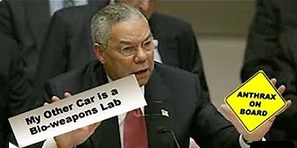
From Anthrax to Iraq
or go to
Aletho News Archives – Video-Images
Book Review
New paperback: Butchered by “Healthcare”
Lies are Unbekoming | October 20, 2026
 Butchered by “Healthcare” is Robert Yoho’s plain-spoken account of how American medicine stopped being a profession and became an industry. 341 pages. Over a thousand references. Thirty-eight chapters.
“Screening Tests Are Useless”, on tests that find diseases that would never have hurt you. “The FDA Protects the Big Drug Companies”, on an agency funded by the companies it regulates. “The Journals’ Sins Are the Editors’ Sins”, on ghostwritten studies and captured peer review. “Opioids and ‘Pain Management’”, on how a generation was prescribed its way into addiction. “Prozac and Relatives” and “Antipsychotics Are Disastrous”, on what psychiatry does to adults and children. “Surgery: Money Before Patients”. “Failed Cancer Treatments”. “Futile CPR and Overprescribing”. “Billing Scams & Specialty Warfare”. “Hospitals Are Sharks”. Each with a Patient Tips section at the end on how to survive it.
If you have ever walked out of a doctor’s office with a prescription you didn’t ask for, or watched a parent put through a treatment that made them worse, this is the book you want on your shelf before the next appointment. … Full review
Butchered by “Healthcare” is available on Lulu now.
Blog Roll
 Aletho News
- Iraq shuts key border crossing with Iran under US pressure: Report
- Undersea Internet cables could be targeted in retaliation for attacks on Iran: IRGC deputy chief
- EU sending ‘biased’ observers to interfere in Serbian election – president
- White House envoy declares kinetic action against Yemen ‘fruitless’
- Ukraine deployed thousands of microdrones in Iraqi Kurdistan: Tasnim
- Iran calls for emergency UNSC meeting over Trump’s ‘brazen’ bomb talk, Israeli threats
- Iranian sources reveal details of Russia-China Hormuz proposal
- Plan for more US-Israel integration puts our military tech at risk
- Another Round Against Iran Will Break What Is Left of the Gulf
- SVR Report on Ukraine’s Mexican Drug Gang Links Could Pressure Zelensky, Won’t Change US Policy
- If Americans Knew
- Christiane Amanpour exits CNN with a legacy shaped by the debate over Israel
- Israel’s war on Iran is the final move in a decades-old strategy
- Israel Denies Entry to French Journalist, U.S. Researcher Amid Rise in Entry Denials
- Gaza’s hospitals are running out of life-saving fuel – Daily Update
- Mysterious bot accounts reportedly spread fake ‘man on the street’ videos for Michigan Senate candidate
- Israeli Defense Minister Katz Says Over 60 Lebanon Villages Have Been Destroyed
- Why Is Israel Running TV Ads in Iowa Ahead of the Midterms?
- Hind Rajab’s Alleged Killer Is in the United States. HRF Demands His Arrest.
- US Officials Face Fresh Pressure After Another American ‘Brutalized’ by Israeli Settlers in West Bank
- Israel-Backed Palestinian Militias Terrorize Displaced Families in Gaza
- No Tricks Zone
- E-Cars Reduce CO2 Emissions By Only 41% Compared To Internal Combustion Engine Vehicles
- Predictions Made By Renowned Climate Professor Over Past Decades Have Been Proven To Be Poor
- New Study Suggests Large Regions Of The Pacific Ocean Have Been Cooling For The Last 80 Years
- Germany’s Green Energy Debacle: High Energy Costs Force Kahla Porzellan to Close After 182 Years!
- New Study: 50 Years Of The Most Aggressive ‘Net Zero’ Policies Can Only Affect The Global Climate By 0.03°C
- US September “Heat” Was No Record…Many Records Set Decades Ago
- Latest European Green Energy Debacle; Portugal’s Largest Flagship Solar Park Insolvent!
- Green Energy Debacle: German Expert Professor Fritz Vahrenholt Warns Of Severe Economic And Social Consequences
- Two More Paleo Reconstructions Affirm Meters-Higher Sea Levels Across Ireland, Brazil 7000-6000 Years Ago
- New Study: Earth And Venus Surface Warmth Largely Explained By Convection And Lapse Rate, Not CO2 Or Radiation

