The Hares Boys: Israeli Justice in Palestine

By Richard Hardigan | CounterPunch | December 18, 2015
On November 26 five Palestinian teenagers were sentenced to fifteen years in prison and fined roughly $40,000 each. This is not an unusual occurrence. Examples of Palestinians being punished for crimes they did not commit abound, but in this case the Israeli authorities have taken their injustice to a new level. Not only were “The Hares Boys”, so named because of the West Bank town from which they hail, not involved in any crime, but there was never any crime to begin with. This did not concern the Israelis in the least. Palestinians must be punished, and even if they are not guilty in this particular case, then surely they are guilty of something. So goes the thinking of the occupying force. The case has garnered international attention, but this did not worry the always image-conscious Israelis, and they have proceeded to mete out their own particular brand of justice.
I first heard of the Hares boys in June of 2014. Their names were written in black magic marker in large letters on the whiteboard in the living room of our apartment in Nablus. I was volunteering with the International Solidarity Movement (ISM), an organization devoted to standing in solidarity with the Palestinian people, and it was the evening of my first day in the northern West Bank city.
Charlie, the coordinator of the Nablus team, liked to write the names of all the projects ISM was involved in on the whiteboard, and the Hares boys were second from the top, squeezed between the name of a contact in a local refugee camp and a village that had recently been the subject of a settler attack.
Earlier that afternoon I had watched the limp body of yet another victim of Israeli aggression being carried through the streets of Nablus. Ahmed’s head was uncovered, with only a black and white keffiyah wrapped around his forehead. As his body was carried by the stretcher bearers, it was jostled quite a bit, and the head lolled back and forth with regularity. His father, an old bent man, walked behind, fingering his prayer beads, a vacant stare in his eyes. Ahmed had been murdered the previous night. Coming out of a mosque, the young mentally handicapped man had been screamed at by Israeli soldiers. They ordered him to stop, and when he did not heed their instructions, presumably because he did not understand them, they shot him four times – once in the stomach and three times in the chest.
With his close-shorn hair, Charlie looked younger than his twenty-three years, and as he explained the events surrounding the boys, I thought about the fact that he could not have been much older than the teenagers of Hares.
There were five Hares boys. At that point they had been in Israeli prison for over a year. Whenever there was a court date, ISMers would try to travel to the court, located in the town of Salem, which is north of Jenin and on the border with Israel, in order to provide moral support to the boys and their families.
In the evening of March 14, 2013, Adva Biton, a female settler, and her three daughters were involved in a traffic accident on their way to the settlement of Yakir, which lies southwest of Nablus. Biton and her three daughters were injured, and the injuries to one of the daughters were serious.
She died two years later of her injuries, compounded by pneumonia. The accident, which occurred near the Palestinian village of Hares, took place when Biton crashed her car into the back of a truck that was parked along the side of the road. The driver of the truck told police that he had pulled over to repair a flat tire. The trouble began when Biton later claimed that the accident had been caused not by the truck but by Palestinian youths who had been throwing stones. In fact, “in an Australian TV interview, Biton stated that she had a building block thrown at her vehicle which hit her daughter in the head and caused her to hit the back of the truck.”ii There were no witnesses to the accident, and nobody had seen anybody throwing stones, but the truck driver did add afterwards that he had noticed stones lying by the side of the road.iii
There are many problems with the story. In neither the initial accounts by the involved parties, nor in the original police investigation, was there a mention of stones. This changed a few days later, when Biton and the truck driver modified their original versions, and, in addition, when a subsequent police investigation uncovered a stone in Biton’s car. No building blocks were found anywhere near the scene. The fact that building blocks are exceedingly difficult to throw casts yet further doubt on Biton’s version of events.iv The truck driver’s statement about having seen stones on the side of the road should be seen as meaningless, since that part of the road is full of stones.v
Charlie’s face during his telling of the Hares boys’ story did not betray any emotion, but I imagined he must have been incensed, as he had been following these events for the past three months. He had even been to the court and later described the treatment that the boys’ families and other visitors received at the hands of the authorities.vi I wondered if this is what happened to activists after they had been in country for a while. Did they just become accustomed to the violence and suffering, and especially, the injustice?
In the days following the accident the Israeli army went into action. They entered the villages of Hares and nearby Kifl Hares three times, arresting a total of nineteen boys between the ages of 16 and 17 years. The nighttime raids were violent and the soldiers behaved aggressively. Accompanied by attack dogs and Israeli secret service (Shabak) agents, they broke down the doors of villagers’ houses and demanded to know the whereabouts of all the teenage sons. They handcuffed and blindfolded the boys without telling their families why or where they were taking them.
““Kiss and hug your mother goodbye,” a Shabak agent told one boy. “You may never see her again.””vii
All of the boys endured violent interrogations. They were also kept in solitary confinement. “One boy, since released, described his cell: a windowless hole 1m wide and 2m long; there was no mattress or blanket to sleep on; toilet facilities were dirty; the six lights were kept on continuously, leading to the boy losing track of the time of the day; the food made him feel ill. The boy was denied a lawyer; he was interrogated violently three times during three days.”viii After this ill-treatment, 14 of the 19 boys were released, while five boys confessed to the crimes. They are Ammar Souf, Mohammed Suleman, Ali Shamlawi, Tamer Souf and Mohammed Kleib.ix These are the Hares boys.
The Israeli media has played a significant role in this case. A few days after the accident, rumors began to surface that it had been a terrorist attack, and the subsequent media storm caused 61 witnesses to come forward, claiming that their cars had also been damaged by stones thrown on the same road that day. Prime Minister Netanyahu himself got involved, announcing proudly that “he had caught the terrorists that did it”x.
The boys were originally charged with twenty counts of murder and five counts of stone throwing each.
Unlike in most cases of Israeli injustice, the story of the Hares boys has garnered a great deal of attention, both international and domestic, and there have been several campaigns calling for the boys’ release.
A report by the Israeli NGO B’Tselemxi indicates that the Hares boys never had a chance. Between 2005 and 2010, 835 children were arrested in the West Bank on charges of stone throwing. Of the 835 only one was acquitted, an absurdly low number. Of the children, 34 were aged 12-13, 255 were aged 14-15, and 546 were aged 16-17.
The B’Tselem report also confirms that in a large majority of the cases, the judge does not allow bail and instead orders the defendant to be remanded in custody until the end of the proceedings. Because of the absurd conviction rate, the length of the pre-trial period and the inhumane conditions in the prisons, defendants often make plea bargains in exchange for shorter sentences.
The Hares boys awaited their fate in the notorious Meggido prison in Israel, where the conditions are reportedly atrocious, especially for minors.
“Conditions in Megiddo are severe. All prisoners, including children, are deliberately denied essential items such as food, clothing, bedding and hygiene products which have to be provided by their families, when families are permitted to deliver them, or purchased at inflated prices from the Israeli prison canteen. This means that inmates are required to fund their own incarceration. The children are almost entirely disconnected from the outside world. They are rarely allowed to exit their cells. Reports suggest that they are permitted to spend a couple of hours a week in the fresh air.
Their schooling has been discontinued. They are allowed infrequent family visits and no direct physical contact is permitted. They must communicate with relatives through a glass screen and speak through phones that do not always work. Families from the Occupied Territories do not usually receive permission to travel to what is now the State of Israel. When permitted, these journeys are expensive, lengthy and dangerous. Inmates are rarely treated for medical conditions.”xii
The great majority of the population of the West Bank has lived under military occupation for over 48 years. Only the settlers are exempt. The lives of the Palestinians are ruled by the military, and they are subject to military law, which is enforced by military courts. The system is based on military orders, which are issued by army commanders without approval from any civilian branch of government. They rule all aspects of Palestinian life in the West Bank, including freedom of movement, agriculture, access to water, ability to protest and land transactions.
Some of these orders are patently absurd (Military Order 107 prohibits the publication of treatises on Arabic grammar), while others have far-reaching consequences. Military Order 1651, for example, allows for the incarceration of children as young as twelve years old. It also allows for the administrative detention of individuals without charge for up to six months.
It is this military system that has destroyed the lives of the Hares boys and their families, as it has so many others. They face fifteen years in prison, and it is believed that unless the families can produce $7,750 for each of the boys by January 28, 2016, their sentences will be extended by an additional ten years.xiii
The troubling aspects of this particular case are many. There was little evidence that a crime had been committed and even less that pointed to the Hares boys as the offenders. There were no witnesses. The statements of the victims were contradictory and subject to change. The boys were tortured and coerced into giving false confessions. As children they awaited their fate in an Israeli adult prison in horrific conditions for over two years. This is what passes for justice in the territories occupied illegally by Israel, the self-proclaimed only democracy in the Middle East.
Notes
[1] “Hares Boys” Retrieved at https://haresboys.wordpress.com/.
[2] Fludd, Elischia. “Hares Boys Anniversary Still Worries Global Activists.” The Huffington Post. March 18, 2014. Retrieved at http://www.huffingtonpost.com/elischia-fludd/hares-boys-anniversary_b_4971764.html.
[3] “Hares Boys.”
[4] “Hares Boys Anniversary Still Worries Global Activists.”
[5] “Hares Boys Anniversary Still Worries Global Activists.”
[6] Donnelly, Charlie. “El Sistema Judicial Israelí: De Pseudo-democracia a Proto-fascismo (Parte II).” September 23, 2014. Retrieved at http://palestinalibre.org/articulo.php?a=52637.
[7] “Hares Boys.”
[8] “Hares Boys.”
[9] “Hares Boys Anniversary Still Worries Global Activists.”
[10] “Hares Boys.”
[11] “No Minor Matter: Violation of the Rights of Palestinian Minors Arrested by Israel on Suspicion of Stone-Throwing, July 2011.” July, 2011. Retrieved at http://www.btselem.org/publications/summaries/2011-no-minor-matter.
[12] Paul, Chandra. “For the Hares Boys.” June 19, 2014. Retrieved at http://weekly.ahram.org.eg/News/6520/19/For-the-Hares-boys.aspx.
[13] Edmonton, Amanda. “Hares Boys Sentenced to 15 Years.” International Middle East Media Center RSS. December 14, 2015. Retrieved at http://www.imemc.org/article/74219.
Richard Hardigan is a university professor in the United States.
Israel plans to build walls around Palestinian towns
MEMO | December 18, 2015
 Media reports in Israel have reported that the army is planning to build walls around Palestinians towns and villages on the pretext that it will stop stones being thrown at illegal Jewish settlers.
“The army will build 9 metre high walls in the areas of Beit Ummar, Al-Arroub, Gush Etzion, and the areas surrounding Highway 60, south of the West Bank,” claimed Channel 2 TV.
In response, Mustafa Barghouti, the Secretary-General of the Palestinian National Initiative, told Anadolu, “The Israeli army’s decision to build walls around important and vital areas in the southern part of the West Bank aims to control large Palestinian areas for settlers. It also aims to isolate the areas from each other in order to prevent any chance to establish a Palestinian state.”
Such walls, added Barghouti, are in addition to the 676 military checkpoints in the occupied West Bank as part of the Israeli plan to divide the territory and control all of its vital areas.
Lieberman launches campaign to oust Hanin Zoabi and the Joint Arab List from the Knesset
MEMO – December 17, 2015
Israeli Member of Knesset Avigdor Lieberman, who also heads the Yisrael Beiteinu Party, has launched a campaign to oust Arab MK Hanin Zoabi and the Joint Arab List from the Israeli parliament.
The campaign, which Lieberman began on his Facebook page yesterday, calls for “permanently” ousting Hanin Zoabi from the Knesset. “Together we can expel vandal supporters from the Knesset,” he said in a Facebook post.
In a video posted on his page, Lieberman called on the Israeli public to put pressure on MKs from the Likud, Jewish Home, Kulanu, Shas and United Torah Judaism parties to support the proposed campaign, which aims to expel Zoabi and the Joint List from the Knesset.
Lieberman mentions in the video that the Central Election Commission (CEC) previously banned Zoabi and her party Balad (a member of the Arab Joint List) from running but that the Supreme Court overturned the commission’s decision. As a result, Lieberman presented a bill seeking to remove the Supreme Court’s power of intervening in CEC’s decision of whether to approve or ban the participation of a candidate or a list in the Knesset’s elections.
Lieberman claims that the banning of Balad was in line with the law, which states that those who support terrorism and armed struggle against the state of Israel, or deny Israel’s existence as a Jewish state, cannot be in the parliament. “The party of traitor Azmi Bishara and his successor Hanin Zoabi is doing that openly, and it is time they were made to pay the price,” he added.
US House Passes Bill to Block Hezbollah from International Financial System
Bill also targets Al-Manar TV
Press TV December 16, 2015
The US House of Representatives has approved sanctions against banks that do business with the Lebanese resistance movement Hezbollah.
Lawmakers unanimously voted for the imposition of the sanctions in a bill that will be sent to the White House for US President Barack Obama’s signature.
Following a unanimous one in the US Senate on November 17, the House voted for the measure 422 to 0 .
The bill also targets the resistance movement’s television channel Al-Manar through attempts to cut the broadcast of satellite operators that air the channel’s programs.
Meanwhile, a senior administration official told AFP that the president will sign the legislation, adding the White House and the US Congress have been working together for long “to intensify the pressure” on the organization, which the official described as a “terrorist.”
This is while Hezbollah fighters have been engaged in battles against the Daesh Takfiri terrorists in Syria.
Apart from pressuring banks that knowingly do business with the group, the bill also requires the White House to present reports to the Congress in regard to Hezbollah’s operations.
The organization has been accused by the US of committing “terrorism” while its fighters keep advancing against the ISIL militants, originally trained and funded by the CIA in Jordan in 2012 to destabilize the government of Syrian President Basher al-Assad.
In an Appalling Act of Hypocrisy, NY Times Promotes Settlers as Peace Builders
By Barbara Erickson | TimesWarp | December 15, 2015
Gush Etzion Junction was a peaceful corner of the West Bank, according to The New York Times, until Palestinians ruined it with a series of attacks in the latest uprising. Such is the message in Isabel Kershner’s most recent attempt to whitewash Israel’s brutal and illegal occupation of Palestinian territory.
Readers are never reminded of the fact that Gush Etzion is an illegal Jewish-only settlement block located in the heart of the West Bank. Nor are they told that its presence means the loss of thousands of acres of land once vital to the livelihood of the indigenous Palestinians, the confiscation of water resources and a choking system of military checkpoints.
In her story today, Isabel Kershner makes no attempt to discern what Gush Etzion means to Palestinians, although it sprawls over a large tract of their heartland, on their confiscated hills and fields. She provides Gush Etzion’s Jewish history but says nothing of the Palestinian experience, and while listing recent attacks on Jews, she makes no mention of Palestinian injuries and deaths, which far exceed those of Israelis.
Her one attempt to provide a motive for Palestinian attacks is ludicrous: The junction has become a target because it is a “hub of coexistence.” Nothing is said about the crushing effects of the occupation, trigger-happy Israeli troops, the continuing confiscation of Palestinian land and the loss of hope.
She writes: “Jewish settler leaders have promoted the slightly shabby complex as a symbol of peaceful coexistence and evidence that Israelis and Palestinians can share the hotly contested territory.”
In other words, the settlers have the best of intentions. After stealing Palestinian land and water to build Jewish-only colonies, they insist that they want only to be good neighbors.
Kershner also makes a feeble effort to provide “balance,” bringing out her stock phrases to defend Israel’s crimes: “The Palestinians and much of the world consider all settlements in the territories seized in 1967 as illegal and an obstacle to establishing a Palestinian state.”
Much of the world. This is a duplicitous way to put it. In fact, the entire world opposes the settlements, even Israeli’s staunchest ally, the United States.
When Prime Minister Benjamin Netanyahu last year announced a huge land grab from Palestinian villages surrounding Gush Etzion, the world rushed to condemn the act. This is important context in any discussion of the block, but no mention of it appears in Kershner’s story.
Other factors undermine her claim of peaceful coexistence and good intentions from settler leaders. B’Tselem, the Israeli human rights monitoring group, has frequently charged that the Gush Etzion police station is notorious for torturing Palestinian teens in order to extract confessions. It has released reports over several years pointing to significant abuses in the heart of the settlement block.
Kershner makes much of the presence of Palestinian employees at Gush Etzion Junction and manages to quote one of them—at the end of her story—thus suggesting that it is a welcoming place, open and tolerant. The backstory, however, is more revealing. It can be found in this paragraph from The Economist, written after Netanyahu’s land grab announcement last year:
“Encircled by Mr Netanyahu’s latest appropriation, Palestinian residents of the bucolic village of Wadi Fukin have already lost all but 450 of the 3,000 acres they once had, and stand to lose more. The hillsides where the village’s 600 sheep and goats graze are set to go. Unable to farm, many men find work as builders, often on Jewish settlements nearby. They may yet be called upon to build homes for Israelis on land they regard as their own.”
Wadi Fukin is one of the villages destined to lose under the latest expansion of Gush Etzion. Its tragic tale and that of many others are entirely missing from the story in the Times today. In such a context-free effort, Kershner makes her claims of tolerant settlers and a peaceful oasis, and the result is an appalling act of hypocrisy and spin.
Follow @TimesWarp on Twitter.
DONALD TRUMP IS ELECTABLE AS PRESIDENT, BUT…
By John Chuckman | Aletho News | December 15, 2015
I think it entirely possible Donald Trump could be elected President. I am not in favor of it – but then neither am I in favor of any of the other candidates on offer – yet I do think his election is increasingly possible. America displays every four years – almost like a temporary clothesline erected on the front lawn of the White House loaded with soiled and tattered undergarments – the sheer poverty of its political system. Every four years, a gang of mediocrities and thugs spend vast amounts of money to say, from coast to coast, nothing worth hearing.
Sometimes I wonder why anyone bothers to run for office in a long, costly, and exhausting contest which if won means four years of taking directions from the Pentagon and seventeen security agencies. America is not a democracy, and the last president who actually tried to exert some significant influence on affairs left much of the right side of his head in the streets of Dallas. But ego is a mighty powerful motivator, and the gang engaged in national American politics has plenty of it, even if few other redeeming qualities.
Trump could make Hillary Clinton regret she ever shared a stage to debate with him, especially a Hillary Clinton whose past has finally begun to catch up with her, now finally wounded by her long record of dark intrigues and vicious lies. Trump is no angel by comparison, but his focus has been on making money and aggrandizing his name, things most Americans respect. He has no political record for which to account or apologize.
He has said many things which make him sound like a juvenile given to insulting people’s appearances, and he has some proposals which would prove impossible for anyone to implement, yet somehow he has hit on some issues which find a welcome hearing by many, especially unsophisticated people who might even once have been Democratic voters. Americans are tired of unresponsive politicians, something of which they have stables full. They are also tired of the bewildering events in a world at the center of which invariably the United States finds itself. Most Americans never voted for such things and have no interest in them. Only dishonest appeals about supporting the troops keep them from rebelling, and their own increasingly difficult economic lives generate a lot of stress. America is full of frustrated and angry people, many of them not even sure what it is they are so angry about and many of whom have no time or patience to understand the world in which they live. Hard-hitting simplicities are music to the ears.
One of the sharpest ironies of Trump is that not all of his views are simplicities. Some are dead-on assessments of things which could have been avoided and leaders who failed the country. So this man comes bundled with a wide-ranging group of political goods, far more so than anyone I can recall in recent times. Just think of the simple-minded recitals of senior American politician after senior American politician. They all sound rather like Sarah Palin reciting her money-generated mantra but with differing levels of sophistication and vocabulary. She is the basic template while other models come with little tweaks and feature, but they all say nothing worth hearing. There is a very real reason for that: under America’s establishment-run, aristocratic political system, there is almost zero latitude for change either in domestic or foreign affairs, except in the field of war where more seems always welcome.
No matter what you think of Trump’s views – and the author should confess he is not an admirer of most of them – many people find it utterly refreshing to hear him touch subjects none of the usual Washington politicians touch. He goes far beyond the pathetic high-school recitation of lines by Sarah Palin. Or, I might add, the paid lies of men like Newt Gingrich and scores of others who will literally speak in absurdities in return for multi-million dollar campaign contributions. I only mention Newt because the last time he tried to campaign, he ran around the country saying there really was no such thing as a Palestinian, his quid pro quo for nearly twenty million dollars in funds from a man with claustrophobic ties to Israel.
Just think of the all the bland, say-nothing-worth-hearing types, epitomized by Jeb Bush who resembles nothing so much as a well-groomed hamster both in the sounds he makes and in his blinking-into-the-camera, insipid-smile looks. And think of all the grotesque liars who run for high office in America never telling people what really motivates or enables them or what special interests pay their way. It all really is a parody of democracy.
You might think a brash and independent-minded guy like Trump is just the answer to changing some of that, and I can well understand the hopes, but there are very powerful barriers in American society as it now has come to be organized against such hopes being realized. The first day of sitting at a huge polished conference table, greatly outnumbered by arrogant country-club security chiefs with secret budgets you cannot imagine and rigid generals whose uniforms glitter almost like Christmas trees, might just test the mettle of a Trump. Add to that the heads of great corporations each worth hundreds of billions of dollars making private appointments. And then the polished heads of mighty special interest lobby groups used to getting their way. And just who are your allies and confidants in opposing some of the things they demand? You have no political background from which you would have built such relations.
It’s a daunting and dreary picture, and you have to remember, these powerful people who compose the formidable American aristocracy are the very ones who allowed and encouraged the ugly situations into which America is straight-jacketed.
Despite Trump’s freshness and energy, a Trump victory could prove a disaster. Not because he would flirt with atomic war, something Obama now already does regularly, or create vast new domestic schemes. Of course, the scheme of building a fence across Mexico and rounding up and returning all illegal migrants is vast indeed – a virtual moon-landing project from scratch – but this author thinks it would fortunately prove impossible. Even if the American aristocracy permitted him to pursue such a Don Quixote project, it would only be in order to gain his compliance in other, far more important and consequential matters such as the vast, destabilizing, and murderous wars in the Middle East and the bullying of Russia and China.
On top of all that, Trump has made some deadly serious enemies, and number one on the list is Israel and its supporters who view him as not adequately friendly to Israel’s interests.
When Trump, for example, speaks, entirely sensibly, about leaving Syria for Putin to sort out, he goes dead against a dark and costly scheme which was in part created by Israel. They want Assad dead. They want Syria Balkanized much as Iraq is. And they are enjoying the stolen, discount-priced oil they get indirectly from ISIS through Turkey.
And they don’t want Russia gaining genuine influence in the Mideast, the United States being Israel’s source of seemingly inexhaustible assistance, permission, and protection – the provider of vast subsidies of every kind imaginable. Moreover, Netanyahu and other leaders in Israel have long striven to have Israel assume a geopolitical role in the Mideast as a kind of miniature replica of what the United States is in the world, a bully hegemon. There’s no room in that picture for Russia.
If you read the kind of columnists who regularly serve as apologists for Israel’s brutality – there’s at least one filling that role on the staff of every mainline newspaper – you find a universally negative attitude towards Trump. It has nothing to do with conservatism versus liberalism, and it certainly has nothing to do with human rights. The columnists use words about human rights to make their view more palatable to the general population of readers and to serve as a smokescreen for what it is with which they are really defending.
After all, Israel’s Netanyahu is perhaps the world’s most flagrant violator of human rights, holding about five million people completely against their will with absolutely no rights or freedoms, periodically stealing their homes and land, violating the sanctity of their religious places, and frequently just killing large batches of them – always undoubtedly with an eye to making them so miserable that they will pick up and leave. The people of Gaza are not even allowed to import cement to repair Israel’s recent destruction of their homes and institutions. I simply do not know of crueler circumstances in the world completely tolerated by America’s aristocracy.
There have been several ugly outbursts recently, including one from an executive of Colorado’s American Civil Liberties Union who was yelling about assassinating Trump voters, words I just could not believe when I first read them.
But then in past years we have had extremist defenders of Israel propose many horrible measures including one from an American lawyer who proposed summarily killing the entire families of any Palestinian acting as a “terrorist,” so the raving speech is not without precedent. The executive’s words communicate the intense level of hate which simmers. I am sure this disturbed man – since forced to quit – is not the only one with such thoughts bubbling like sewerage through his mind.
Always admirers of political hamsters and gerbils as candidates with dark eminences behind them doing the necessary filth, the Bush-Cheney model if you will, or indeed the Eisenhower-Dulles or Reagan-Casey one – the Republicans will make every effort to stop Trump with backstage political manipulations, such as a brokered convention, but they may well not succeed, his position being made quite strong by the possibility of his running as a third-party candidate, and one with huge financial resources to boot.
But if they fail, and he wins, look out for the darkest possibilities.
All this is quite terrible, but that is simply what America is today, terrible.
57 Congress Reps Taken to Israel
Who Do They Really Represent?
By Paul Larudee | Dissident Voice | December 14, 2015
In August, 2015, 57 brand new members of the U.S. House of Representatives bowed their heads and promised to obey their Israeli overlords. They allowed themselves to be taken to Israel, plied with good food and propaganda. They then returned home to do Israel’s bidding in the Congressional seats that Israel helped them win. Sixty were invited, but only three decided not to go, for unknown reasons.

But isn’t there a more innocent explanation? Perhaps they just wanted to learn more about the issue and would equally have accepted an invitation to visit Palestine and see it from a Palestinian point of view. Nothing wrong with giving equal opportunity to both sides.
The Free Palestine Movement tested this theory and found it wanting. We sent a personalized invitation to exactly the same members of Congress to come to Palestine at our expense. Not a single one accepted. Although we sent a followup to those who did not respond the first time, the vast majority never responded at all. A few said that they could not make time in their schedule, not even when we suggested that they could wait as long as their next term. Only one, Brad Ashford of Nebraska, said that he was working with some of his constituents to visit Palestine. (We have been able to find no evidence of such an initiative.)
Israel, through its US Lobby, has of course been doing this for more than half a century. There are hardly any members of Congress that have not accepted an invitation at least one time during their career, often more. Can you name any other country with such a devoted following in the U.S. Congress?
The reason, of course, is that the Israel Lobby has a reputation of making or breaking congressional careers, and that members of Congress are x-rayed to assure that they possess no detectable spine before they take office. There is more pushback from some Israeli newspapers than from the US Congress.
And why not? There has never been any price to pay for obeying Israel. In fact, candidates compete to do favors for Israel and to get donations managed by Israel’s Lobby, with little or no consideration of how much they are robbing their constituents.
But this time it’s different. We may not be able to persuade members of Congress to look at both sides of the Israel question, nor to ask why US taxpayer money is supporting an Israeli ethnic cleansing campaign against Palestinians, nor why our roads are not paved nor our bridges repaired nor our children educated. But we can show the depravity of our elected officials. We can demonstrate their hypocrisy and their bias and dishonest treatment of US foreign policy, which results in war, death and destruction for all but the tiny number of super-wealthy profiteers whose hands are covered in blood.
That’s why the Free Palestine Movement is running the ad below on the sides of buses in San Francisco. It is why we are making the same ad available at cost as a 3″ x 9″ sticker to anyone who wants to use it. It’s why we’re ready to share the cost of a display ad on buses or anywhere else with any group that wants to run the ad anywhere in the US, for as long as our funds last.
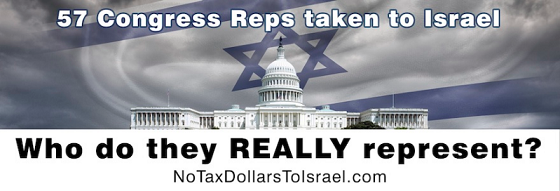
It is only a start, but we can at least begin to hold our elected officials accountable. We can make them begin to pay a price for selling out both the American and the Palestinian people to Israel.
Paul Larudee is one of the founders of the Free Gaza and Free Palestine Movements and an organizer in the International Solidarity Movement.
Featured Video
Trita Parsi: Israel Set a Trap for Total War in the Region
or go to
Aletho News Archives – Video-Images
From the Archive
Zionism’s Violent Legacy
By Donald Neff | Washington Report On Middle East Affairs | January 1996
On January 4, 1948, Jewish terrorists drove a truck loaded with explosives into the center of the all Arab city of Jaffa and detonated it, killing 26 and wounding around 100 Palestinian men, women and children.[1] The attack was the work of the Irgun Zvai Leumi – the “National Military Organization,” also known by the Hebrew letters Etzel – the largest Jewish terrorist group in Palestine. The Irgun was headed by Revisionist Zionist Menachem Begin and had been killing and maiming Arabs, Britons and even Jews for the previous ten years in its efforts to establish a Jewish state.
This terror campaign meant that at the core of Revisionist Zionism there existed a philosophical embrace of violence. … continue
Blog Roll
 Aletho News
- Trita Parsi: Israel Set a Trap for Total War in the Region
- Trump’s Iran war is on an Israeli leash
- Saudi oil boss issues global supply warning
- Riyadh Says Its Oil System Is Intact. The Numbers Say Otherwise.
- Trump and Netanyahu Want to “Finish the Job” on Iran
- US ‘one-sided dictation’ not Iran’s beliefs makes rational talks impossible: Baghaei
- Iran’s Next Strike May Not Explode. It Could Shut You Down /Col Doug Macgregor
- Iran: US political targets legitimate if assassinations return
- Iraq shuts key border crossing with Iran under US pressure: Report
- Undersea Internet cables could be targeted in retaliation for attacks on Iran: IRGC deputy chief
- If Americans Knew
- The Israel Lobby’s Changing Fortunes
- AIPAC has become such a political liability that it’s shifting to a more “nimble” approach to buying politicians
- At least 160 Israeli settler attacks in 2 weeks
- Will Gaza’s Ancient Christian Community Disappear Forever?
- Israel’s vision of regional security rests on keeping Arab states weak
- Heidi Levine recounts how Palestinian youths helped save her in settler attack
- DAILY UPDATE: Latest essential news on Palestine, Israel, & region
- Trump’s Intensifying Sabotage of the ICC, for Israel’s Sake
- Israeli military detain US and UK volunteers in West Bank including Democratic NY politician Brad Lander
- Americans at National Conservatism Conference held in Israel this year criticize Israel
- No Tricks Zone
- E-Cars Reduce CO2 Emissions By Only 41% Compared To Internal Combustion Engine Vehicles
- Predictions Made By Renowned Climate Professor Over Past Decades Have Been Proven To Be Poor
- New Study Suggests Large Regions Of The Pacific Ocean Have Been Cooling For The Last 80 Years
- Germany’s Green Energy Debacle: High Energy Costs Force Kahla Porzellan to Close After 182 Years!
- New Study: 50 Years Of The Most Aggressive ‘Net Zero’ Policies Can Only Affect The Global Climate By 0.03°C
- US September “Heat” Was No Record…Many Records Set Decades Ago
- Latest European Green Energy Debacle; Portugal’s Largest Flagship Solar Park Insolvent!
- Green Energy Debacle: German Expert Professor Fritz Vahrenholt Warns Of Severe Economic And Social Consequences
- Two More Paleo Reconstructions Affirm Meters-Higher Sea Levels Across Ireland, Brazil 7000-6000 Years Ago
- New Study: Earth And Venus Surface Warmth Largely Explained By Convection And Lapse Rate, Not CO2 Or Radiation

