Sami Ali El Goga – The Story of a Gazan Fisherman
International Solidarity Movement | September 3, 2015
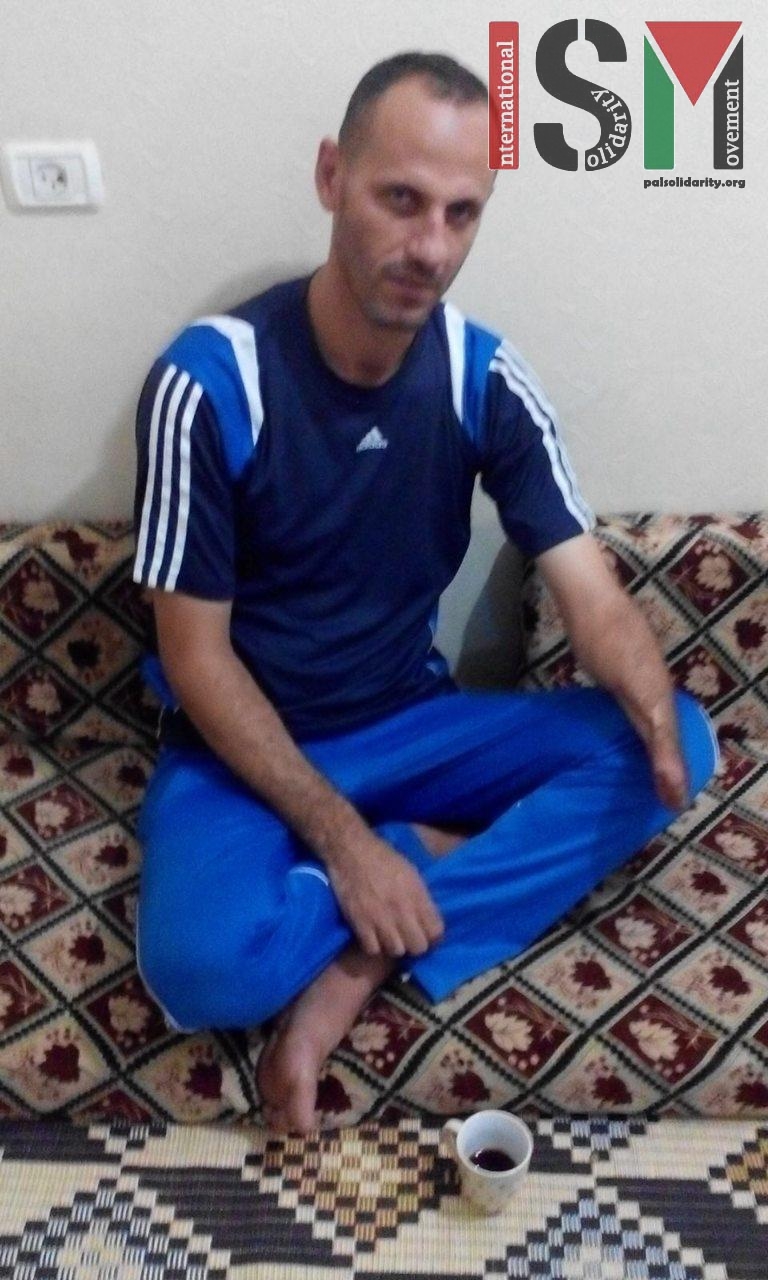 ISM Gaza met the fisherman Sami Ali El Goga, 36, who lost his hand and part of his arm the 12th March 2007, when he was attacked by the Israeli navy. In the same attack his boat was completely destroyed and his 13-year-old nephew, who was in the boat with him, sustained shrapnel wounds throughout his body.
Eight years later he is still waiting for the assistance promised by several international agencies, as he hasn’t been able to work since the attack, and without the boat a 20-member-family lost its source of income.
On that day, Sami and his nephew had just reached the 1.5 miles naval blockade when the zionist army approached and started shooting rockets towards them. They attempted to escape to the closest beach, as there was no chance to reach the port. Once on the beach the shooting didn’t stop. Whilst attempting to escape from the boat with his nephew, it was hit by a rocket and in the explosion Sami was severely injured. He nearly bled to death waiting for medical assistance as the Israeli navy prevented any recue from reaching him until 30 minutes later.
After 3 hospitals in Gaza weren’t able to treat him the Palestinian Authority mediated in order that he could be treated in a Hospital in the ‘48 territories (AKA Israel), as the occupation had previously refused to allow him to exit Gaza. The doctors there amputated his hand and afterwards he was taken by the zionist intelligence for an interrogation before sending him back to Gaza.
This wasn’t the first attack Sami suffered, as another boat from his family had been stolen by the occupation in the past.
UK government acts to stop councils divesting from Israeli occupation
MEMO | October 3, 2015
The UK government has said it intends to change legislation in order to prevent local councils divesting from the arms trade and Israeli human rights abuses.
Announcing the plans, a Conservative spokesperson said that “Labour’s Jeremy Corbyn and John McDonnell, alongside Labour-affiliated trade unions, are urging councils to use their procurement and pension policies to punish both Israel and the UK defence industry.”
The spokesperson continued: “Hard-left campaigns against British defence companies threaten to harm Britain’s £10 billion export trade, destroying British jobs, and hinder joint working with Israel to protect Britain from foreign cyber-attacks and terrorism.”
The proposed amendment to legislation will be aimed at stopping councils from incorporating the concerns of human rights campaigners into their pension and procurement policies.
According to Communities and Local Government Secretary Greg Clark, such a step would be a challenge to “the politics of division.”
The language used by the Conservatives, including the claim that divesting from companies complicit in Israeli atrocities “poison[s] community relations”, mirrors the rhetoric of pro-Israel lobby groups.
Clark added that “divisive policies undermine good community relations, and harm the economic security of families by pushing up council tax.” Cabinet Office Minister Matthew Hancock said: “We will…prevent such playground politics undermining our international security.”
Update on Amer Jubran Case: Torture and Denial of Justice
Urgent Action for Amer Jubran Mon 10/5
Members of the Amer Jubran Defense Campaign have recently received trial documents revealing severe human rights violations at every stage in the arrest, trial, and sentencing of Amer Jubran and his co-defendants. Most importantly, the documents show that the defendants were forced to sign prefabricated confessions under torture from agents of the General Intelligence Directorate. According to testimony the defendants submitted at trial, they were not even allowed to read these statements before being forced to sign them.
Methods of torture enumerated in a brief filed by defense attorneys include sleep deprivation, routine and constant humiliation, threats of violence against members of the defendants’ families, physical beatings, and prolonged stress positions. One defendant with a life-threatening illness was denied medication unless he agreed to sign.
The defendants contested these fabricated confessions at trial. In its decision, the State Security Court nevertheless stated that it was not required to consider the defendants’ testimony or any of the defense’s evidence, and used the forced confessions as the primary basis for its ruling.
The confessions that formed the basis for the court ruling defy all credibility. In Amer’s case, we are to believe that a full confession to all the facts in the trial was made voluntarily on May 6, 2014–less than 24 hours after his arrest. (He nevertheless continued to be held for close to two months in incommunicado detention.) According to the GID officer who provided the document, the confession was made without any interrogation, as a simple answer to the question: “Tell us what occurred with you.” A similar procedure was supposedly followed with the other defendants, all of whom confessed to the same facts in statements that frequently used identical language to describe the same events, referring in some cases to events that allegedly took place ten years earlier.
That such confessions should be submitted to the court and accepted by it without question suggests that the use of confessions obtained through torture has become so routine in Jordan–and takes place within such an atmosphere of impunity–that no serious attempt has been made to conceal the fact.
Amer’s case is now in appeal before Jordan’s Court of Cassation (i.e., its Supreme Court). A decision is likely to be issued within the next 1-2 weeks. International pressure at this moment is key, since it is the last opportunity under ordinary procedures in which the unjust decision in this case can be reversed.
Amer has also made us aware that he is concerned about the possibility of retaliatory measures being taken against him in prison–including transfer to a facility with prisoners who have been charged with membership in organizations such as Al-Qaeda, who would have a hostile relationship to a prisoner charged with affiliation with Hizballah. This is further reason to make the Jordanian government aware that people around the world are watching.
Action Call: E-mail Campaign on Monday, October 5:
We are asking Amer’s supporters and all who care about fundamental human rights, to direct e-mails calling for urgent intervention in Amer’s case on Monday, October 5, to:
Minister of Justice, Bassam Talhouni: Feedback@moj.gov.jo .
Please cc’ the following:
Prime Minister and Defense Minister, Abdullah Ensour, info@pm.gov.jo
Minister of Interior, Salamah Hammad, info@moi.gov.jo
Or you can send an e-mail automatically by through the website of the Samidoun Network of Support for Political Prisoners: http://samidoun.net/2015/10/take-action-update-on-amer-jubran-case-torture-and-denial-of-justice/
A sample letter, an open letter from the Amer Jubran Defense Campaign, and more details regarding the human rights violations in Amer’s case are included below.
In addition to torture, some of the other violations of elementary rights to due process and to fair trial included the following:
1) No warrant was presented at the time of his arrest.
2) Amer and other defendants were denied access to lawyers after their arrest. They were specifically threatened with torture if they requested the presence of lawyers when they were ultimately brought before the Public Prosecutor.
3) Defense attorneys at trial were not allowed to summon for questioning GID officers involved in the arrests, in the seizure of evidence, in interrogation, and in drawing up the arrest records. They were thus deprived of their ability to demonstrate that the confessions were false and to contest material evidence used in the trial.
4) Defense attorneys were not allowed to call expert witnesses concerning key issues at stake in the use of material evidence (such as computer forensics) or to request intelligence central to the charges in the trial.
***
Sample Letter:
Dear Minister of Justice Bassam Talhouni,
I am writing to call your attention to the severe miscarriage of justice against Amer Jubran, a Jordanian citizen who currently has a case before Jordan’s Court of Cassation.
⦁ Mr. Jubran was arrested on May 5, 2014 by agents of the General Intelligence Directorate and held in incommunicado detention for close to two months. No warrant was presented at the time of his arrest. The UN Working Group on Arbitrary Detention sent an urgent appeal on his behalf to your government at that time: See https://spdb.ohchr.org/hrdb/28th/public_-_UA_Jordan_07.07.14_%281.2014%29_Pro.pdf
⦁ During his period in GID detention, Mr. Jubran and six other defendants in the same case were subjected to prolonged periods of torture, including sleep deprivation, beatings, stress positions, and threats of violence against their families. Under these conditions they were forced to sign false confessions to planning a series of “terrorist” actions–confessions they were not even allowed to read before signing them.
⦁ On July 29, 2015, Mr. Jubran was sentenced by Jordan’s State Security Court to 10 years in prison with hard labor. The Court refused to consider the defense evidence in the case, and used the fabricated confessions as the basis for its decision.
Global human rights organizations, including Amnesty International, Human Rights Watch, and the Al Karama Foundation have condemned the prevalence of torture in Jordan by the General Intelligence Directorate. The lack of independence of State Security Court from the GID and its failure to condemn torture and other fundamental human rights violations by GID agents have been specifically cited as a reason for the persistence of torture in security cases in Jordan. The United Nations Committee Against Torture, and the UN Working Group on Arbitrary Detention have repeatedly called for the abolition of the State Security Court.
I am writing now to urge that you take all necessary action in the case of Amer Jubran to see that his appeal before the Court of Cassation receives full and independent review. The severe violations of human rights in his case must be condemned and the unjust sentence reversed.
Sincerely,
***
Letter from the Amer Jubran Defense Campaign:
Dear Minister of Justice,
We urgently call your attention to the case of Amer Jubran and his horrendous treatment at the hands of the Jordanian General Intelligence Directorate. Mr. Jubran currently has a case before the Court of Cassation for severe violations of legal process in his arrest, interrogation and trial.
Mr. Jubran was violently arrested in May of 2014 and no crimes were specified at that time. He spent 50 days in a secret detention facility where he was unable to see his lawyer or family. According to the defendants’ testimony at trial, he and six other defendants were repeatedly tortured in this facility. They were forced by torture to sign identical statements that had been prepared in advance by the interrogators–statements they were not even allowed to read before signing them. The torture, led by Colonel Habes Rizk, involved 72 hour periods of sleep deprivation, being forced under cold water, being forcibly revived after fainting, threats, beatings, face-slapping, insults, and humiliation. The intelligence officers threatened to bring Mr. Jubran’s parents, wife, and children into the interrogation. They threatened to assault Mr. Jubran’s wife in front of him in order to force co-operation. Pressure was applied to his shoulder and neck and to his legs for prolonged periods to cause pain. Critical medication and transfer to a hospital was withheld from one defendant suffering from hepatitis and liver disease until such time as he signed his statement. Lawyers were not allowed to see their clients during the entire period of interrogation.
It’s only after this lengthy period of incommunicado detention and torture that charges of “terrorism” were ultimately brought against him.
At the end of Mr. Jubran’s trial in August 2015 the judges of the State Security Court completely ignored a thorough defense by his lawyers, declaring all evidence brought by the defense irrelevant. The Court then sentenced Mr. Jubran to ten years in prison with hard labor.
International human rights organizations, including Amnesty International, Human Rights Watch, the United Nations Committee Against Torture, and the United Nations Working Group on Arbitrary Detention have been clear in condemning the atmosphere of impunity in Jordan, especially in cases before the State Security Court involving torture by agents of the General Intelligence Directorate.
The actions of the GID, the State Prosecutor and the State Security Court in Mr. Jubran’s arrest, detention and trial violate the most basic standards of international human rights, including protection from torture and the right to a fair trial before an impartial court. It is clear from his case that these agencies are confident that their activities will not be called into question, that they can get away with any and all violations of the rights of Jordanian citizens.
We ask you to demonstrate that this is not so, and to intervene on Mr. Jubran’s behalf. The current appeal is perhaps the only opportunity left for responsible officials in Jordan to reverse this gross violation of Mr. Jubran’s legal and human rights. Amer Jubran has friends and supporters from all over the world who will be watching for your response.
Sincerely,
The Amer Jubran Defense Campaign
Israel Escalates ‘Water-Apartheid’ As Illegal Settlers Contaminate Palestinian Water
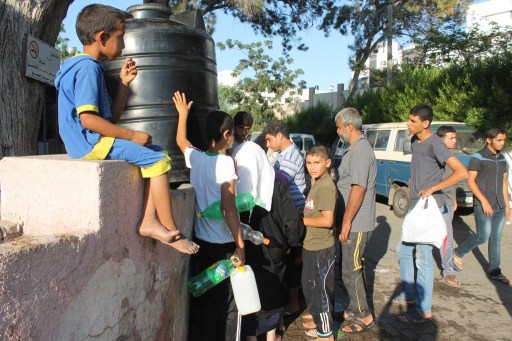
Palestinians displaced by Israeli strikes wait to get water from portable tanks near a makeshift encampment behind Gaza’s al-Shifa hospital, July 26, 2014. (Joe Catron)
By Joe Catron | Mint Press News | September 29, 2015
UNITED NATIONS — Israeli restrictions on Palestinian water use, as well as damage to water supplies and infrastructure by both Israeli forces and Jewish settlers, continue to deplete the already limited water supplies available to millions of Palestinians in the occupied West Bank and Gaza Strip.
“Water is used by the Israelis to achieve non-water interests, as a tool of punishment,” Dr. Abed Elrahman Tamimi, director of the Palestinian Hydrology Group in Ramallah, told MintPress News.
Meanwhile tens of thousands of Palestinians within Israel continue to lack access to running water, despite their citizenship in the state and the equality they should receive under its laws.
Israel has limited the water available to Palestinians in the Gaza Strip and West Bank since its forces occupied the enclaves, placing them under military rule, in 1967.
‘Scandalously uneven, humiliating and infuriating’
The Oslo II Accord, signed by Israel and Palestine Liberation Organization on Sept. 28, 1995, formalized this disparity, imposing what Israeli newspaper Haaretz writer Amira Hass called “a scandalously uneven, humiliating and infuriating division of the water resources of the West Bank.”
The agreement afforded Palestinians 118 million cubic meters of water per year from the Mountain Aquifer that stretches into Israel from the West Bank, while obligating Israel to sell Palestinians a further 27.9 mcm annually at full price.
It also entitled Israel to claim 483 mcm per year – over four times as much – but allocated none to the Gaza Strip, which was left to rely on the small Coastal Aquifer.
According to its own terms, Oslo II should have terminated in Palestinian independence after five years, with a joint committee increasing Palestine’s water allocation through consensus in the meantime. Neither scenario has come to pass.
In coming years, Israel would make clear that it had no intention of ever ending its control of Palestinian water. A June 7, 1997 order reiterated its longstanding policy: “All the water in the land that was occupied again is the property of the State of Israel.”
Successive governments pushed new waves of settlement construction, universally considered war crimes under the fourth Geneva Convention, on Palestinian lands in the West Bank. By 2000, the number of settlers had swelled 26 percent.
Like earlier settlements, the sites of many new units were calculated to maximize Israeli control of Palestinian water. In 2001, then-Israeli Prime Minister Ariel Sharon told Haaretz : “Is it possible today to concede control of the aquifer, which supplies a third of our water? Is it possible to cede the buffer zone in the Jordan Rift Valley? You know, it’s not by accident that the settlements are located where they are.”
Israeli measures to cement its occupation, along with provocative raids of the Al-Aqsa Mosque in Jerusalem, ultimately produced the Second Intifada, a Palestinian uprising that erupted on Sept. 28, 2000, five years to the day after Oslo II.
A vicious water cycle
Palestinians currently use no more than 11 percent of the Mountain Aquifer, with Israel enjoying the rest, according to the Emergency Water, Sanitation and Hygiene group (EWASH), a coalition of 28 Palestinian and international agencies dealing with water issues in the West Bank and Gaza Strip.
Meanwhile, West Bank Palestinians purchase 50 mcm of water each year from Mekorot, Israel’s national water company, paying $50 million for the return of their own resources at prices up to three times those charged to Israeli consumers.
Oslo II obligated Israel to increase its water sales to Palestinians in the Gaza Strip from 5 to 10 mcm annually during the supposed five-year “interim period.” But only this year, following widespread condemnation of its military operation against the besieged enclave last summer, did it finally do so, meeting 5 percent of the water needs of a population that has more than doubled.
On September 1, a United Nations Conference on Trade and Development report repeated a warning, first made by the UN’s Country Team for the occupied Palestinian territory in 2012, that the Gaza Strip could become unlivable by 2020.
UNCTAD cited the destruction of Gaza infrastructure during repeated Israeli offensives, including damage to 20-30% of the enclave’s water and sewer network, a water desalination plant, and 220 agricultural wells during last summer’s 51-day operation alone, as well as Israeli restrictions on economic development and reconstruction.
It also warned that “a severe water crisis” had forced the use of water from the Coastal Aquifer — 95% of it unfit for drinking — at levels “well above the recharge rate by over 100 million cubic meters, almost twice the sustainable rate.”
“The over-abstraction and scarcity of drinking water have been exacerbated by crumbling sanitation infrastructure, while the blockade creates chronic shortages of electricity and fuel, which in turn aggravate contamination and the water crisis,” the report said.
“The damage of contamination and over-abstraction is such that the aquifer may be unusable by 2016 and, if unaddressed, the damage may be irreversible by 2020.”
The total damage inflicted to the water sector by Israeli strikes last summer reached over $34 million, according to a report by the Palestinian Water Authority, although UNCTAD’s report says that “long-term repair of the accumulated damage and decay of the water and sanitation infrastructure will require $620 million.”
Last month, EWASH reported that 120,000 Palestinians across the Strip remained disconnected from its water network, while 23 percent of its 1.8 million residents lacked access to its sewage service.
Destroying infrastructure
Palestinians have never extracted their full 118 mcm of water from the Mountain Aquifer, as Israeli restrictions on wells and other infrastructure across most of the West Bank prevent them from doing so.
These military orders stretch into the Gaza Strip, where the threat of airstrikes forces residents hoping to dig wells to first seek permits from the Israeli army.
While sometimes given there, such permission is usually denied in Area C, the 60 percent of the West Bank under direct Israeli military administration, often on the claimed basis of Israeli security.
Israel targets unauthorized construction ruthlessly. Since the beginning of this year, its forces have destroyed 36 Palestinian water, hygiene and sanitation structures in Area C, usually citing their lack of permits, according to United Nations Office for the Coordination of Humanitarian Affairs data reviewed by EWASH.
Rare permits come at high prices. A 2013 study found that Israel usually conditions its approval of Palestinian water projects on the Palestinian Authority’s acquiescence to the construction of new settlement infrastructure, forcing the occupied population to “consent to their own colonization.”
As Palestinians, particularly in agricultural communities, scramble to meet their needs for water, Israel’s demolition of the necessary infrastructure, from pipes in Kafr Qaddum and Khirbet Yarza to wells in Hebron, continues.
‘Water-apartheid’
The pollution resulting from the destruction of wastewater treatment facilities has further damaged Gaza’s already depleted aquifer, rendering over 90 percent of local water unfit for drinking.
In the West Bank, 73.5 percent of Palestinians have expressed satisfaction with the quality of their water.
Yet the quantity remains woefully inadequate, as the average Palestinian can use only 70 liters of water per day – a figure that dips to 20 in some cases – while illegal Israeli settlers enjoy over 300. The World Health Organization suggests a minimum of 100 liters of water per day for sanitation, hygiene and consumption.
Confronted by a lack of water in some areas of the West Bank, and nearly all of the Gaza Strip, Palestinians face the “economic burden of purchasing water from tankers,” the Palestinian Hydrology Group’s Dr. Tamimi said.
In a March 2013 report, the Ramallah-based human rights group Al-Haq called Israel’s “demarcation of the population along racial lines,” their “segregation into different geographical areas” and the “use of ‘security’ to justify an institutionalized regime of domination and systematic oppression,” “the three pillars of Israel’s ‘water-apartheid.’”
“[A] second and disadvantaged Palestinian society living in the same territory is denied most of its basic rights,” Al-Haq stated. “Palestinians are forcibly confined to a land-locked archipelago of territory with minimal water resources available.”
This gross asymmetry extends inside Israel, where a June 2014 report by the Negev Coexistence Forum for Civil Equality found that 73,000 Palestinian Bedouin, living in villages unrecognized by the state, lacked sufficient running water.
Despite paying 30 percent more than other consumers for the meager supplies of water they received, the Israeli Ministry of Health did not monitor its quality.
Hazardous waste
Palestinian water supplies face further threats from pollution by Israeli waste, both dumped from nearby illegal settlements and shipped from inside Israel.
A June 2013 Israeli state report found that a third of sewage treatment facilities in settlements were either insufficient or inoperative.
The previous year, it reported, 2.2 mcm of waste had flowed from settlements directly into nearby waterways and cesspits.
As many settlements stand on hills, much of this untreated sewage then becomes the problem of neighboring Palestinian communities whose farmlands and groundwater it pollutes.
“The settlement wastewater goes to the aquifers and pollutes the groundwater,” Dr. Tamimi said.
The city of Salfit and nearby town of Kafr al-Deek have been repeatedly drenched with sewage from the settlements of Ariel and Yakir, most recently on Wednesday, affecting their agriculture and tourism, as well as local water supplies.
“Josephine,” a volunteer for the Ramallah-based International Solidarity Movement, noted that settlement pollution does not stop with sewage. “Many factories let out polluted water and waste into the water sources that Palestinians use,” she told MintPress.
In February, after Palestinian customs police discovered a truck transporting asbestos from Israel to a landfill in Tulkarem, the Palestinian Environment Quality Authority warned against attempts to smuggle Israeli waste into the West Bank.
‘A form of racism’
On July 2, the Association for Civil Rights in Israel announced that Israel’s High Court had ruled in favor of its clients, Palestinian residents of East Jerusalem who had faced years of water shortages and cutoffs.
Their neighborhoods, lying within the Jerusalem boundaries claimed by Israel but beyond its West Bank barrier, had been “perennially neglected by both municipal and national water authorities,” ACRI said.
The court’s ruling ordered the National Security Council to “investigate and work to mitigate the water crisis in East Jerusalem.”
By the following month, a new water crisis had gripped Palestinian communities throughout the West Bank as governorates in Hebron, Bethlehem, Nablus, Jenin and the Jordan Valley resorted to water schedules announcing planned cutoffs.
These windows of austerity, many Palestinians say, are nothing new. They often occur when demand for water is at its height, like during the hot summer months. Still, they never result in cutoffs inside illegal settlements or in Israel itself.
This disparate treatment, some think, aptly demonstrates the nature of the occupation itself. As Palestinian National Initiative leader Mustafa Barghouti put it: “Restricting water and electricity is a form of racism.”
Israel’s government no longer bothers to deny the intended permanence of its occupation. Last week, as Deputy Foreign Minister Tzipi Hotovely readied a diplomatic offensive against a pending European Union policy to label settlement products, she told the Times of Israel that withdrawals from “Judea and Samaria aren’t even on the list of options we’re offering the Palestinians.”
The occupied West Bank will remain under Israel’s “de facto sovereignty,” Hotovely said.
“It’s not a bargaining chip. It does not depend on the Palestinians’ goodwill. It’s the land of our forefathers. We don’t intend to evacuate it,” she continued, adding: “What I can promise is that Israel’s position will be very forceful and tough on this matter.”
Report Examines Widespread Attacks On Palestinian Human Rights Activists On College Campuses
By Kevin Gostzola | ShadowProof | September 30, 2015
A nonprofit legal advocacy organization has documented and responded to nearly 300 incidents of censorship, punishment, and other actions intended to “burden” advocacy for Palestinian human rights. The incidents point to a pervasive problem on American campuses, which is chilling the rights of individuals to engage in free speech.
The incidents are largely a result of pressure from defenders of Israel to the increased success of the boycott, divestment, and sanctions (BDS) movement against Israeli military occupation.
Palestine Legal, which was founded in 2012 to support the rights of Americans to speak out for Palestinian freedom, and the Center for Constitutional Rights (CCR) put together a “first of its kind” report focusing on the suppression of speech, expression, and activism over the past two years.
According to the report, the organization “responded to 140 incidents and 33 requests for assistance in anticipation of potential suppression” in the first six months of 2015. In 2014, the organization “responded to 152 incidents” and “68 additional requests for legal assistance in anticipation of such actions.”
“The overwhelming majority of these incidents—89 percent in 2014 and 80 percent in the first half of 2015—targeted students and scholars, a reaction to the increasingly central role universities play in the movement for Palestinian rights,” noted Palestine Legal.
Of incidents from the first six months of 2015, Palestine Legal found more than half involved “false accusations of anti-Semitism” based “solely on speech critical of Israeli policy.” About half of the incidents responded to in 2014 involved accusations of anti-Semitism based solely on criticism of Israeli policy.
Nearly a third of incidents in the first six months of 2015 stemmed from “false accusations of support for terrorism.” This was an increase, as only 13 percent of incidents in 2014 suggested Palestinian advocates supported terrorism.

“The claim that Palestine activists support terrorism frequently relies on anti-Muslim and xenophobic stereotypes about the inherent violence and hateful worldviews of Arab, Muslim, and international students,” the report states.
Most importantly, the accusations are “baseless,” because “no links between terrorism and student activism for Palestinian rights have been substantiated.”
Dima Khalidi, the director for Palestine Legal, noted the organization had interviewed hundreds of students, professors, administrators, and others. Eighty-five percent of the incidents took place on 65 college and university campuses and in 24 different states.
“We’re not just talking about a handful of isolated incidents,” Khalidi declared. “This is really a widespread problem that affects hundreds of people across the country.”
A “primary tool” for pro-Israel groups is vilification
Israel advocacy groups, university administrators, and government officials accuse Palestinian human rights activists of anti-Semitism or “supporting Hamas” to frighten them into abandoning their organizing. Several students informed Palestine Legal false accusations “would hinder their ability to find a job or travel.”
As the report acknowledges, “The speech activities of Palestinian-American, Arab-American, and Muslim students routinely subject them to heightened harassment, intimidation, and discriminatory treatment in the midst of a post-9/11 climate in which their communities already face infringements of their civil liberties.”
Vilification is a “primary tool” for pro-Israel groups. One student falsely accused of associating with terrorists suggested, “The underlying message [is] that if you speak out too loudly or work too hard … anti-Palestinian activist[s] will smear you just like [they] tried to smear me.”
These accusations of anti-Semitism and support for terrorism coerce campus administrators into restricting and punishing students or scholars for their speech.
Fodder for character assassination against Palestinian human rights activists sometimes comes from surveillance of social media. Organizations “identify out-of-context quotations, Facebook posts, and other material.”
In January 2015, as the report highlights, “The Reut Institute reportedly held a ‘hackathon,’ in which Israeli officials and a number of other Israeli advocacy groups participated, aimed at exploring ways to gather intelligence on and target individuals involved in Palestine solidarity work. In its June 2015 strategy document, the Reut Institute highlighted the need to ‘out-name-shame the delegitimizers’ as a strategy to fight BDS, recommending the use of ‘all available firepower—financial, social, legal, etc.’”
A shady outfit called Canary Mission put out a “list of organizations and activists it accused of supporting terrorism, including campus chapters of the Muslim Student Association, which it refers to as a ‘virtual terror factory.”
The list was published for the express McCarthyist purpose of “exposing” individuals and student groups to make it harder for them to obtain positions in school and earn jobs after graduation.
Students have reported being spied upon by Israeli consulate officials. For example, in 2014, students reported members of the Israeli consul general’s entourage “photographed pro-divestment student campaigners as they spoke with other students and leafleted.”
The surveillance was part of acts to disrupt a divestment vote on campus. Students with family and friends in occupied Palestine expressed concern “such surveillance could have serious consequences” as it might allow Israel to block them from entering Israel and the West Bank to visit family.
Additionally, the comprehensive report examines various other tactics used against activists, including: official denunciation, bureaucratic barriers, cancellations and alterations of academic and cultural events, administrative sanctions, threats to academic freedom, lawsuits and legal threats, legislation, and criminal investigations and prosecutions.
“All of these tactics—individually and in the aggregate—threaten the First Amendment rights of people who seek to raise awareness about Palestinian human rights and challenge the dominant perspective in this country, which discounts Israel’s discriminatory and violent government policies,” the report asserts.
Multiple examples of tactics used against activists
The report details several examples of instances when these tactics were wielded to disrupt and stifle actions.
In February 2015, DePaul University’s Students for Justice in Palestine chapter sought to hold a fundraising event for Rasmea Odeh, a Palestinian American organizer who was tortured by Israeli forces into confessing that she played a role in a 1967 bombing. The United States government prosecuted her for lying about her past history in immigration documents.
DePaul administrators imposed security fees on the SJP because of a “planned counter-protest,” which led administrators to determine they might need the protection. Four security guards were detailed, and SJP was billed $480. After being forced to subsidize risk from threatened opposition, SJP could not afford to pay the bill and lost the privilege to reserve space for events on campus.
On October 8, 2014, John Jay College instructed the SJP chapter not to “use sheet covered in red paint (representing blood),” as they did during their “Die In/Vigil from Ferguson to Gaza” action. The instruction was a response to pro-Israeli students, who claimed they “felt uncomfortable with the message.”
University of Illinois Urbana-Champaign violated Professor Steven Salaita’s academic freedom when they terminated him in 2014 over tweets he sent reacting to Israel’s assault on Gaza.
At Montclair State University, the student government initially sanctioned the university’s SJP for handing out “offensive” pamphlets. The literature led SGA to “fine the group five percent of its fall semester budget” and an order to cease distribution of all “political propaganda.” The brochure focused on Israeli settlements and the loss of Palestinian land from 1946 to 2000.
In April 2013, Northeastern University placed SJP members on “probation” after they walked out of a campus event featuring a soldier from the Israeli Defense Forces (IDF). Offficials warned the students before the event not to hold signs or engage in “vocal disruption.”
“Students decided to tape the names of Palestinian children killed by the IDF to their shirts and planned a walkout,” the report notes. “During a pause in the presentation, one SJP student stood up and stated, ‘The IDF are war criminals and they are not welcome on our campus,” then proceeded to walk out with other students, who spontaneously chanted ‘Free Palestine’ as they left the room.”
Students were investigated by university administrators, and the university canceled a lecture the SJP had planned with Dr. Abu Sitta. The students were later charged with violations of school codes, and after a hearing, SJP was found to have violated “demonstration policy.” They were on probation until December 2013 and forced to write a “civility statement.”
In November 2010, Rutgers University administrators refused to allow students, who raised money for the Gaza Flotilla, to disburse those funds after Hillel alleged the fundraising constituted “material support for terrorism.”
Rather stunningly, University of California President Mark Yudof issued a rare public statement in February 2012 after activists disrupted an event, which compared Palestinian rights activism to incidents of racism. He likened the “hecklers” to the “hanging of nooses” on black students’ dorm doors or putting “swastikas on Jewish students’ property. He pledged to get the Anti-Defamation League (ADL) and the Simon Wiesenthal Center’s Museum of Tolerance involved to “improve campus climate for all students.”
In the spring semester of 2015, the University of Toledo student government caved to Israeli advocacy groups and blocked the public from attending a divestment hearing, a violation of the Open Meetings Act in Ohio. Attendance by SJP members was restricted, as they were forced to sit in a “separate room” away from Hillel students. Student senators were blocked from voting on the resolution. But outcry eventually led to the resolution coming up for a vote and it passed “overwhelmingly.”
One of the more stunning examples involves eleven University of California-Irvine students, who were criminally prosecuted in 2010 for walking out of a speech by then-Israeli ambassador to the U.S., Michael Oren. They were charged with misdemeanors for disrupting a public meeting, and the jury found ten of the students guilty.
The numbers do not necessarily tell the full story of how organizing is being suppressed. These are only incidents, which were reported to Palestine Legal so the organization could provide assistance.
“They’re really only the tip of the iceberg with a lot more incidents that go unreported,” Khalidi added.
However, the report clearly demonstrates how heavy-handed tactics are being used to intimidate Palestinian human rights activists and chill their criticism of Israeli policies against Palestinians.
Venezuela: UN Should Support Sovereignty in Syria and Palestine
teleSUR | September 30, 2015
 Venezuela called on the UN to do its job, Wednesday, and be a leader in enforcing international law and the right to sovereignty.
Venezuelan Foreign Minister Delcy Rodriguez, speaking at the UN Security Council as it discussed the situation in the Middle East and northern Africa, said that it was “concerning” that after decades, the UN was still talking about Palestine, and was not standing up to the attacks on Syria.
She condemned the “illegal occupation” of Palestine and stated that, “Venezuela is a country that has historically condemned terrorism.” If there is a two-state solution between Palestine and Israel, “it should be two states that are truly equal and sovereign, not where there is terrorism and discrimination … we have to put effort into making this happen. There is a situation where the Israeli state is promoting terrorism and violating Palestinian human rights,” she said.
Talking then about Syria, where the U.S. claims to be attacking the Islamic State, and where Russia has, after talks with the Syrian government, agreed to attack the Islamic State group, Rodriguez said, “Terrorist groups aren’t born spontaneously, we want to know who finances them … This is a multilateral organization that respects international law, or are we here hypocritically, not condemning unilateral interventions (such as that by the U.S). What is the cost in Iraq, Libya, Afghanistan? What do we want today for Syria? The same?”
“Why are we here if we don’t plan to respect international law?” she said.
“In Venezuela we call for abandoning hypocrisy and for real willingness to combat terrorism, and that it not be used to support a certain leader. The UN should assume its leadership and apply international law against aggressions against people. Syria should have sovereignty” over what occurs in its territory,” she concluded.
Settler violence sharply escalates in Hebron during Sukkot holiday
International Solidarity Movement | September 30, 2015
Hebron, occupied Palestine – On the second day of the Jewish Sukkot holiday, hundreds of settlers continued filing into al-Khalil (Hebron) creating mass restrictions and sharp escalations in violence against Palestinians living here. Over a period of two hours dozens of them continuously invaded the roof of the Palestinian Abu Shamsiyye family home where several small children live.
Laughing and trying to gain vantage point to view Israeli forces teargassing, stun grenading and firing rubber coated steel bullet projectiles into crowds of Palestinians in the Bab al-Zawiya area of H-1 Hebron, the settlers spit and cursed at the children, darted towards them to frighten them, called them “Arab terrorists” and one male settler charged at and punched a female ISM international human rights monitor as she filmed him trespassing on the roof. The settler was allowed to leave the scene without incident as Israeli forces stood present but did nothing.
Shortly thereafter, as a Palestinian man and his two young sons tried to exit the gate fronting their home, a crowd of a dozen settler boys sat and stood in front of the gate blocking his exit as he politely asked to be allowed to pass. For fifteen minutes the boys kept the man and his sons trapped until an Israeli soldier finally came and told them to move.
Through the sounds of stun grenading and the blasts of high powered rubber coated steel bullets being showered onto Palestinians by Israeli forces just past checkpoint 56, the settlers, of all ages, took turns standing in the Israeli military post where they posed for photos, shouted curses and racial abuses at Palestinians and international human rights monitors and cheered each time a blast rang out.

This was the situation just outside the Abu Shamsiyye family home alone. But hundreds of Palestinian families have been literally under siege during the Jewish Sukkot holiday began yesterday as their roads have been closed, their businesses have been attacked, their children have been arrested and their streets have undergone hours of endless assault by heavily armed Israeli forces both on roofs as well as in the streets to allow for settlers to move freely through Palestinian governed areas it is illegal for them to be, in so they could pray in the streets.
The misery continues for Palestinians existing in occupied al-Khalil (Hebron).
Obama’s Ludicrous ‘Barrel Bomb’ Theme
By Robert Parry | Consortium News | September 30, 2015
The U.S. government has dropped hundreds of thousands of tons of bombs on Iraq alone in the last dozen years – and even hailed the start of the bombing campaign in 2003 as “shock and awe” – but now has coyly and repeatedly decried the Syrian government’s supposed use of crude “barrel bombs.”
This hyper-hypocritical propaganda theme was given voice in President Barack Obama’s Sept. 28 speech to the United Nations General Assembly when he denounced anyone who doesn’t favor “regime change” in Syria as advocating “support [for] tyrants like Bashar al-Assad, who drops barrel bombs to massacre innocent children.”
Yet, Obama offered no criticism of various U.S. administrations and American allies that have leveled whole cities, killing countless men, women and children. That slaughter has included two atomic bombs dropped on Hiroshima and Nagasaki in Japan in 1945 and the devastation of Indochina during the 1960s and 1970s with more bomb tonnage than was dropped in all of World War II. Millions, including countless children, were killed in these bombing campaigns.
More recently, Obama’s predecessor, President George W. Bush ordered the devastation of Fallujah and other Iraqi cities to suppress resistance to the U.S. invasion and occupation of Iraq. Obama himself has boasted of ordering military strikes in seven countries, mostly aerial bombardments with many confirmed civilian dead.
In 2014, Israel used American warplanes and armaments to blast apart Gaza killing some 2,100 people – the vast majority civilians and many of them children, including four little boys playing on a beach. President Obama not only refrains from criticizing Israel’s indiscriminate use of these devastating weapons but stays silent on Israel’s rogue nuclear stockpile and today ponders which giant “bunker buster” bombs should be added to Israel’s bristling arsenal.
Meanwhile, Saudi Arabia is dropping U.S.-supplied ordnance, reportedly including cluster bombs, on the helpless population of Yemen with Obama’s tacit approval and reportedly with U.S. intelligence assistance.
On Monday, the Saudi air force apparently bombed a wedding party on Yemen’s Red Sea coast killing more than 130 people, including women who had taken refuge in a tent, according to various news reports.
One surviving relative said it was difficult to determine the exact number of dead because the bodies were blasted into so many bloody pieces. “I saw no body intact,” said Ahmed Altabozi, the uncle of one of the victims.
Yet, while President Obama has avoided any direct public rebukes of U.S. or allied militaries for their slaughter of civilians, he singled out Syria’s embattled government for using a homemade weapon in its desperate fight against terrorists of the Islamic State and Al Qaeda’s Nusra Front.
Further, Obama claimed that President Assad dropped the “barrel bombs to massacre innocent children” when there is no evidence that Assad had any such intent. Obama’s comment amounted to crude and deceptive propaganda.
By contrast, when Israeli Prime Minister Benjamin Netanyahu launches one of his periodic “lawn mowing” operations against the people of Gaza and many children are cut down in the process, Obama stands mute, apparently judging that the exercise in recurring butchery is just one of those “price is worth it” moments.
Obviously, any killing of civilians in wartime is to be deplored – whoever is dropping the bombs and whatever the weapon’s degree of lethality – but it was still stunning to watch Obama apply such selective outrage. Indeed, much of the UN General Assembly seemed genuinely shocked by Obama’s blatant double standards.
Propaganda Buzz Phrase
But it’s really all par for the course. Whenever propagandists develop their “themes” for a conflict, they look for certain “hot button” phrases that make the behavior of a “black-hatted enemy” appear particularly venal. “Barrel bomb” has become the propaganda buzz phrase of choice associated with the Syrian conflict.
Yet, it seems likely this clumsy, improvised weapon – supposedly dropped from helicopters – would be far less lethal than rocket-propelled bombs delivered from afar by jet planes or drones, the approach favored by the U.S. government and its “allies.”
Civilians would have a much better chance to seek safety in a bomb shelter before some “barrel bomb” is shoved out the door of a helicopter than when a sophisticated U.S.-made bomb arrives with little or no warning, as apparently happened to the victims of that wedding in Yemen.
And that is not to mention the U.S. bombs that involve depleted uranium, napalm, phosphorous and cluster munitions, which present other humanitarian concerns. However, while U.S.-assisted or U.S.-directed slaughters of civilians attract little attention in the mainstream U.S. media, there are endless denunciations of the Syrian government’s “barrel bombs.”
The propaganda drumbeat is such that the American people are told that they must support “regime change” in Syria even if it risks opening the gates of Damascus to a victory by the Islamic State and Al Qaeda terrorists.
This odd “humanitarian” equation, tallied up by the State Department and “human-rights” NGOs, holds that to secure revenge for Syria’s alleged use of “barrel bombs,” the world must accept the possibility of the black flag of Sunni terrorism flying over a major Mideast capital while its streets would run red with the blood of Christians, Alawites, Shiites and other “heretics.”
Then, apparently, the United States would have little choice but to lead a massive expeditionary force into Syria to oust the Islamic State and Al Qaeda, ensuring the deaths of hundreds of thousands more innocents and sending millions more fleeing into a destabilized Europe.
But such is the power of propaganda in managing public perceptions. Use a phrase like “barrel bomb” over and over again as if it is a uniquely evil weapon when, in fact, it is far less lethal and destructive than the ordnance that the United States routinely deploys or hands out to its “allies” like candy on Halloween. Soon the people lose all perspective and are open to manipulation. [See Consortiumnews.com’s “The Power of False Narrative.”]
Once the U.S. public is softened up with the propaganda and psy-ops – also known as “strategic communications” or Stratcom – the only acceptable option is “regime change” in Syria even if that prospect holds the likelihood of a far worse human catastrophe.
By hearing “barrel bomb” enough times, the judgment of American citizens is clouded and any practical suggestion for a realistic political settlement of Syria’s conflict is deemed “appeasement” of a tyrant, which was the clear message of President Obama’s UN tirade.
And, thus, the killing continues; the chaos grows worse.
Investigative reporter Robert Parry broke many of the Iran-Contra stories for The Associated Press and Newsweek in the 1980s. You can buy his latest book, America’s Stolen Narrative, either in print here or as an e-book (from Amazon and barnesandnoble.com).
Moscow: Western media lied about the victims of Russian air strikes in Syria
Riafan.ru – September 30, 2015
Moscow – Western news agencies reported civilian victims resulting from Russian air strikes in Syria. The representative of the Russian Foreign Ministry, Maria Zakharova, called such fabrications a dangerous trend.
As stated on Wednesday at a meeting with journalists, Russian Foreign Ministry spokesman Maria Zakharova, the propaganda of the anti-Russian campaign against Moscow’s actions in Syria started even before Russia launched an operation to combat ISIS. She called this practice a dangerous but significant trend.
“Numerous fabrications have appeared in the media that in the course of Russian operations, civilians have been killed and that these are aimed at the democratic forces of the country”, – Zakharov clarified in response to questions about whether the Russian military pilots could be eliminating peaceful citizens.
Earlier Reuters, citing unnamed sources, reported that on Wednesday in the Syrian province of Homs, as a result of air strikes, at least 27 people were killed, including six children. The agency did not report whose planes struck the airstrike.
Following this, a number of Western and Ukrainian media outlets reported that as a result of Russian air force sorties around the Syrian city of Homs, at least 30 jihadists were killed, including 12 children. In these publications the source of the information refers to other media, in particular to the newspaper Times of Israel.
“All of this – an information attack, war, of which we have heard of so many times,” – said Zakharov on the occasion.
The representative of the Russian Foreign Ministry recalled that, in contrast to the actions of the ‘international coalition’ formed under the aegis of the United States – which makes airstrikes without the consent of the UN – the Russian military arrived in Syria at the request of the current government of that country. Their targets are the positions of militants of the terrorist organization “Islamic State”, whose activities are prohibited on the territory of Russia, as well as a number of other banned extremist organizations.
Israeli settlers raid park south of Hebron under armed guard
Ma’an – September 30, 2015
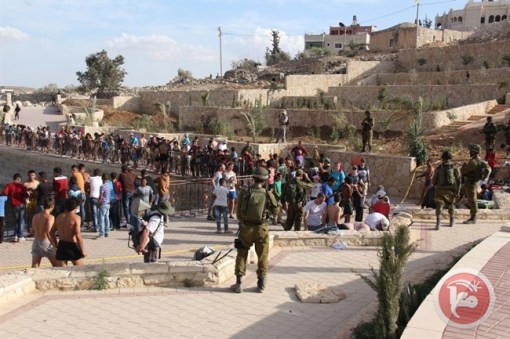
Dozens of Israeli settlers raided a park and ancient pool in the Palestinian town of al-Karmil in the southern occupied West Bank on Wednesday, under the armed protection of Israeli forces, witnesses said.
The park, part of the Yatta Municipality in the south Hebron hills, lies in Area A, under full Palestinian jurisdiction according to the Oslo Accords.
Buses carrying the settlers arrived to the park escorted by large numbers of Israeli forces and military vehicles, locals said.
Settlers came from the nearby settlements of Maon, Karmel, Beit Yatir, Susya, and the outposts of Havat Yair, Mitzpe Yair, Havat Maon, and Avigal, in order to “perform religious rituals” for several hours, they added.
The mayor of Yatta, Moussa Makhamreh, condemned the raid, pointing to the “dangerous nature of Israeli authorities’ and settlers’ racist actions taken under armed security.”
Makhamreh called upon local governance to support and protect the park in order to end frequent violations by Israeli settlers in the area.
An Israeli army spokesperson had no immediate information on the incident.
The park was created in 2011 by the Palestinian Yatta municipality, which renovated an ancient pool located at the site.
Settlers have come to the area in the past through the initiative of the Susiya Tour and Study Center which describes the pool as the historical site of the Biblical settlement of Carmel, according to rights group B’Tselem. Such visits are generally approved by and coordinated with Israeli authorities.
In April, Israeli soldiers expelled Palestinians from the pool in order to allow settlers to swim and have exclusive use of the park.
Around 3,000 Israeli settlers live in Jewish-only settlements in the Yatta region according to the Applied Research Institute – Jerusalem.
The presence of settlements in the area, considered illegal under international law, comes at the expense of Palestinian residents’ ability to build homes and infrastructure, or live unimpeded by constant and often violent interruption from Israeli forces and settlers.
Israeli Soldiers Attack Ambulances, Kidnap Wounded Palestinian
IMEMC & Agencies | September 30, 2015
Israeli soldiers attacked, Tuesday, several Palestinian ambulances while transporting wounded Palestinians to hospitals, in Ramallah, kidnapped one Palestinian after dragging him out of the ambulance, and attempted to abduct another.
Medical sources said at least two Palestinians were shot with rubber-coated steel bullets, and dozens suffered the effects of tear gas inhalation, after the soldiers assaulted hundreds of Palestinians protesting the ongoing Israeli invasions into the Al-Aqsa Mosque in occupied Jerusalem.
The soldiers stopped Palestinian ambulances, trying to transfer injured residents to hospitals in Ramallah, and kidnapped a wounded Palestinian, identified as Mohammad Ouri, after forcibly removing him from the ambulance.
They also attacked another ambulance, transferring a wounded Palestinian, but were unable to abduct him.
The assaults took place near the Beit El roadblock, north of Ramallah, when the soldiers assaulted dozens of protesters, including various political leaders of different Palestinian factions.
The army fired rounds of live ammunition, rubber-coated steel bullets, concussion grenades and gas bombs, in addition to spraying the protesters with wastewater mixed with chemicals.
In Hebron, in the southern part of the West Bank, soldiers kidnapped a Palestinian child, identified as Bassel Issa Shawaheen, 12 years of age, after breaking into his family’s home and searching it.
Also on Tuesday, at least 18 Palestinians were injured, as Israeli forces suppressed demonstrations across the occupied West Bank in support of the Al-Aqsa Mosque.
Nine Palestinians, including three women, have also been kidnapped in occupied East Jerusalem, after the soldiers attacked several men and women near Al-Aqsa Mosque, and prevented them from entering it.
Remembering Muhammad al-Durrah
International Solidarity Movement | September 30, 2015
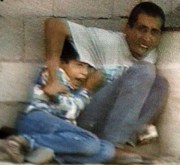 … Filmed by Talal Abu Rahma, a Palestinian cameraman freelancing for France 2, Jamal al-Durrah and his 12-year-old son Muhammad are seen, backs pressed against the wall, Jamal’s arm shielding his young son whose mouth is oval with what must have been a paralyzing fear. And then the shots.
When the cloud of dust cleared, the boy is on his side, draped over his father’s lap.
Throughout an enduing four and a half year widespread Palestinian resistance, with all of its gut wrenching failures, and with the solace and strengths of solidarity en masse coming from both the history before the second intifada and the aftermath in its wake, the slaughter of Muhammad al-Durrah continues to be a defining moment. A young boy viewed guilty through the eyes of the Israeli military due only to the origin of his birth.
In the investigation to follow, an Israeli-initiated tug of war of blame across the grave of and over Muhammad’s murder ensued. Where initially the Israeli government took blame and expressed public relational regret with an apology, that space soon became occupied with denials, accusations and disturbing tales of Palestinian’s faking the boy’s death. If only Palestinians weren’t so busy mourning the actual mass murders of their children in order to be able to spontaneously arrange for the staged murder of one, a second intifada might not have been necessary, nor a third or a fourth for that matter.
Without politicizing the end of a human life, in a 67 year crime drenched in politics; fifteen years ago today a terrified little boy was shot to death while he hid beside his father. And the world should remember his name.
Warning graphic content! Raw footage of Mohammed ad-Durrah’s final moments of his life:
Featured Video
“Historic Russia”: The Land Putin Will Not Give Back
or go to
Aletho News Archives – Video-Images
From the Archive
How Ukraine Tortured and Slaughtered Donbass
By Kit Klarenberg | Al Mayadeen | July 11, 2024
Almost immediately after the proxy war erupted, ISIS-tier footage of the torture and murder of Russians in Ukrainian custody emerged.
On July 6th, the New York Times published an astonishing investigation: In Ukraine, Killings of Surrendering Russians Divide an American-Led Unit. The article documents in grim detail how Chosen Company, an international volunteer battalion for Kiev, routinely executes Russian prisoners of war. It is the very first mainstream admission that this practice – a brazen breach of the Geneva Conventions, and a grave war crime – is widespread among Ukraine’s fighters, both foreign and homegrown. … continue
Blog Roll
 Aletho News
- Burnham tackles Britain’s poverty with aggression in Yemen
- Peace in Ukraine: the easy way – or the hard way
- Trump & the Rrrrussians
- US taxpayer money laundered back through Ukraine – Musk
- Before COVID, an NIH lab chief proposed making a SARS-like bat virus more infectious
- Gates, Bourla on Trial in Netherlands Accused of ‘Great Reset’ Scheme at Vaccine Injury Hearing
- BRITAIN’S WARNING: PREPARE FOR WAR
- “Historic Russia”: The Land Putin Will Not Give Back
- How the Cambridge Analytica scandal still haunts Mark Zuckerberg
- The Ongoing Cancellation Campaign Against a Dissenting Academic in Norway
- If Americans Knew
- DAILY UPDATE: Latest essential news on Palestine, Israel, & region
- Damning report shows the media must confront its failures on Gaza
- BBC senior broadcaster speaks out on Gaza coverage
- Netanyahu vows vast West Bank invasion in response to 20-minute skirmish that left 2 Israeli soldiers and 2 Palestinian fighters dead
- Tied up and tortured: Israel using US-made electroshock weapons on Palestinian detainees
- The outsourced risk: how newsrooms rely on Gaza’s freelancers without protecting them
- Gaza bakeries forced to shut as Israel blocks flour shipments
- Gaza’s breast cancer patients face a deadly wait for treatment amid Israel’s genocide
- DAILY UPDATE: Latest essential news on Palestine, Israel, & region
- The Israel Lobby’s Changing Fortunes
- No Tricks Zone
- Two New Studies Find Thwaites Glacier Melt Cannot Be Driven By Human Activity Or A Warming Ocean
- E-Cars Reduce CO2 Emissions By Only 41% Compared To Internal Combustion Engine Vehicles
- Predictions Made By Renowned Climate Professor Over Past Decades Have Been Proven To Be Poor
- New Study Suggests Large Regions Of The Pacific Ocean Have Been Cooling For The Last 80 Years
- Germany’s Green Energy Debacle: High Energy Costs Force Kahla Porzellan to Close After 182 Years!
- New Study: 50 Years Of The Most Aggressive ‘Net Zero’ Policies Can Only Affect The Global Climate By 0.03°C
- US September “Heat” Was No Record…Many Records Set Decades Ago
- Latest European Green Energy Debacle; Portugal’s Largest Flagship Solar Park Insolvent!
- Green Energy Debacle: German Expert Professor Fritz Vahrenholt Warns Of Severe Economic And Social Consequences
- Two More Paleo Reconstructions Affirm Meters-Higher Sea Levels Across Ireland, Brazil 7000-6000 Years Ago

