PA security: No proof Palestinians attempted stabbing attacks
Ma’an – August 18, 2015
RAMALLAH – The Palestinian Authority security forces on Tuesday said that there was no evidence that Palestinians shot by Israeli forces in recent days, in two cases fatally, had stabbed Israeli soldiers.
In the last week, Israeli forces have shot three Palestinians, killing two, who they claimed attempted to stab Israeli soldiers or Border Police officers.
However, the spokesperson for the PA security forces, Major-General Adnan Dmeiri, said in a statement that Israel had provided no evidence to support its allegations.
He questioned the fact that in each case the Israeli army or police force investigated its own soldiers or officers, “without the interference of any other party.”
He said that the investigations had portrayed the Israeli soldiers and officers as “heroes.”
Dmeiri criticized the fact that the army and police force were both the investigators and the “executors” of Palestinians.
Most recently, Israeli forces shot dead a young Palestinian man on Monday afternoon after they claimed he attempted to stab an Israeli Border Police officer.
An Israeli army spokeswoman alleged that the Palestinian man approached Israeli Border Police officers at Tappuah junction, known to Palestinians as Zaatara military checkpoint, asking for “medical assistance.”
The spokeswoman said that he then pulled out a knife and attempted to stab an Israeli officer before he was shot dead.
She said that the Israeli police officer was lightly injured.
Two days earlier, Border Police shot dead another Palestinian after the army said he stabbed an Israeli Border Police officer near Beita in southern Nablus.
Rafeeq Kamil Rafeeq al-Taj, 21, was shot five times, the Palestinian Red Crescent Society said.
On the same day, Israeli forces shot and lightly injured a Palestinian man after he allegedly stabbed a soldier west of Ramallah. He was taken into custody following the incident.
Israeli media recently reported that the Israeli army had implemented new rules of engagement, requiring soldiers in the occupied Palestinian territory to hold their fire unless there is a genuine threat to their lives.
Previous rules allowed Israeli soldiers to use fire “warning shots” when their lives were not at imminent risk, and subsequently aim for lower extremities when engaging with Palestinians on the ground.
Since the beginning of 2015 Israeli forces have injured an average of 37 Palestinians a week, and killed a total of at least 25 Palestinians, according to UN figures.
Fish farms in Gaza counter Israeli restrictions on fishing limit
MEMO | August 17 2015
 Israel’s occupation of the Gaza Strip is ongoing, despite frequent reminders that it “withdrew” its settlers and army posts 10 years ago. Legally and practically it is still the occupying power and it remains inflexible.
For example, Palestinian territorial waters off the coast of the Gaza Strip as defined by the 1982 UN Convention on the Law of the Sea, should extend to 12 nautical miles (22.2 km or 13.8 miles) but the Israeli navy enforces a six mile limit, sometimes even five and a half miles, for Gaza’s fishermen. In addition, the Israeli occupation authorities often make petty and spiteful “security” excuses to reduce the already reduced fishing limit to three miles.
On top of that, Palestinian fisherman are harassed by the Israeli navy on a daily basis; their boats are fired upon, sunk and confiscated, and the fishermen themselves are often arrested if they are not killed or wounded in the process. All of this, of course, has an impact on the amount of fish caught off the Gaza coast, which should be a rich fishing ground. Catching more and larger fish requires sailing into international waters, as fishermen from other countries do.
Palestinian investors in Gaza have thus resorted to fish farming. Speaking to MEMO, Yasser Al-Haj said that he invested in this sector for personal gain as well as to ease the crisis in the Palestinian market. Although it is not regarded as a solution to the crisis, it can alleviate it.
Al-Haj’s newly-opened fish farm only produces one type of fish, sea bream. It is imported from Israel and then raised in this farm and others. He says that his farm produces 7 per cent of the Gaza Strip’s needs and sells about 250kg a day. One kilo of sea bream costs about $12.
For an ordinary middle-class citizen, this price is high, but for a poor citizen it is very expensive, given the average income in the Gaza Strip. The high price is set by many factors, including the price of fish feed from Israel, which is $1,850 per tonne, plus the issue of the power cuts suffered across the territory.
Fish farms require generators to keep the oxygen moving and water pumping continuously in the ponds. Yasser Al-Haj notes that he is unable to breed the fish in the sea because of pollution, which poses a danger to the fish and people who eat them. The sewage processing plants aren’t working due to the power cuts and lack of maintenance resulting from the Israeli blockade.
Images from MEMO photographer: Mohammad Asad
Israeli forces destroy 100 trees to build separation wall in Beit Jala
Ma’an – August 17, 2015
 BETHLEHEM – Israeli forces on Monday destroyed more than 100 trees as they leveled Palestinian-owned land in the Beit Jala area to make way for construction of the separation wall, locals said.
Israeli bulldozers reportedly destroyed the trees in an area known as Bir Onah, near the illegal settlement of Gilo.
The trees belonged to the Al-Shatla, Abu Eid, Abu Ghattas, Abu Saada, Khaliliya, and Abu Mohor families, locals said.
Witnesses told official Palestinian news agency Wafa that Israeli bulldozers razed an area of 30 dunams near Beit Jala for the expansion of the wall following a recent court ruling to change the route of the controversial infrastructure.
Residents in Beit Jala have been engaged in a nine-year legal battle against a 2006 Israeli military order to build the separation wall around Beit Jala and Har Gilo.
In 2013, 58 local landowners as well as nuns from the Salesian convent who joined their legal action, lost an appeal against the route of the separation wall.
Residents hoped that an Israeli Supreme Court decision in 2014 — which ordered the Israeli state to justify the route of the separation wall in Beit Jala’s Cremisan valley — was an indication that the proposed land seizure could be canceled, with a ruling in April this year in favor of a petition by locals creating further hope construction of the wall could be suspended.
However, in July the Israeli High Court approved construction of the wall using an alternative route, which would still separate the Salesian monastery and convent from the community it serves in Beit Jala.
The Cremisan Valley lies between the sprawling settlement of Gilo in annexed East Jerusalem, and the smaller West Bank settlement of Har Gilo, a few kilometers to the southwest.
Palestinians have long argued the the separation wall in Cremisan had no security benefit for Israel and was being constructed to annex land and connect illegal settlements in the area.
In 2004, the International Court of Justice issued an advisory opinion calling on Israel to stop building the wall and dismantle or re-route sections that had been constructed.
The separation wall will be approximately 708 kilometers long when complete, nearly twice the length of the 1949 Armistice Line due to its meandering route, and 85 percent of the wall will be located in the occupied West Bank, according to UNOCHA.
Israeli forces punish Kafr Qaddum by damaging the water supply system
International Solidarity Movement | August 16, 2015
Kafr Qaddum, Occupied Palestine – On Saturday the 15th of August 2015, the villagers from Kafr Qaddum once again demonstrated against the blockage of the road leading to Nablus as well as the nearby Kedumin settlement. In solidarity with the local people there were a few international activists and journalists covering the demonstration.
The non-violent protest was immediately suppressed by the Israeli occupation forces shooting dozens of teargas canisters and live ammunition. Instead of the frequently used bad-smelling skunk water, the army drove a bulldozer into the village. This bulldozer destroyed the only water pipe in the village, leaving the people Kafr Qaddum without any connection to water until the pipe is repaired. Especially during the hot summer months, water is a scarce and essential good.
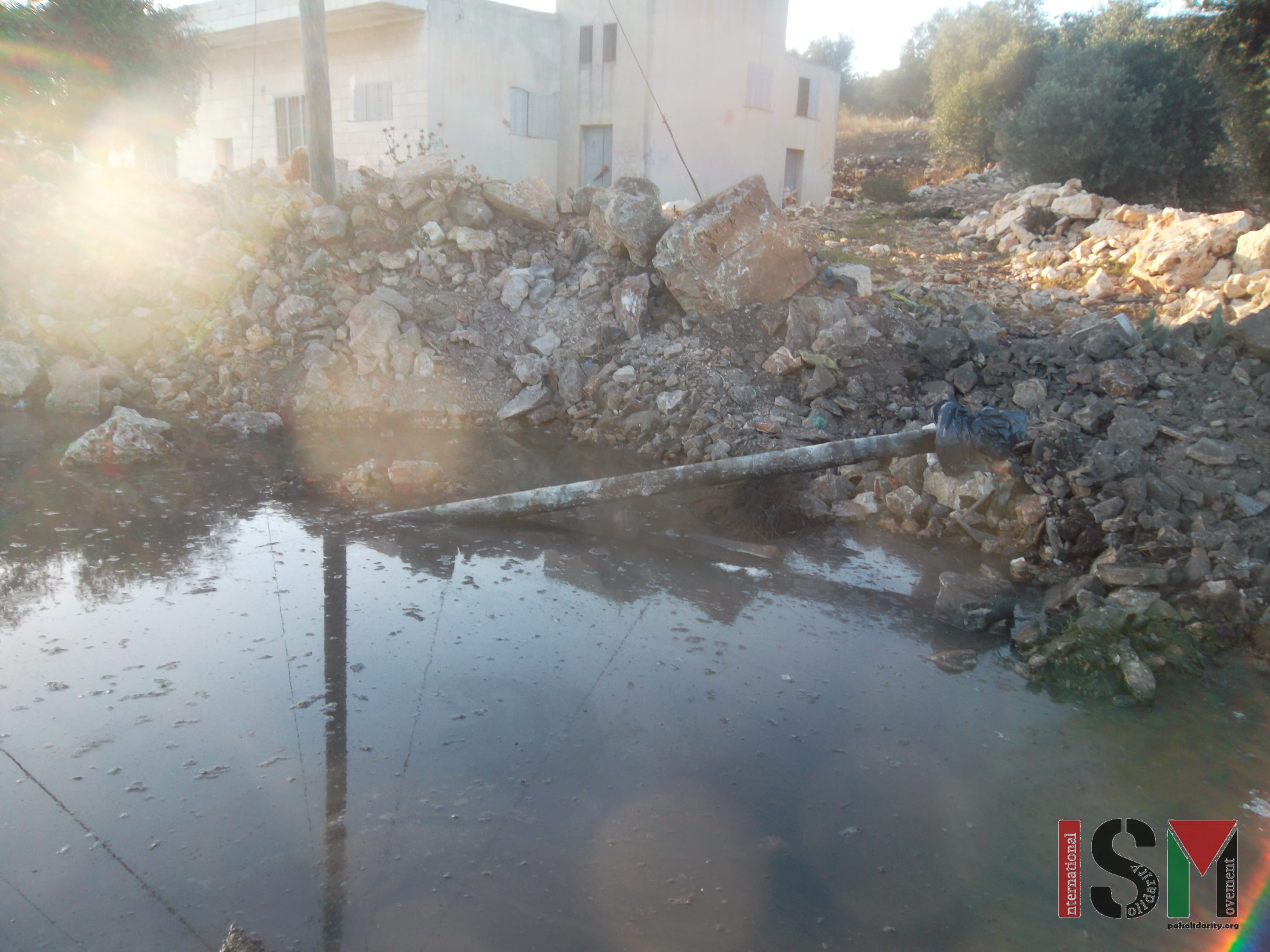
Murad Shtaiwi, one of the leaders of Kafr Qaddum Popular Committee, understands the damage to the water pipe as a way to collectively punish the village for its ongoing resistance. The costs of a new pipe have to be paid for by the municipality. As Murad explains, damaging the water pipe is a deliberate attempt by the Israeli army to suppress the support among the villagers to continue to protests and thus block future demonstrations.
Huckabee traveling to Israel to raise money for presidential campaign
Press TV – August 16, 2015
US presidential candidate Mike Huckabee says he is traveling to Israel this week to raise money for his campaign and meet with a number of Israeli officials to discuss the nuclear accord with Iran.
The former governor of Arkansas opposes the Obama administration’s nuclear agreement with Iran, like most of his Republican colleagues.
Huckabee’s campaign spokeswoman, Alice Stewart, said the presidential hopeful will depart on Tuesday for Israel but did not specify which officials he would meet with.
Stewart declined to say whether he would meet with Israeli Prime Minister Benjamin Netenyahu, citing security concerns.
She said the campaign will disclose details of the trip when he returns. Huckabee announced the trip to Israel on Sunday.
Last month, Huckabee made controversy for saying US President Barack Obama was marching Israelis “to the door of the oven” following the nuclear deal with Iran.
“This president’s foreign policy is the most feckless in American history,” he said. “It is so naive that he would trust the Iranians. By doing so, he will take the Israelis and march them to the door of the oven.”
Analysts believe his remarks were aimed at appealing to Israel advocacy groups in order to receive campaign contributions from Zionist donors.
Huckabee is currently at 7th place among Republican presidential hopefuls, holding steady at six percent.
US seeking disintegration of entire Mideast: Iran MP
Press TV – August 17, 2015
A senior Iranian lawmaker has slammed recent remarks by a top US military commander on Iraq’s disintegration, saying Washington seeks to break down the entire Middle East.
“The US has created Daesh based on a calculated scheme in order to realize the Greater Middle East plan and disintegrate the region. That’s why the Americans are bringing up the issue of Iraq’s disintegration,” Alaeddin Boroujerdi, the chairman of the National Security and Foreign Policy Committee of the Iranian Parliament (Majlis), said on Sunday.
The Iranian lawmaker’s remarks came after US Army Chief of Staff General Raymond Odierno, who once served as the top US commander in Iraq, said on August 12 that partitioning Iraq “is something that could happen” and “might be the only solution.”
The remarks came as a controversial US Congress bill, the draft of which was released in April, proposes the division of Iraq into three states and allows the Kurdish forces and the Sunni tribesmen to be armed directly without Baghdad’s approval.
The bill stipulates that 25 to 60 percent of the USD 715-million aid money allegedly allocated to Iraq in its war against Daesh will be directly supplied to Sunni and Kurdish forces.
Iraqi Prime Minister Haider al-Abadi strongly condemned the comments by the top US military commander as “irresponsible,” saying they reflected “ignorance of the Iraqi reality.”
Iraqi politicians, including members of the parliament, as well as religious leaders have also voiced their opposition to the bill.
Syria no-fly zone
Elsewhere in his remarks, Boroujerdi said that Turkey’s pushing for a no-fly zone over Syria is a “strategic mistake” for Ankara.
He said that the move is a violation of international law as well as sovereignty and territorial integrity of the Arab country.
“Turkey is expected to adopt a policy that will contribute to regional stability and security, not [one that will] lead to instability in the region,” he added.
Turkey has been pushing for a no-fly zone over northern Syria, claiming that such a buffer zone could protect Ankara from Syrian airstrikes against foreign-backed militants.
Turkish Prime Minister Ahmet Davutoglu said in an interview last week that he would work with the US to establish what he called a “safe area,” claiming that the buffer zone would protect civilians.
The US has not given the official go-ahead for the plan yet.
Settlements and the settler state of ‘Judea and Samaria’
Al-Araby Al-Jadid | August 13, 2015
There is a clear contradiction between Israel’s demolition of two houses built by Jewish settlers in Beit El settlement following a judgement by the Supreme Court that they were built on private property belonging to a Palestinian, and the approval of Benjamin Netanyahu’s government for the construction of 300 new homes in the same settlement, one of a number of building projects across the occupied West Bank.
Such a contradictory stance was reflected in the Israeli prime minister’s condemnation of the arson attack on the home of the Dawabsheh family by Jewish settlers, which killed a Palestinian baby and his father, given that the building programmes approved by the Netanyahu government and a climate of state-sanctioned impunity not only entices settlers to move in but also encourages them to carry out such attacks. We should not, therefore, be deceived by the apparent awakening of Netanyahu’s conscience towards the suffering of the Palestinians at the hands of settlers and settlements.
It is through the judgements passed by the Israeli courts that the legal system plays a role in expanding settlements and gives them the legitimacy that Israelis crave. If the courts call for what we know will only ever be a temporary removal of some violations (the two Beit El houses, for example) they are only trying to remind settlers that they need to follow official guidance on the best way to confiscate Palestinian land and uproot the Palestinian residents therefrom.
Netanyahu’s justice minister said that it is useful to destroy two houses to make it possible to establish dozens of others in the same place, albeit it is “regrettable” to have to demolish them in order to re-build them. The minister of education explained that the court can decide whatever it wants, for the judicial system has to issue judgements while the government gets to decide about ongoing construction. It is as if they are saying, “We will learn from our mistakes, and we will build settlements in accordance with the legal instructions booklet with which the government overrides some of its formal procedures, so that the courts’ task becomes to re-direct the government towards better methods and pretexts for the confiscation of land and expansion of settlements.”
The legal process for this is represented by the permissibility of confiscating land from its owners for security reasons, or to establish army bases; later, civilians — Jewish settlers only, of course — are allowed to live there, on the pretext that they are part of the security provision; then these bases are turned into settlements, which are gradually expanded, and they swallow the surrounding areas on the pretext that the settlers themselves need security. The Israeli courts can also provide Palestinian land for the settlers because their presence in the occupied Palestinian territory is a security necessity for the state.
A number of laws are available to the government which allow it to control Palestinian land as it wishes. The Closed Areas Law, for example, allows the military to close any area without giving any reason; the Law of Absentee Property, allows the confiscation of land that belongs to people who are not in residence, for whatever reason (they may just be travelling); and the Law of Fallow Land, which allows for the confiscation of land that has not been cultivated. The latter is one of the most unjust and ridiculous of laws, because the Israeli authorities declare certain areas to be closed and prevent the owners from reaching their land to cultivate it, and then the government confiscates the land on the basis that it is uncultivated.
The Oslo Accords did not address the issue of settlements and allocated more than 60 per cent of the West Bank to what is known as Area C, which is entirely under Israeli military administration. Settlements are the essence of Israel’s founding Zionist ideology, and they have expanded many times under peace negotiations; the Palestine Liberation Organisation has failed to extract any Israeli pledge to halt settlement activity or freeze it. The West Bank is filled with settlements housing more than 600,000 settlers — all illegal under international law — with 200,000 in Jerusalem alone. The settlement programme has dismembered the West Bank, making a two-state solution almost impossible to envisage and making it unlikely that Israel will ever withdraw from the occupied Palestinian territory under its control.
In the process, Jewish settler groups and political parties have grown in number and influence; it is impossible to form a government in Israel without their support. Militant extremists amongst the settlers are responsible for attacks against Palestinians and their homes and farms. An estimated 1,000 such attacks take place every year, and include murder, beatings, the burning of crops and trees, arson attacks on buildings and restricting free movement. The latest of these attacks was the arson attack targeting the Dawabsheh family. The incident cannot be separated from the context of all other settler violence. Needless to say, all settlers are heavily armed and are provided with back-up and protection by the Israeli army, and encouragement from the state.
It is no longer a secret that ardent Zionists are talking about the creation of a settler state in what they call “Judea and Samaria” in an effort to thwart any attempt by the government to withdraw from any occupied territory or close settlements as part of a peace deal with the Palestinians. This has even been mentioned by Yuval Diskin, the former head of Israel’s internal security service, the Shin Bet. Such a move would subject the West Bank to the control of the settlers, under the pretext that there is a dispute between residents of the West Bank; any “solution” in the occupied territories must therefore take into account the diversity of the population, even if the settlers have imposed their presence on the Palestinians in their own land.
It is enough for us to get alarmed to know that the proportion of Jewish settlers relative to the Palestinians in the West Bank exceeds the proportion of Jews to Arabs in 1948 when Israel was created. The Jewish settlers have the ability and influence to enable them to declare their own state, leaving the Israeli government free to claim that it is not responsible for what is happening there. That would, of course, be a disingenuous argument, given that it has created the settlements and settler-only access roads, and provided security and infrastructure for the settlers in the first place.
The West Bank is thus undergoing a serious Judaisation process as I write, and a major disaster is about to hit the Palestinians amid the near-complete absence and deadly inaction of the so-called Palestinian Authority. Regional Arab states and the international community are silent about what is happening before their eyes, which leaves the Israeli occupation government free to do what it wishes, and settlers free to declare their own state in the West Bank, which they call Judea and Samaria. Is anyone going to respond, to stop the disaster before it takes place?
Translated by Moein Taher
The U.S.-Israel Conflict Is Finally Visible for All to See
By Sheldon Richman | Free Association | August 14, 2015
Thanks to the Iran nuclear deal, something remarkable is happening in American politics: the irreconcilable conflict of interest between most Americans on one side and Israel and its American supporters on the other is on full display and impossible to ignore. In the past the conflict could be papered over with grand empty rhetoric about the two sides being in “lock-step” and the absence of “daylight” between them. But no more. The conflict is out in the open where everyone can see it. Iran should be thanked for this valuable service.
War with Iran would be a catastrophe not only for the Iranians, including thousands of Jewish Iranians who openly practice their religion in their ancient community, and other people in the Middle East; it would also be a catastrophe for Americans — hence the conflict of interest between most Americans and the war party. Those, like Tom Cotton, Norman Podhoretz, Bill Kristol, and John Bolton, who think an attack on Iran would be a cakewalk, are either liars or fools. These are the same people, of course, who said the Iraq war would be easy and would usher in a new liberal Middle East. The result has been unspeakable sectarian violence throughout the region, culminating in the Islamic State and a reinvigorated al-Qaeda.
Despite the predictable catastrophe a war with Iran would bring, Israel and its staunchest, most prominent American supporters are conducting a well-financed campaign against the Iran nuclear deal that would surely lead to that war if a Republican wins the presidency next year. In fact, they want war because only war (followed by regime change) would give Israel and its American supporters what they want: unrivaled dominance in the Middle East, which among other things would relieve the pressure to make a just peace with the Palestinians at least by leaving the occupied territories.
Let’s acknowledge that most Jewish Americans favor the nuclear deal and do not want war with Iran; in fact, many Jews feel little or no connection to Israel at all. But that must not obscure the fact that the Israeli government, which was recently returned to power by the Israeli people, and the richest, best-organized Jewish American groups — AIPAC and the rest of the Israel/Jewish Lobby — lead the opposition to the deal and the neoconservative coalition in favor of war. (This is not to overlook the prominent non-Jewish members of the coalition.) They feign offense at being called warmongers, but they know that the kind of deal they favor would require Iran to fully capitulate to the United States and Israel, demands which go beyond nuclear questions, and surrender its sovereignty. Such a deal could never be reached, and the war hawks know it. They ought to be honest enough to admit that war is what they want. (Some neoconservatives, Jews and non-Jews, are honest enough, including Bolton, Podhoretz, Cotton, Kristol and Joshua Muravchik.)
What’s noteworthy is that both sides of the divide have taken the gloves off. We had Israeli Prime Minister Benjamin Netanyahu, whom former Meet the Press host David Gregory once called “the leader of the Jewish people,” invited to speak before Congress for the sole purpose of undercutting President Obama’s efforts to engage in diplomacy with Iran. We had senators doing the bidding of Israel and the Lobby by writing to the leader of Iran to tell him no agreement would be long-lasting. And most recently we had Netanyahu, in an unprecedented display, openly urging Jewish Americans to oppose the deal with Iran: “The days when the Jewish people could not or would not speak up for themselves, those days are over,” he said in a webcast to 10,000 Jewish American activists arranged by the Jewish Federations throughout North America and the Conference of Presidents of Major American Jewish Organizations.
Are Jewish Americans supposed to see Netanyahu as their leader? (Not that I think they should see Obama as their leader.) Netanyahu apparently thinks so, and prominent Jewish Americans seem to agree. Sen. Dianne Feinstein, who is Jewish, has courageously condemned this “arrogant” pretense. (Recall that Netanyahu has told Western Jews that they are welcome to “return” to Israel — even those who have never been there — to escape the dangers in their countries. Thus he embraces the pernicious Zionist doctrine, shared by anti-Semites, that Jews ultimately are aliens everywhere except in Israel.)
Obama, on the other hand, has finally been willing to openly identify the source of hawkish anti-Iranian pressure: Israel and its American supporters, especially prominent and well-organized Jewish Americans and non-Jews who kowtow to win their political and financial support.
“Because this is such a strong deal,” Obama said, “every nation in the world that has commented publicly, with the exception of the Israeli government, has expressed support.” He also said, “Between now and the congressional vote in September, you’re going to hear a lot of arguments against this deal, backed by tens of millions of dollars in advertising. And if the rhetoric in these ads, and the accompanying commentary, sounds familiar, it should — for many of the same people who argued for the war in Iraq are now making the case against the Iran nuclear deal.”
Everyone knows, first, that the major push for the war against Iraq came from Israel and the Lobby, supported by the neocon devotees of Israel’s agenda, and, second, that the multimillion-dollar ad campaign against the Iran deal is run by an AIPAC-related group, Citizens for Nuclear Free Iran, and United Against Nuclear Iran, led by former Sen. Joe Lieberman and financed by wealthy casino magnate Sheldon Adelson, who makes no secret of his Israel-first sentiment.
But we shouldn’t overstate Obama’s willingness to identify the malign influence on American foreign policy that emanates from Israel, its Lobby, and the neocons in general. He also said:
When the Israeli government is opposed to something, people in the United States take notice. And they should. No one can blame Israelis for having a deep skepticism about any dealings with a government like Iran’s — which includes leaders who have denied the Holocaust, embrace an ideology of anti-Semitism, facilitate the flow of rockets that are arrayed on Israel’s borders, are pointed at Tel Aviv. In such a dangerous neighborhood, Israel has to be vigilant, and it rightly insists that it cannot depend on any other country — even its great friend the United States — for its own security. So we have to take seriously concerns in Israel.
Note that he did not mention Israel’s large, invulnerable nuclear arsenal. Israel is the nuclear monopolist in the Middle East and has been since the 1960s, thanks to the connivance of its American supporters inside and outside of government. In the context of Iran’s potential for obtaining a nuclear weapon, wouldn’t you think that fact is relevant? Why do establishment politicians and the mainstream news media hardly ever mention it? Moreover, the rockets that threaten Israelis come from people whom Zionist militias drove off their land in 1948 in a far-reaching ethnic-cleansing campaign and who are now routinely threatened and oppressed: the Palestinians in the open-air prison known as the Gaza Strip, target of savage air wars and a years-long blockade, and the people of southern Lebanon, whom Israel has attacked repeatedly and occupied over the years.
Note also that Obama accepts the premise that Iran aspires to be a nuclear power, a proposition for which there is zero evidence and against which there is abundant evidence.
Nevertheless, to his credit, Obama did say,
As President of the United States, it would be an abrogation of my constitutional duty to act against my best judgment simply because it causes temporary friction with a dear friend and ally.
It’s not every day that an American president acknowledges that, whatever his job is, it is not to serve the interests of Israel’s racist ruling elite and population. That is indeed good to hear, but it would be news to the Weekly Standard and the Wall Street Journal editorial page, among others.
Israel’s American partisans have predictably accused their opponents of anti-Semitism for focusing on Jewish attempts to kill the Iran agreement, hoping Americans will believe that criticism of Israel and the Lobby in itself constitutes bigotry, if not Nazi sympathies. (Mike Huckabee’s claim that Obama is leading the Israelis to the ovens is only the most obnoxious example.) But taking offense at the focus on Jewish efforts is a cynical ploy void of legitimacy. Israel bills itself The Jewish State, representing Jewish interests worldwide. The Lobby embraces that designation. (Not all Jews regard Israel as The Jewish State, however. Jewish anti-Zionism, which dates back to before Theodor Herzl’s time, thrives today.) AIPAC boasts of its political clout and its command of vast resources that can make or break political careers. An AIPAC official, asked if the Lobby had lost influence after a scandal, once famously boasted to a journalist over dinner, “You see this napkin? In twenty-four hours, we could have the signatures of seventy senators on this napkin.”
In light of all this, it’s a little absurd to object to the identification of Israel with Jews or to rail against those who point out the obvious: that Israel and its Jewish American partisans have been at the forefront of the campaign for war against Muslim nations. As Chemi Shalev, writing in the Israeli daily Haaretz, put it:
Netanyahu is allowed to address 10,000 American Jewish leaders and activists from Jerusalem, but mentioning their faith is forbidden; he is allowed to be the sole foreign leader to openly campaign against the deal, but singling him out is verboten; AIPAC can raise emergency funds, cancel all vacations and send its lobbyists to canvass on Capitol Hill, but say the words “lobby” or “money” and you are quickly branded a bigot; [Sen. Chuck] Schumer can famously boast that he sees himself as a Shomer [guardian of] Israel but you won’t dare say that when he seems to live up to his promise.
Moreover, how absurd is it for Israel’s partisans to accuse critics of raising the dual-loyalty issue, which these days sounds rather antiquated? Did anti-Semites put Netanyahu up to his machinations? Did they sponsor the trip to Israel for over 50 members of Congress just as debate over the Iran deal was starting?
Do not misunderstand: Israelis and Israel’s Jewish American partisans are not promoting war with Iran because they embrace Judaism, the Torah, and the Prophets. Many of Israel’s Jewish American supporters are secular and even atheist, and many observant Jews oppose war with Iran, support the nuclear deal, and hate Israel’s mistreatment of the Palestinians. What motivates many Israelis and Israel’s Jewish American partisans has little if anything to do with Judaism. Rather, they are motivated by an essentially secular ideology and parochial identity politics — Gilad Atzmon calls it “Jewishness” to distinguish it from Judaism — that prioritizes the interests of the tribe. These Jews judge issues by the standard “Is it good for the Jews?” (as they see the good). This chosen-people framework is anti-liberal and anti-universal, featuring ubiquitous enemies and impending doom. One might think this attitude is understandable in light of the history of persecution of Jews, culminating in the Nazi Judeocide. But since this ideology fuels the persecution, oppression, and slaughter of innocent others, rather than extra sensitivity to injustice no matter who the victim, we cannot be so forgiving. Nothing in Jewish history can justify how self-identified Jews have treated the Palestinians, or American Jewish support for, or acquiescence in, that treatment. Israel faces no “existential threat” from Iran or anyone else. If that treatment is an application of Jewish values, then Americans should take note. If it is not, then in what sense is Israel The Jewish State?
Whether this ideology has roots in Judaic doctrine and tradition or whether it is a modern secular phenomenon is a complicated question. But people ought to see it for what it is — before we are dragged into another catastrophic war.
Finally, Israel’s Jewish American partisans warn that criticizing the campaign against the Iran deal risks reinforcing stereotypes and inflaming anti-Semitism (even if in itself it does not constitute anti-Semitism). Almost anything anyone says about anyone else could be exploited by bigots, so that is no reason to withhold valid criticism. But if Israel’s partisans genuinely fear an anti-Semitic backlash — which all decent people would condemn as bigoted collectivism — perhaps they should reconsider their campaign to provoke an American/Israeli war of aggression against Iran.
Can You Trust a Country That Has Violated 20 International Agreements?
By Michael S. Rozeff • Lew Rockwell • August 14, 2015
AIPAC formed a group called “Citizens for a Nuclear Free Iran”. The assumption is that Iran is “BAD” and should be treated as a pariah nation. AIPAC presumes that Iran should be held inferior to such heroes of human rights as Israel. It presumes that Iran shouldn’t be allowed to sign and support the Nuclear Non-Proliferation Treaty as it has. For AIPAC, it is kosher to assassinate Iran’s physicists and wreck its computers. As far as AIPAC is concerned, it is within Israel’s rights to launch a unilateral attack on anything nuclear within Iran if it so chooses. For AIPAC, Iran must be bad. After all, it resists Israel’s treatment of Palestinians. It calls for political change in Palestine, change that Israel resists, so it must be “BAD”. Iran has no nuclear weapons, but it still must be “BAD” according to AIPAC. It hasn’t slaughtered Palestinians, but it still must be “BAD” according to AIPAC.
On the other hand, it is AIPAC’s view that any killing that Israel does has been “GOOD” and must be “GOOD”. To say otherwise and accuse Israel is not simply to be supportive of human rights, or possibly anti-Zionist, but also possibly to be branded as that old enemy that went out of fashion in the 20th century with the Third Reich or at least has been thoroughly discredited and meets with not a fiber of serious intellectual support: anti-Semitic. If one is not to risk being accused of hating Jews or even hating oneself if one is Jewish, one must by this perforation and shredding of logic, by this muddling of distinct ideas, support Israel and all of its genocidal and expansionist policies in all important respects. One must regard nuclear weapons in Israel’s hands as inherently “GOOD” too.
APIAC has launched ads using this new group. One of these popped up on a web site I went to this morning. It asked whether a country (Iran) that has violated 20 international agreements can be trusted. The “documentation” is here. The so-called violations are accusations, not proven facts and not self-evident. The charges are way overdone, much exaggerated, and trumped up. It’s a phony indictment.
What meaning does it have to charge Iran with not having top-notch governance or not having eliminated human trafficking? Is Iran really out for genocide because its former president made some sort of quote that has been widely and wildly misinterpreted, mistranslated and repeated endlessly? What meaning does it have to accuse Iran of chemical weapons hanky-panky when Israel is not a signatory to the Chemical Weapons Convention and Iran is?
Even if they were not baloney, or not all baloney, or half-truths, or fractional-truths, or not mainly unproven accusations and exaggerations, one has to ask how long a list of similar charges one could bring against many other countries in similar social, political and economic situations.
What would an indictment against the U.S. look like? It would easily be as long, indeed much longer, and the charges would be far more tangible, serious and actually have happened. Shall we lead off with the unprovoked attack on Iraq? Shall we include the 14-year war that began by bringing down Afghanistan’s existing government? Dare we mention the U.S. support for attacking Libya under false pretexts and reducing the country to warring factions, sources of weapons and bases for terrorists; and that has destabilized neighboring countries to boot? Shall we mention genocidal sanctions against Saddam Hussein’s Iraq?
Who trusts the U.S. when an ally one day becomes an enemy the next day as Gaddafi found out?
In a one-on-one comparison, which state would look more trustworthy, the U.S. or Iran?
Palestinian photographer’s visa problem exposes British government’s double standards
MEMO | August 15, 2015
Palestinian Hamdi Abu Rahma is a gifted photographer whose work in Gaza has been highly acclaimed around the world. He is also now at the centre of a political storm after he was told that he could not travel to Britain in order to take part in the renowned Edinburgh International Festival. Scottish politicians and supporters have accused the British government of trying to damage the reputation of the festival by its “overly bureaucratic and insensitive decision” to refuse Abu Rahma a visa.
The row has erupted as Prime Minister David Cameron prepares to roll out the red carpet for Israeli leader Benjamin Netanyahu. The timing is particularly sensitive, as an online petition calling for Netanyahu to be arrested for war crimes when he arrives in London next month has already attracted more than half of the 100,000 needed to trigger a parliamentary debate.
Now that the decision to reject the young Palestinian’s visa application has been challenged by members of the Scottish Government, as well as festival organisers and pro-Palestinian activists, there are hopes that the UK Visa and Immigration agency will think again.
Already widely travelled to show his work at exhibitions around the globe, this is the first time that Abu Rahma has had a visa application rejected without warning. Some observers are particularly surprised since the focus of his photography is about the power of non-violent resistance in Palestine, which he has captured through his camera lens.
“The UK government refused to give me a visa today and the reason for refusal was that I didn’t show any bank statements or documentation to demonstrate my ability to support myself during my visit,” he said in a prepared statement. “Despite sending complete evidence of the sponsorship provided to fund my trip and all contact details of my sponsors, proving that all my travel and accommodation costs have been met, they still refused my application.”
Abu Rahma pointed out that he has travelled extensively in order to tell the Palestinian story through his photographs but Britain is the first country that has refused him entry. “We all know the real reason for this refusal,” he said. “Britain knows very well what my trip is about. I am not going there to claim asylum or beg in the streets. I am going there to educate the British people and pose some questions.” Such questions as: “Have you ever asked Israel why they kill and murder innocent men, women and children in Palestine? Do you know why Israel occupies Palestinian land illegally and destroys our homes, and why it allows colonial settlers to move into our homes illegally against international law?”
Expressing his “deep disappointment” at being unable to travel to Britain on this occasion, the young photographer thanked his friends across the country for their support and for being willing to host him in their homes.
Phil Chetwynd, one of the festival organisers who invited Abu Rahma said: “The Network of Photographers for Palestine raised the money through crowdfunding to finance Hamdi’s visit earlier this year.” All of his travel and subsistence expenses are covered by this, he explained. “I pledged to provide accommodation throughout the visit. Last month I tried to contact the visa office in Amman to back-up Hamdi’s application, but the process is so obscure that they didn’t seem to have a mechanism to add information to that already submitted by the applicant. It seems that the FCO has tendered out the whole process to another organisation.”
Despite the visa ban organisers have said that they will still exhibit Hamdi’s photographs and will ask a performer from another show to read out the speech that he has prepared. As news spread of the visa ban, an additional exhibition of his work may now also be shown at “Welcome to the Fringe: Palestine day at Out Of The Blue (OOTB)”. Other events organised for Hamdi to speak in Inverness, Dundee and Glasgow may still go ahead via a live link-up to his home in Gaza.
According to Sofiah MacLeod, the chair of the Scottish Palestine Solidarity Campaign, the visa rejection came as “no surprise”. She pointed out that the Cameron government is preparing to welcome the “war criminal” Benjamin Netanyahu to London in September. “As the petition calling on Netanyahu to be arrested for war crimes nears 55,000 signatories, the government’s visa denial to Abu Rahma will only strengthen our resolve to oppose its complicity in Israel’s ethnic cleansing project against the Palestinians.” MacLeod is adamant that Palestinian voices, including Abu Rahma’s, will be heard at this year’s Edinburgh Festival in “unprecedented” numbers. “We already know that the Israeli government has received our message loud and clear that it is not welcome during the festival, or at any other time.”
Scottish Parliamentarian Joan McAlpine of the SNP raised the issue with Sarah Rapson, the Director General of UK Visas and Immigration within hours of hearing about Abu Rahma’s visa being rejected. In a letter seen by MEMO, she told Rapson: “While I understand that immigration is a reserved matter, culture is not. I am the co-convenor of the Scottish Parliament’s Cross Party Group on Culture. I certainly feel that this decision is damaging to culture and the world’s greatest art festival in Edinburgh.”
McAlpine called for a rethink on what appeared to be “an overly bureaucratic and insensitive decision” adding: “I am particularly concerned that the decision means festival goers will miss the opportunity to hear this artist discuss his award-winning work, which of course has implications for freedom of expression.”
This is not the first time that Palestinian artistes have encountered difficulties at the hands of the UK Border Agency. Ali Abukhattab and Samah Al-Sheikh, a married couple also based in Gaza, were due to appear at the Institute for Contemporary Art in June 2013 as part of the Shubbak festival. They were to read from their own works and discuss how Palestinian writers in Gaza have responded to the ongoing Israeli siege and internal political situation.
Al-Sheikh, a short story writer and novelist, and Abukhattab, a poet and critic, are both established writers whose works have appeared in collections and anthologies. Both are also active in promoting the arts in Gaza, but that was not enough for the British government. In an increasingly familiar scenario for artists and writers seeking to visit this country, their visa applications were also rejected.
In April 2012, a tour by Palestinian Oud player Ahmad Al-Khatib and other musicians was delayed because of visa issues raised by the UK Border Agency. Discrimination by immigration officials has also hampered other Arab artists visiting the UK, including Iraqi poet Sabreen Kadhim, and even those only in transit through Britain’s airports, such as Syrian painter Tammam Azzam.
In an age when racial and religious discrimination is increasingly — and thankfully — more unacceptable, the fact that Arab artistes can still face what looks like systematic institutionalised discrimination is a huge concern. Instead of welcoming an alleged war criminal to London, perhaps David Cameron could look into this situation and start to treat all would-be visitors to Britain with fairness and justice.
Thomas Friedman’s Bizarre Moral Universe: Defending Israel in The NY Times
By Barbara Erickson | Times Warp | August 14, 2015
Thomas Friedman in The New York Times argues for approval of the Iran nuclear deal, and on the way to this conclusion he hauls readers through a morass of false narratives and murky ethics, all of them invoked on behalf of Israel.
The column, however, does more than reveal the contortions of Israeli propaganda. It also points up a defect in the Times op-ed pages: The section allows writers to assert almost any claim without having to supply evidence to the readers, and although the newspaper says that it fact-checks even its editors, plenty of misinformation appears in the op-ed pages.
Thus we have Friedman’s latest, “If I Were an Israeli Looking at the Iran Deal,” which lays out a series of bald statements about Iran, Mideast history and the Israeli military that point to one overriding premise: Israel is a lonely moral force in the midst of lunatic regimes.
Friedman asserts, among other things, that Iran “regularly cheated” in order to expand its nuclear capability and aided Lebanon in “an unprovoked war” against Israel in 2006. Israel, however, “tries to avoid hitting civilian targets,” follows “Western mores” and pursues “war without mercy” only “when it has to.”
We are told, in other words, that Iran is an existential threat to Israel, bent on its destruction. Oddly, just as Friedman’s column was appearing in the Times, the newspaper also published a rebuttal to his claim in a story titled “Reporting From Iran Jewish Paper Sees No Plot to Destroy Israel.”
Here we learn that many Iranians support a two-state solution in Palestine-Israel and that Jewish Iranians are “basically well-protected second-class citizens—a broadly prosperous, largely middle-class community whose members have no hesitation about walking down the streets of Tehran wearing yarmulkes.”
If readers took the time to check out some of Friedman’s specific claims, they would find that the “unprovoked war” of 2006 was something else again. Israel was actually planning to attack Lebanon and seized on one incident (among many skirmishes on both sides) to unleash its arsenal on the country.
They would discover that Iran has not “regularly cheated its way” in its nuclear program. Instead, as investigative journalist Gareth Porter notes, “The evidence adduced to prove that Iran secretly worked on nuclear weapons represents an even more serious falsification of intelligence than we saw in the run-up to the war in Iraq.”
As for Friedman’s claim that the “Israeli army tries to avoid hitting civilian targets,” many readers already know that rights groups have cast grave doubts on this particular bit of propaganda. Most recently, we have heard from Breaking the Silence and Amnesty International, as both groups have exposed the criminal policies and actions that left so many civilians dead last summer in Gaza.
This sloppy approach to the facts is appalling, but even worse in this particular piece is the moral quagmire he creates in justifying Israel’s war crimes. Israel is forced to kill civilians, he says, because it faces enemies that stop at nothing. Therefore, Israel will “play by local rules” because “for all its Western mores it will not be out-crazied.”
Friedman would have it both ways: Israel is a moral society and Israel is the toughest, meanest guy on the block. If Hezbollah or Hamas fire rockets, he writes, Israel “will not be deterred by the threat of civilian Arab casualties.” The threat that concerns him here is the damage to Israel’s reputation, not the deaths of innocent Arabs.
He finds Iran’s alleged nuclear cheating particularly egregious because the country had signed the Nuclear Nonproliferation Treaty. This observation, however, does not prevent him from threatening Iran with Israel’s nukes: “[Israel] not only possesses 100 to 200 nuclear weapons,” he writes, “it can deliver them to Iran by plane, submarine and long-range rocket.”
Israel, on the other hand, has never signed the NPT and has never allowed inspectors into its nuclear plant, but this is no matter to Friedman. Iran, which has signed the treaty and allows inspections of its facilities, finds this state of affairs used against it in his bizarre moral universe.
Friedman presents Iran as one of the “crazies” that force Israel to break from its “Western mores,” but he can maintain this stance only by ignoring a little-discussed fact: Iran has forbidden the production and use of weapons of mass destruction, including chemical warfare and nuclear arms.
Even when Iraq attacked Iranians with poison gas during the eight-year war, Iran refused to retaliate in kind. Two supreme leaders have pronounced a fatwa against such weapons, including nuclear arms, Ayatollah Ruhollah Khomeini and Ayatollah Ali Khameini. Iran’s nuclear program, they declared, can only be pursued for peaceful purposes, and under the Iranian system, their word is the law of the land.
No wonder we hear not a word of this from Friedman (or the Times): Iran’s fatwa contrasts starkly with the Israeli stance on its own nuclear program.
In Friedman’s piece, facts that would expose his fraudulent narratives are excluded, in spite of the newspaper’s claim to fact-check even opinion pieces and editorials. Readers are denied even the minimal links that appear in most news stories.
Friedman’s columns appear twice a week in the Times. He has won awards for reporting and commentary, and he is a member of the Pulitzer Prize board. Such is the state of mainstream American journalism today.
Featured Video

BRITAIN’S WARNING: PREPARE FOR WAR
or go to
Aletho News Archives – Video-Images
From the Archive
How Ukraine Tortured and Slaughtered Donbass
By Kit Klarenberg | Al Mayadeen | July 11, 2024
Almost immediately after the proxy war erupted, ISIS-tier footage of the torture and murder of Russians in Ukrainian custody emerged.
On July 6th, the New York Times published an astonishing investigation: In Ukraine, Killings of Surrendering Russians Divide an American-Led Unit. The article documents in grim detail how Chosen Company, an international volunteer battalion for Kiev, routinely executes Russian prisoners of war. It is the very first mainstream admission that this practice – a brazen breach of the Geneva Conventions, and a grave war crime – is widespread among Ukraine’s fighters, both foreign and homegrown. … continue
Blog Roll
 Aletho News
- Israel Demolishes Home Of Lebanese Journalist Whose Viral Film Exposed Pager Attack
- Record Oil, Empty Tanks: The UAE’s Miracle Recovery
- Burnham tackles Britain’s poverty with aggression in Yemen
- Peace in Ukraine: the easy way – or the hard way
- Trump & the Rrrrussians
- US taxpayer money laundered back through Ukraine – Musk
- Before COVID, an NIH lab chief proposed making a SARS-like bat virus more infectious
- Gates, Bourla on Trial in Netherlands Accused of ‘Great Reset’ Scheme at Vaccine Injury Hearing
- BRITAIN’S WARNING: PREPARE FOR WAR
- “Historic Russia”: The Land Putin Will Not Give Back
- If Americans Knew
- DAILY UPDATE: Latest essential news on Palestine, Israel, & region
- Damning report shows the media must confront its failures on Gaza
- BBC senior broadcaster speaks out on Gaza coverage
- Netanyahu vows vast West Bank invasion in response to 20-minute skirmish that left 2 Israeli soldiers and 2 Palestinian fighters dead
- Tied up and tortured: Israel using US-made electroshock weapons on Palestinian detainees
- The outsourced risk: how newsrooms rely on Gaza’s freelancers without protecting them
- Gaza bakeries forced to shut as Israel blocks flour shipments
- Gaza’s breast cancer patients face a deadly wait for treatment amid Israel’s genocide
- DAILY UPDATE: Latest essential news on Palestine, Israel, & region
- The Israel Lobby’s Changing Fortunes
- No Tricks Zone
- Two New Studies Find Thwaites Glacier Melt Cannot Be Driven By Human Activity Or A Warming Ocean
- E-Cars Reduce CO2 Emissions By Only 41% Compared To Internal Combustion Engine Vehicles
- Predictions Made By Renowned Climate Professor Over Past Decades Have Been Proven To Be Poor
- New Study Suggests Large Regions Of The Pacific Ocean Have Been Cooling For The Last 80 Years
- Germany’s Green Energy Debacle: High Energy Costs Force Kahla Porzellan to Close After 182 Years!
- New Study: 50 Years Of The Most Aggressive ‘Net Zero’ Policies Can Only Affect The Global Climate By 0.03°C
- US September “Heat” Was No Record…Many Records Set Decades Ago
- Latest European Green Energy Debacle; Portugal’s Largest Flagship Solar Park Insolvent!
- Green Energy Debacle: German Expert Professor Fritz Vahrenholt Warns Of Severe Economic And Social Consequences
- Two More Paleo Reconstructions Affirm Meters-Higher Sea Levels Across Ireland, Brazil 7000-6000 Years Ago

