New York Times: Outcry Over Susiya Nothing but Clever PR
By Barbara Erickson | Times Warp | July 24, 2015
Susiya, a West Bank village under threat of demolition, has now made it into the pages of The New York Times news section, and we are permitted a view of how Israel wants us to see this disturbing story: All the fuss about Susiya is little more than the result of clever marketing on the part of the villagers.
Thus we find a story today by Diaa Hadid titled (in the online version) “How a Palestinian Hamlet of 340 Drew Global Attention.” This primes readers from the start to expect a tale of simple villagers who devised a winning media strategy, and it distracts from the real issue, which is nothing less than ethnic cleansing: Susiya is to be destroyed to make way for Jewish settlers.
High in her story Hadid writes, in a telling phrase, that “the cause of [this] tiny village” has become “outsized,” in other words overblown, as if Susiya, with its population of 300 or so, is not worth the fuss.
The village first got notice when “sympathetic” foreigners visited Susiya some 20 years ago and took up its cause, Hadid states. By that time the residents had been forced out of their original homes and were living near the centuries-old site that had belonged to their ancestors.
Jewish settlers had taken over the original village in 1986, she writes, and Israeli forces made them move on again them in 1990 “for unknown reasons.” They were expelled once more in 2001, according to Hadid, “as collective punishment over the shooting death of a Jewish settler.”
Her story omits a crucial detail: The authorities knew that the villagers were innocent of the killing but used the incident as an excuse to harass the Susiya residents once more. The Times account leaves the impression that a Susiya resident was responsible for the settler’s death.
Hadid quotes a staff member of B’Tselem, an Israeli rights group, who notes that residents “have managed to place Susiya on the international agenda in ways that other villages have not managed to do,” and her story goes on to say that “years of advocacy appeared to pay off when Susiya’s residents began warning early this month that their village was under threat.”
As a result, the story reports, Susiya received visits from a European Union delegation, Israeli activists and American consular officials. Then, a week ago, the U.S. State Department mentioned Susiya in a press briefing and urged Israel to spare the village.
The Times story suggests that Susiya has received this backing because of its skill in winning attention, and by imposing this angle on the story, the newspaper is attempting to divert readers from the real issues at play: the fact that Israel’s treatment of the villagers is blatantly racist and defies the norms of international and humanitarian law.
Also missing is the context of occupation and dispossession that is crushing Susiya and other villages. Hadid fails to give any sense of this. She writes only that activists have used the village as a symbol of how Israel “has sought to maintain control over large parts of the occupied West Bank.”
We find the word “occupied” here, as usual in Times reporting, but it is devoid of meaning. Readers do not hear that the West Bank is Palestinian territory; that Israel is there as an invading military force; and that the settlements violate international law, which forbids an occupying power from transferring its own population into the foreign territory.
The Times story makes no reference to international law, but it does quote an Israeli military spokesman who says Susiya “was built illegally.” Thus Hadid emphasizes the pretext of legality Israel draws over its defiance of international norms while she ignores the flagrant breaches of the Geneva Convention and other standards.
Readers can pick up some revealing details in the story: the ousted villagers’ descriptions of sleeping outside “in the wild, in the rain,” the fact that they can no longer access two- thirds of their original land because of the settlers, the expectation that if Susiya goes, other vulnerable villages will also fall to Israel’s greed for Palestinian land.
But the story glosses over these details to present the Susiya’s case as above all a successful publicity effort. The Times would have us believe that the real story here is how the village became an “outsized” international cause, through “years of advocacy.”
Susiya is just one of many villages in Israel’s Negev and in the occupied West Bank where Israel is determined to ethnically cleanse certain areas of their indigenous inhabitants and install Jewish residents in their place. Times readers are finally learning about Susiya only because international attention has forced the newspaper to acknowledge the issue.
The village should have been known to readers long before now, just as they should also know of dozens more facing annihilation: Al Araqib, Umm Al Kher and Khirbet Yarza, to name just a few. In the South Hebron Hills alone, where Susiya is located, some 30 villages are faced with demolition.
But even now the Times can’t just tell the story of a village nearly helpless under the weight of Israeli might, a community faced with extinction after centuries of living on the land. Instead we find an effort to play down the tragedy, to present it as an overblown cause, not really worth our concern.
Israel Clears the Bench in Iran Fight
By Robert Parry | Consortium News | July 24, 2015
Israel’s Ambassador to the United States Ron Dermer, acting like the coach of a football team, instructed congressional Republicans to “leave everything on the field” in the fight to defeat the international agreement with Iran over its nuclear energy program, a sign of how openly Israel now feels it controls the GOP.
Israel wants the Iran deal killed so it can keep open options for bombing Iran and imposing “regime change.” And, immediately after Dermer’s locker-room-style pep talk, Republican members of Congress began falling into line, lashing out at Secretary of State John Kerry and other senior officials who negotiated the agreement reached earlier this month between six world powers and Iran.
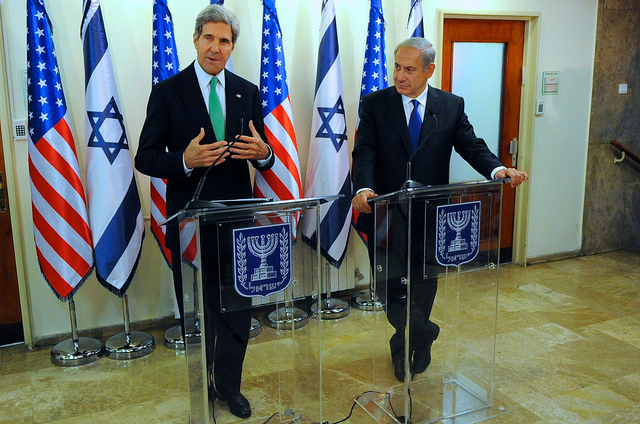
John Kerry and Benjamin Netanyahu. (State Department photo)
House Speaker John Boehner announced that he would “do everything possible to stop” the deal. Senate Foreign Relations Committee Chairman Bob Corker told Kerry that he’d been “fleeced.” Sen. Marco Rubio, a Republican candidate for president, said the next president – presumably meaning himself if he’s successful – could overturn the deal because it’s not a binding treaty.
All this was remarkable even to The New York Times, which usually looks the other way when Israel flexes its muscles in Official Washington. A Times article by Jonathan Weisman noted the extraordinary image of the Israeli ambassador using sports analogies to rile up Republican congressmen to overturn a key foreign policy initiative of the U.S. president.
“Mr. Dermer’s plea — which is widely expected to be followed by a mail, television and radio assault in Democratic districts during the August recess — demonstrates the power that the Israeli government and supportive interest groups in Washington maintain over congressional Republicans,” Weisman wrote.
Obviously, some of this Republican opposition is driven by a deep-seated animus toward President Barack Obama, but the confidence that Dermer, a onetime aide to former Republican House Speaker Newt Gingrich, showed in rallying Republicans to Israel’s foreign policy priority of hostility toward Iran reveals the degree to which the GOP as a party now ties its agenda in the Mideast to Israel.
Connections between Republicans and right-wing Israelis have grown tighter since the presidency of George W. Bush who began implementing Israeli Prime Minister Benjamin Netanyahu’s strategy of “regime change” against countries on his enemies list, starting with Iraq in 2003. [See Consortiumnews.com’s “The Mysterious Why of the Iraq War.”]
Since then, wealthy Israeli backers, such as casino magnate Sheldon Adelson, have funneled huge sums of money into Republican campaigns. In 2012, Netanyahu virtually endorsed GOP presidential nominee Mitt Romney. And, on March 3, House Speaker Boehner invited Netanyahu to deliver a speech to a joint session of Congress that was remarkable in its overt appeal to American lawmakers to embrace Israel’s foreign policy regarding Iran – over the head of the sitting U.S. president.
Clearing the Bench
In its current pull-out-all-the-stops to show who controls the U.S. political/media process, Israel also is throwing other key assets into this high-stakes fight. For instance, Steven Emerson, who has long posed as a professional journalist and then as a terrorism expert, was a featured speaker at a Times Square rally urging not only death to the nuclear deal but death to Iran.
“So now we have the situation that unless Congress acts, I believe ultimately, it’s going to be left up to a military strike to take out the Iranian capabilities to take out the world,” Emerson told a cheering crowd of a couple of thousand. “If we don’t take out Iran, they will take out us. … Because if you don’t your children will never forgive you – never forgive you for not protecting this country from a holocaust. For not protecting the state of Israel from a holocaust that will occur assuredly just as it did 70 years ago.
“Rarely in our lives do we have an opportunity to change history. Now is the time to do it, and it’s your responsibility all of ours, to go do it.”
Earlier this year, Emerson, who has longstanding close ties to right-wing Israeli officials, was caught in a blatant falsehood – and slur – about British Muslims. Appearing on Fox News as a “terrorism expert,” claimed that Birmingham, England, is now a “Muslim-only city” and that in parts of London “Muslim religious police … beat and actually wound seriously anyone who doesn’t dress according to religious Muslim attire.”
Emerson asserted that Muslim areas have become “no-go zones” for non-Muslims and cited as an example “actual cities like Birmingham that are totally Muslim, where non-Muslims just simply don’t go in.” Yet, Birmingham, Great Britain’s second-largest city of more than one million people, is nearly half Christian, with the Muslim population less than one-quarter and with significant numbers of Sikhs, Hindus, Jews and non-religious.
As Emerson’s Muslim-bashing remarks drew criticism from the media watchdog group FAIR and ridicule across the United Kingdom, he acknowledged that his “comments about Birmingham were totally in error” and vowed not to blame someone else for his slander.
“I do not intend to justify or mitigate my mistake by stating that I had relied on other sources because I should have been much more careful,” Emerson said in an apparent attempt to do exactly that, shift the blame to some unnamed source for supposedly misleading him. [For more on Emerson’s history of distortion, see Consortiumnews.com’s “The Sorry Record of a Muslim Basher.”]
The heated debate over the Iran nuclear deal is bringing out of the woodwork other longstanding alarmists about Iran’s nuclear program, which has not produced a single bomb, even as some of these same “experts” have studiously ignored the reality of Israel’s rogue nuclear arsenal.
For instance, David Albright, the president of the Institute for Science and International Security (with the now unfortunate acronym ISIS), is back in the pages of the mainstream media warning about possible gaps in the Iranian nuclear deal.
Albright was sought out for comment by the Times’ neocon national security writer Michael R. Gordon, who co-authored the infamous “aluminum tube” story in 2002 that was used to frighten Americans about “mushroom clouds” if they didn’t support an invasion of Iraq. On Thursday, Gordon’s latest story quoting Albright was entitled, online, “Verification Process in Iran Deal Is Questioned by Some Experts.”
An Iraq War Reunion
At times, this Israeli-driven battle to stop the Iran deal almost seems like a reunion of discredited journalists and “experts” who helped guide the United States into the disastrous Iraq War. In 2002, around the same time Gordon, along with Judith Miller, was penning his “aluminum tube” story, Albright and his ISIS were key figures in stoking the hysteria for invading Iraq around other false allegations of its WMD program.
At the end of summer 2002, as Bush was beginning his advertising roll-out for the Iraq invasion and dispatching his top aides to the Sunday talk shows to cite Gordon’s “aluminum tube” article and warn about “smoking guns” and “mushroom clouds,” Albright co-authored a Sept. 10, 2002, article – entitled “Is the Activity at Al Qaim Related to Nuclear Efforts?” – which declared:
“High-resolution commercial satellite imagery shows an apparently operational facility at the site of Iraq’s al Qaim phosphate plant and uranium extraction facility … This site was where Iraq extracted uranium for its nuclear weapons program in the 1980s. … This image raises questions about whether Iraq has rebuilt a uranium extraction facility at the site, possibly even underground. … The uranium could be used in a clandestine nuclear weapons effort.”
Albright’s alarming allegations fit neatly with Bush’s propaganda barrage, although as the months wore on – with Bush’s warnings about aluminum tubes and yellowcake from Africa growing more outlandish – Albright did display more skepticism about the existence of a revived Iraqi nuclear program. Still, he remained a “go-to” expert on other Iraqi purported WMD, such as chemical and biological weapons. In a typical quote on Oct. 5, 2002, Albright told CNN: “In terms of the chemical and biological weapons, Iraq has those now.”
After Bush launched the Iraq invasion in March 2003 and Iraq’s secret WMD caches didn’t materialize, Albright admitted that he had been conned, explaining to the Los Angeles Times : “If there are no weapons of mass destruction, I’ll be mad as hell. I certainly accepted the administration claims on chemical and biological weapons. I figured they were telling the truth. If there is no [unconventional weapons program], I will feel taken, because they asserted these things with such assurance.” [See FAIR’s “The Great WMD Hunt,”]
Albright may have been “mad as hell” for being “taken” but he suffered little, especially compared to the nearly 4,500 U.S. soldiers who died in Iraq and the hundreds of thousands of slain Iraqis, not to mention the millions of others who have suffered from the chaos that the likes of Emerson, Gordon and Albright helped unleash across the Middle East.
In recent years, Albright and his institute have adopted a similarly alarmist role regarding Iran and its purported pursuit of a nuclear weapon, even though U.S. intelligence agencies say Iran terminated that weapons project in 2003.
Nevertheless, Albright transformed his organization into a sparkplug for a new confrontation with Iran. Though Albright insists that he is an objective professional, his ISIS has published hundreds of articles about Iran, which has not produced a single nuclear bomb, while barely mentioning Israel’s hundreds of bombs.
An examination of the ISIS Web site reveals only a few technical articles relating to Israel’s nukes while Albright’s ISIS expanded its coverage of Iran’s nuclear program so much that it was moved onto a separate Web site. The articles have not only hyped developments in Iran but also have attacked U.S. media critics who questioned the fear-mongering about Iran.
A few years ago when a non-mainstream journalist confronted Albright about the disparity between his institute’s concentration on Iran and de minimis coverage of Israel, he angrily responded that he was working on a report about Israel’s nuclear program. But there is still no substantive assessment of Israel’s large nuclear arsenal on the ISIS Web site, which goes back to 1993.
Despite this evidence of bias, mainstream U.S. news outlets typically present Albright as a neutral analyst. They also ignore his checkered past, for instance, his prominent role in promoting President Bush’s pre-invasion case that Iraq possessed stockpiles of WMD.
However, since Albright and these other propagandists/operatives were never held accountable for the Iraq catastrophe, they are now rushing back into the game to try to block the Iran nuclear deal – and potentially turn the ball over in pursuit of another Mideast war. Netanyahu and his team appear to be clearing the bench for a goal-line stand.
~
Investigative reporter Robert Parry broke many of the Iran-Contra stories for The Associated Press and Newsweek in the 1980s. You can buy his latest book, America’s Stolen Narrative, either in print here or as an e-book (from Amazon and barnesandnoble.com).
Israel and “Self-Defense”
By Robert Fantina | CounterPunch | July 24, 2015
Occasionally, this writer will read an article from an Israel publication. Often, there is a survey which pops up when he clicks on the article, and the question often is this: ‘Do you believe Israel has the right to defend itself?’
The question is not a valid one. Any nation, one supposes, has such a right, but Israel has not had to defend itself for decades, if ever. Responding to ineffective ‘rocket’ fire from the Gaza Strip is not defense. An occupied nation has the internationally-recognized right to resist with violence the occupation. The occupier is not ‘defending’ itself; it is merely enforcing the occupation.
So why ask the question? Let’s look at the two possible answers that may shed light upon that reason.
A ‘yes’ response indicates that Israel is justified in its periodic carpet-bombing of the Palestinians. The publication issuing the survey can proclaim, therefore, that X% of its survey respondents support Israel.
A ‘no’ response, on the other hand, will be seen as anti-Semitic, denying Israel its basic right of existence. Why, the publication can ask, do Y% of respondents deny Israel its right to self-defense? People would only respond in this way if they hate Jews.
The question, in many ways, is reminiscent of the old political question, ‘Do you still beat your wife?’ ‘Yes,’ is wrong for obvious reasons. ‘No’, however, is still wrong, since it would indicate that spousal abuse was, at one time in the past, something the responder did, but no longer does. So a man who never beat his wife would have no right answer for that question.
So in answering the question about Israel’s right to defend itself, the thoughtful respondent has no right answer. ‘Yes’, gives Israel more ammunition to say that the world supports it, and ‘no’ is dismissed as the response of an anti-Semitic bigot, showing again, in Israel’s view, the great existential threat that it faces.
Israel and the people and publications that support it must resort to such deceitful tactics, since they are without a moral leg to stand on. Reviewing a few facts of international law relating to occupation, and Israel’s blatant and constant violations of them, may be helpful:
Law: An occupying power must not move its own citizens permanently onto the occupied nation’s land. Temporarily housing soldiers on a short-term basis there to maintain peace and the safety of the occupied people is allowed.
Israeli violations: Israel has moved over half a million Israelis into the West Bank, and Israeli Prime Murderer Benjamin Netanyahu has stated categorically that not one of them will be removed.
Law: The people of the occupied lands must not be displaced permanently.
Israeli violations: Millions of Palestinians have been forced from their homes to make room for illegal Israeli settlers.
Law: The culture of the occupied land must be respected.
Israeli violations: Israel has done much to destroy and obliterate the culture of Palestine. The destruction of entire towns and villages, mosques and historical sites is ongoing. In one particularly egregious example, Israel bulldozed the ancient Ma’man Allah cemetery, dating at least to the 12th century and possibly earlier, and constructed a ‘Museum of Tolerance’ on the site.
Law: The occupying power must ensure the safety of the occupied peoples.
Israeli violations: Bombing the Gaza Strip, breaking into the homes of Palestinians in the West Bank at all hours of the day and night, arresting men, women and children without charge, shooting peaceful protesters in the back, cannot be seen as ensuring their safety, and protesting these atrocious crimes does not make one anti-Semitic.
The list is long; a short, representative sample is all that has been given here.
In addition to this, Israel refuses to cooperate with any investigation into its ‘alleged’ war crimes. If, as Israel continually proclaims, it has the most moral army in the world, why would it not welcome such investigations, to prove the falsehood of such allegations? Why not assist the United Nations, and the International Criminal Court, in thoroughly examining each charge, if Israel is confident that each is false?
Of course, Israel knows it is guilty of war crimes, and labors under the mistaken belief that it can continue to commit them, because the United States will always protect it.
Although it can’t be said that anyone has neglected to advise Israel that the rules of the game have changed, for some reason, the information has not been received. Transmission, obviously, does not equate to reception. Today, Israel continues to destroy entire Palestinian villages to make room for illegal settlements; IDF (Israeli Defense Forces) terrorists continue to shoot and kill innocent men, women and children in the West Bank, and arrest without charge men, women and children. None of this is new; what is new is that the world is now aware of it. The news media, which now actually gets paid by organizations and individuals to run ‘news’ stories that are written by lobbyists, corporations, and other major advertisers, has not seen fit to report this information. Massive demonstrations in support of Palestinians in major cities in the U.S., Europe and the Middle East are not seen on the evening news, but that is no longer the only venue for information. Social media gives everyone with a camera and an internet connection a worldwide audience, and that audience is seeing atrocities it never knew existed. As a result, the ostracization of the rogue state of Israel is ever growing, as more churches and businesses divest from Israeli companies, and performers and academics refuse to appear in that apartheid nation.
This writer always ignores the question, ‘Does Israel have a right to defend itself’, and will continue to do so. A ‘yes’ only gives Israeli atrocities a false veneer of legitimacy which is untenable.
Apartheid Israel is a world power in decline, and therefore very dangerous. Yet despite the mad behaviors it may still indulge it, its decline is snowballing, and cannot be stopped by anything but justice for the Palestinians, and the Arabs, Africans and other people living within its much-disputed borders. That day cannot come soon enough.
 Robert Fantina’s latest book is Empire, Racism and Genocide: a History of US Foreign Policy (Red Pill Press).
Save Susiya: Israeli Threat to Demolish Village Finds a Back Door to the NY Times
By Barbara Erickson | Times Warp | July 23, 2015
The New York Times has finally done the right thing and informed readers of Israel’s plan to destroy an entire village in the West Bank. This is good to see, but the move exposes a significant fault line in the newspaper: The foreign desk and Jerusalem bureau have been the gatekeepers here, avoiding their responsibilities in reporting the story.
The piece appears on the op-ed page under the byline of one of the threatened villagers—Nasser Nawaja, community organizer and a researcher for the Israeli human rights organization B’Tselem. It’s a good article, summarizing the sad history of Susiya and the resistance to Israel’s plan, which comes from local and international supporters.
Nawaja’s article includes a quote from U.S. State Department spokesman John Kirby made during a press briefing last week. Kirby was clearly prepared to address the issue and ask Israel to back off. This in itself should have prompted the news section of the paper to address the story, but the Times remained silent. (See TimesWarp 7-20-15.)
Until today the only mention of Susiya’s plight came in a Reuters story that the Times published earlier this week without posting it on the Middle East or World pages. Readers had no way to find it unless they specifically searched for it, by typing in the key word “Susiya,” for instance.
The story of Susiya and its struggle to survive has been reported in news outlets since 2013. The United Nations and other groups, such as Rabbis for Human Rights, have issued statements and press releases on Susiya; the European Union, and now the State Department, have spoken out; but none of this prompted the Times to do what good journalism demands and assign a reporter to the story.
The Times’ treatment of Susiya is reminiscent of a similar story, which emerged during the attacks on Gaza in 2012: In one day Israel targeted and killed three journalists traveling in marked cars, but the Times article describing events that day simply said that “a bomb” had killed two men, even though an officer confirmed the army’s responsibility.
Times readers learned the full story only when columnist David Carr wrote of the journalists’ deaths days later in the Business section. He titled his piece “Using War As a Cover to Target Journalists,” and he did the reporting that was missing in the news section. (See TimesWarp 2-17-15.)
Carr gave the details of the killings, and quoted the lieutenant colonel who affirmed the attacks on the journalists. He then wrote, “So it has come to this: killing members of the media can be justified by a phrase as amorphous as ‘relevance to terror activity.’”
When Carr died earlier this year, the Times was filled with tributes to his work, but none of the articles mentioned this fine moment of his career. The story of the assassinated journalists never again emerged in the newspaper.
Susiya may have a different fate, however. Now that its name has appeared in the back pages of the newspaper, we may find that the story flickers to life in the news section as well. All things are possible, even in the Times.
Man Shot Dead By Israeli Army in His Home While Trying To Rescue His Wounded Son

By Saed Bannoura | IMEMC News | July 23, 2015
On Thursday at dawn Israeli soldiers shot and killed a Palestinian man who was in his own home, in Beit Ummar town, north of the southern West Bank city of Hebron, as he tried to help his son who was shot and injured by army fire, also in his family home.
Falah Hamdi Abu Mariya, 53 years of age, was shot dead in his home, while two of his sons, Mohammad and Ahmad, were injured by Israeli army fire, after dozens of soldiers surrounded their home, and stormed it.
The family said soldiers fired two live rounds at Mohammad, one of Abu Mariya’s sons, wounding him in the pelvis. The father then rushed to help his wounded son, before the soldiers fired two more rounds, striking Abu Mariya in the chest.
Mohammad Ayyad Awad, spokesperson of the Popular Committee against the Wall and Settlements in Beit Ummar, reported that a group of Israeli soldiers, including an undercover unit, stormed Abu Mariya’s home, and fired at Mohammad, 22 years of age, wounding him with two live rounds in the pelvis.
He added that the distraught father tried to help his wounded son, but the soldiers fired three more rounds directly at him, seriously wounding him in the chest; he was moved to the al-Ahli Hospital in Hebron, where he died of his serious injuries.
Medical sources also stated that Falah’s son, Ahmad, 25 years of age, was hit by bullet shrapnel in the chest, and was also moved to the al-Ahli Hospital suffering minor injuries.
During the invasion, the soldiers also kidnapped a former political prisoner, identified as Hammad Ahmad Abu Mariya, 23 years of age, and took him to an unknown destination.
On Wednesday at dawn, Israeli soldiers shot and killed a young Palestinian man in Burqin village, west of the northern West Bank city of Jenin.
Wrong on the Facts, Wrong on the Law: Israeli’s False Claims of “Self-Defense” in Gaza War
By James Marc Leas | CounterPunch | July 23, 2015
Although the facts, the law, and admissions by Israeli government officials all pointed otherwise, during the July-August 2014 Israeli assault on Gaza, the Israeli government was successful in promoting its self-defense claim with western news media and in persuading certain U.S. politicians that Israel was implementing its right to defend itself.
Claims of “self-defense” against Hamas rocket fire were invoked by Israeli Prime Minister Benjamin Netanyahu, U.S. President Barack Obama, U.S. Secretary of State John Kerry, and the United States Senate, and not only as justification for the Israeli assault. “Self-defense” against the rockets also served to deflect allegations that Israeli forces committed war crimes by targeting civilians and civilian property in Gaza.
Public relations campaigns based on self-defense have been critical to Israeli officials avoiding accountability after each of the six major assaults on Gaza since Israel withdrew its settlers from Gaza in 2005. Notwithstanding the reports of war crimes committed by Israeli forces, the remarkable success of those self-defense based public relations campaigns continued to provide Israeli officials with impunity: the freedom to strike militarily again.
That impunity may come to an end if the Prosecutor of the International Criminal Court (ICC) decides to open an investigation into the situation in Palestine and prosecutions follow. However, immediately after the Prosecutor announced that she was launching a “preliminary examination” on January 16, 2015, Netanyahu launched a multi-pronged “public diplomacy campaign to discredit the legitimacy of the International Criminal Court’s (ICC) recent decision to start an inquiry into what the Palestinians call Israeli ‘war crimes’ in the disputed territories.” The public diplomacy campaign is based entirely on Israel’s claim that it acted in self-defense. The Israeli campaign also included a threat to disregard the decision of the court, a threat to the funding of the court, and the announcement that Israel was freezing transfer of more than $100 million a month in taxes Israel collects for the Palestinian Authority in retaliation for the State of Palestine joining the ICC and requesting the ICC inquiry.
A new 63 page report, “Neither facts nor law support Israel’s self-defense claim regarding its 2014 assault on Gaza,” submitted to the ICC Prosecutor on behalf of the Palestine Subcommittee of the National Lawyers Guild (“the ICC submission”), uses both authoritative contemporaneous Israeli and Palestinian reports and newly released reports and documents to demonstrate that Israeli claims of “self-defense” for its 2014 attack on Gaza are unsupported in both fact and law. The ICC submission notes that the unusual strategy implemented by Israeli officials to publically discredit the court inquiry demonstrated a distinct departure from the traditional method of respectfully presenting evidence and persuasive arguments to the court.
The facts don’t fit Israel’s self-defense claim
Among the material considered in the ICC submission is the 277 page Israeli government report, “The 2014 Gaza Conflict: Factual and Legal Aspects” that was released by the Israeli government on June 14, 2015. Although the Israeli government report builds its case around self-defense, to its credit, the Israeli government report openly acknowledges that Israeli military forces (a) had been striking Gaza during 2013 and early 2014, (b) had launched a massive attack on the West Bank in mid-June 2014, and (c) had launched an aerial strike on a tunnel in Gaza on July 5, 2014. However, the Israeli government report omits mention that all these dates were before the night of July 7, 2014, the date a contemporaneous report from an authoritative Israeli source said “For the first time since Operation Pillar of Defense [November 21, 2012], Hamas participated in and claimed responsibility for rocket fire” (emphasis in the original). The contemporaneous report was issued by the Meir Amit Intelligence and Terrorism Information Center (ITIC), a private Israeli think tank that the Washington Post says “has close ties with the country’s military leadership.”
While the Israeli government report acknowledged the aerial strike on the tunnel in Gaza, it omitted mention of the extent of Israeli attacks on Gaza during the night before Hamas participated and claimed responsibility for its first rocket fire since 2012: The contemporaneous ITIC July 2 – July 8, 2014 weekly report states that on July 7 “approximately 50 terrorist targets in the Gaza Strip were struck,” by Israeli forces, including strikes that killed six Hamas members in the tunnel.
The Israeli government report states:
On July 7, 2014, after more than 60 rockets and mortars were fired into Israel from the Gaza Strip on a single day, the Government of Israel was left with no choice but to initiate a concerted aerial operation against Hamas and other terrorist organisations in order adequately to defend Israel’s civilian population.
Thus, the Israeli government report claims that the government was acting to defend Israel’s civilian population notwithstanding the fact that it had just admitted to an Israeli government attack that preceded the Hamas rocket fire on July 7. The attack on the tunnel that the ITIC reported killed the six Hamas members.
In a minute by minute timeline of events that day, the Israeli daily newspaper Ha’aretz reported the Israeli attacks that began during the night of July 6 and continued in the early morning hours of July 7 that showed that the Israeli attack on the tunnel preceded the Hamas rockets:
at 2:24 a.m. on July 7:
Hamas reports an additional four militants died in a second Israeli air strike in Gaza, bringing Sunday night’s death total to six. This is the biggest single Israeli hit against Hamas since 2012’s Operation Pillar of Defense.
at 9:37 p.m. on July 7 Ha’aretz reported:
Hamas claims responsibility for the rockets fired at Ashdod, Ofakim, Ashkelon and Netivot. Some 20 rockets exploded in open areas in the last hour.
Thus, an authoritative contemporaneous Israeli report acknowledged the fact that Hamas started firing its rockets some 20 hours after Israeli forces launched the attack on Gaza and killed the six Hamas members.
The Israeli government report couches the more than 60 rockets launched at Israel on the night of July 7 as giving the government of Israel no choice but to escalate aerial operations. But the report fails to mention that Israel actually had a choice as to whether or not to launch its prior lethal attack on the night of July 6 and the early morning hours of July 7. By omitting mention of the timing and the lethal effects of its attack on the tunnel, the Israeli government report avoids recognizing that its killing of the six Hamas members provoked the Hamas rocket fire.
While the Israeli government report mentions strikes on Gaza during 2013 and 2014, it omits mention of the number of Palestinians killed by Israeli attacks during 2013 and the increased rate of such killing during the first three months of 2014.
According to a report issued by the Palestinian Center for Human Rights, “PCHR Annual Report 2013:”
The number of Palestinians who were killed by Israeli forces was 46 victims in circumstances where no threats were posed to the lives of Israeli soldiers. Five of these victims died of wounds they had sustained in previous years. Of the total number of victims, there were 41 civilians, 33 of whom were in the West Bank and eight in the Gaza Strip, including six children, two women; and five non-civilians, including one in the West Bank and the other four in the Gaza Strip. In 2013, 496 Palestinians sustained various wounds, 430 of them in the West Bank and 66 in the Gaza Strip, including 142 children and 10 women.
An escalation of Israeli violence against Palestinians in early 2014 compared to the rate for the entire year 2013 is evident from PCHR’s “Report on the Human Rights Situation in the Occupied Palestinian Territories, 1st Quarter of 2014.”Among the violations presented in the report, 20 Palestinians were killed by Israeli forces during the first three months of 2014, including 11 civilians of whom two were children; 259 were wounded, of whom 255 were civilians, including 53 children. “The majority of these Palestinians, 198, were wounded during peaceful protests and clashes with Israeli forces.”
Nor does the Israeli government report mention any of the lethal Israeli government attacks on the West Bank and Gaza in the days and weeks before three Israeli teenagers were kidnapped and killed on the West Bank on June 12, 2014:
* Israeli forces shot 9 teenagers demonstrating on the West Bank on May 15, killing two.
* Israeli forces wounded nine Palestinian civilians, including a child during the week of June 5 to June 11.
* Israeli forces launched an extrajudicial execution on June 11 in Gaza that killed one and wounded three.
Nor does the Israeli government report describe the extent of casualties inflicted by the June 13 to June 30 military offensive on the West Bank, Operation Brothers Keeper, in which Israeli forces killed 11 Palestinians and wounded 51, according to the contemporaneous weekly reports issued by the Palestinian Center for Human Rights.
In addition, the Israeli government’s 277 page report omits mention of admissions by Prime Minister Netanyahu of other military and political purposes for its assault on the West Bank, described in a contemporaneous report in the Israeli daily newspaper Yediot Aharonot, on June 15, 2014: to capture Hamas members (some of whom the Israeli government had previously released in a prisoner exchange and some of whom were Parliamentarians in the new Palestinian unity government), create “severe repercussions,” and punish the Palestinian Authority and Hamas for forming a unity government. Importantly, although he accused “Hamas people” of carrying out the kidnapping of the three Israeli teenagers, Netanyahu made no mention of stopping rocket fire. The non-mention of rocket fire by Netanyahu is consistent with the ITIC report of no rocket fire at that time.
Similarly, after describing the Israeli operations that caused Hamas to pay a “heavy price” on the West Bank, as shown in a video of his speech at the US Ambassador’s residence in Tel Aviv on July 4, Netanyahu acknowledged that “in Gaza we hit dozens of Hamas activists and destroyed outposts and facilities that served Hamas terrorists.” Thus Netanyahu himself acknowledged major Israeli military operations in Gaza preceding the launching of Hamas rockets on July 7.
Media collaboration
Facilitating the Israeli and U.S. government campaign to pin responsibility on Hamas and support an Israeli self-defense claim, certain western news media, including the New York Times, published an incorrect timeline. The timeline published by the New York Times dated the start of the war to July 8, the first full day of Hamas rocket barrages, and more than a day after Israeli forces had escalated their aerial attack on Gaza killing the six Hamas members. The Times timeline simply omits mention of the lethal Israeli attacks on the night of July 6 and early morning hours on July 7 that Ha’aretz said preceded the Hamas barrage of rockets on the night of July 7. The New York Times timeline also omits mention of the 24 days of “Operation Bring Back Our Brothers,” that began on June 13, the June 11 extra-judicial execution of a Hamas member in Gaza, the June 13 attack on the “terrorist facility and a weapons storehouse in the southern Gaza Strip,” and the killing of the two Palestinian teenagers and wounding of seven other Palestinians who were demonstrating on May 15. The New York Times timeline also omits mention of the lethal Israeli attacks in 2013 and the escalation of those attacks in early 2014 that the Israeli government report admitted under the euphemism “targeted efforts to prevent future attacks.”
The law doesn’t fit Israel’s self-defense claim
Not just facts and admissions stand in the way of Israel’s self-defense claim. In a 2004 decision rejecting Israel’s self-defense claim for the wall, a relatively passive structure crossing occupied Palestinian territory, the International Court of Justice (ICJ) held that, under the UN Charter, self-defense under Article 51 of the UN Charter is inapplicable to measures taken by an occupying power within occupied territory. While the ICJ recognized Israel’s right and its duty to protect its citizens, it said “The measures taken are bound nonetheless to remain in conformity with applicable international law.” While the Israeli government report includes mention of a law review article that relies on an ICJ holding favorable to an Israeli position on another issue, the Israeli government report omits mention of the directly on point ICJ case regarding applicability of self-defense to Israel as occupying power in Gaza.
But even if Israel could overcome the facts showing that Israeli forces initiated the combat, and even if Israel was not the occupying power in Gaza and did not have to address the law regarding self-defense for an occupying power presented in the ICJ decision, Israel’s claim to self-defense would still be invalidated if its assault extended beyond what was necessary and proportionate to deal with an armed attack it was purportedly facing, as more fully described in the ICC submission.
Necessity was contradicted by the data provided by the ITIC showing that Israel had been wildly successful at stopping and/or preventing rocket fire by agreeing to and at least partially observing a ceasefire, while Israel consistently dialed up rocket fire with each of its major assaults on Gaza since 2006. By contrast, as shown in the ICC submission, hundreds of times more rockets were falling on Israel during each day of each of the major assaults on Gaza than were falling in the periods before Israeli forces attacked or after the assault ended with a new ceasefire.
Necessity was also contradicted by an article in the May 2013 Jerusalem Post, “IDF source: Hamas working to stop Gaza rockets,” quoting the IDF General who commands the army’s Gaza Division who said that Hamas had been policing other groups in Gaza “to thwart rocket attacks from the strip.” The Hamas observance of the ceasefire and its policing of other groups to prevent rocket fire demonstrated an effective alternative to an Israeli assault. The Israeli attacks on the West Bank and Gaza during the period between June 13 and the early morning hours of July 7, 2014 put that ceasefire and that Hamas policing of other groups at risk. Israel could have more effectively protected its citizens from rocket fire by continuing to at least partially observe the successful cease-fire in place before Israel escalated its assaults on the West Bank and Gaza. So the necessity for the escalation on June 13 and the further escalation on July 7 to protect Israeli citizens from rocket fire has not been shown.
The necessity and proportionality requirements for a self-defense claim were also contradicted by evidence that actions by Israeli forces during the assault on Gaza went outside the laws of war by directly targeting Palestinian civilians and Palestinian civilian property. The proportionality requirement was further contradicted by evidence of widespread Israeli attacks that harmed civilians or civilian property disproportionate to the military advantage Israeli forces received from the attacks. The evidence for such war crimes cited in the ICC submission comes from reports of investigations conducted by the UN Human Rights Council Commission of Inquiry (June 22, 2015); the Al Mezan Center for Human Rights, Lawyers for Palestinian for Human Rights (LPHR), and Medical Aid for Palestinians (MAP) (June 26, 2015); the UN Human Rights Council (December 26, 2014); Defense for Children International Palestine (April 2015); Physicians for Human Rights-Israel (PHR-Israel) (January 20, 2015); Al-Haq (August 19, 2014); the United Nations Office for the Coordination of Humanitarian Affairs (OCHA) (September 4, 2014); Breaking the Silence (May 3, 2015); The Guardian (May 4, 2015); The International Federation for Human Rights (FIDH) (March 27, 2015), and contemporaneous and periodic reports issued by the Palestinian Center for Human Rights.
Along with support from top U.S. officials, the enormously successful public relations campaigns based on claimed self-defense that Israeli officials mounted during and after each of the Israeli assaults on Gaza allowed Israel to avoid accountability, maintain impunity, and launch subsequent attacks. In view of that successful record, the effectiveness of Israel’s “public diplomacy campaign to discredit the ICC inquiry” based on the same self-defense claims should not be underestimated. Widespread recognition that Israel’s self-defense claim is deeply flawed is needed to counter the intense pressure Israeli officials and their allies are exerting on the ICC so the court may resist that pressure and base its decisions strictly on the facts and law.
James Marc Leas is a patent attorney and a past co-chair of the National Lawyers Guild Palestine Subcommittee. He collected evidence in Gaza immediately after Operation Pillar of Defense in November 2012 as part of a 20 member delegation from the U.S. and Europe and authored or co-authored four articles for Counterpunch describing findings, including Why the Self-Defense Doctrine Doesn’t Legitimize Israel’s Assault on Gaza. He also participated in the February 2009 National Lawyers Guild delegation to Gaza immediately after Operation Cast Lead and contributed to its report, “Onslaught: Israel’s Attack on Gaza and the Rule of Law.”
No “Compensation” to Israel for Iran Deal
By Sheldon Richman | Free Association | July 22, 2015
In The Joys of Yiddish, Leo Rosten defined chutzpah as “that quality enshrined in a man who, having killed his mother and father, throws himself on the mercy of the court because he is an orphan.” Today we have a new paradigm for chutzpah: the Israeli government’s demand for “compensation” from the American taxpayers for the Iran nuclear agreement.
Israel’s Defense Minister Moshe Ya’alon told the Times of Israel that during U.S. Defense Secretary Ash Carter’s visit the Israeli government would discuss “the compensation that Israel deserves in order to maintain its qualitative [military] edge” over Iran. The Obama administration of course is amenable.
Why does Israel deserve compensation (in addition to its $3 billion in U.S. aid every year)? If anything, Israel should compensate American taxpayers!
Iran is not — and was not going to become — a nuclear threat. American and Israeli intelligence have said so repeatedly.
But even if Prime Minister Benjamin Netanyahu were right about Iran’s intentions, he should be rejoicing at the agreement, under which Iran will get rid of nearly all of its enriched uranium and two-thirds of its centrifuges. Its nuclear facilities will be open to even more intrusive inspections than they have been under the Non-Proliferation Treaty (NPT). Even its non-nuclear military sites will be subject to inspection, an intrusion no other government — particularly the United States — would accept. And that is just the beginning. Uranium-enrichment research will be restricted, and construction of a heavy-water reactor, which would yield plutonium, will be scrapped.
The term for these various restrictions begin at 10 years and lengthen from there, but this does not mean that Iran will later be free to do what it wants. As an NPT party (unlike nuclear monopolist Israel), it will always be subject to inspection by the International Atomic Energy Agency, which certifies that Iran has not diverted uranium to military purposes.
What did Iran get in return for those concessions? Iranian money frozen since the 1979 Islamic revolution will be released and the economic warfare perpetrated by the United States and the rest of the world — euphemistically called “sanctions” — will eventually be ended.
In other words, Iran can rejoin the world economy — its people relieved of cruel economic warfare — if it gives up a weapons program it never had, never wanted, and did not plan to pursue. Those crafty Iranians! They acquired thousands of centrifuges as bargaining chips to be traded away for peaceful commercial relations with the world.
Israel’s rulers, like their American supporters, say they have another reason to hate the agreement. (For my own far different reservation, see this.) “Giving” Iran all that cash (it belongs to Iranians) will let the Islamic Republic pursue its aggressive aims in the Middle East, which include helping Israel’s enemies, Hamas and Hezbollah.
Balderdash. Iran is not pursuing an aggressive policy in the Middle East, and it is sheer projection for an American or Israeli to make that charge. George W. Bush handed Shia-majority Iraq to Iran when he overthrew Iran’s nemesis, Saddam Hussein. Barack Obama is siding with Iran against the Islamic State in Iraq. Iran’s ally, Bashar al-Assad of Syria, is under assault by ISIS, al-Qaeda, and the United States. And the Houthis in Yemen, who get some Iranian help and are fighting al-Qaeda in the Arabian Peninsula, have long struggled against the central government for self-rule, in response to which U.S.-backed Saudi Arabia is waging a bloody war of aggression.
Iran has supported Hamas, although the Palestinian group (like Israel) opposes Assad. But Hamas exists to resist Israeli occupation of Palestinian lands. Likewise, Hezbollah arose to resist Israeli occupation of and periodic attacks on southern Lebanon. While some of Hamas’s and Hezbollah’s tactics have indeed been atrocious, their raison d’être is opposition to Israeli aggression — not terrorism.
There is no Iranian imperialism.
Nuclear Israel faces no threat. In the current turmoil it sides with Sunni Arabs, including al-Qaeda affiliates, against Iran, because turmoil serves Israel’s interests and Iran is a ready-made bête noire. Why does Israel need a manufactured threat? Because if Americans knew the truth, they might focus on the Palestinians’ plight. Israel and its Lobby cannot have that.
Pro-Israel supporters rally in New York City against Iran nuclear agreement
Press TV – July 23, 2015
A group of pro-Israel protesters have held a rally in New York City against the recent nuclear conclusion between Iran and the P5+1 group of countries.
The pro-Zionist protesters gathered in Times Square on Wednesday to demand that Congress veto the proposed agreement with Iran.
The organizers of the rally had advertised heavily in recent weeks and had hoped for a much larger turnout. The New York metropolitan area is home to the largest Jewish population in the world outside Israel.
The demonstrators said the nuclear deal is a threat to Israel and global security, but even the staunchest allies of Israel in the West see it as a step toward a more secure and peaceful world.
Iran and the P5+1 group — the United States, Britain, France, China, Russia and Germany – reached a conclusion on the Joint Comprehensive Plan of Action (JCPOA) on July 14 in the Austrian capital of Vienna following days of intensive talks over Tehran’s nuclear program.
Israeli Prime Minister Benjamin Netanyahu has fiercely opposed any nuclear agreement.
Israel pressed lawmakers on Wednesday to block the deal, with Israeli Ambassador Ron Dermer meeting privately with a group of about 40 Republican lawmakers in the House of Representatives.
The nuclear accord does not need Congressional approval to take effect, but Republicans are expected to try and add provision with legislation that would block President Barack Obama from removing anti-Iran sanctions imposed by Congress.
The nuclear conclusion reached last week has been praised by world leaders, leaving Tel Aviv isolated.
Gays who swallow unverified anti-Iran propaganda will be partly responsible if Iran is turned into another Iraq
Uprooted Palestinians | July 23, 2015
Gay hanging in Iran: Atrocities and impersonations
By Scot Long
Everybody on earth knows that last week a deal on Iran’s nuclear program was announced. Everybody also knows that this apparent step toward peace launched a new stage in an old war: of propaganda. Proponents praise the possibility of a historic opening. Opponents — who include Israel, Saudi Arabia, and the Republican Party — warn of disaster. Both sides want to expand their constituencies. In Western countries, gay communities — small but politically influential — are more and more the target for just this courtship and recruitment.
The right-wing pundit Amir Taheri greeted the nuclear deal with a storm of tweets and screeds condemning it. One 140-character charge drew special attention.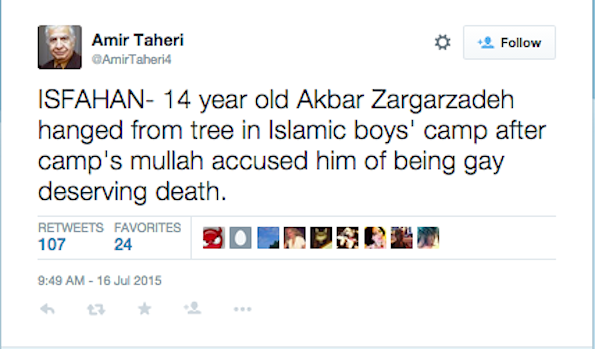 Anyone’s first reaction would be some version of “My God.” It sounded horrible. I wrote to Taheri asking for more information — and so, judging from Twitter, did at least three other people.
But the story quickly began to show cracks. Taheri didn’t reply to me, or anybody. I sat down that night with a Farsi-speaking friend and began searching for the story in the Iranian press: under the youth’s name, under various other key words. It didn’t turn up anywhere. I wrote to the Toronto-based Iranian Queer Organization (IRQO), a diaspora-based group of LGBT Iranian activists with which I’ve worked closely over the years. They searched the media as well and found no sign of it. They also reached out to contacts in Isfahan. On Friday morning, they told me no one there had heard of the story, either.
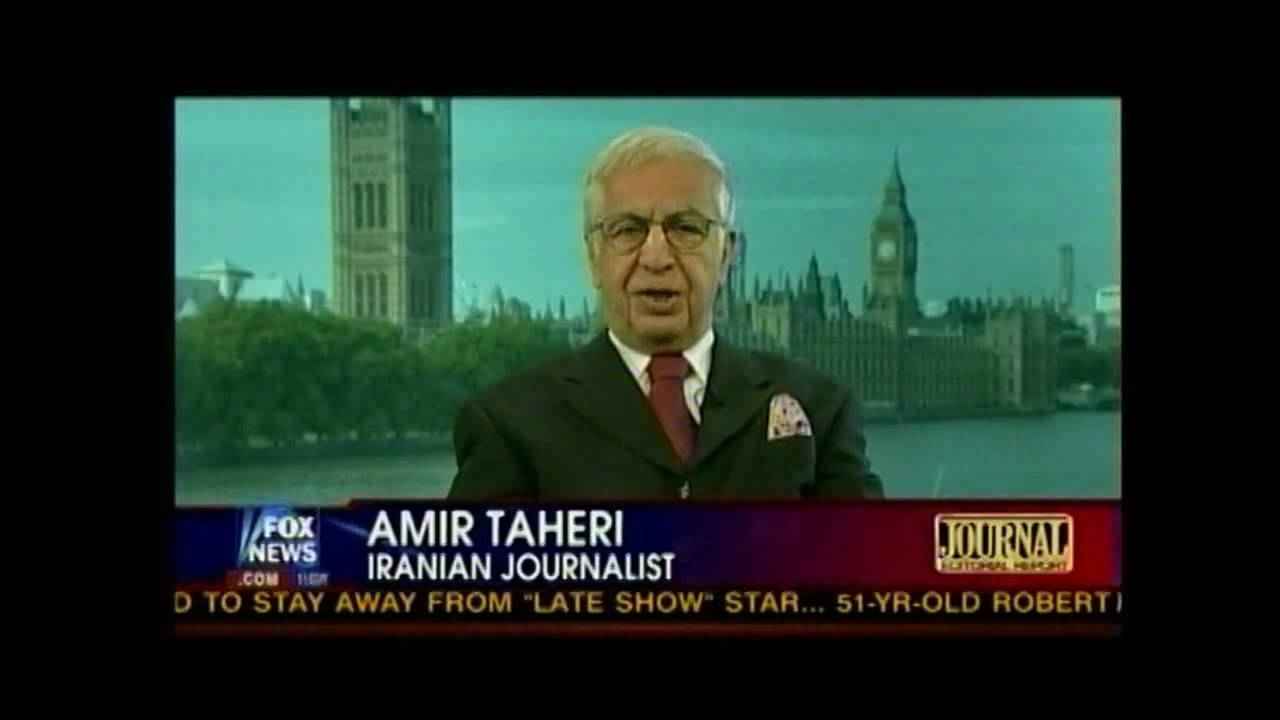
Amir Taheri lies a lot. Eight years ago, Jonathan Schwartz called him “one of the strangest ingredients in America’s media soup,” adding, “There may not be anyone else who simply makes things up as regularly as he does, with so few consequences.” An arch-conservative protege of the Pahlavis, an editor of the Tehran daily Kayhan under the Shah, he repeatedly fabricates stories about Iran to please right-wingers in his adoptive West. Most famously, in 2006 he claimed in Canada’s National Post that a new dress-code law in Iran would impose special clothes on religious minorities, including yellow badges for Jews. Many conservatives swallowed the story; even the Canadian Prime Minister repeated it. But it was a complete falsehood, and after a huge furor the National Post retracted it and apologized: “It is now clear the story is not true. … We apologize for the mistake and for the consternation it has caused.” (The Post also noted that Taheri went “unreachable” after his fiction was exposed, rather as he did on Twitter.) Undeterred, in 2008 Taheri concocted a quote from Ayatollah Khomeini, complete with a fake citation of an invented source; American neoconservative luminaries duly repeated it. In 2002, Taheri claimed that “Osama bin Laden is dead …. the fugitive died in December and was buried in the mountains of southeast Afghanistan.” The list of his duplicities goes on and on. In 1989, an academic reviewing one of Taheri’s books
detailed case after case in which Taheri cited nonexistent sources, concocted nonexistent substance in cases where the sources existed and distorted the substance beyond recognition when it was present. … [The reviewer] concluded that Nest of Spies was “the sort of book that gives contemporary history a bad name.”
Larry Cohler-Esses condemns Taheri as a “journalistic felon,” part of a “media machine intent on priming the public for war with Iran.”
There are ample grounds for skepticism about stories Taheri spreads.
But skepticism doesn’t make headlines. Propaganda’s best friend is the ambition of the press. On Thursday, a reporter for the UK-based Gay Star News also tweeted to Taheri.
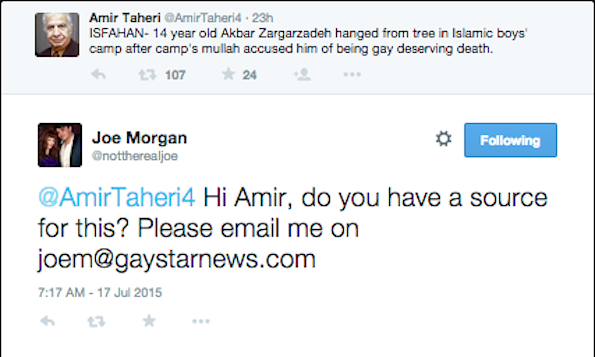
Taheri didn’t answer him, either. I know this because the reporter didn’t wait for a source. About 25 minutes later, his story — “GAY TEEN, 14, ‘HANGED FROM TREE’” — topped the website of Gay Star News, and it said Taheri hadn’t told them anything. In other words, their entire account was based on one single tweet with no evidence behind it. This tweet was special, though. The topic of gay killings in Iran has shown its passionate drawing power over a decade, its ability to keep queers clicking. GSN wanted the clicks for itself.
The reporter clearly never asked Iranian LGBT activists or groups for their take. It was more important to get the headline out there. I wrote to Tris Reid-Smith, GSN’s editor, and asked “Is this standard practice — to run a story based on a single, unsourced, unconfirmed tweet from someone who declines to answer follow-up questions?” Tris rather cannily refused to reply in writing; he wanted to talk by phone. My phone in Cairo is tapped; I declined. I wanted this on the record, but not State Security’s record. If Tris still wants to answer my question, he is welcome to do so here. GSN has since added a few sentences to its story, saying:
we should note Iranian LGBTI networks have not confirmed the story. Some critics have questioned Taheri’s reliability. … UPDATE: For clarity, GSN has noted from the outset this report has not been independently verified. Taheri is yet to reply to our questions seeking to substantiate his claims. We urge caution but feel it is in the public interest to report the claims, given they are gaining traction on social media.
Let that final sentence revolve in your mind. What defines news these days isn’t truth. It’s traffic. (I’ve saved a screenshot of GSN’s original article, prior to the caution-urging, here.)
And of course the story spread. Neoconservative propagandist Ben Weinthal tweeted it manifold times:
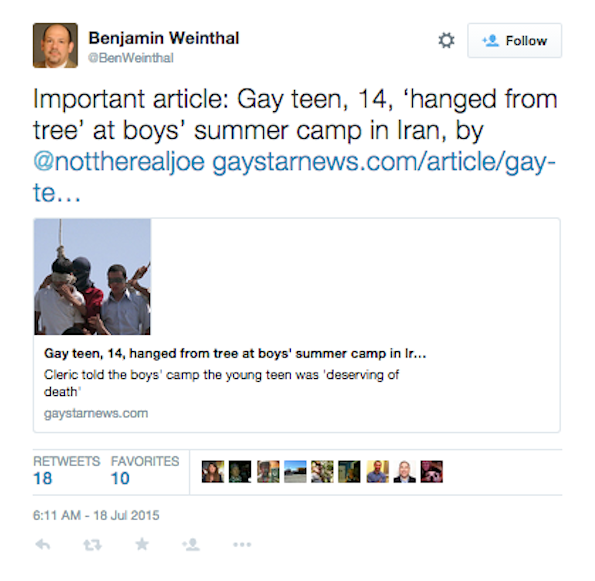 Weinthal is a lobbyist for the right-wing, pro-Israel Foundation for Defense of Democracies. One of his jobs is to drum up support in gay communities for hardline policies against Iran. I’ve detailed some of his many misrepresentations here. His desperate drive to ensure Taheri’s tweet gets coverage suggests what the motives at work are.
No one should ever minimize the real, documented, and terrible human rights abuses in Iran. But credulity for suspicious stories devalues the true ones. Given Taheri’s record, and the tangled political context, there is no reason to credit this tale without corroboration.
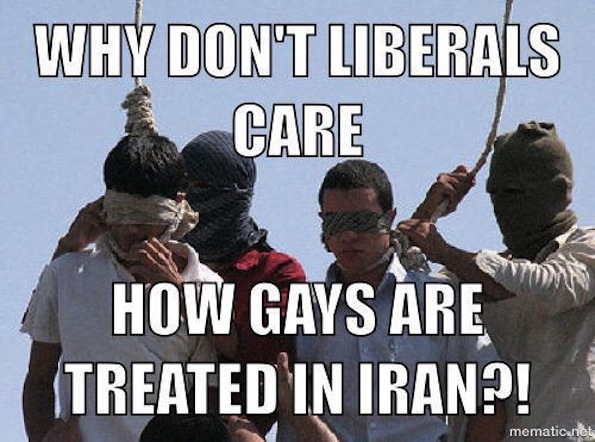
And here’s the thing: we’ve been through this before, and learned nothing. Look at the photo GSN attached to its article.
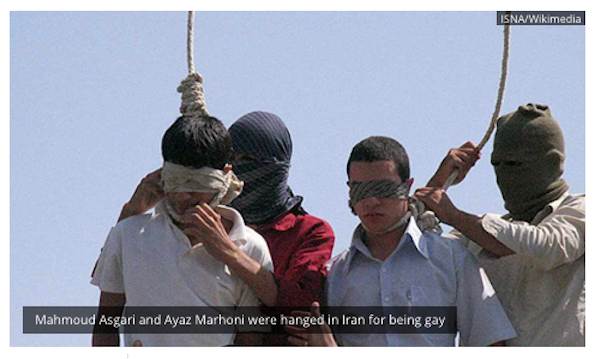 That famous image, exactly ten years old, reverberates with misery and horror. And cynics and opportunists know it as proven clickbait. In fact, the two youths were not executed simply for “being gay.” They were convicted of the rape, at knifepoint, of a 13-year-old boy. Claims that they were gay lovers circulated widely among Western activists; but no clear evidence materialized to confirm them.
International tension shaped the context, then as now. In June 2005, Mahmoud Ahmadinejad was elected President of Iran. The religious hardliner’s victory intensified foreign fears of Iran’s nuclear plans; Ahmadinejad moved quickly to quash negotiations with European powers and smear reformists as appeasers. Western conservatives stoked those fears, and rumors roiled. Immediately after the vote, a website affiliated with the Mujahedin e Khalq claimed Ahmadinejad had participated in the 1979 seizure of the US embassy in Tehran. The Mujahedin is a wealthy, cult-like Iranian exile group widely despised in the diaspora, but closely tied to many Western politicians. Amir Taheri leapt in; he alleged in print that that Javad Zarif — then Iran’s UN ambassador, now its foreign minister — had joined the hostage-taking. (Another fabrication: Zarif was studying in the US at the time.) That summer, a charged, familiar storm-cloud of fact, anxiety, and speculation swirled round the subject of Iran.
On July 19, 2005, the two teenagers were hanged in Mashhad. Reports in the local and national Iranian media said clearly they had been tried for tajavoz (rape) or lavat beh onf (“sodomy by force,” or male rape); the Quds newspaper in Mashhad quoted both the 13-year-old victim and his father. Another website of the Mujahedin e Khalq, however, published a piece on the execution aimed at Western audiences, and omitted the rape charge. Almost certainly the Mujahedin pointed out the story to lone-ranger UK activist Peter Tatchell — who had a record of publicity-seeking animosity to Iran and political Islam — and proposed the “gay” angle. On July 21, Tatchell’s OutRage website blared, “IRAN EXECUTES GAY TEENAGERS,” above the pictures taken from the Iranian press. Tatchell claimed, falsely, that Iranian media had not mentioned the rape, and that the pair were originally charged with consensual sex: setting in motion a stream of fictions that didn’t stop for months.
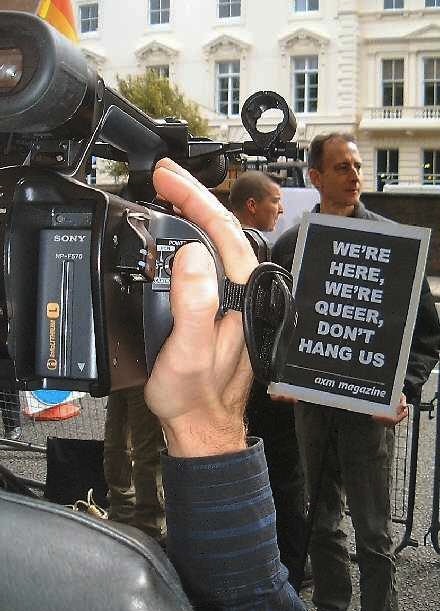
With panic over Iran already in the air, the photos went vastly viral. If politics motivated some to promote the story, for others it was publicity. (Doug Ireland, a gay US writer with no prior knowledge of Iran who nonetheless rode the story to a new journalistic job, told me his blog got 60,000 hits the first day he carried the pictures.) As more facts came out and the tale seemed less plausible, its proponents got aggressive: not only with doubters, but with the protagonists. Tatchell, for instance, belittled the alleged rape and suggested the victim wanted it: “It could be the 13-year-old was a willing participant.” Meanwhile, the story’s popularity led to a desperate search for sequels, for new “gay victims,” that stretched for years. Virtually any execution for rape reported in the Iranian media — even of male rapists of women — could be arrogated or mistranslated as a punishment for consensual gay sex. In a grim and grotesque irony, the quest helped produce the dead. In 2007, Tatchell intervened in the last-ditch appeal of an Iranian prisoner on death row, also for the rape of a 13-year-old. Makwan Mouloudzadeh had been framed in a village vendetta; there was no real evidence he’d had sexual relations with the child, much less any other male. Instead of maintaining Makwan’s innocence, though, Tatchell falsely alleged the child was Makwan’s “partner.” Allies of Tatchell started a letter-writing campaign to Ahmadeinjad pleading for the “young homosexual Makvan,” arguing explicitly that he was “‘guilty’ of having loved a peer when he was 13 and having sexual intercourse with him.” They incriminated the man they were trying to save. Makwan, neither homosexual nor a rapist, was hanged.
The Mashhad story survives, immune to its malign consequences. Taheri certainly knows it — he surely suspected a 14-year-old victim would make his tweet go viral. The youths’ images are memed and manipulated everywhere. Sometimes the uses are political:
 Sometimes they’re mythological figures, as if the kitsch of Shi’ite religious iconography melded with the preoccupations of San Francisco.
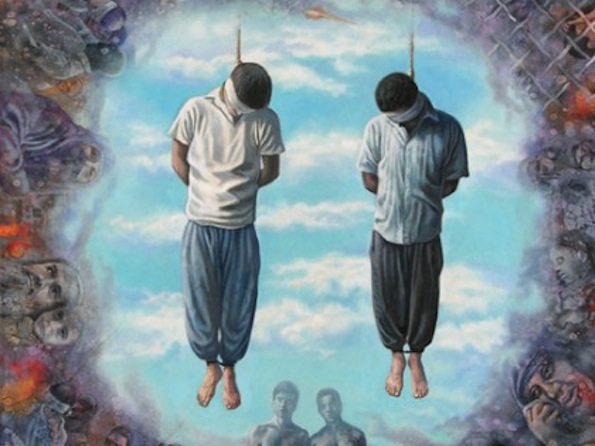
But they remain, always, “the sacred gay martyrs of Iran.”
An hour or two after the Gay Star News story appeared, Tatchell seized the opportunity, announcing a “vigil” to commemorate the tenth anniversary of the youth’s deaths.
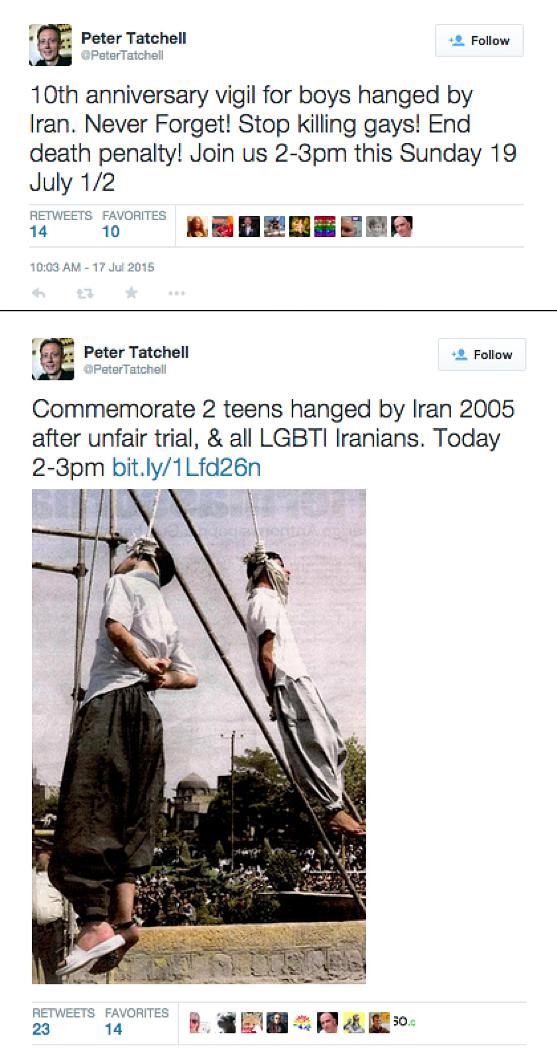 “On 19 July, we stand for life, liberty and love,” Tatchell said at the demo. But think what that rhetoric obliterates. If their 13-year-old victim’s story was true, what would he say about those words? Most human rights activists know that you can oppose grave abuses, like the appalling execution of children, without spinning narratives of absolute innocence or “love.” But to do that requires abjuring sentimentality, and acquiring maturity.
A deep narcissism lies pooled here. What does “never forget” them mean, when you never knew anything about them in the first place? No one has ever seriously sought to learn facts (rather than weave romances) about the youths’ lives; no one ever showed the least interest in the 13-year-old they allegedly brutalized; no one has ever tried to find their families, and hear what they think of their sons’ pictures being broadcast in this way, or inserted into a foreign story about “gayness.” The boys are silent. Their muteness is their appeal. They offer a clean field for Western political and erotic fantasies; they’ve withered to ventriloquist’s dolls for Western voices. The indignities they suffered before death have been succeeded by a further descent, the indignity of being erased in the imperial name of memory. What Tatchell wants remembered is not the murdered youths. It’s himself.
II.
Strangely, I took two different tacks with Amir Taheri. The day after I politely asked him for information, you could have found me on Twitter writing in quite a different tone:
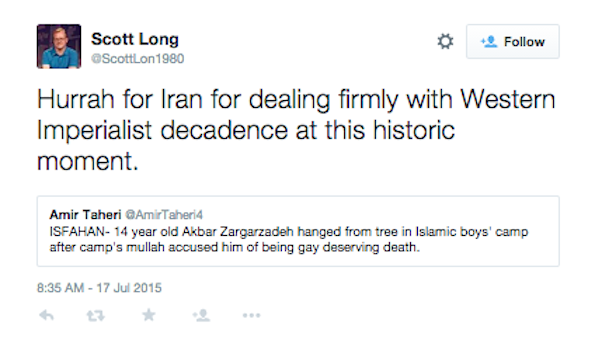 Except that wasn’t me. It was an account someone set up under my name about a week ago, which has been firing off tweets to Egyptians and various right-wing Westerners ever since. It says I’m a pro-Iran Islamist. It uses an old picture of me, and the inevitable photo of the hanged Iranian youth.
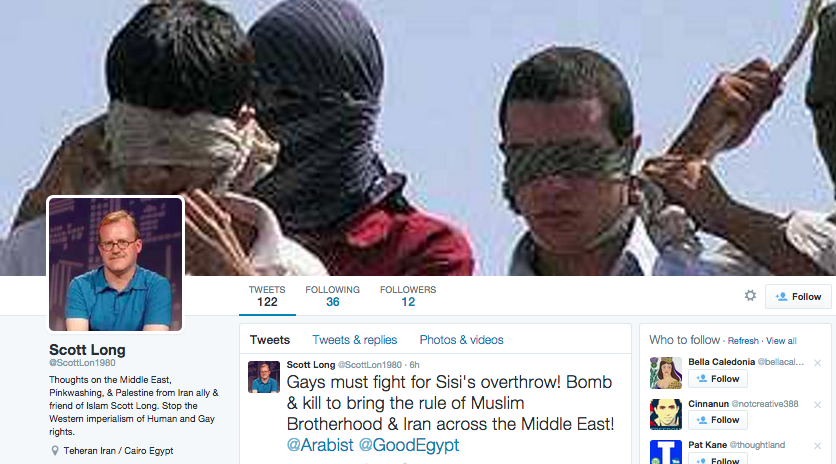
The account isn’t a “parody.” Not just that it isn’t funny: it’s trying to get me arrested. It makes out that I support banned insurgent movements and want the Egyptian government overthrown. These messages it forwards to Egyptian tweeters, including government accounts.
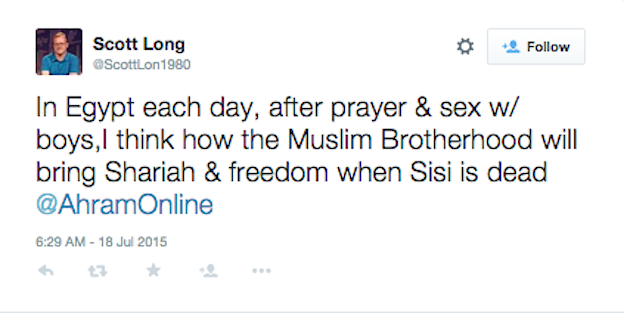
That one tweet could easily lead to a few decades in prison here. And the person who put my name to it appears quite conscious of the fact.
Who’s behind this thing? I have no idea. But I know who likes it. Here are the account’s followers when I checked it on July 16:
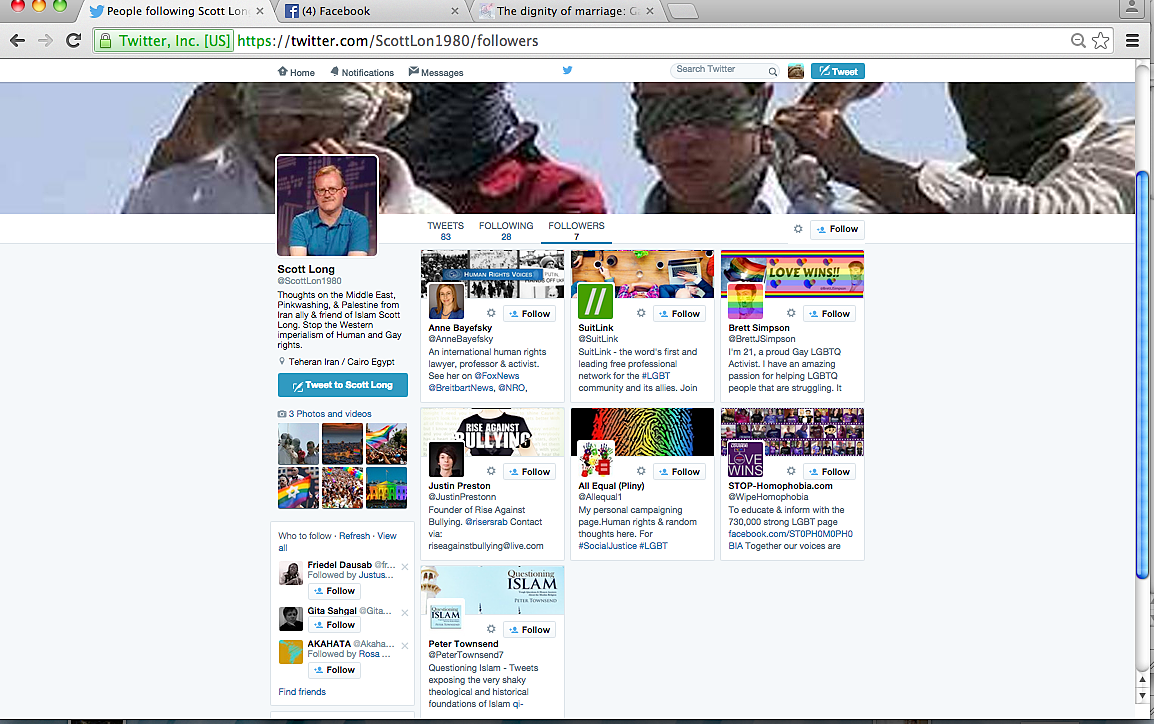
The third person who’d followed the account — out of seven at the time — was “All Equal.” That’s the Twitter of Pliny Soocoormanee, who happens to be the personal assistant of Peter Tatchell, director of the Peter Tatchell Foundation. How he found out about this obscure account when no one else knew of it, and why it interested him so much, is a fascinating question. I can’t imagine the answer.
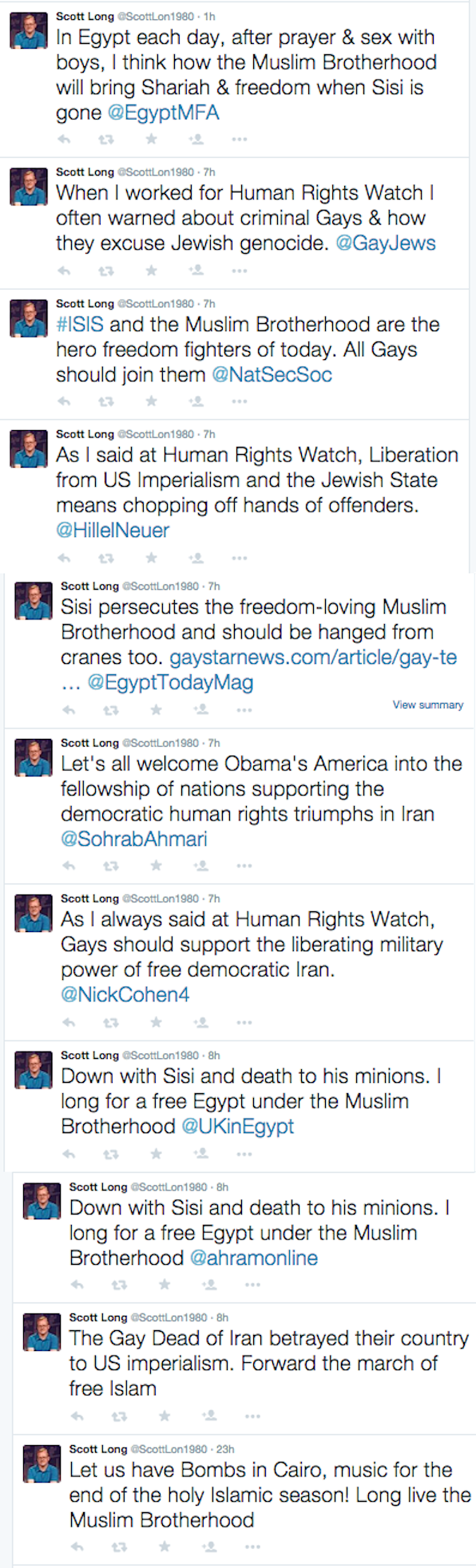
The morning after I criticized the Taheri story on Twitter, the account exploded with vengeful drivel, directed at people inside and outside Egypt (the one at top went to the country’s Ministry of Foreign Affairs):
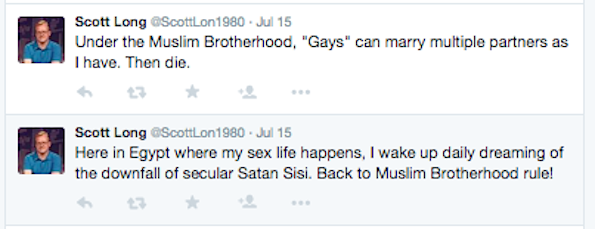
 But this BS is merely typical. Apparently I work for the Brotherhood, an illegal organization here:
 My motives appear to be erotic as well as pecuniary.
 I’m also an informer.
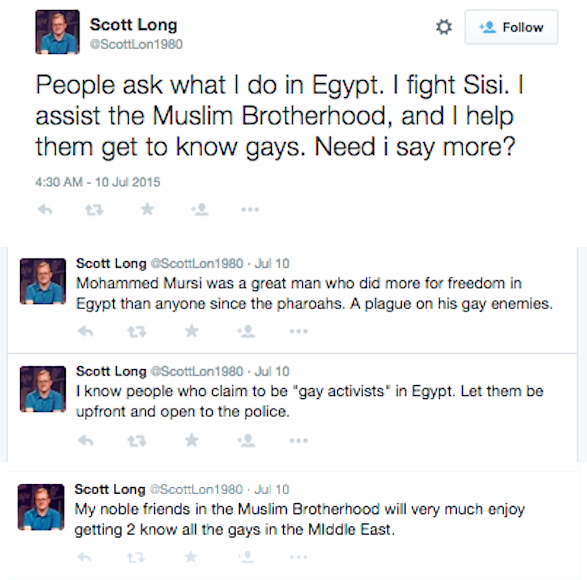
But mostly the account just strives to identify me with vicious anti-Semitic ravings, marking the intrinsic fascism of its maker’s mind. (Fascism is the politics of a cynical, corrosive narcissism. The mark of fascism is that it imagines all other opinions are as fascist as itself.)
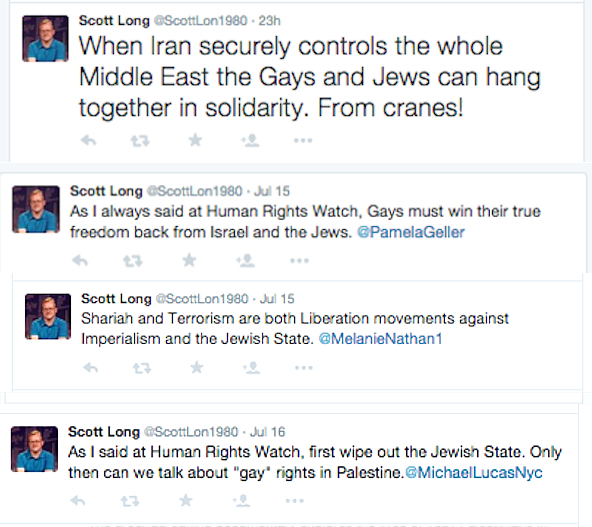
The account is pretty much coeval with the nuclear deal with Iran. Its first three tweets:

I wouldn’t pay attention to this crude fakery if it weren’t trying explicitly to incriminate me to Egypt’s government — which is arresting gay foreigners, and may not know the difference, or want to. I never cease to be surprised by the retributory malice of the Iran- and Islam-obsessed crowd, whether driven by ideology or the sheer love of headlines. They never stop.
Back in 2006, when Amir Taheri’s lies about Iran’s dress-code law were exposed, The Nation spoke to his PR agent. Accuracy on Iran is “a luxury,” she said. “As much as being accurate is important, in the end it’s important to side with what’s right. What’s wrong is siding with the terrorists.” You see? It’s us or them. Loyalty trumps truth. To expose useful lies is to take the terrorists’ side. And by that standard I am, of course, a terrorist.
Why does it matter? Because LGBT Iranians shouldn’t be exploited for propaganda. They lead lives seamed by danger, distinguished by courage; they deserve better than to be backgammon pieces, passive tokens stacked and shifted in a great-power political game. LGBT people should speak in their own voices, be masters and heroes of their own lives. That is what the liberation struggle is about.
The fact that nobody — not Tatchell, not Ben Weinthal, not Gay Star News — bothered to ask LGBT Iranian activists or groups what the truth was, or whether they wanted a demonstration, is appalling. But it’s typical. The story of Western engagement with LGBT rights in Iran has been one of occupation and ventriloquism, not freedom. It’s long past time for the sick game to stop.

NOTE: The fake account seems to have been taken down not long after I posted this: I don’t know whether by its maker or by Twitter (of course I complained). But, in some form or another, they’ll be back.
Interview with the US Campaign to End Anti-Semitism
By Barb Weir | Dissident Voice | July 21, 2015
As many of you already know, Alison Weir (no relation, and she pronounces her name WEER while mine is pronounced WAH-YER) and her organization, If Americans Knew (IAK), have been expelled from the U.S. Campaign to End the Israeli Occupation (USCEIO). I decided to get to the bottom of this important development, so I got in touch with Rube Joshner at the USCEIO, who agreed to be interviewed on condition of anonymity.
Barb Weir: For our readers who may not know, could you please explain why the USCEIO expelled IAK and Alison Weir from your organization?
Rube Joshner: Alison Weir violated our most sacred principle against racism, which is at the foundation of all our work.
BW: My goodness! Is she a closet Zionist? Does she advocate an exclusivist Jewish state. Does she support the ethnic cleansing of non-Jews from Palestine or defend the theft of Arab land?
RJ: I’m not sure what you mean by Zionist. I’m not familiar with the term, but as for the rest, no, just the opposite. She violated our anti-Semitism clause.
BW: She’s an anti-Semite?
RJ: Not exactly, but she’s been seen with anti-Semites and she failed to denounce them to their face. We require all of our members to do everything possible to expose and denounce anti-Semites whenever possible, and especially to their face.
BW: I thought that was the job of the Anti-Defamation League (ADL).
RJ: The ADL is too busy defending Israel to fight anti-Semitism. Our organization criticizes Israel, which gives us a much better platform to fight anti-Semitism. In fact, we believe that the best way to defend Israel is to more-or-less liberate a significant part of 18% of Palestine and let Palestinians live there, as long as they are demilitarized and cannot defend themselves.
BW: I thought you were concerned with defending Palestinians.
RJ: We think that the best way to defend Palestinians is to fight anti-Semitism. Anti-Semitism is the cause of all the Palestinians’ problems.
BW: So you’re not opposed to Zionism?
RJ: There you go with that word again. What do you mean?
BW: I’m talking about the project to create a Jewish state where none previously existed. You’re not opposed to a state that prefers Jews?
RJ: Where did you get that idea?
BW: I thought you had a policy against racism. Isn’t a Jewish state a racist idea?
RJ: We support the principle of separate but equal, and you won’t find anything against a Jewish state in our policy on racism. That would be anti-Semitic.
BW: Are you planning to expel all the groups that oppose a Jewish state?
RJ: As I said, our first duty is to fight anti-Semitism. Sometimes a group that opposes a Jewish state will get expelled.
BW: Do you have a plan for accomplishing this?
RJ: I’m glad you asked. We’re just now drafting a new application form with a list of questions that is not in the old form. We may even apply it retroactively. Would you like to see it?
BW: Sure.
1. Are you now or have you ever been an anti-Semite?
2. Have you ever attended a meeting of anti-Semites?
3. Have you ever associated anyone that was or is an anti-Semite?
4. Are you willing to provide the U.S. Campaign with a list of all anti-Semites that you have known?
5. Have you ever tolerated the presence of anti-Semites without denouncing or challenging them?
RJ: I hope that shows we’re serious about fighting racism and defending Palestinians.
Barb Weir is the pseudonym of a writer in Northern California.
Iran’s Nuclear Deal With the P5+1: Winners and Losers
By Sasan Fayazmanesh | CounterPunch | July 22, 2015
The dust has settled and the long-awaited agreement between Iran and the P5+1 (five permanent members of the Security Council and Germany) called “Joint Comprehensive Plan of Action” (JCPOA) is now a reality. The JCPOA curtails Iran’s nuclear program in exchange for some sanctions relief. Also real is the UN Resolution 2231, which terminates all the previous sanctions resolutions against Iran passed by the United Nations Security Council. We can now announce the winners and losers in the 36-year battle between Iran and its adversaries.
Let us start with the biggest loser in this battle, the colonial regime in Palestine called Israel. Since the 1990s Israeli leaders, particularly Benjamin Netanyahu, had been trying to wage a war against both Iraq and Iran, the twin pillars standing in the way of Eretz Yisrael. But they tried to do this on the cheap, sending American boys and girls to kill and get killed. They were successful in the case of Iraq, but had a difficult time getting the US to wage a war against Iran. They could not even convince George W. Bush to go along with bombing Iran, even though they had planted their “neoconservative” allies around a president who was not known for his immense intelligence and had visions of talking to God before invading Iraq. The work became harder when Barack Obama became president. Once again, Israel planted some of its best lobbyists, such as Dennis Ross, in the highest positions in the White House and charged them with the task of formulating and implementing the policy of “tough diplomacy,” a policy designed to wage a military attack on Iran after a series of steps beginning with imposing the most severe sanctions on the country. Yet, however hard Israeli leaders tried, they could not get President Obama to take the last step and start a war with Iran. The job became even tougher when some of the Israeli lobbyists left the Obama Administration and Secretary of State John Kerry replaced Hillary Clinton, a sycophant who often mimicked Netanyahu when it came to Iran. In the end Israel not only could not get the US to attack Iran, it had to witness the entire policy of “tough diplomacy” wither away.
The failure to make the US wage a war on Iran is, indeed, one of the greatest losses that Israel has ever suffered. Ironically, the dim-witted Prime Minister of Israel played a role in this loss. Netanyahu’s bizarre behavior was, indeed, instrumental in making the P5+1 take Israel’s demands and threats not too seriously. His insane and incessant comparison of Iran to another Nazi Germany intent to commit Holocaust, his silly and continuous warnings that an Iranian nuclear bomb awaits not only Israel but Europe and the US, his ridiculous spectacle at the UN holding a cartoon of an Iranian bomb—mocked by some as “Bibi’s Wile E. Coyote UN speech”—his behind the scene maneuvers with some like mined looney-tunes in the US to defy Obama and speak before a joint session of the US Congress, all helped to isolate Israel and prevent it from playing a major role in the final P5+1 negotiations with Iran. We should all be grateful to Bibi for helping to prevent another war in the Middle East on behalf of Israel!
Israel’s loss is, of course, also the loss of its surrogates in the US. The gambling and “investor” tycoons allied with Israel, the congressmen and women who owe their seats and survival in the US Congress to these moguls, the lobbyists who are nourished by these magnates, the “neoconservatives” whose existence depends on the benevolence of these tycoons, all and all have suffered a colossal loss. The Adelson and Sabans of this world, the Cottons, Kirks and Menendezs, the AIPACs, WINEPs and UANIs, the Kristols, Boltons and Dubowitzs, have all lost big with the conclusion of the JCPOA and Resolution 2231. We should give them an “A” for effort and an “F” for the final outcome.
All this, of course, does not mean that the colonial regime of Israel and its allies are finished with trying to do to Iran what was done to Iraq. They still have a few weeks left to try to kill the US part of the bargain. But even if they muster all the needed votes against the JCPOA in the Congress, the agreement between Iran and the rest of the P5+1 will not go away. Neither will the UN Resolution 2231. That ship has already sailed!
Other big losers in the decades-old battle between Iran and the West are the medieval regimes in the Middle East, particularly in the Persian Gulf, that are nurtured and nourished by the West, especially by the Unites States. A common argument, originally manufactured in Israel, is that if Iran is allowed to enrich uranium, Arab regimes, such as Saudi Arabia, will try to develop nuclear weapons of their own. But this argument only shows how backward and reactionary these regimes are. Why didn’t these sheikhdoms try to acquire nuclear weapons when a colonial power in their midst acquired hundreds of nuclear warheads? Is it because the existence of these regimes is interwoven with colonialism? Is it because they fear resistance to colonialism? Is it because they see Iran as assisting the anti-colonial forces? Is it because they, too, had been working for decades to maintain sanctions against Iran and were hoping that one day the US or Israel or both would attack Iran? Well, the medieval regimes did not get what they wished for.
Who was the main winner in the 36-year old battle? It is tempting to say Iran. But, for reasons explained below, that would not be my first choice. My answer is actually the international corporations! As I once explained, the battle in the US over sanctioning Iran, particularly during the Clinton’s presidency, was fought between two forces, Israel and its lobby groups that were the underwriters of the sanctions, and the corporate lobby that fought to remove the sanctions. Needless to say that the corporate concern was with profit and not with the ethics of trying to starve a nation.
Over the years the corporate lobby, led particularly by the aerospace, energy and agricultural industries, lost all hopes of ever defeating its much stronger foe. Starting in the second half of the Clinton Administration foreign corporations, too, became increasingly fearful of dealing with Iran. Eventually most ties between Iran and the capitalist world economy were severed. Now, after the JCPOA, both the American and foreign corporations are salivating over the prospect of returning to Iran. Like vultures that see a fresh carcass, the capitalists of the world see a large “market” ahead of them, a country with nearly 80 million people who are mostly young and thirsty to possess commodities. Even before the final agreement was reached between Iran and the P5+1, delegation after delegation of corporate leaders started to visit Iran to reserve their seats at the forthcoming auction. But they might be jumping the gun. The sanctions that would eventually be removed are only related to the nuclear dispute. All the other sanctions, related to such things as Iran’s putative “support for terrorism” and “violations of human rights,” will remain in place.
But did Iran have a victory? I was asked this question after a talk I gave following the April Lausanne agreement. My answer was that the battle between Iran and the P5+1 is analogous to the fight between a lightweight and a heavyweight. Even before the fight begins you know who will get clobbered. The question, however, is if the lightweight will still be standing after the fight. If so, that might be construed as a victory for the lightweight. Using that analogy one can say that President Rouhani’s negotiators were victorious. They entered the talks from a position of weakness and yet they were standing at the end. In the process they crossed many of their own “redlines,” to use a favored expression of both sides of the negotiation. The redlines that were crossed by Iran included, among others, the demand that the agreement be reached in one stage rather than different stages, that military sites not be inspected at all and that sanctions be removed on the day of the agreement and not gradually. The UN Resolution 2231 also includes many concessions by Iran, such as a “snap-back” mechanism, a mechanism that would effectively trigger sanctions on Iran if one of the parties to the nuclear deal, such as the US, contends that Iran is not fulfilling its commitments. In addition, the resolution keeps in place an arms embargo and a ban on ballistic missile technology for many years to come. When examined closely, the concessions made by Iran in the JCPOA and Resolution 2231 appear shocking to those who have followed these negotiations from the very beginning.
Some “principalist” opponents of Rouhani in Iran have compared the concessions made by his team of negotiators to those made in the past by Iran in its struggle against imperialist forces—for example, the 1828 Turkmanchai Treaty with tsarist Russia, or the 1890 Tobacco Concession and, subsequently, the 1919 “Anglo-Persian Agreement” signed with the British, or the 1988 “poison chalice,” which forced Iran to accept a cease-fire demanded by the United Nations Security Council to end the war imposed by Iraq’s Saddam Hussein and his supporters, particularly the U.S. But what the “principalists” ignore is that making concessions did not begin with Rouhani and his team. It started a long time ago, in 2003, during the presidency of the “reformist” President Khatami, when Iran entered negotiations over its enrichment of uranium with E3 (France, Britain, and Germany), while contending at the same time that it has an “inalienable right” under Article IV of the Non-Proliferation Treaty to enrich uranium. Only a country in a weak position negotiates with others over its “inalienable right.” But this weakness was not associated solely with Iranian reformists. President Ahmadinejad, who was considered to be an ally of the principalists, also negotiated with the P5+1 over Iran’s enrichment of uranium. Thus, both the reformists and principalists negotiated with the biggest powers in the world from a position of weakness. This, however, was unavoidable, given the circumstances. When your whole existence is threatened, you might make a Faustian bargain, and, if you are still standing, you might call it a victory.
The biggest victim of 36 years of sanctions and threats against Iran was the Iranian working class who had to live not only under conditions of deprivation and austerity but under continuous fear of being bombed by the US, Israel or both. Let us hope that Iran’s “victory” brings about some relief for these workingmen and women, rather than merely translating into a bonanza for the Western corporate elites and their counterparts in Iran. Let us also hope that with lessening of daily threats of war, the fear of the “enemy”—a common phrase in the parlance of Iranian leaders—lessens and a greater freedom descends upon the people of Iran.
Sasan Fayazmanesh is Professor Emeritus of Economics at California State University, Fresno, and is the author of Containing Iran: Obama’s Policy of “Tough Diplomacy.” He can be reached at: sasan.fayazmanesh@gmail.com.
“The cause of Palestinian suffering and ethnic cleansing is not anti-Semitism, but rather Zionism”
Email to the U.S. Campaign to End the Israeli Occupation
Free Palestine Movement | July 21, 2015
Please be advised that the Free Palestine Movement resigns from the U.S. Campaign to End the Israeli Occupation, effective immediately.
We resign because of the disgraceful, disrespectful and unjust treatment of Alison Weir and her organization, If Americans Knew, in the procedures to expel her from the Campaign on the spurious grounds of insufficient avoidance of anti-Semitic persons and institutions.
We resign because it is clear that the decision had been made to expel IAK before the proceedings to do so had ever begun.
We resign because, in defiance of the most basic principles of justice, Ms. Weir was not given the opportunity to confront her accuser.
We resign because no evidence was presented that she herself is anti-Semitic.
We resign because the USCEIO policy on racism is so broad that someone who is not racist can be found in violation for being insufficiently vigilant about confronting and challenging anti-Semitism whenever it is encountered. This is so vague that the rule can be applied arbitrarily, as has been the case with IAK and Alison Weir.
We resign because the language of the policy on racism was formed through procedures and meetings that allowed persons selected arbitrarily by the staff and leadership of the USCEIO to control the wording, consultation and approval process of the policy and to disregard, disrespect and manipulate attempts by member organizations to participate in the process.
We resign because the policy implicitly gives priority to anti-Semitism and Islamophobia as forms of racism and does not even mention Zionism in the policy statement.
We resign because the cause of Palestinian suffering and ethnic cleansing is not anti-Semitism, but rather Zionism.
We resign because the USCEIO is in violation of its own policy on racism because it tolerates Zionism in its midst and neither confronts nor challenges it.
We resign because the mission of the USCEIO is hypocrisy: to apply double standards to racism and to tolerate Zionism while using anti-Semitism as a tool to determine who may be permitted to participate in the Palestine Rights Movement.
We resign because we prefer to take the courageous Palestinian resistance as our standard, and not anti-Semitism.
We resign because, unlike the USCEIO, we recognize that Zionism is the main problem and almost the only problem for Palestinians, and not anti-Semitism, and that the eradication of a state founded on Zionism must be our primary goal and almost our only goal.
We resign because we believe that a manipulative USCEIO gatekeeper entity does not serve the interests of justice for Palestine and Palestinians, nor for Americans, nor for Jews. We will seek the future of justice in more likely places, which is to say almost anywhere.
We do not give our consent to be considered one of the many cameo organizations, used to inflate the apparent size and importance of the USCEIO even though they have long stopped participating. We believe that the USCEIO is a much smaller organization than it pretends, and should be treated as such. Please remove us from all mailing lists and from the regional list serve, with its threats to remove anyone who steps out of line.
Finally, we join others in thanking the USCEIO for revealing its true face of arrogance, repression and hypocrisy to all who care to see. In this respect you have rendered a great service.
Free Palestine Movement is an accredited NGO of the United Nations whose purpose is to defend and advocate for the human rights of all Palestinians, and in particular the right of access to all of Palestine. Visit Free Palestine Movement’s website.
Featured Video
BRITAIN’S WARNING: PREPARE FOR WAR
or go to
Aletho News Archives – Video-Images
From the Archive
How Ukraine Tortured and Slaughtered Donbass
By Kit Klarenberg | Al Mayadeen | July 11, 2024
Almost immediately after the proxy war erupted, ISIS-tier footage of the torture and murder of Russians in Ukrainian custody emerged.
On July 6th, the New York Times published an astonishing investigation: In Ukraine, Killings of Surrendering Russians Divide an American-Led Unit. The article documents in grim detail how Chosen Company, an international volunteer battalion for Kiev, routinely executes Russian prisoners of war. It is the very first mainstream admission that this practice – a brazen breach of the Geneva Conventions, and a grave war crime – is widespread among Ukraine’s fighters, both foreign and homegrown. … continue
Blog Roll
 Aletho News
- Israel Demolishes Home Of Lebanese Journalist Whose Viral Film Exposed Pager Attack
- Record Oil, Empty Tanks: The UAE’s Miracle Recovery
- Burnham tackles Britain’s poverty with aggression in Yemen
- Peace in Ukraine: the easy way – or the hard way
- Trump & the Rrrrussians
- US taxpayer money laundered back through Ukraine – Musk
- Before COVID, an NIH lab chief proposed making a SARS-like bat virus more infectious
- Gates, Bourla on Trial in Netherlands Accused of ‘Great Reset’ Scheme at Vaccine Injury Hearing
- BRITAIN’S WARNING: PREPARE FOR WAR
- “Historic Russia”: The Land Putin Will Not Give Back
- If Americans Knew
- DAILY UPDATE: Latest essential news on Palestine, Israel, & region
- Damning report shows the media must confront its failures on Gaza
- BBC senior broadcaster speaks out on Gaza coverage
- Netanyahu vows vast West Bank invasion in response to 20-minute skirmish that left 2 Israeli soldiers and 2 Palestinian fighters dead
- Tied up and tortured: Israel using US-made electroshock weapons on Palestinian detainees
- The outsourced risk: how newsrooms rely on Gaza’s freelancers without protecting them
- Gaza bakeries forced to shut as Israel blocks flour shipments
- Gaza’s breast cancer patients face a deadly wait for treatment amid Israel’s genocide
- DAILY UPDATE: Latest essential news on Palestine, Israel, & region
- The Israel Lobby’s Changing Fortunes
- No Tricks Zone
- Two New Studies Find Thwaites Glacier Melt Cannot Be Driven By Human Activity Or A Warming Ocean
- E-Cars Reduce CO2 Emissions By Only 41% Compared To Internal Combustion Engine Vehicles
- Predictions Made By Renowned Climate Professor Over Past Decades Have Been Proven To Be Poor
- New Study Suggests Large Regions Of The Pacific Ocean Have Been Cooling For The Last 80 Years
- Germany’s Green Energy Debacle: High Energy Costs Force Kahla Porzellan to Close After 182 Years!
- New Study: 50 Years Of The Most Aggressive ‘Net Zero’ Policies Can Only Affect The Global Climate By 0.03°C
- US September “Heat” Was No Record…Many Records Set Decades Ago
- Latest European Green Energy Debacle; Portugal’s Largest Flagship Solar Park Insolvent!
- Green Energy Debacle: German Expert Professor Fritz Vahrenholt Warns Of Severe Economic And Social Consequences
- Two More Paleo Reconstructions Affirm Meters-Higher Sea Levels Across Ireland, Brazil 7000-6000 Years Ago

