Israel cheers as Obama retreats before Congress on Iran deal
RT | April 15, 2015
Israel said it is pleased with a compromise bill being floated on the Hill, which would give US legislators oversight in the Iran nuclear deal. The White House agreed to the bill adopted by the Senate Foreign Relations Committee.
“We are certainly happy this morning, this is an achievement for Israeli policy… [Prime Minister Benjamin Netanyahu’s] speech in Congress … was decisive in achieving this law, which is a very important element in preventing a bad deal, or at least, in improving the agreement and making it more reasonable,” Yuval Steinitz, Netanyahu’s intelligence, foreign relations and strategic minister, told Israel Radio.
Israel has been opposing US reengagement with Iran, claiming the result of the nuclear negotiations would be a bad deal that would compromise Israel’s national security. Netanyahu made his case in the US through pro-Israeli legislators, who are opposed to US President Barack Obama.
“What was achieved last night in Geneva is not a historic agreement, but a historic mistake,” said Netanyahu, after a preliminary deal paving the way for negotiations was reached in 2013.
Under the 2010 “Comprehensive Iran Sanctions, Accountability, and Divestment Act,” the president can waive sanctions imposed by Congress for a limited time, as a policy measure. However, Senate Bill 615 would remove that option and insist on congressional review of the final nuclear agreement with Iran before any of those sanctions could be waived.
Proposed by Senator Bob Corker (R-Tenn.) and Democrat Robert Menendez (D-NJ), the “Iran Nuclear Agreement Review Act of 2015” envisions a 52-day review period during which the president “may not waive, suspend, reduce, provide relief from, or otherwise limit the application of statutory sanctions with respect to Iran under any provision of law.” The White House can still suspend, waive or remove sanctions imposed by executive order.
If the bill is adopted, then Congress would be able to reject the nuclear agreement with Iran through a joint resolution, preventing Obama from lifting any congressional sanctions and possibly scuppering the treaty.
Iranian officials have said that the preliminary agreement reached in Geneva earlier this month would see most nuclear-related sanctions lifted immediately, while US officials maintain the sanctions would be lifted in phases, depending on Tehran’s compliance. This is one of the issues that still needs to be resolved before the June deadline for the final agreement.
“We have two and a half months more to negotiate, that’s a serious amount of time with some serious business left to do,” Secretary of State John Kerry told reporters Monday, after meeting with the legislators behind closed doors. “We hope Congress listens carefully and asks the questions that it wants. But also give us the space and the time to be able to complete a very difficult task which has high stakes for our country.”
Under the amended text of the bill agreed in committee, Obama would also have to certify to Congress every 90 days that Iran was complying with the final agreement, and submit detailed reports on Iran’s nuclear program, ballistic missile program, and “support for terrorism,” all of which remain thorny issues between Washington and Tehran.
Announcing the preliminary agreement on April 2, Obama said he wanted Congress to play a “constructive oversight role” in the negotiating process. However, the White House has argued that making international agreements is a constitutional prerogative of the executive branch, and that congressional oversight of the Iran deal would set a dangerous precedent. It now appears that Corker-Menendez has enough support from the congressional Democrats to override the veto Obama has been threatening, a senior Democratic aide told the New York Times.
Amendments proposed by several Republican Senators, including presidential hopeful Marco Rubio, could erode the bipartisan support. There were several amendments that would “pull this bill sharply to the right if adopted,” Senator Chris Coons (D-Del) told reporters Tuesday.
With Republicans making up the majority of the Foreign Relations Committee, these amendments could be adopted through a party-line vote. If that happens, Coons cautioned, “I’d drop off of it in a second.”
Read More: Americans don’t want Congress to sabotage Iran deal – new poll
Russia Impinges on Israeli ‘Right’ to Bomb Iran
By Ray McGovern | Consortium News | April 14, 2015
The front page of the neocon flagship Washington Post on Tuesday warned that the Russians have decided, despite U.S. objections, “to send an advanced air-defense system to Iran … potentially altering the strategic balance in the Middle East.”
So, at least, says the lede of an article entitled “Putin lifts 5-year hold on missile sale to Iran” by Karoun Demirjian, whose editors apparently took it upon themselves to sex up the first paragraph, which was not at all supported by the rest of her story which was factual and fair – balanced, even.
Not only did Demirjian include much of Russian Foreign Minister Sergei Lavrov’s explanation of Moscow’s decision to end its self-imposed restriction on the delivery of S-300 surface-to-air missiles to Iran, but she mentioned Israeli Prime Minister Benjamin Netanyahu’s umpteenth warning on Monday about “the prospect of airstrikes to destroy or hinder Tehran’s nuclear program.”
Lavrov noted that United Nations resolutions “did not impose any restrictions on providing air defense weapons to Iran” and described the “separate Russian free-will embargo” as “irrelevant” in the light of the “meaningful progress” achieved by the negotiated framework deal of April 2 in which Iran accepted unprecedented constraints on its nuclear program to show that it was intended for peaceful purposes only.
The Russian Foreign Minister emphasized that the S-300 is a “completely defensive weapon [that] will not endanger the security of any state in the region, certainly including Israel.” Pointing to “the extremely tense situation in the region around Iran, he said modern air-defense systems are vitally important for that country.” Lavrov added that by freezing the S-300 contract for five years, Russia also had lost a lot of money. (The deal is said to be worth $800 million.)
Predictably, former U.S. Ambassador to the United Nations John Bolton told Fox News that the air-defense system would be a “game-changer” for Israel regarding air strikes. According to Bolton, once the system is in place, only stealth bombers would be able to penetrate Iranian space, and only the U.S. has those and was not likely to use them.
The U.S. media also highlighted comments by popular go-to retired Air Force three-star General David A. Deptula, who served as Air Force deputy chief of staff for intelligence, surveillance and reconnaissance until he retired in 2010 to make some real money. Deptula called delivering the S-300 system to Iran “significant, as it complicates the calculus for planning any military action involving air strikes.”
It strikes me as a bit strange that the media likes to feature retired generals like Deptula, whose reputation for integrity are not the best. Deptula has been temporarily barred from doing business with the government after what Air Force Deputy General Counsel Randy Grandon described as “particularly egregious” breaches of post-employment rules. He remains, however, a media favorite.
Adding to his woes, Deptula was also caught with 125 classified documents on his personal laptop – including 10 labeled “Secret,” 14 labeled “Top Secret” and one with the high protection of “Secret, Compartmented Information.” Deptula pleaded ignorance and was let off – further proof that different standards apply to generals like Deptula and David Petraeus.
A More Subdued Tone
The S-300 announcement hit as Secretary of State John Kerry was testifying on Capitol Hill about the framework deal on Iran’s nuclear program. Speaking later to Fox News, Rep. Adam Kinzinger, R-Illinois, professed shock that Kerry did not seem more upset. According to Kinzinger, Kerry actually said, “You have to understand Iran’s perspective.”
And in keeping with Kerry’s tone of sang-froid, State Department spokeswoman Marie Harf, referring to the S-300 deal, said, “We see this as separate from the negotiations [regarding Iran’s nuclear program], and we don’t think this will have an impact on our unity.”
White House press secretary Josh Earnest took the S-300 announcement with his customary, studied earnestness. Referring not only to the decision to deliver the S-300s but also to reports of a $20 billion barter deal that would involve Russia buying 500,000 barrels of oil a day in return for Russian grain, equipment and construction materials, Earnest referred to “potential sanctions concerns” and said the U.S. would “evaluate these two proposals moving forward,” adding that the U.S. has been in direct touch with Russia to make sure the Russians understand – and they do – the potential concerns that we have.”
With respect to the various sanctions against Iran, I believe this nonchalant tone can be seen largely as whistling in the dark. With the S-300 and the barter deals, Russia is putting a huge dent in the sanctions regimes. From now on, money is likely to call the shots, as competitors vie for various slices of the Iranian – and the Russian – pie. Whether or not there is a final agreement by the end of June on the Iranian nuclear issue, Washington is not likely to be able to hold the line on sanctions and will become even more isolated if it persists in trying.
Worse still for the neocons and others who favor using sanctions to punish Russia over Ukraine, the lifting of sanctions against Iran may have a cascading effect. If, for example, the Ukrainian ceasefire holds more or less over the next months, it is possible that the $1.5 billion sale of two French-built Mistral-Class helicopter carrier ships to Russia, concluded four years ago, will go through.
The contract does not expire for two months and Russia’s state arms exporter is trying to work out a compromise before taking France to court. Russian officials are expressing hope that a compromise can be reached within the time left.
And, regarding the outrage among neocons over the audacious idea that Iran should be allowed to defend itself against airstrikes, there is the “exceptional” argument that Israel, United States and their allies should have the unchallenged right to bomb Iran or any other country as they see fit – and that the targeted country should have no right to protect its people, indeed that trying to defend itself is some kind of unacceptable provocation.
There is also the hypocrisy regarding how the neocons like to differentiate between “defensive” and “offensive” weapons when the question is about giving U.S.-backed governments weapons that have dual purposes, that can be used offensively as well as defensively.
For instance, in regard to Ukraine earlier this year, U.S. Assistant Secretary of State Victoria Nuland counseled U.S. officials to portray the delivery of sophisticated U.S. military hardware to the coup regime in Kiev as “defensive,” even though the weapons had an offensive capacity, such as targeting ethnic Russian rebels firing artillery or mortars at Ukrainian troops attacking eastern Ukraine.
According to the German newspaper, Bild, which published an intercepted conversation between Nuland and U.S. officials in Munich, Germany, she said, “I’d strongly urge you to use the phrase ‘defensive systems’ that we would deliver to oppose Putin’s ‘offensive systems.’”
However, NATO Commander and Air Force General Philip Breedlove left little doubt that these “defensive” weapons would help the Ukrainian government pursue its military objectives by enabling more effective concentration of fire. “Russian artillery is by far what kills most Ukrainian soldiers, so a system is needed that can localize the source of fire and repress it,” Breedlove reportedly said.
So, when “defensive” weapons help a U.S.-backed regime kill its opponents, that’s fine. However, if some truly defensive weapons, such as anti-aircraft missiles to protect a country’s cities, go to a nation that Israel might want to bomb, then that is unacceptable.
~
Ray McGovern works with Tell the Word, a publishing arm of the ecumenical Church of the Saviour in inner-city Washington. During his earlier, 27-year career as a CIA analyst, he led the Soviet Foreign Policy Branch and prepared – and briefed – the President’s Daily Brief. He now serves on the Steering Group of Veteran Intelligence Professionals for Sanity (VIPS).
High Court backs university’s decision to ‘postpone’ Israel conference
MEMO | April 15, 2015
Organisers of a conference on Israel and international law have failed in their bid to overturn a decision by the University of Southampton to cancel the event, previously scheduled for this weekend.
On Tuesday, a High Court judge in London rejected the organisers’ application for a judicial review, with the university claiming that the conference had in fact merely been “postponed” due to “security concerns.”
Pro-Israel groups have been pressuring Southampton for months to stop the academic gathering. The legal challenge was launched earlier this month, following the university authorities’ decision to cancel the conference on the grounds of “risks to safety and public order.”
The news comes as a blow to organisers and their supporters, in what has been described by campaigners as an unprecedented attack on academic freedom in the UK.
In a statement released following the High Court decision, organisers expressed disappointment at the decision, but promised that the conference would ultimately take place.
We must continue to protest publicly against the university decision, and use the moral strength of our cause to ensure freedom of speech and academic debate – for our own sakes as well as for others.
In response to efforts by the Jewish Leadership Council, Board of Deputies of British Jews, and Zionist Federation to stop the conference, more than 900 academics, including dozens from Oxbridge, Russell Group universities and Ivy League schools, signed a statement of support.
The list of signatories included more than 30 researchers, lecturers and professors at Southampton itself, with senior officials referring unhappy staff to a “HR hotline.” In addition, more than 10,500 people have signed a public petition condemning the cancellation, and supporting free speech.
The backlash has already prompted a number of Israel advocates to publicly question the wisdom of campaigning for the cancellation of an academic conference. A piece in Ha’aretz described the affair as “a tactical and a moral defeat” for Israel’s defenders.
Interview with Dr. Basman Alashi in Gaza
By Valeria Cortes | International Solidarity Movement | April 11, 2015
Occupied Palestine – The night of the 17th of July 2014 the Israeli occupation forces bombed the Al Wafaa Hospital, in Shijaia, Gaza Strip. The hospital´s speciality was the rehabilitation of paralyzed patients.
This is the moving testimony of Dr. Basman Alashi, its director:
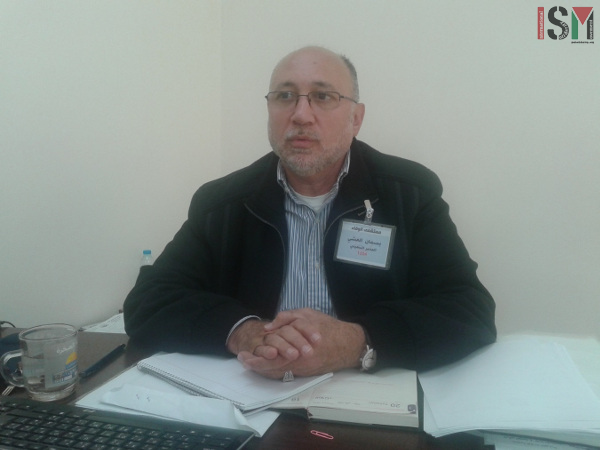
Dr. Basman Alashi
How is it possible to reach the point of bombing a hospital full of patients and medical staff?
“The UN told me that, according to a report from the Israeli occupation forces, the bombing of the hospital was due to the fact that there were weapons within its facilities … I can assure you that this report is completely false; the hospital opened its doors to the international press and to all the foreigners who freely inspected our facilities without finding any weapons at all. Despite all the overwhelming evidence, our hospital was bombed in the middle of the night, with its patients, medical staff, and some international witnesses, still inside the buildings.”
What were the consequences of the bombing by the Zionist occupation forces?
“Whilst under Israeli fire, we evacuated the remaining 17 paralyzed patients that still were inside the hospital. We couldn’t take any medication or equipment; we evacuated them just with sheets. That’s why during a cease-fire we asked the Red Cross to take us to rescue some medicines that were vital for our patients. However the Red Cross refused and we had to go by ourselves. We were only able to stay 45 minutes at the ruins of what was the Al Wafaa Hospital. The bombings continued, and we could only recover a very small amount of medicine, as bombs had destroyed most of it.
Four members of our staff were injured during the bombing. Luckily these weapons of war injured none of the patients. However they did suffer a lot during the emergency evacuation. Four of the paralyzed patients needed oxygen and many of them breathe through tubes, that’s why it was so dangerous to move them from one hospital to another; under conditions of intense aggression, under the attack of lethal weapons used against a defenceless civil population.
We could have lost some of them. It was very hard because we had to evacuate them in regular vehicles, three or four in every vehicle. Luckily we were able to move them all without any loss, due to the heroic efforts of our nurses and hospital staff. Without them all would be dead.
The patients suffered a lot during the Israeli attack on the hospital, some of them still hear the explosions of the bombs and are afraid of the start of another bombing. One of our patients, just 19 years old, refuses to enter to another hospital “the Al Wafa Hospital was bombed, my house was bombed, this hospital will also be bombed” he explained to me, terrified.
We are here to survive, to improve the lives of our children, of our patients. I can’t stand to see a small girl of barely 6 years old, to whom I can’t give the medicines she needs to survive and who can not leave Gaza to receive them. The only thing we want is for them to live with the same freedom as kids from any other place in the world.”
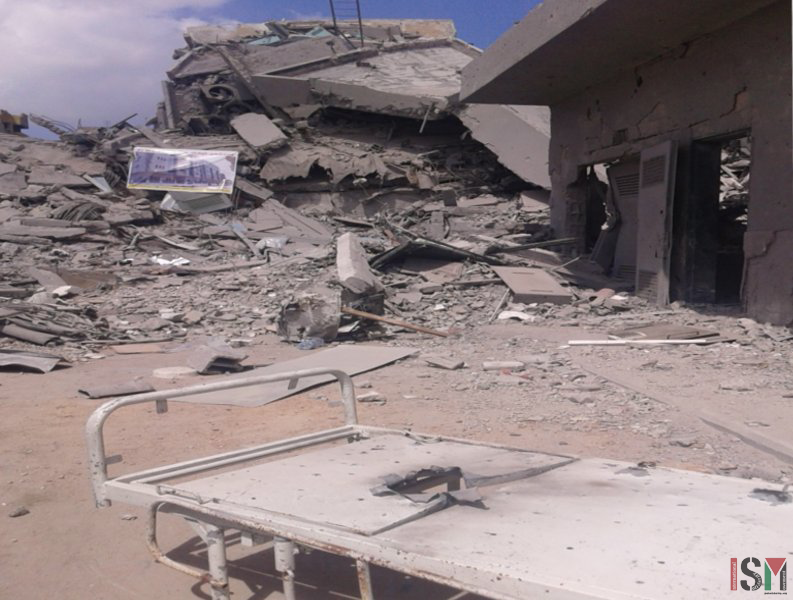
The Israeli occupation forces said that they bombed the hospital because there were weapons inside, this statement was firmly denied by many witnesses. In your opinion, what was the real reason for the attack that left a hospital as big and important as Al Wafaa reduced to rubble?
“The hospital was less than a kilometre from the fence that separates Gaza from the occupied territories. Our facilities had three big buildings, so it was just a military decision, given that those constructions blocked their way for a deeper land incursion. There wasn’t activity from the resistance inside or near the hospital installations.
I challenged the Israeli occupation forces to provide any proof of their reasons to bomb the hospital. They showed me a classified picture where, according to them, there was a rocket launcher from the resistance very near the hospital. However, the picture wasn’t from the hospital, it was from a place located almost five kilometres away. That proves that all the reasons provided by Israel were false. They just fabricated this story to justify the planned destruction of a hospital.
The Israeli occupation forces demanded we evacuate the hospital under fire and, as the facilities were under their control, it was Israel’s duty to protect the buildings. It was their obligation to preserve a hospital with 30 years history and an investment of more than 15 million dollars in equipment. Despite all this, far from protecting it’s medical facilities, they bombed them and destroyed it to the ground.”
The occupation forces point out that the attacks aren’t against the Palestinian people but against Hamas and the resistance. Do you have anything to say against the government of Gaza or the resistance?
“Against the resistance?” – asks the doctor with surprise – “We are the victims!” he clarifies. “In Gaza we have already had 8 years of suffering a terrible blockade by Israel. Our resistance is very basic. Israel has the lead, they have F16 planes, they have the tanks, war ships… they surround us! They deny us the right to defend our children, our women, our land, our homes, our own lives. It’s ridiculous. You corner me, you kill me, and you still ask me not to defend myself. Human beings in this world have the right to defend themselves. We, as Palestinians, have the right to defend our land and our families by all means available. The resistance is a way of defending our lives, it is our right.
Israel has the most powerful and destructive weapons; Israel is the one that the world should control.
Israel has committed genocide in Gaza while the world was looking. It assassinated children playing on the beach. Israel has killed children and women while they were sleeping in their homes and has bombed residential buildings without reason. Thousands of families have been left destroyed or without a home and all this took place before the eyes of the world. That’s why I blame Israel but also the international community.”
What is the situation now regarding the reconstruction of the hospital?
“There are many organizations and countries who want to help us. However, due to the Israeli and Egyptian blockade, they find themselves unable to provide the materials necessary for the reconstruction, or to send to the Gaza Strip the funds necessary for funding this reconstruction. That’s why we started to raise funds through local activities. Even so the amount collected doesn’t cover the 0,01% of the amount needed for the reconstruction of the hospital.
A lot of people all around the world have said to me that they are sorry about what happened to the hospital, and that’s good but we need much more than that to be able to attend our patients and move forward. The blockade is affecting our patients terribly, and it’s impossible for us to provide the medical treatment that they urgently need. They don’t need charity, blankets, or clothes… they need to have the stability to be self-sufficient.
The blockade seriously affects the hospital, as we find ourselves unable to go back to a full medical service like we had before and we are unable to support the rehabilitation and healthy recovery of our patients. Of the 11.000 injured from the last Israeli aggression against Gaza, more than the 50% need rehabilitation. If in one or two years the hospital is not working as it was in the past, there will be an important segment of this population that will be left unable to manage by itself and to contribute to our society, affecting it at all the levels.
What we need from the world more than anything else is an end to the blockade, to allow the entrance of materials for the reconstructions; to allow us to rebuild the homes of our families that were destroyed by Israel. This way there will be peace. But if the blockade continues, peace will be further away every day. We are human; we want a normal life as in every other place in the world. For our kids to be able to grow in a normal house, not in a shelter or a tent, suffering from the cold, without a single blanket to cover them”.
How do you see the current situation and the future of Gaza?
“The people of Gaza are resilient. They live in the most difficult conditions but still smile. The kids keep playing and adapt themselves to all the conditions, but the rest of the world must know that this situation is not normal and for this to end the only solution is to lift the blockade. The blockade must end. It’s not enough to give the people a tent, or some food or a blanket. People need a house, a job, and the possibility of giving their children a good education and to travel abroad if they wish to.
To have the possibility of going to a hospital abroad if their condition requires it. Give us the freedom that the rest of the world enjoys, because we are not different from any other population on the planet. We just want to live in peace if we are given the opportunity and doing it in freedom. But, if that right is denied to us, we will fight until we conquer it… Inshallah!”.
Israel undermines Arab presence in Lod and Ramle

Israeli bulldozer demolishing houses. [File photo]
MEMO | April 14, 2015
The Israeli authorities have intensified a campaign which targets the presence of Arabs in two historic Palestinian cities. Lod (Al-Lod) and Ramle (Al-Ramlah), like many other places in occupied Palestine, were ethnically cleansed and turned into Jewish-majority cities following the creation of the state of Israel in 1948.
According to Jordan’s Al-Ghad newspaper, the Israelis have issued demolition orders for 30 homes in Ramle owned by Palestinians. The intention is to build Jewish-owned homes in their place.
The latest statistics show that more than 34,000 Palestinians still live in the two cities, split almost equally between Lod and Ramle. They have faced official and unofficial harassment and racial discrimination since 1948.
According to a source in Ramle municipality, the 30 homes targeted for demolition were built “without the necessary permission”. This is a common ploy by the Israeli government to evict Palestinians, which has been used frequently in occupied Jerusalem. The residents affected by the demolition orders have joined Palestinians facing similar anti-Arab discrimination in other cities to form a “Popular Committee” to stand up to the “aggression” of the Israeli authorities.
Some of the owners of the 30 houses in Ramle have filed complaints to the Israeli courts to delay the demolition of their homes; they hope to buy some time to fight the orders. The Popular Committee has set up a protest tent in the city and called for all Palestinians inside Israel to get involved until the demolition orders are cancelled.
The three Arab members of Ramle municipality said that they had a special meeting with the Jewish mayor. They got nothing positive out of the meeting. The mayor, they said, is insisting on carrying out the project to build 5,000 more Jewish residential units within three years.
Al-Ghad newspaper reported that Lod is facing an even fiercer Judaisation project. Maha Al-Naqib, an Arab member of Lod municipality, told the newspaper that the homes of 400 Arab families are threatened with demolition there. The Israeli authorities, she said, are planning to knock-down two complete Arab neighbourhoods in Lod — Karm Ein Al-Naqib and Bayarat Shneer — in addition to a number of Arab houses near Al-Mahattah neighbourhood.
Al-Naqib insisted that all the Arab houses in the city were built on Arab-owned land. She added that any Arab house in the city is in danger of being demolished at any time, despite the owners possessing all of the proper documentation.
A Shifting Narrative on Iran
Iran will always be the enemy
By Philip Giraldi • Unz Review • April 14, 2015
For more than twenty years the world has been hearing from Israeli Prime Minister Benjamin Netanyahu and his friends in the United States that Iran is a global threat because it is developing nuclear weapons. Netanyahu’s warning has been framed around his repeated prediction that if nothing were done to intercede in the process the Mullahs would have a weapon of mass destruction in their hands within six months or a year. Since that time numerous time spans of six months or a year have passed and no weapon has appeared, even though Israel did its best to provide forged intelligence to muddy the waters about what was actually occurring. In a notable scam, a lap top prepared by Mossad and delivered by an Iranian dissident group half convinced the International Atomic Energy Agency that Iran was up to something. Israel has also been adept at floating false “intelligence based” allegations that the Iranians were carrying out uranium enrichment in hidden, secret facilities.
But alas, the accepted narrative proved to be a bit creaky. In 2007 the United States intelligence community issued a joint assessment based on reliable information indicating that Iran did not have a nuclear weapons program, so the threat that was being described as imminent suddenly became purely speculative and speculative threats are a dime a dozen, paling before the reality of actual North Korean nuclear weapons and fifty or more nukes in the hands of an unstable Pakistan.
When the threat of Iran actually building a bomb in the near term became less credible, the narrative perforce shifted its focus. It became no longer a question of Iran actually constructing a nuclear weapon. The central bone of contention became their having the capability to do so at some future point. This became known as “breakout capability,” which was defined as the ability to use stockpiled low enriched uranium, enrich it to weapons grade, and engineer it into a weapon. Inevitably, the breakout time for Iran was again often described as six months to a year, demonstrating that no good phony narrative detail element should ever go to waste.
Netanyahu and a number of American congressmen then continued to tinker with their warning, still complaining about breakout but emphasizing that it was actually the capability part that was most troubling. Iran, though a signatory to the Nuclear Non-Proliferation Treaty, which nuclear armed Israel is not, should have no right to enrich any uranium at all and ought to be forced to get rid of any uranium in its stockpile. It would also have to dispose of the centrifuges and other equipment used for enrichment and shut down the Fordo facility which, it was alleged, might be able to secretly produce weapons grade enriched uranium.
Ironically, the demands of both Israel and Congress made no sense as Iran and at least fifty other countries already possessed “capability” to make a nuclear weapon as there are many trained engineers able to understand the technical information that is already publicly available to those who know where to look. And the narrative became even more suspect when, in 2010, U.S. intelligence reexamined its previous finding and stated again that Tehran was not developing a weapon at all, an assertion that was actually confirmed by Israel’s Mossad, making it even more difficult to maintain the fiction that Iran was a danger to world peace.
Other intelligence assessments suggested that even if Tehran were able to obtain one or two crude nuclear weapons the threat could easily be contained, all of which produced yet another reset among the anti-Iran claque. The new focus was on delivery systems. Reports that Iran was developing or possibly buying from North Korea a new longer range missile for its arsenal became a key issue and the Obama administration wasted considerable time and energy in first correctly asserting that the missiles were not part of the discussion before folding and including mentioning them in talks as a sop to Israel. The new missiles, per Netanyahu, could allegedly hit parts of Europe and might be improved to the point where they could become intercontinental. And if Iran could acquire a bomb from somebody or develop its own through breakout it would threaten the entire world. The fact that Iran had neither the missile nor the weapon was seemingly irrelevant.
So now we arrive at 2015 and a former Israeli intelligence chief has openly said what most of the rest of the world has long known: Netanyahu is a liar when he talks about Iran. Concurrently, the P5+1 group of negotiators have concluded a marathon 18 months negotiation by achieving a framework agreement with Iran which will substantially diminish its ability to enrich uranium at all, will greatly reduce its stockpile and will also subject all of its research facilities to intrusive inspections. In return sanctions on Iran will slowly be lifted, but it should be observed that most of the major concessions were made by the Islamic Republic, where there is considerable pressure from the public to make Iran again a normal member of the international community.
It is a good agreement for all parties, guaranteeing that Iran will not go nuclear in a bad way and offering a substantive reward for cooperation to the country’s people and government. Unfortunately, details of how an agreement will actually be implemented have yet to be worked out, meaning that a final document is not anticipated until the end of June. That means the troublemakers still have time to create mischief.
Of course Netanyahu and a large number of American Congressmen might be singled out as the aforementioned troublemakers and it has to be reported that they are clearly not happy with the Obama framework. As an agreement will basically eliminate the short term threat of an Iranian nuclear weapon, the initial kibitzing from the usual critics focused on what might happen after the ten years covered by the agreement. Netanyahu has averred that it would virtually guarantee an Iranian bomb after that point, but as his prescience is questionable and he has been wrong about everything else that argument did not obtain much traction, not even in the Washington Post or Wall Street Journal.
Sensing defeat, Netanyahu and his tame congressmen clearly decided a sharp change in direction would be necessary and, presumably guided by the warm and friendly hand of AIPAC, a new approach was concocted combining two essential elements. First, it was claimed that Iran cannot be trusted to abide by any agreement because, as Chief U.S. negotiator Wendy Sherman put it “deception” is in the Iranian leadership DNA. That would mean that Iran might appear to be going along with the agreement but it would secretly be manufacturing a weapon. Just exactly how that would take place under an intrusive inspections regime is not clear, but the idea is to plant the seed that Iranians are intrinsically deceitful and dangerous.
The second argument, which began to evolve before the framework agreement was announced and which not surprisingly has nothing to do with nuclear weapons, is that Iran is threatening and dangerous by virtue of its behavior beyond its nuclear program. Congressmen and pundits have begun to bleat that Iran “now dominates four Arab capitals” and it also “supports terrorism.” One op-ed writer who should know better has described the development of a new Persian Empire.
The first argument is sheer fantasy and racist to boot but the second argument, intended to shift the narrative in a new direction, is actually the more ridiculous. Iran has a struggling economy, a relatively weak military, and much of its outreach to Shi’a communities in neighboring states is in response to the hostility surrounding it engineered by the U.S., Israel and the Sunni ruled regimes in the Persian Gulf. Creating and exploiting a limited sphere of influence as a defensive measure is far from uniquely Iranian.
And the assertion that Iran is controlling four Arab capitals – Baghdad, Beirut, Damascus and Sanaa – is breathtaking in its audacity. Iran has friends and allies in all four states but it does not determine what the government does or does not do in any one of them. The close relationship of Iran with Syria and Iraq is largely defensive and can indeed be described as derived from the instability in the region that came about because of reckless American intervention against Saddam Hussein followed by Washington’s support of a roadmap to remove Bashir al-Assad.
As for the terrorism issue, one might reasonably argue that Iran has been on the receiving end more often than not. It has been subjected to bombing and shooting attacks carried out by armed separatists supported by Tel Aviv and Washington, its scientists and technicians have been assassinated by Israel and its computer systems have been attacked with Stuxnet, Duqu and Flame viruses. According to the annual State Department Countries Report on Terrorism, Tehran’s actual support of what the U.S. and Israel claim are terrorists consists of continuing “… support for Palestinian terrorist groups in Gaza, and for Hizballah. It has also increased its presence in Africa and attempted to smuggle arms to Houthi separatists in Yemen and Shia oppositionists in Bahrain. Iran used the Islamic Revolutionary Guard Corps-Qods Force (IRGC-QF) and its regional proxy groups to implement foreign policy goals, provide cover for intelligence operations, and create instability in the Middle East. The IRGC-QF is the regime’s primary mechanism for cultivating and supporting terrorists abroad. Iran views Syria as a crucial causeway in its weapons supply route to Hizballah, its primary beneficiary.”
The meddling by the Revolutionary Guards would appear to be small potatoes, largely defensive in nature and focused on specific regional interests and concerns, relatively minor in comparison with what the United States does globally. The two Palestinian groups cited by name later in the report, the Palestine Islamic Jihad (PIJ) and the Popular Front for the Liberation of Palestine-General Command (PFLP-GC), plus Hizballah in Lebanon, would be considered resistance organizations against Israeli occupation and aggression by many. None of them threatens the United States.
The sad reality is that the pro-Israel crowd wants a war with Iran to be fought exclusively by the United States no matter what Iran does to avoid an armed conflict and they will twist the narrative so that Tehran always represents a serious threat. Remember the lies that were concocted to justify invading Iraq? Iraq allegedly had weapons of mass destruction, it threatened the entire region, it supported terrorism… does that sound familiar? Even complete surrender by Tehran might not be enough to satisfy the hawks in Congress and in Israel because the fact that Iran is in terms of geography, resources and population a regional power is what disturbs psychopaths like Benjamin Netanyahu and his Foreign Minister Avigdor Lieberman. Hopefully the American public has finally developed enough savvy to see through the barrage of war talk and lies that it will be subjected to over the next two months. Hopefully Israel and its Lobby and its friends will go down in defeat one more time, perhaps a defeat decisive enough to convince them that their narrative shifting is not any longer working. Hopefully.
Life in jail for using, digging illegal border tunnels: Egypt
Press TV – April 12, 2015
Egyptian President Abdel-Fattah el-Sisi has issued a decree rendering the digging or using of illegal border tunnels punishable by life term.
“Anyone who digs or prepares or uses a road, a passage, or an underground tunnel in the country’s border areas with the purpose of connecting with a foreign entity or state, its citizens or residents… will face life in prison,” said the presidential decree published in the official gazette on Sunday.
According to the decree, those who are aware of such tunnels and refrain from informing authorities also face life in prison, which in Egypt amounts to 25 years behind bars.
The Egyptian government claims that it has destroyed vast numbers of such routes and has recently intensified efforts to demolish such underground passages which connect the restive Sinai Peninsula to the Palestinian Gaza Strip.
Palestinians use the underground tunnels to transfer essential supplies, including food and fuel into Gaza, which has been blockaded by Israel since 2007, a situation which has caused a decline in the standard of living, unprecedented levels of unemployment, and unrelenting poverty.
Israel not only defies international calls to lift the brutal siege, but also refuses to allow medication or construction materials into coastal enclave.
Israel refuses to probe bombing of civilians in Gaza
MEMO | April 10, 2015
Chief Military Advocate General Danny Efroni said he refuses to probe the bombing of civilians in the Gaza Strip during last summer’s war, but will probe potential acts of looting and robbery committed by Israeli soldiers.
Efroni said: “You will never hear me say, ‘The IDF is the most moral army in the world’.”
Nearly 2,200 Palestinians were killed during the air, naval and ground strikes on Gaza, the overwhelming majority of whom were civilians. A quarter of the victims were children.
In an interview with Haaretz newspaper, published yesterday, Efroni said: “We will not put soldiers on trial only in order to satisfy the media, which is disturbed by the large number of civilians killed in the war. I am not investigating in order to satisfy anyone. I will not file indictments in order to arrange the statistics of B’Tselem,” which criticised the small number of indictments in the past.
An indication of Efroni and the army’s general approach is the fact that despite the passing of over eight months since the end of the war, no decision has been made regarding whether or not a military probe into the incident in Rafah that has become known as “Black Friday” on 1 August, when the IDF implemented the Hannibal Directive after the abduction of Second Lt. Hadar Goldin.
This criminal and brutal operation involved the launching of very heavy artillery fire and intensive air, ground and naval strikes, resulting in the death of dozens of Palestinian civilians. Some estimates indicate that 150 Palestinians were killed in the attack, the vast majority of whom were civilians. The Israeli army has admitted that it did not warn the civilians in the Rafah area to leave their homes before they launched the intense strike.
Despite this, Efroni said that a Military Police probe is not an insurance policy for the IDF protecting them from being prosecuted at The Hague. “If the probe is a whitewash and not a true investigation, nothing will stop the ICC,” he added.
Israeli human rights organisations B’Tselem and Yesh Din claimed that the investigation system in the IDF is “a failure” and that Israel “is not interested and not capable of investigating violations of Palestinians’ human rights by the security forces.”
B’Tselem also claimed that the IDF investigations do not arrive at the truth, noting that of the 52 Military Police probes opened after Operation Cast Lead, carried out in late 2008 and early 2009, only three resulted in the filing of indictments – and the harshest punishment was for a soldier who stole a credit card.
The Real Nuclear Threat in the Middle East
By Sheldon Richman | Free Association | April 8, 2015
To get a sense of how badly the regime in Iran wants sanctions relief for the Iranian people, you have to do more than contemplate the major concessions it has made in negotiations with the United States and the rest of the P5+1. Not only is Iran willing to dismantle a major part of its peaceful civilian nuclear program, to submit to the most intrusive inspections, to redesign a reactor, to eliminate two-thirds of its centrifuges, to get rid of much of its enriched uranium, and to limit nuclear research — it must do all this while being harangued by the nuclear monopolist of the Middle East — Israel — which remains, unlike Iran, a nonsigner of the nuclear Non-Proliferation Treaty (NPT) and faces no inspections or limits on its production of nuclear weapons.
This is something out of Alice in Wonderland. The Islamic Republic of Iran, born in 1979, has not attacked another country. (With U.S. help, Iraq attacked Iran in 1980.) In contrast, Israel has attacked its Arab neighbors several times since its founding, including two devastating invasions and a long occupation of Lebanon, not to mention repeated onslaughts in the Gaza Strip and the military occupation of the West Bank. Israel has also repeatedly threatened war against Iran and engaged in covert and proxy warfare, including the assassination of scientists. Even with Iran progressing toward a nuclear agreement, Israel (like the United States) continues to threaten Iran.
Yet Iran is universally cast as the villain (with scant evidence) and Israel the vulnerable victim.
You’d never know that Iran favors turning the Middle East into a weapons-of-mass-destruction-free zone (a nuclear-weapons-free zone was first proposed by the U.S.-allied shah of Iran and Egypt in 1974), and beyond that, Iran over a decade ago offered a “grand bargain” that contained provisions to reassure the world about its nuclear program and an offer to recognize Israel, specifically, acceptance of the Arab League’s 2002 peace initiative. The George W. Bush administration rebuffed Iran.
At the last NPT review conference in 2010, Iran renewed its support for the zone, the BBC reported at the time: “Tehran supports the ‘immediate and unconditional’ implementation of the 1995 resolution [to create the zone], declares the [then] president, Mahmoud Ahmadinejad.”
The United States and Israel claim in principle to support having the Middle East free of nuclear weapons — but not just yet. The Israeli government said in 2010 that implementation of the principle could occur “only after peace agreements with all the countries in the region.” ABC News quoted Israeli Prime Minister Benjamin Netanyahu as saying that Israel might sign the NPT “if the Middle East one day advances to a messianic age where the lion lies down with the lambs.”
That is classic Netanyahu demagoguery. As noted, the Arab League in 2002 — and again in 2007 — offered to recognize Israel if it accepted a Palestinian state in the occupied territories and arrived at a “just solution to the Palestinian Refugee problem to be agreed upon in accordance with UN General Assembly Resolution 194.” At that point the Arab countries would “consider the Arab-Israeli conflict ended, and enter into a peace agreement with Israel, and provide security for all the states of the region”; i.e., they would “establish normal relations with Israel in the context of this comprehensive peace.”
Thus Netanyahu’s position is a sham. He could have peace treaties in short order if he wanted to. But, as he said before the recent elections, he will never allow the Palestinians to have their own country.
For its part, the United States “broadly agrees with Israel that conditions for a nuclear-weapons-free-zone do not yet exist in the Middle East,” the BBC reported. In other words, the Obama administration slavishly takes the Israel-AIPAC line.
While politicians and pundits lose sleep over an Iranian nuclear-weapons program that does not exist — are they having nightmares of the United States being deterred by Iran? — they support Israel, the nuclear power that brutalizes a captive population, attacks its neighbors, threatens war against Iran, and refuses to talk peace with willing partners.
When Free Speech Becomes Dead Silence – The Israel Lobby And A Cowed Academia

Media Lens | April 8, 2015
The sudden cancellation of an academic conference on Israel, as well as the lack of outcry from ‘mainstream’ media, demonstrates once again the skewed limits to ‘free speech’ in ‘advanced’ Western democracies. ‘Je suis Charlie’ already feels like ancient history. It certainly does not apply when it comes to scrutiny of the state of Israel.
The conference, titled ‘International Law and the State of Israel: Legitimacy, Responsibility and Exceptionalism’, was to be held at the University of Southampton from 15-17 April 2015. Planned speakers included Richard Falk, the former UN special rapporteur on human rights in the Palestinian territories, Gabi Piterberg, a historian at the University of California at Los Angeles, Israeli academic Ilan Pappé and Palestinian historian Nur Musalha.
The meeting was billed as the ‘first of its kind and constitutes a ground-breaking historical event on the road towards justice and enduring peace in historic Palestine.’ The approach would be scholarly with ‘multidisciplinary debate reflecting diverse perspectives, and thus genuine disagreements’. Rather than being a coven of political extremists and violent hotheads, this was to be a serious gathering of respected and authoritative academics with in-depth knowledge of Israel and Palestine.
But intense pressure from the Israel lobby about the airing of ‘anti-Semitic views’ has torpedoed the University of Southampton’s earlier stated commitment to uphold ‘freedom of speech within the law’. In a classic piece of bureaucratic hand-wringing, the university issued a corporate-style statement on 1 April that leaned heavily on the pretext of ‘health and safety’ to kill off the conference. This happened a mere two weeks before the conference, planned months earlier in consultation with the university, was due to begin.
The Board of Deputies of British Jews was among those Zionist groups that had been urging the university to cancel the event. Its president, Vivian Wineman, said:
‘It is formulated in extremist terms, has attracted toxic speakers and is likely to result in an increase in anti-Semitism and tension on campus.’
The Telegraph reported that ‘at least two major patrons of the university were considering withdrawing their financial support. One is a charitable foundation, the other a wealthy family.’
There was also fierce criticism from several politicians at Westminster. Mark Hoban, the Conservative MP for Fareham, described the conference as a ‘provocative, hard-line, one-sided forum that would question and delegitimize the existence of a democratic state.’ Caroline Nokes, MP for Romsey and Southampton North, said the university risked bringing itself into disrepute by hosting what she described as ‘an apparently one-sided event’.
A senior government minister even got involved. Eric Pickles, Secretary of State for Communities, derided the conference as a ‘one-sided diatribe’. He went further:
‘There is a careful line between legitimate academic debate on international law and the actions of governments, and the far-left’s bashing of Israel which often descends into naked anti-Semitism.’
This was outrageous high-level political interference in free speech. When the university confirmed that it was cancelling the conference, the decision was predictably welcomed by the Israeli embassy in London:
‘This was a clear instance of an extremist political campaign masquerading as an academic exercise, and it is only right to recognise that respecting free speech does not mean tolerating intolerance.’
Michael Gove, the Government Chief Whip and former Secretary of State for Education, could barely contain his glee:
‘It was not a conference, it was an anti-Israel hate-fest.’
The ‘Health And Safety’ Pretext
On April 2, the conference organisers responded to the university’s sudden reversal of its earlier commitment to hold the conference. The organisers, who include Israeli-born law professor Oren Ben-Dor, said that they were ‘shocked and dismayed’ at the university’s about-turn. This was especially disappointing given that the police had given assurances that they would be ‘able to manage the demonstrations’.
The organisers noted that ‘general sensitivity following recent terrorist events in Europe’ had been ‘misused to inflate the risks’ of the conference going ahead. More widely, warned the organisers, the implications for academic freedom would be dire:
‘The stakes for academic public space, for academic freedom and for freedom of speech are too high. The message it sends to other academic institutions and to students all over the world is grave and depressing. It will potentially make campuses obedient and depoliticised, distant and docile corporate spaces.’
An inadvertent clue to the reality underlying the university’s rhetoric on ‘security’ and ‘health and safety’ could be found in a report last month in the Jewish Chronicle. Board of Deputies of British Jews president Wineman told the Chronicle that:
‘When we had a meeting with the university vice-chancellor they said they would review it [the conference] on health and safety terms.
‘The two lines of attack [sic] possible were legal and health and safety and they were leaning on that one.’
The ‘line of attack’ about ‘health and safety’, then, appears to be cover for the university caving in to pro-Israel pressure. This fits a wider pattern of the pro-Israel lobby’s fear of increasing global condemnation of Israeli crimes against the Palestinian people and international law. As Ben White, an authoritative freelance journalist on the Middle East, reported last month, the British ambassador to Israel, Matthew Gould, recently met with UK university heads to discuss Israel and the limits of ‘freedom of speech’. Also present were representatives of at least three pro-Israel organisations: the Board of Deputies of British Jews, the Jewish Leadership Council, and the Union of Jewish Students.
Southampton University’s refusal at the time to buckle under pro-Israel lobby pressure was cited in the meeting. White noted:
‘This stubborn commitment to freedom of speech has clearly angered Britain’s Israel lobby, but the bigger question here is why a UK ambassador was involved in the first place.’
When pressed to explain this, a Foreign Office spokesperson told White that ‘part of Matthew Gould’s role involves outreach to the British Jewish Community.’ White added:
‘The spokesperson did not elaborate on whether lobbying British universities was part of the ambassador’s remit.’
The conference organisers have now lodged an injunction at the High Court in London in an attempt to prevent the university from curtailing their right to freedom of speech. The legal argument is that in unfairly withdrawing permission for the conference, the university has capitulated to the pro-Israel lobby. ‘This is blatant censorship under the guise of a specter of campus being overrun by violent hordes, which is patently groundless,’ said Mark McDonald, a public interest lawyer from the chambers of Michael Mansfield QC.
Many academics have protested the university’s decision. David Gurnham, the Director of Research at the university’s School of Law, wrote in an email to vice-chancellor Professor Don Nutbeam:
‘It seems to me outrageous that you seem to have allowed the bullying and threats of the Israeli lobby to prevent the perfectly lawful and legitimate exercise of free speech and academic debate. I understand that the police had reported that they would be perfectly able and willing to deal with any security concerns at the event: this ought to be good enough.
‘Cancelling the event in this way makes the University look weak, spineless and reactionary. I am proud to be a member of academic staff here, but your decision to withdraw support for a conference in this manner makes me, and I’m sure very many others like me, seriously question the University’s commitment to open and free debate.’
(More letters of protest from academics can be read here.)
All this comes at a time when the Boycott, Divestment and Sanctions movement is gathering strength. A recent debate at the Cambridge Union Society even passed the motion that ‘This House Believes Israel Is A Rogue State’.
At the time of writing, a petition calling for the University of Southampton to uphold free speech has attracted almost 10,000 signatures in just one week (it took a Zionist petition in favour of cancelling the conference one month to reach around 6,500).
An earlier petition in support of the conference was signed by round 900 academics around the world.
All of this must make the pro-Israel lobby deeply uncomfortable. As Ben White observed:
‘Whatever the final outcome, this story is significant for the way in which it illustrates not so much the pro-Israel lobby’s power, but its weaknesses.’
No More ‘Je Suis Charlie’
Media coverage of the cancellation of the conference has been almost non-existent. We found just three news articles in the national press: one in the Guardian, one in the Telegraph and one in the Express.
But what is even more glaring than the lack of news coverage is the editorial silence on the pro-Israel lobby’s bullying and intimidation. What happened to all those grand declarations from editorial offices, under the banner ‘Je suis Charlie’, to uphold freedom of speech and the ‘right to offend’? The journalists and cartoonists who were murdered at the Charlie Hebdo offices in Paris were, we were told, ‘martyrs for freedom of speech’. The atrocity was ‘a war declared on civilisation’, ‘an attack on the free world’, ‘an assault on journalists and free speech’. A Guardian editorial proclaimed:
‘If there is a right to free speech, implicit within it there has to be a right to offend. Any society that’s serious about liberty has to defend the free flow of ugly words, even ugly sentiments.’
Where is the outpouring of dismay now from liberal commentators across the British media at the actions of the pro-Israel lobby? Where are the comment pieces decrying this latest attack on free speech? When it comes to Israel, the ‘right to offend’ is quietly dropped.
Moreover, why should it be ‘toxic’ to examine critically the founding ideology of Israel, a state that was built on one of the largest forced migrations in modern history? As Israeli historian Ilan Pappé documented in his acclaimed 2006 book, The Ethnic Cleansing of Palestine, the establishment of Israel in 1948 was ‘Nakba’ – a catastrophe – for the Palestinians. More than half of Palestine’s native population, close to 800,000 people, were uprooted, and over 500 Palestinian villages destroyed.
Nakba largely remains a taboo subject for ‘mainstream’ coverage of the Middle East. Indeed, notes Pappé, the ethnic cleansing of the Palestinians by Israel is a ‘crime [that] has been erased almost totally from the global public memory’. This crime, he continues:
‘has been systematically denied, and is still today not recognised as an historical fact, let alone acknowledged as a crime that needs to be confronted politically as well as morally.’ (Ibid., p. xiii)
Sadly, the fear of offending the powerful pro-Israel lobby remains a major factor in British politics, cultural debate and media reporting of Israel and Palestine (see Peter Oborne’s Dispatches documentary for Channel 4 in 2009). As one senior BBC television news producer revealed to Professor Greg Philo of the Glasgow Media Group:
‘We wait in fear for the telephone call from the Israelis.’
‘The Specious Slur Of Anti-Semitism’
In a moving piece of personal testimony, Professor Suleiman Sharkh of the University of Southampton, one of the conference organisers, published an open letter. He said:
‘I grew up in Gaza, but my family is originally from a town called Majdal Asqlan (now called Ashkelon by Israel). In November 1948, six months after the establishment of the State of Israel and after the wars had ended, the town was bombed and many people were killed. Those who survived were herded towards Gaza, crawling on their hands and knees in the thorny field. Since then we have lived in squalid refugee camps. I walked around in the sand soiled by the open sewers with my bare feet. I got my first shoes when I went to school at the age of six.’
Professor Sharkh then explained the relevance and importance of the conference to Palestinian people:
‘International Law was responsible for our misery. It was used to legalise the theft of our homes and it continues to be used to legalise the ongoing oppression of my people by the State of Israel. The questions asked by the conference are therefore questions that I have been asking all my life. They are important questions that need to be answered.’
The conference is now likely to go ahead at an alternative venue to be publicised soon.
The journalist and filmmaker John Pilger, whose powerful documentary Palestine Is Still The Issue is a must-see, told Media Lens (email, April 3, 2015):
‘Israel is a gangster state. It holds the world record in the breach and defiance of international law. It regularly massacres and terrorises the Palestinian civilian population of Gaza, which even David Cameron has described as an “open prison”. Its courts uphold racism as state policy. It has re-elected a congenital liar as its prime minister. Its historians have long revealed the criminality of its beginning — the theft of land, the murder and brutalising of the indigenous population.’
He continued:
‘What Israel has, however, are powerful collaborators, who, even at the lowest rung, are able to intimidate institutional bureaucrats and others with the specious slur of anti-Semitism. In Britain, the Jewish Chronicle and the Board of Deputies operate this barely disguised smear as efficiently as a metronome. They, and others, have now helped silence a much needed conference on Israel at the University of Southampton. But they should not be wholly blamed. The collusion of the university authorities as they run up the false flag of “security concerns” is to blame; and the memory of every murdered child in Gaza is now their spectre. And along with the so-called “lobby”, they cannot win.’
Pilger concluded:
‘The rest of humanity has long recognised the truth about Israel, as every international survey shows. With exquisite timing, student unions across the UK are joining the boycott, divestment and sanctions movement that is sweeping country after country, including the United States. The craven decision of Southampton will speed its progress; nothing is surer.’
Suggested Action
Please sign this petition in support of the conference.
Academics can also sign this statement of support.
Featured Video
BRITAIN’S WARNING: PREPARE FOR WAR
or go to
Aletho News Archives – Video-Images
From the Archives
British weapons and personnel doing much of the killing in Yemen
Press TV – June 18, 2019
A detailed report published by the Guardian newspaper has shown how Britain is massively contributing to Saudi Arabia’s devastating war on Yemen as it suggests that London is not only supplying the bombs that fall on Yemenis, but it provides the personnel and expertise that keep the war going.
The comprehensive report by Arron Merat published on Tuesday showed that Britain was doing much of the killing in Yemen as the country continues to provide Saudi Arabia with everything it needs to turn its southern impoverished neighbor into a graveyard.
“Every day Yemen is hit by British bombs – dropped by British planes that are flown by British-trained pilots and maintained and prepared inside Saudi Arabia by thousands of British contractors,” said Merat in the report. … continue
Blog Roll
 Aletho News
- Yemen denounces European Parliament’s ‘hypocritical’ push to blacklist Ansarullah
- Qalibaf: UAE’s UN bid aims to ‘clear the runway’ for ‘Greater Israel’, whitewash genocide
- Pakistan reopens Iran border after boosting security: Report
- Why are so many Brazilians voting for Flávio Bolsonaro?
- Democrats Put Anti-Russia Agenda Ahead of American Workers
- Elijah Magnier: Yemen’s Strikes Are Shattering Saudi Arabia’s Long-Term Strategy
- Pentagon designates Chinese cultural centers national security threat
- Israel Demolishes Home Of Lebanese Journalist Whose Viral Film Exposed Pager Attack
- Record Oil, Empty Tanks: The UAE’s Miracle Recovery
- Burnham tackles Britain’s poverty with aggression in Yemen
- If Americans Knew
- An error has occurred; the feed is probably down. Try again later.
- No Tricks Zone
- Sudden Stratospheric Warming, Powerful El Niño Combination May Lead To Extreme Europe Cold, Energy Crisis!
- Two New Studies Find Thwaites Glacier Melt Cannot Be Driven By Human Activity Or A Warming Ocean
- E-Cars Reduce CO2 Emissions By Only 41% Compared To Internal Combustion Engine Vehicles
- Predictions Made By Renowned Climate Professor Over Past Decades Have Been Proven To Be Poor
- New Study Suggests Large Regions Of The Pacific Ocean Have Been Cooling For The Last 80 Years
- Germany’s Green Energy Debacle: High Energy Costs Force Kahla Porzellan to Close After 182 Years!
- New Study: 50 Years Of The Most Aggressive ‘Net Zero’ Policies Can Only Affect The Global Climate By 0.03°C
- US September “Heat” Was No Record…Many Records Set Decades Ago
- Latest European Green Energy Debacle; Portugal’s Largest Flagship Solar Park Insolvent!
- Green Energy Debacle: German Expert Professor Fritz Vahrenholt Warns Of Severe Economic And Social Consequences

