In Israel and the occupied territories, discrimination is enshrined in the law
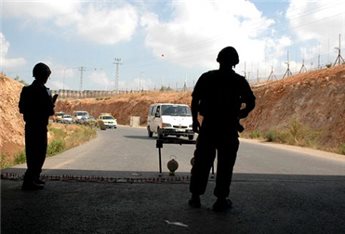
By Amelia Smith | Open Democracy | December 18, 2014
In November five Israelis were killed and eight wounded when two Palestinians attacked a synagogue in West Jerusalem. Israeli police shot the attackers dead at the scene and Benjamin Netanyahu ordered that the assailant’s houses be demolished.
The family of Mohammed Abu Khdeir, the young Palestinian teenager who was kidnapped and burnt to death in July, have also called for the homes of the Israelis who killed Mohammed to be demolished, though it is highly unlikely they will be. Such is the nature of Israel’s unequal application of the law.
News that Israel discriminates between Jewish Israelis and Palestinians is nothing new. Just last month the Israeli government voted to make all ratified Israeli civilian law passed through the Knesset apply to settlers. Most of the legislation on criminal law, tax law and military conscription already does, despite the international consensus that settlements are illegal. Around 350,000 settlers currently reside in the occupied West Bank yet for what it’s worth article 49 of the Fourth Geneva Convention states: “The Occupying Power shall not deport or transfer parts of its own civilian population into the territory it occupies.”
Knesset member Orit Struck, who drafted the bill, lives in one of these illegal settlements in the West Bank city of Hebron. Critics of Struck’s bill have said that applying civilian law to the West Bank would be a solid step towards the annexation of the occupied territories adding that it “legalises occupation”. Presumably, this is Struck’s intention.
In order to justify the bill, senior right-wing MKs have argued that the current split system – that Israelis in Israel are governed by different laws than Israelis in the West Bank – is “unacceptable from a democratic point of view” and have said it leads to discrimination against Israelis living in the occupied territories.
But what about Palestinians living in the West Bank? Article 66 of the Fourth Geneva Convention, which Israel has adopted, states that non-political military courts can be established for residents in the occupied territory. Palestinians in the West Bank are therefore subject to Israeli military law. Under the two legal systems, an Israeli settler and a Palestinian, accused of the same crime, will be treated, and sentenced, very differently.
Palestinian children, shackled and accused of throwing stones, have also been brought before these courts. The Palestinian Prisoners Center for Studies says that some 308,000 Palestinians have been detained within Israeli jails since the First Intifada in 1987.
Under military law Palestinians are threatened with arbitrary arrest, detention and are denied freedom of movement. As American-Israeli lawyer Emil Schaeffer points out, whilst an Israeli settler must be brought before a judge in less than 24 hours a Palestinian may be interrogated for up to eight days before he or she sees a judge.
In a military court Palestinians may be denied access to a lawyer for up to 90 days, yet within the Israeli legal system a meeting with a lawyer must be granted immediately. Within the military courts there is little internal supervision and consequently little public scrutiny.
The list continues, as does the system of legalised separation, discrimination and ultimately the guarantee of rights based on nationality. This segregated system goes far beyond the occupied territories of the West Bank.
On the other side of the concrete separation barrier that has sectioned off the West Bank, Palestinians living in Israel face a raft of laws that discriminate against them. According to Adalah, there are 50 laws in place that discriminate against Palestinians citizens of Israel from access to land to state budget resources.
Perhaps the most obvious of these is the Law of Return, which grants Jewish people across the world the right to live in Israel and gain citizenship. In the drive to bump up the numbers, free flights have been offered, as have financial benefits and tax breaks. On arrival accommodation is sometimes offered in annexed East Jerusalem.
Meanwhile, the seven million Palestinian refugees across the world are not only denied the right to return to their land, but also Palestinian citizens of Israel are not allowed to bring their husbands and wives from the occupied territories to live with them. So one group is actively encouraged, whilst the other is denied their basic rights.
In recent weeks a proposed law, which defines Israel as the nation-state of the Jewish people, has whipped up much controversy thanks to the controversial nature of the bill, part of which would mean the dropping of Arabic as a second language.
Like the bill that seeks to apply Israeli civilian law wholeheartedly to settlers in the West Bank, the Jewish nation-state bill is part of an ongoing system of discrimination against Palestinians, which has long rendered them second-class citizens. Little by little it is being enshrined in the law, which ultimately means discriminatory treatment towards Palestinians can continue.
Israel’s system of formal and informal discrimination reaches into all aspects of Palestinian’s lives, from separate housing in the West Bank to separate roads, schools and hospitals. It even infiltrates personal lives.
Whilst Israel regularly passes discriminatory laws, they clearly have little regard for international law – or at least, the parts of it that don’t suit them. As a signatory to some of the most important human rights and humanitarian law statutes, they should be held accountable for their discriminatory policies; which undoubtedly constitute grave breeches.
Geneva Convention meeting goes ahead, criticises Israeli violations
MEMO | December 18, 2014
The High Contracting Parties to the Fourth Geneva Convention urged an end to violations of international law in the Occupied Palestinian Territory (OPT) following a conference Wednesday.
The special Geneva meeting, hosted by the Swiss government, saw representatives from 126 state parties adopt a ten-point declaration that reaffirmed international humanitarian law and the applicability of the Fourth Geneva Convention in the OPT, something that Israel denies.
The declaration urges Israel “to fully and effectively respect the Fourth Geneva Convention in the Occupied Palestinian Territory, including East Jerusalem”, and stresses its “obligation” to administer the OPT “in a way which fully takes into account the needs of the civilian population.”
The parties went on to express “deep concern about the impact of the continued occupation”, specifically singling out Israel’s Wall and associated regime as “contrary to international humanitarian law”, along with “the closure of the Gaza Strip”.
The declaration also affirmed “the illegality of the settlements in the said territory and of the expansion thereof and of related unlawful seizure of property as well as of the transfer of prisoners into the territory of the Occupying Power.”
Speaking after the meeting, Swiss ambassador Paul Fivat hailed the declaration as “unprecedented”, and a “signal which is being sent to conflicting parties and especially to the civilian populations that there is a law, international, which is protecting their interests.”
Fivat clarified that “the declaration binds only the parties who were [present]”, with Israel, the U.S., and Canada, examples of “a small of number of High Contracting Parties” who “expressed their opposition and did not attend the Conference.”
In the lead up to Wednesday’s gathering, Israel tried to persuade the parties to the Convention to not convene the summit at all, even sending officials several times to Bern and Geneva.
In response to the conference yesterday, Israel’s UN mission claimed that “it confers legitimacy on terrorist organizations and dictatorial regimes wherever they are, while condemning a democratic country fighting terrorism in accordance with international law.”
Palestine’s Permanent Mission in Switzerland, meanwhile, praised the declaration, stating that “legal actions, including through universal jurisdiction and international criminal justice mechanisms” are necessary to hold Israel “accountable for its decades of violations of international law.”
Israeli human rights NGO B’Tselem described the declaration as a reflection of “the illegality of the ongoing occupation and its attendant human rights violations”, the “baselessness of Israel’s claims of compliance with the Fourth Geneva Convention”, and of “Israel’s ever deteriorating international status as the violations persist.”
Kerry: US will veto Palestinian bid for statehood
MEMO | December 17, 2014
 US Secretary of State John Kerry is reported to have informed the Palestinian delegation headed by Saeb Erekat that Washington will use its veto power at the UN Security Council against the Arab draft resolution which calls for an end to the Israeli occupation of the Palestine territories occupied in 1967; AFP quoted a senior Palestinian official as saying.
Kerry had earlier said that Washington has not decided on the Security Council draft resolution saying: “The time is not right for speculation about a UN draft resolution that has not been submitted yet.”
He told reporters before his meeting with Erekat that it was imperative to help lower tensions. “Many of us share a deep sense of urgency about this. But we’re also very mindful that we have to carefully calibrate any steps that are taken for this difficult moment in the region,” he said.
Al-Jazeera’s Bureau Chief in Ramallah Walid Al-Omari said the Palestinian leadership delayed a meeting scheduled yesterday and will wait for the outcome of a meeting between the Palestinian delegation and a delegation of Arab foreign ministers, headed by Nabil Elaraby, with the US secretary of state and European foreign ministers.
On Monday Israeli Prime Minister Benjamin Netanyahu met with Kerry in Rome. Israel’s Channel 10 said that Netanyahu attempted to push the US to use its veto against the Palestinian draft resolution.
Palestinian woman who stabbed Israeli settler was defending herself: official
Al-Akhbar | December 17, 2014
A Palestinian woman suspected of stabbing an Israeli settler on December 1 was defending herself after being harassed by the man, a Palestinian official claimed Tuesday.
Amal Jamal Taqatqa, 22, was shot and critically wounded by soldiers near Gush Etzion on December 1 after allegedly stabbing an Israeli settler.
The director of Bethlehem’s military liaison department told Ma’an news agency that officials requested an investigation into the shooting, but that it has been delayed due to the political atmosphere.
“Is it reasonable that 46 surveillance cameras in Gush Etzion settlement bloc have failed to document what really happened between Amal Taqatqa, 22, from Beit Fajjar and an Israeli settler who claimed that she attempted to stab him?” Khaled Qaddura said.
Taqatqa reportedly engaged in a hand-to-hand fight with the settler after he verbally abused her, causing a minor scratch to the settler’s neck, Qaddura said.
“At that point, the settlers asked an Israeli soldier who was in the area to shoot the girl, and the soldier immediately shot her in the chest. The girl fell to the ground then tried to get up and run away, but the soldier shot her again in the feet causing her to fall down again then he approached her and shot a last round,” the official added.
Taqatqa is still receiving medical treatment at Hadassah hospital and is in a stable condition.
Qaddura slammed Israel’s labeling of Taqarqa as a “terrorist”, noting that the term “terrorism” is used automatically when Israelis – whether civilians or soldiers – are injured.
He urged Palestinians who witness such incidents to film them or record the registration number of the military vehicles involved.
Unrest has gripped Jerusalem and the West Bank on an almost daily basis for the past five months, flaring up after a group of Zionist settlers kidnapped and burned a young Palestinian to death because of his ethnicity, and worsened by the deadly Israeli assault on the Gaza Strip in July and August.
(Ma’an, Al-Akhbar)
No donkeys allowed
International Solidarity Movement |December 17, 2014
Hebron, Occupied Palestine – Mohammad Saleh, a sixty-six-year-old Palestinian resident of Tel Rumeida, al-Khalil (Hebron), waited with his mule outside Shuhada checkpoint for nine hours over the course of two days. He spent four hours waiting before being allowed through on Monday (15/12/14) evening.
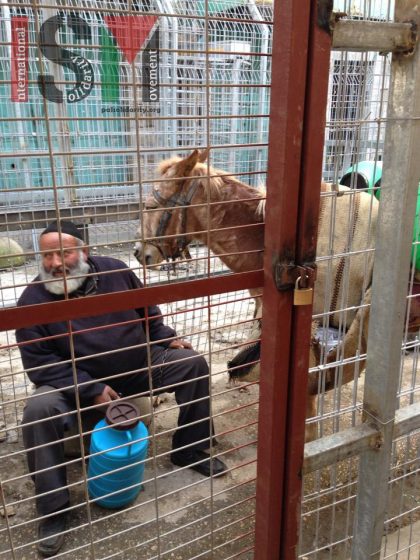
He then spent five hours Tuesday (16/12/14) attempting to cross in the opposite direction before eventually turning back, after being denied repeatedly by Israeli forces claiming that donkeys, mules, horses, and carts are not permitted to pass through the checkpoint.
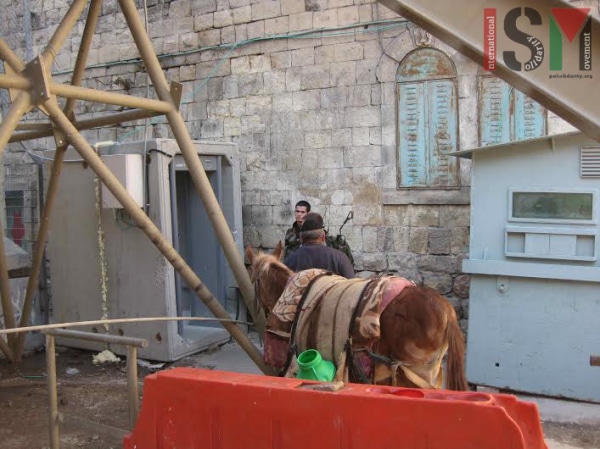
Shuhada checkpoint serves as the only clear passage between the H2 (Israeli-controlled) neighbourhood of Tel Rumeida and the H1 (Palestinian Authority-administered) neighbourhood of Bab Al-Zawiye, a route many Palestinians must traverse regularly in the course of their work and daily routines.
Mohammad arrived at the Bab Al-Zawiye side of the checkpoint at 13:40 on Mondayafternoon, his mule laden with empty milk jugs and saddlebags packed with various provisions. Israeli forces refused to let him through, claiming no animals were allowed past the checkpoint – a claim no one, including other international organisations at the scene as well as the Palestinian District Coordination Office for al-Khalil, had ever heard before.
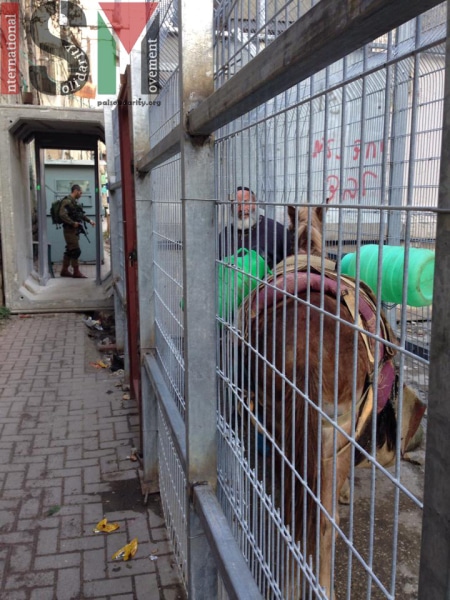
Mohammad explained that he had been allowed pass the checkpoint on Monday morning, with the promise that he would be let back through later in the day. When he returned, he found a new shift of soldiers and no one willing let him pass. The soldier manning the checkpoint claimed he needed permission from his commander to open the gate, which would allow Mohammad to pass with his mule.
An ISM volunteer at the scene later received a call explaining that the Israeli military’s new rule stated that horses, donkeys and mules were not permitted to pass through the checkpoint. No one, however, was able to explain why Mohammad had been allowed through that morning, but denied on his way home. “Look at my ID,” he told the soldier at one point, “I’m in your computer. I go through here all the time.”
He stayed waiting, sitting beside his mule on the cold concrete base of the fence, even as the afternoon turned into evening. The sky grew dark, though the lights from the checkpoint still illuminated the fences,
turnstiles, and barbed wire. Even the soldier seemed concerned, telling him to please go home, as it was cold and late and staying would not help him. But Mohammad had already made it clear he would not leave. About ten minutes later the soldier finally opened the gate, saying it was the “last time” that he would be allowed through. Although Mohammad heard the soldier’s message, it was clear he would not heed it. He intended to continue to resist, no matter what anyone told him.
Sure enough, the following morning he was once again standing outside the checkpoint, this time on the Tel Rumeida side, with full milk jugs tied to the back of his patient mule. The soldiers presented multiple reasons from denying him passage, from a prohibition on taking anything through the checkpoint too large to be carried through the turnstile, to the new rule against allowing donkeys, horses and mules through. ISM volunteers attempted to find a solution, offering to carry the milk jugs around the checkpoint and meet Mohammad and his mule on the other side. The Israeli soldiers manning the checkpoint rejected all suggestions.
“Is the donkey the problem or the milk the problem?” One ISM activist eventually inquired.
“The donkey’s the problem,” a soldier replied.
The animal could have easily passed through the metal detector; only last night ISM activists had witnessed the ludicrous sight of Mohammad’s mule strolling through the concrete structure, empty milk jugs banging against the corners of the gateway. The turnstile served as the only obstacle to the his passage – an obstacle the soldier could easily remove by opening the gate on the other side of the metal detector and letting the mule pass around the turnstile and into Bab Al-Zawiye.
After five hours of waiting, Mohammad’s comment seemed by far the most accurate. “The soldiers are the problem,” he had responded in Arabic.
Barring donkeys, mules, and horses and carts is only the latest in a string of frustrating, humiliating regulations imposed on the people living near the checkpoint, who must pass through to work, study, and shop for essentials such as fresh food. Just a few days earlier a group of elderly Palestinians, ill people, young children, and teachers at a local school had also been forced to wait, some for up to three hours, before being allowed through.
When Israeli forces shut down the checkpoint after it was burnt nearly a month ago , barring most people from passing through for over three weeks, the Palestinians were forced to adapt. Local people know ways around the checkpoint; several paths lead through local families’ yards and over the walls and rubble between Tel Rumeida and Bab Al-Zawiye. These “rabbit runs,” however, are entirely unsuited to traveling through with a mule – as well as for anyone sick, elderly, or carrying large heavy objects.
Since the attempted burning of the checkpoint, the Israeli military rebuilt it larger and with more obstacles for anyone traveling through. One side now has a metal detector, and both sides are equipped with vertical metal turnstiles which are a major impediment to anyone trying to move through with large baggage. Soldiers continue to use the burning of the checkpoint to justify collective punishment imposed on the entire Palestinian population – young and old, men and women, healthy and ill – who live or work near the Shuhada checkpoint.
Any Palestinian might be stopped while attempting pass through. Even with the checkpoint officially open, far too many are. Soldiers regularly search bags and make people remove their belts and empty their pockets before being allowed through. These everyday humiliations accompany frequent ID checks and detentions, serving as an inescapable reminder of the illegal Israeli occupation. Soldiers present at checkpoints routinely cite newly imposed rules and orders from superior officers as reasons for denying people passage, but whether someone passes easily through a checkpoint or must wait for hours often seems to be determined by nothing more than the soldiers’ caprice.
Many Palestinians must pass through Shuhada checkpoint multiple times in a day, carrying items as diverse as fresh vegetables, tubs of oil, and gas for cooking and heating their homes. During the hours ISM volunteers stood waiting with Mohammed, they witnessed multiple people struggle with the cumbersome design of the rebuilt checkpoint. One woman was carrying too many grocery bags to be able to fit into the turnstile. Someone on the other side of the turnstile had to reach a hand between the metal bars and move one bag through, returning it to the woman once she had passed. Another Palestinian, this time a young boy, needed the help of multiple passers-by over several minutes to figure out how to get two tubs of oil and a metal trolley through the turnstiles. Soldiers denied passage outright to boys who wanted to walk through the checkpoint with their bicycles.
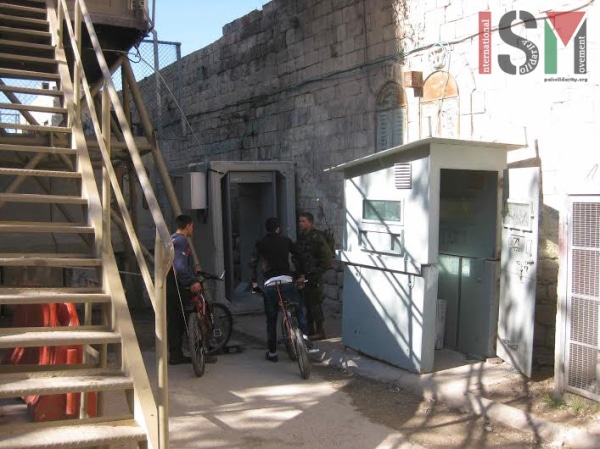
At one point on Monday night, a group of off-duty soldiers ran up Shuhada street and stopped near the checkpoint to rest, stretching and laughing, their easy freedom of movement a stark contrast to experiences of Palestinians struggling through Shuhada checkpoint. Almost all of Shuhada street has been closed off to Palestinians, reserved instead for the settlers and soldiers occupying H2. Even Palestinians who manage to get through the checkpoint must pursue long, circuitous routes between the surrounding areas of al-Khalil. Many, especially the elderly or disabled, are effectively barred from traveling to significant portions of the city their families have lived in for generations.
“I want to resist,” Mohammad told the ISM activists the first day they waited with him. He made sure the man translating said it twice, to make sure the ISM volunteers understood. “I want to resist,” he said, after over three long hours of waiting to be allowed through.
Iran Nuclear Talks à la Israeli-Palestinian Negotiations
By ISMAEL HOSSEIN-ZADEH | CounterPunch | December 16, 2014
Soon after the Iran nuclear talks were recently extended for another seven months (beyond the November 22, 2014 deadline), President Rouhani spoke with the Iranian people in a televised address in which he sought to portray the inconclusive negotiations as a diplomatic victory for Iran, as an indication that his team of negotiators “stood their ground” in the face of excessive demands by the US and its allies.
In reality, however, the extension meant the failure of the Iranian negotiators to achieve anything of substance (in terms of sanctions relief) in exchange for the significant unilateral concessions they had made a year earlier. To put it differently, it meant that the US and its allies refused to honor what they had promised Iran in return for its suspension and/or downgrading of its nuclear technology.
A year earlier, that is, in the first round of negotiations on 24 November 2013, Iran had agreed to the following significant concessions: limit its enrichment of uranium from the level of 20 percent to below 5 percent purity, render unusable its existing stockpile of 20 percent fuel for further enrichment, not activate its heavy-water reactor in Arak, not use its more advanced IR-M2 centrifuges for enrichment, and consent to extensive IAEA inspections of its nuclear industry/facilities.
This obviously means that Iranian negotiators had agreed to more than freezing Iran’s nuclear technology; more importantly, they had reversed and rolled back significant scientific achievements and technological breakthroughs of recent years.
In return, the US and its allies had agreed that following the “confidence building” implementation of these commitments by Iran, economic sanctions against that country would be lifted.
A year later, and despite the fact that IAEA has consistently confirmed Iran’s compliance with these commitments, major sanctions continue unabated. At a press conference on November 22, 2014, US Secretary of State John Kerry boasted that undiminished sanctions have forced Iran to either reverse or freeze much of its nuclear program. “Today,” Kerry stated, “Iran has no 20 percent enriched uranium. Zero. None. They have diluted and converted every ounce that they have… Today, IAEA inspectors have daily access to Iran’s enrichment activities and a far deeper understanding of Iran’s program.”
Instead of honoring what they had promised during the initial negotiations of year ago, the US and its allies now argue that Iran needs to make more concessions, and that therefore more time is needed for further negotiations—hence the seven-month extension of negotiations, to July 1, 2015.
And what are the new demands that are made of Iran? The new requirements, which the Iranian negotiators have now additionally agreed to, include the following:
* Expanded snap Inspections of Iran’s Centrifuge Production Facilities: under the seven-month extended negotiations, the IAEA will double its unannounced, snap inspections of Iran’s centrifuge production facilities.
* Conversion of more 20% Uranium Oxide to Reactor Fuel: Iran will convert 35 additional kg of its remaining 75 kg of 20% enriched uranium powder from oxide form into reactor fuel for the Tehran Research Reactor, thereby helping prevent the reversibility of a key concession Iran has made.
* Further Limitations on Research and Development (R&D) of Advanced Centrifuges and Enrichment Technology. The most important of these new limits are:
* Iran cannot pursue semi-industrial-scale operation of the IR-2M, a necessary prerequisite toward mass production of the model.
* Iran cannot feed IR-5 model centrifuges with uranium gas.
* Iran cannot pursue gas testing of the IR-6 centrifuge on a cascade level.
* Iran cannot install the IR-8 centrifuge at the Natanz Pilot Plant, preventing it from being tested with uranium gas.
* Iran is prohibited from using other/new forms of enrichment, including laser enrichment [source].
And what would Iran gain in return for these significant additional/new concessions? Not much. Under the extended interim agreement, as in the two previous interim agreements, dating back to November 2013, Iran will be permitted to repatriate only $700 million per month of its nearly $100 billion assets that are frozen overseas under the sanctions regime.
This explains why many critics have pointed out that Iranian negotiators have, once again, made significant one-sided concessions without much reciprocity in the way of sanctions relief. It also explains why President Rouhani’s (and his negotiating team’s) portrayal of the extension of negotiation as a diplomatic victory for Iran is far from warranted—it is, indeed, tantamount to self-deception, or more precisely, deception of the Iranian people.
Off-the-record briefings in Washington indicate that the US is projecting a long period of 15 to 20 years of protracted negotiations before restrictions on Iran’s civilian nuclear program are fully lifted. In light of the fact that the US and its allies have already achieved their goal of downgrading and freezing Iran’s nuclear program, while retaining crippling sanctions on that country, their policy of prolonging negotiations—as a tactic to avoid honoring what they have promised Iran—is understandable. As Keith Jones, a keen observer of the Iran nuclear talks, points out:
“Washington is determined to continue to subject Iran to crippling economic sanctions, with relief doled out incrementally and over a period of years. Moreover, during a lengthy initial period, the Western powers want only piecemeal suspension of the sanctions, not their repeal, so that they can be quickly reinstituted should they determine that Tehran has failed to fulfill its commitments” [source].
This means that President Rouhani’s (and Foreign Minister Javad Zarif’s) wishful thinking that a combination of generous concessions and a diplomatic charm offensive would suffice to have the US lift the economic sanctions against Iran has, effectively, placed his negotiators on a slippery slope, with no end to ever newer demands and additional conditions required of them by the US and its allies.
The perils of prolonged negotiations—increasingly resembling the Israeli-Palestinian negotiations—go beyond downgrading and/or freezing Iran’s nuclear technology. Equally devastating are the crippling effects of the continued sanctions on the Iranian economy/society.
Detrimental effects of sanctions on the Iranian economy have been further exacerbated by the Rouhani administration’s misguided policy of having tied the fate of Iran’s economy to the outcome of nuclear negotiations—effectively, making the future of the economy hostage to the unreliable and unpredictable consequences of the nuclear talks. This policy stems from the administration’s neoliberal economic outlook that seeks solutions to economic stagnation, poverty and under-development in unreserved integration into world capitalist system. The policy tends to hurt Iran in two major ways.
First, by tying the chances of economic recovery in Iran to the removal of the sanctions, that is, to the “successful” conclusion of the nuclear talks, the policy has undermined Iran’s bargaining position in the negotiations. Indeed, it can reasonably be argued that President Rouhani condemned Iran to a losing nuclear negotiation long before he was elected. He did so during his presidential campaign by pinning his chances for election on economic recovery through a nuclear deal. This was a huge mistake, as it automatically weakened Iran’s bargaining position and, by the same token, strengthened that of the United States and its allies. By exaggerating the culpability of his predecessor in the escalation of economic sanctions against Iran, he committed two blunders: (a) downplaying the culpability of the US and its allies, and (b) placing the onus of reaching a nuclear deal largely on Iran.
Second, the policy of linking the chances of an economic recovery to the outcome of nuclear negotiations and/or the lifting of sanctions has created an ominous atmosphere of business/market uncertainty among the Iranian investors and entrepreneurs. Uncertainty is perhaps the worst enemy of a market economy, which explains why long-term, productive investment is drying up in Iran, or why economic stagnation has deteriorated since President Rouhani took office in early 2013.
Iran could minimize the baleful effects of sanctions by trying to delink its economic policies from nuclear negotiations and the threat of further sanctions. This would be possible if the Rouhani administration’s economic outlook somehow tilted away from outward-looking to inward-looking strategies of economic development; that is, the development of a “resistance economy,” as Iran’s Supreme leader, Ayatollah Khamenei has put it. This requires an economic strategy that would view the sanctions as an opportunity to mobilize national resources and chart an industialization course toward import-substitution and economic self-reliance—something akin to a war economy, since Iran has effectively been subjected to a brutal economic war by the United States and its allies.
Such a path of development would be similar to the eight years (1980-88) of war with Iraq, when at the instigation and support of regional and global powers Saddam Hussein launched a surprise military attack against Iran. Not only did the Western powers and their allies in the region support the Iraqi dictator militarily but they also subjected Iran to severe economic sanctions. With its back against the wall, so to speak, Iran embarked on a revolutionary path of a war economy that successfully provided both for the war mobilization to defend its territorial integrity and for respectable living conditions of its population.
By taking control of the commanding heights of the national economy, and effectively utilizing the revolutionary energy and dedication of their people, Iranian policy makers further succeeded in bringing about significant economic developments. These included: extensive electrification of the countryside, expansion of transportation networks, construction of tens of thousands of schools and medical clinics all across the country, provision of foodstuffs and other basic needs for the indigent at affordable prices, and more.
Alas, despite its record of success, this option seems to be altogether alien to President Rouhani and his team of economic advisors who, following the neoliberal/neoclassical school of economic thought, maintain that the solution to Iran’s economic problems lies in an unrestrained integration into world capitalism, in a wholesale (and often fraudulent) privatization of the economy, and in an IMF-style of economic austerity.
Ismael Hossein-zadeh is Professor Emeritus of Economics (Drake University). He is the author of Beyond Mainstream Explanations of the Financial Crisis (Routledge 2014), The Political Economy of U.S. Militarism (Palgrave–Macmillan 2007), and the Soviet Non-capitalist Development: The Case of Nasser’s Egypt (Praeger Publishers 1989).
Why Hamas should not heed calls to amend charter
By Ibrahim Al-Madhoun | Al Resalah | December 15, 2014
The Hamas Charter is considered by the movement’s supporters as a key and stand-alone historical document pertaining to Hamas’s political and social ideology. In the event that this document is altered or amended, it would cause a state of undue and untimely confusion and tension within the ranks of the Hamas supporters. It would also be seen as a concession to international and Israeli pressures, even if the changes made to the charter were not substantial or even if the new charter was more extreme in crucial issues such as the recognition of Israel or dealing with international proposals. As long as such amendments form part of international demand or foreign advice, then any response to these demands will be seen as a concession and a weakness in the eyes of both Hamas’s supporters and the movement’s political opposition. It will also send a message to international forces that soft pressure on the movement actually works.
In addition to this, no amendment to the charter would sufficiently please the international community beyond altering the core of the Hamas’s political thought. No changes to the charter would satisfy Western forces unless they explicitly recognise the two-state solution and clearly accept the legitimacy of the continued existence of the Israeli state on Palestinian territories, while shunning the Palestinian national struggle in all its forms. From a strategic regional and international perspective, unless making concessions to these specific points there is no point in changing the charter, as such change may ultimately crack the intellectual infrastructure of Hamas and cause severe repercussions affecting its survival.
Palestinians still remember Fatah’s ill-fated political acquiescence, particularly the amendment of the organisation’s charter under the supervision of Yasser Arafat in 1996 to appease Bill Clinton. Although Fatah changed the PLO Charter under US pressure, it did not reap the fruits of this change and it ultimately did not serve the Palestinian cause. Instead, it caused disappointment and decline; a fate which may well befall Hamas if it makes the same mistake.
Although it may be true that some of Hamas’s positions need to be clarified, the best way to do this would not be to change the existing charter but to issue a new document explaining the movement’s strategic vision over a specified period of time. However, this document must be clear and understandable, devoid of any extra words and without any dense literary jargon. It must be focused on the clear political matters at hand and keep pace with social and political developments in the Palestinian arena, allowing for changes over the next five to ten years.
All political entities have their literatures and philosophies that serve to carry and propagate their core values and that cannot be altered; they must remain as a foundation stone and intellectual inheritance for all new recruits. Such entities can later be developed through practice, conflict, and building relationships, but their core values always remain the same. No one truly believes that changes to Hamas’s charter would bring respect, acceptance and understanding from the international community. This community only understands the language of power and force through the ability to raise some voices and silence others. And Hamas must not allow itself to be covertly silenced in such a way.
Translated by MEMO, 15 December, 2014
Israeli crimes continue in al-Quds
Israel continues its widespread crackdown on the Palestinian residents of East Jerusalem al-Quds. The rights groups have dubbed Israel’s crackdown an act of “collective punishment” against the Palestinian population.
More than 1,300 local residents have been arrested since summer, 40 percent of them children, according to the Palestinian Prisoners Club, an advocacy group.
Over the past weeks, the al-Aqsa Mosque has been the scene of clashes between Palestinian worshippers and Israeli settlers and troops.
Israel has tried over the past decades to change the demographic makeup of al-Quds by constructing illegal settlements, destroying historical sites and expelling the local Palestinian population.
Educators, Holocaust group join Sept. 11 museum in ‘teaching’ children official 9/11 lies
By Craig McKee | Truth and Shadows | May 15, 2014
The 9/11 official story is rooted in deception, distortion, and misdirection. Now all of its lies have been dressed up and put on display in an expensive federally funded monument for paying customers.
The National September 11 Memorial and Museum is more of a walk-in indoctrination center than a tribute to the victims of 9/11. It’s a piece of propaganda made of glass and steel that plays on emotions and on the sincere desire of people to honor those who sacrificed their lives in this false flag event.
The Memorial and Museum’s web site not only reiterates all the same lies, but it even explains a framework that educators will be using to indoctrinate children so they can grow up to be believers in the war on terror and the need for more wars and greater and greater security and surveillance. Even as the mainstream media turn their attention to misrepresenting other events, the museum and accompanying “lesson plans” for school children will continue to do their work.
On the site, we learn that: “The National September 11 Memorial & Museum has partnered with the New York City Department of Education and the New Jersey Commission on Holocaust Education to develop a robust set of 9/11 lessons for K-12 classrooms.”
The New Jersey Commission on Holocaust Education (created by the State of New Jersey) is involved in creating lessons that teach children that Muslims are the bad guys and that they attacked America? Oh wait, I forgot – they are making it clear that it’s not all Muslims, just the “extreme” ones. These lessons are directed at all age groups, and the content will be used within a wide array of subjects and courses.
Through its exhibits, the museum purports to tell the story of what happened on September 11, 2001 – that 19 Muslim extremists led by Osama bin Laden killed nearly 3,000 people by hijacking four airliners and crashing them into the World Trade Center, the Pentagon, and a field in Pennsylvania. We will even be shown photographs of the 19 alleged hijackers” (although I guarantee they won’t use the word “alleged”), which will be interesting since several of those turned out to be alive after 9/11, and no proof has been presented that establishes that any of the 19 ever boarded any of the planes.
Architects and Engineers for 9/11 Truth has produced brochures in the same style as the official ones that teams of volunteers pass out to visitors to the museum, which it calls “an elaborate, taxpayer-funded, public relations campaign to forever cement the fantastic claims of the official conspiracy theory into the history books.”
I wish I’d written that.
In a fundraising email, AE describes what it wants to do in response to this PR campaign: “This historical revisionism needs to be countered with an all-out effort of the truth of 9/11. By printing thousands of educational flyers and distributing them via teams of AE911Truth volunteers at the memorial grounds entry, we can inform the public as to why the 9/11 Memorial Museum is largely a fraud.”
Muslim Americans have been the victims of increased bigotry and hate since they were tagged as the perpetrators of 9/11 more than 12-and-a-half years ago. Now, Muslim- and Arab-American groups fear this will happen all over again as a result of a seven-minute video called “The Rise of al-Qaeda” that is shown as one of the exhibits.
The film, they charge, perpetuates the myth that Muslims were responsible for 9/11, using terms like “Islamists” and “jihad” in the presentation. They say it fails to offer any nuance that would help people to understand that blaming Muslims in general for what happened is unjust and inaccurate. Based on the protest in New York in 2010 over the plan to open a Muslim cultural center two blocks from Ground Zero, their concerns appear justified.
“The Rise of al-Qaeda” is even being protested by the Memorial’s own Interfaith Advisory Committee, which reacted with alarm when it was allowed to watch the short film last year. The committee’s only Imam resigned in protest in March. As quoted in the New York Times, Sheikh Mostafa Elazabawy, the imam of Masjid Manhattan, wrote in a letter to the museum’s director: “Unsophisticated visitors who do not understand the difference between Al Qaeda and Muslims may come away with a prejudiced view of Islam, leading to antagonism and even confrontation toward Muslim believers near the site.”
The museum responded with some unintentional self-parody when they stated that they are standing by the film because it has been vetted by scholars of Islam and terrorism. What a relief to hear that scholars of the very lies that 9/11 represents are on the job, making sure the film sends the “proper” message.
A coalition of groups, including the American-Arab Anti-Discrimination Committee (ADC), wants changes to the video so that it is made clear that the extremist Muslims who it agrees carried out 9/11 are not portrayed as being representative of the more than 1.6 billion Muslims around the world.
In a letter to museum president Joe Daniels and director Alice Greenwald, the coalition raised concerns about the video, which neither they nor the media have been allowed to see. The letter states:
“We have learned that you have been aware, since at least June 2013, that viewers have found this video confusing and possibly inflammatory. The museum’s own interfaith religious advisory group has repeatedly asked that this video be edited, with their concerns being dismissed.”
According to their testimony, the video:
- Deploys haphazard and academically controversial terminology, in particular “Islamic” and “Islamist”, to generalize, unnecessarily, about al-Qaeda’s acts of terrorism.
- Does not properly contextualize al-Qaeda as a small organization in comparison to the world’s 1.6 billion Muslims.
- Uses stereotypical, accented English for speakers of Arabic in translation.
- May give some viewers, especially those not familiar with the subtleties of the terminology being used, the impression that Islam, as a religion, is responsible for September 11.
I completely support the Muslim- and Arab-American groups in their protest of the stereotyping that it appears that the film contains. But I’m concerned about the fact that the big lie – that any kind of Muslims pulled off 9/11 – is being accepted by these groups. I think they concede too much when they accept the premise that an extremist Muslim group called al-Qaeda was actually behind the alleged terrorist attacks when the evidence shows that this is just a smokescreen to disguise the real culprits and to hide their real motives.
The truth of the matter is that Muslims were not responsible for 9/11 – period. The evidence simply isn’t there to show otherwise. By putting the focus on the idea that Muslims as a whole are not violent and that al-Qaeda is not representative of what Islam is all about just falls into the trap set by the actual perpetrators.
Of course, that’s easy for me to say: I’m not a Muslim and I have not been victimized in the way that they have since 9/11. For them to argue that the official story is false would be very tricky and would certainly result in more hostility coming their way. And, of course, they may genuinely believe the official story. After all, Muslim Americans are subject to the same disinformation and propaganda that everyone else is.
The real purpose of the museum
A tour around the web site of the Memorial and Museum offers a good summary of the language of the 9/11 official story and its accompanying talking points. On the page “9/11 FAQ,” we get all the key elements of the story fed to us by the 9/11 Commission, NIST, and other official agencies. But they get the year of the London bombings wrong (it was 2005, not 2007), they offer the lie that al-Qaeda took responsibility for several terrorist attacks including 9/11 (the “confession” video features an Osama bin Laden “double” and contains serious inconsistencies).
The Memorial and Museum’s announced mission is to honor the victims and to “educate” future generations. It will not succeed in doing either, however. In fact, by perpetuating the 9/11 lie, it does exactly the opposite. The only way to meaningfully honor the victims is by telling the truth about what happened. And no one in officialdom is willing to do that more than a dozen years after the fact.
The memorial’s web site is full of “information” about the artifacts contained within its walls (actual twin WTC girders, an exposed portion of the “slurry wall” that keeps the site from being flooded, an actual staircase that was used to escape one of the towers). But the most disturbing thing the site addresses is the museum’s effort to direct its propaganda at children who have no choice in the matter. I wonder what kind of mark a student will get if they write an essay questioning whether the official story is true?
On the surface, the site has some useful and positive things to suggest: including pointing out how destructive it can be to “compare the suffering of one person to another” or to “assign blame to an entire group.”
Sounds good, but what is suggested is that parents and educators focus on the heroic efforts of both victims and rescuers on 9/11, because 9/11 is “actually thousands of individual stories.” That’s true: everyone who was in New York, and particularly those who had a connection to the World Trade Center site in some way experienced the event in their own way. Some were true heroes, risking and even giving their lives to help others. Some were just in the wrong place at the wrong time and paid with their lives.
But there is a bigger picture. And they don’t want you to look at that. They want you to stick to the emotion of the event, the stories, the courage, and the loss. Don’t look at whether the official explanation of the event fits with the evidence. Don’t “disrespect the victims” by questioning anything you’ve been told.
By the way, victims’ family members and recovery workers don’t have to pay the $24 adult entrance fee to the museum, while firefighters, the group that has paid a more terrible price than just about any other, gets a discount. That’s right, a discount.
Featured Video
Elijah Magnier: Yemen’s strikes are shattering Saudi Arabia’s long-term strategy
or go to
Aletho News Archives – Video-Images
From the Archives
British weapons and personnel doing much of the killing in Yemen
Press TV – June 18, 2019
A detailed report published by the Guardian newspaper has shown how Britain is massively contributing to Saudi Arabia’s devastating war on Yemen as it suggests that London is not only supplying the bombs that fall on Yemenis, but it provides the personnel and expertise that keep the war going.
The comprehensive report by Arron Merat published on Tuesday showed that Britain was doing much of the killing in Yemen as the country continues to provide Saudi Arabia with everything it needs to turn its southern impoverished neighbor into a graveyard.
“Every day Yemen is hit by British bombs – dropped by British planes that are flown by British-trained pilots and maintained and prepared inside Saudi Arabia by thousands of British contractors,” said Merat in the report. … continue
Blog Roll
 Aletho News
- Netizens condemn Japanese drama for projecting Japan’s wartime atrocities onto Chinese characters
- Racist Seinfeld Dances for Joy as Bibi Unveils His New Map
- A West Bank War for Netanyahu’s Election Campaign, Could It Backfire?
- Yemen denounces European Parliament’s ‘hypocritical’ push to blacklist Ansarullah
- Qalibaf: UAE’s UN bid aims to ‘clear the runway’ for ‘Greater Israel’, whitewash genocide
- Pakistan reopens Iran border after boosting security: Report
- Why are so many Brazilians voting for Flávio Bolsonaro?
- Democrats Put Anti-Russia Agenda Ahead of American Workers
- Elijah Magnier: Yemen’s Strikes Are Shattering Saudi Arabia’s Long-Term Strategy
- Pentagon designates Chinese cultural centers national security threat
- If Americans Knew
- Latest updates from Israeli assault on West Bank
- Tourism Ministry launches free food truck tour in US
- “So Much Worse Than People Realize”: Never-Before-Seen Images Reveal Damage at U.S. Bases as Troops Describe Being Abandoned
- UK Bell Review Confirms Only Anti-Israel Attitudes Are Rising, Not Antisemitism
- DAILY UPDATE: Latest essential news on Palestine, Israel, & region
- DAILY UPDATE: Latest essential news on Palestine, Israel, & region
- Damning report shows the media must confront its failures on Gaza
- BBC senior broadcaster speaks out on Gaza coverage
- Netanyahu vows vast West Bank invasion in response to 20-minute skirmish that left 2 Israeli soldiers and 2 Palestinian fighters dead
- Tied up and tortured: Israel using US-made electroshock weapons on Palestinian detainees
- No Tricks Zone
- Sudden Stratospheric Warming, Powerful El Niño Combination May Lead To Extreme Europe Cold, Energy Crisis!
- Two New Studies Find Thwaites Glacier Melt Cannot Be Driven By Human Activity Or A Warming Ocean
- E-Cars Reduce CO2 Emissions By Only 41% Compared To Internal Combustion Engine Vehicles
- Predictions Made By Renowned Climate Professor Over Past Decades Have Been Proven To Be Poor
- New Study Suggests Large Regions Of The Pacific Ocean Have Been Cooling For The Last 80 Years
- Germany’s Green Energy Debacle: High Energy Costs Force Kahla Porzellan to Close After 182 Years!
- New Study: 50 Years Of The Most Aggressive ‘Net Zero’ Policies Can Only Affect The Global Climate By 0.03°C
- US September “Heat” Was No Record…Many Records Set Decades Ago
- Latest European Green Energy Debacle; Portugal’s Largest Flagship Solar Park Insolvent!
- Green Energy Debacle: German Expert Professor Fritz Vahrenholt Warns Of Severe Economic And Social Consequences

