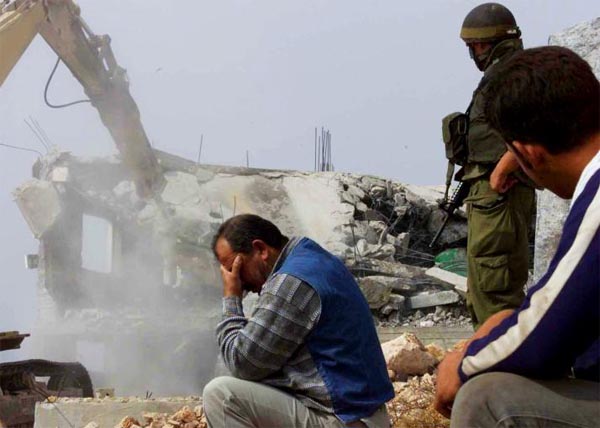
One-third of Palestinian homes in Jerusalem are threatened with demolition
MEMO | September 26, 2013
An international human rights organisation has revealed that one-third of the Palestinian-owned houses in Jerusalem face demolition under the pretext that applications for building permits were incomplete. This, claims Euro-Mid Observer for Human Rights, is a way for the Israeli authorities to continue their demographic war against Palestinians in the Holy City. Israel gives Jerusalemite Palestinians the right to use just 13 per cent of the area of occupied East Jerusalem to meet the needs of their growing population.
A report from Euro-Mid shed some light on the widespread Israeli settlement programme in Jerusalem. It mentioned that the financial committee of the Israeli-controlled Jerusalem municipality decided to support 1,500 new settlement units in the city at the end of August. The human rights group also pointed out that Israel’s bulldozers are still razing Palestinian homes in Al-Tour neighbourhood because the authorities plan to set up the “National Israeli Park”.
According to the UN, poverty is getting worse among Palestinians in Jerusalem. Euro-Mid noted that the unemployment rate rose to 78 per cent in 2012 compared with 64 per cent in 2006. More than 40 per cent of Palestinian Jerusalemites now live below the official poverty line; one of the reasons is the disparity in wage rates between Israeli and Palestinian labourers.
Euro-Mid has called upon Israel to stop its frenzy of settlement construction in the occupied territories and to protect Palestinian sovereignty over East Jerusalem, as the potential capital of a Palestinian state.
Related articles
- Israel levels 7 Palestinian homes in East Jerusalem (worldbulletin.net)
- Jewish settlers occupy Palestinian land in Al-Quds (worldbulletin.net)
- Dozens Injured In Jerusalem, Two Kidnapped (imemc.org)
- Palestinians Attacked By Soldiers In Jerusalem’s Old City (imemc.org)
Egyptian minister praises Obama’s remarks on Egypt, Hamas slams Egypt’s FM for threatening to attack Gaza
Egyptian minister praises Obama’s remarks on Egypt in the UNGA
MEMO – September 25, 2013
Egyptian Foreign Minister Nabil Fahmy has described US President Barack Obama’s remarks to the UN General Assembly about Egypt as “positive” and reflective of “an objective treatment of the situation in Egypt.”
Fahmy was responding to Obama’s speech on Tuesday that was critical of both ousted President Morsi’s government for being non-inclusive, and the interim government established by the coup for violating the Egyptian people’s rights, including policies such as the curfew, the state of emergency and the restrictions on press freedoms.
About how the latter issues would be resolved, the minister said: “They will be overcome through the context of the implementation of the roadmap and efforts to build a modern and democratic state in Egypt.”
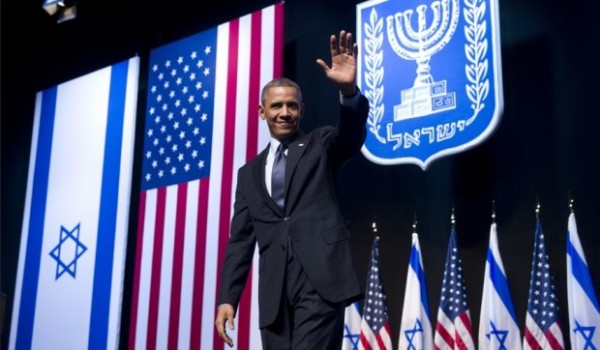 In his speech to the UN General Assembly, Obama repeatedly asserted his country’s respect for the will and choices of the people in the Middle East. However he also warned that the “United States will at times work with governments that do not meet, at least in our view, the highest international expectations, but who work with us on our core interests.”
Obama affirmed that the US is going to preserve good relations with Egypt, saying the US “will maintain a constructive relationship with the interim government that promotes core interests like the Camp David Accords,” as well as counterterrorism efforts.
But he added that US support will also “depend upon Egypt’s progress in pursuing a more democratic path.”
Hamas slams Egypt’s foreign minister for threatening to attack Gaza
Palestine Information Center – 25/09/2013
GAZA — The Hamas Movement strongly denounced Nabil Fahmi, the Egyptian minister of foreign affairs, for threatening to take military and security action against the Palestinian resistance in Gaza.
Its spokesman Fawzi Barhoum stated on Tuesday that Fahmi’s threats were reprehensible and very dangerous and would do a great disservice to Egypt’s reputation and historical stature.
Barhoum added that Fahmi’s remarks in this regard unveiled bad intents and hostile tendencies against the Palestinians in general and Gaza in particular.
He stressed that such position would remove Egypt from its national, Arab and Islamic role in supporting the Palestinian people and their cause.
The spokesman affirmed that Hamas and its people in Gaza have no intention or agenda to engage in any kind of conflict with Egypt.
“We will remain defenders of the Arab and Muslim nations’ pride and dignity, and our main struggle is only against the Israeli occupation, the greatest threat to Egypt and Palestine,” he underscored.
For its part, Al-Ahrar Movement in Gaza also deplored the Egyptian minister’s threat to use military and security options against Gaza.
“We were expecting an Egyptian position supporting the Aqsa Mosque and preventing its division, and not a threat by the foreign minister of Egypt to attack Gaza. We affirm that such remarks undermine Egypt’s ethics and role in protecting our people,” Al-Ahrar Movement stated on Tuesday.
It also said that this new Egyptian position only serves the Israeli occupation regime which has taken advantage of the military coupe and are trying to drive a wedge between Gaza and Egypt.
AL-KHALIL: Settlers re-occupy Abu Rajib house
CPTnet | September 24, 2013
On 23 September 2013, in response to the death of Israeli soldier Staff Sgt. Gal Kobi, Prime Minister Benjamin Netanyahu called for illegal settlement expansion in the Old City of Hebron.
At 1:00 a.m. on Tuesday 24 September, the Christian Peacemaker Team in Hebron received reports from the Hebron Rehabilitation Committee that Israeli settlers had re-occupied the Abu Rajib house west of the Tomb of the Patriarchs. Settlers had been evicted from the building in April of 2012.
The resettlement of the Abu Rajib house is a direct and significant risk to the community of Hebron, international law, and human rights, as settlements are illegal under international law and impede the ongoing peace process.
In addition to the illegality of the settlement, the location of Abu Rajib will constitute a severe threat to the freedom of movement for Palestinians. The house sits between two Palestinian Schools and Israeli military checkpoint 209, which CPT monitors every morning as part of its school patrol. If the settlement remains, it will be in the middle of an area hundreds of Palestinian children must pass each morning to attend classes.
Over the past week of the Jewish holiday of Sukkoth, the Israeli military has increased its presence with additional soldiers on the ground, occupying Palestinian homes and turning them into military outposts in and around the area of the Abu Rajib house. As a result, school attendance at Al-Faihaa girl’s school and Al-Ibrahimmiye has dropped.
On Monday, 23 September, the Al-Faihaa girl’s school was shut down completely since so few students were able to attend classes. The added Israeli military presence installed around the settlement will continue this trend.
Israeli settlement expansion has led to several cases of violence between Palestinians and Israelis, including near the settlement of Tel Rumeida.
“For the residents of Tel Rumeida, living next to settlers means living under constant threat of attack,” said a representative from the human rights observer organization, the International Solidarity Movement (ISM). “The Abu Shamsiyeh family who live in Tel Rumeida is particularly vulnerable to attacks, as settlers and Jewish tourists tend to enter their roof and even invade their garden without permission. Most use this private Palestinian roof to enjoy the view of the city, but incidents have occurred where settlers threw stones and garbage down at the family, urinating into their garden and verbally harassing the family.
“Last month, settler youth entered the family’s garden, threw stones at them, and beat their thirteen-year old son. When Abu Shamsiyeh asked the soldier stationed outside their house for help, he came down and watched as settlers kicked Abu Shamsiyeh, and another soldier pushed his wife, who was videoing the incident, to the ground.”
If the Abu Rajib settlement is allowed to stay, in breach of international law and during the ongoing peace negotiations, the rise in settler violence against Palestinian youth and adults will escalate.
Related articles
Netanyahu Orders Court To Allow Settlers Back Into Hebron Home
By Saed Bannoura | IMEMC & Agencies | September 23, 2013
Following the deadly shooting of an Israeli soldier in Hebron city, in the southern part of the occupied West Bank, Israeli Prime Minister, Benjamin Netanyahu, vowed to boost settlement activities, and ordered the Civil Administration, to take all needed measures to allow the return of Israeli settlers into a Palestinian home they previously occupied in Hebron.
The Israeli Civil Administration Office is run by the Israeli military in the occupied West Bank.
Back in April of 2012, a group of settlers was removed from the home, near the Ibrahimi Mosque in Hebron. They allegedly purchased the property but the purchase was deemed invalid, especially since such deals must be first approved by a commander of the Israeli occupation army.
The settlers were removed after the then-Israeli Defense Minister, Ehud Barak, issued an order in this regard following a court ruling.
The decision to allow the settlers to return to the property was made on Sunday night; Netanyahu said that the settlers “must be allowed into the home without any delay”.
After being removed from the property, the settlers filed several court appeals, demanding a recognition of the alleged transaction, while Israeli Defense Minister, Moshe Ya’alon, also vowed to do whatever he can to authorize their “return to the home”.
Netanyahu made his decision hours after a Palestinian sniper shot and killed an Israeli soldier in Hebron, following ongoing tension that led to clashes between the soldiers and dozens of local youths who hurled stones at them.
It is also related to the death of an Israeli soldier who was killed two days ago in the Qalqilia district, in the northern part of the occupied West Bank.
“Anyone who attempts to remove us from Hebron, from the city of our patriarchs, will just achieve the exact opposite”, Netanyahu said according to the Israeli daily Haaretz, “We will boost our settlement activities”.
Netanyahu said that the “return of the settlers to the Hebron home would still have to go through legal means”; yet, he ordered all related government facilities, to do whatever they can to ensure their fast return.
His decision comes despite the fact than an appeals committee, looking into the purchase did not recognize the documents presented by the settlers, but criticized the way this purchase was denied.
Haaretz added that, should the process be finalized, Netanyahu and his Defense Minister could sign off the deal, and authorize the settlers back.
In related news, Israeli Economics Minister, Neftali Bennet, demanded that Netanyahu stop the release of Palestinian political prisoners, as part of peace talks with the Palestinians, and said that the Palestinians “must be punished for the killing of the two Israeli soldiers.”
Bennet, of the Jewish Home Party, who also serves at the Ministerial Council, said that “the release of Palestinian prisoners is based on progress of talks, and our duty should be a war on murderers…” according to the official.
Israel’s Transportation Minister, Yisrael Katz, said that he previously voted against the release of any detainee, and that the release of what he called “terrorists” encourages others to attack Israel.
Following the fatal shooting of the Israeli soldier in Hebron, the army initiated a large campaign and broke into and searched hundreds of homes close to the Ibrahimi Mosque area where the soldier was shot.
Hundreds of Palestinians were kidnapped, and where rounded up in the southern area of the occupied city of Hebron.
The soldiers also occupied rooftops of several homes, using them as monitoring towers, while the army operated in the area.
The military declared Hebron a closed military zone, preventing the Palestinians from entering or leaving it.
Last week, Israeli soldiers shot and killed one Palestinian, and injured four, including three children, in different attacks carried out in the occupied Palestinian territories.
The army carried out 49 invasions into Palestinian communities, and kidnapped at least 41, including 9 children.
Two Palestinians have been killed, dozens have been injured, and hundreds were detained, by Israeli forces since the beginning of the month.
Related articles
Two-State Solution or Illusion?

By Lawrence Davidson | Al-Ayham Saleh | September 21, 2013
Part I – The Two-State Solution
Peter Beinart is a “liberal Zionist” who has written a piece in the New York Review of Books of 26 September 2013 entitled “The American Jewish Cocoon.” In this essay he laments, “The organized Jewish community [is] a closed intellectual space.” By this he means that most American Zionist Jews (it is important to remember that not all Jews are Zionists) know little or nothing about those who oppose them, particularly Palestinians. They also seem to have no interest in changing this situation. For these Zionists the opposition has been reduced to an irredeemably anti-Semitic “them.”
Beinart goes on to tell us that such is the political clout of the organized Zionist community that this know-nothing attitude has come to characterize the “debate about Israel in Washington” and the opinions offered in the mass media as well. While Mr. Beinart does not say so, I can tell you that this has been the basic situation since the early 1920s. Beinart does note, however, that over time this situation has led Palestinians and those who support them to show less willingness to dialogue with Zionists, most of whom they consider irredeemably racist.
Beinart thinks this prevailing ignorance is a disaster. Why so? Because he feels that Jews betray the lessons of their own past by failing to understand the meaning of the “dispersion and dispossession” of the Palestinians. They do not seem to care that this particular people has had its “families torn apart in war – [continue] to struggle to maintain [their] culture, [their] dignity, [their] faith in God in the face of forces over which [they] have no control.” This sort of situation, according to Beinart, is something “the Jews should instinctively understand.”
Be this as it may, achieving such an understanding is, for Beinart, a means to an end. That end is realizing a two-state solution to the ongoing Israeli-Palestinian struggle. For this to happen the Zionists have to essentially feel the pain of the Palestinians and the Palestinians have to understand their no-win situation so that everyone agrees to a Palestinian mini-state on “22 percent of British mandatory Palestine” along with “compensation and resettlement [for the] people whose original villages and homes have long ceased to exist.”
Part II – The Two-State Illusion
An important question is whether Mr. Beinart’s two-state solution does not itself represent a goal whose practicality has “long ceased to exist”? That certainly is the opinion of Ian Lustick, a professor of political science at the University of Pennsylvania. In the Sunday Review section of the New York Times of 15 September 2013, he published an op-ed piece entitled “Two-State Illusion.”
According to Professor Lustick, the two-state idea has become something of a fraud behind which lies opportunistic political motives. For instance, the Palestinian Authority (PA) keeps this hope alive so that it can “get the economic aid and diplomatic support that subsidizes the lifestyle of its leaders, the jobs of tens of thousands of soldiers, spies, police officers and civil servants.” The Israeli government keeps this hope alive because “it seems to reflect the sentiments of the Jewish Israeli majority and it shields the country from international opprobrium, even as it camouflages relentless efforts to expand Israel’s territory into the West Bank.” Finally, the U.S. government maintains the hope of a two-state solution to “show that it is working toward a diplomatic solution, to keep the pro-Israel lobby from turning against them and to disguise their humiliating inability to allow any daylight between Washington and the Israeli government.”
Lustick believes the two-state solution is an impossible hope that has produced periodic negotiations which have always been “phony” and have prevented new ideas for positive change from being seriously entertained. This long-term stifling has also set the stage for possible “sudden and jagged” events that can send the conflict off in catastrophic directions. Oddly enough Lustick finds this prospect of heightened conflict a necessary one.
He tells us that only when the “neat and palatable” two-state solution disappears – and with it the PA and its policies of collaboration – will we get the “mass mobilization, riots, brutality, terror, Jewish and Arab emigration and rising tides of international condemnation of Israel,” along with the subsequent withdrawal of unconditional U.S. support for the Zionist State. At that point
“Israeli leaders may then begin to see, as South Africa’s white leaders saw in the late 1980s, that their behavior is producing isolation, emigration and hopelessness.” Then, finally, they will become reasonable, and something new and acceptable (a one-state solution?) will be possible.
Lustick’s necessary scenario happens to be Peter Beinart’s nightmare and in the latter’s essay it is called “civil war.” Beinart’s call for greater mutual understanding is designed to prevent this violence. One can assume that, for Professor Lustick, things have gone too far for this understanding to suddenly prevail. “Peacemaking and democratic state building require blood and magic,” he tells us. Delaying the inevitable with false hopes will only make things worse.
By the way, Lustick is not alone in his view that the two-state formula is a dead end. One of Israel’s very best historians, Ilan Pappe, who now is the director of the University of Exeter’s European Centre for Palestinian Studies, believes that this prospect has been dead for over a decade. What killed it, and what keeps it dead, are “Zionist greed for territory and the ideological conviction that much more of Palestine [beyond the 1967 borders] is needed in order to have a viable Jewish State.” It is worth noting that it is just this ideological conviction that renders Peter Beinart’s plea for more understanding of the Palestinian position by American Zionist Jews a nonstarter. Any ideology that can justify incessant ethnic cleansing has to make its adherents incapable feeling their victims’ pain.
Part III – Conclusion
If Beinart’s hope for mutual understanding is naive, Lustick’s hope that more “blood” will lead to the “magic” of a positive outcome is not at all assured.
One might ask just how much disaster is necessary before the hard-line Zionists who have long controlled Israel will compromise their ideological commitment. Keep in mind that the Israeli political elites, right and left, have always been expansionist. Even Peter Beinart is not pushing for a return to the 1967 Green Line and an evacuation of illegal settlements, as far as I can tell. In the past, the Israeli elites have judged their terror and brutality to be justified. They will do so in the future as well. Some of them will interpret any increase in Jewish emigration (a process already ongoing) as a weeding out of weak elements. Militarily the Israelis can probably maintain superiority over their neighbors even in the face of reduced American aid, and as far as world opinion is concerned, most of them care little about it. If this assessment has any validity, the Israelis could go on ethnically cleansing for a very long time.
In my view, the only viable weapon against such vicious stubbornness is a worldwide comprehensive economic boycott on the South Africa model. However, even this may not be the last page in the drama. Such an economic boycott may prove strong enough to undermine the will of some Israeli ideologues, but not all of them. And then, unlike South Africa, you may need an intra-Israeli Jewish civil war to finally bring the curtain down on the tragedy of Zionism.
Related article
EU calls for explanations from Israel over diplomat scuffle
RT | September 22, 2013
European diplomats are holding Israel accountable over an incident where IDF servicemen attacked a EU humanitarian convoy in the West Bank on Friday. So far Tel Aviv has left the scandal in limbo, offering no official explanation for the incident.
Diplomats from several EU countries have spoken out against the shocking incident of harassing a person with diplomatic immunity, clearly awaiting some sort of official reaction from the state of Israel.
After disturbing photos of the French diplomat, Marion Fesneau-Castaing, spread on the ground with IDF soldiers standing around her hit international news, the scandal over hijacked EU aid to homeless Bedouins from demolished villages in the West Bank has gained momentum.
“EU representatives have already contacted the Israeli authorities to demand an explanation and expressed their concern at the incident,” says a statement issued by the spokesmen for EU foreign policy, Catherine Ashton and Humanitarian Aid Commissioner, Kristalina Georgieva.
An EU official described the Israeli actions as “shocking and outrageous”, the BBC reported.
The British Consulate General in Jerusalem is “concerned at reports that the Israeli military authorities have prevented the affected community from receiving humanitarian assistance,” the consulate’s spokesman said.
“We have repeatedly made clear to the Israeli authorities our concerns over such demolitions, which we view as causing unnecessary suffering to ordinary Palestinians, as harmful to the peace process and contrary to international humanitarian law,” the spokesman added.
The Israeli authorities should “live up to their obligations as occupying power to protect those communities under their responsibility,” the UN Humanitarian Coordinator James Rawley said.
‘Illegal diplomatic activity’
The Israeli Foreign Ministry’s spokesperson, Paul Hirschson, has threatened to lodge a complaint over Marion Fesneau-Castaing’s actions, Agence France-Presse reported.
“If she did participate then a formal complaint will be filed because that is not the way diplomats behave,” he said.
On Saturday the EU ambassador in Israel called the Foreign Ministry Deputy Director-General for Europe, Rafi Shutz, demanding explanations regarding the IDF in the West Bank on Friday.
“What was done there by the European diplomats was a provocation,” said Shutz as quoted by the Haaretz.
Mr Shutz claimed that force against the female French diplomat was used because she slapped one of the soldiers. He also announced that the state of Israel is looking into allegations that foreign diplomats “abused their diplomatic privileges”.
Because Palestinian construction at the site of former Khirbet Al-Makhul village was ruled illegal by an Israeli court, the European diplomats were engaging in illegal activity, Shutz stated. He also pointed out that humanitarian aid to Palestinians should be delivered through the proper channels, coordinated with Israel.
The IDF explained the use of stun grenades during the incident, claiming that stones were thrown at security forces. Stun grenades were thrown directly into a group of European diplomats, aid workers and locals who were trying to deliver emergency aid to the residents of a demolished Palestinian village, Reuters reported.
On Friday a truck with EU humanitarian aid for the villagers of the demolished Khirbet Al-Makhul settlement was attacked by IDF personnel, who confiscated the truck and the payload. French diplomat Marion Fesneau-Castaing, who attempted to prevent confiscation of the aid, was pulled out of the truck and forced to the ground. The incident received wide international coverage.
Houses, stables and a kindergarten at Khirbet Al-Makhul village were demolished on Monday after a decision by Israel’s High Court, which ruled that villagers had illegal building permits. The villagers refused to leave the ruins saying they have been living on that land for generations.
The seizure incident of a truck carrying humanitarian aid has become yet another page in the row between Brussels and Tel Aviv. In July the EU announced it is going to stop all financial assistance to Israeli organizations operating in the occupied territories, starting from 2014.
The government of Prime Minister Benjamin Netanyahu reacted angrily, denouncing the move as interference in Israel-Palestine relations and retaliated by blocking EU humanitarian aid to tens of thousands of Palestinians in the West Bank.
Israel and the Palestinian Autonomy remain in fruitless peace talks, with the major stumbling block being the ongoing construction of Jewish settlements in the West Bank and East Jerusalem, occupied since the 1967 Middle East war.
Related article
Tension rises in Khalil during Sukkot celebrations
International Solidarity Movement | September 21, 2013
Hebron, Occupied Palestine – Sukkot is a joyful festival in Judaism; however its impact upon day-to-day life in Khalil has only caused greater problems for the Palestinians. Many residents of Khalil have commented that it is during this holiday period every year where daily life in the city becomes all the more difficult.
Last week soldiers began preparations for taking over a house next to the container checkpoint 209 (Quatoum/Abu Rish), which belongs to a Palestinian family. The family received a military order informing them that this house would be occupied by the Israeli army until Tuesday 24th September, the end of Sukkot. Due to the large number of Jewish tourists visiting Hebron during Sukkot, reinforcement brigades have been sent to Hebron, and due to lack of accommodation for these additional soldiers, the army decided to take over this Palestinian house and use it as a military base for the duration of the holiday. Residents of this area have stated that since the soldiers began occupying the house, child detainment and arrests have increased, and there are further concerns that checkpoint 209 may be moved in an attempt to increase control in the surrounding area.
Today, Saturday 21st September, several clashes and attacks took place between settler youth and Palestinian children and teenagers in Tel Rumeida. Additionally, as on every Shabbat, settlers invaded the roof of the Abu Shamsiyeh family and verbally attacked international activists who, at the request of the family, were monitoring the entrance to the roof as it is often entered without family permission. In the past, settlers have attacked the family by throwing stones, spitting at, beating members of the family and urinating into their garden.
On Friday 20th September, clashes erupted in the afternoon as Palestinian youths threw stones at checkpoint 56. After the PA (responsible for this area of Hebron which is part of H1) chased away the stone-throwers, the clashes moved into the OldCity and souq of Hebron, which is part of H2 and thus under Israeli military control. Throughout Friday evening and most of Saturday, Palestinian youths were throwing stones and Molotov cocktails, whilst Israeli soldiers responded with sound grenades, teargas and rubber-coated steel bullets. International activists witnessed border police shooting teargas canisters directly at protesters, as opposed to shooting it in an arch as they are supposed to under Israeli army regulations. Further clashes are expected tomorrow as settlers and Jewish tourists invade area H1.
On Sunday 22nd and Monday 23rd September, tens of thousands of Jewish tourists are expected to descend upon Hebron for Sukkot celebrations. On important Jewish holidays, there is a tradition of the settler community, alongside Jewish tourists, visiting a house in H1 (the Palestinian-controlled part of Hebron) which they claim used to be the home of a rabbi and thus holds religious significance. The Israeli military has ordered the closure of the road outside checkpoint 56 leading to Yatta between 10am and 3pm on Sunday 22nd September. The house that the settlers and Jewish tourists pilgrim to is located on said road, however it is the first time ever that the Israeli military has formally ordered the closure of the road and the shops located there. This order is a clear violation of the Hebron Agreement, signed in 1997 by the Palestinian Authority and the Israeli government, which divided the city into areas H1 and H2 under Palestinian and Israeli military control respectively.
Related articles
Israeli soldiers rough up EU diplomat, confiscate aid supplies for Palestinians
Al-Akhbar | September 20, 2013
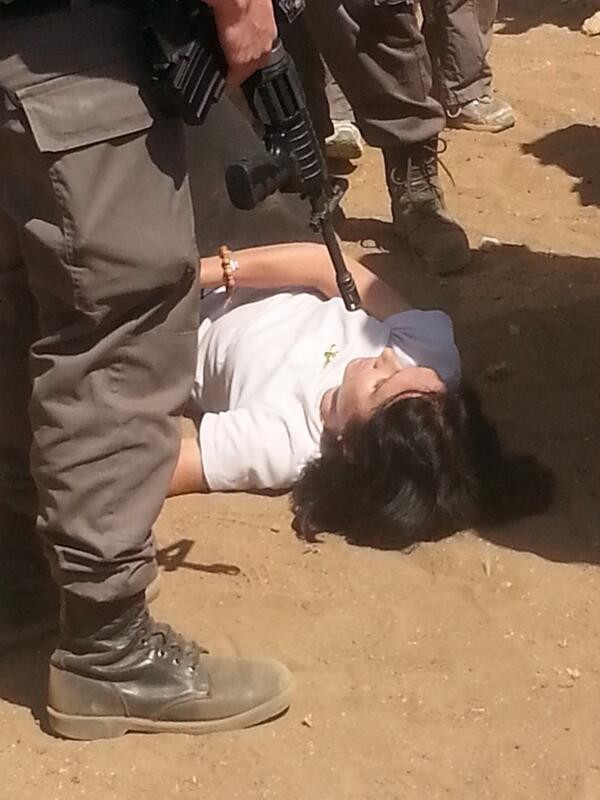 Israeli soldiers manhandled European diplomats on Friday and seized a truck full of tents and emergency aid they had been trying to deliver to Palestinians whose homes were demolished this week.
A Reuters reporter saw soldiers throw sound grenades at a group of diplomats, aid workers and locals in the occupied West Bank, and yank a French diplomat out of the truck before driving away with its contents.
“They dragged me out of the truck and forced me to the ground with no regard for my diplomatic immunity,” French diplomat Marion Castaing said.
“This is how international law is being respected here,” she said, covered with dust.
The Israeli army and police declined to comment.
Locals said Khirbet al-Makhul was home to about 120 people. The army demolished their houses, stables and a kindergarten on Monday after Israel’s high court ruled that they did not have proper building permits.
Despite losing their property, the inhabitants have refused to leave the land, where they say their families have lived for generations along with their flocks of sheep.
Israeli soldiers stopped the International Committee of the Red Cross (ICRC) delivering emergency aid on Tuesday and on Wednesday IRCS staff managed to put up some tents but the army forced them to take the shelters down.
Diplomats from France, Britain, Spain, Ireland, Australia and the European Union’s political office, turned up on Friday with more supplies. As soon as they arrived, about a dozen Israeli army jeeps converged on them, and soldiers told them not to unload their truck.
“It’s shocking and outrageous. We will report these actions to our governments,” said one EU diplomat, who declined to be named because he did not have authorization to talk to the media.
“(Our presence here) is a clear matter of international humanitarian law. By the Geneva Convention, an occupying power needs to see to the needs of people under occupation. These people aren’t being protected,” he said.
In scuffles between soldiers and locals, several villagers were detained and an elderly Palestinian man fainted and was taken for medical treatment.
The UN Office for the Coordination of Humanitarian Affairs (OCHA) said in a statement that Makhul was the third Bedouin community to be demolished by the Israelis in the West Bank and adjacent Jerusalem municipality since August.
Palestinians have accused the Israeli authorities of progressively taking their historical grazing lands, either earmarking it for military use or handing it over to the Israelis whose settlements dot the West Bank.
Israeli forces regularly demolish Palestinian homes, claiming they do not have the proper construction permits. However, the Israeli government regularly announces the expansion of settlements, which are considered illegal under international law.
Israelis and Palestinians resumed direct peace talks last month after a three-year hiatus. Palestinian officials have expressed serious doubts about the prospects of a breakthrough.
“What the Israelis are doing is not helpful to the negotiations. Under any circumstances, talks or not, they’re obligated to respect international law,” the unnamed EU diplomat said.
(Reuters, Al-Akhbar)
Syria and the ‘devious’ Israeli connection — Dr. Olmert doth protest too much, methinks
By Maidhc Ó Cathail | The Passionate Attachment | September 18, 2013
In a September 9 blog for The Huffington Post, Dr. Josef Olmert seizes on Professor Stephen Walt’s open letter to Congressman Joseph Kennnedy, urging him to oppose the use of military force against Syria, as an opportunity to attack Walt and Mearsheimer’s thesis that the influential — not “demonic” as Olmert chooses to misrepresent it — Israel Lobby has managed to skew U.S. foreign policy from its national interest. Writes Olmert:
So, under these circumstances, I eagerly expected to read about the Israeli connection of the Syrian problem, as well as it being behind the President’s decision to attack in Syria. Nothing of the kind in the open letter, and for good reason. The Syrian conflict has nothing to do with Israel. So was the case in Tunisia, where the Arab Spring started, so it was in Libya, where the US intervened ” from behind,” so it was in Egypt, where the secular-liberal Tamarud movement agitates against the Egyptian-Israeli Peace Treaty and the deposed Muhammad Morsi related to Jews as descendants of pigs and monkeys.
Well, Israel has not been involved in all these situations, as well as in Yemen, Bahrain etc. because the Arab Spring had nothing to do with the Arab-Palestinian-Israeli conflict. It has to do with poverty, corruption, authoritarianism and sectarianism — all are huge issues which are concerned with the very fabric of the Arab state system, with basic ills of Arab societies; in sum, with issues that are mostly the makings of the Arabs, ones which ought to be solved by them.
The Arab Spring has been a cataclysmic, formative event, the most important to have happened in the Middle East since the heydays of Nasserism, back in the 1950′s. Such a huge event and no Israel connection, so where is the big thesis of Walt and Mearsheimer? How is it connected to the Middle East circa 2013? Well, it is not.
Dr. Olmert’s denial of an Israeli connection to the so-called “Arab Spring” is undermined, however, by his own biography. Although omitted from his “full bio” page at the HuffPost, the adjunct professor at the University of South Carolina is a contributor to an “online community” known as Fikra Forum, “that aims to generate ideas to support Arab democrats in their struggle with authoritarians and extremists.” Notwithstanding the high-sounding self-description, the pro-democracy “Arab” forum is in fact a creation of the Washington Institute for Near East Policy, a think tank that was itself created by the American-Israel Public Affairs Committee (AIPAC), the most powerful and best known organization in the Israel Lobby.
Among Olmert’s fellow Fikra Forum contributors is Mouaz Moustafa, the executive director of the Syrian Emergency Task Force (SETF), a group that lobbies Washington for military intervention on behalf of the Syrian opposition. As Moustafa’s Israeli Fikra co-contributor no doubt remembers, an op-ed piece in the Wall Street Journal by SETF’s recently resigned political director, “Doctor” Elizabeth O’Bagy, was touted by John McCain and John Kerry during a Senate Foreign Relations hearing to bolster the dubious case for intervention in support of the supposedly “moderate” rebels.
So who does the one-time advisor to former Israeli Prime Minister Yitzhak Shamir and the brother of former Prime Minister Ehud Olmert think he’s fooling when he claims there’s no “ever devious” Israeli connection to the Syrian problem?
Maidhc Ó Cathail is an investigative journalist and Middle East analyst. He is also the creator and editor of The Passionate Attachment blog, which focuses primarily on the U.S.-Israeli relationship. You can follow him on Facebook and Twitter @O_Cathail.
Related articles
- A brief insight into the Israel Lobby’s non-transparent reinforcement of a ‘red line’ on Syria (thepassionateattachment.com)
- Israelis Flying Aid to Syrian Rebels Under the Cover of Humanitarianism (thepassionateattachment.com)
Featured Video

Weaponized Journalism: 2021 Sayer Ji Interview with NPR
or go to
Aletho News Archives – Video-Images
From the Archives
How Rothschild Banking Clan Uses Its Vast Wealth to Influence World Events and Control Governments

By Ilya Tsukanov – Sputnik – 15.09.2024
How powerful is the Rothschild banking family? How did they amass their fortune? Just how rich are they? Do they secretly control the world? Sputnik explores. … continue
Blog Roll
 Aletho News
- London tourism expo promotes Israeli agency linked to theft of Palestinian land
- Dockworkers launch global strike against Israeli and US military shipments
- Europe facing gas price shock – Gazprom chief
- Ukraine continues recruiting people with disabilities
- Weaponized Journalism: 2021 Sayer Ji Interview with NPR
- Beyond Netanyahu: what Israel’s election means for Palestinians
- Lithuania plans universal conscription
- Lies, Damn Lies, and Ukraine News
- Financial Times rejects Nordic demands to correct Putin call story – media
- The Case for Less Unity in Europe
- If Americans Knew
- An error has occurred; the feed is probably down. Try again later.
- No Tricks Zone
- Germany’s Green Energy Transition Becoming Increasingly Expensive…Another 6 Trillion Euros!
- Sudden Stratospheric Warming, Powerful El Niño Combination May Lead To Extreme Europe Cold, Energy Crisis!
- Two New Studies Find Thwaites Glacier Melt Cannot Be Driven By Human Activity Or A Warming Ocean
- E-Cars Reduce CO2 Emissions By Only 41% Compared To Internal Combustion Engine Vehicles
- Predictions Made By Renowned Climate Professor Over Past Decades Have Been Proven To Be Poor
- New Study Suggests Large Regions Of The Pacific Ocean Have Been Cooling For The Last 80 Years
- Germany’s Green Energy Debacle: High Energy Costs Force Kahla Porzellan to Close After 182 Years!
- New Study: 50 Years Of The Most Aggressive ‘Net Zero’ Policies Can Only Affect The Global Climate By 0.03°C
- US September “Heat” Was No Record…Many Records Set Decades Ago
- Latest European Green Energy Debacle; Portugal’s Largest Flagship Solar Park Insolvent!

