CHOMSKY ATTACKS CHAVEZ FOR NEOCON CARR CENTRE?
The Naked Facts | July 3, 2011
Chomsky reveals he has lobbied Venezuela’s government behind the scenes since late last year after being approached by the Carr centre for human rights policy at Harvard University. – http://www.guardian.co.uk/world/2011/jul/03/noam-chomsky-hugo-chavez-democracy
WHO IS CARR CENTRE?
Carr Center for Human Rights Policy http://www.sourcewatch.org/index.php?title=Carr_Center_for_Human_Rights_Policy
Sarah Sewall is the Director of the Carr Center – http://www.sourcewatch.org/index.php?title=Sarah_Sewall
SHE IS ALSO ON ADVISORY BOARD OF?… Center for a New American Security – http://www.sourcewatch.org/index.php?title=Center_for_a_New_American_Security
WHO ELSE IS ON THAT BOARD WITH HER? … Susan Rice and James Steinberg, The Honorable Dr. William J. Perry, Hoover Institution/ Dr. Madeleine K. Albright, Principal, The Albright Group LLC/Richard L. Armitage, President, Armitage International/ Norman R. Augustine, Lockheed Martin Corporation/Admiral Dennis C. Blair, USN (Ret.), Former Commander-in-Chief, U.S. Pacific Command Dr. Richard J. Danzig, Sam Nunn Prize Fellow, Center for Strategic and International Studies/William J. Lynn, Senior Vice President, Government Operations & Strategy, Raytheon Company/Lt Gen Gregory S. Newbold, USMC (Ret.), Managing Director, Torch Hill Capital/John D. Podesta, President and CEO, Center for American Progress (THATS THE CARR CENTRE DIRECTORS COHORTS)
NOW WHO ARE THE MAJOR SUPPORTERS OF CARR CENTRE FOR WICH CHOMSKY IS INTERVENING IN VENEZUELAS INTERNAL AFFAIRS?
BRACE YOURSELVES …
The Schooner Foundation, Carnegie Foundation, Ford Foundation, McCormick Tribune Foundation, Sydney and June Barrows Foundation, Alchemy Foundation, Kathy and Gary Anderson, Greg Carr, John L. Eastman, Gail Furman, Tsutomu Kanase, Tristin and Martin Mannion, Robert McKeon, Sheila and James Mossman, Cynthia Ryan, and Vincent Ryan are listed in their 2003 / 2004 annual report. 2003/04
According to their http://www.hks.harvard.edu/cchrp/aboutus/annualreports/20022003_AnnualReport.pdf 2002/03 Annual Report, supporters included Fabbio Cappon, Carnegie Corporation of New York, Gregory C. Carr, Center for Public Leadership, Ford Foundation, Gail Furman, Norman and Rosita Winston Foundation, and Reebok Foundation.
NOW HOW AN ESTIMEED … (TO OTHERS NOT ME) SCHOLAR CAN INTERVENE ON THESE GROUPS BEHALF, SPEAKS VOLUMES …. AND CHOMSKY IS NOT JUST ACTIVE IN SUCH MATTERS AGAINST CHAVEZ, BUT ALSO WORKING TO ADVANCE WESTERN INTERESTS AND POLICIES IN NICARAGUA …
SEE …
At Work for John Negroponte? http://fanonite.org/2008/06/19/at-work-for-john-negroponte/
Noam Chomsky, Brian Wilson and Tom Hayden and their fellow signatories have helped the Bush regime recoup lost ground for unjust US and European militarist corporate domination in Latin America which they will bequeath to whichever US plutocrat dauphin is anointed in November.
CHOMSKY IS ALSO A CLOSE FRIEND OF HAMID DABASHI SPOKESPERSON AND A MOST VOCAL PROPONENT OF THE GREEN MOVEMENT OF IRAN
DABASHI IS A FRAUD, SEE … http://thenakedfacts.blogspot.com/2011/06/bswatch-war-in-context-exposed-arab.html
ITS NO SECRET CHOMSKY BACKS THE GREEN PARTY WHAT HE LEAVES OUT IS THEIR PRO MONARCHY, PRO SHAH, PRO NEOLIBERALISM, PRO WESTERN IMPERIALISM POSITIONS, THEIR VIOLENT ACTS, THEIR DISHONESTY IN COOKING UP VIDEOS OF BEING BRUTALIZED BY USING BOTTLES OF FAKE BLOOD AND MANY MORE CASES, LIKE WESTERN FUNDING BY THE US STATE DEPARTMENT AND CIA … AND EVEN ITS LEADERS WHO ARE BILLIONAIRES UNDER THE GUISE OF ”REFORMERS”!!!
More on the green movement of Iran, scroll down after it opens… http://thenakedfacts.blogspot.com/2011/06/more-lies-by-western-backed-green-party.html (see supplementation)
~
For more on the Venezuela – Chomsky issue see:
Chomsky is dishonest and deceptive in denying assault on Chavez
By Stephen Gowans on July 6, 2011
And:
Widely ignored facts on Chomsky’s criminal “victims of authoritarianism”
A Few Facts about the Case of Judge Afiuni
By Fernando Vegas Torrealba | Correo del Orinoco International | July 8th 2011
Why Obama’s “new thinking” initiative on Middle East peace is doomed to fail
By Lawrence Davidson | January 22, 2011
According to Laura Rozen, a journalist specializing in foreign policy matters and writing in Politico (13 January 2011), the Obama administration is seeking “new ideas from outside experts on how to advance the peace process” in the Middle East. This is because the president and his counsellors are “utterly stuck” following the failure of last year’s efforts to strong-arm Mahmoud Abbas and bribe Binyamin Netanyahu into negotiations. Quoting an administration consultant, Rozen tells us “there is no pretence of progress. With the State of the Union coming up and the new GOP [Grand Old Party – the Republican Party] Congress, they [the administration] are taking a few weeks to regroup and solicit ideas to push forward and … to give a real jump-start” to the negotiation process”.
On the surface this would appear to be welcome news. The White House entourages having this revelation that their process, and that of their predecessors too, have all failed and so we need some new, progressive thinking about peace in the Holy Land. Maybe there should be a new approach that would play to the leverage the US can bring to bear on both parties (and not just the Palestinians). But then Rozen proceeds (in a completely dead pan style) to explain to us how the administration is going about its search for “new ideas from outside experts”.
Two separate efforts have been set up to brainstorm these new ideas:
1. “One task force has been convened by Sandy Berger and Stephen Hadley”. Who are they? Berger was national security adviser to Bill Clinton. He was a “prominent actor at the Camp David 2000 Summit”. What about Hadley? He was assistant to Undersecretary of Defence Paul Wolfowitz during George W. Bush’s first term of office and then national security adviser to the president during Bush’s second term. In these positions he worked closely and comfortably not only with Wolfowitz, but also with men like Dick Cheney and Donald Rumsfeld.
2. “A second effort [is] led by Martin Indyk.” And who is Martin Indyk? Indyk served twice as US ambassador to Israel as well as being a member of the National Security Council (NSC) under Clinton. Before that he was deputy research director for the American Israel Public Affairs Committee (AIPAC) and served eight years as the executive director of the pro-Israel Washington Institute for Near East Policy (WINEP), which he helped co-found. WINEP is supported by AIPAC. According to Rozen’s report, one of the first things Indyk has done in his search for “new ideas” is to seek out, among others, “senior NSC Middle East/Iran adviser Dennis Ross”. And who is Dennis Ross? Ross was Bill Clinton’s Middle East envoy in the 1990s. Before that he was on Ronald Reagan’s NSC and, along with Indyk, helped co-found WINEP.
These are the people who the Obama administration is looking to for new thinking about the peace process. One is left simply amazed at this development. Almost, but not quite, speechless. For all these men – Berger, Hadley, Indyk and Ross – are strongly biased in favour of Israel, and among the folks who have been running the US side of the peace process at least since the 1980s. They are not “outside experts” at all. They are retreaded inside “experts” whose records, with very minor exceptions, in regard to the peace process, are ones of failure. Going to these people for “new ideas” that will “jump-start” peace talks in the Middle East is like going to Supreme Court Justice Anthony Scalia for a forward-looking and progressive take on the US Constitution. Such an effort is a standing contradiction. It is a rigged game designed to get you the opposite of what you claim to seek.
The unavoidable question is why is the Obama administration wasting its time and our money doing this? The answer has to be first and foremost domestic politics. Although Barack Obama would, understandably, still like to make a positive impact on the Palestinian-Israeli impasse, he is convinced that any effort in this regard must conform to the wishes of domestic political forces led by the Zionist lobby. For instance, what would happen if he decided that all those listed above were hopeless failures and, instead of going to back to them, he was going to turn to, say, Rashid Khalidi, the Edward Said Professor of Modern Arab Studies at Columbia University? Khalidi is undoubtedly an expert on the Middle East and the Palestinian-Israeli question. However, he is also very much in favour of justice for the Palestinians. If President Obama was to consult Khalidi there would be an immediate knee-jerk reaction in Congress consisting of quite literal screaming and yelling. AIPAC would call Obama a man seriously lacking in judgment and Khalidi a friend of terrorists. The president’s possibilities for re-election would, allegedly, recede dramatically. On the other hand, there is no doubt that he would get “new ideas” from an “outside expert”.
The political pragmatist might argue, what good are “new ideas” if they cannot be implemented? But this position accepts the same assumption noted above, that any US president must be tied down by the political power of the Zionist lobby. It is, in fact, an assumption that must be challenged if any future progress is to be made. Thus, the president should take a chance. He should consider making a new and forceful initiative and demand Israeli compliance like Eisenhower did at the end of the Sinai Crisis of 1956. He should go to the American people and explain what he is doing and why. He should use every presidential prerogative there is, including the negative ones, to assure Israeli cooperation, etc. Oh, this is political suicide, answers the political pragmatist; it will never work. But, as is obvious, nothing else has worked to date. We are spending enormous sums to subsidize Israeli obstinacy and, according to General David Petraeus, the man who leads the American effort in Afghanistan, doing so is helping to kill American soldiers. So, go ahead Mr President, take the bull by the horns already.
Alas, he will not. And Rozen’s report is proof positive that the president will not do this. He is first and foremost a domestically-oriented politician cut out of a very standard mould. Politically, then, it has been judged safer to resurrect the dead in the form of Berger, Hadley, Indyk and Ross. So, there you have it. What is necessary for success in the peace process is always assumed to equal political failure at home. On the other hand, political success at home (which entails letting the Zionist lobby set the criteria for what is possible) equals continued failure of the peace process. It also equals ever increasing danger for US interests in the Middle East and the Muslim world. This latter equation is not based on an assumption. It is a historically demonstrated fact.
This is why we fail. No one wants to seriously test the old standing assumptions. Our political system is ossified. It is trapped in a lobby-driven, financially-corrupt rut. And until we find a way out of it we are doomed to go round in circles. That is what the administration’s pseudo effort at seeking “new ideas from outside experts” amounts to, going in a circle. Round and round and round and round.
British Zionists’ hypocritical view of suffering and the Holocaust
January 10, 2011 by Gilad Atzmon
For years Israelis and Zionists have been pumping ‘Shoah’ into our veins by using every possible propaganda outlet: media, education, Hollywood, music, literature, billboards and so on.
Seemingly they have been very successful: We are all properly ‘Holocausted’. We accept the suffering of the Jewish people — and we have even managed to draw a universal message from it all.
We do accept that a real Shoah is taking place in front of our eyes in Palestine, where the Jewish state locks millions of Palestinians behind bars: it starves them, it stops medical supplies, food, cement, and educational materials from getting in. But it does not stop there — when the Jewish state feels like it, it also kills Palestinians indiscriminately. It either blitzes them with white phosphorous, or sends in its tank battalions to drive over Gaza.
In preparation for Holocaust Memorial Day (1), London Zionist mouthpiece The Jewish Chronicle is very disturbed by a UK-based pro Palestinian web site named shoah.org.uk. The site is obviously dedicated to the Palestinian Holocaust.
The Jewish paper insists that the Shoah — like Israel — is a ‘Jews only club’. They do not want to ‘let anyone else in’.
Karen Pollock, chief executive of the Holocaust Educational Trust told the Jewish paper, “Using the word ‘Shoah’ in this context is done with the sole intention of causing offence to Holocaust survivors, their families and the wider Jewish community and shows the greatest possible disrespect to the tragedy of the Holocaust.”
I would fiercely argue that Pollock is wrong. Using the word ‘Shoah’ in this very context is there to awaken the world, the Jews, and holocaust victims in particular, to the fact that the biggest current perpetrator of crimes against humanity — is actually the Jewish state.
Mark Gardner, of the Community Security Trust, said: “This website is yet another sickening example of how the Holocaust is perverted by anti-Zionists in order to attack Israel and Zionism.”
Mark Gardner is almost correct; anti Zionists do indeed use the Shoah as a means of mirroring. And it is now an accepted fact that the Palestinians are the last victims of Hitler. It is also becoming accepted that the Israelis are the Nazis of our time. And tragically enough, the crimes in Palestine carried out by the Jewish state are also being committed in the name of the Jewish people. As if this is not enough, it is Jewish pilots who drop white phosphorus from planes which are decorated with Jewish symbols.
These facts are disturbing and demand the immediate attention of world Jewry.
Jon Benjamin, chief executive of the Board of Deputies ( another morbid institute that claims to represent British Jews ) told the Jewish Chronicle that “even without delving into what is clearly a one-sided and skewed narrative, by virtue of its title, this website is extremely provocative and any trivialisation of the Holocaust in which over six million Jewish men, women, and children were systematically murdered is completely abhorrent.”
Benjamin is probably too lame to grasp that what we see here is the total opposite — We are actually witnessing an acceptance of an astute universalising of the holocaust as carrying a humanist message for all of us. We can see a deeper understanding of the true moral meaning of that historical event.
Surely we need to stand up against all forms of ethno-centric homicidal policies. And it seems clear that Israel is no different from Nazi Germany in that regard. In fact Israel is far worse, because Israel acts under the guise of being a democracy, and its merciless policies are a reflection of the majority Israeli population’s yearning to live in a ‘Jews only’ state.
However, a few questions are still left open — Why exactly do the aforementioned Jews from the Jewish Chronicle and the Board of Deputies want to maintain the notion and reality of historical suffering as being exclusively Jewish property? Why don’t they want anyone else to use the word ‘Shoah’? Why do they demand a total control over the usage of words and applications of meanings ?
Can you imagine a Ukrainian protesting against the word ‘famine’ being applied to the situation in Ethiopia?
I really wonder why so many Jews insist on grounding their identity politics on suffering and being hated by others?
For clearly, one must admit that being loathed is not exactly something to brag about.
I am bewildered.
(1) It is interesting to read the definition of the Holocaust Memorial Day on the official HMD’s site:
“HMD is about remembering the victims and those whose lives have been changed beyond recognition of the Holocaust, Nazi persecution and subsequent genocides in Cambodia, Rwanda, Bosnia and the ongoing atrocities today in Darfur.”
Basically everywhere except in Palestine.
Related articles
- The Curse of Chutzpa (alethonews.wordpress.com)
- Is Palestinian Solidarity an Occupied Zone? (alethonews.wordpress.com)
Students for Justice in Palestine condemns US government witch hunt
Students for Justice in Palestine | 29 December 2010
“For if they take you in the morning, they will be coming for us that night.”
– James Baldwin, in an open letter to Angela Davis, 19 November 1970
As students at over fifty American universities, we unequivocally condemn the abuse of grand jury subpoenas to chill the exercise of First Amendment rights by university students and anti-war activists speaking and organizing against Israel’s continued oppression of the Palestinian people. Since 24 September 2010, the FBI has served at least 24 grand jury subpoenas on students and activists in a secret investigation that many have called a witch hunt. We call upon Attorney General Eric Holder and United States Attorney Patrick Fitzgerald to respect the civil rights and free speech of all those who support the Palestinian struggle for freedom by immediately withdrawing grand jury subpoenas which threaten the First Amendment rights of students and activists around the country.
The government’s assault on organizations and individuals who support the Palestinian struggle for freedom has become increasingly authoritarian. The abuse of laws criminalizing “material support for terrorism” is unprecedented and, had they been implemented at the time of South African apartheid, would have effectively criminalized broad American support for the anti-apartheid movement. At the apparent behest of US Attorney Patrick Fitzgerald, the government today has cast a net so wide that it has entangled journalists, college students, and peace activists. We know that a campaign so indiscriminate will seriously impinge on the First Amendment and other civil rights of people living in the United States. This will, in particular, affect active and outspoken students on university campuses, especially those of Palestinian descent.
It is not only our right but also our moral duty to speak and act against American foreign policy and its destructive impact on innocent people around the world. Today, America unfortunately stands behind Israel’s oppression of the Palestinian people with money, weaponry, and diplomatic support. We seek to reverse this situation so that American foreign policy stands on the side of people who work towards justice. We reject the government’s efforts to isolate the Palestinian people by severing them from their non-violent supporters abroad. Therefore we stand in solidarity with the victims of our government’s campaign both in America and around the globe.
If Attorney Fitzgerald’s campaign marks the morning of a new day, then we are certain of what awaits us in the night. Like Baldwin before us, we live in an age in which silence is not only criminal but suicidal — we shall, therefore, make as much noise as we can.
Signed:
* American University, Students for Justice in Palestine
* Arizona State University, Students for Justice in Palestine
* Bard College, International Solidarity Movement
* Benedictine University, Students for Justice in Palestine
* Boston University, Students for Justice in Palestine
* Brandeis University, Brandeis SJP
* Brooklyn College CUNY, The Palestinian Club
* Columbia University, Students for Justice in Palestine
* Cornell University, United for Peace and Justice in Palestine
* DePaul University, Students for Justice in Palestine
* Eastern Washington University, SLAC
* Florida International University, Students for Justice in Palestine
* George Mason University, Students for Justice in Palestine
* George Washington University, Students for Justice in Palestine
* Georgetown University, Students for Justice in Palestine
* Hampshire College, Students for Justice in Palestine
* Harvard Law School, Middle East Law Students Association
* Harvard University, Alliance for Justice in the Middle East
* Harvard University, Harvard College Palestine Solidarity Committee
* Harvard University, Harvard Law School Justice for Palestine
* Hunter College, Students for Justice in Palestine
* Loyola University, Middle Eastern Student Association
* Massachusetts Institute of Technology, Palestine@MIT
* New York University, Students for Justice in Palestine
* Northeastern Illinois University, Students for Justice in Palestine
* Northwestern University, Students for Justice in Palestine
* Ohio State University, Committee for Justice in Palestine
* Pennsylvania State University, Students for Justice in Palestine
* Rutgers University – New Brunswick, BAKA: Students United for Middle Eastern Justice
* San Diego State University, Students for Justice in Palestine
* School of the Art Institute of Chicago, Students for Justice in Palestine
* Temple University, Temple Students for Justice in Palestine
* Tufts University, Students for Justice in Palestine
* University of Arizona, Students for Justice in Palestine
* University of California, Berkeley, Students for Justice in Palestine
* University of California, Berkeley Law, Law Students for Justice in Palestine
* University of California, Davis, Students for Justice in Palestine
* University of California, Irvine, Students for Justice in Palestine
* University of California, Los Angeles, Students for Justice in Palestine
* University of California, Riverside, Students for Justice in Palestine
* University of California, San Diego, Students for Justice in Palestine
* University of Chicago, Students for Justice in Palestine
* University of Florida, Students for Justice In Palestine
* University of Illinois at Chicago, Students for Justice in Palestine
* University of Maryland, Baltimore County, Students for Justice in Palestine
* University of Michigan, Students Allied for Freedom & Equality
* University of Nebraska, Lincoln, Palestine Solidarity Committee
* University of Pittsburgh, Pitt Students for Justice in Palestine
* University of South Florida, Students for Justice in Palestine
* University of Southern California, Students for Justice in Palestine
* University of Texas at Austin, Palestine Solidarity Committee
* University of Washington, Students for Justice in Palestine
* Vermont Law School, Law Students for Justice in Palestine
* Wellesley College, Justice for Palestine
* Yale University, Yale Students for Justice and Peace in Palestine
The Myth of American Pressure
By Osamah Khalil | al-Shabaka policy brief | 26 October 2010
Recent reports that the Obama administration offered Israel a series of incentives to continue its limited ten-month moratorium on settlement building have sparked an outcry among Palestinians and their supporters. Although the concessions for halting the construction of new settlements for only 60 days are unprecedented, Washington’s inability to maintain consistent pressure on Israel fits into a much broader historical pattern. The conventional wisdom is that when Washington has exerted pressure on Israeli governments they have eventually succumbed to American demands. However, a closer reading of the historical record and declassified American archival documents reveals a more complex dynamic between the two allies.
In this policy brief, Al-Shabaka Co-Director Osamah Khalil examines four major crises in the “special relationship” between the U.S. and Israel: the 1949 Lausanne Conference; the 1956 Suez Crisis; the October 1973 War; and the 1991 Madrid Peace Conference. He demonstrates that while Israel has on occasion publicly acceded to American demands, privately it has received concessions and agreements that rewarded its intransigence and improved its negotiating position at the expense of Palestinian rights. Khalil argues that American pressure was negligible when compared to the policy options available to the different presidential administrations. Finally, he offers recommendations for Palestinians and their supporters.
The Lausanne Conference
The pattern of public American pressure and private concessions to Israel was established early on. In April 1949, the Lausanne Conference was convened in order to translate the separate armistice agreements between Israel and Egypt, Lebanon, Syria, and Transjordan signed after the 1948 Palestine War into a final peace. Among the key issues to be negotiated was the fate of over 750,000 Palestinian refugees who were either expelled by or fled from Zionist militias during the war. In accordance with UN General Assembly Resolution 194, Washington advocated for a substantial repatriation of Palestinian refugees to their homes. Israel, however, was reluctant to consider repatriating more than a token number of refugees.
Israel’s intransigence at Lausanne led to a sharp exchange of letters between President Truman and Israeli Prime Minister David Ben-Gurion. Truman was incensed by a report that American attempts to negotiate an agreement were being rebuffed by Tel Aviv and that Israeli officials had informed American representatives that they intended to “bring about a change in the position” of the administration “through means available to them in the United States.”1 Truman’s letter warned that should Israel continue to reject America’s “friendly advice,” Washington would “regretfully be forced to conclude that a revision of its attitude toward Israel has become unavoidable.”2
Although the Israelis appeared to reject Truman’s claims, their position at Lausanne softened over the next two months, including an offer to repatriate 100,000 refugees.3 However, the number was still deemed insufficient by the Arab states and by Secretary of State Dean Acheson. Acheson called for the Israelis to repatriate a “substantial number” of refugees — roughly 250,000 — with the remainder to be resettled in the neighboring Arab states where they had sought shelter and to receive some compensation.4
A State Department memorandum drafted after the Israeli reply to Truman recommended four actions for the administration to pursue, including: blocking the release of the remainder of a $100 million Export-Import loan, removing the tax-exempt status that U.S.-based Jewish groups enjoyed to raise funds for Israel, refusing Israeli requests for technical assistance and expertise, and not supporting the Israeli position in international organizations.5 Of these recommendations, the Truman administration opted to delay, but not block, the release of the remainder of the loan. In addition, the State Department decided not to use Israel’s application for membership to the United Nations -– a key Israeli goal -– as an opportunity to pressure Tel Aviv at Lausanne. Rather, Washington believed that Israel’s admission to the UN would compel concessions by the Arab states in the negotiations.6
By late August the loan issue escalated. Responding to an inquiry by the Israeli government, the Export-Import Bank replied that it had approved the loan and the delay was due to the State Department. Eliahu Elath, Israel’s ambassador to the U.S., responded angrily to the news, and informed an American delegation at a luncheon in Washington that such actions “could only be interpreted as attempted duress.” Elath added that “such tactics would not succeed. In fact, they could be expected to have the opposite result.”7
Acheson discussed the situation with President Truman the day after the luncheon. By early September, $2.35 million of the $49 million was released to Israel.8 This amateurish attempt at diplomatic pressure was the last one the Truman administration would undertake with Israel. It would also establish a consistent pattern of American behavior toward Israel: although Washington had an array of policy options available, the Truman administration and its successors lacked the political will to employ them effectively and consistently.
Suez 1956: A Successful Example?
The most prominent example of the successful application of American pressure on Israel was during the 1956 Suez War. Using Egyptian President Gamal Abdel Nasser’s nationalization of the Suez Canal as a pretext, France, Britain, and Israel jointly planned and invaded Egypt in late October. In a rare moment of Cold War superpower agreement, Washington and Moscow demanded that the invasion end and the tripartite forces withdraw. Indeed, the Dwight D. Eisenhower administration considered a series of actions to pressure Israel that were similar to those presented to President Truman. While Israel agreed to withdraw under American and Soviet pressure, far from damaging U.S.-Israeli relations, the Suez crisis led to closer cooperation.9
Of particular importance was the understanding reached between the U.S. and Israel over the Straits of Tiran, the narrow waterway which connects the Gulf of Aqaba and the Red Sea. Secretary of State John Foster Dulles concurred with Israel’s position that it had the right to send ships through the Straits and an attempt by Egypt to renew the blockade would be an act of war, giving Israel the right of self-defense under the UN Charter. The long-term implications of this agreement would be profound. As tensions increased in the spring of 1967, Nasser’s decision to close the Straits would be cited by Israel as the rationale for its surprise attack on Egypt in June 1967.10 During the Suez crisis, Lyndon Johnson was Majority Leader of the U.S. Senate and he opposed the Eisenhower administration’s pressure on Israel to withdraw from the Sinai without a peace agreement.11 Eleven years later as President, Johnson was unwilling to repeat what he viewed as Eisenhower’s mistake.12
In the wake of the Suez War, Nasser’s influence grew dramatically not just in the region but across the “Third World.” However, Eisenhower and Secretary of State John Foster Dulles were convinced that Egypt had become an unwitting pawn of the Soviet Union and were unmoved by Nasser’s claims of a policy of “positive neutrality” in the Cold War. Although publicly aimed at preventing the influence of “International Communism” in the “general area of the Middle East,” what became known as the Eisenhower Doctrine had a much more specific target: containing Nasser. While Ben-Gurion’s hopes for a formal military alliance with the U.S. were never realized during the Eisenhower administration, due largely to American plans for a regional defense pact that was hindered by the Arab-Israeli conflict, the U.S. and Israel found common cause in diminishing Nasser. As Washington sought support throughout the region for the Eisenhower Doctrine, Israel began to develop its “periphery pact,” developing alliances with non-Arab countries, including Turkey, Iran, and Ethiopia.13
The Kissinger Era
Unlike the Suez crisis, the October 1973 War led to a tense superpower showdown. The initial Egyptian and Syrian attack managed to surprise the Israeli military causing heavy casualties, however, Israel counterattacked and eventually took the offensive. When the Egyptian Third Army was almost encircled, Moscow threatened to intervene unless a cease-fire was declared. While the combination of American pressure and Soviet threats finally forced Israel to halt its advance, Washington interceded largely because of the possibility of a superpower confrontation.
Although the cease-fire revealed how effectively American pressure on Israel could be applied when larger American interests were at risk, the U.S.-led negotiations conducted over the next two years demonstrated the implications of such actions on Palestinian rights. Secretary of State Henry Kissinger focused his efforts on Egypt, relying on “step-by-step” shuttle diplomacy rather than a comprehensive negotiation involving all parties, and was reluctant to expand the negotiations to include the Syrians or the Palestine Liberation Organization (PLO).14 This was more than just a tactical approach. Washington perceived Egypt to be the most prominent Soviet ally in the region, and Kissinger hoped to drive a wedge between Moscow and Cairo. He found a willing partner in Egyptian President Anwar Sadat, who also sought to break with the Soviet Union and end hostilities with Israel.15
The negotiations were augmented by significant shipments of U.S. military aid to Israel. Kissinger argued that the aid was designed to make Israel feel more secure and willing to make concessions, especially as Moscow was rearming Syria and Egypt. Yet in negotiating the second Sinai disengagement, Israel’s position hardened. Although Kissinger emphasized the benefits of removing the most prominent and populous of the Arab states bordering Israel from the Arab-Israeli conflict and the Soviet orbit, Israeli Prime Minister Yitzhak Rabin was unmoved. By March 1975, Kissinger was frustrated by Israeli intransigence and returned to Washington, leading President Gerald Ford to call for a “reassessment” of U.S. policy in the region.16
Washington’s reassessment lasted roughly three months. Although existing arms contracts were honored, new shipments to Israel were halted during this period and Kissinger met with leading foreign policy specialists to discuss a new comprehensive approach to achieving peace. However, the Israeli government countered with its own pressure. In May, seventy-six U.S. senators signed a letter to Ford, calling on him to be “responsive” to Israel’s request for $2.59 billion in military and economic aid. Ford would later write that although the senators claimed the letter was “spontaneous,” that “there was no doubt in my mind that it was inspired by Israel.”17 In his memoirs, Rabin would concede that the letter was the result of an Israeli public relations campaign.18 Without domestic political support, Ford and Kissinger abandoned the reassessment and resumed negotiations.19
The Sinai II agreement was signed in September, but only after significant concessions by Washington. This included $2 billion in aid to Israel and abandoning any attempts for substantial negotiations on the Syrian or Jordanian fronts. In other words, Israel’s occupation of the West Bank and Golan Heights were further entrenched not to win an Israeli withdrawal from the Sinai Peninsula, but merely in order to establish a buffer zone between Israeli and Egyptian forces. In addition, Israel won a commitment from Washington to prevent future Soviet intervention in the region as well as placement of American civilian monitors in the Sinai. Most damaging to Palestinian interests was the secret memorandum of understanding Kissinger signed with Israel related to the PLO. Although the PLO was recognized by the UN and the Arab League as the “sole legitimate representative of the Palestinian people,” Washington agreed not to “recognize or negotiate with” the PLO as long as it refused to recognize Israel’s right to exist and rejected UN Security Council (UNSC) Resolutions 242 and 338.20 Kissinger’s success helped set the stage for the 1978 Camp David Accords negotiated by President Jimmy Carter.21
Madrid 1991
From the perspective of Washington, the end of the Cold War and the success of the U.S.-led coalition in expelling Iraqi forces from Kuwait appeared to offer an opportunity to finally resolve the Arab-Israeli conflict. In the spring of 1991, Secretary of State James Baker began galvanizing support for an international peace conference. However, Israeli Prime Minister Yitzhak Shamir was reluctant to participate in the conference, and even more resistant to the “land for peace” formula. At the same time, Israel requested $10 billion in loan guarantees to assist with the settlement of Jewish immigrants from the Soviet Union. In an attempt to pressure the Shamir government, President George H.W. Bush requested that Congress delay approval of the loan guarantees for 120-days. However, when Congressional leaders rebuffed the request, Bush held an unprecedented news conference in September where he denounced the influence of the Israel lobby on Capitol Hill.22 The gambit appeared to work, as Israel agreed to attend the conference as well as to the presence of a joint Palestinian-Jordanian delegation.23
Held at the end of October in Madrid, Spain, the conference marked the first time Israelis and Palestinians would engage in direct negotiations. However, with the U.S. unwilling to serve as more than a facilitator of the meetings, the negotiations bogged down and eventually became victim to the Israeli and American political calendars. Shamir’s Likud party was voted from power in June 1992 and the loan guarantees were eventually approved by Congress in October. A month later, Bush lost his bid for reelection.24
Ultimately, the Madrid process would be undone not only by American inattention and Israeli intransigence but also by the PLO, which chose to sign a secret agreement negotiated in Oslo, Norway unbeknownst to the Palestinian negotiating team in Washington. Instead of demanding an end to the occupation and an independent state, PLO Chairman Yasser Arafat settled for an interim agreement that initially guaranteed limited autonomy for the Gaza Strip and the West Bank city of Jericho.25 Final status talks were to be concluded within five years, during which Israel was to maintain overall sovereignty for the OPT.26
Although it is often cited as another example of successful American pressure on Israel, in reality the Bush administration obtained few concessions from Shamir’s government and even fewer tangible results. While the loan guarantees were delayed, they were eventually approved and the Bush administration’s attempts to freeze settlement construction were unsuccessful. Nor did Shamir’s attendance at the conference constitute his acceptance of the “land for peace” formula, as he admitted in an interview with the Israeli paper Ma’ariv after the June 1992 election. Shamir explained that, “I would have carried on autonomy talks for ten years and meanwhile we would have reached a half million people in Judea and Samaria [i.e., the West Bank].”27 Indeed, Shamir’s strategy has been adopted by successive Israeli governments.
Lessons Learned and Recommendations
What lessons can Palestinians and their supporters draw by examining these crisis moments in U.S.-Israeli relations? Perhaps most important is to differentiate between the perception that pressure is being applied by Washington and the reality. In each of the historical cases, both the U.S. and Israel had an interest in overstating the political pressure brought to bear. For Washington, the audience was typically the Arab states who looked to the United States as the only power capable of securing concessions from Israel. On occasion, as with Bush’s 1991 press conference, the discussion of the Israel lobby was also for domestic consumption. Meanwhile, Israel’s attempts to exaggerate American pressure have been aimed not just at its own domestic audience and the competition between the major political parties, but toward its American supporters as well.
While the influence of the Israel lobby in these crisis moments particularly on Congress cannot be dismissed, it should not be overstated either. In each case, the different Presidential administrations had an array of policy options available to them, but they were unwilling or unable to muster the political will to adopt more aggressive approaches. This behavior was often driven by the desire of American policymakers for the most politically expedient solution, dictated largely by the political calendar and intensified media attention, rather than a long-term resolution. As a result, Israel benefited from the reticence of the different administrations and their pre-existing biases toward supporting the Israeli position.28 Moreover, Israel used Washington’s desire to achieve its strategic goals regionally and internationally in order to obtain concessions at the expense of the weakest party in the conflict — the Palestinians.
American pressure on Israel has been successful when larger American interests have been at risk. For example, during the 1956 and 1973 Wars in the midst of the Cold War competition with the Soviet Union, Washington had very immediate and definite interests at stake which required it to press its demands in earnest. Moreover, Israel also had an interest in preventing the intervention of Soviet forces into the region, which made it more receptive to American pressure. Without a superpower competitor, the threat to American interests from Israeli actions might be substantial, but from the perspective of Washington they were not unmanageable or insurmountable. In other words, when the Palestinians and their supporters among the Arab states were angered by American policies or actions in support of Israel, once they agreed to a process mediated by the U.S. they had nowhere else to go –- and Washington knew it. This was particularly true of the regimes that relied on American military and economic aid to secure their rule, who found that the price for their participation in the peace process was an increasing number of concessions demanded by Washington in order to placate Israel.
Kissinger’s influence on today’s policymakers cannot be underestimated. His reliance on piecemeal, interim negotiations accompanied by high-level shuttle diplomacy has become the standard for successive administrations. Indeed, the apparent lesson learned is that the U.S. State Department must appear to be actively engaged, even when the results of such public activity are negligible. This has been repeatedly demonstrated in the attempts over the past decade to revive the Oslo Peace Process, in which merely the appearance of process is now considered more important than the actual process or achieving peace.
While Washington was able to extract some concessions from Israel over the years, these were eclipsed by Arafat’s decision to accept the deeply flawed Oslo Accords. Although the PLO was weak as an organization in 1993, the Palestinian cause was arguably at its height in international sympathy and support due to the first intifada and the diplomatic efforts surrounding the PLO’s acceptance of the two-state solution and 1988 Declaration of Independence. Rather than attempting to galvanize popular support among its Palestinian base and internationally around its goals, Arafat and the Tunis-based leadership opted for its own short-term and ultimately self-defeating solution. In short, the Palestinian leadership saved itself and the Israeli occupation at the expense of its own people inside and outside of Palestine.
The historical pattern described in this brief has also been observed with the Obama administration. Both the administration and the Netanyahu government have advanced the perception that President Obama has put unprecedented pressure on the Israelis to halt the construction of settlements in the OPT. Yet over the past year it has become evident that like its predecessors, the Obama administration has sought to reward Israeli intransigence and violations of Palestinian rights by increasing and expanding its support for Israel, rather than curtailing it. This included additional funding for the “Iron Dome” project, Washington’s shielding of Israel at the UN after the assault on the Freedom Flotilla, and supporting Israel’s admission into the Organization for Economic Cooperation and Development (OECD).29 Moreover, the recently reported concessions for a mere 60-day extension of the settlement “freeze,” including maintaining Israeli control over the Jordan River Valley, once again demonstrates Israel’s ability to secure private concessions at a time of supposedly heightened American pressure.30
What then constitutes real pressure? As the Truman and Eisenhower administrations determined, the U.S. has a number of ways to pressure Israel, or any other state, which is reliant on it for military, political, and economic support. This includes blocking or suspending the delivery of economic and military aid, removing the tax-exempt status from U.S. based donations for groups that donate to Israel, denying requests for technical or military assistance and expertise, and withholding support for Israel in international and regional organizations. To date, Washington has rarely considered these options. Rather, it has chosen to reward Israel’s intransigence with increasing amounts of aid, in the vain hope that if Israel feels secure it will be willing to make concessions.
At a minimum, Palestinians and their supporters should advocate for the U.S. to deny tax deductible status to organizations that fund and support Israeli settlements in the OPT. They should also continue to insist that Washington hold Israel accountable to U.S. and international law, including continued settlement activity and construction of the wall in the West Bank and East Jerusalem, the use of American weapons on Palestinian civilians, the repeated violations of Palestinian human rights, as well as to live up to its commitments as a member of the UN and the OECD, and as a signatory to numerous international treaties. The real pressure that Palestinians must look to and rely on is not from Washington toward Israel, but from the Palestinian people to the world community by continuously asserting that only by realizing their rights can a just and lasting peace be achieved.
Notes
[1] “” (hereafter FRUS, 1949) (Washington, DC: Government Printing Office, 1977): 1061.
[2] “FRUS, 1949.” 1072-1074.
[3] “FRUS, 1949,” 1125. The Israeli response further angered Truman, who told Undersecretary of State James E. Webb that he had informed “Jewish leaders who had called him” that “unless they were prepared to play the game properly and conform to the rules they were probably going to lose one of their best friends.”
[4] “FRUS, 1949,” 1013-1015, 1207.
[5] “FRUS, 1949,” 1110.
[6] Admission to the UN was a top diplomatic priority for Israel in 1949. In meetings with Truman and State Department officials, the Israelis stressed their desire to be conciliatory at Lausanne on the question of refugees but noted that UN Membership was needed to secure the precarious position of the fledgling state. See “FRUS, 1949,” 943-948.
[7] “FRUS, 1949,” 1328-1331.
[8] In response to complaints by the American representative at the Lausanne conference, who had not been notified of the decision to release the funds, Acheson offered a tepid defense of the State Department’s actions and an empty threat that future reviews of loan allocations could occur and that Israel should not “construe such action as either direct or indirect political pressure.” “FRUS, 1949,” 1375, 1388-1389.
[9] Avi Shlaim, The Iron Wall: Israel and the Arab World (Boston: W.W. Norton, 2001): 181.
[10] Shlaim has a fuller discussion of these events and the negotiations between the US and Israel, 178-185.
[11] “FRUS, Arab-Israeli dispute, 1955-1957,” 139-140. Johnson dispatched a letter to Dulles stating that he was “disturbed” by reports that the UN was considering sanctions against Israel but not the Soviet Union. He called for “a determined effort” by the UN and US to “go to the root causes of the troubles in the Middle East,” which included cross-border raids by Palestinians from Gaza. Johnson stated that “it is not utterly unreasonable for Israel to request guarantees by the United Nations that these attacks against her will not once more be prevalent, once she has withdrawn her troops from” Gaza and the Sinai, (“Letter from Senator Lyndon B. Johnson to the Secretary of State“).
[12] William Quandt, Peace Process: American Diplomacy and The Arab-Israeli Conflict Since 1967, Third Edition (Washington, Berkeley: Brookings Institute and the University of California Press, 2005): 44-52. Quandt discusses the influence of the Suez War on Johnson’s perceptions of the Arab-Israeli conflict.
[13] For an analysis of the Eisenhower Doctrine, see Salim Yaqub, Containing Arab Nationalism: The Eisenhower Doctrine and the Middle East (Chapel Hill: University of North Carolina Press, 2004).
[14] As National Security Adviser during President Richard Nixon’s first term, Kissinger largely ignored the Arab-Israeli conflict. Already Nixon’s most trusted advisor on foreign affairs, in the second term, serving as both Secretary of State and National Security Adviser, Kissinger’s power and influence was enhanced further by the Watergate crisis, which distracted the President.
[15] Quandt, 133; Shlaim, 313. In the build-up to the war, one of the signs missed (or ignored) by the United States and Israel was the expulsion of 15,000 Soviet advisers from Egypt in July 1972. Thus, relations between Moscow and Cairo were already strained before the war and Sadat was even more receptive to American overtures in its aftermath.
[16] Quandt, 159-163. Among Rabin’s demands was that Sadat sign a separate peace and declare an end to the state of belligerency between Egypt and Israel.
[17] Gerald R. Ford, A Time to Heal: The Autobiography of Gerald R. Ford (New York: Harper and Collins, 1979): 287. In discussing his decision for a “reassessment,” Ford wrote that it “jolted the American Jewish community and Israel’s many friends in Congress. The Israeli lobby, made up of patriotic Americans, is strong, vocal and wealthy, but many of its members have a single focus. I knew I would come under intense pressure soon to change our policy, but I was determined to hold firm” (247).
[18] Yitzhak Rabin, The Rabin Memoirs (Boston: Little, Brown and Company, 1979): 261-263. Rabin stated that the reassessment was “an innocent-sounding term that heralded one of the worst periods in American-Israeli relations.” While Rabin’s assessment of the situation may have been dubious, other Israeli officials have sought to emphasize this historical example for their own purposes. For example, in March, the Israeli newspaper Yedioth Ahronot reported that Israeli Ambassador Michael Oren claimed in a call with other Israeli diplomats that because of tensions between the Obama administration and the government of Israeli Prime Minister Benjamin Netanyahu “Israel’s ties with the United States are in their worst crisis since 1975 … a crisis of historic proportions,” (“Israeli envoy sees “historic crisis” with US: Report,” Reuters, 15 March 2010).
[19] Quandt, 163-166.
[20] Quandt, 166-169. UNSC Resolutions 242 and 338 were passed in response to the June 1967 and October 1973 Wars respectively. The “land for peace” formula embodied in the resolutions has served as the framework for a peaceful settlement of the Arab-Israeli conflict for the past 37 years. Resolution 242 called for Israel’s withdrawal from the occupied territories in exchange for peace with neighboring Arab states. Because the resolution did not mention Palestinian self-determination or the rights of the Palestinian refugees it was rejected by the PLO, but was adopted Arab states as the basis for a peace agreement. UNSC Resolution 338 called for an end to hostilities and the resumption of negotiations based on Resolution 242.
[21] There is insufficient space to discuss the Camp David negotiations and agreement but it is worth noting that the benefits to Israel and the implications for Palestinian rights of the Accords far outweighed Israeli Prime Minister Menachem Begin’s concessions under pressure by the Carter administration to finalize an agreement.
[22] In his comments on the loan issue, Bush stated that “we’re up against very strong and effective, sometimes, groups that go up to the Hill working the other side of the question. We’ve got one lonely little guy down here doing it,” “Excerpts from President Bush’s News Session on Israeli Loan Guarantees,” The New York Times, 13 September 1991.
[23] Quandt, 303-310.
[24] Quandt, 310-317. The Madrid process was already floundering before Bush lost the 1992 election. It was eventually put on hold after Israel expelled more than 400 Palestinians from the occupied West Bank and Gaza Strip into southern Lebanon in December. During the 1992 election, Democratic Party candidate Governor Bill Clinton criticized Bush’s stance on the loan guarantees. In its first nine months in office, the administration of President Bill Clinton was focused largely on domestic issues and was less willing to publicly pressure Rabin’s Labor government.
[25] See my article “Pax Americana: The United States, the Palestinians, and the Peace Process, 1948-2008,” New Centennial Review 8 (2008), for a discussion of the PLO’s willingness to negotiate on the issue of representation.
[26] The Oslo accords and their implications on Palestinian rights and aspirations will be discussed in a future al-Shabaka policy brief, but it should be noted that the pattern observed in this brief of public US pressure resulting in private concessions to Israel continued during the Oslo process.
[27] An English translation of this quote was reported by David Hoffman, “Shamir Plan was to Stall Autonomy,” Washington Post, 27 June 1992. In an interview seven years later with the Middle East Quarterly, Shamir claimed he was misquoted by Maariv. Yet the interview revealed how limited his conception was of what would constitute a “comprehensive agreement” and what autonomy, if any, there would be for the Palestinians. See Daniel Pipes, “Yitzhak Shamir: A Lifetime of Activism, Middle East QuarterlyJune 1999.
[28] It should be noted that a fuller discussion of the influence of the Israel lobby on US decision making is outside the scope of this brief and additional research is required in order to discuss the cultural, political, economic and strategic factors that influence American policy toward the Arab-Israeli conflict.
[29] In July, US Assistant Secretary of State Andrew Shapiro announced that the Obama administration was expanding the amount of security aid Israel will receive in 2010 to $2.775 billion, “the largest such request in US history.” Shapiro explained that that administration hoped its “expanded commitment to Israel’s security will advance the process by helping the Israeli people seize this opportunity and take the tough decisions necessary for a comprehensive peace.” Natasha Mozgovaya, (“ US official: More US aid will help Israel make “tough” decisions,” Haaretz, 16 July 2010).
[30] Mark Landler, Helene Cooper and Ethan Bronner, “US Presses Israelis on Renewal of Freeze, The New York Times, 1 October 2010). By early November, press reports indicated that the Obama administration negotiated a package of incentives with Netanyahu for a “one-time-only” ninety-day extension of the settlement freeze in the occupied West Bank, excluding East Jerusalem. This reportedly included additional military aid and advanced weaponry, as well as US support at the UN and other international bodies against Palestinian attempts to obtain recognition for an independent state without a final peace agreement. The agreement was pending approval by Netanyahu’s cabinet (Ethan Bronner and Mark Landler, “A 90-day Bet on Mideast Talks,The New York Times, 14 November 2010).
Related articles
- Romney Breaks With Every GOP President, Pledges To Never Criticize Israel (thinkprogress.org)
Israelis attacking children on their way to school
April 2010
Palestinian Children in the rural village of at-Tuwani speak of their encounters with violent Israeli Settlers in the South Hebron Hills of Occupied Palestine.
Related articles
- PALESTINE: Tent for school children demolished hours after it was built (alethonews.wordpress.com)
- Stranded in Shuhada: Hebron’s Qurtuba school (alethonews.wordpress.com)
- Mass arrest of schoolchildren (alethonews.wordpress.com)
Tribal affiliation and intolerance of the “Jewish left”
By Gilad Atzmon | November 1, 2010
I have spent the last 10 years elaborating on Jewish national ideology and tribal politics. During my journey of grasping what Zionism and Israel stand for, I came to realize that it is actually the Jewish left – and Jewish Marxists in particular – that provide us with an good glimpse into contemporary Jewish identity, tribal supremacy, marginal politics and tribalism.
Jewish dissidence
The term “Jewish left” is basically an oxymoron. It is a contradiction in terms, because “Jewishness” is a tribal ideology, whilst “the left” are traditionally understood as aspiring to universalism.
On the face of it, the “Jewish left” falls into the same category as Israel and Zionism, in that it is an attempt to form yet another “Jews-only political club”. And as far as the Palestinian solidarity movement is concerned, its role is subject to a growing debate. On the one hand, one can see the political benefit of pointing at the small number of “good Jews” and emphasizing that there are Jews who “oppose Zionism as Jews”. Yet on the other hand, however, accepting the legitimacy of such a racially oriented political affair is in itself an acceptance of yet another form or manifestation of Zionism, for Zionism claims that Jews are primarily Jewish and must operate politically as Jews.1
To a certain extent, then, Jewish anti Zionism can be viewed as just another form of Zionism.
“Jewish dissidence” has two main roles: First, it attempts to depict and promote a positive image of Jews in general.2 Second, it is there to silence and obscure attempts by outsiders to understand the meaning of Jewish identity and Jewish politics within the context of the Jewish state. It is also there to prevent elements in this movement from elaborating on the crucial role of Jewish lobbying.
The Jewish left is there, then, to mute any possible criticism of Jewish politics within the wider left movements. It is there to stop the goyim, or gentiles, from looking into Jewish affairs.
”Paddling in chicken soup has never been my thing”
A decade ago I met the kosher dissidents brigade for the first time. As soon as I began to voice criticism of Israel and Zionism, they started to bounce around me. For a short while, I fitted nicely into their discourse: I was young and energetic. I was an award-winning musician and a promising writer. In their eyes, I was a celebrity – or at least a good reason to celebrate. Their chief commissars reserved the best, and most expensive dining tables ahead of my Orient House Ensemble concerts.
The five penniless grassroots activists followed the trend and came to my free stage Jazz Combo afternoon concerts in the Barbican Centre foyer. They all wanted to believe that I would follow their agenda and become a commissar myself. They were also very quick to preach to me about who were the “bad guys”, those who should be burnt in hell, such as Israel Shahak, Paul Eisen, Israel Shamir and Otto Weininger – these were just a few of the many baddies. As one might guess by now, it didn’t take me too long to admit to myself that there was more wisdom in a single sentence by Eisen, Weininger, Shahak or Shamir than in the entire work of the Jewish left put together. I was quick to make it clear to my new “red” fans that it was not going to work: I was an ex-Israeli and I no longer regarded myself as a Jew any more. I shared nothing with them and I did not believe in their agenda. Indeed, I had left Israel because I wanted to drift as far away as I could from any form of tribal politics.
Paddling in chicken soup has never been my thing.
Naturally, I bought myself at least a half a dozen enemies, and they were quick to run a campaign against me. They tried to silence me, they desperately (and hopelessly) tried to wreck my music career, they mounted pressure on political institutions, media outlets and music venues. One of them even tried to drag me to court.
But they failed all the way through and they failed on every possible level. The more pressure they mounted, the more people read my writing. At a certain point, people around me were convinced that my detractors were actually running my public relations campaign. Moreover, the relentless attempts to silence me could only prove my point. They were there to divert attention from the crucial role of Jewish politics and Jewish identity politics.
I have asked myself often enough: how is it that they failed with me? But I guess that the same internet that successfully defeated the Israeli hasbara, or Israeli propaganda, has also defeated the Jewish left and its hegemony within the movement. In the wider scheme of things, it is totally obvious how marginal the Jewish Marxist discourse is. Its voice within the dissident movement is, in actual fact, insignificant.
I guess also that the fact that I am a popular Jazz artist didn’t make life easy for them. At the time those Jewish commissars labelled me as a racist and an anti-Semite, I was touring the world with two ex Israeli Jews, an Argentinean Jew, a Romanian Gipsy and a Palestinian Oud player. It just couldn’t work for them, and it didn’t.
But here is an interesting twist. In contrast to the contemporary Jewish “red terror”, Zionism comes across as a relatively tolerant endeavour. In recent months I have been approached by every possible Israeli media outlet. In the summer, “Ouvda”, the leading Israeli investigative TV show, asked repeatedly to join me and my band on the road. They were interested in launching a debate and discussing my ideas in primetime. This week, the Israeli Channel 2 TV approached me for a news item. Again, they were interested in my views. Yesterday, I discussed my views for an hour with Guy Elhanan on Israel’s Kol ha-shalom (Voice of Peace).
For the most obvious of reasons, I am very cautious when dealing with the Israeli media. I choose my outlets very carefully. I usually refuse. But I also accept that as a person who cares about the prospect of peace I must keep an open channel with the Israeli public, and two weeks ago I agreed to be interviewed by Ha’aretz writer,Yaron Frid. This was my first published interview in Israel for more than a decade. I must admit that I was shocked to find out that not a single word of mine had been removed or censored. Ha’aretz let me say everything that the kosher “socialists” had consistently tried to stop me from saying.
On my “self-hatred” and Jewishness, the Israeli paper Ha’aretz let me say:
I am not a nice Jew, because I don’t want to be a Jew, because Jewish values don’t really turn me on and all this “Pour out thy wrath on the nations” stuff doesn’t impress me.
It also let me question the entire Zionist ethos, the reality of plunder and deluded historicism, the questions Zionists cannot answer “Why do I live on lands that are not mine, the plundered lands of another people whose owners want to return to them but cannot? Why do I send my children to kill and be killed, after I myself was a soldier, too? Why do I believe all this bullshit about ‘because it’s the land of our forefathers’ and ‘our patrimony’ if I am not even religious?”
And about the Palestinian right of return, I said:
The Israelis can put an end to the conflict in two fucking minutes. Netanyahu gets up tomorrow morning, returns to the Palestinians the lands that belong to them.
They let me express how I would differentiate and define Israel and Palestine:
Palestine is the land and Israel is the state. It took me time to realize that Israel was never my home, but only a fantasy saturated in blood and sweat.
About chosenness, de-Judaization and Jewish identity, I said:
…for Netanyahu and the Israelis to do that [accept the Palestinian right of return], they have to undergo de-Judaization and accept the fact that they are like all peoples and are not the chosen people. So, in my analysis this is not a political, sociopolitical or socioeconomic issue, but something basic that has to do with Jewish identity.
In the interview I compared the Jewish left with national socialism – and Ha’aretz’s editor let it through:
The idea of left-wing Jews is fundamentally sickening. It contains an absolute internal contradiction. If you are leftists, it doesn’t matter whether you’re Jewish or not, so in principle when you present yourselves as leftist Jews you are accepting the idea of national socialism. Nazism.
Ha’aretz, as would be expected, challenged my opposition to Jewish politics:
Atzmon has been accused from every possible platform of disseminating vitriol against Jews. He, though, maintains that he “hates everyone in equal measure”. He’s also been accused of self-hatred, but he is the first to admit this, and in comparison with Otto Weininger – the Austrian Jewish philosopher who converted to Christianity and of whom Hitler said: “There was one good Jew in Germany, and he killed himself” – he is even proud. “Otto and I are good friends.”
But at least Israelis can cope with Otto Weininger and his ideology. However – when I gave a talk about Otto Weininger in a London Marxist bookshop five years ago (Bookmarks), a ”synagogue” of 14 Jewish Marxists unsuccessfully tried to picket the event and to pressure the Socialist Workers Party into submission. Guess what: they failed!
Ha’aretz challenged my take on the Holocaust, yet it printed my answer without changing a single word.
I am fighting against all the disgusting laws and persecutions of those so-called Holocaust deniers – a categorization I don’t accept. I think the Holocaust, like any historical episode, must be open to research, to examination, to discussion and debate.
And Ha’aretz, an Israeli Zionist paper, let me express my thoughts about Israeli mass murderers and their destiny.
It might be a good thing if the Nazi hunters hunt down [Shaul] Mofaz and [Ehud] Barak, for example, and not all kinds of 96-year-olds who are barely alive. It’s pathetic.
It also let me tell Israelis that they are all to blame:
In Israel 94 per cent of the nation supported Operation Cast Lead. On the one hand, you want to behave like a post-enlightenment state and talk to me about individualism, but on the other hand you surround yourselves with a wall and remain attached to a tribal identity.
Yaron Frid ended his piece by saying “Israel lost Gilad” and “The score, for now: 1-0, Palestine leading.”
I was happy with the article. But I was also jealous. For here in Britain we are still far from free to explore these issues.
The message here is plain and simple: Ha’aretz, a Zionist paper, has let me discuss all those intellectual avenues that the “kosher socialists” insist on blocking. A week before my Haaretz special, the Israeli paper featured Mavi Marmara hero Ken O’keefe. Again, Ha’aretz’s coverage was fairly balanced, certainly more balanced than the BBC’s “Panorama”.
The moral is clear : As much as Zionism is repugnant and murderous, it is still way ahead of the Jewish left , simply because it is still, in some regards at least, part of an ongoing and open discourse.
There is no doubt that among the most prolific enemies of Israel and Jewish identity, you will find Israelis and ex Israelis, such as Ilan Pappe, Gideon Levi, Amira Hass, Tali Fahima, Israel Shamir, Israel Shahak, Nurit Peled, Rami Elhanan, Guy Elhanan, Jonathan Shapira,Yeshayahu Leibowitz, Mordechai Vanunu, Uri Avnery, Shimon Tzabar, myself, and others.
We may not always agree with each other, but we let each other be.
Zionism was an attempt to bring about a new Jew: an ethical, productive and authentic being. But Zionism failed all the way through. Israel is a criminal state, and the Israelis are collectively complicit in relentless crimes against humanity. And yet, Zionism has also succeeded in erecting a solid school of eloquent and proud “self-haters”. Israelis are taught to be outspoken and critical. Unlike the Diaspora Jewish left who for some reason operate as a thought-police, Israeli dissidence speaks out. Israelis are trained to celebrate their “symptoms” – and this also applies in the case of dissidence.
Unlike Jewish Marxism, which operates largely as a tribal public relations campaign, Israeli dissidence is an ethical approach. You wouldn’t hear Israeli activists shouting “not in my name”. The Israelis mentioned above do accept that each Israeli crime is committed in their names. They also accept that activism is the crucial shift from guilt to responsibility. Hence, it is also far from surprising that on the “Jewish Boat to Gaza” mission, the veteran Israeli air force pilot Yonatan Shapira – and also Rami Elahanan – both spoke about ethics and humanitarian issues, while the British Jew Richard Kuper was apparently, judging from his words, perhaps more concerned with amending the image of world Jewry.
Being an ex Israeli, I believe that the only thing I can do for Palestine, Iraq, Afghanistan, myself, my family, my neighbours and humanity is to stand firm and speak my heart against all odds.
I also believe that we all know the truth. We just need to be courageous enough to spit it out.
Notes
1. As bizarre as it may sound to some, “Jews against Zionists” (JAZ) and “Jews for BDS” (Boycott, Divestment and Sanctions) actually affirm the Zionist mantra, in that they operate primarily as Jews. As much as it is impossible for uprooted Palestinians to settle in Israel and become a citizen with equal civil rights, it is also impossible for them to join any of the primarily Jewish groups for Palestine.
2. Richard Kuper, the person behind “Irene – the Jewish Boat to Gaza”, was bold enough to admit it: “Our goal is to show that not all Jews support Israeli policies toward Palestinians.”. It is now an established fact that the Jewish boat carried hardly any humanitarian aid for the Gazans: its main mission, as far as Kuper was concerned, seems to have been to amend Jewish reputation.
Jeffery Blankfort: Israel Is The Most Immediate Threat To The Future Of The Planet
Kourosh Ziabari | October 25, 2010
Jeffrey Blankfort is an American photojournalist, radio producer and Middle East analyst. He currently hosts radio programs on KZYX in Mendocino, CA and KPOO in San Francisco. Blankfort was formerly the editor of the Middle East Labor Bulletin and co-founder of the Labor Committee of the Middle East. In February 2002, he won a lawsuit against the Zionist organization Anti-Defamation League (ADL), which was found to have been spying on the American citizens critical of Israel and its expansionist policies.
Jeffrey joined me in an exclusive interview to discuss the influence of the Israeli lobby on the decision-makers of the U.S. government, Israel’s illegal, underground nuclear program, the prospect of Israeli – Palestinian conflict and the imminent threat of an Israeli strike against Iran’s nuclear facilities. Blankfort is quite outspoken in his criticism of the apartheid regime of Israel and believes that Israel is the most immediate threat to the future of our planet.
Kourosh Ziabari: In your article “The Israel Lobby and the Left: Uneasy Questions”, you elaborately explore the dominance of the Israeli lobby over the U.S. administration and cite good examples of the influence of well-off Zionists on multinational companies and mainstream media in America. My question is, what are the root causes of this enormous power and immense wealth which the Zionists have possessed?
How did the Jews take over the vast resources of power and money that have made them capable of framing, modifying and overturning the political equations in the United States?
Jeffrey Blankfort: That question requires a long and complicated answer. In short, an important, well organized segment of the American Jewish community emerged after World War II that has been dedicated to the establishment and prospering of a Jewish state in historic Palestine in which the lives and well being of the indigenous Palestinian Arabs were of no consequence.
That this segment did not and has never represented the majority of American Jews has been more than made up for by its concerted activity on Israel’s behalf in every critical sector of U.S. society and at every level of the nation’s political life. Its success would not have been possible, however, were it not for the fact that within its ranks have been a sizeable number of wealthy Jewish businessmen who have been quite willing to expend the funds necessary to either purchase the support of the U.S. Congress as well as virtually all of the state legislatures or intimidate Israel’s would-be critics into silence.
KZ: In your articles, you’ve alluded to the conflicts and struggles between the U.S. and Israeli administrations during the past decades in which the U.S. Presidents, starting from Richard Nixon, tried to curb the expansionist policies of Israel and bring about an improved living condition for the oppressed nation of Palestine. Should you believe that there have been such efforts on the side of the U.S. administration, what has led to their failure, having in mind that they’ve repeatedly proclaimed their commitment to the security of Israel?
JB: There has not been the slightest interest on the part of any US president, I suspect, in improving the living conditions for the Palestinians. Halting Israeli expansion and getting Tel Aviv to withdraw from all the territories it conquered in 1967 has been seen as being in the U.S. national interest.
All the past efforts have failed because none of the presidents have been willing to spend the domestic political capital that would be necessary to force an Israeli withdrawal and particularly so when they know their efforts will be opposed by the overwhelming majority of both houses of Congress irrespective of party affiliations as well as by the Zionist dominated media.
The only one who made a serious effort and who was willing to confront the Zionist network and Congress was George Bush Sr., when he denied Israel its request for $10 billion in loan guarantees in 1991 and again in 1992 but even he was eventually forced to surrender.
KZ: Israelis are used to employing the anti-Semitism label to defame and vilify whoever dares criticize their belligerent, aggressive policies and actions. They accuse whoever criticizes them of being anti-Semitic. This makes the politicians and opinion-makers hesitant and demoralized in talking of Israel negatively. Is there any solution to reveal the futility of the anti-Semitism label and educate the public that criticism of Israel is different from criticizing Judaism?
JB: The allegation of “anti-Semitism” leveled against critics of Israel does not carry the weight it once did but it still is extremely effective, particularly, when the accused is employed by the mainstream media as we have seen recently in the case of Helen Thomas, Octavia Nasr and Rick Sanchez, and in the film industry which has long been a Zionist bastion and which was brought into existence by Jews in the last century, although none at the time were Zionists.
The power of the accusation of anti-Semitism to bring public figures to their knees will continue to exist until there is a sufficient number of prominent Americans who are willing to challenge it. When that will be I won’t begin to speculate.
KZ: Although undeclared, it’s confirmed by the Federation of American Scientists that Israel possesses up to 200 nuclear warheads. Being a non-signatory to the Nuclear Non-Proliferation Treaty, Israel has never allowed the IAEA to probe into its nuclear arsenal. We already know about the destiny of Mordecai Vanunu who swapped his freedom for the expression of truth. What’s your viewpoint about the destiny of Israel’s nuclear program? Will Tel Aviv continue enjoying immunity from responsibility?
JB: As long as the Zionist support network controls Congress and as long as no American president has the courage to even mention the existence of Israel’s nuclear weapons, and while the U.S. continues to hold the purse strings to the UN, Israel will continue to enjoy both immunity and impunity. Had the leadership of the now non-existent anti-nuclear movement in the US, like the “peace movement”, not been also Zionist-dominated, there might have been some debate on the issue but, because it was [non-existent], the subject was considered off limits.
KZ: Let’s turn to Iran. Iran’s is being portrayed by the U.S. mainstream media in a distorted and hypocritical way. Many Americans, who hadn’t even heard the name of Iran before, are now exposed to a horrifying and dreadful image of the country presented to them by the Zionist-led media outlets. They aren’t aware of the historical civilization of Iran and its unique cultural and social features. How is it possible to unveil the concealed realities of Iran for the Americans who don’t find the proper opportunities to become familiar with a misrepresented Iran?
JB: Most Americans would have a problem finding Iran or any other country in the Middle East, or for that matter, anywhere in the world on a map. They are, for the most part, what can be called “geographically challenged,” as well as historically challenged. There is no antidote to that on the horizon which is why Washington is able to get away with making war on countries and peoples that have never done them harm. If there was a military draft as there was during the Vietnam War, neither the war in Iraq or Afghanistan would have gone on as long as they have and there would be opposition to an attack on Iran.
When Nixon cleverly halted the draft of 18-year olds in the early 70s, that took the backbone out of the anti-war movement and that is the reason that as hard pressed as the U.S. is today to maintain an army large enough to fight multiple wars, Washington will not bring back the draft. Hiring private contractors became the alternative. Without the fear of 18-year olds that they will be taken into the army, there is no anti-war movement and there is none worthy of the name at this moment in the United States.
KZ: Many people around the world have come to believe that the media in the US have unrestricted freedom and can express whatever they want, without any impediment or obstruction imposed on them by the administration. It’s almost accurate to say that the US government doesn’t have any direct involvement in media-related affairs; however, there seems to be an implicit pressure on the media not to cross the red lines and violate unwritten laws, including the criticism of Israel. Can you elaborate on this more precisely?
JB: It is not the government that prevents criticism from Israel in the media but fear of the repercussions that are guaranteed to follow any genuine criticism be it written or in cartoon form in the U.S. media, even when that criticism is leveled by a Jewish journalist. There are several organizations, most prominently the Anti-Defamation League, CAMERA, and HonestReporting which are able to unleash at a moment’s notice a torrent of emails and letters to the editor, and in certain cases, visits to the offices of an offending newspaper, to make sure those in the media know what they can and cannot write. Since there is no corresponding pressure from Israel’s critics in the public, most editors choose to avoid a fight.
There was a time when a number of columnists in the mainstream press did write critically of Israel and got away with it. But that was 20 years ago and they are no longer around.
KZ: As the final question, what’s your prediction for the future of Israel? Will it continue to determine the U.S. foreign policy and rule the American politicians? Is it capable of maintaining the blockade of Gaza? After all, will Israel succeed in surviving politically?
JB: As long as Israel’s supporters, or agents in the U.S., are able to control the U.S. Congress and intimidate whoever happens to be president and as long as those same forces dominate the media there will be no change in the US or in the situation in Gaza. The Boycott, Divestment and Sanctions movement, while slowly growing in the US, does not have the intensity that it has elsewhere and its targets are limited to what Israeli and US companies do in the West Bank so, realistically, there is unlikely to be any meaningful pressure coming from the US.
What Israel does, however, may produce changes that are unpredictable at the moment. Having twice been defeated by Hezbollah, Israeli officials keep threatening another war on Lebanon and since the US, Europe and the UN have let them get away with all their previous wars on Lebanon, they are likely to try again.
Unlike the Palestinians, the Lebanese are able and willing to aggressively fight back as the Israeli soldiers know all too well, from their resistance to occupation and their halting of the vaunted Israeli wehrmacht in 2006. Should Israel find a way to attack Iran, the repercussions from that might be sufficient to send Israel on the road to what will ultimately be viewed as self-destruction. At the moment, thanks to the unconditional backing by the US for all it crimes, and given its arsenal of nuclear weapons, I consider Israel to be the most immediate threat to the future of the planet.
Photos of Israeli soldiers humiliating Palestinian detainees disclosed

Occupation soldier leaves threat: “we will be back”
Press TV – October 25, 2010
Israeli troops have abused Palestinian detainees during the 2008-2009 attack on the Gaza Strip, new photos released by a rights group show.
The photos were published on Monday by Breaking the Silence, an Israeli group of veteran combat soldiers who collect testimonies and photos of troops who have served in the occupied territories.
One picture shows a soldier pointing his assault rifle at the face of a blindfolded Palestinian detainee.
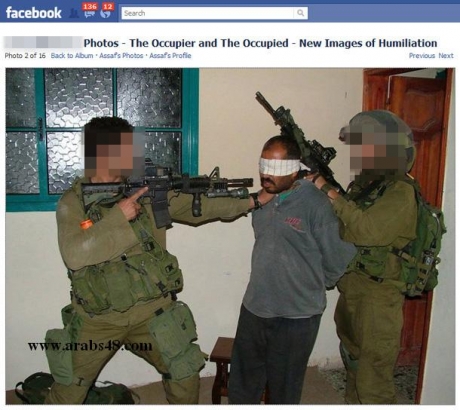
Other images show soldiers smiling and posing inside what appears to be Palestinian homes and in one picture a woman in a headscarf is cooking at a stove.

Yehuda Shaul, a founding member of Breaking the Silence, said the group has received dozens of similar pictures that point to a widespread phenomenon.
“It’s the norm in the Israeli military and it’s a direct consequence of being in a place where you control and rule civilians on a daily basis,” he said.
“You become corrupt, and you are not able any more to see them as human beings like you,” he added.

Blindfolded and bound Palestinian girl on her knees with four Israeli soldiers pointing their guns and laughing provocatively

The Israeli military would not immediately comment on the photos.
The Israeli military launched a deadly assault on the beleaguered Gaza Strip at the turn of 2009, killing at least 1,400 Palestinians, most of them women and children.
Photos – IMEMC
Related articles
- Israeli admits shooting at Palestinian children on TV game show (alethonews.wordpress.com)
- Pathetic Israeli Soldiers Firing indiscriminately at Palestinian Farmers South of Gaza (uprootedpalestinians.wordpress.com)
Walter Russell Mead’s Faulty Logic: Israel policy is broadly rooted in the will of the American people
Daniel Luban | Lobe Log | October 20, 2010
Walter Russell Mead has a new piece in which he reiterates the argument that he’s been making for some time: namely, that U.S. policy towards Israel is not the product of special interests or lobbies, and in fact has little to do with the political views of American Jews at all. Rather, argues Mead, the U.S.’s deference to Israel is simply an expression of the views of the U.S. Christian majority. The upshot — although Mead is understandably hesitant to say so explicitly — seems to be that there’s no point attempting to change U.S. policy towards Israel, since this policy is broadly rooted in the will of the American people. I’ve already suggested some of my problems with Mead’s thesis, but it’s worth spelling out more fully just where Mead goes wrong.
To begin with, his entire argument is built around a strawman. He attributes to AIPAC’s critics the view that “the Jews” control U.S. foreign policy, calling such critics “theorists of occult Jewish power” who spin conspiracy theories about the “allegedly awesome mindbending power of Jews in the media and the allegedly irresistible power of Jewish money.” He then goes on to note, quite rightly, both that the Israel lobby relies heavily on Christians (particularly evangelical Christian Zionists) and that the views of AIPAC and other lobby organizations skew well to the right of U.S. Jews as a whole.
The problem is that no mainstream critics of the lobby (and certainly not John Mearsheimer and Stephen Walt, who are clearly the implicit if unmentioned targets here) ever claimed that the lobby was synonymous with “the Jews”. This latter notion was primarily attributed to them by attackers who were eager to conflate such criticism with the language of traditional anti-Semitism. But on the contrary, most critics of the lobby have always been explicit both about the role of Christian Zionists and about the dovish views of American Jews. In fact, these have been among the chief complaints about the lobby: that it relies on large numbers of people who espouse a messianic Greater Israel ideology that is certain to end in disaster, and that organizations like the Conference of Presidents and the ADL skew far to the right of the Jewish community that they claim to represent. Thus Mead’s strategy is to attribute to the lobby’s critics a view that few if any of them have ever espoused, to use this nonexistent view as evidence for their basic anti-Semitism, and then to patronizingly lecture them in support of precisely the view that they actually hold.
As noted, Mead is surely correct to note that U.S. policy toward Israel does not reflect the views of the American Jewish community as a whole. However, he then goes to the opposite extreme by denying that Jews have anything to do with the power of AIPAC and the lobby. He notes that Jews make up only a small part of the electorate and that polls show broadly positive attitudes toward Israel on the part of the U.S. Christian population; for him, this demonstrates that Christian support is the key factor (indeed, virtually the only one) accounting for U.S. deference to Israel. However, this argument has several major flaws.
First, it rests on a rather naive and uncritical view of how policy is made, as if U.S. foreign policy simply flowed unproblematically from the Will Of The American People. If this were actually the case, of course, our foreign policy would look very different (we wouldn’t be in Afghanistan, to take one obvious example). But this suggests that simply to point at poll findings as a sufficient explanation for U.S. policy is inadequate, and I doubt if Mead would resort to such a simplistic explanation to explain our policy towards any country other than Israel.
Second, it rests on a similarly naive and blinkered role of political power. Mead’s entire argument for the claim that Jewish power is irrelevant to the lobby is that “[l]ess than two percent of the US population is Jewish, and Jews aren’t exactly swing voters.” Again, Mead is surely too smart to sincerely believe that political power is purely synonymous with the number of votes that a group commands. I realize that discussions of Jewish money or Jewish media influence conjure up all sorts of unsavory associations, but it is simply impossible to have a serious discussion of these issues if one does not recognize the basic fact that Jews punch above our weight in terms of political, intellectual, and financial influence. Contributions from Jews account for an enormous chunk of the donations received by the Democratic party (the exact number is difficult to ascertain), and incidents like last year’s Jane Harman scandal demonstrate the ways that this influence can be manifested in practice. Thus to simply write American Jewry out of the story when it comes to explaining the lobby’s success is fallacious; the highly mobilized hardliners within the Jewish community have been absolutely critical to this success.
Third, it rests on a simplistic and misleading reading of history. The allegedly deep, abiding, and everlasting love of the American people for Israel turns out on closer inspection to be far less than meets the eye. I suspect that most American Jews whose memories extend farther back than about 1950 would take issue with the notion that American culture is based around some inherent and eternal affection for Jews. Similarly, the attempt to portray some sort of proto-Zionism as a major force in American political culture “dating back to colonial times” requires a willful cherry-picking of the historical record. (A few months ago, Phil Weiss wrote a revealing investigation of Michael Oren’s attempts to portray Abraham Lincoln as a Zionist; following Oren’s footnote trail, Weiss found that the original sources suggest no such thing. It’s just one anecdote, but a revealing and perhaps symptomatic one.)
Mead writes that during the Cold War, “Americans gradually got into the habit of considering Israel one of our most valuable and reliable allies”. This formulation appears to be a euphemistic way of dealing with the fact that there is little evidence of Americans clamoring for an alliance with Israel prior to the 1967 war. In fact, strong support for Israel in the U.S. among Jews and non-Jews alike only came about post-1967, once the U.S. had already formed its strategic alliance with Israel. Far from the U.S.-Israel alliance springing from overwhelming popular sentiment, it would be more accurate (although still a bit simplistic) to argue on the contrary that the popular sentiment sprang out of the alliance.
Fourth, Mead’s argument overstates the importance of poll results. As I’ve written elsewhere, the fact that a majority of Americans claim to have “positive feelings” about Israel or to “support” Israel tells us very little about whether this support will manifest itself in any concrete action.
Thus Mead cites a poll finding that “53% of voters were more likely to vote for a candidate who was ‘pro-Israel’.” We should note, first, that this number is actually surprisingly low. Considering how broad the term “pro-Israel” is, it’s revealing that barely over half the voting population even considers “pro-Israel” views as a selling point in a candidate at all. But we should also note that this number tells us virtually nothing about how voters will actually behave. It suggests that a bare majority would prefer a candidate who is in some sense “pro-Israel,” all else being equal — but it says nothing about whether “pro-Israel” views are actually important enough for voters to prioritize them over other interests.
Finally, it’s worth noting that even if American public support for Israel were as overwhelming as Mead claims, this still would not by itself explain the extreme deference shown by the U.S. to its client even when Israel does things that cut against U.S. interests. To take a counterexample, think of the U.S. relationship with Britain in the 1950s. This was the very height of the Cold War special relationship; the two countries had shed enormous amounts of blood fighting alongside one another in two world wars, and the American public showed a level of goodwill toward the British that dwarfed that which they now show to Israel. (Even as late as 1997, a Harris poll showed that 63% of Americans considered the U.K. a “close ally,” compared with only 29% who felt the same about Israel.)
Yet this high level of public support for the special relationship did not prevent the U.S. from acting against the U.K. (not to mention Israel) during the 1956 Suez Crisis, when it felt that the U.K. was acting against its interests. This is one clear indication of how misleading it is to try to deduce U.S. foreign policy directly from broad indications of goodwill found in polling data. And it is a refutation of the claim that U.S. deference to Israel simply reflects standard practice between allies. Can anyone claim that a U.S. president would have the political fortitude to stand down Israel today the way that Eisenhower stood down the U.K. in 1956? The performance we’ve seen so far from the Obama administration indicates how far-fetched such a possibility is.
As I suggested at the beginning, the upshot of Mead’s piece is that critics of U.S. policy toward Israel/Palestine are wasting their time trying to change it, since the American people’s deep-seated love for Israel makes this policy inevitable. We have seen the ways in which this argument fails to hold water. Yet I suspect that Mead’s real belief is not that changing our policies toward Israel/Palestine would be impossible, but that it would be undesirable; I suspect, in other words, that his arguments about U.S. public opinion are ultimately rooted in his own support for a continuation of the status quo. And I suspect, finally, that it is precisely the difficulty of making a tenable argument in support of this status quo that has caused him to fall back on the pose of the disinterested observer, and to rely on these fallacious arguments about the status quo’s inevitability.
Israeli police look to settlers to fill ranks
First army, now police set for takeover
By Jonathan Cook | October 18, 2010
As US-sponsored peace talks have stalled over the issue of settlements, Israel’s national police force has revealed that it is turning to the very same illegal communities in its first-ever drive to recruit officers from among the settlers.
The special officer training course, which is chiefly aimed at discharged combat soldiers, includes seven months of religious studies in an extremist West Bank settlement.
The programme has provoked widespread concern among Israel’s 1.3 million Palestinian citizens, a fifth of the population.
“The police have already repeatedly demonstrated their hostility to Palestinian citizens, but this move proves that the authorities want to extend and deepen our oppression,” said Jafar Farah, the director of Mossawa, an advocacy centre for the Palestinian minority.
“Is it really credible that these religious extremists who have been educated to hate Palestinians in the West Bank are going to behave differently when they police our communities inside Israel?”
The first 35 cadets in the officer-training programme – known as “Believe in the police” – are to start their studies next month. More than 300 settlers are reported to have expressed an interest in the course so far.
The police command is said to have taken up the idea, originally proposed by right-wing groups, in the hope of reversing years of declining recruitment levels that have led to a national shortage of officers.
Cadets will study for three and a half years, mostly at Haifa University in Israel, at the end of which they will be awarded a degree and the rank of officer.
But their studies also include seven months in a religious seminary in a small extremist settlement, Elisha, deep in the West Bank. Although all the settlements are illegal under international law, Elisha is one of dozens of wildcat settlements also illegal under Israeli law.
Gershom Gorenberg, an expert on the religious settlers, said Israel’s “future police commanders” would graduate from the course after an early lesson in law-breaking.
Yonatan Chetboun, the head of the Raananim movement, a right-wing group overseeing the programme, described to Olam Katan, a newspaper popular with the religious community, one way the organizers might win over settlers to a career in the police.
He said taking potential recruits on night-time patrols of Ramle and Lod – Israeli towns notorious for containing deprived, crime-ridden Palestinian neighbourhoods – would quickly open their eyes to one of “the most meaningful national issues”.
The police spokesman was not available for comment.
A team of rabbis has been appointed to resolve potential conflicts between the settlers’ religious principles and their police duties, which could involve desecrating the sabbath and dealing with “immodest” women.
A right-wing settler activist, Hor Nizri, who has clashed with the police in the past over the evacuation of settlements, has been put in charge of recruiting young settlers.
He told the Yedioth Aharonoth newspaper that the programme was “a historic reconciliation”, adding: “We want to fill the ranks of the police as we fill the ranks of the army.”
His comments have sparked concern among Palestinian groups inside Israel that the programme is the first phase of an attempted settler “takeover” of the police, replicating their growing dominance of sections of the army.
The first official figures on the number of settlers in the Israeli military, released last month, show their massive over-representation in combat units. About a third of all officers in such units were settlers, up from only 2.5 per cent in 1990.
The police hope that a career in the force will be attractive to many of the settlers after they are discharged.
However, Mr Farah said there was plenty of evidence that religious settlers were becoming ever more extreme in their hostility towards Palestinians. He pointed to the growing influence of extremist rabbis in promoting anti-Palestinian views.
Over the summer, two prominent rabbis from the settlement of Yitzhar, near Nablus, were questioned on suspicion of incitement after publishing a book, The King’s Torah, in which they sanctioned the killing of non-Jews, including children. In one passage, the authors write: “There is justification for killing babies if it is clear that they will grow up to harm us.”
The book has been endorsed by a number of senior rabbis in the settlements.
Similar sentiments have been gaining a foothold among army rabbis.
Early last year, in the immediate wake of Israel’s three-week operation in Gaza, it was revealed that the army rabbinate had handed out a booklet to combat soldiers about to enter Gaza calling their attack “a war on murderers” and warning them against “surrendering a single millimetre” of territory.
Some 1,400 Palestinians were killed in the attack, including hundreds of women and children.
The Palestinian minority’s relations with the police are already marked by deep distrust, following the killing of 13 unarmed demonstrators and the wounding of hundreds more in 2000, at the start of the second intifada.
A subsequent state commission of inquiry accused the police command of viewing the minority as “an enemy”.
Mr Farah also pointed to the unexplained deaths of 36 Palestinian citizens by the police over the past decade. In only two cases have police officers been convicted.
Some Israeli observers have expressed concern that the settlers’ greater influence on the police could also make implementing the dismantlement of West Bank settlements much harder in any future peace deal.
Mr Gorenberg said previous evacuations, including the 2005 withdrawal from Gaza, had been handled chiefly by the police because so many army units were dominated by settlers. The police, he added, “could acquire the same weakness”.
A version of this article originally appeared in The National, published in Abu Dhabi.
Featured Video

Thomas Fazi: NATO’s Hybrid Warfare – Deception & Permanent War
or go to
Aletho News Archives – Video-Images
Book Review
UAE tortured, killed journalist for opposing Israel normalization
The Cradle | October 31, 2026
UAE security officers detained, tortured, and killed Emirati poet and news editor Habib al-Sayegh in August 2019, shortly after he published a column opposing UAE normalization with Israel, according to a newly published book.
“Princes and Thieves,” a book by investigative journalist Matthew Cole published on 25 October, alleges that UAE security officers raided Sayegh’s Abu Dhabi home shortly after the publication of the column, hooded him in front of his wife and took him to a detention facility where he was tortured to death.
His interrogators reportedly pulled out several of his teeth with pliers and beat him repeatedly with a sharp metal object.
On 11 August 2019, Sayegh criticized the UAE’s plan to normalize relations with Israel as part of the Abraham Accords in his weekly column for Khaleej newspaper. The column was titled “Israel Is Our Real Enemy and A Dangerous Project.”
Sayegh described Israel as “a real and natural enemy” while questioning “who authorized the normalizers to speak on behalf of everyone?”
Nine days after the column was published, Emirati state media announced his death, without stating a cause. … continue
Blog Roll
 Aletho News
- ‘The Arab Vote’: How Israeli Racism Has Ruined Their Elections
- Israel forces Palestinians in Gaza to choose between assassination alone or death with their families: Report
- US Approves Sale of 500 Patriot Missiles to Ukraine, Deliveries May Take Years
- German Imperialism: An Urgent Explainer
- Backed by AAP, West Virginia Proposal Would Allow Dental Hygienists to Give HPV Vaccine to 9-Year-Olds
- Poland Is the Symptom and Europe Is the Patient
- UAE security forces tortured, killed journalist for opposing Israel normalization: Report
- They Compared the Spice to the Drug. The Spice Won — Again. (Part 2)
- Thomas Fazi: NATO’s Hybrid Warfare – Deception & Permanent War
- Wrong, AP and NPR: Europe’s 50,000 Heat Deaths Are a Computer-Model Estimate, Not a Real Body Count
- If Americans Knew
- An error has occurred; the feed is probably down. Try again later.
- No Tricks Zone
- Germany’s Green Energy Transition Becoming Increasingly Expensive…Another 6 Trillion Euros!
- Sudden Stratospheric Warming, Powerful El Niño Combination May Lead To Extreme Europe Cold, Energy Crisis!
- Two New Studies Find Thwaites Glacier Melt Cannot Be Driven By Human Activity Or A Warming Ocean
- E-Cars Reduce CO2 Emissions By Only 41% Compared To Internal Combustion Engine Vehicles
- Predictions Made By Renowned Climate Professor Over Past Decades Have Been Proven To Be Poor
- New Study Suggests Large Regions Of The Pacific Ocean Have Been Cooling For The Last 80 Years
- Germany’s Green Energy Debacle: High Energy Costs Force Kahla Porzellan to Close After 182 Years!
- New Study: 50 Years Of The Most Aggressive ‘Net Zero’ Policies Can Only Affect The Global Climate By 0.03°C
- US September “Heat” Was No Record…Many Records Set Decades Ago
- Latest European Green Energy Debacle; Portugal’s Largest Flagship Solar Park Insolvent!

