Updating Japan’s Nuclear Disaster
By Stephen Lendman | March 27, 2011
Japan’s March 11 earthquake/tsunami-caused nuclear disaster affects millions of people regionally and throughout the Northern Hemisphere. But you’d never know it from most major media reports, downplaying an unfolding catastrophe.
In fact, distinguished experts like Helen Caldicott long ago warned of inevitable nuclear disasters, especially in seismically active areas. On May 23, 2004, The Japan Times contributor Leuren Moret headlined, “Japan’s deadly game of nuclear roulette,” saying:
“Of all the places in all the world no one in their right mind would build scores of nuclear power plants, Japan would be pretty near the top of the list.”
“Japan sits on top of four tectonic plates….and is one of the most tectonically active regions of the world. (There) is almost no geologic setting in the world more dangerous for nuclear power than Japan.”
In 2004, Kobe University Seismologist/Professor Katsuhiko Ishibashi called the situation then “very scary. It’s like a kamikaze terrorist wrapped in bombs just waiting to explode.”
American cities like New York have no credible evacuation plans in case of nuclear disasters. Neither does Japan, its Fukushima response a clear example. In fact, however, there’s no adequate plan possible in cases of catastrophic nuclear events. How and to where do you transfer millions of people. Abandoning the technology alone can work, a possibility not considered, at least not so far.
Japanese nuclear engineer Yoichi Kikuchi told Moret about serious longstanding safety problems at Japanese nuclear facilities, including cooling system cracks in pipes from reactor vibrations. Operators are thus “gambling in a dangerous game to increase profits and decrease government oversight,” he said.
Former GE senior field engineer Kei Sugaoka agreed, saying:
“The scariest thing, on top of all the other problems, is that all the nuclear power plants are aging, causing a deterioration of piping and joints which are always exposed to strong radiation and heat.”
As a result, Moret, like Caldicott, said:
“It is not a question of whether or not a nuclear disaster will occur in Japan (or most anywhere); it is a question of when it will occur,” and if catastrophic enough, perhaps nothing can be done to contain it.
Moreover, all radiation, especially large amounts, is harmful, cumulative, permanent and unforgiving. Yet lunatic fringe, self-styled “nuclear experts” like Ann Coulter told Fox News host Bill O’Reilly that a “growing body of evidence (shows radiation) is actually good for you and reduces cases of cancer.” Even O’Reilly reacted skeptically to the “hormesis” notion. Wikipedia calls it:
“the term for generally-favorable biological responses to low exposures to toxins and other stressors,” including radiation.
Other toxins aside, no amount of radiation is safe. In her book “Nuclear Madness,” Helen Caldicott explained:
“Lower doses of radiation can cause abnormalities of the immune system and can also cause leukemia five to ten years after exposure; (other) cancer(s), twelve to sixty years later; and genetic diseases and congenital anomalies in future generations.”
“Nuclear radiation is forever,” she added. It doesn’t dissipate or disappear. Jeff Patterson, former Physicians for Social Responsibility president said, “There is no safe level of radionuclide exposure, whether from food, water or other sources. Period.” In 1953, Nobel laureate George Wald agreed saying “no amount of radiation is safe. Every dose is an overdose.”
On March 19, Ralph Nader’s “Nuclear Nightmare” article said:
“Over 40 years ago….the Atomic Energy Commission (now the Nuclear Regulatory Commission) estimated that a full nuclear meltdown could contaminate an area ‘the size of Pennsylvania’ and cause massive casualties.”
In square miles, Pennsylvania is one-third the size of Japan. Nader said that “people in northern Japan may lose their land, homes, relatives, and friends as a result of a dangerous technology designed simply to boil water.”
On March 25, New York Times writers Hiroko Tabuchi, Keith Bradsher and David Jolly headlined, “Japan Encourages a Wider Evacuation from Reactor Area,” saying:
“New signs emerged Friday that parts of the crippled Fukushima Daiichi nuclear plant were so damaged and contaminated that it would be even harder to bring the plant under control soon.”
Japan’s Nuclear and Industrial Safety Agency (NISA) measured seawater showing “the level of iodine-131 at 50 becquerels per cubic centimeter – 1,250 times the legal limit.”
Moreover, several workers were contaminated by water measuring 10,000 times above normal, according to the National Institute of Radiological Sciences. In addition, a senior nuclear executive said “a long vertical crack” running down the side of the reactor vessel (expected to enlarge) was detected “leaking fluids and gases.” The Times said, “There is a definite crack in the vessel – it’s up and down and it’s large. The problem with cracks is they do not get smaller.”
In addition, contamination is spreading, now affecting Tokyo water with elevated radioactive iodine levels, an alert saying don’t let infants drink it. Milk, vegetables, fruits, and likely all crops in northern Japan are affected. Further, on March 25, the Asahi Shimbun newspaper said:
“Iodine-131 detected in Tokyo hit 12,000 becquerels, compared with the previous day, a tenfold increase in both radioactive iodine and cesium.” In addition, “Hitachinaka City, Ibaraki Prefecture, saw the highest radioactive values recorded, with 12,000 becquerels of cesium, iodine and 85,000 becquerels.”
On March 25, the Takoma Park, MD-based Institute for Energy and Environmental Research (IEER) said:
“Radioactive iodine releases from Japan’s Fukushima Daiichi reactors may exceed those of Three Mile Island by over 100,000 times….While Chernobyl had one source of radioactivity, its reactor, there are seven leaking radiation sources at the Japanese site. Together, the three damaged reactors and four spent fuel pools at Fukushima Daiicho contain (much) more long-lived radioactivity, notably cesium-137, than the Chernobyl reactor.”
Its half life is about 30 years. According to IEER president Arjun Makhijani, “This accident has long since passed the level of Three Mile Island.” Already, large parts of Honshu, Japan’s main island, have been affected. Even so, Japanese authorities haven’t been forthcoming about actual radiation releases that independent experts believe are extremely high and dangerous.
On March 26, government officials said predictions on when Fukushima could be stabilized aren’t known, spokesman Yukio Edano saying “this is not the stage for predictions.” According to IAEA head Yukiya Amano, “(t)his is a very serious accident by all standards, and it is not yet over.” Ending it “will take quite a long time.”
So far efforts to stabilize the damaged reactors haven’t succeeded. On March 24, Natural News.com writer Mike Adams headlined, “Radioactive fallout from Fukushima approaching same levels as Chernobyl,” saying:
“The radioactive (iodine-131) fallout is now as much as 73 percent of the daily radiation emitted from Chernobyl following its meltdown disaster.” For cesium-137, it’s 60%.
Monitoring in Hawaii, Alaska, California, Montreal and other cities are registering Fukushima fallout. Yellow rain in Japan was reported, much like what happened after Chernobyl. Whether it’s entirely radioactive isn’t known. Contamination, however, is spreading, yet “the nuclear industry says stop worrying….it’s all safe!”
On March 25, Natural News.com writer Ethan Huff headlined, “Ominous smoke plumes, contaminated water and food, but everything is just fine in Japan, suggest authorities,” saying:
“….black smoke….was seen billowing from Reactor 3, (containing) highly dangerous MOX plutonium fuel,” prompting an “evacuation at all four reactors.” No explanation was given.
In addition, Kyodo News said “mysterious neutron beams (were seen) coming from the plant 13 times since” the earthquake/tsunami, suggesting uranium and plutonium releases from damaged reactors and fuel rods.
Interviewed on March 17, nuclear expert Hirose Takashi doubts water sprayed on damaged reactors was effective, saying:
“If you want to cool a reactor down with water, you have to circulate the water inside and carry the heat away, otherwise it has no meaning. So the only solution is to reconnect the electricity. Otherwise, it’s like pouring water on lava.”
Moreover, by using salt water “(y)ou get salt. The salt will get into all these valves and cause them to freeze. They won’t move. This will be happening everywhere. So I can’t believe that it’s just a simple matter of reconnecting the electricity and the water will begin to circulate….I can’t understand it….Now it’s a complete mess inside….I’m speaking of the worst case, but the probability is not low….Only in Japan it is being hidden.”
“I hate to say it, but I am pessimistic….We have to think of all six (reactors) going down, and the possibility of that happening is not low.”
On March 26, Reuters headlined, “Radiation spikes in seawater by stricken Japanese plant,” saying:
“Radioactivity levels are soaring in seawater near (Fukushima), Japan’s nuclear safety agency said on Saturday….” On March 25, tests showed they spiked to 1,250 times normal. NISA official Hidehiko Nishiyama criticized Tokyo Electric (TEPCO) for not following safety procedures inside the turbine building. Throughout the crisis, TEPCO hasn’t given accurate information on the disaster’s severity, downplaying it instead.
As a result, independent experts express grave concerns that conditions are much worse than reported. They also believe it will take months perhaps to contain Fukusima. In the meantime, radiation keeps leaking and spreading, but it will be years before the real toll is known. Downplaying its gravity is scandalous.
~
Stephen Lendman lives in Chicago and can be reached at lendmanstephen@sbcglobal.net. Also visit his blog site at sjlendman.blogspot.com
Israel destroys ancient wells near Bethlehem
Ma’an – 27/03/2011
BETHLEHEM — Israeli authorities destroyed ancient water wells and natural reservoirs used by Bedouins southeast of Bethlehem, Palestinian officials said.
A 3,000-cubic-meter well owned by Ali Madghan Rashayida and a 225-cubic meter reservoir belonging to Majid Rashayida were demolished last week, in a move Palestinian Authority officials said was illegal and “an obvious assault by the Israeli occupation.”
International and local human rights groups had been working with PA officials to help the Rashayida Bedouins rehabilitate the area, and use natural caves to collect water for domestic use and for their sheep.
Bringing water tankers to the area had been very costly, and beyond the means of the community.
By demolishing the structures, Israeli authorities deprived the community of the right to file a legal appeal, officials added, noting that the time limit given in the demolition warrants had not yet passed.
Residents of Arab Ar-Rashayida were handed demolition orders for the tents and wells in their enclave of the village during the week of 13 March.
Ali Auda, the head of the family, said if the orders were carried out in full, the family — 50 members in all — would have nowhere else to go.
“It is the farce of the twenty-first century, imagine, an occupying state telling Palestinians they are violating their own land.”
The partial demolition of the community will have an equally devastating effect, officials said, explaining that the Bedouin would not have sufficient water for themselves or their livestock, and would be at high risk during summer months in the desert area.
The UN has noted a sharp increase in Israel’s demolitions of Palestinian structures in the West Bank in 2011.
“Although the Israeli authorities maintain that these demolitions are carried out due to the lack of Israeli-issued permits, the highly restrictive and often discriminatory nature of the planning regime implemented by the same authorities rarely grants Palestinians such permits in Area C, leaving them with no choice but to build ‘illegally,’ or to leave the area,” the agency said February in its monthly report.
“It is difficult to understand the reasoning behind the destruction of basic rain water collection systems, some of them very old, which serve marginalised rural and herder Palestinian communities where water is already scarce and where drought is an ever-present threat,” said Maxwell Gaylard, who heads OCHA in the Palestinian territories.
Gaylard noted that the demolitions were illegal under international law, which prohibits an occupying power from destroying property belonging to individuals or communities except when absolutely required by military operations.
Following Israel’s confiscation of nine water tankers from a community in Khirbet Tana, in Nablus, on March 7, Gaylard said, “if the authorities ultimately responsible for these demolitions could see the devastating impact on vulnerable Palestinian communities, they might reflect upon the inhumanity of their actions.”
Fukushima troubles affecting other nuclear plants
NHK World | March 26, 2011
Japanese electric power companies that operate nuclear power plants are facing difficulty in either restarting nuclear reactors in their checkups or transporting nuclear fuel to the power plants.
Municipal governments that host nuclear power plants are urging plant operators to freeze expansion projects and to review safety measures.
Hokuriku Electric Power Company has indicated that the firm has difficulty in rebooting two reactors at its Shika plant in Ishikawa Prefecture without the understanding of the prefectural government and residents. The reactors were taken out of operation for either mechanical trouble or regular inspection.
In western Japan, Kansai Electric Power Company has decided to postpone transporting nuclear fuel to one reactor at its Takahama plant in Fukui Prefecture from France.
The company cites difficulty in ensuring the fuel’s safe delivery because the government is busy handling the aftermath of the March 11th disasters and can’t provide the necessary safeguards for transport.
Kyushu Electric Power Company has delayed restarting its two reactors at the Genkai plant in Saga Prefecture.
Ichiki-Kushikino City in Kagoshima Prefecture, southwestern Japan, says it will ask Kyushu Electric to freeze planned construction of a new reactor at its Sendai plant until the safety of the plant is guaranteed. Most of the city is within 20 kilometers of the nuclear power plant in neighboring Sendai City.
Fukui Prefecture in central Japan has urged Japan Atomic Power Company, which runs Tsuruga Power Station, to do all it can to ensure safety of its plant.
The plant operator replied that it has just installed portable emergency power generators for its two reactors.
The company has also revealed new safety measures costing nearly 250 million dollars, including a plan to add pipes that supply water directly from a fire truck to one of its reactors and its spent fuel pool.
The reactor is a boiling-water type, the same as those at Tokyo Electric’s troubled Fukushima plant.
Israeli army destroys home in Jordan Valley
26 March 2011 | International Solidarity Movement

Settlers erect tent 10 metres from family
Yesterday afternoon the Israeli army destroyed the home of the Nabel Daraghmeh family who have been living in the Ein Al Hilwe region of the Jordan Valley for over 15 years. Three days previously, a group of armed illegal settlers descended in the middle of the night on the area where the family had their tent, setting up their own tent only metres away. In the following days the settlers intimidated and threatened the family of six, ordering them to move their home and leave the area. According to Jordan Valley Solidarity, the settlers threw rocks towards the family’s cattle pen, urinated outside their tent and water-tank, and made as much noise as possible, preventing the family from sleeping. They also put up a fence around the family’s tent and cattle pen preventing them from being able to bring their cattle in at night. The Daraghmeh family legally rent the land from the Lutheran Church, however the Israeli army ordered the family to dimantle and remove their home from the land, eventually destroying it themselves by force.

Settlers erect fence around family’s home
Ein Al Hilwe is located just below the illegal settlement of Maskiot which houses 28 familes. In the past years the villagers of Ein Al Hilwe have suffered from ongoing attacks from the settlers. Five days ago settlers tied a rope around the neck of a young horse belonging to villagers and attached the rope to the back of their truck, lynching the horse in front of a group of children. Two weeks previously a woman from the village was also attacked whist attempting to take water from the well.
Iranian reporter forced out of France
Press TV – Mar 26, 2011
Iranian journalist Kamran Najafzadeh

An Iranian journalist has been forced to leave France due to restrictions imposed on him by the French government over his so-called “controversial” reports.
“After 18-month of journalistic activities, in a joint meeting of the French Interior and Foreign Ministry they came to the conclusion that ‘the IRIBNews reporter has crossed red lines and has stirred hatred in French public opinion,’” Kamran Najafzadeh said upon his arrival in Tehran on Saturday.
Commenting on restrictions imposed on him by the French administration, Najafzadeh said, “They told me you cannot go to the Elysee Palace… then they told me you are not allowed to go to the French parliament,” Fars News Agency reported.
“If I return to France, I will once again reports on the Louvre Museum and I will ask how they (the French) acquired these antiques? I will once again report on the Eurodif nuclear plant which 10 percent of its stocks belong to Iran and I will ask where Iran’s share is?”
Tehran holds a 10 percent stake in the Eurodif nuclear plant, which makes it entitled to some of the plant’s output. France’s largest provider of nuclear equipment and services AREVA, however, announced in 2009 that it had not delivered any enriched uranium to Iran.
Resistance factions do not call for war, Ashkenazi calls for shelling populated areas
Palestine Information Center – 26/03/2011
GAZA — The recent firing of mortar shells at Israeli targets by the armed wing of Hamas, the Qassam Brigades, was in retaliation to the escalating Israeli army crimes against the Palestinian people, Abu Obaida, the Brigades’ spokesman, said.
He added in an interview with the Panorama TV program on the Hiwar network Friday that there is a practical calm in Gaza, and the resistance factions only retaliate against Israeli attacks.
The spokesman stressed that resistance factions do not call for war and seek to spare the people its repercussions, charging Israel with starting the aggression.
Israel is trying to picture the resistance as the one starting violence and that its aggression was in retaliation, which is totally false and the vice versa is correct, Abu Obaida added.
He accused Israel of spreading rumors about resistance arming itself with advanced weaponry to the extent it said the resistance has acquired pilotless planes.
Israel is trying to drive a wedge among the Palestinians in a bid to weaken resistance, which is the factor uniting the Palestinian people, Abu Obaida said.
~
Ashkenazi calls for shelling populated areas to kill resistance fighters
Palestine Information Center – 26/03/2011

OCCUPIED JERUSALEM — Israel’s former chief of staff Gabi Ashkenazi has called for killing Palestinian resistance fighters in the Gaza Strip using all means even it entails shelling populated areas.
Speaking at a ceremony in Paris, Ashkenazi was quoted by the Hebrew radio on Friday as saying that the Israeli army should chase and liquidate Palestinian resistance fighters in Gaza at any price “even if they are present in civilian areas”.
Shifting to Iran, the former chief of staff opined that Iran should be blocked from attaining nuclear weapons. He added that no option should be ruled out in this attempt.
~
Israel deploys air defense system ‘Iron Dome’ near Gaza
Palestine Information Center – 26/03/2011
OCCUPIED JERUSALEM — The Israeli army is to deploy the mobile air defense system the “Iron Dome” in areas adjacent to the Gaza Strip on Sunday, a Hebrew press report said.
Yediot Ahronot said the deployment of the system to start on Sunday was in anticipation of further deterioration of the conditions on the “Gaza front” as calls are escalating for launching a large scale offensive against the besieged coastal enclave.
Two of the Iron Dome’s systems would be initially deployed, the paper said, noting that it would not be practically operational for months.
However, heads of local councils surrounding Gaza doubted the Iron Dome’s ability to ward off the danger of rockets fired from the Strip as it would not cover all those areas in the first stage.
The army announced that the Iron Dome, which is designed to intercept very short-range rockets up to 70 kilometers in all-weather situations, would not be able to cover and protect all settlements surrounding the Strip.
~
Israeli artillery shell blasts factory in Gaza
Palestine Information Center – 26/03/2011

GAZA — Artillery shelling by the Israeli occupation forces (IOF) at dawn Saturday started a huge fire in a soft drinks factory in the Gaza Strip and inflicted major damage to the facility.
The PIC reporter said that an artillery shell slammed into Al-Sattar factory east of Zaitun suburb in Gaza city causing a big explosion in the petrol tanks inside the factory.
He said that fire fighters controlled the resultant massive fire after two hours, adding that civil defense squads participated in the effort.
Over 400,000 join London anti-cuts march
Press TV – March 26, 2011
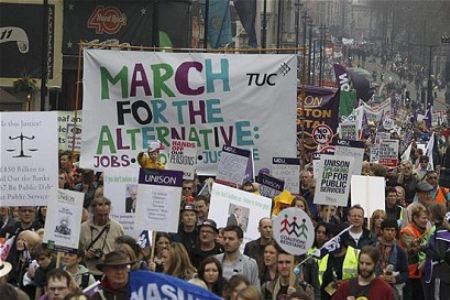
Hundreds of thousands of British opposed to the coalition government’s budget cuts are marching in London streets, chanting for an alternative to the government’s austerity cuts.
Tens of thousands of teachers, council staff, nurses, students, National Health Service (NHS) officials and many others who are angry at the public cut plans, mounting rates of unemployment, tax rises, pay cuts and pension reforms are partaking in the demonstration.
About 800 coaches were planned to get people from across the country to London to participate in the rally, which is considered the biggest public reaction against the government’s spending cuts since it took office in May 2010 following the general elections. The protesters began marching from Victoria Embankment to Hyde Park.
Hundreds of people from North East traveled to London on Saturday morning to join the London protest. Demonstrators from Aberystwyth to Aberdeen and from Penzance to Perth also arrived in London to denounce the spending cuts along with the Londoners.
British Education Secretary Michael Gove claimed that he could understand people’s anger, but “the difficulty that we have as the government inheriting a terrible economic mess is that we have to take steps to bring the public finances back into balance.”
Unite union’s General Secretary Len McCluskey said the coalition government has exaggerated about the level of the deficit.
Describing his economic plan, McCluskey said, “Our alternative is to concentrate on economic growth through tax fairness so, for example, if the government was brave enough, it would tackle the tax avoidance that robs the British taxpayer of a minimum of £25bn a year.”
Around 100 legal observers are monitoring the policing of the protest, and there are more representatives from other human rights groups on hand to offer advice to demonstrators.
Syrian Opposition is a conglomeration of Western-backed “human rights activists”
By Tony Cartalucci – BLN – March 25, 2011

The Syrian revolution uses a strikingly familiar logo. The Otpor fist was originally used in Serbia in 2000, and handed off to the various movements trained by the US funded CANVAS organization, including the Tunisian & Egyptian youth movements- now the Syrian Youth Revolution.
“A prominent Syrian opposition figure says the country is “a bomb, ready to explode” as protesters demand freedom and an end to president Bashar al-Assad’s “cancerous regime,” reports Australia’s ABC News. This prominent Syrian opposition figure is “human rights activist” Haitham Maleh, of the Human Rights Association of Syria, recently released from a Syrian prison.
Haitham Maleh, and Muhannad al-Hassani, another activist whose plight is being used to stir up unrest, both received “pro-bono” legal services from the CFR stacked “Freedom Now” organization. Freedom Now receives funding from the Moriah Fund, the Lantos Foundation which includes Israeli President Shimon Peres as an “adviser,” Real Networks Foundation (which also funds Democracy Now) and the Charles Bronfman Prize which proclaims on its website “Jewish Values. Global Impact.” Freedom Now also receives “pro-bono” legal support from the Pillsbury law firm, a CFR corporate member.
Freedom Now specializes in “political prisoners” from various regions around the world that attract the attention of globalist ambitions. Leveraging these “human rights abuses” affords the globalists a perceived moral high ground from which they can exert pressure on target nations. This is very similar to the operation being run by Chatham House globalist Robert Amsterdam of Amsterdam & Peroff, who is defending western-backed Mikhail Khodorkovsky to ratchet up pressure on Russia, and Thaksin Shinawatra to exert pressure on Thailand.
Understanding who these “human rights activists” are, who is supporting them, and the role they play in the latest round of the Western-backed “Arab Spring,” we can better understand articles like the Jerusalem Post’s ‘More than 100 killed in Syrian anti-government rallies.’ In the very first paragraph, the article concedes that the reports were cited from human rights activists and witnesses, thus a continuation of the absurd, unsubstantiated reporting seen earlier in Libya where unverified reports by the criminally irresponsible corporate media laid the groundwork for an equally criminal military intervention.
It is important to remember that Syria was included under George Bush’s “Axis of Evil” and mentioned in a 2007 speech by US General Wesley Clark as slated for destabilization and regime change.
Other actors amongst the Syrian unrest to be wary of include the London-based Syrian Human-Rights Committee whose hearsay statements posted on its website are cited by corporate news media in outlandish reports of violence that also include “activists say” after each allegation.
The clownish London-based Syrian Human Rights Committee puts on a poorly staged demonstration outside the Syrian Embassy in England. As silly as the SHRC looks, a good majority of the information the mainstream media reports on from Syria comes from “human rights organizations” like this.
There is also Kamal Labwani, who in 2005 was arrested in Syria after returning from a trip to Europe and the United States where he met with government officials, journalists, and “human rights” groups in his effort to “change” the Syrian government. Amongst these officials Labwani consorted with was George Bush’s Deputy National Security Adviser J.D. Crouch.
Considering that the United States had openly declared Syria a rogue-state, and in a speech by John Bolton, was targeted by possible US military action, Syria’s accusations that Labwani was guilty of “communicating with a foreign country and inciting it to initiate aggression against Syria” doesn’t seem so far fetched. In most nations the punishment for treason is death, under Syria’s “cancerous regime” Labwani got 12 years.
Once again, we see an entire movement fomented and propelled by Western-backed opposition in tandem with the corporate owned media. This is all part of a now irrefutable larger plot consuming the Middle East and Northern Africa.
Just as we saw in Egypt and to a greater extent in Libya, the initial phases of unrest in Syria are marked by purposefully sloppy and confused reporting giving the destabilization efforts on the ground a chance to stampede the government from office. Should this stampeding fail, the truth will begin to trickle out, and the West’s involvement will become more overt.
Stoking the Fires of Islamophobia
By ISMAEL HOSSEIN-ZADEH | CounterPunch | March 25, 2011
The House Homeland Security Committee’s hearings on “Muslim radicalization,” which began on March 10 and expected to be held periodically for 18 months, are objectionable on a number of grounds.
To begin with, the hearings are championed and chaired by a politician, Congressman Peter King, who is known for his notoriously negative attitude toward Muslims. In an interview with Politico, for example, Mr. King argued that there are “too many mosques in this country. . . . There are too many people sympathetic to radical Islam. . . . We should be looking at them more carefully and finding out how we can infiltrate them.” In an earlier interview with radio and television host Sean Hanity, he had said that 85 percent of the mosques in this country are controlled by “extremist leadership,” a claim that has been roundly refuted by evidence:
“American Muslims recognize the validity of the democratic process and are eager to participate in it to shape the political environment in which they live. Recent surveys on political attitudes within the community have clearly indicated that American Muslims will participate quite vigorously in the coming presidential elections and will also engage the political process at multiple levels. For example, a recent study of Detroit Muslims showed that over 93% of those surveyed were determined to vote. A survey by the Washington DC based Council of American Islamic Relations (CAIR) found that 93% of its respondents were registered to vote; of them, 92% were determined to vote.”
Not surprisingly, King’s insistence that 85% of American mosques have “extremist leadership” has come under criticism by many law enforcement officials, counter-terrorism professionals, civil rights organizations, religious/interfaith leaders, editorial boards, the American Civil Liberties Union, and more.
Second, by focusing exclusively on Muslims, King and his cohorts close their eyes to the more numerous instances of violent acts committed by non-Muslims. Using the FBI statistics, Franklin Lamb points out that between 1980 and 2005 only six percent of terrorist incidents in the US were committed by Muslims while 94% were committed by non-Muslims. “The FBI claims that of the 83 terrorist attacks in the United States between 9/11 and the end of 2009, only three were clearly connected with the jihadist cause (3.6% of total).” Lamb further points out that “The picture is similar in Europe. Of a total of 1,571 terrorist attacks in the E.U. from 2006-2008 only 6 were committed by Islamist terrorists which translates to less than 0.4% of all attacks, which means 99.6% of all attacks were committed by non-Muslims.”
In light of this evidence, it is not surprising that a number of critics have characterized King’s hearings on the “Radicalization of Muslims” as witch hunting or McCarthyism, comparing them with earlier prejudices and persecutions of other ethnic and religious minorities such as Catholics, Jews, African Americans, Asian Americans, and others.
Third, and more importantly, the champions of Muslim hearings completely fail the elementary principle of any problem-solving endeavor: a sound diagnosis of the problem. They make no effort to shed light on the submerged factors or causes that may contribute to some Muslims’ suspicion of security forces, or some misguided acts of violent behavior. Instead, they (implicitly) attribute such suspicions or behaviors to their religion, or the “pathological problems of the Muslim mind.” Rather than asking “Why convulsive reactions of the disenfranchised Muslims (or other ethnic/religious minorities) sometimes take religious form,” they ask “What is in Islam that leads to such convulsive reactions?”
While extreme, King is unfortunately not alone in demonizing Islam and/or Muslims. His is simply a more blatant case of a broader narrative of Muslim-bashing. Mainstream media reports, editorials, political pundits, and talk shows tend to harp on the narrative—some directly, like Fox News, others in subtle ways—that the roots of “Muslim radicalization” must be sought in Islam itself, or in their “hatred of our way of life,” as President George W. Bush famously put it.
The pernicious view that “they hate our way of life” is essentially a popularized version of the so-called theory of “the clash of civilizations,” which was initially expounded by Samuel P Huntington in the early 1990s. Huntington sets out to identify “new sources” of international conflicts in the post–Cold War world. During the Cold War years, major international conflicts were explained by the “threat of communism” and the rivalry between the two competing world systems. In the post–Cold War era, however, argue Huntington and his co-thinkers, the sources of international rivalries and collisions have shifted to competing and incompatible civilizations, which have their primary roots in religion and/or culture. In other words, international conflicts erupt not because of imperialistic pursuits of economic advantage, territorial conquests, or geopolitical ambitions but because of “Muslim’s inability to change.”
A more insidious version of Huntington’s “clash of civilization” is Richard Perle’s strategy of “de-contextualization.” Perle, a leading neoconservative militarist (and a prominent advisor to Israel’s ultra-nationalist Likud Party) coined the term “de-contextualization” as a way to explain both the desperate acts of terrorism in general and the violent tactics of the Palestinian resistance to occupation in particular. He argued that in order to blunt the widespread global criticism of the Israeli treatment of Palestinians, their resistance to occupation must be de-contextualized; that is, we must stop trying to understand the territorial, geopolitical and historical reasons that some groups turn to terrorism. Instead, he suggested, the reasons for the violent reactions of such groups must be sought in the arenas of culture and/or religion.
Like Huntington’s “clash of civilizations” theory and Perle’s “de-contextualization” strategy, King’s “radicalization of Muslims” is part of a well-orchestrated effort to divert attention from the root causes of terrorism, and attribute it to “Islamic way of thinking.” There are both economics and political forces behind this insidious effort at demonization of Muslims.
Economic interests behind the effort are vested largely in the military-security industries that have mushroomed around Homeland Security. There is a whole host of security-based technology industries and related businesses that have rapidly spun around the Pentagon and the Homeland Security apparatus in order to cash in on the Pentagon’s and Homeland Security’s spending bonanza. For example, as William Hartung and Michelle Ciarrocca point out, “Air Structures is introducing fortified vinyl domes for quarantining infected communities in the aftermath of a potential bioterror attack, Visionics is looking into designing facial recognition technology, and PointSource Technologies is developing a sensor to detect biological agents in the air or water.”
Just as the notorious military-industrial complex is known for inventing external enemies in order to justify the continued escalation of the Pentagon budget, so does Homeland Security need enemies and “threats to national security” in order to justify both its parasitic role and its lion’s share of our tax dollars. In light of the fact that Homeland Security has become an effective money-making machine in the hands of some of the powerful technology corporations, it is no accident that King, one of the most Islamophobic members of Congress, is selected to chair the Homeland Security Committee of the House of Representatives.
The politics of the witch-hunting Muslim hearings are equally dubious. In his pursuit of higher office and re-election, King is known for groveling to the Christian Right and the Israeli lobby. His McCarthy-type hearings suit this nefarious purpose well. While monetary and military support for the colonial policies of the state of Israel is essential to garnering the electoral clout of the Jewish and Christian Zionism, demonization of Muslims is also viewed to be an added service to these powerful groups. Muslim-bashing has indeed become a major component of the support for Israel.
While an extreme case, King’s political strategy of pandering to special interests at the expense of social cohesion and long-term national interests is tragically not rare. It includes most American politicians. Indeed, the overwhelming majority of the members of the US Congress, as well as the President, routinely compete with each other in doing the bidding of the military-industrial-security-Israeli lobbies.
Bigotry, intolerance and xenophobia also play an important role in the demonization of Muslims. Not only is the anti-Muslim propaganda divisive and detrimental to social peace and stability, it is also disingenuous. I suspect that King and his Islamophobic cohorts are afraid not so much of the US “Muslim radicalization/terrorism,” or of the absurd view that “Muslims may establish the Sharia judicial system in America,” as they are of the Muslims’ steady advancements and achievements in all fields of the American socio-economic and political life—that is, of their gradually becoming part of the American mainstream.
Not only does the insidious view that Islam is “incompatible” with change and Western values tend to sow the seeds of ignorance, hatred and social tension, it also fails the test of history. The history of the relationship between the modern Western world and the Muslim world shows that, contrary to popular perceptions in the West, from the time of their initial contacts with the capitalist West more than two centuries ago until almost the final third of the twentieth century, the Muslim people were quite receptive of the socio-economic and political models of the modern world. Many people in the Muslim world, including the majority of their political leaders, were eager to transform and restructure their societies after the model of the capitalist West. The majority of political leaders, as well as a significant number of Islamic experts and intellectuals, viewed the rise of the modern West and its spread into their lands as inevitable historical developments that challenged them to chart their own programs of reform and development. John L. Esposito, one of the leading experts of Islamic studies in the United States, describes the early attitude of the political and economic policy makers of the Muslim world toward the modern world of the West:
“Both the indigenous elites, who guided government development programs in newly emerging Muslim states, and their foreign patrons and advisers were Western-oriented and Western-educated. All proceeded from a premise that equated modernization with Westernization. The clear goal and presupposition of development was that every day and in every way things should become more modern (i.e., Western and secular), from cities, buildings, bureaucracies, companies, and schools to politics and culture. While some warned of the need to be selective, the desired direction and pace of change were unmistakable. Even those Muslims who spoke of selective change did so within a context which called for the separation of religion from public life. Western analysts and Muslim experts alike tended to regard a Western-based process of modernization as necessary and inevitable” (The Islamic Threat: Myth or Reality? Oxford University Press, 1992, p. 9.)
In light of this background, the question arises: What changed that entire earlier receptive and respectful attitude toward the West to the current attitude of suspicion and disrespect?
The answer to this question rests more with the policies of the Western powers in Muslim lands than the alleged rigidity of Islam, or “the clash of civilizations.” It was only after more than a century and a half of imperialistic pursuits, and a series of humiliating policies in the region, that the popular masses of the Muslim world turned to religion as sources of defiance, mobilization, and self-respect. In other words, for many Muslims the recent turn to religion represents not so much a rejection of Western values and achievements as it is a way to resist or defy the oppressive policies and alliances of Western powers in the Muslim world.
Most of today’s regimes in the Muslim world such as those ruling in Pakistan, Saudi Arabia, Egypt (even after Mubarak), Jordan, Kuwait, and a number of smaller kingdoms in the Persian Gulf area are able to maintain their dictatorial rule not because their people want them to stay in power but because they are useful to some powerful interests abroad.
It is not surprising, then, that many people in these countries are increasingly asking: Why can’t we elect our own governments? Why can’t we have independent political parties? Why can’t we breathe, so to speak? Why are our governments so corrupt? Why are our people, especially Palestinians, treated like this? Why are we ruled by regimes we don’t like and don’t want, but cannot change? And why can’t we change them? Well, the majority of these countries’ citizens would answer, “Because certain powerful interests in the West, especially in the United States, need them and want them in power.”
Nor is it surprising that many people in the Muslim world, especially the frustrated youth, join the ranks of militant anti-U.S. forces and employ religion as a weapon of mobilization and defiance. Correlation between U.S. foreign policy and such reactions was unambiguously acknowledged by the members of the United States’ Defense Science Board, who wrote in a 1997 report to the Undersecretary of Defense for acquisition and science, “Historical data shows a strong correlation between U.S. involvement in international situations and an increase in terrorist attacks against the United States.”
~
Ismael Hossein-Zadeh, author of The Political Economy of U.S. Militarism (Palgrave-Macmillan 2007), teaches economics at Drake University, Des Moines, Iowa.
Featured Video

US JET SHOT DOWN OVER IRAN /Lt Col Daniel Davis & Nima Alkhorshid
or go to
Aletho News Archives – Video-Images
From the Archives
Experts Warned For Years That A War With Iran Would Happen This Way
By Caitlin Johnstone | April 3, 2026
… It’s so wild how we keep seeing reports that Iran’s retaliation caught the US off guard. For all the years I’ve been paying attention to this issue I’ve been reading experts and analysts saying if the US attacks Iran, Iran can close the Strait of Hormuz and strike US bases and the energy infrastructure of US allies in the region.
A few examples:
A 2006 Oxford Research Group paper titled “Iran: Consequences of a War” warned that Iran has numerous options at its disposal in the event of a US attack, and that the “most significant of these would be any possible retaliatory Iranian action to affect the transport of oil and liquefied natural gas through the Straits of Hormuz,” adding that stopping Iran from doing this “would be difficult if not impossible to achieve, leading to a fear of attack which alone would have a formidable impact on oil markets.”
A 2007 Cato Institute paper titled “The Iraq War and Iranian Power” warns that “Iran possesses the largest ballistic-missile inventory in the Persian Gulf — missiles which can reach Israel, Saudi Arabia and US military bases in Iraq,” and that “experts argue Iran could also use the ’oil weapon’: blocking the 34km-wide Strait of Hormuz and conducting submarine and anti-ship missile attacks against ports and oil facilities in Saudi Arabia, Kuwait and other Gulf Cooperation Council states.”
A 2012 NPR article titled “Can Iran Close The World’s Most Important Oil Route?” features then-chairman of the Joint Chiefs of Staff acknowledging that Iran absolutely can block the Strait of Hormuz, saying Tehran has “invested in capabilities” which specifically enable them to do so.
A paper from the Columbia Center on Global Energy Policy and the Center for a New American Security titled “IN DIRE STRAITS? IMPLICATIONS OF US-IRAN TENSIONS FOR THE GLOBAL OIL MARKET” warns of a potential scenario “that includes damage to Gulf oil infrastructure and a temporary closure of the Strait of Hormuz.”
These weren’t a bunch of keffiyeh-wearing peaceniks making these assessments, they were deeply entrenched swamp monsters entirely loyal to the US empire. They opposed war with Iran not because it would be an evil act of unforgivable mass murder, but because it would be bad for the imperial power structure. … Full article
Blog Roll
 Aletho News
- Al Mayadeen voices solidarity with Dr. Marandi amid death threats
- US dismantling international law in its war against Iran while claiming ‘false’ victory: Legal scholar
- One martyr, 5 injuries in US attack on Iraqi border crossing with Iran
- ‘This war is Israel’s war’: World facing ‘security breakdown’, says Qalibaf
- IRGC decries attack on US embassy in Riyadh, says executed by ‘Israel’
- Iran blasts EU hypocrisy as EU invokes international law over Hormuz
- There is no military solution to Strait of Hormuz
- NATO’s structural collapse – the outcome of deviation from reality
- Poll finds world views China better than US
- One Of America’s Leading Neo-Cons Has Turned Against The Iran War And Israel
- If Americans Knew
- US loses planes over Iran, Israel downgrades Lebanon war goals – Daily Update
- Israel Is Blocking Palestinians from Easter at Church Where Jesus Resurrected
- Plot to assassinate Palestinian activist follows harassment campaign promoted by Zionist groups and elected officials
- Prominent New York synagogue hosts presentation on why U.S. Jews should support the ethnic cleansing of Gaza
- Tapper vs. Piker: Is the CNN Anchor Auditioning for David Ellison?
- Shouldn’t Democrats Be Able to Condemn Genocide?
- Israel-US kill negotiators, destroy civilian structures, but Iran’s military capabilities still largely intact – Daily Update
- ‘War crime’: Global condemnation as Israeli ministers celebrate death penalty law targeting Palestinian prisoners
- 7 Ways Israel Is Turning Lebanon Into Gaza
- World’s Leading Football Bodies Under Fire Over Israel Policies
- No Tricks Zone
- An Inconvenient Tree: Uncovered In Alps… Europe Much Warmer Than Today 6000 Years Ago
- New Study Reports A 60% Slowdown In Greenland’s Ice Loss Rate In The Last Decade
- Low Intensity Tornado Wrecks Major Solar Farm, Creating A Potential Toxic Dump
- New Study Finds Warming Saves Lives…Cold Temperatures 12 Times More Deadly Than Excess Heat
- German Science Blog Accuses PIK Climate Institute Of Hallucinating Climate Tipping Points
- Devastating Assessment Of Comirnaty Vaccine By Former Senior Pfizer Europe Toxicologist
- New Study: CO2 Is ‘Effectively Negligible’ As An Explanatory Climate Change Factor Since 2000
- Former Pfizer Toxicologist Dr. Helmut Sterz Tells Bundestag Hearing Pfizer Vaccine Should Have Never Been Approved
- Energy Expert: Germany’s Nuclear Phaseout Was A “500 Billion Euro Mistake”
- New Research: South Australia’s Mid-Holocene Sea Surface Temperatures Were 4°C Warmer Than Today
 Aletho News