Mercosur suspends Paraguay from trade bloc over Lugo ouster
Press TV – June 29, 2012
South American foreign ministers have suspended Paraguay from the regional trade bloc, Mercosur, over last week’s ouster of former President Fernando Lugo.
However, the bloc stopped short of imposing economic sanctions on Paraguay, which is one of the four founding members of the Mercosur bloc, along with Brazil, Argentina and Uruguay.
Paraguay was banned from this week’s summit held in Mendoza, Argenita, as the regional leaders considered the removal of the country’s first left-wing president as a parliamentary coup.
“Through a unanimous decision by Mercosur’s permanent and associate members, it has been decided– because of the events that occurred last Friday– to suspend Paraguay’s participation in this presidential summit,” Argentine Foreign Minister Hector Timerman said on Friday at a news conference.
Last week Paraguay’s Senate removed Lugo from office after a five-hour impeachment trial. He was accused of mishandling an armed clash over a land dispute in which seven police officers and ten landless farmers were killed on June 15.
Lugo was immediately replaced by his pro-US deputy, Federico Franco. The move has prompted harsh criticism inside the country and among its neighboring nations.
South American officials said that the suspension of Paraguay will stand until “democracy is fully restored” to the country.
Bolivian President Evo Morales voiced his concerns over what happened in Paraguay, saying that his country will not “recognize a dictatorship in paraguay.”
Several South American nations have recalled their ambassadors from Paraguay’s capital Asuncion, permanently or for consultation, in a bid to show their opposition to the dismissal of a democratically elected president.
Related articles
- Paraguay faces expulsion from Mercosur/Unasur, economic isolation (alethonews.wordpress.com)
NO to War in Syria
By Mairead Maguire | June 29, 2012
People around the world are deeply concerned about the ongoing crisis in Syria.
While we are being presented with some perspective of what is occurring on the ground to the people of Syria, the door seems closed to others. We search for voices we can trust, voices which point to a peaceful, lasting solution to the conflict. We search for truth because it is truth which will set the Syrian people free. Truth is difficult to find, so through the haze of conflicting narratives we must inevitably hear the voices and wisdom of men and women of peace in Syria.
Many may believe that there is a fight going on in Syria for ‘democracy’ and ‘freedom’. We can be seduced into thinking there is a magic wand or instant formula to mix that will create a democratic country, but there are none. If it is a democracy a people want they must strive for it in their own way. It is said the Greek idea of democracy was that people would be equally valued. This is something every society has to strive for at every point in its history; it itself is a ‘revolutionary’ concept and a nonviolent revolutionary action. Strive to value everyone equally. It is an idea, a motivation for a better world that doesn’t require blood; it requires the hard work of people and the nurturing of a community spirit; a constant growing of peace and it starts within each human heart.
Who are the voices of peace in regard to the crisis in Syria? Many of them we cannot hear from where we are standing. They are the mothers and fathers and children who want to leave their homes to walk to market or to school without fear. They are the people, who have been working hard for Syria, for the idea of Syria as a secular and modern country.
There are some Syrian voices that have been heard consistently since the beginning of the crisis. Many of them are anonymous and they speak to us about injustices and atrocities. Numbers are given and fingers are pointed. The blame may be apportioned correctly or it may not. Everything is happening too quickly; commentators and politicians are making decisions with haste and looking only in one corner for support for their certainty. But in the heat of the madness of violent ethnic/political conflict we must listen and ask questions and hear and speak with some uncertainty because it is certainty that can take a people and a country in a rush to war.
The face of the Mufti of Syria is hardly known in the western world, but if we have learned anything from past conflict, it is the importance of all inclusive dialogue. He and many other Syrians who have peace in their hearts should be invited to sit with a council of elders from other countries, to tell of their stories and proposals for ways forward for the Syrian people. The United Nations was not set up to provide an arena for the voices and games of the powerful; rather it should be a forum for such Syrian voices to be heard. We need to put ourselves in the shoes of the Syrian people and find peaceful ways forward in order to stop this mad rush towards a war the mothers and fathers and children of Syria do not want and do not deserve.
We all know there are imams, priests and nuns, fathers, mother, young people all over Syria crying out for peace and when the women in hijabs shout to the world after a bombing or a massacre in Syria ‘haram, haram’ let us hear and listen to them.
We are sure there are many heroes in Syria among them, christian patriarchs, bishops, priests, and religious. A modern hero of peace, one whose name we do know and whose voice we have heard is Mother Agnes Mariam*. In her community her voice has been clear, pure and loud. And it should be so in the West. Like many people in Syria she has been placed in life threatening situations, but for the sake of peace she has chosen to risk her own existence for the safety and security of others. She has spoken out against the lack of truth in our media regarding Syria and about the terror and chaos which a ‘third force’ seems to be spreading across the country. Her words confront and challenge us because they do not mirror the picture of events in Syria we have built up in our minds over many months of reading our newspapers and watching the news on our televisions. Much of the terror has been imported, we learn from her. She can tell us about the thousands of christian refugees, forced to flee their homes by an imported Islamist extreme. But Mother Agnes Mariam’s concerns, irrespective of religion, are for all the victims of the terror and conflict, as ours must be.
In all our hearts we know War is not the answer for Syria (Nor for Iran). Intervention in Syria would only make things worse. I believe all sides are committing war crimes and the provision of arms will only result in further death. The US/UK/NATO and all foreign governments should stay out of Syria and keep their funding and troops out of Syria.
We should support those Syrians who work for peace in Syria and who seek a way of helping the 22 million or so people of Syria to resolve their own conflict without furthering the chaos or violence.
* Mother Agnes Mariam of the Cross is a Greek-Catholic (Melkite) nun of Lebanese / Palestinian descent and has lived and worked in Syria for 18 years. She restored the ancient ruined monastery of St. James the Mutilated at Qara, in Homs province where she founded an order which serves the local and wider community. In 2010 the monastery welcomed 25,000 visitors both Syrian and international.
~
Mairead Maguire is a Nobel Peace Laureate with The Peace People.
The Peace People, 224 Lisburn Road, Belfast BT9 6GE, Northern Ireland
Phone: 0044 (0) 28 9066 346
Email: info@peacepeople.com www.peacepeople.com
Does Israel really fear Jihad terrorism from a post-Assad Syria?
By Maidhc Ó Cathail | The Passionate Attachment | June 29, 2012
According to an article yesterday in Ynet, the Israeli military fears that “global Jihad terrorists will launch attacks from Syria” if President Bashar Assad’s regime falls. The Israeli newspaper reported:
Army officials are not ruling [sic] a situation whereby terrorists will take advantage of the chaos that may follow a regime change in Damascus to seize control of the border region, as was the case in the Sinai Peninsula after Egyptian President Hosni Mubarak was overthrown.
Over the past few months the 36th Armored Division (Ga’ash), which is in charge of security along the border, has been gearing for a number of possible scenarios, including a cross-border attack by global jihad, which is operating in Syria against Assad’s regime.
The IDF fears the Horan region, near the border with Israel, will become a “no man’s land” and a hotbed of terrorism. Military officials are not ruling out the possibility of rocket fire from Syria and attempts to kidnap Israeli soldiers and civilians.
But if Israel is so concerned about global Jihad terrorists getting a foothold in Syria, then why is its American lobby leading the push for regime change in Damascus? Anyone who has been paying the slightest attention to websites such as the Washington Institute for Near East Policy, Foreign Policy Initiative or Foundation for Defense of Democracies over the past year and a half knows how fervently pro-Israelis have been urging Washington to topple Assad.
To cite but one example, in November last year Foreign Policy Initiative and Foundation for Defense of Democracies jointly issued a discussion paper that outlined “policy options for the United States and like-minded nations to further assist the anti-regime Syrian opposition.” Entitled “Towards a Post-Assad Syria,” the paper advocated imposing “crippling sanctions” on the regime and providing assistance to opposition groups, including no-fly/no-go zones.
Foreign Policy Initiative co-founder Bill Kristol also heads the Emergency Committee for Israel, which specializes in producing videos attacking any politician, including President Obama, it deems to be insufficiently supportive of the Jewish state. Unless Kristol et al. are pursuing an agenda on Syria opposed by Tel Aviv — which is most unlikely — then why have they been promoting a policy that the IDF says will lead to global Jihad terrorists launching attacks on Israel? Could they be that stupid? Or could it be that Israeli strategists welcome the chaos that its army officials supposedly fear?
Related articles
- Rumsfeld’s Papers: The Perennial Anti-Syrian (alethonews.wordpress.com)
US shuns Bahrain condemnation at UN
Al Akhbar | June 28, 2012
The United States and the United Kingdom on Thursday declined to sign a UN document condemning the ongoing human rights abuses in Bahrain.
The UN Human Rights Council document, which was signed by major European countries including Germany and France, calls on the Gulf state to do more to protect civil liberties in the country.
“We express our concern over the human rights situation in Bahrain, both the violations that took place in February and March 2011 as well as the related ongoing ones,” the document said.
“We are particularly concerned about the consequences faced by those who protested for democratic change in a peaceful manner,” it adds.
Bahraini forces, backed by Saudi troops, crushed a pro-democracy uprising in early 2011, but protests have reemerged in recent months despite repression.
The US has remained quiet on the human rights situation in the country, which is the host of its Fifth Fleet, while condemning government crackdowns in Syria and elsewhere.
Bahraini activists have accused global bodies such as the Human Rights Council of being pressured into silence on the issue.
Maryam Al-Khawaja, acting head of the Bahrain Center for Human Rights, welcomed the ruling.
“This is the first step in showing that the Human Rights Council will not allow the implementation of double standards, although they have allowed it this long,” she said.
However she condemned the decision by the US and Britain to not sign the treaty as evidence of “double standards” on human rights.
“The thing that disappoints us most is the fact that the United Kingdom and the United States decided not to sign, which to us says a lot more about how they are insisting on implementing double standards when it comes to supporting or standing against human rights violations in different countries.”
Related articles
- Bahrain arrests main human rights activist Nabeel Rajab (rt.com)
- Bahrain Arrests Human Rights Activist Nabeel Rajab (eurasiareview.com)
- Bahrain: Why Should the Media Care About One Man’s Fast? (alethonews.wordpress.com)
Armed rebels abduct 14 Palestinian Liberation Army members in Syria
Press TV – June 28, 2012
Fourteen members of the Palestine Liberation Army (PLA) have been kidnapped in northern Syria by anti-government armed groups.
The incident occurred on Thursday in the city of Aleppo, where gunmen seized and took away the PLA members at gunpoint.
There were not immediately any reports about the destination the kidnapped men where transported to.
The PLA, considered as the military wing of the Palestine Liberation Organization, was established at the 1964 Arab League summit in Alexandria, with the mission of countering the Israel regime.
Syria has always been deemed as in the frontline of the anti-Israeli resistance and has been praised by Palestinians and the Lebanese for its unflagging support for the resistance in the passage of years.
The country has been plagued by more than a year of rampant violence and bloodshed, which Damascus blames on terrorist elements funded and masterminded from abroad.
In May, Syrian militants abducted 13 Lebanese nationals near the town of Aazaz, which is on the border with Turkey.
The Lebanese were returning to Lebanon after visiting Shia shrines in Iran when the militants reportedly hijacked their bus, then kidnapped the men onboard the vehicle.
Related articles
- Nasrallah calls for restraint after Syria kidnapping (alethonews.wordpress.com)
Quebec court upholds law limiting student protests
Press TV – June 28, 2012
Students in the Canadian province of Quebec have pledged to continue protests after a court rejected a petition to scrap parts of a law that was passed to crush student protest over tuition hikes.
The controversial law was passed in May in the wake of clashes between police and students fighting an 82 percent hike in tuition fees in the French speaking province.
Judge Francois Rolland said on Wednesday that the parts in question do “not prevent protests, even if certain limitations are imposed.”
Students and their lawyers rejected the court’s ruling, saying they would consider appealing.
Under Special Law 78, the organizers must inform the police about the timing and locations of marches at least eight hours before they stage a protest. It also allows imposing heavy fines on protesters who fail to do so.
Critics believe the law breaches rights of assembly and free expression. Police have arrested many people since the start of the protests more than four month ago.
University students and student unions have been protesting since mid-February to draw international attention to the government’s announced plans to raise tuition fees and the passing of the controversial law.
Related articles
- Canadian police arrest 400 in student protest in Montreal (alethonews.wordpress.com)
China, Singapore to be exempted from Iran sanctions
By Jamie Crawford | Jeenyus Corner | June 28, 2012
China and Singapore will receive exemptions from U.S. sanctions scheduled to go into effect Thursday that would have cut off banks in those countries from the U.S. financial system for handling Iranian oil transactions, a source in the office of Sen. Robert Menendez, D-New Jersey, a source in the office of Sen. Robert Menendez (D-N.J.) tells Security Clearance.
Secretary of State Clinton called Senator Menendez earlier today to inform him.
Under legislation signed by President Barack Obama In December, the United States will take action against countries that continue buying large volumes of Iranian oil through Iran’s Central Bank by cutting off financial institutions engaged in those transactions from the U.S. banking system.
– State Department released a statement from Secretary of State Hillary Clinton:
Today I have made the determination that two additional countries, China and Singapore, have significantly reduced their volume of crude oil purchases from Iran. As a result, I will report to the Congress that sanctions pursuant to Section 1245(d)(1) of the National Defense Authorization Act (NDAA) for Fiscal Year 2012 will not apply to their financial institutions for a potentially renewable period of 180 days.
A total of 20 world economies have now qualified for such an exception. Their cumulative actions are a clear demonstration to Iran’s government that Iran’s continued violation of its international nuclear obligations carries an enormous economic cost. According to the International Energy Agency (IEA), Iran’s crude oil exports in 2011 were approximately 2.5 million barrels per day, and have dropped to roughly 1.5 million barrels per day, which in real terms means almost $8 billion in lost revenues every quarter. When the European Union oil embargo goes into effect July 1, Iran’s leaders will understand even more fully the urgency of the choice they face and the unity of the international community.
Today marks an important milestone in the implementation of the NDAA and U.S. sanctions toward Iran. Following the President’s determinations on March 30 and June 11 on the availability of non-Iranian supplies of oil, as of today, any foreign financial institution based in a country that has not received an NDAA exception is subject to U.S. sanctions if it knowingly conducts a significant transaction with the Central Bank of Iran for the sale or purchase of petroleum or petroleum products to or from Iran.
We have been clear all along that there is a path for Iran to fully re-join the global economy. Iran’s leaders have the opportunity to address international concerns by engaging seriously and substantively in negotiations with the P5+1. I urge Iran to demonstrate its willingness to take concrete steps toward resolving the nuclear issue during the expert-level talks scheduled in Istanbul on July 3. Failure to do so will result in continuing pressure and isolation from the international community.
Related articles
- US Sanctions Policy on a Collision Course against Iran; Increasing Tensions with China (alethonews.wordpress.com)
Daniel Yergin: Excess oil capacity seen as adequate to weather sanctions impacts
RussiaToday | Jun 27, 2012
On the 1st of July Europe will cease importing oil from Iran and new US sanctions will also come into place. To talk about how this will affect the energy market RT is joined by prize-winning author and energy specialist Daniel Yergin.
UK Report finds Israel breaches International Law in treatment of Palestinian children
By Julie Webb-Pullman – Scoop – 27/06/2012
A group of nine British lawyers lawyers from the fields of human rights, crime and child welfare released the Children in Military Custody report on Tuesday, concluding that Israel is in breach of the United Nations Convention on the Rights of the Child, and the Fourth Geneva Convention in its treatment of Palestinian children.
The Report compared Israeli domestic law as it applies to Israeli children, and Israeli military law as it applies to Palestinian children, and found significant differences.
“What is important is that, whatever the offence charged, an Israeli child and a Palestinian child should from start to finish be treated by the Israeli justice system, whether civilian or military in form, according to the same principles and procedures,” the Report states.
Practices criticised in the report included discrimination, failure to observe the child’s best interests, premature resort to detention, confining children with adult prisoners, delayed access to lawyers, and the use of shackles. The group also considered that other practices they were informed of, if proven, would constitute cruel, inhuman or degrading treatment.
The Report contains a litany of abuses of Palestinian children at every stage of the process, from arrest through interrogation, bail hearings and plea bargains, trial, sentencing, detention and complaints.
One section (Section 36, of the 120 in the Report) describing only the detention process, states:
“…those who have been identified as offenders or suspects are arrested by soldiers, usually in nighttime raids on their homes are blindfolded, and, with their wrists painfully bound behind them, are then transported to interrogation centres, sometimes face-down on the floor of military vehicles. The majority are verbally and / or physically abused and, without being informed of their right to silence or the right to see a lawyer, are sometimes held in solitary confinement, pressured to inculpate themselves and others, and are often made to sign statements which they cannot read because they are written in Hebrew. Interrogations are not, save on rare occasions, audio-visually recorded, and those tapes that do exist are almost impossible to obtain by defence lawyers representing the children.”
The details of these detentions, as well as the remand and jail conditions, make horrifying reading.
The project was funded by the United Kingdom Foreign and Commonwealth Office, and the reporting group was comprised by The Rt Hon Sir Stephen Sedley, The Rt Hon the Baroness Patricia Scotland of Asthal QC, Frances Oldham QC, Marianna Hildyard QC, Judy Khan QC, Jayne Harrill, Jude Lanchin, Greg Davies and Marc Mason.
The stature of the reporting group, and the fact that “a substantial and balanced body of relevant information was collated” from key parties, including Israeli Government departments and the military, Israeli and Palestinian NGOs, UN agencies, former Israeli soldiers and Palestinian children, gives some hope that international pressure will be brought upon Israel to end these illegal and inhumane practices.
Whether Israel bows to the pressure, and observes international law, is quite another matter.
Related articles
- Israeli ex-top diplomat backs boycott (alethonews.wordpress.com)
Israeli Government Fails to Carry Out Terms of Prisoner Agreement
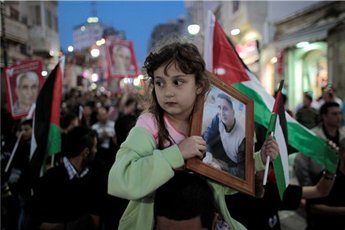
By Saed Bannoura | IMEMC News | June 28, 2012
Palestinian and international rights groups have condemned the Israeli government’s failure to live up to the agreement made one month ago in order to end the month-long hunger strike of over 2,000 Palestinian prisoners.
The promises made by the Israeli government in order to end the hunger strike included an end to solitary confinement, improved living conditions for prisoners, proper medical care and increased family visits. A month after the hunger strike was declared over, however, the Israeli authorities have yet to implement these agreed-upon terms.
The one item that Israeli authorities did carry out was the return of 91 bodies from the so-called ‘Numbers’ cemetery in Israel – a cemetery made up of Palestinians who died or were killed inside Israel. Although Israel has always denied the existence of this cemetery, mocking those Palestinians who insisted that it did exist, the release of the bodies constituted an admission by the Israeli government that the Numbers cemetery does exist. Those 91 bodies are not all of the Palestinians buried in the Numbers cemetery, but no one on the Palestinian side knows how many bodies remain, and Israel has refused to release any data.
Some prisoner rights groups are blaming the Palestinian Authority for giving in to easily during negotiations with the Israelis regarding the hunger striking prisoners, and for failing to pressure Israel to live up to its end of the bargain.
In fact, there is no mechanism by which the Palestinian Authority can force Israel to carry out its promises regarding prisoners, as Palestinians have no legal recourse to take the Israeli government to court.
One of the promises made by the Israeli government was hailed at the time as a success for prisoners, but prisoner rights groups including Addameer have cautioned that it does not constitute a real change in policy. That is the decision to not extend so-called ‘administrative detention’ orders under which Palestinians are held without charges. The caveat, however, is that Israel can extend those orders if there is ‘new information’ in the case. Since the charges and trial in these cases are held in secret, with no possibility of mounting a defense, this caveat makes the change in policy virtually meaningless.
One representative of Addameer, Mourad Jadallah, told reporters with the Ma’an news agency, “Israel also does not want Palestinians to feel they reached something with the hunger strike or let the prisoners movement feel like they reached their demands. They want to say: We can control everything.”
Related articles
- Outrage as Israel breaks prisoner agreement (altahrir.wordpress.com)
Featured Video
Yemen joins the war – Red Sea could be blocked next – Saudi regime at risk
or go to
Aletho News Archives – Video-Images
From the Archives
A superpower and “the world’s sickest warrior state”
By Paul J. Balles | March 8, 2010
Living through five or six major wars has hardened me to what I thought were the extremes of inhuman cruelty and brutality.
Two things made those extremes almost bearable: the brutality always revealed – at least according to the media coverage – the viciousness of the enemy. It was therefore quite understandable when our “brave men and women” pulverized the enemy.
Films of Japanese torturing captive Americans somehow justified holding Japanese Americans in internment camps during World War II; and only a small percentage of Americans found the bombing of Hiroshima and Nagasaki unreasonably vengeful at best, at worst, depraved.
The media giants in America portrayed the North Koreans as barbaric beasts with their captives, quite unlike their southern counterpoints – our allies during the Korean War. No one ever felt the need to explain how the South Koreans were a civilized breed while the North Koreans were absolute savages, at least according to the official line.
In Vietnam, our warriors justifiably (or so the media made us believe) dropped napalm on the North Vietnamese who had the gall to hide in villages and tunnels to ravage our invaders. At least it was accepted practice until some rogue photojournalist filmed a young girl screaming down a Vietnamese road in flames. … continue
Blog Roll
 Aletho News
- Russian tanker approaches Cuba despite US oil blockade
- Marandi: Yemen joins the war – Red Sea could be blocked next – Saudi regime at risk
- Pro-Palestinian French member of European Parliament denied entry to Canada
- Pakistan to Host US-Iran Talks
- How Indonesia’s tilt toward the US left it stranded in the Strait of Hormuz
- US has no choice but to retreat from Iranian borders: Top commander
- Iran Retaliation Strikes Chemical Plant Near Dimona
- AWACS’ Destruction is a Major Loss for US Military – Ex-DoW Analyst
- Israel’s Iran Strategy Uses US Military & Gulf States as Its Pawns
- Iran: Trump wanted regime change, now just begging for Hormuz to open
- If Americans Knew
- Israeli police block Catholic cardinal from entering Church of the Holy Sepulchre on Palm Sunday
- Israel is assassinating journalists again, more than any other nation, anywhere, ever – Not a ceasefire Day 170
- Over 300 US service members wounded, majority have brain injuries – Not a ceasefire Day 169
- Researchers at Human Rights Watch Resign Over Blocked Report on Palestinian Refugee Return
- Jewish Groups Are Backing a War Americans Don’t Want
- Eric Fingerhut Thinks He’s the President of the Jews
- Top Jewish Philanthropists, Rabbis Urge Israeli President to Take Action Against ‘Jewish Extremists’
- Don’t Be Fooled. Zionist Leaders Have Always Wanted to Control Southern Lebanon
- Israel’s widespread use of torture is a core element of its genocide against the Palestinian people
- In Israel’s War on Iran, Many Middle East US Bases Rendered “All But Uninhabitable”
- No Tricks Zone
- New Study Finds Warming Saves Lives…Cold Temperatures 12 Times More Deadly Than Excess Heat
- German Science Blog Accuses PIK Climate Institute Of Hallucinating Climate Tipping Points
- Devastating Assessment Of Comirnaty Vaccine By Former Senior Pfizer Europe Toxicologist
- New Study: CO2 Is ‘Effectively Negligible’ As An Explanatory Climate Change Factor Since 2000
- Former Pfizer Toxicologist Dr. Helmut Sterz Tells Bundestag Hearing Pfizer Vaccine Should Have Never Been Approved
- Energy Expert: Germany’s Nuclear Phaseout Was A “500 Billion Euro Mistake”
- New Research: South Australia’s Mid-Holocene Sea Surface Temperatures Were 4°C Warmer Than Today
- Storing Green Energy To Last Germany 10 Days Would Require A 60-Million Tonne Battery
- New Studies: UK Sea Levels Were 4 Meters Higher Than Today During The Mid-Holocene
- Destructive Green New Deal: German Energy And Metal Group Warns Of Drastic Crisis
 Aletho News