White House wins fight to keep drone killings of Americans secret
RT | January 3, 2013
A federal judge issued a 75-page ruling on Wednesday that declares that the US Justice Department does not have a legal obligation to explain the rationale behind killing Americans with targeted drone strikes.
United States District Court Judge Colleen McMahon wrote in her finding this week that the Obama administration was largely in the right by rejecting Freedom of Information Act (FOIA) requests filed by the American Civil Liberties Union and The New York Times for materials pertaining to the use of unmanned aerial vehicles to execute three US citizens abroad in late 2011 [pdf].
Anwar al-Awlaki and Samir Khan, both US nationals with alleged ties to al-Qaeda, were killed on September 30th of that year using drone aircraft; days later, al-Awlaki’s teenage son, Abdulrahman al-Awlaki, was executed in the same manner. Although the Obama administration has remained largely quiet about the killings in the year since, a handful of statements made from senior White House officials, including President Barack Obama himself, have provided some but little insight into the Executive Branch’s insistence that the killings were all justified and constitutionally-sound. Attempts from the ACLU and the Times via FOIA requests to find out more have been unfruitful, though, which spawned a federal lawsuit that has only now been decided in court.
Siding with the defendants in what can easily be considered as cloaked in skepticism, Judge McMahon writes that the Obama White House has been correct in refusing the FOIA requests filed by the plaintiffs.
“There are indeed legitimate reasons, historical and legal, to question the legality of killings unilaterally authorized by the Executive that take place otherwise than on a ‘hot’ field of battle,” McMahon writes in her ruling. Because her decision must only weigh whether or not the Obama administration has been right in rejecting the FOIA requests, though, her ruling cannot take into consideration what sort of questions — be it historical, legal, ethical or moral — are raised by the ongoing practice of using remote-controlled drones to kill insurgents and, in these instances, US citizens.
“The Alice-in-Wonderland nature of this pronouncement is not lost on me; but after careful consideration, I find myself stuck in a paradoxical situation in which I cannot solve a problem because of contradictory constraints and rules — a veritable Catch-22,” she writes. “I can find no way around the thicket of laws and precedents that effectively allow the Executive Branch of our Government to proclaim as perfectly lawful certain actions that seem on their face incompatible with our Constitution and laws, while keeping the reason for their conclusion a secret.”
Throughout her ruling, Judge McMahon cites speeches from both President Obama and Attorney General Eric Holder in which the al-Awlaki killings are vaguely discussed, but appear to do little more than excuse the administration’s behavior with their own secretive explanations.
“The Constitution’s guarantee of due process is ironclad, and it is essential — but, as a recent court decision makes clear, it does not require judicial approval before the President may use force abroad against a senior operational leader of a foreign terrorist organization with which the United States is at war — even if that individual happens to be a US citizen,” McMahon quotes Mr. Holder as saying during a March 2012 address at Chicago’s Northwestern University. “Holder did not identify which recent court decisions so held,” the judge replies, “Nor did he explain exactly what process was given to the victims of targeted killings at locations far from ‘hot’ battlefields… ”
And while both Mr. Holder and President Obama have discussed the killings in public, including one appearance by the president on the Tonight Show with Jay Leno, the Justice Department insists that going further by releasing any legal evidence that supports the executions would be detrimental to national security.
While Judge McMahon ends up agreeing with the White House, she does so by making known her own weariness over how the Obama administration has forced the court to rely on their own insistence that information about the attacks simply cannot be discussed.
“As they gathered to draft a Constitution for their newly liberated country, the Founders — fresh from a war of independence from the rule of a King they styled a tyrant — were fearful of concentrating power in the hands of any single person or institution, and most particular in the executive,” McMahon writes.
Responding to the decision on Wednesday, ACLU Deputy Legal Director Jameel Jaffer issued a statement condemning the White House’s just-won ability to relieve itself from any fair and honest explanation as to the justification of Americans.
“This ruling denies the public access to crucial information about the government’s extrajudicial killing of US citizens and also effectively green-lights its practice of making selective and self-serving disclosures,” Jameel writes. “As the judge acknowledges, the targeted killing program raises profound questions about the appropriate limits on government power in our constitutional democracy. The public has a right to know more about the circumstances in which the government believes it can lawfully kill people, including US citizens, who are far from any battlefield and have never been charged with a crime.”
The ACLU says they plan to appeal Judge McMahon’s decision and are currently awaiting news regarding a separate lawsuit filed alongside the Center for Constitutional Rights that directly challenges the constitutionality of the targeted kills.
“The government has argued that case should also be dismissed,” the ACLU notes.
In a Wednesday afternoon statement from the Times, assistant general counsel David McCraw says the paper will appeal the ruling as well.
“We began this litigation because we believed our readers deserved to know more about the US government’s legal position on the use of targeted killings against persons having ties to terrorism, including US citizens,” McCraw says.
Although she ruled against the plaintiffs, Judge McMahon, says McCraw, explained “eloquently … why in a democracy the government should be addressing those questions openly and fully.”
Related articles
- VIDEO: On CNN, Nasser Al-Awlaki Demands “Accountability” for U.S. Drone Strike That Killed His Grandson (alethonews.wordpress.com)
Obama continues rendition despite extensive condemnation of tactic

Press TV – January 2, 2013
US President Barack Obama’s administration is continuing rendition, the practice of sending terrorism suspects to third countries for detention and interrogation without due process.
George Bush administration’s practice of rendition is continuing under the Obama administration despite widespread condemnation of the tactic in the years after the September 11, 2001 attacks, the Washington Post reported on Wednesday.
According to the US daily, it is unknown how many renditions have taken place during Obama’s first term due to the secrecy involved but his administration has not disavowed the practice.
In the latest example of Obama administration’s use of the tactic, a number of American interrogates visited three European men with Somali origins in a jail in the small African country of Djibouti. The detainees had been arrested on a vague pretext in August as they were passing through the African country.
US agents accused the three men of supporting Somalia’s al-Shabab group. The prisoners were secretly indicted by a federal grand jury in New York two months after their arrest. They were then clandestinely taken into custody by the FBI and flown to the United States to face trial.
The secret arrests and detentions became known on December 21, when the suspects appeared briefly in a Brooklyn courtroom.
The US government has revealed little about the circumstances of the arrests. The FBI and federal prosecutors for the Eastern District of New York have also not said where and why the defendants were detained.
Human rights advocates have condemned the Obama administration’s decision to continue rendition.
Obama, in his first presidential candidacy, had strongly suggested he might end the practice but the tactic is still continuing under his administration.
Related articles
2012 in Review: Blackout Protests Against Blacklist Bills
By Parker Higgins | EFF | January 1, 2013
Coming into 2012, the Internet community was looking down the barrel of very dangerous legislation that would have created legal structures to silence legitimate speech in the name of curbing online “piracy.” A House bill called the Stop Online Piracy Act (SOPA) and its Senate counterpart, the PROTECT IP Act (PIPA), had been debated, amended, and looked to be on the fast track for legislative approval.
That all changed on January 18. An historic “Blackout Day” protest, loosely coordinated by a coalition of public interest groups, startups, tech companies, and thousands of different websites, resulted in millions of emails and tens of thousands of calls to legislators. As sites across the web turned out their virtual lights at once, an important but otherwise arcane copyright bill became front-page news—and impossible for the content lobby and their favorite legislators to sneak past the public.
There were plenty of reasons to be concerned. After all, Congress has passed 15 laws aimed at stopping “piracy” over the last 30 years—an impressive record given the general absence of actual facts about the problem or the effectiveness of the proposed solutions. And even after an earlier protest, held in November 2011, resulted in nearly 90,000 calls to Congress in one day, SOPA’s author (and Judiciary Committee chair) Lamar Smith seemed intent on pushing the bill through, dismissing the complaints as not being “legitimate.”
But support for the bills began to crumble when met with the magnitude of the blackout protests. Over the course of January 18, people sent nearly a million emails to their legislators through the EFF’s action center alone, and many million more through other sites. Some of the most popular sites on the Internet, like Google, Reddit, and Wikipedia, were among over 100,000 pages dark in protest.
It worked. Angry supporters of the bill may have derided the grassroots action—MPAA chief Chris Dodd called it “dangerous” and a “gimmick,” while RIAA CEO Cary Sherman said it was based on “misinformation” and, strangely, a “misuse of power”—but legislators got the message, and began jumping ship from SOPA and PIPA almost immediately. Within a month, the bills were effectively dead.
The defeat of SOPA and PIPA marked an important victory in an ongoing struggle for copyright policy that’s based on actual facts and real evidence. The January 18 protests, too, served as a template for a new era of online activism. In 2012, we’ve already seen similar battles play out all over the world; in 2013, we’re sure to see even more.
Related articles
- U.S. Congress may not have stomach for another SOPA/PIPA fight (pcworld.com)
- Looking forward: The fight for Internet freedom (rappler.com)
Israeli Offer to Palestinian Families: Take $500,000 and Leave West Bank
Al-Manar | January 2, 2013
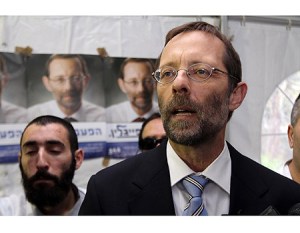 A Zionist Likud hardliner suggested paying Palestinian families $500,000 each to emigrate from the West Bank to the West.
Moshe Feiglin, who earlier on Tuesday was detained by Israeli police after trying to pray at the so-called Temple Mount, proposed paying Palestinians to leave West Bank.
“The State of Israel is paying 10% of its GNP every year for the two-state solution and the Oslo Accords. It’s paying for separation fences, Iron Domes and a guard at every café. Soon we’ll have to place Iron Domes in every school in Tel Aviv.
“With this budget we can give every Arab family in Judea and Samaria $500,000 to encourage it to immigrate to a place with a better future.
“You may say, ‘But no one will have them.’ That’s not true because the Western nations are shrinking due to low birth rates. The question is whether the world will have Sudanese migrants who can’t build or migrants from Judea and Samaria who do know how to build.”
Related articles
- Israel forces Jordan Valley Palestinians from homes ahead of war drill (alethonews.wordpress.com)
Local activist detained in Hebron
International Solidarity Movement | January 2, 2013
West Bank – Israeli soldiers in Hebron tied up and blindfolded a Palestinian activist this afternoon because he walked on the ‘Jewish side’ of the road.
Issa Amro, coordinator for Youth Against Settlements, was detained on Shuhada Street, sections of which are segregated with the majority reserved for the illegal Israeli settlers and Israeli military, leaving only a tiny portion open for Palestinian use.
Issa claimed he wasn’t walking in the Israeli only section of the road and that the soldier became infuriated when he told him to check the rules with a commanding officer. The soldier then told Issa he would be detained for 2 hours, however, he was released after 20 minutes. Issa believes that one of the illegal settlers had instructed the soldier to harass him.
Locals, members of the press and international activists turned up and the soldiers refused to answer questions about why he was being detained, or let anyone bring him water. One soldier then forced the crowd to stay 25 metres away.
Palestinians, Israeli soldiers and illegal settlers are always in close proximity in Shuhada Street and as a result it is an extremely volatile area of the city. On Sunday, Israeli soldiers extended a section of the apartheid road near the Ibrahimi Mosque. The newly constructed barrier runs past a Palestinian home due to be rebuilt meaning that when it is finished, Palestinians will have only half a metre to walk on.
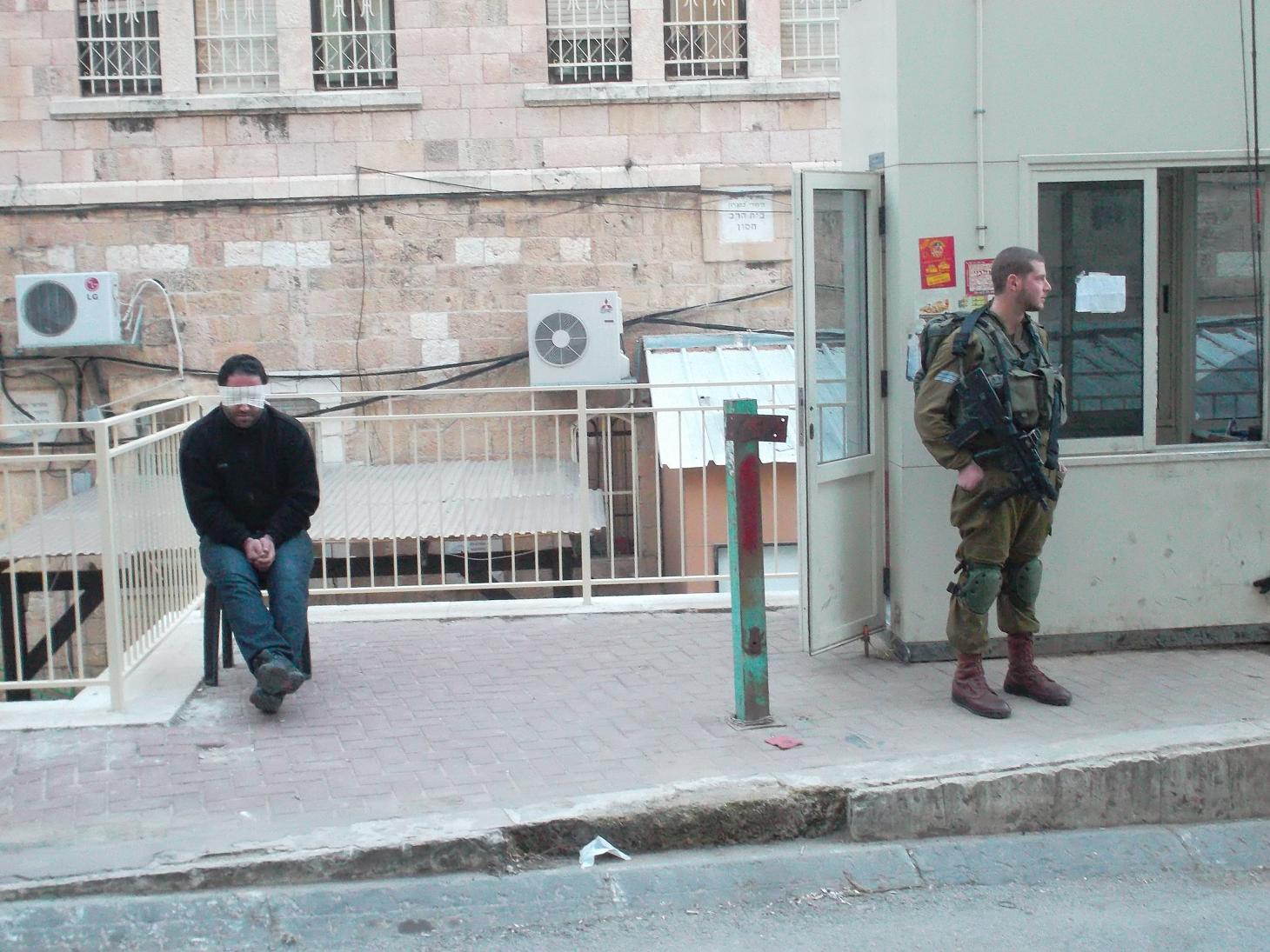
Local activist Issa Amro detained in Shuhada Street in Hebron
Related articles
- Israeli forces kill teenager on his 17th birthday in Hebron (alethonews.wordpress.com)
- Army Kidnaps Four Palestinians In Hebron (imemc.org)
- Israeli military conducts illegal operations in Tel Rumeida, Hebron (palsolidarity.org)
- Second group of journalists beaten in Hebron (alethonews.wordpress.com)
- Settlers raid Nablus village homes and a tractor. Uproot 190 olive trees and burn Hebron car (occupiedpalestine.wordpress.com)
Israeli forces attack Tammun, four injured from live bullets
International Solidarity Movement | January 2, 2013
Tammun, Occupied Palestine – From 9am to 6pm Israeli special forces, regular army and border police attacked the village of Tammun, south of Jenin. They used helicopters, many soldiers firing live rounds of ammunition, tear gas and plastic coated steel bullets. 35 people were injured, including 4 with live bullets. 2 children sustained serious head injuries from tear gas canisters.
 The raid began with at least 15 plain clothed special forces driving into the village in Palestinian plated vehicles to arrest a man. They forced the family out of their home, took one Palestinian brother, Murad, tied him, blindfolded him, pushed him against the wall and took him back into the house. They made the family stand outside as human shields against any resistance to the incursion and, in doing so, committed a war crime. His brother, Mohammed, was forced to assume a stress position for two hours. When he told the soldiers that had a health problem with his chest, they replied that if he said that again they would beat him to death.
The forces interrogated and beat Murad while blindfolded. These special forces, called Duvdevan, are known for targeted assassinations. Murad was told to climb over a wall, but fearing that this could be an excuse to kill him, he refused. The soldiers severely beat him for this.
The soldiers vandalised the house, breaking furniture and shooting walls, wardrobes, beds, mirrors and a fridge.
Last year the same family was raided by these forces. The two brothers were stripped naked and tied to an olive tree in their front garden.
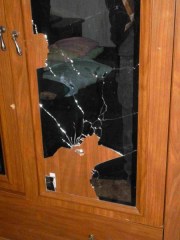 Today, soldiers entered another home. They searched it, broke furniture and shot around the house as well. They threatened the mother that if her husband doesn’t hand himself in, in 24 hours, they will kill him. Another 20 homes were searched in the village.
After the plain clothes special forces entered the village around 20 jeeps of regular army followed. They went into houses and took positions on rooftops.
Resistance by the population to this erupted on news of the incursion and people were attacked. Paramedics reported 35 injuries, two serious head wounds from tear gas canisters that are often used as baton rounds. The two head injuries were inflicted on children. Four of the injuries were from live rounds.
The attack continued until after dark with the army using parachute flares to illuminate the village.
The army eventually left the village at 6pm with Murad. The other Palestinian wanted by the Israeli occupation force has until tomorrow morning to hand himself in or he will be assassinated.
2012 in Review: State Surveillance Around the Globe
By Katitza Rodriguez | EFF | December 31, 2012
All things considered, 2012 was a terrible year for online privacy against government surveillance. How bad was it? States around the world are demanding private data in ever-greater volumes—and getting it. They are recognizing the treasure troves of personal information created by modern communications technologies of all sorts, and pursuing ever easier, quicker, and more comprehensive access to our data. They are obtaining detailed logs of our entire lives online, and they are doing so under weaker legal standards than ever before. Several laws and proposals now afford many states warrantless snooping powers and nearly limitless data collection capabilities. These practices remain shrouded in secrecy, despite some private companies’ attempts to shine a light on the alarming measures states are taking around the world to obtain information about users.
To challenge the sweeping invasions into individuals’ personal lives, we’re calling on governments to ensure their surveillance policies and practices are consistent with international human rights standards. We’re also demanding that governments and companies become more transparent about their use of the Internet in state surveillance.
Signs of Growing International Surveillance in 2012
A new law in Brazil allows police and public prosecutors to demand user registration data from ISPs directly, via a simple request, with no court order, in criminal investigations involving money laundering. And, a new bill seeks to allow the Federal Police to demand registration data of Internet users in cases of crimes without the need of a court order nor judicial oversight.
Colombia adopted a new decree that compels ISPs to create backdoors that would make it easier for law enforcement to spy on Colombians. The law also forces ISPs and telecom providers to continuously collect and store for five years the location and subscriber information of millions of ordinary Colombian users.
Leaked documents revealed that the Mexican government shelled out $355 million to expand Mexican domestic surveillance equipment over the past year.
The Canadian government put proposed online surveillance legislation temporarily “on pause” following sustained public outrage generated by the bill. The bill introduces new police powers that would allow authorities easy access to Canadians’ online activities, including the power to force ISPs to hand over private customer data without a warrant.
The EU’s overarching data retention directive has become a dangerous model for other countries, despite the fact that several European Courts have declared several national data retention laws unconstitutional.
Romania went ahead with adopting a new data retention mandate law without any real evidence or debate over the right to privacy, despite the 2009 Constitutional Court ruling declaring the previous data retention law unconstitutional.
The German government is proposing a new law that would allow law enforcement and intelligence agencies to extensively identify Internet users, without any court order or reasonable suspicion of a crime. This year, more details were found on German State Trojan Program to spy on and monitor Skype, Gmail, Hotmail, Facebook and other online communications.
The UK government is considering a bill that would extend the police’s access to individuals’ email and social media traffic data. The UK ISPs will be compelled to gather the data and allow the UK police and security services to scrutinize it.
A Dutch proposal seeks to allow the police to break into foreign computers and search and delete data. If the location of a particular computer cannot be determined, the Dutch police would be able to break into it without ever contacting foreign authorities. Another Dutch proposal seeks to allow the police to force a suspect to decrypt information that is under investigation in a case of terrorism or sexual abuse of children.
In Russia, several new legal frameworks or proposed bills enable increased state surveillance of the Internet.
Australian law enforcement and intelligence agencies have continued to advance the false idea of the need for data retention mandates, mandatory backdoors for cloud computing services and the creation of a new crime for refusing to aid law enforcement in the decryption of communications.
A controversy arose in Lebanon over revelations that the country’s Internal Security Forces (ISF) demanded the content of all SMS text messages sent between September 13 and November 10 of this year, as well as usernames and passwords for services like Blackberry Messenger and Facebook.
The Rwandan Parliament is discussing a bill that will grant sanctions the police, army and intelligence services the power to listen to and read private communications in order to protect “public security”, the keyword often invoked to justify unnecessary human rights violations.
Pakistan adopted a Fair Trial Bill authorizing the state to intercept private communications to thwart acts of terrorism. No legal safeguards have been built in to prevent abuse of power and the word “terrorism” has been poorly defined (a word that’s often invoked to justify unnecessary human rights violations).
RIM announced that they had provided the Indian Government with a solution to intercept messages and emails exchanged via BlackBerry handsets. The encrypted communications will now be available to Indian intelligence agencies.
The Indian government approved the purchase of technological equipment to kickstart the National Intelligence Grid (NATGRID)—a project that seeks to link databases for ready access by intelligence agencies. The project is expected to facilitate “robust information sharing” by security and law enforcement agencies to combat terror threats.
Moving Forward
EFF’s international team and a coalition of civil society organizations around the world have drafted a set of principles that can be used by civil society, governments and industry to evaluate whether state surveillance laws and practices are consistent with human rights. In 2013, we will continue demanding that states adopt stronger legal protections if they want to track our cell phones, or see what web sites we’ve visited, or rummage through our Hotmail, or read our private messages on Facebook, or otherwise invade our electronic privacy. EFF will keep working collaboratively with advocates, lawyers, journalists, bloggers and security experts on the ground to fight overbroad surveillance laws. Our work will involve existing legislative initiatives, international fora, and other regional venues where we can have a meaningful impact on establishing stronger legal protections against government access to people’s electronic communications and data.
Related articles
- Colombia Adopts Mandatory Backdoor and Data Retention Mandates (informationliberation.com)
- Do we need the Snooper’s Charter to save lives? (pcpro.co.uk)
- ISP Walks Out of Piracy Talks: “We’re Not The Internet Police” (torrentfreak.com)
Honduras: Miguel Facusse is Tragically Misunderstood
By Dan Beeton | CEPR | December 21, 2012
The Los Angeles Times’ Tracy Wilkinson conducted a rare interview with Miguel Facussé Barjum, considered by many to be the most powerful man in Honduras, and also believed to be behind the killings of dozens of campesinos in the Aguan Valley, where Facussé has extensive land holdings. He has been the subject of much recent scrutiny, as Wilkinson notes, especially following the assassination of attorney Antonio Trejo Cabrera, who worked on behalf campesino organizations in the Aguan. Wilkinson describes some of the allegations and criticism leveled at Facussé from members of the U.S. Congress and human rights organizations:
In October, shortly before he lost reelection, U.S. Rep. Howard L. Berman (D-Valley Village) took the unusual step of singling out Facusse in a letter to Secretary of State Hillary Rodham Clinton. Berman demanded a major overhaul of U.S. policy toward Honduras, including suspension of aid to human rights abusers. He repeated Trejo’s accusation, calling for an investigation of Facussé.
“It is breathtaking that Facusse has been so untouchable,” said a House of Representatives staffer with knowledge of the issue, who spoke anonymously in keeping with Washington protocol.
The New York-based Center for Constitutional Rights, in filings with the International Criminal Court, alleges that Facusse may have committed “crimes against humanity” in the killings of Trejo and several peasant farmers.
As we have previously noted, Facussé has admitted the killings of some campesinos by his security forces. A 2011 human rights report from the FoodFirst Information and Action Network, the International Federation for Human Rights and other groups details a number of killings, kidnappings, torture, forced evictions, assaults, death threats and other human rights violations that victims, witnesses and others attribute to Facussé’s guards. In May this year, Reporters Without Borders declared Facussé to be a “predator” of press freedom. Facussé’s response has sometimes been to threaten to sue for defamation. As he explains in the LA Times article, “He said he considered suing Berman but was advised by friends that legal action would be a waste of time.”
Perhaps seeing the limits to suing for defamation when the allegations are supported by evidence, Facussé, it appears, wanted to sit down with Wilkinson in order to set the record straight. He explains that, while yes, his airplane was “was used to illegally carry the foreign minister out of the country against her will” during the 2009 coup d’etat; and yes, drug planes have used his property to traffic cocaine; and yes, he normally keeps a pistol on his desk; and yes, he “keeps files of photos of the various Honduran activists who are most vocal against him,” and yes, he was aware of the plans for the 2009 coup in advance – he’s misunderstood. One has to appreciate the tremendous pathos as Facussé laments, “My name is mud all over the world,” he said. “I’m the bad guy in the world.”
And
As for the allegations of involvement in the lawyer’s killing?
“I probably had reasons to kill him,” he said, “but I’m not a killer.”
Featured Video
Marandi: Threat of Seizing Kharg Island & the Use of Nuclear Weapons
or go to
Aletho News Archives – Video-Images
Frlom the Archives
Iran War: United States Military Versus Israel Firsters
By James Petras | November 27, 2007
Why must Jewish organizations be and be seen as the loudest drum-beaters of all? Why can we not bring ourselves to say that military intervention is not on the table at all? Why not stash it under the table, out of sight and mount instead a diplomatic assault? – Leonard Fein, Forward
Introduction
As the White House and Congress escalate their economic sanctions and military threats against Iran, top military commanders and Pentagon officials have launched a counter-offensive, opposing a new Middle East War. While some commentators and journalists, like Chris Hedges (Truthdig, November 13, 2007), privy to this high stakes inter-elite conflict, attribute this to a White House cabal led by Vice President Cheney, a more stringent and accurate assessment puts the Zionist Power Configuration (ZPC) in the center of the Iran war debate.
There is a great deal riding in this conflict – the future of the American empire as well as the balance of power in the Middle East. Equally important is the future of the US military and our already heavily constrained democratic freedoms. The outcome of the continuous and deepening confrontation between top US military officials and the Israel Firsters over US foreign policy in the Middle East has raised fundamental questions over self-determination, colonization, civilian primacy and military political intervention, empire or republic. These and related issues are far from being of academic interest only; they concern the future of the United States. … continue
Blog Roll
 Aletho News
- How Zionist Control Is Hurting US Interests
- Iran warns it may target US missile launch sites in UAE cities
- American Military Failure in Afghanistan
- Friendly Skies of Georgia: Are Israeli-Linked Drones Launching False Flags from Georgian Territory?
- The Three Big Lies about Mammography Screening
- Ukrainian Embassy in Beirut sheltering top Mossad agent
- Palestinian family displaced after settlers violently attack them in Humsa, Jordan Valley
- The EU never learns – except for the wrong lessons
- Iran attacks on UAE leaves RSF militia high and dry
- Hosting Washington’s war: Bahrain faces the consequences
- If Americans Knew
- ‘Of Course’: IDF Drops Case Against Soldiers Accused of Raping Palestinian Prisoner
- Don’t Fall for the Regime Change Talk. Israel Is ‘Mowing the Lawn’ in Iran
- Will Israel and the US wreck the Gulf States along with Iran?
- US so far burned through ‘years’ of munitions in Iran war: Report
- How the Israeli Tail Wags the American Dog
- Outdated intel likely led to deadly U.S. strike on Iranian elementary school, sources say
- Pentagon insider says high U.S official Douglas Feith reported to Netanyahu
- In fond memory of Walid Khalidi, the historian of Palestine
- 6 more Americans killed, as Israel ‘mows the lawn’ in Iran – Not a ceasefire Day 154
- Are we on the precipice of World War III?
- No Tricks Zone
- New Studies: UK Sea Levels Were 4 Meters Higher Than Today During The Mid-Holocene
- Destructive Green New Deal: German Energy And Metal Group Warns Of Drastic Crisis
- New Study Documents A 20-Year Pause In Arctic Sea Ice Decline – Driven By Internal Variability
- Wake-up Call: Survey Shows Majority Of Germans Now Favor Postponing Climate Targets!
- Televised! Leading German Political Candidate Tells Schoolchildren CO2 Makes Sun Hotter!
- New Study: A Century Warming Of 1.1°C Is ‘Commonplace’ And ‘Not Unusual’ During This Interglacial
- New Study: ‘Internal Noise’ And Volcanic Forcing Can Trigger 10-15°C Warming Within Decades
- Glaciers Worldwide Are Suddendly Surging, Experts Blame Warming!
- Surprising Discovery: Sahara Is Greening…Billions Of Trees Where Once Thought To Be Barren
- New Research Reaffirms Clouds, Aerosols, And Surface Solar Radiation Are ‘Driving The Climate System’
 Aletho News