Oscar-nominated Palestinian director detained at LAX
By Yumna Marwan | Al-Akhbar | February 20, 2013
Palestinian director of Oscar-nominated “5 Broken Cameras” Emad Burnat was detained at Los Angeles airport and threatened with deportation Wednesday, Burnat told Al-Akhbar in an interview.
The filmmaker traveled to Los Angeles, from Palestine via Turkey, to attend Sunday’s Academy Awards ceremony, where his film had been nominated for the “Best Documentary” category.
The director was interrogated, detained for an hour and a half, and had his fingerprints taken twice. Airport officers googled his name to confirm that he had indeed been nominated for an Oscar.
LAX officials at first told Burnat they intended to deny him entry to the United States. “I told them I don’t care if you send me back to Palestine, just don’t detain me for any longer,” Burnat said.
His wife and eight-year-old son, who is the documentary’s main character, were also held at the airport.
During his layover in Turkey’s Istanbul, Burnat was also questioned by airport security officials.
Asked whether he thought he was sought out because of his film, Burnat said: “I don’t know, but this is the first time this happens. I’ve been to the States six times in the last year.”
“5 Broken Cameras” documents non-violent resistance in Bil’in, a Palestinian village surrounded by Israeli settlements and Palestine’s Apartheid Wall.
The US$400,000 documentary was made with contributions from Israeli and French government film funds. Its title refers to the number of cameras that Burnat, the filmmaker and main protagonist, had broken by Israeli forces as he tried to film weekly demonstrations against the military.
Documentary filmmaker Michael Moore was the first to break the news of Burnat’s detainment, because the Palestinian director’s detainment kept him away from a dinner party for nominees where Moore was present. Moore announced Burnat’s ordeal on his Twitter account.
“Apparently the Immigration & Customs officers couldn’t understand how a Palestinian could be an Oscar nominee. Emad texted me for help.” wrote Moore in his Twitter account this morning.
Burnat won the documentary director’s award at the Sundance Film Festival this year.
Iran-Iraq-Syria Gas Pipeline Project Agreement Finalized
Fars News Agency | February 20, 2013
TEHRAN – Implementation of the Friendship Gas Pipeline project which is due to take Iran’s rich gas reserves to Iraq and Syria was agreed by the Iraqi government, an Iraqi cabinet statement announced.
A Tuesday Iraqi cabinet statement said that Iraq’s Minister for Petroleum Abdel Kareem Luaibi had been authorized to sign the “framework of the agreement” on setting up the strategic pipeline that would also prepare the ground for exporting Iranian gas to Europe through Syria in the future.
The statement added that Luaibi had recently held talks with his Iranian counterpart Rostam Qassemi and Managing Director of the National Iranian Oil Company (NIOC) Ahmad Qalebani in Tehran regarding the issue.
Late in January, Iranian Oil Ministry Spokesman Alireza Nikzad Rahbar said the country will start exporting natural gas to Baghdad by next summer via an under-construction pipeline between the two countries.
He said that the “friendship” pipeline project between Iran, Iraq and Syria is the most important project currently pursued by the ministry.
The official said if the project is carried out according to schedule, the gas pipeline between Iran and Iraq will be completed next summer, adding that tripartite talks are underway to extend the pipeline to Syria.
He noted that the pipeline would be designed in such a way that it would be able to deliver gas to other Muslim countries like Jordan and Lebanon in the future.
The oil ministers of Iraq, Iran and Syria had signed a preliminary agreement for a $10 billion natural-gas-pipeline deal on July 25, 2011, in Assalouyeh industrial region located in the Southern province of Bushehr.
Iranian oil officials then said Syria would purchase between 20 million to 25 million cubic meters a day of Iranian gas while Iraq had also already signed a deal with Tehran to purchase up to 25 million cubic meters a day to feed its power stations.
The main project, 1,500 km length of piping Assalouyeh gas to Damascus requires $10 billion investment.
The pipeline will transfer a capacity of 110 million cubic meters of natural gas a day to Damascus.
The gas will be produced from the Iranian South Pars gas field in the Persian Gulf, which Iran shares with Qatar, and holds estimated reserves of 16 trillion cubic meters of recoverable gas.
Iranian officials have said that Tehran also aims to extend the pipeline to Lebanon and the Mediterranean to supply gas to Europe.
Related article
Colombia: FARC Reiterates Call for Ceasefire During Peace Talks
By Marc Rogers | The Argentina Independent | February 2013
The leader of the Revolutionary Armed Forces of Colombia (FARC)’s negotiating team, Iván Márquez, underscored the group’s willingness to agree to a bilateral ceasefire with government forces while historic peace talks between the two continue.
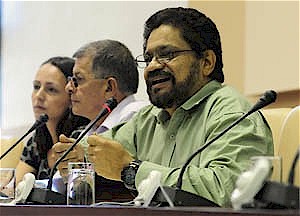 At the start of the fifth round of peace talks in Havana, Cuba, Márquez praised the proposal for a ceasefire written by Colombian politician and former cabinet minister Álvaro Leyva in a column for the El Nuevo Siglo newspaper.
Leyva called for a bilateral truce with international verification and oversight.
“For us a ceasefire requires a huge effort,” said Márquez, “but we know it is an important step to demonstrate a will for peace on both sides.”
FARC declared a unilateral ceasefire for two months after peace talks began in November last year, but did not extend the measure after the government refused to reciprocate. Even as peace talks continued, there has been an upsurge in violence since that ceasefire ended on 20th January, with seven Colombian soldiers killed in the latest incident.
The government has so far refused to accept a ceasefire agreement, over concerns that it would allow the guerilla group to re-arm and consolidate its position.
What the One-Percent Heard at the State of the Union
By SHAMUS COOKE | CounterPunch | February 19, 2013
When President Obama speaks, most Americans hear what he wants them to hear: lofty rhetoric and a “progressive” vision. But just below the surface the president has a subtly-delivered message for the 1%, whose ears prick up when their buzzwords are mentioned.
Obama’s state of the union address was such a speech – a pro-corporate agenda packaged with chocolate covered rhetoric for the masses; easy to swallow, but deadly poisonous.
Much of Obama’s speech was pleasant to the ears, but there were key moments where he was speaking exclusively to the 1%. Exposing these hidden agenda points in the speech requires that we ignore the fluff and use English the way the 1% does. Every time Obama says the words “reform” or “savings,” insert the word “cuts.”
Here are some of the more nefarious moments of Obama’s state for the union speech:
“And those of us who care deeply about programs like Medicare must embrace the need for modest reforms [cuts]…”
“On Medicare, I’m prepared to enact reforms [cuts] that will achieve the same amount of health care savings [cuts] by the beginning of the next decade as the reforms [cuts] proposed by the bipartisan Simpson-Bowles commission.”
This ultra-vague sentence was meant exclusively for the 1%. What are some of the recommendations from the right-wing Simpson-Bowles commission? Obama doesn’t say. Talking Points Memo explains:
-Force more low-income individuals into Medicaid managed care.
-Increase Medicaid co-pays.
-Accelerate already-planned cuts to Medicare Advantage and home health care programs.
-Create a cap for Medicaid/Medicare growth that will force Congress and the president to increase premiums or co-pays or raise the Medicare eligibility age (among other options) if the system encounters cost overruns over the course of 5 years.
There were many other subtly-delivered attacks on Medicare in Obama’s speech, all ignored by most labor and progressive groups, who clung tightly to the “progressive” smoke Obama blew in their face.
Obama’s speech also included a frightening vision of a national privatization scheme to previously publicly owned resources. But it was phrased so inspirationally that only the 1% seemed to notice:
“I’m also proposing a Partnership to Rebuild America that attracts private capital [wealthy investors] to upgrade what our businesses need most: modern ports to move our goods; modern pipelines to withstand a storm; modern schools worthy of our children…we’ll reward schools that develop new partnerships with colleges and employers [corporations]…”
Obama’s proposal plans to “rebuild America” in the image of the wealthy and corporations, who only put forth their “private capital” when it results in a profitable investment; resources that previously functioned for the public good will now be channeled into the pockets of the rich, to the detriment of everyone else.
Allowing the rich to privatize and profit from public education and publicly owned infrastructure (ports and pipelines, etc.) has been a right-wing dream for years. This will result in massive user fees for the rest of us, while further dismembering public education, which Obama’s ill-named Race to the Top education reform is already successfully accomplishing.
Obama’s speech also put forth two massive pro-corporate international free trade deals, which would further drive down wages in the United States:
“We intend to complete negotiations on a Trans-Pacific Partnership [a massive free trade deal focused mainly on Asian nations]. And tonight, I am announcing that we will launch talks on a comprehensive Transatlantic Trade and Investment Partnership [free trade deal] with the European Union – because trade that is free and fair across the Atlantic supports millions of good-paying American jobs.”
While praising free trade Obama disarmed labor and progressive groups by throwing in the meaningless word “fair.”
Lastly, Obama’s drone assassination policy was further enshrined in his speech. Drone assassinations are obvious war crimes — see the Geneva Convention — while also ignoring that pesky due process clause — innocent until proven guilty — of the constitution.
But Obama said that these programs will be “legal” and “transparent,” apparently good enough to keep most progressive groups quiet on the issue.
There were plenty of other examples of sugar-coated poison in Obama’s speech. It outlined a thoroughly right-wing agenda with no plan to address the jobs crisis — sprinkled with pretty words and “inspiring” catchphrases.
Some labor leaders and “progressive” groups seem dazzled by the speech. President of the union federation, AFL-CIO, Richard Trumka, praised Obama’s anti-worker speech:
“Tonight President Obama sent a clear message to the world that he will stand and fight for working America’s values and priorities. And with the foundation he laid, working families will fight by his side to build an economy that works for all.”
And here is the real problem; as President Obama follows in the footsteps of President Bush, labor and progressive groups have found their independent voice stifled. The close ties between these groups and the Democratic Party have become heavy chains for working people, who find themselves under assault with no leadership willing to educate them about the truth, let alone organize a national fightback to win a massive jobs-creation program, prevent cuts to social programs, and fully fund public education. Obama’s second term will teach millions these lessons via experience.
Shamus Cooke is a social service worker, trade unionist, and writer for Workers Action (www.workerscompass.org) He can be reached at shamuscooke@gmail.com
Related article
- Obama’s State of the Corporate Union (alethonews.wordpress.com)
Turkey to consider gas deal with Iraqi Kurds
US claims to oppose deal
Press TV – February 19, 2013
Turkey has reportedly struck a massive oil and gas agreement with Iraq’s Kurdistan Regional Government, a move that would strain Ankara’s ties with the US and the central government in Baghdad.
According to a Monday report by The New York Times the Kurds in Iraq have agreed to supply Turkey with at least 10 billion cubic meters of gas every year through a natural gas pipeline whose construction is part of the deal.
Turkey has not officially confirmed the deal, which represents a fifth of the country’s current gas consumption.
The agreement is a major bone of contention between Turkey and the US, which believes such a measure would put Iraq’s integration in jeopardy by pushing the Kurds in the oil-rich country into the hands of Turks, the report says.
“Economic success can help pull Iraq together,” US Ambassador to Turkey Francis Ricciardone said earlier this month.
But “if Turkey and Iraq fail to optimize their economic relations … there could be more violent conflict in Iraq and the forces of disintegration within Iraq could be emboldened,” he warned.
The US envoy added that at the end of the day, the measure would harm the interests of Turkey, the US and the regional countries.
Turkey had previously shied away from engagement with Iraqi Kurds fearing their probable efforts for independence on Iraqi soil would embolden the Kurds in Turkey to intensify their three-decade battle for autonomy. But Ankara’s recent attempts at ironing out issues with Kurds to put an end to the long hostility may have convinced them to build up courage and get closer to Iraqi Kurds.
The recent deal is also a thorn in the side of Iraq’s central government which tries to block Turkey’s efforts at boosting leverage by planning to become an energy hub in the region.
In November, Baghdad prevented Turkish national energy firm TPAO from bidding for an oil exploration contract.
And in December, Baghdad barred a plane carrying Turkish Energy Minister Taner Yildiz from landing in Arbil as he was reportedly on his way to seal the much-speculated energy deal.
Honduras: Murdered Lawyer’s Brother Killed in Aguán
Weekly News Update on the Americas | February 17, 2013
Unidentified assailants shot Honduran campesino José Trejo Cabrera on the evening of February 16th as he was riding on his motorbike to his home in the San Isidro section of Tocoa in the northern department of Colón. Trejo was taken to a local hospital, where he died a few minutes later. The victim’s brother, Antonio Trejo Cabrera, an attorney who defended campesino activists and fiercely opposed plans for autonomous “model cities” in Honduras, was gunned down the evening of September 22, 2012, in Tegucigalpa near the Toncontín International Airport [see Update #1145]. Both brothers were members of the Authentic Claimant Movement of Aguán Campesinos (MARCA), one of several campesino collectives seeking the return of land in the Lower Aguán Valley in northern Honduras that they say big landowners bought illegally.
The conservative Tegucigalpa daily La Tribuna reported that according to several neighbors the attackers were trying to steal Trejo’s motorbike, but Vitalino Alvarez, a spokesperson for the Unified Campesino Movement of the Aguán (MUCA), told the French wire service AFP that the killers had been “waiting for” Trejo. Some 85 campesinos have been killed in the Aguán since the land dispute intensified in late 2009; two were murdered just two weeks earlier, on Feb. 2 [see Update #1163]. The government of President Porfirio (“Pepe”) Lobo Sosa has militarized Colón department, claiming that this would reduce violence both from the land disputes and from common crime, but many campesinos feel the militarization was actually directed against them. “We don’t understand how we can go on being killed in a department that’s under siege by the army and the police,” Alvarez remarked.
Another campesino, Santos Jacobo Cartagena, was gunned down a few hours before Trejo on the afternoon of February 16th. Unidentified men riding in a car shot Cartagena, a MUCA member, as he was waiting for a bus at the La Confianza community. “More murders can be expected after the persecution and threats against the campesinos who struggle for land,” the Permanent Human Rights Monitoring Center for the Aguán, a Honduran human rights group, wrote on February 16th. (Vos el Soberano 2/16/13; La Tribuna 2/17/13; AFP 2/17/13 via Terra.com; Conexihon.info (Honduras) 2/17/13)
Economic Growth with More Equality: Learning From Bolivia
By Emily Achtenberg | Rebel Currents | February 15, 2013
Until recently, conventional economic wisdom held that sustained economic growth in any society could only be achieved at the expense of income equality. Today, even free market disciples like The Economist recognize that these goals are not contradictory—and that growing inequality, in fact, is an impediment to economic prosperity.
Recent data on economic growth and inequality for the United States and Bolivia reveal two starkly contrasting portraits.
The United States, after four decades of widening inequality, is experiencing the greatest economic downturn since the Depression. In 2011, while the economy grew by only 1.7% (down from 3% in 2010), income inequality increased by almost as much—the biggest single year increase in two decades. Over the past 30 years, the share of income held by the top 1% has more than doubled, increasing from 8% to 17%, while the share held by the bottom 20% has fallen from 7% to 5%. Currently, the United States has the highest level of income inequality of any developed country.
Poverty rates in the United States have risen 23% since 2006, now leveling off at 15.1%. Today, more Americans are living in poverty than at any time in the half-century since the census started publishing these estimates. Due to declining incomes, the U.S. “middle class” is eroding, dropping from 61% of adults 40 years ago to a bare majority now.
As Nobel prize-winning economist Joseph Stiglitz has noted, the United States’ declining middle class is too weak to support the consumer spending that has historically fueled our economic growth. Thus, inequality is “squelching our recovery”—but U.S. political leaders have been slow to act on this lesson.
In contrast, despite the worldwide economic crisis, Bolivia’s economy is on track to increase by at least 5% in 2013, as it did last year. This is among the highest growth rates in Latin America, exceeded only by Chile, Panama, Peru, and Venezuela. Since the start of Evo Morales’s presidency in 2006, Bolivia’s GDP has tripled, and GDP per capita has more than doubled.
At the same time, according to data recently presented by Morales to the Legislative Assembly, income inequality in Bolivia has significantly decreased. In 2011, the richest 10% of the population had 36 times more income than the poorest 10%, down from 96 times more in 1997. “Bolivia is one of the few countries that has reduced inequality,” notes Alicia Bárcena, head of the UN Economic Commission for Latin America and the Caribbean (ECLAC). “The gap between rich and poor has been hugely narrowed.”
Between 2005 and 2011, Bolivia’s poverty rate declined by 26% (from 61% to 45%). The extreme poverty rate fell even more, by 45%. An estimated 1 million people joined the ranks of the “middle class.” The World Bank has officially recognized Bolivia as a lower-middle income country, a ranking that affords more favorable credit terms.
Between 2006 and 2011, Bolivian workers’ purchasing power increased by 41%, as compared to 17% between 1999 and 2005. The minimum wage has risen 127% since 2005, far exceeding the rate of inflation. In contrast, U.S. workers’ real wages have stagnated or fallen, with inflation-adjusted incomes now at their lowest point since 1997. Since 1972, the average hourly wage has risen only 4%.
In Bolivia (unlike the United States), domestic demand fueled by rising incomes and narrowing inequality is a driving force behind the country’s economic prosperity. Local evidence of increased domestic consumption and consumer purchasing power can be seen in places like El Alto, the sprawling indigenous city overlooking La Paz, where banks and fast food outlets are sprouting up and the first supermarkets, shopping centers, and cinemas are being planned. In 2012, there were 8.9 million mobile phones in Bolivia (with a population of around 10.4 million). Construction activity has outpaced the capacity of the domestic producers, with cement now being imported from Peru.
Rating agency Standard and Poor’s gave Bolivia high marks for economic resiliency last October, in underwriting a successful $500 million bond sale—the country’s first venture into the international credit markets since the 1920s.
Behind these positive indicators is Bolivia’s state-led economic policy, including the re-nationalization of strategic sectors divested by past neoliberal governments (such as hydrocarbons, telecommunications, electricity, and some mines). Around 34% of the national economy is now under state control—although private investment (on Bolivia’s terms) is encouraged and has continued, in hydrocarbons and other key sectors.
The vast increase in hydrocarbons and mining revenues under Morales has funded a major expansion of social welfare programs, including highly popular cash transfers targeted to the elderly, pregnant mothers, and school children. It has also supported major infrastructure improvements, a significant increase in the coverage of basic services (such as water, electricity, and domestic gas), and a major expansion of public healthcare and education programs—all boosting the living standards of average Bolivians. … Full article
Related articles
Israel changes law to allow re-arrest of freed prisoners
MEMO | February 18, 2013
A leading Israeli newspaper, Haaretz, revealed on Sunday that the occupation authority has amended its military law to allow the re-arrest of 14 Palestinian prisoners who were freed as part of the Shalit deal. The released prisoners are now expected to serve the remainder of their original sentences, in some cases decades.
Palestinian human rights organizations view the arrest of the released prisoners as a serious breach of the agreement brokered in October 2011 by the Egyptian and German governments between the Islamic Resistance Movement (Hamas) and the Israeli authorities.
The newspaper noted that under the new amendment the Israeli authorities are not obliged to prove the case for the re-arrest of released prisoners. It referred to a petition filed by Ahlam Haddad, the legal counsel for two prisoners, in which she pointed out that a driving offence or staying illegally in Israel were enough to return any released prisoner back to prison to spend his remaining decades; without the need to prove these charges.
Bolivia: President Evo Morales Nationalises Airports
By Sabrina Hummel | The Argentina Independent | February 18, 2013
Earlier today, Bolivian president Evo Morales announced plans to nationalise the country’s three largest airports. The airport operator Bolivian Airports Service Company (SABSA), a subsidiary of the Spanish firm Abertis y Aena, is accused of not carrying out agreed investments towards updating its facilities.
The decision to nationalise SABSA was taken after executives refused to increase their initial investment of US$36m, required to maintain and develop the country’s principal airports. The military is set to take control of airport terminals in El Alto (La Paz), Viru-Viru (Santa Cruz), and Wilsterman (Cochabamba). In Bolivia, it is common practice for troops to be dispatched to recently nationalised companies.
SABSA is the third Spanish company to be nationalised in less than a year in what began with the expropriation of Red Eléctrica in May 2012, followed by two electricity distribution companies owned by Spanish utility Iberdrola in December of the same year.
The nationalisation of SABSA reflects attempts by the Bolivian government to reclaim control of the country’s strategic resources, including natural gas, minerals, and public services. It is a move which aims to promote and indeed facilitate state-led development of the country without direct foreign interference. Morales issued the statement from the main city of Cochabamba, accompanied by vice-president Álvaro García Linera and the minister for public works, Vladimir Sánchez.
Featured Video

Daniel Davis: China & Russia Will Defend Iran
or go to
Aletho News Archives – Video-Images
From the Archives
Sugar: Killing us Sweetly
Staggering Health Consequences of Sugar on Health of Americans
By Dr. Gary Null | Global Research | February 3, 2014
In September 2013, a bombshell report from Credit Suisse’s Research Institute brought into sharp focus the staggering health consequences of sugar on the health of Americans. The group revealed that approximately “30%–40% of healthcare expenditures in the USA go to help address issues that are closely tied to the excess consumption of sugar.”[1]The figures suggest that our national addiction to sugar runs us an incredible $1 trillion in healthcare costs each year. The Credit Suisse report highlighted several health conditions including coronary heart diseases, type II diabetes and metabolic syndrome, which numerous studies have linked to excessive sugar intake.[2]
Just a year earlier in 2012, a report by Dr. Sanjay Gupta appearing on 60 Minutes featured the work of Dr. Robert Lustig, an endocrinologist from California who gained national attention after a lecture he gave titled “Sugar: The Bitter Truth” went viral in 2009. Lustig’s research has investigated the connection between sugar consumption and the poor health of the American people. He has published twelve articles in peer-reviewed journals identifying sugar as a major factor in the epidemic of degenerative disease that now afflicts our country. The data compiled by Lustig clearly show how excessive sugar consumption plays a key role in the development of many types of cancer, obesity, type II diabetes, hypertension, and heart disease. His research has led him to conclude that 75% of all diseases in America today are brought on by the American lifestyle and are entirely preventable.[3]
Until the airing of this program, no one in the “official” world acknowledged anything wrong with sugar, here is a sampling of some the latest research available to them if they chose to look… continue
Blog Roll
 Aletho News
- Lebanon: Between sovereignty and the mirage of normalization
- Ukraine Given $43Bln in Proceeds From Russian Assets Frozen by G7 Since 2024 – Estimates
- The military is babying F-35s to hide their true cost to taxpayers
- Ukrainian military analyst praises use of drones against ‘Russian-Hungarian-Slovak friendship’
- Von der Leyen warns Hungary: We have ways of making you talk
- EU manipulating polls in bid to oust Orban – German opposition leader
- Daniel Davis: China & Russia Will Defend Iran
- The US’ self-directed ‘China nuclear threat’ will only be a waste of effort: Global Times editorial
- Female Iranian academic sentenced to 4 years in prison in France over protesting Israel’s genocide in Gaza
- US university cancels Palestine conference citing sanctions concerns
- If Americans Knew
- Israeli leaders want to buy global legitimacy – Not a ceasefire Day 140
- Israel warns of a Ramadan escalation — while doing everything to provoke one
- Democrats Should Release Their 2024 Election Autopsy – and Stop the Gaza Denial
- Israel responsible for 2/3 of press killings worldwide – Not a ceasefire Day 139
- Are the Jews indigenous to Palestine?
- AIPAC Wants to Kill a Bill that would Ensure Israel Complies with Ceasefire
- Former Israeli PM, in Epstein Files, Dreamed of Israeli Eugenics and Pretty Converts
- Israeli settlers join ‘safari’ tour of Palestinian prisoners
- Flooding in Gaza amid rumors of war; fire in West Bank – Not a ceasefire Day 138
- Fourteen Countries Condemn Huckabee’s Support for Israel Taking Over Most of the Middle East
- No Tricks Zone
- Surprising Discovery: Sahara Is Greening…Billions Of Trees Where Once Thought To Be Barren
- New Research Reaffirms Clouds, Aerosols, And Surface Solar Radiation Are ‘Driving The Climate System’
- Germany: Electric Car Catches Fire At Charging Station, Sets Off Local “Inferno”, Widespread Damage
- New Study: Canada’s New Brunswick Was 1°C Warmer Than Today During The Medieval Warm Period
- Coal Power Back In Trend As Globe Tries To Keep Pace With Growing Demand For Power
- New Study: A 4°C Warmer Beaufort Sea Had ‘No Sea Ice’ 11,700 – 8200 Years Ago
- Unfudging The Data: Dutch Meteorological Institute Reinstates Early 20th Centruy Heat Waves It Had Erased Earlier
- German Gas Crisis…Chancellor Merz Allegedly Bans Gas Debate Ahead of Elections!
- Pollen Reconstructions Show The Last Glacial’s Warming Events Were Global, 10x Greater Than Modern
- Germany’s Natural Gas Storage Level Dwindles To Just 28%… Increasingly Critical
 Aletho News