Abby Martin peddles Jewish exceptionalism, fears WW2 truth
By Brandon Martinez | February 24, 2014
Recently, Abby Martin, the host of “Breaking the Set” on the Putin-funded Russia Today network, released two segments on the subjects of the Nazis and the “holocaust,” an event which she described as “a horrific genocide that forever changed the world.”
One wonders why Martin – like her compatriots in the Zionist-dominated Hollywood establishment — places exceptional status on the “holocaust” when in fact a far greater number of non-Jews — particularly Germans, Russians and Chinese — perished during the Second World War than even the highest exaggerations of the sacred Shoah.
Why have the Western media and academia placed such an importance and focus on Jewish deaths in World War II? Are Jewish deaths more tragic than non-Jewish deaths? Are Jewish lives worth more than those of non-Jews? Does Jewish suffering trump that of non-Jewish peoples? The supremacist and racist disposition of Jewish eminence in this regard must necessarily be the viewpoint of those who promote the “holocaust” as a seminal event in history, elevating it to sacrosanct status. Whether they realize it or not, commentators who advance the primacy of Jewish suffering are enabling the Zionists’ continued genocidal subjugation of the Palestinians.
Most people, including Martin, are blinded by decades of intense Zionist propaganda on the subject and cannot bring themselves to overcome their brainwashing. Or they are just too proud to admit they were wrong. If such people took the time and effort to do a little research, they would quickly discover that millions of “holocaust victims” have been excised from the official death total. For 45 years, the standard histories told us four million people died at Auschwitz. When the communist iron curtain disintegrated in 1990, the figure was revised downwards to 1.5 million, but the real death total still remains a mystery. Some historians estimate less than 100,000 people died in that camp, primarily from disease and starvation caused by Allied bombing. Death totals at other major German camps have likewise been significantly reduced by official sources. The Majdanek and Mauthausen camps were at one time claimed to be the resting places of 3.5 million Jews and others. Establishment sources now contend that around 74,000 Jews died in those two facilities combined.
Deborah Lipstadt, a leading holocaust industry figure, pointed out in a review of Tom Segev’s biography of the famed “Nazi hunter” Simon Wiesenthal, that Wiesenthal invented the figure of five million non-Jewish victims of Hitler in order to stimulate interest in the holocaust among non-Jews. “He chose five million because it was almost, but not quite, as large as six million,” she writes, but the figure, according to Lipstadt, “had no basis in historical reality.”
The most infamous German camp, Auschwitz, is the Rosetta Stone of the holocaust story. The camp’s true purpose bears little resemblance to the picture painted in Hollywood movies and mainstream history books. It is an irrefutable fact that Auschwitz had facilities one would never expect to find in a bona fide “death factory,” such as a swimming pool, a soccer pitch, a theater, a library, a post office, a hospital, dental facilities, kitchens and so on. Inmates were encouraged to participate in orchestras, theater productions, soccer matches and other cultural and leisure activities.
“We also had an orchestra where some of the musicians played together,” said one former Jewish inmate. Another former inmate noted some of the cultural activities in Auschwitz: “We had a piano. Not just a piano, a grand piano was brought into Block One,” she said. “Once that new block was built, the downstairs room was assigned for theater. I had a big table where I could work and lay out all the paper. That was very peaceful and relaxing,” she added. “I went out to pick the leaves, which would be used to make tea for the whole camp.”
“At the beginning of those days there was a library where people could get books to read,” said a former Buchenwald inmate. “There were newspapers that we could get … and later on … [the German authorities] made a movie theater in the camp.” “Once I came to the main camp we were allowed twice a month to write home,” he said. Other former inmates recounted memories of soccer matches in various German camps, including Auschwitz, Theresienstadt and Gross-Rosen. “On the weekends we got a group of us together and made a soccer team, we played soccer,” said one former inmate. Another explained, “In 1944 we had soccer games. We organized very well. Each nationality organized a … team. [German SS officers] even played soccer with us.”
In his article “Auschwitz: Myths and Facts,” historian Mark Weber noted that around 200,000 inmates were transferred from Auschwitz to other camps and 8,000 prisoners were found alive and well when the Soviets arrived in January of 1945. Many of the self-styled “holocaust survivors” claim to have survived internment in multiple “death camps,” which makes little sense. Weber also pointed out that about 1,500 inmates who had served their sentences were released from Auschwitz and returned home before the war’s end. “If Auschwitz had actually been a top secret extermination center,” Weber observed, “it is difficult to believe that the German authorities would have released inmates who ‘knew’ what was happening there.”
In reality, Auschwitz was a labour camp. “Arbeit macht frei (Work makes you free),” read the sign over the camp’s gated entrance. Inmates worked in the nearby factories to produce armaments, synthetic rubber and other materials for the German war effort. It makes no practical sense why the German government would waste so much time and resources to kill off their own labour force, especially when they were fighting a war on two fronts against formidable enemies. It goes without saying that labour camps are reprehensible, but when put into context, the practice was not particularly unusual. The Soviets established a vast network of forced labour camps (known as the Gulag) long before the Germans set up their labour facilities during the war, but there is far less criticism or condemnation of the Soviets for this, even though their camps were far more inhumane than those of their German counterparts.
In the 1990s, the Jewish revisionist researcher David Cole produced a film where he explored the various facilities at Auschwitz. He was taken on the traditional tour of the camp and asked the tour guide some probing questions. One of his queries related to the alleged “gas chamber” room shown to tourists in Auschwitz’s main camp. For decades Auschwitz guides had been telling naïve tourists that the room was a “homicidal gas chamber” that was in “original state.” Cole later confirmed in an interview with Auschwitz’s senior curator, Dr. Franciszek Piper, that the room was not in original state, but was a reconstruction built several years after the war by the Polish communist authorities. Revisionist historians had long held that the room was a fraudulent post-war contrivance of the communists and that it had never functioned as a gas chamber, but was actually a morgue that was later converted into an air raid shelter.
Some of the glaring problems with the structure include: the chimney, which was essential for evacuating the gas, is not connected to the building; the plain wooden doors at either end of the room are not air-tight; there are clear marks on the walls and floors showing where walls had once stood and toilets had once been; and multiple holes had been crudely smashed into the ceiling to give the appearance of openings for Zyklon B gas pellets to be dropped from. The location of the chamber was also conspicuous, situated extremely close to the hospital and other buildings. The poison gas would have infected the whole area, creating an environmental disaster.
The gassing stories form the foundational myths of the holocaust, but experts have challenged these claims. Experts contend that gassing is the most inefficient and dangerous method for executions. In 1988, researcher Ernst Zundel commissioned an expert to examine the rooms in Auschwitz and Majdanek which were claimed to have functioned as gas chambers for killing mass amounts of people. Fred Leuchter, a specialist who designed execution equipment including gas chambers for American prisons, did a forensic examination of these facilities. Going into the endeavor, Leuchter fully believed the official story about gassings, but was quickly amazed at how implausible it would have been for these rooms to function as mass execution gas chambers. He was bewildered as to why the National Socialists would have chosen such a risky method. He took brick samples of the walls of the alleged gas chambers and sent them to a chemical laboratory in Massachusetts. The test results revealed the brick samples contained negligible traces of cyanide residue. These results were contrasted with other samples taken from walls of delousing chambers — rooms where Zyklon B was sprayed on clothing and mattresses to kill lice – and these samples contained high traces of cyanide residue. “It is the best engineering opinion of this author that the alleged gas chambers at the inspected sites could not have [been] utilized or seriously considered to function as execution gas chambers,” writes Leuchter in his 1988 report entitled The Leuchter Report.
Another problem with the gassing story is the issue of blue staining caused by Zyklon B. “[T]he walls within the buildings in which Zyklon B is proved to have been used to delouse inmate clothing exhibit massive, blotchy, bluish discoloration,” writes chemist Germar Rudolf in his 1993 study The Rudolf Report. Massive blue staining is visibly present in rooms used for delousing, but no such stains are visible in any of the rooms claimed to have been “homicidal gas chambers.” “For chemical-physical reasons,” Rudolf concludes in his report, “the claimed mass gassings with hydrocyanic acid in the alleged ‘gas chambers’ in Auschwitz did not take place.” Contrary to eyewitness claims, Rudolf explains, “The supposed facilities for mass killing in Auschwitz and Birkenau were not suitable for this purpose… The supposed gas chambers in Auschwitz and Birkenau did not come into contact with Zyklon B. In legal language: the weapon was not loaded.”
A notable point which undermines the homicidal gassing story is that in April 1944 German authorities ordered the exact same amount of Zyklon B (195 kg) to be delivered to two camps: Auschwitz and Oranienburg. No historian contends that anyone was killed by gassing at the latter camp, yet the same amount of Zyklon gas was delivered there to be used for disinfection purposes. This begs another question: Why did the German authorities go out of their way to disinfect inmates’ clothing and bedding from lice (which spread the typhus disease) if their intention all along was to exterminate them? Wouldn’t they just let them get sick and die? In contravention of the extermination hypothesis, the Germans’ delousing policy was designed to save lives, not take them.
Additionally, a December 1942 directive authored by the head of the SS camp administration office criticized the high death rates in Germany’s labour camps due to disease, and issued an order to take measures to combat the trend. The directive ordered camp physicians to “use all means at their disposal to significantly reduce the death rate in the various camps.” It further called on camp doctors to supervise the nutrition of the prisoners more closely and commanded them “to see to it that the working conditions at the various labor places are improved as much as possible.” The directive stresses the seriousness of the order to reduce deaths in the camps, stating that it originated from SS chief Heinrich Himmler himself.
Interestingly, the German SS commandant of Buchenwald, Karl Koch, was charged and convicted by a Third Reich court of abuses in the camp and was sentenced to death for his transgressions. There are many other examples of German officers being punished for committing excesses against inmates and Jews. If the official state policy of the Third Reich was to systematically murder the inmates of these camps, then why would the SS punish their own officers for excesses and abuses in the camps as they did with Koch?
Not only have we been misled about the true nature of Germany’s wartime concentration camps, we have also been deceived about the real culprits behind the Second World War itself and their motivations. Official Western propaganda places all of the blame for the war squarely on Hitler, but renowned historian David Irving revealed a clue into the hidden forces behind the escalation of tensions between the Western Allies and Germany. Irving unearthed a letter written by the Jewish-Zionist leader Chaim Weizmann, who became the first president of Israel in 1948, which contained a pledge as well as a stunning admission. In exchange for helping to build a Jewish fighting force for the future Zionist conquest of Palestine, Wiezmann assured British leader Winston Churchill that American Jewry would use their collective power to drag the United States into the war on Britain’s side. “There is only one big ethnic group which is willing to stand, to a man, for Great Britain, and a policy of ‘all-out-aid’ for her: the five million American Jews,” wrote Wiezmann in the letter dated Sept. 10, 1941. “From Secretary Morgenthau, Governor Lehman, Justice Frankfurter, down to the simplest Jewish workman or trader, they are conscious of all that this struggle against Hitler implies.” “It has been repeatedly acknowledged by British Statesmen,” Wiezmann continued, “that it was the Jews who, in the last [world] war, effectively helped to tip the scales in America in favour of Great Britain. They are keen to do it – and may do it – again.” Weizmann emphasized that American Jewry “waits for a word – a call – from His Majesty’s Government. The formation of a Jewish fighting force would be that signal.”
Secret Polish documents captured by the Germans in Warsaw in 1939 confirm Weizmann’s boastful assertion that American Jewry was a primary factor responsible for America’s entry into the war against Germany and that they indeed had the power to bring the US into wars that are not in the country’s national interest. In February 1938, Count Jerzy Potocki, the Polish Ambassador in Washington, divulged to the foreign minister in Warsaw the leading role of Jewish elites in guiding then US President Franklin Roosevelt’s foreign policy and shaping public opinion to favour a war with Germany.
“The pressure of the Jews on President Roosevelt and on the State Department is becoming ever more powerful,” Potocki warned. “The Jews are right now the leaders in creating a war psychosis which would plunge the entire world into war.” Potocki explained that the American media was largely in the hands of Zionist Jews and that they were feverishly inciting for war with Germany. “The American public is subject to an ever more alarming propaganda which is under Jewish influence,” he opined, adding, “Propaganda is mostly in the hands of the Jews who control almost 100 percent radio, film, daily and periodical press.” “In conversations with Jewish press representatives,” Potocki continued, “I have repeatedly come up against the inexorable and convinced view that war is inevitable. This international Jewry exploits every means of propaganda to oppose any tendency towards any kind of consolidation and understanding between nations.” Potocki asserted that President Roosevelt’s foreign policy was not his own, but rather was predicated on the desires of influential Jewish policymakers surrounding him such as Bernard Baruch, Felix Frankfurter and Henry Morgenthau, Jr. “Roosevelt has been given the foundation for activating American foreign policy, and simultaneously has been procuring enormous military stocks for the coming war, for which the Jews are striving very consciously,” he wrote.
The underlying motivation of all this deception and subterfuge on the part of the Jewish-Zionist elite was outlined in 1900 by an influential American rabbi and Zionist leader named Stephen S. Wise. “There are 6,000,000 living, bleeding, suffering arguments in favor of Zionism,” he announced at a meeting of the Federation of American Zionists. The notion of “six million” Jews either being persecuted or on the precipice of a “holocaust” was forwarded more than 250 times between the years 1900 and 1945. In his book The First Holocaust, researcher Don Heddesheimer documented that the primary aim of these reckless propaganda campaigns was to promote sympathy for the creation of a Jewish state in Palestine as well as to raise funds for Jewish settlement there. The Soviet-Jewish war propagandist Ilya Ehrenburg disseminated the erroneous claim that precisely “six million Jews” had been killed by Germany several months before the end of World War II, long before any accurate statistical data on war deaths would become available, and thus unveiled the pre-meditated and altogether fraudulent nature of the story.
In October 1940, Arthur Greenwood, a British politician and member of the war cabinet, publicly pledged a “new world order” to World Jewry. He announced that once Germany was defeated in the war and Nazism was crushed, Jews everywhere would be given an opportunity to make a “distinctive and constructive contribution in the rebuilding of the world.” Fifty-one years later, in November 1991, an official of the Zionist society of B’nai B’rith announced that memorializing ‘the holocaust’ was a central component of Zionist plans for a “new world order.” Pacifying the Gentile world with guilt constitutes a major portion of the global Zionist agenda. In his book The Holocaust Industry, the Jewish scholar Norman Finkelstein observed that “The holocaust has proven to be an indispensable ideological weapon” and that invoking it “is a ploy to delegitimize all criticism of Jews. By conferring total blamelessness on Jews, the Holocaust dogma immunizes Israel and American Jewry from legitimate censure.”
In a comment on her Facebook page in response to this author, Abby Martin denounced “holocaust denial,” decrying those who question certain aspects of the victors’ version of the Second World War. That prompted this author to pose the question, “If I disbelieve the official story of 9/11, does that make me a ‘9/11 denier?’” When Galileo contradicted the established dogma of the Catholic Church, which erroneously held that the earth is at the center of this solar system, he was assailed as a “heretic” and forced to recant his “heretical theories.” Today, Galileo’s enlightened expositions are accepted fact. Similar witch-hunts to the one that victimized Galileo have been aimed at revisionist historians who challenge Zionist fictions about what life was like in Germany’s wartime concentration camps.
In the second segment of her show dealing with this subject, Martin did a report about how “Nazis” infiltrated America via Operation Paperclip, a CIA covert program to bring German scientists to the US to serve the American war machine during the Cold War. She denounces these mere scientists (who had no power to make political or military decisions during the war) as defacto “Nazi war criminals” and cites the Nuremberg trials as if they were legitimate justice. This is the same trial where Stalin’s handpicked Soviet judges submitted forged documents and coerced witnesses to blame Germany for the Katyn forest massacre of tens of thousands of Poles which took place in 1940, a heinous crime that was committed by the Soviets themselves. This is the same show trial, presided over by the victorious powers, that accused the Germans of such patently absurd things as killing people by means of steam and electricity, manufacturing soap and lampshades out of human tissue, the production of shrunken heads from inmates, and of having bicycle races in the gas chamber of Birkenau. Those are but a few of the sensationalist war propaganda stories that are no longer contended to be true by anyone, not even the staunchest holocaust promoters.
Conveniently, Martin forgets to mention that her own nation of America – a country founded upon ethnic cleansing and genocide — committed egregious war crimes against Germany and Japan during the Second World War, starving to death more than 1.5 million German POWs in concentration camps after the end of the war, and dropping two atomic bombs on Hiroshima and Nagasaki. Not to mention the Allied carpet-bombing of German cities during the war, killing hundreds of thousands of German civilians in a matter of hours. The Allied Powers fully aided and abetted Stalin’s crimes against humanity, and took part in the massive ethnic cleansing of Germans after the war from territory stripped from Germany and given to surrounding countries. According to historian James Baque, more than nine million Germans died between the years 1944 and 1950 as a result of deliberate Allied-Soviet expulsion and starvation tactics. More than two million German women ware mass raped and tortured by invading hordes of Soviet Red Army troops.
Absent from all of Martin’s exposés of elite corruption is any coverage of the predominant Jewish role in Bolshevism and the unmitigated evil that it spawned. “The Communist movement and ideology played an important part in Jewish life, particularly in the 1920s, 1930s, and during and after World War II,” explained the Encyclopaedia Judaica (a Jewish publication) in its article on Communism. “Individual Jews,” the article continued, “played an important role in the early stages of Bolshevism and the Soviet Regime.” The Judaica revealed that “the bulk of Russian Jewish youth” joined the ranks of the Bolsheviks in 1917. The article further observed that “Jews became the leading element in the legal and illegal Communist parties and in some cases were even instructed by the Communist International to change their Jewish-sounding names and pose as non-Jews.” It adds that Jews occupied “many responsible positions in all branches of the party and state machinery at the central and local seats of power.” It goes on to produce a sizable list of top Jewish Bolshevik functionaries in the Soviet state, which included: Maxim Litvinov (Wallach), M. Liadov (Mandelshtam), Grigori Shklovsky, A. Soltz, Grigori Zinoviev (Radomyslsky), Lev Kamenev (Rosenfeld), Rozaliya Zemliachka (Zalkind), Helena Rozmirovich, Jacob Sverdlov, Y. Yaklovlev (Epstein), Lazar Kaganovich, D. Shvartsman, Simon Dimanstein, Leon Trotsky (Bronstein), M. Uritsky, M. Volodarsky, J. Steklov, Adolf Joffe, David Riazanov (Goldendach), Yuri Larin, Karl Radek (Sobelsohn) and many others.
Without the Jewish element, the communist victory in Russia would not have succeeded. The Wall Street Jewish banker Jacob Schiff of Kuhn, Loeb & Co. heavily subsidized the Bolshevik effort to depose the Czar. “Mr. Schiff has always used his wealth and his influence in the best interests of his people,” noted the Jewish Communal Register of New York City (1917-1918). “He financed the enemies of the autocratic Russia and used his financial influence to keep Russia away from the money market of the United States.” In 1917 Schiff publicly declared, “Thanks are due to the Jew that the Russian revolution succeeded.”
Eliminating opponents of Jewish intrigue was evidently crucial to the success of Bolshevism. In 1918, Vladimir Lenin instructed all Bolshevik deputies to “take uncompromising measures to tear the anti-Semitic movement out by the roots. Pogromists and pogrom agitators are to be placed outside of the law.” Lenin declared that expressions and actions against Jews “are fatal to the interests of the … revolution” and called upon everyone sympathetic to Bolshevism to “fight this evil with all the means at their disposal.” Leon Trotsky (real name: Bronstein), Lenin’s right-hand man who founded the murderous Red Army, boasted in a newspaper interview that the very first order of the Bolshevik regime led by Lenin was to immediately execute anti-Semites “on the spot without trial.” Stalin upheld Lenin’s homicidal decree, explaining, “anti-Semitism is punishable with the utmost severity of the law as a phenomenon deeply hostile to the Soviet system. Under U.S.S.R. law active anti-Semites are liable to the death penalty.” In a 1936 speech before the eighth All-Union Congress of Soviets, then Soviet foreign minister Molotov proudly acknowledged that “in the Soviet Union actual anti-Semites are shot.”
The genocidal policies of the Soviet Bolsheviks, a large portion of whom were Jewish, led to the deaths of at least 40 million people, a number that far exceeds even the greatest myths about the holocaust. In 1932 alone, the Soviet secret police (the Cheka) orchestrated the demise of more than seven million Ukrainians in what is now known as the Holodomor, an artificial famine-genocide sponsored by Moscow. In 2009, the Jewish Telegraphic Agency reported that Ukraine’s security service “is pressing the case against a list of former Soviet officials accused of committing the Holodomor, which caused the deaths of millions in Ukraine in 1932-33.” “Most of the names on the list,” the article noted, “were Jewish.” In 2010, the Israeli president and veritable war criminal Shimon Peres visited Ukraine and gave a speech. “If I were asked what advice Ukraine, I would say: forget history. History in general is not important at all,” said Peres in a vile display of hubris and contempt for Ukrainian victims of the Holodomor.
The Israeli writer Sever Plocker put it succinctly in an op-ed for the Israeli publication Ynet News. “We mustn’t forget that some of greatest murderers of modern times were Jewish,” he writes in the sub-head of the article, acknowledging the predominant Jewish role in Bolshevist bloodletting. Plocker observed that Genrikh Yagoda, the fearsome NKVD chieftain for many years, was “the greatest Jewish murderer of the 20th Century.” “Yagoda diligently implemented Stalin’s collectivization orders,” writes Plocker, “and is responsible for the deaths of at least 10 million people. His Jewish deputies established and managed the Gulag system.” He also drew attention to the activities of the Jewish official Lazar Kaganovich, Stalin’s right-hand man, whose leading role in communist crimes against humanity has been swept under the rug of history. “Many Jews sold their soul to the devil of the Communist revolution and have blood on their hands for eternity,” writes Plocker, concluding: “Even if we deny it, we cannot escape the Jewishness of ‘our hangmen,’ who served the Red Terror with loyalty and dedication from its establishment. After all, others will always remind us of their origin.”
All forms of exceptionalism and supremacism are equally detestable, but it seems that only one particular form of ethnic supremacism has been placed outside the bounds of legitimate rebuke: Jewish supremacy. Is it wrong or ‘racist’ for one to point out that leading Jewish religious figures steep their followers in the principles of Jewish supremacy quite openly? “Non-Jews only exist to serve Jews as slaves,” declared Rabbi Ovadia Yosef, the spiritual leader of Shas, a major Israeli political party. “Goyim were born only to serve us. Without that, they have no place in the world – only to serve the People of Israel,” he said. More than 800,000 Israeli Jews attended Yosef’s funeral when he died in October 2013, including Israel’s Prime Minister Benjamin Netanyahu. Another prominent Israeli rabbi once said, “One million Arabs are not worth a Jewish fingernail.”
Rabbi Shneur Zalman of Liadi, the founder of the extremist Chabad movement, advanced the view that non-Jews have evil souls “with no redeeming qualities whatsoever… All Jews are innately good, all Gentiles are innately evil.” A revered Jewish religious leader named Rabbi Kook the Elder explained that the difference between the souls of Jews and non-Jews “is greater and deeper than the difference between a human soul and the souls of cattle.” “[T]he Jews are the highest and most cultured people on earth,” writes Rabbi Harry Waton in his 1938 text A Program for the Jews. Because of their self-professed superiority, Waton believed that “The Jews have a right to subordinate to themselves the rest of mankind and to be the masters over the whole earth.” Israel’s first Prime Minister David Ben-Gurion said, “There have been only two great peoples: the Greeks and the Jews.” Such supremacist opinions are not the ravings of fringe lunatics, but rather constitute mainstream Zionist thought and belief.
In conclusion, the media’s obsession with the holocaust is part and parcel of the Zionist campaign to cast a spell over the collective consciousness of the Western world in order to desensitize the public to the suffering of the Palestinians and shield Israel from criticism. The Orwellian attempt to stifle unfettered debate about questionable aspects of the holocaust story and censor skeptics by enshrining laws that punish dissenting opinions only fortifies the revisionist position.

Two Palestinian Human Rights Defenders Kidnapped In Nablus
By Saed Bannoura | IMEMC | February 25, 2014
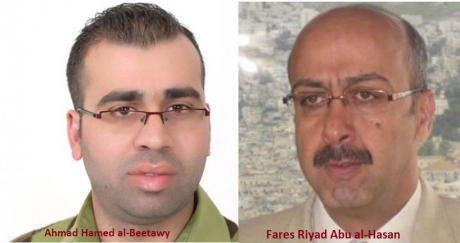 The Solidarity Foundation for Human Rights (SFHR) has reported that Israeli soldiers kidnapped, on Tuesday at dawn, its lawyer and its researcher, after the army violently invaded their homes in the northern West Bank city of Nablus.
The foundation said dozens of soldiers invaded the home of SFHR lawyer Abu al-Hasan, in the Rojeeb Housing Projects area, east of Nablus, and kidnapped him after violently searching his home causing property damage.
Soldiers detonated the door of Abu al-Hasan’s home, invading the place and terrifying the family.
They also interrogated Abu al-Hasan’s father for more than an hour, and confiscated documents and files. Abu al-Hasan was moved to the Petah Tikva interrogation facility.
It added that the soldiers also broke into several nearby homes, violently searched them and ransacked their property and belongings, and used their rooftops as monitoring towers during the invasion.
Meanwhile, soldiers also detonated the front door of the home of SFHR researcher Ahmad al-Beetawy, and invaded the property in the Dahia area, south of Nablus, searched it for more than an hour and kidnapped him.
His brother said the soldiers also invaded the home of their mother, in the same neighborhood, and violently searched it. Al-Beetway defends the rights of Palestinian political prisoners, illegally held by Israel.
The foundation said that the soldiers also invaded its office in al-Isra’ building, in the center of Nablus city, and confiscated computers and files after violently searching the property.
Related articles


Israeli Knesset passes bill differentiating Christian Palestinians from 1948 Palestinian community
By Yazan al-Saadi | Al-Akhbar | February 25, 2014
Israel’s legislative branch, known as the Knesset, passed a controversial bill into law that defines 1948 Christian Palestinians as “non-Arabs”, Israeli media reported.
The new law – passed on Monday with a vote of 31 in favor and 6 against – for the first time differentiates Christian Palestinians from the rest of the Palestinian community, who had survived the 1947-48 ethnic cleansing by Zionist forces, and remained within the 1948 territories.
“This is a historic law. It’s the first time there is separate representation for Christians,” Likud Beytenu coalition chairman Yariv Levin, who proposed the bill, was quoted by the Israeli press prior to the the vote.
“Soon we’ll expand on this and give [Christians] all the separate representation they deserve,” he added.
Previously, Levin justified the bill as “an important, historic step that could introduce balance to the State of Israel, and connect us [Jews] with the Christians, I am careful not to refer to them as Arabs, because they are not Arabs.”
“We and the Christians have a lot in common. They’re our natural allies, a counterweight to the Muslims that want to destroy the country from within… We will use an iron hand and demonstrate zero tolerance of Arabs who tend to identify with the terror of the Palestinian state,” he added. According to reports, the law will enforce a separate representation on the Advisory Committee for Equal Opportunity within the Employment Commission, by extending the number of panel members to ten, adding specific seats for the ultra-Orthodox, Druze, Christian, Circassian populations, and others.
‘Palestinian Christians are Arabs’
CIA statistics put the Arab Christian population living in Occupied Palestine at around 123,000. These people will be directly affected by the new law.
Arab members of the Knesset unanimously condemned the bill as a “racist” act and a “divide-and-conquer” tactic.
“Colonialists try to separate groups of natives. The prime example of this is South Africa,” MK Hanin Zoabi of the Arab political party, Balad, reportedly said to the media after the vote.
“We are the natives here and we have a clear identity, [we] are Palestinians, part of the Arab nation, and your law will fail. Part of the Zionist project is to oppress our identity, but I have the right to speak in the name of Palestinians.”
Khalid Musmar, an official for the Palestinian National Council, told Al-Akhbar,“The Palestinian Christian community will rebuke this before anyone else. The Palestinian Christians are Arab despite the wishes of anyone in the Knesset or otherwise.”
“They have always said they were Arabs and have fought side-by-side with their Muslim brethren, from the times of the Crusades to today. The Palestinian community, in all it’s colors and creeds, is a unified Arab community confronting occupation. They are struggling for a Palestinian nation with Jerusalem as it’s capital. This will not change by the acts of Knesset or anyone else,” the official said.
“The community in 1948 will not remain quiet. This is a major move by the forces of occupation and colonization, and there will be mobilizations just like how we saw the creation and continuation of Land Day protests within 1948 lands. We will see protests in the future.”
“If [Israel] wants to do right to the Palestinians in general and Christians in particular,” said Jumana, from the Galilee region of northern occupied Palestine, during a separate conversation with Al-Akhbar, “let them approve the return of the refugees and internally displaced Palestinians from the two Christian villages of Ekrith and Birem, who already have a court ruling allowing them to return to their destroyed villages.”
She added that this law comes at a time when “the government is attempting to make the drafting to the Israeli Army obligatory to Palestinian Christians, [and] this is completely not acceptable, since this is their way of dividing the Palestinian minority and fragmenting the community as a whole.”
In a similar vein, a 1948 Palestinian Christian from Nazareth, who requested anonymity due to the sensitivity of the matter, told Al-Akhbar, “I think [Levin’s comments] are outrageous and untrue. It is part of Israel’s broader attempt to segment and fragmentize the Palestinian community from one another inside Israel. Other examples of this are with the Bedouins and the Druze, and this is part of [Israel’s] attempt to break up what is a cohesive community. It won’t work.”
“I see myself as an Arab and so do other Palestinian Christians. [Levin’s] logic only reaffirms the agenda to separate and break-up minorities within minorities,” she added.
“There should be more representation of Palestinians in Israel in general. Christian Palestinians are just as repressed as Muslims.”
Assad: Syria Seeks to Build National Dialogue, Coalitions
Al-Manar | February 25, 2014
Syrian President Bashar al-Assad stressed Monday the importance of dialogue among the state’s parties in order to reach a sound political environment.
During his meeting with Baath party figures – Damascus branch, Assad pointed out to the importance of the Syrian capital Damascus, which is featured by preserving the Islamic and Christian inheritance together, thus presenting a model of modern openness.
“Damascus played a major role in Syria’s steadfastness during a three-year crisis,” the Syrian President indicated.
He also stressed the need for dialogue and effective and constructive communication with the new parties in Syria, in order to identify future mechanisms of sound communication.
“We are facing great challenges emerged by the crisis and the first one is to confront the extremist ideology which tries to penetrate the society,” he stated.
“We also have unprecedented serious intellectual vacuum… Our duty is to deal with it,” Assad went on to say, adding that “Without dialogue we cannot develop neither the party (Baath) nor the country.”
President Assad assured that the popular support of terrorism is shrinking while the reconciliation circle is being widened, and it is the most effective way to fight off the project of defeating Syria.”
Zionism in the Age of the Dictators
By Lenni Brenner | CounterPunch | February 24, 2014
I’m American, but my first book, Zionism in the Age of the Dictators (now finally back in print), was published in Britain. American houses wouldn’t risk selling an expose of Zionist collaboration with Hitler. Then I found pro and anti-Zionist books published by Croom Helm Ltd. I went to them. They gave me an ultimatum: “You are about to write the most controversial book imaginable…. So there can be no mistakes. You must send us a photocopy of every document you quote.” It was published in 1983.
While British leftists organized a lecture tour for me, I went to Israel. By luck, that visit ultimately generated international attention to the book.
When Menachem Begin retired and Yitzhak Shamir became Israel’s 2nd Likud Prime Minister, I had a Palestinian English-language weekly publish a translation of his 1940-41 outfit’s offer to go to war on Hitler’s side. An Israeli newspaper questioned him about it. I went on to London and there, in the 21 October Times, was the PM’s lie:
“Shamir… denied that he had any part in the efforts by Mr. Abraham Stern… to establish contact with the Nazis and Italian Fascists.
‘There was a plan to turn to Italy for help and to make contact with Germany on the assumption that these could bring about a massive Jewish immigration to Palestine. I opposed this… but I did join Lehi after the idea of contacts with the Axis countries was dropped.’”
The “Proposal of the National Military Organization (Irgun Zvai Leumi) Concerning the Solution of the Jewish Question in Europe and the Participation of the NMO in the War on the side of Germany” was found post-war in Germany’s Turkish embassy. The Sternists declared that
“The establishment of the historical Jewish state on a national and totalitarian basis, and bound by a treaty with the German Reich, would be in the interest of a maintained and strengthened future German position of power in the Near East.
Proceeding from these considerations, the NMO in Palestine, under the condition the above-mentioned national aspirations of the Israeli freedom movement are recognized on the side of the German Reich, offers to actively take part in the war on Germany’s side.”
I went to The Times with the German original, the translation and a letter. “You sure didn’t make this up in German!” My letter appeared on 4 November:
“Away from my files, I cannot be certain exactly when in 1940 Shamir joined the group. But in any case, isn’t he confessing that he knowingly joined an organization of traitors which had offered to ally itself to the archenemy of the Jews? Nor can there be any doubt that he joined up with Stern before December 1941, when the Sternists tried to send Nathan Yallin-Mor to Turkey to contact the German ambassador there with the same proposal.”
I relocated evidence that Shamir was a ‘Stern Gang’ founder and presented it to The Times. He organized their 1944 assassination of Britain’s Middle East High Commissioner in Cairo. In 1963, Gerold Frank published The Deed about it.
Stern split off from David Raziel’s Irgun in September 1940. Frank wrote up a meeting where “Yizernitsky” (Shamir’s born-name)….“spoke tersely, summing up the reason, behind Stern’s decision decision to walk out of the Irgun.” One of the assassins “could not forget Yizernitsky’s ‘fire and powder’ remark in the days immediately following the Raziel-Stern split.”
This led to Edward Mortimer reviewing the book in the 11 February 1984 Times:
“Who told a Berlin audience in March 1912 that “each country can absorb only a limited number of Jews, if she doesn’t want disorders in her stomach. Germany already has too many Jews”?
No, not Adolf Hitler but Chaim Weizmann, later president of the World Zionist Organization and later still the first president of the state of Israel….
Zionism itself encouraged and exploited self-hatred in the Diaspora. It started from the assumption that anti-Semitism was inevitable and even in a sense justified so long as Jews were outside the land of Israel.
It is true that only an extreme lunatic fringe of Zionism went so far as to offer to join the war on Germany’s side in 1941, in the hope of establishing “the historical Jewish state on a national and totalitarian basis, and bound by a treaty with the German Reich.” Unfortunately this was the group which the present Prime Minister of Israel chose to join….
Mr Brenner is able to cite numerous cases where Zionists collaborated with anti-Semitic regimes, including Hitler’s; he is careful also to put on record the opposition to such policies within the Zionist movement.
In retrospect these activities have been defended as a distasteful but necessary expedient to save Jewish lives. But Brenner shows that most of the time this aim was secondary. The Zionist leaders wanted to help young, skilled and able-bodied Jews to emigrate to Palestine. They were never in the forefront of the struggle against fascism in Europe.”
Indeed the Stern Gang weren’t the only Zionist collaborators. On June 21, 1933 the Zionistische Vereinigung fur Deutschland, the German Zionist Federation, appealed to the Nazis:
“May we therefore be permitted to present our views, which, in our opinion, make possible a solution in keeping with the principles of the new German State of National Awakening…. because we, too, are against mixed marriage and are for maintaining the purity of the Jewish group….
For its practical aims, Zionism hopes to be able to win the collaboration even of a government fundamentally hostile to Jews…. Boycott propaganda – such as is currently being carried on against Germany in many ways – is in essence un-Zionist, because Zionism wants not to do battle but to convince and to build.”
The WZO made the Ha’ Avara (Transfer) agreement in 1933. The Nazis ‘taxed’ money leaving Germany, but the rate was lowest for German Zionists buying Nazi goods which the WZO sold in Palestine and the Middle East. In 1935 Weizmann explained that the WZO “should concern ourselves with the constructive solution of the German question through the transfer of the Jewish youth from Germany to Palestine, rather than with the question of equal rights of Jews in Germany.”
The WZO opposed anti-Nazi boycott movements. Fritz Reichart, the Gestapo’s Palestine agent, wrote to his headquarters:
“The London Boycott Conference was torpedoed from Tel Aviv be- cause the head of the Transfer in Palestine, in close contact with the consulate in Jerusalem, sent cables to London. Our main function here is to prevent, from Palestine, the unification of world Jewry on a basis hostile to Germany.”
The ZVfD asked Baron von Mildenstein of the Nazi SS elite corp to write pro-Zionist articles in the Nazi press. He visited Palestine for six months as the ZVfD’s guest and wrote 12 articles for Der Angriff (The Assault), the leading Nazi propaganda organ, about how Jewish soil under a Jew’s feet “reformed him and his kind in a decade. This new Jew will be a new people.”
To commemorate the Baron’s expedition, Propaganda Minister Goebbels had a medal struck: the Zionist star and EIN NAZI FÄHRT NACH PALÄSTINA — A Nazi Travels to Palestine — on one side, the swastika UND ERZÄHLT DAVON IM Angriff – And tells about it in Angriff – on the other.
The medal is on the front cover of the new edition of my book.
The WZO tried to extend its relationship with Nazism. On February 26, 1937, Feival Polkes of the Haganah Labor Zionist militia, met with Adolf Eichmann in Berlin. The report on their negotiations was in SS files found after the war:
“Polkes…. noted that the Haganah’s goal is to reach, as soon as possible, a Jewish majority in Palestine…. he declared himself willing to work for Germany in the form of providing intelligence as long as this does not oppose his own political goals. Among other things he would support German foreign policy in the Near East. He would try to find oil sources for the German Reich without affecting British spheres of interest if the German monetary regulations were eased for Jewish emigrants to Palestine.”
Eichmann and another SS man went to Palestine on October 2nd. Polkes took them to a kibbutz, a Labor Zionist co-op farm. Two days later the British realized that the visitors also contacted Reichart, known to be a Gestapo agent, and they expelled them to Egypt. Polkes met them in Cairo. He passed on two pieces of “intelligence”:
“The Pan-Islamic World Congress convening in Berlin is in direct contact with two pro-Soviet Arab leaders: Emir Shekib Arslan and Emir Adil Arslan…. The illegal Communist broadcasting station whose transmission to Germany is particularly strong, is, according to Polkes’ statement, assembled on a lorry that drives along the German-Luxembourg border when transmission is on the air.”
Later, Eichmann, hiding in Argentina, taped a look-back at his career. The holocaust’s prime organizer waxed nostalgic about Palestine:
“I did see enough to be very impressed by the way the Jewish colonists were building up their land. I admired their desperate will to live, the more so since I was myself an idealist. In the years that followed I often said to Jews with whom I had dealings that, had I been a Jew, I would have been a fanatical Zionist. I could not imagine being anything else. In fact, I would have been the most ardent Zionist imaginable.”
MUSSOLINI: “YOUR FASCIST, JABOTINSKY”
Most American pro-Zionists, Jew or gentile, know little Zionist history. Most can’t identify Vladimir Jabotinsky (1880 – 1940) even though he was the founder of the Zionist-Revisionist movement, the precursor of the Likud Party, and Prime Minister Netanyahu’s father was his secretary.
In 1917 Jabotinsky organized a Jewish Legion to help the British take Palestine from Ottoman Turkey. When Britain declared it the “Jewish national home,” Palestine included today’s Jordan. But in 1921 London separated it from Palestine and gave it to the son of Britain’s puppet Sharif of Mecca. As no Zionists lived there, WZO leaders accepted the loss. But Jabotinsky insisted that the WZO had to “revise” its policy. Britain giving part of Palestine to an Arab would inspire Palestinians to struggle on until London completely abandoned Zionism. “One side of the Jordan is ours – and so is the other.” So goes Shtei Gadot, a song identified with Revisionism from 1923, when Jabotinsky founded the Betar youth movement, until well after the 1948 creation of Israel.
In 1923 he wrote Revisionism’s Bible, an article, “The Iron Wall (We and the Arabs)”:
“Every native population in the world resists colonists as long as it has the slightest hope of being able to rid itself of the danger of being colonized. That is what the Arabs in Palestine are doing, and what they will persist in doing as long as there remains a solitary spark of hope that they will be able to prevent the transformation of “Palestine” into the “Land of Israel.”…. Zionist colonization must either stop, or else proceed regardless of the native population. This means that it can proceed and develop only under the protection of a power that is independent of the native population –- behind an iron wall, which the native population cannot breach.”
Jabotinsky looked for a new imperial protector committed to a ruthless policy towards Arabs. Italy was appealing with its bloodthirsty Libyan colonialism. But he had been a student in Italy and couldn’t see anything wrong with the liberal and aristocratic traditions that Mussolini repudiated. In 1926 he sneered at Fascism:
“There is today a country where ‘programs’ have been replaced by the word of one man… Italy; the system is called Fascism: to give their prophet a title, they had to coin a new term—‘Duce’—which is a translation of that most absurd of all English words—‘leader’. Buffaloes follow a leader. Civilized men have no leaders.”
But for Ex-Labour Zionists turned Revisionist, ex-socialist Mussolini was a hero. At the 1932 Revisionist World Conference, Abba Achimeir and Wolfgang von Weisl proposed Jabotinsky as their Duce. He refused but, without abandoning liberal rhetoric, he incorporated Mussolini’s concepts into his ideology.
Jabotinsky proposed quitting the WZO, but their World Union Executive saw no gain in splitting. He took personal control of the movement and let the ranks choose between him and the Executive in a plebiscite. He wrote a letter: “The time has apparently come when there must be a single, principal controller in the movement, a ‘leader’, though I still hate the word. All right, if there must be one, there will be one.”
Jabotinsky set up the New Zionist Organization. Achimeir, its Palestine leader (Britain barred Jabotinsky from Palestine) ran his Yomen shel Fascisti (Diary of a Fascist) in their paper. Von Weisl, NZO’s Financial Director, told a newspaper that “He personally was a supporter of Fascism, and he rejoiced at the victory of Fascist Italy in Abyssinia as a triumph of the White races against the Black.”
In 1934 Mussolini authorized a Betar squadron at his maritime academy. In 1935 he met a rabbi and hailed “your fascist, Jabotinsky.” Mussolini reviewed the squadron in 1936.
The orientation towards Italy ended in a debacle. The Spanish civil war persuaded Mussolini to unite with Hitler to ward off worker revolutions. It was impossible to be Hitler’s ally and have Jews in his own party. He expelled Jews from the party and geared up for war. The Revisionists declared that they were wrong for the right reasons:
“For years we have warned the Jews not to insult the fascist regime in Italy. Let us be frank before we accuse others of the recent anti-Jewish laws in Italy; why not first accuse our own radical groups who are responsible for what happened.”
Stern and Shamir’s “historical Jewish state on a national and totalitarian basis” evolved from this fanaticism.
“THERE IS NOT THE REMOTEST CHANCE OF WAR”
Shmuel Merlin, NZO’s Secretary-General, later explained that in January 1933 Jabotinsky “thought that Hitler would either reform or yield to the pressure of the Junkers and Big Business.” But by March he called for an anti-Nazi boycott. On June 16 Revisionists assassinated Labor Zionist Chaim Arlosoroff who negotiated the Ha’Avara pact with Berlin.
Two days later the British police brought Revisionists Avraham Stavsky and Zvi Rosenblatt in for an identity parade. Arlosoroff’s widow recognized Stavsky. Rosenblatt was cleared on a legal technicality but Stavsky was sentenced to hang. Later the Palestine Court of Appeal acquitted him on technicalities but the Chief Justice was displeased: “in England… the conviction would have to stand.” In 1944 a ballistics expert discovered the gun that killed Arlosoroff was used in the Cairo assassination by the Stern Gang splitters from Jabotinsky’s organization.
There’s no evidence that Jabotinsky ordered Arlosoroff killed but he insisted that Revisionists didn’t commit the crime. Many in the WZO opposed Ha’Avara, but they wouldn’t unite with Arlosoroff’s murderers in anti-Nazi actions. Alone they accomplished nothing and inevitably Revisionist policies re Germany became surreal.
Even as they demonstrated against Hitler throughout Europe, their Staatzionistische Organisation and its leader, George Kareski, were Hitler’s favorite Zionists. On April 13, 1935, the Gestapo declared that State Zionism would receive “permission to let its members… wear uniforms indoors… because the State Zionists have proven to be the organization which had tried in any way, even illegally, to bring its members to Palestine, and… meets half-way the intention of the Reich Government to remove the Jews from Germany.”
The scandalized NZO ranks compelled a resolution that, under the circumstances, there was no German Revisionist movement and Jabotinsky called on him to deny any Nazi connection. However in 1936 Kareski was his go-between with the German publishing house holding the copyright to one of his books, and the Fascists around von Weisl remained in contact with him.
In 1937 Kareski went to Palestine. German Jews discovered him and chased him through the streets until police rescued him. I’d like to report that he died alone and hated, but in 1947 he was appointed chairman of a Revisionist health fund.
In 1939, a week before Hitler invaded Poland, Jabotinsky insisted that “There is not the remotest chance of war.” He planned to invade Palestine, landing a boatload of Betarim on Tel Aviv’s beach while the Irgun seized Government House in Jerusalem, and a provisional Jewish government was proclaimed abroad. After his capture or death, it would operate as a government-in-exile.
His model was the 1916 rising in Ireland. Its leaders were executed, but their martyrdom inspired a revolutionary movement. However it is impossible to see how an invasion could have convinced Jews in Palestine, mostly his WZO enemies, to rise up after his defeat. The plan’s fantasy was revealed on the night of August 31-September 1. The British arrested the Irgun command as they debated whether to take part in the scheme and, within hours, Hitler started the war Jabotinsky insisted wouldn’t happen.
The December 4, 1948 New York Times ran a letter by Albert Einstein and other Jews re Menachem Begin’s visit to the US, exposing his Herut Party which evolved into today’s Likud. Given that Achimeir and von Weisl wrote for Herut’s newspaper, Einstein’s evaluation of Begin’s Revisionist commitment bears quotation:
“Among the most disturbing political phenomena of our time is the emergence in the newly created state of Israel of the ‘Freedom Party’ (Tnuat HaHerut), a political party closely akin in its organization, methods, political philosophy and social appeal to the Nazi and Fascist parties…. They have preached an admixture of ultra-nationalism, religious mysticism and racial superiority… it is imperative that the truth about Mr Begin and his movement be made known in this country.”
Indeed Zionist Revisionist history must be known here. Read Zionism In The Age Of The Dictators and then convince other Americans to read it.
Lenni Brenner can be contacted at BrennerL21@aol.com.
Violence and Vulnerability in Buenaventura, the Dark Side of Development
By Margaret Boehme | Red Hot Burning Peace | February 24, 2014
From the tenth-floor balcony of our hotel in Buenaventura, we sit with community leader Miguel Duarte and watch as the sunset over the Pacific Ocean streaks the sky with peach and mauve before fading to a shroud of lavender-gray and darkness. Below us, teenage girls chase a soccer ball. A few hundred yards away, a patch of the island is covered with tree tops like the heads of broccoli. “Take a photo of that island,” says Duarte, pointing at the tree line. “There are thousands of dead bodies buried on it.”
“We need a commission from the Attorney General’s office to count the bodies,” he continues. “The island is controlled by paramilitaries.”
The violence in Buenaventura is staggering, yet reliable statistics are hard to attain: official documentation is lacking and it’s left to community leaders, like 18-year-old Jesús, to try to compile the data independently. At our meeting, he pulls out his notebook and begins reading off his handwritten list of victims from a recent massacre. He gets to the end of his list, glances up, and says, “Children were cut up and heads were found in barrios Santa Monica and Campo Alegro. Last night Alberto’s cousin was killed in a confrontation. That one made the newspaper.”
According to a report issued in January 2014, the city sees two-to-three murders and three-to-six forced disappearances daily. In November 2013 alone, fighting between different armed groups displaced 2,500 families in Buenaventura.
“We’re convinced of one thing,” says Duarte. “This pressure is so that people leave.”
On the heels of shoot-outs in waterfront neighborhoods, city officials arrive and ask residents if they’re ready to sign documents in which they agree to vacate the zone. On February 5 and 6, local security forces staged an elaborately orchestrated tsunami drill for neighborhoods near the port, with armed men blocking off streets and redirecting traffic into the night. According to Colombian Process of Black Communities (PCN), the exercise was yet another effort to brainwash Buenaventura’s Bajamar residents into believing that it’s not safe to live in the area and that they should be ready to evacuate at a moment’s notice.
Many point out that Buenaventura is dangerous for people who live in neighborhoods slated for commercial development but that, paradoxically, these same areas are safe for tourists. Below our hotel, a seafood fusion-sushi bar does slow business just yards from a neighborhood where armed groups recently did battle.
It’s Friday night in this commerce town, and clubs cater to weekend carousers with pockets full of pesos. Against a backdrop of giraffe-like cranes, half-built high-rises sprouting rebar, and a balmy breeze dispersing salsa beats, Duarte explains that 15 or 20 years ago, people began to talk about megaprojects in the region: port expansion, a cargo terminal, a tourist boardwalk, and an international airport in nearby Cali. Those conversations coincided with the beginning of the market liberalization process, as the port changed from public to private ownership.
Over the past 15 years, as the armed conflict arrived to nearby rural areas, many residents fled their farming communities at the outskirts of Buenaventura and settled in ocean-front neighborhoods near the city center, joining communities of Afro-Colombians who had arrived generations ago. In 2005, the FARC and Colombian military battled in Buenaventura. In 2006, paramilitaries entered the urban zone to protect businesses and terrorize the local population.
The first interurban displacement in Buenaventura—in which people fled from one neighborhood to another within the city—was in 2009. Today, ground zero for violent displacement coincides perfectly with zones marked for port expansion, a coal warehouse, a massive container storage area, and a tourist promenade. The violence, PCN states, is “part of the war strategy to control territory and clean out the zone to bring in projects.”
Residents in vulnerable neighborhoods are not opposed to the city’s economic growth, per se. But many feel that projects should benefit all people in the area, not bring prosperity to few while forcing misery on most.
That’s what Remedios’ husband, Eduardo believed. Their home in Caucana, about 45 minutes from the port, is along the road being widened to facilitate port expansion and accompanying projects in order to make Buenaventura competitive for Free Trade Agreement projects.
The old road is narrow, windy, and unpaved, meaning that it currently takes a truck seven or eight hours to make the trip from Buenaventura to Bugalagrande, a town along the Pan-American Highway. The new road will reduce the journey to about an hour.
Eduardo opposed the road expansion through their community because small children play there, and the project was contaminating their air and bad for people’s health. Remedios said, “He’d been looking to strengthen the community. He didn’t want to leave people in misery.” He’d been advocating for the community’s right to Free Prior and Informed Consent for new projects on their land guaranteed under Law 70, or the “Law of Black Communities.”
One morning Eduardo got a call that warned him he’d be killed if he ran in upcoming community council elections. For months he lived under the dark cloud of death threats, and on February 23, 2013, he was murdered. A year later, despite the efforts of his wife and other community members to seek justice, the government has made no progress in the investigation of his death.
“It has left me desperate, my kids too. They’re struggling at school. They don’t remember their vowels, just sleep, play, fight, scream….My children want to know why their father was murdered. They’re small, thinking bad thoughts, seeking vengeance. I’m asking for help because I don’t want my kids to become bad people.”
While we are in Buenaventura, a death threat is circulated, naming as military targets indigenous groups, campesinos, Marcha Patriotica members, protestors who block roads, and “guerilla-defending” NGOs—the name often used by paramilitaries to refer to NGOs that work on human rights issues.
Back on the tenth-floor balcony, a man whose community is surrounded by illegal armed groups looks out over the port, past the island of dead bodies, to the green lights blinking at the edge of the bay. He says, “If we don’t act quickly in Buenaventura, there will be more deaths.”
Margaret Boehme is a member of the Witness for Peace Colombia team based in Bogotá.
Related article

Iraq signs deal to buy arms from Iran: Report
Al-Akhbar | February 24, 2014
Iran has signed a deal to sell Iraq arms and ammunition worth $195 million, according to documents seen by Reuters – a move that would break a UN embargo on weapons sales by Tehran.
The agreement was reached at the end of November, the documents showed, just weeks after Iraq’s Prime Minister Nouri al-Maliki returned from Washington, where he lobbied the Obama administration for extra weapons to fight al Qaeda-linked militants.
Some in Washington are nervous about providing sensitive US military equipment to a country they worry is becoming too close to Iran. Several Iraqi lawmakers said Maliki had made the deal because he was fed up with delays to US arms deliveries.
A spokesman for the Iraqi prime minister would not confirm or deny the sale, but said such a deal would be understandable given Iraq’s current security troubles.
“We are launching a war against terrorism and we want to win this war. Nothing prevents us from buying arms and ammunition from any party and it’s only ammunition helping us to fight terrorists,” said the spokesman, Ali Musawi.
The Iranian government denied any knowledge of a deal to sell arms to Iraq. It would be the first official arms deal between Iran and Iraq’s government and it highlights the growing bond between them in the two years since the departure of US troops from Iraq.
One US official, told of Reuters’ findings, said such a deal could further complicate Washington’s approach to negotiating with Iran on easing international sanctions over its nuclear program, which the West suspects, with no evidence, is aimed at producing bombs. Iran says its aims are purely peaceful.
“If true, this would raise serious concerns,” the US official said. “Any transfer of arms from Iran to a third country is in direct violation of Iran’s obligations under UNSCR 1747.”
The official documents seen by Reuters showed that six of eight contracts were signed with Iran’s Defense Industries Organization to supply Iraq with light and medium arms, mortar launchers, ammunition for tanks as well as artillery and mortars.
A final two contracts were agreed to with the state-owned Iran Electronic Industries for night vision goggles, communications equipment and mortar guiding devices.
One of the contracts includes equipment to protect against chemical agents. An Iraqi army major with knowledge of procurement issues said that would include items such as gas masks and gloves, as well as injections. Baghdad has expressed fear the militants will use such agents against its forces.
Officials from the Iraqi and Iranian defense ministries signed the agreements, according to the documents. They did not list a timetable for deliveries and it was not possible to confirm whether they had taken place.
Maliki is engaged in a nearly two-month-old battle in western Iraq against al Qaeda-inspired militants and rebellious tribesmen. The prime minister has blamed the unrest in Anbar on the conflict spilling over from neighboring Syria.
One Western security official said US government experts believed an Iranian-Iraqi arms deal had been in the works for some time.
The growing friendship between the two countries is discomfiting for the United States.
Iran already supplies Baghdad with electricity and gas and reiterated an offer of military assistance in January.
The weapons purchases amount to a drop in the ocean for Iraq, which receives most of its arms from the United States and has also bought weapons and helicopters from Russia and other countries.
But they are politically significant as Maliki pursues a third term in office.
“We have here a political and not a military deal,” said Amman-based Iraq analyst Yahya al-Kubaisi from the Iraqi Center for Strategic Studies, a think tank filled with political opponents of the Iraqi government. “On one hand it is aimed at financing Iran, which is desperately in need of dollars, and on the other it is clearly aimed at winning Tehran’s support for Maliki’s third term.”
Three Iraqi lawmakers, who said they had knowledge of the deals, argued they were due to Maliki’s unhappiness with Washington’s response to his request to supply Iraq with arms and ammunition to fight militant groups during his visit late last year. Iraq has long complained the timetable for US weapons and aircraft delivery was too slow.
“The Americans were obviously dragging their feet from implementing the arms deals signed with Baghdad and under different pretexts, and that was a reason to get urgent shipments from Tehran,” said one of the lawmakers, who spoke on condition of anonymity due to the sensitivity of the subject.
The US government in recent months has delivered Hellfire missiles and surveillance drones to Iraq as part of its long-standing relationship with Baghdad, which it illegally invaded and occupied in 2003. It has also supplied Iraq with M1 Abrams tanks and is in process of delivering F-16 fighter jets.
Since fighting broke out in western Anbar in January, Washington has pushed to move ahead with the sale of 24 Apache attack helicopters to Iraq, which had been held up for months due to the concerns of US lawmakers about how Maliki would use them.
A lawmaker close to Maliki said the deal with Iran sent a message to Washington that threatening to withhold or delay arms purchases would no longer work.
“If you went to a shop to buy a toy and they refused to sell it to you, then as long as you have the cash, you can get it from the shop next door. It’s as simple as that,” said the official, who also asked to remain unnamed due to the sensitivity of the issue.
A senior Iraq army officer said Iran was the best source for quick shipments as some of the arms used by the Iraqi army are similar to those manufactured by Tehran, including assault weapons, mortars, artillery and tank ammunition. Iran even produces ammunition for US-made M-12 assault rifles, used by the Iraqi military.
(Reuters, Al-Akhbar)
Cop Harasses Photographer, Steals His Cellphone Battery And Attempts To Get YouTube To Pull The Incriminating Video
By Tim Cushing | Techdirt | February 24, 2014
Recording a police officer in public isn’t a crime. Well, it isn’t anything a cop can cite or arrest you for doing. Instead, a bunch of vague infractions are listed in hopes that something will stick and deter future citizen recordings.
Shawn Randall Thomas, a New York photographer, was approached by NYPD officer Efrain Rojas when he noticed Thomas filming another officer’s interaction with a turnstile jumper in a subway station. “Approached” is putting it mildly. Rojas confronted Thomas and got physical when the photographer refused to stop filming.
A New York City cop beat up and arrested a man for video recording him inside a subway station from 30 feet away Saturday night, walking up to him and getting in his face all while claiming the man was invading his personal space…
Thomas also obtained footage from another man who had recorded Rojas with his knees on Thomas’ back as he lay face down on the sidewalk just outside the sub station, seconds after Rojas had bashed his face into the pavement, busting his lip.
The injury was so bad that they had to transport him to the hospital twice during his 24-hour incarceration where doctors described him as a victim of assault.
As if the impromptu “use of force” wasn’t enough, Thomas was also charged with the following:
[Thomas] is still facing charges of resisting arrest, trespassing, disorderly conduct and obstructing government…
Here’s the video:
Note that Rojas had to come over to where Thomas was filming (nearly 30 feet away) in order to be “obstructed.” Note also that Thomas was filming in a public location, where it’s almost impossible to “trespass.” And note that the de rigueur “resisting arrest” is included only because Thomas didn’t apply his own handcuffs, hoof it to the nearest cruiser and slide into the back seat.
Here’s the description of “resisting arrest” from the arrest report itself:
Deponent further states that, at the above time and place, defendant did resist a lawful arrest by crossing defendants’ arm across defendant’s chest while deponent attempted to place defendant in handcuffs.
But it gets worse. Officer Rojas apparently grabbed Thomas’ cellphone and either deleted the footage or removed the battery in order to prevent Thomas from filming any further. (PINAC’s account of this event mentions “deletion” and Thomas using Recuva to recover the deleted footage, but the description of events only says Rojas took Thomas’ phone and pocketed the battery.) Thomas then took out his backup phone (a Blackberry) and tried to continue filming, at which point Rojas “knocked the phone out of [Thomas’] hand” and slammed him to the ground.
Either way, Rojas made an effort to prevent any further filming. The incident report filed by Rojas makes no mention of the fact that he seized a cellphone and either deleted footage or seized the phone’s battery. He also undermines the charge of trespassing by noting the area where Thomas was filming was public, which is contrary to Rojas’ filmed assertion that Thomas was “violating” his “personal space.”
Apparently, Rojas wasn’t done with feeling “violated” by Thomas’ filming. According to PINAC’s Facebook page, Officer Rojas filed a privacy complaint asking YouTube to remove the video. YouTube, fortunately, turned his request down, which means that Rojas will now have to deal with a recording that contradicts (or severely weakens) many of the claims he made in his sworn statements (the arrest report).
As PINAC and Thomas point out, the obstruction charge is especially baseless, given Thomas’ distance from the officers (approx. 30 feet compared to the report’s “close proximity”) and the fact that the entire situation appears to be completely under control by the time Officer Rojas arrives. Rojas seems to be the only cop there who viewed Thomas and his camera as somehow interfering with police business. Rojas then abandons his “partner” — who is presumably dealing with an actual criminal — solely to harass someone with a camera. If nothing else, Rojas has problems with prioritizing, giving the non-criminal (and protected) act of filming precedence over an actual law enforcement work.
Officer Rojas had multiple paths to take when he noticed a citizen filming him performing his public duties in a public place. Unfortunately, he decided to take the well-worn path and violate the rights of the photographer. And like many others, this decision has done nothing more than heap more negative publicity on the police department and the officer involved. The correct response — ignore it and do your job — still remains largely untested.
Related article

NSA bugs Merkel aides instead of chancellor
RT | February 24, 2014
In the wake of President Obama’s promise to stop spying on German Chancellor Angela Merkel, the US intelligence has switched its attention to her top government officials, a German newspaper reported.
Washington’s relations with Germany were strained last year after revelations that the US National Security Agency (NSA) was conducting mass surveillance in Germany and even tapped the mobile phone of Chancellor Merkel.
Facing the German outrage, President Barack Obama pledged that the US would stop spying on the leader of the European country, which is among the closest and most powerful allies of America.
After the promise was made, the NSA has stepped up surveillance of senior German officials, German newspaper Bild am Sonntag (BamS) reported on Sunday.
“We have had the order not to miss out on any information now that we are no longer able to monitor the chancellor’s communication directly,” it quoted a top NSA employee in Germany as saying.
BamS said the NSA had 297 employees stationed in Germany and was surveying 320 key individuals, most of them German decision-makers involved in politics and business.
Interior Minister Thomas de Maiziere is of particular interest to the US, the report said, because he is a close aide of Merkel, who seeks his advice on many issues and was rumored to be promoting his candidacy for the post of NATO secretary-general.
A spokesman for the German Interior Ministry told the newspaper it would not comment on the “allegations of unnamed individuals.”
Privacy issues are a very sensitive area in Germany, which holds the memory of invasive state surveillance practices by the Nazi government and later by the Communist government in the former East Germany.
Part of the outrage in Germany was caused by the allegation that US intelligence is using its surveillance capabilities not only to provide national security, but also to gain business advantage for American companies over their foreign competitors.
Berlin has been pushing for a ‘no-spying deal’ with the US for months, but so far with little success. Germany is also advocating the creation of a European computer network which would allow communication traffic not to pass through US-based servers and thus avoid the NSA tapping.
Planning for the Future of the BDS Movement
By Lawrence Davidson | To the Point Analyses | February 24, 2014
Part I – Norman Finkelstein’s Predictions
Much has been made of the rising influence of the Boycott, Divestment and Sanctions (BDS) movement against Israel. Indeed, there is a growing sense that the boycott power of civil society, particularly as it is manifesting itself in Europe, is on track to repeat history—to do to Israel what it once did to South Africa. Simultaneously, there is the persisting assumption that the latest effort at negotiating a settlement to the Israeli-Palestinian conflict, now being managed by Secretary of State Kerry, will go down the same ignoble path as all its predecessors.
However, not everyone agrees with this. In an interview given to the New Left Project, posted on-line on 11 January 2014, Norman Finkelstein (a well published critic of Israel) presents a different scenario. Finkelstein firmly believes that Kerry’s efforts will bear fruit and thus, before the end of President Obama’s term in office, Israel and the frankly unrepresentative Palestine Authority (PA) will come to terms.
Finkelstein explains that the classic debate over Israel’s illegal settlement blocs is over and, on this issue, Israel has won. It will be allowed to absorb the major settlements and thus render any Palestinian entity geographically dubious. The right of return so dear to Palestinian refugees will also be abandoned by the PA.
As a consequence, what is now being “negotiated” are the Israeli demand that the Palestinians recognize Israel as a “Jewish state” and the final status of the Jordan Valley. Finkelstein predicts that the first issue will be solved by describing Israel as “the state of the Jewish people and its citizens,” thus affording alleged legal protection to Arab-Israelis, and correspondingly, Palestine will become “the state of Palestinians and its citizens.” As to the Jordan Valley, Israel will slowly withdraw from the area. Finkelstein’s comment on this is that “Israel is adept at ‘conceding’ things to which it has no title in the first place.”
Finkelstein describes the “Palestinian leadership” as “irredeemably corrupt, incompetent and stupid.” He is only slightly kinder in his description of “Palestinian supporters abroad,” who, he says, are “not acting smartly.” He discounts boycott achievements in the U.S. and believes that those in Europe should be thought of as pressure tactics in support of Kerry’s efforts. Palestinian solidarity groups “carry on as if the Kerry process is a meaningless sideshow, something that can safely be ignored.” He thinks that this is a big mistake and that the possibility of real Palestinian self-determination will be gone before these supporters know what has hit them.
Part II – What If He Is Right?
Whatever one might think of Norman Finkelstein and his prognostications, it would be wise for those supporting BDS and Palestinian rights to consider how they might react if, against all odds, Secretary of State Kerry succeeds. So let’s think about this.
Such a settlement (at least as described by Finkelstein) would transform a good part of the West Bank’s occupied territory into “sovereign” Israeli land and set up a truncated Palestinian entity to which Palestinian refugees could “return.” Some might question whether there would remain a rationale for continuing to boycott Israel. The BDS movement could lose steam, at least temporarily. However, would it and its goals dissipate all together?
Probably not. What would ultimately save the BDS movement is Israel’s leadership itself, driven as they are by the inherently racist nature of the Zionist ideology. In other words, Israel’s policy makers can be safely relied upon to be true to character. Take the “politically moderate” finance minister Ya’ir Lapid ,who recently told an Israeli audience, “the issue [is] we need to get rid of the Palestinians. It threatens us, it chokes us.” As a result of this commonly shared attitude, the ethnic cleansing of Palestinians (and other non-Jews such as asylum seekers from East Africa) within Israel’s territory will continue apace. To put it another way, the 67-year-old effort to harass most non-Jewish citizens and residents out of the country will greatly intensify. The BDS campaign conducted against South Africa was a reaction against that society’s racist culture and policies. There is no reason why a powerful BDS movement cannot be sustained against Israel on the same basis.
Part III – What If He Is Wrong?
However, Norman Finkelstein may be wrong. It might be that the well-informed journalist Jonathan Cook is correct when he observes that “despite outward signs … [Israeli Prime Minister] Netanyahu [is] far from ready to compromise.” Cook claims that Netanyahu has “the bulk of the Israeli public behind him. … But most importantly he has a large chunk of the Israel’s security and economic establishment on his side too.” As a result, “These negotiations may not lead to an agreement, but they will mark a historic turning-point nonetheless. The delegitimization of Israel is truly under way, and the party doing most of the damage is the Israeli leadership itself.”
Part IV – The Fate of the Movement
I think that the BDS movement, and more generally the movement for Palestinian rights, should be able to survive either way. If Cook is right, not only survival but rapid growth of the movement can be expected. If Finkelstein is correct, the situation will prove more complicated. Cook is certainly right about one thing: we are at a crossroads. Where exactly the situation might lead us is not as clear as either he or Finkelstein make it out. This means that those who support the Palestinians no matter in what format should think about these possibilities. There is as yet lead time to formulate suitable contingencies. Let’s make the most of it.
Israeli army deploys new division in occupied Golan Heights: report
Al-Akhbar | February 24, 2014
The Israeli military deployed a new division to the border with Syria in a move described as “a significant boost to border security and stability,” the Jerusalem Post reported on Sunday.
The 210th Regional Bashan Division replaced the 36th Armor Division and the Har Dov sector, which have been stationed on the occupied Golan Heights for 40 years.
The 36th Armor Division will become “an all-purpose wartime division, designed to be sent to any combat arena, such as Lebanon or Gaza, to support other divisions,” while the 210th Regional Bashan Division, with it’s “enhanced capabilities” backed by air defense systems and intelligence operations, will also have the ability “to carry out a ground maneuver in enemy territory.”
The deployment, dubbed “historic” has been planned months in advance, spurred by the volatile events across the border in Syria particularly in terms of fears that “there is no Syrian state sovereignty in areas bordering the southern Golan Heights, and global jihadi forces are expected to get stronger in such areas,” the Jerusalem Post said, citing Israeli intelligence assessments.
“The military sources said they do not expect Syria to recover from the civil war and go back to being a sovereign state in the foreseeable future, and they described the conflict as a strategic change that will be studied in future textbooks on Middle East history. It is impossible to know how Syria will turn out,” the report said.
“The IDF’s map of territory controlled by the Assad regime and the rebels is changing continuously,” it added.
Furthermore, the Jerusalem Post report noted that the 210th Division will be assisted by “a recently created Combat Intelligence Collection battalion, active along the Syrian border, and by a new security fence complete with electro-optical surveillance means and radars.”
The 210th Division will also have the ability to conduct military operations without seeking higher approval.
Solar warnings, global warming and crimes against humanity
Malaysian Realist
We’ve been seeing a lot of unexpectedly cool weather across the world. While this may be explained by local phenomenon such as the Northeast Monsoon in Malaysia and the Polar Vortex in the USA, a longer term trend of worldwide cooling is headed our way.
I say this because the sun – the main source of light and heat for our planet – is approaching a combined low point in output. Solar activity rises and falls in different overlapping cycles, and the low points of several cycles will coincide in the near future:
A) 11-year Schwabe Cycle which had a minimum in 2008 and is due for the next minimum in 2019, then 2030. Even at its recent peak (2013) the sun had its lowest recorded activity in 200 years.
B) 87-year Gleissberg cycle which has a currently ongoing minimum period from 1997 – 2032, corresponding to the observed ‘lack of global warming’ (more on that later).
C) 210-year Suess cycle which has its next minimum predicted to be around 2040.
Hence, solar output will very likely drop to a substantial low around 2030 – 2040. This may sound pleasant for Malaysians used to sweltering heat, but it is really not a matter to be taken lightly. Previous lows such as the Year Without A Summer (1816) and the Little Ice Age (16th to 19th century) led to many deaths worldwide from crop failures, flooding, superstorms and freezing winters.
But what about the much-ballyhooed global warming, allegedly caused by increasing CO2 levels in the atmosphere? Won’t that more than offset the coming cooling, still dooming us all to a feverish Earth?
Regarding this matter, it is now a plainly accepted fact that there has been no global temperature rise in the past 25 years. This lack of warming is openly admitted by: NASA; The UK Met Office; the University of East Anglia Climatic Research Unit, as well as its former head Dr. Phil Jones (of the Climategate data manipulation controversy); Hans von Storch (Lead Author for Working Group I of the IPCC); James Lovelock (inventor of the Gaia Theory); and media entities the BBC, Forbes, Reuters, The Australian, The Economist, The New York Times, and The Wall Street Journal.
And this is despite CO2 levels having risen more than 13%, from 349 ppm in 1987 to 396ppm today. The central thesis of global warming theory – that rising CO2 levels will inexorably lead to rising global temperatures, followed by environmental catastrophe and massive loss of human life – is proven false.

(All the above are clearly and cleanly depicted by graphs, excerpts, citations and links in my collection at http://globalwarmingisunfactual.wordpress.com – as a public service.)
This is probably why anti-CO2 advocates now warn of ‘climate change’ instead. But pray tell, exactly what mechanism is there for CO2 to cause climate change if not by warming? The greenhouse effect has CO2 trapping solar heat and thus raising temperatures – as we have been warned ad nauseum by climate alarmists – so how does CO2 cause climate change when there is no warming?
Solar activity is a far larger driver of global temperature than CO2 levels, because after all, without the sun there would be no heat for greenhouse gases to trap in the first place. (Remember what I said about the Gleissberg cycle above?)
And why is any of this important to you and I? It matters because countless resources are being spent to meet the wrong challenges. Just think of all the time, energy, public attention and hard cash that have already been squandered on biofuel mandates, subsidies for solar panels and wind turbines, carbon caps and credits, bloated salaries of dignitaries, annual jet-setting climate conferences in posh five-star hotels… To say nothing of the lost opportunities and jobs (two jobs lost for every one ‘green’ job created in Spain, which now has 26% unemployment!). And most of the time it is the common working man, the taxpayer, you and I who foot the bill.
What if all this immense effort and expenditure had been put towards securing food and clean water for the impoverished (combined 11 million deaths/year)? Or fighting dengue and malaria (combined 1.222 million deaths/year)? Or preserving rivers, mangroves, rainforests and endangered species? Or preparing power grids for the increased demand that more severe winters will necessitate – the same power grids now crippled by shutting down reliable coal plants in favour of highly intermittent wind turbines?
In the face of such dire needs that can be met immediately and effectively, continuing to throw away precious money to ‘possibly, perhaps, maybe one day’ solve the non-problem of CO2 emissions is foolish, arrogant and arguably malevolent. To wit, the UN World Food Programme just announced that they are forced to scale back aid to some of the 870 million malnourished worldwide due to a $1 billion funding shortfall and the challenges of the ongoing Syrian crisis. To put this is context, a billion is a mere pittance next to the tens of billions already flushed away by attempted adherence to the Kyoto Protocol (€6.2 billion for just Germany in just 2005 alone!).
During the high times for global warmist doomsaying, sceptics and realists who questioned the unproven theories were baselessly slandered as ‘anti-science’, ‘deniers’, ‘schills for big oil’… Or even ‘war criminals’ deserving Nuremberg-style trials for their ‘crimes against humanity’!
Now that the tables are turned, just let it be known that it was not the sceptics who flushed massive amounts of global resources down the drain – while genuine human and environmental issues languished and withered in the empty shadow of global warming hysteria. Crimes against humanity, indeed.
Related articles


Featured Video
US Marines Seized Panama in 1903
or go to
Aletho News Archives – Video-Images
From the Archives
Precedents for Pizzagate
Marc Dutroux, Belgian pedophile, sadist, and serial killer with friends in high places
By Aedon Cassiel | Counter – Currents | December 23, 2016
To reiterate a point that should be clear to the more astute reader, my goal in this series (part 1, part 2) has not been to defend “Pizzagate” as such. My goal has been to defend the people who want to investigate it against specific accusations levied against them by people who think Pizzagate has revealed no intriguing information at all—for a specific reason, which I will be honing in and focusing on much more directly in this closing entry.
Whereas the mainstream critics of Pizzagate would have you believe that the dividing line is between paranoid conspiracy theorist followers of “fake news” and level-headed people who follow trustworthy news sources and rely on cold, hard reason to determine the truth, my goal has been to show that—whatever is or is not happening with Pizzagate itself—this framing of the issue is arrogant, insulting, and the product of extremely narrow tunnel vision. … continue
Blog Roll
 Aletho News
- The U.S. Sanctions Cuban Journalist For Reporting On The U.S. Blockade
- Israeli firms transform cars into intelligence devices: Reports
- Zionist-controlled companies to surveil British citizens
- THE CHILDREN GAMBIT
- A note on comment posting at Alethonews
- Trump stalls over Iran strike plan, Iran holds all the aces
- Zelensky’s Ceasefire for Elections is Strategic Gambit, Not Democratic Move
- US and Dutch pilots flying F-16s for Ukraine – Western media
- West’s Claims of Non-Involvement in Ukraine Conflict ‘Epitome of Hypocrisy’ – Expert
- Putin aide urges retaliation to ‘Western piracy’
- If Americans Knew
- Help end the injustice against Shadi
- Israel’s Favorite American President
- Israel’s “Yellow Line” Is a Death Trap for Palestinians. We Drove Into It.
- Why Israel’s expanding occupation in Syria presents a critical legal test
- Gaza is not a natural disaster. It is the victim of genocide enabled by global inaction
- Netanyahu’s plan to “end” US aid to Israel is to give even more money under a different name
- Israel ceased firing on Gaza for just 15 days of the “ceasefire” – Not a ceasefire Day 130
- In Gaza, “rats run over our faces” – Not a ceasefire Day 129
- Israel-backed border guards, GHF-linked aid – Not a ceasefire Day 128
- Israel battles Palestinian right of return, one Palestinian at a time – Not a ceasefire Day 127
- No Tricks Zone
- New Study: A 4°C Warmer Beaufort Sea Had ‘No Sea Ice’ 11,700 – 8200 Years Ago
- Unfudging The Data: Dutch Meteorological Institute Reinstates Early 20th Centruy Heat Waves It Had Erased Earlier
- German Gas Crisis…Chancellor Merz Allegedly Bans Gas Debate Ahead of Elections!
- Pollen Reconstructions Show The Last Glacial’s Warming Events Were Global, 10x Greater Than Modern
- Germany’s Natural Gas Storage Level Dwindles To Just 28%… Increasingly Critical
- New Study Rebuts The Assumption That Anthropogenic CO2 Molecules Have ‘Special’ Properties
- Climate Scientist Who Predicted End Of “Heavy Frost And Snow” Now Refuses Media Inquiries
- Polar Bear Numbers Rising And Health Improving In Areas With The Most Rapid Sea Ice Decline
- One Reason Only For Germany’s Heating Gas Crisis: Its Hardcore-Dumbass Energy Policy
- 130 Years Later: The CO2 Greenhouse Effect Is Still Only An Imaginary-World Thought Experiment
 Aletho News