Rights concerns in Colombia over leaked recording
Press TV – February 18, 2014
Human rights concerns have risen again in Colombia after an online recording of a military chief revealed his solidarity with a colonel jailed for alleged extrajudicial killings.
In the recording, published by leading news magazine Semana on Sunday, Colombia armed forces chief General Leonardo Barrero is heard telling colonel Robinson Gonzalez del Rio that prosecutors’ investigations into the extrajudicial killings is a “bunch of crap.”
The army chief also suggests that Gonzalez, who is facing criminal charges over the killing of two men in 2007, mount a counterattack to discredit prosecutors.
According to local reports, deputy joint chief General Javier Rey, resigned on Monday following the revelation by Semana’s weekend report. Barrero is also reported to have expressed regret over his remarks in the audio recording.
Colombian President Juan Manuel Santos said the serious allegations made in the Semana report need to be investigated. The government, however, said it was taking no immediate action against Barrero as he was not directly accused of corruption.
An earlier scandal on extrajudicial killings by Colombia military dubbed the “false positives scandal” broke in 2008.
According to media reports, hundreds of innocent civilians were slain and presented as guerrillas killed in battle by the country’s army in an effort to inflate body counts and receive promotions or other benefits.
Earlier this month, Semana reported that a military spy ring had eavesdropped for 15 months on emails and text messages of government negotiators involved in peace talks with leftist rebels.

Do We Care About People If They Live in Bahrain?
By David Swanson – February 17, 2014
I had a heck of a time making sense of the U.S. Navy’s new motto “A Global Force for Good” until I realized that it meant “We are a global force, and wherever we go we’re never leaving.”
For three years now people in the little island nation of Bahrain have been nonviolently protesting and demanding democratic reforms.
For three years now the king of Bahrain and his royal thugs have been shooting, kidnapping, torturing, imprisoning, and terrorizing nonviolent opponents. An opponent includes anyone speaking up for human rights or even “insulting” the king or his flag, which carries a sentence of 7 years in prison and a hefty fine.
For three years now, Saudi Arabia has been aiding the King of Bahrain in his crackdown on the people of Bahrain. A U.S. police chief named John Timoney, with a reputation for brutality earned in Miami and Philadelphia, was hired to help the Bahraini government intimidate and brutalize its population.
For three years now, the U.S. government has been tolerating the abuses committed by Bahrain and Saudi Arabia, continuing to sell weapons to Bahrain and Saudi Arabia, and continuing to dock the U.S. Navy’s Fifth Fleet in Bahrain. In fact, the U.S. military has recently announced big and pricey plans to expand its bases in Bahrain and add more ships.
For three years now, the U.S. government has continued to dump some $150 billion (with a ‘B’) each year into the U.S. Navy, a large portion of which goes for the maintenance of the Fifth Fleet in Bahrain. Withdrawing and disbanding that fleet would save that gargantuan expense. Retraining and re-employing in peaceful activities all personnel would cost a fraction of $150 billion. Providing aid to nonviolent pro-democracy activists in Bahrain would cost a tiny fraction of a fraction. Establishing a policy in the case of this one country of supporting human rights over brutal dictatorship would be, as they say, priceless. It would create a very useful model for a transformation of U.S. policy in numerous other nations as well.
Accurate and timely information about the horrors underway for the past three years in Bahrain are available online, via Western human rights groups, and via small back-page stories in U.S. newspapers. There’s little dispute over the general facts. Yet, there’s little outrage. There appears to have been no polling done of the U.S. public on the topic of Bahrain whatsoever, so it’s impossible to know what people think. But my impression is that most people have never heard of the place.
The U.S. government is not shouting about the need to bomb Bahrain to protect its people. Senators are not insisting on sanctions, sanctions, and more sanctions. There seems to be no crisis, no need for “intervention,” only the need to end an intervention we aren’t told about.
Which raises a tough question for people who give a damn. We’re able to reject a war on Iran or Syria when the question is raised on our televisions. But we can’t seem to stop drone strikes nobody tells us about. How do we create a question nobody is asking, about a topic nobody has heard of, and then answer it humanely and wisely? And how do we overcome the inevitable pretense that the Fifth Fleet serves some useful purpose, and that this purpose justifies a little teargas, a bit of torture, and some murders here and there?
The Fifth Fleet claims to be responsible for these nations: Afghanistan, Bahrain, Egypt, Iran, Iraq, Jordan, Kazakhstan, Kyrgyzstan, Lebanon, Oman, Pakistan, Qatar, Saudi Arabia, Syria, Tajikistan, Turkmenistan, United Arab Emirates, Uzbekistan, and Yemen. None of these nations have ships in U.S. waters claiming to be responsible for it. None of these nations’ peoples have indicated majority support for having the Fifth Fleet be responsible for them. Afghanistan has suffered under U.S. occupation for over a decade, with chaos and tyranny to follow. Egypt’s thugs are rising anew with steady U.S. support, money, and weaponry. Iran has threatened and attacked no other nation for centuries, has never had a nuclear weapons program, spends less than 1% what the U.S. does on its military, and moves away from democracy with every U.S. threat. Why not leave Iran alone? Iraq, Jordan, Qatar, Saudi Arabia, Yemen, and others of these nations, including Bahrain, suffer under the rule of U.S.-backed governments. One might reasonably add Israel and the lands it occupies to the list, even if the Navy cannot bring itself to mention them. Yemen and Pakistan suffer under the constant buzzing and missile launching of U.S. drones, which are creating far more enemies than they kill. In fact, not a single nation falling under the past 19 years of benevolent “responsibility” of the Fifth Fleet has clearly benefited in any way.
At a third annual conference recently held in Lebanon, Bahraini activists laid out a plan of action. It includes building international connections with people who care and are willing to help. It includes supporting the International Day to End Impunity on November 23rd. It includes pushing Bahrain to join the ICC, although that may be of little value until the U.S. can be persuaded to do the same and until the United Nations can be democratized. The plan includes calls for an end to weapons sales and the initiation of sanctions against the Bahraini government (not its people).
Those would certainly be good steps. The first question in my mind remains: do the people in the nation that screams most loudly about “freedom” and does the most to support its repression wherever deemed useful, care?
Qatar World Cup toll: ‘Hundreds’ of Indian migrant workers dead in two years
RT | February 17, 2014
More than 450 Indian migrant workers in Qatar have died in the last two years, media revealed on Monday. Another upcoming report will show that 400 Nepalese have lost their lives scrambling to get the Gulf state ready for the 2022 World cup.
At least 237 Indian migrants lost their lives in Qatar in 2012 and another 218 in 2013 up to December 5, AFP reported on Monday, citing figures received via a Right to Information request filed at the Indian embassy in Qatar.
On average, 20 Indian migrants die per month in Qatar. August last year was the most deadly month on record, with 27 fatalities being reported.
The Indian embassy did not provide information regarding the causes of death or where they occurred. It also declined to disclose any correspondence between the diplomatic mission and the Indian government regarding the treatment of its nationals in the Gulf state.
Meanwhile, figures set to be released later this week say that 400 Nepalese workers have died at building sites since construction for the World Cup 2022 got underway in 2010, the Guardian reports. The Guardian did not state when the deaths occurred, but said that the Pravasi Nepali Co-ordination Committee, a respected human rights organization, which reached its figure using official sources in Doha, would release more information in the coming days.
There were 500,000 Indians estimated to be in Qatar at the end of 2012 – roughly 26 percent of Qatar’s population. Nepalese workers comprise approximately 20 percent of Qatar’s migrant workforce and 16 percent of the total population. The total death toll stemming from the country’s World Cup scramble could in fact be higher, as other migrant groups are also present in the country.
As of January 2012, Bangladeshis, Pakistanis and Sri Lankans together accounted for 14 percent of the emirate’s population, according to US State Department figures.
On February 11, Qatar issued detailed guidelines intended to protect the country’s massive expatriate community from exploitation and stem the intensified international criticism on its human rights record.
Activists, however, believe the number of dead could swell to 4,000 by the time the 2022 World Cup kicks off.
On Thursday, FIFA said there was little it could do to alleviate the slave labor conditions migrants are toiling under in the country.
According to German paper Die Welt, however, a source identified as a “senior FIFA employee” said moving the World Cup to another country is “a serious option” despite public claims to the contrary. Last July, Theo Zwanziger, a current member of FIFA’s executive committee, said the decision to award Qatar the 2022 event was a “blatant mistake.”
In September, The United Nations condemned Qatar for failing to comply with an international convention banning the use of forced labor.
Related articles
CIA seeks new bases for deadly drones
Press TV – February 17, 2014
The US Central Intelligence Agency is seeking new drone bases in unnamed countries in Central Asia, fearing the full withdrawal of US troops from Afghanistan would affect the targeted killings in neighboring Pakistan.
The spy agency asserts that if the US fails to sign a bilateral security deal with Afghanistan and secure an enduring military presence there, it would not be able to fly drones from its Afghan bases because drone operations are covert and need US military protection.
The security deal, which Washington says “ought to be signed” and is not renegotiable, could allow thousands of US troops to stay in Afghanistan beyond 2014.
However, despite pressures from the White House and Congress, Afghan President Hamid Karzai has so far refused to sign the deal and the US intelligence community is hoping that the next Afghan president will agree to sign it.
Worried that its drone killings can become a casualty of strained relations between Kabul and Washington, the CIA is reportedly making contingency plans to use bases in other countries.
“There are contingency plans for alternatives in the north,” an unnamed US official briefed on the matter told the Los Angeles Times without specifying the countries.
According to Brian Glyn Williams, a University of Massachusetts professor, the CIA and the Pentagon used to fly drones from an airbase in Uzbekistan until the US was evicted in 2005.
Michael Nagata, commander of US special operations in the Middle East and Central Asia, also traveled last month to Tajikistan, which is Afghanistan’s northern neighbor, to discuss “issues of bilateral security cooperation” and “continued military cooperation.”
Meanwhile, US officials say a new jet-powered drone, called Avenger, which will be able to “get to ‘hot’ targets in Pakistan much faster,” could soon be flying from bases outside Afghanistan.
The CIA is in charge of drone strikes in Pakistan since the country is not officially a war zone and the CIA’s program is covert.
US President Barack Obama has already stated that the responsibility for Washington’s deadly drone attacks could gradually shift from the CIA to the Pentagon. However, the idea of putting the US military in charge of drone attacks is not favored by US lawmakers.
CRISES IN CLIMATOLOGY
By Donald C. Morton | Watts Up With That? | February 17, 2014
Herzberg Program in Astronomy and Astrophysics, National Research Council of Canada
ABSTRACT
The Report of the Intergovernmental Panel on Climate Change released in September 2013 continues the pattern of previous ones raising alarm about a warming earth due to anthropogenic greenhouse gases. This paper identifies six problems with this conclusion – the mismatch of the model predictions with the temperature observations, the assumption of positive feedback, possible solar effects, the use of a global temperature, chaos in climate, and the rejection of any skepticism.
THIS IS AN ASTROPHYSICIST’S VIEW OF CURRENT CLIMATOLOGY. I WELCOME CRITICAL COMMENTS.
1. INTRODUCTION
Many climatologists have been telling us that the environment of the earth is in serious danger of overheating caused by the human generation of greenhouse gases since the Industrial Revolution. Carbon dioxide (CO2) is mainly to blame, but methane (CH4), nitrous oxide (N2O) and certain chlorofluorocarbons also contribute.
“As expected, the main message is still the same: the evidence is very clear that the world is warming, and that human activities are the main cause. Natural changes and fluctuations do occur but they are relatively small.” – John Shepard in the United Kingdom, 2013 Sep 27 for the Royal Society.
“We can no longer ignore the facts: Global warming is unequivocal, it is caused by us and its consequences will be profound. But that doesn’t mean we can’t solve it.” -Andrew Weaver in Canada, 2013 Sep 28 in the Globe and Mail.
“We know without a doubt that gases we are adding to the air have caused a planetary energy imbalance and global warming, already 0.8 degrees Celsius since pre-industrial times. This warming is driving an increase in extreme weather from heat waves to droughts and wild fires and stronger storms . . .” – James Hansen in United States, 2013 Dec 6 CNN broadcast.
Are these views valid? In the past eminent scientists have been wrong. Lord Kelvin, unaware of nuclear fusion, concluded that the sun’s gravitational energy could keep it shining at its present brightness for only 107 years. Sir Arthur Eddington correctly suggested a nuclear source for the sun, but rejected Subrahmanyan Chandrasekhar’s theory of degenerate matter to explain white dwarfs. In 1983 Chandrasekhar received the Nobel Prize in Physics for his insight.
My own expertise is in physics and astrophysics with experience in radiative transfer, not climatology, but looking at the discipline from outside I see some serious problems. I presume most climate scientists are aware of these inconsistencies, but they remain in the Reports of the Intergovernmental Panel on Climate Change (IPCC), including the 5th one released on 2013 Sep 27. Politicians and government officials guiding public policy consult these reports and treat them as reliable.
2. THEORY, MODELS AND OBSERVATIONS
A necessary test of any theory or model is how well it predicts new experiments or observations not used in its development. It is not sufficient just to represent the data used to produce the theory or model, particularly in the case of climate models where many physical processes too complicated to code explicitly are represented by adjustable parameters. As John von Neumann once stated “With four parameters I can fit an elephant, and with five I can make him wiggle his trunk.” Four parameters will not produce all the details of an elephant, but the principle is clear. The models must have independent checks.

Fig. 1. Global Average Temperature Anomaly (°C) upper, and CO2 concentration (ppm) lower graphs from http://www.climate.gov/maps-data by the U.S. National Oceanic and Atmospheric Administration. The extension of the CO2 data to earlier years is from the ice core data of the Antarctic Law Dome ftp://ftp.ncdc.noaa.gov/pub/data/paleo/icecore/antarctica/law/law_co2.txt.
The upper plot in Fig. 1 shows how global temperatures have varied since 1880 with a decrease to 1910, a rise until 1945, a plateau to 1977, a rise of about 0.6 ºC until 1998 and then essentially constant for the next 16 years. Meanwhile, the concentration of CO2 in our atmosphere has steadily increased. Fig. 2 from the 5th Report of the Intergovernmental Panel on Climate Change (2013) shows that the observed temperatures follow the lower envelope of the predictions of the climate models.

Fig. 2. Model Predictions and Temperature Observations from IPCC Report 2013. RCP 4.5 (Representative Concentration Pathway 4.5) labels a set of models for a modest rise in anthropogenic greenhouse gases corresponding to an increase of 4.5 Wm–2 (1.3%) in total solar irradiance.
Already in 2009 climatologists worried about the change in slope of the temperature curve. At that time Knight et al. (2009) asked the rhetorical question “Do global temperature trends over the last decade falsify climate predictions?” Their response was “Near-zero and even negative trends are common for intervals of a decade or less in the simulations, due to the model’s internal climate variability. The simulations rule out (at the 95% level) zero trends for intervals of 15 yr or more, suggesting that an observed absence of warming of this duration is needed to create a discrepancy with the expected present-day warming rate.”
Now some climate scientists are saying that 16 years is too short a time to assess a change in climate, but then the rise from 1978 to 1998, which was attributed to anthropogenic CO2, also could be spurious. Other researchers are actively looking into phenomena omitted from the models to explain the discrepancy. These include
1) a strong natural South Pacific El Nino warming event in 1998 so the plateau did not begin until 2001,
2) an overestimate of the greenhouse effect in some models,
3) inadequate inclusion of clouds and other aerosols in the models, and
4) a deep ocean reservoir for the missing heat.
Extra warming due to the 1978 El Nino seems plausible, but there have been others that could have caused some of the earlier warming and there are also cooling La Nina events. All proposed causes of the plateau must have their effects on the warming also incorporated into the models to make predictions that then can be tested during the following decade or two of temperature evolution.
3. THE FEEDBACK PARAMETER
There is no controversy about the basic physics that adding CO2 to our atmosphere absorbs solar energy resulting in a little extra warming on top of the dominant effect of water vapor. The CO2 spectral absorption is saturated so is proportional to the logarithm of the concentration. The estimated effect accounts for only about half the temperature rise of 0.8 ºC since the Industrial Revolution. Without justification the model makers ignored possible natural causes and assumed the rise was caused primarily by anthropogenic CO2 with reflections by clouds and other aerosols approximately cancelling absorption by the other gases noted above. Consequently they postulated a positive feedback due to hotter air holding more water vapor, which increased the absorption of radiation and the backwarming. The computer simulations represented this process and many other effects by adjustable parameters chosen to match the observations. As stated on p. 9-9 of IPCC2013, “The complexity of each process representation is constrained by observations, computational resources, and current knowledge.” Models that did not show a temperature rise would have been omitted from any ensemble so the observed rise effectively determined the feedback parameter.
Now that the temperature has stopped increasing we see that this parameter is not valid. It even could be negative. CO2 absorption without the presumed feedback will still happen but its effect will not be alarming. The modest warming possibly could be a net benefit with increased crop production and fewer deaths due to cold weather.
4. THE SUN
The total solar irradiance, the flux integrated over all wavelengths, is a basic input to all climate models. Fortunately our sun is a stable star with minimal change in this output. Since the beginning of satellite measures of the whole spectrum in 1978 the variation has been about 0.1% over the 11-year activity cycle with occasional excursions up to 0.3%. The associated change in tropospheric temperature is about 0.1 ºC.
Larger variations could explain historical warm and cold intervals such as the Medieval Warm Period (approx. 950 – 1250) and the Little Ice Age (approx. 1430 – 1850) but remain as speculations. The sun is a ball of gas in hydrostatic equilibrium. Any reduction in the nuclear energy source initially would be compensated by a gravitational contraction on a time scale of a few minutes. Complicating this basic picture are the variable magnetic field and the mass motions that generate it. Li et al. (2003) included these effects in a simple model and found luminosity variations of 0.1%, consistent with the measurements.
However, the sun can influence the earth in many other ways that the IPCC Report does not consider, in part because the mechanisms are not well understood. The ultraviolet irradiance changes much more with solar activity, ~ 10% at 200 nm in the band that forms ozone in the stratosphere and between 5% and 2% in the ozone absorption bands between 240 and 320 nm according to DeLand & Cebula (2012). Their graphs also show that these fluxes during the most recent solar minimum were lower than the previous two reducing the formation of ozone in the stratosphere and its absorption of the near UV spectrum. How this absorption can couple into the lower atmosphere is under current investigation, e. g. Haigh et al. (2010).

Fig. 3 – Monthly averages of the 10.7 cm solar radio flux measured by the National Research Council of Canada and adjusted to the mean earth-sun distance. A solar flux unit = 104 Jansky = 10-22 Wm-2 Hz-1. The maximum just past is unusually weak and the preceding minimum exceptionally broad. Graph courtesy of Dr. Ken Tapping of NRC.
Decreasing solar activity also lowers the strength of the heliosphere magnetic shield permitting more galactic cosmic rays to reach the earth. Experiments by Kirkby et al. (2011) and Svensmark et al. (2013) have shown that these cosmic rays can seed the formation of clouds, which then reflect more sunlight and reduce the temperature, though the magnitude of the effect remains uncertain. Morton (2014) has described how the abundances cosmogenic isotopes 10Be and 14C in ice cores and tree rings indicate past solar activity and its anticorrelation with temperature.
Of particular interest is the recent reduction in solar activity. Fig. 3 shows the 10.7 cm solar radio flux measured by the National Research Council of Canada since 1947 (Tapping 2013) and Fig. 4 the corresponding sunspot count. Careful calibration of the radio flux permits reliable comparisons

Fig. 4. Monthly sunspot numbers for the past 60 years by the Royal Observatory of Belgium at http://sidc.oma.be/sunspot-index-graphics/sidc_graphics.php.
over six solar cycles even when there are no sunspots. The last minimum was unusually broad and the present maximum exceptionally weak. The sun has entered a phase of low activity. Fig. 5 shows that previous times of very low activity were the Dalton Minimum from about 1800 to 1820 and the Maunder Minimum from about 1645 to 1715 when very few spots were seen. Since these minima occurred during the Little Ice Age when glaciers were advancing in both Northern and Southern Hemispheres, it is possible that we are entering another cooling period. Without a physical understanding of the cause of such cool periods, we cannot be more specific. Temperatures as cold as the Little Ice Age may not happen, but there must be some cooling to compensate the heating that is present from the increasing CO2 absorption.
Regrettably the IPCC reports scarcely mention these solar effects and the uncertainties they add to any prediction.
5. THE AVERAGE GLOBAL TEMPERATURE
Long-term temperature measurements at a given location provide an obvious test of climate change. Such data exist for many places for more than a hundred years and for a few places for much longer. With these data climatologists calculate the temperature anomaly – the deviation from a many-year average such as 1961 to 1990, each day of the year at the times a measurement is recorded. Then they average over days, nights, seasons, continents and oceans to obtain the mean global temperature anomaly for each month or year as in Fig. 1. Unfortunately many parts of the world are poorly sampled and the oceans, which cover 71% of the earth’s surface, even less so. Thus many measurements must be extrapolated to include larger areas with different climates. Corrections are needed when a site’s measurements are interrupted or terminated or a new station is established as well as for urban heat if the meteorological station is in a city and altitude if the station is significantly higher than sea level.

Fig. 5. This plot from the U. S. National Oceanic and Atmospheric Agency shows sunspot numbers since their first observation with telescopes in 1610. Systematic counting began soon after the discovery of the 11-year cycle in 1843. Later searching of old records provided the earlier numbers.
The IPCC Reports refer to four sources of data for the temperature anomaly from the Hadley Centre for Climate Prediction and Research and the European Centre for Medium-range Weather Forcasting in the United Kingdom and the Goddard Institute for Space Science and the National Oceanic and Atmospheric Administration in the United States. For a given month they can differ by several tenths of a degree, but all show the same long-term trends of Fig. 1, a rise from 1978 to 1998 and a plateau from 1998 to the present.
These patterns continue to be a challenge for researchers to understand. Some climatologists like to put a straight line through all the data from 1978 to the present and conclude that the world is continuing to warm, just a little more slowly, but surely if these curves have any connection to reality, changes in slope mean something. Are they evidence of the chaotic nature of climate with abrupt shifts from one state to another?
Essex, McKitrick and Andresen (2007) and Essex and McKitrick (2007) in their popular book have criticized the use of these mean temperature data for the earth. First temperature is an intensive thermodynamic variable relevant to a particular location in equilibrium with the measuring device. Any average with other locations or times of day or seasons has no physical meaning. Other types of averages might be more appropriate such as the second, fourth or inverse power of the absolute temperature, each of which would give a different trend with time. Furthermore it is temperature differences between two places that drive the dynamics. Climatologists have not explained what this single number for global temperature actually means. Essex and McKitrick note that it “is not a temperature. Nor is it even a proper statistic or index. It is a sequence of different statistics grafted together with ad hoc models.”
This questionable use of a global temperature along with the problems of modeling a chaotic system discussed below raise basic concerns about the validity of the test with observations in Section 2. Since climatologists and the IPCC insist on using this temperature number and the models in their predictions of global warming, it still is appropriate to hold them to comparisons with the observations they consider relevant.
6. CHAOS
Essex and McKitrick (2007) have provided a helpful introduction to this problem. Thanks to the pioneering investigations into the equations for convection and the associated turbulence by meteorologist Edward Lorenz, scientists have come to realize that many dynamical systems are fundamentally chaotic. The situation often is described as the butterfly effect because a small change in initial conditions such as the flap of a butterfly wing can have large effects in later results.
Convection and turbulence in the air are central phenomenon in determining weather and so must have their effect on climate too. The IPCC on p. 1-25 of the 2013 Report recognizes this with the statement “There are fundamental limits to just how precisely annual temperatures can be projected, because of the chaotic nature of the climate system.” but then makes predictions with confidence. Meteorologists modeling weather find that their predictions become unstable after a week or two, and they have the advantage of refining their models by comparing predictions with observations.
Why do the climate models in the IPCC reports not show these instabilities? Have they been selectively tuned to avoid them or are the chaotic physical processes not properly included? Why should we think that long-term climate predictions are possible when they are not for weather?
7. THE APPEAL TO CONSENSUS AND THE SILENCING OF SKEPTICISM
Frequently we hear that we must accept that the earth is warming at an alarming rate due to anthropogenic CO2 because 90+% climatologists believe it. However, science is not a consensus discipline. It depends on skeptics questioning every hypothesis, every theory and every model until all rational challenges are satisfied. Any endeavor that must prove itself by appealing to consensus or demeaning skeptics is not science. Why do some proponents of climate alarm dismiss critics by implying they are like Holocaust deniers? Presumably most climatologists disapprove of these unscientific tactics, but too few speak out against them.
8. SUMMARY AND CONCLUSIONS
At least six serious problems confront the climate predictions presented in the last IPCC Report. The models do not predict the observed temperature plateau since 1998, the models adopted a feedback parameter based on the unjustified assumption that the warming prior to 1998 was primarily caused by anthopogenic CO2, the IPCC ignored possible affects of reduced solar activity during the past decade, the temperature anomaly has no physical significance, the models attempt to predict the future of a chaotic system, and there is an appeal to consensus to establish climate science.
Temperatures could start to rise again as we continue to add CO2 to the atmosphere or they could fall as suggested by the present weak solar activity. Many climatologists are trying to address the issues described here to give us a better understanding of the physical processes involved and the reliability of the predictions. One outstanding issue is the location of all the anthropogenic CO2. According to Table 6.1 in the 2013 Report, half goes into the atmosphere and a quarter into the oceans with the remaining quarter assigned to some undefined sequestering as biomass on the land.
Meanwhile what policies should a responsible citizen be advocating? We risk serious consequences from either a major change in climate or an economic recession from efforts to reduce the CO2 output. My personal view is to use this temperature plateau as a time to reassess all the relevant issues. Are there other environmental effects that are equally or more important than global warming? Are some policies like subsidizing biofuels counterproductive? Are large farms of windmills, solar cells or collecting mirrors effective investments when we are unable to store energy? How reliable is the claim that extreme weather events are more frequent because of the global warming? Is it time to admit that we do not understand climate well enough to know how to direct it?
References
DeLand, M. T., & Cebula, R. P. (2012) Solar UV variations during the decline of Cycle 23. J. Atmosph. Solar-Terrestr. Phys., 77, 225.
Essex, C., & McKitrick, R. (2007) Taken by storm: the troubled science, policy and politics of global warming, Key Porter Books. Rev. ed. Toronto, ON, Canada.
Essex, C., McKitrick, R., & Andresen, B. (2007) Does a Global temperature Exist? J. Non-Equilib. Thermodyn. 32, 1.
Haigh. J. D., et al. (2010). An influence of solar spectral variations on radiative forcing of climate. Nature 467, 696.
IPCC (2013), Climate Change 2013: The Physicsal Science Basis. Contribution of Working Group I to the Fifth Assessment Report of the Intergovernmental Panel on Climate Change, http://www.ipcc.ch
Li, L. H., Basu, S., Sofia, S., Robinson, F.J., Demarque, P., & Guenther, D.B. (2003). Global
parameter and helioseismic tests of solar variability models. Astrophys. J., 591, 1284.
Kirkby, J. et al. (2011). Role of sulphuric acid, ammonia and galactic cosmic rays in atmospheric
aerosol nucleation. Nature, 476, 429.
Knight, J., et al. (2009). Bull. Amer. Meteor. Soc., 90 (8), Special Suppl. pp. S22, S23.
Morton, D. C. (2014). An Astronomer’s view of Climate Change. J. Roy. Astron. Soc. Canada, 108, 27. http://arXiv.org/abs/1401.8235.
Svensmark, H., Enghoff, M.B., & Pedersen, J.O.P. (2013). Response of cloud condensation nuclei (> 50 nm) to changes in ion-nucleation. Phys. Lett. A, 377, 2343.
Tapping, K.F. (2013). The 10.7 cm radio flux (F10.7). Space Weather, 11, 394.
Related articles


Iran’s Khamenei says nuclear talks will ‘lead nowhere’
Al-Akhbar | February 17, 2014
Iran’s top decision-maker Ayatollah Ali Khamenei said on Monday that while he is not against a resumption of nuclear negotiations with the world’s major powers, the talks will “lead nowhere”.
“Some of the officials of the previous government as well as the officials of this government think the problem will be resolved if they negotiate the nuclear issue,” Khamenei said in remarks published on his website Khamenei.ir.
“I repeat it again that I am not optimistic about the negotiations and they will lead nowhere, but I am not against them,” he added.
Iran is due to resume talks on Tuesday in Vienna with the P5+1 powers – Britain, France, the United States, Russia and China plus Germany – aimed at reaching a comprehensive accord on its controversial nuclear program following a landmark interim deal in November.
Under the interim deal, Iran agreed to freeze some nuclear activities for six months in exchange for modest sanctions relief and a promise by Western powers not to impose new restrictions on its hard-hit economy.
Western powers and Israel, which is the only country in the region to have a nuclear arsenal, have long suspected Iran is pursuing a nuclear weapons capability alongside its civilian program, charges with no evidence and constantly denied by Tehran.
Khamenei said Iran would abide by its pledge to pursue the negotiations.
“The work that has been started by the foreign ministry will continue and Iran will not violate its commitment, but I repeat it again, it will lead to nowhere,” Khamenei said.
Iranian Foreign Minister Mohammad Javad Zarif, who is leading Tehran’s negotiating team, arrived in Vienna on Monday. He is scheduled to meet EU foreign policy chief Catherine Ashton over a working dinner.
Iranian media reported the negotiations would officially begin at 0830 GMT on Tuesday.
(AFP, Al-Akhbar)
UK flood defenses on hold due to cuts: Report
Press TV – February 17, 2014
A report says that the flood-stricken areas in the southern coasts of Britain have been left without planned defenses due to the UK government’s austerity cuts.
The report, published by the Guardian on Sunday, said that the flood-affected areas, including Somerset Levels and Yalding in Kent, have not received planned defense measures, which total many millions of pounds, due to the funding cuts.
Among the undelivered defenses are protection schemes near the nuclear power station at Hinkley Point in Somerset and also on the stretch of Devon coast at Dawlish, where a part of a railway fell into the sea earlier this month due to the severe weather conditions.
In addition, a 2.2-million-pound project was halted in the flood-stricken Somerset Levels. The project aimed to improve flood management on the Parret River, the main waterway draining the area, and the nearby Sowy River.
Prime Minister David Cameron’s government is under fire for cutting flood defense spending by almost £100 million a year since it came into power four years ago.
Cameron’s government has also been criticized for its poor handling of the flood crisis.
A poll published on Sunday by the Independent revealed that six out of ten British voters believe the government has failed to get a grip on the flooding crisis.
Large parts of Britain continue to remain on high alert, with severe flood warnings still in place along the Thames and in Somerset.
Heavy rains have inundated villages in Britain’s southwestern area of Somerset Levels, with thousands of acres having been underwater for more than a month.
According to the estimates by the Environment Agency, it will take 26 days to pump all the water out of the Curry Moor area of the Levels once it stops raining.
Canada grants new identity, passport to Mossad assassin
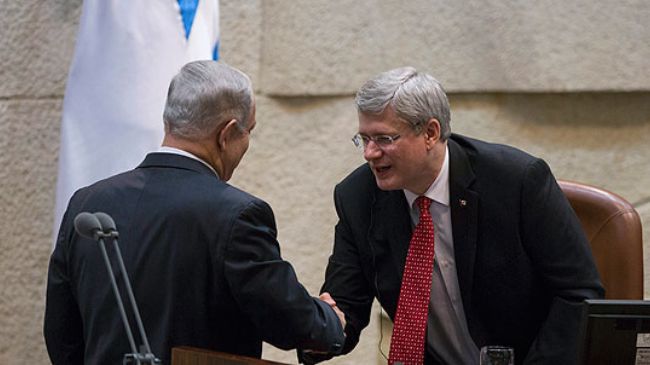
Press TV – February 16, 2014
The Canadian government has granted a new identity and passport to an agent of the Israeli spying service Mossad who had been involved in an assassination plot in 2010.
The Mossad agent, whose identity was not revealed, received the new identity and passport after his participation in the assassination of Hamas leader Mahmoud al-Mabhouh in Dubai in 2010, Canadian news agency QMI quoted Arian Azarbar, a businessman, as saying.
“The girl who was in charge of that file at Passport Canada… told me about it,” Azarbar said.
Al-Mabhouh was killed in his hotel room by a team of ten assassins carrying European passports.
“The Canadian government has said we had nothing to do with this, but it is a lie,” Azarbar added.
Azarbar has also provided the QMI agency with the name of the Israeli spy and the location of his residence in Canada. The agency, however, has declined to disclose the information, saying it would “endanger the safety and security” of the Mossad agent.
Alexis Pavelich, the spokesman for Canada’s Immigration Ministry, has refused to talk about the passport issue.
Back in 1997, Jordan arrested two Mossad agents carrying fake Canadian passports following a life attempt on Hamas leader Khaled Mashal.
Canada is closely allied to the Israeli regime.
Canada was one of the few countries that opposed the successful Palestinian bid in November 2012 to upgrade its status at the United Nations from “non-member observer entity” to “non-member observer state.”
In October 2011, Canada also opposed the Palestinian effort to win membership within the United Nations Educational, Scientific and Cultural Organization (UNESCO).
Israeli forces use tear gas against schoolchildren in Hebron
International Solidarity Movement | February 17, 2014
Hebron, Occupied Palestine – On Sunday, the 16th of February, Israeli soldiers and border police in Hebron fired tear gas and sound grenades at children on their way to school. The border police also chased the children, attempting to arrest them.
At Checkpoint 29, around 7:30 a.m., a few children on their way to school (there are three schools near the checkpoint) were throwing stones at the soldiers stationed there. In response to this two border police and a soldier appeared from an alley and threw a sound grenade at the kids close to the United Nations school on Tareq Ben Ziyad Street.
This frightened not only the children who had thrown stones but all the children on their way to school, causing them to flee. When they did not catch any children the two border police and the soldier stood in front of the school blocking the entrance and started firing teargas at those who had fled.
As the border police and the soldier returned to the checkpoint, three new soldiers came out of an apartment across the street, preventing the children from entering their school. The soldiers continued firing teargas towards the crowd of upset and frightened children.
Tear gas is a nondiscriminatory nerve gas which affects all persons nearby. The gas often takes a long time to disperse, forcing children to go through the half-dispersed gas clouds on their way to school, leaving them crying and coughing. The use of tear gas against schoolchildren is common in Hebron.
In total, seven soldiers and two border police were involved in the incident, firing six tear gas grenades and two sound grenades at the children.
Related articles


400 Nepalese World Cup stadium construction workers die in Qatar
Press TV – February 16, 2014
A Nepal-based human rights organization says over 400 Nepalese workers have lost their lives on World Cup stadium construction sites in Qatar.
The Pravasi Nepali Coordination Committee (PNCC), which follows up on migrant workers deaths in Qatar, recently published lists of the dead using official sources in the Qatari capital, Doha.
The PNCC also warned that the death toll can reach 4,000 by 2022.
The report will pile new pressure on the Qatari authorities and FIFA to curb the mounting death toll of foreign workers on the building sites.
Nepalese workers make up only 20 percent of two million migrant workers in Qatar and the death toll can be much higher than this.
Migrants from other countries are also feared to have died, but there is no official data available.
Harsh working conditions for foreign laborers in Qatar first came to light last September and the deaths of at least 36 Nepalese construction workers were registered in the weeks following the September revelations.
The new death toll also sets alarm bells ringing for FIFA as it shows that global protests against the treatment of migrant workers in Qatar have fallen on deaf ears.
Last month, the PNCC said, “FIFA and the government of Qatar promised the world that they would take action to ensure the safety of workers building the stadiums and infrastructure for the 2022 World Cup. This horrendous roll call of the dead gives the lie to those reassurances.”
Migrant workers in Qatar live in extremely inhumane and sordid conditions and they are deprived of any workplace security.
Are Palestinians Allowed to Resist? Part I
Part I: Palestinian Resistance in Context, Between Non-Violent and Armed Struggle
By Dina Jadallah-Taschler | Palestine Chronicle | February 26, 2009
The issue of Palestinian resistance, in terms of its permissibility and types, is a highly inflammatory question for most Western observers. Mainstream media discourse frequently boils down to criticisms and condemnations of its “violence” or alternatively, asserts its impotence in the face of Israeli military might and Western opposition. It might therefore be helpful to place it in historical and current context and to comparatively evaluate it against that other famous struggle for independence, Indian national liberation. India’s struggle, given the prominent role of Gandhi’s satyagraha’s role, is usually synonymous in Western discourse with non-violent resistance.
This first part in the essay deals with legal and historical issues that define Palestinians’ struggle for independence, then describes their repercussions on the current status of the occupation. In the second and final part, I will present examples from the history of Palestinian unarmed struggle and then compare it with the Indian one. I will argue that the agreeable and reasonable sounding frame of the superiority of peaceful resistance sets up a false dichotomy. Presenting satyagraha as the exemplary approach to liberation is deceptive on two levels. First, India’s independence was not achieved through non-violence alone. And second, while inspirational and useful on many levels, it is not sufficient as sole guide or solution to achieving Palestinian liberation.
The Prevailing Western Mainstream Media Perspective on Palestinian Resistance Today
Language and the framing of issues is always the privilege of the strong. This applies to international and legal attitudes concerning national liberation movements. At the height of their occurrence in the 1960s and 1970s, there was an international consensus on the necessity and legal right of oppressed people living under colonial and / or racist states to resist their status by any means available to them, including armed conflict. However, since the 1980s, there has been a shift away from focusing on ultimate legitimate goals of national liberation to a discussion of methods. Concomitantly, there was an interjection of a growing set of rules of military engagement that the international community wanted to apply to even non-state actors who were fighting for their independence. Israel, being a colonial and ethnically-based state and seeking to curb the use of armed struggle against itself, is in the camp that marks as “aggression” and “terroristic” any and all active resistance to its occupation of Palestinian land. Thus in terms of language and its function in rationalizing or justifying events, there is a sharp contrast between descriptions of “armed conflict” depending on which side of the aisle one is on: on the one hand, “national liberation movements” and “freedom fighters” and on the other, “terrorists” and “pre-emptive strikes.”
The justice of the initial demands for independence is frequently obscured by the legalistic focus on the means of inducing change. Moreover, international institutions, like the Security Council or the General Assembly of the United Nations or the International Court of Justice did not develop the means (or the will — in the case of the Palestinians) to enforce the legitimate claims of colonized peoples, or to punish states, like Israel, that place themselves above the application of basic legal and ethical principles. In a sense, this shift in focus is a regression to more imperial / colonial attitudes of the past.
It is a frustrating endeavor to peel away obscurantist assumptions and pervasive and intentional misdirection to arrive at the truth. Keeping in mind that Gandhi defined satyagraha as to hold on to the truth, the most basic reality for the Palestinians is that they are dispossessed, displaced, occupied, oppressed and most recently, massacred in Gaza. But most Western media coverage ignores some basic background facts that constitute the basis of the problem and which I will review briefly below. Ignoring the root causes renders incomprehensible to the casual observer Palestinians’ resistance, thereby facilitating their designation as stereotypical “terrorists.”
Historical Background of Palestinian Plight
Palestinian dispossession started under the British Mandate, which “got” Palestine from the dismantled Ottoman Empire after World War I. The Balfour Declaration (1917) established a national “home” for the Jews in Palestine and disregarded the wishes of the “non-Jewish communities.” While the latter was the overwhelming majority, and despite promises of “non-prejudice” to their “rights,” they were considered not significant enough to warrant that the colonizer ask their opinion about the “giving” of their homeland to an imported ethnic and religious group. In addition, British troops had not even set foot in Palestine yet. Thus Britain contradicted the legal maxim nemo dat quod non habet, meaning no one can give that which he has not. But being a superpower at the time, ordinary laws did not apply to itself. And the “promise” in the Balfour Declaration was incorporated into the Mandate by the League of Nations, which promptly validated this gift, even though the League did not possess Palestine either. The League also overlooked its inconvenient commitment to the right of self- determination for peoples originally inhabiting a land.1
Zionist actions to actively dispossess and remove Palestinians from their lands, exemplified in Plan Dalet, led to the ethnic cleansing of 750,000 people and created a majority Jewish area just in time for the declaration of the Israeli state in 1948. The dispossession both preceded and was concurrent with the war. The Palestinians’ legal right of return was reaffirmed more than one hundred times by the United Nations. But Israel placed itself above international law and passed The Prevention of Infiltration/Offenses and Jurisdiction Law in the Knesset in 1954. The defining of who is an “infiltrator” is instructive in explaining the violence and injustice done to the Palestinians, who were denied their legal right to return: the third definition for “infiltrator” in the law is a “Palestinian citizen or a Palestinian resident without nationality or citizenship or whose nationality or citizenship was doubtful and who, during the said period left his ordinary place of residence in an area which became a part of Israel for a place outside Israel.”2 Later in 1967, the Israeli state expanded again and encompassed the rest of natural Palestine. The reason that there is an occupation in the new territory is simple. The Zionist enterprise, all proclamations to democracy not-withstanding, could not incorporate/digest the newly acquired territories without reducing the majority Jewish composition, thereby exposing the non-democratic, ethnocentric and racist premise of the state.
Evaluation of Losses and Achievements
The facts are simple enough. And yet that is not at all how current media narratives present the struggle. It is never referred to as one for liberation and freedom. Resistance to the oppressive occupation and to the expansionist and dispossessing Israeli state is never presented as a right, despite the self-evident moral and legal principle, that as the (occupying) aggressor, Israel cannot justify violence against resistance to its own initial aggression.3 And yet, in this last massacre, Gazans who are starving, imprisoned, mostly refugees from the original displacement that happened with Israel’s creation, and who have qualitatively modest (but technologically improving — distance/reach) weapons, are the ones being blamed for “starting” or inviting the attack on themselves. This is objectionable on several levels. Fundamentally, the framing of the story that equates Palestinian resistance with the fourth strongest army in the world is inherently deceptive. Additionally, it blames the victim for resisting annihilation.
But once again, because it is the strong who determine what is legal and what is not, the Palestinian struggle for national liberation and their resistance against their oppressors are illegal by definition and are presented as “terrorism.” The right of self-defense has been appropriated by the dominant, occupying, aggressing side and simultaneously denied to its victims. It is becoming increasingly apparent to the resisting Palestinians that this excessive use of legality is simply a means to preserve pre-existing power asymmetries that will perpetuate their oppression. It is ultimately aimed at their extinction as a people. It is the root cause of their resistance: for they refuse a peace built on injustice, no matter how much misinformation is produced disguise the facts.
The Oslo Peace Process must be evaluated from this perspective. It was started more than 15 years ago but has led to no tangible benefits for the Palestinians. On the contrary, it has led to their increasing dispossession and subjugation. It co-opted the PLO leadership and made the Palestinian Authority into a police arm of and chief appeaser/concessor to Israel, the occupier. The Process has served as legal cover for continued oppression. It is no different from the NATO announcement to “protect” Israel, or the Rice-Livni Accords, or the United Nations Resolutions that are never enforced.
All these entities and agreements give a cover of multilateralism and legality to what is essentially aggressive expansionism and intentional dispossession. Similarly, Israel’s “withdrawal” from Gaza in 2005, narratively presented in mainstream media with so much angst for the trauma of the occupier, does not remove the initial aggression of the original and consistently brutal occupation. Even when one allows for the prison that is Gaza to be considered “unoccupied,” the fact remains that Palestinians are one people and that the West Bank and East Jerusalem continue to be occupied. This is even acknowledged in the Oslo Accords, which defines them as “a single territorial unit.”
Moreover, Israeli expansionism continues, and even accelerates, in the shadow of the peace process and of the headline- grabbing events in Gaza. Just in the last week, Israel has announced the annexation of extensive areas of Palestinian-owned land, where the villagers have been non-violently protesting the apartheid wall. For three days the Israeli army invaded the village of Jayyous declaring it a “Closed Military Area” and arbitrarily arrested 65 Palestinians: “The Israeli wall confiscated about 600 dunums of lands and 8,600 dunums were isolated behind the wall, where the town’s area is 12,500 dunums,” leading to the loss of thousands of jobs lost as a result of the wall and the isolation of agricultural land.4 Similarly, on 1/26/2009, the Israeli High Court approved the complete destruction of the village of Tana, east of Nablus, in order to expand the settlement colony of Makhurah.5 In addition, an expansion to the Effrat settlement colony near Bethlehem was also announced, swallowing an additional 170 hectares of “state land.”6 All this is happening in the West Bank, ostensibly the co-operating segment under the dictatorial and oppressive control of the Palestinian Authority. And it is definitely not conducive to economic independence, let alone the mirage of prosperity that was promised to come with the pursuit of a negotiated and non-violent “settlement.”
The argument is frequently made that Hamas is a “terrorist organization” because it targets civilians. But that is a question that is both not for the militarily strong to ask and also ignores completely Israel’s far greater and more consistent targeting of civilians. In this last attack on Gaza, despite an earnest and far reaching hasbara/propaganda effort by Israel to change perceptions, the extent of the destruction was too blatant to repress. Any fair assessment of damage to civilians will plainly see the disproportionate suffering of the weaker party. It also must account for the slow strangulation and eradication of Palestinians even when there is no “war.” The means of destruction are so entrenched and persistent so as to become too banal for Western media to report on. The “targeted assassinations” that inevitably kill civilians, the ever-growing “settlements” / colonies, the land expropriations, the apartheid “separation” Wall, the roadblocks, the economic blockade and de-development, and so forth have effectively ended any hope of a two state solution. In fact, the Palestinians’ pursuit of the peaceful route of “settlement” through the peace process, recently “negotiated” at Annapolis, has resulted in a 20% increase in settlement expansion in the West Bank and a 36% settlement expansion in East Jerusalem, just in the last sixteen months.6
The Oslo Peace Process has essentially reached a dead end. Remember that it was launched after the First Intifada proved that a militarily powerful actor could not defeat Palestinian grassroots resistance. Hence, Israel’s resort to “settlement” and its reliance on the native enforcer, in the form of the Palestinian Authority. But that too failed. The endless peace process has been unable to accomplish the main (colonialist/racist) goal that gave it life: namely, to convince the Palestinians that they are defeated and are rightfully untermenschen in the legally still border-less Zionist state.
Taken to its ultimate logical and counter-intuitive conclusion, this will eventually (and in fact has already started to) call into question the viability of a Zionist Israel in the long term. Increasingly, Israel’s own success in oppressing its Other has left it with two equally non-palatable options: either transition into an equal society or dismantle the colonialist enterprise. Its current choice of apartheid separation and oppression is demographically, morally, ethically, and in time, technologically unstable and unacceptable going forward.
1) For an extensive discussion of this topic, see, Musa E. Mazzawi, Palestine and the Law: Guidelines for the Resolution of the Arab-Israeli Conflict, Garnet & Ithaca Press, 1997: pp. 21-23.
2) Ibid, p. 178.
3) For a broader discussion of this issue, see Michael Mandel, “Israel’s Unjust War on Gaza: Self-Defense Against Peace,” Counterpunch, 2/5/2009.
4) ”Israeli forces seize 65 youths in Jayyus in third day of mass arrest,” Maan News Agency, February 18, 2009. Also, for a broader perspective (Arabic), visit here.
5) Tiny URL
6) TINY URL
Dina Jadallah-Taschler is an Arab-American of Palestinian and Egyptian descent, a political science graduate and is also an artist. She can be reached at: Dina.Jadallah.Taschler@gmail.com or visit Dina’s website.
Georgia to join NATO Response Force in 2015
Xinhua News Agency | February 12, 2014
TBILISI: Georgian Defense Minister Irakli Alasania said Wednesday that the country has decided to join the NATO Response Force (NRF) in 2015 with financial support from the United States.
The decision was announced at a joint press conference with Knud Bartels, chairman of the NATO Military Committee, on the second day of the committee’s first ever visit to the South Caucasus country, during which talks with Georgian leaders were also held to discuss security, cooperation and Georgia’s involvement in NATO’s mission in Afghanistan.
“It has already been decided that Georgia will become part of the NATO Response Force in 2015 and a sponsor state has already been selected. The United States will ensure readiness along with the NATO military to provide rapid response in case of crisis,” said Alasania.
Bartels told the assembled press that Georgia has made “solid progress in its defense reforms that will allow cooperation between Georgia and NATO.”
The NRF, initiated in November 2002, has a joint force of around 13,000 high-readiness troops made up of land, air, maritime and special operations components that the Alliance can deploy quickly wherever needed, according to NATO information.
Featured Video

No Threat Can Force Iran’s Surrender /Trita Parsi & Lt Cl Daniel Davis
or go to
Aletho News Archives – Video-Images
From the Archives
An Expert Military Analysis of War with China
Actually, None is Necessary
By Fred Reed • Unz Review • December 13, 2020
The Correlation of Armed Forces: U.S. goods and services trade with China totaled an estimated $634.8 billion in 2019. Exports were $163.0 billion; imports were $471.8 billion. The U.S. goods and services trade deficit with China was $308.8 billion in 2019. Trade in services with China (exports and imports) totaled an estimated $76.7 billion in 2019. Services exports were $56.5 billion; services imports were $20.1 billion. The U.S. services trade surplus with China was $36.4 billion in 2019.
There is talk within the Washingtoniat of a possible war with China. Steve Bannon, who apparently was dropped on his head as a child, actually favors such a war. We hear the usual shoo-the-boobs alarm about how the Chinese are doing something terrible and we must gird our loins and American values and show them what for, bow wow, woof. The danger is that the current game of who-blinks-first in Asian waters might actually provoke a shooting war. You know the kind of thing: One warship refuses to get out of the way of another, a collision ensues, some retard lieutenant who signed up on waivers opens fire, and we’re off and running. It is not a good idea to let children play with matches.
The said war is discussed either in emotional terms by idiots or in purely naval terms by those familiar with such things, so we hear of the First Island Chain and the Second Island Chain and whose missiles against the other’s missiles and so on. This would be appropriate if we were fighting World War Two again. Which we aren’t. Let’s take a quick-and-dirty look at how such a war might go.
To begin the war, America would overestimate itself and underestimate China. This is doctrine in the Pentagon. … continue
Blog Roll
 Aletho News
- Theodore Postol: Iran’s Missiles & Drones Were Underestimated
- Iran To Target Military Industrial-Tech Complex That Facilitated Gaza Genocide
- Collapsing Empire: The Resistance Disarms ‘Israel’
- Suicide Should Not Be a Government Service
- Rethinking America’s greatest threat: Iran vs. Israel-Firsters
- Iran accuses adversaries of false flags to strain Turkey ties
- Poland rules out sending Patriot missiles to US/Israel amid war on Iran
- Tehran approves new Hormuz plan with major restrictions
- No Threat Can Force Iran’s Surrender /Trita Parsi & Lt Cl Daniel Davis
- UK’s New Pandemic Plan Would Turn Big Tech Into a Mass Location Tracking Network
- If Americans Knew
- Ann Coulter Rips Into Fox News for Iran War Coverage, Compares to False Rigged 2020 Election Reporting
- Joe Kent Urges Americans To Call White House and Congress To Object To Sending Troops Into Iran
- DNC Resolution to Reject AIPAC Funding Puts Democratic Leaders in the Hot Seat
- Swedish foundation to build 400 schools as over 650,000 Gaza children remain without education for 2 years
- Israeli army admits photshopping image of slain Lebanese journalist
- This is how Israel is systematically killing health workers under the cover of war in Lebanon
- Carrying life under fire: Israeli invasion of Lebanon leaves pregnant women facing deadly risks
- Champagne all around for the new death penalty (for Palestinians) law – Not a ceasefire Day 172
- Why are Palestinian books struggling to be seen on Amazon?
- The Line Between Affinity and Conspiracy
- No Tricks Zone
- New Study Finds Warming Saves Lives…Cold Temperatures 12 Times More Deadly Than Excess Heat
- German Science Blog Accuses PIK Climate Institute Of Hallucinating Climate Tipping Points
- Devastating Assessment Of Comirnaty Vaccine By Former Senior Pfizer Europe Toxicologist
- New Study: CO2 Is ‘Effectively Negligible’ As An Explanatory Climate Change Factor Since 2000
- Former Pfizer Toxicologist Dr. Helmut Sterz Tells Bundestag Hearing Pfizer Vaccine Should Have Never Been Approved
- Energy Expert: Germany’s Nuclear Phaseout Was A “500 Billion Euro Mistake”
- New Research: South Australia’s Mid-Holocene Sea Surface Temperatures Were 4°C Warmer Than Today
- Storing Green Energy To Last Germany 10 Days Would Require A 60-Million Tonne Battery
- New Studies: UK Sea Levels Were 4 Meters Higher Than Today During The Mid-Holocene
- Destructive Green New Deal: German Energy And Metal Group Warns Of Drastic Crisis
 Aletho News