The Iranian Threat That Never Was
By Sheldon Richman | Future of Freedom Foundation | March 26, 2014
If you take politicians and the mainstream media seriously, you believe that Iran wants a nuclear weapon and has relentlessly engaged in covert efforts to build one. Even if you are aware that Iran signed the nuclear Non-Proliferation Treaty (NPT) and is subject to International Atomic Energy Agency (IAEA) inspections, you may believe that those who run the Islamic Republic have cleverly found ways to construct a nuclear-weapons industry almost undetected. Therefore, you may conclude, Democratic and Republican administrations have been justified in pressuring Iran to come clean and give up its “nuclear program.”
But you would be wrong.
Anyone naturally skeptical about such foreign-policy alarms has by now found solid alternative reporting that debunks the official narrative about the alleged Iranian threat. Much of that reporting has come from Gareth Porter, the journalist and historian associated with Inter Press Service. Porter has done us the favor of collecting the fruits of his dogged investigative journalism into a single comprehensive and accessible volume, Manufactured Crisis: The Untold Story of the Iran Nuclear Scare.
A grain of truth can be found at the core of the official story. Iranian officials did indeed engage in secret activities to achieve a nuclear capability. But it was a capability aimed at generating electricity and medical treatments, not hydrogen bombs.
Porter opens his book by explaining why Iran used secretive rather than open methods. Recall that before the 1979 Islamic revolution, Iran was ruled by an autocratic monarch, the shah. The shah’s power had been eclipsed in the early 1950s by a democratically elected parliament. Then, in 1953, America’s Eisenhower administration sent the CIA in to foment civil discord in order to drive the elected prime minister, Mohammad Mossadegh, from office and restore the shah’s power.
During his reign, the shah, a close ally of the United States and Israel, started building a nuclear-power industry — with America’s blessing. Iran’s Bushehr reactor was 80 percent complete when the shah was overthrown.
When Ayatollah Ruhollah Khomeini became Iran’s supreme leader in 1979, he cancelled completion of the reactor and stopped related projects. But “two years later, the government reversed the decision to strip the [Atomic Energy Organization of Iran] of its budget and staff, largely because the severe electricity shortages that marked the first two years of the revolutionary era persuaded policymakers that there might be a role for nuclear power reactors after all,” Porter writes.
The new regime’s goals were “extremely modest compared with those of the shah,” Porter adds, consisting of one power plant and fuel purchased from France. Take note: the Iranian government did not aspire to enrich uranium, which is the big scare issue these days.
Iran brought the IAEA into its planning process, Porter writes, and an agency official, after conducting a survey of facilities, “recommended that the IAEA provide ‘expert services’ in eight different fields.” Porter notes that the IAEA official said nothing about an Iranian request for help in enriching uranium, “reflecting the fact that Iran was still hoping to get enriched uranium from the French company, Eurodif.”
Had things continued along this path, Iran today would have had a transparent civilian nuclear industry, under the NPT safeguard, fueled by enriched uranium purchased from France or elsewhere. No one would be talking about Iranian centrifuges and nuclear weapons. What happened?
The Reagan administration happened.
Continuing the U.S. hostility toward the Islamic Republic begun by the Carter administration, and siding with Iraq when Saddam Hussein’s military attacked Iran, the Reagan administration imposed “a series of interventions … to prevent international assistance of any kind to the Iranian nuclear program.” Not only did President Reagan block American firms from helping the Iranians; he also pressured American allies to participate in the embargo. This was in clear violation of the NPT, which recognizes the “right” of participating states to acquire nuclear technology for civilian purposes.
No wonder Iran turned to covert channels, most particularly A.Q. Khan, the Pakistani who “was selling nuclear secrets surreptitiously.” This would have been the time for Iran to buy weapons-related technology — however, Porter writes, “there is no indication that [Khan’s Iranian contact] exhibited any interest in the technology for making a bomb.”
This is indeed a manufactured crisis.
Related article


AL-KHALIL (HEBRON): Settlers attempt construction of new access path at Tel Rumeida
CPTnet | March 27, 2014
 |
|
Attempt by settlers to begin construction of walking path on Tel Rumeida. The blue fence is on the |
On 24 March 2014, settlers attempted to begin construction of a walking path outside the fenced “archaeological” dig near the Abu Haikal home on Tel Rumeida. The settlers pounded in metal stakes in an area just below the fence erected by Israelis around what was once the orchard of the Abu Haikal family, and is now an archaeological site to which Palestinians, including Palestinian archaeological experts, are denied access. The stakes are a first step in an apparent attempt to link the settlement of Tel Rumeida to the fenced area of the archaeological dig.
Palestinians living in the building adjacent to the land on which the settlers were trespassing called the police, who ordered the settlers to stop. However, the following day, 25 March, soldiers arrived at the home of the Abu Haikal family and threatened them with arrest.
Feryal Abu Haikal had just finished hosting a group of neighbors, along with the Palestinian Liaison Officer and an officer from the Hebron Governor’s office, when soldiers arrived at her home and began to dispute the ownership of some of the land on Tel Rumeida, showing her a map that contained false information. The soldiers told Feryal Abu Haikal that no visitors are allowed on the land surrounding her home, and threatened to arrest and deport any internationals there, including members of the Abu Haikal family.
For background on the settler archaeological dig on Tel Rumeida click here
To see a map of multiple land-grab efforts by settlers in Hebron click here.
Related articles
The Anti-Defamation League’s Deceit Helps Sink a Judgeship
By David Boyajian | Dissident Voice | March 26, 2014
After two fair and lengthy hearings, the eight elected members of the Massachusetts Governor’s Council, in a 4-4 tie vote on March 5, refused to confirm attorney Joseph Berman to be a Superior Court judge. It was a defeat for Governor Deval Patrick, who had nominated Mr. Berman. But the Council took its responsibilities seriously and rendered a well-considered judgment.
Councilors voiced many concerns about the nominee. Foremost was a lack of truthfulness.
Berman, under oath, was asked three times whether he had requested anyone to lobby the Council to advance his nomination. Each time, he replied no.
Later, after some stumbling, he admitted to another Councilor that he had phoned State Senator – now Congresswoman – Katherine Clark to lobby Councilors.
Mr. Berman’s meager criminal trial experience also troubled Councilors. Another concern was Berman’s scant knowledge of drug abuse. And some worried that Berman, politically active and a national leader in the heavily political Anti-Defamation League (ADL), would promote those viewpoints as a judge.
Several Councilors questioned Berman’s $100,000 in campaign contributions, including to Governor Patrick, since being turned down for a judgeship in 2004. They saw this as a possible attempt to advance his judicial ambitions.
At his second hearing, Mr. Berman tried to deflect these criticisms. He claimed, for example, to have misunderstood the Councilors’ questions about lobbying them. He also said he had been studying up on drug addiction and criminal law.
Berman’s being a 19-year member, and since 2006 a National Commissioner, of the ADL also caught the attention of some Councilors and media.
Recall the ADL scandal that broke out in mid-2007. It exposed that organization’s decades-old hypocrisy in denying the Armenian genocide and colluding directly with Turkey, a major human rights violator, to defeat U.S. Congressional resolutions on that genocide.
Shocked at the ADL’s stance, the Massachusetts Municipal Association, which represents every city and town, then dropped its sponsorship of the ADL’s so-called “No Place for Hate” anti-bias program. So did Arlington, Bedford, Belmont, Lexington, Medford, Needham, Newburyport, Newton, Northampton, Peabody, Somerville, Watertown, and Westwood. The ADL scandal quickly became national and international news.
Naturally, the Governor’s Council quizzed Berman about his ADL leadership role. He claimed that after the scandal erupted in 2007 he and some New England ADL members tried to convince the National ADL to change its position on the Armenian genocide. But there is no hard proof of that. And surely Berman knew long before 2007 of the ADL’s anti-Armenian stance. Yet he never spoke out publicly or resigned. Even after 2007, Mr. Berman remained publicly silent about the ADL’s indefensible assault on Armenian Americans.
Alongside the Council’s other concerns, Berman’s ADL record raised doubts about his worthiness to be a judge.
On August 21, 2007, the National ADL tried to squirm out of the scandal with a press release that used deceptive and legalistic wording about the Armenian genocide. It implied that the Armenian genocide was a mere “consequence” of wartime events, which meant it wouldn’t qualify as genocide under the United Nation’s official definition. The dishonest ADL declaration was widely rejected.
Nearly 20 countries, such as Canada, France, and Argentina, the European Union Parliament, the International Association of Genocide Scholars, and the Polish Jewish lawyer who coined the word “genocide” in the 1940s, Raphael Lemkin, have recognized the Armenian genocide of 1915 -23 committed by Turkey.
Many American human rights, ethnic, and church organizations have supported the Armenian genocide resolution. These include the American Jewish World Service and the Jewish War Veterans of the USA.
But not the ADL nor, reports the Jewish media, the American Jewish Committee, AIPAC, and B’nai B’rith. They adhere to a long-standing arrangement among themselves, Turkey, and Israel to deny the Armenian genocide. See “History of Lobbying” at NoPlaceForDenial.com.
The ADL professes to defend the human rights of all ethnic groups, not just Jews. It insists that the American people acknowledge and pass legislation on the Holocaust. Yet the ADL tries to prevent recognition of a Christian genocide. The hypocrisy is astonishing.
Meanwhile, a significant precedent has been created: Members of the ADL, or similar organizations, who aspire to a higher post, particularly in government, may now be asked what they knew of their organization’s genocide hypocrisy, when they knew it, and what they did about it. Such are the bitter fruits of deceit.
David Boyajian is a freelance journalist.
Related article
Israeli forces shut down Palestinian conference in Jerusalem
Ma’an – 27/03/2014
JERUSALEM – Israeli forces on Wednesday prevented Palestinian human rights organizations in Jerusalem from holding a conference in opposition to Arab enlistment in the Israeli military, organizers said.
Israeli special forces and police reportedly stormed the headquarters of the Yabous Cultural Center immediately prior to the beginning of the conference and shut down the building until the evening.
Organizers said that the police hung a notice signed by the chief of police banning the proceedings from moving forward because the conference was organized by activists associated with the Popular Front for the Liberation of Palestine, which Israeli authorities consider a terrorist organization.
Jerusalem Legal Aid and Human Rights Center director Rami Saleh denied the allegations, noting that the conference was organized by JLAC, St. Yves, Kanaan Project, and in cooperation with the Baladna organization’s Haifa branch.
Saleh said the conference aims to raise awareness in the Arab community of Jerusalem about “civil service,” a form of service in the Israeli army that the Israeli state has increasingly enjoined Arab youth to enlist in.
The conference was intended to encourage opposition to “civil service” and all kinds of military service in the Israeli army, which is not mandatory for Muslim and Christian Palestinians in Israel, unlike for Druze and Jewish Israelis.
Dozens of Jerusalem youths aged 18-21 had joined the program, Saleh said.
Yabous institute director Rania Elias condemned the closure of the institute from 2-8 p.m, adding that the institute will continue to provide service and organize events for Palestinian organizations.
Related article

US bullying UK on Iran: British politicians
Press TV – March 27, 2014
Senior British politicians say the United States is “bullying” UK banks and is hampering legal exports from Britain to Iran.
The politicians, including former British Foreign Secretary Jack Straw and former Chancellor Lord Lamont, made the remarks at a Westminster Hall debate on Wednesday.
British parliamentarians say the US threatens British banks with heavy sanctions and hampers the legal exports of food, pharmaceuticals and medical devices from the UK to the Islamic republic. They add that Washington is hindering UK’s legal trade with Iran.
Lamont said Britain “should not be bullied by the American authorities.”
Straw noted that as British banks fear US sanctions, they do not provide UK companies with banking services for legal exports to Iran.
“The pressure on our banks is intense,” Straw said, adding, “The impact of this unilateral, extraterritorial jurisdiction of the US is discriminatory, especially against UK-based financial institutions, given their multinational nature.”
Straw also said the US authorities would not accept the way that British banks and companies are treated if they were in the same situation.
“The US Congress and government would not tolerate this for a moment were the situation reversed,” Straw stated, saying the move by the US is a direct challenge to the sovereignty of the UK.
Straw, who is also the British head of Iran-Britain Parliamentary Friendship Group, visited Iran at the head of a high-ranking delegation, including Lamont, Conservative lawmaker Ben Wallace and Labor lawmaker Jeremy Corbyn as guests of Iran’s Majlis in January.
The British delegates held meetings with high-ranking Iranian officials. The three-day official visit was the first by a delegation of British politicians since 2008.
Earlier this month, in remarks meant to dissuade foreign countries from planning trade cooperation with the Islamic Republic, US Secretary of State John Kerry said Iran is not an open market for business.
“We have made it crystal clear that Iran is not open for business,” Kerry said, addressing US Senators on Capitol Hill on March 13. He warned that the core sanctions against Iran remain firmly in place.
Several delegations from across the world have visited Iran over the past few months in order to boost trade and ties with the Islamic Republic.
Merkel not ready to back economic sanctions against Russia
RT | March 27, 2014
The West has not yet reached a stage where it will be ready to impose economic sanctions on Russia, German Chancellor Angela Merkel said, stressing that she hopes for a political solution to the stalemate over Ukraine crisis.
The chancellor said she is “not interested in escalation” of tensions with Russia, speaking after Wednesday meeting with the South Korean president in Berlin.
“On the contrary, I am working on de-escalation of the situation,” she added, as cited by Itar-Tass.
Merkel believes that the West “has not reached a stage that implies the imposition of economic sanctions” against Russia, advocated by US President Barack Obama. “And I hope we will be able to avoid it,” she said.
Berlin is very much dependent on economic ties with Russia with bilateral trade volume equaling to some 76 billion euros in 2013. Further around 6,000 German firms and over 300,000 jobs are dependent on Russian partners with the overall investment volume of 20 billion euros.
Germany is currently the European Union’s biggest exporter to Russia. German car manufacturing companies are likely to suffer first if sanctions against Russia become more substantial, as about half of German exports to Russia are vehicles and machinery.
Volkswagen, BMW, and lorry maker MAN all have Russian operations, with VW willing to inject another €1.8 billion in its Eastern European segment by 2018, the Local reports. Opel, a German car maker which sold over 80,000 cars in Russia in 2013, last week said that the company was “already feeling the stresses and strains from the changing course of the ruble,” Karl-Thomas Neumann, boss of car makers Opel, told Automobilwoche magazine.
On the retail side, German Metro stores wanted to take its Russian subsidiary public this year, but the plan is now imperiled, Der Spiegel reported.
Earlier this month Germany’s KfW development bank canceled a contract with Russia’s VEB bank worth €900 million in investment initiatives for mid-sized companies. Under the deal Germans were to have invested €200 million in Russia.
In addition, Germany is heavily dependent on Russian energy with around 35 percent of its natural gas imports coming from Russia.
Russian Finance Minister Anton Siluanov commented on Russia’s economic situation on Wednesday.
“At present, the investors’ worries are connected with the consequences of sanctions. We see ratings agencies lower the outlook on Russia’s ratings. It certainly puts us on alert. There are no basic grounds for changing the general stability of Russia’s economy,” Siluanov told Russia-24 TV channel.
Standard & Poor’s (S&P) global credit rating agency changed the outlooks for Russia’s large energy companies on Wednesday. Gazprom, Rosneft, Transneft and Lukoil ratings were reduced from stable to negative outlook for having “very strong links” with the Kremlin. Last week S&P and Fitch Ratings lowered Russia’s overall creditworthiness. Both companies affirmed Russia at BBB.
Yet Siluanov defended Russia’s economy and trustworthiness saying that foreign investors hope that the any sanctions against Moscow are temporary.
“The measures that were taken regarding certain persons and companies have their effect. The general mood around Russia has become nervous. But we have good conditions for business,” he said, adding that “neither Western companies nor Russia need the sanctions.”
Bahraini photographer among 29 jailed for up to 10 years
Al-Akhbar | March 26, 2014
A Bahraini court on Wednesday jailed 29 people, including an award winning photographer, for up to 10 years for an alleged attack on a police center in April 2012.
A judicial source and activists said the verdicts were based on defendants’ confessions that were extracted under torture.
Twenty-six of those convicted were handed 10-year prison terms and three others jailed for three years, a source told AFP.
Among those sentenced to 10 years was Ahmed Humaidan, a 26-year-old photojournalist abducted by plainclothes police in late-2012.
Humaidan’s lawyer said the court presented no evidence to suggest that he was involved in any attack against police aside from a confession he made under torture.
The Bahrain Center for Human Rights has documented cases of torture against the young photojournalist in prison, which included being blind-folded and told to hold an object for hours that police claimed was a bomb.
The prosecution accused the defendants of attacking a police center in the village of Sitra, south of Manama, with petrol bombs and iron rods, wounding a policeman.
The other defendants also told the court that they were tortured and their confessions obtained under duress, according to the judicial source.
Bahrain, home to the US Fifth Fleet, remains in a constant state of turmoil since authorities launched a bloody crackdown on a popular uprising three years ago, with hundreds of protesters and activists jailed on “terror” charges.
Authorities in the Gulf dictatorship last year increased the penalties for those convicted of violence, introducing the death penalty or life sentences in certain cases.
(AFP, Al-Akhbar)
Related articles
Israeli soldiers shot dead Palestinian teen in cold blood: Rights group
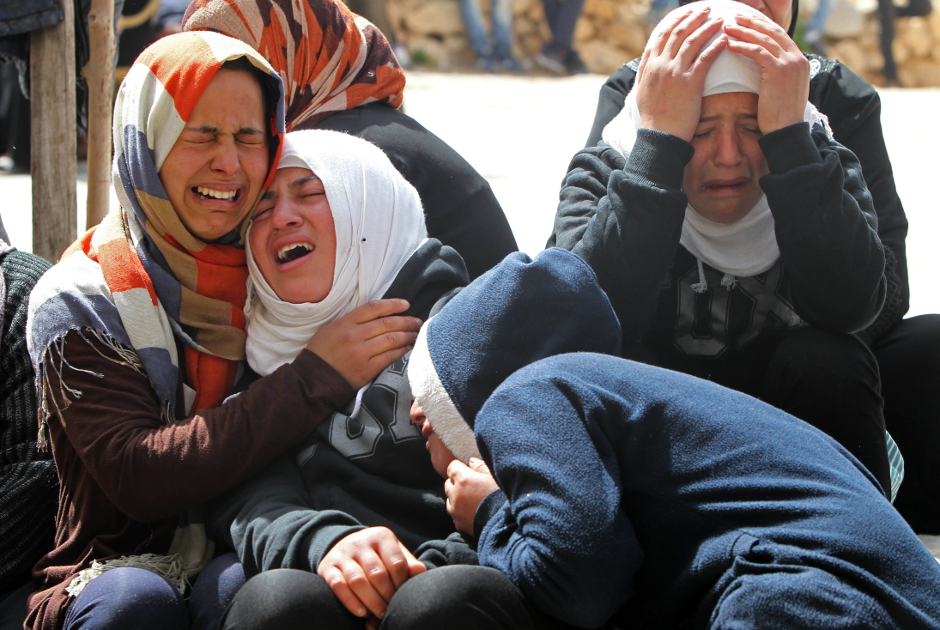
Relatives of Palestinian teenager Yussef Shawamreh mourn outside his house in the West Bank village of Deir al-Asal, 15 kilometers from Hebron on March 19, 2014 after he was shot dead by Israeli troops in the occupied West Bank. (Photo: AFP – Hazem Bader)
Al-Akhbar | March 26, 2014
Israeli occupation forces who shot dead a Palestinian teenager in the West Bank last week used live fire, without warning, against innocent youngsters out foraging for roots, an Israeli rights group said Wednesday.
After investigating the March 19 death of 15-year-old Yussef Sami Shawamreh, B’Tselem said it had found no evidence to support the army’s version of events that troops had opened fire at youths who had “sabotaged” the West Bank apartheid wall.
B’Tselem said the primary responsibility for the boy’s death rested with the army commanders who approved the use of live fire at a site where villagers from Deir al-Asal al-Tahta are known to go out and pick wild plants on their own land.
An army spokeswoman told AFP after the incident that soldiers had spotted three Palestinians vandalizing the wall, saying they had “verbally warned” them before firing warning shots in the air then shooting at their lower extremities.
But Shawamreh’s family and witnesses said the teenager had been looking for gundelia, a thistle-type plant used in cooking.
B’Tselem said the shooting occurred in an area where there is a wide breach in the barrier and where families regularly go out to forage on their own farmland.
“The two surviving youths… heard three or four shots as they got off the road, fired with no advance warning,” the report said.
Shawamreh, who was severely wounded but not picked up by a military ambulance for some 30 minutes, was later pronounced dead at an Israeli hospital.
The NGO said its findings were “markedly different” from the army’s version of events.
“The youths made no attempt at vandalism; they were crossing through a long-existing breach, and the soldiers did not carry out suspect arrest procedure, shooting at Shawamreh with no advance warning,” it said.
Troops in the area were “well aware” that over the past two years, Palestinians have been crossing the barrier at the breach “to pick gundelia on their own farmland,” B’Tselem.
It added that the use of live fire showed a “cynical lack of concern for the life of a Palestinian teenager.”
Two days earlier, soldiers had detained four teenagers in the same spot, beating them and confiscating the plants they had picked.
“The decision to mount an armed ambush at a point in the barrier known to be crossed by youths, who pose no danger whatsoever to anyone, for the purpose of harvesting plants is highly questionable,” the report said, noting it showed “extremely faulty discretion” on the part of the commanders.
“The primary responsibility for the killing lies with the commanders who sent the soldiers out on armed ambush,” B’Tselem director Jessica Montell said in a statement that urged the military police to consider whether the commanders should “bear personal criminal responsibility” for Shawamreh’s death.
There was no immediate response from the occupation authorities.
(AFP, Al-Akhbar)
U.S. Still Cleaning up Chemical Weapons from World War II… in 40 States
By Noel Brinkerhoff and Danny Biederman | AllGov | March 26, 2014
Bring us your nerve gases, your blister agents, your horrible weapons of warfare, your wretched refuse of World War II… This about sums up the decision of leaders in Washington after World War II when it came time for the American military to dispose of its arsenal of chemical weapons and those belonging to both the countries it fought against and alongside.
After the war’s conclusion, the U.S. government buried thousands of munitions loaded with chemical agents all across the country. These weapons of mass destruction were part of the U.S. arsenal as well as those belonging to ally Britain and enemies Germany and Japan.
The bombs and containers were simply dumped in the ground and buried, without concern for long-term environmental and health consequences.
Alabama is home to the largest of 249 such sites that are located in 40 states. Redstone Arsenal, a longtime U.S. Army base, sits atop miles of hidden trenches containing blister agents, choking agents, blood agents and more.
The 38,000-acre base is surrounded by homes, schools, churches and shopping centers—a city of 200,000 people. It was reported that few residents are aware of the toxic danger lurking nearby.
A disposal team has been working at Redstone since the 1970s trying to locate all of the chemical weaponry that is buried beneath 17 six-mile-long trenches. Once those trenches have all been located, the next step—scheduled to begin in 2019—is to remove the bombs and containers with great care, due to the uncertainty of the weapons’ condition after being held deep underground for decades. No more than six munitions can be safely removed each day.
“Even if we tried to do this as fast as anybody could ever get it done, we’re talking decades and decades,” James Watson, a disposal team member, told the Los Angeles Times. “This stuff is very dangerous to dig up. It’ll hurt you. It will blister you up. If you get that nerve agent on you, it will kill you.”
Redstone’s cleanup is expected to take until at least 2042. The quantity of weapons: 388,000. Between 20,000 and 25,000 of these are intact and, once disturbed, may be volatile.
Alabama has a second site, at former Camp Sibert (pdf) near Huntsville, with at least 13 stockpiles of mustard and phosgene gas.
Another of these sites is located in Spring Valley, Virginia, not far from the White House. Its arsenal features even older chemical munitions—possibly including mustard and arsenic—manufactured during World War I.
Several years ago, a vast supply of munitions from World War II was discovered beneath the grounds of Odyssey Middle School in Orlando, Florida. One of the weapons ignited into flames, but didn’t explode, injuring an Army Corps of Engineers contractor attempting to remove it. More than 200 potentially volatile explosives were found, most under the school and some near homes in the surrounding neighborhood. Home values, which were originally in the $600,000 range, plunged by at least 30%, while banks told homeowners their residences were worthless to lend against.
The U.S. military also dumped a huge volume of chemical weapons off both the Atlantic and Pacific coasts. There are no plans to clean up those sites, although Congress has authorized studies to look into it.
In 1958, about a hundred miles offshore of California, the SS William Ralston—loaded with more than 300,000 mustard gas bombs and 1,500 one-ton containers of Lewisite, a blistering agent—was scuttled by the U.S military. To this day it sits beneath nearly 14,000 feet of water just outside of San Francisco.
Ralston believes the U.S. task of removing 1,300 tons of secured chemical weapons from Syria for destruction at sea will be something of a breeze compared to the job here at home. “In Syria, you know where the weapons are and what they are, and they can move them with a forklift,” Watson told the Times. “Here, we don’t know. We have to go out there and dig them out of the ground … The sheer mass of this stuff is overwhelming.”
To Learn More:
Deadly Chemical Weapons, Buried and Lost, Lurk Under U.S. Soil (by David Zucchino, Los Angeles Times)
Redstone Arsenal: Yesterday and Today (by Michael Baker, U.S. Army Missile Command)
A Generation of Indiscriminate Dumping (Daily Press) (pdf)
Water Apartheid in Palestine – A Crime Against Humanity
By Ayman Rabi | The Ecologist | March 22, 2014
This week the UN celebrated World Water Day – a day to remember the billion people who are unable to meet their needs for safe, clean water due to drought, poverty and official neglect.
But it’s also a day to remember, and fight for, 2.1 million Palestinians who suffer something different – an artificial water scarcity deliberately created and sustained by Israel’s military occupation, and the private Israeli water company Mekorot.
Increased international pressure brings hope that the tide may be finally turning for Palestinians striving for water justice in the West Bank and Gaza – in particular, recent investment and partnership decisions against Mekarot, which runs Israel’s discriminatory water policy in the West Bank.
Waterless in Gaza and East Jerusalem
The situation in Gaza is especially dire. The tiny, densely populated territory relies entirely on its depleted, saltwater-contaminated and sewage-polluted aquifer, and the water it produces is unfit for consumption. Water has to be bought, expensively, in bottles or from mobile tanks.
Moreover restrictions on fuel imports mean that Gaza’s single power station spends most of its time idle – and so long as it’s not running water and sewage cannot be pumped. So the taps are dry, toilets are blocked, and sewage pollution gets worse.
Not that Palestinian residents of East Jerusalem have it a lot better. As reported on 17th March, the city suffered a long water cut beginning on 4th March leaving Ras Shehada, Ras Khamis, Dahyat A’salam and the Shuafat refugee camp – cut off from the rest of the city by the separation wall – with no running water.
The reason is simple – old and inadequate water infrastructure, which there are no plans to improve or renew.
Oslo II Accords – the Palestinians were shafted
For West Bank as a whole the facts speak for themselves. The Oslo II Accords dealt Palestinians a singularly poor hand – limiting the volume of water it could produce, as well as imposing severe restrictions on the development and maintenance of Palestinian water infrastructure.
The Accords allow Palestinians to abstract only 118 million cubic meters (mcm) per year from boreholes, wells, springs and precipitation in the West Bank. But Israel is allowed to take four times as much – 483 mcm per year – from the same Palestinian resources.
So not only does Israel now occupy 80% of the area of historic Palestine, but it – via the water company Mekarot – also takes 80% of the water resources from the 20% of the land that is left to the Palestinians.
Sold down the river
But it gets worse. Oslo II’s draconian restrictions on water development imposed by Israel mean that Palestinians can only actually abstract 87 mcm in the West Bank, of the 118 mcm they are allowed.
The acute water deficit is made up by the supply of piped water from Israel. Mekarot currently sells the Palestinian Water Authority some 60 mcm per year – at full price.
As reported by Amira Hass in Ha’aretz, “in that agreement Israel imposed a scandalously uneven, humiliating and infuriating division of the water resources”.
While Palestinian water is piped into Israel at no cost, a fraction of it is then piped back again, and paid for. In this way Israel is extracting from Palestinians both their water, and their money.
In some cases Palestinians are forced to pay ten times more for their water than the price in Tel Aviv – as in the village of Sussia on South Mount Hebron, where they have to drive to the nearby town to buy over-priced water (see photo), even though a water main passes directly through the village on its way to an Israeli settlement.
Water plenty, and water famine
According to the UN Human Rights Council, this all translates into a wide disparity between water use by Palestinians and by settlers in the West Bank. Settlers enjoy 400 litres per capita per day (l/c/d) while some Palestinians survive on a little as 10 l/c/d.
All Palestinian populations receive water volumes far below the level recommended by the World Health Organization of 100 – 250 l/c/d. According to the UNHRC:
“Settlements benefit from enough water to run farms and orchards, and for swimming pools and spas, while Palestinians often struggle to access the minimum water requirements.
“Some settlements consume around 400 l/c/d, whereas Palestinian consumption is 73 l/c/d, and as little as 10-20 l/c/d for Bedouin communities which depend on expensive and low quality tanker water.”
These very low levels of water provision fail to meet the water needs of many Palestinian communities – leaving them with often contaminated water, and not enough of it.
While Palestinian water use may just exceed 70 l/c/d in the relatively well served urban centers of the West Bank, it drops much lower in rural areas that have no access to piped water and depend on wells and rainwater collection.
An estimated 113,000 Palestinians in the West Bank have no piped water supply, while hundreds of thousands more have only intermittent supply, especially in the summer.
Additional restrictions
The restrictions and limitations imposed on Palestinians to access their own resources and develop them have exacerbated the already severe water shortages among Palestinian communities.
Among the restrictions are limits on the size of supply pipe, intended to limit flows as a form of rationing. Typically 30% of the water leaks from Palestinian supply pipes – because Israel refuses to allow their renewal
In ‘Area C’, which covers 60% of the area of the West Bank, Palestinian farmers and communities are not allowed to connect to the water network that serves the growing settlements – and are forbidden even to dig out cisterns.
The international community considers the establishment of Israeli settlements in the Israeli-occupied territories illegal under international law, as set out in the report of the fact finding mission of the United Nations Office of the High Commissioner for Human Rights.
Yet the construction of new illegal Israeli settlements and ‘outposts’, and the expansion of existing ones, is proceeding apace – and further reducing the quantity of water allocated to Palestinians.
Your water or your life
As reported by the UN in March 2012, another threat arises from settlers seizing springs by force: “Palestinians have increasingly lost access to water sources in the West Bank as a result of the takeover of springs by Israeli settlers, who have used threats, intimidation and fences to ensure control of water points close to the settlements.”
The UN Office for the Coordination of Humanitarian Affairs (OCHA) examined 60 springs on Palestinian land close to Israeli settlements. They found that:
“In 22 of the water sources, Palestinians have been deterred from accessing the springs by acts of intimidation, threats and violence perpetrated by Israeli settlers, while in the eight springs under full settler control, Palestinian access has been prevented by physical obstacles, including the fencing of the spring area, and its ‘de facto annexation’ to the settlement.”
Violence and destruction may also come directly from the occupation authorities. “Destruction of water infrastructure, including rainwater cisterns, by Israeli authorities has increased since the beginning of 2010; double in 2012 compared to 2011.
“The denial of water is used to trigger displacement, particularly in areas slated for settlement expansion, especially since these communities are mostly farmers and herders who depend on water for their livelihoods.
“A number of testimonies highlighted that the cutting off from water resources often precedes dispossession of lands for new settlement projects.”
Mekorot – at the heart of Israel’s water apartheid
All Israeli settlements in the West Bank are connected to piped water supplied by Israeli water company Mekorot, which took over responsibility for the water resources of the West Bank from the occupying forces in 1982.
Thus it Mekarot which is both the on-the-ground enforcer, and the economic beneficiary, of the West Bank’s ‘water apartheid’.
As the UN Human Rights Council reports: “In the Jordan Valley, deep water drillings by the Israeli national water company Mekorot and the agro-industrial company Mehadrin have caused Palestinian wells and springs to dry up. Eighty per cent of the total water resources drilled in the area is consumed by Israel and the settlements.”
“The lack of availability of Palestinian water resources has led to chronic shortages among Palestinian communities in Area C and a dependence on Mekorot … Mekorot supplies almost half the water consumed by Palestinian communities.
Restricted access
The UNHRC also reported that Palestinians do not have access to the cheaper ‘recycled water’ available to Israeli settlements, and have to buy more expensive drinking water even for irrigation purposes.
This injustice and inequity of access to water supply has always been a source of tension, especially when Palestinian villagers see water pipes leading to Israeli colonies passing through their land without supplying their village with water – as reported above at Sussia.
“The Mission heard of situations where villagers must travel several kilometres to get water when closer water resources serve neighbouring settlements”, reported UNHRC.
And even when they do get water, they receive second class treatment. “In the event of a water shortage, valves supplying Palestinian communities are turned off; this does not happen for settlements.
‘Week of Action Against Mekorot’
Mekorot violates international law and colludes in resource grabbing -including pillaging water resources in Palestine. It supplies this pillaged water to illegal Israeli settlements, and engages in systematic discrimination and denial of water to the Palestinian population.
For this reason Palestinian organizations including PENGON / Friends of the Earth Palestine have co-organised a ‘Stop Mekorot‘ week of action starting today, on World Water Day.
The campaign aims to intensify pressure on governments and companies to boycott Mekorot and hold the company accountable for its discriminatory water policies and practices in Palestine.
On March 20, the environmental federation Friends of the Earth International announced its support for the campaign against the discriminatory practices of Mekorot – joining the global call on governments, public and private utility companies and investors worldwide to avoid or terminate all contracts and cooperation agreements with Mekorot.
Campaign successes
In December 2013 the largest drinking water supplier in the Netherlands, Vitens, set a precedent when it decided that its commitment to international law meant it had to withdraw from a cooperation agreement with Mekorot. According to the company:
“Vitens attaches great importance to integrity and adhering to international laws and regulations. Following consultation with stakeholders, the company came to the realization that it is extremely difficult to continue joint work on projects, as they cannot be separated from the political environment.”
Mekorot suffered another blow this week when authorities in Buenos Aires, Argentina, suspended a proposed $170m water treatment plant deal.
The decision followed a campaign by local trade unions and human rights groups which highlighted Mekorot’s role in Israel’s theft of Palestinian water resources – and raised the prospect that Mekorot might export its discriminatory water policies to Argentina.
Palestinians must have their rightful share of available resources and be granted full authority to manage them properly. Equitable and wise use of available resources among all people is the only basis for lasting peace in the region.
And until then the deliberate, systematic, purposeful water discrimination and resource theft carried out in Occupied Palestine by the Occupation and Mekorot must be recognised for what they are – crimes against humanity. The perpetrators must be punished accordingly.
US offers to release Israeli spy for extended peace talks
MEMO | March 26, 2014
Israel’s army radio reported on Wednesday that the US administration has offered to release the American who spied for Israel, Jonathan Pollard, in exchange for the 26 Palestinian prisoners initially scheduled for release in March, but only if Palestinian President Mahmoud Abbas agrees to extend the negotiations with Israel.
The offer was proposed during Abbas’s recent visit to Washington. Western sources had earlier reported that officials in the US administration did not rule out releasing Pollard to encourage Israel’s Prime Minister Benjamin Netanyahu to release a fourth group of Palestinian prisoners and to push the stalled peace talks forward.
The Palestinian and Israeli sides have not yet reacted to the news.
US Secretary of State John Kerry is scheduled to arrive in the Jordanian capital Amman on Wednesday to meet with Abbas.
The US arrested Pollard, a former analyst in the CIA and US Navy, for supplying Israel with thousands of secret documents revealing US involvement in spying on the Arab world, and sentenced him to life in prison in 1987.
Israel was scheduled to release a fourth group of Palestinian prisoners consisting of 26 Israeli Arab prisoners at the end of March as part of last summer’s deal to re-launch peace talks with the Palestinians under US auspices.
According to the deal, Israel had agreed to release a total of 104 prisoners in four groups. Three groups were released last year; however, Israel now refuses to release the last group, claiming that, “the Palestinian Authority has nothing to do with them because they are Israeli citizens.”
UN official: Israeli blockade on Gaza ‘illegal and must be lifted’
MEMO | March 26, 2014
Commissioner General of the United Nations Relief and Works Agency (UNRWA) Filippo Grandi yesterday called on Israel and Egypt to lift the siege that has been imposed on the Gaza Strip for more than half a decade.
Grandi said the siege on the Gaza Strip is considered the longest in history; longer than that of Sarajevo, Berlin and Leningrad.
The UNRWA official acknowledged Israeli and Egyptian security concerns but insisted that the plight of about 1.8 million residents in the Strip also needs to be considered.
He said that the Rafah Crossing has been closed for the seventh consecutive week and it is necessary to remind Egypt of its obligations towards patients and students who are in desperate need to travel.
“I think the world should not forget about the security of the people of Gaza,” he said. “Their security is worth the same as everybody else’s security so we appeal to the humanitarian sense of all.”
Grandi called the Israeli blockade on Gaza “illegal and [it] must be lifted”. He said that there are infrastructure projects run by the UNRWA worth $150 million. These projects are suspended until Israel lifts the siege, further harming the Palestinians.
“I also want to make a strong appeal for export to resume because the lack of export is the main reason for the poverty of Gaza,” Grandi said.
The official, who is leaving his office next week, said that the Gaza Strip has been suffering from a dangerous water problem, citing data mentioned in the UN 2020 report.
Featured Video

America Racing to Strategic Defeat in Iran
or go to
Aletho News Archives – Video-Images
From the Archives
Should Europeans ‘Thank’ the Americans for Destroying Nord Stream?
By Robert Bridge | Strategic Culture Foundation | September 29, 2022
With an investigation continuing into the destruction of the Nord Stream gas pipeline that provided energy supplies to Europe from Russia, there appears to be just one prime suspect, and that should surprise nobody.
Following the sabotage of the Nord Stream 1 and 2 gas pipelines, former Polish Foreign Minister Radoslaw Sikorski already seemed to know the identity of the perpetrator when he tweeted out: “Thank you, USA.”
At first glance, it seemed that Sikorski was speaking sarcastically, berating Washington for carrying out an attack that will have severe repercussions for the people of Europe. After all, how could anyone see any good coming from the termination of Europe’s primary source of gas reserves with winter just around the corner? It was Sikorski’s homeland of Poland, after all, that urged its citizens to collect firewood in the face of dwindling gas reserves.
In fact, the Polish diplomat was speaking one-hundred percent literally… continue
Blog Roll
 Aletho News
- Growing insecurity, soaring prices fuel protests in north as regime bans evacuation: Sources
- Iran denies responsibility for ‘depraved’ attack on Kuwait desalination plant
- Bring The Troops Back. End This War Now!
- Can we please stop calling Israel the ‘only democracy in the Middle East’ now?
- US should start removing its troops from Germany, proposes AfD co-leader Chrupalla
- Iran Red Crescent: 600 educational centers attacked in US-Israeli ‘war crimes’
- Russian Oil Tanker Arrives in Cuba Amid U.S. Blockade
- America Racing to Strategic Defeat in Iran: Lt Col Daniel Davis
- FTC Warns Visa, Mastercard, PayPal, Stripe Over Political Debanking
- Russian tanker approaches Cuba despite US oil blockade
- If Americans Knew
- Israeli police block Catholic cardinal from entering Church of the Holy Sepulchre on Palm Sunday
- Israel is assassinating journalists again, more than any other nation, anywhere, ever – Not a ceasefire Day 170
- Over 300 US service members wounded, majority have brain injuries – Not a ceasefire Day 169
- Researchers at Human Rights Watch Resign Over Blocked Report on Palestinian Refugee Return
- Jewish Groups Are Backing a War Americans Don’t Want
- Eric Fingerhut Thinks He’s the President of the Jews
- Top Jewish Philanthropists, Rabbis Urge Israeli President to Take Action Against ‘Jewish Extremists’
- Don’t Be Fooled. Zionist Leaders Have Always Wanted to Control Southern Lebanon
- Israel’s widespread use of torture is a core element of its genocide against the Palestinian people
- In Israel’s War on Iran, Many Middle East US Bases Rendered “All But Uninhabitable”
- No Tricks Zone
- New Study Finds Warming Saves Lives…Cold Temperatures 12 Times More Deadly Than Excess Heat
- German Science Blog Accuses PIK Climate Institute Of Hallucinating Climate Tipping Points
- Devastating Assessment Of Comirnaty Vaccine By Former Senior Pfizer Europe Toxicologist
- New Study: CO2 Is ‘Effectively Negligible’ As An Explanatory Climate Change Factor Since 2000
- Former Pfizer Toxicologist Dr. Helmut Sterz Tells Bundestag Hearing Pfizer Vaccine Should Have Never Been Approved
- Energy Expert: Germany’s Nuclear Phaseout Was A “500 Billion Euro Mistake”
- New Research: South Australia’s Mid-Holocene Sea Surface Temperatures Were 4°C Warmer Than Today
- Storing Green Energy To Last Germany 10 Days Would Require A 60-Million Tonne Battery
- New Studies: UK Sea Levels Were 4 Meters Higher Than Today During The Mid-Holocene
- Destructive Green New Deal: German Energy And Metal Group Warns Of Drastic Crisis
 Aletho News