Bethlehem village of 15,000 blockaded by Israeli forces
Ma’an – 12/05/2014
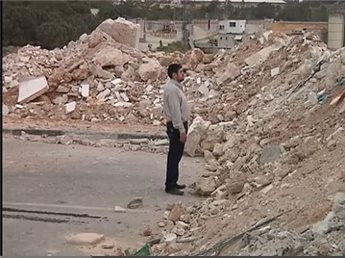 BETHLEHEM – Israeli forces have blocked the main entrances to a southern West Bank village since Saturday night, locals said, impeding villagers’ ability to travel freely.
Locals in the village of Beit Fajjar south of Bethlehem told Ma’an on Tuesday that Israeli forces had shut the roads in and out of the village by constructing large earth mounds on them.
Locals said that they were unsure of the reasons behind what they called the “collective punishment” of the village, highlighting that the Israeli authorities had cited security reasons without giving any explanation.
As a result of the closure, residents need to take bypass routes through the nearby al-Arrub refugee camp or Tuqu village. However, these routes are bumpy mountainous paths unqualified as roads.
The town has a population of about 15,000 many of whom leave every day to work outside. In addition, the town does not have a hospital or a major medical center, and so access to Bethlehem, about 10 kilometers to the north, is important for healthcare and emergencies.
The town is also known for stone factories and quarries, and the closure of the main road creates a serious problem for truck drivers who need to travel back and forth every day.
Furthermore, dozens of teachers who work at several public schools in the town come from other cities and village in Bethlehem district every day.
The Case of Amer Jubran
By Richard Hugus | May 11, 2014
Zionism is a system that chafes against the world. With its idea of a chosen people and its privileged control of states and institutions, where one whisper behind the scenes can outweigh the voice of millions, it offends us as an injustice. That injustice continues day in and day out for all the world to see in Palestine as occupation soldiers arrest even small children and shoot young demonstrators with impunity, as settlers burn olive trees and go on rampages of theft and harassment, and as settlers and soldiers together increase their attacks on the sacred buildings and grounds of the al-Aqsa mosque.
The idea that nothing is sacred seems to be at the front of Zionist ideology. This may be the motive for the terror we associate with it. We are stupefied by the brazenness of the repeated attacks on Lebanon, the bombings of Gaza, the rocket assassinations of Palestinian leaders, bulldozer and tear gas rifle murders of solidarity activists, the massacre of humanitarian volunteers on the Mavi Marmara, home demolitions, the killing of Palestinians in their own streets and on their own farmland. Perhaps this is the point — brazenness inspires fear, and fear inspires obedience. They seem to think that if you can sufficiently shock your enemy and the rest of the world, you have control. For people in the US, 9/11 would be the paradigm of this. Zionist planners Michael Ledeen and Philip Zelikow have defined covert US foreign policy by promoting the ideas of “creative chaos” and the power of “the searing event,” respectively, to establish a “new world order.”
But fear is not effective in the long run. We may immediately see through the act that tried to impose it, or, when we have had time to think, instead of being mystified, we are disgusted. As they say, the truth comes out; lies are hard to maintain. In the end perhaps this is because some things have remained sacred — human dignity, the right to live, the right to have a place to live, the innocence of children, the beauty of nature — and we remember that. Our feeling for these things is of a spiritual nature, and can’t ultimately be taken away by the aggressive and predatory weapons used by those who have power in the world.
Zionism chafes because each of the several million people it has expelled remember that they had a home in Palestine, and they know that to have that home back is their right. It is a constant irritant to the Arab people who have not yet been forced out, each of whom have a story to tell of wrongs committed against them during the nightmare occupation. After 67 years of attack and dispossession, Zionism has built up a long list of souls who have been wrongly treated and who have not forgotten.
This is the context in which one might understand the case of a Palestinian activist named Amer Jubran. The facts of Amer’s life are comprised of a number of wrongs attributable to Zionism. His family was forced to leave the area of al-Khalil in Palestine before he was born. They went into exile in Jordan. Amer’s grandfather was shot by an Israeli soldier in Palestine and left to bleed to death in the middle of a road. His relatives who remained in Palestine live under occupation and undergo each day the harassment and mistreatment which we all know now are the Israelis’ method of making all the rest of the indigenous people leave. At college age Amer chose a second country of exile – the United States. He may not have known then but he soon learned that he had moved to a country which Zionism had made its principal host (in the biological sense). He brought the cause of Palestine with him. In 2000 he was arrested for protesting an “Israel Day” celebration in a wealthy suburb of Boston. A long court struggle followed, and he was found not guilty. He was arrested again in 2002 during the Ashcroft-inspired attack on all Arabs and Muslims in the US, which Ashcroft waged through immigration authorities. This arrest followed two days after a march for Palestinian rights in the streets of downtown Boston which Amer helped to organize, and which had wide support. But one person whispered, and the deed was done. Another long court struggle followed. In 2004, unable to stand up against the stacked deck which is the US judicial system, he was forced to leave the US and return to Jordan.
In Jordan Amer began working at his family’s business and started a family, but continued to raise the cause of Palestine. In 2006 he was beaten and arrested at a protest at the Zionist embassy in Amman. In 2010 he gave a lecture at the American University in Beirut and was under noticeable surveillance both leaving and returning to Amman. Just a few days ago, May 5, 2014 he was arrested at his home in Amman by the Jordanian secret police, the Mukhabarat, and has since been held in an unknown location with no charges and no representation by a lawyer. No one is able to reach him. His most recent arrest is due to his being a supporter of the resistance to the Zionist project in the entire region. Where Zionism is concerned, it is no different in Jordan than in the United States. Zionism is indeed a world movement. Politically motivated police and judicial harassment of critics of Zionism can be found on every continent.
It is amazing that so many power structures in so many parts of the world have been so thoroughly invaded that a relatively few people could steal the relatively small piece of land which is historic Palestine. But there it is. And there is the constant irritation which this theft has brought about in the world. The irritation will not go away until the injustice is addressed. It will chafe and spring up in odd places forever until the truth is able to come out.
Richard Hugus is a Palestine solidarity activist who worked with Amer Jubran from 2002-2003 in The New England Committee to Defend Palestine
~~~~~~~~~~~~~~~~~~~
Additional information on the case of Amer Jubran can be found here.
400 US mercenaries ‘deployed on ground’ in Ukraine military op
RT | May 11, 2014
About 400 elite mercenaries from the notorious US private security firm Academi (formerly Blackwater) are taking part in the Ukrainian military operation against anti-government protesters in southeastern regions of the country, German media reports.
The Bild am Sonntag newspaper, citing a source in intelligence circles, wrote Sunday that Academi employees are involved in the Kiev military crackdown on pro-autonomy activists near the town of Slavyansk, in the Donetsk region.
On April 29, German Intelligence Service (BND) informed Chancellor Angela Merkel’s government about the mercenaries’ participation in the operation, the paper said, RIA Novosti reported. It is not clear who commands the private military contractors and pays for their services, however.
In March, media reports appeared suggesting that the coup-imposed government in Kiev could have employed up to 300 mercenaries. That was before the new government launched a military operation against anti-Maidan activists, or “terrorists” as Kiev put it, in southeast Ukraine.
At the time, the Russian Foreign Ministry said then that reports claiming Kiev was planning to “involve staff from foreign military companies to ‘ensure the rule of law,” could suggest that it wanted “to suppress civil protests and dissatisfaction.”
In particular, Greystone Limited, which is currently registered in Barbados and is a part of Academi Corporation, is a candidate for such a gendarme role. It is a similar and probably an affiliated structure of the Blackwater private army, whose staff have been accused of cruel and systematic violations of human rights in various trouble spots on many occasions.
“Among the candidates for the role of gendarme is the Barbados-registered company Greystone Limited, which is integrated with the Academi corporation,” the Foreign Ministry said in a statement. “It is an analogue, and, probably and affiliated body of the Blackwater private army, whose employees have repeatedly been accused of committing grievous and systematic human rights abuses in different troubled regions.”
Allegations increased further after unverified videos appeared on YouTube of unidentified armed men in the streets of Donetsk, the capital of the country’s industrial and coal mining region. In those videos, onlookers can be heard shouting “Mercenaries!”“Blackwater!,” and “Who are you going to shoot at?”
Academi denied its involvement in Ukraine, claiming on its website that “rumors” were posted by “some irresponsible bloggers and online reporters.”
“Such unfounded statements combined with the lack of factual reporting to support them and the lack of context about the company, are nothing more than sensationalistic efforts to create hysteria and headlines in times of genuine crisis,” the US firm stated.
The American security company Blackwater gained worldwide notoriety for the substantial role it played in the Iraq war as a contractor for the US government. In recent years it has changed its name twice – in 2009 it was renamed Xe Services and in 2011 it got its current name, Academi.
The firm became infamous for the alleged September 16, 2007 killing of 17 Iraqi civilians in Baghdad. The attack, which saw 20 others wounded, was allegedly without justification and in violation of deadly-force rules that pertained to American security contractors in Iraq at the time. Between 2005 and September 2007, Blackwater security guards were involved in at least 195 shooting incidents in Iraq and fired first in 163 of those cases, a Congressional report said at the time.
Clearing the plains
Book review by Paul Burrows • Briarpatch Magazine • March 10, 2014
In the context of a Canadian popular imagination still permeated by myths about heroic voyageurs, intrepid Mounties, and an inexorable yet ostensibly “peaceful” and “lawful” acquisition of other peoples’ lands, James Daschuk’s Clearing the Plains is a vital intervention. Described by historian Elizabeth A. Fenn as a “tour de force that dismantles and destroys the view that Canada has a special claim to humanity in its treatment of Indigenous peoples,” Daschuk’s study of Indigenous health and disease on the Canadian Prairies draws on decades of research to recount Canada’s policies of forced starvation and ethnic cleansing. More broadly, it’s a good introduction to the history of Canadian expansion into the northwest and the nature and evolution of Canadian Indian policy in the 19th century.
Research for Clearing the Plains began some 20 years ago as part of Daschuk’s doctoral program in history at the University of Manitoba under the supervision of D.N. Sprague. Sprague was himself a scholar of Canadian and Métis history, perhaps best known for his lengthy feud with Tom Flanagan over interpretations about Louis Riel, presumptions of government “benevolence,” and the causes of Métis dispossession in the Red River valley. Like Sprague’s own work, Canada and the Métis (1988), Clearing the Plains finds little evidence of Dominion “benevolence” in its annexation of the Canadian northwest or in its post-Confederation dealings with First Nations.
However, Daschuk’s is also a work of environmental and epidemiological history. As such, he argues that human agency, greed, and colonial power are “only half of the story.” In his view, the field of biology is equally important to understanding Indigenous history, not just in present-day Canada but also throughout the hemisphere. Much of what follows is an attempt to strike a balance between these two sides of causation, with Daschuk see-sawing between a portrait of epidemic disease as an inexorable, objective, even organic force, and a counter-portrait that emphasizes the social determinants and policy-induced nature of compromised immunity, disease outbreaks, and death.
The historical scope of Clearing the Plains is sweeping. The book opens with an assessment of pre-European health and well-being on the northern Great Plains, then concentrates on the impact of the fur trade era and nascent European settlement, and ends with the post-Confederation treaty era and the “nadir of indigenous health” in the wake of the Northwest Resistance of 1885. Throughout the book, Daschuk emphasizes the relationships between Indigenous health, outbreaks of epidemic diseases, and environmental factors, as well as settlement expansion, settler ideology, and most crucially, Indian policy. In this regard, Clearing the Plains joins a growing body of historical work examining the social determinants of health and, in particular, the relationship between Indigenous health and Canadian policy.
Overall, Daschuk’s book is important less for unearthing new and surprising historical facts than for expanding upon, reinterpreting, and publicizing them. For example, one of the central theses of Clearing the Plains is that famine was a deliberate policy weapon used to coerce “unco-operative Indians” onto reserves and remove them from lands coveted by white settlers. This isn’t a revelation for anyone familiar with existing scholarship. In his influential 1983 article, “Canada’s Subjugation of the Plains Cree,” John Tobias persuasively demonstrated that starvation was a weapon used to impose the reservation system, bring “recalcitrant” leaders such as Big Bear to heel, and force the Cree to capitulate to treaty terms. Clearing the Plains not only expands on such themes, bringing to light further evidence and examples, but its publication has made them accessible to a much wider public.
Daschuk’s interpretive framework sheds the congratulatory and smug self-image that still dominates in much Canadian historical writing. He is unafraid, for example, to label the settler-colonial process in southern Saskatchewan “ethnic cleansing,” and elsewhere he has described the foundation of modern Canada as resting upon the twin truths of “ethnic cleansing and genocide.” Those wanting a crash course in Prairie colonial history would do well to read Daschuk’s book alongside Sarah Carter’s Aboriginal People and Colonizers of Western Canada to 1900 (University of Toronto Press, 1999). Both books are carefully empirical but rooted in a deep commitment to social justice. Together, they serve as excellent points of departure for further research into colonial policy in the Canadian Prairie provinces.
Paul Burrows is a Winnipeg-based writer, researcher, and parent. A lifelong activist, he co-founded the Winnipeg A-Zone (Emma Goldman Building) in 1995 and is currently finishing a PhD in history related to Treaty 1 Territory and settler-colonialism.

By James Daschuk
University of Regina Press, 2013
Kiev’s armored vehicles attack village near Lugansk – self-defense forces
RT | May 11, 2014
The village of Novoaydar in the Lugansk region is being attacked by Ukrainian troops, according to the local self-defense leader.
“Around 15 APCs have come near Novoaydar,” Aleksey Chmilenko said. “Our self-defense guards are trying to stop the attack and prevent the vehicles moving farther in the direction of Lugansk.”
Meanwhile, representatives of another Lugansk region self-defense group, based in Krasny Luch, told RT that they have seen APCs in the region, but have not heard any fighting yet.
Reports of sightings of Ukrainian APCs in various towns and villages in the Lugansk region have been coming in throughout the day. One report said that as many as 45 APCs were moving from the Kharkov region in the direction of Lugansk.
Novoaydar election commission was reportedly evacuated by self-defense activists, after it had been attacked by National Guard troops.
Earlier in the day, shooting and artillery fire was heard on the outskirts of Slavyansk, in southeast Ukraine’s Donetsk region, RIA Novosti reported, citing its correspondent in the area.
There have also been reports of a military operation going on in the town of Krasny Liman, Donetsk region. Those emerged after communication was lost with two territorial self-determination referendum committees there, according to the head of the Central Election Commission of the self-proclaimed “Donetsk People’s Republic,” Roman Lyagin.
On Sunday, Donetsk and Lugansk regions opened polling stations for a referendum seeking autonomy from the central government. Local self-defense forces boosted security, fearing that Kiev could stage provocations to disrupt the self-determination vote.
Voting in four towns across Lugansk region has been disrupted, as military vehicles block passage to polling stations, representatives of referendum coordination council told Interfax.
“In four districts – Belokurakinsky, Svatovsky, Troitsky and Melovsky – APCs of the Ukrainian National Guard do not let residents pass to the referendum polling stations,” the sources said.
In total, two helicopters, 10 APCs and 100 National Guard troops are currently engaged in attempts at disrupting the referendum in the Lugansk region, according to deputy head of the Krasnoluchsky district referendum commission, Elena Khryapina. She says that turn-out is high despite the tense situation.
Meanwhile, the acting head of Ukraine’s presidential administration, Sergey Pashinsky, said Kiev’s military operation in the Donetsk region towns of Krasny Liman, Slavyansk and Kramatorsk was in its its final stage, adding that “a lot of separatists have been eliminated during the operation.” He would not provide any figures though.
Lugansk and Donetsk regions vote for self-determination
RT | May 11, 2014
The referendum is in full swing in Ukraine’s Donetsk and Lugansk regions, seeking independence from the central government. Local self-defense forces boosted security, fearing that Kiev could stage provocations to disrupt the self-determination vote.
Turnout at the referendum is exceptionally high, the head of the Central Election Commission of the self-proclaimed “Donetsk People’s Republic,” Roman Lyagin, told Interfax.
“The turnout is not just high, it’s off the charts,” Lyagin said. “People are queuing up at polling stations, and election commissions are working at full capacity.”
In Lugansk, 22 percent of eligible voters cast their ballots two hours after the polls opened, a leader of the city’s self-defense forces, Vasily Nikitin, told RIA Novosti.
In Mariupol, recovering from Friday’s deadly clashes, only eight polling stations have been opened, according to the coordinator of the central election commission of the “Donetsk People’s Republic”, Boris Litvinov. Those willing to vote have to wait for their turn in huge queues.
Almost simultaneously with the opening of polling stations, sounds of shooting and artillery fire were heard on the outskirts of Slavyansk, in southeast Ukraine’s Donetsk region, RIA Novosti reported, citing its correspondent in the area.
Slavyansk already witnessed mortar shelling of its outskirts by Ukrainian forces on the eve of the referendum. In the embattled city the stations will close at 15:00 GMT for security reasons.
Some 1,471 polling stations in Lugansk region and around 1,500 in Donetsk region opened their doors for voters at 8:00 local time (5:00 GMT) and will close at 22:00 (19:00 GMT). Security has been tightened around them.
“We sent additional self-defense units to polling stations and also to the most important social institutions,” a Lugansk self-defense leader, Aleksey Chmilenko, told Interfax. “So far everything is normal, there are no incidents.”
RT’s Paula Slier, currently in Donetsk, reports that Roman Lyagin, chair of the central election commission in the region, believes that a provocation has been planned and says that anti-government activists are ready for it.
An attempt at provocation was registered in Lugansk, where a group of people tried to take away ballot papers from voters, a representative of the city’s self-defense forces, Vasily Nikitin, told RIA Novosti. He said the attempt to disrupt voting was foiled and the incident is being investigated.
Citizens of the two southeastern regions of Ukraine are being asked if they “support the Act of state self-rule” of Donetsk People’s Republic or Lugansk People’s Republic. The election commission officials explained that the people are not choosing between staying within Ukraine and joining Russia, as widely reported, but instead are asked to support regions’ right for political self-determination.
Over 3 million ballot papers were printed for Donetsk region. All in all, the organizers spent about 20,000 hryvnas preparing for the vote in Ukraine’s industrial region, the heart of the country’s coal-mining. “The referendum will be considered valid whatever voter turnout will be,” Roman Lyagin, the head Donetsk election commission told reporters on Saturday.
In Donetsk, western observers are not present at the polling stations, commission officials said, as nobody expressed willingness to oversee the vote in the turbulent region. “We did not refuse anyone, there were no applications,” Lyagin said, adding though that over 470 international journalists are accredited in Donetsk.
Some 30 international observers are monitoring the voting in Lugansk region, where some 1.8 million are expected to take part in the referendum. “According to a survey, 83% of Lugansk residents are ready to support the Act of state self-rule of the People’s Republic of Lugansk,” said Igor Shakhov, the head of the local election commission.
Security measures have been increased on the day of the historic vote with self-defense units in both regions preparing to thwart any attempt by Kiev’s military and paramilitary forces to disrupt the vote and prevent provocations by radicals at the polling stations.
The referendums, announced back in March, are going ahead as planned despite Russian President Putin’s call on pro-federalization activists to postpone them due to the deteriorating and unpredictable security situation in Ukraine.
The Kiev government as well as many western countries, including the US, France and Germany are calling the referendums “illegal” and urge dialogue between all conflicting parties in Ukraine, at the same time showing no readiness to stop the punitive military operation in the east of the country.
If a majority of voters answer “yes” on Sunday the regions will gain full moral right to officially state they do not accept what is happening in the country, anti-coup protesters say. The combined population of Donetsk and Lugansk industrial regions, rejecting the legitimacy of the coup-installed Kiev authorities, stands at about 6.7 million in a country of 45 million.

U.S. Bill Proposing Sanctions on Venezuela Passes House Foreign Affairs Committee
By Z.C. Dutka | Venezuelanalysis | May 9, 2014
Santa Elena de Uairen – A Human Rights bill proposed by Florida Republican Congresswoman Ileana Ros-Lehtinen, which includes sanctions on the Venezuelan government, cleared its first legislative hurdle this morning after passing the House Foreign Affairs Committee.
Individual Sanctions
The bill, known as the Venezuelan Liberty and Democratic Solidarity Act, will sanction individuals responsible for “serious human rights abuses” against those participating in the anti-government protests that have received widespread media attention since February. It also includes those individuals who have supported those acts, whether financially or otherwise, and those officials who called for the arrest of those “legitimately exercising their freedom of expression and assembly.”
The most recent draft presented to the Committee listed asset blocking and inadmissibility to the US as types of individual sanctions. It also included the possibility of a presidential waiver of the application of sanctions, if the U.S. president should consider national security interests call for it, or conditions in Venezuela have improved.
Democracy Promotion
Section 7 of the bill outlines a “Comprehensive Strategy to Promote Internet Freedom and Access to Information,” including the expansion of activities to “train HR, civil society, and democracy activists” and the expansion of proxy servers for said activists, as well as access to “uncensored news sources.”
Section 8 asks that US Secretary of State, John Kerry, submit a “comprehensive strategy outlining how the US is supporting the citizens of Venezuela” in seeking basic civil liberties, development of an independent civil society, and free and transparent elections.
Section 9 offers refugee status or political asylum in the US to Venezuelan political dissidents if requested, and a direct effort on behalf of the US state department to identify cases of “prisoners of conscience and HR abuses in Venezuela.”
The bill ends with Section 10, the Authorization of Appropriations for Assistance to Support Civil Society in Venezuela, which pledges a minimum of $5 million through USAID, and finally, a Sunset Clause of two years after the date of enactment of the legislation.
Response
Venezuelan president Nicolas Maduro has accused possible sanctions of being “encouragement to extremist groups,” those protestors who he believes have sparked violence in their widespread call for regime change. Members of the Venezuelan opposition coalition, the Democratic Unity Roundtable (MUD), have also expressed their misgivings at the prospect of sanctions.
This morning Roberta Jacobson, Assistant Secretary of State for Western Hemisphere Affairs, heard testimonies from Venezuelan opposition representatives regarding the alleged use of extreme force on behalf of Venezuelan security forces. She admitted to hearing a “diversity of opinions,” from “different oppositional factions” but that the majority asked that the U.S. not impose sanctions “yet.”
“They have asked us not to introduce sanctions at this time,” Jacobson said.
A caravan of Venezuelans, residents of South Florida, traveled to Washington D.C. yesterday to show support for the bill.
Only two committee representatives, Gregory Meeks and Karen Bass, voted against the bill this morning. In recent weeks, many Latin American leaders have expressed their distaste for the possibility of US interference in Venezuela.
Uruguayan president Pepe Mujica said, “When the entire world asks the U.S. to shelve its economic blockade policy against Cuba, voices emerge from within that government threatening sanctions against Venezuela. Are the lessons of history never learned? (…) the first thing that Venezuela and all of Latin America need is to be respected.”
Many sources believe the bill will reach the House floor the week of May 12th, and will likely be approved with little resistance. A number of organizations, including the Alliance for Global Justice, have organized petitions in attempts to prevent this from taking place.
Venezuelan Policeman Killed by Sniper While Clearing Protest Barricade in Caracas
By Z.C. Dutka | Venezuelanalysis | May 9, 2014
Santa Elena de Uairen – In the early hours of Thursday morning, Jorge Tovar, 24, a Venezuelan national police officer was shot dead in the neck by a sniper, according to official sources. The shooting occurred as police attempted to clear an encampment that blocked traffic set up by hardline anti-government protestors, or guarimberos, in the upperclass neighborhood of Los Palos Grandes, in eastern Caracas.
Injuries were sustained on both sides as protestors clashed with security forces. Two other police officers suffered bullet wounds, albeit nonfatal, allegedly by the same sniper. Justice Minister Miguel Rodriguez Torres reported that police have evidence of where the shots were fired shot from, but the shooter’s identity remains unknown, while a full investigation is being launched.
The police and national guard had organized that morning with the intention of clearing out the four remaining barricades in the Eastern area of Caracas.
Minister Torres said it was imperative these four guarimba camps be eliminated, “given the evidence that it was from these places that the most violent terrorist acts were committed: the torching of Metro trains and police vehicles, confrontations with molotovs and weapons against security forces.”
Some 243 barricaders were apprehended for questioning, although 12 were released hours later due to their juvenile status. A variety of weapons, including guns and homemade bombs, as well as illegal drugs, were found among protestors.
Among the arrested was a young man responsible for the burning of a National Guard vehicle, according to Rodriguez.
Later that day, near the scene of Tovar’s death, more hardline protestors attacked the Public Fund for Micro Finance Development (Fondemi) with explosives and stones.
Yesterday Venezuelan president Nicolas Maduro pledged a medal of bravery to the bus driver, Jonathon Jimenez, whose bus was assaulted by protestors wielding molotov cocktails last week. Jimenez still remains in the hospital with severe burns.
“Can it be called protest to throw a molotov at a worker? That’s something we should reflect on,” said Maduro yesterday afternoon.
Another worker, Victor Yajure, of the United Socialist Party (PSUV), was kidnapped by unknown assailants in front of his home in Iribarren, Lara state. According to those who reported the crime, Yajure was previously aware of a plot designed by anti-government student protestors to frame him for arson of the local university.
Colleagues of Yajure are convinced the kidnapping had political motives, and condemn oppositional governor Henry Falcon of “abetting violent acts” by permitting the protestors to “control the area” for three months, under the alleged protection of local police.
Featured Video
Daniel Davis: U.S. Military Options & War Narrative Collapse
or go to
Aletho News Archives – Video-Images
Book Excerpt
US Axis of Aggression in Gulf
By Finian Cunningham | Strategic Culture Foundation | August 15, 2019
When Washington announced a few weeks ago the formation of a maritime “international coalition” to “protect shipping” in the Persian Gulf, many observers were skeptical. Now skepticism has rightly turned to alarm, as the proposed US-led “coalition” transpires to comprise a grand total of just three nations: the US, Britain and Israel.
The term “coalition” has always been a weasel word used by Washington to give its military operations around the world a veneer of international consensus and moral authority. If the US goes ahead with deploying forces in the Persian Gulf the guise of “coalition” is threadbare. It will be seen for what it is: naked aggression.
Iran promptly warned that if the US, Britain and Israel move on their intention to deploy in the Persian Gulf, it will not hesitate to defend itself from a “clear threat”. … continue
Blog Roll
 Aletho News
- Washington’s War on Cuba Is Older Than You Think
- Daniel Davis: U.S. Military Options & War Narrative Collapse
- Protesters call on Brussels university to cut partnership with Israeli defense-linked firm
- Weapons makers cash in on Trump’s Iran war
- Why Trump’s anti-Iran naval coalition in Strait of Hormuz is doomed to fail
- IRGC says regional energy sites linked to US will be reduced to ashes
- Qatar condemns ‘dangerous’ Israeli attack on gas field
- Iran made ‘unexpectedly substantial’ offer during Geneva talks, US envoys ‘dragged’ Trump into war: Report
- Russia condemns Israel’s attack near Bushehr plant, files complaint
- Russia Strongly Condemns Actions Aimed at Harming Health of Iranian Leadership – Kremlin
- If Americans Knew
- How ignorance, misunderstanding and obfuscation ended Iran nuclear talks
- Israeli media reports grotesque settler attack in West Bank
- UK security adviser attended US-Iran talks and judged deal was within reach
- Tucker Carlson says ‘neocons’ will try to destroy Joe Kent over resignation
- Lebanon death toll exceeds 900, another assassination in Iran, bombing in Gaza – Not a ceasefire Day 159
- Trump’s counterterrorism chief, whose own wife was killed by ISIS, quits over Iran War saying Tehran posed ‘no imminent threat’
- Here’s what US could fund instead of Bibi’s war on Iran
- Israel Killed Over a Dozen Lebanese Paramedics in Three Days, Now Claiming That Ambulances Are “Hezbollah” Targets
- War on Iran: These are the heritage sites devastated by US and Israeli attacks
- Four news stories from Israeli media that illustrate Israeli “justice”
- No Tricks Zone
- Energy Expert: Germany’s Nuclear Phaseout Was A “500 Billion Euro Mistake”
- New Research: South Australia’s Mid-Holocene Sea Surface Temperatures Were 4°C Warmer Than Today
- Storing Green Energy To Last Germany 10 Days Would Require A 60-Million Tonne Battery
- New Studies: UK Sea Levels Were 4 Meters Higher Than Today During The Mid-Holocene
- Destructive Green New Deal: German Energy And Metal Group Warns Of Drastic Crisis
- New Study Documents A 20-Year Pause In Arctic Sea Ice Decline – Driven By Internal Variability
- Wake-up Call: Survey Shows Majority Of Germans Now Favor Postponing Climate Targets!
- Televised! Leading German Political Candidate Tells Schoolchildren CO2 Makes Sun Hotter!
- New Study: A Century Warming Of 1.1°C Is ‘Commonplace’ And ‘Not Unusual’ During This Interglacial
- New Study: ‘Internal Noise’ And Volcanic Forcing Can Trigger 10-15°C Warming Within Decades
 Aletho News